Hertz, Marconi and the Invention of Radio
Between 1886 and 1888, in a lecture room at the Technical University of Karlsruhe, the physicist Heinrich Hertz made electric sparks jump across a small gap in one circuit and detected their effect as tiny sparks in a separate loop of wire several metres away. He showed that the disturbance travelled through space as a wave, that it could be reflected, refracted and polarised like light, and that it moved at about the speed of light. In doing so he confirmed the prediction made by James Clerk Maxwell some twenty years earlier that light was one member of a much larger family of electromagnetic waves. Hertz regarded the waves as a scientific result with no practical use. Within a decade a young Italian, Guglielmo Marconi, had turned them into a commercial system of telegraphy without wires, and in December 1901 he announced that signals sent from Cornwall had been received in Newfoundland. This article follows the path from Maxwell’s equations to Hertz’s experiments, through the work of the physicists and inventors who made the waves detectable at a distance, to Marconi’s wireless telegraph and the beginnings of radio broadcasting.
Maxwell’s Prediction
In 1831 Michael Faraday had shown that a changing magnetic field produces an electric current in a nearby conductor, and he had described electric and magnetic effects in terms of lines of force filling the space around charges, magnets and currents. In a series of papers between 1855 and 1865, culminating in “A Dynamical Theory of the Electromagnetic Field”, James Clerk Maxwell gave mathematical form to Faraday’s ideas. His equations described how electric and magnetic fields are produced by charges and currents and how each field, when it changes, produces the other. A crucial addition of his own was the term he called the displacement current, which allowed a changing electric field in empty space or in an insulator to act as a source of magnetic field in the same way as a current in a wire.
The consequence was striking. If a changing electric field produces a magnetic field, and a changing magnetic field produces an electric field, then a disturbance in one can sustain itself by continually regenerating the other, and the pair can travel away from their source through empty space. Maxwell calculated the speed of such waves from the ratio of the electromagnetic and electrostatic units of charge, a quantity that had been measured by Wilhelm Weber and Rudolf Kohlrausch in 1856, and found it very close to the speed of light as measured by Armand Fizeau and Léon Foucault. “We can scarcely avoid the inference,” he wrote in 1862, “that light consists in the transverse undulations of the same medium which is the cause of electric and magnetic phenomena.” In his Treatise on Electricity and Magnetism of 1873 he set out the theory in full.
The theory was accepted slowly. It was mathematically difficult, Maxwell’s own presentation was hard to follow, and on the Continent most physicists preferred theories of action at a distance, developed by Weber, Franz Neumann and Hermann von Helmholtz, in which forces between charges and currents acted directly across space. The decisive test would be to produce electromagnetic waves by electrical means and detect them, but the frequencies involved were far higher than any that could be produced with ordinary alternating currents, and there was no obvious way to detect a wave if one were produced. In Britain, George Francis FitzGerald in Dublin suggested in 1883 that the rapidly oscillating discharge of a Leyden jar might radiate such waves, and the self-taught English physicist Oliver Heaviside and others worked to put Maxwell’s theory into a simpler form. But it was in Germany that the experiment was done.
Hertz in Karlsruhe
Heinrich Rudolf Hertz was born in Hamburg on 22 February 1857 into a prosperous family; his father was a lawyer and later a senator of the city. He began training as an engineer, then turned to physics and became a student and assistant of Helmholtz in Berlin, where he took his doctorate in 1880. In 1879 the Prussian Academy of Sciences, at Helmholtz’s suggestion, had offered a prize for experimental evidence on one of the questions at the heart of Maxwell’s theory: whether changing electric polarisation in an insulator produced magnetic effects. Hertz considered the problem and concluded that the effects would be too small to detect with the methods then available, but the question stayed with him. After a period as a lecturer at Kiel, he became professor of physics at the Technische Hochschule in Karlsruhe in 1885.
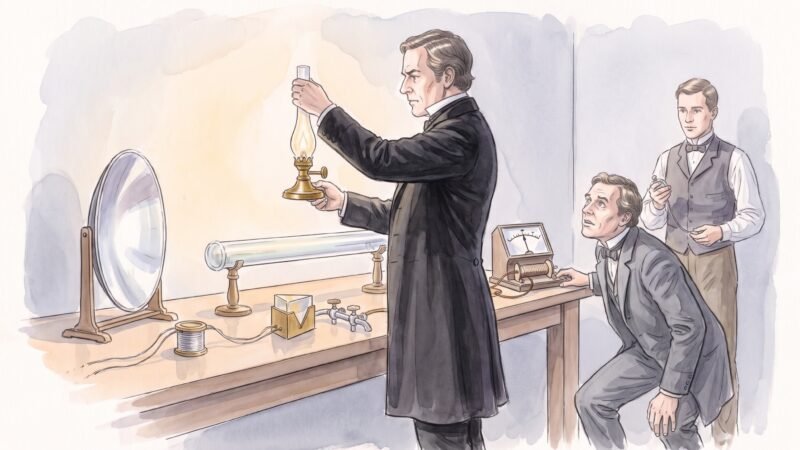
In the autumn of 1886, while demonstrating a pair of flat induction coils known as Riess or Knochenhauer spirals to his students, Hertz noticed that the discharge of a Leyden jar or an induction coil through one coil produced sparks in the other, even when the second coil was not connected to anything. The effect suggested that very rapid electrical oscillations were taking place. He began building apparatus to study them. His oscillator, or transmitter, consisted of two straight brass rods, each about a metre long, placed end to end with a small gap between two polished brass balls. At the outer ends of the rods he fixed large metal spheres or square plates, which acted as capacitors. The rods were connected to the secondary of a Ruhmkorff induction coil. Each time the coil charged the rods to a high voltage, a spark jumped across the gap. The spark made the air conducting for a brief instant, and the charge on the rods surged back and forth through it many times before the oscillation died away, at a frequency fixed by the size and shape of the rods and plates. For his first apparatus the frequency was of the order of a hundred million cycles a second, and the wavelength several metres.
The detector was simpler still: a loop of copper wire, bent into a circle or rectangle, with a tiny adjustable spark gap between a brass ball and a point. When the receiving loop was tuned to the right size and placed in the right orientation, minute sparks appeared in its gap each time the oscillator fired. They were so faint that Hertz had to watch them in a darkened room, sometimes through a magnifying glass. Using this loop he mapped the space around the oscillator, measuring how the sparks varied with distance and orientation.
The crucial experiments came in 1887 and 1888. He set up his oscillator at one end of a lecture hall about fifteen metres long and fixed a large sheet of zinc, four metres by two, to the wall at the other end. Waves reflected from the sheet interfered with the waves coming directly from the oscillator, setting up standing waves in the room, with fixed points of maximum and minimum effect. By moving the detector loop along the line between the oscillator and the sheet, Hertz located the nodes and measured the distance between them. Half that distance was half a wavelength. Knowing the frequency of the oscillator, which he calculated from the dimensions of the circuit, he could work out the speed of the waves. His figures were close to the speed of light, though an error in his calculation of the frequency, later corrected by Henri Poincaré, made some results discordant. He also showed that the waves were transverse and polarised: a grid of parallel wires let them through when the wires were at right angles to the oscillator and stopped them when the wires were parallel. Large concave mirrors of sheet zinc focused them into beams, and a prism of pitch about one and a half metres high, weighing over a tonne, refracted them as glass refracts light.
Hertz published his results in a series of papers in the Annalen der Physik between 1887 and 1890, collected in 1892 as Untersuchungen über die Ausbreitung der elektrischen Kraft, published in English as Electric Waves in 1893. In the course of the work he also noticed that the sparks in his detector jumped more readily when the gap was illuminated by ultraviolet light from the oscillator’s own spark, an observation now recognised as the first report of the photoelectric effect, which Einstein explained in 1905. The confirmation of electromagnetic waves settled the long dispute in favour of Maxwell’s field theory, and Hertz turned to reformulating Maxwell’s equations and to the foundations of mechanics. Asked by his students what use the waves might be, he is reported to have replied that they were of no use whatever, and that they simply showed that Maestro Maxwell was right. He died of an infection, probably granulomatosis with polyangiitis, at Bonn on 1 January 1894, at the age of thirty-six. The unit of frequency, the hertz, was named after him in 1930.
Making the Waves Detectable
Hertz’s detector was too insensitive to be used at more than a few metres. The step from a laboratory demonstration to a means of communication required a detector that could register very weak waves at a distance and do so reliably. The answer came from a curious effect that several experimenters had observed. Metal filings loosely packed in a tube offer high resistance to an electric current, but when an electric spark or an electromagnetic wave passes near them they cling together, and their resistance falls sharply.
The French physicist Édouard Branly, at the Institut Catholique in Paris, studied the effect systematically in 1890. He placed metal filings in a glass tube between two electrodes and connected it in series with a battery and a galvanometer. When a spark was made some distance away, the galvanometer showed a sudden current, and the filings remained conducting until the tube was tapped, when they fell apart and the resistance returned. Branly called the device a radioconductor. In 1894 Oliver Lodge, professor of physics at University College, Liverpool, who had himself come close to anticipating Hertz in experiments with waves along wires in 1888, gave a memorial lecture on Hertz at the Royal Institution in which he demonstrated the detection of waves with a filings tube, which he named the coherer. He added an automatic tapper, a small electric bell mechanism that knocked the tube after each signal to restore it. In a demonstration at the meeting of the British Association in Oxford in August 1894 he is said to have sent signals between two buildings about fifty metres apart, though accounts differ on whether the signals carried a message in Morse code. Lodge did not at first see the commercial possibilities. He later said that he had been too busy to pursue the idea of telegraphy.
In Russia, Alexander Popov, an instructor at the Torpedo School of the Russian Navy at Kronstadt, built a sensitive coherer receiver with an automatic tapper and connected it to a long vertical wire to detect the electromagnetic disturbances produced by distant thunderstorms. He described the instrument to the Russian Physical and Chemical Society in St Petersburg on 7 May 1895, a date celebrated in Russia as Radio Day. In 1896 he is reported to have demonstrated the transmission of signals between buildings of the university, though the details are disputed. In India, Jagadish Chandra Bose, professor of physics at Presidency College in Calcutta, worked with much shorter waves, of a few millimetres to centimetres, and in 1895 demonstrated their transmission through walls; he developed new detectors, including one based on a galena crystal, but he did not patent his work and was not interested in commercial telegraphy. In New Zealand and then at Cambridge, the young Ernest Rutherford developed a magnetic detector for Hertzian waves in 1894 and 1895 and received signals over a distance of more than half a mile, before turning to the study of radioactivity.
By the middle of the 1890s, then, the elements of a wireless telegraph existed in several laboratories: the spark transmitter, the coherer with its tapper, the use of Morse keys and relays from the wire telegraph, and the observation that long vertical wires could pick up atmospheric disturbances. What none of these physicists did was to combine them into a system designed for signalling over long distances and to set about making it work commercially.
Marconi’s Wireless Telegraph
Guglielmo Marconi was born in Bologna on 25 April 1874, the second son of Giuseppe Marconi, a wealthy landowner, and Annie Jameson, a member of the Irish whiskey-distilling family. He was educated largely at home and in Florence and Livorno, and he never attended a university, though he followed some lectures and had the informal guidance of Augusto Righi, professor of physics at Bologna, who was a neighbour and had published work on Hertzian waves. In the summer of 1894, at the age of twenty, Marconi read an obituary of Hertz and began experimenting in the attic of the family villa, the Villa Griffone at Pontecchio, near Bologna.
His early apparatus followed the established pattern. He used a spark transmitter of the type Righi had developed, with the spark taking place between brass balls immersed in oil, and a coherer receiver, which he improved by using a mixture of nickel and silver filings in a small evacuated glass tube with silver plugs, and by careful attention to the size of the gap and the fineness of the filings. His decisive change was to the aerials. In 1895 he connected one side of the transmitter’s spark gap to a metal plate or wire raised high on a pole and the other side to a plate buried in the ground, and did the same at the receiver. With this arrangement of an elevated aerial and an earth connection, the range of his signals increased dramatically. In the late summer of 1895 he sent signals from the villa to a point beyond a hill some two kilometres away, where his brother Alfonso, out of sight, fired a rifle to show that they had been received.
Marconi offered the invention to the Italian Ministry of Posts and Telegraphs, which was not interested. On the advice of his mother’s family he went to England in February 1896. His apparatus was damaged by customs officers at Dover, who suspected it, but he rebuilt it, and on 2 June 1896 he filed a provisional British patent for “Improvements in transmitting electrical impulses and signals, and in apparatus therefor”, the first patent for a system of wireless telegraphy based on Hertzian waves. With an introduction from his cousin, he was taken up by William Preece, engineer-in-chief of the Post Office, who had himself experimented with telegraphy by induction between parallel wires. Preece arranged demonstrations on the roof of the General Post Office in London and on Salisbury Plain, where in September 1896 Marconi sent signals over nearly three kilometres before observers from the Army and Navy, and in May 1897 across the Bristol Channel between Lavernock Point in Wales and the island of Flat Holm, about five kilometres, and then to Brean Down, about fourteen kilometres. Preece described the work in a lecture at the Royal Institution and Marconi became famous.
In July 1897 Marconi and a group of investors formed the Wireless Telegraph and Signal Company, renamed Marconi’s Wireless Telegraph Company in 1900. The company set up stations on the Isle of Wight and in Bournemouth, and in 1898 Marconi reported the Kingstown Regatta for the Dublin Daily Express from a tug, and set up a link between Queen Victoria at Osborne House and the royal yacht, on which the Prince of Wales was recovering from an injured knee. In March 1899 signals crossed the English Channel between South Foreland and Wimereux, near Boulogne. Later that year Marconi demonstrated his system to the United States Navy and reported the America’s Cup yacht races in New York.
A serious weakness of the early systems was that a spark transmitter radiated energy over a wide range of frequencies, and any receiver within range picked it up, so that several stations working at once interfered with one another and messages could be overheard. Lodge had patented a method of tuning transmitter and receiver to the same frequency in 1897, and Karl Ferdinand Braun in Strasbourg had developed coupled circuits that made the transmitter produce more sustained, narrow-band oscillations. Marconi’s patent of 26 April 1900, British patent number 7777, for “Improvements in apparatus for wireless telegraphy”, covered a system of tuned circuits in both transmitter and receiver, coupled through transformers, which allowed several stations to operate without interfering. The “four sevens” patent became central to the company’s position and to long litigation, and in 1943 the Supreme Court of the United States held that Marconi’s American equivalent was invalid in part because of the prior work of Lodge, Tesla and John Stone Stone.
Across the Atlantic
The accepted view among physicists was that, since electromagnetic waves travel in straight lines, the curvature of the Earth would limit wireless communication to distances of perhaps two hundred miles at most. Marconi, who was not a theorist, believed that with enough power and large enough aerials the waves would follow the surface of the Earth. In 1900 his company began to build a high-power station at Poldhu, on the coast of Cornwall near Mullion. The power plant and transmitter were designed by John Ambrose Fleming, professor of electrical engineering at University College London and a consultant to the company. Instead of the induction coils of the earlier sets, Fleming used a 25-kilowatt alternator driven by an oil engine, stepped up by transformers to charge a large bank of condensers, which discharged through a spark gap in two stages. The aerial was a circle of twenty masts, each about sixty metres high, supporting a cone of wires. A matching station was built at South Wellfleet on Cape Cod.
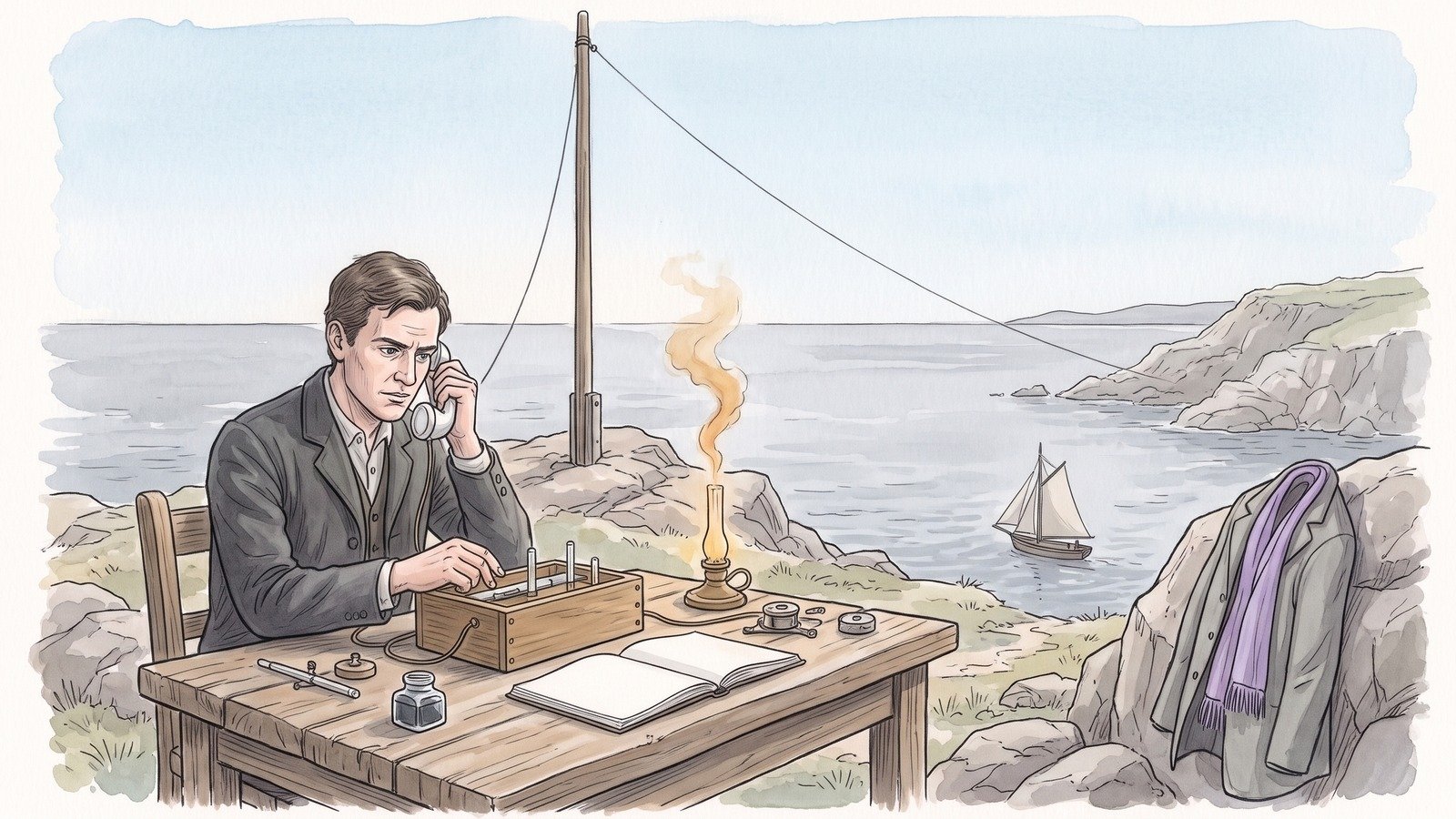
In September 1901 a gale destroyed the Poldhu masts, and in November the Cape Cod aerial also fell. Marconi replaced the Poldhu aerial with a temporary fan of wires suspended between two masts and, rather than wait for Cape Cod to be rebuilt, sailed with two assistants, George Kemp and Percy Paget, for St John’s, Newfoundland, with receiving equipment and kites and balloons to lift an aerial wire. They set up their receiver in a disused military hospital on Signal Hill above the harbour. A balloon broke away, and on 12 December they flew a kite carrying a copper wire about 150 metres long in a strong wind. The arrangement with Poldhu was that the station would send the Morse letter S, three dots, repeatedly for several hours each afternoon. Using a telephone earpiece and a detector of a newer type, a mercury coherer, Marconi reported that he heard the three faint clicks at about half past twelve local time, and Kemp heard them too. Further signals were reported that day and the next.
The claim was received with scepticism. No independent witness was present, the signals were faint and irregular and might have been confused with atmospheric noise, and the frequency at which Poldhu was transmitting, probably around 850 kilohertz, was one at which, according to later understanding, daytime transatlantic reception would have been very difficult. Thomas Edison and some other scientists doubted it. Marconi silenced most critics in February 1902, when, aboard the American liner Philadelphia sailing from Southampton to New York, he received messages from Poldhu at distances of up to 2,500 kilometres, recorded on paper tape by a Morse inker and countersigned by the ship’s officers. In December 1902 a station at Glace Bay in Nova Scotia transmitted the first complete messages from North America to Poldhu, and in January 1903 a greeting from President Theodore Roosevelt to King Edward VII was sent from South Wellfleet. A regular transatlantic commercial service between Clifden in Ireland and Glace Bay opened in October 1907. The reception at Signal Hill is now recognised as an IEEE Milestone.
The physics of the achievement was explained only later. In 1902 Arthur Kennelly in the United States and Oliver Heaviside in Britain independently suggested that a conducting layer in the upper atmosphere might reflect radio waves back to Earth, allowing them to travel around its curvature. The existence of this layer, the ionosphere, was confirmed experimentally in 1924 by Edward Appleton and Miles Barnett in Britain and by Gregory Breit and Merle Tuve in the United States. Marconi’s own later observations, that signals carried much further at night than by day, were among the clues that led to it.
Wireless at Sea
The first great market for wireless telegraphy was at sea, where no other means of communication existed. Navies adopted it rapidly; the Royal Navy signed an agreement with Marconi’s company in 1903, and wireless was used by both sides in the Russo-Japanese War of 1904 and 1905. The Marconi International Marine Communication Company, formed in 1900, supplied equipment and operators to merchant ships, and its policy of refusing to communicate with stations using rival equipment caused international friction until the Berlin conventions of 1906 required ships and coastal stations to exchange messages regardless of the system used. In January 1909 a wireless call for help from the liner Republic, sinking after a collision off Nantucket, brought ships that rescued almost everyone on board, and the operator, Jack Binns, became famous. In 1910 the murderer Hawley Harvey Crippen was arrested on arrival in Canada after the captain of the ship on which he was escaping recognised him and sent a wireless message to Scotland Yard.
The sinking of the Titanic on 15 April 1912 made the importance of wireless unmistakable. The ship’s Marconi operators, Jack Phillips and Harold Bride, sent distress calls that brought the Carpathia, which rescued the survivors, but the nearby Californian, whose only operator had gone to bed, did not hear them. The inquiries that followed led to the International Convention for the Safety of Life at Sea of 1914 and to rules requiring ships to carry wireless and to keep a continuous radio watch. Marconi himself had been due to sail on the Titanic but had taken an earlier ship.
Marconi and Braun shared the Nobel Prize in Physics for 1909 “in recognition of their contributions to the development of wireless telegraphy”. Braun had made the transmitter more efficient and selective by placing the spark gap in a separate circuit loosely coupled to the aerial, and he had also, in 1897, invented the cathode-ray oscilloscope tube that bears his name. It was unusual for the prize to recognise practical invention rather than scientific discovery, and the award to Marconi, who had no academic qualifications, was a sign of how far the technology had changed the world in a decade.
From Telegraphy to Telephony
Spark transmitters could send only the dots and dashes of Morse code, because each spark produced a train of damped oscillations that died away quickly. To transmit speech or music it was necessary to generate a continuous wave of steady amplitude and to vary, or modulate, that amplitude in step with the sound. The Canadian-born engineer Reginald Fessenden saw this clearly. Working at Brant Rock in Massachusetts, with a high-frequency alternator built for him by Ernst Alexanderson of General Electric, he is reported to have broadcast speech and music, including himself playing “O Holy Night” on the violin, to ships of the United Fruit Company on Christmas Eve 1906, although some historians have questioned whether that broadcast took place as later described. Fessenden also invented the heterodyne principle, in which the incoming signal is mixed with a locally generated oscillation to produce an audible beat note. Valdemar Poulsen in Denmark developed the arc transmitter, which produced continuous waves from an electric arc burning in hydrogen, and large arc and alternator stations dominated long-distance radiotelegraphy until about 1920.
The detectors changed too. The coherer was slow and unreliable. Marconi’s magnetic detector, introduced in 1902, was used widely on ships. Crystal detectors, using a fine wire in contact with a crystal of galena or carborundum, were introduced around 1906 by Greenleaf Whittier Pickard and Henry Dunwoody and made cheap receivers possible. In 1904 Fleming, looking for a more reliable detector for Marconi’s company, adapted an effect Edison had noticed in his light bulbs: a current would flow in a vacuum from a heated filament to a separate metal plate, but only in one direction. Fleming’s two-electrode thermionic valve rectified radio-frequency currents and so acted as a detector. In 1906 the American inventor Lee de Forest added a third electrode, a zigzag wire grid between filament and plate, creating the Audion. De Forest did not fully understand how it worked, and it was only around 1912 that he, Edwin Howard Armstrong and others found that a triode valve with a good vacuum could amplify weak signals, and that, fed back on itself, it could generate continuous oscillations. Armstrong’s regenerative circuit of 1912 and his superheterodyne receiver of 1918 became the basis of nearly all later radio receivers. The valve oscillator made the spark, the arc and the alternator obsolete within a decade.
With the valve, radio telephony became practical. During the First World War radio was used extensively by armies, navies and the new air forces, and large numbers of engineers and operators were trained. After the war amateur enthusiasts and companies began regular transmissions of speech and music to anyone who cared to listen. The Marconi company’s station at Chelmsford broadcast a concert by the soprano Nellie Melba on 15 June 1920. In the United States, the station KDKA of the Westinghouse company in Pittsburgh broadcast the results of the presidential election on 2 November 1920 and went on to transmit a regular schedule of programmes. In Britain the British Broadcasting Company, formed by a group of manufacturers including Marconi’s company, began transmitting in November 1922 and became the publicly owned British Broadcasting Corporation in 1927. Within a few years millions of households owned receivers. Marconi spent his later years experimenting with short waves, which carried over long distances with far less power than the long waves of the early stations, and with microwaves. He died in Rome on 20 July 1937, and on the day of his funeral radio stations around the world fell silent for two minutes.
The Question of Priority
Few inventions have produced as many rival claims as radio. In Russia, Popov has long been honoured as its inventor, on the strength of his receiver of 1895. In India, Bose’s work with millimetre waves and crystal detectors has been recognised as a pioneering contribution to microwave physics. In the United States, Nikola Tesla had described the wireless transmission of energy and signals in lectures in 1893 and filed patents in 1897 for tuned circuits for the transmission of electrical energy, and his supporters have argued that Marconi drew on them. In Britain, Lodge’s patent of 1897 on tuning anticipated an essential element of Marconi’s later system, and the Marconi company eventually bought it in 1911.
Much of the argument turns on what is meant by invention. Hertz demonstrated the waves; Branly, Lodge, Popov and others devised ways to detect them; Tesla, Lodge and Braun contributed the principles of tuning and efficient transmission. Marconi’s contribution was to combine these elements, to discover by persistent experiment that a raised aerial and an earth connection extended the range far beyond what physicists had expected, and to build a company that turned the technology into a working international service. The case decided by the Supreme Court of the United States in 1943, in a dispute between the Marconi company and the United States government over wartime use of radio, recognised the priority of others for certain features of tuning, but left Marconi’s achievement as the first to establish practical long-distance wireless telegraphy intact. Most historians now treat radio as the product of many contributors working in several countries over two decades, with Hertz and Marconi standing at the two ends of the story, the first for the science and the second for the system.
The Legacy of the Hertzian Wave
The idea that information could be carried through empty space by electromagnetic waves, without a connecting wire, underlies almost every form of modern communication. Radio waves were turned to broadcasting, to aircraft navigation and to radar before and during the Second World War, and to television. Satellites relay telephone calls and television signals and broadcast the timing signals used for navigation. The cellular telephone uses radio links between handsets and networks of base stations, a technology whose origins are described in the account of the first cell phone call, made in New York in April 1973, and in the history of the passage from mobile phones to smartphones. Local wireless networks carry data between computers and devices within a building, as described in the Wi-Fi engineering story, at frequencies of several gigahertz, far higher than anything Marconi used but close to the short centimetre waves Bose and Righi studied in the 1890s.
The physical principles have not changed since Hertz. A transmitter produces an oscillating current in an aerial, which radiates electromagnetic waves at the speed of light; a receiving aerial tuned to the same frequency picks up a tiny fraction of the energy; and the information is carried by varying some property of the wave. What has changed is the means of generating, controlling and detecting the waves, from the spark gap and the coherer to the valve and then the transistor and the integrated circuit, and the way information is encoded, from Morse code to amplitude and frequency modulation to the digital schemes used today. The story from Maxwell to Marconi also shows a pattern repeated many times since: a prediction made from abstract theory, confirmed by a laboratory experiment whose author saw no practical use for it, and then developed by an inventor with little interest in theory but a clear view of what the technology might do, into a system that changed the way people lived.
References
- Heinrich Hertz - Grokipedia, life and the Karlsruhe experiments on electromagnetic waves
- Heinrich Hertz - Engineering and Technology History Wiki, IEEE History Center
- James Clerk Maxwell - Grokipedia, the electromagnetic theory of light
- Guglielmo Marconi - Grokipedia, wireless telegraphy, the transatlantic signal and later work
- Guglielmo Marconi - Engineering and Technology History Wiki, IEEE History Center
- Guglielmo Marconi: Facts - NobelPrize.org, the Nobel Prize in Physics 1909
- Ferdinand Braun: Facts - NobelPrize.org, the Nobel Prize in Physics 1909
- Milestones: Transmission of Transatlantic Radio Signals, 1901 - Engineering and Technology History Wiki, IEEE
- Marconi Collection - History of Science Museum, University of Oxford
- Oliver Lodge - Grokipedia, the coherer and syntonic tuning
- Coherer - Grokipedia, Branly, Lodge, Popov and the early detectors
- Spark-gap transmitter - Grokipedia, the first generation of radio transmitters
- Reginald Fessenden - Grokipedia, continuous waves, modulation and the heterodyne
- Fleming valve - Grokipedia, the thermionic diode of 1904
- Nikola Tesla - Grokipedia, tuned circuits and wireless transmission
- Lee de Forest - Grokipedia, the Audion and the triode