The Discovery of X-rays by Wilhelm Conrad Rontgen in 1895
At a glance
The discovery of X-rays in November 1895 by the Würzburg physicist Wilhelm Conrad Röntgen was the first of the great wave of breakthroughs that opened twentieth-century physics. Within two months of the discovery, Röntgen had completed and published his first paper, taken the most famous medical image of the nineteenth century, and demonstrated that a new kind of radiation existed that could pass through the human body and cast shadows on a photographic plate. Within a year, the discovery had been taken up by hospitals, by military surgeons, and by physicists in laboratories across Europe and America. Within four years, Röntgen had received the first Nobel Prize in Physics. The discovery opened the way to the modern physics of the atom, to diagnostic radiology, to radiotherapy, and to the discovery of radioactivity itself.
When
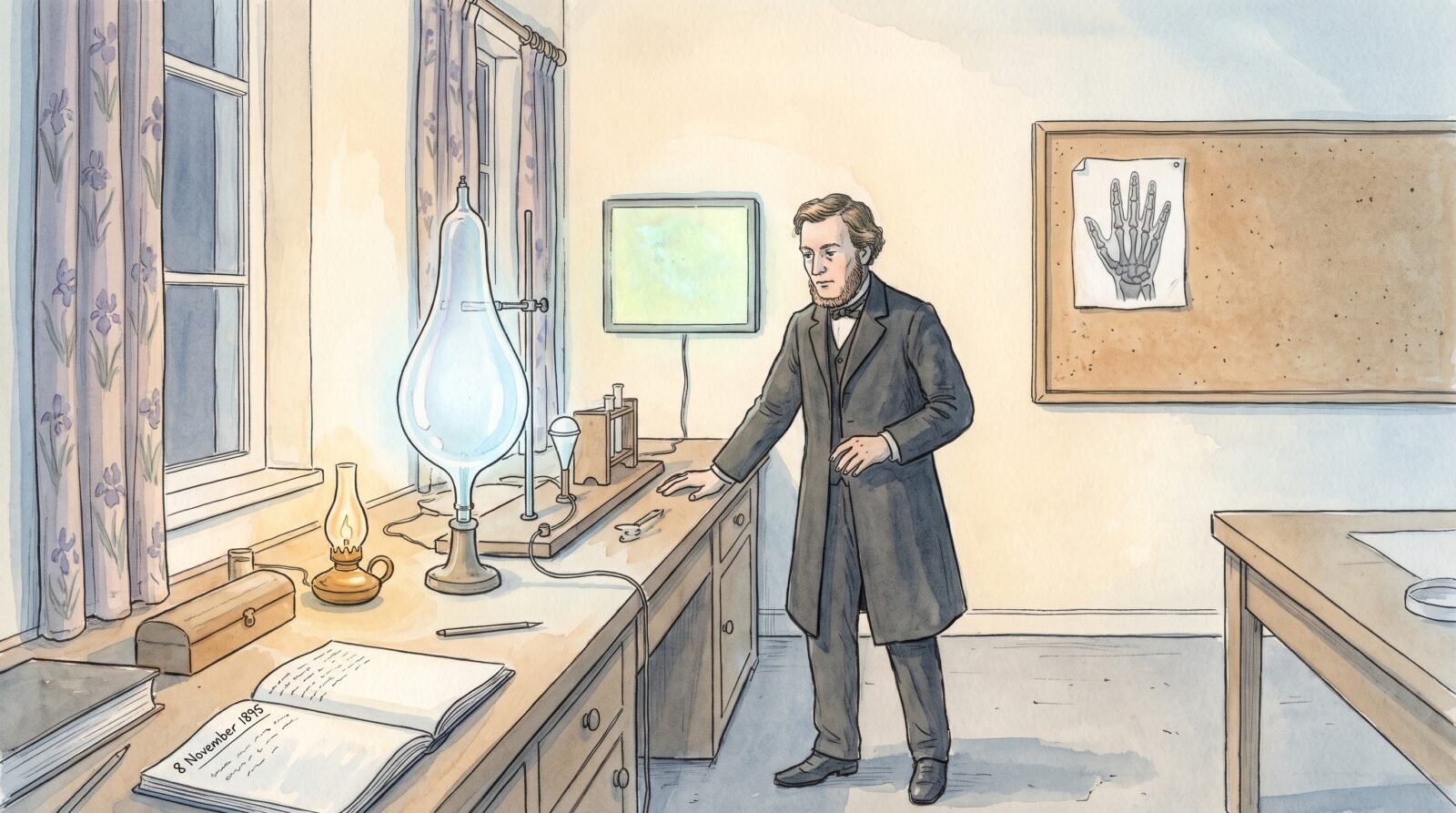
The discovery happened on the afternoon of Friday, 8 November 1895, in the Physical Institute of the University of Würzburg in Bavaria. Röntgen had been working in his laboratory with a Lenard tube, a Crookes tube modified to allow cathode rays to escape through a thin aluminium window, and a Crookes tube of the older design. He had been testing whether cathode rays, the streams of electrons observed in evacuated glass tubes when a high voltage was applied, could escape from the tube into the open air.
On 8 November, in the late afternoon, Röntgen covered a Crookes tube with black cardboard, applied the high voltage, and darkened the laboratory to see whether any light escaped from the cardboard cover. He noticed, instead, that a small piece of paper coated with barium platinocyanide, lying on a bench about a metre away from the tube, was glowing faintly with a greenish light. The barium platinocyanide was a fluorescent material that he had been using in earlier experiments, and it was clearly responding to something coming from the tube. The light he saw was the first observation of what he would soon call X-rays.
The discovery is one of the most carefully documented in the history of physics. Röntgen recorded it in his working notebook, and he later published a detailed account of the events of the next several weeks. He worked alone in his laboratory for most of the seven weeks between the discovery and the publication of his first paper. He did not tell his colleagues at Würzburg what he had found. He did not tell his own family. He worked late into the night, and he sometimes slept in the laboratory. He locked the laboratory door and kept the only key in his pocket.
On 28 December 1895, he deposited his paper, “On a New Kind of Rays” (Ueber eine neue Art von Strahlen), with the Proceedings of the Würzburg Physical-Medical Society. The paper was published on 31 December 1895, and it was sent to leading physicists across Europe on the same day. By the end of January 1896, the discovery had been reported in newspapers in Vienna, in Paris, in London, and in New York. Within a few weeks, the new rays had been given a name by the press: the X-rays, the unknown rays, the rays that Röntgen had named by writing for the unknown letter of the algebraic alphabet.
Where
The Physical Institute of the University of Würzburg was, in 1895, one of the most active centres of German experimental physics. The institute was housed in a new building on the Pleicher wall, near the old city. The director was the professor of experimental physics, and the position had been held for several decades by Wilhelm von Bezold, before being offered to Röntgen in 1888. The institute had a workshop for instrument making, a small library, and a series of laboratory rooms equipped with the latest electrical apparatus.
Röntgen had his own private laboratory on the upper floor of the institute building. The room was modest in size and was equipped with the apparatus he needed for his work on cathode rays. The Lenard tubes he had been working with were on a wooden bench, together with the induction coil that provided the high voltage, the rheostat, and the photographic plates that he used to record his experiments. The barium platinocyanide screen that he noticed on 8 November was on a separate bench, about a metre away.
Würzburg itself was a small university town in the Main valley of Bavaria. The university had been a major centre of science and medicine since the early modern period, and it had been one of the first German universities to establish a chair of experimental physics in the early nineteenth century. The university was small enough that the discovery of X-rays was reported almost immediately to the city and the region. The local newspaper of Würzburg carried an early account of the discovery, and the discovery was soon taken up by the press across Germany.
Who
Wilhelm Conrad Röntgen was born in 1845 in Lennep, in the lower Rhine region of Prussia. His family was a respectable merchant family of Dutch origin, and Röntgen grew up in the Netherlands, in Apeldoorn, where his family moved when he was a child. He was educated in the Netherlands and in Switzerland, and he studied mechanical engineering at the Federal Polytechnic in Zurich before completing his doctorate in physics at the University of Zurich in 1869.
Röntgen’s academic career was slow to develop. He worked as an assistant at the University of Zurich, then at the University of Giessen, and then at the University of Strasbourg. He was thirty-eight when he was finally appointed as a professor, at the University of Giessen, in 1879. He moved to the University of Würzburg in 1888, where he was appointed as director of the Physical Institute.
By the late 1880s, Röntgen had established himself as one of the leading experimental physicists of the German-speaking world. He was known for his careful work on the properties of liquids, on the thermodynamics of crystals, and on the electrical properties of matter. He was known, in particular, for his careful work on the relationship between electricity and the behaviour of materials, and his work on the conductivity of crystals was an important contribution to the physics of the solid state.
Röntgen was, by all contemporary accounts, a serious and reserved man. He had no children. He had married Anna Bertha Ludwig in 1872, and she was his companion for the rest of his life. Anna Bertha was the subject of the most famous medical image of the nineteenth century, the radiograph of the hand that Röntgen took on 22 December 1895. The image shows the bones of her hand, with a ring on her fourth finger, and it is one of the most reproduced scientific images of all time.
What
The discovery of X-rays was the discovery of a new kind of electromagnetic radiation. Röntgen’s paper of 28 December 1895 described the new rays in some detail. He observed that the rays were produced when cathode rays struck the glass wall of a Crookes tube, that they travelled in straight lines from the point of impact, that they could pass through a wide range of solid materials, that they could affect a photographic plate, that they could cause fluorescence in a wide range of materials, and that they were not deflected by magnetic fields.
Röntgen’s paper described the penetration of the new rays through different materials. He observed that the rays passed through paper, through a thick block of wood, through aluminium, through tinfoil, through thin sheets of lead, and through a wide range of other solids. He observed that the rays did not pass through thick sheets of lead or through a thick layer of mercury. He observed that the rays could be used to take photographs of the bones of the hand, and he described the radiograph of his wife’s hand as evidence of the practical significance of the new rays.
The paper was also careful about what it did not claim. Röntgen did not claim to have identified the new rays with any previously known form of radiation. He did not claim to have explained the origin of the new rays. He did not claim to have measured the wavelength of the new rays. He wrote that the new rays might be a kind of longitudinal vibration of the ether, but he noted that this was a speculation. The empirical content of the paper was the description of the experiments and the observation of the behaviour of the new rays.
Penetration, fluorescence, and photographic effect
The three defining properties of X-rays, as described in Röntgen’s paper, were penetration, fluorescence, and photographic effect. The penetration of the new rays was their most striking property. Röntgen observed that the rays passed through paper, through cloth, through leather, through wood, and through thin sheets of metal. He observed that the rays did not pass through thick layers of dense metal. He observed that the rays passed through the human hand and cast shadows of the bones.
The fluorescence of the new rays was the property that had allowed Röntgen to discover them. Barium platinocyanide, the material he noticed glowing on 8 November 1895, was one of the materials that fluoresce when struck by X-rays. Other materials, including calcium tungstate, zinc sulphide, and a range of other salts, also fluoresce when struck by X-rays. The fluorescence of X-rays was the basis for the fluoroscope, the device that was used in medical practice for the next half century to view X-ray images in real time.
The photographic effect of X-rays was the property that allowed them to be used for medical imaging. Röntgen observed that the new rays affected a photographic plate in the same way as visible light, and he used this property to take the famous radiograph of his wife’s hand. The photographic effect of X-rays was also the basis for the widespread use of X-rays in the physical sciences, since they could be used to take images of objects that were opaque to visible light.
The hand of Anna Bertha
On the afternoon of 22 December 1895, Röntgen asked his wife Anna Bertha to come into his laboratory and place her hand on a cassette holding a photographic plate. He exposed the plate to the X-rays from a Crookes tube for fifteen minutes, and then he developed the plate in his darkroom. The resulting image showed the bones of her hand, with a soft outline of the flesh and a clear outline of the ring on her fourth finger. The image is the first medical X-ray ever made, and it is one of the most famous scientific images of all time.
The image is striking for several reasons. It shows the bones of the hand with a clarity that had never been seen before in a living person. It shows the soft tissue of the hand as a faint shadow. It shows the ring as a clear circle of shadow. The image was reproduced in Röntgen’s paper, and it was reproduced in the popular press across Europe within weeks. The image became the symbol of the new discovery, and it was reproduced in newspapers and magazines for the rest of Röntgen’s life.
The image was also, of course, an event of great personal significance for Anna Bertha. She later reported that she had been horrified when she saw the image, and that she had refused to allow the image to be reproduced during her lifetime. The image was eventually published after her death, and it is now in the collection of the Deutsches Museum in Munich.
The reception
The reception of Röntgen’s paper was immediate and almost universal. The paper was sent to physicists across Europe on 31 December 1895, and it was reported in the popular press within weeks. By the end of January 1896, the new rays had been demonstrated in laboratories in Vienna, in Paris, in London, and in New York. By the end of 1896, the new rays were being used in hospitals across Europe and America. By the end of 1897, X-ray machines were being manufactured commercially in Germany, in the United States, and in Britain.
The reception of the discovery was also, in some respects, sensationalist. The popular press of the time was full of stories about the new rays, and there were many reports of the rays being used for entertainment, for fortune-telling, and for dubious medical purposes. There were also many reports of the dangers of the new rays, including reports of burns and other injuries. The popular reception of the new rays was, in effect, a preview of the way that scientific discoveries would be received in the twentieth century.
The scientific reception of the discovery was also important. Röntgen’s paper was the subject of detailed experimental work in the major physics laboratories of Europe and America. The penetration of the rays was measured. The fluorescence of the rays was characterised. The photographic effect of the rays was studied. The theoretical explanation of the rays was the subject of intense discussion. The discovery was, in effect, the beginning of the modern study of electromagnetic radiation.
Becquerel and radioactivity
The discovery of X-rays had an immediate and direct impact on the discovery of radioactivity. In February 1896, the French physicist Henri Becquerel, having heard of Röntgen’s discovery, decided to investigate whether fluorescent materials emitted a similar kind of radiation. Becquerel had been working on the fluorescence of uranium salts for some time, and he thought that the fluorescence might be the source of the new rays.
Becquerel’s experiment was straightforward. He placed a uranium salt on a photographic plate wrapped in black paper, and he exposed the assembly to sunlight. The photographic plate was affected by the uranium salt, which suggested that the salt emitted a radiation that could pass through the paper. Becquerel reported the result to the French Academy of Sciences on 24 February 1896.
The crucial next step was a coincidence. Becquerel had prepared a second experiment for the next week, but the weather was cloudy, and he put the photographic plate and the uranium salt in a drawer for several days. When he finally developed the plate, he found that it had been affected by the uranium salt even though it had not been exposed to sunlight. The fluorescence was not the source of the radiation. The uranium salt itself emitted the radiation. This was the discovery of radioactivity.
The connection between Röntgen’s discovery and Becquerel’s discovery is, in retrospect, one of the most striking in the history of physics. Röntgen’s discovery suggested that there might be other forms of radiation that could affect a photographic plate without being visible light. Becquerel’s experiment tested this suggestion by using uranium salts, and the result was the discovery of radioactivity. The two discoveries, taken together, opened the way to the modern physics of the atom and to the development of nuclear physics.
Physics explanation
The physics of X-rays was worked out in the years after Röntgen’s discovery, and it became one of the most important areas of twentieth-century physics. The new rays were eventually identified as a form of electromagnetic radiation with wavelengths much shorter than visible light. The theoretical explanation of the new rays was the work of several physicists, including J. J. Thomson, who showed in 1897 that cathode rays were streams of electrons, and Max von Laue, who showed in 1912 that X-rays could be diffracted by a crystal.
The diffraction of X-rays by a crystal was a particularly important result. Von Laue’s experiment showed that X-rays were a form of electromagnetic radiation, and it also showed that crystals had a regular atomic structure. The diffraction of X-rays by crystals was the basis for the development of X-ray crystallography, which became one of the most important techniques of twentieth-century science. The diffraction of X-rays by crystals was used to determine the structure of DNA in 1953, and it has been used to determine the structure of thousands of other molecules since.
The physics of X-rays was also the basis for the development of medical imaging. The penetration of X-rays through the human body made them an ideal tool for medical imaging, and the use of X-rays for medical imaging was the first major medical application of the new rays. The use of X-rays for medical imaging was followed, in the early twentieth century, by the use of X-rays for radiotherapy, the use of X-rays for the treatment of cancer.
Medical and military applications
The medical applications of X-rays were the first major practical use of the new rays. By the spring of 1896, X-ray machines had been installed in hospitals in Vienna, in Paris, in London, and in New York. The new rays were used for the diagnosis of fractures, of foreign bodies, and of a range of other conditions. The medical use of X-rays was particularly important for military surgery, and the new rays were used extensively in the medical services of the major armies of the late nineteenth and early twentieth centuries.
The military applications of X-rays were particularly important during the Second Boer War, the Russo-Japanese War, and the First World War. X-ray machines were used in field hospitals to locate bullets and shrapnel in wounded soldiers. The military applications of X-rays were also the basis for the development of portable X-ray machines, which became standard in military medical services in the early twentieth century.
The medical applications of X-rays were also the basis for the development of radiation therapy. The first uses of X-rays for cancer therapy were in the late 1890s and early 1900s, and the use of X-rays for cancer therapy was the first major medical application of radiation. The use of X-rays for cancer therapy was followed, in the twentieth century, by the use of other forms of radiation for cancer therapy, including gamma rays from cobalt-60 and electron beams from linear accelerators.
The Nobel Prize
Röntgen received the first Nobel Prize in Physics in 1901. The prize had been established by the will of Alfred Nobel in 1895, and the first prizes were awarded in 1901. The prize was awarded to Röntgen in recognition of the discovery of X-rays, and the prize was the most prestigious scientific award of the period. Röntgen received the prize alone, and the prize was one of the largest of the Nobel Prizes awarded in the first years of the award.
Röntgen’s Nobel Prize was also notable for his refusal of the personal honours that came with the prize. He refused to give the conventional Nobel lecture, although he did give a brief account of his discovery at the award ceremony. He refused to patent his discovery, and he made no effort to profit from the commercial applications of X-rays. He donated his Nobel Prize money to the University of Würzburg. The pattern of his behaviour was unusual even for the time, and it set a precedent for the conduct of Nobel laureates that has been followed in varying degrees ever since.
Why it matters
The discovery of X-rays matters for several reasons. It opened the way to the modern physics of the atom, to the modern physics of electromagnetic radiation, and to the modern physics of the solid state. It opened the way to the modern medical imaging industry, which is one of the largest and most important industries of the contemporary world. It opened the way to the modern medical specialty of radiology. It opened the way to the modern medical specialty of radiation therapy. It opened the way to the discovery of radioactivity, which was the first step in the development of nuclear physics.
The discovery also matters as an example of the kind of scientific work that is possible in a well-equipped laboratory with a single investigator and a few months of careful work. The discovery was made by a single man, in a small laboratory, with apparatus that was mostly standard in the physics laboratories of the late nineteenth century. The discovery did not require a large research team, did not require a large budget, and did not require a sophisticated theoretical framework. The discovery was, in effect, a vindication of the kind of careful experimental work that had been the foundation of nineteenth-century physics.
The discovery also matters because it was the first of the great wave of breakthroughs that opened twentieth-century physics. The discovery of X-rays in 1895 was followed by the discovery of radioactivity in 1896, by the discovery of the electron in 1897, by the discovery of the quantum in 1900, by the discovery of special relativity in 1905, by the discovery of general relativity in 1915, by the discovery of quantum mechanics in the 1920s, and by the discovery of the neutron in 1932. Each of these discoveries built on the others, and each of them changed the way that physicists understood the physical world. The discovery of X-rays was, in effect, the first step in the long chain of discoveries that produced twentieth-century physics.
The legacy
The legacy of the discovery of X-rays is the kind of legacy that is hard to overestimate. The discovery opened the way to diagnostic radiology, which is one of the most important medical specialties of the contemporary period. The development of diagnostic radiology was, in turn, the basis for the development of computed tomography, magnetic resonance imaging, and a range of other imaging technologies. The development of these imaging technologies was, in turn, the basis for the modern medical specialty of medical imaging.
The discovery of X-rays also opened the way to the modern physics of the atom. The diffraction of X-rays by crystals, discovered in 1912 by Max von Laue, was the basis for the development of X-ray crystallography. The development of X-ray crystallography was, in turn, the basis for the determination of the structure of DNA in 1953, for the determination of the structure of thousands of other biological molecules, and for the development of the modern science of structural biology. The discovery of X-rays was, in this sense, the basis for one of the most important developments in twentieth-century science.
The discovery of X-rays also opened the way to the modern medical specialty of radiation therapy. The use of X-rays for the treatment of cancer was one of the first major medical applications of radiation, and it was the basis for the development of modern radiation therapy. The use of X-rays for radiation therapy was, in turn, the basis for the development of radiation therapy using other forms of radiation, including gamma rays from cobalt-60 and electron beams from linear accelerators. The development of modern radiation therapy was, in turn, one of the most important developments in twentieth-century medicine.
The Crookes tube
The Crookes tube was the key piece of apparatus that made the discovery possible. The tube had been developed in the 1870s by the English physicist William Crookes, who was experimenting with evacuated glass tubes containing electrodes at either end. Crookes found that when a high voltage was applied to the electrodes, the inside of the tube glowed with a soft greenish light, and a dark space appeared near the cathode. Crookes identified the greenish light as fluorescence of the glass caused by cathode rays, streams of electrons emitted from the cathode.
The Crookes tube was, in effect, a controlled environment for the production of cathode rays. The vacuum in the tube was sufficient to allow the electrons emitted from the cathode to travel to the opposite end of the tube without being deflected by collisions with gas molecules. The fluorescence of the glass at the end of the tube was caused by the impact of the electrons on the glass. The cathode rays were, in effect, a stream of electrons travelling through a vacuum and hitting a target.
Röntgen’s contribution to the development of the Crookes tube was his use of a thin aluminium window at the end of the tube. The Lenard tube, which was the apparatus he had been using on 8 November 1895, was a Crookes tube modified to allow the cathode rays to escape through the thin aluminium window. Röntgen’s experiment had been to test whether the cathode rays could escape from the tube and produce effects outside the tube. The new rays he observed were not the cathode rays that escaped through the window. They were the rays produced by the impact of the cathode rays on the glass wall of the tube, and they were the rays that passed through the cardboard cover and affected the barium platinocyanide screen.
The Crookes tube was, in effect, the apparatus that allowed the discovery of X-rays. Without the Crookes tube, there would have been no high-vacuum environment for the production of cathode rays. Without the cathode rays, there would have been no impact on a glass target. Without the impact on the glass target, there would have been no production of X-rays. The Crookes tube was, in this sense, the apparatus that made the discovery possible, and the development of the Crookes tube was one of the most important developments in the history of nineteenth-century physics.
Hazards and the early safety question
The early use of X-rays was accompanied by a striking pattern of injuries. By the late 1890s, physicians and physicists who worked with X-rays reported a range of effects: burns, skin reactions, hair loss, and other symptoms. The effects were not always attributed to the new rays, and many of the early investigators of X-rays suffered chronic injuries that were not understood at the time.
The most famous of the early injuries was suffered by Clarence Dally, an American physicist who worked with Thomas Edison on the development of X-ray equipment in the 1890s. Dally suffered severe burns on his hands and arms from prolonged exposure to the new rays, and he eventually died in 1904 from the long-term effects of the radiation. The death of Dally was one of the first deaths attributed to radiation exposure, and it was a powerful argument for the development of radiation safety standards.
The hazards of X-rays were eventually understood to be the result of ionisation, the breaking of chemical bonds in the molecules of living tissue by the energy of the X-rays. The hazards of X-rays were also eventually understood to be cumulative, with the effect of exposure adding up over time. The development of radiation safety standards was a major achievement of twentieth-century physics, and the standards that emerged in the 1920s and 1930s were the basis for the development of modern radiation safety practices.
The Würzburg demonstration
On 23 January 1896, Röntgen gave his first and only public lecture on the new rays, before the Würzburg Physical-Medical Society. The lecture was attended by most of the senior physicists and physicians of the university, and it included a demonstration of the new rays. The demonstration included the radiograph of his wife’s hand, and it included the use of the new rays to image a variety of objects, including a set of weights in a wooden box and a piece of metal hidden in a wooden block.
The Würzburg demonstration was also the occasion for a famous exchange. After the lecture, the professor of anatomy at Würzburg, Albert von Kölliker, asked Röntgen whether the new rays would be useful for medical diagnosis. Röntgen replied that the new rays would be useful for many kinds of medical diagnosis, and he predicted that the new rays would become a major tool of medical practice. Von Kölliker then proposed that the new rays should be called Röntgen rays, in honour of their discoverer. The proposal was greeted with applause, and it has been the standard name for the new rays in the German-speaking world ever since.
The Würzburg demonstration was also the first public announcement of the discovery by Röntgen himself. Before the demonstration, the discovery had been known only to Röntgen himself, and the discovery had not been published in any detail. The Würzburg demonstration was, in effect, the formal announcement of the discovery to the world.
What Röntgen did not know
It is striking to read Röntgen’s paper of 28 December 1895 in the light of what was eventually understood about the new rays. Röntgen did not know that the new rays were electromagnetic radiation. He did not know that the new rays had a wavelength. He did not know that the new rays were produced by the deceleration of electrons in a target. He did not know that the new rays could be diffracted by a crystal. He did not know that the new rays could ionise atoms.
What Röntgen did know, however, was that he had observed a new phenomenon. He was careful in his paper to describe what he had observed without claiming to explain what he had observed. He was careful to avoid speculation. He was careful to describe the experiments in detail, so that they could be repeated. He was careful to note the limits of his observations, and to identify the questions that his experiments did not answer. The care of the paper is one of the reasons it became a classic.
The fact that Röntgen did not understand the new rays at the time of their discovery is, in retrospect, one of the most interesting features of the discovery. It shows that the discovery of X-rays was an empirical discovery rather than a theoretical one. It shows that the discovery was made by observation rather than by theory. It shows that the discovery was open to theoretical explanation in several different ways, and that the actual explanation required the development of the modern physics of the atom and of electromagnetic radiation.
References
- The discovery of X-rays - Nature milestone, Nature, 2021
- Wilhelm Conrad Röntgen: Nobel Prize in Physics 1901 - Nobel Foundation, 1901 / 2026
- Wilhelm Conrad Röntgen and the Early History of the Roentgen Rays - Otto Glasser, Norman Publishing, 1993 (English reprint of the 1933 biography)
- Physics Before the Yield Congress: The Discovery of X-rays - Shuang Shen, Rowman & Littlefield, 2023
- The Cambridge History of Science, Volume 5: The Modern Physical and Mathematical Sciences - edited by Mary Jo Nye, Cambridge University Press, 2003
- Paving the Way for the Birth of Radiology: Wilhelm Conrad Röntgen and His X-ray Experiments - the Deutsches Röntgen-Museum, Remscheid, Germany, accessed October 2026
- The Becquerel rays and the birth of radioactivity: Henri Becquerel’s discovery - Lawrence Badash, American Journal of Physics, vol. 33, 1965
- A Short History of Nearly Everything - Bill Bryson, Doubleday, 2003 (popular history including the X-ray chapter)
- The Discovery of X-rays and the Birth of Medical Imaging - in Radiology: The Journal of the Radiological Society of North America, RSNA, 2015
- The Nature of the X-rays - J. J. Thomson, Philosophical Magazine, vol. 45, 1898