Faraday and Electromagnetic Induction
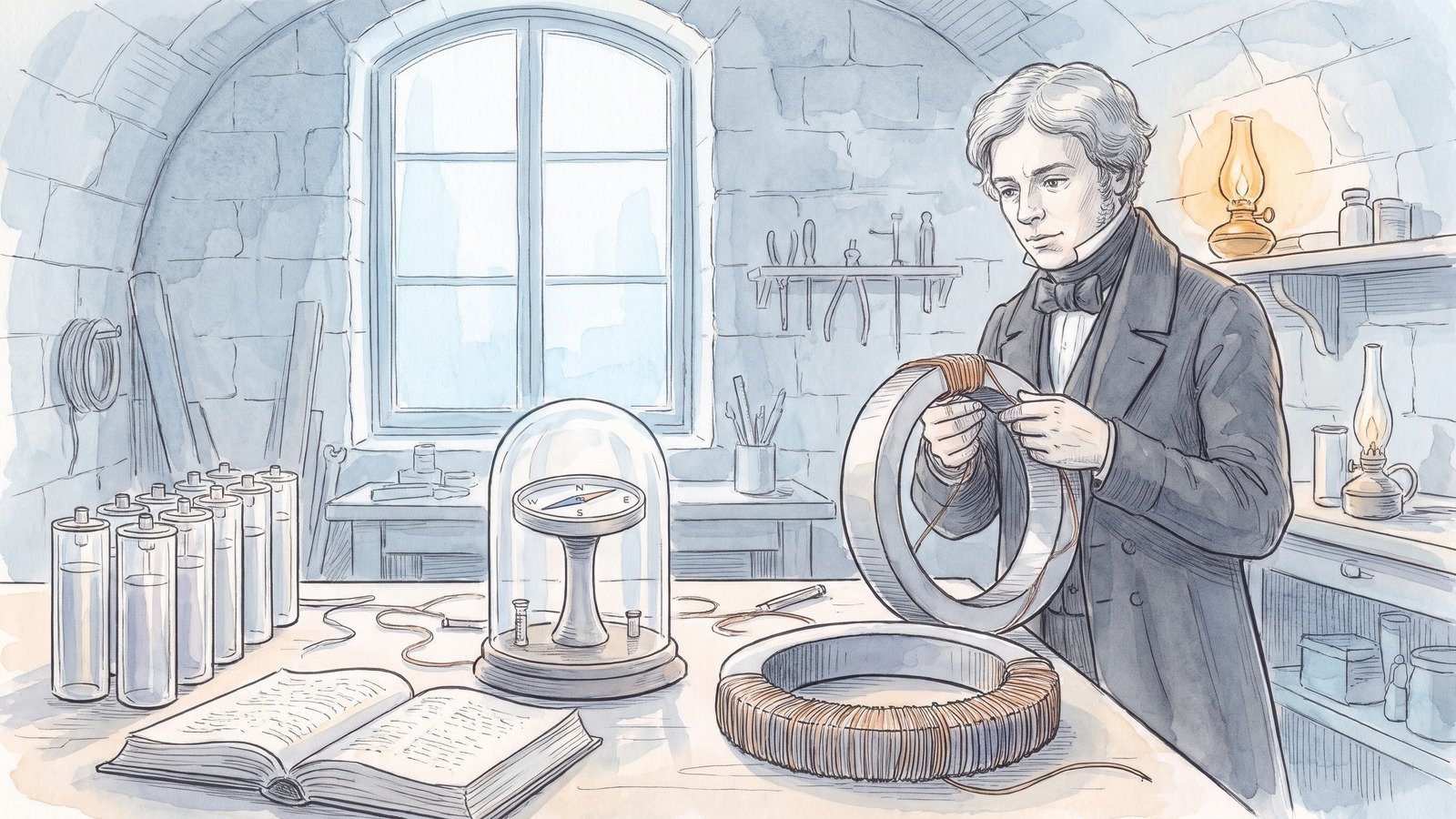
On 29 August 1831, in the basement laboratory of the Royal Institution in Albemarle Street, London, Michael Faraday wound two separate coils of insulated copper wire on opposite sides of a soft iron ring about six inches across. He connected one coil to a battery and the other to a length of wire that passed over a magnetic needle. When he closed the battery circuit the needle swung, settled back, and stayed still; when he broke the circuit it swung again, the other way. Nothing passed between the two coils except through the iron, and no steady current flowed in the second coil at all. What Faraday had seen was a brief current produced in one circuit by a change in the magnetism created by another. Within three months he had worked out the general rule behind it, and that rule, now called electromagnetic induction, became the basis of the dynamo, the transformer, the electric motor in its modern forms and the whole system of electrical power generation and distribution. This article follows the discovery from its background in the electrical science of the early nineteenth century, through the experiments of the autumn of 1831, to the ideas of lines of force and fields that Faraday drew from them and the uses to which later engineers put them.
A Bookbinder’s Apprentice at the Royal Institution
Faraday was born on 22 September 1791 at Newington Butts, then a village on the southern edge of London, the third child of James Faraday, a blacksmith who had come down from Westmorland, and his wife Margaret. The family belonged to the Sandemanians, a small Christian sect that had broken away from the Church of Scotland in the eighteenth century, and Faraday remained a member all his life, serving at times as a deacon and an elder. The family was poor, and his schooling was limited to reading, writing and arithmetic at a day school. At fourteen he was apprenticed to George Riebau, a bookbinder and bookseller in Blandford Street, and it was there, binding and reading the books that passed through the shop, that he taught himself the elements of science. He later singled out two sources: the article on electricity in an edition of the Encyclopaedia Britannica and Jane Marcet’s Conversations on Chemistry, a popular textbook written as a dialogue between a teacher and two young women.
Riebau encouraged him. Faraday built a simple electrostatic machine from bottles and scraps, attended the lectures on natural philosophy given by John Tatum to the City Philosophical Society, and kept careful notes. In 1812 a customer of the shop, William Dance, gave him tickets to the last four lectures of a series given by Humphry Davy at the Royal Institution. Davy was then the most celebrated chemist in Britain, famous for isolating sodium and potassium by electrolysis and for the brilliance of his public lecturing. Faraday wrote up the lectures, bound the notes, and sent them to Davy with a request for employment. Nothing was available at first, but in March 1813 a laboratory assistant at the Institution was dismissed after a fight, and Davy offered Faraday the post. He was twenty-one.
The Royal Institution had been founded in 1799 to spread scientific knowledge and its practical application. By the time Faraday arrived it had a lecture theatre, a library and a laboratory in the basement, and it depended heavily on income from public lectures. Within months of his appointment Faraday left with Davy and Davy’s wife on an eighteen-month tour of the Continent, travelling through France, Italy, Switzerland and Germany in the middle of the Napoleonic Wars under a special passport. The journey was uncomfortable socially, since Lady Davy treated him as a servant, but scientifically it was an education. Faraday met André-Marie Ampère, Alessandro Volta and other leading natural philosophers, watched Davy work on the newly identified element iodine, and learned to keep the kind of systematic laboratory notebook that he maintained for the rest of his working life.
For most of the next decade Faraday was known as a chemist. He analysed samples for industrial clients, worked with Davy on the miners’ safety lamp, studied alloys of steel, and in 1823 liquefied chlorine under pressure. In 1825 he isolated a new compound from the oily residue left by the gas used for street lighting, which he called bicarburet of hydrogen and which is now known as benzene. In the same year he became Director of the Laboratory at the Royal Institution, and in 1826 he began the Friday Evening Discourses and the Christmas Lectures for young people, both of which continue. These achievements alone would have secured him a place in the history of chemistry. But electricity and magnetism had held his attention since 1821, and the problem that occupied him intermittently through the 1820s was one that the most able mathematical physicists of Europe had also failed to solve.
Electricity and Magnetism Before 1831
At the start of the nineteenth century electricity and magnetism were treated as separate subjects. Static electricity had been studied for well over a century, through friction machines, Leyden jars and the experiments of Benjamin Franklin and Charles-Augustin de Coulomb, who in the 1780s had shown that the forces between electric charges and between magnetic poles both fall off with the square of the distance. Many natural philosophers suspected that the two were related. Lightning was known to reverse the polarity of ships’ compasses and to magnetise knives and forks. But no one had found a reliable laboratory connection between them.
The situation changed in 1800, when Volta announced his pile, a stack of zinc and copper or silver discs separated by cloth soaked in brine. For the first time experimenters had a source of continuous electric current rather than the brief discharge of a jar. Within weeks William Nicholson and Anthony Carlisle in London had used it to decompose water, and Davy went on to use large batteries to isolate the alkali metals. The steady current also opened the way to a renewed search for magnetic effects, since a current could be passed through a wire for as long as the battery lasted.
The decisive observation was made by Hans Christian Ørsted, professor of physics at the University of Copenhagen, in the spring of 1820. During or shortly after a lecture he noticed that a compass needle placed near a wire carrying current from a battery was deflected. Over the following months he established that the needle tended to set itself at right angles to the wire, and that the direction of deflection reversed when the needle was moved from below the wire to above it or when the current was reversed. He published his results in July 1820 in a short Latin paper that he sent to scientific societies across Europe. The effect was unexpected in its geometry. Every known force acted along the straight line joining two bodies, but the magnetic action of the current seemed to circle around the wire.
The response was rapid. In Paris, Ampère heard the result reported to the Académie des Sciences in September 1820 and within a week was presenting his own experiments, showing that two parallel wires carrying current attract each other when the currents run in the same direction and repel when they run in opposite directions. Over the next few years he built a mathematical theory of the forces between current elements and proposed that magnetism itself arises from tiny electric currents circulating within the particles of magnetic materials. Jean-Baptiste Biot and Félix Savart measured the way the force on a magnetic pole near a long straight wire depended on distance. François Arago showed that a wire carrying current could attract iron filings and magnetise steel needles placed inside a helix. In 1825 the English experimenter William Sturgeon wrapped a coil around a varnished iron bar bent into a horseshoe and produced the first practical electromagnet, and a few years later Joseph Henry in Albany, New York, built far more powerful magnets by using many turns of silk-insulated wire.
Faraday entered the subject in 1821 at the suggestion of Richard Phillips, the editor of the Annals of Philosophy, who asked him to write a historical survey of electromagnetism. Repeating the experiments described in the literature, Faraday became convinced that the circular character of Ørsted’s effect was its essential feature. In September 1821 he arranged a wire dipping into a cup of mercury so that it could move freely around the pole of a fixed bar magnet. When current was passed, the wire rotated continuously around the magnet; in a second arrangement a magnet free to move rotated around a fixed wire. These were the first devices to convert electric current into continuous mechanical motion, the ancestors of the electric motor. The publication caused an awkward dispute, since William Hyde Wollaston had been discussing the possibility of rotation and some members of the Royal Society believed that Faraday had used his idea without acknowledgement. The matter was smoothed over, and Faraday was elected a Fellow of the Royal Society in 1824, but the episode made him cautious about publishing anything not fully worked out.
The obvious next question was whether the process could be reversed. If an electric current could produce magnetism, could magnetism produce an electric current? Faraday wrote in his notebook in 1822 a reminder to himself to “convert magnetism into electricity”. Many people tried, and almost all of them looked for a steady effect: a strong magnet placed beside or inside a coil, they reasoned, ought to produce a steady current in it, just as a steady current produced a steady magnetic force. Faraday himself made several attempts in the 1820s, placing magnets near wires and wires near other wires carrying current, and found nothing. The difficulty was that the effect they were looking for does not exist. A stationary magnet produces no current at all in a stationary circuit. The effect that does exist appears only while something is changing, and it lasts only as long as the change.
The Ring and the Needle
Faraday returned to the problem in the summer of 1831. His notebook entry for 29 August describes the apparatus in detail. He had a ring of soft iron, about seven-eighths of an inch thick and six inches in external diameter. Around one half of the ring he wound three coils of copper wire, each about twenty-four feet long, insulated from one another and from the iron with twine and calico; these could be joined together or used separately, and he called this side A. On the other half, separated from the first by a gap, he wound about sixty feet of wire in two lengths, which he called side B. The ends of side B were connected by a long copper wire that passed directly over a magnetic needle about three feet from the ring, so that any current in B would deflect the needle. Side A was connected to a battery of ten pairs of plates four inches square.
When he made the connection to the battery, there was a sensible effect on the needle: it oscillated and settled at last in its original position. When he broke the connection, the needle was disturbed again. Making and breaking produced deflections in opposite directions. The current in side B did not persist; it appeared only at the moment the current in side A was started or stopped. Faraday’s instrument, which survives at the Royal Institution, is a plain iron ring wrapped in faded coils, and it is often described as the first transformer, since it has two windings on a common iron core and transfers electrical energy from one circuit to another through a changing magnetic state. Faraday did not describe it that way. He wanted to know what was happening, and over the next weeks he took the experiment apart to find out.
He left the subject for some weeks and came back to it in late September. On 24 September he showed that a coil placed between the poles of two bar magnets produced a current when the magnets were brought up to touch the iron core. In the following days he showed that a current could be produced in one coil by switching a current on and off in another coil wound beside it on a block of wood, with no iron at all. The effect was weaker, but it was there. Iron concentrated and strengthened the effect but was not essential to it. On 17 October he wound a coil of wire around a hollow paper cylinder, connected the ends to a galvanometer, and plunged a cylindrical bar magnet into the coil. The needle moved. When he drew the magnet out, the needle moved the other way. When he held the magnet still inside the coil, the needle stayed at rest. Motion of a magnet, with no battery anywhere in the arrangement, had produced an electric current.
This was the experiment that finally showed what had escaped everyone. What mattered was not the presence of magnetism but its change. Moving a magnet towards a coil, moving it away, switching on an electromagnet, switching it off: each was a way of changing the magnetic condition of the space around the wire, and each produced a current lasting only as long as the change. On 28 October Faraday borrowed a large compound permanent magnet belonging to the Royal Society, a battery of magnets assembled earlier by Gowin Knight, and arranged a copper disc about twelve inches across so that its edge could rotate between the magnet’s poles. Sliding contacts pressed against the axle and against the rim. When the disc was turned by hand, a steady current flowed through the galvanometer connected between the contacts. The current reversed when the rotation reversed and grew stronger as the disc turned faster. This was the first continuous generator of electric current from mechanical motion, a device later known as the Faraday disc or homopolar generator.
The disc also explained a puzzle that had stood since 1824, when François Arago observed that a copper disc rotated beneath a suspended magnetic needle dragged the needle round with it, although copper is not magnetic. A copper disc spinning near a magnet has currents induced in it, and those currents, being currents, are themselves acted on by the magnet. The forces between the induced currents and the magnet produce the drag that Arago had observed. What had looked like a mysterious magnetism of copper was electromagnetic induction at work in a solid conductor, in the form now known as eddy currents.
Faraday presented his results to the Royal Society on 24 November 1831 as the first series of what became his Experimental Researches in Electricity, a sequence of numbered papers that eventually ran to thirty series and more than three thousand numbered paragraphs over the following quarter of a century.
Volta-Electric and Magneto-Electric Induction
In the first series Faraday distinguished two forms of the effect. When a current in one circuit was started, stopped or varied, it induced a current in a neighbouring circuit; this he called volta-electric induction, after the voltaic battery that supplied the primary current. When a magnet or a magnetised piece of iron was moved relative to a circuit, it also induced a current; this was magneto-electric induction. He showed that the two were the same phenomenon in different dress. A coil carrying a steady current behaves in every respect like a magnet, so switching on a current in a nearby coil is equivalent to suddenly bringing a magnet up to the second circuit, and switching it off is equivalent to suddenly taking the magnet away.
He also established the direction of the induced currents. When a current was started in the primary circuit, the induced current in the secondary flowed in the opposite direction; when the primary current was stopped, the induced current flowed in the same direction as the primary current had been flowing. A few years later, in 1834, the Baltic German physicist Heinrich Lenz stated the general rule now known as Lenz’s law: an induced current always flows in such a direction that its own magnetic effect opposes the change that produced it. The rule is a form of the conservation of energy. If the induced current helped the change along, pushing a magnet into a coil would produce a current that pulled the magnet further in, and the system would accelerate without any input of work. Because the induced current opposes the change, work must be done to move the magnet against the resistance, and that work appears as electrical energy in the circuit and eventually as heat in its wires.
The most important conceptual step in the first series concerned how to describe the conditions under which a current was produced. Faraday had for some years been thinking about the patterns formed by iron filings sprinkled on paper over a magnet. The filings arrange themselves along curves running from one pole to the other, and Faraday began to treat these curves, which he called magnetic curves and later lines of magnetic force, as real features of the space around the magnet rather than a convenient picture. In the first series he stated that a current is produced in a wire when the wire moves so as to cut the magnetic curves. A wire moving along the lines produces no current; a wire moving across them does. The faster the cutting, the stronger the current. This statement was qualitative, but it was precise enough to predict the results of experiments he had not yet tried, and it turned out to be the seed of the modern field concept.
What Kind of Thing Is Electricity?
The discovery of induction raised an awkward question that Faraday spent much of 1832 and 1833 answering. By then electricity could be produced in many ways: by friction, as in the old electrostatic machines; by the chemical action of the voltaic battery; by heat, through the thermoelectric effect discovered by Thomas Seebeck in 1821; by living creatures such as the electric eel and the torpedo fish; and now by magnetism. It was not obvious that these were all the same thing. Frictional electricity produced sparks and attractions but seemed to carry little current; voltaic electricity produced large currents but weak sparks. Some natural philosophers argued that they were distinct agents.
In the third series of the Experimental Researches, presented in January 1833, Faraday compared the effects of electricity from all these sources one by one: their power to deflect a magnetic needle, to heat a wire, to decompose chemical solutions, to produce a spark, to give a physiological shock. He found that every source could produce every effect, provided the quantity and intensity were suitable. The differences were differences of degree, not of kind. Electricity, whatever its source, was one thing. In a related experiment he discharged a Leyden jar through a galvanometer and through a decomposing solution, and showed that the same quantity of electricity produced the same chemical and magnetic effect whether it came from a jar or from a battery.
The same comparison led directly to his laws of electrochemistry in 1834: the amount of a substance decomposed by a current is proportional to the quantity of electricity passed, and the amounts of different substances released by the same quantity are in proportion to their chemical equivalent weights. With the help of the Cambridge scholar William Whewell he introduced the words electrode, anode, cathode, electrolyte and ion to describe the process. The laws of electrolysis suggested that electricity comes in fixed units attached to atoms, and when the electron was identified at the Cavendish Laboratory in 1897, Faraday’s equivalents were one of the threads that led to it.
Lines of Force and the Idea of a Field
Most of Faraday’s contemporaries took the magnetic curves to be a useful diagram and nothing more. The standard view of electric and magnetic forces, developed with great mathematical skill in France, treated them as actions at a distance: two charges or two poles acted on each other directly across empty space, with a strength determined only by the quantities involved and the distance between them, in the same way that Newton’s gravitation acted between the Sun and the planets. On this view the space between the bodies played no part.
Faraday came to doubt this. He was not a mathematician; he never used algebra in his published papers, and he described his results in words and drawings. But he was an exceptionally careful observer, and the behaviour of induction pushed him towards the view that the space around a magnet or a current was in some physical condition, which he at first called the electrotonic state, and that the lines of force were a map of that condition. In 1837 and 1838, in the eleventh to fourteenth series, he applied a similar idea to electrostatics. He showed that the force between two charged bodies depended on the insulating material between them, a property he called specific inductive capacity and which is now called the dielectric constant or relative permittivity. If the medium between two charges changed the force between them, the medium was taking part in transmitting the force.
In 1845, prompted by a conversation with the young Glasgow physicist William Thomson, later Lord Kelvin, Faraday looked for a connection between magnetism and light. After many failures he passed polarised light through a block of heavy lead borate glass that he had made years earlier during a long and unrewarding project on optical glass for the Royal Society. When he placed the glass between the poles of a powerful electromagnet so that the light travelled along the lines of force, the plane of polarisation of the light was rotated. The rotation, now known as the Faraday effect, was the first experimental evidence that light and magnetism were related. In the same year he found that every material responds to a strong magnet. Some, such as iron, are drawn strongly into the field; others, such as bismuth and glass, are weakly repelled. He named the second behaviour diamagnetism and the first paramagnetism, and he described both in terms of whether a substance conducted the lines of force better or worse than the space around it.
James Clerk Maxwell, then a young fellow of Trinity College, Cambridge, read the Experimental Researches in the early 1850s and set out to put Faraday’s lines of force into mathematical form. His paper “On Faraday’s Lines of Force”, read to the Cambridge Philosophical Society in 1855 and 1856, treated the lines as analogous to the flow of an incompressible fluid. He sent a copy to Faraday, who replied that he was almost frightened to see such mathematical force brought to bear on the subject, and pleased to see how well the subject stood it. In “On Physical Lines of Force” in 1861 and 1862, and above all in “A Dynamical Theory of the Electromagnetic Field” in 1865, Maxwell built a complete set of equations for the electric and magnetic fields. One of those equations is a mathematical statement of Faraday’s law of induction: the electromotive force around a closed loop equals the rate at which the magnetic flux through the loop is changing, taken with a negative sign that expresses Lenz’s rule. The equations also predicted that disturbances in the field would travel through space as waves, at a speed which Maxwell calculated from electrical measurements and found to be very close to the measured speed of light. He concluded that light was an electromagnetic wave. Faraday’s suggestion that light might be a vibration of the lines of force had become a theory. Two decades later, Heinrich Hertz in Karlsruhe produced and detected such waves in the laboratory, and from his experiments came radio.
From the Faraday Disc to the Power Station
Faraday himself showed little interest in exploiting induction commercially, but instrument makers took up his results within months. In 1832 Hippolyte Pixii in Paris built a hand-cranked machine in which a horseshoe magnet rotated beneath a pair of coils, and in the 1850s and 1860s larger magneto-electric machines driven by steam engines lit arc lamps in lighthouses, with Faraday supervising trials for Trinity House. All of them used permanent magnets, which limited their output. The decisive improvement came in the 1860s, when several inventors, among them Werner von Siemens in Berlin, Charles Wheatstone and Samuel Alfred Varley in London, realised that a generator could use part of its own output to energise its field magnets. Once a small residual magnetism started the process, the current and the field built each other up until the machine reached its working output. This self-excited dynamo, announced by Siemens in January 1867, allowed generators to be made very much larger. In 1871 the Belgian engineer Zénobe Gramme, working in Paris, introduced a ring armature that produced a much smoother direct current, and Gramme machines were soon used for arc lighting and electroplating.
Large-scale electricity supply followed in the 1880s. A small public supply was installed at Godalming in Surrey in 1881, driven by a waterwheel on the River Wey. In 1882 Thomas Edison’s company opened the Holborn Viaduct station in London in January and the Pearl Street station in New York in September, both driven by reciprocating steam engines and supplying direct current to nearby customers for incandescent lamps. The steam engines that drove these first generators were descendants of the machines described in the history of the steam engine, and when Charles Parsons coupled his steam turbine directly to a dynamo in 1884, he created the combination of turbine and generator that still produces most of the world’s electricity. Whether the turbine is driven by steam from coal, gas or nuclear fission, by falling water or by the wind, the final step is always the one Faraday demonstrated with his copper disc: a conductor moved through a magnetic field, so that the changing flux drives a current.
Direct current could not easily be sent far, because losses in the wires grow with the square of the current, and the only way to deliver much power with a small current is to use a high voltage, which is dangerous in the home. The solution was the transformer, the direct descendant of Faraday’s iron ring. In a transformer an alternating current in one winding produces a continually changing flux in an iron core, which induces an alternating voltage in a second winding; the ratio of the voltages is close to the ratio of the numbers of turns. Lucien Gaulard and John Dixon Gibbs demonstrated a system of secondary generators in London in 1882 and 1883, and in 1885 the engineers Károly Zipernowsky, Ottó Bláthy and Miksa Déri at the Ganz works in Budapest patented closed-core transformers connected in parallel, the arrangement used ever since. In the United States, George Westinghouse bought rights to the Gaulard and Gibbs patents, William Stanley built a working alternating-current distribution system at Great Barrington, Massachusetts, in 1886, and Nikola Tesla’s polyphase induction motor, patented in 1888, provided a simple motor for alternating supply. The long dispute between direct and alternating current systems in the late 1880s was settled largely in favour of alternating current because induction made it possible to raise the voltage for transmission and lower it again for use.
The applications of induction now extend far beyond power. Microphones and loudspeakers of the moving-coil kind, the pickups on electric guitars, the readers for magnetic stripe cards, the coils in induction hobs and in the wireless chargers for mobile phones, metal detectors and the detectors that trigger traffic lights all rely on currents induced by changing magnetic flux. Magnetic resonance imaging uses induction to pick up the faint signals emitted by atomic nuclei in the body. The regenerative brakes of electric trains and cars turn their traction motors into generators, so that the motion of the vehicle drives a current back into the supply or the battery. In each case the principle is the same one Faraday stated in 1831.
The Later Years
Faraday continued to work at the Royal Institution for more than thirty years after the discovery of induction, though from about 1839 he suffered from periods of exhaustion and memory loss that forced him to stop work for months at a time. The cause is uncertain; mercury poisoning from his laboratory work has been suggested, but the evidence is not conclusive. He declined most honours that might have drawn him away from the Institution. He refused a knighthood and is said to have twice refused the presidency of the Royal Society. He accepted a Civil List pension in 1835, though only after an awkward interview with the Prime Minister, Lord Melbourne, whose dismissive remarks about pensions for scientific men led Faraday at first to decline it. In 1858 Queen Victoria, at the suggestion of Prince Albert, gave him the use of a house on Hampton Court Green, and he moved there with his wife, Sarah Barnard, whom he had married in 1821.
He gave his last Friday Evening Discourse in 1862 and resigned his remaining posts at the Institution in 1865. He died at his house at Hampton Court on 25 August 1867, a few weeks before his seventy-sixth birthday, and, in keeping with his wishes, was buried in the Sandemanian plot at Highgate Cemetery under a plain headstone. A memorial tablet was later placed in Westminster Abbey near the grave of Isaac Newton. The unit of electrical capacitance, the farad, was named after him, and his laboratory notebooks, his induction ring and a reconstruction of his basement laboratory are preserved at the Royal Institution.
The Significance of the Discovery
The discovery of electromagnetic induction is sometimes presented as a single moment of insight, but the notebooks show something slower and more deliberate. Faraday had been thinking about the reverse of Ørsted’s effect for nearly a decade before the experiment with the ring, and once he had a positive result he spent three months taking it apart, varying the conditions one at a time until he could state when a current would appear and when it would not. The decisive element was his recognition that change, not mere presence, was the cause. Many able experimenters had placed magnets beside coils and seen nothing, because they expected a steady effect from a steady cause.
His second contribution was to describe what he had found in terms of lines of force that filled the space around magnets and currents. The description was qualitative, and many of his contemporaries regarded it as the natural idiom of a man who could not use mathematics. Maxwell regarded it differently. In the preface to his Treatise on Electricity and Magnetism in 1873 he wrote that Faraday’s methods, once translated into mathematical form, were in fact a mathematical method of a very high order, and that the field theory he himself had developed was an expression of Faraday’s ideas. Through Maxwell, the lines of force became the electromagnetic field, the first field theory in physics and the model for later theories of gravitation and of the forces within the atom.
The third contribution was practical, though Faraday did not pursue it. Every generator in every power station, every transformer in the distribution network and most of the electric motors in industry and transport work on the principle he demonstrated in the autumn of 1831. Few discoveries in the history of physics have been so quickly confirmed, so thoroughly understood within a lifetime, and so completely absorbed into the technology of the following two centuries.
References
- Michael Faraday - Grokipedia, biography covering his apprenticeship, the Royal Institution, electromagnetic rotation, induction, electrochemistry and the Faraday effect
- Michael Faraday - Engineering and Technology History Wiki, IEEE History Center
- Archives Biographies: Michael Faraday - Institution of Engineering and Technology Archives, London
- Browse our science online: the collections - Royal Institution of Great Britain, London, holder of Faraday’s notebooks, induction ring and laboratory
- Electromagnetic induction - Grokipedia, the 1831 experiments, Lenz’s law and later applications
- Faraday’s law of induction - Grokipedia, the flux rule and its place in Maxwell’s equations
- Hans Christian Ørsted - Grokipedia, the 1820 discovery of the magnetic effect of a current
- André-Marie Ampère - Grokipedia, electrodynamics and the force between currents
- Joseph Henry - Grokipedia, electromagnets and his independent observations of induction
- James Clerk Maxwell - Grokipedia, the papers on lines of force and the dynamical theory of the electromagnetic field
- Faraday effect - Grokipedia, the 1845 rotation of polarised light in a magnetic field
- Electric generator - Grokipedia, from the Faraday disc and Pixii’s machine to the self-excited dynamo
- Transformer - Grokipedia, the induction ring, Gaulard and Gibbs, and the Ganz closed-core transformer