A Capital on the Bâc
Chișinău, known for much of the modern period as Kishinev, stands on low hills above the Bâc, a modest tributary that joins the Dniester farther east. The city that grew here has never commanded a great river frontage or a mountain pass. Its importance has been administrative and commercial rather than topographic. For more than two centuries it has served successive states as a provincial capital on the edge of the steppe, absorbing Moldavian, Ottoman, Russian, Romanian and Soviet layers of law, language and building. Gardens, vineyards and wide nineteenth-century avenues shaped its public image long before tower blocks and ring roads remade its skyline.[1][2]
This special feature follows the history of Chișinău from its Moldavian origins through the Russian annexation of 1812, the exile of Alexander Pushkin, the growth of a large Jewish city, the pogroms of 1903 and 1905, Romanian rule between the wars, the wartime ghetto and deportations, the Moldavian Soviet Socialist Republic, and the independent Republic of Moldova. It closes with an assessment of places and memory. An interactive timeline at the end of the essay gathers the principal dates. The spelling of the city’s name has shifted with sovereignty and alphabet: Chișinău in Romanian, Kishinev in Russian imperial usage, Keshenev in Yiddish, and other forms in German and French travel writing. This feature uses Chișinău for the contemporary city and Kishinev where the historical context of Russian imperial or Jewish diaspora usage makes that form natural. The place is the same; the names record its successive publics.
1. Origins beside the Bâc
The earliest documentary references to a settlement on this stretch of the Bâc date from the fifteenth century, when the Principality of Moldavia organised tolls, markets and military obligations across the lands between the Carpathians, the Dniester and the Danube. The name of the place appears in Slavic and Romanian forms; etymologies connecting it to a spring, a small river or a personal name have been proposed without decisive proof. What the written record shows more clearly is a modest market point on routes that linked the Moldavian interior with the Dniester crossings and, beyond them, with the Black Sea and the Crimean trade.[1][3]
Geography favoured settlement even when politics did not. The Bâc valley offered water, mills and a corridor for carts; the surrounding hills carried vineyards and orchards that later observers would praise as the city’s distinctive landscape. The soils of Bessarabia, as the eastern Moldavian lands came to be called, supported grain and pasture. Tatar raids from the steppe, Ottoman campaigns and the rivalries of Moldavian boyars repeatedly interrupted growth. Fires reduced wooden quarters. Epidemics thinned populations. Recovery was slow and local.
Moldavia itself had taken shape in the mid-fourteenth century as a frontier principality between Hungarian, Polish and, later, Ottoman spheres. Its princes ruled from seats farther west, at Suceava and subsequently at Iași. Chișinău was never a princely capital. It belonged to the network of county towns and market villages that collected dues, held fairs and supplied levies. Armenian merchants, known across Moldavia for long-distance trade, appear in the wider regional record; Jewish traders are attested in Moldavian towns from the early modern period, though continuous communal documentation for Chișinău itself begins later.[4][5]
The religious landscape of the Moldavian countryside was overwhelmingly Eastern Orthodox. Monasteries organised much of elite cultural life; parish churches in wood and, more rarely, in stone served the peasantry. Latin-rite Catholics and Protestants remained few. The Metropolitanate of Moldavia mediated between the princes and the Ecumenical Patriarchate. For a small market town on the Bâc these structures meant that baptism, marriage and burial followed Orthodox calendars, while commercial life followed fair days and the seasonal movement of cattle and grain.
Archaeological finds in the wider Bessarabian region attest to prehistoric and early medieval habitation, including traces associated with steppe cultures and with later Slavic and Romance-speaking communities. Linking any single find-spot directly to the medieval market requires caution. Rescue archaeology before modern construction has been uneven. Each foundation trench is a potential archive, yet urban history for the earliest centuries still rests chiefly on charters, toll registers and later copies of privileges.
Comparative urban history places early Chișinău among a string of Moldavian small towns that lived from transit trade and local agriculture. What distinguished its later fate was not geographic destiny but contingent administrative choice. Without the Russian decision of the early nineteenth century to make it a provincial centre, the Bâc market might have remained obscure. Contingency remains the safer guide. The Moldavian centuries nonetheless supplied the Orthodox and agrarian substrate without which later national claims are incomprehensible.[3]
Trade goods passing through the district included wax, honey, hides, wine, coarse cloth and occasional luxury imports moving north from Black Sea ports. Customs officers recorded loads imperfectly; smuggling was endemic. Seasonal fairs concentrated exchange into intense weeks of bargaining. Court records of fights and unpaid debts from fair time, where they survive in later cartularies, give flashes of popular life otherwise lost.
Climate and soil shaped the agrarian base. The Bessarabian plain and the hills around the Bâc supported mixed farming and extensive vineyard culture. River transport on the Bâc was seasonal and limited; overland carts remained the staple of trade into the Russian era. Disease environments included the epidemic diseases common to early modern Europe. Demographic recovery after each war was slow. When Russian surveyors arrived after 1812 they found a landscape that looked thin by western European standards yet was already socially organised by parish, estate and custom.
Border treaties after Ottoman–Polish and Ottoman–Russian wars occasionally redrew rights of pasture and toll. Local memory of jurisdiction outlasted the treaties themselves. Folk songs mention rivers as crossings and barriers. Hydronyms are among the oldest words in the landscape. The Bâc, though modest, structured settlement patterns that later street grids would overlay rather than erase.
Administrative geography in the Moldavian period placed the settlement within a hierarchy of counties whose officers collected taxes, raised levies and adjudicated disputes in the prince’s name. Surviving documents mention border demarcations and disputes over cattle and timber. The town’s seal and market privileges, where they survive in later copies, show a community conscious of its corporate rights. Artisans organised in loose fraternities before later guild reforms. Women appear in the record chiefly as widows managing stalls or as parties to inheritance cases, a reminder of how incompletely the archive represents the working population.
Later Romanian and Russian historians wrote competing narratives of these centuries, emphasising different saints, princes and battles. Jewish historians searched the same centuries for traces of early settlement. Each national historiography illuminated and occluded. A twenty-first-century account can afford to admit uncertainty where the sources are thin and to resist the teleology that reads the fifteenth-century market as destined to become a national capital. The city that would grow on the Bâc was still, in these centuries, a place of mills, vines and fairs, waiting on decisions made elsewhere. Numismatic finds and occasional coin hoards from Moldavian and Ottoman periods turn up in construction digs, reminding contractors and archaeologists that the modern city sits on older layers. Rescue archaeology before new building is unevenly enforced. Each foundation trench is a potential archive. Urban history and archaeology must collaborate if the pre-documentary horizon is ever to thicken beyond speculation.
The continuity of Orthodox parish life from the Moldavian period into later centuries meant that baptismal, marriage and burial registers—where preserved—offer demographic series spanning political ruptures. Priests became, willingly or not, data collectors for successive states. Their handwriting fills volumes that demographers still sample. The parish was the cell of both spiritual and statistical life.
Comparative study with other Prut and Dniester towns—Orhei, Soroca, Bender—clarifies what was typical and what was contingent in Chișinău’s early trajectory. All lived from transit trade and agriculture; only Chișinău later received the administrative investment that produced a true capital. Geography supplied a site; politics supplied a destiny.
Folk memory of fords, mills and fair days outlasted many written privileges. Songs collected by ethnographers in the nineteenth and twentieth centuries preserve hydronyms and market customs. Used critically, folklore supplements the charter evidence without replacing it. The earliest Chișinău is audible as well as legible.
Soil science and palaeobotany, applied sparingly in Bessarabia, hint at long histories of vineyard and orchard culture around the Bâc. Pollen cores and terrace surveys remain incomplete. Environmental history of the site is a research frontier rather than a settled narrative. The green city of later fame had agrarian roots measurable in sediment as well as in travel writing.
Merchant networks linking the Bâc market to Iași, to Lviv and to Black Sea ports can be reconstructed from scattered customs records and from later Armenian and Jewish commercial correspondence. Credit instruments, partnership contracts and dispute settlements show a commercial culture more sophisticated than the town’s modest architecture suggested. Liquidity and trust travelled farther than stone buildings.
Seasonal labour migration brought shepherds, harvesters and drovers through the district. Their temporary camps left little archaeology but shaped the fair calendar. Conflict between settled townsmen and mobile pastoralists appears in complaints to princely officers. The frontier economy was as much about movement as about fixed markets.
Clerical visitations recorded the state of parish churches, the quality of vestments and the morals of congregations. These sources, formulaic yet informative, locate Chișinău within the Moldavian ecclesiastical landscape. Saints’ cults and feast days structured time. The ritual year was a social fact as binding as the tax year.
Boyar estate inventories from the wider county list vineyards, mills and dependent households. Where Chișinău burghers appear as creditors or debtors in these inventories, the town’s links to the agrarian order become visible. Urban and rural history are not separate subjects in a market of this size.
Later national museums have displayed pottery, tools and icons attributed to the early town. Provenance is sometimes insecure. Museum narratives serve identity as well as scholarship. The visitor must read labels with the same caution that the historian brings to chronicles. Market dispute records, copied into later cartularies, mention weights, wine measures and the timing of evening stalls. Even fragmentary, they show a town conscious of regulation. The prince’s officer and the local judge shared jurisdiction in ways that litigants tried to exploit. Forum shopping is not only a modern legal habit. Toll stations on the approaches to the Bâc market charged carts by load type. Disputes over classification filled officers’ days. Revenue from these small dues funded local repairs and princely claims alike. The fiscal microhistory of a ford town begins with such charges.
2. A Moldavian market town
By the sixteenth century Chișinău functioned as a recognised Moldavian market town, though still of secondary rank beside Bender (Tighina), Orhei and the princely centres farther west. Urban privileges of a Magdeburg type, which granted burghers limited self-government under the authority of the prince, were recognised in Moldavian towns as in Polish and Galician ones. The economic base remained modest: fairs, crafts serving the hinterland, and the processing of agricultural produce. Wine from the surrounding hills entered regional trade. Leather and fur processing used the water of the Bâc.[1][3]
The Principality of Moldavia after the campaigns of Suleiman the Magnificent became an Ottoman tributary state. The princes, whether drawn from local boyar families or imposed from Constantinople, paid tribute, supplied auxiliaries and accepted Ottoman oversight of their foreign relations, while retaining substantial autonomy in landholding, Orthodox church life and customary law. Chișinău lay in the eastern half of this tributary principality, in the zone later called Bessarabia. Romanian-speaking peasants cultivated the valleys; Ukrainian-speaking communities lived farther north; Armenian and Jewish merchants appeared in the markets; Orthodox monasteries organised much of elite culture.[3][6]
Military insecurity shaped urban form. Wooden construction made fire a constant risk. Defensive arrangements were limited. When armies crossed the region—Polish, Ottoman, Tatar, Cossack or Russian—the town suffered requisition, flight and rebuilding. Chronicles and later local histories record burnings associated with the Russo-Turkish wars of the eighteenth century, including destruction in 1739 and again in 1788. Two churches of Moldavian type, dating from the mid- and late eighteenth century, survived into the modern city as rare pre-Russian monuments, their fabric altered by later repairs.[1]
Social structure followed Moldavian patterns. Boyars held estates in the hinterland. Free peasants and dependent cultivators worked the land under customary and written obligations. A small urban population of craftsmen, innkeepers, butchers and traders served both residents and travellers. Gypsy (Roma) communities, some attached to boyar households, performed specialised crafts. The slave status of certain Roma groups in Moldavia, abolished only in the nineteenth century, is part of the region’s social history and cannot be omitted from any account of the early modern countryside.[6]
Jewish settlement in Chișinău is documented securely from the early eighteenth century. By 1774 a Jewish population of several hundred is recorded, with a burial society already organised. The first rabbis and the foundations of communal institutions belong to this Moldavian–Ottoman twilight. Jewish livelihoods clustered in trade, crafts and leasing. The community remained a minority within a still small town, yet it established the institutional base—synagogue, cemetery, mutual aid—that would expand dramatically under Russian rule.[4][5]
Language in daily life was Romanian in its Moldavian form among the majority peasantry and townspeople, with Church Slavonic and later Romanian in liturgical and administrative use, Turkish and Greek in Ottoman and Phanariot contexts, and Yiddish among Jews. Multilingualism was practical rather than ideological. A merchant might bargain in several tongues at a fair without theorising identity. Later national movements would retrospectively assign these speakers to exclusive categories that the early modern record does not cleanly support.
The Phanariot period of the eighteenth century, when Greek Orthodox elites from Constantinople dominated the thrones of Moldavia and Wallachia under Ottoman appointment, brought fiscal pressure and cultural currents from the wider Orthodox world. Princes and their suites extracted revenues; boyars negotiated survival. For a provincial market the Phanariot era meant heavier dues and occasional opportunities for those who served the new networks. It did not yet mean urban monumentality. Chișinău’s streets remained irregular, its houses largely of wood and adobe, its public buildings few.
Relations with neighbouring powers continued to define the town’s horizons. The Russian Empire pressed southwards toward the Black Sea through the eighteenth century. The Habsburg Monarchy, after the acquisition of Bukovina in 1775, held the northern Moldavian lands across the present frontier. The Ottoman Porte defended its tributary system with diminishing success. Chișinău sat in the path of these pressures. When the Russo-Turkish war of 1806 to 1812 brought Russian occupation of the eastern Moldavian lands, the stage was set for annexation. The market town on the Bâc was about to become a Russian provincial capital.[2][3]
Demographic estimates for the late eighteenth century remain approximate. Travellers’ accounts describe a small place of a few thousand inhabitants, with vineyards pressing close to the streets and a river prone to flood. Mills and tanneries used the Bâc’s water. Clouds of insects in summer and mud in the rains entered every description. The contrast with the planned upper town of the nineteenth century would be sharp. Understanding the Moldavian market is essential to understanding why later planners treated the old core as something to be left behind or regularised.
Craft organisation before Russian guild reform was informal. Butchers, bakers, tailors and smiths served local demand. Seasonal labour from the countryside filled the fairs. Credit rested on personal reputation and on Jewish and Armenian commercial networks that linked Bessarabia to Odessa, Iași and beyond. Bankruptcy and debt imprisonment appear in scattered legal records. The moral economy of the market—fair prices, just weights, charity at festivals—structured social expectation even when practice diverged.
Women’s economic roles included market stalls, textile work, innkeeping and the management of household production. Inheritance customs under Moldavian law gave widows and daughters defined claims. Church courts and princely officers adjudicated disputes. The documentary silence around most women’s names is a methodological problem, not evidence of inactivity.
Education for the Orthodox majority was parish-based and limited. Monastery schools served a thin elite. Jewish heders taught boys Hebrew literacy and religious texts. A secular curriculum for Jewish children would appear only in the nineteenth century under Russian and maskilic initiative. Literacy rates remained low by western European standards. Oral culture—songs, proverbs, seasonal rites—carried memory across generations that left few written traces.
The built fabric of the Moldavian town clustered near the river and along roads that followed older tracks. Street names in later maps preserve some of these alignments. Flood marks on riverside buildings, recorded into the twentieth century, reminded residents that the Bâc could still assert itself. Modern flood control and channelisation have changed the river’s behaviour; the old hydrology survives in memory and in the archive.
By 1800 Chișinău was thus a recognisable Moldavian market with an Orthodox majority, a growing Jewish minority, Armenian commercial presence and the vulnerabilities of a frontier town. It was not yet a city of European standing. The transformation that followed annexation would be rapid, planned and imperial in character. The Moldavian substrate would not vanish; it would become the demographic and linguistic base of a capital that spoke, for a century, the administrative language of St Petersburg. Guild-like fraternities of craftsmen regulated apprenticeship and feast days before Austrian or Russian models arrived. Surviving mentions in princely confirmations show butchers, cobblers and smiths defending privileges against outsiders. Women entered some trades as widows. The moral vocabulary of just price and honest weight structured disputes that reached local courts.
Epidemic disease—plague, typhus, smallpox—periodically emptied streets. Burial registers spike; then silence. Rebuilding after epidemic resembled rebuilding after fire. Demographic recovery depended on migration from the countryside as much as on natural increase. The town’s population was always partly rural in origin.
Diplomatic gifts and tribute caravans between Iași and Constantinople sometimes passed near Chișinău’s latitude without stopping. The town was a point on maps of obligation rather than a destination of ceremony. Its obscurity in diplomatic sources is itself evidence of secondary rank.
Armenian merchant families maintained correspondence in their own script and language while bargaining in Romanian and Turkish. Their churches and cemeteries elsewhere in Moldavia are better documented than any early Armenian presence in Chișinău itself. Caution forbids inventing what the sources do not show; analogy suggests commercial roles that leave thin traces.
Wine quality and grape varieties enter travellers’ notes. Local white and red wines supplied inns and boyar tables. Export was limited by transport costs and by politics. The vineyard landscape that later defined the city’s image was already productive in the Moldavian centuries.
Legal pluralism allowed Orthodox canon law, princely statutes and customary practice to coexist. Jews and Armenians used internal arbitration for many disputes. Appeals to the prince or his officers marked the limits of autonomy. The archive of such appeals, where it survives, is a window onto everyday conflict.
Military obligation fell on counties to supply horsemen and provisions. Chișinău’s district contributed according to assessments that boyars contested. Desertion and substitution were common. The gap between paper levies and actual musters is a standing theme of early modern military history.
Monastic landholding in the county linked the town to Putna, Suceava and other spiritual centres. Pilgrimage routes and donation charters mention market dues assigned to monasteries. Sacred and commercial geography overlapped. A fair day might also be a saint’s day.
Oral genealogies of boyar families claimed origins in the founding centuries of Moldavia. Written genealogies, when compiled later, mixed fact and aspiration. Chișinău’s hinterland estates changed hands through marriage, confiscation and princely grant. Land title was a political as well as an economic fact.
By the eve of the Ottoman wars’ intensification, Chișinău was a known market with a mixed population and fragile wooden fabric. It was prepared for neither imperial planning nor industrial scale. Those would come from outside, after 1812, with surveyors’ chains and straight streets. Seasonal pilgrimage to monasteries west of the Prut took townsmen away for weeks. Vows after illness or safe return from trade structured these journeys. Chișinău’s early religious life was thus partly mobile, tied to a sacred geography that later borders would cut. Night watch rotations among burghers protected stalls from theft. Failure brought fines. Collective security in a wooden town was a burgher duty before it was a police function.
3. Under Ottoman suzerainty
Ottoman suzerainty over Moldavia, consolidated in the sixteenth century, framed the political existence of Chișinău without placing Ottoman garrisons permanently in the town itself. Tribute, military auxiliaries and diplomatic obedience flowed through the princely court. Local life continued under Moldavian customary law and Orthodox church administration. The Ottoman presence was felt in fiscal demand, in the politics of princely appointment and in the wider security environment created by Crimean Tatar allies of the Porte and by wars with Poland, Russia and the Habsburgs.[3][6]
The eighteenth century brought repeated Russian occupations of Moldavia and Wallachia during successive Russo-Turkish wars. Each occupation was temporary until 1812. Russian officers mapped, taxed and negotiated with boyars; then treaties restored Ottoman suzerainty over the principalities as a whole, sometimes with border adjustments. Chișinău experienced these passages of armies as destruction and opportunity by turns. Merchants who supplied troops prospered briefly; peasants fled or were requisitioned; fires followed battles.
Two destructions are particularly remembered in local historiography. In 1739, during the war that ended with the Treaty of Belgrade, the town suffered burning. In 1788, in the war associated with the sieges of Ochakov and other Black Sea fortresses, fire again reduced much of the settlement. Rebuilding after each disaster used familiar materials and plans. The churches of St Constantine and Helen and of the Protection of the Mother of God (often called the Măzărache church), dating from the mid- and late eighteenth century, stand as rare survivors of this fabric, their Moldavian architectural type—triconch plans, arched supports—linking Chișinău to the monastic and parish architecture of the principality.[1]
Economic life under late Ottoman suzerainty remained agrarian and commercial on a small scale. Vineyards around the town produced wine for local consumption and limited export. Grain moved toward the Dniester and the Danube ports when politics allowed. The leather trades used river water. Jewish and Armenian merchants mediated between peasant producers and distant markets. Credit networks extended to Iași, to Ottoman ports and, increasingly, to the rising Russian Black Sea city of Odessa after its founding in 1794.[2][5]
Social hierarchy placed boyars at the apex of the rural order, with free and dependent peasants below and urban craftsmen in a separate corporate world. The enslavement of Roma groups, a Moldavian institution with deep roots, continued. Manumission and reform would come only in the nineteenth century, under both Russian Bessarabian and Romanian Old Kingdom legislation. Any history of the region that ignores this labour system misrepresents the countryside that fed the town.
Cultural life was Orthodox and oral as much as literate. Manuscripts were copied in monastery scriptoria farther west; folk songs and seasonal rites structured peasant time; boyar courts cultivated bilingual literacy. The later Russian claim that Bessarabia was a vacant land awaiting civilisation was a colonising myth. It was, rather, a structured Orthodox agrarian society onto which imperial administration would graft a new urban elite. Understanding that prior world is essential to understanding why Romanian national movements in the nineteenth and twentieth centuries could claim Bessarabia as ancestral land, and why Russian and Soviet narratives emphasised different layers of the same past.[3][6]
Diplomatic correspondence between Iași, Constantinople, St Petersburg and Vienna occasionally mentioned the Prut and Dniester crossings. Control of fords and bridges was a military asset. In winter, ice altered calculations; in spring flood, crossings closed. Chișinău’s fortunes hinged on hydrology and on the wider balance of power. The Treaty of Bucharest of May 1812, signed while Napoleon prepared to invade Russia, would convert temporary occupation into permanent annexation of the lands between the Prut and the Dniester. For the town on the Bâc the Ottoman chapter was closing.[2][3]
Religious minorities under Ottoman–Moldavian arrangements lived under the millet-like structures of the Orthodox world and under local custom. Jews paid communal taxes and organised internal governance through rabbis and burial societies. Armenians maintained their own networks. Catholics were few. Conversion and intermarriage occurred at the margins; endogamy remained the norm. Confessional boundaries structured neighbourhoods that later street plans would partly overwrite.
Fiscal pressure intensified in the late Phanariot decades. Princes bought their thrones and recovered costs from the population. Boyars resisted and collaborated by turns. Peasant flight to the Russian side of shifting borders is attested. The image of Bessarabia as underpopulated, which Russian administrators later used to justify colonisation by Bulgarians, Gagauz, Germans and others, had roots in this fiscal and military disruption as well as in genuine demographic thinness.
Travel accounts by European and Russian observers in the late eighteenth and early nineteenth centuries describe Chișinău as dusty, green with vines, and provincial. They note the mix of costumes in the market, the quality of the wine, and the absence of monumental architecture. These descriptions, filtered through Enlightenment and imperial expectations, became sources for later historians. Read critically, they confirm a small town on the eve of transformation rather than a void.
The Ottoman peace, such as it was, rested on tribute and on the mutual interest of Porte and boyars in stability. It did not prevent war. Each Russo-Turkish conflict redraw the map of suffering. When Kutuzov’s campaigns in 1811 forced Ottoman retreats across the Danube, the diplomatic endgame in Bucharest sealed the cession of eastern Moldavia. Article VIII of the treaty transferred the territory to Russia in perpetuity. Chișinău passed from the Moldavian–Ottoman world into the Russian Empire.[2][3]
Memory of the Ottoman centuries in later Chișinău was selective. Romanian historians emphasised continuity of language and faith; Russian historians emphasised liberation from the Porte; Soviet historians fitted both into stages of feudalism. Synagogues and churches kept ritual calendars that outlasted empires. Place names preserved older layers. The historian’s task is to hold these memories in tension rather than to choose a single authorised past.
By 1812 the town counted a few thousand inhabitants, a Jewish minority with communal institutions, Orthodox churches of Moldavian type, vineyards pressing the streets, and a river that flooded. It was ready, in the eyes of Russian administrators, to become something else: a planned capital for a new province. The building of that capital is the subject of the chapters that follow. Crimean Tatar raids into Moldavia, conducted as allies or as autonomous predators under loose Ottoman suzerainty, drove refugees toward walled places and emptied unprotected villages. Chișinău’s lack of serious fortification made flight the principal defence. Return after raids rebuilt the same vulnerable pattern.
Phanariot households in Iași demanded revenues that cascaded down to county towns. Tax farmers and boyar intermediaries took cuts. Peasant petitions complained of double collection. The rhetoric of Ottoman tyranny in later Romanian historiography captures real fiscal pain while sometimes simplifying a system that local elites also exploited.
Greek merchants and clerics associated with Phanariot rule brought Mediterranean commercial techniques and Orthodox scholarly networks. A thin layer of Greek literacy appeared in urban Moldavia. Chișinău’s share of this layer was modest compared with Iași or Galati, yet not entirely absent.
Russian military maps from the eighteenth-century wars mark Chișinău as a stage point. Officers’ diaries note wine, dust and the mix of costumes. These sources, written for careers and for curiosity, became building blocks of later imperial ethnography. Their biases are those of conquerors describing a future province.
Church construction after fires reused foundations and donated timber. The Moldavian triconch plan linked Chișinău’s surviving churches to a wider architectural family. Restorations in the nineteenth and twentieth centuries altered interiors. What visitors see today is a palimpsest of piety and repair.
Jewish communal taxes under Moldavian–Ottoman arrangements funded rabbis, synagogues and poor relief. Conflict over assessment appears in responsa literature from the wider region. Kishinev’s early rabbis participated in this legal culture. Continuity of halakhic correspondence tied the local community to Brody, Lviv and Constantinople.
Smuggling across shifting military lines enriched some and criminalised others. Salt, tobacco and livestock moved on paths that customs posts could not fully control. Borderland economies thrive on porosity. Chișinău’s merchants knew both legal and illegal routes.
Women’s petitions for widow’s rights, for protection against violence and for market stall confirmation appear occasionally in princely records. Each petition is a rare first-person fragment in an archive of male officeholders. Social history advances by collecting such fragments without overgeneralising from them.
Climate anomalies—harsh winters, late frosts, drought—enter chronicles as divine signs and into estate accounts as lost harvests. The Bâc’s floods destroyed mills and tanneries. Environmental vulnerability was structural. Later flood control would change the river; memory of flood marks remained.
The end of Ottoman suzerainty over eastern Moldavia in 1812 was a diplomatic event with local consequences that unfolded over decades. For residents who lived through the change, the first signs were Russian uniforms, new taxes and surveyors measuring streets for a plan they had not chosen. Janissary and Tatar horsemen appear in local complaints as consumers who paid badly or not at all. Military procurement was a forced market. The town’s innkeepers remembered these customers without affection. Candle shortages during wartime winters darkened houses and raised prices. Light was a commodity. Ecclesiastical demand for liturgical candles competed with domestic need.
4. The annexation of 1812
The Treaty of Bucharest, signed on 28 May 1812 at Manuc’s Inn, ended the Russo-Turkish war of 1806 to 1812 on terms favourable to Russia. Under its provisions the Ottoman Empire ceded the eastern half of the Principality of Moldavia—the lands between the Prut and the Dniester, historically part of Moldavia and increasingly called Bessarabia—to the Russian Empire. The cession severed a territory that had shared princes, church hierarchy and customary law with the Moldavian lands west of the Prut, which remained under Ottoman suzerainty until the later union of the Romanian principalities.[2][3][6]
Russian troops had occupied the region since the early years of the war. Annexation converted occupation into permanent administration. The new province was organised first as an oblast with a degree of autonomy designed to reassure the local elite, then, after successive reforms, as the Bessarabia Governorate with Kishinev as its capital. The choice of Kishinev over Bender or other candidates reflected lobbying, the preference of Metropolitan Gavril Bănulescu-Bodoni for an ecclesiastical centre on monastic lands, and the convenience of a site already known to Russian officers.[1][2]
Gavril Bănulescu-Bodoni, a cleric of Transylvanian origin who had served in imperial church administration, became a central figure in the transition. He organised the eparchy, promoted education and supported the elevation of Kishinev as the seat of both civil and ecclesiastical authority. The theological seminary and related buildings anchored a new institutional landscape. Boyars who accepted Russian sovereignty retained estates under adjusted law; those who did not faced pressure. The peasantry encountered new tax and recruitment regimes.[3][6]
Colonisation policies brought Bulgarians, Gagauz, Germans, Ukrainians and Russians into Bessarabia, altering the ethno-demographic map. Jewish migration from other parts of the Pale of Settlement and from Galicia increased the urban Jewish population. Kishinev’s Jewish community, already present, grew rapidly as the city became an administrative and commercial magnet. By mid-century Jews would form a large minority; by the 1897 census they approached half of the city’s inhabitants.[4][5][7]
Urban planning began early. Engineer Mikhail Ozmidov drew a plan in 1813 that oriented growth westward onto higher ground, creating the distinction between the older lower town near the Bâc and a new upper town of straight streets and wider plots. Streets later known under Russian and then Romanian names—Moscow Street, Golden Street, and others—took shape according to this geometry. Public gardens, enclosed against wandering livestock, became the ancestor of the present Ștefan cel Mare Park. The wicker fences of the early gardens entered local anecdote.[1]
Legal status as a city was confirmed in 1818, with Angel Nour as an early head of municipal administration. Merchants received incentives. Private houses of boyars and traders—Donici, Catargi, Bartholoomew and others—rose in the new centre. The metropolitanate buildings and the seminary gave the city an institutional skyline before commercial wealth produced denser construction. Growth was rapid by regional standards. A dusty Moldavian market was becoming a Russian provincial capital.[1][2]
Language policy favoured Russian in administration and secondary education, while Romanian (Moldavian) remained the language of the majority peasantry and of much daily urban life. Church Slavonic and Romanian continued in Orthodox worship under the imperial church’s oversight. Yiddish and Hebrew structured Jewish literacy. German colonists kept their language in their settlements. The city’s soundscape was polyglot from the start of the Russian period.
Economic integration into the empire tied Bessarabian grain, wine and livestock to the Black Sea ports, especially Odessa, and to the internal Russian market. Jewish merchants and grain traders played a large role in this commerce. Credit, milling and retail clustered in Kishinev. The city’s function as a capital multiplied clerks, officers, lawyers and teachers. Demand for housing and services drove construction. Vineyards retreated as streets advanced, though the garden character of the city remained a point of pride for residents and visitors alike.[2][5]
Resistance and accommodation coexisted. Some boyars looked west to the Moldavian and later Romanian principalities; others entered imperial service. Peasant unrest flared periodically. The Greek War of Independence and the wider Balkan crises of the 1820s echoed in local politics. Russian authorities watched for sedition. The exile of Alexander Pushkin to Kishinev from 1820 to 1823, treated in the next chapter, belongs to this atmosphere of surveillance and provincial cultural life.[8]
By the 1830s and 1840s Kishinev had acquired the basic apparatus of a Russian governorate capital: offices, courts, a growing grid of streets, churches of imperial style alongside older Moldavian ones, synagogues, schools and a commercial class that included a large Jewish component. The old town near the river retained irregular streets and poorer housing. The social geography of upper and lower town would structure residence, class and, later, the geography of violence in 1903. The annexation of 1812 had set that geography in motion.[1][2]
Demographic figures for the early Russian decades show steady growth from a few thousand to tens of thousands by mid-century. Exact counts vary by source and by whether suburbs are included. What matters for urban history is the direction of change: Kishinev was no longer a small Moldavian market but a multiethnic provincial capital whose institutions looked to St Petersburg and whose commerce looked to Odessa and the steppe.
Land tenure reform and the eventual emancipation of peasants in the Russian Empire affected Bessarabia on a timetable and with local modifications that historians continue to debate. Estate agriculture and peasant smallholding coexisted. Wine and grain remained staples. The city’s food supply depended on a hinterland that was itself being reshaped by colonisation and by market integration.
Church administration under Bănulescu-Bodoni and his successors subordinated the local Orthodox structure to the imperial Holy Synod. Romanian-language ecclesiastical printing and schooling became arenas of negotiation. The metropolitanate’s landholdings in and around the city gave the church a direct stake in urban development. Seminary students formed a literate cohort that would later feed into teaching, journalism and national movements.
Jewish legal status followed the rules of the Pale of Settlement. Residence, occupation and recruitment were regulated by imperial statutes that changed across the century. Within those constraints the Kishinev community built schools, a hospital and charitable societies. Maskilic initiatives introduced secular curricula. The tension between traditional heder education and state-supervised Jewish schools appeared early. By mid-century Kishinev was already recognisable as a major Jewish city of the south-western empire.[4][5]
The annexation thus created the modern city in outline: planned streets, imperial institutions, a polyglot population, a large Jewish community and an Orthodox Moldavian majority in the surrounding countryside. Everything that followed—Pushkin’s verses, the pogroms, Romanian and Soviet rule—unfolded within the frame set between 1812 and the 1830s. The autonomous oblast experiment of the first Russian years reflected Alexander I’s early reformist currents and the desire to avoid alienating Bessarabian boyars. Statutes promised respect for local custom. In practice Russian governors and the needs of imperial security narrowed autonomy. By the 1820s and 1830s centralising tendencies prevailed, culminating in fuller governorate status.
Metropolitan Gavril’s printing and educational projects aimed to supply clergy and teachers for a church now under the Holy Synod. Romanian-language religious books continued alongside Church Slavonic. The politics of liturgy and alphabet would return in every subsequent regime. Bănulescu-Bodoni’s library and seminary left institutional footprints still traceable in the city’s educational geography.
Bulgarian and Gagauz colonists settled southern Bessarabia under imperial invitation, receiving land and privileges. German colonists established agricultural colonies with distinctive building types. These settlements altered the province’s ethnic map and supplied Chișinău’s markets with produce and with migrants seeking urban trades. Colonisation was an imperial tool with local demographic results.
Jewish legal disabilities under the Pale included restrictions on rural residence that funnelled Jews into towns. Kishinev benefited demographically from this funnel. The city’s Jewish growth was thus partly a product of imperial restriction elsewhere. Paradox structures much of Pale urban history.
Ozmidov’s plan of 1813 and subsequent surveys imposed a geometry of right angles on a landscape of tracks and gardens. Property disputes followed new lines. Compensation for cleared vineyards occupied petitions. The upper town’s straightness was an achievement of surveying as much as of architecture. Residents learned to give addresses by the new street names.
Military recruitment into the imperial army introduced Bessarabian youth to Russian command and to distant postings. Returnees brought language skills and pensions. Desertion and bribery to avoid service were endemic. Conscription linked the province to the empire’s body more tightly than tax alone.
Quarantine stations and medical police tried to control plague and cholera moving along trade routes. Kishinev’s doctors, few at first, reported to imperial boards. Epidemic years produced mortality spikes visible in parish and synagogue records. Public health became a justification for urban regulation.
Boyar families that entered Russian service acquired ranks and decorations. Those who resisted found estates scrutinised. Intermarriage with Russian officers created new elites. The social history of Bessarabian nobility under Russian rule is a history of adaptation under pressure.
Commercial courts and notarial practice introduced Russian legal forms into transactions previously governed by Moldavian custom. Lawyers trained in imperial universities began to appear. The professionalisation of dispute resolution was gradual and incomplete. Custom retained force in villages long after the capital’s courts spoke Russian.
By mid-century the annexation’s urban results were clear: a planned capital, a growing Jewish city, a Russophone administration and a Moldavian hinterland that had not consented to the treaty signed in Bucharest. The next generations would inhabit that uneven settlement. Surveyors’ field notebooks, where preserved, show erasures and arguments with landowners over vineyard boundaries. The straight street was drawn through living property. Compensation tables reveal whose vines mattered to the new state. Church bells under new imperial regulation still marked hours for Orthodox parishioners. Soundscapes changed less quickly than flags. Continuity of bells was a mercy and a disguise of rupture.
5. Building a provincial capital
The transformation of Kishinev into a recognisable provincial capital occupied the middle decades of the nineteenth century. Straight streets of the upper town filled with one- and two-storey houses in plaster and brick. Public buildings in a sober neoclassical manner housed the governor’s offices, courts and educational institutions. The public garden expanded and acquired paths, benches and a more deliberate planting. Visitors from Odessa and from the interior of the empire remarked on the greenness of the city, on the quality of its fruit and wine, and on the mixture of costumes in its markets.[1][2]
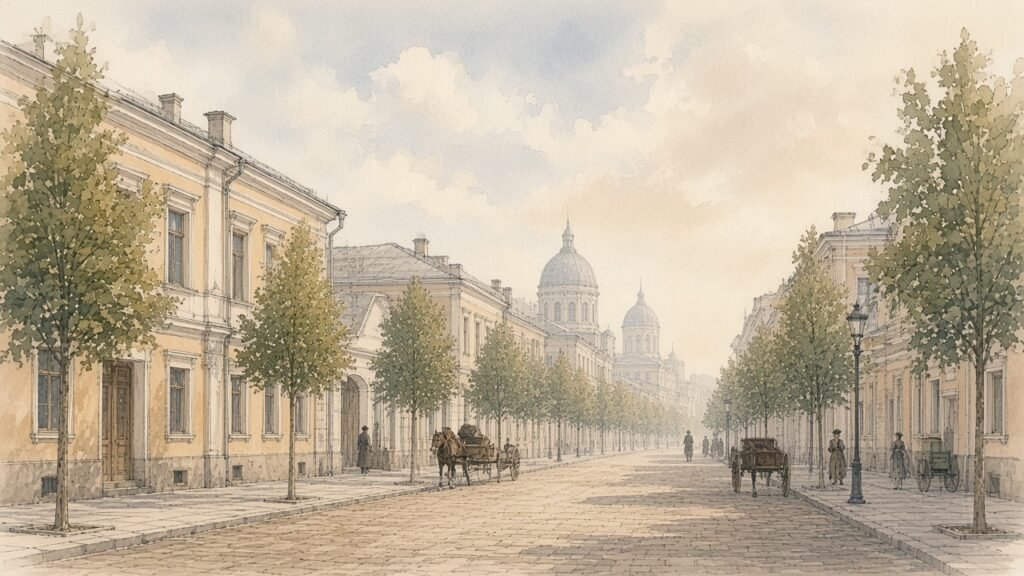
Municipal government operated under imperial statutes that defined the competences of the city duma and the mayor. Budgets covered paving, lighting, policing and poor relief in proportions that always seemed inadequate to reformers. Fires remained a danger in wooden quarters. Cholera and other epidemics struck periodically; sanitary commissions responded with varying energy. The water of the Bâc, used for industry and polluted by waste, featured in complaints. Wells and later piped supply became markers of urban modernity.
The Orthodox cathedral of the Nativity, built in the 1830s to designs associated with Abram Melnikov, gave the upper town a monumental focus. Its neoclassical forms announced imperial taste. Older Moldavian churches continued to serve parishes. Synagogues multiplied as the Jewish population grew; the Great Synagogue and numerous smaller prayer houses structured religious geography. A Lutheran church served German colonists and officials. The city’s skyline, still low, acquired cupolas and spires that later painters and photographers would treat as emblems—though any account for this site must note that sacred architecture, in image as in life, has been variously preserved, altered and contested.[1]
Education expanded slowly. The theological seminary trained clergy. Gymnasia offered classical secondary education to a thin elite of Orthodox, Jewish and other pupils who passed entrance barriers. Jewish secular schools, promoted by maskilim and regulated by the state, taught Russian and secular subjects alongside Jewish studies. Heders continued to educate the majority of Jewish boys in traditional curricula. Girls’ education lagged but advanced through private schools and, later, public provision. Literacy in Russian became a credential for advancement; literacy in Romanian and in Yiddish structured other publics.[4][5]
Commerce diversified. Grain trading houses linked Bessarabian harvests to Odessa exporters. Wine cellars and tobacco works employed seasonal and permanent labour. Artisans—tailors, shoemakers, carpenters, metalworkers—clustered in streets that took their names from trades. Jewish dominance in certain retail and craft sectors was statistically marked by the later nineteenth century and was noted, with admiration or resentment, by contemporary observers. Credit institutions, some Jewish and some not, financed trade. Bankruptcy courts recorded the failures that accompanied growth.[5][7]
Transport improved with road works and, from the 1870s, with railway connections that tied Kishinev more tightly to the imperial network. The railway station, built outside the older core, pulled development toward new axes. Suburban villages—Buiucani, Visterniceni, Muncești and others—were gradually absorbed or linked by tram and road. The city’s population passed 100,000 by the end of the century. The 1897 census recorded roughly 108,000 to 109,000 inhabitants in the city proper, of whom about 46 percent were Jews—a proportion that made Kishinev one of the most heavily Jewish large towns of the empire.[4][7]
Cultural life included theatres, newspapers and voluntary associations. Russian-language papers served officials and the assimilated public; Romanian-language publication faced constraints but persisted; Yiddish and Hebrew journalism flourished in various degrees of legality and quality. Amateur theatricals and visiting companies entertained mixed audiences. Clubs organised reading, charity and politics. The provincial capital was no St Petersburg, yet it participated in the empire’s wider currents of reform, reaction and national awakening.
Social geography hardened. The upper town housed officials, prosperous merchants and professionals. The lower town and certain suburbs housed poorer artisans, labourers and the densest Jewish neighbourhoods. This geography would matter in April 1903, when violence mapped onto streets and courtyards that reformers had failed to integrate into a single civic body. Building a capital had created wealth, institutions and green avenues; it had also created the spatial conditions of catastrophe.[2][7]
Police and military garrisons maintained order in ordinary times and failed, spectacularly, in extraordinary ones. The presence of thousands of troops in and near the city did not prevent the 1903 pogrom; it framed debates about official negligence. Governors came and went. Some promoted sanitation and schools; others left little mark. The quality of provincial administration varied with personality and with the attention of St Petersburg.
Architectural fashion moved from neoclassicism toward eclectic and, later, art nouveau facades on the principal streets. Private mansions of grain merchants and bankers displayed wealth. Courtyard housing of a more modest type filled secondary streets. Gardens and orchards survived in plots behind houses, preserving the city’s reputation for greenery even as density increased. Travel writers continued to call Kishinev a garden city into the early twentieth century.
Professional classes—lawyers, doctors, teachers, engineers—formed associations and read the metropolitan press. Many were Jewish; many were Orthodox Moldavian or Russian. Professional antisemitism and professional solidarity coexisted uneasily. Universities elsewhere in the empire supplied credentials; Kishinev itself lacked a full university in the tsarist period, a gap that sent ambitious youth to Odessa, Kiev, Dorpat or abroad.
Women entered teaching, clerical work and medicine in growing numbers by 1900. Charitable societies gave middle-class women a public role. Feminist and socialist currents reached the city through pamphlets and personal networks. The documentary record of women’s organisations, incompletely preserved, shows fundraising, night schools and mutual aid. Private life’s constraints—dowry, chaperonage, early marriage—remained strong even as public opportunities widened.
By 1900 Kishinev was a mature provincial capital: green, commercial, multiethnic, administratively Russian, demographically balanced between a large Jewish urban population and a Moldavian hinterland, connected by rail to the empire and culturally alert to Odessa and to the Romanian lands across the Prut. It was also a city in which antisemitic journalism had found a loud local voice. The next chapters turn to the Jewish city in detail and to the violence that made the name Kishinev notorious throughout the Jewish world. Statistical committees compiled provincial yearbooks that listed factories, schools and livestock. Historians still use these tables, adjusting for undercounting and category changes. The yearbooks present Kishinev as a success of imperial urbanisation; reading them beside police and charity records restores the poor to the picture.
Fire insurance maps, where they survive, show construction materials street by street. Wooden lower-town density explains both fire risk and the rapid spread of riot in 1903. Brick upper-town streets burned less easily and were policed more visibly. Material fabric and social vulnerability mapped onto each other.
Theatre repertoires included Russian classics, light opera and occasional Romanian or Yiddish performances under varying censorship. Benefit nights raised money for hospitals and schools. Actors’ memoirs, rare for Kishinev, illuminate touring circuits that linked Odessa, Kiev and provincial stages.
Veterinary and agricultural societies promoted improved vines and cattle breeds. Bessarabia’s export reputation depended on such improvements. Chișinău hosted exhibitions that displayed provincial produce to visiting officials. Agrarian modernity and urban capital status reinforced each other.
Prison records document ordinary crime and political surveillance. The provincial prison held thieves, debtors and, at times, political suspects. Reformers complained of overcrowding. Genealogy researchers now find ancestors in these grim lists.
Photographic studios opened in the later nineteenth century. Family portraits, street views and official group photographs created a visual archive that museums and websites still circulate. The camera made Kishinev imaginable to distant relatives and to the imperial public.
Tram concessions and utility contracts attracted foreign and Odessa capital. Corruption allegations accompanied many contracts. Municipal politics was a business as well as a civic vocation. Investigative reporting in the local press occasionally exposed scandals before censorship intervened.
Earthquake tremors reminded builders of seismic risk even before the major twentieth-century quakes. Construction practices adapted incompletely. Heritage losses to later earthquakes had nineteenth-century precedents in cracked walls and hurried repairs.
By 1900 the capital’s institutional density—schools, courts, hospitals, newspapers, synagogues, churches—supported a public sphere capable of both cultural production and catastrophic failure. The building of the capital was complete enough to stage the drama of 1903. Postal directories and address books from the 1870s to 1914 allow reconstruction of occupational topography. Goldschmidt the tailor, Ivanov the clerk, and Cohen the grain dealer appear on the same pages. Digitisation projects have begun to make these directories searchable. Urban history gains names where once it had only categories. Evening gaslight transformed commerce and courtship along the boulevard. Shop hours extended. Police reports of night disturbances rose. Illumination was progress with a crime appendix. Directory advertisements for dentists, photographers and sewing-machine agents sketch a consumer culture in formation. Desire was taught by the page as well as by the shop window.
6. Pushkin in exile
Alexander Pushkin arrived in Kishinev in September 1820, transferred to the administration of Bessarabia after his southern exile had begun in Ekaterinoslav and the Caucasus. He remained until July 1823, when he was moved to Odessa. The three years in Kishinev occupy a distinct place in his biography and in the city’s cultural memory. The young poet, already famous for Ruslan and Lyudmila and for politically sensitive verse, lived under surveillance, drew a modest official salary, and wrote in a provincial setting far from the capitals.[8]
Kishinev in the early 1820s was still a raw capital. Dust, vines, irregular streets and a mixed population of Moldavians, Russians, Jews, Armenians, Greeks and others formed the backdrop. Pushkin lodged in houses that local tradition later identified and museumified. He participated in the social life of officers and officials, danced, quarrelled, pursued love affairs and read. Letters and memoirs by contemporaries sketch a restless exile who mocked provincial society even as he depended on it.
Literary production of the Kishinev period includes lyrics, unfinished projects and work toward longer narratives. The southern poems as a group—The Prisoner of the Caucasus, The Fountain of Bakhchisarai and related pieces—belong to the broader southern exile rather than to Kishinev alone, yet the Bessarabian years supplied images, encounters and a sense of frontier exoticism that entered his writing. Scholars debate how much specifically Bessarabian colour appears in particular texts; what is clear is that the exile shaped his reputation and his networks.[8]
Political atmosphere mattered. The Greek uprising of 1821 and the movement of Philhellenes through the principalities and Odessa created excitement and suspicion. Pushkin’s interest in freedom, his contacts among officers, and the memory of the Decembrist circles that would erupt in 1825 placed him under watch. Kishinev’s police and the governor’s office tracked unreliable elements. The poet’s famous restlessness had an administrative dimension.
Local memory has made Pushkin a civic emblem. The Pushkin House Museum, streets and monuments commemorate the exile. School curricula in Russian and later in Soviet Moldavia treated the Kishinev years as a point of pride. Romanian and Moldovan narratives have sometimes emphasised other cultural heroes. The competition over commemorative space is itself part of the city’s modern history. A balanced account notes both the genuine literary importance of the exile and the later instrumental uses of Pushkin’s name.[1][8]
Daily life for the exile included the frustrations of provincial boredom and the pleasures of a warm climate and cheap wine. Pushkin’s letters complain and joke by turns. He studied, translated and drafted. He observed Jewish and Moldavian customs with the curiosity and the prejudices of his class and time. Ethnographic accuracy was not his aim; atmospheric suggestion was. Later readers have sometimes mined his remarks for social history; the yield is real but partial.
The household economy of a junior official in exile depended on salary, gifts and credit. Gambling losses and debts appear in the biographical record. Hosts and acquaintances filled gaps. The social hierarchy of a small capital meant that a famous poet, even in disgrace, remained a catch for dinner tables. Women of the official and boyar circles feature in anecdotes that biographers have repeated and revised.
Comparison with other exiles and with Pushkin’s later Mikhailovskoye confinement highlights what Kishinev offered: urban society, however provincial; proximity to the Ottoman frontier; and a multiethnic street life unlike the northern estates. Odessa, his next station, would offer a larger port city and a different intensity. Kishinev was the quieter, greener, dustier prelude.
After 1823 Pushkin did not return. The city continued without him, growing into the capital described in the previous chapter. Yet the association stuck. Tourist itineraries, school essays and museum labels keep the exile present. For a history of Chișinău the Pushkin years matter less as literary criticism than as evidence of how a provincial capital participated in imperial cultural circuits—and of how later regimes used that participation for legitimacy.
Archival traces of Pushkin’s Kishinev sojourn include official correspondence, postal records and the memoirs of officers such as I. P. Liprandi and others who knew him. Discrepancies among memoirs are well known to specialists. The historian of the city may leave fine-grained biographical disputes to literary scholars while retaining the firm outline: three years, surveillance, writing, social life, departure for Odessa.
The houses associated with Pushkin have been restored, damaged, rebuilt and interpreted across Russian, Romanian and Soviet administrations. Authenticity debates accompany every plaque. What visitors see today is a layered commemorative site rather than an untouched 1820s interior. That layering is typical of Chișinău’s heritage landscape more broadly.
Pushkin’s antisemitic and ethnographic remarks, where they occur in letters and drafts, belong to the common stock of his milieu and should neither be erased nor anachronistically foregrounded as the essence of the exile. A formal history notes them as part of the evidence for attitudes among imperial officers and literati in Bessarabia. The Jewish city that would later dominate Kishinev’s demography was already visible in the 1820s; Pushkin saw it through the eyes of his class.
By the time of Pushkin’s death in 1837 Kishinev had continued its growth. The poet’s name remained a resource for civic identity. In Soviet Moldavia, Pushkin statues and school names served Russophone cultural policy. In independent Moldova, commemorative practice has been more plural, with Romanian-language and national heroes sharing space. The exile of 1820 to 1823 thus remains a living thread in the city’s self-presentation, even as the demographic and political realities of Chișinău have repeatedly changed.[8]
For the structure of this essay the Pushkin chapter serves as a hinge between the building of the capital and the deeper examination of its peoples. The green provincial town that housed the poet was the same town that would, within eighty years, become synonymous with pogrom in the Jewish public sphere of Europe and America. Continuity of place and rupture of meaning define the problem. Pushkin’s reading in Kishinev included classical authors, contemporary French literature and materials for his growing historical interests. Booksellers in a small capital offered a limited stock; friends lent volumes; orders from the capitals took weeks. The intellectual diet of exile was real but constrained.
Dueling culture among officers shaped masculine honour codes that Pushkin both mocked and inhabited. Quarrels over cards, women and remarks escalated according to scripts familiar across the empire. Kishinev’s garrison supplied partners and audiences for these dramas.
Moldavian boyar hospitality included feasts at suburban vineyards. Pushkin’s attendance is attested in memoirs. The social mixture of such gatherings—Russian officers, local nobles, occasional foreign visitors—embodied the frontier capital’s peculiar society.
Linguistic notes in Pushkin’s papers occasionally register Romanian or Romani words and customs. Philological accuracy was uneven; ethnographic curiosity was genuine. Later Romanian critics have both claimed and critiqued his Bessarabian gaze.
The postal censorship that read his letters was part of the exile’s condition. Self-censorship and coded allusion appear in surviving correspondence. What was destroyed by the poet or by the police remains unknown. The Kishinev letter corpus is therefore a curated remnant.
Local women who appear in biographical tradition—named and unnamed—have been treated variously as muses, victims and literary devices. Feminist historiography asks for their agency beyond the poet’s plot. Sources rarely permit full answers; the question remains worth posing.
After departure for Odessa, Pushkin’s references to Kishinev diminished. The city became a chapter rather than a continuing home. For Kishinev, conversely, the chapter never closed. Museum pedagogy keeps the poet permanently present.
Soviet literary scholarship produced detailed chronologies of the exile that remain useful even when their ideological framing has dated. Post-Soviet scholarship has reopened questions of empire, ethnicity and sexuality in the southern period. The Kishinev years participate in these wider debates.
Commemorative practice includes readings, school competitions and wreath-layings. Each regime has tuned the ceremony to its needs. The poet’s statue and museum are thus political objects as well as cultural ones. Visitors may ignore the politics and still encounter a carefully staged nineteenth century.
Kishinev’s climate in the early 1820s—hot summers, muddy seasons, abundant fruit—entered Pushkin’s letters as both pleasure and complaint. Sensory history of the exile can be written from these remarks alongside officers’ memoirs. The taste of Bessarabian wine and the irritation of dust were part of the condition of writing.
Friends among the freemasons and among officers under watch shared books and songs. The boundary between sociability and conspiracy was thin in police eyes. Pushkin’s proximity to such circles kept him under observation without yielding a simple political label for the Kishinev years. Copybooks of Pushkin’s Kishinev lyrics circulated among local amateurs before metropolitan publication fixed the texts. Variant readings interest philologists. The exile’s first audience was provincial and warm. Garden paths where Pushkin walked have been relandscaped repeatedly. Claiming a path as his is mostly conjecture. Tour guides nonetheless point. Desire for presence outruns evidence, a common heritage predicament.
7. Streets, gardens and institutions
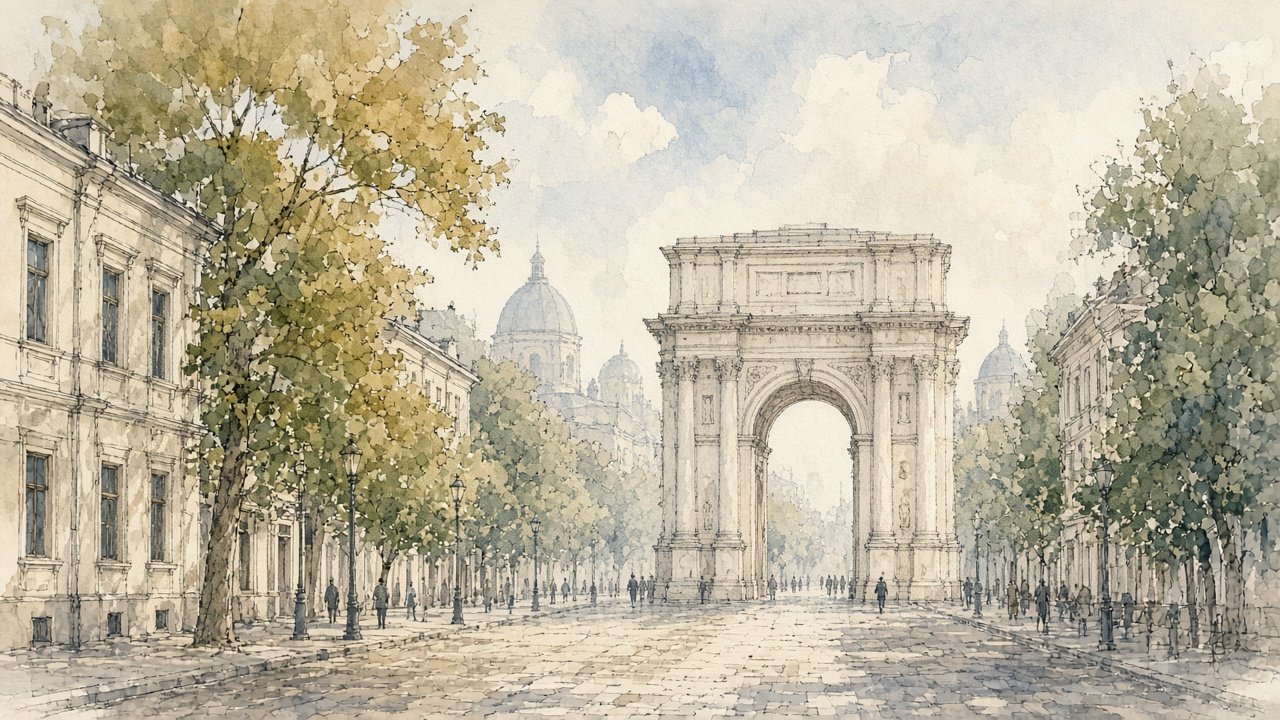
By the late nineteenth century the streets and gardens of Kishinev formed a coherent urban landscape that residents recognised as their own. The principal avenue of the upper town—later Ștefan cel Mare Boulevard—ran as a wide, tree-lined axis past public buildings, shops and the gates of the central park. The Triumphal Arch (Holy Gates), erected in the 1840s to commemorate the Russian victory in the war of 1828 to 1829, stood as a neoclassical marker near the cathedral square. Side streets carried the traffic of carts, droshkies and, eventually, trams. Gas lighting and then electric lighting extended the evening economy.[1][2]
Gardens were not merely decorative. Vineyards and orchards occupied plots within and around the city. Fruit sellers filled markets. Wine cellars stored the production of Bessarabian hills. Travellers’ clichés about Kishinev as a garden city had a basis in land use. As density increased, gardens retreated, yet parks and tree lines preserved a green character that distinguished the city from more densely built ports. The central park remained a promenade for all classes, a stage for uniforms, parasols and newspaper reading.
Institutions multiplied. Hospitals, including Jewish communal hospitals, served a growing population. Banks and credit societies financed trade. Printing presses issued newspapers, liturgical books and pamphlets. The city duma debated budgets and bylaws. Voluntary associations—charitable, professional, national—organised lectures and collections. Fire brigades, incomplete sewerage and contested water supply occupied municipal agendas. Reformers measured Kishinev against Odessa and found it wanting; patriots defended its amenities.
Architectural eclecticism marked the decades before 1914. Eclectic facades, neo-Renaissance details and early art nouveau ornaments appeared on commercial buildings. Courtyard houses of a Balkan and south-Russian type filled secondary streets, with workshops on the ground floor and dwellings above. Synagogue architecture ranged from modest prayer rooms to more ambitious structures. Orthodox churches of imperial style stood beside older Moldavian fabric. The Lutheran church and other minority houses of worship completed a confessional map visible to any walker.[1]
Transport and communication tied the city to the empire. Telegraph and postal services carried news. The railway brought goods, conscripts, travellers and ideas. Hotels near the station housed commercial visitors. The road to Bender and the routes toward the Prut remained important for local traffic. Suburban growth followed the new infrastructures. Villages became neighbourhoods; neighbourhoods acquired schools and police posts.
Language on the streets remained mixed. Russian dominated administration, secondary education and much high commerce. Romanian was heard in markets, in working-class districts and in the speech of servants and carters. Yiddish filled Jewish courtyards and many shops. Ukrainian, Bulgarian, Gagauz, German and other languages appeared according to neighbourhood and occupation. Advertisements and shop signs reflected this polyglossia until later regimes imposed stricter linguistic hierarchies.
Leisure included theatre, music, cafés and the promenade. Visiting opera and drama companies played short seasons. Local amateurs staged benefits. Cafés served as reading rooms and political exchanges. Sport clubs and cycling associations appeared late in the century. Seasonal festivals—Orthodox, Jewish, state—structured the calendar. Easter and Passover, when they coincided, charged the atmosphere; in 1903 that charge became catastrophic.[7]
Philanthropy built lasting institutions. Jewish and Orthodox charities funded hospitals, orphanages and dowry funds. Municipal poor relief covered only part of need. Begging and informal mutual aid filled gaps. Epidemics tested these systems. The cholera years left traces in burial records and in sanitary reports that historians still mine for demographic data.
Professional directories listed doctors, lawyers, notaries and midwives. Jewish overrepresentation in medicine and law was a statistical fact and a political grievance for antisemites. Professional associations debated ethics and fees. Malpractice and fee disputes reached the courts. The thinness of the professional class relative to population meant that personal reputation carried great weight.
Women’s public presence increased in teaching, clerical work, midwifery and charity. Secondary education for girls expanded. Socialist and Zionist movements recruited young women. Orthodox and Jewish religious structures offered different roles—teachers, mikveh attendants, charitable organisers. The historiography of women in Kishinev remains incomplete; surviving association minutes and school records are among the best sources.
By 1900 the physical and institutional city was mature enough to support the dense Jewish public sphere described in the next chapter and fragile enough to fail the test of April 1903. Streets, gardens and institutions are not neutral backgrounds. They are the stage on which commerce, politics and violence unfold. Kishinev’s stage was green, wide and fatally divided between quarters that did not equally share the protection of the state.[2][7]
Police statistics, where they survive, record theft, assault and public drunkenness as the ordinary crimes of a provincial capital. Extraordinary crime—the organised riot—would require a different analysis. The geography of policing, with posts concentrated in some districts and thin in others, shaped response times in 1903. Reform proposals after the pogrom included better street lighting and more patrols, the classic municipal answers to moral panic and real danger alike.
Markets specialised: cattle, grain, clothing, second-hand goods. Market women and Jewish traders dominate contemporary descriptions. Price riots and disputes over weights appear in police blotters. The moral economy of the market—accusations of overcharging, of collusion, of ritual offence—fed into the antisemitic press that prepared the ground for pogrom.
Schools reported enrolment by confession and language. Competition for places in prestigious gymnasia was intense. Quotas and informal barriers limited Jewish entry even where talent was clear. Private tutoring filled gaps. The production of a Russophone elite through the school system was a deliberate imperial project; its partial success in Kishinev created the bilingual and trilingual intelligentsias that later staffed Romanian and Soviet institutions.
The Triumphal Arch and the cathedral square formed a ceremonial centre for imperial holidays, military parades and religious processions. Photographs from the turn of the century show uniforms, crowds and bunting. The same spaces would host Romanian royal visits after 1918 and Soviet demonstrations after 1944. Continuity of ceremonial geography across regimes is one of Chișinău’s quiet structural facts. Street lighting contracts specified lamp types and hours. Darkness in unlit alleys structured both crime and courtship. Petitions for additional lamps reveal neighbourhood hierarchies of attention. Light was a municipal good unequally distributed.
Water sellers and well committees managed supply before piped systems. Contested access to wells appears in police reports. Cholera maps later correlated mortality with water sources. The politics of water was a politics of class and neighbourhood.
Cemetery location and expansion occupied municipal agendas. Orthodox, Jewish, Lutheran and other burial grounds marked confessional space at the city’s edge. Processions from centre to cemetery were public performances of mourning. Urban growth periodically threatened burial land.
Market halls and open squares specialised by product. Municipal fees and stall allocations favoured certain traders. Conflicts over allocation reached the duma. The sounds and smells of markets dominate memoir accounts of childhood in Kishinev.
Hotel registers, where preserved, list commercial travellers, officers and touring artists. The city’s insertion into wider circuits is measurable in these names. A night’s lodging connected Kishinev to Odessa, Iași and Vienna.
Bicycle clubs and early automobile owners announced modernity on the boulevard. Accidents and bylaws followed. Photographs of early cars in Kishinev streets are prized by collectors. Speed changed the experience of the garden avenues.
Seasonal mud and dust structured complaints in the press. Paving programmes never covered all streets. Boot scrapers and raised sidewalks were markers of respectable housing. The sensory history of the city includes the feel of mud underfoot.
Nightwatchmen and private guards supplemented thin policing in commercial districts. Jewish courtyard gates closed at night. The architecture of security preceded the pogrom and failed during it. Locked gates were not enough when mobs came in daylight.
Street renaming across regimes created layered toponymies. Maps from different decades disagree on names for the same alignments. Historians working with addresses must hold multiple nomenclatures in mind. Residents often kept old names in speech long after official change. Public toilets, bathhouses and laundry places rarely enter civic boastfulness yet structured hygiene and women’s labour. Municipal reports count them. Reformers demanded more. The infrastructure of cleanliness is part of the garden city’s hidden history. Snow clearance contracts in winter employed day labourers from the suburbs. Failure left the boulevard impassable and the duma embarrassed. Climate and municipal competence met each February. Bandstands in the central park hosted military and civilian concerts on summer evenings. Programmes mixed waltzes and marches. Audience behaviour—applause, flirtation, newspaper reading—made the park a theatre of manners as well as of music.
8. The Jewish city
Jewish Kishinev by 1900 was one of the principal Jewish cities of the Russian Empire’s south-western frontier. The 1897 census counted some 50,237 Jews in a city of about 109,000—roughly 46 percent. Jews owned a large share of commercial and industrial enterprises, dominated much of retail trade and filled the ranks of artisans in garment production, carpentry and related crafts. Legal barriers that excluded Jews from landownership and from many state offices channelled energy into the urban economy. Poverty and wealth coexisted: charitable societies documented widespread need even as a merchant elite built mansions and endowed institutions.[4][5][7]
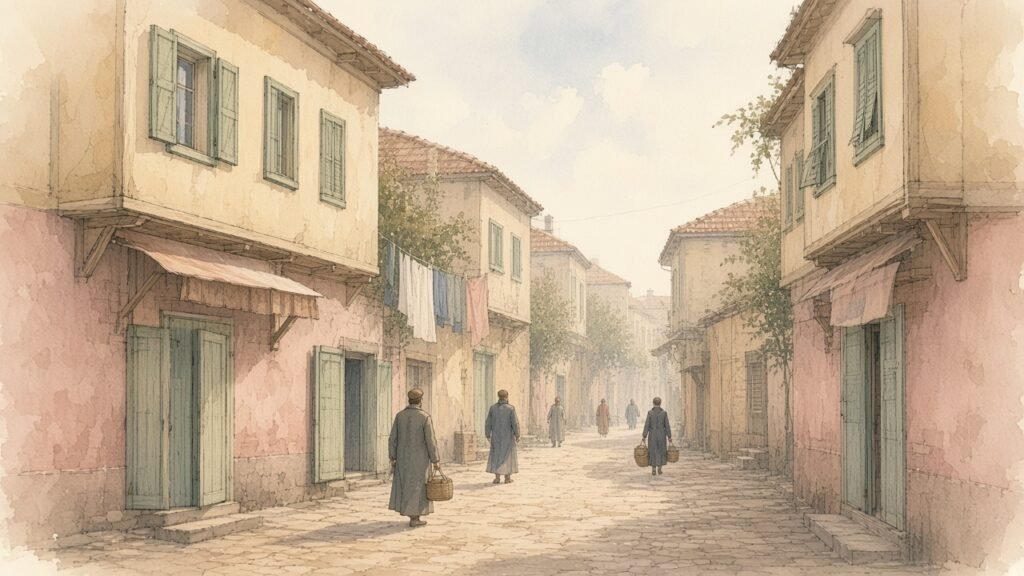
Communal organisation rested on synagogues, burial societies, a hospital, schools and welfare associations. The Society in Aid of the Poor of Kishinev, formed from earlier bodies, coordinated relief. A Hasidic yeshiva, among the first in the south of the empire, functioned from 1860. State Jewish schools and private maskilic schools taught secular subjects. Heders remained numerous. Girls’ education advanced through private initiatives. Rabbis, maskilim, Zionists and traditionalists contested the tone of communal leadership.[4][5]
Religious life spanned Orthodoxy, Hasidism and modernising currents. Prayer houses served landsmanshaftn and occupational groups. The Great Synagogue and other major congregations marked the calendar with public worship. Kashrut, mikveh and sabbath observance structured daily life for the observant majority; a growing minority adopted more secular habits while remaining within communal boundaries. Burial in the Jewish cemetery produced a landscape of Hebrew and Russian inscriptions that genealogists still photograph.
Language stratified the community. Yiddish was the mother tongue of most households. Hebrew was the language of liturgy, study and, increasingly, of Zionist aspiration. Russian was the language of the gymnasium, the professions and advancement. Romanian was heard in market contact with Moldavian customers. Children often moved among three languages. The press reflected this polyglossia: Yiddish papers for a popular audience, Russian-Jewish papers for the assimilated, Hebrew periodicals for Zionists and scholars.[4][5]
Economic roles made Jews visible and vulnerable. As intermediaries between peasant producers and urban or export markets, Jewish traders absorbed resentment when prices fell or credit tightened. Artisans competed with non-Jewish workshops. Factory ownership by Jews in milling, tobacco and garments was statistically marked. Antisemitic journalism, especially in the newspaper Bessarabets under Pavel Krushevan, translated economic friction into ritual murder libels and conspiracy theories. The ground for 1903 was prepared in print as well as in the street.[7][9]
Political currents multiplied after 1881. Liberal integrationists trusted imperial reform. Zionists organised clubs, Hebrew classes and collections for Palestine; Hibbat Zion had early roots in Bessarabia. Socialist and Bundist ideas reached workers and students. Self-defence discussions, still theoretical before 1903, would become practical afterward. Emigration to the United States and Argentina rose in waves tied to violence and to economic hope. Between 1902 and 1905 the city’s Jewish population fluctuated under the pressure of flight and return.[4][5]
Women’s organisations ran night schools, dowry funds and hospital aid. Teachers, midwives and clerical workers formed an emerging female public. Matchmaking and dowry inflation structured bourgeois marriage. Private life’s economic calculus is part of communal history. Memoirs and letters, preserved in archives in Israel, the United States and Moldova, give access to kitchens, courtyards and workshop floors that official statistics omit.
The built environment of Jewish Kishinev included synagogues, the hospital, schools, courtyard housing and the cemetery. Many structures were damaged in 1903, again in 1905, and catastrophically during the Second World War. Soviet urban planning erased or repurposed others. Heritage initiatives since independence have marked sites and published walking maps. The physical trace of the Jewish city is fragmentary; the documentary and memorial trace is larger.
Relations with non-Jewish neighbours ranged from partnership to hostility. Business partnerships, shared streets and municipal coexistence exemplified the former; Bessarabets, professional exclusion and pogrom exemplified the latter. The imperial legal order set limits that were poorly enforced in April 1903. Understanding Jewish Kishinev requires holding together prosperity and vulnerability, cultural productivity and the knowledge that protection could fail.[7][9]
Philanthropy linked Kishinev to Odessa, to St Petersburg and to overseas donors. Fundraising after disasters followed telegraphed appeals. Account books record sums and beneficiaries. Charity was also ideological contest: Zionist collections competed with local welfare. The communal board managed taxation and representation under imperial rules that defined who counted as a voting member.
By 1903 Jewish Kishinev was confident enough to sustain a dense public sphere and exposed enough to suffer a pogrom that would define the city’s name in Jewish memory worldwide. The next chapter turns to those April days, to their causes and to their consequences. Rabbinic responsa and pinkasim (communal record books) from Kishinev and Bessarabia, where they survive in Israeli and diaspora archives, document marriages, bans and charitable decrees. These Hebrew and Yiddish sources complement Russian police files. A full social history requires both.
Artisanal strikes and journeymen’s complaints reveal class conflict within the Jewish economy. Masters and workers disputed wages and hours. Socialist organisers found audiences in workshops. The Bund’s message competed with Zionist and religious appeals for the same young artisans.
Steamship agents advertised passages to New York and Buenos Aires on courtyard walls and in the Yiddish press. Emigration was a household decision involving sale of goods, borrowed funds and letters from earlier migrants. Chain migration linked Kishinev streets to specific American neighbourhoods.
Music in Jewish Kishinev ranged from liturgical cantorial art to wedding bands and Yiddish theatre songs. Gramophone records later captured some of this soundscape. Oral historians have recorded elderly singers’ repertoires. Sound is a historical source when preserved.
Medical practitioners among Kishinev Jews included graduates of imperial universities and feldsher-trained healers. Epidemics tested both. Jewish hospitals set standards that municipal facilities sometimes matched and sometimes lagged. Professional pride and communal obligation intertwined.
Sport clubs bearing Jewish names organised football and gymnastics. Matches against other communal teams carried symbolic weight. Youth bodies were trained for health and, after 1903, for self-defence. The muscular Jew of Zionist ideology had local embodiments.
Library societies stocked Hebrew, Yiddish, Russian and European books. Reading rooms were heated refuges in winter. Debates over which languages and authors belonged on shelves mirrored wider cultural politics. Catalogues, when they survive, map intellectual horizons.
Funeral practices and eulogies preserved biographies of merchants and rabbis otherwise lost. Printed sermons circulated. Homiletics, read against the grain, yields social data. The cemetery remains a primary archive in stone.
By 1903 the Jewish city was demographically weighty, culturally productive and politically exposed. The density of its institutions made the violence that followed a blow to an entire urban civilisation, not merely to isolated victims. Hasidic courts beyond the city, including those linked to wider Ukrainian and Galician dynasties, drew Bessarabian followers who travelled for festivals and advice. Kishinev’s own prayer houses reflected these loyalties in their customs and melodies. The map of Hasidic allegiance was a map of spiritual geography overlaid on the Pale.
Maskilic salons debated Mendelssohn, scientific education and the reform of dress. Generational conflict between maskilim and traditionalists played out in marriages and in school choice. Periodicals staged the arguments for a reading public. The Haskalah in Kishinev was provincial yet connected to Odessa and Vilna.
Women’s literacy in Yiddish grew through romances, prayer books and the press. Female readers were a market that publishers cultivated. Night schools for women taught Russian and arithmetic. Emancipation of Jewish women in Kishinev was incremental and class-differentiated.
Credit cooperatives and mutual lending societies tried to reduce dependence on high-interest lenders. Success was partial. Bankruptcy still ruined families. The ethics of interest and collateral occupied rabbinic and secular debate alike.
Craft exhibitions displayed Jewish artisans’ work to municipal and imperial visitors. Medals and certificates entered family archives. Pride in skilled production coexisted with anxiety about factory competition. Industrial modernity threatened as well as employed.
By the turn of the century Kishinev’s Jewish public sphere was dense enough to sustain multiple newspapers, theatres and parties—and fragile enough that two days of riot could define its global reputation forever. Charitable ball seasons raised funds with orchestras and gowns that matched Odessa’s lesser events. Society pages in the Russian-Jewish press recorded attendees. Glamour and need shared the same communal calendar.
Apprenticeship contracts in artisan trades specified years, payments and moral conduct. Breach led to rabbinic or civil dispute. The making of a tailor in Kishinev was a legal as well as a manual process. Dowry registers and marriage contracts specify household goods in detail—featherbeds, candlesticks, sewing machines. Material culture of Jewish marriage is recoverable from these lists. Romance and property were not opposites. Burial society minute books record fees, grave locations and charitable exemptions. The geography of the cemetery is a geography of wealth and piety. Stone carvers’ styles date graves when inscriptions weather. Conservation photography now precedes restoration.
9. The pogrom of 1903
The Kishinev pogrom of 6 to 7 April 1903 (Old Style; 19 to 20 April Gregorian) lasted two days and left 49 Jews dead, more than 500 injured, and hundreds of houses and shops looted or destroyed. It was not the deadliest pogrom in the Russian Empire, yet it acquired outsized notoriety through vivid reporting, international protest and literary response. The name Kishinev became, for a generation, synonymous with Jewish vulnerability under tsarist rule.[7][9][10]
Immediate triggers included a blood libel arising from the death of Mikhail Rybachenko, a Christian boy found near Dubossary earlier in 1903. Autopsy and investigation indicated no ritual murder; the killer was a Christian relative. Nonetheless the antisemitic newspaper Bessarabets, edited by Pavel Krushevan, amplified rumours of Jewish ritual crime in the weeks before Easter. Orthodox Easter coincided with Passover. Church bells, crowds and alcohol mixed with incitement. Violence began around midday on Easter Sunday in central areas and spread to Jewish neighbourhoods in the lower town and suburbs.[7][9]
Mobs of local residents, workers and peasants from the surroundings attacked with clubs, stones and iron bars. Police response was delayed and inadequate despite the presence of a substantial garrison. Governor Rudolf von Raaben failed to deploy troops promptly. For more than a day the riot continued with little effective interruption. On the second day military forces finally restored order. The geography of violence followed the social geography of the city: poorer Jewish streets suffered most.[7][10]
Casualty figures settled, after investigation, at 49 Jewish dead—38 men and boys, 11 women and girls—with hundreds wounded and numerous rapes, the exact number of which remains debated because of underreporting and the rhetorical inflation of some contemporary appeals. Property damage ran to over a thousand dwellings and businesses. Contemporary Western press sometimes cited higher death tolls before correction. Historians such as Edward H. Judge and Steven J. Zipperstein have separated verified facts from myth while confirming the brutality of the assault.[9][10]
Official aftermath included von Raaben’s dismissal, an imperial investigation and trials that produced relatively light sentences for a minority of those arrested. Central government complicity in the sense of direct orders from St Petersburg has not been demonstrated; local negligence and a climate of tolerated antisemitic agitation are well documented. A forged “Plehve letter” fuelled contemporary belief in high-level orchestration; careful archival work has not sustained that specific claim. Responsibility lies in a combination of press incitement, popular antisemitism, economic tension and administrative failure.[9][10]
Jewish responses included relief committees, emigration and the organisation of self-defence. Hayim Nahman Bialik visited the city and wrote the poem In the City of Slaughter (also known in related forms), which condemned passivity as well as murder and became a foundational text of modern Hebrew literature and Zionist self-critique. International protest reached the United States, where mass meetings and a petition associated with President Theodore Roosevelt pressed the Russian government. Fundraising for victims linked Kishinev to Jewish communities across Europe and America.[9][10]
The pogrom’s mythic afterlife sometimes overshadowed empirical history. Exaggerated atrocity details circulated in fundraising and journalism; later memory cast Kishinev as a unique climax rather than as one episode in a longer pattern that included the 1905 wave. Zipperstein’s study Pogrom: Kishinev and the Tilt of History examines how narrative and fact intertwined. For the city’s own history the facts remain stark: two days, dozens dead, a community traumatised, and a name forever altered in the world’s ears.[10]
A second pogrom struck Kishinev on 19 to 20 October 1905, amid the revolutionary upheaval following the October Manifesto. Nineteen Jews were killed and dozens wounded. Organised Jewish self-defence, built after 1903, limited the toll relative to 1903. The pattern of delayed policing recurred. Emigration accelerated. By 1910 the Jewish population had stabilised at a lower figure than the pre-1903 peak.[4][5]
Literary and artistic responses—Bialik, Lilien’s graphic works, Yiddish lament songs—carried Kishinev into the cultural memory of the Jewish twentieth century. Memorials in Chișinău, including the monument in Alunelul Park erected in 1993, mark the site for contemporary commemoration. Diplomatic statements on anniversaries continue to link the pogrom to broader warnings against ethnic violence.[9]
For the structure of this essay the 1903 pogrom is both a climax of imperial Kishinev’s contradictions and a prelude to the further catastrophes of war and Holocaust. The green capital that Pushkin had known, the commercial city of the 1897 census, and the Jewish public sphere of schools and synagogues all met, in April 1903, a failure of protection that no subsequent regime could fully repair in memory. Michael Davitt’s on-site reporting for the Hearst press brought Kishinev into American living rooms with a mixture of verified observation and rhetorical intensity. His account shaped English-language memory. Comparison with Russian official reports and Jewish relief committee tallies remains a historiographical exercise.
Vladimir Korolenko’s essay on House No. 13 used a single looted dwelling to indict society. Literary method served moral witness. Tolstoy and Gorky also spoke; conservative papers minimised or justified. The Russian public sphere split along familiar lines.
Trial transcripts, partially published, show defendants claiming drunkenness, rumour and crowd pressure. Judges and juries operated within an antisemitic common sense that limited accountability. Sentences disappointed Jewish observers and foreign diplomats. Law performed imperfectly.
Relief funds from the United States, Britain and western Europe passed through committees in Odessa and Kishinev. Accounting scandals occasionally erupted. Most funds reached victims as food, clothing, rebuilding grants and emigration aid. Transnational Jewish solidarity had institutional form.
Self-defence drills after 1903 used scrap weapons and borrowed revolvers. Police attitudes ranged from harassment to grudging tolerance. In 1905 these preparations saved lives. The lesson of Kishinev for Jewish politics was organisational as well as emotional.
Bialik’s poem, in Hebrew and in translation, reached audiences who never saw Bessarabia. Its accusation of passivity wounded and mobilised. Later critics have debated its fairness to actual self-defence efforts; its cultural force is not in doubt.
Postcard images of destruction circulated as proof and as fundraising tools. Visual culture of the pogrom includes atrocity imagery that raises ethical questions for historians about display and voyeurism. Archives flag sensitive materials; educators choose carefully.
Anniversary commemorations in Chișinău since independence have involved the Jewish community, diplomats and sometimes national officials. Speeches link 1903 to tolerance education. The monument’s granite and the park’s trees form a quiet counterpoint to the boulevard’s ceremonial noise.
The pogrom’s place in Zionist and Bundist memory differed in emphasis—territorial exit versus local organisation—yet both treated Kishinev as evidence. American Jewish politics used it to argue for immigration defence and for protest diplomacy. A local riot became a global reference. Lists of victims compiled by relief committees and later by JewishGen researchers name the dead street by street. Genealogy reconstitutes families from these lists. Each name resists the anonymity of aggregate death tolls. Memorial candles on anniversaries are lit for persons as well as for a symbol.
Diplomatic correspondence from the American and British missions in Russia reported the pogrom with varying accuracy. Roosevelt’s association with protest petitioning entered American Jewish political memory. The limits of foreign pressure on the tsarist regime were also demonstrated.
Krushevan’s subsequent career, including his role in circulating Protocols-related materials, links Kishinev’s local incitement to a wider antisemitic international. Intellectual history of the Protocols passes through Bessarabian hands. The city’s shame was not only riot but ideology.
Insurance claims and property inventories after the pogrom quantify loss in rubles. Rebuilding grants never matched inventories. Some families never recovered economically. Emigration was sometimes the only remaining strategy.
Comparative historiography places Kishinev beside Homel, Odessa 1905 and other sites. Scale, press attention and literary response made Kishinev exemplary. Exemplarity can distort; Zipperstein’s caution about myth remains salutary. The local dead remain local even when the world claims them. American Jewish relief organisations learned logistics in Kishinev that they later applied to larger catastrophes. Institutional memory of 1903 shaped responses to 1914–18 refugee crises and beyond. Local disaster trained transnational capacity. Surgeons who treated the wounded left case notes that forensic historians read for weapon types and timing. Medical evidence corroborates and sometimes corrects memoir. The body’s archive is precise where rhetoric is not. Children orphaned in April 1903 entered communal orphanages funded by local and overseas donors. Case files, where they survive, follow some into emigration. The pogrom’s demographic aftershock lasted a generation in household form.
10. Revolution and the late empire
The years between the 1905 pogrom and the First World War saw Kishinev participate in the empire’s constitutional experiments, revolutionary underground and national awakenings. The October Manifesto and the Duma elections created new political arenas. Jewish parties, Russian liberals, Moldavian cultural activists and socialist cells competed for influence within the limits of police surveillance. The city remained a governorate capital, green and commercial, but its publics were more openly politicised than before.[2][5]
Moldavian (Romanian) cultural nationalism gathered strength through societies, periodicals and schools that asserted linguistic rights against Russification. The proximity of Romania, independent since the late nineteenth century, offered a mirror and a magnet. Some activists looked to Iași and Bucharest; others sought autonomy within a reformed empire. The peasantry of Bessarabia, largely Romanian-speaking and Orthodox, remained the demographic majority of the province even as Kishinev’s streets spoke many languages.[3][6]
Jewish politics diversified. Zionists built institutions and youth groups. Bundists organised workers. Liberal integrationists continued to hope for equal rights under imperial law. Emigration to America continued, though at varying rates. Self-defence organisations maintained readiness. The memory of 1903 structured every discussion of security. Trials and press debates kept the pogrom alive as a reference point.[4][5]
Economic life recovered from the immediate destruction of 1903 and 1905. Trade, crafts and small industry resumed. The railway and the Odessa connection remained vital. Vineyards and grain defined the hinterland’s contribution. Urban growth resumed. New buildings filled gaps. Yet inequality and overcrowding in poorer quarters persisted, and sanitary reform lagged.
The First World War brought requisition, inflation and the passage of armies. Retreating Russian forces in 1917 and 1918 looted and disrupted. Refugees from other parts of the collapsing empire entered the city. The Russian Revolution of 1917 dissolved the old administrative order. Soviets, national councils and military authorities competed. In this vacuum the question of Bessarabia’s future—Russian, Romanian, or autonomous—became urgent.[3][6]
The Sfatul Țării, a representative council in Bessarabia, voted in March 1918 for union with Romania after intermediate steps of autonomy and federation proposals. Romanian troops entered the province. Kishinev became, for the next twenty-two years with a brief Soviet interruption in 1940 to 1941, a Romanian provincial capital rather than a Russian one. The late empire ended not with a single decree but with war, revolution and a national assembly’s choice under pressure.[3][6]
Cultural life in the final imperial years included a mature press, theatre seasons and the continued polyglossia of the streets. Photographers recorded avenues, markets and family portraits that now fill archives. The last imperial directory of addresses captures a city on the eve of transfer. Many of the names in that directory would be gone by 1945.
Labour unrest and strikes flared in the revolutionary years. Food shortages and currency collapse hit the poor hardest. Charitable societies strained. Jewish relief organisations, some with overseas funding, filled gaps. The continuity of communal welfare across the 1918 boundary is one of the quieter threads of the city’s history.
For Moldavian intellectuals the union of 1918 fulfilled a national programme. For many Jews, Russians and others the change of sovereignty meant new language requirements, new officials and uncertainty. For the peasantry the questions were land, tax and recruitment. Kishinev’s streets absorbed all these tensions as Romanian administration replaced Russian.[3][11]
The late empire thus closed with the city intact as a physical place and transformed as a political one. The chapters that follow examine Romanian Chișinău, the Soviet annexations, the wartime destruction of the Jewish community and the long Soviet century that remade the capital yet again. Duma elections in Bessarabia returned deputies who spoke for landowners, for Russian nationalists and, within limits, for minority interests. Kishinev’s urban voters participated under franchise rules that weighted property. Political clubs debated programmes in Russian and Romanian. Police spies attended.
Underground printing presses produced revolutionary leaflets. Arrests of socialist and nationalist activists filled prison cells. Some later surfaced as Romanian-era politicians or as Soviet cadres. The revolutionary generation of 1905 to 1917 crossed the 1918 boundary in unexpected careers.
Wartime inflation from 1914 destroyed savings and strained charities. Military hospitals filled public buildings. Refugees from Galicia and from the retreating fronts crowded schools. Kishinev tasted imperial collapse before the formal end of Russian rule.
Soldiers’ soviets and national councils competed in 1917 for legitimacy. Street demonstrations for land, peace and national rights overlapped and conflicted. The city’s garrison was unreliable. Authority fragmented by the week.
Sfatul Țării delegates included Moldavian intellectuals, peasant representatives and minority members under complex formulae. Debates over autonomy, federation and union were real, even under the shadow of Romanian military presence. The vote for union was both a national act and a wartime decision.
Russian-speaking officials who stayed faced language tests and loyalty questions under Romanian rule. Some adapted; some left for the Soviet side when borders hardened. Continuity of expertise was partial. The capital’s administrative memory was disrupted.
Jewish deputies and communal leaders negotiated minority rights guarantees that Romania’s record would later compromise. The promise of 1918 and the practice of the 1930s diverged. Kishinev’s Jews entered Romanian sovereignty with hope tempered by recent memory of pogrom and war.
The late empire’s end was thus messy, multipolar and locally negotiated as well as internationally imposed. Chișinău’s streets registered every phase. Peasant unrest in Bessarabia during the 1905–1907 revolutionary years included land seizures and attacks on estates. Kishinev’s garrison was sometimes deployed to the countryside. The capital experienced revolution as rumour, refugee flow and political meeting as much as barricade.
Cooperative dairies and credit unions attempted agrarian modernisation. Agronomists trained in imperial institutes lectured in the province. Results were patchy. The peasantry’s relation to the capital remained one of tax, conscription and market rather than civic identification.
Jewish political parties ran candidates under the restricted franchises of the Duma era. Success was limited; symbolism mattered. Posters and leaflets in Yiddish and Russian survive in collections. Electoral geography of Kishinev’s wards reflected confessional residence patterns.
War industry from 1914 converted workshops to military supply. Women entered factory labour in larger numbers. Strikes over wages and food occurred. The social history of Kishinev’s war is still incompletely written from scattered factory and police files.
When Romanian troops entered in 1918, some residents greeted them as liberators and others as occupiers. The split mapped roughly onto language and politics but not perfectly. Individual choices were contingent. The late empire ended in a chorus of incompatible welcomes. Officers’ clubs and regimental libraries brought metropolitan culture to the garrison. Amateur theatricals in uniform played to mixed audiences. Military Chișinău was a city within the city, with its own calendars of drills and balls.
Grain price crises in the pre-war years emptied peasant purses and filled political meetings. Kishinev’s markets transmitted rural distress into urban politics. Bread riots elsewhere in the empire had local echoes.
When the Romanian army entered, some Russian imperial monuments were left standing and later reinterpreted; others were removed. The material politics of the transition deserves its own study. Continuity of paving stones accompanied discontinuity of flags.
Refugee relief in 1917–1918 trained a generation of communal organisers who later worked under Romanian and then Soviet conditions. Skills of committee work transferred across regimes even when ideologies did not. Troop trains through Kishinev in 1916–17 carried wounded from Romanian and Galician fronts. Station volunteers organised tea and bandages. The capital’s war was partly a hospital corridor. Food levies for the army emptied village stores and raised urban prices. Women’s demonstrations for bread occurred in Kishinev as elsewhere. Gendered protest is part of the revolutionary years’ record.
National Moldavian committees collected signatures and funds for cultural causes that shaded into political ones. The border between culture and politics dissolved as Russian authority dissolved. Telegraph bulletins posted outside newspaper offices drew crowds during the revolutionary months. Reading aloud for the illiterate made news a street performance. Literacy and orality shared the pavement.
11. Union with Romania
The union of Bessarabia with Romania in 1918 made Chișinău the administrative centre of a Romanian province. Romanian became the language of administration, secondary education and public inscriptions. Russian retained a large spoken presence; Yiddish continued in Jewish districts; Ukrainian and other minority languages persisted in their communities. The change of sovereignty was legal and symbolic as well as administrative: new flags, new holidays, new schoolbooks and a new orientation toward Bucharest.[3][6][11]
Romanian officials arrived to staff the prefecture, courts and schools. Land reform, a major Romanian project of the early 1920s, redistributed estates across Bessarabia with consequences for boyars, peasants and the credit networks that linked them to the city. Chișinău’s markets adjusted to new tariff and currency regimes. The railway now looked west toward Iași and Bucharest as well as east toward the Dniester. Commercial elites negotiated the transition with mixed success.
Jewish life under Romanian rule combined cultural vitality with political vulnerability. Hebrew and Yiddish schools, theatres and newspapers operated within Romanian legal frameworks that were more permissive in the 1920s than in the late 1930s. Zionist and Bundist activity continued. At the same time antisemitic parties and leagues, including the League of National Christian Defence and later the Iron Guard’s orbit, agitated against Jewish citizenship and economic presence. University and professional quotas limited advancement. Street violence and administrative harassment increased as Romanian politics radicalised.[4][5][11]
Moldavian and Romanian cultural institutions expanded. Theatres, publishing houses and schools promoted Romanian language and history. The city’s street names shifted toward Romanian historical commemorations. Ștefan cel Mare became the emblematic boulevard name. Monuments and plaques marked the union. Russian cultural life continued privately and in minority arrangements but lost its official primacy.
Urban modernisation continued. Trams, electricity, cinemas and new apartment buildings altered daily life. Cafés and parks remained promenade spaces. The garden character of the city persisted in tourist descriptions. Population growth brought suburban expansion. The 1930 Romanian census recorded a city in which Romanians, Jews, Russians and others formed a complex mosaic; exact percentages varied by how mother tongue and ethnicity were counted, a methodological issue that still occupies demographers.[11]
Relations with the Soviet Union across the Dniester were tense. The Moldavian Autonomous Soviet Socialist Republic, created on the Ukrainian bank in 1924, broadcast an alternative Moldavian identity under Soviet auspices. Propaganda and espionage flowed both ways. Chișinău’s authorities watched the border. Refugees and migrants crossed when they could. The ideological competition over what “Moldavian” meant—Romanian regional identity or Soviet nationality—had its urban stage in Chișinău’s schools and newspapers.[3][6]
The late 1930s brought royal dictatorship under Carol II, then the fragmentation of Romanian politics under German pressure. The Hitler–Stalin pact of August 1939 assigned Bessarabia to the Soviet sphere of interest. In June 1940 the Soviet Union issued an ultimatum; Romania ceded Bessarabia and northern Bukovina. Soviet troops entered Chișinău. Romanian administration evacuated. The union of 1918 was reversed for a year, with consequences that the next chapters address.[3][6][12]
Looking back on the interwar decades from the far side of war, survivors remembered both the freedoms of the 1920s—press, parties, schools—and the narrowing of the late 1930s. Jewish memoirs emphasise rising fear. Romanian official memoirs emphasise state-building. Soviet accounts later denounced Romanian rule as occupation. A formal history registers all three memories without collapsing them into one.
Economic statistics show Chișinău as a regional market and light industrial centre, not a heavy industrial giant. Artisans and small factories employed much of the workforce. Jewish participation in commerce remained high. Agrarian Bessarabia’s produce still flowed through the capital. The Depression hit credit and trade. Recovery was incomplete when the geopolitical crisis of 1940 arrived.
Educational institutions trained a Romanian-speaking elite for provincial service. Jewish students faced numerus clausus pressures. Russian-speaking families negotiated language shifts. The production of teachers, clerks and officers for the Romanian state was a central function of interwar Chișinău. Many of those trained would flee, perish or adapt under the regimes that followed.
The physical city of 1939 was still recognisably the green planned capital of the nineteenth century, thickened by decades of building but not yet transformed by Soviet tower blocks. Photographs from the late 1930s show avenues, the arch, the park and tram wires. Within five years much of the Jewish population would be dead or deported, and within twenty the streetscape would begin a different transformation. The Romanian chapter closed under Soviet tanks in June 1940.[12] Land reform commissions measured estates and assigned parcels. Litigation clogged courts. Peasant beneficiaries and dispossessed owners both petitioned Chișinău. The capital’s lawyers found steady work. Agrarian structure changed more on paper in some districts than in others.
Romanianisation of the university-preparatory schools altered teacher corps and curricula. Russian-language parents organised private supplements. Conflict over school language prefigured later identity wars. Children became carriers of state policy.
Censorship under Romanian administration targeted communist agitation and, increasingly, minority presses. Yiddish and Russian papers navigated permit regimes. Editors were fined and jailed. The relative openness of the mid-1920s narrowed thereafter.
Royal visits brought temporary spectacle: arches of flowers, school choirs, military reviews. Chișinău performed loyalty. Photographs of Carol II in the boulevard entered albums. Ceremony papered over economic grievance and minority fear.
Cross-border family ties to Soviet Moldavia and to Romania proper created correspondence and remittance channels that police watched. Letters were opened. Accusations of espionage ruined careers. The Prut was a border through living rooms.
Economic alignment with the Romanian Old Kingdom redirected trade. Some Odessa-linked firms failed; others reoriented west. Jewish grain traders adapted or emigrated. The city’s commercial geography followed sovereignty.
Archaeological and historical societies under Romanian auspices emphasised Dacian and medieval Moldavian continuity. Russian imperial monuments were reframed or neglected. Museum labels taught a new past. Chișinău’s public history was rewritten in Romanian.
The ultimatum of 1940 ended these experiments. Suitcases packed overnight. Archives burned or abandoned. The union’s twenty-two years left street names, school cohorts and a contested memory that still structures Moldovan politics. Minority schools under Romanian law operated with permits that could be withdrawn. Hebrew pedagogical networks built impressive institutions under this uncertainty. Inspectors’ reports praise and police by turns. The quality of Hebrew education in interwar Chișinău was noted beyond Bessarabia.
Orthodox church politics involved tensions between Romanian national church structures and local Russophone clergy. Calendar, language of liturgy and appointment of bishops were contested. Parishioners felt these contests as changes in Sunday practice.
Road building and cadastral surveys continued Romanian state penetration into the countryside. Chișinău’s engineering offices coordinated projects. Maps from the 1930s show a denser administrative grid than 1918. State capacity grew even as democracy narrowed.
Cultural festivals celebrated union anniversaries with peasant costumes and military bands. Jews and other minorities participated awkwardly or not at all in some events. Nationalising ceremony produced inclusion and exclusion simultaneously.
The Soviet broadcast alternative from across the Dniester offered land, literacy and industrial jobs in propaganda that some Bessarabians found credible. Crossings and arrests followed. The war of identities was already cold before 1940 made it hot. Banking mergers tied Chișinău firms to Bucharest capital. Credit in lei replaced credit in rubles with conversion losses. Commercial correspondence from the early 1920s is full of exchange complaints. Monetary sovereignty had daily costs.
Sports federations under Romanian rules reorganised clubs. Jewish clubs faced affiliation battles. International matches occasionally brought foreign teams to Chișinău’s fields. Sport was never only sport.
The 1930 census enumerator instructions reveal how the state wanted ethnicity and language counted. Deviations in the field produced the contested tables historians inherit. Counting was already a political act. Cadastre maps of the 1920s, beautifully drawn, hang in archives as art as well as evidence. They freeze a moment of Romanian state ambition onto Bessarabian soil. Farmers disputed the ink for years. Border guards on the Prut checked papers with a thoroughness that families experienced as harassment or as security according to their politics. Smuggling jokes entered folklore. The river was funny until it was not.
12. Interwar Chișinău
Interwar Chișinău was a provincial capital of Greater Romania, oriented toward Bucharest yet marked by its Russian imperial past and its large Jewish population. Daily life mixed Romanian official culture with Russian, Yiddish and other vernaculars. Cafés served as reading rooms. Cinemas showed European and American films. Football clubs organised loyalties. The promenade in the central park remained a social stage where uniforms, school caps and Sabbath clothes passed in review.[11]
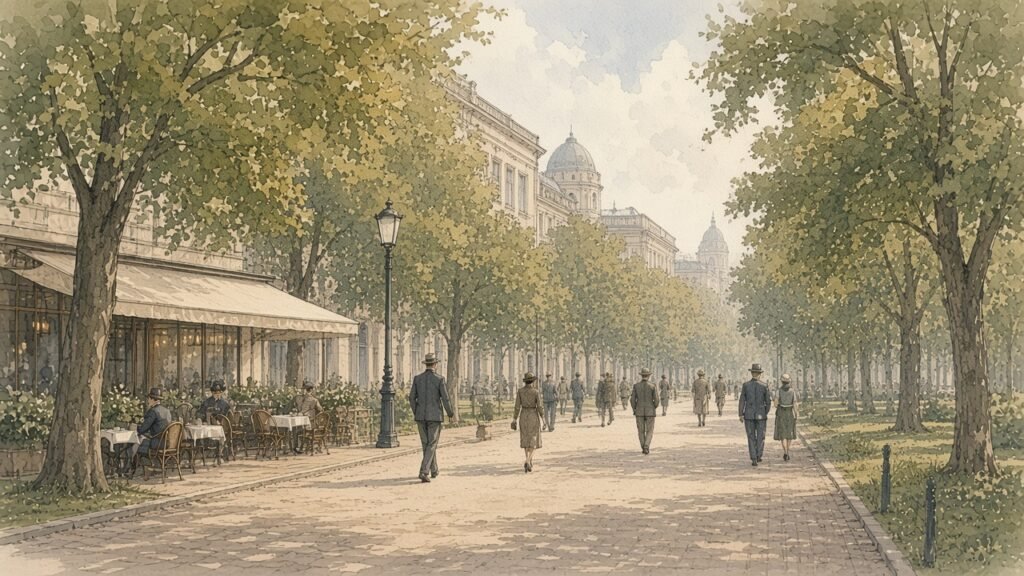
Municipal politics operated under Romanian law. Budgets struggled with paving, schools and poor relief. Corruption scandals occupied the press. Mayors and prefects came and went with national political shifts. Civic associations—professional, charitable, national—filled gaps. Fire and flood still threatened poorer quarters. Sanitary infrastructure improved slowly.
Jewish cultural life produced theatres, choirs, libraries and a Hebrew pedagogical scene of note. Yiddish writers and journalists maintained a public. Zionist youth movements—Hashomer Hatzair, Betar and others—organised camps and street collections. Bundist and communist cells operated under police watch. Synagogues continued their calendars. The communal board negotiated with Romanian authorities over taxation, shechita and schools.[4][5]
Antisemitism structured the political environment with increasing force after 1933. The Iron Guard’s rise, university violence and economic boycotts created a climate of intimidation. Jewish emigration continued where visas allowed. Citizenship revisions threatened those whose papers were deemed incomplete. The legal equality promised in minority treaties after the First World War eroded in practice. Chișinău’s Jews lived the contradiction of cultural flourishing and political endangerment.[11]
Romanian cultural policy promoted the language through schools, the church and the army. Russian gymnasia were Romanianised. Street names and shop signs shifted. Resistance and adaptation both occurred. For Moldavian peasants turned urban migrants, Romanian schooling could be advancement; for Russophone clerks, it could be displacement. Identity was negotiated in kitchens and classrooms as well as in parliament.
The city’s economy remained commercial and artisanal. Light industry—food processing, garments, printing—employed thousands. Credit was tight in the Depression. Market women and Jewish traders continued to dominate certain retail niches. Peasant carts still filled the edges of the city on fair days. The smell of wine and fruit in season linked the capital to its vineyards.
Photographs and postcards of interwar Chișinău show a tidy European provincial city: the boulevard, the arch, the cathedral square, tramcars, men in hats, women in coats. What they do not show is the anxiety in Jewish households as news from Germany and from Bucharest darkened, or the calculations of officials watching the Dniester. Heritage nostalgia for the interwar years must sit beside the documentary record of discrimination and fear.[11]
Women’s education and employment continued to expand within limits. Teachers, secretaries and shop assistants became familiar figures. Political movements recruited young women. Religious structures offered parallel roles. Memoirs by women who survived the war often begin with interwar childhoods of school, park and market—ordinary lives that the 1940s destroyed.
The Soviet ultimatum of June 1940 ended the interwar chapter abruptly. Romanian officials and many civilians fled west. Soviet cadres arrived. Nationalisations and arrests began. A year later Romanian and German armies would return. The interwar city, with its cafés and Hebrew schools, would not be restored. What followed was occupation, ghetto and the near destruction of Jewish Chișinău.[12][13]
Intellectual life included Romanian writers who treated Bessarabia as a romantic frontier and Jewish writers who wrote of the city in Yiddish and Hebrew. The archive of interwar periodicals, incompletely preserved in Chișinău, Bucharest and Jerusalem, is a principal source for daily opinion. Advertisements reveal consumption: radios, sewing machines, patent medicines, steamship lines. The modern consumer of Chișinău appears in those columns beside the political citizen of the editorials.
Sport and scouting organised youth across confessions, sometimes in separate clubs. Football derbies carried ethnic meanings. Gymnastics displays demonstrated modern bodies. These organisations became, for some members, pathways into politics; for others, simply a social life. Membership lists later served historians and, in darker years, persecutors.
By the summer of 1940 interwar Chișinău had achieved a precarious normality: a Romanian provincial capital with a large Jewish minority, a Russophone residue, a commercial economy and a green streetscape. That normality ended with the Soviet tanks. The next chapter turns to the year of Soviet rule that preceded the German–Romanian reconquest and the Holocaust in Bessarabia. Cinema programmes mixed Romanian, Hollywood and European films. Subtitles and live translators served multilingual audiences. The darkened theatre was a rare shared public across confessions. Fan magazines circulated among the young.
Football club archives list players’ names that later appear on Holocaust victim rolls and on emigration manifests. Sport history intersects catastrophe. Memorabilia auctions occasionally surface jerseys and badges from vanished teams.
University students from Chișinău who studied in Bucharest, Iași or abroad returned with political vocabularies—liberal, Iron Guard, Zionist, communist—that reshaped local associations. Generational revolt had an educational geography.
Household budgets reconstructed from price lists and wage data show the Depression’s bite. Middle-class families dismissed servants; working-class families doubled up in courtyards. Charity rolls lengthened. Recovery was incomplete when war returned.
Police files on the Iron Guard and on communist cells, later captured by Soviet archives, allow reconstruction of surveillance. Informants named neighbours. The files are toxic sources that historians use with ethical care.
Wedding photographs from the 1930s show mixed fashions—traditional and modern—across Jewish and Christian families. Dowry negotiations continued. The private century’s rituals persisted until deportation trains stopped them.
Municipal statistical offices counted births, deaths and migrations with Romanian categories. Comparison with 1897 Russian categories requires careful crosswalking. Demographers still argue over interwar ethnic percentages. The argument is political as well as technical.
By 1939 the interwar city had achieved a look of permanence that history would refute within two years. Postcards lied by omission. The historian’s duty is to read them beside the orders that emptied the ghetto. Medical statistics show tuberculosis and infant mortality rates that reformers publicised. Jewish and municipal hospitals competed and cooperated. Visiting nurses entered courtyards. Public health was a rare field of partial confessional cooperation.
Architects trained in Bucharest and abroad designed villas and apartment houses in modernist styles that still punctuate central Chișinău. Heritage lists now protect some of these. Interwar modernism is a layer between imperial eclecticism and Soviet modernism.
Radio ownership spread in the 1930s. Broadcasts from Bucharest and from foreign stations entered kitchens. Political news arrived faster than in the newspaper age. Rumour still outran fact in crises.
Divorce and family law under Romanian codes altered Jewish and Orthodox customary practices. Rabbinic courts retained moral authority for the observant. Legal pluralism persisted informally. Women’s petitioning for divorce appears in court records.
Summer colonies and scouting camps took urban children to the Bessarabian countryside. Photographs show tents and flags. Some campers later emigrated; some died in Transnistria; some became Soviet officials. Youth culture’s archive is bittersweet. Bookstore windows displayed Romanian novels, Russian classics still in demand, and Hebrew textbooks. Confiscations during censorship campaigns emptied some shelves overnight. Readers shifted to lending libraries and private stacks.
Tram strike records show wage demands and municipal counters. Public sympathy split along class and ethnic lines. A stopped tram network froze the city’s rhythm and made politics visible on every corner.
Diplomatic consuls resident in Chișinău reported to Warsaw, Vienna’s successors, and other capitals on minority conditions. Their despatches, now in foreign archives, offer outside views of Romanian Bessarabia’s capital. Pharmacy ledgers list medicines sold during influenza waves. Demographic historians use them. Everyday suffering leaves commercial traces. Chișinău’s interwar body was as fragile as its politics. School exercise books in Romanian, filled by children whose parents spoke Yiddish or Russian at home, show language shift in real time. Pedagogy left a paper trail of accent and error. Telephone directories of the late 1930s list professions and addresses that Holocaust and emigration would empty. Holding a directory is holding a census of the doomed and the dispersed. Librarians treat these volumes as sensitive. Charity bazaars run by women of all confessions raised funds with handicrafts and cakes. Photographs show tables and smiles. These events were social infrastructure as much as philanthropy.
13. Soviet annexation, 1940 to 1941
In June 1940 the Soviet Union presented Romania with an ultimatum demanding the cession of Bessarabia and northern Bukovina. Romania, isolated after the fall of France and bound by the implications of the Molotov–Ribbentrop Pact, complied. Soviet troops entered Chișinău. Romanian administration, parts of the elite and many ordinary civilians fled across the Prut. The city became the capital of the Moldavian Soviet Socialist Republic, newly created by joining most of Bessarabia with part of the former Moldavian ASSR from the Ukrainian bank of the Dniester.[3][6][12]
Sovietisation proceeded rapidly. Nationalisation of banks, factories and large commercial enterprises redistributed property. Collectivisation pressures began in the countryside. The NKVD arrested politicians, officers, priests, Zionists, bourgeois nationalists and others classified as class enemies. Night-time detentions and sealed trains entered collective memory. In June 1941, days before the German invasion of the Soviet Union, a major wave of deportations removed thousands of Bessarabian families—Romanians, Jews and others—to the interior of the USSR. Exact numbers remain debated; the trauma does not.[12][13]
Language policy promoted Moldovan as a Soviet nationality language, written in Cyrillic and distinguished officially from Romanian, alongside Russian as the language of interethnic communication and advancement. Schools were reorganised. Romanian-era textbooks were withdrawn. A new administrative elite of cadres, some local and many from elsewhere in the USSR, staffed offices. Portraits changed on walls. Street names shifted toward revolutionary commemorations.
Jewish life under the first Soviet year was contradictory. Some Jews welcomed the end of Romanian antisemitic legislation and the opening of certain educational and professional doors. Others, especially Zionists, religious functionaries and property owners, faced arrest and deportation. Hebrew schooling was suppressed; Yiddish institutions were reshaped under Soviet Jewish cultural policy that was itself narrowing by 1940. Synagogues operated under constraint. The communal autonomy of the Romanian period ended.[4][5][12]
Economic shortages and administrative chaos accompanied the transition. Refugees and returnees crowded housing. Rationing and queues became familiar. Propaganda celebrated liberation from Romanian “occupation”; private conversation was more cautious. The border along the Prut closed. Families divided by the 1918–1940 boundary found communication difficult.
Military preparation for a possible German war increased through the spring of 1941. Fortifications, conscription and the movement of units altered the city’s rhythm. Few ordinary residents knew the timing of Operation Barbarossa. When German and Romanian armies attacked on 22 June 1941, Chișinău lay in the path of the southern advance. Soviet evacuation of officials, equipment and some civilians began under bombardment and confusion. Not everyone who wished to leave could leave.[12][13]
The year 1940 to 1941 thus compressed revolution, repression and fear into twelve months. It destroyed the interwar institutional order without yet destroying the Jewish population—that destruction would come with the Romanian–German reconquest. Survivors’ memoirs often treat the Soviet year as a distinct ordeal, separate from the Holocaust that followed, though for some families deportation to Central Asia meant survival when those who remained were murdered.
Administrative geography of the new Moldavian SSR placed Chișinău at the centre of a republic whose eastern districts had different recent histories from Bessarabia proper. Cadres from the old ASSR sometimes looked down on Bessarabian colleagues, and vice versa. These internal Soviet tensions outlasted the war. The capital’s role as integrator of two shores of the Dniester began in this first Soviet year.
Cultural policy opened Russian theatres and Soviet film distribution while closing or reshaping Romanian and Hebrew institutions. Writers were invited to join unions under ideological guidelines. Some complied; some were silenced; some were arrested. The thinness of the 1940–41 cultural record reflects both short duration and later archival losses.
When Romanian and German forces approached in July 1941, the Soviet authorities who could withdraw did so. The city that fell to the Axis was a capital already stripped of much of its interwar leadership, whether by flight in 1940 or by deportation in 1941. What awaited its Jewish population was not restoration of Romanian minority life but ghettoisation and deportation to Transnistria.[13][14]
Historians continue to refine estimates of arrests and deportations in 1940 to 1941 using opened archives in Chișinău, Moscow and elsewhere. Lists of names, train compositions and settlement destinations in Kazakhstan and Siberia allow family reconstructions. Memorials and research organisations in Moldova document this wave alongside the Holocaust, insisting that both belong to the city’s twentieth-century catastrophe.
The first Soviet year ended in military collapse. Its legacy included the legal creation of the Moldavian SSR, the Cyrillicisation of Moldovan public writing, the destruction of much of the interwar elite and a precedent for mass deportation that Soviet authorities would repeat in 1949. Chișinău’s Soviet century properly begins here, even though the German–Romanian occupation interrupted it for three years. Nationalisation inventories listed pianos, sewing machines and shop stocks. Families hid valuables. Denunciations for concealed property filled NKVD files. Material culture of the interwar middle class entered state warehouses or informal redistributions.
Schoolchildren learned new songs and saluted new portraits. Parents whispered corrections at home. The pedagogical violence of regime change is measurable in memoir literature. Childhoods were split by June 1940.
Railway cars for the June 1941 deportations were loaded at stations under guard. Families received hours or minutes of notice. Destinations in the Urals and Central Asia became new homes for those who survived the journey. Return after decades was incomplete.
Jewish communists who had suffered under Romanian antisemitism sometimes staffed early Soviet offices. Their enthusiasm met the reality of arrests among Zionists and bourgeois co-religionists. Intra-Jewish political scores were settled under Soviet colours with tragic consequences.
Military archives of the Jassy–Kishinev battles later reconstructed the 1941 retreat. Chaos, blocked roads and Luftwaffe attacks killed civilians as well as soldiers. Evacuation priority favoured cadres. Ordinary residents largely stayed to face the reconquest. Currency conversion from lei to rubles produced winners and losers overnight. Savings evaporated for some; debts lightened for others. Market traders recalculated prices daily during the transition chaos.
Church boards faced pressure to register under Soviet religious laws that constrained youth work and charity. Some priests fled; some were arrested; some accommodated. Parish continuity was uneven.
Jewish agricultural colonies and urban cooperatives promoted by Soviet policy had little time to take root before war. The experiment’s brevity limits assessment. Files nonetheless show ambition. Factory directors appointed in 1940 confronted broken supply chains and suspicious workforces. Production targets ignored wartime logistics until war made the targets absurd. The brief Soviet industrial year left unfinished plans and unfinished arrests.
Photograph albums confiscated from “bourgeois” homes entered NKVD stores. Faces of interwar Chișinău survive in these seized images, now partly returned to museums. Private memory became state property and then, slowly, public archive.
Romanian-language libraries were purged; Russian and Soviet titles filled shelves. Readers adapted, resisted or stopped reading publicly. The politics of the bookshelf was immediate and intimate.
Cross-border radio from Romania still reached receivers until jamming and fear reduced listening. News of the Old Kingdom’s fate under German pressure filtered through rumour. Bessarabia’s isolation was never total.
When German aircraft appeared in June 1941, blackout orders and trench digging began too late for many. Cellars sheltered mixed populations. The year of Soviet power ended in the sound of engines that were not Soviet. Wall newspapers in factories denounced wreckers and praised Stakhanovites in the brief Soviet year. Few originals survive; photographs of them do. Agitprop’s graphic style entered Chișinău overnight. Family separation across the Prut in June 1940 created a correspondence problem that wartime and Cold War deepened. Letters via third countries, when possible, took months. Some families reunited only in the 1990s. The annexation’s intimate cost was measured in unanswered mail. Apartment shares and room subdivisions multiplied as evacuated and arriving populations competed for space. Housing conflict was the intimate face of annexation. Neighbours became file subjects.
14. War, ghetto and deportation
Romanian and German forces took Chișinău in July 1941 after fighting and bombardment that damaged parts of the city. Romanian administration returned under the conditions of the Antonescu regime’s alliance with Nazi Germany. For Jews the return was not a restoration of interwar life but the beginning of systematic persecution, ghettoisation and deportation. The Holocaust in Bessarabia and in the administrative unit called Transnistria destroyed the great majority of Chișinău’s Jewish community.[13][14][15]
In the first days and weeks of reoccupation, killings of Jews by Romanian forces, German units and local participants occurred in and around the city. Precise victim counts for these initial murders remain incomplete. A ghetto was established in Chișinău, concentrating Jews from the city and from surrounding areas into a delimited and guarded zone. Overcrowding, hunger, disease and violence structured daily existence. Romanian gendarmerie and civil authorities administered the ghetto under policies set in Bucharest and in the governorate of Transnistria.[14][15]
Deportations from the Chișinău ghetto to Transnistria—the territory between the Dniester and the Bug placed under Romanian administration—began in the autumn of 1941. Columns of deportees moved on foot and by rail under guard. Many died on the roads from exhaustion, exposure and shooting. Survivors were distributed among ghettos and camps in Transnistria, including sites whose names—Bogdanovka, Domanevka, Mohyliv and others—became synonymous with mass death. Typhus, starvation and mass executions killed tens of thousands of Bessarabian and Bukovinian Jews in Transnistria.[13][14][15]
Romanian policy toward Jews in Bessarabia and Bukovina differed in timing and method from German policy in the General Government, yet the outcome for Chișinău’s Jews was catastrophic. Scholarly estimates indicate that the overwhelming majority of the pre-war Jewish population of the city was murdered or died in deportation. A remnant survived in Transnistria until the Soviet advance of 1944; others survived by flight, hiding or prior Soviet deportation that ironically removed them from the path of the ghetto. Returnees after 1944 found a city emptied of most of its Jewish public sphere.[4][14]
Non-Jewish Chișinău lived the occupation differently: conscription, requisition, censorship and the presence of German and Romanian military authorities. Some civilians participated in violence or denunciation; some helped Jews at risk to themselves; many were absorbed in survival. The moral landscape of occupation, reconstructed from trials, memoirs and oral history, resists simple summary. Formal history records the range without pretending to weigh every soul.
Soviet forces retook Chișinău in August 1944 as part of the Jassy–Kishinev offensive, a major operation that destroyed German and Romanian formations in the region. The city returned to Soviet sovereignty. The Moldavian SSR was restored. Reconstruction began amid ruins, mines and displaced populations. For Jewish survivors the return was to a cemetery city. Synagogues stood damaged or empty. Courtyards that had held extended families held strangers or rubble.[12][14]
Documentation of the Chișinău ghetto and the Transnistria deportations includes Romanian administrative orders, gendarmerie reports, survivor testimonies collected by Soviet commissions and later by Yad Vashem, the United States Holocaust Memorial Museum and Moldovan researchers. Photograph collections show sealed streets and columns on the roads. Memorials in Chișinău and in Transnistrian sites mark the dead. Education programmes in independent Moldova have slowly integrated this history into public curricula, against currents of denial and indifference.[14][15]
The wartime chapter is the darkest in the city’s modern history. It ended the Jewish Chișinău that had grown since the eighteenth century and that had survived even the pogroms of 1903 and 1905. Post-war Soviet Chișinău would include a small Jewish population of survivors, returnees and migrants, but the demographic and cultural weight of the pre-war community was gone. The green capital’s most distinctive urban minority had been destroyed by a Romanian wartime state allied to Germany.[13][14]
Administrative responsibility for the Holocaust in Bessarabia rests primarily with the Antonescu government and its local organs, operating in a context of German alliance and antisemitic ideology shared across the Axis. Post-war trials in Romania and in the Soviet Union prosecuted some perpetrators; many escaped full accountability. Historical research since 1989 has clarified orders, routes and death tolls that wartime propaganda and postwar silence had obscured.
Physical traces of the ghetto—walls, gates, specific courtyards—have been partly erased by later construction. Marker plaques and research publications identify locations. Walking tours organised by Jewish organisations and by municipal partners guide visitors through a landscape that does not always announce its past. The wartime courtyard, emptied of its inhabitants, remains a fitting emblem for this chapter’s close.
When Soviet authority returned in 1944, it brought its own repressions even as it ended the Romanian Holocaust regime. The next chapter turns to the long Soviet period in which Chișinău was rebuilt as a socialist capital, its streetscape transformed, its demography altered by migration and its public memory selectively curated. Ghetto ordinances regulated exit permits, food entry and internal governance. Jewish councils under Romanian orders faced impossible choices. Memoir literature records both coercion and attempts at mutual aid. Judgement of council members remains contested in historiography.
Transit camps between Chișinău and Transnistria held deportees in open fields. Rain, cold and shootings killed before arrival. German SS and Romanian gendarmes appear in different proportions across sites; Romanian authority structured Bessarabian deportation overall.
Bogdanovka and related sites saw mass shootings of Jewish deportees in late 1941 and early 1942. Survivor numbers were small. Forensic and archival work since the 1990s has clarified scales previously obscured. Chișinău’s dead lie in Transnistrian earth as well as in local cemeteries.
Conversion offers and baptism as survival strategies appear in some testimonies. Most were refused or were insufficient. Hiding by non-Jewish neighbours saved individuals at mortal risk. Yad Vashem’s Righteous among the Nations list includes Bessarabian names.
Soviet extraordinary commissions in 1944 to 1945 collected testimonies that mixed accuracy with wartime ideology. Historians triangulate these with Romanian archives opened after 1989 and with survivor interviews conducted decades later. The documentary base for Chișinău’s Holocaust is now substantial. Children’s experiences in the ghetto—hunger, games in courtyards, sudden disappearances of neighbours—appear in late testimonies with particular clarity. Child survivors’ voices are now central to education programmes.
Romanian administrative maps of Transnistria marked ghettos and colonies with bureaucratic neatness that belied the killing. The cartography of genocide is chilling in its ordinariness.
Post-war property claims by returning Jews rarely succeeded under Soviet nationalisation. Legal aftermath compounded theft. Restitution debates continue into the present at the margins of politics. Food smuggling into the ghetto risked shooting and sustained children for weeks. Market women and sympathetic gendarmes appear in testimonies on both sides of moral lines. Survival economies were improvised daily.
Typus epidemics in crowded rooms killed without bullets. Medical personnel among the imprisoned organised what care they could without medicines. Death registers, incomplete, still convey the epidemic’s curve.
Orthodox priests and Baptist villagers who hid Jews appear in Righteous files with sparse documentation that belies courage. Silence after the war, under Soviet atheism and fear, buried many stories until late interviews.
Return in 1944–45 to empty apartments occupied by others produced legal and emotional conflicts. Soviet housing boards rarely favoured claimants. The robbed remained robbed under a new flag.
International research collaborations since the 1990s have mapped deportation routes with GIS tools. Students walk the old ghetto perimeter with printouts. Pedagogy makes geography again. Shoes left on the roads to Transnistria enter testimonies as unbearable detail. Material remnants of the marches rarely survive; narrative preserves them. History sometimes walks barefoot. Romanian officers’ private letters, later published or archived, reveal a range of attitudes from ideological antisemitism to bureaucratic indifference and occasional unease. The spectrum matters for understanding perpetration without relativising responsibility. Orders from above met local dispositions below.
Synagogue ruins after 1944 were quarried for building materials or left as shells. Sacred space became rubble storage. Reconstruction of Jewish religious life had to begin without most of its houses of worship. Clandestine schools in the ghetto taught children alphabets between raids. Teachers improvised without books. Survivor accounts honour these improvised classrooms as defiance as well as care.
15. The Moldavian SSR
Soviet Chișinău after 1944 was rebuilt as the capital of the Moldavian SSR. War damage, demographic loss and ideological ambition shaped the reconstruction. Wide avenues, monumental public buildings in Stalinist and later modernist styles, and housing blocks for workers altered the scale of the city. The nineteenth-century green core survived in part, but suburbs of panel housing extended far beyond the old limits. Population growth drew Moldovans from the countryside, Russians and Ukrainians from elsewhere in the USSR, and a small stream of Jewish survivors and migrants.[3][6][12]
Industrialisation placed factories on the urban periphery: food processing, machinery, textiles and construction materials. Collective farms in the hinterland fed the capital under planned delivery. Shortages and queues remained familiar features of daily life despite official statistics of growth. The Bâc was channelled and polluted by industry. Parks were maintained as showpieces of socialist amenity. The central boulevard retained ceremonial functions for parades and demonstrations.
Language policy continued to treat Moldovan, written in Cyrillic, as the republican language, with Russian dominant in higher education, technical fields and interethnic communication. Debates over the identity of Moldovan and Romanian—suppressed or channelled in the Soviet period—would erupt openly after 1989. Schools produced bilingual and Russophone elites. Literature and theatre operated under censorship and union structures. A Moldovan national culture within Soviet limits was cultivated and constrained by turns.[3][6]
Deportations recurred. In 1949 a major wave targeted supposed kulaks, nationalists and other categories, removing families to Kazakhstan and Siberia. Collectivisation advanced through coercion. The famine conditions of the late 1940s in parts of Moldavia, linked to drought, requisition and policy, killed and displaced rural populations and drove migrants toward the capital. Exact mortality figures remain subjects of research and political argument; the human cost is not in doubt.[12]
Jewish life in Soviet Chișinău was a remnant. Synagogues were closed or reduced to a handful. Yiddish culture, briefly promoted in earlier Soviet decades elsewhere, found little room in postwar Moldavia. Emigration to Israel, when intermittently allowed, reduced numbers further. Antisemitism persisted in informal discrimination and in official campaigns. Memorialisation of the Holocaust was subordinated to a generic Soviet narrative of fascist occupation that blurred Romanian responsibility and Jewish specificity. Only late Soviet and post-Soviet research restored clearer accounts.[4][14]
Urban planning produced the ring roads, microdistricts and civic squares visible today. Earthquake damage, notably in 1986, destroyed buildings and lives and prompted further reconstruction. The Triumphal Arch and parts of the old centre were preserved as heritage within a socialist frame. New government houses, hotels and cultural palaces announced the capital’s status. Visitors from other republics saw a green southern city with vineyards still near the edges.
Political life was channelled through the Communist Party of Moldavia. Dissidence existed in small circles—national, religious, human-rights—and was punished. The late 1980s brought glasnost and national mobilisation. The Popular Front demanded language law changes, closer ties to Romania and, increasingly, independence. Russian-speaking counter-mobilisation defended Soviet ties and linguistic status. Chișinău’s streets filled with demonstrations. The Supreme Soviet moved toward sovereignty.[3][6][16]
On 27 August 1991, following the failed Moscow coup, Moldova declared independence. Chișinău became the capital of an independent republic. The Soviet century ended formally; its housing blocks, factories, demographic mixes and unresolved identity questions remained. The city’s Soviet layer is the most visible in today’s built environment, even as pre-Soviet streets and post-Soviet glass towers share the skyline.
Economic statistics of the Moldavian SSR showed growth in absolute terms and persistent lag relative to more industrialised republics. Wine, fruit and light industry defined specialisation. Chișinău concentrated administration, higher education and cultural institutions. Rural–urban migration reshaped family structures. Weekend returns to village parents remained common. The capital’s food markets linked the two worlds.
Earthquake geology is part of urban history. The 1940 and 1986 quakes, among others, damaged masonry and required rebuilding. Construction codes evolved. Informal additions to panel blocks complicated safety. Heritage buildings in the centre proved variously fragile. Seismic risk continues to shape planning debates in the independent city.
By 1991 Soviet Chișinău was a capital of half a million, multiethnic, partly Russophone, marked by socialist modernism and by the unfinished business of language and memory. Independence would open borders, markets and arguments that the Party had closed. The next chapter turns to that transition. Housing allocation through workplaces and party offices created waiting lists measured in years. Bribery and connections shortened waits. Communal apartments forced strangers into shared kitchens. Privacy was a scarce socialist good.
Wine factories and collective vineyard farms made Moldavia a Soviet cellar. Chișinău hosted tasting rooms for officials and tourists. Quality varied; quantity met plan targets. The vineyard identity of the city acquired a planned economic form.
Dissident baptists, true orthodox Christians and Zionist activists faced psychiatric abuse, job loss and imprisonment. Files released since independence document methods. Religious and national dissent shared surveillance apparatuses.
The 1980s youth scene included informal rock music, taped Western radio and café debate. Komsomol officials oscillated between repression and co-optation. Generational change prepared the Popular Front’s cadres.
Earthquake reconstruction after 1986 used rapid panel methods that later showed defects. Memorials to quake victims stand in the city. Natural disaster joined political history in shaping the late Soviet capital. Gastronomy of Soviet Chișinău mixed Moldovan, Russian, Ukrainian and Caucasian dishes in canteens and at home. Cookbooks and market lists document this hybrid cuisine. Food history softens, without erasing, political history.
Closed cities and travel restrictions limited foreign contact. Intourist itineraries showed the boulevard and selected factories. What visitors did not see was as revealing as what they did.
Party congresses brought provincial delegates to the capital. Hotels filled. Speeches lasted hours. The ceremonial calendar of Soviet power occupied the same squares that imperial and Romanian ceremonies had used. Komsomol construction brigades built housing and sang on scaffolds. Photographs of smiling youth contrast with oral histories of exhaustion and cynicism. Official and unofficial Soviet Chișinău shared streets and diverged in speech.
Wine festival weeks brought visitors from other republics. Hotel Intourist served as a controlled window. Black-market currency traders worked the edges of the tourist zone. Contact with foreigners was a watched privilege.
Academic institutes of language and history produced the authorised Moldovan past. Scholars who tested boundaries lost jobs. Footnotes from this period require decoding. Yet data collected then still underpin research.
The late Soviet city trained the engineers and doctors who would staff independent Moldova. Institutional continuity across 1991 was greater than revolutionary rhetoric admitted. Capitals outlast the hymns sung in their squares.
Panel-block courtyards developed informal gardens and bench societies of pensioners. Microdistrict life had its own ethnography. Anthropologists of the 2000s recovered this Soviet everyday as a subject in its own right. Queue ethnography—who stood where for sausages, how information about deliveries travelled—defines late Soviet urban experience. Chișinău’s queues had their own humour and hierarchies. Oral history recovers both. Closed archives of the Moldavian KGB, partially opened, show the density of surveillance on writers, priests and would-be emigrants. Card catalogues of suspicion outlasted the organisation that typed them. Researchers now need ethical protocols as well as passes.
Internationalist festivals brought African and Asian students to Chișinău institutes. Their memoirs, slowly appearing, add a global south perspective on the Soviet provincial capital. The city’s world was wider than its boulevard suggested. Hospital waiting lists and informal payments for care defined late Soviet medicine in Chișinău as elsewhere. Physicians’ memoirs describe improvisation. Health statistics improved on paper; lived experience was more mixed.
Victory Day ceremonies every May concentrated Soviet commemorative energy on the boulevard. Veterans’ medals and schoolchildren’s flowers composed a ritual that outlasted the USSR in modified form. Memory of 1944–45 remains a public language even when its meanings diverge. Factory sports clubs produced athletes who competed in all-Union games. Medals brought prestige to the republic. Sporting Chișinău was a soft version of Soviet integration that outlasted harder forms.
Library reading rooms stayed warm when apartments were cold, drawing students who studied and who courted. Soviet Chișinău’s romance had institutional shelters. Memoirs remember the heat of radiators as much as the texts.
16. Independence
Independence transformed Chișinău’s political status overnight and its economy over a decade of crisis. The collapse of Soviet supply chains, the loss of markets and the war in Transnistria in 1992 produced unemployment, inflation and emigration. Factories closed or limped. Markets filled with petty trade. Remittances from workers in Russia, Italy and elsewhere became a pillar of household survival. The city’s population stagnated or fell as young people left.[3][16]
Language law made Romanian (officially restored to Latin script and, after political struggle, increasingly called Romanian rather than Moldovan in public use) the state language. Russian remained widely spoken. School and university reform shifted curricula. Street signs changed. The identity conflict—Moldovanism versus Romanianism—structured party politics and cultural institutions. Chișinău’s universities, theatres and publishers became arenas of this conflict.[3][6]
Transnistria, the strip east of the Dniester, seceded in a brief war that left a frozen conflict and a separate administration in Tiraspol. Chișinău remained the capital of internationally recognised Moldova but not of the whole former Moldavian SSR territory. Checkpoints, smuggling and diplomatic stalemate became standing features. Refugees and displaced persons passed through the capital in 1992. Memorials to the dead of that war joined older commemorative landscapes.[16]
Jewish communal life revived on a small scale. Synagogues reopened. Schools, a theatre and welfare organisations appeared with overseas support. Emigration to Israel and Germany continued, keeping numbers low. Holocaust memorialisation advanced through research, monuments and anniversary ceremonies. The 1903 pogrom monument in Alunelul Park and later markers gave the Jewish past a public topography it had lacked in the Soviet period.[4][9]
Urban change mixed decay and speculation. Panel blocks deteriorated. New elite housing and shopping centres appeared for those with remittance or business income. NGOs and foreign embassies clustered in the centre. European integration became a long-term political project, contested by parties favouring closer ties with Russia. Elections, protests and constitutional crises punctuated the 1990s and 2000s. The city’s streets repeatedly filled with demonstrators.
Cultural life diversified. Romanian, Russian and other media competed. Independent theatre and film struggled for funding. Wine tourism and heritage tourism sought to brand Chișinău and its surroundings. The green boulevards and the Triumphal Arch remained postcard images. Earthquake preparedness, traffic and corruption in construction occupied municipal debate.
By the 2010s Chișinău was a capital of an independent state navigating between European and Eurasian orientations, marked by emigration, remittances and a built environment that still spoke Soviet modernism with nineteenth-century interludes. The present city, treated in the next chapter, continues these patterns under new pressures including the war in neighbouring Ukraine.[16][17]
Demographic ageing and brain drain worried planners. Universities trained students who often left. Return migrants brought capital and ideas. Marriage and fertility patterns shifted. The city’s ethnic composition continued to change as Moldovan rural migrants replaced some of the Russophone outflow. Census politics made every count controversial.
Religious life revived across confessions. The Orthodox Church, split between Moscow and Bucharest jurisdictions in complicated ways, reclaimed public visibility. Minority churches and the small Jewish community organised openly. New mosques and evangelical halls reflected migration and mission. The secular Soviet street acquired religious processions again.
Infrastructure—water, heating, roads—aged. International loans and projects funded partial renewal. The airport connected Chișinău to European destinations used by migrants. Marshrutka minibuses organised daily mobility. The Bâc’s ecological rehabilitation remained an uncompleted project. Flood risk and pollution linked environmental and urban history.
Independence did not resolve the questions set by 1812, 1918, 1940 and 1944; it reopened them under new sovereignty. Chișinău’s role as capital now meant diplomacy, national ceremony and the concentration of a small state’s scarce resources. The city’s past remained visible in every layer of its streets. Privatisation vouchers and insider deals transferred factories into oligarchic hands. Public anger at corruption became a standing political theme. Chișinău’s skyline of unfinished builds marked speculative cycles.
University reform introduced Bologna processes and fee pressures. Student protests occasionally erupted. Brain drain to Romania, the EU and Russia emptied seminar rooms. Diaspora networks funded some research chairs.
NGOs documenting the Holocaust and the Soviet deportations professionalised memory work. International grants mattered. Local volunteers cleared cemeteries. Memory became a sector as well as a duty.
Wine exports sought EU markets with mixed success. Counterfeit scandals damaged reputation. Rebranding Chișinău as a wine capital continues. Tourism numbers remain modest beside regional competitors.
Electoral maps of the city show neighbourhood patterns of language and age. Russophone districts and younger Romanian-speaking districts vote differently. Urban political geography is legible to any campaign manager. Cassette tapes and later digital files of Popular Front speeches circulate as historical sources. Oral history projects interview ageing activists. The revolutionary moment of 1989–1991 is becoming archival.
Currency introduction and banking collapses taught hard lessons about monetary sovereignty. Pyramid schemes ruined savers. Trust in institutions remains fragile partly for these reasons.
Chisinau’s mayors since independence have ranged across the party spectrum. Municipal archives of their terms await fuller exploitation. Local government history is still a thin field. Passport queues for Romanian citizenship formed outside consulates as EU hopes rose. Dual citizenship remade the meaning of borders for those who obtained it. Chișinău’s young measured futures in visa stamps.
Independent media outlets opened and closed with oligarchic sponsorship. Investigative reporters faced threats. Quality journalism existed and was precarious. Public opinion formed in a noisy, uneven information market.
Restoration of the Triumphal Arch and cathedral square for tourism mixed heritage care with political messaging. Scaffolding itself became a familiar civic sight. Who pays for the past remains a present question.
Floods and utility failures periodically reminded residents of infrastructural fragility. Blame assigned to mayors and to history. The garden city’s pipes are part of its legacy as much as its trees.
Diaspora conferences bring successful emigrants home for panels and investments. Some stay; most leave again. Chișinău performs welcome and farewell in the same airport hall. Hyperinflation stories—wages spent within hours, wheelbarrows of coupons—anchor the 1990s in bodily memory. Economists’ charts cannot replace these anecdotes. Trauma of money shapes later distrust. Transnistrian war veterans’ associations lobby for pensions and memory. Their monuments occupy squares with contested meanings for those who saw the 1992 fighting differently. Veteran politics is a living legacy of the frozen conflict.
Bookshops that opened with Romanian philosophy and closed under rent pressure chart the cultural market’s volatility. Readers migrated online. The smell of paper shops remains a nostalgia cue for a thin cohort. Constitutional courts and street protests alternated as venues of legitimacy through the 2000s and 2010s. Chișinău learned to recognise the sound of helicopter blades over the government district as a sign of crisis. Continuity of capital function meant continuity of capital tension.
Foreign radio and later social media broke state monopolies on narrative. Russian, Romanian and Western channels competed for Moldovan attention. Information geopolitics had a local audience rating.
Pensioners selling produce at crossings became an economic icon of the transition. Informal markets occupied spaces left by closed factories. The capital’s survival strategies were often extra-legal and effective. Street kiosks selling cigarettes, chewing gum and bus tickets employed thousands in the 1990s. Their disappearance under regulation and mall competition remade sidewalks. Informal Chișinău left empty pitches.
17. The present city
Present-day Chișinău is the capital of the Republic of Moldova, a city of roughly 700,000 in the wider urban area by common estimates, with precise figures depending on census methods and the counting of suburbs. Its centre retains the nineteenth-century boulevard, the Triumphal Arch and parks that Pushkin’s successors would still recognise in outline. Soviet housing belts surround this core. Post-1991 glass and steel mark banks, hotels and malls. The result is a layered city typical of post-socialist capitals, green by reputation and strained by emigration.[1][17]
Politics in the capital reflect national divides over European integration, relations with Romania and with Russia, and the unresolved status of Transnistria. Protests periodically fill the square before government buildings. Elections are closely watched by European and Russian media. The war in Ukraine since 2022 has brought refugees, security concerns and economic shocks. Chișinău has absorbed Ukrainian arrivals while managing energy dependence and inflation. Municipal services strain under new loads.[16][17]
Economic life depends on services, administration, light industry, construction and remittances. Wine and agritourism link the city to its historic hinterland. Information technology outsourcing has grown from a small base. Informal trade persists. Inequality is visible in housing and in the contrast between central cafés and peripheral panel blocks. Corruption perceptions shape foreign investment and domestic trust.
Cultural institutions—the opera, museums, universities and libraries—operate on limited budgets with international partnerships. Heritage debates concern the restoration of interwar and nineteenth-century buildings, the fate of synagogues and Jewish sites, and the interpretation of Soviet monuments. The 1903 pogrom and the Holocaust have a more secure place in public education than in the Soviet period, though knowledge gaps remain. Pushkin’s museum continues to draw visitors; so do wine cellars at the city’s edge.[8][9]
Demography is shaped by low fertility and high emigration. The city’s population is sustained by internal migration from rural Moldova. Language practice remains mixed: Romanian dominates official and increasingly public commercial use; Russian is widely understood and spoken, especially among older residents and in certain neighbourhoods. English grows among the young. The polyglossia of the nineteenth century persists in new proportions.
Transport includes trolleybuses, buses, marshrutkas and growing private car use. Congestion and parking strain the nineteenth-century street grid. Airport traffic reflects migrant itineraries. Railway links are limited compared with the city’s imperial and Soviet past. Regional road connections to Romania and Ukraine carry trade and refugees.
Climate and environment enter municipal politics through heatwaves, the state of the Bâc and air quality. Green identity remains a civic asset. Tree planting and park maintenance are popular budget items when funds allow. Seismic risk requires building standards that informal construction sometimes evades.
Jewish Chișinău today numbers in the low thousands, with active communal organisations, a school and synagogues. Overseas partnerships sustain much programming. Genealogy tourism brings descendants of Kishinev families from Israel, the United States and elsewhere. The cemetery and memorial sites organise memory. The demographic contrast with 1897—when Jews approached half the city—measures the twentieth century’s destruction more eloquently than any single statistic.[4][5]
The present city is thus a capital managing scarcity, memory and geopolitics on the edge of a war zone, still green along its old boulevard, still speaking more than one language, still carrying the administrative role first assigned in 1812. Legacy, treated next, asks what endures from the layers beneath. Ukrainian refugees since 2022 have used Chișinău as transit and as temporary home. Schools and shelters adapted. Solidarity mixed with strain on housing and budgets. The war next door is heard in conversation daily.
EU accession rhetoric shapes infrastructure grants and judicial reform programmes. Implementation lags. Chișinău’s cafés host the consultants and activists of the European project. Sceptics vote in significant numbers.
Tech hubs and coworking spaces advertise a young entrepreneurial Chișinău. Success stories are real and limited. Most graduates still weigh emigration. The city’s future workforce is a policy anxiety.
Air quality alerts and summer heat shape municipal discourse. Tree cover along the boulevard is defended by civic groups. Climate adaptation is a new chapter in the garden city’s history.
Genealogy tourists photograph courtyard addresses found in family papers. What they find is often rebuilt or gone. Absence is part of what Chișinău teaches its visitors. Startup pitch nights and wine bars cater to a globalised youth culture that coexists with pensioners selling herbs at street corners. The sociological distance between these Chișinăus is large; the tram ride between them is short.
Orthodox processions at Easter again fill the boulevard. Contested jurisdictions between metropolitanates produce parallel ceremonies. Religion’s return is plural and political.
Open-data initiatives publish municipal budgets online. Civic hackers map potholes. Digital Chișinău is a thin but growing layer over the analogue city of queues and signatures. Bicycle lanes and scooter rentals announce a mobility fashion among the young while marshrutkas remain the workhorse of the majority. Infrastructure inequality is visible at every intersection.
Co-working spaces host freelancers serving foreign clients across time zones. Night shifts for American deadlines coexist with morning markets. Global time enters the provincial capital through screens.
Memorial days for deportation victims and for Holocaust victims draw uneven crowds. Competing calendars of mourning reflect competing pasts. Attendance itself is a political signal.
Restaurants advertise New Nordic or fusion menus beside Moldovan stews. Culinary branding seeks TripAdvisor scores. Taste is a soft-power and a livelihood question.
The city’s planners debate densification versus green belts. Ozmidov’s ghost and Soviet microdistricts haunt every master plan. Present Chișinău is still arguing with its maps. Embassy receptions and EU twinning projects bring foreign officials to the boulevard hotels. Soft power has a catering budget. Chișinău performs capital hospitality on limited means. Marathon routes close the boulevard on autumn Sundays. Timing chips and charity bibs modernise the promenade. Civic fitness shares space with civic protest on the same asphalt across the calendar.
Archaeological watching briefs during metro or cable works—when they occur—still find Ottoman and nineteenth-century layers. The past interrupts construction schedules. Developers negotiate; sometimes scholars win a week. Museum night events open heritage buildings after dark with projections and music. Young audiences rediscover the arch and the park as leisure. Heritage succeeds when it entertains without lying.
Water quality reports on the Bâc circulate among NGOs and municipal engineers. Clean-up pledges recur in election platforms. The river’s future is a test of whether green identity is more than branding.
Conscription debates and security reforms after 2022 altered the capital’s relation to the army. Military parades regained salience. Geopolitics is audible in marching boots again. Language on café menus shifts with owner and neighbourhood. A single walk can pass Romanian, Russian and English boards. Linguistic landscape studies photograph these signs as data. The capital still speaks in chorus.
Sunday markets at the city’s edges still sell cheese, honey and seedlings as they did under other flags. Continuity of petty trade is a quiet legacy. Bargaining tones change less than constitutions. The capital’s oldest economy is the stall.
18. Legacy
The legacy of Chișinău is the accumulation of its roles as Moldavian market, Russian provincial capital, Romanian county seat, Soviet republican capital and capital of an independent Moldova. Few cities of its size have changed sovereignty so often in two centuries. Each regime left streets, laws, demography and memories that the next regime partly overwrote. The historian’s task is to read the overwriting without forgetting what was written before.[1][3]
Geographically the city remains what the Bâc and the Bessarabian plain made it: a green administrative centre on the steppe edge, without a great harbour or mountain pass, important because states chose it. The gardens and vineyards that shaped its nineteenth-century image survive in parks, in peri-urban plots and in the wine industry’s self-presentation. The Triumphal Arch and the boulevard organise ceremonial space across regimes. Continuity of place is the first legacy.[1][2]
Demographically the decisive rupture is the destruction of Jewish Kishinev in 1941 to 1944. The pogroms of 1903 and 1905 traumatised and politicised; the Holocaust erased. Post-war and post-Soviet Jewish life is real and valuable; it is not a restoration of the 1897 city. Any honest legacy account centres this fact beside the stories of Pushkin, of union and of independence.[4][14]
Politically the unresolved questions of language, of Transnistria and of orientation between Romania, Europe and Russia are inheritances of 1812, 1918, 1940 and 1991. Chișinău’s streets have hosted each argument. The capital concentrates a small state’s contradictions. Its diplomats and demonstrators enact legacy as current events.[16][17]
Culturally the city offers Pushkin and Bialik, Romanian and Russian theatres, wine cellars and Holocaust memorials, Soviet modernism and nineteenth-century plaster. Heritage tourism can simplify this into a postcard; scholarship should not. The formal, neutral narrative appropriate to this feature ends not with a moral but with a topography: a boulevard, an arch, a park, a river of modest size, and under them the layers of empire, violence and rebuilding that make Chișinău what it is.
Educational curricula in Moldova now include more of the Jewish and Holocaust past than Soviet schools allowed, while debates over Romanian versus Moldovan history continue to shape textbooks. Museums negotiate these pressures in their labels. Foreign research institutes and local NGOs fill gaps. The production of public history is itself part of legacy.
Architectural conservation faces earthquake risk, ownership disputes and funding shortages. Listings protect some nineteenth-century facades. Demolitions continue elsewhere. The Soviet panel stock ages. New construction seeks height and glass. The skyline of 2050 will add another layer; the boulevard’s trees will still, if maintained, recall the garden city that Ozmidov’s plan enabled.
For the Jewish world Kishinev remains a name that evokes 1903 before it evokes a living capital. For Moldovans it is simply home, the city of work, study and departure. For historians it is a case study in borderland urbanism. These publics overlap in commemorations and diverge in daily speech. Legacy is plural because memory is plural.
This special feature has followed the city from the Moldavian market to the present capital. The timeline that follows gathers dates; the references list sources. Between them lies a city that has been repeatedly remade and that still, on a spring morning, can look like the green provincial place that exiles and traders once entered with hope and uncertainty.[1] School textbooks remain battlegrounds for the meaning of 1812, 1918 and 1940. Committees revise; parents protest; publishers reprint. Chișinău’s children inherit arguments with their primers.
Sister-city relationships and embassy events perform international belonging. Cultural institutes teach languages. Soft power maps onto the old boulevard. Empire’s successors compete politely.
Wine competitions and marathon races brand the contemporary city for outsiders. Marketing cannot erase Transnistria or emigration, but it can fill hotel beds. Civic boosterism is a legacy form of capital pride.
Archives in Chișinău, Bucharest, Moscow, Jerusalem and Washington hold complementary pieces of the city’s past. No single archive is enough. Digitization projects slowly reconnect what politics separated.
The final legacy is methodological: Chișinău teaches that borderland capitals are made by decisions elsewhere as much as by local wills, that demographic majorities in streets can vanish, and that green avenues outlast many of the regimes that planted them. The Bâc still runs. The arch still stands. The names on the doors keep changing. Comparative urban history places Chișinău beside Odessa, Chernivtsi and Iași as sibling borderland centres with overlapping populations and divergent twentieth-century fates. Comparison sharpens what is specific: the garden plan, the 1903 emblem, the double Soviet annexation, the frozen conflict nearby.
For readers of this feature the legacy is also methodological caution: check the name on the map against the date on the document; distrust single-archive stories; remember the dead without instrumentalising them. Chișinău rewards and punishes the careless historian in equal measure.
The Bâc’s rehabilitation projects, repeatedly announced, stand as a metaphor for unfinished repair. Water quality reports are legacy documents of industrial socialism and weak regulation. A cleaner river would be a civic achievement continuous with the oldest geography of the site. Tourist guides compress the city’s past into a day of arch, park, market and wine. Compression is inevitable and distorting. This feature has argued for duration: twenty-five thousand words for two centuries of a capital that repaid the attention.
Writers born in Chișinău and writing elsewhere— in Romanian, Russian, Hebrew, English—carry the city into world literature in fragments. Anthologies collect them. Literary legacy is portable as stone is not.
Seismic retrofit programmes, if funded, would protect both people and plaster facades. Legacy is also engineering. Without it the next earthquake rewrites the archive of walls.
The last word belongs to continuity of care: gardeners who tend the boulevard trees, archivists who flatten brittle papers, teachers who correct the spelling of Chișinău and Kishinev alike. Empires pass. Maintenance remains. Future historians will read our present digital exhaust—social media, phone GPS, online budgets—as we read yearbooks. Legacy is being created now in formats that may not outlast paper. The garden city’s next layer is partly invisible already. Place-name boards that still show Soviet forms beneath peeling Romanian stickers are small allegories of layered sovereignty. Drivers navigate by both. Speech outlasts policy.
Genealogical DNA projects link Chișinău descendants across continents in ways parish registers never could. Science remakes kinship around the old streets. Legacy acquires a genetic chapter without escaping history’s violence.
If this feature has a closing image, let it be morning light on the boulevard trees, small figures on their way to work, the arch pale against haze, and under the paving the compacted dust of markets, armies and gardens that made a capital on the Bâc. Archives of the Fieldline-era digital present will include this essay among other traces. Self-awareness need not be vanity; it is a reminder that historical writing joins the stack it describes. Chișinău on the Bâc continues beyond any closing sentence. Maintenance workers who repaint the arch and prune the boulevard lindens rarely enter narratives of empire. Without them the postcard fades. Labour of care is the condition of visible legacy.
19. Timeline
Documentary references place a settlement on the Bâc within the Moldavian commercial network of the fifteenth century.
About 540 Jews are recorded in Chișinău, with a burial society already organised.
The Treaty of Bucharest cedes Bessarabia to the Russian Empire; Kishinev becomes a provincial centre.
Engineer Mikhail Ozmidov draws a plan directing growth into a new upper town of straight streets.
Kishinev receives formal city status and consolidates its role as Bessarabia’s capital.
Alexander Pushkin lives in Kishinev under administrative surveillance and writes during his southern exile.
The Nativity Cathedral and expanding public gardens shape the upper town’s monumental core.
The Holy Gates (Triumphal Arch) are erected to commemorate the war of 1828 to 1829.
A Hasidic yeshiva, among the first in the south of the empire, opens in Kishinev.
Railway connections tie Kishinev more tightly to Odessa and the imperial network.
Jews number about 50,237 of roughly 109,000 inhabitants—some 46 percent of the city.
Forty-nine Jews are killed and hundreds injured in the Easter pogrom of 6–7 April Old Style.
A second pogrom kills nineteen Jews; organised self-defence limits the toll relative to 1903.
Sfatul Țării votes for union; Chișinău becomes a Romanian provincial capital.
The Soviet ultimatum of June brings Bessarabia into the USSR; the Moldavian SSR is created.
After Romanian–German reconquest, Jews are ghettoised and deported to Transnistria.
The Jassy–Kishinev offensive restores Soviet rule; few Jewish survivors remain.
A major Soviet deportation wave removes families classified as kulaks and nationalists.
Popular Front protests and the Moscow coup lead to Moldova’s independence declaration.
Fighting freezes a conflict that leaves Chișinău capital of a divided former republic.
The Victims of the 1903 Pogrom Monument is dedicated in Alunelul Park.
Russia’s full-scale invasion of Ukraine brings refugees and new security pressures to the capital.
References
- Grokipedia, “Chișinău” ↩
- Grokipedia, “Bessarabia Governorate” ↩
- Grokipedia, “History of Moldova” ↩
- YIVO Encyclopedia, “Kishinev” ↩
- YIVO Encyclopedia, “Bessarabia” ↩
- Grokipedia, “Moldavia” ↩
- Grokipedia, “History of the Jews in Bessarabia” ↩
- Grokipedia, “Alexander Pushkin” ↩
- Grokipedia, “Kishinev pogrom” ↩
- Steven J. Zipperstein, Pogrom: Kishinev and the Tilt of History (Liveright, 2018) ↩
- Grokipedia, “Moldova” ↩
- Grokipedia, “Moldavian Soviet Socialist Republic” ↩
- United States Holocaust Memorial Museum, Holocaust Encyclopedia, “Romania” ↩
- United States Holocaust Memorial Museum, Holocaust Encyclopedia, “Transnistria Governorate” ↩
- United States Holocaust Memorial Museum, Holocaust Encyclopedia, “Pogroms” ↩
- Grokipedia, “Bessarabia” ↩
- Grokipedia, “Treaty of Bucharest (1812)” ↩