Little Vienna on the Prut
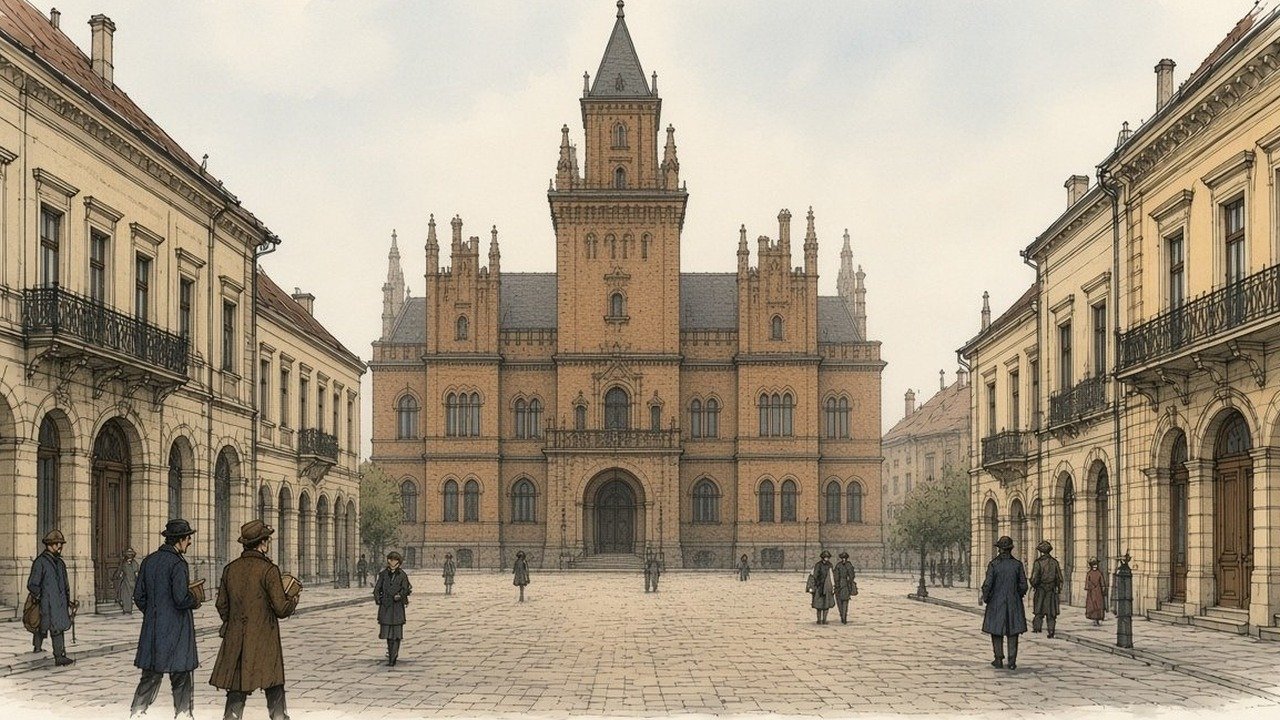
Chernivtsi stands on the Prut river in the foothills of the Carpathians, a city that has been known in successive centuries as a Moldavian county seat, as Habsburg Czernowitz, as Romanian Cernăuți, as Soviet Chernovtsy and again as Ukrainian Chernivtsi. Few places of its size have changed sovereignty so often while leaving so dense a cultural memory. Under Austrian rule it became the capital of the crownland of Bukovina and earned the nickname of a little Vienna; within its streets a large Jewish population built a German-speaking and Yiddish-speaking public culture that produced the Yiddish Conference of 1908 and, a generation later, the poets Paul Celan and Rose Ausländer. The Second World War destroyed that community through ghettoisation and deportation to Transnistria. What remains is a Habsburg architectural centre in a Ukrainian regional capital, layered with Romanian, Soviet and independent Ukrainian histories.[1][2]
This special feature follows that history from the Moldavian town on the Prut to the present. It describes the Habsburg annexation of 1775, the making of a provincial capital, the peoples of Bukovina and the politics of the crownland, the university of 1875 and the Residence of the Metropolitans, and the streets, theatres and civic life of late imperial Czernowitz. It then turns to German-speaking Jewish culture, to the Hasidic courts of the hinterland, to the Yiddish Conference of 1908 and to the writers of the late empire and after. It recounts the Romanian takeover after 1918, the interwar city, the Soviet and wartime occupations, the ghetto and the Transnistrian deportations, the Soviet decades and Ukrainian independence. It closes with an assessment of the city’s legacy. An interactive timeline at the end of the essay gathers the principal dates.
1. A town above the Prut
The earliest secure documentary mention of Chernivtsi dates from 1408, when the Moldavian prince Alexandru cel Bun issued a commercial privilege that named the settlement among the places of trade on the route between Lviv and the lower Danube. The town stood on the right bank of the Prut, a river that rises in the Carpathians and joins the Danube near the Black Sea. In the late Middle Ages this stretch of the Prut marked a frontier zone between the Polish–Lithuanian lands to the north and the Principality of Moldavia to the south. The name of the town, recorded in Slavic, Romanian, Armenian and later German forms, is usually derived from the black colour of the local oak woods, though folk etymologies and rival scholarly proposals have never been entirely settled. What is clear from the charters is that by the early fifteenth century Chernivtsi was already a toll station and a market.
In 1488 the settlement became the centre of a Moldavian county. Urban privileges of a Magdeburg type, which granted burghers limited self-government under the authority of the prince, were recognised there as in other Moldavian towns. The economic base was modest. Fairs held on the left bank of the Prut attracted merchants dealing in cattle, hides, wax, honey and imported cloth. The surrounding countryside produced timber and grain. Chernivtsi was never a princely residence on the scale of Suceava or Iași, nor a monastic centre comparable to Putna, yet it occupied a useful position on the north–south road and on the edge of the beech forests that later gave the whole district its name, Bukovina.
Moldavia itself had been founded in the mid-fourteenth century as a frontier principality between the Carpathians, the Dniester and the Danube. Its rulers balanced among the Kingdom of Hungary, the Kingdom of Poland and, from the early sixteenth century, the Ottoman Empire. After the campaigns of Suleiman the Magnificent, Moldavia became an Ottoman tributary state. The princes, whether drawn from local boyar families or imposed from Constantinople, paid tribute, supplied auxiliaries and accepted Ottoman oversight of their foreign relations, while retaining substantial autonomy in landholding, Orthodox church life and customary law. Chernivtsi lay in the northern tip of this tributary principality. Ukrainian-speaking and Romanian-speaking peasants cultivated the valleys; Armenian traders and a thin Jewish presence appeared in the market towns; Orthodox monasteries organised much of the cultural life of the elite.
The religious landscape of the Moldavian period was overwhelmingly Eastern Orthodox. The Metropolitanate of Moldavia, first at Suceava and later at Iași, ordained clergy, supervised monasteries and mediated between the princes and the Ecumenical Patriarchate. Parish churches in wood and, more rarely, in stone served the rural population. Latin-rite Catholics and Protestants were few. Documentary evidence for a continuous Jewish community in Chernivtsi before the Austrian annexation is limited, but Jewish merchants are attested in the Moldavian trade more broadly, and later Habsburg registers treat some families as established before 1775. The town’s fortunes rose and fell with the wars of the region. Polish, Tatar, Cossack and Ottoman forces crossed Bukovina repeatedly in the sixteenth and seventeenth centuries. Fire, plague and requisition reduced the population. For long periods Chernivtsi remained a county seat of a few streets rather than a city of European standing.
By the eighteenth century the balance of power around Moldavia had shifted. The Russian Empire pressed southwards toward the Black Sea. The Habsburg Monarchy, consolidating its hold on Hungary and on the newly acquired Kingdom of Galicia and Lodomeria after the first partition of Poland in 1772, looked for a land connection between Galicia and Transylvania. The Russo-Turkish war of 1768 to 1774 brought Russian armies deep into Moldavia and Wallachia. Austria remained formally neutral but occupied the north-western corner of Moldavia as the fighting ended. In the diplomatic settlement that followed, the Ottoman Porte agreed to cede that territory. The Convention of Constantinople of 1775 confirmed the transfer. The district, roughly corresponding to the later crownland, passed under Habsburg military administration and received the name Bukovina.
The Moldavian prince Grigore III Ghica protested the loss of the northern lands. His protests were ignored at first and later proved fatal. In 1777, under Ottoman pressure and with Austrian diplomatic encouragement, he was assassinated in Iași, an episode remembered in Romanian historical writing and dramatised in one of the earliest plays written in Romanian. For Chernivtsi the annexation closed the Moldavian chapter. The small Prut town was about to be rebuilt as an Austrian provincial capital, settled by German-speaking officials and craftsmen, opened to Jewish immigration, and gradually equipped with the schools, theatres, newspaper offices and monumental public buildings that would make late Habsburg Czernowitz famous. The older Orthodox and Romanian–Ukrainian rural world did not vanish; it remained the demographic foundation of the countryside. But the city’s public language, street plan and institutions would, for the next century and a half, belong to Central Europe.
The geography of the site rewarded settlement long before the 1408 charter. The Prut valley offered water, fish and a transport corridor; the surrounding hills offered timber and a measure of defence. Archaeological finds in the wider Bukovinian region attest to prehistoric and early medieval habitation, including traces associated with the Chernyakhov culture and with later Slavic communities, though linking any single find-spot directly to the medieval town requires caution. What the written record shows more clearly is the incorporation of the Prut towns into the Moldavian princely system of tolls, customs and military obligation. Merchants travelling between the Galician cities and the Danube ports paid dues at Chernivtsi; local boyars held estates in the hinterland; the Orthodox parish anchored the ritual year.
Relations with Poland shaped the town’s early modern experience. Moldavian princes alternately fought and allied with Polish kings. Border raids and commercial treaties followed one another. The Union of Lublin in 1569, which created the Polish–Lithuanian Commonwealth, strengthened the northern neighbour. Cossack uprisings and Tatar campaigns in the seventeenth century devastated stretches of the frontier. Ottoman suzerainty did not spare Moldavia from such violence; it merely channelled it through the politics of the Porte. Chroniclers recorded burned villages and emptied markets. Chernivtsi recovered each time as a modest county centre, never yet a metropolis.
The cultural life of Moldavian Bukovina was monastic and oral as much as urban. Manuscripts were copied in monastery scriptoria; folk songs and seasonal rites structured peasant time; boyar courts cultivated a bilingual literacy in Church Slavonic and Romanian. The later Habsburg claim that Bukovina was a vacant land awaiting civilisation was a colonising myth. It was, rather, a thinly peopled but structured Orthodox agrarian society onto which Austrian administration grafted a new urban elite. Understanding that prior world is essential to understanding why Romanian and Ukrainian national movements in the nineteenth century could both claim Bukovina as ancestral land, and why the city’s later German and Jewish flowering remained surrounded by a countryside that did not speak German.
Administrative geography in the Moldavian period placed Chernivtsi within a hierarchy of counties (ţinuturi) whose officers collected taxes, raised levies and adjudicated local disputes in the prince’s name. Surviving documents mention border demarcations along the Prut and disputes with Polish starostas over cattle and timber. The town’s seal and market privileges, where they survive in later copies, show a community conscious of its corporate rights. Artisans organised in loose fraternities before the Austrian guild reform. Women appear in the record chiefly as widows managing stalls or as parties to inheritance cases, a reminder of how incompletely the archive represents the working population.[1]
Climate and soil shaped the agrarian base. The Bukovinian foothills supported mixed farming and extensive woodland. Beech, oak and fir supplied building material, fuel and export timber. River transport on the Prut was seasonal and hazardous; overland carts remained the staple of trade into the Austrian era. Disease environments included malaria in low-lying areas and the epidemic diseases common to early modern Europe. Demographic recovery after each war was slow. When Austrian surveyors arrived in the 1770s they found a landscape that looked empty by western European standards yet was already socially organised by parish, estate and custom.
Later Romanian and Ukrainian historians wrote competing narratives of the Moldavian centuries, emphasising different saints, princes and battles. Austrian historians treated the pre-1775 period as prelude. Jewish historians searched the same centuries for traces of early settlement. Each national historiography illuminated and occluded. A twenty-first-century account can afford to admit uncertainty where the sources are thin and to resist the teleology that reads the fifteenth-century county seat as destined to become Celan’s city. Contingency remains the safer guide.
Trade goods passing through fifteenth- and sixteenth-century Chernivtsi included wax, honey, hides, salt fish, coarse cloth and occasional luxury imports such as spices and fine textiles moving north from Black Sea ports. Customs officers recorded loads imperfectly; smuggling was endemic. The town’s butchers, bakers and innkeepers served both residents and travellers. Seasonal fairs concentrated exchange into intense weeks of bargaining, entertainment and dispute. Court records of fights and unpaid debts from fair time, where they survive in later cartularies, give flashes of popular life otherwise lost.
Diplomatic correspondence between Suceava, Kraków and Constantinople occasionally mentioned the Prut crossings. Control of fords and bridges was a military asset. In winter, ice altered the calculations; in spring flood, crossings closed. The town’s fortunes thus hinged on hydrology as much as on politics. Modern flood control has changed the river’s behaviour, but the old flood marks on riverside buildings remained visible into the twentieth century as vernacular history.
Comparative urban history places early Chernivtsi among a string of Moldavian and Galician small towns—Suceava, Siret, Kolomyia—that lived from transit trade and local agriculture. What distinguished its later fate was the Austrian decision to make it a capital. Without that decision the 1408 market town might have remained obscure. Contingent administrative choice, not geographic destiny, produced the Czernowitz of the literary imagination. The Moldavian centuries nonetheless supplied the Orthodox and agrarian substrate without which the crownland’s national conflicts are incomprehensible.
Numismatic finds and occasional coin hoards from Moldavian and Ottoman periods turn up in construction digs, reminding contractors and archaeologists that the modern city sits on older layers. Rescue archaeology before new building is unevenly enforced. Each foundation trench is a potential archive. Urban history and archaeology must collaborate if the pre-1408 horizon is ever to thicken beyond speculation.
The continuity of Orthodox parish life from Moldavian to Austrian rule meant that baptismal, marriage and burial registers—where preserved—offer demographic series spanning the annexation. Priests became, unwillingly or willingly, data collectors for the new state. Their handwriting fills volumes that demographers still sample. The parish was the cell of both spiritual and statistical life.
Border treaties after Ottoman–Polish wars occasionally redrew rights of pasture and toll along the Prut. Local memory of which bank belonged to which jurisdiction outlasted the treaties themselves. Folk songs mention the river as a crossing and a barrier. Hydronyms are among the oldest words in the landscape.[4]
2. The Habsburg annexation
The Habsburg annexation of Bukovina was carried out by Austrian troops under Major General Gabriel von Splény in the final phase of the Russo-Turkish war. Formal title was secured by the Convention of Constantinople in 1775. The new province was placed at first under military administration. Its population was small, its roads were tracks, and its towns were little more than market villages with wooden houses and open drains. Chernivtsi, selected as the seat of the military command, counted only a few thousand inhabitants. The governors faced the twin tasks of securing a frontier district against banditry and Ottoman residual claims, and of folding it into the fiscal, legal and ecclesiastical systems of the Habsburg Monarchy.
Karl von Enzenberg, who succeeded Splény in the late 1770s, pursued a deliberate policy of invitation and colonisation. Merchants, craftsmen and officials were encouraged to settle in Chernivtsi with offers of land, tax exemptions and freedom of trade. Germans from the Bohemian lands, from Swabia, from the Banat and from Galicia arrived as clerks, teachers, innkeepers and artisans. Romanians and Ruthenians, as Ukrainian-speakers were then commonly called in Austrian documents, moved in from the surrounding villages and from Galicia as labourers, carters and small traders. Poles, Armenians and Greeks appeared in smaller numbers. Jewish families, many of them from Galicia and from the Russian Pale, were admitted under regulated conditions and within a generation formed a large share of the urban population. The result was a multi-ethnic town whose commercial and administrative speech, by the early nineteenth century, was increasingly German in the central streets, even while Romanian and Ukrainian remained the languages of the villages and of much of the lower town.
Ecclesiastical reorganisation followed imperial priorities. The Orthodox Church of Bukovina, previously under the Metropolitanate of Moldavia at Iași, was reconstituted as a Habsburg bishopric and later raised to an archbishopric and metropolitanate. The purpose was to detach Bukovinian Orthodoxy from the Romanian principalities and to bind it to Vienna, while preserving the rite and the calendar that the faithful expected. Latin-rite Catholics and Greek Catholics received parishes and schools. A small Protestant community formed among German settlers. Jewish communal life organised itself around prayer houses, a burial society and, in time, a recognised Kultusgemeinde with elected officers. The Josephinian reforms of the 1780s, which sought to make religious institutions useful to an enlightened absolutist state, shaped schooling, marriage registration and the supervision of endowments across the province. German became the language of the higher administration and of the classical gymnasium.
Economically the early Austrian decades were restrained. Bukovina exported timber, cattle, wool and agricultural produce. Chernivtsi’s fairs, among them the St Peter’s fair established in the 1780s, drew regional trade in livestock and manufactured goods. Craft guilds were organised in the town from 1783. Industry remained limited to mills, breweries, brickworks, tanneries and workshops. The deeper transformation of Chernivtsi into a city of solid masonry and European amenities waited on the railway, on the crownland constitution and on the building boom of the second half of the nineteenth century. Even so, the early military and civil governors fixed the street plan of the upper town, raised the first stone public buildings and established the pattern of ethnic and confessional coexistence that later observers would treat as the essence of Habsburg Czernowitz.
In 1786 Bukovina was attached as a district to the Kingdom of Galicia and Lodomeria. For more than sixty years Chernivtsi was therefore a Galician district capital rather than the seat of a separate province. Galician officials, Polish and German-speaking, staffed its courts and revenue offices. The arrangement was never popular with Bukovinian notables, who argued that their territory had a distinct Moldavian past and a different ethnic balance from Galicia, where Poles and Ukrainians predominated in a different ratio and where the Polish nobility retained great social weight. The revolutions of 1848, which shook Vienna, Prague, Budapest and Lviv, reopened the question of Bukovina’s status. After the neo-absolutist experiments of the 1850s, the constitutional reorganisation of the monarchy produced a durable settlement. In 1849 Bukovina had already been separated from Galicia and raised to the rank of a crownland, the Duchy of Bukovina, with Chernivtsi as its capital. That status, elaborated in the December Constitution of 1867 and in the provincial statute, lasted until the dissolution of Austria-Hungary in November 1918.
Military administration left durable marks on the map. Surveyors measured estates; foresters regulated the beech woods that gave the province its name; sanitary ordinances attempted to impose grid and hygiene on irregular medieval streets. The first stone buildings of the Austrian period—barracks, a commandant’s house, a Latin-rite church—announced the new order in masonry. German place-names and street-names multiplied. At the same time the authorities confirmed certain Orthodox and municipal customs in order to secure acquiescence. The Josephinian toleration patents, applied with local variation, opened legal space for Protestants and for the regulated expansion of Jewish settlement. Bukovina became known in official correspondence as a laboratory of colonisation on the south-eastern frontier.
Migration streams were carefully watched. German settlers from Bohemia and south-western Germany received land in agricultural colonies as well as urban lots. Romanian and Ukrainian peasants moved within the province as population recovered. Jewish immigration from Galicia accelerated after the 1780s, drawn by commercial niches and by the relative liberalism of Bukovinian practice compared with some Galician districts. Polish officials and professionals arrived with the Galician connection after 1786. Each group founded prayer houses, burial grounds and mutual-aid societies. The city’s parish registers and tax lists, read together, show a population that was already, by 1800, unusually mixed for its size.
The attachment to Galicia in 1786 had administrative logic and political cost. It saved Vienna the expense of a fully separate provincial apparatus, and it placed Bukovina under the large Galician governorship in Lviv. It also subjected Bukovinian Orthodox Romanians and Ukrainians to a polity dominated by Polish elites and by German bureaucrats, and it fuelled the Bukovinian desire for autonomy that culminated in 1849. Petitions for separation recurred. When the crownland was finally created, Chernivtsi gained not only a diet and a Landespräsident but a symbolic promotion: it was no longer a secondary Galician town but a capital in its own right, however small the duchy it headed.[3]
Enzenberg’s invitations were advertised in German newspapers and through agents. Colonists signed contracts that specified land allotments, years of tax freedom and obligations to build permanent houses. Failures occurred: some settlers abandoned holdings; others clashed with neighbouring peasants over pasture. The military government adjudicated such disputes with an eye to stability. Jewish lessees of estates and taverns became intermediaries in the rural economy, a role that generated both income and hostility. Police ordinances regulated Jewish residence in villages differently from the town, producing a pattern of urban Jewish concentration that would deepen over the nineteenth century.
Cartography accompanied conquest. Austrian military maps of Bukovina, preserved in Vienna archives, show roads, mills and Orthodox churches with a precision that served both tax and defence. Place-names were standardised in German forms—Czernowitz for Chernivtsi, Suczawa for Suceava—while Romanian and Ruthenian forms continued in popular use. The dual toponymy of the province, which later expanded into Romanian and Ukrainian official forms, began in these surveys. Naming was never neutral; it announced which linguistic community held the pen.
Religious orders and missionary initiatives accompanied the Austrian arrival. Catholic teaching orders opened schools. Orthodox brotherhoods reorganised under new statutes. The struggle over calendars, saints’ days and processional routes expressed deeper contests over public space. When bells of different churches rang competing hours, the city’s soundscape announced its pluralism and its friction simultaneously.
School foundations in the early Austrian decades were few but strategic. A German elementary school and, later, a gymnasium began the work of producing German-literate clerks. Romanian-language schooling continued in some parish contexts. Jewish heders taught boys Hebrew prayers and elementary literacy in Yiddish surroundings. The educational map was thus plural from the start, even when official rhetoric spoke only of enlightenment through German. Inspectors’ reports complained of irregular attendance, especially at harvest. Compulsory schooling laws arrived gradually and were enforced unevenly in the countryside.
Legal pluralism characterised the early Austrian decades. Ottoman-derived customary practices faded as Austrian civil law extended. Land registration improved title but also enabled foreclosure. Peasant petitions against survey errors fill archival cartons. The state’s claim to rationalise was experienced locally as intrusion and opportunity in unequal measure. Jewish leaseholders of propination rights (alcohol sales) became flashpoints of rural resentment that nationalist politicians later exploited.
Road building under military engineers cut travel times between Chernivtsi and Lviv. Mileposts in German marked the new order along muddy tracks. Stagecoach schedules appeared in newspapers. Mobility rose for those who could pay. For peasants, the road also meant faster arrival of tax collectors and recruiting sergeants.
Vaccination campaigns against smallpox, ordered from Vienna, met peasant suspicion and eventual acceptance. Priests and rabbis were enlisted to persuade. Medical police powers expanded. The body’s relation to the state tightened in the name of enlightenment.[3][5][6]
3. Building a provincial capital
As capital of the Duchy of Bukovina, Chernivtsi acquired the full apparatus of a Habsburg provincial city. A Landtag, or diet, met in the town and debated budgets, schools and the always delicate distribution of offices among Romanians, Ukrainians, Germans, Poles and Jews. A Landespräsident represented the emperor and supervised the bureaucracy. Municipal self-government, strengthened in 1864, produced a mayor and a council drawn largely from the German-speaking and Jewish bourgeoisie, with Romanian and Ukrainian members in shifting proportions. The most prominent mayor of the late nineteenth century, Anton Kochanowski von Stawczan, held office for long periods between the 1860s and 1905 and oversaw much of the city’s physical modernisation. Streets were paved and lit with gas and later with electricity; a water supply and a sewerage system were begun; public parks and tree-lined promenades were laid out on the model of larger Austrian cities.
The railway reached Chernivtsi in the 1860s, linking the city northwards to Lviv and thence to Kraków, Vienna and the Bohemian lands, and later southwards toward the Romanian principalities and the Danube. Grain, timber, cattle and manufactured goods moved more cheaply and in greater volume. The population grew rapidly. From a few thousand at the annexation, Chernivtsi passed twenty thousand by the mid-nineteenth century and approached ninety thousand on the eve of the First World War. Within the municipal boundaries Jews formed the largest single ethno-religious group by the late nineteenth century, followed by Germans, Ukrainians, Romanians and Poles. The countryside of the crownland remained predominantly Ukrainian-speaking in the north and Romanian-speaking in the south, a demographic fact that structured every electoral contest and every quarrel over schools and church appointments.
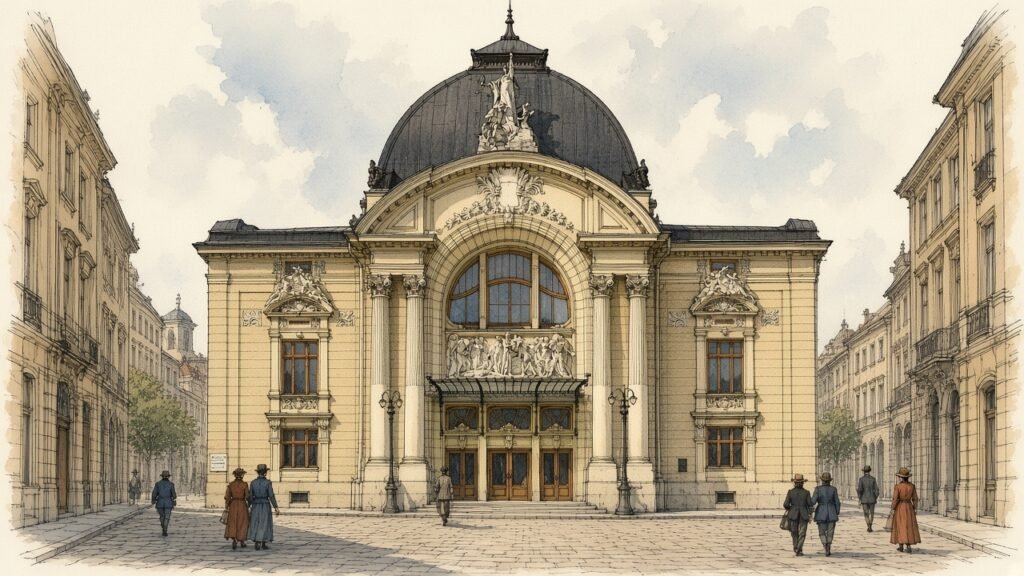
Public architecture expressed the city’s new rank. The Orthodox cathedral, the Armenian church, the Jesuit and parish churches, and the Great Synagogue and the Reform Temple marked different quarters of the skyline. Banks, insurance offices, hotels and apartment houses rose around the Ringplatz, or Central Square, whose town hall, a historicist brick building with a tall tower, became the emblem of civic authority. The Herrengasse and neighbouring streets filled with cafés, bookshops, lawyers’ offices and the clubs of the national houses. The municipal theatre, opened at the beginning of the twentieth century in a design indebted to the Viennese theatre architects Ferdinand Fellner and Hermann Helmer and to the taste of the Secession, gave the city a house for opera, operetta, spoken drama and visiting companies from Vienna, Lviv and Bucharest.
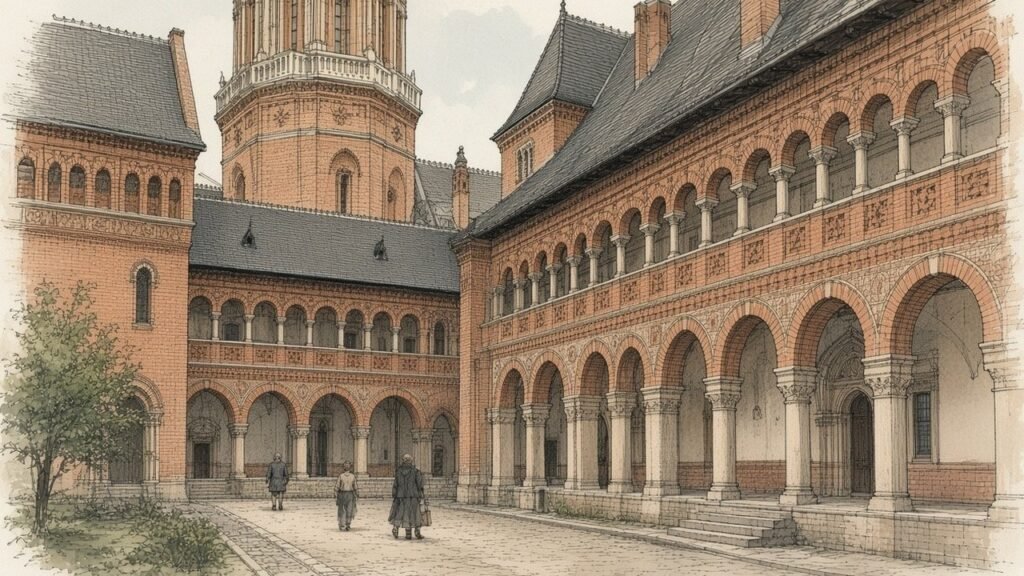
The most ambitious single building project was the Residence of the Bukovinian Metropolitans, designed by the Czech architect Josef Hlávka and constructed between 1864 and 1882 on a rise north of the centre. Its patterned brick, arcaded courtyards, steep roofs and ceremonial halls combined Byzantine, Gothic and Romanesque motifs into a historicist ensemble that proclaimed the dignity of Orthodoxy within a Catholic empire. The complex later housed parts of the university and was inscribed as a UNESCO World Heritage Site in the twenty-first century. Nearby, the Franz-Josephs-Universität opened in 1875, giving the crownland a full university with faculties of theology, law and philosophy, and with chairs that served Ukrainian and Romanian as well as German scholarship.
Newspapers, associations and voluntary societies multiplied. German-language dailies and weeklies dominated the urban public sphere, but Romanian and Ukrainian papers and reading clubs also flourished, as did Polish societies and a varied Jewish press in German and Yiddish. Classical gymnasia prepared students for the university and for the imperial civil service. A teachers’ seminary, trade schools and a higher theological institute completed the educational landscape. By 1900 visitors from Vienna and from the Romanian kingdom alike described Czernowitz as a “little Vienna,” a phrase that captured both the city’s architectural ambition and its sense of living at the eastern edge of the German-speaking cultural world. The building boom was not evenly shared. The upper town housed officials, merchants and professionals; the lower town toward the Prut retained older wooden houses, markets and poorer Jewish and Ukrainian streets. Floods periodically damaged the riverside districts. Yet the overall impression left by late Habsburg Czernowitz was of a compact, walkable capital whose public face was Central European and whose private households spoke many languages. That combination of civic pride and linguistic plurality became the city’s most durable legend.
Civic improvement required money and expertise. Engineers trained in Vienna and Prague designed waterworks and bridges. Architects adapted Ringstrasse idioms to Bukovinian budgets: historicist façades in brick and stucco, iron balconies, courtyard apartment plans. The building code gradually pushed out wooden construction from the centre. Insurance maps from the late nineteenth century show a city of masonry blocks around the Ringplatz and more mixed fabric toward the river. Fires in the lower town repeatedly cleared ground for rebuilding. Flood control on the Prut remained imperfect; spring waters still entered cellars in bad years.
The social calendar of the capital followed imperial and religious rhythms. The emperor’s birthday, the dedication festivals of churches and synagogues, the opening of the Landtag and the university semester structured public time. Military bands played in the parks. Charity balls raised funds for hospitals. Duelling scars among students and officers, a Habsburg commonplace, appeared in memoirs. Women of the educated classes organised reading circles and philanthropic committees; their access to higher education widened slowly after 1900. Servants, many of them Ukrainian- or Romanian-speaking girls from the villages, staffed the bourgeois households of the centre and appear only rarely in the written record under their own names.
Transport tied Chernivtsi into wider markets. The Lviv–Chernivtsi railway line carried passengers to the Galician capital in a few hours and to Vienna overnight. Southbound connections toward Romanian markets grew in importance as the Romanian kingdom consolidated after 1878 and 1881. Telegraph and later telephone linked banks and newspapers to Vienna and Budapest. Information moved faster than goods. Stock prices, theatre reviews and political crises in the imperial capital were known in Czernowitz cafés within a day. This compression of distance reinforced the city’s self-image as an outpost of the metropolis rather than a backwater.[1]
Municipal finance rested on consumption taxes, property rates and loans. Bond issues funded waterworks and school buildings. Creditworthiness depended on the city’s reputation in Vienna banking houses, which in turn depended on the perceived stability of the crownland. Jewish bankers and German municipal officials collaborated in these operations. Scandal and accusation occasionally surfaced in the press when contracts seemed too favourable to particular firms. Transparency norms of the liberal era were imperfect but not absent; diet debates aired budgets that earlier military governors had kept closed.
The city’s hotels advertised hot water, electric light and proximity to the theatre. Guidebooks in German described day trips to the Residence, to Sadagora and to Carpathian foothill resorts. Tourism remained secondary to administration and trade, yet it reinforced the “little Vienna” brand. Photographers sold postcards of the Ringplatz and the metropolitan complex. These images, circulating through the monarchy, fixed a visual identity that Soviet and Ukrainian tourism would later inherit and rebrand.
Professional chambers—of advocates, notaries, physicians and merchants—regulated entry and ethics. Membership lists are demographic sources of high value. They show the Jewish preponderance in some professions and the German preponderance in others. Romanian and Ukrainian entry into these chambers accelerated only late in the Austrian period and more rapidly after 1918. Professionalisation was thus also nationalisation, delayed and uneven.
Hospitals and clinics expanded with municipal and Jewish communal investment. Antisepsis and later bacteriology changed surgical outcomes. Midwives registered with the authorities. Epidemics of cholera in the mid-nineteenth century killed hundreds and prompted sanitary reform. The memory of those epidemics lingered in building regulations that required better drainage. Public fountains replaced some well water. The link between civil engineering and mortality was understood by progressive councillors who cited Viennese models in diet speeches.
Fire insurance maps and address books allow virtual reconstruction of who lived above which shop in 1910. Digital humanities projects have begun to map these sources. They show clustering: Jewish merchants on certain streets, officials on others, mixed courtyards nearly everywhere. Segregation was real but incomplete. The courtyard, with its shared well and overlapping languages, was the microscopic unit of Czernowitz coexistence.
Artisan workshops modernised unevenly. Some guilds adapted to factory competition; others died. Clockmakers, printers and confectioners catered to bourgeois taste. Apprenticeship indentures specify years of service and moral conduct. Reading them, one sees the reproduction of craft skill across generations that the war would interrupt.
Library catalogues of the municipal and university libraries list German classics, legal digests, Hebrew titles and Romanian novels. Acquisition budgets reveal cultural priorities. Missing stamps show theft and war loss. A catalogue is a city’s intellectual portrait in bibliographic form.
4. Peoples of Bukovina
The population of Bukovina and of its capital was, from the Austrian annexation onwards, a subject of official counting and of political argument. Censuses recorded language of daily use, religion and, less consistently, nationality. The figures for the crownland as a whole showed a rural majority of Ukrainian-speakers in the north and Romanian-speakers in the south, with Germans, Jews, Poles, Hungarians and Lipovan Old Believers present in towns and in particular villages. In Chernivtsi itself the balance was different. By the last decades of the nineteenth century Jews were the largest single group within the municipal boundaries, often approaching or exceeding two-fifths of the population. German-speakers, many of them Catholic or Protestant officials and professionals, formed a substantial minority. Ukrainians and Romanians, though dominant in the hinterland, were less numerous in the city centre. Poles clustered around particular parishes and associations. This urban demography, so different from that of the villages, explained why German could function as a lingua franca of commerce, administration and secondary education even in a province whose peasants spoke other tongues.
Jewish Czernowitz was itself diverse. Families from Galicia brought Yiddish, Hasidic attachments and experience of Austrian liberal politics. Others arrived from the Russian Empire, fleeing restrictive laws or seeking commercial opportunity. Within the community there were Orthodox, Hasidic and Reform currents, Yiddishists and Hebraists, Zionists, socialists and liberals. The great synagogue and the Reform temple stood for different styles of worship and of public presentation. Jewish merchants dominated much of the grain, timber and retail trade; Jewish lawyers, doctors and journalists filled the free professions; Jewish students crowded the gymnasia and, after 1875, the university. Anti-Jewish prejudice existed in popular culture and in some political programmes, yet the legal emancipation of Jews in the Austrian constitutional era and the relative openness of Bukovinian municipal life gave the community a security and a visibility that contemporaries contrasted with conditions further east.
German-speaking Christians in the city included both long-settled Bukovina Germans and newcomers from other crownlands. They staffed the bureaucracy, the higher schools and many of the technical professions. Their clubs, choral societies and newspapers sustained a sense of belonging to the wider German cultural nation without, in most cases, demanding political union with the German Empire. Romanian intellectuals and politicians in Chernivtsi organised reading societies, published journals and contested seats in the Landtag in the name of the Romanian nation of Bukovina, looking sometimes to Vienna for protection against Ukrainian claims and sometimes to the Romanian kingdom across the border for cultural support. Ukrainian activists similarly founded associations, pressed for Ukrainian-language schooling and gymnasia, and developed a press that linked Bukovina to the Ukrainian movements of Galicia and of the Russian Empire. The competition between Romanian and Ukrainian national projects was the deepest structural conflict of the crownland’s politics, and it was fought out in Chernivtsi’s diet, schools and church appointments as much as in the countryside.
Poles in the city maintained their own church life, library and mutual-aid societies, and they supplied a share of lawyers and officials. Armenians, though few, retained a historic church and a memory of earlier commercial importance. Lipovan Old Believers, Russian-speaking dissenters from the official Orthodox Church, lived in particular villages and traded into the town. The everyday reality of this mosaic was less a harmonious multicultural idyll than a practical coexistence regulated by law, by the German administrative language and by the shared spaces of the market, the café and the theatre. National houses—Romanian, Ukrainian, German, Polish and Jewish—gave each community a club, a library and a stage for lectures and amateur drama. Marriages across communal lines occurred but remained less common than commercial partnerships. Children often grew up hearing two or three languages at home and in the street. It was this dense, competitive, multilingual urban society that later writers, looking back from exile, would remember as the lost world of Czernowitz.
Statistics never fully captured identity. A household might report German as its language of daily use while praying in Hebrew, speaking Yiddish in the market and singing Romanian songs learned from servants. Ukrainian-speakers in the city sometimes adopted German for schooling and Romanian after 1918 for administration. Poles in Bukovina included both long-settled families and Galician newcomers. The census category “Israelite” for religion cut across language. Nationalists of every camp tried to harden these fluid practices into exclusive identities; the city’s everyday life resisted full hardening until war and deportation destroyed the social basis of fluidity.
Education was the principal machine of linguistic change. A child from a Yiddish-speaking home who completed the German gymnasium and the university emerged as a German-speaking professional who might still return to Yiddish with grandparents. Romanian and Ukrainian activists therefore fought not only for elementary schools in their languages but for secondary and higher pathways that would produce a national intelligentsia without requiring passage through German. The Ukrainian gymnasium of 1896 and the Romanian gymnasia were victories in that struggle. Jewish Zionists built Hebrew schools with a similar logic. The result, by 1914, was a city in which several complete cultural systems operated in parallel, overlapping in the university and the marketplace but diverging in their libraries and their heroes.
Conflict was real. Elections produced street clashes. University students fought over the display of national colours. Pamphlets accused rival nations of dominating the bureaucracy or the grain trade. Blood libels and ritual-murder rumours, though less catastrophic here than in the Russian Empire, surfaced in the regional press and had to be policed. The famous Bukovinian “Ausgleich” spirit—the habit of compromise among national clubs in the diet—was an achievement of elites, not a natural state. It depended on imperial arbitration, on a franchise that excluded most peasants, and on a shared interest in preventing Vienna from suspending autonomy. When the empire fell, that scaffolding vanished.
Mixed marriages, though uncommon, occurred especially among secular professionals. Children of such marriages navigated multiple grandparents and sometimes chose one national affiliation for schooling and another for marriage. Conversion to Christianity, motivated by career or belief, removed individuals from Jewish communal rolls but not always from social stigma. Conversion to Judaism was rare. Atheism and freethought spread in student circles after 1900. The city’s religious statistics therefore understate the growth of a secular milieu that still inherited communal languages and networks.[2]
Carnival, Purim, Easter and Christmas marked the calendar with processions and performances that spilled into shared streets. Masks and satire allowed temporary inversions of hierarchy. Police watched for political insults. The national houses staged amateur plays that taught national history to audiences of shopkeepers and clerks. These performances were pedagogical instruments as much as entertainment. The repertoire choices of the Romanian, Ukrainian and Jewish houses offer historians a guide to the myths each community wished to inhabit.
Funerals revealed hierarchy and solidarity. A metropolitan’s funeral filled the streets with processions; a famous rebbe’s funeral drew Hasidic crowds from across the province; a liberal burgomaster’s funeral assembled the municipal elite. Jewish funerals wound toward the cemetery with their own liturgy. Shared epidemics produced overlapping mourning. The city’s cemeteries remain among its most eloquent texts, readable by anyone who walks the rows and notes the languages of the inscriptions.
Military service conscripted young men into Austro-Hungarian regiments that mixed Bukovinians with recruits from across the monarchy. Barracks in Chernivtsi were sites of linguistic improvisation and of nationalist recruiting by rival agitators. Veterans returned with pensions, injuries and sometimes with socialist ideas acquired in Vienna or Prague. The garrison also supplied husbands for local women and customers for local trades. Civil–military relations were a constant thread of urban history, visible in parade schedules and in complaints about soldiers’ drunkenness.
Music boards and conservatory teachers trained a generation of instrumentalists. Some left for Vienna’s orchestras; others staffed local ensembles. Jewish violinists were prominent, as in Odessa, though on a smaller scale. Salon concerts in private flats preceded public ones. Sheet music shops imported the latest Viennese hits. The city’s sound was not only bells and tramcars but also piano practice drifting from windows on summer evenings.
Festivals of national houses displayed costumes, choirs and gymnastic pyramids. Judges awarded prizes; newspapers printed scores. These competitive displays trained emotion as well as bodies. A child who marched under a national banner learned belonging in the muscles. The politics of the diet began in the parade ground.
Interethnic business partnerships required trust contracts and sometimes silent partners to evade informal barriers. Court cases when partnerships failed expose the workings of credit across communities. The market could integrate where the diet divided—and could exploit where the diet preached harmony.[14][16]
5. The crownland and its politics
The Duchy of Bukovina possessed, under the Austrian December Constitution of 1867 and the provincial statute, a diet, a provincial executive and a defined share of competences in education, welfare and local taxation. The Landtag in Chernivtsi was elected on a curial franchise that weighted property and education heavily and that distributed seats among national groups by a combination of territorial districts and national curiae. The result was a politics of bargaining. Romanian and Ukrainian clubs competed for influence over Orthodox church appointments and over the language of elementary schools. German liberals and Jewish liberals often allied in defence of the German character of the secondary schools and of the university. Social Democrats and agrarian radicals appeared toward the end of the century. No single nation commanded a permanent majority, and the Landespräsident in the name of the emperor frequently mediated.
The Orthodox Church was both a spiritual institution and a political prize. The metropolitan in Chernivtsi ranked among the senior Orthodox hierarchs of the monarchy. Control of the metropolitanate, of the theological faculty and of parish appointments mattered intensely to Romanian and Ukrainian politicians, because the church reached into every village and because its language of liturgy and preaching shaped national consciousness. Compromises were periodically struck, including arrangements for bilingual administration and for the alternation or pairing of candidates. Elsewhere in the monarchy such church–nation conflicts had produced deeper crises; in Bukovina they remained, for most of the dualist period, within the bounds of parliamentary and bureaucratic negotiation.
Schools were the other great arena. Elementary education expanded under provincial and municipal auspices. The question of the language of instruction—German, Romanian, Ukrainian or, in Jewish schools, also Hebrew and Yiddish—was fought out case by case. Secondary education remained predominantly German. The classical gymnasium and the Realschule prepared students for the university and for careers in law, medicine and the civil service. A Ukrainian gymnasium was established in Chernivtsi in 1896 after prolonged pressure. Romanian secondary provision also improved. Jewish parents often preferred the German gymnasia, which opened the widest professional doors. The Franz-Josephs-Universität, founded in 1875, taught primarily in German but maintained chairs of Ukrainian language and literature and of Orthodox theology, and it attracted students from Galicia and from the Romanian lands as well as from Bukovina itself.
Municipal politics in Chernivtsi reflected the same balances. Mayors of German or Polonised German background, supported by Jewish votes and by property owners, dominated for decades. The city’s budget paid for paving, lighting, schools, hospitals and the theatre. Philanthropy supplemented public provision: Jewish hospitals and orphanages, Romanian and Ukrainian cultural foundations, and German association funds. The relative prosperity of the late nineteenth century, interrupted by agricultural crises and by the commercial shocks of the 1870s, underwrote this civic expansion. By 1910 Czernowitz presented itself as a model of what a small crownland capital could achieve within the Habsburg framework: a university city, a seat of an Orthodox metropolitan, a bilingual and multilingual press centre, and a municipality whose elite spoke of loyalty to the emperor and of progress in the same breath.
The provincial budget revealed priorities. Funds flowed to roads, to agricultural improvement, to schools and to the subvention of cultural societies. German theatre and Ukrainian and Romanian cultural associations all sought grants. Jewish communal institutions financed themselves largely from internal taxation and philanthropy, though municipal subsidies for hospitals crossed communal lines. Forestry revenues from the beech woods mattered to the provincial treasury. Agrarian reform remained limited; large estates, some of them church lands, persisted alongside peasant smallholdings. Rural indebtedness and seasonal labour migration to Bessarabia, to Romania and to America were features of Bukovinian life that the capital’s prosperity only partly masked.
Public health improved slowly. Cholera and typhus epidemics struck in the nineteenth century. A municipal hospital and the Jewish hospital raised standards of care for those who could reach them. Midwifery and vaccination campaigns extended into the countryside with mixed success. The university’s medical teaching, when it developed, drew patients from across the province. Cemeteries expanded. Demographic transition—lower death rates, then lower birth rates—began earlier in the city than in the villages, altering the age structure of the urban population by the early twentieth century.
Law and order rested on the gendarmerie in the countryside and on municipal police in the city. Smuggling across the Russian and Romanian borders was a constant concern. Political surveillance watched socialists, nationalists and anarchists, though Bukovina never became a centre of terrorism comparable to other imperial frontiers. The courts applied Austrian civil and criminal codes. Advocates pleaded in German; interpreters served Romanian and Ukrainian clients. This legal world, drab in its daily operation, was nonetheless a pillar of the city’s professional class and of Jewish upward mobility.
Agrarian politics entered the diet through peasant deputies and through parties that claimed to speak for villagers. Demands included credit reform, schooling in the vernacular and relief from church tithes or their modern equivalents. Landowners resisted redistribution. The forest domain, partly under state or church control, was a particular flashpoint when peasants’ customary gathering rights collided with commercial forestry. Chernivtsi lawyers found steady work in these disputes. The capital’s newspapers took sides, often along national lines that mapped imperfectly onto class.
Women’s suffrage and women’s higher education were debated in Bukovina as in the wider monarchy. Female teachers filled elementary schools; female doctors appeared in small numbers before 1914. Jewish women entered clerical and medical pathways earlier than many Christian peasant daughters. Memoirs by women of the Czernowitz intelligentsia, published decades later in exile, describe a city that offered them schooling and conversation while still limiting their formal power. Those memoirs are now essential sources for the social history of the crownland capital.[3]
Foreign consuls and commercial agents maintained small offices in the city, reporting to Vienna, Bucharest and other capitals on harvests, troop movements and political temper. Their despatches, now in state archives, provide outside views of Bukovinian crises. Travellers’ accounts—some condescending, some enthusiastic—circulated in German and French periodicals. The phrase “little Vienna” itself was a travellers’ and locals’ coinage that flattered and constrained: it demanded architectural and cultural performance of Viennese standards on a provincial budget.
Electoral fraud and pressure were alleged in nearly every diet campaign. Petitions to Vienna complained of intimidation at the polls. Reforms of the franchise at the imperial level after 1907 altered calculations without fully democratising the provincial system. Mass politics arrived late and incompletely. The Social Democratic vote grew in the city’s poorer districts. Peasant parties coalesced around language and land. By 1914 Bukovinian politics looked more like the rest of Cisleithania than it had in 1867: noisier, more ideological and less easily managed by notable bargaining alone.
Statistical yearbooks of the crownland, printed in German, tabulated population, livestock, schools and crimes. Historians rely on them while knowing their categories were politically loaded. Language of daily use, the key census variable, rewarded whatever tongue a household preferred to present to the enumerator. National activists campaigned before census years to persuade co-nationals to declare correctly. The resulting numbers were weapons in diet debates over school funding. Demography was never merely descriptive in Bukovina.
Cross-border kinship tied Bukovinians to Galicia, to Romania and to Bessarabia. Weddings and funerals moved people across frontiers that states regarded as hard lines. Smuggled newspapers and books followed the same routes. The crownland’s politics cannot be understood within its borders alone. Chernivtsi was a node in networks that reached Warsaw, Vienna, Bucharest and Odessa.
Agricultural exhibitions in Chernivtsi displayed improved breeds and machinery. Prizes encouraged innovation among landlords and richer peasants. Jewish grain dealers financed next year’s seed. Crop failure years produced hunger that municipal soup kitchens only partly relieved. The capital’s prosperity was always hostage to the harvest of its hinterland.
Petitions to the emperor, drafted by provincial lawyers, used deferential formulas to convey sharp demands. The genre of the petition is a source for popular and elite grievances alike. Bundles of them in Vienna archives await systematic study. Chernivtsi’s letterheads appear frequently in the Bukovina files.
Hunting rights in Bukovinian forests belonged to large landowners and to the state. Poaching cases filled rural courts. The beech woods were not only metaphor; they were timber money and contested commons. Environmental history and social history meet in the forest files.
6. The university of 1875
The foundation of the Franz-Josephs-Universität in 1875 was the cultural event that completed Chernivtsi’s rise from district town to crownland capital. The occasion was chosen to mark the centenary of the Austrian annexation of Bukovina. After Lviv University had moved toward Polish as a language of instruction in the early 1870s, Bukovinian notables, led by the Romanian jurist and liberal politician Constantin Tomashchuk, petitioned Vienna for a German-language university in Czernowitz. Other cities of the monarchy—Trieste, Brno, Ljubljana, Salzburg—had also hoped for new colleges. The emperor and the Imperial Council decided for Chernivtsi. The new university opened on 4 October 1875, the name day of Franz Joseph, with Tomashchuk as its first rector. It comprised three faculties: Orthodox theology, law and philosophy. German was the principal language of instruction. Chairs of Ukrainian language and literature and of practical theology in Ukrainian were established from the start, a concession to the Ukrainian population of the crownland and of neighbouring Galicia.
The theological faculty was unique in the Austrian half of the monarchy: it was the only Orthodox faculty in a state whose dynastic religion was Catholic. It trained priests for Bukovina and attracted candidates from other Orthodox regions. The law faculty prepared the officials, advocates and judges of the province. The philosophy faculty covered the humanities and the natural sciences and housed the Ukrainian and classical philological chairs. Student numbers grew steadily. Young men from German, Jewish, Romanian, Ukrainian and Polish families shared lecture halls, though they often organised in separate national student societies and sometimes clashed in the streets over flags, songs and faculty appointments. Women were admitted later, in line with broader Austrian reforms. The university library and the learned societies attached to the faculties made Chernivtsi a minor but real centre of scholarship on south-eastern Europe, on Orthodox canon law and on the languages of the region.
The university’s German character was both its strength and its political vulnerability. It linked Bukovina to Vienna, Graz and Prague and gave local graduates access to imperial careers. It also became a target for Romanian and Ukrainian nationalists who wanted instruction in their own languages, and for critics in Vienna who doubted the expense of maintaining a full university in a small province. In the Romanian period after 1918 the institution was Romanianised as Universitatea Regele Carol I; under Soviet rule it became a Ukrainian state university and was eventually named after the Bukovinian Ukrainian writer Yuriy Fedkovych. Continuity of site and of some scholarly traditions coexisted with abrupt changes of language, curriculum and personnel. The Hlávka Residence buildings, which the university came to occupy in large part, gave the campus an architectural identity unmatched by most provincial universities of the region.
For the city’s Jewish students the university was particularly important. Numerus clausus restrictions that limited Jewish enrolment in some other Habsburg and Russian universities were less severe in Czernowitz, and the German medium suited families already educated in German gymnasia. Jewish graduates entered law, medicine, journalism and commerce in large numbers. Among the university’s later alumni and associates were figures who would shape the literary memory of the city. The lecture halls, the reading rooms and the student cafés formed part of the everyday geography that Paul Celan, Rose Ausländer and their generation still knew, even after the monarchy had fallen.
Student life generated its own geography of pubs, duelling grounds and rented rooms. National student corporations—German, Jewish, Romanian, Ukrainian, Polish—organised libraries, singing evenings and political meetings. Fights between corporations were reported in the press and occasionally disciplined by the academic senate. Professors negotiated a difficult neutrality. Some were openly aligned with national causes; others cultivated a Habsburg imperial identity. Scholarship on the region’s languages, folklore and church history flourished in this competitive atmosphere. Editions of texts, dialect studies and legal histories produced in Chernivtsi entered the wider Central European academic circuit.
The theological faculty trained priests who would serve villages where national identity was being forged from the pulpit. Sermons in Romanian or Ukrainian, the choice of saints’ cults and the language of catechism became political acts. The faculty’s dual role—as an imperial Orthodox institution and as a nursery of national clergy—mirrored the metropolitanate’s own ambiguity. Law graduates staffed not only Bukovinian courts but postings across the monarchy. Philosophy graduates became gymnasium teachers, the multipliers of whatever linguistic and political formation they had received. In this sense the university was the central factory of Bukovinian elites in the last Habsburg generation.
After 1918 the Romanian authorities moved quickly to change the language of instruction and the composition of the professoriate. Some German and Jewish academics left; others adapted. Ukrainian chairs were curtailed. The institution’s library holdings retained Austrian-era collections that later Soviet and Ukrainian librarians would catalogue as historical deposits. The physical continuity of Hlávka’s buildings, filled with successive regimes’ furniture and portraits, offers a concrete image of how a single campus can host discontinuous intellectual worlds.
Scientific collections—minerals, botanical specimens, ethnographic objects—accumulated in university museums. Fieldwork in the Carpathians and among Bukovinian villages supplied data for theses. The medical clinic treated both urban and rural patients, exposing students to the disease patterns of the frontier. Law clinics and moot courts trained advocates for the provincial bar. Theology students practised homiletics in Romanian, Ukrainian and Church Slavonic. This practical orientation distinguished the small university from purely metropolitan institutions and tied it tightly to regional needs.
Alumni networks stretched to Vienna, to Bucharest, to Lviv and to American emigration destinations. Reunion dinners and subscription lists for memorials kept the connection alive. When the monarchy fell, alumni found themselves citizens of different states overnight. Correspondence among former classmates became a record of the partition of a single academic world into Romanian, Polish, Czechoslovak and Soviet fragments. The Chernivtsi degree, once an Austrian credential, had to be renegotiated in each new jurisdiction.[1]
International scholarly exchanges brought guest lecturers from Vienna, Prague and German universities. Bukovinian students travelled westward for doctoral work and returned with new methods. Publications in German journals put Chernivtsi on academic maps of linguistics, law and theology. The university’s Orthodox theological faculty attracted attention from Russia and from the Balkan Orthodox churches as a rare seminary operating under a Catholic sovereign. Correspondence with the Ecumenical Patriarchate and with other metropolitanates passed through the faculty’s professors.
Disciplinary conflicts—between evolutionists and traditionalists in the sciences, between historicists and dogmatists in theology, between Romanists and Germanists in law—played out in miniature. Appointment battles became local causes célèbres. The ministry in Vienna had the final word, and lobbying campaigns filled summers. Losing candidates sometimes published pamphlets. These micro-histories of academic politics reveal how national and confessional stakes attached to every chair.
Student poverty was common. Stipends, tutoring and shared rooms made study possible for sons of peasants and small traders. Jewish students from Hasidic towns underwent linguistic and cultural transformations in the German lecture hall. Some returned home estranged; others mediated between worlds. Alumni memoirs describe first encounters with Kant, with Roman law, with laboratory science, as biographical ruptures. The university’s greatest export was this transformed youth.
Laboratory science required equipment imported from Germany and Austria. Budgets constrained research. Nonetheless, publications in chemistry, botany and medicine appeared. The veterinary and agrarian needs of the province oriented some applied work. Pure scholarship coexisted with practical service. That dual mandate remains visible in the university’s modern mission statements, however rewritten for Ukrainian accreditation.
Honorary doctorates and imperial decorations linked the university to monarchical favour. Ceremonies in academic dress filled the Residence halls with colour. Portraits of rectors lined corridors. Continuity of ceremonial form across Austrian, Romanian and Soviet regimes, with changed insignia, illustrates how institutions preserve ritual while altering ideology.
Disputes over lecture language occasionally disrupted classes. Students stamped feet or walked out when a professor’s national stance displeased them. The academic senate issued reprimands. Ministers received reports. Academic freedom and national mobilisation coexisted uneasily in the same auditorium.
Foreign students from the Romanian kingdom and from Russia enrolled in small numbers, seeking German-language credentials. Their presence internationalised seminar rooms. Police watched Russian subjects for revolutionary contacts. The university was a border institution in the intelligence sense as well as the geographic.[24]
7. The Residence of the Metropolitans
The Residence of the Bukovinian and Dalmatian Metropolitans stands on a wooded rise above the centre of Chernivtsi and is the city’s most celebrated architectural monument. It was commissioned to house the Orthodox metropolitan and his administration, and to give Orthodoxy a visible seat of honour in a Catholic empire. The Czech architect Josef Hlávka, already known for work in Vienna and in the Bohemian lands, designed the complex. Construction lasted from 1864 to 1882. The ensemble combines patterned red brick, light stone dressings, arcaded galleries, steep tiled roofs and ceremonial interiors decorated with murals, woodwork and liturgical fittings. Stylistically it draws on Byzantine, Gothic and Romanesque precedents, filtered through the historicist vocabulary of the mid-nineteenth century. The result is neither a copy of any single medieval building nor a purely modern invention, but a carefully composed statement of ecclesiastical dignity.
The complex includes the metropolitan’s palace, seminary buildings, a guest wing, courtyards and a former seminary church. Ceremonial halls were used for receptions, synods and the entertainment of imperial and foreign visitors. The gardens and terraces framed views over the city and the Prut valley. Hlávka’s attention to brick ornament, to the rhythm of arcades and to the silhouette of roofs gave the Residence a unity that survived later alterations. In the twentieth century the buildings passed to the university. Lecture rooms, administrative offices and assembly halls occupied spaces once reserved for the metropolitan’s household. The change of function preserved the fabric more effectively than many ecclesiastical seats that remained in church hands through wars and regimes.
In 2011 the Residence was inscribed on the UNESCO World Heritage List as an outstanding example of nineteenth-century historicist architecture expressing the cultural identity of the Orthodox Church within the Austro-Hungarian Empire. The inscription drew international attention to Chernivtsi and encouraged restoration. For local residents the buildings had long been simply “the university,” a place of examinations, graduations and summer shade under the arcades. For historians of architecture they illustrate how a provincial capital of the monarchy could commission work of empire-wide ambition. For the narrative of the city they mark the moment at which Orthodox Bukovina received a monumental centre equal in prestige to the Catholic and civic buildings of the Ringplatz.
The Residence also embodied the political tensions of the crownland. Romanian and Ukrainian factions contested influence over the metropolitanate that the building housed. Appointments, the language of administration and the character of the seminary were watched closely by the Landtag and by the press. The splendour of the architecture did not resolve those conflicts; it raised the stakes. When the Habsburg Monarchy collapsed, the Residence passed with the city into Romanian sovereignty, then into Soviet hands, and finally into independent Ukraine, each regime adapting the symbolism of the brick courtyards to its own story of legitimacy.
Josef Hlávka’s career helps explain the ambition of the project. A graduate of the Vienna technical culture of the mid-century, he combined entrepreneurial capacity as a builder with historicist design. His Bukovinian commission was among his most complete urban ensembles. He attended to brick supply, to the training of local craftsmen and to the integration of landscape with architecture. The ceremonial staircase, the synodal hall and the chapel interiors received decorative programmes that fused imperial loyalty with Orthodox iconographic tradition. Visitors from Vienna expressed surprise that so elaborate a complex should stand so far east; Bukovinian elites took that surprise as a compliment.
Restoration in the late twentieth and early twenty-first centuries faced the usual problems of brick decay, roof leakage and inappropriate Soviet-era alterations. UNESCO listing brought standards, funds and tourism. Guides now recount Hlávka’s biography, the metropolitanate’s history and the university’s occupation of the site. School groups file through the arcades. Wedding photographers use the courtyards. The building has become the city’s principal postcard image, sometimes at the expense of quieter streets that equally preserve Habsburg fabric. For a historical account the Residence matters less as a postcard than as evidence of how Orthodoxy, empire and historicist art collaborated to produce a landmark that outlasted all three of the regimes that first gave it meaning.
Labour on the construction site brought together bricklayers, carpenters, painters and hauliers from across the province. Payroll records, where they survive, show a multi-ethnic workforce. Accidents and disputes left traces in court files. The completed complex required a permanent staff of gardeners, cooks, clerks and guards. The metropolitan’s household was itself a small court, with etiquette modelled partly on episcopal and partly on aristocratic precedent. Imperial visits demanded special protocol. Franz Joseph’s attention to Bukovina, including the university foundation, lent the Residence additional ceremonial weight.
Comparative architecture places Hlávka’s ensemble alongside other historicist ecclesiastical residences of the monarchy, yet its Orthodox programme and brick polychromy give it a particular profile. Art historians debate the balance of Byzantine quotation and Central European workmanship. For the city’s inhabitants the debates matter less than the lived experience of shade under the arcades and of graduation photographs on the steps. Architecture succeeds socially when it becomes a habit of the eye. The Residence has achieved that status in Chernivtsi.[1]
Iconographic programmes inside the ceremonial halls depicted Orthodox saints, imperial arms and allegorical figures of faith and learning. Craftsmen executed woodcarving, tilework and stained glass to Hlávka’s specifications. Some furnishings were later removed or destroyed; inventories help reconstruct the original appearance. Lithographs and early photographs document the complex for periods when written descriptions are thin. The UNESCO nomination file assembles much of this visual evidence and argues for the Residence as a masterpiece of historicist synthesis.
Pilgrims and petitioners who came to see the metropolitan walked the same courtyards later walked by students. The overlay of sacred and academic use is part of the building’s meaning. A seminarian of 1890 and a physics student of 1980 inhabited the same brick envelope with entirely different mental worlds. Architecture stores time without resolving it.
Gardens of the Residence followed formal designs with local plant adaptations. Orchards and vegetable plots supplied the household. Gardeners, often invisible in architectural histories, maintained the spectacle that visitors praised. In Soviet times parts of the grounds were altered for institutional needs. Recent restoration has sought to recover Hlávka-era sightlines. Botanical inventories interest specialists; the shade and gravel paths interest everyone else.
Seismic awareness is part of contemporary conservation. The region experiences earthquakes; retrofitting historic brick is costly. Climate change affects freeze–thaw cycles on masonry. The Residence’s long-term survival depends on technical maintenance as much as on cultural prestige. Heritage is a material commitment renewed every winter.
Comparative photographs from 1880, 1920, 1960 and 2020 show the complex’s changing surroundings: denser trees, new university signage, tourist groups replacing clerical processions. Continuity of brick and discontinuity of use are both visible. Architecture historians use such sequences to teach the difference between fabric and function. Chernivtsi’s Residence is an exemplary teaching case.
Inventories of silver, vestments and books belonging to the metropolitanate reveal liturgical wealth and scholarly holdings. War and regime change scattered some objects. Museum collections in Chernivtsi and elsewhere hold fragments. Provenance research continues. Sacred property has a history of seizure and recovery like any other.
Guided tours today script Hlávka’s biography, UNESCO criteria and university facts into thirty-minute loops. Scripts change with politics. Tourists photograph the same arcade from the same angle. The Residence has entered the age of algorithmic reproduction while remaining a working campus.
The Residence’s painted interiors and ceremonial staircases were designed for a church that negotiated between imperial favour and Orthodox autonomy. Hlávka’s workshops brought Bohemian craftsmen into Bukovina for seasons at a time, and local apprentices learned techniques that later appeared on lesser civic façades. Inventories from the metropolitan household list liturgical silver, libraries of canon law and guest apartments reserved for visiting bishops. When the university later occupied large parts of the complex, lecture rooms and laboratories were fitted into spaces originally planned for clerical administration, so that the same corridors that once led to synodal chambers came to lead to philology seminars and mineral collections.
Conservation after the UNESCO inscription required documentation of murals, timber roofs and drainage. Ukrainian and international teams recorded layers of overpaint that reflected Romanian and Soviet interventions as well as Habsburg originals. The resulting technical reports are themselves historical sources: they show which ornamental programmes survived war and which were reconstructed from photographs. Visitors who walk the arcades today therefore move through a building that is at once a nineteenth-century design, a twentieth-century campus and a twenty-first-century heritage project, each phase legible to anyone who reads the stone with care.[1][24]
8. Streets, theatres and civic life
Late Habsburg Czernowitz was a city of short distances. From the Ringplatz, with its town hall tower, the Herrengasse led toward the theatre and the cafés. Side streets climbed toward the Residence and the university or descended toward the Prut and the railway station. Trams, introduced in the early twentieth century, supplemented walking and horse cabs. The central streets were lined with three- and four-storey apartment houses in historicist and Secession styles: rusticated ground floors for shops and offices, piano nobile flats for professional families, and cheaper lodgings under the roof. Wrought-iron balconies, stucco ornament and courtyard wells gave the domestic architecture a Viennese air scaled to a provincial capital.
The municipal theatre, opened in the first years of the twentieth century, became a focus of civic pride. Its repertoire mixed German classics, contemporary drama, operetta and opera. Visiting companies from Vienna and from other crownland cities filled the calendar. Romanian and Ukrainian amateur and professional troupes also performed, sometimes in the main house and sometimes in the halls of the national houses. Concert life included choral societies, military bands and solo recitals. The pianist and later celebrity John Demjanjuk is not of this story; more relevant are the local musicians and the visiting virtuosi who appeared on Czernowitz stages. Franz Liszt had passed through in an earlier generation; by 1900 the city sustained its own public of subscribers and critics.
Cafés were the informal institutions of the intelligentsia. In the Habsburg manner, a café offered newspapers on wooden rods, chessboards, coffee and a place to hold court for journalists, lawyers, students and politicians. Jewish, German, Romanian and Ukrainian regulars often favoured particular tables or particular establishments, yet the rooms themselves were rarely closed by confession. Bookshops stocked German literature from Vienna and Berlin, Hebrew and Yiddish publications, Romanian and Ukrainian titles, and the schoolbooks of the gymnasia. Printing houses issued newspapers, pamphlets and the occasional volume of verse or fiction. The public library and the university library served readers who could not buy.
Parks and promenades offered another shared space. The Volksgarten and later green spaces provided shade, bandstands and paths for Sunday walking. The cemetery, with its Jewish, Christian and municipal sections, recorded the city’s languages on its headstones. Markets near the Prut sold produce from the Bukovinian countryside: cheese, fruit, poultry, firewood. Flood years left mud lines on the lower walls. Fires in the wooden districts periodically cleared ground for rebuilding in brick. By 1914 a visitor arriving by train and walking up into the centre could see, within an hour, the town hall, the theatre, the principal churches and synagogues, the university quarter and the café streets—the compact stage on which the crownland’s public life was acted.
Retail geography mapped wealth and confession. The principal shopping streets held watchmakers, drapers, booksellers and cafés with German signs. Markets near the river sold foodstuffs in a babel of languages. Credit relations tied Jewish grain merchants to Ukrainian and Romanian peasants, German banks to municipal bonds, and Polish attorneys to landed clients. Bankruptcy notices in the newspapers recorded the failures that accompanied the successes. Apprentices boarded with masters; journeymen travelled the monarchy and returned with new styles of work.
Entertainment extended beyond the theatre. Variety stages, cinemas after the turn of the century, sports clubs and cycling associations drew younger publics. Football and gymnastics carried national colours into stadiums. Women appeared increasingly in audience seats and, more slowly, on stages and in club committees. Prostitution and informal economies occupied streets that respectable guidebooks omitted. Police records give a fuller social history than the commemorative literature. The city’s night life, its taverns and its petty crime were those of any provincial capital, intensified by the presence of a garrison and a student population.
Soundscapes mattered. Church bells, the shofar in season, tram bells, market cries and military bugles layered the day. German theatre announcements, Yiddish songs from open windows and Romanian street vendors’ calls competed in the air. Memoirists of the lost city often begin with sound as much as with sight. Reconstructing that acoustic plurality is part of reconstructing Czernowitz.
Street lighting advanced from oil to gas to electricity, each transition recorded in municipal contracts. Night-time opening hours of cafés and theatres extended the usable day. Crime statistics show pickpocketing, drunken assault and fraud as the common offences; sensational murders were rare but heavily reported. The prison on the edge of town held political as well as common prisoners. Escape attempts and amnesties entered local lore.
Children’s geography differed from adults’. Schools, courtyards and riverbanks were their primary territories. Memoirs recall ice on the Prut, chestnut vendors and the fear of certain dogs. Jewish children learned to navigate absences on Christian holidays and vice versa. The city’s compactness meant that a child could know several linguistic worlds before adolescence. That early multilingualism, later celebrated by exiles, was simply the ordinary condition of growing up between the Ringplatz and the river.[1]
Seasonal rhythms structured street life. Spring mud, summer dust, autumn rains and winter snow each posed municipal challenges. Sleighs replaced carts in deep winter. Coal smoke darkened façades. Spring cleaning of courtyards was a communal ritual. Market days brought villagers into the centre with baskets and animals. The encounter between urban and rural dress, speech and manners was a daily drama of the capital, recorded in humorous feuilletons and in police reports of altercations.
Public transport maps from the tram era show lines connecting station, centre, university and suburbs. Ticket prices and routes were political subjects for the council. Extension of lines raised property values along new corridors. Speculators watched the planning debates. The compact city began to sprawl. Suburban villas of timber merchants and professors appeared on higher ground. The social gradient from Ringplatz to periphery steepened.
Postal services linked Chernivtsi to the imperial network. Letter volumes grew with literacy. The main post office was a civic monument of its own. Telegrams announced deaths, business deals and political crises. Delay and error in transmission caused quarrels. The archive of remaining telegrams, sparse as it is, captures the staccato of modernising communication. Postage stamps with Franz Joseph’s profile arrived on every bourgeois desk.
Street renaming is a chronicle of regimes. Habsburg names gave way to Romanian ones, then to Soviet heroes, then to Ukrainian national figures and to occasional restorations of older forms. Maps from different decades disagree. Residents of long memory still give directions in multiple toponymies. The city’s palimpsest is audible in taxi conversations.
Night watchmen, later policemen, walked beats that can be reconstructed from duty logs. Gas lamp lighting schedules changed with seasons. Power cuts in war and in early Soviet years returned streets to darkness. The history of light is a history of state capacity. When the Ringplatz blazed with electric light for a festival, the municipality displayed its modernity to itself and to visitors.
Advertisements painted on courtyard walls, photographed before fading, list trades and telephone numbers of the 1920s. Ephemeral graphics are historical sources. Urban explorers and heritage activists document them. The city writes on itself faster than historians can read.
Snow removal budgets appear in municipal minutes. Harsh winters strained horses and men. Spring revealed broken paving. Civic competence was measured in passable streets. Complaints about mud are among the most democratic sources in the archive—everyone walked.
Municipal statistics from the last Habsburg decades record the growth of water connections, school places and hospital beds alongside the more familiar counts of theatres and cafés. Engineers debated filtration of Prut water and the placement of reservoirs on higher ground. Physicians traced typhoid and scarlet fever through tenement courtyards and pressed the council for inspection of wells. These debates, preserved in council minutes and in the German-language press, show civic life as an argument about infrastructure as much as about culture. The same streets that carried promenading subscribers to the theatre also carried night-soil carts and funeral processions, and the municipality’s competence was judged by how quietly those necessary services ran.
Associations proliferated in the compact centre: choral societies, volunteer fire brigades, professional chambers, women’s charitable circles and reading clubs attached to the national houses. Membership lists reveal overlapping loyalties—an advocate might sing in a German Liedertafel, subscribe to a Jewish charitable fund and plead cases for Romanian village clients in the same season. Public balls and charity bazaars occupied the theatre foyer and the larger hotels. Photographs of these gatherings, posed beneath electric lights, became souvenirs of a provincial capital that measured its modernity by the density of its organised leisure. When war emptied the associations after 1914, the surviving minute-books became unintended archives of a social world that could not be reassembled under later regimes.[14][5]
9. German-speaking Jewish Czernowitz
Jewish Czernowitz was, by the turn of the twentieth century, one of the most distinctive Jewish urban communities of the Habsburg east. Jews had settled in Bukovina under Austrian rule in growing numbers from the late eighteenth century, many of them migrating from Galicia, where the partitions of Poland had brought large Jewish populations under Habsburg sovereignty, and others from the Russian Empire. Imperial patents and later constitutional laws regulated residence, occupation and communal organisation. Emancipation in the Austrian constitutional era removed the formal disabilities that had limited Jewish landholding, professional entry and political participation. In Chernivtsi the community built synagogues, schools, hospitals and charitable societies, and it entered the municipal electorate as a decisive bloc.
The religious life of the community spanned a wide spectrum. Traditional Orthodox congregations maintained established patterns of worship, study and dietary practice. Hasidic courts in the nearby market towns of Sadagora and Vizhnitsa drew followers from the city and the countryside; their dynasties, linked to the Ruzhin lineage, made Bukovina a centre of Hasidic prestige. In the city itself a Reform or Tempel congregation introduced vernacular sermons, a choir and an architectural style that announced accommodation with Central European bourgeois culture. Rabbis such as Eliezer Elijah Igel, associated with the more modern current, and their Orthodox counterparts contested the tone of communal leadership. Burial societies, dowry funds and hospitals organised mutual aid. The Jewish hospital and orphanages were among the city’s principal charitable institutions.
Language stratified the community. Yiddish remained the mother tongue of many households, especially among recent arrivals and among the poorer streets near the Prut. German was the language of the gymnasium, the university, the liberal professions and the prestige press. Hebrew was cultivated in Zionist schools and in scholarly circles. Children often moved among all three. The German-Jewish bourgeoisie of Czernowitz produced lawyers, physicians, journalists and merchants who regarded themselves as participants in Austrian liberal culture, reading Schiller and Heine, attending the theatre and voting for German liberal candidates. At the same time Yiddish writers, actors and journalists sustained a parallel public sphere of newspapers, popular theatre and folk performance. The tension and the cross-fertilisation between these spheres gave the city’s Jewish culture its particular energy.
Economically Jews were central to the grain trade, to timber, to retail and to credit. Jewish firms linked Bukovinian produce to the markets of Lviv, Vienna and the German Empire. Jewish advocates dominated parts of the bar; Jewish doctors staffed clinics and private practice. This visibility fuelled both admiration and resentment. Antisemitic pamphlets and parties appeared in Bukovina as elsewhere in the monarchy, yet the municipal alliance between German liberals and Jewish voters held for decades, and pogroms of the Russian type did not become a feature of Habsburg Czernowitz. The security was relative and never absolute, but it was real enough to make the city a magnet for Jews seeking education and livelihood.
Political currents multiplied after 1880. Liberal integrationists trusted the Austrian constitution. Zionists organised clubs, Hebrew classes and collections for settlement in Palestine; Nathan Birnbaum, who would later convene the Yiddish Conference, moved through Zionist and then diaspora-nationalist phases with Czernowitz in his orbit. Socialist and Bundist ideas reached students and workers. The Kadimah and other student societies debated the Jewish future in German, Hebrew and Yiddish. Women entered teaching, clerical work and, more slowly, the professions; charitable associations gave middle-class women a public role. By 1914 Jewish Czernowitz was confident, divided and culturally productive—a community that seemed, to its own members, a permanent feature of a permanent empire.
Communal governance rested on the Kultusgemeinde, whose elected board managed taxation, synagogues, schools and charities under Austrian law. Disputes between Orthodox and Reform factions, between Zionists and integrationists, and between Yiddishists and Hebraists played out in board elections and in the press. Rabbinical authority remained significant in ritual matters but shared influence with secular professionals. Women’s charitable associations raised funds for dowries, hospitals and refugee relief, especially during the First World War when Galician Jewish refugees flooded the city.
The built environment of Jewish Czernowitz included the Great Synagogue, the Temple, numerous smaller prayer houses, the Jewish hospital, schools and the Jewish cemetery with its carved stones. Many of these structures were damaged or repurposed in the Soviet period. Some have been restored since independence; others survive as warehouses or ruins. Walking maps produced by Jewish heritage initiatives now guide visitors through addresses associated with Celan, Ausländer, Steinbarg and the conference delegates of 1908. Heritage tourism cannot restore the community, but it can mark the spaces where the community lived.
Relations with non-Jewish neighbours ranged from partnership to hostility. Business partnerships, shared café tables and municipal coalitions exemplified the former; antisemitic journalism, professional exclusion campaigns and, later, Romanian radical-right violence exemplified the latter. The Habsburg legal order set limits that the Romanian and then wartime orders would remove. Understanding Jewish Czernowitz therefore requires holding together prosperity and vulnerability, German cultural fluency and Yiddish depth, civic confidence and the knowledge, available even before 1914, that empires and enfranchisements can end.
Philanthropy created lasting institutions. Endowments funded hospital beds, student stipends and refugee shelters. American Jewish aid organisations appeared during and after the First World War. Local donors competed for naming rights and for influence on boards. Charity was also a field of ideological contest: Zionist collections for Palestine competed with local welfare and with socialist mutual aid. Account books of these societies, preserved in archives in Israel, Ukraine and the United States, allow precise reconstruction of sums and beneficiaries.
Jewish sports clubs and scouting groups organised youth in the interwar years. Football derbies carried communal meanings. Gymnastics displays demonstrated modern bodies. These organisations became, for some members, pathways into political movements; for others, simply a social life. When deportations began, membership lists sometimes served persecutors as well as historians. The double edge of documentation is a standing problem in Holocaust-era urban history.[14]
Press culture was central. German-Jewish newspapers reported municipal news, serialised fiction and argued politics. Yiddish papers reached a broader popular audience with different tonalities. Hebrew periodicals served Zionist and scholarly readers. Editors were public figures who fought duels of ink and occasionally faced libel suits. Archives of these papers, incompletely preserved, are among the richest sources for daily life. Advertisements reveal consumption patterns: pianos, patent medicines, steamship tickets, sewing machines. The modern Jewish consumer of Czernowitz appears in those columns alongside the political Jew of the editorials.
Theatre-going Jewish audiences supported both the municipal German theatre and Yiddish touring companies. Goldfaden’s repertoire and later literary Yiddish drama found avid spectators. Amateur dramatics in the Jewish national house trained young actors and raised funds. Reviews in multiple languages compared productions. The stage was a parallel public sphere in which accents, costumes and plots negotiated what Jewish modernity should look like.
Legal culture among Jewish advocates in Czernowitz produced a local bar of high reputation. Cases involving commercial credit, inheritance and communal autonomy filled dockets. Some advocates entered politics; others wrote for the press. Training ran from the gymnasium through the university law faculty to apprenticeship. Ethics debates within the bar mirrored wider tensions between liberal universalism and national advocacy. The destruction of this professional class in 1941 cut away a pillar of the city’s civil society.
Dietary practice ranged from strict kashrut to full abandonment. Kosher butchers and restaurants served the observant; other Jewish families frequented ordinary cafés. Passover supplies were a seasonal commercial event. Rabbinical supervision of food was a communal power base. Arguments over certification echoed arguments over the Temple versus the Orthodox synagogue. Everyday religion lived in the kitchen as well as in the pew.
Burial records and cemetery surveys document epidemics, infant mortality and longevity. Hebrew and German inscriptions mix on stones; later Ukrainian graffiti and neglect scars appear on the same surfaces. Conservation volunteers since independence have cleared brush and photographed epitaphs. Genealogists order images online. The dead of Czernowitz have become data and pilgrimage objects for descendants who may speak no word of the city’s living languages.
Youth movements—Zionist, Bundist, religious—organised camps, lectures and street collections. Uniforms and badges marked affiliations visible on promenades. Parents worried; police watched; newspapers mocked or praised. The politicisation of Jewish adolescence in late imperial and interwar Czernowitz prepared some for leadership in Palestine, in America or in underground movements, and prepared none for the specific form of destruction that came.
Dowry inflation among bourgeois Jewish families pressured merchants to raise capital and daughters to accept matches. Matchmakers worked networks across Galicia and Romania. Marriage contracts in Hebrew and German survive in family papers. Private life’s economic calculus is part of communal history.
Funeral sermons in German and Yiddish eulogised merchants and rabbis, preserving biographical data nowhere else recorded. Printed sermons circulated as pamphlets. Homiletics is a historical source when read against the grain of its piety.[7][18]
10. Hasidism and the courts beyond the city
Beyond the city, in the market towns of Bukovina, Hasidism shaped Jewish life in ways that differed from the German-speaking bourgeois culture of the Czernowitz centre. Sadagora, a short distance from the capital, became famous as the seat of the Ruzhin dynasty after Rabbi Israel Friedman of Ruzhin settled there in the 1840s, having fled the Russian Empire. The Sadagora court was noted for its splendour, its music and its attraction of pilgrims from across the region. Vizhnitsa (Vyzhnytsia), further into the Carpathian foothills, housed another influential dynasty. These courts combined mystical teaching, charitable networks and a distinctive style of leadership that emphasised the charismatic tsadik. Yiddish was the language of the court and of the followers. The relationship between the Hasidic towns and the city was constant: merchants, pilgrims and relatives moved back and forth; urban Jews sought blessings and advice; Hasidic leaders intervened in communal disputes.
Hasidism in Bukovina coexisted with Mitnagdic Orthodoxy and with the Haskalah. Maskilic writers criticised what they saw as superstition and dynastic excess; Hasidic followers regarded the urban Reform temple as a dangerous assimilation. Yet boundaries blurred in practice. Families might send one son to a German gymnasium and another to a Hasidic rebbe. Marriages linked town and city. The economic ties of the timber and cattle trades crossed religious styles. For the history of Chernivtsi the Hasidic hinterland mattered because it supplied a continuous Yiddish-speaking depth to a city whose public face was German, and because it made Bukovina a name of consequence in the wider Jewish world.
The First World War and the subsequent borders disrupted the courts. Some dynasties relocated; followers emigrated. In the Romanian interwar period Hasidic life continued under new administrative rules. The Holocaust destroyed the communities of Sadagora, Vizhnitsa and the villages. Survivors re-established courts in Israel, the United States and elsewhere, carrying Bukovinian Hasidic names into the postwar Jewish geography. The empty synagogues and ruined courts of the Bukovinian towns stand today as traces of a world that once oriented much of the countryside toward Chernivtsi as its urban market and administrative centre.
The splendour of the Sadagora court attracted commentary from maskilim and from Christian travellers alike. Descriptions of the rebbe’s household, of the pilgrim crowds at festivals and of the economic networks that sustained the court filled newspaper columns and travelogues. Vizhnitsa developed its own style and its own diaspora of followers. Smaller prayer houses in Chernivtsi itself maintained Hasidic customs without a resident dynasty. Music—nigunim sung at the table—crossed into urban Jewish memory and, in transcribed forms, into later concert repertoires.
Scholarship on Bukovinian Hasidism has grown in recent decades, drawing on Hebrew and Yiddish sources, Austrian police files and family papers preserved in Israel and the United States. It shows a world that was neither static nor isolated from urban modernity. Hasidic leaders used the postal system, the railway and the press. Followers worked in the timber trade that linked the Carpathian foothills to Chernivtsi merchants. The destruction of this world between 1941 and 1944 was nearly total in situ. Its continuation elsewhere is one of the ways Bukovina remains a living name in Jewish religious geography.
Pilgrimage economies sustained inns, cart drivers and sellers of ritual objects in Sadagora and Vizhnitsa. Festival days transformed small towns into temporary cities. Disease outbreaks sometimes followed the crowds. Austrian sanitary authorities alternated between tolerance and restriction. The dynasties’ international marriages linked Bukovina to Hasidic centres in Galicia, Hungary and the Russian Empire. News of a rebbe’s illness or death travelled by telegraph and drew thousands to funerals. These events were among the largest spontaneous gatherings in the province’s history.
Women in Hasidic Bukovina lived within gendered structures of piety that historians have only recently begun to detail from letters, memorial books and oral histories. They maintained households during husbands’ pilgrimages, educated daughters in religious practice and sometimes held economic roles in markets. The urban–Hasidic contrast in women’s dress and schooling was visible on Chernivtsi streets when village families came to town. Maskilic satire targeted these contrasts; later ethnography tried to describe them more carefully. Any history of Chernivtsi’s Jewish culture that ignored the Hasidic towns would miss the gravitational field in which the city’s own Jewish life moved.
Storytelling traditions at Hasidic courts preserved miracle tales, moral exempla and genealogies of the dynasties. Collectors later wrote them down in Hebrew and Yiddish books printed in Poland and in the land of Israel. Through those books Sadagora and Vizhnitsa entered a global Jewish library. Chernivtsi printers occasionally handled related jobs. The city’s role as a distribution node for sacred books deserves mention beside its role as a centre of secular Yiddishism.[16]
Charitable endowments of Hasidic courts funded poor relief that crossed into the city. Bread and fuel distributions in hard winters linked rebbe to urban poor. Reciprocally, urban donors supported court institutions. The moral economy of Bukovinian Jewry was not divided neatly between modern city and traditional town.
The Ruzhin-Sadagora lineage traced spiritual ancestry through Rabbi Israel of Ruzhin, whose imprisonment in the Russian Empire and subsequent flight gave the dynasty a martyr’s aura among followers. In Sadagora the court developed a style of public majesty unusual among Hasidic centres: elaborate receptions, a household that resembled a small aristocracy, and a deliberate aesthetic of dignity. Critics called it vanity; followers called it revelation embodied. The court’s musicians and singers created a repertoire that travelled with emigrants to America and to the land of Israel. Recordings made in the twentieth century preserve echoes of that sound.
Vizhnitsa’s dynasty, founded by Rabbi Menachem Mendel Hager, emphasised different tonalities of piety and attracted its own dense network of small-town followers in the Carpathian zone. Relations between courts involved both kinship and rivalry. Chernivtsi Jews might maintain ties to more than one rebbe, seeking blessings for illness, marriage or business. Urban maskilim mocked these journeys; novelists used them as colour; economists might note the transfer of resources from city to town. For a social history of Bukovinian Jewry the Hasidic courts are not peripheral colour but central institutions that organised loyalty, charity and meaning for a large fraction of the Jewish population outside the German-speaking bourgeoisie.
During the First World War Russian occupation disrupted the courts; some rebbes fled west. The Romanian period restored a precarious order. The Holocaust ended the Bukovinian phase. Dynastic successors in Israel—continuing under names such as Sadigura and Vizhnitz—rebuilt communities that still count tens of thousands of adherents worldwide. Pilgrims sometimes return to empty sites in Ukraine. The asymmetry between flourishing diaspora courts and devastated original towns is one of the starkest images of Jewish Bukovina’s fate.
Hasidic tales set in Bukovina circulate still in translated anthologies. They present a moral geography of rebbes, merchants and miraculous interventions. As historical sources they are problematic; as evidence of how memory aestheticises the lost towns they are invaluable. Literature and history share the same place-names here.
Candle factories and ritual fringes workshops in the Hasidic towns supplied distant markets. Sacred economies were real economies. Credit from Chernivtsi merchants greased them. The division between holy and profane, sharp in ideology, blurred in the ledger.
Police files on Hasidic gatherings record crowd sizes and occasionally inflammatory sermons. Reading them requires separating state anxiety from social fact. The files nonetheless prove the public scale of Hasidic Bukovina and its visibility to Christian authorities.
11. The Yiddish Conference of 1908
From 30 August to 4 September 1908 Chernivtsi hosted the first international conference devoted to the Yiddish language. The meeting, organised largely on the initiative of Nathan Birnbaum with support from Khayim Zhitlovski, Dovid Pinski and others, brought together writers, activists and delegates from across the Jewish world to debate the status, standardisation and future of Yiddish. The choice of Czernowitz was deliberate. The city lay at a crossroads of Austrian, Russian and Romanian Jewish spheres; it possessed a large Yiddish-speaking population alongside a German-Jewish elite; and it was free of the party domination that might have constrained a conference in Warsaw or Vilna. Invitations went out broadly. Attendance was uneven geographically—Galician Zionists were well represented, the Bund less so—but the symbolic weight of the gathering exceeded its numbers.
The agenda covered education, literature, press, theatre and the question that overshadowed all others: whether Yiddish should be proclaimed the national language of the Jewish people, or a national language alongside Hebrew, or merely a vernacular without national status. Debates were fierce. Hebraists feared the elevation of Yiddish; Yiddishists feared subordination to Hebrew; socialists and cultural nationalists advanced rival programmes. The conference’s celebrated resolution declared Yiddish to be a national language of the Jewish people, a formula that stopped short of exclusivity but that nonetheless marked a milestone in the public legitimation of Yiddish. Plans for a language academy, for standardised orthography and for educational institutions were discussed. Implementation would prove slower and more fragmented than the resolutions hoped, yet the precedent mattered.
For Czernowitz the conference was a moment of international attention. Local Yiddish writers and activists played host. The German and Romanian presses reported the debates with varying degrees of sympathy and condescension. In later memory the Czernowitz Conference became a founding date for modern Yiddishism, cited in histories of the language alongside the rise of the Yiddish press, the theatre of Goldfaden and the literature of I. L. Peretz, Sholem Aleichem and Mendele. The city that had convened the meeting would, within a generation, lose most of its Yiddish speakers to war, deportation and emigration. The conference minutes and the memoir literature preserve the voices of a moment when Yiddish Czernowitz still believed in its own future.
The conference’s afterlife exceeded its immediate organisational results. Standardisation of Yiddish orthography proceeded through later initiatives in the Soviet Union, in Poland and in the Americas. The idea of Yiddish as a national language informed Bundist and Folkist programmes and clashed with Zionist Hebraism in Palestine and in the diaspora. Czernowitz became a symbol invoked at anniversaries and in scholarly retrospectives. For the city’s own Yiddish writers the conference was a validation: their vernacular had been debated on an international stage in their own streets.
Primary sources for the conference include minutes, newspaper reports in Yiddish, German and Russian, and memoirs of participants. Historians have reconstructed attendance lists, voting patterns and the roles of Birnbaum, Zhitlovski, Pinski and others. The YIVO Encyclopedia and related scholarship provide accessible syntheses. Visiting Chernivtsi today, one finds commemorative attention to the conference in Jewish cultural programming, even though the Yiddish-speaking public that filled the galleries in 1908 no longer exists in the city. The gap between commemorative presence and demographic absence is the emblematic condition of Jewish heritage in Chernivtsi.
Birnbaum’s intellectual trajectory—from early Zionism through diaspora nationalism to later Orthodoxy—mirrored wider Jewish ideological experiments. The conference captured him at a Yiddishist moment. Zhitlovski’s socialist diasporism and Pinski’s literary activism supplied complementary energies. Women participated as visitors and reporters more than as official delegates, a limitation that later Yiddishist historiography has noted. The absence of a lasting institutional headquarters in Czernowitz meant that the conference’s legacy migrated with its participants to Warsaw, New York and Vilna.
Local logistics mattered. Hotels filled with delegates; meeting halls were booked; translators worked between Yiddish dialects and German. The city’s Jewish restaurants and cafés became extension rooms of the debate. Police observers filed routine reports. Non-Jewish Czernowitzers registered the event with curiosity or indifference. For a week the provincial capital was the centre of a transnational ideological argument. Then the delegates left, and the city returned to its ordinary multilingual business—altered, if at all, mainly in the pride of those who had hosted a historic assembly.
Critiques of the conference came quickly. Hebraists accused it of demagoguery; some Yiddish writers found it insufficiently radical; party men found it insufficiently organised. Yet anniversaries repeatedly revived its memory. The 2008 centenary produced scholarly conferences and publications that reassessed sources. Czernowitz’s name remains indexed to that August week in every serious history of Yiddish.[15]
Language planning debates at Czernowitz prefigured later Soviet Yiddish orthographic reforms and still later Israeli hostility to Yiddish. The conference is thus a hinge in a longer history of Jewish language politics. Its location in a Habsburg provincial capital, rather than in a Russian shtetl or an American immigrant quarter, shaped the social profile of its delegates and the tone of its resolutions.
The linguistic arguments advanced in 1908 drew on European models of language revival and standardisation—Czech, Ukrainian, Lithuanian and others—while addressing the specific Jewish condition of territorial dispersion. Delegates cited statistics of Yiddish speakers, the growth of the Yiddish press and the achievements of modern Yiddish literature. Opponents cited the sacred status of Hebrew, the utility of German or Russian for social mobility and the fear that Yiddish nationalism would isolate Jews from surrounding cultures. The compromise formula of “a national language” rather than “the national language” was crafted to hold the assembly together.
Implementation committees dissolved amid the wars and revolutions that followed. Yet school networks, writers’ unions and theatre companies across eastern Europe acted in the spirit of Czernowitz even when they did not cite it. In the Soviet Union of the 1920s official Yiddish culture briefly flourished with orthographic reforms and state theatres; Stalinist terror later destroyed many of its cadres. In Poland Yiddish remained a mass vernacular until the Holocaust. In America Yiddish modernism had its own centres. Czernowitz’s name travelled through all these histories as origin myth and as scholarly reference.
For Chernivtsi itself the conference is now a heritage asset: exhibitions, translated protocols and tourist markers. The deeper question it poses—how a non-territorial language claims public dignity—remains alive in debates over minority languages worldwide. The city’s role in that question is secure even though its Yiddish streets are gone.
Souvenir postcards and group photographs of delegates fix faces to the event. Identifying individuals remains an ongoing scholarly game. Some faces reappear later in Warsaw Ghetto memoirs or in New York ship manifests. The conference photograph is a prewar Jewish population sample of a special kind.
Simultaneous debates on Yiddish theatre standards addressed repertoire, diction and the status of actresses. Cultural modernisation was gendered. The conference minutes, skimpy on these points, still register the question. Theatre history and language history intertwine.
Later mythmaking sometimes inflated attendance numbers. Careful historians return to hotel lists and newspaper tallies. Even a modestly sized conference can found a durable symbol. Czernowitz proves the point.[15][8][23]
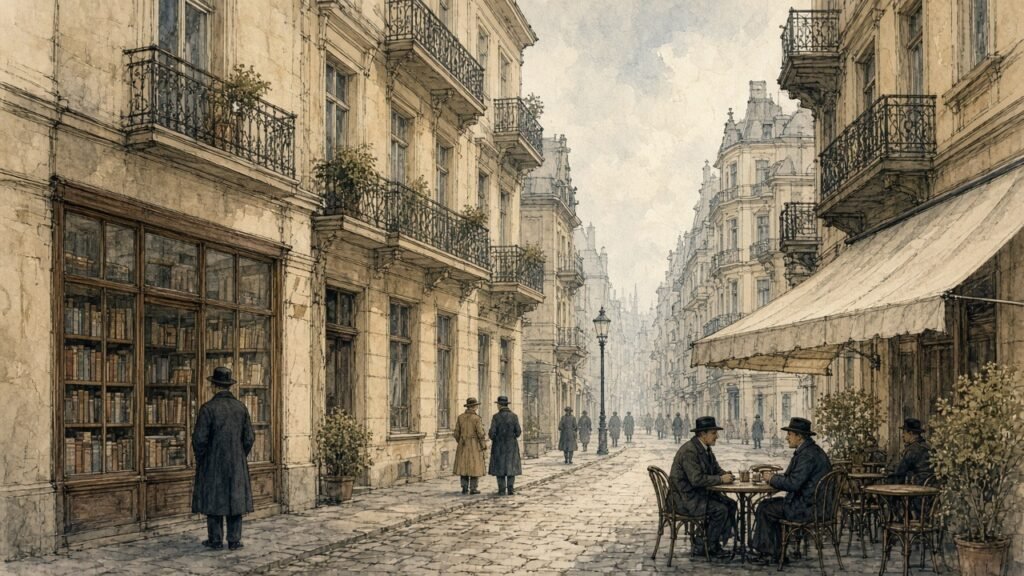
12. Writers of the late empire
The literary reputation of Czernowitz rests on a cluster of writers who were born in the city or formed by it, and who wrote in German, Yiddish, Ukrainian and Romanian. Karl Emil Franzos, born in nearby eastern Galicia and associated with Bukovina in his fiction, presented the region to a German-reading public in novels and stories that mixed ethnographic observation with liberal advocacy. His depictions of Jewish small-town life and of the cultural frontier between east and west shaped outside perceptions of the province for decades. Olha Kobylianska, who settled in Chernivtsi in 1891 and lived there until her death in 1942, wrote modernist Ukrainian prose that explored women’s lives, rural society and psychological conflict; her house became a site of literary memory. Romanian letters claimed the brief presence of Mihai Eminescu in the 1860s and the work of local Romanian journalists and poets.
Yiddish literature in and from Czernowitz included Eliezer Steinbarg, whose fables in Yiddish achieved wide popularity, and Itzik Manger, born in the city in 1901, who later reinvented biblical narrative in a modern Yiddish idiom. Abraham Goldfaden, a foundational figure of the Yiddish theatre, was active in the region’s cultural circuits. The German-Jewish poetry of the interwar and postwar periods, however, gave the city its most enduring literary names. Rose Ausländer, born Rosalie Scherzer in 1901, wrote German verse that returned obsessively to the landscapes and losses of Bukovina. Selma Meerbaum-Eisinger, born in 1924, wrote a small body of poems of remarkable maturity before her death in Transnistria at eighteen. Paul Celan, born Paul Antschel in 1920, became one of the major European poets of the twentieth century.
Celan’s Czernowitz was already Romanian Cernăuți when he was born, yet he described himself as a posthumous child of the Habsburg Empire. German was the language of his mother and of the poetry he read; Hebrew school, Yiddish speech and Romanian administration surrounded him. He studied in the city, survived the ghetto and forced labour, and learned of his parents’ deaths in Transnistrian deportation. After the war he left for Bucharest, Vienna and finally Paris. His poem “Todesfuge,” and the successive volumes of increasingly hermetic verse, made the German language itself a site of reckoning with the destruction of the world into which he had been born. In speeches and letters he returned to the “landscape where people and books lived,” a phrase that has become a shorthand for the lost Jewish Czernowitz. Ausländer, who survived the war in the city under harsh conditions and later lived in the United States and in Germany, likewise made Bukovina a mythical and ethical geography in her poetry.
The Ukrainian, Romanian, German and Yiddish strands of the city’s literature did not form a single school. They overlapped in cafés, in the university and in the reading public, and they diverged in audience and politics. What they shared was the experience of a small capital where several languages were spoken in the same street and where the collapse of empires repeatedly forced writers into exile or into silence. The literary map of Chernivtsi is therefore also a map of twentieth-century European catastrophe and memory.
Translation and multilingual composition were normal in this literary ecology. Celan translated from Romanian, French, Russian and other languages into German; his own German was marked by the Austrian and Jewish speech of Bukovina. Ausländer wrote in German after years in English-speaking America. Manger’s Yiddish carried biblical and European echoes. Kobylianska’s Ukrainian absorbed modernist currents from German and Polish. The city’s writers rarely believed that a single language could exhaust experience; their biographies made linguistic exclusivism implausible.
Reception histories diverge by language community. Celan’s standing in German literature is canonical; his place in Ukrainian and Romanian cultural memory has grown through translation and through local commemorations. Ausländer’s readership expanded late. Steinbarg and Manger are central to Yiddish canons and less known to Ukrainian readers. Kobylianska is a classic of Ukrainian modernism taught in schools. A full literary history of Chernivtsi must therefore be comparative. It must also acknowledge the destroyed readers: the Jewish public of 1939 that never saw the postwar editions of the poets who had been its children.
Archives of manuscripts and correspondence are scattered. Celan’s papers are in Germany and France; Ausländer’s in Germany; Kobylianska’s in Chernivtsi; Yiddish writers’ estates in multiple countries. Digitisation projects have begun to reconnect them. Literary tourism in Chernivtsi offers walking routes past childhood homes and school buildings. The risk of such tourism is sentimental simplification; its value is the preservation of addresses against the amnesia of redevelopment. A responsible literary history keeps both the poems and the property records in view.
School curricula later incorporated some of these writers unevenly. Soviet Ukrainian syllabi elevated Kobylianska and Fedkovych while omitting Celan. Romanian syllabi claimed interwar Cernăuți writers selectively. Independent Ukraine has broadened the canon taught in local schools to include Jewish German-language poets in translation. The politics of the reading list continue. A city’s literary legacy is always also a curriculum dispute.[7]
Photography studios in Chernivtsi produced portraits of writers, actors and ordinary families. Surviving plates and prints, held in museums and private albums, give faces to names. Celan’s childhood photographs have been widely reproduced; so have images of the conference and of the theatre. Visual culture is now part of literary history. The city’s photographers, many of them Jewish, left a documentary legacy that outlasted their studios.
Literary cafés of Czernowitz have been reconstructed from memoir with varying reliability. Particular tables are assigned to particular poets in tourist lore. Scholars caution against over-precision. What is secure is that café sociability, bookshop browsing and newspaper reading formed the infrastructure of literary life. Without that infrastructure the famous names would not have emerged.
Beyond the most famous names, a secondary literature of journalists, schoolbook authors, translators and amateur poets filled the city’s drawers and newspaper columns. Feuilletonists chronicled municipal absurdities in German prose descended from Viennese models. Ukrainian almanacs published village sketches. Romanian magazines debated the national mission of Bukovinian Romanians. Yiddish humorists worked the tension between Hasidic town and secular city. Collectively this production constituted a public sphere. Alone, few of these writers enter encyclopedias; together they made Czernowitz a city that wrote about itself continuously.
Exile literature after 1945 transformed Chernivtsi into a mythic geography. Ausländer’s “Bukovina” poems, Celan’s topographical allusions and the memoirs of lesser-known survivors created a portable city available to readers who would never walk the Prut. That portable city can distort as well as preserve. This special feature has tried to reconnect the myth to administrative dates, demographic counts and architectural facts, so that the poems retain their force without replacing the chronicle.
Translation rights and royalty statements, where preserved, show how little money most Czernowitz writers earned from verse. Journalism paid the bills. Celan’s later European fame was exceptional. Material conditions of literary production belong in any honest account of the city’s cultural flowering.
School anthologies that included Bukovinian authors shaped generational taste. Exclusion from anthologies shaped silence. Canon formation is an institutional process involving ministries, publishers and teachers. Chernivtsi’s writers entered and exited canons as borders moved.
Multilingual notebooks of schoolchildren, preserved by chance, show homework in German, Romanian exercises and Hebrew letters on the same week’s pages. The intimate archive of adolescence explains the adult writers better than any manifesto.[9][10][17]
Publication venues mattered as much as talent. German-language newspapers and feuilleton pages gave poets a first audience; Hebrew and Yiddish journals, some printed locally and some arriving from Warsaw, Vilna or New York, linked Bukovinian writers to wider Jewish literary markets. Romanian and Ukrainian periodicals in the city and in the countryside carried fiction that registered village speech and the pressures of land reform. Translation among these languages was a daily craft in editorial offices, and several authors published in more than one tongue across a career. The resulting corpus cannot be reduced to a single national canon: it is a set of overlapping literatures that shared streets, schools and, after 1941, a common catastrophe.[17][18][14]
13. War and the Romanian takeover
The First World War broke upon Bukovina with particular severity. The province lay on the eastern front. Russian armies occupied Chernivtsi more than once; Austrian and later German forces retook it. Civilians endured requisitions, epidemics and flight. The multi-ethnic administration strained under military rule and under the mutual suspicions that war breeds. Jewish refugees from the Russian advance crowded the city; Romanian and Ukrainian politicians looked to postwar settlements that might attach Bukovina to a national state. When the Habsburg Monarchy dissolved in the autumn of 1918, the question of Bukovina’s future was decided rapidly. On 28 November 1918 a congress in Chernivtsi voted for union with the Kingdom of Romania. Romanian troops entered the city. The Treaty of Saint-Germain and subsequent arrangements confirmed the incorporation of Bukovina into Greater Romania. Czernowitz became Cernăuți.
The transition was abrupt for the German-speaking and Jewish elites who had oriented their careers toward Vienna. Official language, school language and university language shifted toward Romanian. Street names changed. A new cadre of officials arrived from the Old Kingdom. At the same time Romanian Bukovinians who had felt themselves a minority in the Austrian diet now found their language and church in the ascendant. Ukrainian Bukovinians, whose national movement had expected a different settlement, faced a state that regarded them with suspicion. The Jewish community negotiated a new relationship with Romanian parties and with the minorities treaties that the postwar order imposed on the successor states.
The early 1920s were years of administrative Romanianisation and of economic adjustment. The university was reorganised as a Romanian institution. German and Ukrainian schooling contracted. The city’s demographic balance began to shift as Romanian officials and professionals settled and as some Germans and Jews emigrated. Yet Cernăuți remained, for a time, recognisably the old Czernowitz in its streets, its cafés and its private languages. German continued to be spoken in many Jewish and formerly Austrian households. Yiddish thrived in the popular quarters. The theatre and the press adapted. The legend of the Habsburg city persisted in conversation even as the legal framework of the crownland disappeared.
Wartime occupation regimes left administrative traces. Russian occupation authorities issued their own decrees and requisitioned supplies; Austrian military courts punished collaboration; refugees carried typhus. The Jewish population was accused by opposing sides of disloyalty, a lethal stereotype. When Romanian troops entered in 1918, some German and Jewish residents feared reprisals; some Ukrainian activists hoped for a different border. The congress that voted for union with Romania was contested in its composition and its mandate, and Ukrainian historiography has long disputed its representativeness. International recognition nonetheless followed the Romanian claim.
The Romanianisation of institutions proceeded through laws on citizenship, language of administration and education. Option rights allowed some residents to choose Austrian or other citizenship and leave. Those who stayed navigated oaths, language exams and new patronage networks. Property remained largely in private hands in the 1920s, distinguishing the Romanian transition from the later Soviet nationalisations. Continuities of personnel in commerce and the free professions softened the shock for parts of the middle class. For Ukrainian peasants and intellectuals the new border with Poland and the Soviet Union reoriented political horizons toward Bucharest and, clandestinely, toward Ukrainian causes abroad.
Military maps of 1914 to 1918 show front lines oscillating across Bukovina. Villages changed hands repeatedly. Scorched-earth retreats destroyed crops. The city’s hospitals filled with wounded of several armies. Nurses and doctors worked past exhaustion. Jewish burial societies struggled to keep up with mortality. When peace came, the demographic losses were visible in school enrolments and in the age structure of the workforce. The Habsburg world ended not only in diplomatic conferences but in these accumulated absences.
Food shortages in 1917 and 1918 produced queues and black markets. Women led protests over bread prices. Returning soldiers brought weapons and radical politics. The weeks between imperial collapse and Romanian consolidation were filled with rumour: of Ukrainian troops, of Bolshevik agitation, of Polish claims. Committees of public safety formed and dissolved. The Romanian entry imposed a new clarity, welcome to some and ominous to others. Property rights remained formally intact, but the currency transition and the new customs frontier disrupted trade patterns built over decades of Habsburg integration.
Currency conversion from crown to leu created winners and losers. Savings held in Austrian instruments lost value; those who anticipated the change speculated. Banks reorganised under Romanian law. Credit networks rebuilt slowly. The economic history of the transition is as important as the political history for understanding who stayed and who left. Not all departures were ideological; some were simply insolvency.
Orthodox church politics shifted with the border. The metropolitanate’s relationship to Bucharest replaced its relationship to Vienna. Calendar and liturgical language disputes acquired new stakes. Ukrainian Orthodox believers faced pressure toward Romanian church structures. Schisms and resistances followed. Ecclesiastical history is political history in Bukovina.[13]
Ukrainian Galician Army units and local Ukrainian committees briefly contested eastern Galicia and eyed Bukovina; their failure left Northern Bukovina outside the short-lived West Ukrainian People’s Republic’s effective control. Romanian historiography celebrates 28 November 1918 as union; Ukrainian historiography has often described it as occupation. International diplomacy, preoccupied with larger fronts, accepted the Romanian fait accompli at Saint-Germain and in subsequent recognitions. Minorities treaties obligated Romania to protect Jews, Ukrainians and others; enforcement was weak. The pattern of postwar settlement across eastern Europe—national armies arriving before treaties—was repeated in Chernivtsi.
German cultural associations negotiated reduced space. The German theatre lost subsidies; German schools lost pupils to Romanianisation. Some Bukovina Germans emigrated to Germany or Austria in the 1920s and 1930s; others stayed until the wartime transfers and expulsions. Their periodicals, archived in Graz and elsewhere, record the shrinking of a once-confident minority. The city’s German face, so prominent in 1910, was by 1939 already a historical layer rather than a governing present.
Newspaper closures and relaunches marked the regime change. German dailies shrank or Romanianised; Ukrainian papers faced censorship; Jewish papers negotiated new rules. Journalists emigrated or switched languages. The public sphere’s linguistic reorientation was as consequential as the change of flags on the town hall. Readers who had followed Viennese politics now followed Bucharest’s. The intellectual rewiring of a city’s attention is a subtle historical process visible in surviving subscription lists and editorial calendars.
Railway gauges and customs posts changed with sovereignty. Freight that had moved freely within Austria faced new paperwork. Merchants cursed and adapted. Smuggling routes adjusted. Economic geography was rewritten by treaty lines drawn far from the Prut.
War cemeteries of 1914–18 hold soldiers of multiple armies. Inscriptions in German, Russian, Hungarian and Polish mark the imperial slaughter. Maintenance of these cemeteries has been intermittent. They are among the city’s quietest historical texts.
The Romanian army’s entry was photographed and filmed; newsreels played in Bucharest cinemas. Local Romanian notables posed with officers on the Ringplatz. Ukrainian activists circulated protest memoranda to the peace conferences. Jewish leaders sought assurances on citizenship. The choreography of regime change was public and contested from the first day.
Schoolchildren learned new national anthems and forgot old imperial ones. Curriculum change is regime change in the classroom. Exercise books from 1919 show overwritten headings. Pedagogy archives are among the most intimate records of sovereignty’s transfer.[13][11]
14. Cernăuți between the wars
Interwar Cernăuți was a provincial capital of Greater Romania and a border city watching the Soviet Union across a nearby frontier. The Romanian state invested in administration, schooling and Orthodox church life. Romanian cultural institutions expanded. At the same time the city’s Jewish population remained large and culturally active. German-language literary life continued in private and in limited public forms. Ukrainian cultural activity persisted under constraint. The political atmosphere of Romania in the 1920s and 1930s grew more nationalist and, by the late 1930s, more antisemitic. Parties of the radical right, including the Iron Guard, gained adherents. Jewish students faced quotas and violence in universities across the country. In Cernăuți the old Habsburg habits of coexistence eroded under the pressure of nationalising policy and of European radicalisation.
Economically the city lived from trade, light industry, administration and the university. The Great Depression struck agriculture and commerce. Emigration to America, to Palestine and to western Europe removed some of the young. Those who remained inhabited a city still architecturally Habsburg and increasingly Romanian in its public face. Paul Celan’s childhood and adolescence unfolded in this milieu: Hebrew school, German gymnasium reading, Romanian street life, Zionist and socialist youth debates. Rose Ausländer returned from American years and wrote. The Yiddish theatre and press continued. The national houses still opened their doors. To later memory this interwar city appears as a last chapter of plurality before destruction; to contemporaries it was simply the world in which they studied, traded and quarrelled.
In June 1940 the geopolitical floor gave way. The Soviet ultimatum to Romania, following the Molotov–Ribbentrop arrangements, forced Bucharest to cede Bessarabia and Northern Bukovina. Soviet troops entered Cernăuți. The city became Chernovtsy in the Ukrainian Soviet Socialist Republic. A first year of Sovietisation brought nationalisation, political arrests, deportations of “class enemies” and the collapse of the old professional order. Some Jews hoped that Soviet rule would be preferable to Romanian antisemitism; others lost property and freedom. In June 1941, when Germany invaded the Soviet Union and Romania joined the attack, the Soviets retreated. Romanian and German forces reoccupied the city. The stage was set for the ghetto and the deportations.
Cultural life in the 1920s retained a surprising density. German bookshops still ordered from Vienna and Berlin. Jewish printers issued Yiddish and Hebrew works. Romanian state theatres and schools expanded their reach. Ukrainian clandestine and semi-legal cultural work continued. The university produced Romanian-trained professionals who staffed the province. Cafés remained debating rooms. Yet the legal equality of the Austrian era was replaced by a hierarchy of citizenship and ethnicity that disadvantaged Jews and Ukrainians in different ways. Numerus clausus practices and street violence in the 1930s signalled the narrowing of the public sphere.
The Soviet year 1940 to 1941 remains under-studied relative to the later Romanian Holocaust, yet it mattered profoundly. NKVD arrests, property seizures and the June 1941 deportations of supposedly anti-Soviet elements removed portions of the political and social elite, Jewish and non-Jewish. When Romanian and German forces returned, they exploited chaos and collaborated in mass killing in the countryside even before the ghetto’s formal creation. Survivors’ testimonies describe the whiplash of successive occupations: red flags replaced by Romanian and German ones, neighbours disappearing under different pretexts, the collapse of any predictable legal order.
Passports and visas became obsessions of the interwar middle class. Crossing into Poland, into Romania’s Old Kingdom, or toward western Europe required papers that antisemitic and nationalist bureaucracies could withhold. Students sought places at universities abroad when local quotas blocked them. Letters to relatives in America pleaded for affidavits. The sense that the city’s future might lie elsewhere spread among the young before the war confirmed it. Emigration was already a rehearsal for the later exodus of survivors.
Students of Celan’s generation formed reading circles that mixed Rilke, Marx, Zionist tracts and Romanian modernist poetry. The intellectual density of a small city can be higher than that of a metropolis when talent has fewer places to disperse. Conversations in Cernăuți flats shaped poets who would later be read worldwide. The destruction of that conversational community is part of what “the Holocaust in Bukovina” means—not only deaths but the end of a particular ecology of talk.
Cinemas showed Hollywood, German and Romanian films. Jazz and tango reached dance halls. Fashion magazines from Budapest and Paris circulated among the middle class. Modernity arrived as style as well as as ideology. Young people measured their city against screen images of elsewhere and found it small. That restlessness, recorded in diaries, was part of the interwar mood. Provincial capitals modernised by imitation and by radio.
Radio ownership spread in the 1930s. Broadcasts from Bucharest, from Vienna and from Soviet stations competed for listeners. The state attempted to control information; shortwave undermined control. Young people danced to music their parents found scandalous. Generational conflict layered onto national and political conflict. The apartment wall was thin between eras.[13]
Antisemitic legislation and street violence in late-1930s Romania—professional restrictions, student riots, Iron Guard assassinations—reached Cernăuți in local forms. Jewish shopkeepers faced boycotts. University life became dangerous for Jewish students. Some families sent children abroad; visas were scarce. The sense of closing doors pervades contemporary letters. When the Soviet ultimatum arrived in June 1940, it landed on a Jewish community already under siege from the Romanian right, which helps explain the ambivalent reactions to the first Soviet year.
Economic data from the 1930s show stagnation in some trades and growth in others. The city remained a regional market for agricultural produce. Light industry employed women in workshops. Remittances from American relatives mattered to many Jewish households. Poverty in the peripheral streets contrasted with middle-class comfort near the theatre. Social surveys from Romanian ministries, read critically, sketch this unevenness. The ghetto walls of 1941 would soon cut through both poverty and comfort alike.
Architecture of the interwar decades added Romanian national styles to the Habsburg fabric: administrative buildings with neo-Brâncovenesc motifs, monuments to Romanian heroes, Orthodox parish renovations. The visual competition of styles recorded the competition of legitimacies. Photographs from the 1930s show both layers in a single frame—Secession balconies beside new Romanian inscriptions. Walking the centre today, one still reads that layered façade if one knows the dates of cornices and plaques.
Surveillance files of the Romanian secret police on suspected communists and Ukrainian nationalists fill metres of shelf. Reading them requires caution against police paranoia. Yet they document networks and meeting places. The café table appears in police prose as well as in literary memoir.
Football club rivalries mapped onto communal identities without being reducible to them. Match reports in the press used military metaphors. Stadium crowds practised mass politics before the parties fully did. Sport history illuminates urban emotion.
Census categories in Greater Romania differed from Austrian ones, complicating demographic comparison. Declared nationality, mother tongue and religion were recorded with political pressure. Historians adjust for undercounts of Ukrainians and Jews. The city’s statistical image shifted partly because of real migration and partly because of how questions were asked.
Café waiters remembered orders in four languages. Tips and insults taught the same vocabulary. Service work is under-represented in literary memory and over-represented in police reports of fights. A social history from below would start with the waiter’s pad and the market woman’s stall.
15. Occupation, deportation and the ghetto
The return of Romanian administration in the summer of 1941, in alliance with Nazi Germany, opened the darkest chapter of the city’s history. Northern Bukovina and Bessarabia were placed under Romanian military and civil control. Antonescu’s regime, which had already begun the destruction of Jewish communities in Bessarabia and in Romania proper, extended policies of murder, robbery and deportation to Bukovina. In Chernivtsi a ghetto was established in October 1941. Jews were concentrated in a delimited area of the city. From there, beginning in the autumn of 1941, mass deportations set out for Transnistria, the region between the Dniester and the Bug that Romania administered as a dumping ground for Jews and Roma. Tens of thousands of Bukovinian and Bessarabian Jews died in Transnistria of hunger, disease, exposure and killing.
The mayor of Cernăuți, Traian Popovici, intervened to obtain exemptions that allowed a portion of the city’s Jews to remain, arguing for the economic necessity of Jewish skilled workers and professionals. His efforts, recognised after the war as an act of rescue, saved thousands of lives, though they could not stop the overall destruction. Among those deported from Bukovina were the parents of Paul Celan, who perished in Transnistria. Celan himself was conscripted into Romanian forced-labour battalions. Rose Ausländer survived in the city under ghetto conditions. Selma Meerbaum-Eisinger was deported and died in Transnistria. The Yiddish and German-Jewish culture of Czernowitz was murdered in the space of a few years.
Soviet forces returned in 1944. The city was reincorporated into the Ukrainian SSR. Survivors emerged from hiding, from Transnistria and from the Red Army. The prewar Jewish population of Chernivtsi, which had numbered in the tens of thousands, was reduced to a fraction. Synagogues stood empty or were converted. The German civilian population was largely gone, expelled or evacuated. Romanian officials fled. The demographic and cultural rupture was permanent. What had been a Jewish city with a German public language became a Soviet Ukrainian regional centre with a Russian and Ukrainian public sphere and a small, ageing Jewish remnant.
Transnistria’s camps and ghettos—Mogilev, Bershad, Pechora and many smaller sites—became killing grounds through deliberate neglect as well as shootings. Romanian gendarmes, German units and local auxiliaries shared responsibility in varying proportions by locality. Documentation in Romanian archives, German records and survivor memoirs has allowed historians to reconstruct transports from Cernăuți and from provincial Bukovinian towns. The United States Holocaust Memorial Museum and Yad Vashem hold extensive collections. Popovici’s exemptions, recorded in administrative correspondence, remain a rare instance of municipal resistance within the Romanian Allied system.
After 1944 returning survivors found homes occupied, synagogues wrecked and the community organisation destroyed. Some attempted to rebuild communal life under Soviet rules; many sought to leave for Romania proper, for Palestine, or, later, for the United States and western Europe. The city’s Jewish population stabilised at a low level. Trials of war criminals in postwar Romania and in the Soviet Union addressed some perpetrators and ignored others. Public memory in Soviet Chernivtsi subordinated Jewish suffering to a generic narrative of fascist occupation. Only after independence did monuments and school programmes begin to name the ghetto and Transnistria specifically.
Individual stories illustrate the statistics. Families divided by exemption lists; bribes paid for temporary reprieves; children hidden with neighbours; suicides on the eve of transport. Diaries written in the ghetto, some published decades later, record hunger, rumour and the persistence of school lessons in cramped rooms. Celan’s early poems and Ausländer’s wartime verse transform these experiences into literature without diminishing their documentary force. Historians cross-check literary testimony against administrative orders and transport lists. The convergence of sources leaves little doubt as to the scale and intent of the destruction enacted from Cernăuți.
Material plunder accompanied deportation. Apartments were sealed and then reassigned; furniture and books were stolen or auctioned; businesses were liquidated under Romanianisation decrees. Legal paperwork gave theft a bureaucratic face. After the war, restitution was partial and slow where it occurred at all. Soviet nationalisation overwrote remaining private claims. The property history of central Chernivtsi flats is therefore often a history of successive dispossessions. Title searches, where possible, read like compressed tragedies.
Medical personnel inside the ghetto fought typhus with almost no supplies. Makeshift clinics operated until deportations emptied them. Physicians who remained under Popovici’s exemptions treated both Jews and, clandestinely, others. Some were later honoured; others perished in later transports when exemptions were revoked. The history of medicine in the Cernăuți ghetto is a specialised literature that illuminates the broader catastrophe through the lens of epidemic and care.
Roma deportees from Romania also passed through the Transnistrian system; their history intersects Bukovinian Jewish history in shared killing sites and in postwar neglect of memory. Comparative research on Romanian Holocaust policies has grown since the 2000s, aided by the Wiesel Commission’s findings and by archival openings. Chernivtsi’s ghetto is a chapter in that wider Romanian and European history, not a local aberration.[20]
Administrative orders establishing the ghetto specified streets and gates. Guards controlled movement. Food smuggling became a survival skill. Epidemics spread in overcrowding. Schools and prayer continued clandestinely. The Judenrat, where it functioned, faced impossible choices under Romanian military authority. Historians debate degrees of coercion and collaboration with the care such debates require. What is not debated is the outcome: mass death in Transnistria and the end of Czernowitz as a Jewish city.
Postwar trials in Romania prosecuted some officials; others resumed careers. Popovici was recognised as Righteous Among the Nations. Soviet narratives emphasised partisan resistance and fascism’s defeat while muting Jewish specificity. Only with Ukraine’s independence and with international Holocaust education standards did local museums and schools begin systematic teaching of the ghetto and Transnistria. Gaps remain. This chapter cannot close them; it can only insist on their importance.
Children’s experiences of the ghetto—hunger, interrupted schooling, games in courtyards behind sealed streets—appear in survivor testimonies collected decades later. Child survivors aged into the witnesses of the 1990s and 2000s. Their recorded interviews, held at USHMM and Yad Vashem, are primary sources of irreplaceable value as the generation dies. Historians of Chernivtsi must listen to those voices alongside the administrative orders.
Clothing confiscated from deportees entered reuse economies; books from emptied flats appeared on second-hand stalls. The material afterlife of genocide is an uncomfortable research field. Object biographies lead from Czernowitz apartments to anonymous warehouses. Restitution claims decades later try to reverse a few of those paths.
Maps of the ghetto boundaries, redrawn by historians from orders and testimonies, are now teaching tools. Walking tours follow them. Spatial history makes the crime visible in today’s streets. Pavement and memory coincide uneasily.
International awareness of Transnistria lagged behind awareness of German camps. Diplomatic reports existed; public mobilisation in Allied countries was limited. Postwar historiography corrected the imbalance slowly. Romanian responsibility is now a standard finding of specialist literature and of Romania’s own historical commission.
Names on deportation lists, reconstituted from Romanian archives, now appear in memorial databases. Searching a family name can return a transport date and a Transnistrian destination. Digital memory does not heal; it documents. For Chernivtsi descendants it has become a primary way of touching the city’s worst months.[20][21][22]
Romanian military orders of 1941 defined the ghetto’s streets, gates and hours of movement with bureaucratic precision. Inside those limits, overcrowding and confiscations produced hunger within weeks. Transports toward the Dniester assembled at designated points; survivors later recalled the noise of carts, the weight of bundled clothes and the presence of gendarmes who enforced departure more often than they prevented robbery. Across the river, the territory administered as Transnistria received deportees into camps and ghettos whose death rates rose through winter cold, typhus and deliberate starvation. Administrative correspondence treated the removals as a logistical problem; the human result was the destruction of a Jewish urban culture that had been central to Czernowitz for more than a century.[29][30]
Popovici’s exemption lists, contested and revised under pressure from higher Romanian authorities, created a narrow and unstable shelter for those who remained. Skilled workers, physicians and some professionals appeared on successive registers; others paid bribes that bought only days. Families split when one member received a stamp and another did not. The moral record of those months is therefore uneven: rescue and predation occurred on the same streets, sometimes in the same offices. Postwar testimony, Romanian archival files and the documentation assembled by Holocaust research institutions allow the sequence of ghettoisation, deportation and selective retention to be reconstructed with a clarity that wartime rumour never possessed.[20][21][26]
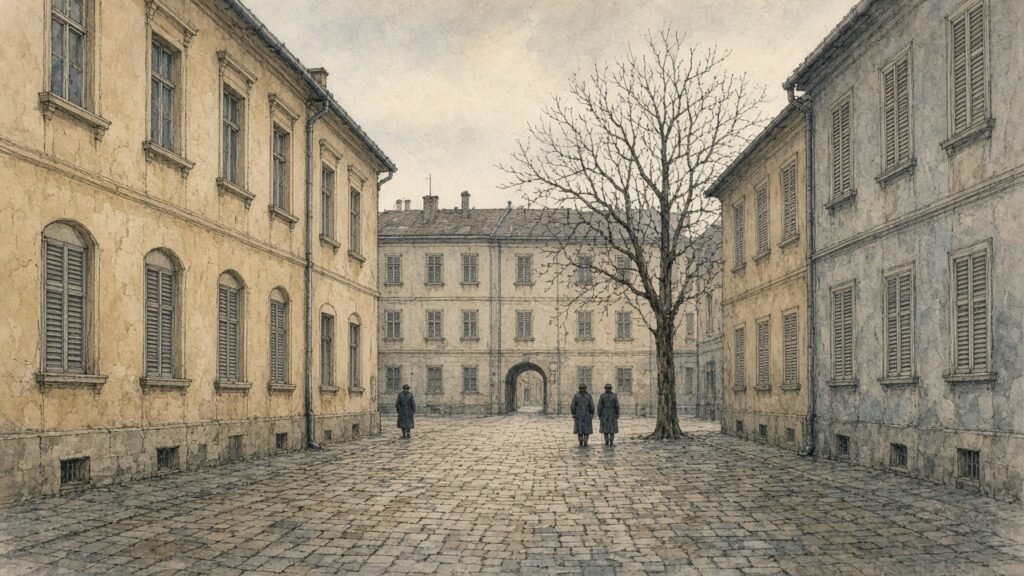
16. Soviet Chernivtsi
Soviet Chernivtsi was rebuilt as an oblast centre of the Ukrainian SSR. The university reopened as a Ukrainian-language state institution and was eventually named after Yuriy Fedkovych. Factories, housing blocks and Soviet administrative buildings rose on the outskirts, while the Habsburg centre was retained and gradually restored. Russian and Ukrainian became the languages of public life. The remaining Jewish community practised its religion under the constraints of Soviet atheist policy; many younger Jews emigrated when exit permissions became available in the 1970s and 1980s. German cultural life virtually disappeared. Romanian speakers in the northern Bukovinian countryside maintained a minority presence. The city’s wartime history was narrated through the Soviet category of the Great Patriotic War, with limited public space for the specific Jewish catastrophe of Transnistria and the ghetto.
Everyday life in the postwar decades followed the Soviet provincial pattern: shortages and queues, a large student population, industrial employment, and a cultural calendar of theatre, philharmonic concerts and official commemorations. The architectural heritage of the Residence and the central streets was maintained sufficiently to strike visitors as unusually “European” for a Soviet western oblast. Scholars of Bukovina, often working from abroad, began to reconstruct the multilingual past. Inside the city, memory of Celan, Ausländer and the Yiddish conference was muted until the late Soviet thaw and the approach of independence. Deportations of the 1940s, both of Jews and of other “enemies,” left silences in family histories. The city’s population grew with Ukrainian and Russian in-migration. By the 1980s Chernivtsi was a recognisably Soviet place inhabiting recognisably Habsburg walls.
Industrialisation brought textile, food-processing and machine enterprises. Collective farms surrounded the city. The university trained teachers for Ukrainian schools across the oblast. Russian language held prestige in administration and inter-ethnic communication. Churches operated under surveillance; several were closed or converted. The Jewish cemetery suffered neglect and vandalism. At the same time, a quiet pride in the city’s “European” look persisted among residents who compared their streets favourably to more thoroughly Sovietised cities further east.
Dissident and semi-dissident memory kept Celan’s name alive among small circles of readers of German and among Jewish families. Western scholars of Bukovina visited with difficulty. Emigration waves in the 1970s thinned the Jewish remnant further; Mila Kunis’s family, leaving in the 1990s, belonged to a later stage of that outflow. By glasnost the city’s past had begun to resurface in local journalism. Independence accelerated the process.
Housing policy redistributed Habsburg apartments to workers and officials. Former owners who had fled or been deported lost claim. Communal apartments split large flats into multiple family units. Courtyard life acquired Soviet norms of surveillance and mutual aid. The physical traces of Jewish doorposts and German nameplates were scraped away or painted over. Occasional discoveries during renovation—hidden books, mezuzah marks—surprised new tenants. The city’s material culture became a palimpsest in which earlier languages bled through plaster.
Cultural policy promoted Ukrainian theatre and literature while constraining religious and Jewish expression. The philharmonic and the drama theatre received state budgets. Festivals celebrated Soviet holidays in the Ringplatz. Portraits of leaders replaced imperial and Romanian symbols. Yet older residents privately retained alternative calendars of memory: Habsburg anniversaries, Jewish memorial days, Romanian commemorations. The city’s public time and private time diverged. Oral history projects since independence have tried to recover that private time before its carriers die.
Sporting victories of local teams supplied permitted civic pride. Chess clubs flourished. Mountaineering in the nearby Carpathians attracted students. These activities built social capital outside politics. Veterans of the Soviet Afghan war and later of Ukrainian conflicts added other layers of memory to a city already saturated with wars. Monuments to Soviet soldiers still stand beside newer Ukrainian memorials; their coexistence is an unresolved conversation in stone.
Closed archives opened incompletely after 1991. NKVD files on 1940–41 deportations revealed names and charges. Families learned fates long unknown. The city’s Soviet past is still being processed in courts of opinion if not always in courts of law. Statues come down or stay up according to parliamentary laws and local votes. History remains a present tense verb.[12]
Planning documents of the 1950s and 1960s envisioned industrial growth and standardised housing. Prefabricated blocks rose beyond the Habsburg core. Green belts were promised and partly delivered. The tram network modernised. A Soviet ceremonial culture occupied the central square with parades. Private life retreated into kitchens where politics could be whispered. Jokes about shortages circulated. The city’s Habsburg beauty became, paradoxically, a quiet form of distinction within the Ukrainian SSR—a reason for assignment preferences among officials and a lure for occasional western visitors escorted by Intourist.
Jewish emigration bureaucracy—affidavits, refusals, exit taxes—dominated many families’ lives in the 1970s. Those who left arrived in Israel, Vienna transit centres or North America with Czernowitz accents and memories. Those who stayed kept the synagogue open on a reduced scale. Intermarriage and secularisation continued. By 1991 the living Jewish community was a remnant; the cultural Jewish city existed mainly in books and in the diaspora’s annual commemorations.
Manufacturing employment peaked and then declined in the late Soviet period. Environmental pollution from poorly regulated plants damaged river quality. Activists of the perestroika years began to raise ecological as well as national questions. The Chernobyl disaster of 1986, though geographically distant, affected Ukrainian public trust and political mobilisation nationwide, including in Chernivtsi. Informal associations formed in that climate became seeds of later civil society.
Amateur photography under Soviet rule produced family albums that now surface in diaspora homes. Birthday tables, beach trips to the Black Sea, graduation rows under university arches—ordinary happiness against a backdrop of constraint. Historians of emotion read these images for what they show and for what they omit.
Kitchen gardens and dacha plots supplemented diets. Informal exchange networks mitigated scarcity. Anthropologists of Soviet everyday life find in Chernivtsi a western variant of patterns studied elsewhere. The Habsburg flat and the Soviet shortage shared the same kitchen.
Teachers of German dwindled; German books moved to special stacks. Occasional GDR cultural visits brought sanctioned German culture without the Jewish Czernowitz corpus. Celan’s name surfaced late and carefully. The city’s German ghost was managed rather than celebrated.
Factory newspapers and wall newspapers (stengazety) recorded production campaigns in a language of quotas and shock workers. Reading them against oral histories reveals the gap between official enthusiasm and private fatigue. The genre is a Soviet specialty that Chernivtsi practiced like any oblast centre.[12]
Soviet planning documents treated Chernivtsi as a western oblast centre whose Habsburg core was an asset for tourism propaganda and whose outskirts would absorb industrial labour. Prefabricated housing estates extended the city toward the hills; factory clubs and pioneer palaces supplied sanctioned leisure. The university’s Ukrainianisation redirected curricula toward the needs of the Ukrainian SSR, while Russian remained the language of many technical and party settings. Archives of the period show both genuine reconstruction—repaired roofs, reopened clinics—and the silences imposed on Jewish and Romanian wartime experience. What could be said in public about 1941 differed sharply from what families said in kitchens, and that divergence shaped the city’s spoken history until the late 1980s.[12][11]
17. Independence and memory
Ukraine’s declaration of independence in 1991 made Chernivtsi a regional capital of a sovereign state. The university, the Residence and the historic centre became resources for tourism and for a renewed local identity that could acknowledge Austrian, Romanian, Jewish and Ukrainian layers without the constraints of Soviet ideology. Streets recovered older names or received new Ukrainian ones. National houses—Jewish, Romanian, Polish, German—reopened or were refounded as cultural centres. A monument to Paul Celan and plaques to other writers appeared. The Jewish community, small but active, restored prayer spaces and organised commemorations of the ghetto and Transnistria. Romanian and Ukrainian politicians occasionally contested the interpretation of 1918 and of the war, yet the city’s everyday multilingual courtesy, remarked upon by visitors such as the historian Karl Schlögel, recalled older habits.
Economic transition was difficult. Industry contracted; labour migration to western Europe and to other Ukrainian cities drained the young. Restoration of the UNESCO-listed Residence and of central facades proceeded with foreign and state support. Universities and colleges kept Chernivtsi a student city. The Euromaidan of 2013 to 2014 and the Russian war against Ukraine from 2014, escalating to full invasion in 2022, placed the city in the rear of a national struggle. Chernivtsi received refugees from the east and south, organised humanitarian aid and lived under the alerts of a country at war. The Habsburg legend of peaceful plurality acquired, in this context, both nostalgic and hortatory uses. The city’s past was enlisted to say that coexistence had been possible and might be possible again, even as the present demanded solidarity in defence of Ukrainian statehood.
Local museums and the university’s Bukovina studies initiatives expanded research on Habsburg administration, on Jewish history and on the wartime period. International conferences brought scholars of Celan and of Yiddish culture to the city. Twin-city arrangements and Austrian cultural institutes supported restoration and exchange. Romanian consular and cultural presence reminded residents of the interwar border. Ukrainian nation-building emphasised Fedkovych, Kobylianska and the Ukrainian gymnasium tradition. These projects sometimes competed and sometimes complemented one another.
The war since 2022 has added a new layer. Air-raid alerts, refugee reception and military funerals have entered daily life. The historic centre has been sandbagged in places. Yet cultural programming continues, and the city’s identity as a western Ukrainian, formerly Habsburg place has been mobilised as a claim to European belonging. Whether postwar reconstruction will prioritise heritage, housing or industry remains an open political question. The historical deep structure—the Prut frontier, the layered empires, the destroyed Jewish metropolis—will continue to shape how Chernivtsi understands itself.
Civil society organisations documenting the Holocaust, promoting Romanian–Ukrainian dialogue, and teaching Habsburg history have proliferated since 1991 with uneven funding. School textbooks have been rewritten more than once. Controversies over statues and street names flare and subside. The city’s mayors balance tourist branding with budget constraints. Earthquake risk and deferred maintenance threaten unprotected historic buildings. Heritage success at the Residence contrasts with decay elsewhere. A comprehensive conservation strategy remains a work in progress.
Migration remittances from western Europe now support many households. Cross-border shopping into Romania is routine. The Schengen frontier, when Romania joined relevant arrangements, altered travel calculations. Chernivtsi’s youth weigh careers in Kyiv, Wrocław, Berlin or Toronto against staying. The brain drain threatens the university’s future even as the historic centre attracts more visitors. Managing shrinkage and tourism together is the demographic puzzle of the present.
Digital archives and Facebook groups of Bukovina descendants worldwide have created a virtual Czernowitz that interacts with the physical city. Genealogists visit to photograph cemeteries. Documentary filmmakers shoot in the Residence courtyards. The global diaspora of Bukovinian Jews, Romanians, Ukrainians and Germans is now part of the city’s history, even when its members never return. Chernivtsi exists simultaneously as a Ukrainian municipality and as a node in transnational memory networks.
University partnerships with Austrian and German institutions revived Habsburg-era scholarly ties in new forms. Student exchanges take Chernivtsi undergraduates to Vienna and bring EU lecturers east. Funding cycles are precarious. Yet the intellectual reconnection is real. The city teaches its past partly by hosting those who come to study it.[12]
Local elections after independence produced mayors who campaigned on European integration, on road repair and on heritage. Corruption scandals intermittently broke. Civil society monitoring improved transparency unevenly. The Euromaidan found supporters in Chernivtsi as in other western Ukrainian cities. Volunteers organised aid to the Donbas front after 2014. The full-scale invasion of 2022 brought blackouts, air alerts and an influx of displaced persons. Schools and universities shifted online when necessary. Cultural institutions staged benefit concerts. The city’s western location made it a logistical hub for humanitarian corridors toward Romania and Poland.
Memory politics sharpened. Laws on decommunisation removed remaining Soviet monuments with contested exceptions. Holocaust education standards rose under international partnership. Romanian minority rights and Ukrainian national narrative required continual negotiation. The Residence’s UNESCO status helped attract restoration funds. Tourist numbers fluctuated with war. Through all this the everyday work of sweeping streets, teaching classes and opening cafés continued. History is lived between alerts.
Census data since 1991 show Ukrainian linguistic majoritisation in the city, a small Romanian minority, a tiny Jewish remnant and negligible German presence. These numbers reverse the Habsburg urban pattern. The countryside of Chernivtsi oblast retains Romanian villages in the south and Ukrainian villages throughout. Cross-border Romanian television and schooling options complicate identity for some families. Statistics and self-description continue to diverge in familiar Bukovinian ways.
Grant applications for heritage projects recycle the “little Vienna” brand for EU and Austrian funders. Branding simplifies; funding enables plaster and roofs. The compromise is visible on restored façades. Purists complain; residents enjoy dry interiors. Heritage practice lives in that compromise.
Sister-city agreements with Austrian and Romanian towns fund youth exchanges. Bureaucratic and warm at once, these agreements weave Chernivtsi into a European municipal network the Habsburgs would have recognised in form if not in democratic content.
Earthquake retrofitting and façade programmes compete for scarce budgets with hospitals and schools. Voters notice potholes more than cornices. Heritage advocates argue that tourism revenue justifies conservation. The argument is won street by street.
Language laws of independent Ukraine promoted Ukrainian in schools and administration while guaranteeing minority rights on paper. Implementation in Chernivtsi, with its Romanian villages and residual Russian speech, required local negotiation. Kindergarten language choices became political. The city’s Habsburg habit of practical bilingualism reappeared in new legal clothes.
Since independence the city’s museums and university institutes have widened the range of publicly tellable pasts. Exhibitions on Habsburg administration, on Jewish Czernowitz and on the Romanian and Soviet decades now share calendar space with commemorations of Ukrainian statehood and of the war that began in 2014 and expanded in 2022. International partnerships brought conservation funds and scholarly conferences; local volunteers catalogued cemetery inscriptions and translated survivor memoirs. None of these projects erases demographic facts: the living Jewish community is small, German public life is vestigial, and Ukrainian is the dominant language of streets that once sounded primarily German and Yiddish. The work of memory is therefore partly archaeological—recovering names, maps and languages from a built fabric that still stands—and partly ethical, deciding which losses a regional capital of a country at war can afford to name aloud.[25][18][7]
18. Legacy
The legacy of Chernivtsi is inseparable from the successive names under which the city has been known—Chernivtsi, Czernowitz, Cernăuți, Chernovtsy—and from the languages that have been spoken in its streets. Few cities of its size have accumulated so dense a layered memory in so short a modern history. A Moldavian county seat became a Habsburg crownland capital; a German-speaking Jewish cultural centre became a Romanian provincial city; a site of ghetto and deportation became a Soviet oblast centre and then a Ukrainian regional capital. Each regime left buildings, archives and graves. Each also left silences.
What travellers and readers now seek in Chernivtsi is often the trace of the Habsburg and Jewish city: the Residence arcades, the theatre, the town hall square, the cafés that advertise a Viennese inheritance, the plaques to Celan and Ausländer. That inheritance is real, but it is not the whole. The Ukrainian and Romanian rural worlds that surrounded the city, the Orthodox metropolitanate, the Soviet housing estates and the wartime dead belong equally to the historical account. The Yiddish Conference of 1908 and the poetry written in German by the children of the destroyed community have given the city a place in Jewish and European literary memory out of proportion to its demographic present.
To study Chernivtsi is therefore to study the possibilities and the limits of coexistence in a borderland; the making of a provincial capital by imperial investment; the productivity of multilingual urban culture; and the speed with which such a culture can be destroyed. The books and the people that Celan remembered did live here. Their absence structures the city as much as their monuments do. The special feature that has traced this history from the Moldavian Prut town to independent Ukraine closes on that double presence: a fabric of streets that still looks Central European, and a memory that must be continually reconstructed from archives, poems and the testimony of survivors and their descendants.
For nekud.click readers the Chernivtsi story connects to wider themes of Jewish urban history already explored in features on Odessa and elsewhere: the making of a modern Jewish city under imperial liberalism; the flowering of Yiddish and German-Jewish letters; the catastrophe of the 1940s; and the problem of memory in the absence of the community that produced the culture being remembered. Czernowitz differs from Odessa in its Habsburg legal frame, in the centrality of the 1908 Yiddish Conference, and in the particular German-language poetic afterlife associated with Celan and Ausländer. It differs from Vilna in scale and in the Orthodox Christian metropolitan context of the Residence. It belongs on the map of Jewish Europe as a small capital of unusual intensity.
The streets remain. The arcades of the Residence, the theatre façade, the town hall tower and the café rooms can still be walked. The books are in libraries and in reprint. The people of the lost city speak through poems, memoirs, archival petitions and the testimony of survivors’ descendants. This special feature has tried to set those voices in a continuous historical narrative from the Moldavian county town to the Ukrainian present, without collapsing the differences between epochs and without pretending that coexistence was simple or that destruction was inevitable. The record shows contingent choices—at Vienna, at Bucharest, at Berlin and at local desks—that built a world and then annihilated part of it. Responsibility and remembrance both begin with that contingency.
Methodologically this account has drawn on urban history, Jewish history, imperial history and literary history. It has treated architecture as evidence, literature as testimony and demography as structure. It has avoided nostalgia without denying the affective power of the lost city. Readers seeking further depth may turn to the YIVO Encyclopedia entries on Czernowitz and Bukovina, to the USHMM materials on Romania and Transnistria, to scholarly biographies of Celan and Ausländer, and to the UNESCO documentation of the Residence. The interactive timeline that follows gathers principal dates; the reference list records the sources cited.
The title of this special feature, “Little Vienna on the Prut,” adopts a historical nickname without endorsing its complacency. Czernowitz was never only a copy of Vienna; it was a borderland capital with Orthodox, Jewish, Romanian and Ukrainian engines of its own. The Prut river in the name insists on geography: on the Moldavian frontier, on floods and markets, on the line between empires. Little Vienna was a boast and an aspiration. The Prut was a fact. Holding both together is a way of holding the city’s whole history together.
If this special feature has a single argument, it is that Chernivtsi’s importance lies in the density of its successive transformations rather than in any one golden age. The Moldavian crossing, the Habsburg capital, the Jewish metropolis of German speech and Yiddish depth, the Romanian border city, the site of ghetto and Transnistria deportations, the Soviet oblast centre and the Ukrainian regional capital are not chapters that cancel each other. They accumulate. Walking the city with that accumulation in mind is the beginning of historical understanding.[1]
Future research will dig deeper into women’s history, into the Romanian and Ukrainian vernacular press, into environmental histories of the Prut and into the microhistory of particular courtyards and streets. This special feature is a synthesis, not a final word. It aims to give readers a reliable continuous narrative and a map of further reading. The timeline and references that follow are tools for that further work.
Syntheses invite challenges. Specialists in Moldavian diplomatic history, in Hasidic genealogy, in Romanian Holocaust studies or in Celan philology will find compressions and omissions here. The bibliography points toward remedies. Word limits—even at the length of this feature—force choices. The choice made has been to keep the urban thread continuous: to treat Chernivtsi as a city whose institutions, streets and populations can be followed across regime changes, rather than as a mere backdrop for imperial or literary narratives. The city is the subject.
Readers who walk Chernivtsi after reading will see the town hall tower, the theatre, the Residence arcades and the quieter streets toward the Prut with a denser set of associations. That denser seeing is the practical purpose of a historical special feature. The interactive timeline that follows compresses the narrative into dated entries; the references list the authorities on which the narrative rests. Between timeline and references, the chapters remain for those who want the continuous prose argument.
Pedagogically, the Chernivtsi case teaches students of history how to think about borderlands without romanticism. Empires can foster plurality and hierarchy at once. Nationalising states can educate and exclude at once. Destruction can be rapid even where coexistence seemed rooted. Memory can be reconstructed without being recovered. These lessons travel beyond Ukraine. The city’s particularity remains: the Residence brickwork, the conference of 1908, the poems written after the parents died in Transnistria. General lessons cling to particular stones.
The word count of a city’s history can never match the word count of its lived years. Compression is the historian’s craft and the historian’s regret. What remains on the page is an invitation to further reading, further walking and further listening to those who still remember.
An honest ending resists closure. Chernivtsi continues. New sentences will be written by residents who never knew Celan’s café and by readers who meet the city first through his poems. The historical record remains open on the Prut.
19. Timeline
A Moldavian privilege names Chernivtsi as a trading place on the Prut route between Lviv and the Danube.
Chernivtsi becomes the centre of a Moldavian county with Magdeburg-type urban privileges.
The Convention of Constantinople confirms Austria’s acquisition of Bukovina; Chernivtsi becomes the military administrative seat.
Bukovina is joined to the Kingdom of Galicia and Lodomeria as a district with Chernivtsi as district capital.
Bukovina is raised to a duchy and crownland; Chernivtsi becomes its capital with a provincial diet.
Josef Hlávka’s Residence of the Bukovinian Metropolitans is constructed on a hill above the city.
The Franz-Josephs-Universität opens on 4 October with faculties of theology, law and philosophy.
A Ukrainian-language gymnasium is established in Chernivtsi after prolonged political pressure.
The first international conference on the Yiddish language meets in Czernowitz from 30 August to 4 September.
A congress in Chernivtsi votes for union with Romania; the city becomes Cernăuți.
The Soviet Union annexes Northern Bukovina; Cernăuți becomes Chernovtsy in the Ukrainian SSR.
Romanian and German forces reoccupy the city; a ghetto is formed and mass deportations to Transnistria begin.
Soviet forces retake Chernivtsi; the city remains in the Ukrainian SSR.
Chernivtsi becomes a regional capital of independent Ukraine.
The Residence of the Bukovinian Metropolitans is inscribed on the UNESCO World Heritage List.
References
- Grokipedia, “Chernivtsi” ↩
- Grokipedia, “Bukovina” ↩
- Grokipedia, “Duchy of Bukovina” ↩
- Grokipedia, “Moldavia” ↩
- Grokipedia, “Austria-Hungary” ↩
- Grokipedia, “Franz Joseph I of Austria” ↩
- Grokipedia, “Paul Celan” ↩
- Grokipedia, “Nathan Birnbaum” ↩
- Grokipedia, “Itzik Manger” ↩
- Grokipedia, “Karl Emil Franzos” ↩
- Grokipedia, “Soviet occupation of Bessarabia and Northern Bukovina” ↩
- Grokipedia, “Chernivtsi Oblast” ↩
- Grokipedia, “Kingdom of Romania” ↩
- YIVO Encyclopedia, “Czernowitz” ↩
- YIVO Encyclopedia, “Czernowitz Conference of 1908” ↩
- YIVO Encyclopedia, “Bukovina” ↩
- YIVO Encyclopedia, “Celan, Paul” ↩
- YIVO Encyclopedia, “Auslander, Rose” ↩
- YIVO Encyclopedia, “Franzos, Karl Emil” ↩
- United States Holocaust Memorial Museum, Holocaust Encyclopedia, “Romania” ↩
- United States Holocaust Memorial Museum, Holocaust Encyclopedia, “Chernivtsi” ↩
- United States Holocaust Memorial Museum, Holocaust Encyclopedia, “Bukovina” ↩
- YIVO Encyclopedia article on the Czernowitz Conference (encyclopedia.yivo.org) ↩
- Yuriy Fedkovych Chernivtsi National University ↩
- Hirsch, Marianne, and Leo Spitzer, Ghosts of Home: The Afterlife of Czernowitz in Contemporary Imagination (University of California Press, 2010) ↩
- Glajar, Valentina, and Jeanine Teodorescu, eds., Local History, Transnational Memory in the Romanian Holocaust (Palgrave Macmillan, 2011) ↩
- Corbea-Hoisie, Andrei, Czernowitz: Diskurse der Nationalitäten (Franz Steiner, various essays collected) ↩
- Felstiner, John, Paul Celan: Poet, Survivor, Jew (Yale University Press, 1995) ↩
- Grokipedia, “Transnistria” ↩
- United States Holocaust Memorial Museum, Holocaust Encyclopedia, “Transnistria” ↩