The Emergence of Modern Hebrew
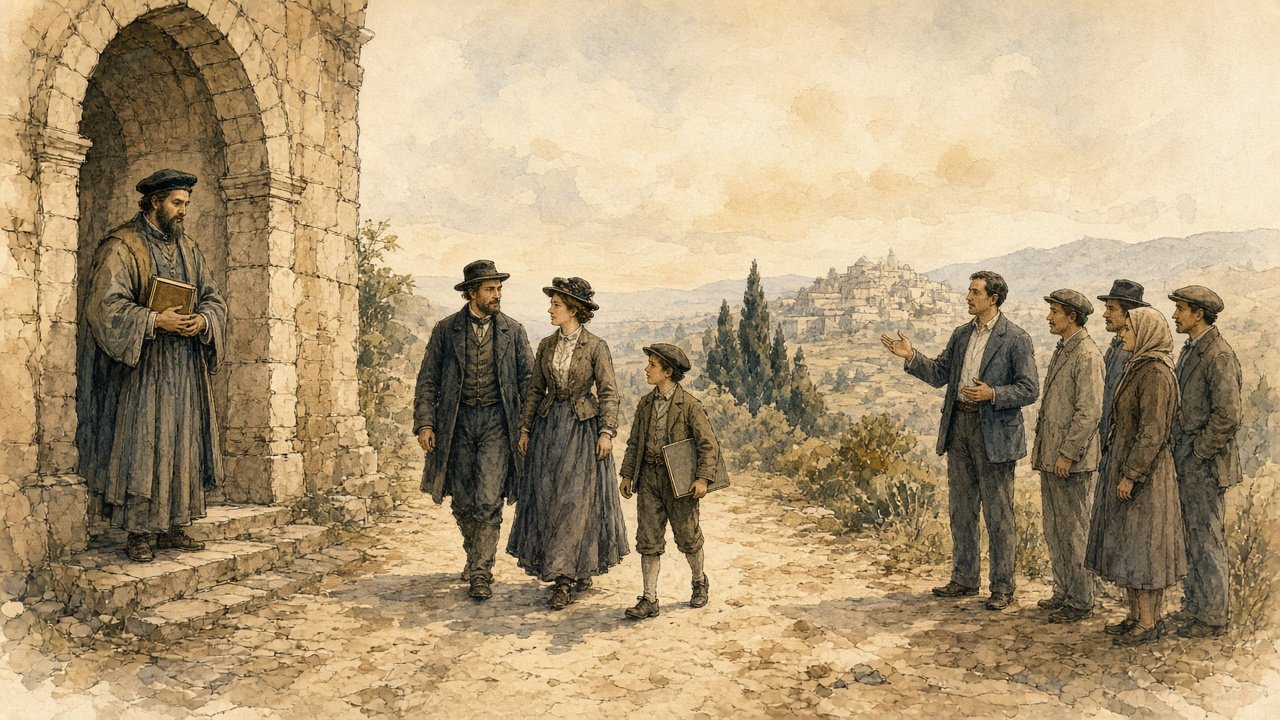
For most of the past two thousand years, Jews prayed, studied and wrote in Hebrew while speaking other languages at home and in the marketplace. Hebrew was not forgotten. It was taught to children, copied by scribes, printed by presses, argued over by grammarians and renewed by poets. What it was not, after late antiquity, was a mother tongue. The emergence of Modern Hebrew as a vernacular language between the late nineteenth and the mid-twentieth century therefore did not resurrect a dead language from silence. It changed the functions of a language that had remained continuously alive on the page and in the synagogue. Conversation, intimacy, labour, government and childhood came to be conducted in a tongue long reserved for liturgy, literature and learning.
This special feature follows that change from the end of ordinary spoken Hebrew in late antiquity to the consolidation of Israeli Hebrew after 1948. It describes the written and liturgical life of Hebrew in the diaspora, the Masoretic and grammatical traditions that made the language teachable, the medieval and early modern literatures that kept it flexible, and the Haskalah’s creation of a modern Hebrew reading public. It examines Mendele Mocher Sforim’s prose style, the career and myth of Eliezer Ben-Yehuda, the schools of the Yishuv, the War of the Languages over the Technion in 1913, and the work of the Language Committee and the Academy of the Hebrew Language. It treats the Second and Third Aliyot, Mandate official status, mass immigration and the ulpan, and the sounds, slang and grammar of the contemporary vernacular. Later chapters survey scholarly debates about revival, revernacularization and hybridity, and compare Hebrew with other language revitalisation movements. The aim is explanatory history rather than celebration: an account of how a liturgical and literary language became again a language of common use.
The chronology is uneven. Literary modernisation preceded mass speech; school immersion preceded statehood; official status preceded demographic majority in the wider land; demographic majority among Jewish Israelis after 1948 locked in what ideology had begun. No single year marks the birth of vernacular Hebrew. Thresholds multiplied: the first native children; the first Hebrew city culture; the first graduating class of a Hebrew gymnasium; the first university lecture; the first army trained in Hebrew; the first generation that needed English classes because Hebrew was already theirs. This feature treats those thresholds as a sequence rather than as a single overnight miracle.
1. After the vernacular fell silent
The end of ordinary speech
By the second century of the Common Era, Hebrew had ceased to be the ordinary spoken language of most Jewish communities in the land of Israel. The process had been gradual. Under Persian and then Hellenistic rule, Aramaic had already become the vernacular of much of the Near East, and Greek had taken hold in the coastal cities and among the educated. By the time of the Mishnah, compiled around the turn of the third century, the everyday speech of many Jews in Galilee and Judaea was Aramaic, while Hebrew survived as the language of scripture, prayer and a growing body of legal and narrative literature. The distinction was not absolute. Mishnaic Hebrew, the language of the tannaitic corpus, shows the marks of a living, changing tongue in contact with Aramaic and Greek, and some scholars argue that forms of Hebrew continued to be spoken in limited circles into the third or even fourth century. What ended was not literacy in Hebrew, nor its use in writing, but its status as the default language of the street, the market and the home.[1][2]
The destruction of the Second Temple in 70 CE and the failure of the Bar Kokhba revolt in 132–135 accelerated demographic and linguistic change. Large numbers of Jews left Judaea or were displaced, and the centres of learning shifted northward to Galilee and, later, to Babylonia. In Babylonia the vernacular was Aramaic, and the Babylonian Talmud, completed in the fifth and sixth centuries, is written largely in Aramaic, with Hebrew reserved for quotations from the Bible and the Mishnah and for certain formulaic and midrashic passages. In the land of Israel the Palestinian Talmud and the midrashim preserve a similar bilingual pattern. Hebrew thus entered a long period in which it functioned as a sacred and literary language within a diglossic system: Jews prayed and studied in Hebrew, wrote letters, poems and legal documents in Hebrew when the occasion demanded, and spoke other languages at home and in the marketplace.[3]
This arrangement was not unique to Hebrew. Classical Chinese, Latin, Sanskrit and Classical Arabic have all served for centuries as written and liturgical languages for communities that spoke something else. What distinguished Hebrew was the intensity with which later generations remembered it as the language of national life, and the degree to which its vocabulary, morphology and literary models remained available for reuse. The Bible and the rabbinic corpus formed a continuous library that every educated Jewish man, and in some communities many women, encountered from childhood. The language was never fossilised into a purely ceremonial register. It continued to be written for new purposes, and it continued to absorb words and constructions from the languages around it.
Layers of the classical language
Biblical Hebrew itself is not a single dialect. The language of the earlier narrative books differs from that of the late books such as Esther, Ezra, Nehemiah and Chronicles, which show Persian loanwords, Aramaic influence and a freer syntax. Poetry and prose diverge in vocabulary and word order. The language of the Dead Sea Scrolls, dating from the third century BCE to the first century CE, adds further evidence of variety within the Second Temple period. Mishnaic Hebrew, sometimes called Rabbinic Hebrew, differs again: it prefers different particles, uses the participle more freely for present time, and draws on a lexicon suited to law, agriculture and daily life in Roman Palestine. These layers would later become resources for modern writers seeking a flexible prose. When nineteenth-century Hebraists spoke of returning to the language of the Bible, they often meant a selective return that also drew, knowingly or not, on Mishnaic and medieval usage.[1][4]
The Dead Sea Scrolls, discovered from 1947 onwards in caves near Qumran, confirmed that Hebrew remained a written language of considerable vitality in the late Second Temple period. Sectarian documents, biblical manuscripts and other texts show a community that copied scripture meticulously and also composed new works in Hebrew. Some of these texts use a Hebrew close to the later Masoretic tradition; others display orthographic and morphological features that did not survive into the medieval manuscripts. The scrolls do not prove that Hebrew was still the spoken vernacular of Judaea as a whole, but they show that it was far from a dead language among the literate and the devout.
After the tannaitic and amoraic periods, Hebrew writing continued in liturgical poetry, in midrashic compilation and in the legal responsa that travelled between communities. The payyetanim of Byzantine Palestine composed elaborate poems for the synagogue, dense with biblical allusion and neologism. Their Hebrew was artificial in the sense that it was not the speech of the street, but it was creative and demanding, and it kept the language in public performance week after week. In Babylonia and later in the Islamic world, the geonim wrote in a Hebrew that mixed biblical and rabbinic diction, and they corresponded across vast distances in a language that all learned Jews could read. The vernaculars changed; the written medium endured.[5]
Diglossia as a durable arrangement
Modern linguists describe the long coexistence of Hebrew as a high written language with Aramaic, Arabic, Persian, Greek, Latin, Spanish, German, Yiddish and other vernaculars as a form of diglossia, or more precisely as a multilingual ecology in which Hebrew occupied a specialised domain. Diglossia in the classic sense pairs a prestigious written variety with a related spoken variety, as with Classical and colloquial Arabic. In Jewish communities the spoken languages were often unrelated to Hebrew, belonging to Germanic, Romance, Slavic or Iranian families, while Hebrew and Aramaic together formed the sacred-literary pair. Children learned Hebrew as a second language through the heder and the synagogue, not as a mother tongue. Competence varied widely. A merchant might recite prayers by rote and sign his name; a scholar might compose poetry and legal opinions with ease. Between these poles lay a spectrum of literacy that, in many communities, was higher among men than among women, though women often transmitted songs, blessings and domestic formulae in Hebrew and Aramaic mixed with the vernacular.[6]
The arrangement proved durable precisely because it did not require Hebrew to compete with the vernacular for everyday tasks. Trade, family life and local politics could be conducted in the language of the surrounding society, while Hebrew marked the boundary of Jewish religious and intellectual life. When political conditions changed, as they did repeatedly under Christian and Muslim rule, the vernacular might shift from Aramaic to Arabic, from Arabic to Spanish, from Spanish to Ottoman Turkish or from German to Slavic languages and Yiddish, but the Hebrew library travelled with the community. This portability is one reason why a vernacular revival remained conceivable centuries later. The language had never been abandoned as a written system; what had been abandoned was its use as the language of infancy and of unreflective speech.
Historians of the revival sometimes speak as if Hebrew slept between antiquity and the nineteenth century. The metaphor is misleading. Hebrew was continuously written, taught, debated and expanded. What slept, if anything, was the expectation that a child would acquire it at the mother’s knee. The chapters that follow trace how that expectation returned, first as a literary programme and then as a social fact, and how the language of liturgy and books became again the language of kitchens, playgrounds and offices.
Evidence from late antique sources
The question of when Hebrew ceased to be a mother tongue has been debated for more than a century. Nineteenth-century scholars often assumed a sharp break after the Bar Kokhba revolt. Twentieth-century research, drawing on rabbinic literature, inscriptions and the Dead Sea Scrolls, has painted a more nuanced picture. Mishnaic Hebrew exhibits innovations that are difficult to explain as purely literary inventions: new particles, altered uses of the verbal system and a lexicon reflecting the agriculture and crafts of Roman Palestine. Some of these features appear in the speech of figures portrayed in rabbinic stories, and some parallel developments in contemporary Aramaic. Scholars such as E. Y. Kutscher and later specialists in Middle Hebrew have argued that a spoken Hebrew persisted in parts of Judaea and Galilee into the tannaitic period, even as Aramaic advanced. The debate continues, but the practical conclusion for the history of the revival is clear enough. By the time the Babylonian Talmud was closed, no substantial Jewish community used Hebrew as its default vernacular. What remained was a high written and liturgical language of extraordinary continuity.[2][4]
Greek and Latin sources occasionally mention Jews speaking Hebrew, but the references are ambiguous and often mean Aramaic or simply the Jewish manner of reading scripture. Inscriptions from synagogues and tombs in the late antique Levant are frequently in Greek or Aramaic, with Hebrew reserved for biblical quotations and formulae. In the catacombs of Rome and in the remains of diaspora synagogues, Hebrew appears in short blessings and names alongside Greek and Latin. These scraps confirm Hebrew’s symbolic prestige without demonstrating vernacular use. The linguistic map of late antique Jewry was already multilingual, and Hebrew’s place on that map was specialised.
The rise of Christianity added a further dimension. Christian scholars preserved Hebrew for biblical study, and the Church Fathers sometimes cited Hebrew words. Yet Christian Hebraism in antiquity was limited compared with the medieval and Renaissance flowering. For Jews, the Christian appropriation of the Hebrew Bible as the Old Testament reinforced the need to maintain their own reading tradition and their own schools. Hebrew became, among other things, a marker of difference. That marker function would outlast empires and would later be reinterpreted as a national rather than a purely religious badge.
Prayer, study and the sound of the page
Even after vernacular speech ended, Hebrew was heard daily. The statutory prayers, the reading of the Torah and the haftarah, the Passover Haggadah, the sabbath hymns and the lifecycle blessings filled the air of the synagogue and the home with Hebrew sound. Children learned to associate the language with solemnity, festivity and belonging long before they could parse a sentence. The melodies of the cantillation marks, standardised in the Masoretic tradition, turned the prose of scripture into a chanted performance. In this sense Hebrew never fell silent. What fell silent was conversation: the unplanned exchange of gossip, instruction, humour and anger that constitutes a living vernacular.
Study halls added another acoustic environment. The traditional mode of Talmud study involves reading aloud, translating into the vernacular and arguing in a mixture of languages. Hebrew and Aramaic phrases fly through Yiddish or Arabic sentences. This macaronic practice kept classical vocabulary active in oral culture even when full Hebrew sentences were rare outside prayer. When teachers in the Yishuv later insisted on Hebrew-only classrooms, they were interrupting a centuries-old habit of mixing, not creating speech from nothing. The raw materials of words and idioms were already present in the mouths of the traditionally educated; what was new was the demand that those materials form complete, exclusive Hebrew utterances in every domain of life.
Women’s Hebrew, long under-documented, also mattered. In many communities women recited certain prayers, sang Hebrew and Aramaic songs, and taught children the alphabet. Some wrote petitions and letters. The exclusion of most women from advanced Talmud study limited their active command of rabbinic Hebrew, but it did not exclude them from the sound-world of the liturgy. In the nineteenth century, when maskilim and Zionists debated who should speak Hebrew, the question of women’s education and women’s speech became central. A language revived only among men in the study house would not become a mother tongue. The later success of Hebrew as a vernacular depended in part on girls’ schools, on mothers who agreed to speak Hebrew to their children, and on the slow normalisation of women’s public Hebrew in theatres, newspapers and political meetings.
Hebrew and Aramaic in the liturgical pair
Jewish liturgy never used Hebrew alone. The Kaddish is in Aramaic; parts of the Passover Haggadah and of legal documents are in Aramaic; the Talmud’s debates move between languages. Ordinary Jews therefore inhabited a sacred bilingualism. Modern vernacular Hebrew had to negotiate this inheritance. Some Aramaic phrases remained embedded in Israeli speech as frozen forms; others were Hebraised. The liturgical pair reminds us that the “holy tongue” was already a bundle of varieties. Reviving Hebrew as a vernacular meant selecting and promoting one strand of that bundle for all-purpose use, while Aramaic receded into scholarship and ceremony.
Synagogue chant also preserved phonetic traditions that later fed into pronunciation debates. Yemenite, Assyrian, Sephardi and Ashkenazi reading traditions differed systematically. When the Yishuv chose a Sephardi-based standard, it was choosing among living liturgical phonologies, not inventing sound from letters alone. The Masoretic signs constrained the choice but did not dictate every consonant’s realisation in modern mouths. Liturgy was thus both archive and battlefield for the sound of the new vernacular.
Names for the language
Jews have called the language by several names: leshon ha-kodesh, the holy tongue; ivrit; Yehudit in some biblical passages; and in modern European languages Hebrew, Hébreu, Hebräisch and so on. Each name carries connotations. “Holy tongue” emphasises liturgical restriction; “ivrit” became the everyday modern name in the Yishuv and Israel; “Hebrew” in English scholarly usage covers all historical stages. This essay uses Hebrew for the historical continuum and Modern Hebrew or Israeli Hebrew for the vernacular that emerged after the revival period. The naming choices inside Jewish communities were themselves part of the functional change: when parents called the language ivrit rather than leshon ha-kodesh, they often signalled that it was available for secular life.[1]
2. A written tongue across the diaspora
Hebrew in the Islamic world
From the seventh century onwards, the majority of Jews lived under Muslim rule, from Spain and North Africa through Egypt and the Levant to Iraq, Persia and beyond. Arabic became the vernacular of most of these communities, and Jewish writers developed a rich literature in Judaeo-Arabic, Arabic written in Hebrew characters. Yet Hebrew retained and even expanded its written roles. The geonic academies of Sura and Pumbedita issued legal opinions in Hebrew and Aramaic. Poets in Iraq, Egypt and Spain composed liturgical and secular verse in Hebrew that drew on Arabic metres and themes. Philosophers and scientists often wrote their technical works in Arabic, then translated them into Hebrew for readers outside the Arabic-speaking world. The result was a bilingual and sometimes trilingual literary culture in which Hebrew remained the shared language of Jewish scholarship across political borders.[5][7]
Saadia Gaon (882–942), head of the academy of Sura, wrote a Hebrew grammar, a Hebrew dictionary and a translation of the Bible into Arabic, and he composed poetry and polemics that helped to establish Hebrew as a language capable of systematic linguistic description. His work responded in part to the Karaite challenge and to the prestige of Arabic grammatical science. By applying the methods of Arabic linguistics to Hebrew, Saadia and his successors created a technical vocabulary for discussing roots, patterns and syntax that later medieval grammarians would refine. The language was being described from within, not only used.[8]
In Muslim Spain, Hebrew poetry reached a peak of formal and thematic ambition. Poets such as Samuel ibn Naghrillah, Solomon ibn Gabirol, Moses ibn Ezra and Judah Halevi wrote wine songs, love lyrics, meditations on exile and liturgical poems of great density. They adapted the quantitative metres of Arabic poetry to Hebrew, exploiting the language’s root system and biblical echoes. Judah Halevi’s philosophical dialogue, the Kuzari, was written in Judaeo-Arabic and later translated into Hebrew, and his poems of longing for Zion became part of the liturgy and of later national memory. The Golden Age of Spanish Hebrew poetry demonstrated that Hebrew could serve as a vehicle for courtly and secular expression as well as for prayer. It did not restore Hebrew as a spoken vernacular in Cordoba or Granada, where Jews spoke Arabic, but it enlarged the range of what written Hebrew could do.[7][9]
Maimonides (1138–1204) wrote his major philosophical work, the Guide of the Perplexed, in Judaeo-Arabic, and his Mishneh Torah, a comprehensive code of Jewish law, in a clear, mishnaic Hebrew that became a model of rabbinic prose. The choice of Hebrew for the code was deliberate: Maimonides wanted a work that could be read by Jews everywhere, not only by those fluent in Arabic. The Mishneh Torah circulated widely in Hebrew manuscripts and later in print, and its style influenced legal and didactic writing for centuries. Here again Hebrew functioned as a transnational written medium, bridging communities that spoke different vernaculars.[10]
Christian Europe and the Ashkenazi world
In Christian Europe the vernaculars of Jewish communities diverged. In the Rhineland and later in Poland and Lithuania, Jews developed Yiddish, a Germanic language with a substantial Hebrew and Aramaic component written in Hebrew script. In the Iberian Peninsula and after the expulsions of the 1490s in the Ottoman Empire and North Africa, Sephardic Jews spoke forms of Judaeo-Spanish, often called Judaeo-Spanish or Ladino in broader usage, again written in Hebrew characters for many purposes. Hebrew remained the language of the Bible, the prayer book, the Talmud and the responsa. Rabbinic correspondence across Europe and the Mediterranean was conducted in Hebrew, creating a republic of letters that ignored vernacular boundaries.[6][11]
Ashkenazi education centred on the heder and the yeshiva. Boys began with the Hebrew alphabet and the prayer book, progressed to the Pentateuch with Rashi’s commentary, and if they continued, entered the world of Talmud and codes. The method produced deep familiarity with Hebrew and Aramaic texts, but it did not aim to produce spoken fluency in Hebrew as a vernacular. Discussion in the yeshiva was often in Yiddish, with Hebrew and Aramaic phrases embedded in the argument. Writing a letter in Hebrew, composing a responsum or drafting a contract required active command of written Hebrew, and the best students acquired it. The mass of the population acquired a more passive competence, sufficient for prayer and for recognising biblical quotations. This educational pattern, replicated across Eastern Europe for centuries, meant that when the Haskalah and later Zionism called for a return to Hebrew speech, they could build on a foundation of literacy that already existed, however unevenly distributed.[12]
Sephardic communities under Ottoman rule maintained their own educational traditions, often with a stronger emphasis on Hebrew grammar and on the medieval Spanish poetic heritage. In centres such as Salonika, Istanbul, Izmir and Jerusalem, Hebrew printing and scholarship flourished alongside Judaeo-Spanish literature. The pronunciation of Hebrew in Sephardic communities differed systematically from Ashkenazi pronunciation, preserving distinctions of vowels and consonants that Ashkenazi reading had merged or shifted. These differences would later become politically and pedagogically important when educators in the Yishuv chose a Sephardi-based pronunciation as the standard for revived speech.[13]
Hebrew as a language of record
Throughout the medieval and early modern periods, Hebrew served as a language of legal and communal record. Marriage contracts, divorce documents, bills of sale, communal ordinances and tombstone inscriptions were routinely written in Hebrew, sometimes mixed with Aramaic formulae. Merchants kept accounts and wrote letters that switched between the vernacular and Hebrew according to the addressee and the subject. Travellers such as Benjamin of Tudela in the twelfth century composed itineraries in Hebrew that described Jewish communities from Spain to the edges of Asia. Chroniclers recorded persecutions, expulsions and local events in Hebrew narratives that circulated in manuscript. The language was thus not confined to the synagogue. It was the default written register for anything that needed to be preserved across generations or sent to another community.[5]
This documentary use kept Hebrew vocabulary in touch with material life. Words for trades, tools, foods, fabrics and legal instruments entered or re-entered written Hebrew through contracts and ordinances, even when the spoken language of the signatories was Yiddish or Arabic. Later lexicographers and language planners would mine these sources, alongside the Bible and the Talmud, for words that could be revived or adapted for modern needs. The documentary trail also shows that Hebrew writing was not the monopoly of rabbis. Scriveners, merchants and communal officials produced a steady stream of practical Hebrew that sat alongside the high literature of poetry and philosophy.
By the eve of the modern period, then, Hebrew occupied a stable and prestigious place in Jewish life without being anyone’s mother tongue. It was the language in which Jews addressed God, studied their classical texts, corresponded with distant communities and recorded the acts of their communal institutions. The gap between this written vitality and the absence of vernacular speech is the starting point of the story that follows. Closing that gap required not only new ideologies of nation and language, but also schools, newspapers, theatres, households and, eventually, a state.
Translation movements and the Hebrew bookshelf
From the twelfth century onwards, a sustained translation movement brought scientific, philosophical and medical works from Arabic into Hebrew for Jewish readers in Christian Europe who did not know Arabic. Families of translators such as the Ibn Tibbons in Provence rendered Aristotle, Averroes, Al-Farabi and medical writers into a Hebrew that had to stretch to accommodate new concepts. They coined or calqued technical terms, sometimes awkwardly, and in doing so expanded the expressive range of written Hebrew far beyond the biblical and rabbinic lexicon. The Hebrew philosophical vocabulary of the later Middle Ages is largely a product of this effort. When nineteenth-century writers sought words for politics, science and emotion, they inherited both the successes and the clumsiness of these medieval experiments.[7][10]
Kabbalistic literature, from the Zohar onwards, added another stratum. The Zohar itself is written mainly in an artificial Aramaic, but Hebrew kabbalistic writing flourished in Spain, Italy and the Ottoman Empire. Mystical Hebrew reused biblical words in symbolic senses and generated a specialised lexicon of emanations, worlds and intentions. Gershom Scholem’s modern scholarship would later map this literature; for pre-modern readers it was simply part of the Hebrew library, recited, copied and feared. The revival of the nineteenth century was largely secular in programme, yet it drew unconsciously on the cumulative lexical wealth of mystical as well as rationalist Hebrew.[17]
Ethical wills, travel accounts, polemics against Christianity and Islam, and local chronicles further diversified the written corpus. No single genre dominated. Hebrew was a toolkit that different communities used for different jobs. The unity of the language across genres and continents is easy to exaggerate; medieval Hebrew varies by region, period and purpose. Yet a reader trained on the Bible and Rashi could, with effort, make sense of a responsum from Poland, a poem from Andalusia and a philosophical preface from Provence. That partial mutual intelligibility across time and space is what made Hebrew available as a national language in the modern sense. A Polish Jew and a Yemenite Jew did not share a vernacular, but they shared a library.
Status without speech
Sociolinguists distinguish between the status of a language and its vitality in daily use. Medieval and early modern Hebrew had high status and low vernacular vitality. It was prestigious, sacred and useful for certain written tasks, yet children did not acquire it naturally. Comparable cases include Latin in medieval Europe, Classical Chinese in East Asia and Sanskrit in South Asia. In each case, later movements have tried to restore or reinvent spoken use, with mixed results. Hebrew is often cited as the most successful of these attempts, but the success rested on prior status. A language with no written tradition and no prestige would have been far harder to reinstate as a vernacular under modern conditions.
The cost of status without speech was a growing gap between the Hebrew of books and the linguistic needs of changing societies. New technologies, new political forms and new literary tastes arrived in the vernaculars and in European languages. Hebrew writers who wished to address these topics had to invent or borrow. The Haskalah would make that invention a programme. Before the Haskalah, the gap was managed by diglossia: one wrote elevated Hebrew for elevated subjects and left the rest to Yiddish, Spanish, Arabic or the local tongue. The decision to collapse diglossia, to make Hebrew do everything, was a modern decision. It was not the inevitable outcome of medieval prestige. It required ideology, institutions and demography, to which the later chapters turn.
North Africa and Yemen
Jewish communities in Morocco, Algeria, Tunisia, Libya and Yemen maintained distinctive Hebrew pronunciation traditions and literary habits. Yemenite Jews preserved phonological features that many scholars regard as especially conservative, and their liturgical reading became a reference point for modern linguists reconstructing older Hebrew sounds. North African centres produced rabbinic responsa, liturgical poetry and Judaeo-Arabic philosophy in patterns parallel to the eastern Islamic world. When immigrants from these communities arrived in Israel in large numbers after 1948, they brought phonetic and musical traditions that complicated Ashkenazi-dominated norms of “correct” Hebrew. Some features, such as realised pharyngeals among many speakers, entered the variable Israeli soundscape. Others were stigmatised in the early state period and only later revalued. The diaspora story of Hebrew is incomplete if it centres only on Europe and the Ottoman Levant; the Maghreb and Yemen were major provinces of the written and recited language.[13][42]
Marriage contracts, commercial deeds and communal ordinances from these regions, often preserved in family archives and in the Cairo Genizah’s broader documentary culture, show the same practical Hebrew documentary habit described for Europe and the East. The language of record travelled with trade across the Sahara’s edges and along Red Sea routes. Vernaculars differed; the notarial Hebrew formulae recognised one another.
Karaite and Rabbanite Hebrew
Karaite communities, who rejected rabbinic oral law, cultivated Hebrew Bible study and Hebrew writing with their own scholarly centres in the Crimea, Byzantium and Egypt. Their grammatical and exegetical works form a parallel track of Hebrew literacy beside Rabbanite yeshivot. Contact and polemic between the groups sharpened linguistic attention on both sides. For the long history of Hebrew as a written language of argument, Karaites matter as proof that non-rabbinic Judaisms also carried Hebrew across centuries. Modern Israeli culture has selectively rediscovered Karaite heritage; linguistically, that heritage already belonged to the medieval Hebrew library on which later modernisers drew.[8]
3. Masoretes, grammarians and the science of the text
The Tiberian tradition
Between the sixth and the tenth centuries, groups of scholars known as the Masoretes developed systems for recording the traditional reading of the Hebrew Bible. Working especially in Tiberias on the Sea of Galilee, and also in Babylonia and in the land of Israel more broadly, they added vowel signs, accent marks and marginal notes to the consonantal text. Their aim was not to invent a pronunciation but to fix in writing a reading tradition that had been transmitted orally. The Tiberian system, which eventually prevailed, became the standard vocalisation of the Hebrew Bible and, by extension, the framework within which later generations learned to read Hebrew aloud.[14][15]
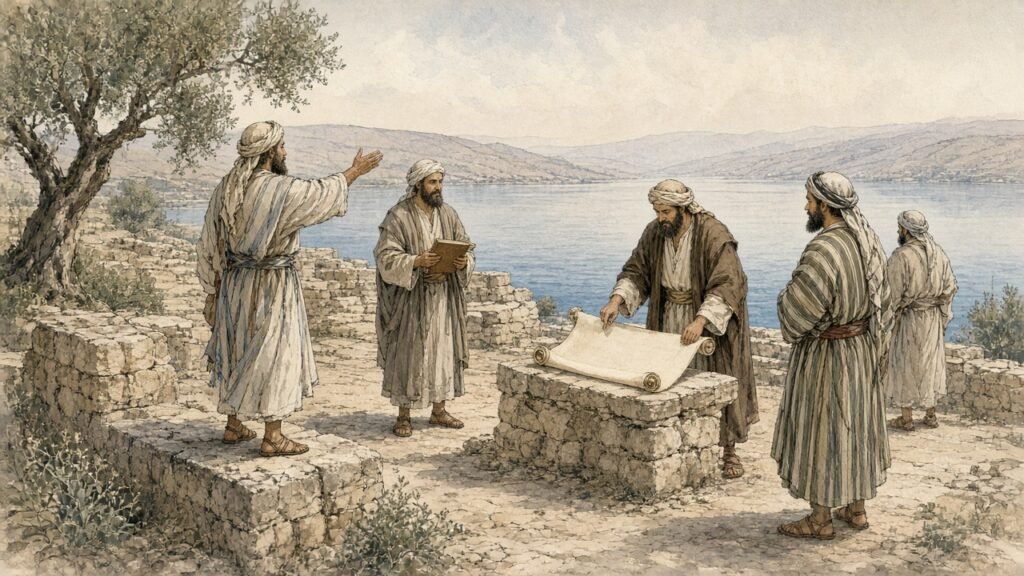
The great medieval manuscripts that embody this tradition include the Aleppo Codex, associated with the Ben Asher family and long regarded as the most authoritative Tiberian manuscript, and the Leningrad Codex, completed in 1008 or 1009, which remains the oldest complete manuscript of the Hebrew Bible and the base text of modern critical editions. The Masoretic apparatus recorded variant readings, counted letters and words, and noted unusual forms, creating a body of meta-textual knowledge that treated the language of scripture as an object of precise study. This scholarly attention to the sound and form of biblical Hebrew would later feed into modern grammar and into debates about how revived Hebrew should be pronounced.[14]
The Tiberian vowel signs distinguished qualities that everyday speech in the diaspora often blurred. Ashkenazi reading traditions merged certain vowels and shifted others; Yemenite and some Sephardic traditions preserved distinctions closer to the Tiberian system. When educators in the late nineteenth and early twentieth centuries sought a standard pronunciation for spoken Hebrew, they looked to Sephardic models in part because those models seemed closer to the Tiberian orthography that every literate Jew already knew from the pointed Bible. The Masoretic text thus served not only as scripture but as a phonetic reference point for a language that was about to be spoken again.[13]
Grammar as a science
Medieval Hebrew grammar grew in dialogue with Arabic linguistics. From Saadia onwards, Jewish scholars analysed Hebrew roots according to the triliteral theory, classified conjugations and noun patterns, and wrote dictionaries organised by root. In Spain and Provence, figures such as Menahem ibn Saruq, Dunash ben Labrat, Jonah ibn Janah and the Kimhi family produced grammars and lexicons that remained standard for centuries. David Kimhi’s Michlol and his dictionary Sefer ha-Shorashim were printed in the early modern period and used by Jewish and Christian Hebraists alike. The grammatical tradition made Hebrew teachable as a system, not only as a collection of sacred phrases.[8][16]
Christian Hebraism from the Renaissance onwards added another layer. Scholars such as Johannes Reuchlin, Sebastian Münster and later the Buxtorfs studied Hebrew grammar in order to read the Old Testament in the original. Their textbooks and dictionaries circulated in European universities and, indirectly, reinforced the status of Hebrew as a classical language comparable to Latin and Greek. For Jews this Christian interest was sometimes a source of unease and sometimes an opportunity for scholarly exchange. It also meant that when maskilim in the eighteenth century argued for a return to pure biblical Hebrew, they could point to a European classical model as well as to Jewish tradition.[16]
The grammatical tradition had limits. It focused heavily on biblical Hebrew and treated rabbinic and medieval Hebrew as secondary or corrupt. It described written forms more confidently than spoken ones, since for most of its history there was no vernacular speech to describe. When the revival began, teachers discovered that the classical grammars did not supply ready answers for the syntax of conversation, the morphology of neologisms or the phonetics of rapid speech. The Academy of the Hebrew Language and its predecessors would spend decades filling those gaps. Yet without the medieval and early modern grammatical corpus, the revival would have lacked both a metalanguage and a sense of historical depth.
The pointed text and the unpointed page
Most Hebrew writing outside the Bible was unpointed. Readers supplied vowels from knowledge of the language and from context. This practice, efficient for the trained reader, made Hebrew harder for beginners and for those whose spoken vernacular was remote from Hebrew morphology. Newspapers, novels and schoolbooks of the revival period experimented with partial pointing, full pointing and various systems of matres lectionis to ease reading. The tension between the pointed biblical model and the unpointed everyday page remains visible in modern Israeli publishing, where children’s books and poetry are often pointed while newspapers and most adult prose are not.
The Masoretic achievement was to make the sound of scripture reproducible across time and space. The grammatical achievement was to make the structure of the language explicit. Together they turned Hebrew into an object of continuous scholarly attention. That attention did not by itself restore vernacular speech, but it meant that when social and political movements demanded a spoken Hebrew, the language was already equipped with a written standard, a phonetic notation and a tradition of analysis. The next chapters turn from this scholarly infrastructure to the literary and ideological movements that put it to new use.
From manuscript to print
The arrival of Hebrew printing in the late fifteenth century transformed the Masoretic and grammatical inheritance. The first dated Hebrew books appeared in Italy in the 1470s, and within decades presses in Soncino, Venice, Naples and later Constantinople, Salonika, Prague and Cracow were producing Bibles, prayer books, Talmud tractates and grammatical works. The Bomberg Talmud printed in Venice in the early sixteenth century fixed a page layout that is still used. Printed Bibles spread the Tiberian vocalisation to every community that could buy a copy. Grammars that had circulated in a handful of manuscripts became classroom textbooks. The effect was to standardise written Hebrew more tightly than medieval manuscript culture had done, while also making the classical language accessible to a wider reading public.[18]
Print did not restore speech, but it multiplied the occasions for reading aloud and for private study. A printed prayer book in the home changed the acoustics of domestic religion. A printed Bible with vowels made self-teaching easier. Newspapers would later complete this democratisation; the grammatical and Masoretic groundwork was laid in the age of the incunable and the early modern press. The essay on Jewish printing published elsewhere on this site follows that story in more detail. For the present purpose it is enough to note that by 1800 a maskil in Berlin or Vilna could buy Hebrew books that embodied a thousand years of scholarly labour on the language’s sounds and structures.[18]
Christian printers and scholars participated in this economy. Hebrew type was cut for polyglot Bibles and for university presses. The circulation of Hebrew grammars among Christian Hebraists created a parallel audience that, paradoxically, helped to keep Hebrew visible in European intellectual life during centuries when Jews themselves were often marginalised. When Moses Mendelssohn and his circle sought to modernise Jewish education, they did so in an environment in which Hebrew already counted as a classical language in the European curriculum. That external recognition mattered for the internal politics of Jewish language reform.
Christian Hebraism and the mirror of prestige
From the Renaissance through the nineteenth century, Christian universities treated Hebrew as a classical language necessary for theology and biblical studies. This external prestige had ambiguous effects on Jewish communities. It could encourage maskilim who wanted Hebrew to stand beside Latin and Greek in the pantheon of learned tongues. It could also feel like appropriation. Either way, grammars printed for Christian students circulated and were sometimes used by Jewish autodidacts. The modern Hebrew textbook descends in part from this dual market of Jewish and Christian pedagogical grammars. Vernacular revival borrowed the prestige of the classical curriculum even as it sought to escape the confinement of classicism.
Alternative Masoretic systems
Before the Tiberian system prevailed, Babylonian and Palestinian vocalisation systems recorded different reading traditions. Manuscripts with Babylonian pointing survive in Genizah fragments and elsewhere, showing vowel qualities and graphic methods that diverge from Tiberian practice. The eventual victory of Tiberian notation was a historical contingency reinforced by the prestige of Tiberian manuscripts and by the spread of printed Bibles that used Tiberian signs. For the modern revival this victory mattered because school grammars taught Tiberian vowels as “the” Hebrew vowels. Alternative traditions survived in the liturgical phonology of communities even when their books looked Tiberian on the page. Yemenite pronunciation, for example, preserves distinctions that interact complexly with Tiberian graphics. Modern Israeli pronunciation simplified this inheritance into a teachable standard while leaving residual variation among ethnic communities.[14][13]
Accent marks, or te’amim, served both syntactic and musical functions. They told readers how to chant and also how to parse. Modern spoken Hebrew abandoned cantillation for conversation, of course, but the marks remained in biblical education and in synagogue performance. The split between chanted Bible and spoken vernacular recreated a specialised oral register within the larger vernacular success. Israelis who speak Hebrew all day may still hear the Torah in a different phonetic and melodic mode on Saturday morning. That residual diglossia of performance is a living link to the Masoretic project.
Grammatical treatises also discussed poetic licence, rare forms and hapax legomena, training readers to notice linguistic oddity. Modern lexicographers hunting for revivable words mined those discussions. A rare biblical noun for an implement or a weather phenomenon could be dusted off for industrial or meteorological use. The Masoretic and grammatical attention to the exceptional thus became a resource for neologism.
4. Medieval Hebrew as living literature
Poetry as a public art
Medieval Hebrew literature is often introduced through its poetry, and with reason. From the liturgical poets of Byzantine Palestine to the court poets of Muslim Spain and the later Hebrew poets of Italy and the Ottoman Empire, verse was the most prestigious demonstration of linguistic mastery. The payyetanim of the land of Israel composed complicated poems for the synagogue service, packing biblical allusions into dense acrostics and patterned stanzas. Their Hebrew was difficult by design, a display of learning for congregations that heard it chanted year after year. In Spain the fashion shifted. Influenced by Arabic poetics, Jewish poets wrote short, metrical poems on wine, love, friendship, nature and the bitterness of exile, as well as continuing to write for the liturgy. The language of these poems is biblical in vocabulary yet new in syntax and theme. It proved that Hebrew could treat subjects that the Bible had not treated in the same way, and it created a canon that later maskilim would reprint and imitate.[9][7]
Judah Halevi’s poems of Zion, Solomon ibn Gabirol’s philosophical and liturgical verse, and Moses ibn Ezra’s reflections on poetry itself became touchstones. Anthologies and commentaries kept them in circulation. When nineteenth-century Hebraists searched for models of elevated style that were not purely biblical pastiche, the Spanish poets offered an alternative. Their metres were hard to reproduce in modern accentual verse, but their diction and their confidence that Hebrew could speak of the self and the world remained influential. The revival of spoken Hebrew was not a poetic project, yet poetry helped to persuade educated Jews that Hebrew was capable of modern literary life.
In Italy, from the Renaissance through the eighteenth century, Hebrew poets continued to write occasional verse, dramas and satirical pieces. Figures such as Immanuel of Rome had already shown, in the late Middle Ages, that Hebrew could handle the themes of Italian comic and love poetry. Later Italian Hebrew writing interacted with the surrounding humanist culture. This Italian strand mattered for the Haskalah because it offered a precedent for Hebrew as a language of polite letters in a European key. Berlin and Vienna maskilim who looked west as well as east found in Italian Hebrew a bridge between the Spanish golden age and their own aspirations.
Prose genres
Medieval Hebrew prose is more varied than survey courses sometimes suggest. Beyond philosophy and law, there were fables, framed tales, rhymed prose narratives, ethical tracts and popularisations of science. The Tahkemoni of Judah al-Harizi adapted the Arabic maqama form into Hebrew, creating witty, mobile narratives that displayed linguistic virtuosity. Translations of Kalila and Dimna and other story cycles brought narrative entertainment into Hebrew. Ethical literature, from Bahya ibn Pakuda’s Duties of the Heart (written in Arabic and translated into Hebrew) to later Ashkenazi musar works, addressed the reader in a didactic Hebrew meant to be understood and applied. None of this was vernacular speech, but all of it stretched the written language toward the textures of ordinary experience: travel, commerce, temptation, friendship and fear.[5]
Historiographical writing in Hebrew recorded expulsions, blood libels and communal crises. The chronicles of the Crusades massacres in the Rhineland, written in a biblical style that echoed the book of Lamentations, shaped Ashkenazi memory for centuries. Later works such as Solomon ibn Verga’s Shevet Yehudah analysed Iberian expulsion and conversion with a mixture of anecdote and political reflection. These texts kept Hebrew available as a language of public memory. When modern Jewish historians and novelists turned to the Jewish past, they found Hebrew already stocked with narrative strategies for recounting catastrophe and survival.
Letter writing deserves separate mention. The Hebrew letter was a cultivated art. Manuals of epistolography taught formulae for addressing scholars, patrons and relatives. Merchants and rabbis corresponded across the Mediterranean and Europe in a Hebrew that mixed set phrases with personal news. Surviving letter collections reveal a practical written Hebrew that had to name ships, goods, illnesses and legal disputes. This epistolary Hebrew is one of the ancestors of modern Hebrew prose. It is less polished than philosophical style and less ornate than poetry, and for that reason it was useful to later writers seeking a middle register.
What medieval Hebrew did not do
Medieval Hebrew did not become the language of the nursery or the marketplace. It did not develop a stable colloquial register documented by playwrights or dialogists. It did not undergo the kind of vernacularisation that Dante advocated for Italian or that the Protestant reformers achieved for German and English Bible translation. Jewish communities translated the Bible into the vernacular for study and, in some cases, for women and the less educated, but the sacred prestige of the Hebrew original limited the desire to replace it. The result was a literature of high achievement that left everyday speech to other tongues.
This limitation is not a failure by medieval standards. Diglossia worked. It allowed Jews to participate in the vernacular cultures around them while maintaining a transnational written identity. Only when modern nationalism redefined language as the soul of a people, and when emancipation and persecution alike disrupted traditional structures, did diglossia come to seem like a problem to be solved. The medieval library then became a resource for a project its authors had not imagined: the restoration of Hebrew as a mother tongue. The next chapters examine how that project took shape in the Enlightenment and after.
One further medieval legacy shaped the revival: the idea that Hebrew could be purified. Grammarians and poets repeatedly criticised mixed or incorrect usage and held up biblical models as ideals. The Haskalah inherited this purist streak and intensified it. Ben-Yehuda and the Language Committee inherited it in turn, even as they coined thousands of new words. The tension between purism and innovation, already audible in medieval debates about loanwords and style, became a structural feature of modern Hebrew language planning.
Centres of production
Medieval Hebrew literature was not evenly distributed. Certain cities and courts concentrated patronage and talent. In Muslim Spain, Cordoba, Granada, Seville and Toledo supported poets who also served as viziers, physicians and communal leaders. After the Almohad invasions and the migrations northward, Hebrew writing continued in Christian Spain and in Provence, where translators and philosophers clustered around families such as the Ibn Tibbons and the Kimhis. In the East, Baghdad, Kairouan, Fustat and later Cairo were centres of geonic and literary activity. Each centre left a deposit of style. Spanish Hebrew tended toward metrical polish and biblical diction; Ashkenazi Hebrew writing leaned toward rabbinic idiom and ethical urgency; Italian Hebrew absorbed Renaissance forms. A modern reader who samples these corpora encounters not one medieval Hebrew but several, united by scripture and school yet divergent in taste.[7][9]
Patronage shaped what could be written. A poet attached to a court might produce wine songs and panegyrics; a poet dependent on a congregation might produce selichot and kinot. The economic basis of Hebrew literature was fragile, and many writers earned their living as doctors, merchants or tutors. This amateur professional pattern persisted into the Haskalah and beyond. Ben-Yehuda himself lived by journalism and tutoring. The romantic image of the Hebrew writer as a national prophet obscures the older pattern of the writer as a man with another trade who wrote in the hours left by livelihood. Understanding that pattern helps to explain both the persistence of Hebrew writing under difficult conditions and the difficulty of expanding it into a full vernacular culture without institutional support.
Women appear rarely as named authors in the medieval Hebrew corpus, though they appear as dedicatees, addressees and, occasionally, as poets in Genizah fragments and later collections. The Genizah of Cairo, preserved in the Ben Ezra synagogue and studied since the late nineteenth century, revealed a vast documentary Hebrew and Judaeo-Arabic world in which women bought, sold, sued and wrote. These documents complicate the literary canon. They show Hebrew and mixed Hebrew-Arabic writing as tools of everyday elite life, not only of poetry and philosophy. For the history of vernacularisation they matter because they prove that practical written Hebrew long predated the modern press. The leap to speech was still enormous, but the leap from sacred writing alone to practical writing had already been made.
Language contact and loanwords
Medieval Hebrew absorbed loanwords from Arabic, Persian, Greek, Latin, Romance languages and German. Some were adapted to Hebrew morphology; others remained recognisable foreignisms. Purists complained. Innovators continued to borrow. Medical and scientific Hebrew in particular could not function without Arabic and Latin terminology. The resulting lexicon was a layered archive. Nineteenth-century language planners who wished to purify Hebrew often rediscovered medieval borrowings and either rejected them or Hebraised them further. The Academy’s later preference for root-based coinages over internationalisms has medieval precedents, as does the opposing practice of frank borrowing. The argument is old; only the institutional setting is new.[8]
Syntax also shifted under contact. Translators from Arabic sometimes produced Hebrew sentences that mirrored Arabic word order and connective patterns. Rabbinic Hebrew had already diverged from biblical syntax; medieval philosophical Hebrew diverged again. Modern Hebrew syntax, with its fondness for certain analytic constructions and its reshaped verbal system, is not a simple return to the Bible. It is the outcome of Mishnaic, medieval, maskilic and spoken innovations piled on one another. Medieval prose is one of the neglected ancestors of that outcome, especially in the clarity of Maimonidean legal style and the flexibility of epistolary Hebrew.
Philosophy, science and the limits of biblical diction
When medieval translators rendered Aristotelian metaphysics or Galenic medicine into Hebrew, they confronted the inadequacy of biblical vocabulary for technical abstraction. They borrowed, calqued and sometimes left Arabic terms in Hebrew characters. The resulting philosophical Hebrew is difficult, but it established that the language could host systematic thought about nature and mind. Later maskilim who wanted Hebrew science could point to this precedent even when they rejected medieval Aristotelianism. The revival’s scientific Hebrew is a grandchild of the translation movement as well as of the Language Committee.
Polemical literature against Christianity and Karaism likewise stretched Hebrew argumentative prose. Authors needed terms for dogma, heresy, trinity debates and scriptural proof methods. Their solutions fed the reservoir of abstract nouns and connective strategies available to modern essayists. Ahad Ha’am’s Hebrew essays, centuries later, still draw on this capacity for sustained abstract argument in Hebrew, a capacity that liturgy alone would not have supplied.
Liturgical poetry as linguistic gymnasium
Piyyut, Hebrew liturgical poetry, trained generations in elaborate morphology, rare biblical allusions and acoustic play. Choristers and congregants who did not control productive grammar still heard dense Hebrew weekly. That hearing built passive competence: a sense of what Hebrew could sound like at full intensity. Modern poets sometimes rebelled against piyyut’s difficulty; they also inherited its licence to invent. The gymnasium of liturgy prepared muscles later used for secular verse and song. Continuity here is acoustic and cognitive rather than institutional. Synagogues were not trying to create Zionist poets. They created ears that could later receive them.[11]
5. Print, correspondence and early modern Hebrew
A republic of Hebrew letters
Early modern Jewish culture, roughly from the sixteenth to the eighteenth century, was a culture of print and correspondence as much as of manuscripts and oral teaching. Hebrew books travelled from Venice to Amsterdam, from Prague to Cracow, from Constantinople to Fez. Rabbinic responsa, printed in collected volumes, created a shared legal conversation across continents. Ethical works, biblical commentaries and kabbalistic treatises found readers far from their authors’ homes. The Hebrew language in this period remained what it had been in the Middle Ages, a written medium of high status, but print increased the speed and volume of exchange and began to create something like a public of Hebrew readers.[18]
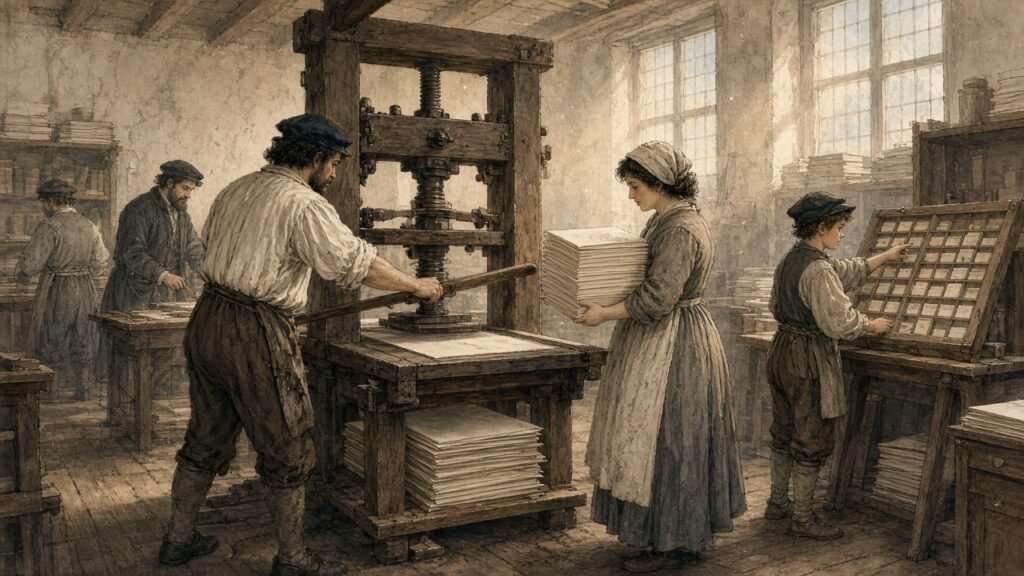
Amsterdam in the seventeenth century offers a vivid example. Portuguese Jews who had fled the Iberian Peninsula and their descendants built a community that printed Hebrew and Spanish books, traded across the Atlantic and maintained contact with the Ottoman Empire and the land of Israel. Hebrew presses in Amsterdam produced Bibles, prayer books and scholarly works for export. Menasseh ben Israel negotiated with English authorities for the readmission of Jews and wrote in Hebrew, Latin and Spanish. The community’s linguistic repertoire was complex, but Hebrew remained the language of serious Jewish learning and of communication with other communities. Similar patterns held in Prague, Frankfurt, Mantua and the Ottoman ports.[18]
Correspondence between the land of Israel and the diaspora sustained fundraising for the Jewish communities of Jerusalem, Hebron, Safed and Tiberias. Emissaries carried letters in Hebrew that described conditions in the holy cities and appealed for support. These letters, formulaic yet informative, kept the geography of the land present in diaspora consciousness and kept practical Hebrew in use for politics and money. The later Zionist use of Hebrew for national mobilisation had this quieter precedent: Hebrew as the language in which Jews asked one another for help across distance.
Internal languages and external languages
While Hebrew served external Jewish communication, internal vernaculars flourished. Yiddish literature expanded in the early modern period with biblical paraphrases, ethical books, romances and, eventually, satirical and narrative works aimed at a broad audience. Judaeo-Spanish literature similarly developed in the Ottoman world. These vernacular literatures did not replace Hebrew; they occupied different niches. A household might hear Yiddish stories and Hebrew prayers in the same evening. The division of labour seemed natural until Enlightenment critics began to attack Yiddish as jargon and to elevate Hebrew as the authentic Jewish tongue. That attack would reshape language politics, but it rested on an early modern reality in which both languages already had print cultures.
Christian interest in Hebrew continued to grow. Universities established chairs of Hebrew. Protestant scholars studied the Masoretic text in order to ground biblical translation and theology. Catholic scholars did likewise within their own frameworks. The presence of Hebrew in European learned culture meant that a Jewish writer who published in Hebrew could occasionally reach Christian readers, and that Hebrew grammar was a recognised academic subject. Moses Mendelssohn’s generation inherited this dual audience. When Mendelssohn translated the Pentateuch into German with a Hebrew commentary, he was addressing Jews in the vernacular while keeping Hebrew as the language of exegesis, a characteristic early modern compromise soon to be challenged by more radical maskilim.[19]
Toward a modern literary language
By the early eighteenth century, signs of a new Hebrew literary ambition appeared. Writers in Italy and Central Europe composed Hebrew dramas, satirical poems and journalistic pieces that addressed contemporary events. The language remained heavily biblical, often to the point of pastiche, but the subjects were new: politics, manners, science and the critique of traditional society. These experiments prepared the ground for the Haskalah’s Hebrew press. They also revealed the strain of writing about modern life in a language whose everyday vocabulary had not been spoken for centuries. Authors reached for rare biblical words, coined awkwardly, or left gaps that the vernacular would have filled without effort.
The early modern period thus bequeathed to the nineteenth century a paradox. Hebrew was more widely printed and more systematically taught than ever before, yet the gap between its written dignity and the absence of vernacular speech had become more visible as European vernacular literatures claimed the full range of modern expression. German, French, Russian and English were becoming languages of science, novels and newspapers. Yiddish was beginning to do some of the same work for Jewish readers. Hebrew risked being left as a language of the past. The Haskalah’s answer was to modernise Hebrew itself. The Zionist answer, a century later, was to speak it. Both answers depended on the early modern infrastructure of print, grammar and correspondence that made a Hebrew reading public imaginable.
Related developments in education also mattered. The traditional heder and yeshiva continued, but in some Western and Central European communities new schools appeared that taught Hebrew grammar along European lines, sometimes alongside German or Italian. These schools produced students who could write Hebrew essays on secular topics. Their numbers were small, yet they formed the first cohorts of what would become the maskilic Hebrew writers. The path from a Prague classroom to a Vienna journal to an Odessa newspaper was winding, but it was already open before Ben-Yehuda was born.
Amsterdam, Venice and the Ottoman presses
The geography of early modern Hebrew printing followed the geography of Jewish commerce and refuge. Venice, with its privileged printers and its access to Mediterranean markets, dominated the sixteenth century. Amsterdam, with its relatively open atmosphere and its Sephardic capital, dominated parts of the seventeenth. Ottoman cities printed for the East. Prague and Polish towns printed for Ashkenaz. Each centre developed specialities: Talmud and codes in one place, Bibles and prayer books in another, kabbalistic works in a third. The cumulative effect was a Hebrew bookshelf that a nineteenth-century reader could take for granted. That bookshelf made autodidact Hebraism possible. A young man in a Lithuanian town could teach himself grammar from Kimhi and read Mapu without ever entering a university.[18]
Printing also fixed orthographic and typographic habits. Square script for books, Rashi script for commentaries, specific layouts for the Talmud page: these visual conventions organised Hebrew reading. When modern newspapers appeared, they had to invent new layouts for a language whose printed look had been shaped by sacred and legal genres. The black letters of a rabbinic folio and the columns of Ha-Zvi or Ha-Aretz belong to one technological history. Continuity of script made the leap from liturgy to journalism visually imaginable, even when the content shocked traditional readers.
Censorship and privilege shaped what could be printed. Christian authorities in Italy and the Holy Roman Empire supervised Hebrew presses; rabbinic haskamot supervised them from within. Controversial works travelled in manuscript or under the radar. The early modern Hebrew public was therefore not a free market of ideas in the modern sense. Yet compared with purely manuscript cultures, print still widened access. By 1750 the problem for Hebrew was less the absence of books than the absence of a spoken community that could make those books feel like the natural extension of daily talk.
Sabbatianism, pietism and the Hebrew word
The Sabbatian upheavals of the mid-seventeenth century and the later Hasidic movement flooded Jewish life with Hebrew and Aramaic formulae, songs and theological terms. Whatever one thinks of these movements theologically, they intensified emotional attachment to Hebrew words as carriers of mystical power. Hasidic tales, though often told in Yiddish, circled around Hebrew verses and names. The Baal Shem Tov’s heirs and the mitnagdic opponents who followed the Vilna Gaon fought in part over the correct use of sacred language. This heightened linguistic consciousness fed unexpectedly into modern Hebraism. Young men who left the study house for the Haskalah sometimes carried with them a feeling that Hebrew words mattered ultimately. They redirected that feeling from theosophy to nation and literature.[17][22]
The Vilna Gaon’s circle emphasised grammatical precision and textual accuracy in the service of traditional study. Their students produced commentaries and textual notes that treated Hebrew and Aramaic with philological care. Some of those students’ intellectual grandchildren became maskilim. The path from mitnagdic scholarship to modern Hebrew philology is not a straight line, but it is a real one. When the Hebrew University and the Language Committee later pursued historical dictionaries and grammatical research, they were continuing, under new auspices, an early modern habit of exact attention to the classical tongue.
Responsa as a living written vernacular of elites
The vast responsa literature of the early modern period is sometimes treated as purely legal. Linguistically it is also a corpus of written Hebrew used to address concrete new situations: tobacco, bills of exchange, new foods, encounters with colonial authorities, disputes born of print and travel. Rabbis writing responsa had to name the contemporary world in Hebrew. Their lexical improvisations parallel, at a slower tempo, the newspaper coinages of the nineteenth century. The difference is audience and ideology: responsa sought halakhic resolution for the observant; newspapers sought information for the citizen. Both refused to leave modernity undescribed in Hebrew.
Collected responsa volumes, printed and reprinted, formed a reference library that bound distant communities. A question from Amsterdam might be answered with citations from Safed and Cracow. Hebrew was the medium of this long-distance legal conversation. When Zionist institutions later conducted worldwide fundraising and political correspondence in Hebrew, they reused a communicative geography that rabbinic responsa had already mapped.
Kabbalah, print and popular Hebrew reading
Printed kabbalistic and ethical works reached audiences beyond scholars, including, through Yiddish adaptations, women and less educated men. Hebrew headings, verses and slogans circulated even when the surrounding explanation was vernacular. This partial Hebrew literacy prepared a public that recognised Hebrew visually and acoustically without fully controlling it. The revival would later convert recognition into production. Early modern popular piety, paradoxically, helped create the semi-speakers whom modern schools would turn into speakers.
6. The Haskalah and maskilic Hebrew
Enlightenment as a language project
The Jewish Enlightenment, or Haskalah, began in late eighteenth-century Central Europe and spread eastward into the Russian Empire over the following decades. Its advocates, the maskilim, sought to modernise Jewish education, to reconcile Jewish life with European culture and to reform what they saw as superstition and social isolation. Language was central to this programme. Many maskilim attacked Yiddish as a corrupted jargon and promoted German or Russian as the languages of civic life, while simultaneously cultivating Hebrew as a classical tongue that could express modern ideas. The combination seems contradictory only if one expects a single vernacular. The maskilim generally did not yet propose that Hebrew replace Yiddish in the home. They proposed that Hebrew become a polished literary language for a regenerated Jewish culture, alongside a European vernacular for citizenship.[19][20]
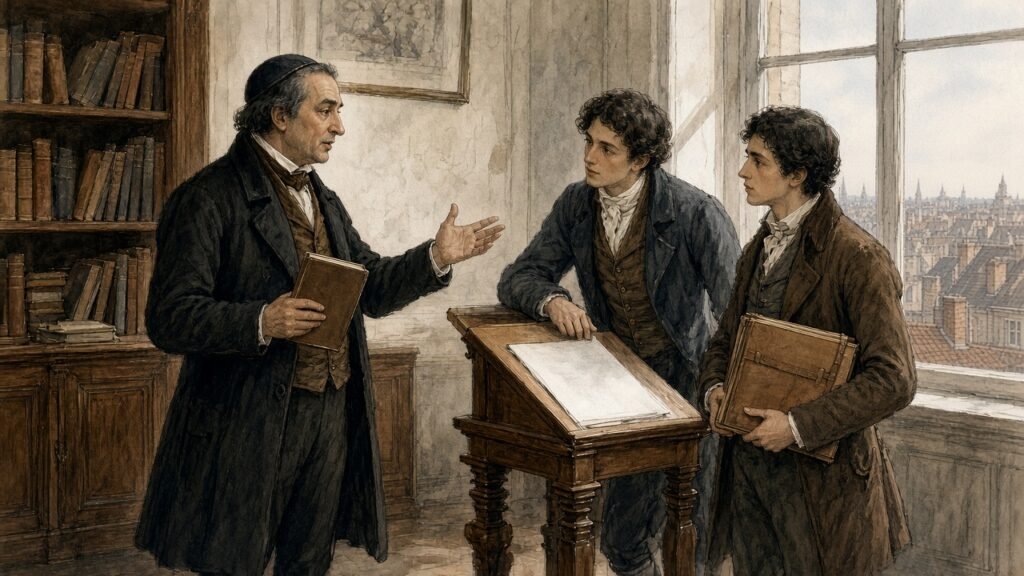
Moses Mendelssohn (1729–1786) stands at the threshold. His German translation of the Pentateuch, with the Biur commentary in Hebrew, aimed to lead Jews toward High German and toward a reasoned understanding of scripture. Mendelssohn wrote philosophy in German and Hebrew commentaries for Jewish readers. He did not call for spoken Hebrew. Yet by treating Hebrew as a language of enlightened exegesis rather than only of traditional learning, he helped to authorise a new literary Hebrew. His circle in Berlin and the journals that followed created a public for maskilic writing.[19]
The journal Ha-Me’assef, founded in Königsberg in 1783, published Hebrew poetry, essays and news in a biblical style. Its contributors practised a Hebrew that imitated Isaiah and the Psalms while discussing contemporary manners and education. The style now seems stiff, but it trained a generation to write continuous Hebrew prose on non-rabbinic subjects. Later journals in Galicia and Russia, including Bikkurei ha-Ittim, Kerem Hemed and eventually Ha-Melitz and Ha-Tzebira, expanded the audience and the range of topics. By the mid-nineteenth century a Hebrew press existed in the Russian Empire, read by maskilim and by traditionally educated men curious about the wider world.[20]
East European transformations
In the Russian Pale of Settlement the Haskalah took on a sharper social edge. Maskilim criticised the heder, the Hasidic courts and the economic fragility of the shtetl. They wrote satires in Hebrew and in Yiddish. They founded modern schools that taught Hebrew grammar, Bible, and European languages and sciences. The Russian government sometimes supported these schools as instruments of assimilation, which compromised the maskilim in the eyes of traditionalists. Hebrew became a battlefield. For traditionalists it was the holy tongue, to be kept within the bounds of sacred study. For maskilim it was a national classical language that could carry Enlightenment. Both sides valued Hebrew; they disagreed about its purpose.[12][20]
Writers such as Isaac Erter, Joseph Perl and later Judah Leib Gordon used Hebrew for satire and civic poetry. Gordon’s famous line urging Jews to be humans in the street and Jews at home captured the bilingual programme of mid-century Haskalah: Russian or German for public life, Hebrew for Jewish literary identity. Abraham Mapu’s novel Ahavat Zion (1853), a romantic biblical tale set in ancient Israel, became a bestseller by the standards of Hebrew publishing and showed that Hebrew could sustain long narrative fiction. Mapu’s language was florid and biblical, closer to a costume drama than to spoken dialogue, yet thousands of readers learned to follow a plot in Hebrew. The novel created expectations that Hebrew literature could entertain as well as instruct.[20]
Peretz Smolenskin, editor of the Vienna journal Ha-Shahar, pushed Hebrew writing toward journalism and national thought. In the 1870s he criticised assimilationist maskilim and argued for a more assertive Jewish national culture, still centred on Hebrew as a literary language. His novels and essays reached readers across the Pale. Smolenskin did not yet organise spoken Hebrew in Palestine, but he helped to turn Hebrew from an Enlightenment tool into a national symbol. The pogroms of 1881 and the rise of Hibbat Zion would complete that turn.[21]
Limits of maskilic Hebrew
Maskilic Hebrew remained a language of writers and readers, not of speakers. Its style was often remote from any conceivable conversation. Biblical tense usage, heavy allusion and avoidance of rabbinic idiom produced a prose that had to be decoded. Critics within the movement recognised the problem. Some called for a simpler Hebrew; others defended elevated style as the mark of culture. Yiddish, meanwhile, was developing a vigorous vernacular literature that reached audiences Hebrew could not. The competition between Hebrew and Yiddish as modern Jewish literary languages intensified toward the end of the century and continued into the twentieth.
Women’s access to maskilic Hebrew was limited by educational patterns, though some women read and a few wrote. The ideal maskil was typically imagined as male. This gendering of the Hebrew public would later be challenged in the Yishuv, where women’s organisations, girls’ schools and female teachers became essential to vernacularisation. For the Haskalah moment itself, the main achievement was different: the creation of a secular Hebrew reading culture and a press that normalised Hebrew discussion of politics, science and literature. Without that culture, Ben-Yehuda’s newspapers and the Odessa writers’ circle would have had no audience.
The Haskalah also bequeathed an ambivalence about the vernacular. By scorning Yiddish while not yet speaking Hebrew, many maskilim left ordinary Jewish speech in a kind of disgrace, neither holy nor fully modern. Zionist Hebraists later resolved the ambivalence by elevating Hebrew to vernacular status. Yiddishists resolved it by elevating Yiddish. The conflict between these resolutions shaped Jewish cultural politics for decades and formed the backdrop to the language struggles of the Yishuv. The next chapter turns to the writer who did more than anyone to forge a modern Hebrew prose style capable of describing ordinary life: Mendele Mocher Sforim.
Schools, theatres and the Hebrew stage
Maskilic educational reform produced schools in which Hebrew grammar was taught as a subject comparable to Latin. In Galicia, under Austrian rule, and in parts of the Russian Empire, such schools coexisted uneasily with the heder. Textbooks presented Hebrew paradigms in European pedagogical order. Pupils wrote compositions on nature, history and morals. The best of them acquired an active written command that earlier generations had reserved for rabbinic genres. This school Hebrew was still not spoken as a vernacular, but it normalised the idea that children could produce new Hebrew sentences about the contemporary world.[20]
Hebrew theatre began tentatively in the same milieu. Amateur performances of biblical dramas and allegorical plays gave audiences the unfamiliar experience of hearing extended Hebrew dialogue. The language often sounded unnatural, because it was. Actors trained in liturgical chant or in European theatrical styles struggled to find a conversational cadence. Yet the experiment mattered. It suggested that Hebrew could be embodied, not only read. In the Yishuv, theatre would become a major instrument of vernacularisation, with companies performing Shakespeare, Ibsen and original Hebrew plays before crowds that were themselves learning to speak. The maskilic stage was a prelude to that louder theatre.
Journalism remained the chief maskilic instrument. A weekly Hebrew newspaper created habits of regular reading and supplied a shared agenda of topics. Editors coined words for politics and technology because they had to. Readers wrote letters to the editor in Hebrew. The newspaper is the ancestor of the Israeli public sphere in Hebrew, more directly than the medieval poem or the talmudic sugya. When Ben-Yehuda founded his papers in Jerusalem, he was importing a maskilic institution into a new setting and radicalising its purpose from literary modernisation to spoken revival.[21]
Hebrew and the national turn
After 1881 the Haskalah’s cosmopolitan hopes darkened. Pogroms, May Laws and educational quotas in the Russian Empire pushed many maskilim toward Hibbat Zion and, later, political Zionism. Hebrew was reinterpreted as the language of a people that needed territory as well as culture. Odessa became a capital of this national Hebraism, as described in the special feature on the Jews of Odessa elsewhere on this site. Writers who had begun as Enlightenment satirists became advocates of settlement in the land of Israel. The literary language they had polished now seemed to demand a landscape and a speech community to match.[21][23]
This national turn did not immediately produce mass spoken Hebrew. It did produce a cadre of activists who believed that speaking Hebrew was a duty. It linked language to settlement, school and flag. Without that link, Ben-Yehuda’s household experiments would have remained eccentric. With it, they became legendary. The Haskalah had made Hebrew modern on the page. Nationalism set out to make it modern in the mouth. The following chapters examine how that shift was accomplished, beginning with the prose revolution associated with Mendele Mocher Sforim and then with Ben-Yehuda’s career, stripped of some of its myths.
Maskilic travel and the Hebrew report
Travelogues and reports in Hebrew about Europe, America and Palestine trained readers to expect Hebrew descriptions of trains, hotels, factories and political assemblies. Writers struggled with vocabulary and sometimes transliterated wildly. Their struggles are evidence of demand. A public wanted Hebrew to cover the contemporary globe. That demand later supported newspapers in Jerusalem and Tel Aviv that had to name every modern thing weekly. The Haskalah’s geographic imagination, not only its satire of the shtetl, prepared the lexical hunger of the revival.
Russian, German and the bilingual maskil
Many East European maskilim wrote Hebrew and also Russian or German. Their Hebrew style sometimes calqued Russian sentence rhythms; their German philosophical reading supplied concepts that Hebrew then named awkwardly. Bilingualism was the workshop of modern Hebrew abstraction. Purists later tried to sand away the foreign grain. They never entirely succeeded, because the grain was how the wood was grown. Recognising maskilic bilingualism prepares the reader for Zuckermann’s later hybridity arguments without requiring acceptance of his strongest claims. Contact is not a scandal; it is a historical mechanism.[20][43]
Women readers and maskilic Hebrew
Maskilic Hebrew publishing imagined various readers, including women who might read Hebrew or who might hear it read aloud. Educational debates about teaching girls Hebrew grammar paralleled wider European arguments about female schooling. Some women became Hebrew writers and translators in the nineteenth and early twentieth centuries, though in smaller numbers than men; their presence complicated the image of Hebrew as an exclusively male scholarly tongue. Later, women teachers in the Yishuv would become the revival’s frontline workforce. The maskilic question of the female reader thus connects to the sociological reality of the female teacher. Expanding Hebrew’s public meant expanding who was allowed to master it.[20]
7. Mendele, the nusach and modern prose
From Yiddish to Hebrew and back
Sholem Yankev Abramovitsh (1835/36–1917), known by the persona Mendele Mocher Sforim, Mendele the Book Peddler, is widely regarded as the grandfather of both modern Yiddish and modern Hebrew prose. Born near Minsk, he began as a Hebrew maskil, writing essays and fiction in the elevated biblical style of his generation. In the 1860s he turned to Yiddish in order to reach a broader audience with satirical novels about the poverty, superstition and municipal chaos of the Pale. Works such as The Little Man, The Mare and Fishke the Lame created a flexible literary Yiddish capable of describing muddy streets, dishonest communal leaders and broken lives without costume-drama diction. Then, from the 1880s onward, living in Odessa as director of a Talmud Torah, he rewrote many of his Yiddish works into Hebrew and wrote new Hebrew fiction. In doing so he forged what critics later called the nusach, a synthetic Hebrew style that drew on biblical, mishnaic and medieval layers and bent them toward narrative realism.[24][25]
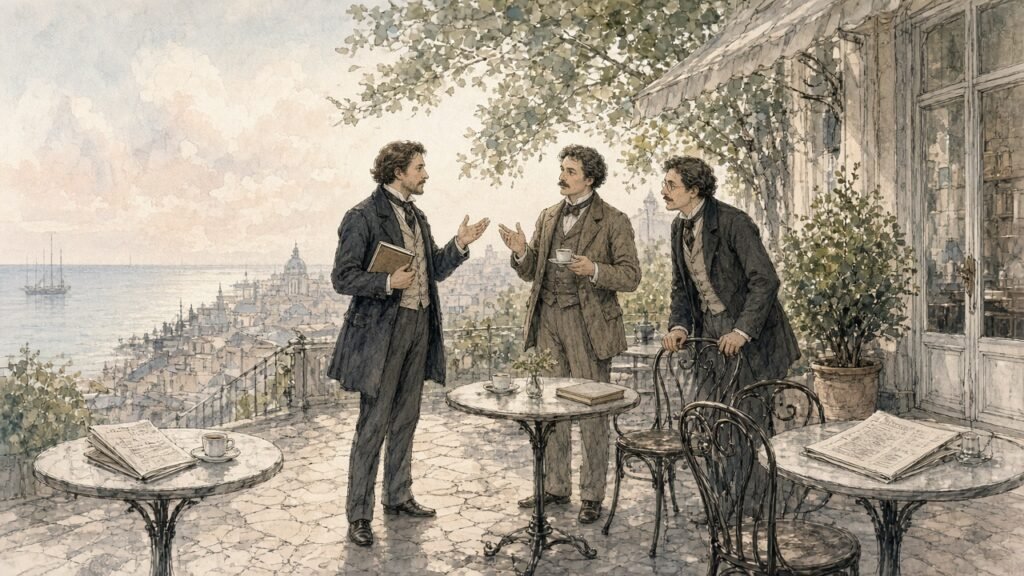
The nusach was not a return to pure biblical Hebrew. It was an admission that biblical Hebrew alone could not narrate the nineteenth-century Jewish town. Mendele mixed registers, allowed rabbinic idiom into literary prose and invented narrative voices that could joke, complain and observe. Hayim Nahman Bialik later described Mendele’s achievement as the creation of a Hebrew vessel fit for the contents of modern life. Younger writers in Odessa and elsewhere learned to write by imitating and then modifying that vessel. Without Mendele, the leap from maskilic pastiche to the prose of Bialik’s essays, Brenner’s novels and Agnon’s stories would have been far steeper.[25][26]
The Odessa circle
Odessa in the last decades of the nineteenth century gathered a remarkable group of Hebrew and Yiddish writers. Mendele, Ahad Ha’am, Hayim Nahman Bialik, Yehoshua Hana Ravnitzky, and later others formed overlapping circles of editors, poets and publicists. Ahad Ha’am’s essays argued for a cultural Zionism centred on Hebrew spiritual renewal. Bialik’s poetry gave the national movement an elevated Hebrew voice capable of rage and mourning after the Kishinev pogrom. The city’s Hebrew printing and journalism supported this activity. Odessa did not yet speak Hebrew in the streets. It wrote Hebrew with a new confidence and sent that Hebrew out to readers across the Pale and into the early Yishuv.[23][26]
The relationship between Hebrew and Yiddish in this circle was intricate. Many writers were bilingual. Some, like Mendele, moved between languages strategically. Yiddishists and Hebraists would later polarise into opposing camps, especially after the Czernowitz conference of 1908 proclaimed Yiddish a national Jewish language. In Odessa before that polarisation hardened, the two languages often fed each other. Techniques pioneered in Yiddish satire enriched Hebrew prose; Hebrew prestige lent dignity to Jewish literary ambition in any tongue. The later “war” between Hebrew and Yiddish in the Yishuv and in diaspora cultural politics simplified a more entangled history.
Women writers and readers remained underrepresented, though Hebrew journals slowly opened space for women’s voices and for discussion of women’s education. The national literary project was still imagined largely in masculine terms. That would change only gradually as girls’ schools and women’s organisations in Palestine made Hebrew a language of female public life.
What the nusach made possible
Mendele’s style made it possible to write a Hebrew novel that felt inhabited. Characters could speak, even if their dialogue still echoed literary convention more than recorded speech. Landscapes of the Pale could be described without constant biblical simile. Social types could be satirised with a precision borrowed from European realism. Later writers such as Yosef Haim Brenner, who immigrated to Palestine and wrote novels of pioneer despair and stubbornness, depended on this prior expansion of prose capacity. Shmuel Yosef Agnon, who would become Hebrew’s Nobel laureate, built his own unmistakable style on intimate knowledge of traditional sources and on the freedom to bend them that Mendele’s generation had won.[27]
The nusach also had limits. It was a writer’s solution, not a speaker’s. It did not tell teachers how to run a classroom in Hebrew or parents how to scold a child. Those problems belonged to the Yishuv’s schools and households. Yet literature and speech interacted. Children who read Mendele and Bialik in Hebrew schools absorbed rhythms and vocabularies that entered their speech. Newspapers that adopted a simpler descendant of the nusach taught thousands of immigrants how written Hebrew could describe the day’s events. The literary revolution and the vernacular revolution were not the same event, but they were coupled.
Mendele died in Odessa in 1917, as war and revolution overturned the world that had produced him. By then Hebrew was already being spoken by children in Palestine, and the centre of Hebrew literature was beginning to shift from Odessa and Warsaw to Tel Aviv and Jerusalem. The grandfather of the nusach did not live to see Hebrew become a state language, but he had given it a prose in which a state, a city and a street could be imagined.
Style wars after Mendele
Younger writers did not simply copy Mendele. They rebelled against him, as literary sons do. Some sought a more Europeanised Hebrew syntax; others a more aggressively spoken idiom; others a return to denser traditional intertextuality. Brenner accused earlier Hebrew literature of evasiveness and demanded a prose that faced sexual and social misery without ornament. The modernist poets of the 1920s and 1930s, including Avraham Shlonsky and later Nathan Alterman and Leah Goldberg, developed poetic diction that interacted with the emerging spoken language of the Yishuv while remaining highly crafted. The point for the history of vernacularisation is that literature kept pace with speech and sometimes ran ahead of it, supplying words and metaphors that speakers then adopted or parodied.[28]
Critics such as Joseph Klausner, who taught Hebrew literature at the Hebrew University, worked to build a historical narrative of Hebrew writing from the Bible to the present. That narrative itself was a Hebraist project: it presented Hebrew literature as a continuous national literature, comparable to English or French, rather than as a sacred corpus plus scattered secular experiments. The construction of a Hebrew literary history helped to persuade students and readers that speaking Hebrew connected them to a long cultural chain. Myth and scholarship intertwined. The next chapter turns to the figure who became the myth’s central hero: Eliezer Ben-Yehuda.
Reading publics and print runs
Hebrew book and periodical print runs in the late nineteenth century were small by European standards, yet large enough to sustain a professional literary life for a handful of writers. Subscription networks stretched from Warsaw to New York to Jaffa. A successful novel or a controversial essay could make an author’s name across continents within months. This dispersed public was not a speech community, but it was a readiness community: people prepared to invest time and money in Hebrew narrative and argument. When those readers immigrated, they brought reading habits that eased the transition to spoken Hebrew. Literacy in a language is not fluency, yet it lowers the threshold.
Libraries and reading rooms in the Pale and in the early Yishuv stocked Hebrew books alongside Russian and Yiddish. Youth groups read aloud. Debating societies argued in Hebrew with varying success. These semi-oral practices blurred the line between reading and speaking and prepared activists for the fuller oral culture of Palestine. Mendele’s peddler persona, travelling with a sack of books, became an allegory of this culture: Hebrew moved through space in print before it moved through space in conversation.
The nusach also influenced journalism. Editors who admired Mendele sought a Hebrew that could report a fire in the market or a debate in the Duma without sounding like Chronicles. They did not always succeed, but the aspiration mattered. A language that can only chant and cannot report will not become a vernacular of citizens. Mendele’s gift to the revival was, in this sense, civic as well as literary. He made Hebrew prosaic in the best sense: capable of prose about the prosaic world.
Bialik, translation and the Hebrew bookshelf
Hayim Nahman Bialik and Yehoshua Hana Ravnitzky’s Sefer HaAggadah compiled rabbinic lore into a modern Hebrew anthology that became a household classic. Bialik also translated European literature into Hebrew and wrote essays on language and culture. His famous meditation on the Hebrew book and on the need to gather the nation’s literary inheritance articulated a programme of cultural concentration parallel to political Zionism. Translation into Hebrew was itself a vernacularising act: it claimed that anything worth reading could exist in Hebrew. The labour of translators in Odessa, Warsaw and later Tel Aviv filled shelves that schools and private readers emptied. A language with a thick bookshelf invites speech; a language with only a thin sacred binder risks remaining ceremonial.[26]
Bialik’s poetry after Kishinev gave Hebrew a public voice of outrage that crowds could recite. Recitation blurred reading and speech. Youth movements chanted poems until lines became proverbial. Literary Hebrew thus entered oral culture not only through theatre but through the memorised poem. The path from nusach prose to spoken idiom ran through these hybrid performances.
The newspaper sentence
Daily journalism trained writers to produce Hebrew sentences under deadline about fires, elections, prices and theatre reviews. Deadline prose differs from essay prose: it must be clear, current and repeatable. The newspaper sentence became a template for educated speech and for bureaucratic writing. Readers internalised its rhythms. When radio arrived, announcers often sounded like newspapers spoken aloud, until looser conversational broadcasting developed. Tracing the Hebrew sentence from maskilic essay through newspaper column to radio talk show is one way to hear vernacularisation as a change in preferred syntax and diction, not only as a change in who speaks.[26][28]
Czernowitz and the status of Yiddish
In August 1908 a conference was held in Czernowitz, in the Austrian province of Bukovina, to discuss the status of Yiddish. Organised with the encouragement of Nathan Birnbaum and attended by writers including Isaac Leib Peretz, the conference debated whether Yiddish should be proclaimed the national language of the Jewish people. The outcome was a compromise formula that described Yiddish as “a national language” rather than “the” national language, a distinction that left room for Hebrew advocates who maintained that Hebrew held the principal claim. The conference nevertheless marked the first major public affirmation of Yiddish as a language of Jewish cultural politics, and it prompted Hebraists to formulate their own position more sharply. The debate was conducted by people who in many cases wrote in both languages, and the supporters of each language agreed that a modern Jewish culture required a literary vernacular.[54]
The rivalry between the two languages shaped the writing careers discussed in this chapter. Mendele had moved between Yiddish and Hebrew, Bialik wrote in both, and many readers consumed newspapers in Yiddish while reading poetry in Hebrew. The question that Czernowitz put to the Jewish public was whether the future would involve one language for all functions or a division of functions. The Hebraists answered that Hebrew could and should assume all functions, including those of everyday speech, and the settlement of Palestine gave them a territory in which that proposition could be tested. The Yiddishists answered that the actual speech of millions of Jews in Eastern Europe constituted a vernacular culture that did not need to be replaced. The two positions were to remain in tension until the destruction of the East European Jewish population made the practical question moot.
8. Ben-Yehuda, the myth and the first households
The making of a symbol
Eliezer Ben-Yehuda (born Eliezer Yitzhak Perelman, 1858–1922) occupies a place in popular memory as the man who revived Hebrew single-handed. The truth is more interesting and less solitary. Ben-Yehuda was a journalist, lexicographer and organiser of exceptional energy who arrived in Jerusalem in 1881 determined to speak only Hebrew and to raise his children in Hebrew. He helped to found societies for the promotion of spoken Hebrew, edited newspapers that practised what they preached, coined and publicised hundreds of new words, and began a monumental dictionary of ancient and modern Hebrew. He did not, however, invent modern Hebrew literature, which was already underway, nor did he personally teach the mass of immigrants who later spoke the language. The revival of Hebrew was a social process involving teachers, writers, political movements and demographic change. Ben-Yehuda became its emblem because his biography dramatised the process in a single household.[29][30]
Born in Luzhky in the Russian Empire, he received a traditional education, encountered Haskalah literature and studied in Paris, where European nationalism and the Jewish national idea fused in his mind with the project of linguistic revival. He published articles calling for Hebrew to become a spoken language in the land of Israel. When he settled in Jerusalem with his wife Devorah, he insisted that only Hebrew be spoken in their home. Their son Ben-Zion, later known as Itamar Ben-Avi, was raised as a Hebrew-speaking child and was celebrated as the first native speaker of the revived language. The household rules were strict, sometimes harshly so by later standards, and the experiment attracted both admiration and hostility. Ultra-Orthodox circles in Jerusalem opposed the use of the holy tongue for mundane speech and clashed with Ben-Yehuda repeatedly.[29]
Newspapers, words and enemies
Ben-Yehuda’s newspapers, including Ha-Zvi, used Hebrew to report local and international news, forcing constant lexical invention. He preferred to derive new words from Hebrew and Aramaic roots, sometimes successfully and sometimes producing forms that speakers ignored. Many of his coinages stuck; many did not. The later Language Committee and Academy inherited both his method and his unfinished business. His dictionary, published in instalments from 1908 and completed decades after his death by his second wife Hemda and by collaborators, aimed to record Hebrew vocabulary from all periods and to serve the needs of modern writers. It was a work of historical lexicography and of language planning at once.[30][31]
Opposition to Ben-Yehuda came from several directions. Traditionalists saw vernacular Hebrew as a desecration. Some maskilim and European Hebraists doubted that spoken revival was feasible. Yiddishists regarded the Hebraist programme as an attack on the living language of the Jewish masses. Within the Yishuv, practical teachers sometimes found Ben-Yehuda’s purism unrealistic. He was arrested by Ottoman authorities on politically charged grounds and faced communal bans. The struggles made good copy for later nationalist historiography, which cast him as a lonely prophet. Revisionist scholarship has emphasised instead the network of teachers and activists who made speech possible in schools and settlements, and the demographic fact that children in Hebrew-speaking peer groups normalised the language more effectively than any single patriarch.[32]
Myth and measure
Measuring Ben-Yehuda’s achievement requires separating symbol from mechanism. As a symbol he gave the revival a face, a story and a set of anecdotes that parents and textbooks could repeat. As a mechanism he contributed journalism, lexicography and organisational initiative through societies such as Safa Brura and the early Language Committee. He did not create the Odessa literary renaissance, the labour movement’s Hebrew culture or the British Mandate’s official recognition of Hebrew. Those had other authors. A balanced history keeps both sides in view. The man who walked Jerusalem’s streets insisting on Hebrew conversation mattered; so did the kindergarten teacher in Jaffa who refused to answer children in Yiddish; so did the agricultural labourers of the Second Aliyah who made Hebrew the language of the kvutza.[32][33]
Ben-Yehuda’s Sephardi-leaning pronunciation preferences aligned with the emerging educational standard, though the spoken Hebrew that eventually stabilised was a compromise shaped by Ashkenazi speakers’ habits as much as by ideological choice. His dream of a Hebrew purged of foreign elements was never fully realised; Israeli Hebrew is full of loanwords and calques. In that sense his purism failed productively: it set a high ideal against which everyday speech defined itself. Languages live by such tensions.
When Ben-Yehuda died in 1922, Hebrew was already an official language of Mandatory Palestine and the language of a growing native-born generation. The myth that he alone revived it was already forming. Historians since have complicated the myth without erasing the man. The following chapters turn from the emblematic household to the institutional engines of revival: schools, the War of the Languages, the Language Committee and the demographic waves of the aliyot.
Family, gender and the first speakers
The Ben-Yehuda household drama has often been told as a father’s victory. Recent attention to Devorah Ben-Yehuda, to Hemda Ben-Yehuda and to the children themselves has reframed it as a family and gendered labour of language. Mothers and female teachers bore much of the daily burden of speaking Hebrew to children who had no Hebrew-speaking peers at first. The first generation of native speakers was small and fragile. What turned a curiosity into a community was the multiplication of such households and, crucially, the creation of schools in which children spoke Hebrew to one another. Peer groups, not parents alone, stabilise a vernacular. Ben-Yehuda understood this and campaigned for Hebrew education; the myth sometimes forgets how much of the work was pedagogical and collective rather than heroic and singular.[32]
Lexicography as nation-building
Ben-Yehuda’s dictionary project placed him in a European tradition of national lexicography that includes Johnson, Littré and the Grimm brothers, with the added burden that his language lacked a continuous spoken vernacular to document. He had to record the past and legislate for the future at once. Entries gathered biblical, rabbinic and medieval usages and then proposed modern meanings. Readers wrote to him with suggestions and objections. The dictionary became a public conversation about what Hebrew could say. Even unfinished, it authorised the idea that modern Hebrew needed a comprehensive reference work of its own, not only bilingual glossaries.[30]
Word coinage followed patterns: revive an obsolete biblical word; extend a root by familiar patterns; calque a European term; borrow from Arabic, Aramaic or international scientific vocabulary. Ben-Yehuda favoured the first three and was cautious about European loanwords, more open to Arabic because of geographic and Semitic proximity. Speakers later adopted English and other loanwords freely, especially after 1948 and again in the age of technology. The planner proposes; the speech community disposes. Ben-Yehuda knew this better than his myth suggests. He complained about failures as often as he celebrated successes.
His newspapers experimented with formats, serials and polemics that made Hebrew a language of daily quarrel. Political enemies answered him in Hebrew, thereby conceding the medium. Every controversy conducted in Hebrew strengthened the language’s public role, even when the content was bitter. In that respect Ben-Yehuda’s talent for making enemies was also a talent for making a Hebrew public sphere.
Jerusalem’s linguistic ecology in Ben-Yehuda’s time
Ottoman Jerusalem was multilingual: Arabic, Turkish, Yiddish, Ladino, Russian, French, English and Hebrew liturgical speech coexisted among Jews, Christians and Muslims. Ben-Yehuda’s Hebrew-only household was an ideological island. Markets, pilgrim traffic and consular protections ensured constant language contact. The Hebraist project in Jerusalem therefore faced a denser multilingualism than the agricultural colonies, where activists could more easily police speech. Success in Jerusalem depended on institutions, schools and newspapers that could carve Hebrew spaces out of the mix. Failure would have confined spoken Hebrew to a few eccentric homes. The city’s later role as capital of Hebrew scholarship, with the university and the Academy, grew from these contested beginnings.[29][35]
Religious opposition in Jerusalem was not monolithic ignorance. It was a reasoned defence of diglossia: Hebrew for holiness, Yiddish or Ladino for life. Hebraists reversed the formula. The conflict was theological and political at once. Understanding that conflict prevents simplistic narratives in which progress faces only stubbornness. Both sides valued Hebrew; they disagreed about its proper domain.
9. Schools of the Yishuv
Kindergartens and gymnasiums
If Ben-Yehuda supplied a legend, the schools of the Yishuv supplied a method. From the 1880s onward, Jewish settlements and urban communities in Ottoman Palestine established schools that used Hebrew as the language of instruction, not only as a subject. Kindergartens following Froebel’s methods but conducted in Hebrew proved especially important, because they caught children before other languages dominated. Girls’ schools and mixed schools spread the language across gender lines. The Herzliya Hebrew Gymnasium, founded in Jaffa in 1905 and later moved to Tel Aviv, became a flagship of secondary education in Hebrew, teaching sciences, humanities and European languages through a Hebrew medium. Its graduates entered the labour movement, the professions and the militias of the Yishuv speaking Hebrew as a matter of course.[33][34]
Teachers had to invent terminology as they went. A lesson on geography or chemistry could not wait for a central committee’s approval. Word lists circulated among teachers. Different schools coined different terms for the same object, creating a confusion that later justified the Language Committee’s coordinating role. The classroom was thus both a site of vernacularisation and a laboratory of neologism. Children corrected their parents. Parents learned modern words from their children. The classic sociolinguistic pattern of school-driven language shift, familiar from other cases of national language planning, appeared here with unusual speed because the immigrant population was already ideologically primed to accept Hebrew.[31]
The Teachers’ Association and method
Hebrew teachers organised themselves, shared pedagogical techniques and debated whether to allow any use of Yiddish or other languages in the lower grades. The dominant ideology became ivrit be-ivrit, Hebrew in Hebrew: immersion without translation. The method was demanding for children who arrived speaking Yiddish, Russian, Arabic or Ladino, and it could be harsh. Yet it produced fluency. Songs, games, school newspapers and excursions extended Hebrew into emotional and informal registers that grammar drills alone could not reach. The school became a total Hebrew environment for several hours a day, compensating for homes that were still multilingual.[34]
Rural settlements of the First Aliyah had often used French, German or Yiddish in schools sponsored by European philanthropic organisations, notably the Alliance Israélite Universelle and the Hilfsverein der deutschen Juden. The struggle to replace those languages with Hebrew was political as well as pedagogical. It pitched local Hebraists and Zionist activists against philanthropic boards in Paris and Berlin. The conflict came to a head in the War of the Languages of 1913, treated in the next chapter. Before that explosion, quieter battles had already been won in many settlement schools that switched their medium to Hebrew under teacher and parental pressure.
Children as a speech community
Demographers and linguists who study the revival emphasise the nativity threshold: once a critical mass of children spoke Hebrew to each other, the language acquired the self-sustaining property of a vernacular. Adults might speak accented, calqued Hebrew; children regularised it, invented slang and enforced peer norms. Tel Aviv, founded in 1909 as a Hebrew-speaking garden suburb of Jaffa, became a symbolic and real space for this youth culture. Streets, shops and posters in Hebrew made the language visible. The city was not uniformly Hebrew-speaking overnight, but its public self-presentation was Hebraist, and that presentation attracted immigrants who wanted to live in Hebrew.[35]
By the eve of the First World War, Hebrew education in the Yishuv, though still contested and incomplete, had produced thousands of young speakers. The war disrupted schools and settlements, yet it also weakened the hold of European philanthropic networks and, after 1917–18, opened the Mandate period in which Hebrew would gain official status. The school remained the primary engine. Armies, newspapers and theatres mattered; childhood mattered more. A language becomes vernacular when it is the language in which children insult each other, tell secrets and call home for supper. The Yishuv’s schools made that possible within a generation.
Training teachers was a bottleneck. Seminaries and courses prepared instructors who were themselves often recent learners of spoken Hebrew. Their accents and grammatical insecurities passed into the speech of pupils, contributing to the mixed phonetic reality of early Israeli Hebrew. Idealised Sephardi pronunciation met Ashkenazi phonology in the classroom and produced compromises that later became native. The teachers’ imperfect Hebrew was not a failure of the revival; it was the medium through which the revival occurred.
Curricula and the sciences
Teaching physics, botany and mathematics in Hebrew required more than goodwill. Textbooks had to be written or translated. Diagrams needed captions. Examinations had to be marked for Hebrew expression as well as for scientific content. The cumulative labour of textbook authors is one of the least glamorous and most important chapters of the revival. Many of their coinages entered general speech; others remained school jargon. The Language Committee later tried to standardise scientific terminology, but the first drafts were written by teachers facing a class on Monday morning.[31]
Secondary schools also taught European languages, recognising that Hebrew isolation would harm students. The aim was bilingual or multilingual competence with Hebrew as the base. This model differed from unilingual nationalist fantasies. Practical Hebraists wanted Hebrew first, not Hebrew only. The distinction matters for comparisons with other revival movements that sometimes treated contact languages as pure threat. In the Yishuv, Arabic, English, German, Russian and Yiddish all remained part of the soundscape. Hebrew’s victory was dominance, not annihilation of every other tongue.
Adult evening classes accompanied children’s education. Workers’ societies and women’s organisations offered Hebrew lessons. The later ulpan system after 1948 institutionalised what had begun as voluntary adult education. From the start, vernacularisation required teaching adults who had missed a Hebrew childhood. Their accents and errors shaped the language as much as children’s innovations did.
Women teachers and the gendered labour of immersion
Kindergarten and elementary teaching were disproportionately women’s work, poorly paid and ideologically praised. Female teachers enforced Hebrew in the earliest years of childhood, when accent and fluency crystallise. Memoirs describe young women from Eastern Europe reinventing themselves as Hebrew educators within months of arrival. Their labour is as structural to the revival as any lexicographer’s dictionary. A history that centres only male publicists misses the mechanism by which Hebrew entered the nursery. Girls’ education also ensured that mothers of the next generation could, if they chose, raise children in Hebrew. The vernacular became domestic because women taught and spoke it, not only because men orated about it.
School inspectors and the making of routine
As Hebrew education expanded, inspectors, teacher-training colleges and standardised curricula turned charismatic immersion into routine. Routine of this kind is easily overlooked in accounts that concentrate on founders. A language revival that depends only on charismatic founders collapses when they tire. The Yishuv’s education department, under Zionist organisational umbrellas, created career paths for Hebrew teachers, pension expectations, examination schedules and textbook approval processes. Children experienced Hebrew as the ordinary language of authority at school, comparable to how English or French functioned in other school systems. Ordinary authority may convert more speakers than extraordinary ideology.[34]
Examinations forced precision. Pupils had to write essays, solve maths problems and describe experiments in Hebrew under time pressure. Errors were marked. Correction by teachers functioned in practice as a form of language planning. Over years it aligned thousands of writers to a shared standard more effectively than academy pamphlets alone. When those pupils became clerks, journalists and officers, they carried school Hebrew into adult institutions. The pipeline from elementary composition to bureaucratic memo is a central artery of vernacular consolidation.
Conflict among educational trends, religious and secular, labour and general Zionist, produced parallel school streams that nonetheless shared Hebrew as medium. Even when they disagreed about Bible interpretation or class politics, they agreed that the argument should happen in Hebrew. That meta-agreement was the revival’s safety net. Fragmentation of parties did not fragment the language of instruction.
Kindergarten as strategic institution
Hebraists grasped early that preschool mattered more than university for vernacular futures. Kindergartens immersed children before literacy, shaping accents and habits when plasticity was highest. Women teachers predominated in this sector, which means that a large share of the revival’s daily labour was female labour often underpaid and under-recorded in hero narratives. Songs, games and scolding in Hebrew made the language the emotional weather of childhood. Parents who spoke Yiddish at home discovered that their children answered in Hebrew and gradually adjusted. Child-driven language shift inside families is a classic immigrant pattern; Hebraists institutionalised it deliberately through kindergartens rather than leaving it to chance.[34][33]
Training colleges for kindergarten teachers became nodes of spoken Hebrew ideology. Graduates carried methods from town to colony. Inspection reports complained about uneven quality, mixed-language slippage and shortages of materials. The complaints prove both the ambition and the difficulty. Perfect immersion was the goal; approximate immersion was the common reality; approximate immersion repeated across thousands of children still shifted a generation.
10. The War of the Languages
German philanthropy and Hebrew ideology
In 1913 a conflict erupted over the language of instruction at the planned technical institute in Haifa, later the Technion, and at other schools supported by the Hilfsverein der deutschen Juden. The Hilfsverein, a German Jewish philanthropic organisation, favoured German as the language of science and higher instruction, with Hebrew as a subject. Hebraist teachers, students and Zionist activists insisted that Hebrew must be the medium of Jewish education at every level. Strikes, demonstrations and resignations followed. The episode, known as the War of the Languages, became a founding legend of Hebrew education in the Yishuv.[36][37]
The conflict was not only symbolic. German was a major language of science and engineering; many of the proposed teachers were German-trained; the Hilfsverein’s money was essential. Hebraists answered that a national society that conceded science to a foreign language would remain spiritually colonised. They also feared that German would crowd out Hebrew in the prestigious upper reaches of schooling, relegating Hebrew to the elementary and the sentimental. The strike of teachers and the mobilisation of public opinion forced compromises. Hebrew’s position in the Yishuv’s educational system was strengthened, and the principle that Hebrew should dominate Jewish public education was asserted with new clarity.[36]
Aftershocks
The First World War broke out the following year, disrupting the Technion’s development and scattering personnel. Yet the War of the Languages left institutional traces. Teachers’ organisations gained confidence. Parents learned that language policy could be fought in the streets and in the newspapers. The Hilfsverein’s influence waned as the Ottoman Empire collapsed and the British Mandate reorganised education. By the 1920s the Yishuv’s autonomous Hebrew education system, funded by Zionist institutions and local taxes, had become the main ladder of social mobility for young Jews in the country. German did not disappear as a language of immigrant scholars, especially after 1933, but it did not become the medium of the national school.[37]
The episode also illustrated the limits of diaspora philanthropic control. Boards in Berlin could not indefinitely dictate the linguistic future of a community that had begun to see itself as a nation in formation. Similar tensions existed with the Alliance Israélite Universelle’s French-medium schools. Over time many Alliance schools in Palestine adapted or lost ground to Hebrew institutions. Language policy became a domain of local political sovereignty before political sovereignty itself existed.
Why a “war” over schools mattered
Observers sometimes find the intensity of the 1913 conflict disproportionate. Why risk funding and careers over the medium of a technical college? The answer lies in the Hebraist analysis of power. Languages of instruction determine which language becomes the language of expertise, status and the future. If engineering, medicine and chemistry were taught in German, Hebrew would remain the language of poems and prayers, and the revival would stall at the threshold of modernity. The War of the Languages was a fight over whether Hebrew would be a complete language or a partial one. The Hebraists’ victory was incomplete and messy, but it aligned educational practice with the ambition of vernacular fullness.[36]
Students who demonstrated in 1913 belonged to the generation that would staff the Mandate bureaucracy, the Histadrut and the Haganah in Hebrew. Their insistence on Hebrew science classes was continuous with their later insistence on Hebrew commands, Hebrew ledgers and Hebrew courtrooms. The war over the Technion was therefore not a side episode. It was a rehearsal for state-building in the medium of Hebrew. Related struggles over university language would recur when the Hebrew University of Jerusalem opened in the 1920s, but by then the principle was largely settled: the Jewish national campus would teach in Hebrew, even when professors’ Hebrew was imperfect and scientific vocabulary had to be coined under pressure.[38]
Memory and curriculum
Israeli schoolbooks long presented the War of the Languages as a straightforward triumph of national will. Historians have since added context: the financial fragility of the Yishuv, the genuine pedagogical arguments for German scientific instruction, the mixed motives of participants and the unfinished nature of the victory. Nuance does not erase significance. The conflict showed that language policy could mobilise the Yishuv as a public. It rehearsed techniques of strike, petition and newspaper campaign later used in labour and political struggles. It also linked the Technion, an institution of economic modernisation, to the Hebrew cause, signalling that Zionism’s productive future and its linguistic future were to be the same.[36]
Comparable disputes occurred in other national movements when philanthropic or imperial languages competed with national languages in elite schools. The Irish struggle over English-medium education, debates over Russification in imperial universities and controversies over French in colonial and postcolonial schools offer parallels. The Hebrew case is distinctive because the national language was being restored as a vernacular at the same time as it was being defended as a medium of high instruction. Most national languages already had speakers; Hebrew was acquiring them while fighting for the curriculum. That double task explains some of the fever of 1913.
Philology, engineering and national dignity
The War of the Languages revealed a hierarchy of prestige among disciplines. Allowing Hebrew for literature while reserving German for engineering would have coded Hebrew as soft and ornamental. Hebraists refused that coding. They insisted that bridges, dynamos and laboratories could have Hebrew names and Hebrew lectures. The insistence foreshadowed later Israeli investment in scientific Hebrew terminology. It also created short-term pedagogical pain: students learned difficult subjects through a language their teachers spoke imperfectly. Some quality was sacrificed for sovereignty of medium. Whether the trade-off was worth it depends on whether one prioritises immediate scientific efficiency or long-term linguistic completeness. The Yishuv chose completeness, and the state inherited that choice.[36]
International observers sometimes misunderstood the conflict as xenophobia toward German culture. Many Hebraists admired German science and continued to read it. Their objection was to German as the ceiling of Jewish education in the land of Israel. One can read Goethe at night, they implied, and still demand Hebrew at the blackboard in the morning. The nuance was often lost in wartime and postwar retellings that preferred sharper national colours.
Aftermath in Haifa and beyond
After the Technion conflict, Hebrew instruction expanded in technical fields more quickly than sceptics expected. Laboratories acquired Hebrew labels; engineering textbooks were translated or written afresh; apprentices learned tool names in Hebrew that their parents had known in German, Russian or Yiddish. The symbolic victory of 1913 matured into curricular fact over the following two decades. Other schools watched Haifa and adjusted. The War of the Languages thus functioned as precedent: when a new institution opened, advocates could cite Technion outcomes to argue that Hebrew was feasible for advanced study.[36]
German continued as a language of Jewish scholarship and of immigrant scientists who arrived in the 1930s fleeing Nazism. Many of them learned Hebrew imperfectly and lectured with accents that students mimicked affectionately or cruelly. The influx enriched Hebrew science even as it temporarily reintroduced German into corridors. The earlier war had decided the official medium; it had not erased European scholarly languages from bilingual minds. Living with that bilingualism became part of Israeli academic culture.
Retrospective commemorations of 1913 sometimes inflate a complex institutional struggle into a simple national parable. Primary documents show negotiation, compromise proposals, student pressure, teacher anxiety and donor politics. Parables mobilise; documents explain. This feature has preferred explanation, while acknowledging why parables appealed to a society that needed morale as well as grammar.
11. The Language Committee and the Academy
From Va’ad HaLashon to Academy
Organised language planning for Hebrew began before the state and continued under it. In 1890, in connection with the society Safa Brura, a literature or language committee formed around Ben-Yehuda and colleagues in Jerusalem, including David Yellin and others. It sought to collect and publish words for modern needs. The first incarnation was short-lived, but in 1904 the Va’ad HaLashon, the Language Committee, was reconstituted and worked for decades as the central voluntary body for terminology, grammar decisions and spelling questions. It issued lists for schools, trades and sciences, answered queries and tried to reduce the chaos of competing coinages. After the establishment of Israel, the Knesset passed the Law of the Supreme Institution for the Hebrew Language in 1953, creating the Academy of the Hebrew Language as the Language Committee’s successor. The Academy’s decisions on official terminology, orthography, punctuation and transliteration bind state institutions and the education system, while research projects such as the Historical Dictionary of the Hebrew Language pursue long-term scholarship.[31][39]
The path from committee to academy was not smooth. Members disagreed about how much to borrow from foreign languages, how to vocalise, how to treat rabbinic versus biblical precedents and how aggressively to police public usage. David Ben-Gurion disliked the foreign word “academy” and delayed aspects of the institution’s naming and establishment. The eventual compromise preserved the international term while grounding the body in statute. Continuity of personnel and of unfinished lexical projects linked the Mandatory committee to the state academy. Language planning in Hebrew is thus older than the state and legally anchored by it.[39]
What planners can and cannot do
The Committee and Academy excelled at terminology for administration, technology and education. They produced thousands of approved words, many of which entered general use. They had less control over slang, informal syntax and the influx of English loanwords. Speakers adopted autobus and later bus alongside coined alternatives; they said telefon even when Hebrew alternatives existed. Planners learned to distinguish between domains. In road signs, textbooks and military ranks, official Hebrew could be enforced. In markets and youth slang, enforcement was futile. Mature language planning accepts this division of labour.[40]
Spelling reform proposals repeatedly arose and repeatedly met resistance. Hebrew’s consonantal writing system, with optional vowel points, creates ambiguities that annoy learners and sometimes natives. Radical Latinisation was proposed by some modernists, including Itamar Ben-Avi in certain moods, and went nowhere. Milder reforms of spelling conventions achieved partial success. The Academy’s careful approach reflected the conservative power of the biblical and liturgical reading tradition. A script associated with scripture changes slowly.
The Historical Dictionary project, still underway in stages, aims to document Hebrew vocabulary across periods with citations. It connects the Academy to the Masoretic and grammatical scholarly tradition discussed earlier. Planning and philology, often separated in popular stereotype, work together here: one cannot coin responsibly without knowing what the language has already done.
Public outreach
Beyond binding decisions, the Academy answers public questions, publishes popular materials and maintains a presence in media. Israelis argue about correctness with a passion that surprises outsiders. Radio and television programmes have long featured language experts. This popular grammar culture is itself a product of revival: a society that built its vernacular consciously continues to negotiate that vernacular consciously. Not every nation debates its academy’s rulings at the dinner table. In Israel many do, even when they ignore those rulings in practice.
Critics accuse the Academy of pedantry or of lagging behind speech. Supporters reply that a standard written language needs a steward. Both accusations can be true at once. The Academy’s relevance is measured less by perfect compliance than by the continued existence of a shared standard that newspapers, schools and ministries can cite. Relative to the chaos of competing coinages in 1910, the achievement is substantial. Relative to the fluid creativity of spoken Israeli Hebrew, it is necessarily incomplete.
Committees, professions and specialised tongues
Beyond the central Language Committee, professional associations developed specialised Hebrew for medicine, law, agriculture and the military. Doctors needed anatomical terms; lawyers needed procedural vocabulary; farmers needed words for pests and irrigation parts. Parallel planning bodies sometimes conflicted with the central committee, then reconciled lists. The ecology of planning was plural. The Academy later tried to coordinate this plurality. Specialised Hebrew became a badge of professional belonging in the Yishuv and the state, reinforcing adult motivation to learn beyond ulpan basics.[31][40]
Military terminology illustrates speed. Underground organisations and then the Israel Defense Forces required secure, efficient Hebrew commands. Coined terms spread through cohorts of conscripts and re-entered civilian slang. Few language academies can match an army’s capacity to enforce usage among nineteen-year-olds. The partnership between voluntary academies and compulsory institutions is a distinctive feature of Hebrew’s modern standardisation.
International conferences of Hebraists and teachers exchanged methods with diaspora educators. Hebrew summer camps in Europe and America, and later youth movements worldwide, extended spoken Hebrew beyond Palestine. Diaspora spoken Hebrew rarely became a full vernacular abroad, but it created reservoirs of semi-speakers who immigrated already primed. The Committee and Academy worked inside the country; the diaspora youth movements worked outside. Together they widened the pipeline.
Spelling, pointing and the reader
Decisions about when to point texts shaped literacy. Children’s books retained vowels; adult newspapers largely abandoned them. Immigrants who could decode pointed prayer books struggled with unpointed headlines. Bridging materials used partial pointing. The Academy’s rules on plene spelling, inserting consonant letters to hint at vowels, tried to ease unpointed reading without full vocalisation. Every orthographic compromise distributed cognitive labour between writer and reader. Modern Hebrew literacy rates are high by international standards, yet the orthographic system continues to challenge learners and computational processing alike. The revival solved speech first and left writing’s old difficulties only partly tamed.[39]
Public campaigns and street Hebrew
Language committees and volunteer groups posted placards urging Hebrew speech in shops and trams. Some campaigns rewarded compliance and shamed Yiddish or other languages in public space. Historians disagree about how widespread coercion was and how much voluntary enthusiasm carried the change. Both existed. In some neighbourhoods, speaking Hebrew was fashionable among youth; in others, it was risky for older speakers who feared ridicule. The geography of pressure mattered. Tel Aviv’s image as a Hebrew city was cultivated in guidebooks and journalism, becoming a self-fulfilling advertisement for immigrants seeking immersion.[31]
Theatre posters, cinema newsreels and later radio announcements extended committee work into entertainment. When audiences laughed at Hebrew jokes, the language’s vernacular status was experientially confirmed. Audience laughter in Hebrew indicated that the language was being understood without effort. Comics and satirists became accidental planners, testing which coinages could survive ridicule and which died of awkwardness. Academy dignity and street comedy needed each other more than either admitted.
12. The Second and Third Aliyot
Labour, settlement and speech
The Second Aliyah (1904–1914) and Third Aliyah (1919–1923) brought ideologically motivated immigrants, many of them young, socialist and Hebraist, who staffed agricultural settlements, the labour movement and the Hebrew cultural institutions of the Yishuv. Their numbers were smaller than later mass immigrations, but their influence on language was outsized. In the kvutzot and kibbutzim they built, Hebrew became the language of meetings, work assignments and evening culture. Yiddish was often stigmatised as diaspora weakness, sometimes cruelly so. The pressure to speak Hebrew was social as well as idealistic. A worker who persisted in Yiddish could be mocked as unreformed. This coercive edge of vernacularisation is part of the historical record alongside the songs and the pride.[33][41]
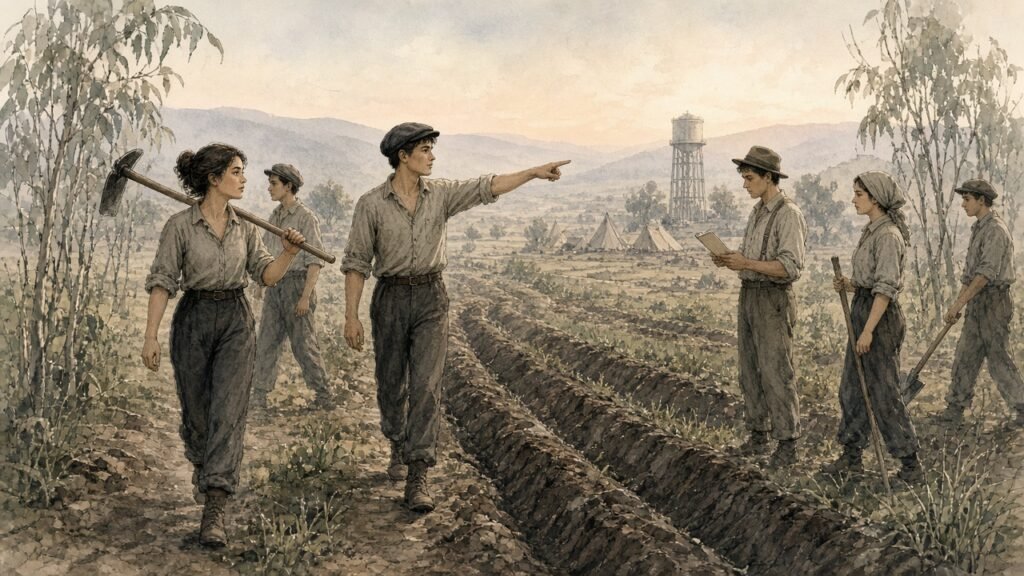
The Histadrut, founded in 1920, conducted its business in Hebrew and became a vast organisational ecosystem of unions, enterprises, clinics and newspapers. Through it, Hebrew penetrated economic life. The labour daily Davar and other papers standardised journalistic Hebrew for a mass readership of workers. Cultural committees sponsored theatre, choirs and lectures. The labour movement’s Hebrew was less purist than Ben-Yehuda’s and more practical. It needed words for strikes, budgets and tractors. It found them, borrowed them or coined them, and moved on.[41]
Military and pre-military organisations, from Hashomer to the Haganah and the Palmach, developed Hebrew command language, slang and songs. The Palmach in particular became legendary for its spoken style, a mix of official Hebrew, Arabic loanwords and youthful invention. Army Hebrew after 1948 continued this creative tradition. Military service, nearly universal among Jewish Israelis for generations, functioned as a language school for immigrants and as a slang factory for natives.
Contact with Arabic, Yiddish and Ladino
Hebrew in the Yishuv did not grow in a vacuum. Arabic surrounded it geographically and demographically. From Arabic, spoken Hebrew took loanwords for food, landscape and daily life, and some syntactic calques. Judaeo-Arabic speaking immigrants later brought additional layers. Yiddish contributed intonation patterns, idioms calqued into Hebrew and a reservoir of expressive particles that surfaced in informal speech. Judaeo-Spanish speakers from the Balkans and Turkey added their own contact features where communities were dense. The resulting spoken Hebrew was a contact language from birth, even when ideology denied the contacts.[42][11]
Scholars such as Ghil’ad Zuckermann have argued that Israeli Hebrew’s structure shows heavy influence from the European languages of the revival’s agents, especially Yiddish, and that it should be analysed partly as a hybrid rather than as a direct continuation of classical Hebrew. Others emphasise continuity of morphology and lexicon with earlier Hebrew layers. The debate, treated at length in a later chapter, begins empirically in the contact situation of the Second and Third Aliyot: young native speakers growing up among multilingual adults in a small society under imperial rule.[43]
Culture in Hebrew
Theatre companies, the Hebrew Writers’ Association, music publishers and the plastic arts institutions such as Bezalel created a Hebrew cultural market. Posters, tickets and catalogues taught commercial Hebrew. Advertising invented persuasive registers. By the 1930s a child in Tel Aviv could spend a day hearing, reading and speaking Hebrew in nearly every public interaction, even if grandparents still quarrelled in Yiddish at home. That daily completeness had been unimaginable in 1881. It was the joint product of schools, labour institutions, municipalities and markets.
The First Aliyah settlements had already experimented with Hebrew, but they often depended on French or German schooling and on multilingual agricultural experts. The Second and Third Aliyot radicalised the linguistic programme and tied it to a new social type: the young labouring Hebraist. Their mythology later overshadowed the quieter Hebrew work of teachers and municipal clerks. A full history needs both the mythic pioneers and the ordinary professionals who kept Hebrew running between harvests and demonstrations.
Cities, cafes and informal speech
Agricultural settlements loom large in Zionist memory, yet much Hebrew speech was urban. Tel Aviv cafés, Jerusalem offices and Haifa docks generated registers the kibbutz dining hall did not. Shopkeepers coined sales phrases; football crowds invented chants; musicians wrote songs that taught idioms faster than textbooks. Urban informal Hebrew accelerated the shift from schoolroom correctness to vernacular ease. Sociolinguistic studies of later Israeli cities show persistent variation by class, ethnicity and neighbourhood. That variation began in the Mandate city, where Hebrew was already a language of strangers negotiating prices, not only of comrades debating ideology.
Ideology of productivisation and language
Second Aliyah ideology linked Hebrew speech to physical labour and to the rejection of diaspora occupational patterns. Speaking Hebrew while draining swamps or building roads became a performance of national rebirth. The performance could shade into contempt for those who spoke Yiddish while keeping shops. Language policing in the labour movement had class and cultural edges. Historians of Yiddish and of Mizrahi experience have documented the injuries. Historians of Hebrew have documented the solidarity and the efficacy. Both archives belong in the account. Vernacularisation succeeded in part because it was bundled with a total lifestyle project that rewarded compliance with belonging.[41]
Not every pioneer lived the ideal. Private diaries reveal bilingual slip-ups, secret Yiddish jokes and exhaustion with vigilance. The gap between public Hebrew and private multilingualism persisted for decades. Children closed the gap more than adults. By the 1930s, sabra speech was already mocking the accents of the ideological fathers. That mockery was a sign of vernacular health: the language now belonged to natives who had not chosen it as a project but inherited it as a fact.
Songs of labour and the ear
Hebrew songs of the labour movement taught verbs of building, sowing and guarding through melody. Communal singing in dining halls and around campfires drilled morphology into muscle memory. A chorus that repeats a conjugated verb fifty times does pedagogical work that a grammar table cannot. Composers and lyricists, some of them major poets, supplied this oral curriculum. The songs also emotionally bonded Hebrew to youth, landscape and solidarity, making the language feel like belonging rather than homework. Critics note the exclusionary side of that bonding when it mocked other languages. Both the bonding and the exclusion were effective as language policy by other means.[41]
Dance, theatre and festival pageants extended the oral-physical curriculum. Speaking Hebrew while dancing the hora or performing a harvest pageant associated the language with bodily joy. The Yishuv’s cultural organisers understood this intuitively. Their festivals were not only nation-building spectacles; they were pronunciation workshops with costumes.
Ahad Ha’am and cultural Zionism
Asher Ginsberg, who wrote under the name Ahad Ha’am, was one of the most influential Hebrew essayists of the generation that shaped the Second Aliyah. Born in 1856 in a village near Kiev, he lived for many years in Odessa and later in London, and he edited the Hebrew monthly Hashiloach, which became a principal forum of Hebrew thought. His essays argued that the Jewish national revival required a spiritual and cultural centre in Palestine, a conception often called cultural Zionism, and that Hebrew was the indispensable medium of that centre. His own prose was disciplined and abstract, and it served as a model of how Hebrew could carry sustained argument on philosophy, ethics and politics. He settled in Tel Aviv in 1922. Younger writers and teachers read his work as proof that the language could be an instrument of modern thought and not only of narrative or poetry, and the esteem in which he was held lent intellectual authority to the Hebraist programme in the schools.[55]
Hebrew in the Hebrew Gymnasium and the teachers’ seminar
The Herzliya Hebrew Gymnasium, founded in Jaffa in 1905 and later moved to the new neighbourhoods of Tel Aviv, provided secondary education in which nearly all subjects were taught in Hebrew. Its graduates formed one of the first cohorts of educated young people whose school experience was entirely in the language, and many of them entered the professions, the press and the leadership of the labour movement. Teachers’ seminaries trained instructors who were sent to the colonies and towns of the Yishuv. These institutions produced a continuing supply of people who regarded the use of Hebrew as a professional obligation, and the cohorts they trained were large enough by the 1920s to sustain the language independently of the first generation of ideologues.[34]
13. Mandate years and official status
Official status under the Mandate
After the First World War, British rule replaced Ottoman rule in Palestine. The Mandate instruments and related policy recognised English, Arabic and Hebrew as official languages for many purposes. Hebrew could be used in courts, administration and public notices within arrangements that also protected Arabic and elevated English as the language of imperial government. For the Yishuv this recognition was a political victory. It meant that Hebrew was no longer only a communal preference; it was a language of legal standing. Documents, stamps and ordinances appeared in Hebrew. The Jewish Agency and the National Council conducted their affairs in Hebrew as a matter of course.[44][45]
Official status did not by itself create speakers, but it changed incentives. Ambitious immigrants learned Hebrew to deal with Zionist institutions. Lawyers and clerks needed Hebrew for professional life. Municipalities such as Tel Aviv operated in Hebrew. The British administration’s own use of Hebrew was limited and instrumental, yet the tripartite official formula prevented Hebrew from being relegated to a private communal language. Comparing this arrangement with minority-language policies elsewhere highlights its unusual strength: a non-sovereign community secured official language rights for a revived tongue while still under colonial rule.
Immigration and the 1930s
The Fifth Aliyah and the refugee immigration of the 1930s brought large numbers of Central European Jews, many of them highly educated German speakers with little Hebrew. Absorption strained schools and ulpan-like courses. German-speaking cafés in Tel Aviv became famous, and Hebraist activists complained of linguistic backsliding. Yet the children of these immigrants generally shifted to Hebrew, following the established school-driven pattern. The Nazi crisis thus tested the revival’s capacity to digest a sudden multilingual influx. The system bent without breaking.[41]
Arabic-speaking Jews from the Middle East and North Africa also arrived in growing numbers before and especially after 1948, but the Mandate period already included communities from Yemen, Iraq and elsewhere. Their Hebrew often connected more directly to liturgical pronunciation traditions different from the East European majority. They enriched the phonetic and cultural mix of the emerging vernacular while frequently facing social hierarchies that privileged Ashkenazi cultural norms. The full demographic transformation of Israeli Hebrew after statehood had Mandate-era previews.
Universities and high culture
The Hebrew University of Jerusalem, opened formally in 1925, committed itself to Hebrew as the language of instruction and scholarship. Early lectures sometimes faltered; professors improvised vocabulary; students took notes in a language that was still consolidating its academic register. Over time the university, the Technion and later institutions produced a Hebrew capable of philosophy, physics and philology at research level. Journals of scholarship in Hebrew joined the newspapers and the novels. A language with a university is harder to dismiss as a dialect of sentiment.[38]
Writers of the Mandate period, including Agnon, Brenner (until his death in 1921), Alterman, Goldberg and many others, wrote for an audience that increasingly spoke the language of the page. The feedback loop between speech and literature tightened. Slang entered fiction; fiction standardised slang. Radio broadcasting in Hebrew, when it developed, added another oral standard. By 1948 Hebrew was ready, linguistically if not demographically, to be the principal language of a state.
Law courts and administrative Hebrew
Mandate courts and later Israeli courts developed Hebrew legal registers drawing on rabbinic law terms, European civil law translations and local improvisation. Sitting in a courtroom where proceedings ran in Hebrew normalised the language as an instrument of power and rights. Municipal bylaws, tax forms and identity documents did the same in quieter ways. Administrative Hebrew is rarely celebrated in literary histories, yet it may have converted more adults to daily Hebrew use than poetry did. One learns the language of the forms one must fill.[44]
English remained the language of many Ordinance texts and of communication with the Mandatory government. Hebrew-English bilingualism among the Yishuv elite was common. After 1948 English stayed important internationally while losing domestic official primacy. The Mandate triangle of English, Arabic and Hebrew left lasting traces in Israeli legal language and in the country’s continuing multilingual paperwork.
Police, railways and postal services generated their own Hebrew usages. Signs on stations taught travellers; stamps and coins taught everyone. Visual Hebrew in the public square trained recognition even among those who spoke poorly. Literacy and oracy reinforced each other through the built environment of the late Yishuv.
Newspapers of the Mandate
Haaretz, Davar, The Palestine Post (later Jerusalem Post, in English) and a range of party papers created overlapping publics. Hebrew papers argued about labour, religion, Britain and Arab relations in a language still polishing its political lexicon. Editorials taught abstract nouns; crime reports taught narrative past tenses; advertisements taught consumer desire in Hebrew. Circulation numbers, though modest by metropolitan standards, were large relative to the Yishuv’s population. Reading a Hebrew daily became a habit of citizenship before citizenship legally existed.[45]
Arabic and Hebrew in the Mandate city
Arabic remained the majority language of Palestine’s population under the Mandate. Hebrew’s rise among Jews occurred beside Arabic continuity among Arabs and beside bilingual and trilingual individuals who moved between communities. Markets, building sites and municipal encounters produced practical language contact: loanwords, pidginised phrases, interpreters. Israeli Hebrew absorbed Arabic vocabulary especially for food, landscape, slang and exclamations. Some borrowings were later invisible to speakers who assumed they were native. Contact was asymmetrical in power after 1948, yet linguistically real in both periods. Any account of Hebrew vernacularisation that erases Arabic from the soundscape falsifies the cities in which Hebrew was spoken.[44][42]
Official trilingualism required translations of ordinances and notices. Translators formed a profession that stabilised legal Hebrew by forcing precise equivalents. Errors could have administrative consequences. The discipline of official translation therefore contributed to standardisation alongside schoolrooms and Academy meetings. Administrative paperwork was a significant but little-noticed means of teaching the language.
The expansion of domains
A language becomes a vernacular when it is used in the domains of ordinary life, not only when individuals can be found who speak it at home. Sociolinguists describe this as domain expansion: the extension of a language into work, commerce, leisure, health care, administration and entertainment, so that a speaker can pass through a whole day without needing another tongue. In the Yishuv of the Mandate years the expansion proceeded domain by domain, unevenly and with frequent relapses, and the following sections treat several of the less conspicuous domains in turn. They are rarely the subject of heroic accounts, but together they explain how a language taught in schools became a language of daily life.
Commerce and cooperatives
Shops, markets, banks and cooperative enterprises required Hebrew bookkeeping, price lists and customer speech. The labour federation’s cooperative network, which included grocery cooperatives, a bus company and construction firms, kept its records and conducted its meetings in Hebrew, and members who wished to participate in the governance of these bodies were obliged to follow debates in the language. Private merchants, especially in Tel Aviv, learned that Hebrew signs and Hebrew advertising attracted a clientele that identified with the national project. Commercial Hebrew accordingly acquired a vocabulary of weights, prices, credit and contracts that was partly drawn from rabbinic sources, where the laws of commerce were discussed at length, and partly invented or borrowed. The rabbinic background supplied terms for ownership, partnership and liability that modern business could adapt with relatively little distortion.
Sport and public leisure
Football clubs, the Maccabi sports federation and the workers’ sports associations organised competitions in which referees, players and spectators spoke Hebrew, and the sports pages of the daily newspapers supplied a vocabulary of attack, defence, scoring and fouls to readers who might never have opened a book of poetry. Youth movements added hiking, camping and nature study, and the Hebrew names of plants, birds and landforms that hikers learned were often those proposed by the language planners and botanists. Leisure thus carried a good deal of lexical teaching, and it did so in a register that was informal and competitive, closer to the speech of the street than to that of the lecture hall.
Food and the market
The vocabulary of the kitchen and the market came from many sources. Hebrew had biblical and rabbinic names for grains, fruits and vegetables, but the dishes of the immigrants arrived with their own names, from Yiddish, Arabic, Ladino, Russian, Romanian and other languages. The Hebrew of the market took many of these over directly. Arabic supplied a large part of the everyday vocabulary of vegetables, spices and street food, while Yiddish and German supplied the names of baked goods and preserved dishes. The result is a culinary lexicon in which Hebrew grammar frames words of obviously diverse origin, an instructive example of the contact processes that later scholars would emphasise in their account of the language.
Shop signs and the visual landscape
Written Hebrew in the public street trained recognition even among passers-by who did not yet speak the language well. In Tel Aviv, Haifa and the larger colonies, shop signs, street names, theatre posters, tram and bus destinations and notices of public meetings appeared in Hebrew, often alongside English and Arabic on official signs. Municipal authorities issued regulations on the languages of signage, and committees and volunteer groups campaigned for the use of Hebrew by shopkeepers. For an immigrant, a daily round of errands became a form of reading practice, and the high proportion of Hebrew in the visual environment helped to make the city appear as a Hebrew city before the majority of its inhabitants spoke the language fluently at home.
Medicine and care
Health services were among the first large institutions to adopt Hebrew at scale. The Hadassah medical organisation and the labour federation’s sick fund employed doctors and nurses trained in several European countries, and a medical vocabulary in Hebrew was developed to allow communication between professionals and with patients. Anatomical and clinical terminology was prepared by medical committees, in some cases working with the Language Committee. Training nurses in Hebrew, and then providing care in the language to immigrants of every origin, created a daily situation of unavoidable use that was sustained by the demands of illness rather than by ideology. Public health campaigns, posters and pamphlets in Hebrew reinforced the pattern.
Transport and communication
Railways, buses, the postal service and later the telephone system generated large amounts of routine Hebrew, such as directions, tickets, timetables, addresses and forms. Postal workers and railway clerks handled a stream of correspondence in many languages, but the forms and notices of the Mandate administration were increasingly trilingual, and Hebrew names for stations and towns became standard. The geography of the country was itself renamed in part: the Jewish National Fund and the government’s naming committees gave Hebrew names to settlements and landscape features, often reviving biblical names. The names of places are among the most visible products of language planning, and daily travel repeated them millions of times.
Crime, courts and the press
Crime reporting, police work and courtroom procedure created a narrative and procedural Hebrew that writers would later exploit in detective fiction and drama. Journalists learned to describe accidents, thefts and trials in Hebrew prose, and the vocabulary of investigation, evidence and testimony was extended from the rabbinic law of witnesses and proof. The language of the criminal process had to be precise, and the discipline of precision, enforced by judges and editors, moved Hebrew away from the florid style of the early nationalist press toward a more sober modern prose.
Agriculture and rural speech
The settlements of the plains and the valleys required a specialised vocabulary of crops, soils, irrigation, animals and tools. Agricultural schools such as Mikveh Israel, and the experimental stations and farming journals of the period, standardised names for citrus varieties, field crops and pests, often adapting words from Arabic farming terms used by neighbouring villages. When the economy urbanised in the following decades, this rural vocabulary persisted in metaphor and in the names of institutions, and many Israelis who had never worked a farm used words whose origin lay in the terraces and orchards of the early settlers.
Music, radio and the arts
The popular song, the choir and the musical theatre were important agents of pronunciation and idiom. The Palestine Broadcasting Service, founded in 1936, provided a daily Hebrew programme, and the Hebrew news bulletins gave listeners a model of standard spoken language. Composers set the work of the principal poets to music, so that verses entered the memory of whole cohorts, and the new Hebrew theatre, which included the Habima and the Ohel companies, gave audiences living speech on stage. The Bezalel school of arts and later academies developed an art vocabulary in Hebrew, while museums and exhibitions presented the language in the context of high culture. Together these institutions placed Hebrew in the domain of aesthetic experience, where its status as an object of pride could attach to pleasure and not merely to duty.
Informal creation at the margins
Each of these domains also generated informal vocabulary that never entered an official list. Sports supporters, market vendors, nurses, soldiers and songwriters produced clipped forms, jokes and slang, and some of these coinages survived while many planned terms did not. Language planning and spontaneous creation operated in tandem: the Language Committee and the Academy provided a stock of standard terms and a conception of correctness, while informal speech tested which forms were usable and discarded those that were not. The interplay is characteristic of Hebrew’s modern history, from Ben-Yehuda’s word lists to the slang of the Palmach and the advertising idioms of later decades.
Hebrew literature in the Mandate years
The literary culture of the Mandate years consolidated Hebrew as a language of high art. Poets such as Nathan Alterman, Avraham Shlonsky and Leah Goldberg, all of whom had come to Palestine from Eastern Europe as young people, wrote in a Hebrew that drew on biblical imagery but used modern syntax and a flexible lexicon, and their poems circulated in newspapers, anthologies and recitals. Shmuel Yosef Agnon, who had arrived in Palestine in the first years of the century and settled in Jerusalem, developed a prose style that deliberately recalled the language of medieval and rabbinic literature while treating modern subjects, and he was later awarded the Nobel Prize in Literature in 1966, the first for a Hebrew writer. The coexistence of the experimental and the archaizing in these writers demonstrated that the language had no single stylistic centre.[56]
The first native-born generation produced its own literature in the 1940s. Young writers of the Palmach generation, among them Moshe Shamir and S. Yizhar, wrote in a clipped, colloquial Hebrew that reflected the speech of the youth movements and the army, and they treated the landscape of the country as familiar rather than as an object of longing. The change in tone marked a shift from the Hebrew of immigrants who had learned the language as adults or adolescents, with its literary and biblical aspirations, to the Hebrew of those for whom it was a mother tongue. Critics have regarded the appearance of this generation as one of the most visible signs that vernacular Hebrew had become a native medium of literary expression.[50]
14. Statehood, ulpan and mass immigration
Statehood and the Law of Return’s linguistic challenge
The Declaration of Independence of May 1948 was read in Hebrew. The new state adopted Hebrew as its principal language, with Arabic also recognised, and set about absorbing immigration on a scale that dwarfed the Yishuv’s earlier waves. Holocaust survivors from Europe, Jews from Iraq, Yemen, Egypt, Morocco, Romania, Poland and elsewhere arrived with a multitude of languages and with Hebrew that ranged from scholarly fluency to a few liturgical phrases. The ulpan system, intensive Hebrew courses for adults, became a central instrument of absorption. Living in immigrant hostels, studying daily, then entering work or the army, newcomers passed through a linguistic pipeline designed to produce functional Hebrew quickly.[46][47]
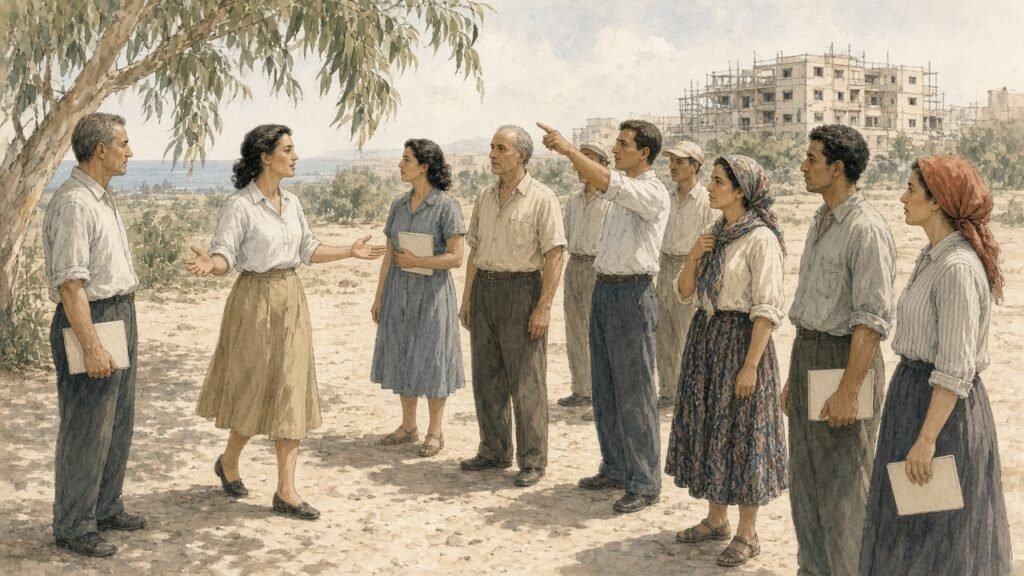
Ulpan pedagogy emphasised spoken communication, simplified grammar and the immediate needs of shopping, employment and bureaucracy. It did not aim to produce Hebraists of Ben-Yehuda’s type. It aimed to produce citizens who could function. The Hebrew that emerged from mass ulpan teaching, army service and children’s schools in the 1950s was demotically consolidating even as purists lamented its roughness. Native-born sabras mocked immigrant accents while inventing their own slang. Within two decades, Hebrew as a mother tongue was statistically normal among younger Jewish Israelis.[46]
Coinage under pressure
State ministries, the army and the schools demanded words for everything from traffic regulations to kitchen appliances. The Academy and ministerial terminology committees worked overtime. Some coinages succeeded spectacularly; others were ignored. English influence grew with commerce, technology and later television and the internet. Russian influence surged again with immigration from the former Soviet Union in the 1970s and 1990s. Amharic, French and Spanish left smaller marks. Israeli Hebrew became, visibly, a language of immigrants’ children, not a museum reconstruction of biblical speech.[40]
Arabic remained present as a co-official and neighbouring language, as the language of Palestinian citizens of Israel and as a source of slang and cuisine terms among Jewish speakers. Political conflict shaped attitudes toward Arabic in ways that go beyond linguistics, yet the linguistic contact continued regardless. Hebrew-Arabic bilingualism among Arab citizens and partial familiarity among Jewish citizens form part of the country’s language ecology, even when ideology obscures it.
Normalisation
By the late twentieth century, Hebrew’s vernacular status was no longer precarious. Novels, pop music, television drama, advertising and internet chat all flourished in Hebrew. The language’s problems became ordinary problems of a living tongue: youth slang opaque to elders, English encroachment in tech and academia, arguments about gender marking, literacy levels, and the teaching of classical texts to students who speak a descendant language. These are the problems of success. The emergency of revival had become the management of a national language.
Yet success was uneven. Some immigrant communities maintained heritage languages for generations. Haredi communities developed complex repertoires in which Yiddish, Hebrew and, in Israel, Israeli Hebrew occupy different domains, with sacred Hebrew still distinguished from everyday speech. The revival’s triumph among the secular and traditional-national majority never meant linguistic uniformity. Israel remains multilingual. Hebrew’s achievement is to be the default public language and the mother tongue of most Jewish Israelis, not to be the only language anyone speaks.
Mass media and the second standard
Radio, and later television, offered Israelis a spoken standard alongside the school. Newsreaders’ Hebrew became a model; entertainment programmes legitimised more colloquial speech. Songs in Hebrew, from early folk repertoires to pop and hip-hop, memorised structures into bodies. Media reduced regional and ethnic differences without erasing them. They also imported English at scale. The ulpan taught survival Hebrew; the media taught belonging Hebrew. Together with the army, they completed what the Yishuv schools had begun: a society in which not speaking Hebrew marked one as new, temporary or separatist rather than as simply Jewish.
Transit camps and linguistic triage
The ma’abarot of the 1950s packed immigrants into temporary housing where Hebrew teaching competed with hunger, cold and unemployment. Ulpan hours were uneven. Children often learned faster than parents and mediated with bureaucrats, reversing household authority. This pattern, familiar from immigrant societies worldwide, had special meaning where the children’s language was also the state’s ideological centrepiece. Family dynamics and nation-building intertwined. Some parents never became fluent; their grandchildren grew up monolingual Hebrew speakers who studied English as a foreign language. Three generations completed a shift that liturgy had not attempted for fifteen centuries.[46]
Ethnic stratification marked accents as prestigious or stigmatised. European accents sometimes ranked above Middle Eastern ones in early state culture, despite the official Sephardi pronunciation ideal. Popular music, comedy and later multicultural politics renegotiated those rankings. Israeli Hebrew today carries the traces of those struggles in jokes, identity claims and phonetic variation. The vernacular is socially layered, not flat.
Army as ulpan
For many immigrants, especially young ones, military service was the decisive Hebrew immersion. Orders barked in Hebrew, slang exchanged in tents, love letters written on leave in unsteady Hebrew script: these experiences forged speakers who had resisted or lacked civilian ulpan. The army’s Hebrew was not academic. It was rapid, elliptical and full of acronyms. It became a prestige dialect of Israeli authenticity. Politicians still quote army idioms to sound rooted. The vernacular’s military layer is one of its most distinctive sociological colours, for better and for worse.[47]
Officer courses and technical corps needed advanced vocabulary, linking army Hebrew back to Academy terminology lists. The feedback loop between combat units and planning bodies continued the Yishuv pattern of practical need driving coinage. A new weapon or tactic required a name by morning. Some names lasted; some were replaced by borrowings. Speed mattered more than elegance.
Ulpan methods and adult learners
The ulpan system was developed in the late 1940s to teach Hebrew rapidly to adult immigrants. The first institutions offered courses of several months in which students studied for hours each day, with classes conducted as far as possible in Hebrew from the first lesson, so that learners did not rely on a shared second language. The method combined direct instruction in grammar and vocabulary with exposure to songs, newspapers and conversation, and many courses were organised in or near the places where immigrants lived or worked. Kibbutz ulpanim combined study with half a day of labour, which gave students experience of Hebrew in the setting of the settlement. Teachers, who were often women with experience in the schools or the army, adapted their methods to learners of different backgrounds, and textbooks were prepared for elementary and advanced levels. Adult education in Hebrew remained a large public programme for decades, and it provided a means by which new immigrants could acquire the language needed for employment and citizenship.[46]
Literature after statehood
After 1948 Hebrew literature expanded to include writers who had arrived as children or who were born in Israel, and the range of their voices widened the stylistic repertoire of the language. Yehuda Amichai, who had come from Germany as a boy, developed a poetry that used the conversational idiom and the everyday objects of the city, joining modern speech with allusions to the liturgy and the Bible. His poems and those of his contemporaries were widely read in schools and became part of the shared cultural memory of Israeli speakers. Novelists wrote about the immigrant experience, the army, the kibbutz and the city, and translation of foreign literature into Hebrew continued on a large scale. By the 1960s a reader could find, in the language alone, a full range of genres from popular fiction to philosophical essays.[50]
Mizrahi immigrants and the Hebrew they brought
Immigrants from Iraq, Morocco, Yemen, Iran and other Middle Eastern and North African countries arrived in large numbers in the 1950s and encountered an educational and administrative system largely shaped by the European-born leaders of the Yishuv. Many of these immigrants spoke Arabic, Judaeo-Arabic or other languages at home but had a strong familiarity with liturgical Hebrew and with a pronunciation tradition that was often closer to the official Sephardi-based norm than the pronunciation of Ashkenazi newcomers. The experience of learning modern Hebrew in the transit camps and development towns was nevertheless one of unequal status, because prevailing attitudes devalued Arabic and the culture associated with it. Some phonetic features of the immigrants’ speech, such as pharyngeal consonants, were treated as markers of backwardness. Subsequent generations, and a wave of Mizrahi writers, musicians and scholars from the 1970s onward, contested those attitudes and affirmed the contribution of these communities to the language. Mizrahi popular music in particular carried Arabic and Hebrew phrases into the mainstream of Israeli culture.[57]
Hebrew in the Knesset and public life
The Knesset, established in 1949, conducted its debates in Hebrew, and its proceedings, published in the language, supplied a record of parliamentary speech that served as a model for political rhetoric. Members who had learned Hebrew as adults spoke with the accents of their origins, and the chamber heard Hebrew inflected by Yiddish, Russian, Polish, Arabic and German. Legislation was drafted in Hebrew, with English and Arabic translations for certain purposes, and the legal vocabulary developed by the Mandate courts and the rabbinic tradition was extended to the needs of a modern state. The use of Hebrew in the chamber, the courts, the civil service and the army established the language as the working medium of public authority, and the effect on the status of the language was probably as significant as the formal declarations of its official position.[47]
15. Sounds, words, slang and grammar
Pronunciation choices
Educators in the Yishuv largely adopted a pronunciation based on Sephardi traditions: stress patterns and vowel qualities that preserved distinctions Ashkenazi liturgical reading had shifted. Resh was typically a trill or tap rather than a uvular fricative; tav without dagesh was /t/ rather than /s/; certain vowels matched Tiberian signs more closely than Ashkenazi norms did. In practice, Ashkenazi immigrants often imported their phonetic habits, and the native speech that stabilised mixed ideals with realities. The famous Israeli resh varies; the pharyngeal consonants ayin and het are robust among some Mizrahi speakers and weak among many Ashkenazi-descended speakers. Sephardi Hebrew provided the target; Ashkenazi Hebrew provided much of the demographic base. The outcome is a phonology with recognisable Israeli features that match neither classical reconstruction nor any single diaspora tradition perfectly.[13][42]
Grammar in motion
Spoken Israeli Hebrew reshaped verbal usage, particle choice and word order relative to biblical and even maskilic norms. The participle bears much of the present-tense load. Analytic constructions flourish. Gender and number agreement sometimes loosen in rapid speech. Subordination patterns show European influence according to some analyses. At the same time, the binyan system of verb patterns remains a living derivational engine, used to coin verbs from nouns and to navigate new meanings. Speakers who cannot read the Bible fluently still manipulate roots and patterns intuitively. Continuity and change are both real.[48]
Orthography debates continue. Unpointed text relies on readers’ knowledge. Newspapers sometimes use partial pointing for ambiguity. Online writing has generated informal conventions, abbreviations and playful spellings. The classical script endures without Latinisation, a victory for continuity that keeps Israeli children visually connected to older texts even when vocabulary and syntax have moved.
Slang, registers and youth language
Every vernacular develops informal registers. Israeli slang draws on Arabic, English, Russian, army jargon and inventive Hebrew morphology. Words rise and fall within a decade. Older Hebraists sometimes treat slang as decay; linguists treat it as evidence of life. Literature and film have embraced slang to varying degrees, from early reluctance to later celebration. Yehuda Amichai and other poets brought spoken cadences into high verse, closing another gap between the language of the street and the language of the page.[28]
Register stratification also persists in the other direction. Legal, liturgical and academic Hebrew retain conservative features. A speaker may move between slangy conversation, neutral workplace Hebrew and elevated ceremonial Hebrew in a single day. This repertoire mirrors older diglossia without returning to it: the varieties are connected by a shared vernacular base, not separated into unrelated spoken and written languages. Modern Hebrew’s internal diversity is the diversity of a complete language.
Vocabulary growth has been immense. Estimates comparing biblical word counts to modern lexicons vary by method, but all agree that contemporary Hebrew names colours, machines, institutions and abstract concepts that biblical Hebrew never named. The root-and-pattern system made much of this growth feel “internal” even when meanings were calqued from European languages. Speakers sense Hebrew words as Hebrew even when historically recent. That sense of interiority is part of what makes the vernacular feel inherited rather than invented.
From roots to apps
Late twentieth- and early twenty-first-century Hebrew faced the internet, mobile phones and globalised entertainment. The Academy issued lists for computing and social media; teenagers ignored many of them and borrowed English verbs into Hebrew morphology, producing hybrid forms that horrify purists and delight contact linguists. Predictive text and online pointing tools changed literacy practices. Diaspora learners used apps that teach modern spoken Hebrew rather than only biblical paradigms. The vernacular that emerged from liturgy had become a language one could swipe through on a glass screen.
Gender-neutral and inclusive language debates arrived in Hebrew with particular morphological intensity because Hebrew marks gender richly. Reformers propose new forms; traditionalists defend older paradigms; institutions choose inconsistently. These debates are signs of a language fully embedded in contemporary politics of identity, far from the older question of whether Hebrew could be spoken at all. The centre of gravity has moved from existence to equity of expression within existence.
Syntax sketches
Modern Hebrew word order in neutral sentences often favours subject-verb-object patterns familiar from European languages, though biblical and mishnaic orders remain available for style and emphasis. Negation, question formation and relative clauses have standardised in ways textbook grammars now describe for learners worldwide. Aspectual and modal nuances are carried by combinations of tense forms, participles and helping verbs rather than by the biblical system alone. Speakers control a continuum from highly literary syntax to stripped conversational utterances that drop elements recoverable from context. That continuum is the hallmark of a vernacular with a written standard, not of a liturgical language alone.[48]
Numerals, dates and measurement phrases show mixture: Hebrew words alongside international units. Street speech counts with Hebrew numbers but may name currencies, brands and technologies in English. Code-switching is common in some social strata and policed in others. The vernacular’s boundaries are socially negotiated moment by moment. Academy lists mark an official centre; speech explores the periphery.
Pronunciation politics revisited
Although institutional Hebrew adopted a Sephardi-influenced phonetic model, Ashkenazi phonological habits persisted in liturgy, in older speakers and in certain stylistic performances. Radio and schools reduced but did not erase variation. Immigrants from North Africa and the Middle East often realised pharyngeal consonants that European speakers merged or dropped, producing accents coded as authentic or as provincial depending on the decade and the listener. Popular singers sometimes amplified marked pronunciations as identity claims. The official story of a single Sephardi-based standard sits atop a noisy reality of social accents. Vernacular Hebrew is phonetically plural even where textbooks show one chart.[48][42]
Hebrew among the Haredi communities
The relation of ultra-Orthodox communities to Modern Hebrew is more complex than a simple opposition suggests. Many Hasidic and other Haredi groups in Israel continue to use Yiddish as the principal language of the home and of religious study, and some leaders have regarded the everyday use of Hebrew as a profanation of the holy tongue. Other Haredi groups, particularly those of Sephardi and Mizrahi origin, use Hebrew as a mother tongue in a form that incorporates the vocabulary of religious study. In practice, large numbers of Haredim use modern Hebrew in the workplace, in commerce and in dealings with the state, and the media and publishing industries of these communities produce considerable amounts of Hebrew text. A variety of Hebrew has developed that blends the Hebrew of Torah study with Yiddish syntax and idioms. The case shows that the vernacularisation of Hebrew was not complete in all communities at the same pace, and that the old distinction between the holy tongue and the everyday language persists in modified form.[58]
16. Scholarly debates
Revival or revernacularisation
Specialists disagree about how to name what happened to Hebrew between 1880 and 1950. Popular histories speak of revival, a word that suggests awakening from death. Sociolinguists and Hebraists such as Lewis Glinert, Shlomo Izre’el and others have preferred terms like revernacularisation, noting that Hebrew had never died as a written and recited language. On this view, the modern achievement was to restore vernacular functions to a language that already possessed literacy, liturgy and literature. The distinction is not pedantic. It changes what counts as explanation. A miracle narrative emphasises unique willpower. A revernacularisation narrative looks for comparable mechanisms in language shift, school policy, migration and prestige planning, while still acknowledging Hebrew’s unusual starting point.[32][48]
Jack Fellman’s early sociological study of the revival stressed institutions and social networks over solitary genius. Later research on children’s peer groups, kindergarten immersion and settlement ideology has reinforced that emphasis. Ben-Yehuda remains important, but as a node in a network. The myth of the lonely reviver persists in popular culture because it is narratively efficient. Scholarship’s task is to densify the story without sneering at the genuine emotional power of the myth for generations of speakers.
Zuckermann and the “Israeli” thesis
Ghil’ad Zuckermann has argued that the language spoken in Israel is not a direct continuation of classical Hebrew but a hybrid “Israeli” language whose grammar and semantics were shaped heavily by the mother tongues of its creators, especially Yiddish, and by other European languages. On his account, calling the language Hebrew without qualification misleads historically and politically. He proposes genetic and contact-linguistic analyses that treat Israeli as partly a relexified European structure wearing Hebrew morphology and vocabulary. The thesis is controversial. Critics reply that continuity of the verbal system, of root extraction, of major lexical strata and of the cultural identification of speakers with Hebrew history justifies retaining the name Modern Hebrew, while still accepting substantial contact influence.[43][49]
The debate has stakes beyond terminology. If Israeli is a hybrid, then purist campaigns to restore biblical syntax may be chasing a ghost. If Israeli is Hebrew under contact conditions, then teaching classical texts remains a project of deepening a language one already speaks rather than of learning a foreign sacred tongue. Most Israeli linguists occupy middle positions: they document European influences without accepting full hybrid renaming, and they document continuity without denying that spoken Israeli differs profoundly from biblical Hebrew. Shlomo Izre’el’s work on the emergence of spoken Hebrew and on the role of imperfect adult learning has similarly complicated simple revival stories by emphasising how adult second-language strategies fossilised into native grammar.[49]
Benjamin Harshav’s cultural analysis presented the revival as part of a broader modern Jewish revolution in which language, literature and society were reinvented together. Harshav stressed the semiotic and social conditions that made a “new Hebrew” possible: secularisation, nationalism, immigration and the creation of a polysystem of Hebrew culture. His account bridges literary history and sociolinguistics. It remains influential among those who study Hebrew as a cultural project rather than only as a structural system.[50]
Continuity theses
Against strong discontinuity claims, other scholars emphasise the unbroken chain of written Hebrew and the ability of modern speakers, with education, to access older layers. The morphological skeleton of the language, the binyanim, the root system, large parts of basic vocabulary and the script itself connect Israeli speech to earlier stages more tightly than English connects to Old English for untrained speakers. An Israeli child does not automatically understand Isaiah, but the distance is smaller than romantic discontinuity sometimes implies. Schooling exploits that residual proximity. The success of Hebrew education in granting access to classical texts is itself evidence in the continuity column, even though spoken grammar has changed.
A balanced synthesis might run as follows. Hebrew was never a dead language in the sense that Etruscan is dead. It was a non-vernacular language of high literacy. The modern period restored vernacular functions under conditions of intense language contact and adult learning, producing a spoken variety that both continues and transforms its ancestors. Labels such as Modern Hebrew, Israeli Hebrew or Israeli capture different aspects of that reality. For a historical essay, the older phrase “emergence of Modern Hebrew as a vernacular” remains serviceable because it names the functional change without deciding every theoretical dispute.
Ideology and description
Hebraist ideology preferred narratives of awakening and purity. Descriptive linguistics prefers narratives of contact and change. Both have shaped what counts as evidence. Early planners underreported loanwords; some later linguists underreport speakers’ experience of continuity. Primary sources from the Yishuv, including teachers’ memoirs, children’s letters and meeting minutes, show improvisation, failure, coercion and joy mixed together. Any adequate theory must make room for that messiness. The scholarly debates are not a sideshow. They are part of the language’s modern history, because Hebrew was revived under the eyes of people who were already theorising what they were doing.
Corpora and empirical turns
Recordings of early speakers, collections of children’s letters, school compositions and digitized newspapers now allow empirical study of how spoken and written Hebrew changed year by year. Corpus linguistics has begun to replace anecdote with frequency counts. Preliminary findings support neither pure continuity nor pure hybrid rupture. They show rapid grammaticalisation of certain constructions, retention of others and lexical replacement at varying speeds across domains. As corpora grow, theoretical claims will be tested more severely. The scholarly debate is entering a data-rich phase that earlier generations of Hebraists lacked.[49]
Psycholinguistic research on Israeli children and on heritage speakers abroad adds another angle. Processing studies ask how root awareness works in real time, how diglossia with English affects fluency, and how classical Hebrew is acquired as a related but distinct code in school. These questions reconnect the modern vernacular to the educational problems of the Yishuv, now researched with laboratory methods rather than only with memoirs.
Political readings of linguistic theory
Arguments about whether to call the language Hebrew or Israeli sometimes track political positions about Zionism, diaspora identity and Palestinian history, though they need not. Some critics of Zionism embrace discontinuity theses to undermine nationalist narratives of return; some Zionists embrace continuity theses to strengthen them. Linguists who try to separate structural analysis from political instrumentalisation face an uphill task because the revival was political from the start. Transparency about stakes is better than pretended neutrality. This essay has used “Modern Hebrew” and “Israeli Hebrew” as near synonyms for the vernacular, while reporting the “Israeli” renaming thesis as a serious scholarly position associated especially with Zuckermann. Readers may judge the naming question differently after weighing continuity of morphology and lexicon against contact-induced change.[43][49]
Franz Rosenzweig and Martin Buber, in a different key, wrote about Hebrew’s theological and translational demands in the early twentieth century, surrounding the revival with philosophical argument about speech, revelation and community. Their Bible translation into German and their essays on Hebrew kept elite European conversation about the language alive even among those who did not settle in Palestine. Intellectual history and sociolinguistic history touch here: ideas about what Hebrew means shaped willingness to speak it.[53]
Israeli Hebrew as a descriptive category
Linguists began to describe the language of native Israeli speakers as a distinct object of study in the mid-twentieth century. Haiim Rosén’s work on what he called Israeli Hebrew emphasised the structures of contemporary speech, and other scholars compared the phonology, morphology and syntax of the spoken language with those of the biblical and rabbinic strata. Descriptive grammars showed that many features of everyday speech differ from the prescriptions of school textbooks, including the use of certain verb patterns, the simplification of the construct state and the loss of some distinctions in the numerals and the pronouns. Scholars who emphasise continuity argue that these developments fall within the range of internal change that any living language undergoes. Scholars who emphasise contact argue that some of them reflect the influence of Yiddish and Slavic languages on the first generations of speakers. The evidence does not settle the question, partly because the same feature may have more than one explanation, and partly because the categories used by the two sides are defined differently.[48]
The disagreement has consequences for how the history of the language is told. If the language is a continuation of earlier Hebrew with extensive borrowing, the narrative is one of revival in the ordinary sense. If it is a new language with a mixed ancestry, the narrative is closer to the creation of a new tongue from several sources. The existence of a large body of descriptive and experimental work, together with the corpora now under construction, makes it likely that the debate will continue to be refined, and that the opposing positions will converge on a more detailed account of which features came from which source.[49]
17. Other revivals in comparison
What counts as comparable
Hebrew is often called the only successful revival of a vernacular from a solely liturgical-literary status. The claim needs qualification, but it points to a real comparative puzzle. Language revitalisation efforts worldwide have produced partial successes: increased numbers of second-language speakers, school programmes, media in the target language and, in some cases, new cohorts of children who speak the language at home. Few have produced a territorially concentrated population of millions for whom the revived language is the default mother tongue and the language of state, science and street. Hebrew did. Comparison clarifies which conditions mattered.[51]
Irish offers a sobering parallel. Despite state independence, compulsory schooling, official status and a rich literary tradition, Irish remains a minority vernacular, with English dominant in most of the Republic. Revitalisation has created speakers and cultural prestige without reversing language shift for the majority. Welsh has done better in recent decades through education, broadcasting and legal support, producing growth in speakers, yet Welsh does not dominate the entire Welsh economy or immigrant absorption. Cornish has been revived from extinction as a spoken language among enthusiasts, a remarkable achievement that still involves hundreds rather than millions. Hawaiian immersion schools have created new young speakers after severe endangerment, a success story within a larger English-dominant environment. Māori language nests and schools have similarly rebuilt intergenerational transmission in parts of New Zealand without displacing English nationally.[51][52]
Catalan and Basque are sometimes cited alongside Hebrew, but they differ in kind: both remained spoken vernaculars and needed normalisation and status planning more than resurrection from liturgical confinement. Sanskrit and Classical Arabic offer closer functional parallels as high languages, yet Classical Arabic coexists with robust colloquial Arabics rather than replacing them, and Sanskrit’s spoken communities remain small despite prestige and state support in India. Hebrew’s path was to collapse diglossia by vernacularising the high language, not to preserve diglossia indefinitely.[6]
Conditions that favoured Hebrew
Several conditions aligned. First, a complete written tradition supplied vocabulary, prestige and learning methods. Second, nationalist ideology linked language to settlement and state-building with unusual intensity. Third, immigration concentrated speakers in a territory where they could form a majority of a new public sphere, even while remaining a minority in the wider country under the Mandate. Fourth, schools immersed children early. Fifth, rival Jewish vernaculars, especially Yiddish, were stigmatised or destroyed by historical catastrophe in Europe, reducing competition among younger generations. Sixth, official recognition under the Mandate and then state power supplied jobs and status in Hebrew. Seventh, military service and labour institutions enveloped adults in Hebrew-speaking organisations. Few revitalisation movements enjoy this full cluster.[51][32]
Costs and coercions accompanied success. Yiddish writers and speakers experienced Hebrew dominance as suppression. Arabic-speaking Jews were sometimes marked as linguistically deficient by Ashkenazi norms even when their liturgical Hebrew was strong. Palestinian Arabs faced a state whose primary language was Hebrew. Internal Jewish multilingualism was undervalued. Comparative honesty requires registering these costs alongside the achievement. Revitalisation is a political process, not only a pedagogical one.
Lessons without slogans
Planners elsewhere have drawn selective lessons from Hebrew: the importance of early education, of media, of official status, of lexical modernisation. They have also learned that copying Hebrew’s results without Hebrew’s conditions leads to disappointment. A liturgical language without a migration-driven speech community and without state or proto-state institutions rarely revernacularises fully. Conversely, endangered vernaculars that still have elderly native speakers face different tasks: documentation, intergenerational transmission, economic domains for the language. Hebrew is a poor template for those tasks if taken literally, and a useful analogy if taken loosely as proof that language trajectories can bend under social organisation.
The comparative file remains open. New media, urbanisation and global English change the environment for every language movement. Hebrew itself now faces English pressure in science and business, a reminder that vernacular success is not permanent immunity. The emergence of Modern Hebrew as a vernacular is a completed historical episode; the maintenance of Hebrew in a globalised century is an ongoing one.
Hebrew as a cited model
Language activists from Ireland to New Zealand have invoked Hebrew as inspiration. The invocation sometimes helps fundraising and morale; it sometimes sets impossible expectations. Careful comparative work distinguishes transferable techniques (immersion schooling, media, official status, lexicon modernisation) from non-transferable conditions (mass ideological immigration, collapse of a competing major vernacular through genocide and assimilation, state formation around the language). Hebrew teaches that revitalisation can, under rare conditions, produce a new majority vernacular. It does not teach that it usually will.[51]
Conversely, Hebrew planners have begun to learn from endangered-language programmes about community consent, about the ethics of pressure on minority languages within Israel, and about documenting variation before standardising it away. The comparative conversation has become two-way. That, too, is a mark of vernacular maturity: Hebrew is now a donor and a recipient of planning knowledge, not only an object of admiration.
Demography as destiny and as policy
Comparative revitalisation research stresses speaker numbers, intermarriage patterns, urbanisation and economic domains. Hebrew benefited from a demographic engine: waves of immigrants whose children needed a lingua franca, supplied by schools as Hebrew. Irish lacked a comparable engine after English had already become the majority vernacular. Māori and Hawaiian programmes create speakers in the tens of thousands, historically significant relative to community size, without matching Hebrew’s millions. Scale matters. So does the fact that Hebrew became the language of upward mobility inside a forming state. Where the economically dominant language remains the old colonial or national language, revitalised tongues struggle to expand domains. Hebrew seized domains early and held them.[51]
Policy lessons include the value of early childhood immersion, the need for adult pathways, the usefulness of official status and the double edge of stigmatising competitor languages. Ethical planning today tends to reject stigma as a tool even when historically it “worked.” Hebrew’s past successes therefore cannot be copied wholesale into present frameworks that prioritise speakers’ rights across multiple languages. The comparison teaches history, not a turnkey kit.
The Irish and Welsh cases
The history of Irish illustrates both the possibilities and the limits of language revitalisation. The Gaelic League, founded in 1893, promoted the teaching and use of Irish, and after independence the language was designated the first official language in the constitution of 1937 and became a compulsory subject in schools. Irish remained the daily language of the Gaeltacht regions in the west, but English continued to dominate the economy and the cities, and the number of habitual speakers outside those regions remained small relative to the whole population, although the numbers who claim some knowledge are considerably larger. Welsh offers a more favourable case. Legislation, the creation of a Welsh-language television channel in 1982, the growth of Welsh-medium schools and the Welsh Language Act of 1993 produced a stabilisation and in some measures an increase in the number of speakers, though the language remains a minority tongue in a bilingual society.[52]
The contrast with Hebrew is instructive. In Ireland and Wales the language was still spoken in rural districts when the revival movements began, and the movements aimed to expand its use against a dominant majority language. In the Jewish case no community spoke Hebrew as a mother tongue, but there existed a population of immigrants who spoke a variety of other languages and had no common vernacular, together with a literate tradition in Hebrew that extended to nearly all adult men and, increasingly, to women. The immigrants’ lack of a shared tongue created a functional need for one, and the settlement of a territory under circumstances that allowed the founding of institutions in the language made it possible to meet that need. These conditions were specific to the Jewish case, and their absence in Ireland and Wales helps to explain the different outcomes.[51]
18. Continuities
What endured
Across two millennia Hebrew retained a script, a sacred library, a grammatical metalanguage and a transnational reading public. Those continuities made vernacularisation conceivable. The Masoretes’ vowels, the medieval poets’ experiments, the printers’ Bibles, the maskilim’s journals and Mendele’s nusach were not detours from the main story. They were the main story’s precondition. When children in Tel Aviv quarrelled in Hebrew, they activated a system that scribes in Tiberias and poets in Cordoba had also activated, differently. Continuity here does not mean identity of speech. It means persistence of a linguistic project through changing functions.
What changed
The decisive change was functional and demographic. Hebrew became the language of infancy, intimacy, work and government for a territorial population. That had not been true since late antiquity. The change required ideology, schools, immigration, institutions and time. It produced a vernacular that carries marks of Yiddish, Arabic, English and the imperfect learning of adults. It left other Jewish languages diminished. It intertwined with nationalism and statehood so tightly that separating language history from political history is impossible. Modern Hebrew as vernacular is both a linguistic event and a chapter of modern Jewish and Middle Eastern history.
Chronology of thresholds
A condensed chronology helps fix the uneven tempo. In the late eighteenth and early nineteenth centuries, maskilic Hebrew expanded essay and satire. In the mid-nineteenth century, Hebrew novels and newspapers multiplied. In the 1880s and 1890s, Ben-Yehuda and circles in Palestine pressed for speech; first native-speaking children appeared in activist households. Between 1905 and 1914, Second Aliyah labour culture and Hebrew schools widened spoken use. In 1913, the Technion conflict dramatised medium choice in higher education. During the First World War, disruption and later recovery reshaped institutions. The 1920s brought Mandate recognition of Hebrew and the growth of Tel Aviv as an urban Hebrew environment. The 1930s absorbed refugees who learned Hebrew under pressure of necessity. The 1940s wartime Yishuv consolidated Hebrew administration. After 1948, mass immigration and ulpan systems converted demographic chaos into Hebrew-majority speech among Jewish Israelis within a generation. By the 1960s, native Hebrew-speaking cohorts dominated youth culture. Each threshold depended on earlier ones. Removing newspapers from the nineteenth century would have weakened schools in the twentieth; removing schools would have weakened the state’s absorption capacity. The chronology is a chain.
Dating “success” depends on criteria. If success means any native speakers, the 1880s–1900s qualify. If it means a self-sustaining urban vernacular, the 1920s–1930s loom larger. If it means demographic dominance within the Jewish population of a sovereign state, the 1950s are decisive. If it means international recognition as a normal national language with science, literature and slang, the late twentieth century completes the picture. This feature treats success as cumulative across those criteria rather than as a single switch flipped by a founder.
Disruptions also belong in the chronology. Epidemics, wars, economic crises and political violence interrupted schooling and killed potential speakers. The First World War emptied some colonies; the Second World War and the Holocaust destroyed European Hebrew centres that had fed the Yishuv with writers and teachers. Vernacular Hebrew in Palestine grew even as European Hebrew culture was murdered. The geographic transfer of the language’s centre of gravity was inseparable from catastrophe. Grieving that fact is compatible with analysing the institutional growth that occurred in the Yishuv. The emergence of the vernacular was not a compensation proportional to the loss; it was a historical process that unfolded alongside the loss and then in its aftermath through immigration of survivors and refugees.
Historiography of the revival
Writing the history of Hebrew’s vernacular emergence has itself a history. Early Zionist accounts stressed heroes and firsts: the first Hebrew-speaking child, the first kindergarten, the first newspaper, the first gymnasium. School textbooks condensed these firsts into civic catechism. Mid-twentieth-century scholarship added institutional detail and began to question solitary hero narratives. Late twentieth-century sociolinguistics brought comparative frameworks and contact linguistics. Twenty-first-century work has emphasised gender, ethnicity, coercion, Yiddish loss and Arabic contact, sometimes in sharp critique of earlier Hebraist historiography. Each wave corrected blind spots and risked creating new ones. Heroic narratives underplayed networks; critical narratives sometimes underplay the agency and joy of speakers who wanted Hebrew. This essay has tried to use all three waves: to keep individuals visible without isolating them; to keep institutions central; and to keep costs and contacts in view.[32][50]
Primary sources for the topic are abundant and uneven. Newspapers are digitised in growing numbers. Teachers’ memoirs fill Israeli archives. The Academy’s publications document decisions. Children’s writing survives in surprising bulk. What is harder to recover is ordinary conversation before recording technology. Reconstructions of early spoken Hebrew therefore lean on written approximations of speech, on later reminiscence and on the first generation of linguistic descriptions. Uncertainty at the level of phonetic and syntactic detail should be acknowledged. The broad functional story, however, is not in doubt: between roughly 1880 and 1960 Hebrew acquired and consolidated vernacular status among the Jewish population of Palestine and Israel.
Periodisation varies by author. Some begin with mapu and the Hebrew novel; some with Ben-Yehuda’s arrival; some with the Second Aliyah; some with Mandate recognition; some with statehood. This feature begins earlier, with the loss of vernacular functions in antiquity, because the meaning of modern revernacularisation depends on what was retained in between. A story that starts in 1881 can sound like creation from nothing. A story that starts in late antiquity shows creation from a crowded inheritance. The two accounts complement each other. The modern actors believed they were reviving something ancient; they were also inventing something new. Holding both descriptions is the historiographic task.
Finally, the geography of the story stretches beyond the land of Israel. Odessa, Warsaw, Berlin, New York, Salonika and Yemeni towns belong to Hebrew’s modern history as surely as Jaffa and Tel Aviv. Diaspora presses and schools fed immigrants into the Yishuv. Diaspora arguments between Hebraists and Yiddishists framed the stakes. After 1948, diaspora communities continued to teach Hebrew as a second language tied to Israel rather than as a vernacular of local streets. The vernacular triumph was territorially concentrated. The written and taught language remained global. That split between Israeli vernacular and global learned Hebrew is the contemporary form of an older pattern: Hebrew as a language that travels farther in writing and schooling than in mother-tongue speech. The difference is that today there exists a large territorial mother-tongue base that earlier centuries lacked. The emergence this feature has described is the emergence of that base.
Open questions
Research continues on the precise chronology of native speaking communities, on women’s roles, on the linguistic features of early spoken Hebrew corpora, on Mizrahi contributions long under-acknowledged in Hebraist historiography, and on the contemporary contact between Hebrew and global English. Theoretical arguments about hybridity and continuity will persist because the evidence supports complexity. For readers of this essay the useful conclusion is modest. Hebrew’s path from liturgy to common use was neither miracle nor routine. It was a historically specific revernacularisation under unusually favourable institutional and demographic conditions, prepared by centuries of written life and completed by decades of spoken practice. The language that emerged is still changing, as living languages do.
Elsewhere on this site, related essays on the Jews of Odessa, on Jewish printing and on the Technion intersect this narrative at particular nodes: Odessa as a literary capital, print as the technology of the reading public, the Technion as a battlefield of the War of the Languages. The present essay has followed the linguistic thread across those nodes from late antiquity to the contemporary Israeli vernacular. The contents list at the head of the feature returns to any chapter. The references below indicate pathways into the specialised literature and into tested encyclopaedic entries for readers who wish to go further.
After vernacularisation
Once a language is vernacular, new questions replace old ones. How should schools teach classical layers? How much English in universities is too much? How should Arabic be taught to Hebrew speakers and Hebrew to Arabic speakers? How can Haredi Yiddish-Hebrew repertoires be understood without forced assimilation narratives? How should technology handle Hebrew morphology? These questions presuppose the success this essay has narrated. They are the agenda of a living national language in a multilingual region and a globalised economy.
The emergence of Modern Hebrew as a vernacular closes as a historical arc around the mid-twentieth century, when native speech and state institutions locked in. Everything since is maintenance, variation and reinvention within a vernacular frame. That frame was built from liturgy, literature, schools, settlements, committees, armies and arguments. It remains one of the clearest modern demonstrations that language functions can be rearranged by organised human effort, under conditions that are historically rare and socially contested. The feature ends where those contests continue, in the ordinary speech of a language that was not ordinary for a very long time.
Reading this history forward
For contemporary readers, the history of Hebrew’s vernacular emergence offers a way to understand Israeli society without reducing it to conflict headlines, and a way to understand Jewish linguistic history without reducing it to nostalgia for Yiddish or liturgy alone. Hebrew’s modern speech does not cancel the ethical claims of other Jewish languages; nor do those claims cancel Hebrew’s historical achievement. Holding both thoughts is part of reading maturely.
The essay has emphasised institutions, contacts and debates over miracles. That emphasis is compatible with recognising dedication and courage among teachers, parents and writers who chose Hebrew when it was still inconvenient. Children played in Hebrew because adults built kindergartens; adults built kindergartens because ideologies and fears made multilingual diglossia seem insufficient. Contingency affected every stage. Had demographic or political conditions differed, Hebrew might have remained what Irish largely remained: an official and cherished language spoken daily by a minority. That it became more than that is the historical fact this feature has tried to explain.
19. References
- On biblical and mishnaic Hebrew and the end of vernacular speech, see the overview at Hebrew language and Mishnaic Hebrew. ↩
- For Middle Hebrew and late antique evidence, see discussions summarised under Biblical Hebrew and related linguistic histories. ↩
- Talmud; Aramaic. ↩
- Dead Sea Scrolls. ↩
- Medieval written Hebrew surveyed in Hebrew literature and Jewish languages. ↩
- Diglossia; comparative high languages including Classical Arabic and Sanskrit. ↩
- Andalusian and medieval Hebrew culture: Judah Halevi; Saadia Gaon. ↩
- Grammatical tradition: Saadia Gaon; medieval lexicography summarised in standard histories of Hebrew linguistics. ↩
- Judah Halevi. ↩
- Maimonides. ↩
- Yiddish; Judaeo-Spanish. ↩
- Education in the Pale of Settlement. ↩
- Sephardi Hebrew; Ashkenazi Hebrew. ↩
- Masoretes; Masoretic Text; Aleppo Codex; Leningrad Codex. ↩
- Tiberias. ↩
- Medieval and Christian Hebraist grammar; see also Hebrew language. ↩
- Gershom Scholem. ↩
- Hebrew printing; related Nekud feature Five Centuries of Jewish Printing and Publishing. ↩
- Moses Mendelssohn; Haskalah. ↩
- Haskalah; Hebrew literature. ↩
- National turn and Hibbat Zion contexts: Zionism; Odessa. ↩
- Vilna Gaon; Hasidic Judaism. ↩
- Odessa Hebraism: Nekud feature The Jews of Odessa; Ahad Ha’am. ↩
- Mendele Mocher Sforim. ↩
- On the nusach and modern Hebrew prose, see literary histories under Hebrew literature. ↩
- Hayim Nahman Bialik; Ahad Ha’am. ↩
- Shmuel Yosef Agnon. ↩
- Avraham Shlonsky; Nathan Alterman; Leah Goldberg; Yehuda Amichai. ↩
- Eliezer Ben-Yehuda; Revival of the Hebrew language. ↩
- Ben-Yehuda’s dictionary and newspapers are described at Eliezer Ben-Yehuda. ↩
- Academy of the Hebrew Language. ↩
- Sociological accounts of the revival: summarised in Revival of the Hebrew language. ↩
- Yishuv; First Aliyah; Second Aliyah. ↩
- Herzliya Hebrew Gymnasium. ↩
- Tel Aviv; Jaffa. ↩
- War of the Languages; Nekud post The Technion. ↩
- Technion – Israel Institute of Technology. ↩
- Hebrew University of Jerusalem; related The Paulson Gift to Hebrew University. ↩
- Academy of the Hebrew Language. ↩
- Neologism; Loanword; Language planning. ↩
- Third Aliyah; Histadrut; Kibbutz. ↩
- Contact linguistics overview in Modern Hebrew and Jewish languages. ↩
- Ghil’ad Zuckermann. ↩
- Mandatory Palestine; Balfour Declaration. ↩
- Jewish Agency for Israel. ↩
- Ulpan; Aliyah. ↩
- Israeli Declaration of Independence; Israel. ↩
- Structural sketches under Modern Hebrew. ↩
- Debates on hybridity and emergence: Ghil’ad Zuckermann; Revival of the Hebrew language. ↩
- Cultural-historical framing associated with Harshav and related literary historians; see Hebrew literature. ↩
- Language revitalization; Language policy. ↩
- Irish language; Welsh language; Cornish language; Hawaiian language; Māori language; Catalan language; Basque language. ↩
- Franz Rosenzweig; Martin Buber. ↩
- Yiddish; Haskalah. ↩
- Ahad Ha’am; Zionism. ↩
- Shmuel Yosef Agnon; Nathan Alterman; Avraham Shlonsky; Leah Goldberg. ↩
- Mizrahi Jews; Sephardic Jews; Yehuda Amichai. ↩
- Haredi Judaism; Hasidic Judaism. ↩