Champollion and the Rosetta Stone
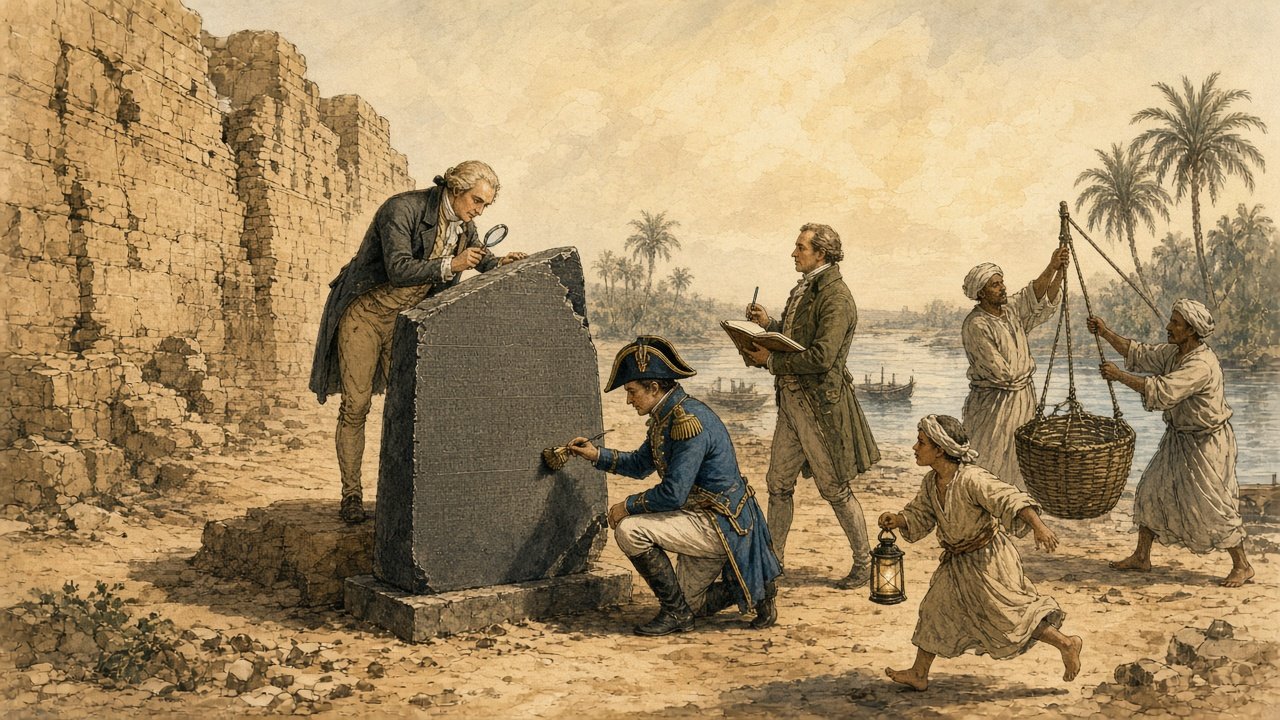
The Rosetta Stone is a fragment of a granite-like stone slab inscribed in 196 BC with a decree issued by a council of Egyptian priests in honour of the king Ptolemy V. Its text is written three times, in two languages and three scripts: Egyptian in hieroglyphs, Egyptian in the cursive script known as demotic, and Greek. Found by French soldiers near the town of Rashid, known to Europeans as Rosetta, in 1799, it passed into British hands in 1801 and has been displayed in the British Museum since 1802. Because the Greek text could be read, the stone offered scholars the opportunity to compare it with the two Egyptian versions, and over the following two decades it became the principal basis for attempts to decipher the Egyptian scripts. The decisive breakthrough was made by the French scholar Jean-François Champollion in 1822, building on earlier work by several others, notably the English physician and physicist Thomas Young. This essay describes the discovery and history of the stone, the content of its inscription, the long process of decipherment and the disputes it provoked, and the later history of the object itself.
Egypt before decipherment
The hieroglyphic script was used in Egypt from about 3200 BC until the end of the fourth century AD. The last known hieroglyphic inscription, carved at the temple of Philae near Aswan, is dated to 24 August 394. The last known demotic inscription, also at Philae, dates from 452. By that time Egypt had been part of the Roman Empire for more than four centuries, and Christianity had become its dominant religion. Egyptian continued to be spoken, but it was written in the Coptic alphabet, an adaptation of the Greek alphabet with several additional letters derived from demotic. Knowledge of how to read the older scripts was lost.
Greek and Roman writers left descriptions of hieroglyphs, but these were based on an incomplete understanding. The most influential was the Hieroglyphica attributed to Horapollo, a text probably composed in the fifth century AD and rediscovered in Europe in the fifteenth century. It explained individual signs as symbols with allegorical meanings, so that, for example, a hawk represented height or the divine, and a goose represented a son. Some of these explanations preserved genuine information about the meanings of particular signs, but they presented the script as a system of symbolic ideas rather than as a means of writing a language. This view shaped European thinking about hieroglyphs for centuries.
During the Renaissance, hieroglyphs were regarded by many scholars as a repository of ancient wisdom. Obelisks brought to Rome in antiquity were re-erected by the popes in the sixteenth century, and their inscriptions attracted attention. The Neoplatonic idea that the Egyptians had expressed philosophical and religious truths in a symbolic script, accessible only to initiates, gave the subject an air of mystery. Attempts to interpret the inscriptions proceeded on this assumption.
Coptic, by contrast, remained in use as a liturgical language of the Egyptian church, and manuscripts in Coptic survived in monasteries. Some European scholars recognised that Coptic was a late form of the ancient Egyptian language. This recognition later proved essential to decipherment, since it meant that the vocabulary and grammar of the language written in hieroglyphs could be approached through a known form of the same language.
Early attempts at interpretation
The German Jesuit scholar Athanasius Kircher, who worked in Rome in the seventeenth century, was the most prominent early student of Egyptian writing. Kircher published a Coptic grammar and vocabulary, the Prodromus Coptus sive Aegyptiacus of 1636 and the Lingua Aegyptiaca restituta of 1643, and argued correctly that Coptic preserved the ancient language of Egypt. His work in this field was a genuine contribution to scholarship. In his interpretations of hieroglyphic inscriptions, however, especially in his multivolume Oedipus Aegyptiacus of 1652 to 1654, he treated the signs as symbols of complex mystical ideas. He offered long translations of short inscriptions that bore no relation to their actual content. A cartouche now known to contain the name of a Roman emperor, for example, was interpreted as a statement about the protection of the divine Osiris. Later scholars regarded his readings as entirely mistaken, although they recognised the value of his Coptic studies.
In the eighteenth century a number of scholars took a more cautious approach. The English bishop William Warburton argued in the 1730s and 1740s that hieroglyphs were not a secret code devised by priests but a form of writing that had developed from pictures and could have been used for ordinary purposes. In 1762 the French scholar Jean-Jacques Barthélemy suggested that the oval rings enclosing groups of signs in hieroglyphic inscriptions, later called cartouches from a French word for a cartridge, might contain the names of kings or gods. The Danish scholar Georg Zoëga, in a study of obelisks published in 1797, supported this view and suggested that some hieroglyphs might have phonetic values, representing sounds rather than ideas. He also observed that the direction in which the signs faced indicated the direction in which the text should be read. These suggestions remained hypotheses without a means of verification.
What was needed was a text in a known language that could be compared with an Egyptian one. The discovery of the Rosetta Stone provided such a text.
The French expedition and its savants
In 1798 the government of the French Republic sent an army under General Napoleon Bonaparte to invade Egypt, which was then a province of the Ottoman Empire governed in practice by the Mamluk military elite. The aims of the expedition included threatening British commercial routes to India, establishing a French presence in the eastern Mediterranean and opening Egypt to French influence. The army landed near Alexandria on 1 July 1798, took the city the following day and defeated the Mamluks at the Battle of the Pyramids near Cairo on 21 July. On 1 August, however, the British fleet under Horatio Nelson destroyed most of the French fleet at anchor in Aboukir Bay, in the Battle of the Nile, leaving the army in Egypt cut off from France.
The expedition was accompanied by a large group of civilian scholars, scientists, engineers and artists, organised as the Commission of Sciences and Arts. It included about 150 members, among them the mathematician Gaspard Monge, the chemist Claude-Louis Berthollet, the naturalist Étienne Geoffroy Saint-Hilaire, the mathematician and physicist Joseph Fourier, the engineer and inventor Nicolas-Jacques Conté, and the artist and writer Dominique Vivant Denon. Many of them were young, recruited from the newly founded École polytechnique and other institutions. They were known collectively as the savants.
In August 1798 Bonaparte founded the Institut d’Égypte in Cairo on the model of the Institut de France. It was divided into sections for mathematics, physics, political economy and literature and the arts, and met regularly to hear papers on subjects ranging from the purification of Nile water and the manufacture of gunpowder to the antiquities of the country. The savants surveyed the land, mapped its cities, studied its flora and fauna, recorded its monuments and documented the customs of its inhabitants. Their work was later published as the Description de l’Égypte, a massive work in many volumes of text and plates issued between 1809 and the late 1820s. Its detailed plates of temples, tombs and inscriptions made Egyptian monuments available to European scholars on a scale not previously possible.
Vivant Denon accompanied the army of General Desaix into Upper Egypt in pursuit of the Mamluk leader Murad Bey and made drawings of the temples of Dendera, Thebes, Edfu and Philae under difficult conditions. His account, Voyage dans la Basse et la Haute Égypte, published in 1802, was widely read and translated, and contributed to a wave of interest in Egypt in France and elsewhere. The work of the savants as a whole laid the foundations for the modern study of Egypt, although it was carried out in the context of a military occupation that the Egyptian population often resisted, as in the Cairo revolt of October 1798.
The discovery at Rashid
The town of Rashid lies on the western branch of the Nile, a few kilometres from the river’s mouth on the Mediterranean coast and some sixty kilometres east of Alexandria. In July 1799 French soldiers were repairing an old fortification north of the town, which they named Fort Julien after an aide-de-camp of Bonaparte killed earlier in the campaign. During the work they found a dark stone slab with inscriptions, apparently built into an old wall. The officer in charge of the work, Lieutenant Pierre-François Bouchard, an engineer, recognised its possible importance and reported the discovery to his commander, General Jacques-François Menou, who was governor of the region.
The exact date of the discovery is not recorded with certainty, and sources give dates in the middle of July 1799. The stone was taken to the Institut d’Égypte in Cairo, where it arrived in August. A notice published in the expedition’s newspaper, the Courrier de l’Égypte, in September 1799 announced the discovery and observed that the stone bore three inscriptions in different characters, of which one was Greek. The notice expressed the hope that the stone would provide a key to the hieroglyphs.
The stone is a fragment of a larger slab, known as a stela. It measures about 112 centimetres in height, 76 centimetres in width and 28 centimetres in thickness, and weighs about 760 kilograms. It is made of granodiorite, a hard igneous rock, and was long described as black basalt. Its upper part is broken away, with the loss of most of the hieroglyphic text, and its lower right corner is also missing, with damage to the end of the Greek text. It was probably originally set up in a temple, perhaps in the town of Sais in the western Delta, and was later reused as building material, a common fate of ancient stones in Egypt.
Members of the Institut immediately recognised that the Greek text might allow the other two to be interpreted. Copies were made by several methods. The printers Jean-Joseph Marcel and Antoine Galland inked the surface of the stone and pressed paper onto it, producing a reversed impression. The engineer Nicolas-Jacques Conté devised a method of making prints from the stone used as a printing surface, and casts were made in sulphur and plaster. These copies were sent to scholars in Paris and elsewhere in Europe, so that work on the inscriptions could begin before the stone itself left Egypt.
From French to British possession
Bonaparte left Egypt secretly in August 1799 to return to France, where he seized power in the coup of 18 Brumaire in November. He left the army under the command of General Jean-Baptiste Kléber, who negotiated an agreement with the British and Ottomans for the evacuation of the French forces, but the agreement was not honoured, and fighting resumed. Kléber was assassinated in Cairo in June 1800, and command passed to Menou, who had converted to Islam and was intent on holding Egypt as a French colony.
In March 1801 a British army under General Sir Ralph Abercromby landed at Aboukir Bay, and an Ottoman army advanced from Syria. Abercromby was mortally wounded in the Battle of Alexandria on 21 March, but the British and Ottoman forces gradually gained the upper hand. The French garrison in Cairo surrendered in June, and Menou, besieged in Alexandria, capitulated at the end of August. The Capitulation of Alexandria, signed in early September 1801, set out the terms of the French withdrawal.
Article 16 of the capitulation required the French to surrender to the British the antiquities and natural history collections gathered by the expedition. The savants protested strongly, and according to later accounts Geoffroy Saint-Hilaire threatened to burn their papers and specimens rather than give them up. A compromise was reached by which the scholars kept their notes, drawings and natural history specimens, while major antiquities were handed over. Menou attempted to claim the Rosetta Stone as his personal property, but the British insisted on its surrender. The stone had been moved to Alexandria and was kept in Menou’s residence or a warehouse when the city fell.
The British officer responsible for taking possession of the stone was Colonel Tomkyns Hilgrove Turner, who later wrote an account of the event. He described how he took it from the French with a detachment of artillerymen and carried it through the streets. The stone was shipped to England on the frigate HMS Égyptienne, itself a captured French vessel, and arrived at Portsmouth in February 1802. It was first taken to the Society of Antiquaries in London, where casts were made and sent to universities in Britain and abroad, and later that year it was placed in the British Museum. Painted on its sides are the inscriptions “Captured in Egypt by the British Army in 1801” and “Presented by King George III”, which record the circumstances of its acquisition.
Other antiquities surrendered under the capitulation included a large stone sarcophagus from Alexandria, then believed to be the tomb of Alexander the Great but later identified as that of the pharaoh Nectanebo II, and several statues and obelisk fragments. These objects formed the nucleus of the Egyptian collection of the British Museum.
The decree of 196 BC
The text inscribed on the stone is a decree issued by a synod of Egyptian priests meeting at Memphis. The Greek version dates it to the fourth day of the month Xandikos in the Macedonian calendar, corresponding to the eighteenth day of the Egyptian month Mecheir, in the ninth year of the reign of Ptolemy V Epiphanes. This corresponds to 27 March 196 BC. The decree was issued on the first anniversary of the king’s coronation at Memphis, which had taken place in the previous year according to Egyptian rites.
Ptolemy V had come to the throne as a child in 204 BC, after the death of his father Ptolemy IV, and his early reign was a period of crisis. Court factions struggled for control of the regency, the Seleucid king Antiochus III took advantage of the situation to conquer the Ptolemaic possessions in Syria and Palestine, and a series of revolts broke out in Egypt itself. Upper Egypt, including Thebes, had been under the control of native rebel kings since about 205 BC, and in the Delta rebels held out in fortified towns. The decree refers to one of these episodes, the siege and capture of the town of Lycopolis in the Busirite nome, where rebels had gathered, and records the punishment of the rebel leaders at the time of the coronation.
The decree belongs to a series of priestly decrees issued under the Ptolemies at meetings of the priesthood. Its structure follows a regular pattern. It opens with a long dating formula listing the king’s titles and the names of the priests of the dynastic cult in Alexandria. It then sets out the benefactions the king had conferred on the temples and the people of Egypt: remission of taxes and debts, release of prisoners, confirmation of temple revenues, reduction of the obligations of the priests, including the requirement to travel to Alexandria each year, gifts to the sacred animals, especially the Apis and Mnevis bulls, restoration of temples and suppression of rebels. In return, the priests resolved to increase the honours paid to the king. A statue of Ptolemy V was to be set up in every temple of Egypt next to the statue of the principal god, with a shrine to be carried in processions, his birthday and accession day were to be celebrated as festivals, and the priests of every temple were to bear the title of priests of the god Epiphanes. The decree ends with the instruction that it should be inscribed on a stela of hard stone in sacred, native and Greek writing and set up in temples of the first, second and third rank beside the statue of the king.
The decree thus illustrates the relationship between the Macedonian monarchy and the Egyptian priesthood. The king depended on the priests for legitimacy among the Egyptian population, and the priests secured privileges and resources in return for honouring the king in traditional Egyptian forms. The final instruction of the decree also explains why the text appears in three versions. Other copies of the same decree have since been found, including fragments from Nubayrah and Elephantine, which have helped scholars to restore the damaged parts of the Rosetta text.
Three scripts and two languages
The three texts on the stone represent two languages. Greek was the language of the Ptolemaic court and administration. Egyptian was the language of the native population and of the temples. The Egyptian version is written twice, in two different scripts.
The upper section is in hieroglyphs, the monumental script of Egypt, used for inscriptions on temples, tombs and monuments. The Greek text calls it the writing of the sacred words, from which the term hieroglyph derives. Only the last fourteen lines survive, all of them incomplete, corresponding to the final part of the decree. The middle section is in demotic, the cursive script used for everyday documents in the Late Period and the Ptolemaic period, which the Greek text describes as the writing of documents or native writing. Thirty-two lines survive, the first of them damaged. The lower section is in Greek, in fifty-four lines, the last of which are damaged at the right side.
The hieroglyphic text uses the language of the classical Middle Egyptian tradition, adapted to the needs of the Ptolemaic period, while the demotic text reflects the contemporary language more closely. Both Egyptian versions were probably composed from a common draft. The Greek text appears to have been the original in some respects, since it follows the conventions of Greek royal decrees, but some passages suggest that the Greek was translated from an Egyptian draft. The question of which version was composed first remains a subject of discussion among specialists.
Demotic had developed from hieratic, a cursive form of hieroglyphs used for writing on papyrus since early in Egyptian history. By the Ptolemaic period demotic had become highly abbreviated, and its signs bear little visual resemblance to the hieroglyphs from which they ultimately derived. This made it difficult for early investigators to recognise the relationship between the two scripts.
The Greek text read
The Greek text was the first part of the inscription to be read. Copies made in Egypt reached Paris in 1800, and the casts made at the Society of Antiquaries were distributed in 1802. The English clergyman and scholar Stephen Weston presented an English translation of the Greek text to the Society of Antiquaries in April 1802. In France, Hubert-Pascal Ameilhon published a Latin and French translation in 1803, and the German classical scholar Christian Gottlob Heyne also worked on the text. Within a few years the Greek version was well understood, apart from the damaged passages, and it provided the sense of the Egyptian texts.
Knowing the content of a text does not, however, allow its scripts to be read directly. The investigators faced several problems. They did not know whether the Egyptian versions were exact translations of the Greek. They did not know whether hieroglyphs represented sounds, words or ideas. They did not know how demotic related to hieroglyphs. They had only a fragment of the hieroglyphic text, which did not correspond to the whole of the Greek. And they had only an imperfect knowledge of the Egyptian language, derived from Coptic, which was more than a thousand years later than the language of the inscription.
De Sacy and Åkerblad
The first serious attempts to read the demotic text were made in 1802. Antoine-Isaac Silvestre de Sacy, the leading French orientalist of his time and a professor of Arabic and Persian in Paris, attempted to identify the proper names in the demotic text by locating groups of signs that corresponded in position and repetition to the names in the Greek text, such as Ptolemy, Alexander and Arsinoe. He identified the probable positions of several names but was unable to establish a consistent set of sound values for the signs, and he abandoned the attempt.
The Swedish diplomat and orientalist Johan David Åkerblad, who had studied Coptic and had travelled in the Near East, took up the problem in the same year. In a published letter addressed to de Sacy in 1802, he identified all the proper names in the demotic text that appear in the Greek and proposed a demotic alphabet of some twenty-nine letters, about half of which were later shown to be correct. He also identified several Egyptian words in the demotic text by comparing them with their Coptic equivalents, including the words for temple, Greek and the pronoun him. Åkerblad assumed, however, that demotic was entirely alphabetic, and this assumption prevented him from making further progress. His work nonetheless demonstrated that the demotic text could be analysed by comparing it with the Greek and with Coptic.
Neither de Sacy nor Åkerblad attempted to read the hieroglyphic text in any detail. The prevailing view was that hieroglyphs were symbolic, and that only demotic, as an everyday script, might be phonetic. It was also generally assumed that demotic was a quite separate script, unrelated in structure to hieroglyphs.
Thomas Young
Thomas Young, born in 1773, was a physician and physicist whose range of interests was exceptional even in an age of wide learning. He had studied medicine in London, Edinburgh, Göttingen and Cambridge and practised as a physician in London. In physics he is best known for his experiments on the interference of light, which provided strong evidence for the wave theory of light, and for his work on the mechanics of elastic materials, commemorated in the quantity known as Young’s modulus. He also made contributions to the physiology of vision, proposing that colour vision depends on three types of receptor in the eye. He had a strong interest in languages, and in a review published in 1813 he coined the term Indo-European for the family of languages that includes most of the languages of Europe and India.
Young began to study the Rosetta Stone in 1814, using a copy of the inscriptions and the published work of Åkerblad and de Sacy. He started by analysing the demotic text, comparing it with the Greek by counting the frequency of words and identifying recurring groups of signs. He was able to divide the demotic text into words and to determine the meaning of many of them by comparison with the Greek, without being able to read them phonetically. He compiled a list of equivalences between demotic groups and Greek words.
Young then made an important observation. He noticed that some demotic signs resembled hieroglyphs, and concluded that demotic was not a separate system but was derived from hieroglyphs through the intermediate stage of hieratic. He realised that demotic contained both phonetic and non-phonetic elements, and that the earlier assumption that it was purely alphabetic was mistaken. He also compared the demotic text with the hieroglyphic text and identified correspondences between groups in the two scripts.
In the hieroglyphic text, Young identified the cartouche containing the name of Ptolemy, which appears several times. Following Barthélemy and Zoëga, he assumed that the cartouche contained a royal name, and that because Ptolemy was a foreign name the Egyptians would have had to spell it out phonetically. He assigned sound values to the signs in the cartouche, some of which were correct, others partly correct and others mistaken. He also identified the name of Berenice, a Ptolemaic queen, in a cartouche from the temple of Karnak, and the feminine ending used in Egyptian names. He believed, however, that phonetic writing was confined to foreign names and that native Egyptian words were written symbolically. He also believed that the phonetic signs were syllabic or partly syllabic.
Young published his conclusions in an article entitled “Egypt” in the supplement to the Encyclopaedia Britannica, which appeared in 1819. The article included a list of more than two hundred hieroglyphic and demotic words with their proposed meanings, of which about a quarter were later shown to be correct, and a hieroglyphic alphabet of thirteen signs, of which several were correct or partly correct. The article was published anonymously, as was usual for the encyclopaedia, but Young’s authorship was known. It represented the most advanced understanding of the Egyptian scripts at that time. Young did not develop his work into a complete system, partly because of his other commitments and partly because of his view that most of the script was non-phonetic.
Champollion’s early life
Jean-François Champollion was born on 23 December 1790 in Figeac, a small town in the Lot region of south-western France, the youngest of seven children of a bookseller. His elder brother, Jacques-Joseph Champollion, twelve years his senior, took responsibility for much of his education and remained his closest supporter throughout his life. Jacques-Joseph later added the name of their birthplace to his own and is known as Champollion-Figeac.
In 1801 Jean-François joined his brother in Grenoble, where Jacques-Joseph worked for a firm of merchants and pursued scholarly interests. The boy was taught at first by a private tutor and then attended the newly founded lycée in Grenoble. He showed early aptitude for languages and studied Latin, Greek and Hebrew, and then Arabic, Syriac, Chaldean and other languages of the Near East. In 1802 the prefect of the department of Isère was Joseph Fourier, the mathematician who had been a member of the Egyptian expedition and secretary of the Institut d’Égypte. Fourier took an interest in the young Champollion, and according to a story later told by Champollion-Figeac, he showed the boy his collection of Egyptian antiquities. Fourier was later responsible for the historical preface to the Description de l’Égypte, and his encouragement is generally regarded as one of the sources of Champollion’s interest in Egypt.
Champollion decided early that he would devote himself to the study of ancient Egypt and that the key to its writing lay in Coptic. In 1807, at the age of sixteen, he presented a paper to the Academy of Grenoble on the geography of Egypt under the pharaohs, based on Coptic, Greek and Arabic sources, and was elected a corresponding member. He then went to Paris, where from 1807 to 1809 he studied at the Collège de France and the School of Oriental Languages. Among his teachers was Silvestre de Sacy, who taught him Arabic and Persian. He also learned Coptic from Egyptian Christians living in Paris, including a priest who had come to France after the expedition, and studied Coptic manuscripts in the Imperial Library. He read Coptic so intensively that, as he wrote to his brother, he began to think in it and talked to himself in the language.
In 1809 Champollion returned to Grenoble, where he was appointed assistant professor of history at the faculty of letters, at the age of eighteen. He continued to work on Coptic, compiling a grammar and a dictionary that were never published in his lifetime, and on the geography of ancient Egypt, publishing L’Égypte sous les pharaons in 1814. His position in Grenoble was affected by the political changes of the period. He and his brother supported Napoleon during the Hundred Days in 1815, and after the second restoration of the Bourbon monarchy they were exiled to Figeac for a time. Champollion later returned to Grenoble and taught at the royal college, but he became involved in liberal politics and in 1821 was accused of participating in an uprising in Grenoble, although he was not formally charged. In July 1821 he moved to Paris to live with his brother.
Champollion’s early work on the scripts
Champollion’s early ideas about the Egyptian scripts were not always correct. For some years he believed that hieroglyphs were primarily symbolic and that they did not represent sounds. In 1821 he published a short work on hieratic in which he showed that hieratic was a cursive form of hieroglyphs, and that the two scripts corresponded sign by sign, but he still described the script as ideographic. He also established, independently of Young or in parallel with him, the relationship between hieratic and demotic.
Champollion’s knowledge of Coptic gave him an advantage over other investigators. He was able to recognise Egyptian words in the demotic and hieroglyphic texts by comparison with their Coptic forms, and he understood the structure of the Egyptian language, its grammar and the forms of its words, in a way that others did not. He also made careful comparisons between the scripts. He counted the signs in the hieroglyphic text of the Rosetta Stone and found that there were 1,419 hieroglyphs in the surviving portion, while the corresponding Greek text contained only 486 words. If each hieroglyph represented a word or idea, the hieroglyphic text would be much longer than the Greek. He concluded that the hieroglyphic script could not be purely ideographic and must contain phonetic signs. He also found that there were only sixty-six distinct signs in the surviving portion, which suggested that individual signs were used repeatedly with consistent values.
The Philae obelisk and Cleopatra
A crucial piece of evidence came from a monument other than the Rosetta Stone. In 1815 the English collector and traveller William John Bankes had acquired a small obelisk from the island of Philae, which was later transported to his estate at Kingston Lacy in Dorset, where it still stands. The Philae obelisk bears a hieroglyphic inscription, and its base, found separately, bears a Greek inscription. The Greek text records a petition by the priests of Philae to Ptolemy VIII and the queens Cleopatra II and Cleopatra III. Bankes noticed that the hieroglyphic text contained two cartouches, one of which resembled the cartouche of Ptolemy on the Rosetta Stone, and he suggested that the other contained the name of Cleopatra. He wrote this suggestion in the margin of a lithograph of the inscriptions, which he circulated in 1821. Copies reached Young and, in January 1822, Champollion.
The names Ptolemy and Cleopatra share several sounds: p, t, o and l. If the hieroglyphs were phonetic, the signs representing these sounds should appear in both cartouches in the appropriate positions. Champollion found that they did. The lion sign that appeared in the fourth position in Ptolemy appeared in the second position in Cleopatra, corresponding to l. The square sign, corresponding to p, appeared first in Ptolemy and fifth in Cleopatra. The loop sign, corresponding to o, appeared in the third position in Ptolemy and the fourth in Cleopatra. The two names used different signs for t, which Champollion correctly explained as two signs with the same sound value. The other signs in the name of Cleopatra gave him values for k, e, a and r. With these values he was able to read other cartouches of Greek and Roman rulers, including Alexander, Berenice, and the Roman titles Caesar and Autokrator.
The Lettre à M. Dacier
Champollion set out his conclusions in a letter addressed to Bon-Joseph Dacier, the permanent secretary of the Académie des Inscriptions et Belles-Lettres in Paris. The Lettre à M. Dacier relative à l’alphabet des hiéroglyphes phonétiques was dated 22 September 1822 and read before the Académie on 27 September. Thomas Young, who was in Paris at the time, was present at the reading and met Champollion there. The letter was published later in the same year with plates.
In the letter Champollion presented a table of phonetic hieroglyphs and their demotic equivalents, which he described as an alphabet. He demonstrated its application to the names of the Greek and Roman rulers of Egypt found on monuments, and he showed that these phonetic signs were used in a consistent way. The letter was cautious in its claims. Champollion presented the phonetic hieroglyphs as a system used for writing foreign names in the Greek and Roman periods, and stated only towards the end that he believed the phonetic principle had been used by the Egyptians at earlier periods to write native names and words. He did not yet present a full account of the script.
The letter has nonetheless come to be regarded as the founding document of modern Egyptology. It established, on the basis of systematic evidence, that hieroglyphs included phonetic signs, and it provided a method by which further signs could be identified.
Ramesses and Thutmose
The extension of the phonetic principle to native Egyptian names came from a different set of evidence. Shortly before the reading of the letter, in September 1822, Champollion received copies of inscriptions from temples in Egypt and Nubia, including the temple of Abu Simbel, made by the architect Jean-Nicolas Huyot. Among them were cartouches of a kind he had not previously examined, from monuments much earlier than the Ptolemaic period.
In one cartouche Champollion found a sign in the form of a disc, which he identified with the sun. In Coptic the word for sun was re or ra. The cartouche also contained a sign he had identified as having the value s, which appeared twice at the end, and between the disc and the s signs a sign resembling three hanging strokes, which he associated with the Coptic word mise, meaning to give birth. He read the name as Ra-mes-ses, the Ramesses of Greek historians. In another cartouche, an ibis sign, representing the god Thoth, was followed by the same signs, which he read as Thoth-mes, Thutmose, the name of another dynasty of kings known from the Greek historian Manetho.
These readings showed that phonetic signs were used in native Egyptian names at an early period and that they could be combined with signs representing whole words or ideas. According to a story recorded later, apparently on the basis of an account by Champollion-Figeac, Champollion ran to his brother’s office at the Institut, exclaimed that he had found the solution, and then collapsed and remained unconscious for several days. The story became famous, though its details may have been embellished in the retelling.
The Précis of 1824
Champollion developed his conclusions over the following eighteen months and published them in the Précis du système hiéroglyphique des anciens Égyptiens in 1824. This work set out the principles of the Egyptian writing system in a form that is recognisably close to the modern understanding. Champollion now stated that the hieroglyphic script was a complex system, at once figurative, symbolic and phonetic, within the same text, the same sentence and even the same word.
He showed that hieroglyphic writing used signs of three kinds. Phonetic signs represented sounds, either single consonants or groups of consonants. Ideographic signs, now often called logograms, represented whole words. Determinatives, signs placed at the end of a word, indicated the category of meaning to which the word belonged, such as a man, a woman, a god, a building or an action, without being pronounced. He demonstrated that the Egyptians did not write vowels in most cases, as in other scripts of the Near East such as Hebrew and Arabic. He also explained that phonetic signs had been derived from the initial sounds of the words for the objects they represented, a principle he called acrophony, although later scholars have shown that this applies to only some signs.
The Précis applied these principles to a large number of words and names, including the names and titles of gods, kings and officials, and to grammatical forms that Champollion was able to identify through Coptic. It also showed that hieroglyphs were used to write ordinary texts in the Egyptian language, not only names. In this respect it went far beyond the position of Young and of Champollion’s own earlier work.
Modern Egyptologists describe hieroglyphic writing in terms that build on Champollion’s system. Signs are divided into uniliteral signs, representing one consonant, of which there are about twenty-four; biliteral and triliteral signs, representing two or three consonants; logograms; and determinatives. Phonetic complements, uniliteral signs added to help in the reading of multiliteral signs, are also recognised. The overall framework, however, is that of the Précis.
The priority dispute
The question of how much Champollion owed to Young became a matter of public dispute soon after the publication of the Lettre à M. Dacier. In 1823 Young published An Account of Some Recent Discoveries in Hieroglyphical Literature and Egyptian Antiquities, with the subtitle Including the Author’s Original Alphabet, as Extended by Mr. Champollion. In it he argued that his own work had established the principles of phonetic writing that Champollion had then applied, and that his priority should be acknowledged.
Champollion replied in the Précis, where he rejected the idea that he had extended Young’s alphabet. He acknowledged that Young had been the first to propose phonetic values for some hieroglyphs in the cartouche of Ptolemy, but he argued that he had reached his own conclusions independently and that Young’s values were in many cases mistaken. He also emphasised that Young had considered phonetic writing to be limited to foreign names and had not recognised the system as a whole. Champollion-Figeac supported his brother’s position vigorously, and the dispute took on a national character, with British writers generally supporting Young and French writers Champollion.
Historians of decipherment have since examined the evidence in detail. It is generally accepted that Young made important contributions: he recognised that demotic was derived from hieroglyphs, that demotic contained phonetic elements and that the cartouches contained names written partly phonetically, and he correctly identified some sound values. It is also accepted that Champollion knew Young’s work, at least in part, before 1822, although the extent of his debt is debated. Champollion’s decisive contributions were his recognition that phonetic signs were used throughout the script and not only in foreign names, his use of Coptic to identify words and grammar, and his construction of a coherent system that could be applied to any text. These were achievements that Young’s approach did not lead to.
Relations between the two men were more courteous in private than the public dispute suggests. Young met Champollion in Paris in 1822 and later corresponded with him, and Champollion assisted Young by giving him access to demotic documents in the Louvre. Young continued to work on demotic until his death in 1829, and his demotic dictionary was published posthumously in 1831. Many historians now present the decipherment as the result of contributions by several scholars, with Champollion’s work as the decisive step.
Champollion’s conclusions were also contested by other scholars on different grounds. Some, including de Sacy for a time, were cautious. Others, such as the German scholar Gustav Seyffarth, proposed alternative systems and attacked Champollion’s results throughout the 1820s and 1830s. Seyffarth argued that hieroglyphs were syllabic and that Champollion’s readings were mistaken. These rival systems did not survive, but they delayed general acceptance of Champollion’s work, especially in Germany.
The role of Coptic
The importance of Coptic to the decipherment can hardly be overstated. Coptic is the last stage of the Egyptian language, written in an alphabet based on Greek with several additional letters derived from demotic for sounds that Greek lacked. It developed in the first centuries AD and became the language of Egyptian Christianity. After the Arab conquest of Egypt in the seventh century, Arabic gradually replaced Coptic as the spoken language, and by the early modern period Coptic survived mainly as a liturgical language of the Coptic Church. Manuscripts of Coptic texts, together with grammars and word lists compiled by Egyptian scholars in Arabic during the Middle Ages, had been brought to Europe from the seventeenth century onwards.
Because Coptic is written with vowels, it provides information about the pronunciation of Egyptian that the earlier scripts do not record. Because it descends directly from the language of the hieroglyphic inscriptions, many of its words can be traced back to words in earlier texts. Kircher had already argued that Coptic was the descendant of the ancient Egyptian language, and Barthélemy and Zoëga had made use of it. Champollion went further than any of his predecessors in mastering it, and he used it constantly to suggest the readings and meanings of Egyptian words. The readings of Ramesses and Thutmose depended on recognising Coptic words for sun and birth, and much of his grammatical analysis in the Précis and the Grammaire rested on comparison with Coptic forms.
The relationship is nonetheless not straightforward. More than two thousand years separate the earliest hieroglyphic texts from the earliest Coptic texts, and the language changed considerably in grammar, vocabulary and pronunciation during that period. Some of Champollion’s errors arose from applying Coptic forms too directly to earlier texts. Later scholars, by distinguishing the successive phases of the language, were able to use Coptic more precisely as one source among several.
Reading the hieroglyphic text of the stone
The hieroglyphic section of the Rosetta Stone illustrates the features of the script that Champollion described. The text is written in horizontal lines read from right to left, the direction indicated by the way the signs representing people and animals face, which is towards the beginning of the line. The name of the king is enclosed in a cartouche, an oval ring representing a loop of rope, which marked royal names. In the Rosetta text the cartouche of Ptolemy V includes not only the name itself but also epithets, which read in translation as living for ever, beloved of Ptah. Young had noticed that the cartouche occurs in a longer and a shorter form and had correctly concluded that the additional signs represented titles.
The hieroglyphs of the Ptolemaic period differ in several respects from those of earlier periods. The priestly scribes of this time expanded the repertoire of signs considerably and used many signs with new or additional values, so that Ptolemaic inscriptions on temple walls, such as those at Edfu and Dendera, are among the most difficult Egyptian texts to read. The Rosetta text is less elaborate than the temple inscriptions, but it contains some unusual spellings and signs. Because its hieroglyphic version is fragmentary and uses the conventions of its period, it is not a straightforward guide to the script of earlier periods, and Champollion’s decipherment depended on the comparison of many texts.
The three versions of the decree also differ in detail. The demotic version, which is the best preserved of the Egyptian texts, is generally considered to be closer to the language that the priests actually used, while the hieroglyphic version translates the decree into the traditional language of monumental inscriptions. Comparing the versions has allowed scholars to study how the Egyptian priesthood rendered Greek administrative and legal concepts in Egyptian and how royal ideology was expressed in the two cultures. The restoration of the lost portions of the hieroglyphic text has depended on the other copies of the decree and on the parallel texts of the Canopus Decree and of a later decree of Raphia, issued under Ptolemy IV.
Modern translations of all three versions have been published, and the text has been studied in detail by philologists working on Ptolemaic Egypt. These studies have shown that the decree is a valuable historical source for the reign of Ptolemy V, for the relationship between the crown and the temples, and for the administration of Egypt in the early second century BC, quite apart from its role in the decipherment.
Turin and the Louvre
After the publication of the Précis, Champollion turned to the study of original Egyptian documents in European collections. The most important collection at that time was in Turin, where the King of Sardinia had acquired the collection assembled in Egypt by Bernardino Drovetti, a former French consul. Champollion went to Turin in 1824 and spent several months studying the collection, which included statues, stelae and a large number of papyri. Among them was the papyrus now known as the Turin King List or Turin Canon, a list of Egyptian kings with the lengths of their reigns, compiled in the Ramesside period. The papyrus was badly fragmented, and Champollion recognised its importance for Egyptian chronology. His work in Turin also allowed him to study hieratic texts in quantity and to confirm that his system could be applied to them.
Champollion also visited collections in Livorno, Rome, Naples and Florence. In 1826, with the support of the Duc de Blacas, he was appointed curator of the new Egyptian collection in the Louvre, created by King Charles X. He advised on the purchase of the collection of Henry Salt, the British consul-general in Egypt, which formed the core of the Louvre’s Egyptian department, and he arranged the galleries and wrote a catalogue of the collection.
The Franco-Tuscan expedition
Champollion had never been to Egypt, and he was eager to examine the monuments in their original setting and to test his system on inscriptions in situ. In 1828, with the support of the French government and Grand Duke Leopold II of Tuscany, he organised an expedition to Egypt and Nubia jointly with the Italian scholar Ippolito Rosellini, a professor at Pisa who had become his pupil. The expedition included artists and architects, among them Nestor L’Hôte, who made drawings of the monuments.
The expedition arrived at Alexandria in August 1828 and travelled up the Nile, visiting the pyramids and tombs near Memphis, Beni Hasan, Dendera, Thebes, Esna, Edfu and Philae, and continuing into Nubia as far as Wadi Halfa and the second cataract. On the return journey the members spent several months at Thebes, where they studied the temples of Karnak and Luxor and the tombs in the Valley of the Kings. Champollion copied and read inscriptions on a large scale and found that his system worked. In a letter from Wadi Halfa written on 1 January 1829 he wrote that he could state that there was nothing to modify in his letter on the hieroglyphic alphabet, and that the alphabet applied equally to the monuments of the Roman period and those of the pharaohs.
The expedition also had consequences of other kinds. Champollion removed some objects from the monuments for the Louvre, including a relief from the tomb of Seti I in the Valley of the Kings, and Rosellini took material for Florence. These removals are now seen in the context of the extensive removal of antiquities from Egypt in the period. At the same time, Champollion expressed concern at the destruction of monuments for building materials and industrial use. In a note submitted to Muhammad Ali, the ruler of Egypt, he recommended measures to protect the monuments, and in 1835 Muhammad Ali issued an ordinance restricting the export of antiquities, although it was not effectively enforced for many years.
The expedition returned to France in December 1829. Champollion’s letters from Egypt were published, and the results were published in Champollion’s Monuments de l’Égypte et de la Nubie, which appeared after his death, and in Rosellini’s I monumenti dell’Egitto e della Nubia, published from 1832 to 1844.
Last years and posthumous works
In 1830 Champollion was elected a member of the Académie des Inscriptions et Belles-Lettres. In 1831 a chair of Egyptian archaeology was created for him at the Collège de France, and he gave his inaugural lecture in May of that year. His health, however, had been declining, perhaps as a result of the conditions of the journey, and he suffered a series of strokes. He died in Paris on 4 March 1832, at the age of forty-one, and was buried in the Père Lachaise cemetery.
Much of his work remained unpublished at his death. His brother Champollion-Figeac edited and published his Grammaire égyptienne in parts between 1836 and 1841, and his Dictionnaire égyptien en écriture hiéroglyphique between 1841 and 1843. The grammar was the first systematic grammar of the Egyptian language in its hieroglyphic form. It contained errors and was soon superseded, but it showed that hieroglyphic texts could be analysed grammatically and translated.
Lepsius and the confirmation of the system
After Champollion’s death, his system was not universally accepted, and opponents such as Seyffarth continued to dispute it. The decisive confirmation came from the work of the German scholar Karl Richard Lepsius. Lepsius, born in 1810, had studied philology at Leipzig, Göttingen and Berlin and then turned to Egyptology, working in Paris and Italy on Champollion’s publications and on Egyptian collections.
In 1837 Lepsius published a letter addressed to Rosellini in which he examined Champollion’s system and corrected one of its main weaknesses. Champollion had treated many signs that represent two or three consonants as if they represented single sounds, and his alphabet therefore contained too many signs. Lepsius distinguished between signs representing one consonant and signs representing groups of consonants, and he clarified the role of phonetic complements. He also confirmed that the Egyptian writing system generally did not write vowels. These corrections placed Champollion’s system on a firmer foundation.
From 1842 to 1845 Lepsius led a Prussian expedition to Egypt and Nubia, sponsored by King Frederick William IV, which recorded monuments throughout the Nile Valley and as far south as Meroe. The results were published in the twelve volumes of the Denkmäler aus Ägypten und Äthiopien, one of the largest publications of Egyptian monuments, which is still consulted. Lepsius later became professor of Egyptology at Berlin and director of the Egyptian Museum there, and he made important contributions to Egyptian chronology.
The final confirmation of the decipherment came in 1866, when Lepsius discovered a second bilingual inscription at Tanis in the eastern Nile Delta. The Canopus Decree, issued by a synod of priests at Canopus in 238 BC under Ptolemy III Euergetes, is inscribed on a limestone stela in hieroglyphs, demotic and Greek, and, unlike the Rosetta Stone, it is complete. The decree honours Ptolemy III and Queen Berenice II, establishes a cult for their deceased daughter Berenice, and introduces a reform of the calendar by adding an extra day every four years, which was not adopted at the time. Egyptologists were able to read the hieroglyphic text of the Canopus Decree by means of Champollion’s system and to verify their reading against the Greek. The result showed that the system was correct and removed any remaining serious doubts. Further copies of the Canopus Decree were later found, and it is now held, along with other copies, in the Egyptian Museum in Cairo.
The development of Egyptology
The decipherment opened Egyptian history to direct study. Before Champollion, knowledge of ancient Egypt depended on Greek and Latin writers and on the Hebrew Bible. After the decipherment, the inscriptions and papyri of Egypt could be read in their original language, and Egyptian history could be reconstructed from Egyptian sources. Over the following decades scholars published grammars, dictionaries and editions of texts. The German scholar Heinrich Brugsch worked extensively on demotic, which had been relatively neglected after Champollion and Young, and established its study on a systematic basis. The French scholar Emmanuel de Rougé translated substantial texts and contributed to the understanding of Egyptian grammar. In the later nineteenth century, Adolf Erman and his colleagues in Berlin established the study of the historical phases of the Egyptian language, distinguishing Old, Middle and Late Egyptian, and began work on the great dictionary of the Egyptian language, the Wörterbuch der ägyptischen Sprache, published from 1926 to 1931.
Field archaeology also developed in this period. Auguste Mariette founded the Egyptian Antiquities Service in 1858 and the museum that later became the Egyptian Museum in Cairo. Flinders Petrie introduced methods of systematic excavation and recording. Egyptian scholars, including Ahmed Kamal in the late nineteenth and early twentieth centuries, took part in the development of the discipline, and Egyptology in Egypt itself expanded considerably in the twentieth century.
The decipherment also became a model for later decipherments. The cuneiform scripts of Mesopotamia were deciphered in the mid-nineteenth century, partly with the help of the trilingual Behistun inscription of the Persian king Darius I, in a process often compared to the work on the Rosetta Stone. The Mycenaean Linear B script was deciphered by Michael Ventris in 1952, and progress on Maya writing in the later twentieth century also depended on recognising that a script combined phonetic and logographic elements, the principle that Champollion had established for Egyptian.
The stone in the British Museum
The Rosetta Stone has been on display in the British Museum almost continuously since 1802. It was originally placed in a temporary structure and then, from 1834, in the new Egyptian Sculpture Gallery. In 1917, during the First World War, when there were fears of air raids on London, the Museum moved its most important objects to places of safety. The Rosetta Stone was taken, together with other objects, to a station of the Postal Tube Railway at Holborn, fifty feet below ground, where it remained until 1919. During the Second World War it was again moved for safety, along with other collections.
The stone’s appearance changed over time. In the nineteenth century the inscriptions were filled with white chalk to make them more legible, and the surface was covered with a layer of carnauba wax to protect it from visitors’ hands. In 1999 the stone was cleaned and the wax removed, revealing its original dark grey colour with a pink vein, and it is now displayed in a glass case. It is one of the most visited objects in the Museum. In 1972, on the 150th anniversary of the Lettre à M. Dacier, the stone was lent to the Louvre for an exhibition in Paris, the only occasion on which it has left the British Museum in modern times.
Requests for restitution
The ownership of the Rosetta Stone has been the subject of public discussion, part of a wider debate about the return of cultural objects acquired in the colonial period. The stone was acquired by the British under the terms of the Capitulation of Alexandria in 1801, an agreement between British and French forces at the end of the French occupation of Egypt. Egypt itself was then a province of the Ottoman Empire, and no Egyptian authority was a party to the agreement.
Egyptian officials and scholars have raised the question of the stone’s return on several occasions. Zahi Hawass, then secretary-general of Egypt’s Supreme Council of Antiquities, called in the early 2000s for its return, initially requesting a loan for the opening of the Grand Egyptian Museum near Giza, and later stating that the stone should be returned permanently. In 2022, the bicentenary of the decipherment, a petition organised by Egyptian archaeologists, including the Egyptologist Monica Hanna, called for the stone to be returned to Egypt and gathered many thousands of signatures. Supporters of return argue that the stone is an important part of Egypt’s cultural heritage, that it was removed without the consent of the Egyptian people as a spoil of war between two foreign powers, and that Egypt now has museums capable of displaying and conserving it.
The British Museum has stated that it has not received a formal request for the stone’s return from the Egyptian government, and that the stone was acquired under a legal agreement of the time. The Museum is governed by the British Museum Act of 1963, which restricts the trustees’ ability to remove objects from the collection permanently. The Museum has argued that its collection allows visitors to see the cultures of the world together, and has pointed to its cooperation with Egyptian institutions, including training programmes and research partnerships. A replica of the stone is on display in Rashid, and other replicas exist in Egypt and elsewhere, including one at Figeac, where a large reproduction of the inscription forms the floor of a courtyard near the museum devoted to Champollion.
The debate concerns legal title, historical circumstances, the purpose of universal museums and the relationship between countries of origin and collections elsewhere. The positions of the parties remain different, and the question of the stone’s future has not been resolved.
Legacy
The Rosetta Stone and Champollion’s decipherment occupy a particular place in the history of scholarship. The stone was the starting point of the decipherment and provided the essential bilingual evidence, although Champollion’s work drew on many other inscriptions and documents, and the decisive steps were taken using material from Philae and Abu Simbel as well. The name of the stone has become a common term for any key that unlocks the understanding of something previously obscure.
Champollion is commemorated in France and elsewhere. The house in Figeac where he was born is now a museum devoted to writing systems, the Musée Champollion, Les Écritures du Monde. A statue by Bartholdi stands in the courtyard of the Collège de France, and a street and a lycée bear his name in many French towns. His Egyptian collection forms part of the Louvre, and his notebooks and drawings are held in the Bibliothèque nationale de France. Young is commemorated in Westminster Abbey, where his memorial describes him as the first to penetrate the obscurity which had veiled for ages the hieroglyphs of Egypt, a formula that reflects the long-standing British view of the decipherment.
The decipherment transformed the study of ancient Egypt from a field dependent on outside testimony into one based on its own written sources. It showed that the Egyptian script, long regarded as a symbolic code of hidden wisdom, was a working writing system that recorded a language, combining signs for sounds with signs for words and meanings. The texts that could now be read included royal inscriptions, religious literature, administrative records, letters, stories and teachings, giving a picture of Egyptian society over more than three thousand years.