The Huang Chao Rebellion and the End of the Tang Aristocracy
In the twelfth lunar month of the first year of the Guangming era (January 881 CE), the cold winter wind howling through the Danfeng Gate of Chang’an (长安) carried not the customary temple incense or the fragrance of court perfumes, but the stench of smoldering timber, terror, and blood. Astride a magnificent black charger, draped in robes of imperial yellow and flanked by thousands of wild-eyed, battle-hardened cavalrymen brandishing bloodstained halberds, rode an unlikely conqueror: Huang Chao (黄巢, c. 835–884 CE). For decades, Huang Chao had been known only as a wealthy illicit salt smuggler from the muddy marshlands of Shandong, and later as a bitter, twice-failed candidate in the imperial civil service examinations. Now, having marched his rebel host tens of thousands of miles across the length and breadth of China—from the Yellow River down to the subtropical maritime port of Guangzhou and back again—the salt trader entered the supreme palace of the Great Tang as an avenging angel of doom.
Days earlier, the petrified eighteen-year-old monarch of the Tang Empire, Emperor Xizong (唐僖宗, Li Xuan 李儇, r. 873–888 CE), accompanied only by a few weeping concubines and an escort of palace eunuchs, had abandoned his capital under cover of darkness, fleeing in terror through the frozen Qinling mountain passes toward the sanctuary of Chengdu in Sichuan. Ascending the elevated dais of the Taiji Palace, Huang Chao proclaimed the eradication of the Tang and the founding of a new dynasty: the Great Qi (大齐, Da Qi). What followed over the next three years within the walls of Chang’an and across the Central Plains was not merely the sacking of a capital; it was the apocalyptic, physical extermination of an entire social class that had ruled China for half a millennium: the medieval Chinese aristocracy (门阀世族).
From the Northern Wei and the Six Dynasties through the glorious centuries of the Sui and Tang, Chinese society, politics, and high culture had been dominated by an exclusive, proud oligarchy of great aristocratic lineages: the venerable Guanlong military clans (关陇集团) and the prestigious ‘Four Surnames’ of Shandong (山东四姓: Cui 崔, Lu 卢, Zheng 郑, Wang 王). These illustrious families guarded their pedigrees in sacred genealogical registers, monopolized the highest chancellorships, intermarried exclusively among themselves, and viewed commoners and provincial military men with aristocratic disdain. Huang Chao’s ragged, peasant-smuggler armies tore through this ancient social order with psychotic fury. Aristocratic mansions along the grand avenues of Chang’an were plundered and put to the torch; prime ministers, dukes, and high-born maidens were dragged into public squares and butchered by the thousands; family genealogical scrolls that had preserved four centuries of noble bloodlines were trampled into the mud.
This comprehensive treatise presents an exhaustive investigation into the Huang Chao Rebellion (874–884 CE) and the permanent, catastrophic destruction of the Tang aristocratic order. We will analyze the structural origins of the uprising in the oppressive imperial salt monopoly (榷盐制) and the ecological collapses of late ninth-century Henan; explore Huang Chao’s psychological transformation from an aggrieved scholar-smuggler into a genocidal warlord, examining his prophetic masterpiece Ode to the Chrysanthemum (赋菊); trace the unprecedented, continental trajectory of the roving rebel host as it marched across the empire and sacked Guangzhou; examine the reign of terror within fallen Chang’an as immortalized in Wei Zhuang’s (韦庄) harrowing epic poem The Lament of the Lady of Qin (秦妇吟); investigate the unspeakable human atrocities of the siege of Chenzhou and the rebel ‘human grinding mills’ (舂磨砦); reconstruct the military turning point catalyzed by the defection of Zhu Wen (朱温) and the intervention of the Shatuo Turkic cavalry under Li Keyong (李克用); and trace the final, gruesome conclusion of the aristocracy at the Baima Station Massacre (白马驿之祸) in 905 CE—an event that permanently closed the book on medieval Chinese aristocratic society and cleared the ashes for the dawn of the Song Dynasty.
1. The Salt Smuggler’s World: The Gabelle and the Agrarian Catastrophe
To understand the genesis of the Huang Chao catastrophe, one must look not to the halls of philosophy, but to the everyday kitchen cooking pots of Chinese peasant households. Following the apocalyptic devastation of the An Lushan Rebellion (755–763 CE), the central treasury of the Tang Dynasty was in permanent, structural ruins. With regional military governors (Jiedushi) across Hebei and Henan seizing local land taxes and refusing to remit revenues to the throne, the imperial court became desperately dependent on a single, aggressive fiscal mechanism: the Imperial Salt Monopoly (榷盐制, Queyan Zhi).
Engineered by the financial genius Liu Yan (刘晏) in the late eighth century, the state seized exclusive control over all salt production along coastal brine-pans and inland salt lakes. The government purchased salt from hereditary salt-producers at cost, added an astronomical state excise tax, and sold it to licensed private merchants for nationwide distribution. While this policy saved the Tang state from immediate bankruptcy—generating more than half of the entire national tax revenue by the early ninth century—it created immense, unbearable structural distortions:
- Astronomical Retail Inflation: Salt was an absolute biological necessity for human and livestock survival. Under late Tang imperial monopolies, the retail price of salt skyrocketed to more than thirty to forty times its production cost. In many impoverished interior counties, a single pint of state salt cost several hundred copper coins, forcing millions of impoverished peasant families to consume flavorless, unsalted food, resulting in chronic goiters, physical exhaustion, and malnutrition.
- The Rise of Militarized Illicit Smuggling Networks: The immense profit margins between production cost and monopolistic retail price spawned a vast, heavily armed shadow economy: Illicit Salt Smuggling (私盐). Smuggling syndicates mobilized thousands of armed outlaws, boatmen, and martial artists who transported black-market salt along hidden riverways and mountain trails, undercutting state prices by half. These syndicates operated with private armies, fortified warehouses, and underground fraternal oaths, engaging in perpetual, bloody guerilla warfare against imperial salt police.
- The Imperial Penal Terror: To protect state revenues, the Tang Code codified horrific penalties for salt smuggling. Anyone caught in possession of more than a single peck (dou) of contraband salt faced mandatory execution; entire villages were frequently massacred by corrupt imperial salt inspectors on the mere suspicion of harboring black-market traders.
Huang Chao was born directly into the elite royalty of this violent, lucrative underworld. Hailing from Caozhou (曹州, modern Heze, Shandong), the Huang lineage had operated the most powerful illicit salt smuggling syndicate in northeastern China for three generations. Huang Chao was exceedingly wealthy, possessed vast private armories, and commanded hundreds of mounted retainers. His ancestors had accumulated millions of strings of copper coin by running armed caravans of black-market salt across Henan, Shandong, and the Huai River basin, protected by private crossbowmen who regularly ambushed imperial customs posts. Yet unlike ordinary rural bandits who sought only localized plunder, Huang Chao was educated: he was trained in archery, horsemanship, and swordplay, while studying classical literature and Confucian statecraft, nursing a burning personal ambition to achieve legitimacy by entering the prestigious imperial bureaucracy through the civil service examinations.
The contradiction between his staggering material wealth and his despised social status as an outlaw merchant ate away at Huang Chao’s soul. In Tang society, merchants occupied the lowest tier of the classical Confucian four-class hierarchy (士农工商, Shi-Nong-Gong-Shang). Even the wealthiest trader was legally prohibited from riding in silk carriages or wearing high hats. For a proud, brilliant man who commanded hundreds of armed warriors and possessed private fortunes that dwarfed those of provincial governors, the disdain of the aristocratic scholar-officials was an intolerable insult that festered into venomous class hatred.
2. The Snubbed Scholar: Huang Chao and the Ode to the Chrysanthemum
In the late 860s and early 870s, Huang Chao journeyed to Chang’an to sit for the imperial Jinshi (进士) examinations. In the twilight decades of the Tang, however, the examination hall was no longer an open meritocracy. The civil service system had become thoroughly corrupted by nepotism, bribery, and the exclusive patronage of entrenched aristocratic clans. High-ranking examiners routinely sold passes to the dim-witted sons of chancellors and ministers, while brilliant candidates from humble or commercial backgrounds were systematically failed. To the proud aristocratic examiners of Chang’an, a provincial salt merchant from Shandong—regardless of his literary talent—was a vulgar, criminal interloper who had no place in the sacred halls of state.
Huang Chao failed the examinations repeatedly. Returning to his lodgings in Chang’an after his final humiliating rejection, his heart consumed by volcanic bitterness and humiliation, the thirty-something smuggler composed a short, terrifying poem that would become one of the most chilling literary portents in Chinese history: Ode to the Chrysanthemum After Failing the Examination (不第后赋菊):
「待到秋来九月八,我花开后百花杀。
— Huang Chao (黄巢), Ode to the Chrysanthemum After Failing the Examination (不第后赋菊)
冲天香阵透长安,满城尽带黄金甲!」
‘When autumn arrives on the eighth day of the ninth month,
After my flower blooms, all other hundred flowers shall be slaughtered!
A soaring fragrant battle-line shall pierce through Chang’an,
And the entire city shall be clad in golden armor!’
In traditional Chinese aesthetic symbolism, the chrysanthemum was the emblem of the gentle, reclusive hermit, celebrated by Tao Yuanming for its quiet endurance amidst winter frost. In Huang Chao’s hands, the autumn blossom was transformed into a violent, militant weapon of destruction. The ‘hundred flowers’ (百花) symbolized the delicate, effete, silk-wearing aristocrats of the imperial capital; the ‘soaring fragrance’ was the smell of rebel blood and smoke; and the ‘golden armor’ (黄金甲) was the yellow uniforms of his coming peasant legions marching to butcher the ruling class. Stripped of any illusion of joining the system, Huang Chao returned to Shandong, determined to burn the empire to the ground.
In another companion poem, simply titled Ode to the Chrysanthemum (赋菊), Huang Chao revealed his supreme, megalomaniacal conviction that Heaven had appointed him to overthrow the existing cosmic hierarchy:
「百花发时我不发,我若发时都吓杀。
— Huang Chao (黄巢), Ode to the Chrysanthemum (赋菊)
要与西风战一场,遍身穿就黄金甲!」
‘When the hundred flowers bloom, I do not bloom;
Yet when I bloom, they shall all be frightened to death!
I shall fight a grand battle against the western wind,
My entire body clad in armor of pure gold!’
These were not the verses of a desperate peasant seeking a bowl of grain; they were the apocalyptic battle cries of an intellectual outlaw who had diagnosed the rot of the dynastic state and resolved to wipe out its ruling class in an ocean of blood.
3. The Spark Detonates: The Roving Rebel Horde (874–879 CE)
The cosmic catalyst for rebellion arrived in 873–874 CE. A series of catastrophic droughts struck the Central Plains between the Yellow and Huai rivers, followed by biblical swarms of locusts that devoured every green blade of wheat and grass. Millions of peasants were reduced to boiling tree bark, digging up poisonous roots, and eating human flesh. Yet despite the nationwide famine, imperial tax collectors, pressured by the corrupt, polo-playing boy-emperor Xizong, flogged starving farmers to extract full grain taxes and salt monopoly payments.
In 874 CE, a fellow illicit salt smuggler, Wang Xianzhi (王仙芝), raised the banner of rebellion at Changyuan in Henan. Thousands of starving peasants, displaced canal boatmen, and outlaw smugglers flocked to his standard. Months later, Huang Chao mobilized several thousand armed horsemen in Caozhou and joined forces with Wang Xianzhi. Together, their rebel army swelled within months to over one hundred thousand men.
Unlike earlier peasant rebellions—such as the Yellow Turbans or the Sui Dynasty uprisings—which sought to seize and hold permanent territorial base areas, the Huang Chao rebellion adopted a radical, fluid operational doctrine: the Roving Bandit Strategy (流寇主义, Liukou Zhuyi). The rebels established no fixed bases, held no defensive perimeter, and maintained no supply lines. Instead, they functioned as a colossal, migrating human avalanche. Living off the land, they swept across provinces, stormed county seats, looted government granaries, slaughtered imperial officials, distributed food to local starving mobs, recruited tens of thousands of desperate peasants, and moved on before imperial field armies could encircle them.
When Wang Xianzhi was killed in battle by Tang general Zeng Yuanying in 878 CE, the surviving rebel host gathered around Huang Chao, acclaiming him as their supreme monarch with the title ‘Heaven-Soaring Grand General of the Roving Host’ (冲天大将军). Huang Chao recognized that imperial garrisons in Henan and Shanxi were too dense for open confrontation. Displaying astonishing strategic boldness, he wheeled his colossal army southward, marching thousands of miles through Jiangxi, Fujian, and Guangdong, heading toward the richest commercial prize in East Asia: the great maritime trade metropolis of Guangzhou (Canton).
4. The Sacking of Guangzhou: The International Massacre of 879 CE
In the ninth lunar month of 879 CE, Huang Chao’s army descended upon the subtropical seaport of Guangzhou. Guangzhou was the glittering southern terminal of the Maritime Silk Road—a wealthy, cosmopolitan metropolis where tens of thousands of foreign Muslim, Persian, Arab, Jewish, Nestorian Christian, and Indian merchants resided in extraterritorial communities (Fanfang 蕃坊), trading in frankincense, spices, pearls, ivory, and silk.
Huang Chao initially demanded that the imperial court grant him the official governorship of Guangzhou. When Emperor Xizong haughtily rejected the smuggler’s petition, Huang Chao ordered an all-out assault. The city walls were breached in a single day. What followed was a catastrophic, xenophobic pogrom that shocked the medieval civilized world.
The contemporary Arab traveler and chronicler Abu Zaid al-Sirafi, in his travelogue Accounts of China and India (Silsilat al-Tawarikh), recorded the horrifying scale of the massacre based on the eyewitness accounts of merchant survivors:
‘Huang Chao took possession of the city of Khanfu (Guangzhou) and put its inhabitants to the sword. There perished of Muslims, Jews, Christians, and Zoroastrians—who were established in the city and traded there—no fewer than one hundred and twenty thousand persons, who were counted because of the poll-tax they remitted to the Chinese authorities. He cut down the mulberry trees and tore up the orchards, so that the trade of silk was ruined, and all shipping from the Persian Gulf and Siraf was halted.’
— Abu Zaid al-Sirafi, Accounts of China and India (c. 916 CE)
The sacking of Guangzhou was an unmitigated humanitarian catastrophe that permanently severed the maritime trade networks connecting the Tang Empire to the Abbasid Caliphate. Yet for Huang Chao, it was a massive financial triumph. His troops plundered mountains of silver bullion, pearls, and foreign luxury textiles, while the rebel ranks swelled with hundreds of thousands of destitute southern laborers. However, the tropical climate and humid swamps of Lingnan soon proved deadly to the northern rebels. Typhus, dysentery, and malaria swept through the encampments, killing more than thirty percent of Huang Chao’s troops. Recognizing that remaining in the south meant death by disease, Huang Chao made the fateful decision to turn his army around and march northward, straight for the jugular of the Tang Empire.
5. The Fall of the Two Capitals: Luoyang Burns and Chang’an Falls
In the spring of 880 CE, Huang Chao’s legions crossed the Yangtze River. The imperial court in Chang’an, paralyzed by corruption and factional blindness, had believed that the rebels were permanently trapped in the distant southern jungles. The news that hundreds of thousands of hardened warriors were crossing the Huai River detonated absolute pandemonium in the capital.
The imperial defense collapsed like a house of cards:
- The Incompetence of the Eunuchs: The supreme commander of the imperial armies was the corrupt palace eunuch Tian Lingzi (田令孜), who had gained absolute psychological control over the young Emperor Xizong by playing polo, gambling, and indulging the emperor’s hedonism. Tian Lingzi withheld intelligence reports from the emperor, executing couriers who brought news of rebel advances, insisting that the ‘bandits’ were being effortlessly suppressed.
- The Fall of the Eastern Capital (Luoyang, 880 CE, 11th Mo.): Huang Chao advanced upon Luoyang with six hundred thousand troops. The imperial garrison fled without striking a blow. The local military commissioner, Liu Yanzhang, surrendered, and Huang Chao entered the imperial city without breaking a single gate. Displaying calculated political moderation, Huang Chao ordered his troops not to harm common citizens, proclaiming: ‘My quarrel is solely with the imperial house of Li; commoners have nothing to fear!’
- The Betrayal at Tongguan (880 CE, 12th Mo.): Standing between Luoyang and Chang’an was the formidable mountain gorge fortress of Tongguan (潼关). Tian Lingzi dispatched the elite Shence Armies (神策军)—the private palace guards of Chang’an. But the Shence soldiers were pampered city youths from wealthy merchant families who had never smelled gunpowder or drawn a bow. When Huang Chao’s screaming shock troops assaulted the pass, the imperial guards broke formation and stampeded, trampling their own generals to death in the mud.
On the eighth day of the twelfth lunar month of 880 CE, with the road to Chang’an wide open, Tian Lingzi bundled Emperor Xizong, a handful of imperial consorts, and fifty mounted bodyguards out of the western gates of Chang’an, fleeing through the icy defiles of the Zhongnan Mountains toward Sichuan. The great capital of the world was left completely defenseless.
6. The Slaughter of the Aristocrats: The Reign of Terror of the Great Qi
When Huang Chao rode into Chang’an on January 8, 881 CE, he was initially greeted by crowds of commoners offering wine and cheering the downfall of the corrupt Tang court. Proclaiming the founding of the Great Qi Dynasty (大齐), Huang Chao ascended the dragon throne in the Hanyuan Hall of the Daming Palace, taking the reign title Jintong (金统, ‘Golden Rule’).
However, the facade of peaceful regime change evaporated within days. Huang Chao attempted to form a civil government by recruiting high-ranking Tang scholar-officials. But the proud aristocratic bureaucrats of Chang’an adamantly refused to serve an illiterate salt merchant, viewing his regime with unconcealed disgust and contempt. Senior chancellors, such as Cui Hang (崔沆) and Dou Lu (豆卢瑑), hid in Buddhist monasteries or attempted to flee the city.
Enraged by this aristocratic arrogance, and facing mounting panic as imperial armies began to gather in the surrounding hills, Huang Chao unleashed an uninhibited, systematic Reign of Terror targeting the entire ruling class. The rebel commanders instituted a policy known as ‘Washing the City’ (淘城, Taocheng):
「巢怒,尽杀皇族在京者,唐诸王及戚属,无少长皆死!又捕杀公卿百官,杀崔沆、豆卢瑑等数十人,其世族衣冠,遇者皆害。赤其族,血流成渠,尸相枕藉!」
— Zizhi Tongjian (资治通鉴), Chapter 254
‘Huang Chao, in his fury, massacred all members of the imperial family remaining in the capital. The Tang princes and imperial relatives, regardless of young or old, were all put to death! Furthermore, he hunted down and executed the high dukes, chancellors, and civil officials, executing dozens including Cui Hang and Dou Lu. Any member of the aristocratic lineages wearing robes and caps who was encountered was instantly murdered. Their entire clans were exterminated, blood flowed through the streets in gutters, and corpses were piled upon one another as pillows!’
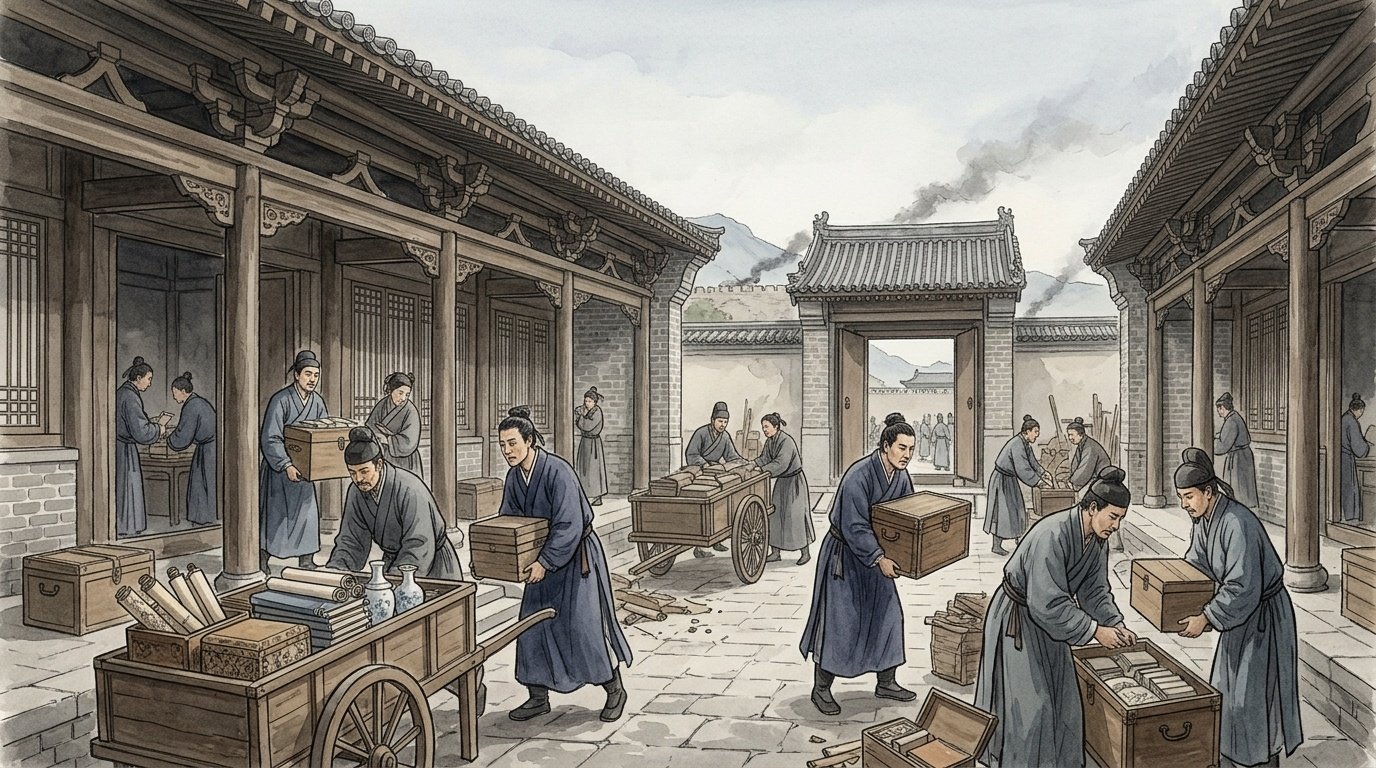
Over three thousand imperial princes, princesses, dukes, and high-ranking ministers were butchered in public squares. Aristocratic ladies who had lived secluded in silk-curtained pavilions were dragged into the thoroughfares, stripped naked, raped by common soldiers, and forced to haul dirt and rocks to build rebel barricades. The ancient aristocratic mansions along Vermilion Bird Way—residences that had accumulated centuries of priceless calligraphy, Tang Sancai porcelain, imperial libraries, and irreplaceable family genealogical scrolls—were looted down to the floorboards and incinerated. Rebel gangs stormed the Hall of Worthies (集贤院) and the imperial archives, ripping down sacred scrolls of calligraphy and burning ancient books of ritual law to warm their campfires.
The prominent aristocratic families of the Central Plains—the Boling Cui, the Qinghe Cui, the Fanyang Lu, the Xingyang Zheng, the Hedong Pei, and the Taiyuan Wang—suffered catastrophic demographic decapitation. These lineages, which had survived the barbarian invasions of the Sixteen Kingdoms and the dynastic transitions of Sui and early Tang by relying upon their genealogical purity and administrative monopolies, were hunted down door to door. Their sacred ancestral genealogical rolls (家谱), which functioned as the legal proof of aristocratic blood, were deliberately thrown into public bonfires by rebel soldiers, permanently eradicating the documentary evidence of their noble pedigree.
7. The Lament of the Lady of Qin: Wei Zhuang’s Poetic Masterpiece
The horror of Huang Chao’s occupation of Chang’an was immortalized by one of the greatest narrative poems in Chinese literature: The Lament of the Lady of Qin (秦妇吟, Qin Fu Yin), composed by the renowned poet Wei Zhuang (韦庄, 836–910 CE). Trapped inside Chang’an during the rebel takeover, Wei Zhuang witnessed the massacres firsthand before escaping to Luoyang, where he penned this extraordinary 1,666-character epic poem through the persona of an aristocratic woman fleeing the devastation.
Wei Zhuang’s verses capture the post-apocalyptic desolation of the world’s greatest metropolis with haunting, visceral intensity:
「长安寂寂今何有?废市荒街麦苗秀。
— Wei Zhuang (韦庄), The Lament of the Lady of Qin (秦妇吟)
采樵大家为公吏,直上金銮坐御床!
内库烧为锦绣灰,天街踏尽公卿骨!
朝携弓马出捉人,暮插白旗迎入市……
家家啼哭招魂魄,岁岁横戈向骨肉!」
‘What remains today of silent, desolate Chang’an?
In abandoned markets and deserted streets, green barley sprouts grow wild!
Rude woodcutters have become high government magistrates,
Striding straight onto the Golden Dais to sit upon the Dragon Throne!
The Imperial Treasuries are burned into ashes of brocade and silk,
And upon the Heavenly Avenues, horses tread down the bones of dukes and ministers!
At dawn they take up bows and steeds to hunt down fleeing citizens,
At dusk they raise white flags to herd captives into the markets…
Every household weeps aloud, summoning the departed souls of the slain,
And year after year, leveled halberds are turned upon our own flesh and blood!’
The line ‘Upon the Heavenly Avenues, horses tread down the bones of dukes and ministers’ (天街踏尽公卿骨) became the definitive epitaph of the medieval Chinese aristocracy. The proud names of the Northern dynasties—the Cui, Lu, Zheng, Wang, and Dugu clans—had been reduced to crushed calcium beneath the iron hooves of a salt smuggler’s cavalry. The poem was so immensely popular that it was copied onto scrolls and tapestries across China, earning Wei Zhuang the lifelong nickname ‘The Scholar of the Qin Lady’ (秦妇吟秀才).
8. The Abomination of Chenzhou: The Human Grinding Mills (舂磨砦)
By late 882 CE, Huang Chao’s situation inside Chang’an had deteriorated into a nightmare. Imperial loyalist armies, surrounding the capital in a vast ring, cut off all grain shipments along the Grand Canal. Inside Chang’an, famine reached unfathomable proportions: a single peck of rice sold for thirty strings of cash, and citizens ate dead horses, dogs, rats, and tree bark. When rebel foraging parties were ambushed, Huang Chao’s soldiers began butchering urban citizens and selling human flesh in the public markets, hanging human carcasses on butcher hooks like salted pork.
In the spring of 883 CE, facing starvation and encircled by imperial troops, Huang Chao evacuated Chang’an and retreated eastward into Henan. There, he besieged the strategic city of Chenzhou (陈州, modern Huaiyang, Henan), defended with legendary courage by the Tang governor Zhao Fan (赵犨). Zhao Fan had accumulated immense grain reserves, fortified the ramparts with iron barricades, and sworn to die before surrendering.
The siege of Chenzhou dragged on for over three hundred days. Huang Chao’s army of several hundred thousand men, trapped in a devastated, uncultivated countryside where five years of warfare had left not a single crop standing, ran completely out of food. It was here that Huang Chao committed one of the most horrifying industrial atrocities in recorded military history: the construction of the Chongmozhai (舂磨砦)—the ‘Human Flesh Grinding Mills’.
The Old Book of Tang and Zizhi Tongjian document this abomination in cold, sickening detail:
「贼围陈州三百日……贼众日匮,粮运不继,遂设舂磨砦数百具,缳生人于舂臼之中,并骨碾成糜,以啖军士!黄巢所过,赤地千里,自河南、许、汝、唐、邓、孟、怀数十州,生民殆尽矣!」
— Old Book of Tang (旧唐书), Chapter 200B: “Biography of Huang Chao”
‘The bandits besieged Chenzhou for three hundred days… As the rebel host faced daily exhaustion and grain shipments failed to arrive, they constructed several hundred “Grinding-Mill Stockades” (Chongmozhai). They cast living human beings into colossal pestles and mortar-vats, crushing flesh and bones together into paste to feed the soldiers! Wherever Huang Chao traversed, the earth was scorched red for a thousand li; across dozens of prefectures including Henan, Xu, Ru, Tang, Deng, Meng, and Huai, living human beings were virtually exterminated!’
Huang Chao unleashed specialized cavalry units, known as ‘Hunting Squads’, across Henan, Anhui, and Shandong. They surrounded civilian villages, kidnapped tens of thousands of men, women, and children, marched them in chains to the Chongmozhai outside Chenzhou, and slaughtered them like cattle to supply the daily rations of the rebel field armies. Hundreds of thousands of human beings were pulverized in these mechanical mortar vats. The region of Henan was transformed into a post-apocalyptic graveyard where silence reigned across entire provinces.
9. The Turning Tide: The Defection of Zhu Wen and the One-Eyed Dragon
The turning point that sealed Huang Chao’s doom was internal betrayal and foreign military intervention. In 882 CE, Huang Chao’s most capable and ruthless field general, Zhu Wen (朱温, 852–912 CE)—a former peasant ruffian who had served as the rebel military governor of Tongzhou—recognized that Huang Chao’s cannibalistic regime was doomed. Murdering his rebel political commissar, Zhu Wen surrendered his entire army to the Tang imperial government. The overjoyed Emperor Xizong bestowed upon the traitor the prestigious name Zhu Quanzhong (朱全忠, ‘Zhu the Completely Loyal’), appointed him military governor of Xuanwu (Kaifeng), and tasked him with annihilating his former master.
Simultaneously, the desperate Tang court took the fatal step of inviting non-Han steppe cavalry into the heart of China. The court summoned the formidable Shatuo Turks (沙陀突厥), commanded by their brilliant, twenty-eight-year-old chieftain: Li Keyong (李克用, 856–908 CE). Li Keyong was blind in one eye from a battlefield arrow, earning him the terrifying moniker ‘The One-Eyed Dragon’ (独眼龙). Commanding forty thousand elite Shatuo horse archers who wore all-black uniforms—the legendary ‘Black Crow Army’ (鸦儿军)—Li Keyong represented the supreme cavalry strike force of East Asia.
In the spring of 883 CE, Li Keyong’s Shatuo cavalry smashed Huang Chao’s vanguard outside Chang’an, routing the rebel host and driving them from the capital. Joined by Zhu Wen and General Li Sijian, the imperial coalition pursued Huang Chao across the Central Plains. In the third lunar month of 884 CE, while Huang Chao was still hopelessly battering against the walls of Chenzhou, Li Keyong struck like a lightning bolt. In a series of savage battles at Chenzhou, Shangcai, and Wangman Ferry on the Bian River, the Shatuo cavalry annihilated the Great Qi host. Over ten thousand rebel shock troops were hacked down in the river shallows, and Huang Chao’s army disintegrated into small, fleeing bands.
Huang Chao fled eastward with only a handful of mounted retainers, pursued relentlessly day and night by Tang cavalry. In the sixth lunar month of 884 CE, trapped inside the jagged defiles of the Tiger and Wolf Valley (狼虎谷, Langhugu) in the Mount Tai mountains of Shandong, Huang Chao reached the end of his road. Knowing that capture meant slow, agonizing dismemberment in the marketplace, Huang Chao took his own sword and slashed his throat, or—according to some chronicles—ordered his nephew Lin Yan to decapitate him so his family could claim the imperial reward. His severed head was packed in salt and presented to Emperor Xizong in Chengdu. The ten-year apocalypse of the Huang Chao Rebellion was over; but the empire he left behind was a smoking corpse.
10. The Final Slaughter: Zhu Wen and the Baima Station Massacre (905 CE)
Although the rebellion was crushed, the central government of the Tang Dynasty never truly ruled again. Chang’an was a blackened ruin; the imperial palaces were overgrown with wild weeds; and all real political and military power had devolved permanently into the hands of rival regional warlords. Chief among these was the ruthless turncoat Zhu Wen (Zhu Quanzhong), who consolidated absolute control over Henan and the Grand Canal from his headquarters in Kaifeng.
In 904 CE, Zhu Wen marched his army into Chang’an, seized the puppet Emperor Zhaozong (唐昭宗), and forced the entire court to relocate to Luoyang. Before departing, Zhu Wen ordered Chang’an completely demolished: palaces, ministries, ancestral temples, and private mansions were torn down to their foundations, and the timber was floated down the Wei and Yellow rivers to build Zhu Wen’s new palaces in Kaifeng. The magnificent metropolis that had stood for three centuries as the capital of the civilized world was permanently erased from the earth.
Months later, Zhu Wen orchestrated the final, gruesome liquidation of the medieval Chinese aristocracy. Surrounded by cynical advisors—chief among them Li Zhen (李振), a failed scholar who, like Huang Chao, had repeatedly been rejected by aristocratic examiners—Zhu Wen decided to eradicate the remaining civil ministers of the Tang court. Li Zhen famously hissed to Zhu Wen:
「此辈常自谓清流,宜投之黄河,使为浊流!」
— Li Zhen’s counsel to Zhu Wen, Zizhi Tongjian, Chapter 265
‘These individuals have always arrogantly styled themselves as the “Pristine Stream” (清流); it is only fitting that we cast them into the muddy Yellow River, so that they may become the Muddy Stream forever!’
On the fifth day of the intercalary sixth lunar month of the second year of Tianyou (July 905 CE), at the Baima Station (白马驿, White Horse Station) on the banks of the Yellow River in modern Henan, Zhu Wen’s soldiers rounded up thirty of the highest-ranking civil ministers, chancellors, and noble scions of the Tang Dynasty—including Chancellor Pei Shu (裴枢), Chancellor Dugu Sun (独孤损), Chancellor Cui Yuan (崔远), and Duke Lu Yi. In a horrifying ritual execution, all thirty statesmen were strangled or decapitated, and their corpses were kicked into the churning, muddy waters of the Yellow River in the infamous Baima Station Massacre (白马驿之祸).
Two years later, in 907 CE, Zhu Wen forced the sixteen-year-old puppet Emperor Aidi (唐哀帝) to abdicate, subsequently murdering him with poisoned wine. Zhu Wen proclaimed the founding of the Later Liang Dynasty (后梁), officially extinguishing the Tang Dynasty after 289 years of rule, and plunging China into the bloody fragmentation of the Five Dynasties and Ten Kingdoms (五代十国, 907–960 CE).
11. Historiographical Debate and the Tang-Song Transformation
The Huang Chao Rebellion and the Baima Station Massacre stand as one of the most momentous watersheds in global historiography. In the seminal historical framework formulated by the Japanese master historian Naitō Torajirō (Naitō Konan)—the celebrated ‘Tang-Song Transition Theory’ (唐宋变革论)—this violent decade marked the definitive end of Medieval China and the dawn of Modernity.
For more than four centuries, the social architecture of China had been defined by Menfa Aristocracy (门阀政治). These aristocratic clans derived their authority not from imperial favor, but from deep genealogical pedigree, vast hereditary estates, and cultural monopolization. An emperor could execute an individual minister, but he could never eradicate the Cui of Boling or the Lu of Fanyang; they were permanent fixtures of the sociopolitical landscape who viewed reigning imperial dynasties as transient upstarts.
Huang Chao and Zhu Wen accomplished what no emperor could ever achieve: the total physical and institutional extinction of the aristocratic caste. By burning their genealogical registers, confiscating their estates, and slaughtering their lineages in Chang’an and at Baima Station, the rebels created an absolute social vacuum. When order was finally reconstituted under the Song Dynasty (宋朝, 960–1279 CE) by Zhao Kuangyin, the ancient aristocracy was gone forever. Not a single medieval lineage survived with institutional political power into the eleventh century.
Recent groundbreaking scholarship by modern historians, notably Nicolas Tackett in The Destruction of the Medieval Chinese Aristocracy (Harvard University Press, 2014), has provided definitive empirical verification of this transformation. Utilizing massive digital databases of over three thousand excavated funerary tomb epitaphs (墓志铭), Tackett demonstrated that before 880 CE, an astonishing 80 percent of Tang chancellors and top ministers were drawn from an interconnected network of just a few dozen elite clans based in Chang’an and Luoyang. After the massacres of Huang Chao and Zhu Wen between 880 and 905 CE, that interconnected national network ceased to exist. Surviving aristocratic branches retreated into isolated provincial villages or dissolved into the common peasantry, stripped of their ancestral estates and political offices.
From the ashes of the Tang aristocracy emerged a fundamentally new civilization: the Meritocratic Scholar-Gentry Society (士大夫社会). The Song civil service examinations became genuinely open to commoners; social mobility skyrocketed; land became freely alienable commercial real estate; and the Emperor, freed from aristocratic checks, became an absolute autocrat governing through a revolving, meritocratic bureaucracy of Confucian scholars. Huang Chao was a brutal, cannibalistic warlord who left a trail of blood and scorched earth across fifteen thousand miles; yet through the fury of his salt trader’s vengeance, he acted as the apocalyptic gravedigger of medieval feudalism, involuntarily clearing the stage for the dawn of the early modern Chinese world.
12. Chronology of the Huang Chao Rebellion and the Fall of Tang
| Year (CE) | Historical Milestone | Key Historical Figures | Tactical & Civilizational Significance |
|---|---|---|---|
| c. 870 | Huang Chao Fails Imperial Examinations; Composes Poem | Huang Chao | Failed examination in Chang’an; pens Ode to the Chrysanthemum vowing vengeance on aristocracy |
| 874 | Wang Xianzhi Raises Rebellion at Changyuan | Wang Xianzhi, Huang Chao | Salt smugglers and starving peasants revolt against crushing salt monopoly and drought famine |
| 878 | Death of Wang Xianzhi; Huang Chao Becomes Supreme Leader | Huang Chao, Zeng Yuanying | Huang Chao proclaimed ‘Heaven-Soaring Grand General’; adopts roving continental strategy |
| 879 (Autumn) | Sacking of Guangzhou and Massacre of Foreign Merchants | Huang Chao, Abu Zaid al-Sirafi | 120,000 Muslims, Jews, Christians, and Zoroastrians slain; Maritime Silk Road severed |
| 880 (Nov) | Fall of Luoyang; Surrender of Eastern Capital | Huang Chao, Liu Yanzhang | Rebel host of 600,000 crosses Huai River; Luoyang captured without resistance |
| 880 (Dec) | Battle of Tongguan; Flight of Emperor Xizong | Tian Lingzi, Emperor Xizong | Shence palace guards routed at Tongguan; Emperor Xizong flees to Chengdu in Sichuan |
| 881 (Jan) | Huang Chao Enters Chang’an; Great Qi Proclaimed | Huang Chao, Tang Princes | Coronation in Daming Palace; initial calm collapses into Reign of Terror and aristocratic slaughter |
| 881–882 | Reign of Terror; Wei Zhuang Composes Qin Fu Yin | Wei Zhuang, Cui Hang, Dou Lu | 3,000 aristocrats butchered; mansions looted; ‘horses tread down the bones of dukes’ |
| 882 (Autumn) | Defection of Zhu Wen; Arrival of Shatuo Turks | Zhu Wen (Zhu Quanzhong), Li Keyong | Zhu Wen betrays Huang Chao; Li Keyong’s ‘Black Crow Army’ deployed by imperial court |
| 883–884 | Siege of Chenzhou; The Human Grinding Mills (Chongmozhai) | Huang Chao, Zhao Fan | 300-day siege; rebels pulverize hundreds of thousands of living citizens for food; total famine |
| 884 (June) | Battle of Tiger and Wolf Valley; Death of Huang Chao | Huang Chao, Li Keyong, Lin Yan | Rebels crushed in Shandong; Huang Chao commits suicide in Langhugu; rebellion extinguished |
| 904 | Demolition of Chang’an by Zhu Wen | Zhu Wen, Emperor Zhaozong | Chang’an razed to the ground; timber floated to Kaifeng; capital moved to Luoyang |
| 905 (July) | The Baima Station Massacre (白马驿之祸) | Zhu Wen, Li Zhen, Pei Shu | 30 aristocratic chancellors murdered and cast into Yellow River (‘muddy stream’); aristocracy ends |
| 907 | Usurpation of Zhu Wen; Extinction of Tang Dynasty | Zhu Wen, Emperor Aidi | Tang Dynasty officially falls after 289 years; Five Dynasties and Ten Kingdoms era begins |
13. Scholarly Bibliography and Primary Historical Sources
To substantiate the military maneuvers, demographic statistics, and historiographical analyses presented in this study, the following primary sources and academic monographs are recommended for further study:
- Liu Xu (刘昫) et al. (comp. 945 CE), Old Book of Tang (旧唐书, Jiu Tang Shu): The primary official historical chronicle. Essential records include the Basic Annals of Xizong (Vol. 19B), the extended Biography of Huang Chao (Vol. 200B), and the Biographies of Zhu Wen (Vol. 1), Li Keyong (Vol. 1), and Tian Lingzi (Vol. 184).
- Ouyang Xiu (欧阳修) and Song Qi (comp. 1060 CE), New Book of Tang (新唐书, Xin Tang Shu): Contains vital supplementary documentation on the late Tang gabelle, notably the Treatise on Food and Money (食货志) analyzing salt monopoly revenues, and Chapter 225 (Rebels).
- Sima Guang (司马光, comp. 1084 CE), Comprehensive Mirror in Aid of Governance (资治通鉴, Zizhi Tongjian): Volumes 252 through 266 provide the definitive chronological, month-by-month reconstruction of the Huang Chao uprising, the occupation of Chang’an, the Chenzhou siege, and the Baima Station Massacre.
- Wei Zhuang (韦庄, comp. 883 CE), The Lament of the Lady of Qin (秦妇吟, Qin Fu Yin): The priceless contemporary narrative poem recording the eyewitness horrors of the sacking of Chang’an, rediscovered among the Dunhuang Mogao Cave manuscripts (Pelliot 2717 / Stein 5477) in the early twentieth century. Translated with commentary by Robin D.S. Yates (1988) in Harvard Journal of Asiatic Studies.
- Abu Zaid al-Sirafi (comp. c. 916 CE), Accounts of China and India (Silsilat al-Tawarikh): Invaluable contemporary Arab eyewitness testimony recording the sacking of Guangzhou, the massacre of foreign merchants, and the disruption of Indian Ocean trade networks. Translated by Tim Mackintosh-Smith (2014), Library of Arabic Literature, NYU Press.
- Chen Yinke (陈寅恪, 1944), Outline of the Political History of the Tang Dynasty (唐代政治史述论稿), Sanlian Shudian: Landmark historiographical masterpiece analyzing the decline of the Guanlong Aristocratic Group, the rise of the provincial Jiedushi, and the ultimate destruction of the aristocratic order.
- Naitō Torajirō (Naitō Konan, 1922), ‘An Overview of the Tang-Song Period’ (概括的唐宋时代观), Rekishi to Chiri: The foundational academic formulation of the ‘Tang-Song Transition Theory’, arguing that the Huang Chao rebellion destroyed the medieval aristocracy and birthed modern gentry-monarchical China.
- Twitchett, Denis, ed. (1979), The Cambridge History of China, Volume 3: Sui and T’ang China, 589–906, Part 1, Cambridge University Press: Comprehensive Western scholarly narrative detailing the economic collapse of the late Tang, the Huang Chao rebellion, and the rise of Zhu Wen.
- Tackett, Nicolas (2014), The Destruction of the Medieval Chinese Aristocracy, Harvard University Asia Center: Masterful, groundbreaking monograph utilizing thousands of archaeological funerary tomb inscriptions (墓志铭) and statistical network analysis to prove the total physical annihilation of the Tang aristocratic elite during the Huang Chao and Zhu Wen massacres.
- Graff, David A. (2002), Medieval Chinese Warfare, 300–900, Routledge: Chapter 12 provides an exhaustive, brilliant military history analysis of the operational maneuvers of the Huang Chao rebellion, the Shatuo cavalry tactics, and the siege mechanics of Chenzhou.