The Sixteen Prefectures of Yanyun and Four Centuries of Exposure
In the eleventh lunar month of the first year of the Tianfu era (936 CE), inside a luxury yurt pitched amid the freezing winds of Taiyuan in Shanxi, a forty-five-year-old Chinese military governor fell to his knees upon felt carpets before a thirty-four-year-old steppe monarch. The kneeling general was Shi Jingtang (石敬瑭, 892–942 CE), the Shatuo commander of Hedong; the seated ruler was Emperor Taizong of Liao (辽太宗, Yelü Deguang 耶律德光, 902–947 CE), Khagan of the Khitan Empire (契丹). In exchange for thirty thousand veteran Khitan horse archers to crush his imperial sovereign in Luoyang and seat him upon the throne of the Later Jin Dynasty (后晋), Shi Jingtang offered a humiliation without precedent in the annals of Chinese statecraft.
Despite being eleven years senior to the Khitan monarch, Shi Jingtang formally addressed Yelü Deguang as his ‘Father Emperor’ (父皇帝), submissively styling himself the ‘Child Emperor’ (儿皇帝, Er Huangdi). He pledged an astronomical annual tribute of three hundred thousand bolts of silk, alongside endless shipments of grain, silver, and gold. Most catastrophically of all, with a stroke of a vermilion brush across silk maps, Shi Jingtang ceded to the Khitan Liao Dynasty the supreme topographical bulwark of northern China: the Sixteen Prefectures of Yanyun (燕云十六州, Yanyun Shiliu Zhou)—a vast, fortified crescent of mountain passes, fertile river valleys, and iron-walled cities stretching across modern Beijing, Tianjin, northern Hebei, and northern Shanxi.
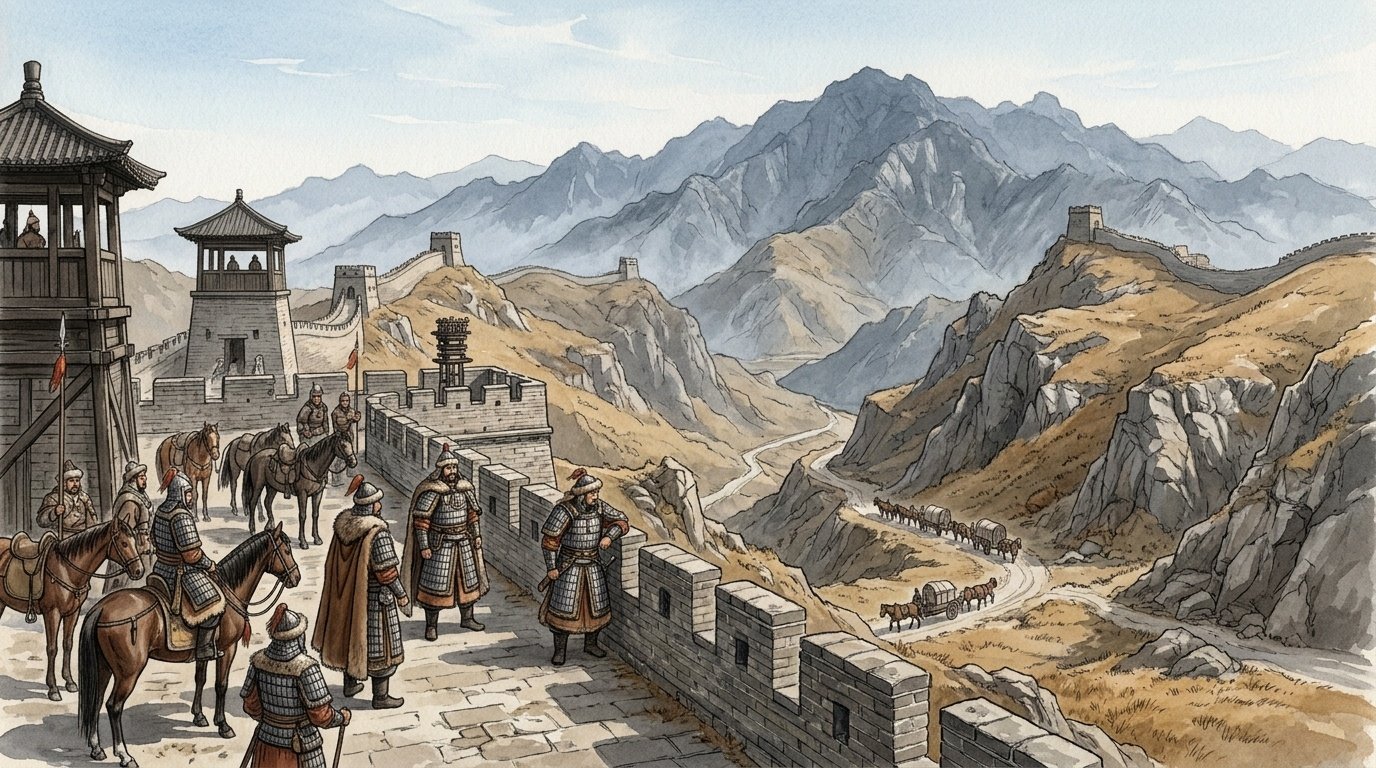
It was a geopolitical betrayal of cosmic proportions. For more than a millennium, from the Warring States period and the First Emperor of Qin through the Han and Tang dynasties, the formidable mountain ramparts of the Yan (燕山) and Taihang (太行山) ranges, crowned by the stone fortifications of the Great Wall, had served as the insurmountable ecological and military shield of Chinese civilization. These jagged cliffs and narrow defiles—anchored by strategic chokeholds such as Juyong Pass (居庸关), Gubeikou (古北口), and Yanmen Pass (雁门关)—prevented northern nomadic cavalry from descending onto the flat, fertile plains of the Yellow River. By surrendering the Sixteen Prefectures, Shi Jingtang tore away China’s armor with his own hands. For the next four hundred and thirty-two years—from 936 CE until the Ming Dynasty founder Zhu Yuanzhang and General Xu Da stormed Dadu in 1368 CE—the agrarian heartland of China lay completely exposed to northern steppe cavalry.
This comprehensive treatise examines the loss, consequences, and agonizing legacy of the Sixteen Prefectures of Yanyun. We will analyze the chaotic geopolitical fragmentation of the Five Dynasties and Ten Kingdoms (五代十国) that birthed Shi Jingtang’s treason; map the minute strategic topography and economic wealth of the sixteen individual prefectures; trace the devastating military exposure of the subsequent Song Dynasty (宋朝), which was forced to defend an open, flat frontier without mountain passes or cavalry breeding pastures; investigate the tragic, failed reconquest expeditions of Chai Rong (Later Zhou Emperor Shizong) and Song Taizong—including the bloody debacle of the Battle of Gaoliang River (高粱河之战) and the martyrdom of General Yang Ye (杨业); dissect the diplomatic compromise of the Treaty of Chanyuan (澶渊之盟, 1005 CE); examine the dual administrative system of the Khitan Liao Empire (南面官与北面官); and evaluate the profound civilizational transformation that permanently shifted China’s military posture from offensive expansion to anxious, passive containment.
1. The Five Dynasties Crucible: The Fractured World of the Warlords
The tragedy of Yanyun cannot be understood without appreciating the utter moral and political bankruptcy of tenth-century China. Following the collapse of the Tang Dynasty in 907 CE under the brutal warlord Zhu Wen, northern China descended into the hyper-violent, chaotic half-century known as the Five Dynasties (五代, 907–960 CE): Later Liang, Later Tang, Later Jin, Later Han, and Later Zhou. During this fifty-three-year nightmare, eight separate imperial houses and fourteen emperors ruled in rapid, bloody succession, averaging barely three and a half years per reign.
Imperial authority was an absolute fiction. The Son of Heaven was merely whichever provincial military commissioner (Jiedushi) possessed the largest private mercenary host and the most ruthless willingness to murder his rivals. As the notorious general An Chongrong (安重荣) famously proclaimed in a phrase that became the cynical motto of the era:
「天子宁有种耶?兵强马壮者为之尔!」
— An Chongrong (安重荣), Zizhi Tongjian (资治通鉴), Chapter 282
‘Does the Son of Heaven possess an immutable pedigree? He who commands the strongest soldiers and the fattest warhorses is he who shall be emperor, nothing more!’
In this brutal Darwinian slaughterhouse, ethnic boundaries dissolved into pragmatic military alliances. The dominant military force in northern China was no longer the sedentary Han peasantry, but the sinicized Shatuo Turks (沙陀突厥). Descended from nomadic horsemen resettled in Shanxi during the late Tang, the Shatuo produced brilliant military dynasties: the Later Tang (founded by Li Cunxu 李存勖, son of the One-Eyed Dragon Li Keyong) and Later Jin. But the Shatuo rulers were plagued by perpetual factional mutinies among their own generals. Troops routinely staged garrison coups, murdering their commanders and demanding lavish imperial coronation bounties in gold and silk before agreeing to march into battle.
Meanwhile, across the northern steppe, a formidable new nomadic superpower had consolidated. In 916 CE, the visionary Khitan chieftain Abaoji (耶律阿保机, Emperor Taizu of Liao) unified the eight nomadic tribes of the Liao River basin, founding the Khitan Empire (Great Liao 大辽). Combining the lethal horsemanship and horse-archery of the steppes with the bureaucratic statecraft, iron foundries, and agricultural manpower of conquered Han and Bohai populations, the Liao emerged as the most organized, administratively sophisticated steppe imperium East Asia had seen since the early Turks. When Abaoji’s brilliant second son, Yelü Deguang (Emperor Taizong), ascended the throne in 927 CE, he gazed southward across the Great Wall at the warring, blood-soaked warlords of the Central Plains, patiently awaiting the exact moment to strike.
2. The Grand Betrayal: Shi Jingtang and the Deal with the Steppe
That moment arrived in the spring of 936 CE through the mutual paranoia of two Shatuo generals. The reigning emperor of Later Tang, Li Congke (李从珂, Emperor Fei 废帝), harbored deep suspicion toward his brother-in-law, Shi Jingtang, who served as military governor of Hedong stationed inside the colossal fortress of Taiyuan (Jinyang 晋阳). Shi Jingtang was a cold, calculating military veteran who commanded the finest shock cavalry in China. Sensing that Li Congke was preparing to strip him of his command and execute him, Shi Jingtang fortified Taiyuan and prepared for rebellion.
In the fifth lunar month of 936 CE, Li Congke mobilized the main imperial field army of Later Tang—over one hundred thousand men under General Zhang Jingda—and laid siege to Taiyuan. Zhang Jingda surrounded the city with a triple ring of earthen ramparts, catapult trenches, and iron stockades. By late autumn, food supplies inside Taiyuan were utterly exhausted. Horses were slaughtered for meat; soldiers boiled leather shields and armor straps, and the civilian population turned to cannibalism. Facing imminent starvation and brutal dismemberment in the marketplace, Shi Jingtang convened his inner circle of conspirators.
His chief advisor, Sang Weihan (桑维翰, 898–947 CE), presented an unsparing proposal: ‘The imperial court’s forces are immense; our isolated city cannot hold out another month. Our sole salvation lies in the north! We must petition the Khitan Khagan, offer him submission as a son to a father, promise an annual tribute of three hundred thousand bolts of silk, and cede the Sixteen Prefectures of Yanyun in exchange for immediate military salvation!’
Even Shi Jingtang’s veteran general, Liu Zhiyuan (刘知远, future founder of Later Han), recoiled in horror at the magnitude of the betrayal, arguing: ‘To acknowledge the Khitan as sovereign is sufficient; to address him as father is excessive humiliation! To grant him immense riches of silk and gold is acceptable, but to surrender the lands of Yanyun is to strip China of its very bones and flesh! This will bring everlasting disaster upon the Altars of Soil and Grain!’
Shi Jingtang ignored Liu Zhiyuan’s warnings. To a tenth-century warlord, dynastic survival and the acquisition of the imperial throne eclipsed any abstract concept of national defense or civilizational integrity. Sang Weihan drafted the fatal diplomatic memorial, sealing it with Shi Jingtang’s personal signet ring, and dispatched secret couriers riding night and day through the northern passes to the Khitan capital at Shangjing.
When Yelü Deguang read the memorial, he was overjoyed. The Khitan monarch immediately mobilized fifty thousand elite iron-armored cavalry—the legendary Tielin (铁林军, Iron Forest Army)—and rode south across the Great Wall. In the ninth lunar month of 936 CE, Yelü Deguang emerged from the Yanmen Pass and launched a devastating cavalry ambush against Zhang Jingda’s besieging army outside Taiyuan. The Later Tang imperial host was utterly annihilated; Zhang Jingda was murdered by his own mutinous subordinate, and eighty thousand imperial soldiers surrendered. Yelü Deguang rode into Taiyuan in triumph, formally invested Shi Jingtang as Emperor Gaozu of the Later Jin Dynasty, and in the eleventh month of 936 CE, accepted the physical surrender of the Sixteen Prefectures.
3. Topographical Anatomy: The Anatomy of the Sixteen Prefectures
What precisely were the Sixteen Prefectures of Yanyun, and why did their loss alter the geopolitical destiny of East Asia for four centuries? Geographically, the sixteen prefectures formed a continuous, crescent-shaped defensive arc spanning over twelve hundred li (approximately 600 kilometers) across northern China, divided into two distinct strategic sectors by the towering Taihang Mountains:
| Strategic Sector | Prefecture Name (Chinese) | Modern Geographic Location | Military Chokehold & Topographical Barrier |
|---|---|---|---|
| Eastern Sector (Yan / Hebei) | Youzhou (幽州) | Modern Beijing (Core regional metropolis) | Southern terminal of Juyong Pass; political and economic hub of the northern plain |
| Eastern Sector | Jizhou (蓟州) | Jixian / Jizhou, modern Tianjin | Controls access to Shanhaiguan and the coastal Bohai corridor |
| Eastern Sector | Yingzhou (瀛州) | Hejian, Hebei | Waterway nexus of the Hutuo River defending the central plains |
| Eastern Sector | Mozhou (莫州) | Renqiu, Hebei | Southern water-marsh defense line along Baiyangdian |
| Eastern Sector | Zhuozhou (涿州) | Zhuozhou, Hebei | Direct gateway to the south; immediate approach to Dingzhou and Baoding |
| Eastern Sector | Tanzhou (檀州) | Miyun, Beijing | Anchors the critical Gubeikou Pass (古北口) through the Yan Mountains |
| Eastern Sector | Shunzhou (顺州) | Shunyi, Beijing | Immediate northern defensive buffer of Beijing |
| Mountain Passes (Yan Mountains) | Guizhou (妫州) | Huailai, Hebei | Controls the northern entrance to the formidable Juyong Pass (居庸关) |
| Mountain Passes | Ruzhou (儒州) | Yanqing, Beijing | Guards the Great Wall ramparts of Badaling |
| Mountain Passes | Wuzhou (武州) | Xuanhua, Hebei | Western flank of the Juyong corridor; massive cavalry staging basin |
| Mountain Passes | Xinzhou (新州) | Zhuolu, Hebei | Ancient Sanggan River valley connecting Shanxi and Hebei |
| Western Sector (Yun / Shanxi) | Yunzhou (云州) | Datong, Shanxi (Core western metropolis) | Ancient capital of Northern Wei; strategic gateway to the northern steppe |
| Western Sector | Weizhou (蔚州) | Yu County, Hebei / Shanxi border | Controls Feihu Pass (飞狐陉), the narrowest defile through the Taihang Mountains |
| Western Sector | Yingzhou (应州) | Ying County, Shanxi | Location of the iconic Wooden Pagoda; northern approach to Yanmen Pass |
| Western Sector | Shuozhou (朔州) | Shuozhou, Shanxi | Southern bank of the Mayi River; frontier cavalry bastion |
| Western Sector | Huanzhou (寰州) | East of Shuozhou, Shanxi | Immediate northern shield of Yanmen Pass |
The strategic value of this territory was threefold:
- 1. The Impassable Mountain Shield: The Yan Mountain range forms a continuous, jagged geological wall rising abruptly from the North China Plain to heights exceeding one to two thousand meters. Traversed by only five narrow, easily defensible river gorges (such as Juyong Pass, Gubeikou, and Xifengkou), a handful of garrison troops atop these cliffs could hold off tens of thousands of attackers. By controlling these passes, Chinese dynasties kept the steppe nomads pinned north of the mountains. Once the Liao held Yanyun, the mountain shield was reversed: the Khitans held the gates, and the plains lay defenseless below.
- 2. The Warhorse Monopoly: The plateaus and valleys of northern Shanxi and Hebei (around Datong, Xuanhua, and Zhangjiakou) provided the sole extensive, high-altitude grassland pastures in northern China suitable for breeding and grazing large herds of hardy warhorses. By losing Yanyun, subsequent Chinese dynasties—most critically the Song—lost access to essential horse-breeding grounds. The Song was condemned to a permanent, fatal cavalry shortage, forced to fight heavy nomadic cavalry with foot infantry armed with spears and crossbows.
- 3. Economic and Demographic Loss: The Sixteen Prefectures were not barren steppe; they were densely populated, highly civilized agricultural and industrial centers inhabited by over three million Han Chinese farmers, blacksmiths, and artisans. The iron foundries of Xuanhua produced the finest armor and weapons in East Asia; the coal mines of Datong and the textile looms of Youzhou (Beijing) injected colossal wealth directly into the coffers of the Khitan state. The Liao transformed from a crude tribal confederation into a sophisticated, self-financing dual-economy empire.
4. The Naked Empire: The Song Dynasty’s Strategic Dilemma
When the Song Dynasty (宋朝, 960–1279 CE) unified China under Zhao Kuangyin (Emperor Taizu), it inherited this catastrophic geopolitical reality. To the north stood the formidable Liao Empire, whose borders were now pushed down to the southern rim of the Hebei plain, barely four hundred li (approx. 200 miles / 300 kilometers) from the Song imperial capital of Kaifeng (开封).
Between the Khitan cavalry garrisons at Zhuozhou and the imperial palace in Kaifeng, there was not a single mountain range, gorge, or natural barrier. The topography was a billiard table of flat, open wheat fields and dry waterways. A Khitan light cavalry division could mount their warhorses in the suburbs of Youzhou and gallop across the North China Plain, reaching the northern bank of the Yellow River in less than ten days of hard riding. Kaifeng, built on the flat junction of the Grand Canal, was entirely undefendable against lightning cavalry assaults.
To compensate for this terrifying geographical vulnerability, the Song Dynasty was forced to invent an artificial, costly, and precarious defense architecture:
- The Water Barrier System (水长城, ‘The Water Great Wall’): In central and eastern Hebei, Song hydraulic engineers flooded hundreds of square miles of low-lying farmland, connecting rivers, marshes, and lakes (such as Baiyangdian 白洋淀) into an intricate labyrinth of defensive ponds, canals, and reed swamps. Designed by visionary commanders like He Chengju (何承矩), this ‘Water Great Wall’ was planted with dense weeping willows and dredged with deep underwater ditches to prevent Khitan warhorses from charging across the plains.
- The Colossal Foot Infantry and Repeating Crossbow Formations: Lacking warhorses, the Song military relied upon mass infantry formations wielding the heavy Divine Arm Crossbow (神臂弩, Shenbi Nu)—a compound crossbow with an effective range exceeding three hundred paces that could penetrate iron scale armor. Song infantry fought from behind wheeled wooden carts (Chariot Formations 车阵) equipped with iron pavise shields and long pikes, creating mobile fortress walls on open terrain.
- Ruinous Military Budgets: The Song was forced to maintain the largest permanent standing army in global antiquity, exceeding one million two hundred thousand professional soldiers by the mid-eleventh century. Because these mercenary soldiers required cash salaries, uniforms, and daily grain, military expenditures consumed an astonishing seventy to eighty percent of the entire national budget, permanently bleeding the state treasury dry.
5. The Iron Emperor’s Tragic Gamble: Chai Rong’s Northern Expedition (959 CE)
The closest Chinese civilization ever came to recapturing the Sixteen Prefectures occurred during the brief, glorious reign of the greatest monarch of the Five Dynasties: Emperor Shizong of Later Zhou (后周世宗, Chai Rong 柴荣, r. 954–959 CE).
Chai Rong was an administrative and military genius who had sworn a famous oath: ‘I shall spend ten years pacifying the realm, ten years enriching the people, and ten years securing peace under heaven!’ Having reformed the tax system, cleansed the Buddhist monasteries, and crushed the southern kingdom of Southern Tang, Chai Rong launched a massive northern expedition in the fourth lunar month of 959 CE to liberate Yanyun from Khitan rule.
The campaign was a military masterpiece of rapid, combined-arms riverine assault. Commanding hundreds of armored warboats sailing up the Grand Canal and the Hutuo River, while his elite cavalry under generals like Zhao Kuangyin advanced along the highways, Chai Rong achieved miraculous victories. In rapid succession, the Later Zhou armies liberated:
- Yingzhou (瀛州): The Khitan military commander surrendered without a fight.
- Mozhou (莫州): The prefectural governor opened the gates and welcomed the Chinese army.
- The Critical Frontier Passes: Yijin Pass (益津关, modern Bazhou), Waguan Pass (瓦桥关, modern Xiongxian), and Yukou Pass were stormed, shattering the Liao southern defense line.
Within forty-two days of launching the campaign, Chai Rong had recovered three entire commanderies and seventeen strategic fortress passes, capturing tens of thousands of Khitan warhorses without losing a single major engagement. The Han Chinese populace of Youzhou (Beijing) rejoiced, preparing to revolt and open the city gates to their sovereign. The Khitan garrison was preparing to evacuate Beijing and withdraw north of the Great Wall.
Then, on the second day of the fifth lunar month of 959 CE, as Chai Rong stood upon the ramparts of Waguan Pass inspecting the road to Beijing, tragedy struck. The thirty-eight-year-old emperor was suddenly seized by violent, feverish pulmonary illness and internal hemorrhage. Weeping with rage at the cruelty of fate, Chai Rong was forced to halt the offensive and be carried back in a closed litter to Kaifeng. Less than a month later, on June 27, 959 CE, Chai Rong breathed his last at the age of thirty-eight. Six months later, his supreme palace general, Zhao Kuangyin, staged the Chenqiao Mutiny, usurping the throne to found the Song Dynasty. The supreme window of opportunity to recapture Yanyun was slammed shut by the hand of death.
6. Blood at Gaoliang River: Song Taizong’s Debacle in the Mud (979 CE)
Twenty years after Chai Rong’s death, the second monarch of the Song Dynasty, Emperor Taizong (宋太宗, Zhao Guangyi 赵光义, r. 976–997 CE), sought to accomplish what his predecessor had left unfinished. Flush with hubris after conquering the Northern Han kingdom at Taiyuan in the fifth lunar month of 979 CE, Taizong made a reckless, fatal strategic decision: without allowing his exhausted, battle-weary troops to rest or distributing coronation bounties, he ordered the imperial army to march directly across the Taihang Mountains into Hebei to besiege Youzhou (Beijing).
The Song army encircled Youzhou in late June 979 CE. However, the city walls were massive, and the Liao garrison, commanded by the brilliant Khitan general Han Derang (韩德让) and Yelü Xuegu, defended with desperate courage, hurling burning pitch, stones, and arrows down upon Song sappers. For fifteen days, Song troops threw themselves fruitlessly against the stone ramparts under the scorching midsummer sun.
Meanwhile, the supreme military commander of the Liao Empire, Yelü Xiuge (耶律休哥), alongside Yelü Xiezhen, marched an elite relief host of forty thousand iron-armored cavalry toward Beijing. On the sixth day of the seventh lunar month of 979 CE, along the banks of the Gaoliang River (高粱河, modern Xizhimen district of northwest Beijing), Yelü Xiuge struck.
The battle was an unmitigated military massacre. Yelü Xiuge divided his cavalry into two sweeping pincer columns, each horseman carrying two blazing torches into the twilight dusk. Emerging from behind the Song army’s rear flanks with thunderous battle cries, the Khitan heavy cavalry crashed into the exhausted, disorganized Song siege lines. Simultaneously, Han Derang opened the gates of Beijing and launched a ferocious sally from within.
Caught in a vice between two charging armies, the Song lines disintegrated into pandemonium. Over ten thousand Song soldiers were slaughtered on the riverbank; hundreds of thousands dropped their weapons and fled into the night. Emperor Taizong was struck in the thigh by two Khitan bodkin arrows, severely wounding him. Stripped of his imperial carriage, bodyguards, and royal insignia, the Son of Heaven of the Great Song was reduced to scrambling into a dilapidated, two-wheeled peasant donkey cart (驴车), fleeing night and day across the muddy roads of Hebei in blind panic until he reached the safety of Zhuozhou.
The Battle of Gaoliang River (高粱河之战) permanently broke the offensive nerve of the early Song military. It proved that in open, mobile field combat, Song infantry could not match the tactical velocity and shock lethality of Khitan heavy cavalry. Taizong’s wounded leg never healed, tormenting him with chronic festering pain for the rest of his life, a visceral bodily reminder of the catastrophe at Beijing.
7. The Yongxi Northern Expedition: The Martyrdom of General Yang Ye (986 CE)
Seven years later, in 986 CE, Emperor Taizong launched one final, massive military gamble: the Yongxi Northern Expedition (雍熙北伐). Believing that the Liao was vulnerable following the accession of an eleven-year-old child emperor (Shengzong) under Empress Dowager Xiao (萧太后), Taizong mobilized three colossal expeditionary armies totaling nearly three hundred thousand men:
- Eastern Army: Commanded by General Cao Bin (曹彬), advancing out of Xiongzhou directly toward Beijing to pin down the main Khitan forces.
- Central Army: Commanded by General Tian Chongjin (田重进), advancing through Feihu Pass toward Weizhou.
- Western Army: Commanded by General Pan Mei (潘美) and the legendary former Northern Han general Yang Ye (杨业, the ‘Peerless Yang’ 杨无敌), advancing through Yanmen Pass to liberate the western prefectures of Yunzhou, Yingzhou, Shuozhou, and Huanzhou.
Initially, the Western Army achieved spectacular triumphs. General Yang Ye, a master of mountain guerilla warfare and cavalry tactics, swept across northern Shanxi, liberating Yunzhou, Yingzhou, and Shuozhou in rapid succession. However, in the east, disaster struck. General Cao Bin’s Eastern Army ran out of grain supplies in the summer heat and was lured into an ambush by Yelü Xiuge at Qigou Pass (岐沟关). The Song Eastern Army was completely annihilated, with thousands drowning in the Juma River.
With the Eastern Army crushed, Empress Dowager Xiao and Yelü Xiuge wheeled their entire hundred-thousand-man cavalry host westward to trap Pan Mei and Yang Ye. The Song court ordered Yang Ye to evacuate the hundreds of thousands of Han civilians from the four western prefectures and retreat south of Yanmen Pass. Yang Ye recognized that escorting a massive civilian refugee train against an overwhelming enemy cavalry force was suicidal. He proposed a brilliant Fabian strategy: use light cavalry to lure the Khitans into mountain gorges, while civilians were safely evacuated through hidden ravines.
However, the arrogant, cowardly Song imperial supervisor, Wang Shen (王侁), accused Yang Ye of treason and cowardice, sneering: ‘You command tens of thousands of elite troops and style yourself “The Peerless”; why do you hesitate? Do you harbor treasonous intentions toward the Khitans?’
Yang Ye wept tears of fury and replied:
「业非避死,盖时有未利,徒杀士卒而功不立耳!今君责我以不死,我当先死!」
— General Yang Ye’s reply to Wang Shen, Song Shi (宋史), Chapter 272
‘I do not seek to evade death! It is merely that the moment is unfavorable; to strike now is to slaughter our soldiers in vain without achieving any merit! Today you reprimand me for not dying—I shall be the first to die before you!’
Pointing to the mouth of the valley at Chenjiagu (陈家谷), Yang Ye begged Pan Mei and Wang Shen to position their archers and reserve infantry on both sides of the defile to ambuscade the pursuing Khitans when he lured them back. But when Yang Ye rode into the teeth of the Khitan army, Wang Shen and Pan Mei—panicked by rumors that the Khitans were approaching—abandoned their posts and fled southward with the reserve army.
When Yang Ye fought his way back to Chenjiagu at sunset, bleeding from dozens of wounds and surrounded by the corpses of his soldiers, the valley was empty. His son, Yang Yanyu, was shot dead beside him. Hurled from his horse and captured, Yang Ye was brought before Empress Dowager Xiao. Refusing to bow or utter a single word of submission, the heroic general went on a complete hunger strike, starving himself to death over three days in captivity, dying a martyr’s death for his lost homeland.
The tragedy of Yang Ye gave birth to the legendary cycle of Chinese folklore and opera: the Generals of the Yang Clan (杨家将). But in the cold calculus of military history, the disaster of 986 CE was the final nail in the coffin of Song northern expansion. The Song court permanently abandoned all offensive plans to recapture Yanyun, adopting an entrenched, fearful defensive posture that lasted for the remainder of the dynasty.
8. The Treaty of Chanyuan: The Cost of Bought Peace (1004–1005 CE)
Eighteen years after Yang Ye’s martyrdom, the existential threat reached its terrifying climax. In the autumn of 1004 CE, Empress Dowager Xiao and Emperor Shengzong mobilized the entire military might of the Liao Empire—over two hundred thousand elite cavalry—and launched an all-out invasion deep into the heart of China. Bypassing heavily fortified Song cities in Hebei, the Khitan cavalry swept southward like a winter avalanche, reaching Chanzhou (澶州, modern Puyang, Henan) on the northern bank of the Yellow River—barely one hundred kilometers north of Kaifeng.
In Kaifeng, the Song court was paralyzed by blind terror. The timorous Emperor Zhenzong (宋真宗) was urged by his chief chancellors to flee south to Nanjing or Sichuan. Only the iron resolve of Chancellor Kou Zhun (寇准, 961–1023 CE) halted the collapse. Kou Zhun grabbed the emperor’s sleeve and threatened to have him forcibly escorted to the front lines, declaring: ‘If Your Majesty advances one foot, the army will advance ten feet! If Your Majesty flees south, the hearts of the realm will collapse in an afternoon!’
Emperor Zhenzong reluctantly arrived at the northern ramparts of Chanzhou. The sight of the yellow imperial dragon banner fluttering over the walls ignited thunderous roars of ‘Ten Thousand Years!’ (万岁) from hundreds of thousands of Song soldiers, completely steadying the battle lines. Moments later, a miraculous shot occurred: Song fortress crossbowmen, using a colossal bed-crossbow (床子弩), fired an iron bolt over several hundred paces, striking the paramount Khitan general, Xiao Talin (萧挞凛), directly through the skull, killing him instantly.
Shaken by the death of their supreme commander, and worried about their overextended supply lines deep in Chinese territory, the Liao court agreed to negotiate. The result was the historic Treaty of Chanyuan (澶渊之盟, 1005 CE). The terms codified a historic geopolitical compromise:
- Brotherly Equality: The Song Emperor and Liao Emperor recognized each other as sovereign, ritual equals (Emperor Zhenzong was addressed as elder brother, Emperor Shengzong as younger brother).
- The Annual Shibi Tribute (岁币): The Song agreed to remit an annual payment of one hundred thousand ounces of pure silver and two hundred thousand bolts of silk to the Liao court.
- Permanent Status Quo on Yanyun: The Song permanently abandoned all legal, territorial, and military claims to the Sixteen Prefectures of Yanyun, accepting the existing border as eternal.
Economically, the Treaty of Chanyuan was an astonishing bargain for the Song state. The annual payment of 300,000 units of silver and silk represented less than two percent of the annual military cost of maintaining an active war on the northern frontier. Furthermore, through the establishment of official cross-border border markets (榷场, Quechang) at Xiongzhou and Bazhou, Song merchants rapidly recouped the tribute money by selling southern tea, silk, porcelain, lacquerware, and medicinal herbs to the Khitans at exorbitant markups, creating a massive trade surplus that drained silver back into the Song treasury.
Yet psychologically and ideologically, Chanyuan was an open, festering wound. For centuries, Chinese political cosmology had asserted that there could be only one Son of Heaven beneath the vault of the skies. To sign an eternal treaty recognizing a barbarian nomad as a legitimate imperial equal, while renouncing all claim to the sacred ancestral soil of Yanyun, was viewed by Confucian literati as an unforgivable act of moral bankruptcy. It fostered an acute, lingering civilizational inferiority complex that haunted Song court politics, ultimately driving successive emperors into disastrous, desperate diplomatic adventurism.
9. Two Worlds in One: The Dual Administration of the Khitan Empire
While the Song agonized over their lost barrier, the Khitans inside the Sixteen Prefectures were executing one of the most brilliant administrative innovations in global imperial history: the Dual Administration System (两面官制, Liangmian Guan Zhi).
Governing an empire that contained both horse-riding nomadic pastoralists in the north and millions of sedentary, literate Han Chinese farmers and merchants in the south presented an acute institutional challenge. Attempting to impose Chinese bureaucratic codes on nomadic tribesmen would destroy their martial prowess; attempting to impose steppe tribal law on Han agriculturalists would provoke non-stop insurrections. The Liao solution, codified in the History of Liao (辽史), was brilliant in its simplicity:
「契丹……官分南北,以国制治契丹,以汉制待汉人。北面治宫帐、部族、属国之政,南面治汉人州县、租赋、军马之事。因俗而治,得其宜矣!」
— History of Liao (辽史), Chapter 45: “Treatise on Government Offices”
‘The Khitans… divided their government into Northern and Southern. They governed the Khitans according to their National System, and treated the Han people according to the Han System! The Northern Administration governed the imperial tents, tribal confederations, and tributary states; the Southern Administration governed the Han prefectures and counties, taxation, and military supplies. Governing according to native customs, they attained what was proper!’
Under this dual-track imperium:
- The Northern Administration (北面官): Staffed exclusively by Khitan nobility (Yelü and Xiao clans). Operating from mobile seasonal encampments (Nabo 捺钵), they managed nomadic cavalry, hunting expeditions, and steppe customary law, dressing in traditional leather robes and braids.
- The Southern Administration (南面官): Headquartered in the Southern Capital (Nanjing, modern Beijing). Staffed by Han Chinese scholar-officials recruited through traditional civil service examinations (科举). They administered the Sixteen Prefectures according to Tang administrative statutes, dressing in classical Han silk robes, collecting agricultural taxes, repairing dykes, and patronizing Confucian academies and Buddhist temples.
Under this enlightened, culturally flexible administration, the Han Chinese populace of Yanyun flourished. They were subjected to lighter taxes than their brethren in the Song Dynasty, were never drafted for ruinous southern canal-digging corvée labor, and enjoyed four centuries of relative stability. Over generations, the Han citizens of Yanyun developed an ambiguous, hybrid identity. While they preserved their Chinese language, classical literature, and ancestral rites, they came to view the Khitan Liao—and later the Jurchen Jin—as their legitimate, sovereign dynasty, regarding the distant Song court in Kaifeng not as their liberating motherland, but as a weak, aggressive southern foreign power.
10. The 400-Year Reckoning: From the Jurchen Catastrophe to the Ming Restoration
The tragic legacy of the Sixteen Prefectures reached its apocalyptic climax in the early twelfth century through the fatal geopolitical folly of Emperor Huizong of Song (宋徽宗). Obsessed with reclaiming Yanyun to achieve ancestral glory, Huizong concluded the Alliance Conducted at Sea (海上之盟, 1120 CE) with the newly emerging Jurchen Jin Empire (金朝). The plan was simple: the Song and Jin would launch a joint pincer invasion to destroy the weakened Liao Empire, and the Jin would return Yanyun to the Song.
The outcome was an unmitigated civilizational catastrophe. When the Song expeditionary army under the corrupt eunuch general Tong Guan (童贯) marched into Yanyun, they were soundly beaten by the dying, ragtag Khitan garrison at Beijing. Disgusted by the Song military’s utter impotence, the ferocious Jurchen cavalry swept south, conquered Beijing themselves, and realized that the Song Empire was a hollow, defenseless giant. In 1127 CE, the Jurchens galloped across the unprotected North China Plain, besieged Kaifeng, and captured Emperor Huizong, Emperor Qinzong, and three thousand royal family members in the cataclysmic Jingkang Incident (靖康之变). Northern China was lost, and the shattered remnants of the dynasty were driven into permanent southern exile at Hangzhou (Southern Song).
It would take another two hundred and forty years, and the rise and fall of the colossal Mongol Yuan Empire (元朝), before the Sixteen Prefectures were finally reunited with the Chinese cultural core. In the eighth lunar month of the first year of the Hongwu era (September 1368 CE), the grand expeditionary armies of the Ming Dynasty, commanded by General Xu Da (徐达) and General Chang Yuchun (常遇春), marched through the gates of Dadu (Beijing), driving the Mongol court of Toghon Temür back into the northern grasslands.
When Xu Da climbed the ramparts of Beijing and looked out across the Yan Mountains, four hundred and thirty-two years of foreign rule had passed since Shi Jingtang had knelt before Yelü Deguang in 936 CE. To ensure that northern steppe cavalry would never again threaten the heartland of China, the Ming Dynasty took radical, historic measures: Emperor Yongle relocated the imperial capital permanently north to Beijing, establishing the principle of ‘The Emperor Guards the Border Gates’ (天子守国门), and spent decades reconstructing the stone battlements, watchtowers, and mountain ramparts of the Ming Great Wall (明长城)—the very stone monument that stands today as an eternal physical scar of the four centuries when the barrier of Yanyun was lost.
The loss of Yanyun transformed the entire psychology of Chinese imperial governance. It taught successive dynasties that the physical geography of the northern borderlands was not merely a territorial line on a map, but an indispensable biological lung through which the empire breathed. Deprived of that mountain barrier, an empire could possess boundless wealth, dazzling arts, and millions of literate citizens, yet remain perpetually vulnerable to sudden, violent extinction at the hands of steppe horse archers.
11. Chronology of the Sixteen Prefectures of Yanyun (936–1368 CE)
| Year (CE) | Historical Milestone | Key Historical Figures | Geopolitical & Civilizational Significance |
|---|---|---|---|
| 936 (11th Mo.) | The Grand Betrayal of Shi Jingtang | Shi Jingtang, Yelü Deguang, Sang Weihan | Shi Jingtang cedes Sixteen Prefectures to Khitan Liao; styles himself ‘Child Emperor’; mountain shield lost |
| 959 (4th–5th Mo.) | Chai Rong’s Northern Expedition | Chai Rong (Emperor Shizong), Zhao Kuangyin | Later Zhou recaptures 3 prefectures and 17 passes in 42 days; Chai Rong falls fatally ill outside Beijing |
| 979 (7th Mo.) | Battle of Gaoliang River (高粱河之战) | Song Taizong, Yelü Xiuge, Han Derang | Song siege of Beijing crushed; 10,000 slain; Song Taizong wounded and flees in peasant donkey cart |
| 986 | Yongxi Northern Expedition & Martyrdom of Yang Ye | Song Taizong, General Yang Ye, Pan Mei | Song three-pronged invasion crushed; Yang Ye starved in captivity; birth of the Yang Family Generals |
| 1004–1005 | The Chanyuan Campaign & Treaty of Chanyuan | Emperor Zhenzong, Kou Zhun, Empress Xiao | Liao general Xiao Talin killed by crossbow; Treaty of Chanyuan establishes century of bought peace |
| 1120–1123 | The Alliance Conducted at Sea (海上之盟) | Emperor Huizong, Tong Guan, Aguda | Song allies with Jurchen Jin to destroy Liao; Song military impotence exposed at Beijing |
| 1127 | The Jingkang Incident (靖康之变) | Emperor Huizong, Emperor Qinzong, Jurchen Jin | Jurchen cavalry crosses open plain; Kaifeng sacked; imperial house captured; Song driven south |
| 1215 | Sacking of Zhongdu (Beijing) by Genghis Khan | Genghis Khan, Mongol Legions | Mongols conquer Jin capital; Yanyun absorbed into the world-spanning Mongol Empire |
| 1271–1279 | Establishment of Yuan Capital at Dadu (Beijing) | Kublai Khan | Yanyun becomes the global administrative hub of the Great Yuan Empire |
| 1368 (9th Mo.) | Xu Da Captures Dadu; The Great Restoration | Zhu Yuanzhang, Xu Da, Chang Yuchun | Ming armies liberate Beijing after 432 years of alien rule; Ming Great Wall constructed as shield |
12. Scholarly Bibliography and Primary Historical Sources
To substantiate the topographical reconstructions, military maneuvers, and institutional analyses presented in this study, the following primary sources and academic monographs are recommended for further study:
- Xue Juzheng (薛居正) et al. (comp. 974 CE), Old History of the Five Dynasties (旧五代史, Jiu Wudai Shi): The primary contemporary record of the Five Dynasties period. Essential chapters include the Basic Annals of Gaozu of Jin (Shi Jingtang, Vols. 75–80) and the Basic Annals of Shizong of Zhou (Chai Rong, Vols. 114–120).
- Ouyang Xiu (欧阳修, comp. 1072 CE), Historical Records of the Five Dynasties (新五代史, Xin Wudai Shi): Masterful literary and moral chronicle, providing critical analysis of Shi Jingtang’s treason, Sang Weihan’s diplomacy, and the rise of the Khitan state.
- Tuo Tuo (脱脱) et al. (comp. 1345 CE), History of Song (宋史, Song Shi): Essential chapters include the Basic Annals of Taizu and Taizong (Vols. 1–5), the Biographies of General Yang Ye (Vol. 272), Cao Bin (Vol. 258), Kou Zhun (Vol. 281), and the Treatises on Military Affairs (兵志).
- Tuo Tuo (脱脱) et al. (comp. 1344 CE), History of Liao (辽史, Liao Shi): Indispensable institutional documentation of the Dual Administration System (两面官制, Chapter 45) and the military campaigns of Emperor Taizong, Yelü Xiuge, and Empress Dowager Xiao.
- Sima Guang (司马光, comp. 1084 CE), Comprehensive Mirror in Aid of Governance (资治通鉴, Zizhi Tongjian): Volumes 279 through 294 provide the master chronological reconstruction of the collapse of Later Tang, the cession of Yanyun, and the northern campaigns of Chai Rong.
- Wang Gungwu (1963), The Structure of Power in North China During the Five Dynasties, Stanford University Press: Landmark academic monograph examining the institutional militarism, Shatuo ethnic networks, and provincial warlord dynamics that characterized tenth-century China.
- Franke, Herbert, and Denis Twitchett, eds. (1994), The Cambridge History of China, Volume 6: Alien Regimes and Border States, 907–1368, Cambridge University Press: Authoritative Western scholarly survey detailing the political, military, and institutional history of the Khitan Liao, Jurchen Jin, and Mongol Yuan dynasties.
- Lorge, Peter (2005), War, Politics and Society in Early Modern China, 900–1795, Routledge: Masterful military analysis of the strategic consequences of the loss of Yanyun, the infantry-cavalry tactical imbalance, and the military evolution of the Song.
- Standen, Naomi (2007), Unbounded Loyalty: Frontier Crossings in Liao China, University of Hawaii Press: Illuminating investigation into the complex identities, political loyalties, and administrative roles of Han Chinese officials serving within the Khitan Liao state.
- Tao, Jing-shen (1988), Two Sons of Heaven: Studies in Sung-Liao Relations, University of Arizona Press: Groundbreaking examination of the diplomatic protocols, border markets, and long-term consequences of the Treaty of Chanyuan.