The Huichang Persecution of 845
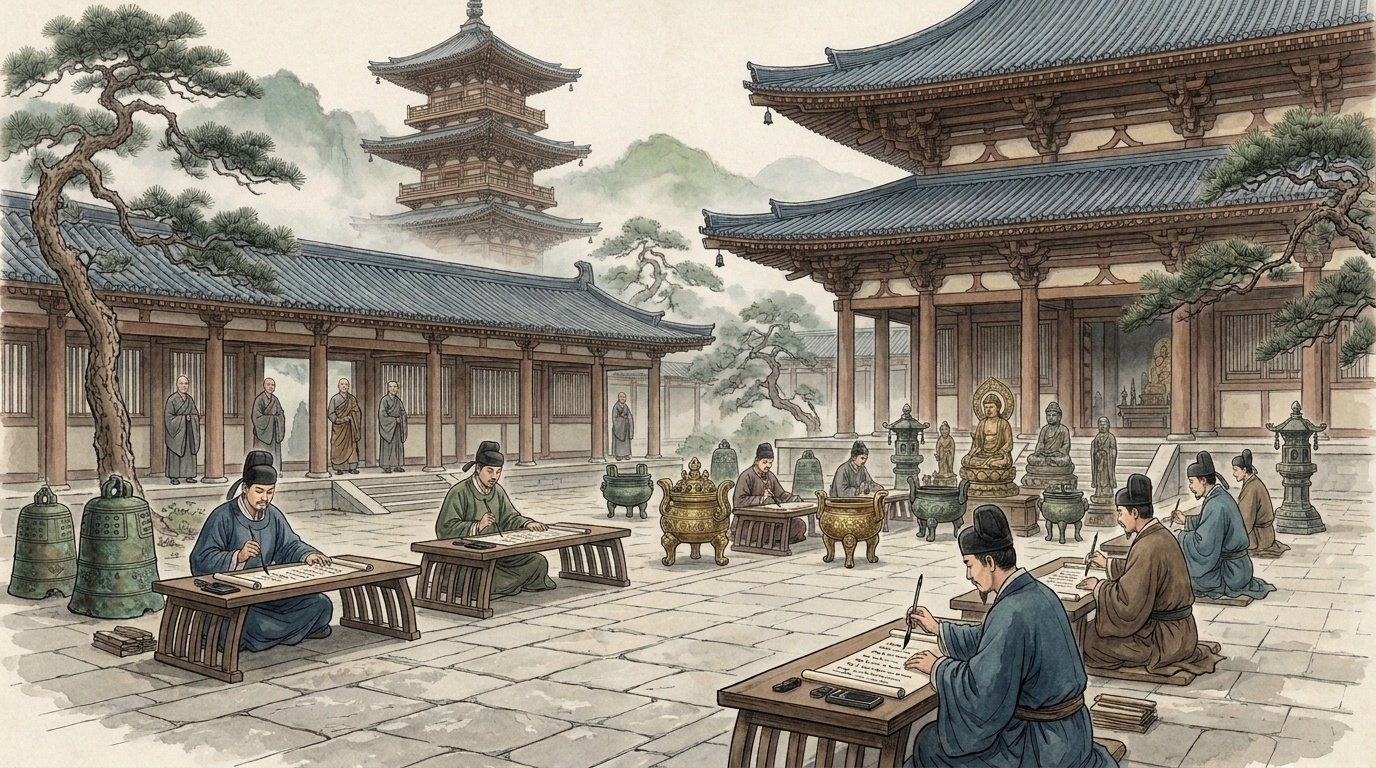
In the eighth lunar month of the fifth year of the Huichang era (August 845 CE), an imperial decree bearing the vermilion seal of the Son of Heaven detonated across the sixteen circuits of the Tang Empire like a clap of thunder. From the imperial palaces of Chang’an and Luoyang to the mist-shrouded mountain sanctuaries of Mount Wutai, Mount Lu, and the remote river valleys of Sichuan, an army of imperial commissioners, prefectural constables, and blacksmiths descended upon the sacred infrastructure of Chinese Buddhism. With sledgehammers and pickaxes, imperial work crews tore down the painted timber halls, kicked over burning incense burners, and smashed thousands of sacred stone steles. Monasteries that had accumulated centuries of imperial donations, golden reliquaries, and vast libraries of Sanskrit sutras were systematically stripped, looted, and demolished. The colossal bronze bells that had tolled the dawn across Chinese metropolises for generations were hauled down from high wooden towers, dragged into government foundries, and melted down into bubbling vats of molten alloy to be restamped into imperial bronze currency. Golden and silver icons of the Buddha were melted into state bullion, while iron images were cast into agricultural plows and ditch-digging hoes.
Simultaneously, more than a quarter of a million Buddhist monks and nuns were dragged before local magistrates. Stripped of their saffron robes, forced to discard their mendicant alms bowls, and commanded to let their shaved hair grow, they were legally defrocked and forcibly returned to secular life (还俗, huansu). More than one hundred and fifty thousand temple slaves, monastery serfs, and indentured agricultural laborers were emancipated from monastic bondage and inscribed directly onto the imperial tax registers as tax-paying peasant households. Tens of millions of qing of prime, fertile agricultural estates—endowed with private watermills, oil presses, and pawnshops—were seized by the state treasury and distributed to land-starved commoners. It was the climax of the Huichang Anti-Buddhist Persecution (会昌灭佛, Huichang Miefuo)—the most sweeping, violent, and economically transformative assault on organized religion in pre-modern Asian history.
In traditional Buddhist historiography, this cataclysm was remembered as the darkest chapter of the Three Wus and One Zong (三武一宗法难)—a sacrilegious nightmare orchestrated by a mad, Daoist-poisoned emperor, Emperor Wuzong of Tang (唐武宗, Li Yan 李炎, r. 840–846 CE), and a cabal of jealous court sorcerers. Yet when examined through the rigorous lens of institutional political economy and fiscal history, the Huichang suppression emerges as something far profounder than an arbitrary religious pogrom. It was a desperate, coordinated, and remarkably effective counter-offensive launched by an impoverished imperial state against an autonomous, tax-exempt institutional monster that had been cannibalizing the fiscal and demographic lifeblood of the empire for over three centuries. Facing crippling financial bankruptcy, mutinous frontier warlords (Jiedushi 节度使), and a catastrophic national currency shortage, the Tang court under Emperor Wuzong and his brilliant, iron-willed chancellor Li Deyu (李德裕) shattered the monastic economy in a ruthless bid to reclaim the fiscal sovereignty of the state.
This comprehensive investigation deconstructs the Huichang Persecution in its full historical, intellectual, and economic complexity. We will trace the ideological roots of anti-Buddhist sentiment among the Confucian literati, examining Han Yu’s (韩愈) iconic 819 CE assault on the Buddha’s bone relic; analyze the staggering economic footprint of the medieval Buddhist church as an institutional tax shelter; explore Emperor Wuzong’s personal martial ethos and his fanatical embrace of religious Daoism under master Zhao Guizhen (赵归真); follow the minute, phased escalation of the persecution decrees between 842 and 845 CE; examine the tragic collateral obliteration of China’s other foreign Silk Road religions—Nestorian Christianity, Zoroastrianism, and Manichaeism; walk through the harrowing eyewitness testimony of the Japanese pilgrim monk Ennin (圆仁), who recorded the unfolding terror in his daily diary; and evaluate the profound, permanent civilizational legacy that broke the intellectual and economic hegemony of medieval scholastic Buddhism and cleared the path for the rise of secular Neo-Confucianism in the Song Dynasty.
1. The State Within a State: The Monastic Economy of the Late Tang
To comprehend why the Tang state struck with such apocalyptic ferocity in 845 CE, one must first appreciate the staggering scale of the economic empire that organized Buddhism had erected across medieval China. Ever since Buddhism entered China from the Western Regions during the Eastern Han Dynasty, imperial patronage had showered the monastic community (the Sangha) with extraordinary privileges. Rulers seeking karmic merit (功德) for dynastic legitimacy—most notably Emperor Wu of Liang (梁武帝) in the Southern Dynasties and Empress Wu Zetian (武则天) during the late seventh century—bestowed upon major monasteries vast tracts of prime arable land, imperial palace buildings, thousands of serfs, and unconditional tax exemptions.
By the ninth century, the Buddhist church had evolved into a gigantic, autonomous economic empire that operated completely outside the fiscal and legal control of the imperial government. This monastic state-within-a-state was characterized by four major structural distortions of the national economy:
- 1. The Monopolization of Arable Land: Buddhist monasteries owned tens of millions of mu of prime agricultural estates across the empire’s most fertile river valleys. These monastic latifundia (寺庄, Sizhuang) were operated like industrial agricultural corporations, equipped with advanced water-powered hydraulic millstones (水碓), oil processing mills, and vast timber orchards. Under imperial statutes, all monastic land was legally classified as ‘Pure Land’ (净土), completely exempt from the Equal-Field redistributions, imperial land taxes (租), and local corvée labor levies.
- 2. Massive Labor Evacuation: According to official census records of the Ministry of Revenue, by the 840s over 260,000 ordained monks and nuns resided in formal monasteries, while another 500,000 to one million unregistered postulants, acolytes, and nominal monks lived within the temple complexes. Every individual who entered the monastery was legally excised from the imperial census registers (黄籍). They paid zero head taxes, remitted zero grain, and owed zero military service. Furthermore, monasteries owned over 150,000 temple serfs and hereditary slaves (寺奴, Sinu), alongside hundreds of thousands of tenant farmers (佃户) who surrendered half their harvests to temple treasuries rather than paying taxes to the Son of Heaven.
- 3. The Financial Banking Monopoly and Inexhaustible Treasuries: Monasteries operated the most advanced and predatory banking network in medieval Asia, centered upon the Inexhaustible Treasuries (无尽藏, Wujin Zang). Originally established as charitable trusts funded by pious lay donations to feed the starving, these treasuries evolved into massive, predatory pawnshops, moneylending agencies, and credit institutions. Wealthy temples loaned grain, seed, and copper currency to desperate peasant farmers at usurious interest rates of 30 to 50 percent per annum. When peasants defaulted, the monasteries legally seized their ancestral lands and bonded their children as temple laborers.
- 4. The Copper Currency Famine (钱荒, Qianhuang): In pre-modern economies, metallic currency was the lifeblood of commerce. Tang commerce required immense volumes of standard bronze coinage (Kaiyuan Tongbao 开元通宝). However, Buddhist devotion created a catastrophic currency drain. Vast quantities of copper were pulled out of commercial circulation and melted down to cast colossal temple bells, incense burners, scripture cases, and gilded Buddha statues. A single monumental statue could consume hundreds of thousands of pounds of refined copper. This hoarding caused a devastating national liquidity crisis, depressing agrarian commodity prices and paralyzing inter-provincial trade.
The economic parasitism of the monasteries was documented with unsparing mathematical precision by the Tang imperial decree of 845 CE, preserved in the Old Book of Tang:
「穷极土木,竞侈旃檀……劳人力于鬼神,夺人利于木石。私度岁增,寺宇日广,农桑之民,遂至减少。一人不耕,天下受其饥;一人不蚕,天下受其寒。今僧尼不可胜数,皆待农而食,待蚕而衣,土木衣裘,何所底止!天下之民,其耗费于此者,十有七八!」
— Imperial Edict of Emperor Wuzong on the Abolition of Monasteries, Old Book of Tang (旧唐书), Chapter 18A
‘They exhaust timber and earth to the extreme, vying in the extravagance of carved sandalwood… They exhaust human labor for ghosts and spirits, and rob human livelihood for wood and stone! Private ordinations multiply year by year; temple halls expand daily, until the cultivators of grain and sericulture are drastically depleted. If a single man fails to plow, the realm suffers hunger from it; if a single woman fails to weave silk, the realm suffers cold from it! Today, the monks and nuns are beyond count, all waiting for farmers to feed them and silkworms to clothe them. For their halls, their robes, their furs—where will it ever end! Of all the wealth of the realm, that which is consumed and wasted upon this accounts for fully seventy to eighty percent!’
2. The Intellectual Crucible: Han Yu and the Confucian War on Barbarian Faith
The economic assault of 845 CE was not born in an intellectual vacuum; it was the direct culmination of a fierce, decades-long ideological crusade launched by the Confucian literati to reclaim Chinese cultural identity. Following the traumatic devastation of the An Lushan Rebellion (755–763 CE), an emerging generation of scholar-officials—spearheading the Ancient Prose Movement (古文运动, Guwen Yundong)—began searching for the deep cultural causes of the dynasty’s collapse. Led by the towering literary giant and philosopher Han Yu (韩愈, 768–824 CE) and his comrade Li Ao (李翱), these intellectuals argued that the Tang had lost its moral mandate because it had abandoned the pristine, native Confucian rites of the Duke of Zhou and Confucius in favor of an alien, barbarian Indian superstition.
The conflict erupted into an explosive public confrontation in 819 CE. Emperor Xianzong (唐宪宗, r. 805–820 CE)—a capable monarch who had successfully re-subjugated several rebellious Jiedushi—became obsessed with Buddhist mysticism. Learning that the sacred bone relic of the finger of the historical Sakyamuni Buddha, preserved inside the subterranean crypt of the Famen Temple (法门寺) near Fengxiang, was scheduled for its once-every-thirty-years ritual exhibition, Xianzong ordered an imperial escort of imperial guards and royal carriages to bring the finger bone to Chang’an. For three days, the bone was housed inside the imperial palace, where the emperor and his concubines prostrated themselves before it. The relic was then paraded through the wards of Chang’an, sparking nationwide religious hysteria: princes and commoners threw fortunes of gold and silver at the relic, while zealots burned their hair, branded their scalps, and severed their own fingers in ecstatic devotion.
Horrified by this spectacle of imperial debasement before an alien bone, Han Yu submitted his blistering, uncompromising memorial, Memorial on the Bone of the Buddha (论佛骨表, Lun Fo Gu Biao), directly to the throne:
「佛本夷狄之人,与中国言语不通,衣服殊制;口不言先王之法言,身不服先王之法服,不知君臣之义,父子之恩。设使其身至今尚在,奉其国命来朝京师,陛下容而接之,不过宣政一见,礼宾一设,赐衣一袭,卫之出境,不令惑众也。况其身死已久,枯朽之骨,凶秽之余,岂宜令入宫禁,玩弄而瞻拜之哉!」
— Han Yu (韩愈), Memorial on the Bone of the Buddha (论佛骨表), preserved in Old Book of Tang, Chapter 160
‘The Buddha was originally a man of the barbarians (夷狄之人); his language was not intelligible to the Central State, and his clothing conformed to an alien pattern. His mouth uttered not the lawful words of the ancient sage-kings; his body wore not their ceremonial robes. He knew nothing of the righteous bonds between sovereign and minister, nor of the sacred affection between father and son! Suppose he were still alive today and came to the capital bearing tribute from his realm; Your Majesty might receive him, yet it would amount to nothing more than a single court audience in the Xuanzheng Hall, a banquet in the Guest Pavilion, a gift of silk robes, and an armed escort beyond our borders, never permitting him to delude the multitude! How much less fitting is it, then, that his body has been dead for centuries, and that these dry, rotten bones, these foul and ominous remnants of a corpse, should be welcomed into the imperial palace, handled, fondled, and worshipped!’
Han Yu concluded with a terrifying demand: he urged Emperor Xianzong to seize the Buddha’s finger bone, hand it over to the judicial authorities, and cast it into blazing fire and rushing water (投诸水火) to sever its evil roots forever and purge the realm of superstition. Han Yu warned that if the Buddha possessed miraculous power, let any divine punishment fall upon Han Yu’s own body alone.
Infuriated by Han Yu’s blunt insolence, Emperor Xianzong prepared to have the scholar executed for treason. Only the desperate petitions of senior chancellors Pei Du and Cui Qun saved Han Yu’s life; he was stripped of his rank and banished to the malarial, tiger-infested southern outpost of Chaozhou (潮州) in Guangdong. Yet while Han Yu was exiled, his fierce ideological manifesto became the holy scripture of an entire generation of young Confucian scholar-bureaucrats. Han Yu had articulated a powerful philosophical framework: Buddhism was unfilial, unpatriotic, economically parasitic, and culturally alien. When an emperor arose who shared this conviction, the theoretical weapon forged by Han Yu would be unsheathed with devastating, lethal effect.
3. The Sovereign and His Chancellor: Emperor Wuzong and Li Deyu
That emperor ascended the throne in the first lunar month of 840 CE: Emperor Wuzong (唐武宗, Li Yan 李炎, 814–846 CE). Unlike his weak, pious predecessors who had spent their reigns secluded in the inner palaces under the thumb of corrupt palace eunuchs, Wuzong was an energetic, martial, and fiercely decisive ruler. Tall, muscular, and skilled in archery and horse-riding, Wuzong possessed an authoritarian temperament and a burning ambition to restore the military glory and fiscal supremacy of early Tang.
Wuzong’s greatest stroke of statesmanship was his unconditional elevation of Li Deyu (李德裕, 787–850 CE, Duke of Wei) to the position of Chief Chancellor. Li Deyu was the undisputed titan of late Tang politics—a man of colossal intellect, aristocratic pedigree (scion of the prestigious Zhao Commandery Li clan 赵郡李氏), and ruthless administrative discipline. In an era paralyzed by the bitter forty-year factional feud known as the Niu-Li Factional Strife (牛李党争), Li Deyu was the undisputed leader of the Li faction, representing aristocratic legalism, rigid bureaucratic efficiency, and absolute centralization of state authority.
Working in perfect harmony, Wuzong and Li Deyu scored a series of dazzling military triumphs that temporarily restored the prestige of the central dynasty:
- The Subjugation of Zhaoyi (昭义之乱, 843–844 CE): When Liu Zhen (刘稹), the hereditary warlord of the Zhaoyi Military Commission in Shanxi, revolted against the throne, previous courts would have appeased him. Wuzong and Li Deyu mobilized five regional armies, coordinated a relentless two-year encirclement campaign, crushed the rebel forces, executed Liu Zhen, and restored direct civil and fiscal administration to southeastern Shanxi.
- The Eradication of the Uighur Threat (840–843 CE): Following the catastrophic destruction of the Uighur Khaganate by the Yenisei Kyrgyz on the Mongolian plateau, over one hundred thousand fleeing Uighur horse archers under Ormïzt Khagan invaded the northern frontiers of the Tang. General Shi Xiong (石雄), coordinated by Li Deyu, launched a daring night assault at Mount Shahu (杀胡山), routing the Uighur host, executing tens of thousands of warriors, and securing the northern borders.
Yet these brilliant military campaigns cost immense sums of money. The imperial treasury was completely hollowed out; army payrolls were in chronic arrears, and the central government faced structural deficits. Wuzong and Li Deyu recognized that if the state were to maintain its military ascendancy over lingering rebellious Jiedushi, it needed a massive, immediate injection of fiscal liquidity and agrarian revenue. Looking across the empire, their gaze fell upon the only institution that possessed limitless wealth, mountains of refined copper, millions of acres of prime land, and hundreds of thousands of healthy laborers paying zero taxes: the Buddhist monasteries.
4. The Daoist Influence: Zhao Guizhen and the Battle for the Imperial Soul
While economic necessity was the primary structural engine of the persecution, Emperor Wuzong’s personal religious passions provided the fanatical, ideological spark. Since his youth, Wuzong had despised Buddhism with visceral contempt, viewing its yellow-robed mendicants as filthy, shaved-headed parasites. Conversely, the emperor was an ardent, devoted follower of Religious Daoism (道教).
In 840 CE, Wuzong summoned the most famous Daoist hierophant of the era to the capital: Zhao Guizhen (赵归真, d. 846 CE), the master of the Southern Sacred Peak (Nanyue), alongside his disciples Deng Yuanqi and Liu Xuanjing. Installed in the palace Daoist sanctuaries, Zhao Guizhen gained profound psychological influence over the young monarch. Zhao Guizhen constantly whispered into the emperor’s ear that the Tang royal house, bearing the imperial surname Li (李), was the direct sacred lineage of the Daoist prophet Laozi (Lao Dan, Li Er 李耳). To permit an alien barbarian faith like Buddhism to flourish upon the soil of China, Zhao argued, was an unfilial sacrilege against the divine imperial ancestors that polluted the Qi of the cosmos, blocked the emperor from attaining physical immortality (长生不老), and sapped the vitality of the dynasty.
Zhao Guizhen urged Wuzong to cleanse the empire of foreign pollutants. He constructed a soaring ninety-foot-tall wooden Daoist altar inside the imperial palace, known as the Terrace Looking toward the Immortals (望仙台), where Wuzong participated in elaborate Daoist purification rituals and consumed alchemical longevity elixirs concocted from mercury, sulfur, arsenic, and ground jade. Reinforced by the secular Confucian anti-monasticism of Chancellor Li Deyu and the anti-Buddhist religious zeal of Zhao Guizhen, the stage was fully set for an unprecedented imperial onslaught.
5. The Phased Assault: Anatomy of an Administrative Extermination (842–845 CE)
Unlike the spontaneous, chaotic religious riots that characterized religious persecutions in ancient Rome or medieval Europe, the Huichang suppression was a meticulously planned, systematically executed bureaucratic campaign. Li Deyu and the Ministry of Rites orchestrated the assault through five escalating administrative phases spanning three years:
| Chronological Phase | Date (Lunar / CE) | Imperial Decrees & Policy Scope | Targeted Population & Economic Assets |
|---|---|---|---|
| Phase 1: Moral Audit & Purge of ‘Irregulars’ | Huichang 2 (842 CE, 10th Mo.) | Mandatory census audit of all monasteries; defrocking of monks who practiced sorcery, held private weapons, or married secretly | Over 3,500 irregular, unregistered monks expelled; private fortunes and weapons caches confiscated |
| Phase 2: Age Demarcation & Labor Extraction | Huichang 3–4 (843–844 CE) | Edict commanding all monks and nuns under age 50 to submit to mandatory defrocking; closure of small private mountain hermitages | Over 40,000 younger monks/nuns forcibly returned to secular life to plow fields and spin silk |
| Phase 3: Liquidation of Rural Shrines & Metals | Huichang 5 (845 CE, 3rd–4th Mo.) | Banning of private bronze statues and ritual bells; demolition of all unofficial rural temples (招提、兰若); smelting begins | Smelting of millions of pounds of bronze bells; casting of Huichang Kaiyuan coins; confiscation of iron tools |
| Phase 4: The Imperial Climax (General Purge) | Huichang 5 (845 CE, 8th Mo.) | Comprehensive, total liquidation decree; each major prefecture permitted only 1 temple; capital permitted only 4 temples | 4,600 monasteries demolished; 40,000 shrines leveled; 260,500 monks/nuns defrocked; 150,000 temple serfs emancipated |
| Phase 5: Eradication of Foreign Religions | Huichang 5 (845 CE, Autumn) | Targeted suppression of all other ‘foreign barbarian’ religions: Nestorian Christianity, Zoroastrianism, Manichaeism | Over 3,000 foreign clergy defrocked; foreign temples demolished; foreign religions virtually eradicated from Central Plains |
The administrative precision of the Phase 4 Climax in August 845 CE was staggering. The imperial decree codified strict geographic quotas: in the western imperial capital of Chang’an, out of hundreds of glorious monastic complexes, only four temples were permitted to remain standing (Daci’en Temple, Ximing Temple, Jianfu Temple, and Anguo Temple), and each temple was legally restricted to precisely thirty ordained monks. In the eastern capital of Luoyang, only two temples were preserved. In each of the empire’s upper-tier prefectures (州), only a single monastery was spared with a maximum quota of twenty monks; in lower-tier prefectures, all temples without exception were ordered demolished to their foundations.
To ensure that the newly defrocked monks and nuns did not simply retreat into private domestic religious devotion, the Ministry of Revenue executed a nationwide cadastral operation. The 260,500 defrocked monks and nuns were officially re-registered on the Yellow Registers (黄籍) as ‘Middle-Tier Households’ (中客), subjected to the full biannual levies of the Two-Tax System (两税法). The 150,000 emancipated temple serfs and private slaves (奴婢) were registered as tax-paying smallholders, allocated portions of the confiscated monastic fields. The confiscated monastic lands—measuring over tens of millions of qing (hundreds of millions of acres)—were nationalized, sold to peasant cultivators, or integrated into state military supply colonies (屯田).
The smelting of the bronze bells and icons was coordinated directly with the imperial mints. In every circuit, the melted sacred metal was cast into standard bronze coinage bearing the inscription ‘Huichang Kaiyuan’ (会昌开元), stamped on the reverse side with the character of the local prefecture (e.g., ‘Chang’ for Chang’an, ‘Luo’ for Luoyang, ‘Yue’ for Yuezhou). Millions of copper coins flooded into commercial circulation, instantly ending the crippling national currency famine and reviving domestic markets.
6. The Eyewitness of the Japanese Pilgrim: Ennin’s Harrowing Chronicle
While official dynastic histories—such as the Old Book of Tang and Zizhi Tongjian—record the Huichang persecution through dry bureaucratic edicts, we possess an extraordinary, intimate, day-by-day eyewitness account of the unfolding catastrophe written by a foreign traveler: the Japanese Tendai Buddhist monk Ennin (圆仁, 794–864 CE, posthumously Jikaku Daishi 慈觉大师).
Ennin had arrived in China in 838 CE as a member of the last official Japanese diplomatic embassy to the Tang (Kentoshi 遣唐使). Traveling for nearly a decade across northern China and studying at Mount Wutai and Chang’an, Ennin kept an exhaustive travel diary written in classical Chinese: The Record of a Pilgrimage to China in Search of the Law (入唐求法巡礼行记, Ru Tang Qiu Fa Xunli Xingji)—hailed by modern historians as one of the greatest travelogues of world literature, rivaling the works of Marco Polo and Ibn Battuta.
Living in the Zishou Monastery (资寿寺) in the northern wards of Chang’an throughout the peak of the terror, Ennin recorded the mounting atmosphere of dread, paranoia, and official brutality with chilling immediacy:
「会昌三年正月……敕天下僧尼,无名籍者皆令还俗。四方州县,官司捕逐,惨毒备至!……会昌五年四月,敕毁天下山林招提、兰若四万余所。有司奉敕,毁拆殿阁,宛如雷震!……金银佛像,皆送入度支;铁佛皆熔为农器;铜佛并钟磬,皆熔为钱……长街之上,僧尼被驱,号泣连天,冠服落地,如屠羊豕!」
— Ennin (圆仁), The Record of a Pilgrimage to China in Search of the Law (入唐求法巡礼行记), Scroll 4
‘In the first lunar month of the third year of Huichang (843 CE)… an imperial decree ordered that all monks and nuns across the realm lacking official registration rolls be forcibly defrocked. Throughout the commanderies and counties of the four quarters, government officials hunted and pursued them, inflicting the most bitter cruelty!… In the fourth month of the fifth year of Huichang (845 CE), an edict commanded the destruction of over forty thousand mountain shrines and private hermitages across the realm. Officials executing the edict smashed and demolished temple halls and pavilions with a roar like thunder!… Gold and silver Buddha statues were all surrendered to the Ministry of Revenue; iron Buddhas were all melted down for agricultural tools; bronze Buddhas along with bells and sounding stones were all melted into coinage… Upon the broad avenues, monks and nuns were driven along like cattle, their wailing and weeping piercing the heavens, their saffron robes and caps cast onto the dirt, slaughtered like sheep and pigs!’
Ennin documented how imperial inspectors conducted unannounced midnight raids on monastic dormitories, seizing hidden sacred texts, beating aged abbots who protested, and hauling away ornamental gold reliquaries. In the fifth month of 845 CE, Ennin himself, despite being a certified foreign diplomatic pilgrim from the Kingdom of Japan, was dragged before the Chang’an prefectural court. His monastic robes were forcibly stripped from his body, his head was forced into the coarse cloth cap of a Chinese commoner, and he was served with a formal imperial expulsion order commanding him to walk on foot under armed police escort thousands of miles back to the coast at Dengzhou (Shandong) for deportation across the Yellow Sea. Ennin’s poignant diary remains the most powerful human testament to the systematic ruthlessness of the late Tang administrative state.
7. Collateral Annihilation: The Eradication of the Silk Road Faiths
While Buddhism was the primary target, the Huichang persecution struck with even more devastating, existential finality against the other foreign religions that had flourished along the Silk Road under the cosmopolitan shelter of the early Tang. To Emperor Wuzong and his xenophobic Confucian-Daoist advisors, faiths imported from the barbarian West were even more abhorrent than Buddhism, possessing not even the redeeming feature of massive popular Chinese followings.
In the autumn of 845 CE, Wuzong issued a supplementary edict specifically targeting these minority foreign doctrines:
「其大秦景教、穆护祆教、摩尼教等,皆西域异端,不可独存。其僧侣二千余人,并令还俗,毋得混杂华风!」
— Imperial Supplementary Edict on Western Religions, Zizhi Tongjian, Chapter 248
‘As for the Syrian Nestorian Christianity (Jingjiao), the Zoroastrian Magi (Xianjiao), Manichaeism (Monijiao), and the like—all are Western barbarian heresies that shall by no means be permitted to survive alone! Their priests and clergy, over two thousand persons, are all commanded to return to secular life, and shall never be permitted to contaminate the customs of the Hua!’
The impact of this single decree was catastrophic:
- Nestorian Christianity (景教, Jingjiao): Having flourished for over two centuries since Alopen’s arrival in 635 CE, the Church of the East in China was utterly eradicated from the Central Plains. The Da Qin monasteries in Chang’an, Luoyang, and Guangzhou were pulled down; Syrian and Sogdian bishops were defrocked and forced into common tax-paying status or driven into exile along the Silk Road. The famous Nestorian Stele (大秦景教流行中国碑), erected in 781 CE to celebrate the glorious history of the church, was secretly buried underground by terrified Christian believers outside Chang’an to save it from the sledgehammers of Wuzong’s work crews—remaining hidden beneath the earth for nearly eight centuries until its rediscovery in 1625.
- Zoroastrianism (祆教, Xianjiao): The ancient Persian fire temples, which had served the vast Sogdian merchant guilds across Chang’an, Luoyang, and the Hexi Corridor, were demolished. The official imperial post of Sabao (萨宝), which had integrated Sogdian community leaders into the imperial bureaucracy, was abolished. Zoroastrianism lingered only as a secretive, domestic cult among residual Central Asian immigrant families.
- Manichaeism (摩尼教): The dualist Persian religion of Mani had enjoyed imperial protection as long as the Uighur Khaganate—which had adopted Manichaeism as its state religion in 762 CE—commanded military terror over the Tang. But when the Uighurs were crushed in 840 CE, Wuzong unleashed vicious vengeance. In 843 CE, two years before the general Buddhist purge, Wuzong closed all Manichaean monasteries in China, confiscated their immense merchant wealth, ordered Manichaean texts and paintings incinerated in the streets, and massacred dozens of Manichaean elect nuns and priests in Chang’an. Surviving Manichaeans fled into the mountains of Fujian and Zhejiang, where their teachings went underground, transforming into secretive syncretic peasant societies that would re-emerge centuries later as the White Lotus and Mingjiao (Bright Religion).
Unlike Buddhism, which possessed deep indigenous roots and millions of lay Chinese followers, these Western religions never recovered. The Huichang persecution marked the permanent, tragic close of the extraordinary era of religious cosmopolitanism that had defined the golden age of the Eurasian Silk Road.
8. The Poison of Immortality: The Death of Wuzong and the Restoration
At the absolute zenith of his anti-Buddhist triumph, Emperor Wuzong’s grand design was abruptly cut short by the ultimate historical irony. Obsessed with achieving physical Daoist immortality and flying to heaven as an immortal transcendent (神仙), the thirty-one-year-old emperor was consuming massive daily doses of heavy-metal longevity pills concocted by master Zhao Guizhen.
By late 845 CE, the toxic cocktail of cinnabar, mercury, sulfur, and lead was systematically destroying Wuzong’s central nervous system and vital organs. The emperor suffered from violent, psychotic mood swings, chronic insomnia, hair loss, and excruciating abdominal agony. By the first lunar month of 846 CE, the monarch had become mute, his tongue blackened and swollen, paralyzed upon his bedchamber couch. On the twenty-third day of the third lunar month of 846 CE (April 846 CE), Emperor Wuzong died in agonized convulsions at the age of thirty-one, poisoned to death by the very Daoist elixirs he believed would grant him eternal life.
Into the power vacuum stepped the powerful palace eunuchs, who placed upon the throne Wuzong’s thirty-six-year-old uncle: Emperor Xuanzong of Tang (唐宣宗, Li Chen 李忱, r. 846–859 CE)—remembered in history as ‘Little Taizong’ (小太宗). Xuanzong, who had spent decades feigning mental stupidity to survive palace purges, despised Wuzong and hated Chancellor Li Deyu.
Within days of his coronation, Xuanzong launched a sweeping political reversal:
- The Purge of the Daoists: The arrogant Daoist master Zhao Guizhen and his inner circle of hierophants were immediately arrested, dragged into the market square of Chang’an, and publicly beheaded.
- The Fall of Li Deyu: The titanic chancellor was stripped of his ministerial offices, demoted to a provincial posting, and eventually exiled to the southernmost penal station of Yazhou (崖州, modern Hainan Island), where he died in exile in 850 CE, marking the final extinction of the aristocratic Li faction.
- The Edict of Buddhist Restoration (846 CE, 5th Mo.): Emperor Xuanzong issued an imperial amnesty permitting the rebuilding of destroyed monasteries, authorizing monks and nuns who wished to re-enter the monastic order to take their vows anew, and restoring surviving Buddhist scriptures.
9. The Irreversible Shift: Why Buddhism Never Truly Recovered
Yet despite Emperor Xuanzong’s generous restoration edicts, Chinese Buddhism was permanently, irreversibly altered. The Huichang persecution had dealt the medieval Buddhist church a mortal institutional and intellectual blow from which it would never truly recover its former glory.
The landscape of post-Huichang Buddhism was fundamentally reshaped along two decisive vectors:
- 1. The Extinction of the Great Scholastic Traditions: Prior to 845 CE, Chinese Buddhism was dominated by intellectually dazzling, philosophically complex scholastic schools that required immense aristocratic endowments, massive specialized libraries, and decades of philological study—most notably the Tiantai (天台宗), Huayan (华严宗), and Faxiang/Yogacara (法相宗) traditions. When the great monastic libraries were burned and their stone printing blocks smashed, these complex textual lineages were virtually extinguished. In subsequent centuries, only two traditions survived with massive popular vitality:
- The Chan (Zen) Tradition (禅宗): Chan was uniquely adapted to survive institutional persecution. Rejecting scholastic pedantry, Chan emphasized direct mind-to-mind transmission (‘not establishing words and letters’ 不立文字). Crucially, under the agrarian monastic code established by master Baizhang Huaihai (百丈怀海, 720–814 CE), Chan monks lived by the revolutionary communal rule: ‘A day without work is a day without food’ (一日不作,一日不食). Chan monks plowed their own fields, washed their own bowls, and lived self-sufficiently in remote mountain huts, completely independent of imperial endowments, monastic latifundia, or temple serfs. When the imperial storm broke, Chan simply retreated into the hills and survived.
- The Pure Land Tradition (净土宗): Pure Land required no philosophical treatises or massive monasteries; its sole requirement was sincere devotion and the continuous chanting of the name of Amitabha Buddha (念佛). It flourished effortlessly among illiterate peasant smallholders and urban commoners, becoming the democratic faith of popular Chinese society.
- 2. The Permanent Subjugation to the Imperial State: The fantasy of Buddhist monastic independence—first defended in the fourth century by Huiyuan in his treatise A Monk Does Not Bow Down to a King—was dead forever. Post-Tang dynasties never again permitted the Buddhist establishment to function as a sovereign tax-exempt enclave. In the Song, Ming, and Qing dynasties, the state strictly regulated monastic ordinations through imperial examination certificates (度牒, Dudie), capped temple landholdings, subjected monks to criminal law, and treated monasteries as tightly surveilled instruments of imperial moral socialization.
10. Historiographical Debate: Sacrilege or Financial Salvation?
For more than eleven centuries, the Huichang persecution has stood at the crossroads of intense ideological and historiographical debate between religious moralists, Confucian scholars, and modern economic historians.
Traditional Buddhist chronicles, such as the Fozu Tongji (佛祖统纪, Comprehensive Chronicle of the Buddhas and Patriarchs), recorded Wuzong’s reign as a horrifying karmic catastrophe. They portrayed Wuzong as an archetype of the blasphemous tyrant whose agonizing death from elixir poisoning was immediate divine retribution for destroying the sacred Dharma. In this moral framework, the Huichang era was an unmitigated disaster that severed sacred lineages and plunged the world into spiritual darkness.
Conversely, traditional Song Dynasty Confucian historians, led by Sima Guang (司马光) in the Zizhi Tongjian, evaluated Wuzong and Li Deyu with profound admiration and nuanced praise. Sima Guang commended Wuzong for his extraordinary courage in striking down the parasitic monastic economy, arguing that no emperor since the Three Dynasties had displayed such iron resolve in liberating millions of agricultural laborers from religious superstition. Sima Guang’s sole criticism was Wuzong’s personal folly in falling prey to Daoist sorcerers like Zhao Guizhen.
In modern twentieth- and twenty-first-century scholarship, pioneered by master historians such as Chen Yinke (陈寅恪), Kenneth Ch’en, and Jacques Gernet in his monumental Buddhism in Chinese Society: An Economic History from the Fifth to the Tenth Centuries, the analysis shifted decisively toward political economy. Gernet demonstrated that the Huichang persecution was not a sudden explosion of religious hysteria, but the inevitable structural climax of an irreconcilable financial conflict. In an agrarian civilization where the central state relies upon land and head taxes to fund national defense and irrigation, it cannot coexist indefinitely with an autonomous religious institution that monopolizes the majority of arable wealth and labor while contributing zero revenue. The Huichang suppression was the painful, necessary surgical extraction of an economic tumor that was choking the medieval Chinese state.
By returning hundreds of thousands of healthy laborers to agrarian production, injecting millions of copper coins into a starved commercial economy, and secularizing millions of acres of farmland, Emperor Wuzong and Li Deyu provided the Tang state with a crucial fiscal reprieve that extended the life of the dynasty for another half-century. More profoundly, by dismantling the medieval monastic monopoly, the Huichang persecution paved the way for the secular, meritocratic, and humanistic intellectual renaissance of the Song Dynasty—proving that the hammer that smashed the bronze Buddhas of Chang’an was the very tool that forged the foundations of early modern China.
11. Chronology of the Huichang Persecution (840–846 CE)
| Date (Lunar / CE) | Historical Milestone | Key Historical Figures | Tactical & Institutional Significance |
|---|---|---|---|
| 819 | Han Yu Submits Memorial on Buddha’s Bone Relic | Han Yu, Emperor Xianzong | Intellectual manifesto of Ancient Prose Movement; establishes anti-monastic Confucian ideology |
| 840 (1st Mo.) | Ascension of Emperor Wuzong; Alliance with Li Deyu | Emperor Wuzong, Li Deyu | Wuzong assumes throne; appoints Li Deyu Chancellor; prioritizes military and fiscal centralization |
| 840 (Autumn) | Arrival of Daoist Master Zhao Guizhen | Zhao Guizhen, Wuzong | Zhao Guizhen enters palace; begins indoctrination linking Daoism to imperial Li lineage |
| 842 (10th Mo.) | Phase 1 Edict: Purge of Unregistered Clergy | Wuzong, Li Deyu | Audit of monasteries; defrocking of 3,500 irregular monks; weapons and private wealth confiscated |
| 843 (Early) | Suppression of Manichaeism (摩尼教) | Emperor Wuzong | Following Uighur collapse, Manichaean temples closed, property seized, elect nuns executed |
| 843–844 | Phase 2 Edicts: Defrocking of Clergy Under Age 50 | Li Deyu, Ministry of Rites | 40,000 younger monks/nuns returned to secular agrarian labor; small hermitages demolished |
| 845 (3rd–4th Mo.) | Phase 3 Edict: Smelting of Bronze Bells & Statues | Ministry of Revenue | Prohibition of bronze icons; casting of Huichang Kaiyuan currency; currency famine relieved |
| 845 (8th Mo.) | Phase 4 General Suppression Edict (The Climax) | Emperor Wuzong, Li Deyu | 4,600 monasteries demolished; 40,000 shrines leveled; 260,500 defrocked; 150,000 serfs freed |
| 845 (Autumn) | Expulsion of Ennin; Eradication of Nestorianism | Ennin, Christian/Zoroastrian Clergy | Japanese pilgrim expelled; Nestorian Christianity and Zoroastrianism eradicated from Central Plains |
| 846 (3rd Mo.) | Death of Emperor Wuzong at Age 31 | Emperor Wuzong, Zhao Guizhen | Wuzong dies of Daoist mercury elixir poisoning; persecution halts abruptly |
| 846 (4th–5th Mo.) | Ascension of Xuanzong; Purge of Daoists | Emperor Xuanzong, Li Deyu | Zhao Guizhen executed; Li Deyu exiled to Hainan; modest restoration of Buddhist monasteries |
12. Scholarly Bibliography and Primary Historical Sources
To substantiate the economic figures, theological decrees, and historiographical analyses presented in this study, the following primary sources and academic monographs are recommended for further study:
- Liu Xu (刘昫) et al. (comp. 945 CE), Old Book of Tang (旧唐书, Jiu Tang Shu): The primary official historical chronicle. Indispensable records include the Basic Annals of Wuzong (Vol. 18A), Basic Annals of Xuanzong (Vol. 18B), the Biographies of Li Deyu (Vol. 174), and Han Yu (Vol. 160).
- Ouyang Xiu (欧阳修) and Song Qi (comp. 1060 CE), New Book of Tang (新唐书, Xin Tang Shu): Essential supplementary data on administrative structures, notably the Treatise on Food and Money (食货志) documenting the smelting of bronze bells and the cadastral registration of defrocked monks.
- Sima Guang (司马光, comp. 1084 CE), Comprehensive Mirror in Aid of Governance (资治通鉴, Zizhi Tongjian): Volumes 246 through 248 provide the definitive, month-by-month chronological reconstruction of the Huichang era, with extensive commentary on Li Deyu’s statecraft and the suppression decrees.
- Ennin (圆仁, comp. 838–847 CE), The Record of a Pilgrimage to China in Search of the Law (入唐求法巡礼行记, Ru Tang Qiu Fa Xunli Xingji): The priceless, four-scroll contemporary diary recording the day-to-day reality of the persecution in Chang’an from an eyewitness perspective. Translated into English with monumental commentary by Edwin O. Reischauer (1955) as Ennin’s Diary: The Record of a Pilgrimage to China in Search of the Law, Ronald Press Company.
- Reischauer, Edwin O. (1955), Ennin’s Travels in T’ang China, Ronald Press Company: The companion scholarly monograph analyzing Ennin’s eyewitness descriptions of late Tang society, popular religion, foreign communities, and the administrative mechanisms of the Huichang purge.
- Gernet, Jacques (1995), Buddhism in Chinese Society: An Economic History from the Fifth to the Tenth Centuries, Columbia University Press: The definitive socioeconomic masterpiece examining the monastic economy, temple serfdom, watermill monopolies, and the financial inevitability of the state suppression.
- Ch’en, Kenneth (1964), Buddhism in China: A Historical Survey, Princeton University Press: Chapter 9 provides the foundational English-language academic analysis of the political, economic, and Daoist causes of the Huichang persecution.
- Chen Yinke (陈寅恪, 1944), Outline of the Political History of the Tang Dynasty (唐代政治史述论稿), Sanlian Shudian: Pioneering analysis of the Niu-Li Factional Strife, Li Deyu’s aristocratic political ideology, and the centralization reforms of Wuzong’s reign.
- Weinstein, Stanley (1987), Buddhism Under the T’ang, Cambridge University Press: Masterful, rigorous historical survey detailing imperial patronage and state regulation of Buddhism from Gaozu through the Huichang persecution and its aftermath.
- Hartman, Charles (1986), Han Yü and the T’ang Search for Unity, Princeton University Press: The definitive intellectual biography of Han Yu, providing deep philosophical analysis of the Memorial on the Bone of the Buddha and the Ancient Prose Movement.