The Equal-Field System, the Fubing Militia and the Breakdown of Tang
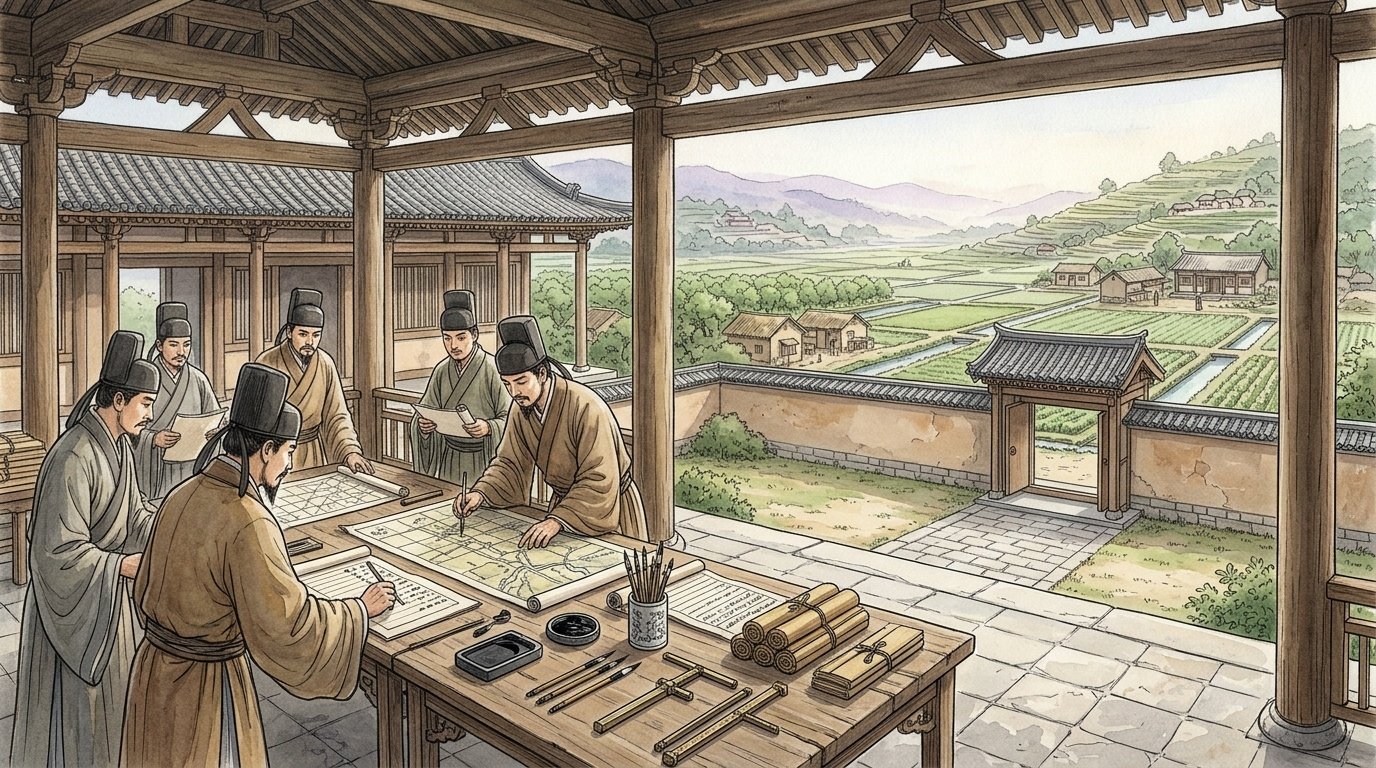
When historians reflect upon the zenith of the Tang Dynasty (唐朝, 618–907 CE)—an epoch celebrated for the celestial poetry of Li Bai and Du Fu, the cosmopolitan glamour of Chang’an, and the sweeping cavalry conquests of Central Asia—they often overlook the unglamorous, iron-geared administrative machinery that made such grandeur possible. The early Tang was not sustained by imperial charisma or romantic genius; it rested upon an intricate, interlocking tripod of agrarian, fiscal, and military institutions: the Equal-Field System (均田制, Juntian Zhi), the Zuyongdiao Tax Structure (租庸调制), and the Fubing Militia System (府兵制). This institutional triad represented one of the most ambitious social engineering projects in human history: a state-mandated economic ecosystem wherein the imperial court claimed ultimate ownership of all agricultural land, distributed it egalitarianly to peasant families, extracted predictable grain, cloth, and labor dues in return, and mobilized self-equipping soldier-farmers to defend the empire without draining a single copper coin from the state treasury.
For more than a century, from the founding of the dynasty through the glorious early reign of Emperor Xuanzong (唐玄宗, r. 712–756 CE), this agrarian-military engine functioned with remarkable efficacy. It shielded the peasantry from landlessness, prevented the premature concentration of aristocratic latifundia, filled the grand imperial granaries at Luoyang and Chang’an to bursting capacity, and supplied Emperor Taizong and Emperor Gaozong with the disciplined, patriotic shock armies that shattered the Turkic khaganates, subdued the Korean kingdoms, and secured the Silk Road across the Tarim Basin. Under this system, China enjoyed an unprecedented era of demographic explosion, social stability, and global prestige.
Yet embedded within the very genius of this system lay fatal, systemic vulnerabilities. The Equal-Field and Fubing models rested upon rigid, static assumptions: a stable agrarian population, abundant frontier arable lands, short seasonal military campaigns, and rigorous household census registration. By the eighth century, the relentless demographic surge of the High Tang, combined with systemic land annexation by imperial aristocrats, corrupt officials, and tax-exempt Buddhist monasteries, caused the agrarian foundation to disintegrate. Millions of land-starved peasants fled their ancestral fields, becoming unregistered vagrants; the Zhechong Garrisons of the Fubing militia emptied into ghostly abandoned barracks; and the central treasury faced catastrophic fiscal collapse. To survive, the Tang was forced to abandon its founding institutions, pivoting to professional mercenary armies under autonomous frontier warlords (Jiedushi 节度使)—a desperate structural gamble that precipitated the apocalyptic devastation of the An Lushan Rebellion (安史之乱) and altered the course of Chinese history forever.
This comprehensive treatise presents an exhaustive institutional and economic post-mortem of the rise and fall of the Tang agrarian-military core. We will dissect the legal mechanics of land distribution under the Equal-Field edicts; analyze the tripartite extraction mechanics of the Zuyongdiao fiscal framework; examine the recruitment, logistical self-sufficiency, and strategic geography of the 634 Fubing Garrisons; trace the multi-faceted crisis of land exhaustion, registration evasion (逃户), and prolonged expeditionary attrition; investigate the military shift toward professional standing armies under Chancellor Zhang Yue; examine the fatal geopolitical imbalance of ‘Heavy Exterior, Empty Interior’ (外重内轻); and analyze the revolutionary tax reform of 780 CE—Yang Yan’s Two-Tax System (两税法)—which permanently closed the book on early medieval Chinese agrarian institutions and laid the structural foundations for the commercialized economy of the Song Dynasty.
1. The Agrarian Bedrock: The Mechanics of the Equal-Field System (均田制)
The Equal-Field System was not an original invention of the Tang; it was inherited and perfected from the Xianbei rulers of the Northern Wei (北魏), who had first promulgated the concept in 485 CE under Empress Dowager Feng and Emperor Xiaowen. Designed originally to restore depopulated, war-ravaged farmlands across northern China following the Sixteen Kingdoms period, the system was codified into its most sophisticated legal form by the Tang founders in the Wude Land Statutes of 624 CE, and later reaffirmed in the Kaiyuan Statutes of 719 CE and 737 CE.
The core philosophical premise of the Equal-Field System was radical: all land within the imperium belonged ultimately to the Son of Heaven. Private, absolute ownership of real estate did not legally exist. Instead, the imperial state acted as the supreme agrarian steward, allocating life-tenancy usufruct rights directly to individual households based strictly upon demographic capacity and labor potential. The standard imperial allocation for a typical peasant household was codified with mathematical precision:
| Land Category | Allocation Standard | Legal Property Status | Crop Requirements & Alienation Rules |
|---|---|---|---|
| Personal Share Land (口分田, Koufentian) | 80 mu (approx. 11 acres) per adult male (丁男, aged 21–59) | State-owned life tenancy; non-hereditary | Must be planted in grain; strictly prohibited from sale, mortgage, or transfer; reverted to the state at age 60 or death |
| Perpetual Property Land (永业田, Yongyetian) | 20 mu (approx. 2.7 acres) per adult male | Hereditary family possession (世业) | Mandated planting of mulberry trees (桑), hemp, or elm; could be legally inherited by male heirs; sale permitted only under extreme destitution |
| Widows & Elderly Households | 30 mu for widows; 40 mu for disabled/elderly | State-owned social security allotment | Exempt from personal labor and military levies; intended to prevent destitution among vulnerable classes |
| Monks, Nuns, & Daoist Priests | 30 mu per monk/Daoist; 20 mu per nun | Institutional state allocation | Granted to officially registered clergy; non-hereditary; reverted to state upon defrocking or death |
In theory, every free male subject upon reaching the age of majority (twenty-one years old) received a total allocation of 100 mu (approximately 13.7 acres). In return, the peasant family was legally anchored to the soil. To prevent land speculation and the resurrection of monopolistic landed estates, the Tang Code (唐律疏议, Article 156) prescribed brutal corporal penalties for anyone attempting to illegally purchase or sell Equal-Field allocations:
「诸卖买口分田者,一亩笞十,二十亩加一等,罪止杖一百。地并还主,财没不追。其官人占田过限者,一亩笞五十,十亩加一等,罪止徒一年。」
— The Tang Code with Commentary (唐律疏议), Chapter 12: “Household and Marriage”
‘Whoever sells or purchases Personal Share Land (Koufentian) shall be punished with ten strokes of the light bamboo for one mu; for every additional twenty mu, the penalty is increased by one degree, up to a maximum of one hundred strokes of the heavy stick. The land shall be restored to its original owner, and the purchase money confiscated. If an imperial official occupies land in excess of statutory limits, he shall receive fifty strokes for one mu, increased by one degree for every ten mu, up to one year of penal servitude!’
However, the imperial statutes made one critical, structural concession to aristocratic and bureaucratic privilege: the granting of Official Rank Land (职分田) and Merit Land (勋田). Imperial princes, dukes, and high-ranking civil ministers holding aristocratic patents were legally entitled to massive hereditary land allocations ranging from several hundred mu for junior magistrates to as much as 10,000 mu (nearly 1,400 acres) for top-tier chancellors and imperial princes. While ordinary peasants held their lands under strict usufruct conditions, the aristocracy possessed legal estates worked by private serfs, tenant farmers, and state slaves—carving out massive, legally protected pockets of land that were permanently shielded from the state’s redistribution pools.
2. The Fiscal Engine: The Zuyongdiao Tripartite Tax Structure
Directly tethered to the Equal-Field System was the fiscal heart of the early Tang state: the Zuyongdiao System (租庸调制). What distinguished this taxation model from modern fiscal systems—and from later Chinese dynasties—was that it was not a tax upon property values, land yields, or commercial profits; it was a universal head tax levied upon the adult male body (按丁征税). Because the state had theoretically endowed every adult male with 100 mu of fertile arable land, every registered adult male (ding 丁) owed the central government three fixed, standardized obligations:
- 1. Zu (租, Grain Tax): An annual tax on agrarian yield. Regardless of weather fluctuations or actual crop harvests, every adult male was required to remit precisely two shi (石, approximately 120 liters) of unhusked millet (粟) or rice to the local state granaries. In southern rice-growing regions, this was remitted as three dou of polished white rice.
- 2. Yong (庸, Corvée Labor Substitution): The universal physical labor obligation. Every adult male owed the imperial state twenty days of compulsory corvée labor (役) per year (extended to twenty-two days during leap years) to construct city walls, dig canals, maintain imperial post-roads, or repair irrigation dykes. Crucially, the Tang Code codified the humane principle of Yong: if the state did not require the peasant’s physical labor, or if the peasant wished to remain tending his harvest, he could commute his twenty days of labor into an in-kind payment of three chi (feet) of silk or linen cloth per day, totaling twenty feet (half a standard bolt) of fabric per year.
- 3. Diao (调, Household Textile Tribute): An annual handicraft tribute reflecting household female sericulture and textile production. Each household was assessed according to its native regional ecology: sericultural regions remitted two zhang (approx. 20 feet) of silk fabric (绫/绢) alongside three ounces of raw silk floss (绵); hemp-producing agricultural regions remitted two zhang and five chi of woven linen cloth (布) and three catties of raw hemp fiber (麻).
The brilliance of the Zuyongdiao framework lay in its simplicity and logistical predictability. It completely bypassed the complexities of rural currency exchange in an era when copper cash was scarce. The empire ran on physical commodities: Grain (Zu) fed the standing armies, the imperial palaces, and urban bureaucrats in the capitals; Silk and Linen (Yong and Diao) functioned as the universal high-denomination currency of the medieval world, used by the Ministry of Revenue to pay official stipends, purchase frontier warhorses, and reward victorious commanders. Furthermore, the system possessed institutional elasticity: the Tang Code contained explicit famine-relief statutes stipulating that if flood, drought, or locust plagues destroyed more than 40 percent of a village’s crop, the Grain Tax was canceled; if damage exceeded 60 percent, the Corvée Labor was canceled; if damage exceeded 70 percent, all three taxes were waived entirely.
3. The Sword of the Peasantry: The Fubing Divisional Militia System (府兵制)
The third, crowning pillar of the early Tang state was its military apparatus: the Fubing System (府兵制). Developed originally under the Western Wei by Yuwen Tai and refined under the Sui, the Fubing achieved its organizational zenith during the Zhenguan reign of Emperor Taizong. The foundational philosophy of the Fubing was the complete institutional integration of the soldier and the cultivator—an ideal known in Chinese military philosophy as ‘Lodging the Soldier Within the Farmer’ (寓兵于农, Yu bing yu nong).
The organizational architecture was anchored upon territorial military divisional units known as Zhechong Garrisons (折冲府, Zhechong Fu). Across the entire empire, the Tang established precisely 634 Zhechong Garrisons. Each garrison was categorized by troop strength:
- Superior Garrison (上府): 1,200 soldiers, commanded by a Zhechong Commandant (折冲都尉, rank 4b).
- Middle Garrison (中府): 1,000 soldiers, commanded by a Zhechong Commandant (rank 5a).
- Inferior Garrison (下府): 800 soldiers, commanded by a Zhechong Commandant (rank 5b).
The total theoretical mobilized strength of the Fubing militia exceeded six hundred thousand elite soldiers. Yet the genius of the system lay in its fiscal cost to the central government: it was virtually free.
Recruitment into the Fubing was an elite privilege, not a penal draft. Conscripts were selected through rigorous vetting overseen by county magistrates and military officers. The selection criteria, codified in the Six Statutes of the Tang (唐六典), gave absolute priority to middle- and upper-tier peasant households who possessed multiple healthy adult sons, substantial Equal-Field holdings, and robust physical stamina. In exchange for military enlistment, the Fubing soldier and his household were granted an extraordinary legal reward: total, perpetual exemption from all Zuyongdiao taxes and local corvée labor drafts.
However, the economic obligations of the Fubing soldier were formidable. The recruit was legally required to equip himself entirely at his own personal expense. When summoned to active duty, each soldier had to report to his garrison with his own complete military kit:
「凡领兵,皆自备弓一张,箭三十,胡禄一,横刀、砺石、大橐、毡帽、毡装各一,麦饭九斗,米二斗。每十人为火,火有火长;六人备驮马一匹,自备釜、甑、锹、锸、斤、斧、索、及火钻等具。」
— New Book of Tang (新唐书), Chapter 50: “Treatise on Military Affairs” (兵志)
‘Every divisional soldier must personally equip himself with one bow, thirty arrows, one leather quiver, one slashing saber (Hengdao), a whetstone, a large rucksack, a felt hat, a felt tunic, nine dou of roasted parched wheat, and two dou of polished rice. Every ten men form a squad (Huo) under a Squad Leader; every six men must jointly provide one baggage pack-horse, providing their own cooking cauldron, rice steamer, spade, mattock, axe, iron hatchet, ropes, and fire-making drills!’
The lifecycle of the Fubing soldier was cyclical. In the spring, summer, and autumn, the soldier lived on his allocated Equal-Field farm with his wife and children, plowing the earth and training daily in archery, saber combat, and spear formations under the supervision of his garrison officers. In the winter months, when agrarian labor ceased, the garrisons conducted grand joint maneuvers, hunting wild game in tactical pincers across provincial mountains to practice battlefield formations.
Active military service was structured into two rotating duties: Palace Guard Duty (宿卫, Suwei) and Frontier Expeditionary Duty (防戍, Fangshu). Every year, Fubing soldiers rotated to the capital of Chang’an to serve one-to-two months guarding the imperial palaces, the Twelve Gates, and the Emperor’s person under the command of the Sixteen Imperial Guard Commands (十六卫). The rotation schedule was calibrated mathematically according to distance: soldiers residing within 500 li of the capital served one month out of every five; those living 2,000 li away served two months every eighteen months. For frontier defense, soldiers were deployed on fixed, limited tours of one year (rarely exceeding three years), after which they returned home to resume farming.
4. Geopolitical Engineering: The Strategic Clustering in Guanzhong
The geographic deployment of the 634 Zhechong Garrisons was one of the most brilliant pieces of geopolitical engineering in medieval history. The Tang founder Li Yuan and his successor Taizong operated under the paramount strategic doctrine known as ‘Controlling the Exterior from the Core’ (以中制外) and ‘Maintaining a Heavy Interior and Light Exterior’ (内重外轻, Nei zhong wai qing).
Having witnessed the fall of the Han and Western Jin dynasties through regional warlordism, the Tang emperors were determined that the central imperial government in Guanzhong (关中, the Shaanxi plain around Chang’an) must always possess overwhelming military superiority over the rest of the empire. Consequently, the distribution of Zhechong Garrisons was deliberately, radically skewed toward the capital heartland:
| Geographical Circuit / Region | Number of Zhechong Garrisons | Percentage of Imperial Garrisons | Strategic Mission & Military Role |
|---|---|---|---|
| Guannei Circuit (关内道, Guanzhong / Chang’an) | 261 Garrisons | 41.2% | Absolute military core; provides immediate garrison defense of Chang’an and the imperial palace |
| Hedong Circuit (河东道, Shanxi) | 164 Garrisons | 25.9% | Secondary defense ring; controls northern mountain passes and the ancestral Tang staging grounds |
| Henan Circuit (河南道, Luoyang Basin) | 74 Garrisons | 11.7% | Secures eastern imperial capital of Luoyang and the Grand Canal supply junctions |
| Hebei Circuit (河北道, Northeastern Plain) | 30 Garrisons | 4.7% | Frontier border watching against Khitan and Mohe raiders |
| Longyou Circuit (陇右道, Gansu / Hexi Corridor) | 37 Garrisons | 5.8% | Guards Silk Road entryways, imperial horse pastures, and Tibetan frontiers |
| All Southern Circuits (Huainan, Jiangnan, Shannan, Lingnan, Jiannan) | 68 Garrisons combined | 10.7% | Minimal policing presence across half of the empire’s total landmass |
As the table demonstrates, over 67 percent (more than two-thirds) of the entire military forces of the Tang Empire were permanently stationed within Guanzhong and Shanxi, immediately surrounding the imperial throne. The central court held an absolute military monopoly. If a provincial rebellion erupted in Shandong, Hebei, or the southern rice valleys, the emperor could mobilize three hundred thousand elite, battle-hardened Guanzhong veterans within weeks, marching out through the Hangu and Tongguan passes to crush the insurrection before it could gain momentum.
Furthermore, the Tang instituted an ingenious institutional separation of military command designed to make military coups impossible. The Zhechong Commandants who trained the soldiers in peacetime possessed no legal authority to mobilize or march them. Troops could only be mobilized through the physical presentation of an imperial Bronze Fish Tally (铜鱼符) issued directly by the Ministry of War in Chang’an. When a war erupted on the frontier, the court appointed a temporary imperial General (行军大总管) to take command of mobilized garrisons. The moment the campaign concluded, the armies returned to their native villages, the soldiers handed back their state weapons, and the commanding generals surrendered their seals of office and returned to court as civilian ministers. As the ancient proverb celebrated: ‘The army had no permanent general, and the general had no permanent army’ (兵无常将,将无常兵).
5. The Cracks in the Foundation: Demographic Explosion and Land Exhaustion
Why did this magnificent institutional system, which seemed to solve the problems of finance, military defense, and agrarian equity simultaneously, collapse into total ruin within a single century? The primary catalyst was demographic and spatial: the Equal-Field System was an institution designed for a depopulated empire, and it could not survive its own demographic success.
When the Equal-Field edicts were first codified in 624 CE, China was recovering from the apocalyptic civil wars of the late Sui Dynasty. Vast regions of the Central Plains were empty wilderness; millions of acres of fertile land lay abandoned, awaiting hands to plow them. The state had vast reserves of uncultivated land to distribute to returning refugees. However, under the long peace of the Zhenguan (626–649 CE) and Kaiyuan (713–741 CE) eras, the registered population skyrocketed from fewer than three million households (approx. 15 million people) in 624 CE to nearly nine million households—over forty-eight million registered individuals—by 742 CE.
China rapidly ran out of arable land. The imperial statutes had divided the empire into two legal classifications: Broad Land Regions (宽乡, Kuanxiang), where available land exceeded the population, and Narrow Land Regions (狭乡, Xiaxiang), where population density far outstripped available acreage. In Narrow Land Regions—which by the late seventh century included the fertile agrarian heartlands of Guanzhong, Henan, and Hebei—the state could no longer provide the statutory 100 mu to adult males. Peasant youths reaching twenty-one years of age received barely thirty, twenty, or sometimes less than ten mu of Personal Share Land; in many densely populated counties, allocations ceased entirely.
Yet while the peasant received only a pathetic fraction of his legal land allocation, the central government’s tax statutes remained rigidly unchanged: the registered adult male was still legally assessed for the FULL Zuyongdiao tax quota. A peasant farming 15 mu was forced to pay the exact same two shi of grain, twenty days of labor, and twenty feet of silk as a peasant farming 100 mu. The tax rate as a percentage of real yield soared from an equitable 2–3 percent to a crushing 25–40 percent. For millions of smallholder families, the Equal-Field System was no longer a protective social net; it had become an engine of grinding agrarian bankruptcy.
6. The Great Enclosure: Aristocratic Estates and Monastic Tax Evasion
Compounding this land shortage was the rapid, predatory expansion of large private estates (庄园, Zhuangyuan) owned by imperial clansmen, high-ranking civil bureaucrats, and powerful Buddhist monasteries. Taking advantage of the legal loopholes governing ‘Official Rank Land’ and ‘Merit Land’, wealthy elites accumulated tens of thousands of contiguous acres.
When impoverished smallholders faced crop failures or could not pay their Zuyongdiao tax quotas, aristocratic landlords and merchant usurers stepped in with predatory loans at exorbitant interest rates. When the peasant defaulted, the landlord seized his hereditary Perpetual Land (Yongyetian) and forced him to sign illegal bills of sale for his Personal Share Land (Koufentian). The dispossessed peasant was then re-hired on the very land he had once owned, reduced to a desperate, landless tenant farmer (佃户) who surrendered 50 percent of his harvest to the aristocratic estate owner.
Even more catastrophic was the institutional tax shelter provided by the Buddhist establishment. During the late seventh and early eighth centuries—particularly under the fervent patronage of Empress Wu Zetian (武则天, r. 690–705 CE)—Buddhist monasteries acquired colossal wealth. Aristocratic families routinely engaged in a corrupt legal maneuver known as ‘Fictitious Monastic Dedication’ (托名伪度). A wealthy landlord would nominally donate his vast agricultural estates and villages of peasant tenants to a Buddhist monastery, or have his family members ordained as nominal monks. Because Buddhist monastic property and ordained clergy were legally exempt from imperial land taxes, labor drafts, and military conscription, the landlord paid zero taxes to the imperial court, while quietly pocketing the tenant rents through private monastic trusts.
The contemporary master scholar and historian Du You (杜佑, 735–812 CE) documented this fatal institutional looting in his monumental institutional encyclopedia, the Tongdian (通典):
「天宝以后,法制弛紊,公私田畴,转相吞并。豪富之人,兼并无艺,贫羸之民,流转无所……官司百里之内,田悉入权贵之门,贫者无立锥之地,逃窜四方,赋敛日繁,遂致国匮民穷!」
— Du You (杜佑), Comprehensive Statutes (通典), Chapter 2: “Food and Money”
‘After the Tianbao era, the legal statutes became lax and corrupt; public and private fields were systematically swallowed up. The wealthy and powerful annexed land without limit, while the impoverished and weak wandered displaced with nowhere to turn… Within a hundred li of official government seats, all arable fields entered the gates of the powerful and nobility! The poor possessed not enough ground to stand an awl; fleeing in all directions, their tax assessments multiplied daily, until at last the state treasury was bankrupt and the people exhausted!’
7. The Refugee Deluge: Taohu (逃户) and the Collapse of Census Registration
Crushed between unpayable Zuyongdiao taxes on non-existent land allocations and the extortion of aristocratic landlords, millions of Chinese peasants made the only rational survival choice: they abandoned their ancestral villages and fled. This mass flight created the demographic crisis known in Tang administrative records as Taohu (逃户, ‘Fleeing Households’).
Peasant families packed their meager belongings in the dead of night, slipping away into mountainous wildernesses, crossing provincial borders into peripheral river valleys, or fleeing south across the Huai and Yangtze rivers. There, they lived as unregistered squatters or surrendered themselves as private clients (客户, Kehu) to southern landowners. In doing so, they vanished completely from the official imperial census registers (黄籍, Huangji).
The administrative breakdown this unleashed was catastrophic. Early Tang fiscal law operated on the principle of collective local liability: if five households in a neighborhood fled, the remaining twenty households in the village were legally forced to pay the tax quotas of the absconded families. This sparked a devastating domino effect: the flight of several families increased the tax burden on their remaining neighbors, driving them to bankruptcy and flight in turn, until entire villages and townships were transformed into ghost towns overgrown with wild brambles.
By the 720s, official government inspections revealed that across large swathes of Henan and Hebei, more than fifty percent of all registered households had absconded from the tax rolls. The Ministry of Revenue in Chang’an was staring into an economic abyss: the imperial state had lost the administrative capacity to count its own citizens, collect its grain revenues, or mobilize its labor drafts.
8. The Ruin of the Soldier-Farmer: The Collapse of the Fubing Militia
As the Equal-Field System disintegrated, the Fubing Militia System—which was entirely predicated upon prosperous, landed soldier-farmers—collapsed alongside it. The life of a Fubing soldier transformed from an honored, privileged civic duty into a terrifying death sentence of economic ruin and lifelong exile.
The destruction of the Fubing unfolded across three devastating vectors:
- 1. Prohibitive Financial Ruin: Remember that Fubing soldiers were legally required to purchase their own warhorses, armor, weapons, and provisions. When peasant families held 100 mu of fertile land, this was manageable. But when their farms were reduced to twenty or ten mu, the cost of purchasing a horse, iron scale armor, bows, and swords drove the soldier’s family into hopeless debt. Peasant families routinely sold their daughters into domestic servitude or mortgaged their ancestral Perpetual Land merely to purchase weapons for their sons’ military service.
- 2. Imperial Exploitation and Social Humiliation: In early Tang, when Fubing soldiers rotated to Chang’an for Palace Guard Duty, they were treated with immense respect by the emperor. By the late seventh century, however, corrupt aristocratic ministers, imperial princes, and palace eunuchs began treating the arriving militia soldiers as unpaid, indentured menial slaves. Fubing soldiers were illegally drafted to construct private luxury mansions, dig artificial lakes for imperial concubines, carry sedan chairs, and haul timber, stripped of their weapons and uniforms. Proud soldier-farmers who had trained as elite warriors found themselves mocked as ‘palace laborers’ (官奴).
- 3. Frontier Attrition and Permanent Exile: The original Fubing model was designed for short, seasonal campaigns. But by the late seventh century, the Tang was locked in brutal, non-stop existential wars against the Tibetan Empire (吐蕃) on the high plateaus of Qinghai and the Second Turkic Khaganate in the northern deserts. Frontier deployments that were legally mandated to last one year were arbitrarily extended by imperial commanders to three, six, or ten years. Thousands of Guanzhong farm boys froze to death on the windswept Tibetan borderlands or succumbed to malaria in the subtropical jungles of Nanzhao (Yunnan), leaving their family farms at home untended and ruined.
The tragedy of this attrition was immortalized by the great poet Du Fu (杜甫) in his heart-wrenching masterpiece The Ballad of the War Wagons (兵车行):
「车辚辚,马萧萧,行人弓箭各在腰。爷娘妻子走相送,尘埃不见咸阳桥。牵衣顿足拦道哭,哭声直上干云霄!……君不见,青海头,古来白骨无人收。新鬼烦冤旧鬼哭,天阴雨湿声啾啾!」
— Du Fu (杜甫), The Ballad of the War Wagons (兵车行)
‘Wagons rattle and screech, horses whinny and snort; the marching conscripts wear bows and arrows at their waists. Fathers, mothers, wives, and children run to bid farewell; the dust clouds swallow Xianyang Bridge. Clutching garments, stamping feet, blocking the road, they weep aloud; their cries rise straight into the vaulted clouds!… Do you not see, along the shores of Qinghai Lake, the white bones from antiquity that no one gathers? The new ghosts harbor bitter grievances, the old ghosts weep; when the sky turns overcast and the rains fall damp, their wailing chirps and mourns!’
Faced with this grim reality, the populace resisted military service with desperate fury. Peasant youths deliberately mutilated their own limbs—smashing their feet with boulders or chopping off fingers—to be classified as medically unfit for the Fubing, a practice grimly referred to as preserving ‘Blessed Hands and Feet’ (福手福足). By the reign of Emperor Xuanzong, recruitment into the Fubing had ceased entirely. Conscripts fled on the march; garrison rolls were filled with fictitious ghost names (虚名); and officers embezzled the remaining stipends. By the 740s, the 634 Zhechong Garrisons, which had once formed the terrifying sword of Taizong, were empty, decaying ghost compounds where wild dogs roamed through abandoned armories.
9. The Rise of the Mercenary: Zhang Yue and the Advent of the Jiedushi
With the Fubing militia utterly dead, the Tang Empire faced a terrifying military crisis: how was a superpower with borders stretching thousands of miles across Central Asia to defend itself against the rising empires of Tibet, the Turks, and the Khitans? The central government had no choice but to undertake a radical, desperate military reorganization: the complete transition from a conscript citizen militia to professional mercenary standing armies.
In 723 CE, Prime Minister Zhang Yue (张说, 667–730 CE) took the first decisive step. He abolished the rotating Fubing guard duty at Chang’an, recruiting a professional, paid mercenary force of 120,000 volunteers, designated the Kuoqi (彍骑, ‘Mounted Crossbowmen’), paid directly in state coin and grain. While this temporarily secured the imperial palaces, it left the vast frontiers completely exposed.
To secure the frontiers, Emperor Xuanzong enacted the fateful institutional reform that would destroy the dynasty: the creation of Ten Frontier Military Commissionerships (十大节度使, Jiedushi). Instead of rotating soldiers from the interior, the court established permanent, regional standing armies along the borderlands, composed entirely of long-service professional mercenaries—known as Jian’er (健儿, ‘Tough Lads’). These mercenaries were recruited from displaced landless vagrants, criminal outlaws, and non-Han nomadic tribesmen who had spent their entire lives fighting on horseback.
The geopolitical balance was codified across ten strategic frontier commands:
| Military Commission (节度使) | Garrison Headquarters | Standing Mercenary Troop Strength | Assigned Frontier Enemy |
|---|---|---|---|
| Fanyang (范阳, modern Beijing) | Youzhou (Hebei) | 91,400 elite cavalry & infantry | Khitans (契丹) and Xi (奚) |
| Pinglu (平卢, Liaoning) | Yingzhou (Chaoyang) | 37,500 mixed troops | Mohe / Bohai and Eastern Khitans |
| Hedong (河东, Shanxi) | Taiyuan | 55,000 veteran cavalry | Turks and northern nomadic raiders |
| Shuofang (朔方, Ordos / Ningxia) | Lingzhou | 64,700 frontier shock troops | Steppe defense and Ordos plateau control |
| Hexi (河西, Gansu Corridor) | Liangzhou (Wuwei) | 73,000 Silk Road cavalry | Tibetan Empire (Tubo) flank defense |
| Longyou (陇右, Qinghai / Gansu) | Shanzhou (Haidong) | 75,000 mountain & cavalry units | Direct defense against Tibetan invasions |
| Anxi & Beiting (Western Regions) | Kucha / Jimsar (Xinjiang) | 44,000 Silk Road garrison troops | Western Turks, Arabs (Abbasid), Central Asia |
| Jiannan & Lingnan (South/Southwest) | Chengdu / Guangzhou | 42,300 combined troops | Nanzhao (Southern Barbarians) and coastal defense |
The total frontier mercenary armies numbered nearly five hundred thousand heavily armed professional warriors. To finance and manage these massive forces in distant borderlands without constant court interference, Emperor Xuanzong took the fatal step of concentrating absolute, unchecked regional authority in the hands of the Jiedushi. A single military commissioner was granted concurrent civilian authority as Governor-General (观察使), Civil Inspector (采访使), and Tributary Commissioner (度支使). The Jiedushi commanded the armies, collected local taxes, appointed their own subordinate officers, and minted regional coinage—becoming sovereign territorial warlords in everything but name.
10. The Fatal Inversion: ‘Heavy Exterior, Empty Interior’ (外重内轻)
The rise of the Jiedushi produced the exact opposite of the founding geopolitical doctrine of early Tang. Instead of ‘Controlling the Exterior from the Core’, the empire was plunged into the fatal constitutional predicament known to historians as ‘Heavy Exterior, Empty Interior’ (外重内轻, Wai zhong nei qing).
Along the northern frontiers stood nearly five hundred thousand hardened, ruthless, professional mercenary killers, bound by personal ties of tribal allegiance not to the distant Son of Heaven in Chang’an, but to their direct field commanders who paid their wages and rewarded their battlefield plunder. Meanwhile, inside the heartland of Guanzhong and the Central Plains, the Fubing militia was completely extinct. In Chang’an and Luoyang, the central government maintained fewer than eighty thousand so-called imperial palace guards—recruited from urban merchants, tavern brawlers, and tea-shop clerks who had never drawn a bow in combat and paid bribes to evade field training.
The ultimate architect of this catastrophe was the corrupt, Machiavellian Chief Chancellor Li Linfu (李林甫, d. 752 CE). Terrified that talented Han Chinese military commanders on the frontier might be summoned to court to replace him as Chancellor, Li Linfu persuaded Emperor Xuanzong to adopt a treasonous personnel policy: appointing exclusively non-Han ‘barbarian’ generals (胡人) as frontier Jiedushi. Li Linfu argued that nomadic warriors were naturally fierce, possessed no literary education, harbored no political ambitions to become chancellors, and would remain simple, obedient guard dogs of the dynasty.
Into this power vacuum stepped a cunning, obese, multi-lingual soldier of mixed Sogdian and Turkic ancestry: An Lushan (安禄山, 703–757 CE). Exploiting Xuanzong’s senile indulgence and Li Linfu’s cynicism, An Lushan accumulated unprecedented military power. By 751 CE, An Lushan held concurrent command over three entire military commissions: Fanyang, Pinglu, and Hedong. He directly commanded nearly two hundred thousand elite heavy cavalry and shock infantry—more than forty percent of the entire military forces of the Tang Empire.
In the eleventh lunar month of 755 CE, An Lushan gave the signal for rebellion at Fanyang. Mobilizing his legions of Sogdian, Turkic, Khitan, and Han mercenaries, he swept southward toward the Yellow River like an avalanche of iron. The central plains of China, where two generations had lived without ever seeing a foreign spear, were utterly defenseless. County magistrates abandoned their cities; imperial armies collapsed in tears at the first sound of rebel battle drums. Within months, Luoyang burned, the mountain pass of Tongguan was broken, Chang’an fell to rebel sacking, and Emperor Xuanzong fled as a weeping fugitive into the mountains of Sichuan. The golden age of the High Tang was drowned in blood.
11. The Fiscal Rebirth: Yang Yan and the Two-Tax System (两税法, 780 CE)
Although the Tang Dynasty miraculously survived the eight-year nightmare of the An Lushan Rebellion through the desperate heroism of generals Guo Ziyi (郭子仪) and Li Guangbi (李光弼), the founding institutions of the empire were dead beyond resurrection. The Equal-Field System was a pile of ashes; the Zuyongdiao tax registers were obliterated; and regional Jiedushi warlords held de facto military control over half the provinces.
In 780 CE, facing an imperial treasury that could not pay the salaries of palace attendants, Emperor Dezong (唐德宗) empowered a visionary financial reformer: Chancellor Yang Yan (杨炎, 727–781 CE). Yang Yan executed the most profound, revolutionary fiscal transformation in Chinese history: the Promulgation of the Two-Tax System (两税法, Liangshui Fa).
Yang Yan recognized that attempting to revive the ancient, classical fantasy of state land distribution (Equal-Field) and universal adult male head taxes (Zuyongdiao) was suicidal madness. The state had to accept reality: land had become private property, wealth was radically unequal, and people were living wherever economic opportunity called them. In a legendary memorial that demolished eight centuries of medieval economic dogma, Yang Yan articulated the foundational principles of the Two-Tax System:
「户无主客,以现居为簿;人无丁中,以贫富为差……量出以制入。居人之税,秋、夏两征之。其租庸调、杂徭悉省!」
— Yang Yan’s memorial establishing the Two-Tax System, Zizhi Tongjian, Chapter 226
‘Households shall no longer be distinguished as native or guest; they shall be registered according to their actual present residence! Individuals shall no longer be assessed by age categories of adult or youth; taxation shall be graded according to wealth and poverty!… The state shall estimate expenditures to determine revenues. The tax on residents shall be collected twice a year, in summer and autumn. All Zuyongdiao taxes and miscellaneous corvée levies are abolished entirely!’
The Two-Tax System revolutionized Chinese political economy across four fundamental vectors:
- 1. Abolition of the Head Tax: Taxation ceased to be a levy upon the physical body of the peasant. The Zuyongdiao, with its rigid demands for grain, silk, and compulsory corvée labor, was permanently abolished.
- 2. Taxation of Wealth and Land (按资征税): Taxes were assessed strictly according to the actual amount of land owned and the total asset wealth of the household. If a wealthy landlord owned 10,000 mu, he paid taxes on 10,000 mu; if a landless peasant owned zero land, he paid zero land tax.
- 3. Elimination of Residency Discrimination: The legal fiction of native versus guest households was eradicated. Wherever a fleeing family actually resided and farmed, that was where they paid taxes, instantly regularizing millions of unregistered vagrants back into legal tax-paying subjects.
- 4. Regularized Biannual Collection in Cash and Grain: Taxes were consolidated into two predictable annual collections: the Summer Tax (夏税) in the sixth lunar month (payable in wheat and silk) and the Autumn Tax (秋税) in the eleventh lunar month (payable in grain and copper coin), based upon a state budget calculated around actual state expenditures (量出为入).
The Two-Tax System was an economic watershed. By legally abandoning the myth of universal state land ownership, the Tang Dynasty officially legitimized private land ownership and free real estate market transactions for the first time in imperial China. This monumental shift unshackled rural labor from hereditary state serfdom, catalyzed agricultural commercialization, encouraged the development of regional cash crops (such as tea, timber, and sugar), and laid the direct economic and institutional foundations for the commercial revolution of the Song Dynasty.
12. Historiographical Debate and Institutional Legacy
The rise and fall of the Tang agrarian-military system has occupied a central position in the debates of Chinese and global economic historians for centuries.
Traditional Confucian moralists, from Sima Guang in the eleventh century to Wang Fuzhi in the seventeenth, mourned the collapse of the Equal-Field and Fubing systems as a profound moral fall. To these neo-Confucian thinkers, the early Tang Fubing model represented the closest approximation in imperial history to the ancient utopian ideal of the Well-Field System (井田制) described in the Rites of Zhou: a harmonious, virtuous society where every peasant owned land, moral virtue flourished, and citizens willingly took up arms to defend their homes. In their moral narrative, the collapse was caused by imperial greed, the decadence of Xuanzong’s court, and the wicked Machiavellianism of Li Linfu and An Lushan.
In modern twentieth-century economic historiography, pioneered by master scholars such as Chen Yinke (陈寅恪), Tang Changru (唐长孺), and Denis Twitchett, the analysis shifted decisively toward structural and institutional dynamics. Chen Yinke demonstrated that the Fubing system was intrinsically bound to the Guanlong Aristocratic Group. As long as the empire’s political, economic, and military power was anchored in Guanzhong, the system thrived. But when the economic center of gravity shifted to the southern rice valleys of the Yangtze delta, Guanzhong could no longer produce enough grain to feed its massive military garrison, requiring complex canal transportation that made the concentration of troops in the northwest financially ruinous.
Furthermore, Japanese socioeconomic historians, notably Naitō Torajirō (Naitō Konan) in his celebrated ‘Tang-Song Transition Theory’ (唐宋变革论), demonstrated that the collapse of the Equal-Field System and the promulgation of the Two-Tax System marked the monumental transition from Medieval China to Early Modern China. The medieval world of aristocratic privilege, state-mandated social ranks, rigid household registries, and hereditary soldier castes perished in the flames of the An Lushan Rebellion. From its ashes emerged the modern Chinese socioeconomic landscape: private land tenure, commercial market flexibility, professional paid armies, and a meritocratic scholar-gentry class selected through open civil service examinations.
The Equal-Field and Fubing systems were majestic institutional monuments of early medieval statecraft. They enabled the Great Tang to achieve its legendary imperial zenith; yet their ultimate, inevitable collapse proved that no administrative decree, however brilliant or absolute, can permanently freeze the organic, evolving dynamics of human population, land, and economic freedom.
13. Chronology of the Tang Agrarian-Military Institutions
| Year (CE) | Institutional Milestone | Key Historical Figures | Significance & Long-Term Impact |
|---|---|---|---|
| 485 | Promulgation of Equal-Field System (Northern Wei) | Empress Dowager Feng, Emperor Xiaowen | State claims ultimate land ownership; distributes usufruct shares to restore post-war agriculture |
| 550 | Creation of Fubing Militia (Western Wei) | Yuwen Tai, Su Chuo | Soldier-farmer integration under the Eight Pillar States and Twenty-Four Armies |
| 624 | Promulgation of Wude Land and Tax Statutes (Tang) | Emperor Gaozu, Pei Ji | Codification of the standard 100 mu Equal-Field allocation and the Zuyongdiao tripartite tax system |
| 636 | Formalization of 634 Zhechong Garrisons | Emperor Taizong, Li Jing | Fubing militia reaches organizational perfection; 41% of garrisons clustered in Guanzhong core |
| 690–705 | Monastic Land Expansion under Wu Zetian | Empress Wu Zetian | Aristocrats exploit tax loopholes; millions of acres transferred into tax-exempt Buddhist estates |
| 719 / 737 | Kaiyuan Land Statutes; Recognition of Narrow Lands | Emperor Xuanzong | Statutes admit land exhaustion; adult males in Narrow Lands receive fraction of statutory allocations |
| 721–724 | Yuwen Rong’s Census Recovery Campaign (括户) | Yuwen Rong, Xuanzong | Aggressive audit registers 800,000 fleeing households (Taohu); yields temporary fiscal reprieve |
| 723 | Abolition of Rotating Palace Guard; Creation of Kuoqi | Chancellor Zhang Yue | First permanent transition to paid mercenary standing corps; Fubing militia ceases capital service |
| 742–749 | Creation of Ten Frontier Military Commissions (Jiedushi) | Emperor Xuanzong, Li Linfu | 500,000 professional mercenaries stationed on frontiers; An Lushan commands 3 northern commissions |
| 749 | Official Extinction of Fubing Mobilization | Emperor Xuanzong | Imperial decree halts Fubing conscription; 634 Zhechong Garrisons abandoned; military hollowed |
| 755–763 | An Lushan Rebellion (安史之乱) | An Lushan, Shi Siming, Guo Ziyi | Warlord armies shatter ’empty interior’; Luoyang and Chang’an sacked; medieval social order burns |
| 780 | Promulgation of the Two-Tax System (两税法) | Chancellor Yang Yan, Emperor Dezong | Zuyongdiao and Equal-Field abolished; private land ownership legalized; taxes assessed on wealth |
14. Scholarly Bibliography and Primary Historical Sources
To substantiate the economic models, legal statutes, and military data detailed in this investigation, the following primary sources and academic monographs are recommended for further study:
- Du You (杜佑, comp. 801 CE), Comprehensive Statutes (通典, Tongdian): The indispensable foundational economic encyclopedia. Volumes 1 through 6 provide the most exhaustive contemporary institutional record of land distributions, Zuyongdiao quotas, and the demographic collapse of the eighth century.
- Li Linfu (李林甫) et al. (comp. 738 CE), Six Statutes of the Tang Dynasty (唐六典, Tang Liudian): The official administrative code of the High Tang, preserving the precise statutory regulations governing the Ministry of Revenue (Vol. 3), Ministry of War (Vol. 5), and the administrative organization of the Zhechong Garrisons.
- Zhangsun Wuji (长孙无忌) et al. (comp. 653 CE), The Tang Code with Commentary (唐律疏议, Tanglu Shuyi): The primary legal document of medieval East Asia. Essential chapters include Chapter 12 (‘Household and Marriage’) detailing penalties for illegal land sales, and Chapter 16 (‘Military and Palace Defense’).
- Liu Xu (刘昫) et al. (comp. 945 CE), Old Book of Tang (旧唐书, Jiu Tang Shu) & Ouyang Xiu (comp. 1060 CE), New Book of Tang (新唐书, Xin Tang Shu): Essential reference chapters include the Treatises on Food and Money (食货志) and Treatises on Military Affairs (兵志).
- Sima Guang (司马光, comp. 1084 CE), Comprehensive Mirror in Aid of Governance (资治通鉴, Zizhi Tongjian): Volumes 190 through 226 provide the master chronological narrative documenting the Fubing mobilization, the rise of the Jiedushi, and the implementation of Yang Yan’s Two-Tax System.
- Chen Yinke (陈寅恪, 1944), Draft Brief Treatise on the Origins of the Sui-Tang System (隋唐制度渊源略论稿), Sanlian Shudian: Foundational twentieth-century historical masterpiece analyzing the Northern Wei and Western Wei institutional roots of the Equal-Field and Fubing systems.
- Tang Changru (唐长孺, 1955), Essays on the History of the Wei, Jin, and Southern and Northern Dynasties (魏晋南北朝史论丛), Sanlian Shudian: Pioneering socio-economic analysis of the Equal-Field System, tenant serfdom, and the transition of peasant labor into private aristocratic estates.
- Twitchett, Denis (1970), Financial Administration Under the T’ang Dynasty, Cambridge University Press: The definitive English-language economic monograph analyzing the mechanics of Zuyongdiao, grain transport on the Grand Canal, and the fiscal revolution of the Two-Tax System.
- Twitchett, Denis, ed. (1979), The Cambridge History of China, Volume 3: Sui and T’ang China, 589–906, Part 1, Cambridge University Press: Authoritative Western scholarly narrative of Tang institutional growth, the frontier military transformation, and the An Lushan cataclysm.
- Pulleyblank, Edwin G. (1955), The Background of the Rebellion of An Lu-shan, Oxford University Press: Masterful examination of the economic collapse of Guanzhong, the rise of mercenary frontier garrisons, and the political machinations behind the creation of the northern Jiedushi.