Tang Taizong, the Heavenly Khagan, and a Cosmopolitan Empire
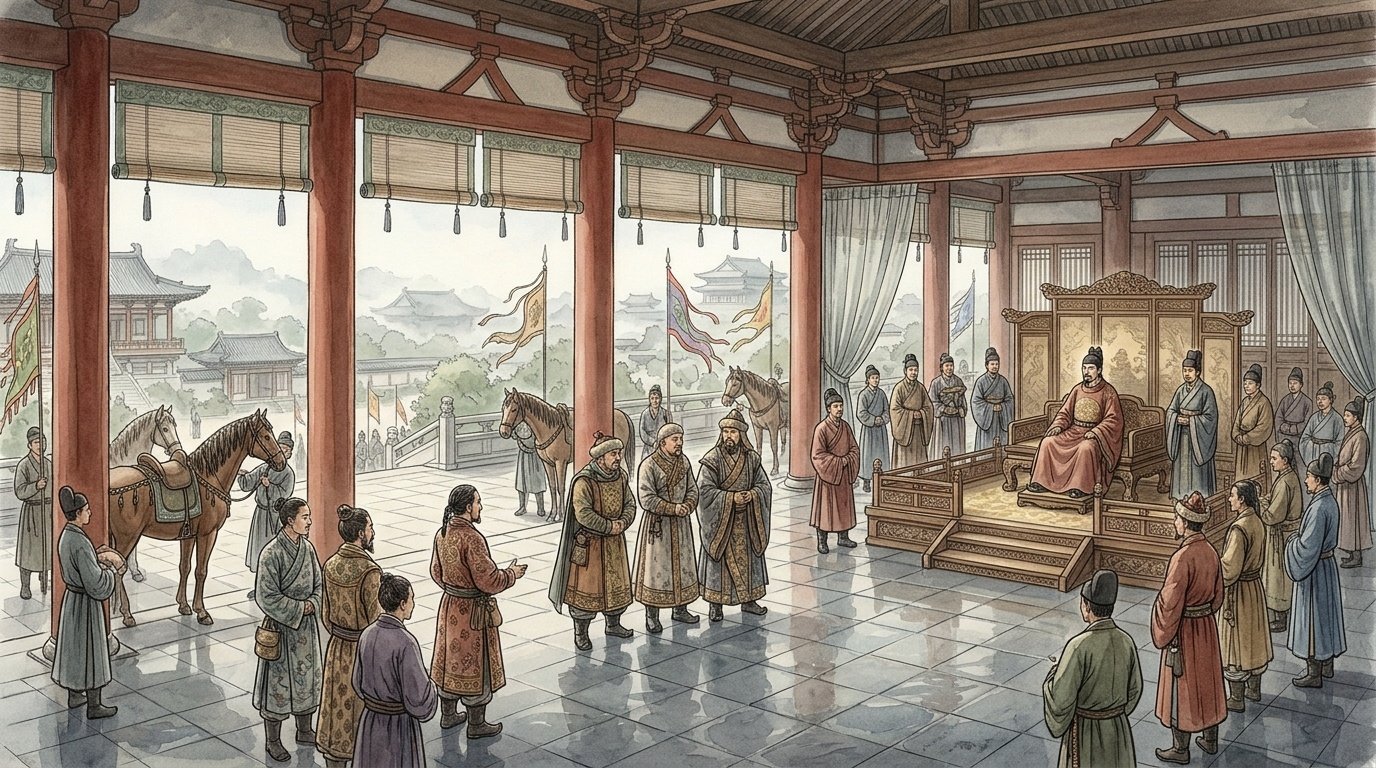
In the fifth lunar month of the fourth year of the Zhenguan era (630 CE), a spectacle unfolded in the imperial capital of Chang’an (长安) that redefined the geopolitical and ideological horizons of the Asian continent. Into the grand courtyard of the Taiji Palace stepped a magnificent diplomatic assembly of nomadic chieftains, tribal khans, and oasis kings representing dozens of pastoral confederations and sedentary city-states from the Mongolian steppe, the Altai Mountains, the Pamir highlands, and the Tarim Basin. Led by chieftains of the Tiele (铁勒), Tujue (突厥, Turks), Tuyuhun, and Sogdian merchant guilds, the foreign dignitaries fell prostrate upon the palace flagstones before the thirty-one-year-old monarch of the Great Tang, Emperor Taizong (唐太宗, Li Shimin 李世民).
Speaking through court interpreters, the steppe delegates presented an unprecedented joint petition. They declared that having witnessed the Tang armies shatter the once-invincible Eastern Turkic Khaganate and liberate the steppe peoples from the tyranny of Illig Khagan, they no longer recognized any separate tribal sovereign. In their native tongues and in classical Chinese, they beseeched Li Shimin to accept a sacred title that no Chinese emperor had ever held: Tian Kehan (天可汗), the ‘Heavenly Khagan’. When Taizong smiled and modestly inquired, ‘I am merely the Son of Heaven of the Great Tang; can I truly act simultaneously as the Khagan of the barbarian nations?’ the envoys and court officials cheered in unison: ‘Your Majesty is both the Son of Heaven and our Heavenly Khagan! From this day forward, our descendants shall serve Your Majesty as children serve their father!’
This coronation marked a civilizational revolution. For over a millennium, Chinese geopolitical theory had rested upon the rigid, dualistic binary of ‘Inside and Outside’ (内外之辨), the civilized agricultural Hua-Xia (华夏) versus the untamable nomadic Yi-Di (夷狄). By assuming the dual crown of Son of Heaven (天子) and Heavenly Khagan (天可汗), Tang Taizong obliterated that ancient division. He forged a revolutionary hybrid imperial identity that fused Chinese bureaucratic universalism with Eurasian steppe legitimacy. Under this dual imperium, the Tang Empire expanded into the most dazzling, open, multi-ethnic, and cosmopolitan superpower in global antiquity, transforming its capital of Chang’an into the beating commercial and intellectual heart of Afro-Eurasian trade.
This comprehensive treatise provides an exhaustive investigation into the creation, governance, and cultural zenith of Tang Taizong’s Eurasian empire. We will analyze the military campaigns that shattered the Eastern and Western Turkic Khaganates; examine the revolutionary institutional apparatus of the ‘Loose-Rein’ Prefectures (羁縻府州, Jimi Fuzhou) and the Protectorate-General to Pacify the West (安西都护府); explore the profound ideological revolution articulated in Taizong’s famous declaration of universal ethnic equality; investigate the multi-ethnic officer corps where non-Han steppe generals commanded Tang imperial armies; examine the return of Xuanzang (玄奘) and the institutional patronage of Indian Buddhism; trace the influx of world religions along the Silk Road—including Nestorian Christianity, Zoroastrianism, Manichaeism, and Islam; deconstruct the vibrant material culture, foreign fashion, music, and dance that intoxicated Chang’an society; and evaluate the enduring historiographical significance of the Tang cosmopolitan synthesis.
1. The Humiliation of Weishui: The Crucible of Steppe Supremacy
The triumph of 630 CE was born from an agonizing moment of national humiliation four years earlier. In the eighth lunar month of 626 CE, barely two months after Li Shimin had seized the throne in the bloody Xuanwu Gate Incident, the Eastern Turkic Khaganate (东突厥) struck with catastrophic power. Sensing that the fledgling Tang court was fractured, vulnerable, and paralyzed by fratricidal purges, Illig Khagan (颉利可汗, Ashina Duobi) and his nephew Tölis Khagan (突利可汗) mobilized a colossal nomadic host of over one hundred thousand elite horse archers. Sweeping past northern frontier garrisons, the Turkic cavalry advanced to the banks of the Wei River (渭水), pitching their white felt yurts at the Bian Bridge (便桥), barely twenty miles north of the city walls of Chang’an.
Chang’an was virtually defenseless. The bulk of the Tang regular armies were scattered across distant provinces, and the capital garrison numbered fewer than ten thousand men. Ministers and courtiers wept in panic, proposing that the imperial court abandon Chang’an, burn the granaries, and flee south across the Qinling Mountains to Sichuan. Li Shimin recognized that flight meant the immediate extinction of the Tang Dynasty. Displaying the breathtaking, suicidal audacity that had made him the master of the battlefield, the young emperor rode out from the gates of Chang’an accompanied by only six mounted companions—including Gao Shilian and Fang Xuanling—unarmed, without bodyguards, galloping directly to the southern bank of the Wei River.
Across the river waters, Li Shimin addressed Illig Khagan directly in his native tongue, fiercely berating him for violating the sacred oaths of alliance sworn during the reign of Emperor Gaozu. Meanwhile, behind the low ridges along the river, Tang generals hastily deployed fluttering banners, drums, and cavalry squadrons in rapid, deceptive formations to simulate the arrival of a massive imperial relief army. Stunned by the young emperor’s fearless demeanor and suspecting an elaborate military trap, Illig Khagan hesitated. Sensing his rival’s unease, Li Shimin seized the psychological initiative, offering to conclude an immediate peace treaty backed by substantial gifts of silk, gold, and grain.
On the Bian Bridge, Li Shimin and Illig Khagan slaughtered a white horse to solemnize the sacred oath, concluding the Treaty of the Wei River (渭水之盟). The Turkic cavalry broke camp and withdrew northward. To the relieved populace of Chang’an, it appeared a miraculous diplomatic deliverance. But to Li Shimin, who had been forced to empty the imperial treasury and bow before a nomadic chieftain, the treaty was an unforgivable humiliation. The emperor vowed to his chancellors that he would never rest until the Eastern Turkic Khaganate was thoroughly obliterated.
In the aftermath of the Bian Bridge crisis, Taizong set about re-evaluating the entire strategic architecture of the Tang borderlands. For decades under the late Sui and early Tang, Chinese courts had maintained a reactive, defensive posture, continually paying exorbitant tributes in raw silk and agricultural supplies to placate nomadic horsemen who could raid with impunity whenever pasture grasses failed. Taizong saw that defensive passivity merely invited further extortion. True national security could be obtained only if the Tang developed an offensive cavalry doctrine that could match the steppe warriors in speed, endurance, and logistical range. He ordered the state stud farms in Longyou and Guanzhong to breed hundreds of thousands of superior warhorses, importing stallions from the Western Regions and crossbreeding them with tough northern steppe mares.
2. The Annihilation of the Eastern Turks: The Battle of the Yin Mountains
For the next three years, Emperor Taizong transformed northern China into a military training camp. He threw open the imperial palace grounds, personally training hundreds of elite archers every day, rewarding marksmanship with imperial silks, and restructuring the Fubing militia into disciplined cavalry formations capable of long-range steppe warfare. Meanwhile, nature and internal politics combined to weaken the Turks. Severe blizzards struck the Mongolian plateau in 628–629 CE; snowdrifts reached meters in depth, freezing millions of sheep, cattle, and warhorses to death. Illig Khagan increased crushing taxes on his vassal tribes to replenish his losses, provoking violent rebellions among the Xueyantuo (薛延陀), Uighurs (回纥), and Bayegu.
In the eleventh lunar month of 629 CE, Taizong unleashed his vengeance. He mobilized a hundred-thousand-man expeditionary force divided into six operational columns, placing supreme command in the hands of the greatest military strategist of the medieval world: General Li Jing (李靖, 571–649 CE, Duke of Wei), assisted by General Li Shiji (李世勣).
The campaign was a military masterpiece of lightning shock warfare:
- The Midnight Raid on Mayi (630 CE, 1st Mo.): Li Jing selected three thousand elite iron-armored cavalry and launched a blinding mid-winter blizzard raid directly out of Mayi, striking Illig Khagan’s headquarters at Dingxiang (定襄). Illig Khagan, terrified that the entire Tang host was upon him, fled in panic into the Yin Mountains (阴山).
- The Battle of the Yin Mountains (阴山之战, 630 CE, 2nd Mo.): While Tang peace envoys were negotiating in the Turkic camp, Li Jing and Li Shiji recognized that the enemy’s vigilance had relaxed. Li Jing led ten thousand elite cavalry through dense fog, striking the main Turkic encampment at Baidao. Over ten thousand Turkic warriors were slain; hundreds of thousands of sheep and cattle were captured, and Illig Khagan fled into the desert with only a handful of bodyguards.
- The Capture of Illig Khagan: In the third lunar month of 630 CE, the fleeing Khagan was hunted down and captured in the southern desert by the Tang general Zhang Baoxiang.
When the news reached Chang’an that Illig Khagan was being brought to the capital in chains, the sixty-four-year-old retired Supreme Emperor Li Yuan was so overjoyed that he gathered his chancellors, pulled out a lute (pipa), and danced with abandon in the palace courtyard, weeping: ‘The Han Gaozu was trapped at Baideng and could never avenge himself; today, my son has obliterated the Turkic Khaganate in a single morning! What regrets could I possibly harbor in this life!’
Rather than executing the captured Khagan or parading him through the streets in humiliation, Emperor Taizong treated Illig with remarkable imperial forbearance. After formally reprimanding the Khagan in the presence of the ancestral temple for his past betrayals, Taizong spared his life, bestowed upon him the high military rank of Grand General of the Right, and granted him a spacious estate with generous stipends in Chang’an. Illig Khagan lived out his remaining years in the capital, an honored pensioner of the court, spending his autumns hawking in the imperial hunting preserves. This astonishing clemency sent shockwaves through the Eurasian steppe, convincing other nomadic rulers that surrender to the Tang promised not annihilation, but status, protection, and honorable incorporation into a grand world order.
3. The Genesis of the Heavenly Khagan: The Dual Imperial Mandate
The destruction of the Eastern Turkic Khaganate created an unprecedented constitutional dilemma for the Tang Empire. What was to be done with the hundreds of thousands of surrendering Turkic nomads, their tribal chieftains, and the vast expanse of the northern steppe? Traditional conservative Confucian ministers, led by the renowned scholar Yan Shigu (颜师古) and Chancellor Dou Jing, demanded a policy of traditional Han isolationism. They cited ancient classical texts arguing that barbarians were wild beasts incapable of civilization, urging the emperor to drive them north of the Gobi Desert or scatter them as indentured agricultural laborers across the interior commanderies.
Into this fierce court debate stepped the brilliant minister Wen Yanbo (温彦博, 574–637 CE), who articulated an extraordinary vision of universal imperial magnanimity:
「天子之于万物也,天覆地载,悉无所遗。今突厥穷鸟入怀,何忍推而掷之于野?宜全其部落,顺其土俗,置之河朔,教以礼义。此所谓’绥之以德,怀远人之道’也!」
— Wen Yanbo’s memorial on the Turks, Zizhi Tongjian, Chapter 193
‘The Son of Heaven in his relation to all creatures is like Heaven that covers all and Earth that sustains all; nothing is abandoned! Today, the Turks are like exhausted birds flying into our bosom; how could we bear to cast them out into the wild? We ought to preserve their tribal structures intact, accommodate their local customs, settle them in the regions along the northern bend of the Yellow River, and instruct them in ritual and righteousness. This is what is meant by “soothing them with moral virtue and cherishing distant peoples”!’
Emperor Taizong enthusiastically endorsed Wen Yanbo’s vision. Over one hundred thousand Turks were permitted to settle in the Ordos region and the northern frontiers, preserving their native lifestyle, pasturelands, and tribal leaders under the overarching sovereignty of the Tang crown. Nearly ten thousand Turkic aristocratic families were invited to settle directly in Chang’an, where their chieftains were granted lavish mansions, imperial stipends, and high officer ranks in the Tang imperial guard.
It was in this climate of profound gratitude and awe that the steppe chieftains arrived at Chang’an in May 630 CE to formally invest Taizong as Tian Kehan (天可汗, Heavenly Khagan). The title was far more than an honorific; it was a functioning legal and diplomatic institution. Whenever Tang Taizong issued imperial decrees to the agrarian Chinese commanderies, he signed himself as the ‘Emperor of the Great Tang’ (大唐皇帝); but whenever he issued orders, arbitrated territorial disputes, or mobilized cavalry levies across the Eurasian steppes, his decrees were stamped with the sacred seal: ‘The Heavenly Khagan’ (天可汗之玺).
Through this constitutional duality, Taizong resolved the ancient civilizational impasse between the steppe and the sown. He became the universal patriarch of two worlds, commanding the devotion of the Han peasantry through the Confucian virtue of filial governance, while commanding the fierce martial loyalty of nomadic horsemen through the personal charisma and martial prestige of the supreme steppe Khagan.
4. ‘I Alone Love Them as One’: The Ideological Revolution
This institutional breakthrough was underpinned by a profound, radical philosophical reinterpretation of ethnic identity articulated by Emperor Taizong himself. In traditional Chinese statecraft, racial and cultural chauvinism had been codified for centuries. Barbarians were viewed as biologically and morally inferior beings, described in historical chronicles as having ‘the faces of humans and the hearts of beasts’ (人面兽心). Conservative scholars drew upon the Spring and Autumn Annals (春秋) to argue that the Chinese core and the foreign periphery were as incompatible as fire and water, warning that any dilution of Hua-Xia customs by foreign practices would corrupt the moral fabric of the realm.
In 647 CE, during an imperial banquet at the Cuiping Palace celebrating the subjugation of the Xueyantuo, Taizong surveyed his assembled chancellors and reflected upon the underlying principles that had enabled his reign to achieve such unprecedented global greatness. The emperor declared, in a passage that stands as the ideological charter of the Tang golden age:
「自古皆贵中华,贱夷狄,朕独爱之如一,故其种落皆依朕如父母!」
— Emperor Taizong, Zizhi Tongjian, Chapter 198
‘From antiquity, all rulers have esteemed the Chinese (Zhonghua) and held the barbarians (Yidi) in contempt. I alone love them as one! Therefore, their tribes and lineages rely upon me as children rely upon their father and mother!’
Taizong’s assertion that he ‘loved them as one’ (爱之如一) was not empty rhetoric; it was the active operational policy of the Tang state. The Tang Empire rejected racial purity in favor of cultural inclusion. Anyone—whether Sogdian, Turk, Persian, Korean, or Tibetan—who adopted the laws of the Tang Code, swore loyalty to the Heavenly Khagan, and contributed their talents to the state was treated as an equal imperial subject, entitled to bureaucratic office, imperial land allocations, and social prestige.
This radical egalitarianism shocked traditionalist scholar-bureaucrats, who argued that barbarian loyalty was fickle and mercenary. Yet Taizong repeatedly proved that true imperial majesty lay in universal inclusiveness. When xenophobic courtiers warned that settling thousands of armed Turks near the capital was suicidal, Taizong replied that virtue, justice, and sincere trust were the only lasting defense of an empire. If a ruler governed with benevolence and integrity, barbarians would become brothers; if an emperor governed with suspicion, deceit, and cruelty, his own imperial kinsmen would become mortal enemies.
This vision reshaped the civil service examinations (科举) as well. The Tang court instituted specialized examination tracks, such as the Bin-gong (宾贡, ‘Guest Tribute’) examinations, allowing foreign scholars, students, and merchants from Korea, Japan, Central Asia, and the Arab world to compete directly for imperial bureaucratic degrees. Dozens of foreign scholars passed these rigorous examinations, serving as magistrates, prefects, and court scribes, creating an international administrative class whose loyalty was tethered not to an ethnic tribe, but to the universal majesty of the Tang imperium.
5. The Multi-Ethnic Generals: Steppe Chieftains as Tang Marshals
The most vivid manifestation of this cosmopolitan philosophy was the military leadership of the Tang expeditionary forces. In an era when Western empires and earlier Chinese dynasties viewed conquered peoples with deep suspicion, Tang Taizong entrusted the supreme military commands of the empire directly into the hands of non-Han nomadic chieftains.
The prominent non-Han generals who forged the military glory of the Zhenguan era included:
- Ashina She’er (阿史那社尔, 604–655 CE): A royal prince of the Eastern Turkic Ashina clan. Surrendering to Taizong in 635 CE, he was granted the emperor’s sister, Princess Hengyang, in marriage. Appointed Grand General, She’er commanded Tang armies deep into the Tarim Basin, conquering the ancient kingdoms of Karasahr (Yanqi) and Kucha (Qiuci), establishing the Anxi Four Garrisons. When Taizong died in 649 CE, She’er was so heartbroken that he begged to commit suicide (殉葬) to accompany his beloved emperor into the afterlife, halted only by an explicit imperial prohibition from Emperor Gaozong.
- Qibi Heli (契苾何力, d. 677 CE): Paramount chieftain of the Tiele Qibi tribe. While visiting his ancestral homeland, Qibi Heli was kidnapped by rebel chieftains who tried to force him to join an anti-Tang revolt. Heli drew his sword and slashed off his own left ear, swearing: ‘The Great Tang Heavenly Khagan treated me with supreme grace; I would rather die than betray him!’ Taizong was so moved that he ransomed Heli with imperial silks. Heli served as Tang commander in campaigns across Goguryeo, Tuyuhun, and Central Asia.
- Zhi Shisi (执失思力): The former chief general of Illig Khagan, who became a devoted Tang field marshal, marrying Princess Jiujiang and successfully repelling Tibetan attacks along the upper Yangzi.
- Heichi Changzhi (黑齿常之, 630–689 CE): A brilliant military strategist of Baekje (Korean) origin, whose heavy cavalry later smashed the Tibetan Empire along the Qinghai borderlands.
- Gao Xianzhi (高仙芝, d. 756 CE): A Goguryeo general whose daring alpine cavalry crossings over the Pamir Mountains and Hindu Kush into Gilgit and Baltistan remain legendary in the annals of mountain warfare.
These foreign generals were not mere mercenary auxiliaries; they were core pillars of the Tang state, bound to Taizong through deep bonds of personal honor, reciprocal loyalty, and imperial kinship. Their presence ensured that the Tang army possessed unmatched tactical agility, combining the formidable siege engineering and infantry discipline of the Han with the lightning mobility and equestrian archery of the Eurasian steppe.
To further cement this bond, Taizong instituted a policy of ennoblement and bestowal of the imperial surname. Foreign commanders of exceptional merit were awarded the royal family name of Li (李), effectively inducting their lineages into the imperial clan. Chieftains who had spent their youth raiding Chinese frontier settlements became Tang dukes, marshals, and royal in-laws, their children studying classical prose in the imperial academies of Chang’an alongside the sons of prime ministers.
6. Governing the Periphery: Loose-Rein Prefectures and the Anxi Protectorate
To administer an empire that spanned from the Korean peninsula to the Aral Sea, the Tang government devised a revolutionary institutional system known as Jimi Fuzhou (羁縻府州)—the ‘Loose-Rein’ Prefectures and Commanderies. Recognizing that attempting to impose direct Chinese bureaucratic rule (such as the Equal-Field System or standard civil magistrates) upon nomadic pastoralists or distant Central Asian city-states would provoke constant insurrections, the Tang state governed with a light, flexible touch.
Under the Jimi system:
| Administrative Tier | Local Leadership | Tang Imperial Integration | Fiscal & Military Obligations |
|---|---|---|---|
| Area Command (都督府, Dudufu) | Native Paramount Tribal Khans / Oasis Kings | Invested with official Tang seals, patents of office, and imperial noble ranks (Dukes/Kings) | Provide cavalry auxiliaries upon imperial summons; pay nominal tribute; settle local disputes via native customary law |
| Loose-Rein Prefecture (羁縻州, Jimizhou) | Native Hereditary Tribal Chieftains (酋长) | Appointed as Tang Prefects (刺史); positions hereditary within native noble clans | Exempt from regular land/head taxes (租庸调); maintain local post-station roads; guarantee Silk Road merchant safety |
| Protectorate-General (都护府, Duhufu) | Tang Imperial Military Commissioners & Senior Staff | Strategic regional command centers (e.g., Anxi, Beiting, Andong, Annam) overlooking local Jimi units | Garrison critical mountain passes; manage imperial post-couriers; arbitrate inter-tribal warfare; enforce strategic frontiers |
In 640 CE, following the conquest of the Silk Road oasis kingdom of Gaochang (Turpan) by General Hou Junji, Emperor Taizong established the legendary Protectorate-General to Pacify the West (安西都护府, Anxi Duhufu). Moving its headquarters to Kucha, the Tang established the famous Anxi Four Garrisons (安西四镇): Kucha (龟兹), Khotan (于阗), Kashgar (疏勒), and Karasahr (焉耆, later replaced by Suyab 碎叶 in modern Kyrgyzstan). Through these forward military strongholds, Tang garrisons protected the northern and southern arms of the Silk Road, projecting imperial authority into Sogdiana, Fergana, and the borders of the Sasanian Persian Empire.
Archaeological discoveries from Dunhuang, Turpan, and Kucha—including thousands of administrative contracts, grain dockets, and tax receipts written in bilingual Chinese and Sogdian or Kharosthi scripts—reveal the astounding sophistication of this frontier administration. Tang bronze coins (Kaiyuan Tongbao 开元通宝) circulated alongside Persian silver drachmas and local bilingual coins. Caravan merchants carrying official Tang travel passports (Guansuo 关所) could travel thousands of miles without harassment, safeguarded by Tang desert patrols and fortified watchtowers that signaled across the wastes with smoke and beacon fires.
The legal flexibility of the Tang Code (唐律疏议) in handling international matters was astonishingly modern. Article 48 of the Tang Code explicitly codified private international law: ‘Whenever foreigners of the same nationality commit crimes against one another, their case shall be adjudicated according to their own native customary laws; whenever foreigners of differing nationalities commit crimes against one another, or against subjects of the empire, the case shall be adjudicated according to the laws of the Great Tang’ (诸化外人同类自相犯者,各依本俗法;异类相犯者,以国法论). This enlightened legal principle protected the cultural autonomy of foreign merchant communities while upholding the supreme sovereignty of the imperial law.
7. Chang’an: The Global Metropolis of One Million
At the center of this vast Eurasian web sat the magnificent imperial capital: Chang’an. Enclosed by massive rammed-earth walls stretching nine kilometers east-to-west and eight kilometers north-to-south, Chang’an was the largest, most populous, and most meticulously planned city on earth, boasting a resident population exceeding one million people inside the walls, with another million in the suburban environs.
The city was constructed upon a grand cosmological grid bisected by the broad imperial avenue of Vermilion Bird Way (朱雀大街), which was an astonishing 150 meters wide. Chang’an contained 108 enclosed residential wards (坊, fang), imperial palace complexes, and two colossal commercial markets: the East Market (东市), which catered to domestic luxury trade and high-ranking court elites, and the West Market (西市)—the legendary global bazaar of Eurasia.
The West Market was an intoxicating, multi-lingual sensory overload. Over forty thousand foreign merchants, diplomats, monks, translators, and students—collectively known as Huren (胡人)—dwelled in the surrounding wards. Sogdian caravans laden with lapis lazuli, frankincense, Roman glassware, and Persian tapestries unburdened their two-humped Bactrian camels at market caravanserais. Persian wine-shops staffed by blue-eyed, blond-haired Central Asian tavern maidens (胡姬) poured fragrant grape wines from Turpan into carved agate chalices, captivating the imaginations of Tang poets. The immortal poet Li Bai (李白) later captured this electric atmosphere in famous verse:
「五陵少年金市东,银鞍白马度春风。落花踏尽游何处,笑入胡姬酒肆中。」
— Li Bai (李白), Youthful Travels (少年行)
‘The young gallants of the Five Tombs ride east of the Golden Market, upon silver saddles and white steeds amidst the spring breeze. Where shall they wander after treading down all the fallen petals? Smiling, they step inside the wine shop of the Central Asian maiden!’
In the imperial state university, the Guozi Jian (国子监), over eight thousand foreign students—including royal princes from Japan (Kentoshi 遣唐使), the Korean kingdoms of Silla, Baekje, and Goguryeo, the Tibetan Empire, and Central Asian kingdoms—studied classical Chinese calligraphy, Confucian philosophy, mathematics, and administrative law, carrying Tang institutions back to reshape the legal and cultural foundations of East Asia.
The urban rhythm of Chang’an was governed by strict imperial regulations. At dawn, three thousand beats of the monumental drum tower in the city center echoed across the wards, signaling the opening of all 108 ward gates and throwing open the thoroughfares to a teeming tide of humanity. By day, camel caravans jostled with silk-canopied ox-carts, Buddhist monks carried begging bowls alongside Zoroastrian priests, and scholars debated in open street pavilions. At nightfall, eight hundred beats of the curfew drums warned citizens to return to their respective wards before the iron gates were locked, transforming the vast metropolis into an orderly checkerboard of self-contained residential compounds guarded by imperial mounted patrols.
Within these bustling wards, especially Huaiyuan (怀远坊) and Buzheng (布政坊), foreign communities built entire neighborhoods replicating their homelands. Sogdians maintained their ancestral funeral houses, council chambers, and communal banquet halls. Wealthy Persian jewelers operated pawnshops and money-lending agencies, financing long-distance camel expeditions across the Pamirs. It was a city where the smells of roasted mutton and cumin mingled with incense from Buddhist pagodas, where the clinking of Chinese cash coincided with the chanting of Aramaic Christian prayers, and where a citizen could encounter travelers from Antioch, Samarkand, Nara, and Pataliputra in a single morning stroll.
8. The Great Spiritual Crossroads: Xuanzang and the Influx of World Religions
The cosmopolitan openness of Taizong’s empire catalyzed an unprecedented spiritual and intellectual explosion. The most celebrated intellectual journey in Asian history occurred during the Zhenguan era. In 629 CE, a brilliant young Buddhist monk named Xuanzang (玄奘, 602–664 CE) defied an imperial travel ban, slipping out of Chang’an under cover of night to embark on an epic sixteen-year pilgrimage across the blazing deserts of the Taklamakan, over the frozen passes of the Tian Shan, and through the Hindu Kush into ancient India.
Studying for years at the great monastic university of Nalanda, Xuanzang mastered Sanskrit, debated the finest philosophical minds of South Asia, and gathered over six hundred and fifty sacred Sanskrit Buddhist scriptures. When Xuanzang returned to Chang’an in 645 CE, Emperor Taizong greeted him with the highest honors of a returning conquering general. Forgetting the monk’s initial illegal departure, Taizong granted him lavish imperial quarters at the Hongfu Temple and later financed the construction of the iconic Giant Wild Goose Pagoda (大雁塔) to store and preserve the sacred manuscripts.
Taizong personally composed the imperial preface, the Da Tang Sanzang Shengjiao Xu (大唐三藏圣教序, Preface to the Sacred Teachings of the Tripitaka of the Great Tang), praising Xuanzang’s superhuman courage. Furthermore, Taizong commissioned Xuanzang to draft an exhaustive geographical and political intelligence report on the kingdoms he had visited, resulting in the monumental masterwork The Great Tang Records on the Western Regions (大唐西域记)—the most vital historical document preserving the geography, politics, and culture of medieval Central and South Asia.
Simultaneously, Chang’an became a sanctuary for the major faiths of the Afro-Eurasian world, all enjoying royal protection and state tolerance under Taizong’s ecumenical rule:
- Nestorian Christianity (景教, Jingjiao): In 635 CE, the Syrian Christian missionary Alopen (阿罗本) arrived in Chang’an from the Persian Church of the East. Taizong sent Prime Minister Fang Xuanling to the western suburbs to welcome Alopen with an imperial escort. After examining the Christian scriptures in the imperial library, Taizong issued an official imperial edict in 638 CE authorizing the translation of the Bible and financing the construction of the Da Qin Monastery (大秦寺) in the Yining ward, immortalized in the famous Nestorian Stele (大秦景教流行中国碑).
- Zoroastrianism (祆教, Xianjiao): Sogdian and Persian merchants constructed fire temples across Chang’an and Luoyang, overseen by state-appointed officials known as Sabao (萨宝), drawn directly from elite Sogdian leadership.
- Manichaeism (摩尼教): The syncretic dualist faith of the Persian prophet Mani found widespread acceptance, especially among Uighur and Central Asian merchant communities.
- Islam: Following the Muslim conquest of the Sasanian Persian Empire, the son of the last Sasanian monarch Yazdegerd III, Prince Peroz III (卑路斯), fled across Central Asia to Chang’an in the mid-seventh century, seeking military aid from the Heavenly Khagan. Taizong and his successor Gaozong granted Peroz high military rank, permitted him to establish a Persian court-in-exile, and authorized the founding of the first Persian and Arab mosques in Chang’an and Guangzhou.
The famous Nestorian Stele, erected in 781 CE and rediscovered in the seventeenth century, records the extraordinary imperial edict of 638 CE in which Emperor Taizong gave his official blessing to Christianity:
「道无常名,圣无常体,随方设教,密济群生。大秦国大德阿罗本,远将经像来献上京。详其教旨,玄妙无为;观其元宗,济物利人。宜行天下,所司即于京义宁坊造大秦寺一所,度僧廿一人。」
— Emperor Taizong’s Edict Tolerating Christianity (638 CE), from the Nestorian Stele (大秦景教流行中国碑)
‘The Way has no invariable name, and the Sage has no immutable body; according to regions they establish doctrines, secretly aiding the multitude of living beings. Alopen, a man of great virtue from the Realm of Da Qin (Syria/Rome), bringing scriptures and icons from afar, has come to present them at our elevated capital. Carefully examining the tenets of his teaching, we find them mysterious, profound, and non-striving; observing its fundamental principles, they benefit creatures and aid mankind. It is fitting that it should operate freely throughout the realm. Let the appropriate authorities construct a Da Qin Monastery in the Yining Ward of the capital, and ordain twenty-one priests!’
This remarkable edict demonstrates that Taizong viewed religious diversity not as a subversive danger, but as an expression of universal cosmic truth. In the capital of the Heavenly Khagan, Christian crosses, Zoroastrian fire altars, Buddhist sutras, Daoist talismans, and Confucian classics flourished in peaceful coexistence beneath the benevolent protection of an enlightened imperial throne.
9. Cultural Intoxication: The ‘Barbarian Craze’ of the Tang Golden Age
The Eurasian influx sparked a sweeping cultural and aesthetic phenomenon known to historians as the ‘Barbarian Craze’ (胡风, Hufeng). Far from clinging to rigid Han conservatism, the Tang aristocratic elite—including the imperial court, noble ladies, scholars, and wealthy merchants—enthusiastically embraced Central Asian fashions, music, foodstuffs, and leisure pursuits.
The cultural landscape was transformed across multiple dimensions:
- The Sogdian Whirl Dance (胡旋舞, Huxuanwu): A dizzying, acrobatic dance performed on small circular carpets, where dancers spun at blistering speeds while leaping through the air. The dance became the supreme sensation of the imperial court; Emperor Xuanzong and his consort Yang Guifei were legendary practitioners, alongside the Sogdian general An Lushan.
- Musical Synthesis: The traditional court music of the Central Plains was revolutionized by the import of Central Asian instruments and musical scales. The Ten Ensembles (十部伎) of the Tang court incorporated music from Kucha (Kuqa), Kashgar, Samarkand, India, and Korea. The four-stringed plucked lute (Pipa 琵琶), the transverse flute, and the waist drum became the dominant sounds of the era.
- Sartorial Liberation for Women: Aristocratic Tang women broke free from Confucian seclusion, donning tight-sleeved Central Asian tunics, trousers, and riding boots (胡服). They discarded heavy veils, rode horseback through the streets of Chang’an alongside men, and applied exotic Persian cosmetics, including forehead spangles and cinnabar lip colorings.
- Polo (击鞠, Jiju): The equestrian sport of kings, imported from Sasanian Persia, became the national obsession of the Tang court. Emperors, generals, and noblewomen kept vast stables of prized ‘blood-sweating’ Fergana warhorses to compete in violent, high-speed polo matches on specially paved palace fields.
- Cuisine and Agriculture: The Tang diet was enriched by foreign cultivars brought along the Silk Road: spinach (波斯草, ‘Persian herb’), pomegranates, sesame, walnuts, figs, watermelons, and cane sugar processing techniques imported from Magadha, India.
- Hunting with Cheetahs and Falcons: Hunting in the imperial parks took on an exotic Central Asian flavor. Aristocrats rode into the Qinling foothills accompanied by trained cheetahs lounging on the croup of saddles, while trained gyrfalcons imported from the northern forests perched upon their leather gauntlets.
Excavations of Tang aristocratic tombs across Shaanxi and Henan have yielded tens of thousands of exquisite tricolor glazed ceramic figurines (Tang Sancai 唐三彩) that bring this vibrant era to life. Figurines portray bearded, deep-eyed Sogdian camel drivers singing atop laden dromedaries, Central Asian female musicians playing harps and panpipes on horseback, Semitic merchants examining coins with magnifying lenses, and ferocious Persian polo players swinging wooden mallets mid-gallop. These artifacts attest to an era of uninhibited visual celebration of ethnic diversity that was never equaled in subsequent Chinese dynasties.
In literary composition, Tang poets broke away from archaic pedantry to celebrate the wild, romantic expanse of the northwestern frontier. Masterpieces of Frontier Poetry (边塞诗) by Wang Wei, Cen Shen, Gao Shi, and Wang Zhihuan celebrated the lonely watchtowers of the Jade Gate Pass (玉门关), the cold moonlight shimmering on desert sands, the galloping of cavalry across snowfields, and the sound of barbarian flutes echoing through mountain defiles. The geopolitical horizon of China was no longer confined to the valleys of the Yellow and Yangtze rivers; it had expanded to embrace the endless deserts and soaring snow-capped mountains of inner Eurasia.
10. Tang-Tibet Diplomacy: Princess Wencheng and the Plateau Alliance
The universal reach of Taizong’s diplomacy was demonstrated most dramatically on the Qinghai-Tibetan plateau. In the early seventh century, the charismatic monarch Songtsen Gampo (松赞干布, 605–650 CE) unified the warring clans of the Yarlung Valley, founding the powerful Tibetan Empire (Tubo 吐蕃). Eager to connect his emerging highland empire with the prestige and advanced technology of the Great Tang, Songtsen Gampo dispatched emissaries to Chang’an requesting an imperial marriage alliance (和亲, heqin).
Following initial military clashes along the border at Songzhou in 638 CE, Taizong recognized that the martial prowess and difficult mountainous terrain of Tibet made direct military conquest impractical. Demonstrating his pragmatic strategic flexibility, Taizong agreed to a marital alliance. In 641 CE, the emperor selected an accomplished, highly educated royal lady of the imperial clan, Princess Wencheng (文成公主, 623–680 CE), to become the bride of Songtsen Gampo, accompanied by a lavish escort led by Prince Daozong of Jiangxia (李道宗).
Princess Wencheng’s arrival in Lhasa was an event of epochal cultural significance. She brought with her an immense dowry of classical Chinese literature, Buddhist sutras, medical treatises, astronomical calendars, agricultural seeds, and master craftsmen skilled in paper-making, silkworm cultivation, metallurgical smelting, and architectural masonry. Songtsen Gampo constructed the magnificent Jokhang Temple (大昭寺) and the Ramoche Temple to house the sacred life-sized statue of the twelve-year-old Sakyamuni Buddha (the Jowo Rinpoche) brought by Princess Wencheng from Chang’an—a statue that remains the most revered sacred icon in Tibetan Buddhism to this day. The alliance stabilized the southwestern frontier for decades and permanently bound the cultural development of Tibet to the Sinic and Buddhist worlds.
According to Tibetan historical chronicles such as the Mirror of Royal Genealogies, Songtsen Gampo was so enthralled by Princess Wencheng’s elegance and intelligence that he abandoned his traditional felt tunics to wear sweeping Chinese silks, sent the young sons of Tibetan nobles to Chang’an to study classical literature at the Imperial Academy, and commissioned his minister Thonmi Sambhota to devise a Tibetan alphabet based upon Indian Brahmi script, ushering the highland plateau into the written literate world.
11. Historiographical Debate and Civilizational Legacy
The cosmopolitan Eurasian imperium forged by Tang Taizong has stood for fourteen centuries as a golden ideal in East Asian and global history, yet it has also provoked intense historiographical debate regarding the sustainability of universal multi-ethnic empires.
Traditional Confucian moralists, while admiring Taizong’s administrative brilliance during the Zhenguan era, harbored deep, lingering reservations about his embrace of barbarian cultures. Song Dynasty Neo-Confucian historians, writing in the aftermath of the devastating nomadic invasions of the Liao, Jin, and Mongols, viewed the Tang ‘Barbarian Craze’ as a fatal moral corruption. Historians like Sima Guang and later Zhu Xi argued that by blurring the sacred boundaries between the civilized Hua and barbarian Yi, and by placing provincial military commands into the hands of non-Han generals, the Tang dynasty sowed the seeds of its own destruction, leading directly to the catastrophic An Lushan Rebellion (安史之乱, 755–763 CE) led by the Sogdian-Turkic warlord An Lushan.
Modern twentieth- and twenty-first-century scholarship, pioneered by Chen Yinke and expanded by modern global historians like Marc S. Abramson, Jonathan Skaff, and Valerie Hansen, rejects this xenophobic interpretation. They demonstrate that the cosmopolitan character of the Tang was not an accidental moral defect, but the foundational secret of its civilizational genius. The Tang was powerful precisely because it was not racially exclusive. By synthesizing the martial horsemanship of the Eurasian steppe with the deep agrarian institutions of the Central Plains, Tang Taizong constructed an empire of unprecedented administrative scale, military reach, and economic vitality.
The collapse of the Tang frontier system a century later was not caused by ethnic tolerance, but by the collapse of the Equal-Field System and the centralization of military power in permanent frontier military governors (Jiedushi 节度使) under the decadent court of Emperor Xuanzong. Under Taizong, multi-ethnic power had been balanced by an unshakeable central court, institutional checks, and personal moral prestige.
The ideal of the Heavenly Khagan proved that civilization is defined not by genetic lineage, but by open institutions, cultural self-confidence, and universal moral magnanimity. In an ancient world fractured by tribal hatreds and narrow parochialisms, Tang Taizong’s Chang’an stood as a dazzling beacon of what human society could achieve when a great empire dared to declare to the world: ‘I alone love them as one.’
12. Chronology of Tang Taizong’s Cosmopolitan Eurasian Reign
| Year (CE) | Imperial / Geopolitical Event | Key Historical Figures | Significance & Global Impact |
|---|---|---|---|
| 626 (8th Mo.) | Treaty of the Wei River (渭水之盟) | Emperor Taizong, Illig Khagan | Taizong halts Turkic invasion at Bian Bridge; endures national humiliation to save Chang’an |
| 629 (Autumn) | Departure of Xuanzang; Northern Expedition Begins | Xuanzang, Li Jing, Li Shiji | Xuanzang begins 16-year Silk Road pilgrimage; Tang mobilizes 100,000 troops against Eastern Turks |
| 630 (2nd–3rd Mo.) | Battle of Yin Mountains; Capture of Illig Khagan | General Li Jing, Illig Khagan | Eastern Turkic Khaganate obliterated in blizzard shock assault; Illig brought to Chang’an in chains |
| 630 (5th Mo.) | Investiture of Heavenly Khagan (天可汗) | Emperor Taizong, Steppe Chieftains | Nomadic khans bestow Heavenly Khagan title; dual steppe-sown imperium established |
| 635 | Arrival of Nestorian Christianity (Alopen) | Alopen, Fang Xuanling, Taizong | Syrian missionary welcomed in Chang’an; Bible translated with imperial funds; Da Qin Monastery built |
| 640 | Conquest of Gaochang; Anxi Protectorate Created | General Hou Junji, Taizong | Tang projects military power into Tarim Basin; establishes Anxi Four Garrisons across Silk Road |
| 641 | Marriage of Princess Wencheng to Songtsen Gampo | Princess Wencheng, Songtsen Gampo | Marital alliance with Tibetan Empire; Jokhang Temple built; technological and cultural transfer to Tibet |
| 645 | Return of Xuanzang to Chang’an | Xuanzang, Emperor Taizong | Xuanzang returns with 657 Sanskrit texts; Taizong builds Giant Wild Goose Pagoda; commissions records |
| 647 | Imperial Edict of Universal Ethnic Equality | Emperor Taizong | Taizong declares: ‘All esteem the Chinese and despise barbarians; I alone love them as one’ (爱之如一) |
| 648 | Conquest of Kucha (Qiuci); Submission of Western Turks | General Ashina She’er | Turkic Tang general conquers Central Asian oasis kingdoms; extends Tang borders to the Pamir mountains |
| 649 (5th Mo.) | Death of Emperor Taizong at Cuiwei Palace | Emperor Taizong, Ashina She’er | Taizong dies at age 51; non-Han generals beg to commit suicide; buried in Zhao Mausoleum with 14 foreign statues |
13. Scholarly Bibliography and Primary Historical Sources
To substantiate the political, institutional, and cultural analyses detailed in this investigation, the following primary sources and academic monographs are recommended for further study:
- Liu Xu (刘昫) et al. (comp. 945 CE), Old Book of Tang (旧唐书, Jiu Tang Shu): Foundational official history. Essential chapters include the Basic Annals of Taizong (Vols. 2–3), Treatises on Foreign Barbarians (Vols. 194–198: Turks, Uighurs, Tibetans, Western Regions), and Biographies of Li Jing (Vol. 67), Wen Yanbo (Vol. 61), Ashina She’er (Vol. 109), and Qibi Heli (Vol. 109).
- Sima Guang (司马光, comp. 1084 CE), Comprehensive Mirror in Aid of Governance (资治通鉴, Zizhi Tongjian): Volumes 191 through 199 provide the master chronological reconstruction of the Zhenguan era, documenting the Weishui Treaty, the Yan Shigu vs. Wen Yanbo court debate, and the investiture of the Heavenly Khagan.
- Wu Jing (吴兢, comp. 708–714 CE), Essentials of Governance of the Zhenguan Era (贞观政要, Zhenguan Zhengyao): Invaluable contemporary manual compiling the philosophical debates on ethnic relations, barbarian governance, and imperial modesty between Taizong and his ministers.
- Xuanzang (玄奘) and Bianji (辩机) (comp. 646 CE), The Great Tang Records on the Western Regions (大唐西域记): Eyewitness travelogue recording the geography, politics, religions, and customs of over one hundred and ten kingdoms across Central Asia and the Indian subcontinent during the Zhenguan reign.
- Chen Yinke (陈寅恪, 1944), Draft Brief Treatise on the Origins of the Sui-Tang System (隋唐制度渊源略论稿) & Outline of the Political History of the Tang Dynasty (唐代政治史述论稿): Foundational twentieth-century historical masterpieces analyzing the hybrid Guanlong aristocratic origins of the Tang imperial house and the dual-track steppe/agrarian state apparatus.
- Twitchett, Denis, ed. (1979), The Cambridge History of China, Volume 3: Sui and T’ang China, 589–906, Part 1, Cambridge University Press: Comprehensive Western academic survey of Tang political institutions, frontier military administration, and foreign relations under Taizong.
- Skaff, Jonathan Karam (2012), Sui-Tang China and Its Turko-Mongol Neighbors: Culture, Power, and Connections, 580–800, Oxford University Press: The definitive English-language monograph investigating the institutional mechanics of the Heavenly Khaganate, multi-ethnic officer recruitment, and cross-cultural diplomacy along the northern frontier.
- Abramson, Marc S. (2008), Ethnic Identity in Tang China, University of Pennsylvania Press: Brilliant investigation into the shifting conceptual definitions of ‘Chineseness’, non-Han assimilation, and visual representations of foreigners in Tang art and mortuary culture.
- Hansen, Valerie (2012), The Silk Road: A New History, Oxford University Press: Illuminating social and economic history utilizing Silk Road contracts and archaeological discoveries from Turpan, Dunhuang, and Kucha to reconstruct everyday life under Tang administration.
- Schafer, Edward H. (1963), The Golden Peaches of Samarkand: A Study of T’ang Exotics, University of California Press: The classic masterpiece on Tang cosmopolitan material culture, examining the import of foreign dancers, grape wines, polo horses, exotic birds, and Central Asian fashions into Chang’an.