The Xuanwu Gate Incident and the Rise of Tang Taizong
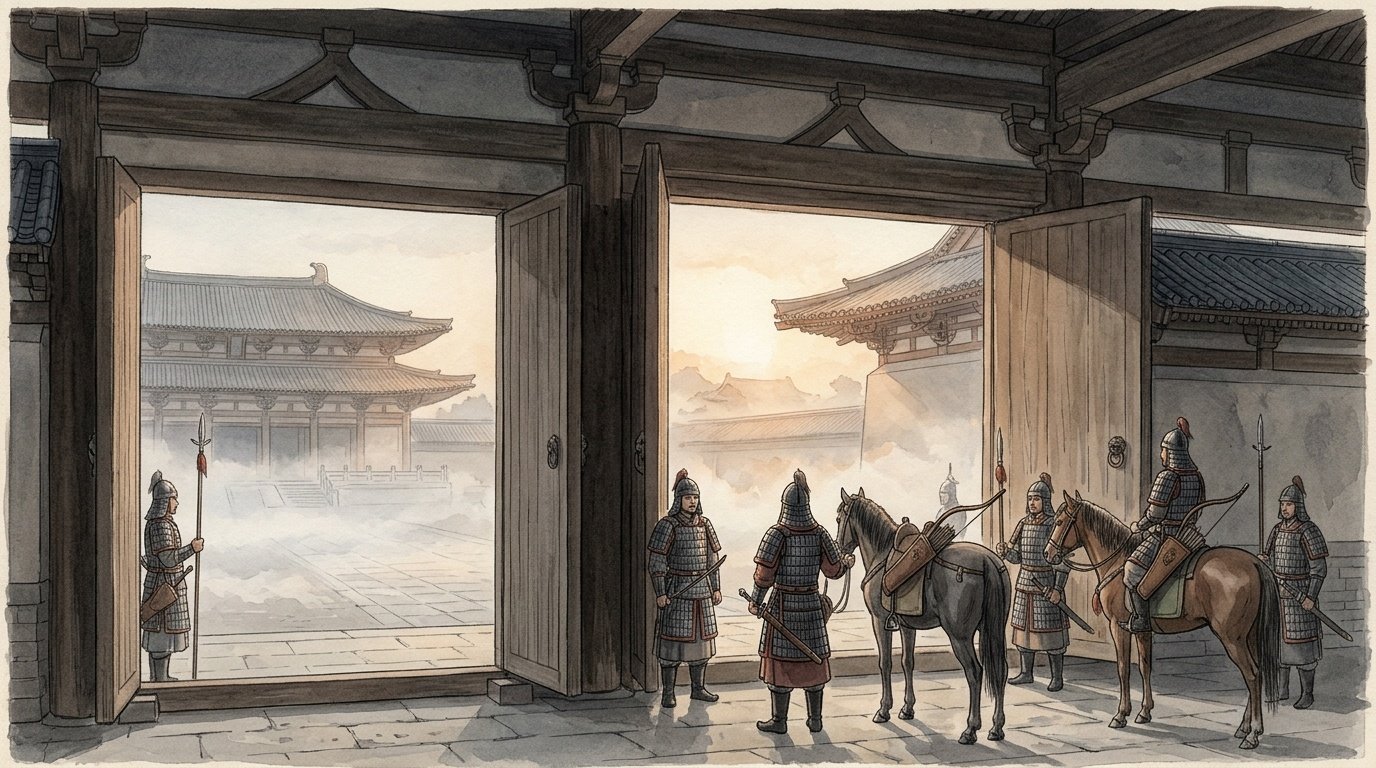
At dawn on the fourth day of the sixth lunar month in the ninth year of the Wude era (July 2, 626 CE), the sprawling imperial capital of Chang’an (长安) was shrouded in a dense, cool summer mist. Deep within the northern perimeter of the Taiji Palace (太极宫), through the formidable stone portal known as the Xuanwu Gate (玄武门, Gate of the Black Tortoise), two men on horseback rode slowly toward the Hall of Court Audience. They were the eldest son and designated heir of the Tang Empire, Crown Prince Li Jiancheng (李建成, 589–626 CE), and his fiery younger brother, Li Yuanji (李元吉, 603–626 CE), Prince of Qi. Summoned by their imperial father, Emperor Gaozu (唐高祖, Li Yuan 李渊), to answer explosive accusations of palace intrigue, the brothers entered the palace grounds accompanied only by a modest personal escort, confident in the absolute security of the imperial sanctum.
Suddenly, the massive iron-studded oak gates slammed shut behind them with a deafening crash, cutting off their guards outside. The inner courtyard was deathly quiet. Sensing immediate mortal danger, Li Jiancheng wheeled his warhorse around to gallop back toward the portal. Emerging from the dense foliage of the palace gardens stood his younger brother, Li Shimin (李世民, 598–649 CE), the Prince of Qin (秦王)—the architect of the Tang Dynasty’s greatest military triumphs. Flanked by nine armored conspirators, Li Shimin held a recurve composite bow drawn to its full tension. Li Yuanji frantically notched an arrow to his own bowstring, but in his trembling panic, his fingers slipped three consecutive times without releasing. Li Shimin did not hesitate. Releasing his bowstring with icy precision, his heavy bodkin-tipped arrow tore through Li Jiancheng’s neck, severing his windpipe and jugular. The Crown Prince tumbled from his saddle into a pool of widening scarlet, dying instantly upon the palace flagstones.
Moments later, after a frantic pursuit through the palace trees, Li Shimin’s ferocious general Yuchi Jingde (尉迟敬德) ran down and shot Li Yuanji through the chest with an arrow. While the severed heads of the two imperial princes were hoisted upon pikes on the gate ramparts to disperse their counter-attacking guards outside, Yuchi Jingde strode directly into the private inner sanctum of Emperor Gaozu. Clad in blood-spattered iron armor and clutching a dripping lance, the warrior confronted the sixty-year-old founding monarch as he was drifting idly in an imperial pleasure barge upon the palace lake. Handing the emperor an imperial decree drafted by Li Shimin, Yuchi Jingde ‘politely’ requested that all civilian and military command of the empire be surrendered immediately to the Prince of Qin. Two months later, a shattered and broken-hearted Li Yuan abdicated the throne, retiring into palace seclusion as Supreme Emperor (太上皇). Li Shimin ascended the dragon throne as Emperor Taizong (唐太宗), inaugurating the celebrated Zhenguan era (贞观之治, 626–649 CE)—one of the most glorious zeniths of governance, cultural brilliance, and military power in Chinese history.
The Xuanwu Gate Incident (玄武门之变, Xuanwu Men zhi Bian) remains one of the most chilling, decisive, and controversial fratricidal coups in global political history. In an empire founded upon the sacred Confucian virtues of filial piety (孝) and brotherly deference (悌), the foundational architect of the Tang golden age rose to supreme power through the premeditated murder of his elder brother, the execution of his younger sibling, the cold-blooded massacre of all ten of his infant and adolescent nephews, and the de facto armed house arrest of his imperial father. This exhaustive study deconstructs the Xuanwu Gate Incident in its entirety: the dual-power structure between the Crown Prince’s court and Li Shimin’s autonomous ‘Mansion of Heavenly Strategy’ (天策府); the strategic brilliance of Li Shimin during the wars of dynastic unification; the escalating cycle of assassination attempts, psychological warfare, and astrological portents; the minute-by-minute tactical execution of the ambush at the gate; the complete purge of the rival princely lineages; the extraordinary reconciliation with Wei Zheng (魏征); Taizong’s controversial breach of historical taboo by rewriting the imperial Veritable Records (实录); and the enduring psychological shadow of blood guilt that drove one of history’s greatest rulers to pursue moral perfection upon the throne.
1. The Founding Crucible: The Sibling Divide and the Battle of Hulao
The roots of the bloody showdown at Xuanwu Gate lay in the very circumstances of the Tang Dynasty’s founding. When the Sui Dynasty (隋朝) imploded under the catastrophic tyranny and failed Korean campaigns of Emperor Yang (隋炀帝), Li Yuan (566–635 CE)—the Duke of Tang and military commander of Taiyuan—raised the banner of rebellion in the summer of 617 CE. In later Tang court propaganda, this Taiyuan Uprising (太原起兵) was portrayed as the exclusive ideological and military masterpiece of Li Yuan’s eighteen-year-old second son, Li Shimin. However, modern historical research by scholars such as Chen Yinke and Woodbridge Bingham demonstrates that the founding was a collaborative family enterprise in which the eldest son, Li Jiancheng, played an indispensable organizational, diplomatic, and logistical role.
When Li Yuan formally established the Tang Dynasty at Chang’an in 618 CE, he followed the strict, inviolable rules of traditional Chinese primogeniture (嫡长子继承制): Li Jiancheng, as the firstborn son of Li Yuan’s primary consort Empress Taimu (太穆皇后 Dou), was officially invested as Crown Prince (皇太子). Li Shimin was ennobled as the Prince of Qin (秦王), and the third surviving son, Li Yuanji, was created Prince of Qi (齐王). By imperial precedent, Li Jiancheng remained in the capital of Chang’an at the Eastern Palace (东宫, Donggong), assisting the emperor in managing civil bureaucracy, taxation, state ceremonies, and the mobilization of grain reserves. Meanwhile, Li Shimin was dispatched into the field as supreme expeditionary commander to wage the bloody wars of national reunification across the length and breadth of China.
This division of labor created an untenable, explosive political imbalance. While Li Jiancheng labored over dry administrative decrees in the capital, Li Shimin was forging an aura of godlike military invincibility on the battlefield. In rapid, brilliant succession, Li Shimin commanded Tang armies to absolute victory over rival warlords:
- Xue Rengao (薛仁果, 618 CE): Crushed the formidable warlord state of Western Qin in Gansu at the Battle of Qianshuiyuan, securing the northwestern frontier.
- Liu Wuzhou and Song Jingang (刘武周/宋金刚, 619–620 CE): Liberated the ancestral Tang homeland of Shanxi through brilliant mobile warfare, starving the rebel host into submission.
- The Double Annihilation at the Battle of Hulao (虎牢之战, 621 CE): The undisputed tactical masterpiece of ancient Chinese warfare. While besieging Wang Shichong (王世充) inside the massive fortress of Luoyang, Li Shimin led an elite corps of thirty-five hundred black-armored heavy cavalry (玄甲军) to block the eastern mountain pass of Hulao. There, he ambushed, routed, and captured the hundred-thousand-man relief army of Dou Jiande (窦建德), monarch of Xia. Witnessing Dou Jiande dragged in chains beneath the walls of Luoyang, Wang Shichong surrendered unconditionally. In a single campaign lasting less than three months, Li Shimin eradicated the two most dangerous rival empires in China.
When Li Shimin returned to Chang’an in triumphant procession in the autumn of 621 CE, wearing gold armor and followed by thousands of captured banners, prisoners of war, and imperial chariots, he was greeted by the populace not merely as an imperial prince, but as the living savior of the Tang Empire. His military prestige, wealth, and popularity completely eclipsed that of the Crown Prince, and began to cast an ominous, suffocating shadow over the imperial throne itself.
2. The Shadow Empire: The Mansion of Heavenly Strategy vs. The Eastern Palace
To reward Li Shimin for his miraculous victory at Hulao, Emperor Gaozu found himself trapped in a dangerous dilemma. Traditional bureaucratic ranks and aristocratic titles were utterly insufficient to honor achievements of such cosmic scale. In the tenth lunar month of 621 CE, Gaozu created an unprecedented, bespoke imperial office for his son: Grand General of Heavenly Strategy (天策上将, Tiance Shangjiang). This extraordinary title ranked above all imperial princes and ministers of state, outranked only by the Emperor and the Crown Prince.
Crucially, the appointment authorized Li Shimin to establish his own independent administrative and military headquarters in Chang’an: the Mansion of Heavenly Strategy (天策府, Tiance Fu). The Mansion functioned as a complete, sovereign shadow government. Li Shimin was legally empowered to appoint his own civil officials, mint his own coinage, gather private tax revenues, grant official government seals, and maintain an autonomous private army of veteran shock troops. Into the Mansion of Heavenly Strategy flocked the finest minds and fiercest blades in medieval China:
- The Eighteen Scholars of the Literary Pavilion (文学馆十八学士): A peerless civil think-tank of administrators, jurists, and literary masters, led by Fang Xuanling (房玄龄), Du Ruhui (杜如晦), Yu Shinan (虞世南), Chu Liang, and Xu Jingzong. These men drafted policy, formulated legal codes, and cultivated widespread support among the intellectual elite of the Central Plains.
- The Fierce Generals of the Black-Armored Cavalry: Seasoned warrior-commanders who possessed unbreakable personal loyalty to Li Shimin, including Yuchi Jingde (尉迟敬德), Qin Shubao (秦叔宝), Cheng Yaojin (程咬金), Hou Junji (侯君集), Zhangsun Wuji (长孙无忌), and Duan Zhirong.
Seeing this colossal military-bureaucratic rival entrenching itself in the southern quarter of Chang’an, Crown Prince Li Jiancheng recognized that his succession was in mortal peril. Primogeniture was a legal fiction if his younger brother possessed an autonomous field army and a private cabinet that dwarfed the imperial court. Li Jiancheng forged an intimate political alliance with his third brother, Li Yuanji. Yuanji was an ambitious, ruthless warrior who possessed immense influence over the imperial palace guards and maintained close relations with Emperor Gaozu’s favored imperial concubines, notably Consort Zhang (张婕妤) and Consort Yin (尹德妃).
Li Jiancheng systematically built up his own military and political counterweight at the Eastern Palace. He formed an elite royal bodyguard unit known as the Changle Guards (长乐兵) and recruited two thousand fierce brawlers and displaced veterans from Henan and Hebei, designated the Changlin Army (长林兵). Furthermore, Jiancheng recruited brilliant advisors who recognized the necessity of bold action, chief among them Wei Zheng (魏征, 580–643 CE). Wei Zheng repeatedly urged the Crown Prince to take the initiative before it was too late:
「秦王功盖天下,海内归心,殿下但以长子居位,无大功以称之,未可保也。宜早图之,无贻后患!」
— Wei Zheng’s secret counsel to Li Jiancheng, Zizhi Tongjian, Chapter 191
‘The Prince of Qin’s achievements overshadow all under heaven, and the hearts of the realm gravitate toward him. Your Highness occupies your position merely by right of being the firstborn son, lacking monumental deeds to match him; your position is by no means secure! You must strike against him early, lest you leave behind endless disaster!’
To acquire military glory of his own, Li Jiancheng took the field in 622 CE, successfully leading the northern campaign that crushed the lingering revolt of Liu Heita (刘黑闼) in Hebei, executing Liu Heita and temporarily stabilizing the eastern commanderies. The empire was now firmly divided into two armed camps, glaring at each other across the streets of Chang’an.
3. The Escalating Cold War: Poison, Purges, and Palace Intrigues
Between 623 and 626 CE, the sibling rivalry deteriorated into a deadly, covert war of assassination plots, bribery, and character assassination. Emperor Gaozu, an elderly ruler who loathed confrontation and desperately wished to maintain family harmony, vacillated wildly between his sons. Whenever Gaozu felt threatened by northern barbarian raids or regional insurrections, he leaned heavily upon Li Shimin’s military genius, promising him: ‘Wait until the realm is pacified, and I shall make you Crown Prince!’ Yet the moment the crisis passed, Gaozu was swayed by the tears and petitions of Consorts Zhang and Yin, who favored Li Jiancheng and warned that Shimin harbored unfilial ambitions to usurp the throne.
The conflict erupted into near-fatal violence during a banquet hosted by Li Jiancheng at the Eastern Palace in early 626 CE. Li Shimin was invited to drink wine with his brothers. According to the Book of Tang and Zizhi Tongjian, the wine was spiked with lethal poison. Mid-banquet, Li Shimin was seized by violent, agonized abdominal cramps, vomiting several liters of fresh blood (呕血数升). He was carried back to the Mansion of Heavenly Strategy in critical condition, barely surviving through emergency medical treatment administered by his personal physicians and his uncle, Prince Huai’an Li Shentong (李神通).
Recognizing that direct assassination was perilous, Li Jiancheng and Li Yuanji shifted their strategy toward systematically dismantling Li Shimin’s inner circle, stripping the Mansion of Heavenly Strategy of its brains and brawn:
- The Attempted Bribery and Framing of Yuchi Jingde: Li Jiancheng sent a carriage laden with sacks of pure gold and silver to Yuchi Jingde’s residence, attempting to buy his loyalty. When Jingde fiercely refused, declaring he would serve only the Prince of Qin unto death, Jiancheng dispatched assassins to murder him in his bedchamber, and subsequently had him imprisoned on trumped-up charges of treason, until Shimin intervened to secure his release.
- The Exile of Fang Xuanling and Du Ruhui: Utilizing palace concubines to manipulate Emperor Gaozu, Li Jiancheng had Li Shimin’s two chief civil strategists, Fang Xuanling and Du Ruhui, formally banished from the Prince of Qin’s staff and expelled from the capital under threat of execution if they ever entered Shimin’s residence again.
- The Reassignment of Cheng Yaojin and Duan Zhirong: Veteran cavalry commanders were reassigned to distant, dangerous frontier postings in Sichuan and Shandong to dilute Shimin’s military strength in Chang’an.
The decisive, existential crisis arrived in the fifth lunar month of 626 CE. The Eastern Turkic Khaganate (东突厥) mobilized a massive nomadic cavalry army to invade the northern borders of the Tang Empire, besieging Wuzhou. In ordinary times, Li Shimin would have been appointed supreme commander. Instead, Li Jiancheng persuaded Emperor Gaozu to appoint Li Yuanji as commander-in-chief of the northern expeditionary army.
Under the pretext of mobilizing for the Turkic campaign, Li Yuanji demanded that all elite armored cavalry units of the Mansion of Heavenly Strategy, along with generals Yuchi Jingde, Cheng Yaojin, and Qin Shubao, be formally transferred to his direct command. A secret informant within the Eastern Palace—General Wang Fu—rushed to Li Shimin with horrifying intelligence: Li Jiancheng and Li Yuanji had arranged a farewell banquet for the expedition at Kunming Lake (昆明池) south of Chang’an. The moment Li Shimin arrived at the banquet to see his brother off, armored assassins concealed behind silk curtains would fall upon him and hack him to pieces. With Shimin dead, Yuanji would march his newly acquired legions back into Chang’an, surround the Mansion of Heavenly Strategy, and butcher every official and general loyal to the Prince of Qin.
4. The Astrological Omen and the Fatal Memorial
Faced with imminent annihilation, Li Shimin’s generals and advisors refused to wait for death. Zhangsun Wuji, Hou Junji, and Yuchi Jingde stormed into Li Shimin’s private chamber. Yuchi Jingde drew his sword, slammed it into the table, and delivered an uncompromising ultimatum to his master:
「处事有疑,非智也;临难不决,非勇也!大王若不用敬德之言,敬德将亡命山泽,不能束手受戮于东宫也!」
— Yuchi Jingde’s ultimatum to Li Shimin, Zizhi Tongjian, Chapter 191
‘To hesitate when action is required is not wisdom; to vacillate in the face of mortal danger is not courage! If Your Highness refuses to employ my counsel, I shall take to the mountains and marshes as an outlaw, for I will never suffer myself to be bound and butchered like a sheep by the Eastern Palace!’
Li Shimin relented. Disguised as Daoist priests, Fang Xuanling and Du Ruhui were smuggled under cover of darkness back into the Mansion of Heavenly Strategy to coordinate the operational blueprint for a preemptive palace coup. At that very moment, celestial mechanics provided Li Shimin with the ultimate ideological weapon. On the first day of the sixth lunar month of 626 CE, the imperial astronomer Fu Yi (傅奕) submitted an urgent, secret astrological memorial to Emperor Gaozu:
「太白见秦分,秦王当有天下。」
— Imperial Astrological Memorial of Fu Yi, Jin Shu / Zizhi Tongjian, Chapter 191
‘The planet Venus (Taibai) has appeared in the celestial division of Qin. The Prince of Qin shall possess All Under Heaven!’
In ancient Chinese astrology, the appearance of Venus in the daytime traversing a specific astrological sector portended dynastic usurpation and imperial death. Shaken, Emperor Gaozu secretly summoned Li Shimin to the palace on the evening of the third day of the sixth lunar month, showing him the memorial and demanding an explanation. Sensing that the moment of absolute crisis had arrived, Li Shimin threw himself onto his knees before his father and launched a blistering counter-accusation:
「臣于兄弟无丝毫之负,今建成、元吉欲为鸩毒,内通张、尹二妃,以图臣命。臣若死,社稷将沦于贼手!臣死不恨,但恐贻羞九庙耳!」
— Li Shimin’s counter-accusation to Emperor Gaozu, Book of Tang, Chapter 64
‘Your servant has never failed his brothers in the slightest! Today, Jiancheng and Yuanji plot with lethal poison, consorting illicitly with Consorts Zhang and Yin to destroy your servant’s life. If your servant perishes, the Altars of Soil and Grain shall collapse into the hands of traitors! Your servant does not fear death, but fears only bringing everlasting shame upon the Nine Imperial Ancestral Temples!’
Li Shimin’s explosive claim—accusing his brothers not only of plotting treason, but of engaging in illicit sexual relations with their father’s favorite imperial concubines—infuriated and stunned Gaozu. Gaozu commanded that Li Jiancheng and Li Yuanji appear at the Hall of Audience early the following morning for an imperial confrontation and judicial interrogation. As Shimin bowed and departed, the concubine Consort Zhang secretly dispatched a fast courier to the Eastern Palace, warning Li Jiancheng: ‘The Prince of Qin has accused you of treason and scandalous crimes! The emperor has summoned you for tomorrow morning; take your precautions!’
Li Yuanji urged the Crown Prince to claim illness, mobilize the Changlin troops, and refuse to enter the palace. But Li Jiancheng, believing that the palace guards were under his control and confident that his father would protect him, overruled Yuanji. He reasoned that with their personal bodyguards and the presence of the emperor, Shimin would not dare attempt open violence within the imperial palace. It was a fatal, irreversible miscalculation.
5. The Ambush at Xuanwu Gate: Minute-by-Minute Tactical Anatomy
While Li Jiancheng prepared for court audience, Li Shimin was executing a military masterpiece of infiltration and treason. The linchpin of Shimin’s plan was the commander of the imperial palace guards stationed at the Xuanwu Gate—the massive northern gate controlling the sole rear entrance to the Taiji Palace: General Chang He (常何).
For years, Crown Prince Li Jiancheng had believed that Chang He was his devoted personal partisan. In reality, modern archaeological discovery of Chang He’s tomb stele (常何墓志铭) in 1954 has conclusively revealed that Chang He had served under Li Shimin during the Battle of Hulao, and had been secretly bribed with immense quantities of gold and jewelry to act as Shimin’s deep-cover sleeper agent inside the palace security apparatus. Under Chang He’s authority, before dawn on July 2, 626 CE, Li Shimin smuggled an elite assassination strike force of ten veteran warriors—including Zhangsun Wuji, Yuchi Jingde, Hou Junji, and Zhang Gongjin—directly inside the gate courtyard, concealing them behind stone walls and ornamental trees.
The tactical sequence of the ambush unfolded in four rapid, harrowing phases:
| Time & Phase | Location & Maneuver | Key Participants | Tactical Action & Fatal Outcome |
|---|---|---|---|
| Phase 1: Dawn (c. 05:30) | Outer Xuanwu Gate / Linhu Hall (临湖殿) | Li Jiancheng, Li Yuanji, Chang He | Jiancheng and Yuanji enter through the gate; Chang He orders heavy iron portcullis closed, locking guards outside. |
| Phase 2: The Trap (c. 05:45) | Palace inner roadway near the Lake | Li Shimin, Li Jiancheng, Li Yuanji | Brothers sense ambush, wheel horses to flee; Shimin rides out shouting; Yuanji tries to shoot 3 times in panic and slips. |
| Phase 3: The Kill (c. 05:50) | Imperial road beneath the gate rampart | Li Shimin, Yuchi Jingde, Princes | Shimin shoots Jiancheng through the throat; Shimin’s horse bolts into woods; Yuanji strangles Shimin; Yuchi Jingde charges and kills Yuanji. |
| Phase 4: Gate Siege (c. 06:15) | Exterior Xuanwu Gate / East Palace Guards | Feng Li, Xue Wanche, Zhang Gongjin | 2,000 East Palace guards assault outer gate; giant Zhang Gongjin holds gate shut; Yuchi Jingde displays severed heads, breaking assault. |
The tactical climax occurred when Li Shimin, after killing Jiancheng, was thrown from his warhorse when the beast panicked and became entangled in low-hanging tree branches in the palace orchard. Trapped on the ground beneath his thrashing steed, Shimin lay completely defenseless. Li Yuanji galloped up, leaped from his horse, seized Shimin’s own composite bow, and wrapped the tough silk bowstring tightly around Shimin’s throat, attempting to strangle his brother to death with his bare hands.
At that split second, Yuchi Jingde galloped into the clearing, leveling his heavy iron lance and roaring with the voice of thunder. Terrorized by the sight of the bloodthirsty warrior, Li Yuanji released the bowstring and sprinted desperately toward the safety of Emperor Gaozu’s Wude Hall. Yuchi Jingde chased him down on horseback, unslung his bow, and shot Yuanji through the back with a bodkin arrow, killing him instantly.
Meanwhile, outside the gate, the battle had erupted into ferocious combat. Hearing the screams of their dying masters, Li Jiancheng’s formidable commanders—Xue Wanche (薛万彻), Feng Li (冯立), and Xie Shuocai—mobilized over two thousand elite East Palace and Changlin guards, accompanied by cavalry. They launched a savage, suicidal assault against the Xuanwu Gate, hacking at the timber and battering the iron fittings with axes. The gate shook under the onslaught. A single heroic warrior of massive physical stature, Zhang Gongjin (张公谨), threw his immense weight against the heavy wooden doors, bracing the crossbars with his bare body under a hail of spears until internal locks could be secured.
Desperate to break the siege, Xue Wanche led a division of cavalry away from Xuanwu Gate, riding toward the southern quarter to storm the Mansion of Heavenly Strategy and slaughter Li Shimin’s family. The entire coup was on the verge of turning into an uncontrollable city-wide civil war. At that precise, harrowing juncture, Yuchi Jingde appeared upon the high stone battlements of Xuanwu Gate. In his blood-stained hands, he held the severed, dripping heads of Crown Prince Li Jiancheng and Prince of Qi Li Yuanji, brandishing them before the attacking troops below.
The sight of their fallen princes shattered the morale of the East Palace guards. Recognizing that their masters were dead and their cause was lost, the soldiers dropped their weapons and dissolved into the city streets. Xue Wanche and Feng Li fled into the southern Zhongnan Mountains with a handful of retainers. The physical battle for Xuanwu Gate was won.
6. The Lake Confrontation: Coercing the Founding Monarch
While blood pooled beneath the stone arches of Xuanwu Gate, sixty-year-old Emperor Gaozu remained completely oblivious to the slaughter unfolding within his palace. The emperor had spent the early morning cruising upon the royal pleasure barge across the tranquil waters of the Sea of Ripples (海池, Haichi), accompanied by his senior chancellors Pei Ji (裴寂), Xiao Yu (萧瑀), and Chen Shuda (陈叔达).
Suddenly, the rhythmic sound of heavy iron armor shattered the morning calm. Striding down to the water’s edge stood Yuchi Jingde. Clad from head to toe in iron scale mail, his beard and armor splattered with warm blood, and holding a sharp, dripping spear, the general was the very image of death. Gaozu was seized with utter terror. Backing away toward the gunwales of his barge, the emperor stammered:
「今日乱者谁邪?卿来此何为?」
— Emperor Gaozu’s terror-stricken question, Zizhi Tongjian, Chapter 191
‘Who are those stirring up rebellion today? Why have you come hither in arms?’
Yuchi Jingde stood motionless upon the bank, lowered his spear slightly, and delivered a chilled, rehearsed declaration that thinly veiled absolute treason behind impeccable legalistic terminology:
「秦王以太子、齐王作乱,举兵诛之,恐惊动陛下,遣敬德宿卫。」
— Yuchi Jingde’s veiled threat to Emperor Gaozu, Book of Tang, Chapter 68
‘The Prince of Qin, because the Crown Prince and Prince of Qi stirred up treasonous rebellion, mobilized troops and executed them! Fearing that Your Majesty would be alarmed and disturbed, he dispatched Jingde to provide palace bodyguard protection!’
Gaozu turned pale and looked toward his chancellors Pei Ji and Xiao Yu. Xiao Yu and Chen Shuda—who had long been secretly sympathetic to Li Shimin—immediately stepped forward and urged the emperor to surrender to reality: ‘Jiancheng and Yuanji never possessed military merit; they were jealous of the Prince of Qin and plotted treason. Today, the Prince of Qin has eradicated them. If Your Majesty will immediately invest the Prince of Qin as Crown Prince and entrust the governance of the realm to his hands, all under heaven will find instant tranquility!’
Gaozu wept bitter tears of grief, but he understood the cold equation before him: the palace guards were disarmed, Chang’an was garrisoned by Shimin’s cavalry, and an armored warrior with a bloody spear stood inches from his chest. Gaozu sighed and said: ‘This is my heartfelt wish from of old’ (此吾之夙心也). The emperor took his imperial seal, issued an edict commanding all armed forces in the empire to submit unconditionally to the Prince of Qin, and ordered all resistance halted. Li Shimin then rushed into the imperial pavilion, threw himself into his father’s lap, and wept aloud for his ‘unavoidable unfilial act’—a masterclass in political theater that sealed his total control of the state.
7. The Purge of the Seed: The Annihilation of the Rival Lineages
If the killing of his adult brothers at Xuanwu Gate could be rationalized under the brutal laws of political survival, the act that followed immediately afterward revealed the unsparing, terrifying ruthlessness of Li Shimin. To eliminate any possibility of future dynastic vendettas, Li Shimin ordered the total physical liquidation of the entire male lineages of Li Jiancheng and Li Yuanji.
The imperial palace guards were dispatched to the residences of the Eastern Palace and the Prince of Qi. Ten young boys—the five sons of Li Jiancheng (Li Chengji, Li Chengxun, Li Chengming, Li Chengyun, Li Chengyi) and the five sons of Li Yuanji (Li Chengsi, Li Chengluan, Li Chengbei, Li Chengyu, Li Chengmian)—were rounded up by armed soldiers. Despite their tender ages, ranging from adolescents to nursing infants in swaddling clothes, all ten princes were systematically strangled or decapitated. Their names were expunged from the imperial genealogy books of the Sima clan, and their ancestral worship tablets were broken.
Furthermore, the female consorts of the murdered princes were seized and absorbed into the imperial palace. Most notoriously, Li Shimin took Li Yuanji’s beautiful widow, Princess Consort Yang (杨妃), into his own imperial harem as an official concubine, fathering a son with her, Prince Cao Li Ming (李明)—an act that deeply shocked traditional Confucian moralists and violated classical mourning and incest taboos. The eradication was total: within twenty-four hours, the houses of Jiancheng and Yuanji had ceased to exist.
8. The Great Reconciliation: Embracing Wei Zheng and Healing the Realm
Yet it was at this darkest, most blood-soaked crossroads that Li Shimin displayed the extraordinary, visionary statesmanship that distinguished him from ordinary usurpers and tyrants. Many of his hardline generals, led by Hou Junji, demanded a sweeping, nationwide purge of the thousands of civil officials, scholars, and officers who had served in Li Jiancheng’s Eastern Palace administration, urging that their property be confiscated and their families enslaved.
Li Shimin categorically rejected this proposal. He recognized that if he inaugurated his rule with widespread political vengeance, the thousands of talented bureaucrats who ran the administrative apparatus of the empire would be driven into permanent alienation and regional rebellion. Instead, Shimin issued a universal imperial amnesty (大赦天下), decreeing that all former partisans of Li Jiancheng and Li Yuanji were fully pardoned, their past records wiped clean, and their administrative talents welcomed in the new regime.
The supreme test of this policy was the confrontation between Li Shimin and Wei Zheng. Captured by Qin cavalry in the Zhongnan mountains, Wei Zheng was dragged in chains before the newly appointed Crown Prince. Li Shimin glared at the unbending Confucian scholar and snapped:
「汝何为离间我兄弟!」
— Li Shimin’s interrogation of Wei Zheng, Zizhi Tongjian, Chapter 191
‘Why did you sow discord and alienation between me and my imperial brothers!’
Wei Zheng did not flinch, bow, or beg for mercy. Looking directly into the eyes of the man who had just butchered his imperial masters, Wei Zheng replied with defiant, razor-sharp honesty:
「皇太子若从臣言,必无今日之祸!」
— Wei Zheng’s legendary reply, Book of Tang, Chapter 71
‘If the Crown Prince had heeded your servant’s advice, he would assuredly never have suffered today’s catastrophe!’
The assembled generals gasped, expecting Shimin to order Wei Zheng instantly beheaded. Instead, Li Shimin’s face broke into a broad, respectful smile. Deeply moved by Wei Zheng’s unshakeable integrity, fearless moral courage, and absolute professional loyalty to his former lord, Li Shimin stepped down from his dais, personally untied Wei Zheng’s bonds, and bowed to him. Shimin immediately appointed Wei Zheng to the prestigious post of Imperial Attendant (谏议大夫, Grand Remonstrator), granting him the unrestricted right to criticize, challenge, and correct the emperor’s policies without fear of retribution.
This masterstroke of political reconciliation transformed potential martyrs into the most devoted architects of the Tang state. Wei Zheng would serve as Taizong’s greatest moral compass for the next seventeen years, famous for his hundreds of fearless remonstrances that checked the emperor’s arrogance, extravagance, and military overreach. When Wei Zheng passed away in 643 CE, Emperor Taizong wept uncontrollably, uttering the famous words:
「以铜为镜,可以正衣冠;以古为镜,可以知兴替;以人为镜,可以明得失。朕尝宝此三镜,以防己过。今魏征殂逝,遂亡一镜矣!」
— Emperor Taizong on the death of Wei Zheng, Zhenguan Zhengyao, Chapter 2
‘With bronze as a mirror, one can adjust one’s robes and cap; with antiquity as a mirror, one can understand the rise and fall of states; with a human being as a mirror, one can illuminate one’s gains and errors. I have constantly treasured these three mirrors to prevent my own shortcomings. Today, Wei Zheng has passed away, and I have lost a mirror!’
9. The Rewriting of History: Breaking the Sacred Historiographical Taboo
Despite his brilliant governance during the Zhenguan era, Li Shimin remained haunted throughout his life by the profound moral stigma of the Xuanwu Gate Incident. In the rigid Confucian worldview, the murder of an elder brother and the coercion of a father were unforgivable crimes against cosmic order. Taizong was terrified of how future generations would judge him through the cold, unsparing brush of the imperial court historians.
In traditional Chinese statecraft, imperial historians enjoyed absolute, sacred independence. Under the ancient institution of Shiguan (史馆, Court of Historiography), scribes recorded every word and action of the reigning emperor in the Diaries of Activity and Repose (起居注, Qiju Zhu). By ironclad taboo, the reigning monarch was strictly forbidden from ever reading these diaries, ensuring that historians could record imperial vices, errors, and crimes without fear of royal censorship or retaliation.
In 640 CE, and again in 642 CE, Emperor Taizong took the unprecedented, shocking step of breaking this ancient taboo. Summoning the Senior Imperial Historian, Chu Suiliang (褚遂良), Taizong demanded to inspect the official Diaries of Activity and Repose. Chu Suiliang bravely resisted, declaring:
「史官书人君言动,善恶必记,庶几人君不为非法。未闻帝王自见史也!」
— Chu Suiliang’s defense of historiographical independence, Zizhi Tongjian, Chapter 196
‘The imperial historians record the words and deeds of the sovereign, setting down good and evil alike, so that sovereigns might refrain from unlawful acts. Never have we heard of an emperor inspecting his own historical records!’
Taizong persisted, pressuring his chief civil advisor, Fang Xuanling, who was simultaneously serving as Prime Minister and supervisor of the official dynastic history bureau. Fang Xuanling capitulated. He culled the original daily diaries and compiled a heavily sanitized, revised draft of the Veritable Records of Gaozu and Taizong (高祖太宗实录), presenting it to the emperor for personal royal inspection.
Reading the account of the ninth year of Wude, Taizong found that the narrative of the Xuanwu Gate Incident was still uncomfortably frank and ambiguous. The emperor commanded Fang Xuanling to revise the text further, ordering: ‘Why must you be so circumspect? Set down plainly how Jiancheng and Yuanji plotted evil, and how my actions were taken in self-defense to preserve the Altars of Soil and Grain!’
Under Taizong’s direct royal editorial pressure, the historical archives of early Tang were systematically rewritten. In this official, sanitized court narrative—which heavily shaped the subsequent Old Book of Tang and New Book of Tang—Crown Prince Li Jiancheng was retroactively transformed into an incompetent, drunken, lecherous coward whose sole talent was manipulating palace concubines; Li Yuanji was painted as a psychotic brute; and Li Shimin was portrayed as an immaculate, passive victim who was driven to armed self-defense only at the final, desperate precipice to save the empire from destruction. Modern historians, led by Chen Yinke, have painstakingly deconstructed this official propaganda, recovering the historical reality of Li Jiancheng’s substantial administrative and military competence.
10. The Shadow of Guilt: The Zhenguan Era as Moral Expiation
Yet it was precisely this gnawing, psychological burden of blood guilt that became the greatest catalyst for Emperor Taizong’s legendary governance. Taizong understood with absolute clarity that having acquired the throne through murder and usurpation, he could never claim legitimacy through inherited ritual right. His sole path to historical redemption lay in performance: he had to govern so brilliantly, so justly, and with such profound benevolence that history would forgive the bloody river he had crossed to reach the throne.
This psychological imperative gave birth to the Reign of Zhenguan (贞观之治, 626–649 CE). For twenty-three years, Taizong subjected himself to an extraordinary standard of self-restraint and public accountability:
- Institutional Checks on Monarchy: Taizong empowered the Chancellery (门下省, Menxia Sheng) with the absolute right of institutional veto (封驳, fengbo). If the emperor issued an edict that violated legal statutes or moral propriety, ministers were legally obligated to reject the document and return it to the throne unsigned.
- Radical Legal Reform and Clemency: Taizong revised the Tang Code (唐律), drastically reducing capital offenses, abolishing cruel mutilating punishments, and instituting a mandatory triple-review process before any death sentence could be carried out in the capital. In 632 CE, in an astonishing display of imperial clemency, Taizong released 390 death-row prisoners to return home for the harvest to bid farewell to their families, on their honor to return to Chang’an the following autumn for execution. Every single one of the 390 convicts returned voluntarily; deeply moved, Taizong pardoned them all.
- Agrarian Recovery and Frugality: Taizong slashed court expenditures, disbanded unnecessary imperial palaces, reduced labor corvée drafts to nominal days per year, and preserved the Equal-Field System, allowing peasant households to recover caloric wealth after decades of civil war.
- The Cosmopolitan Eurasian Empire: In 630 CE, Tang armies under Li Jing (李靖) obliterated the Eastern Turkic Khaganate, capturing Illig Khagan. Steppe nomadic chieftains traveled thousands of miles to Chang’an to prostrate themselves before Taizong, bestowing upon him the unprecedented title of Heavenly Khagan (天可汗, Tian Kehan)—making Taizong the simultaneous legitimate Son of Heaven to the agrarian Han Chinese and the supreme Khagan to the nomadic peoples of Central Asia.
The Xuanwu Gate Incident was born in treachery and butchery, yet it paradoxically birthed one of the most enlightened, prosperous, and cosmopolitan epochs in human civilization. In the tragic duality of Tang Taizong, Chinese history presents its ultimate political paradox: that the darkest of palace crimes could serve as the bloody crucible for the brightest of golden ages.
11. Chronology of the Sibling Conflict and the Xuanwu Gate Incident
| Date / Year (CE) | Historical Milestone | Key Historical Figures | Tactical & Political Impact |
|---|---|---|---|
| 617 (Summer) | Taiyuan Uprising (太原起兵) | Li Yuan, Li Jiancheng, Li Shimin | Tang forces march on Chang’an; collaborative family enterprise begins |
| 618 | Founding of Tang; Investiture of Crown Prince | Emperor Gaozu, Li Jiancheng, Li Shimin | Jiancheng made Crown Prince via primogeniture; Shimin made Prince of Qin |
| 621 (May) | Battle of Hulao (虎牢之战) | Li Shimin, Wang Shichong, Dou Jiande | Shimin annihilates two rival empires simultaneously; achieves supreme military prestige |
| 621 (Oct) | Creation of Mansion of Heavenly Strategy (天策府) | Li Shimin, Gaozu, Eighteen Scholars | Autonomous shadow government created with private civil/military administration |
| 622 | Li Jiancheng Crushes Liu Heita in Hebei | Li Jiancheng, Wei Zheng | Crown Prince acquires battlefield glory and secures political support in eastern plains |
| 623–625 | Covert Cold War; Bribery of Yuchi Jingde; Poisoning | Li Jiancheng, Li Yuanji, Li Shimin | Escalating assassination attempts; Shimin poisoned at Eastern Palace; generals targeted |
| 626 (5th Mo.) | Turkic Invasion; Reassignment of Shimin’s Troops | Li Yuanji, Emperor Gaozu | Yuanji appointed northern commander; plots to massacre Shimin at Kunming Lake |
| 626 (6th Mo., 1st) | Astrological Omen of Venus (太白见秦分) | Fu Yi, Emperor Gaozu | Astrological memorial warns Gaozu that Shimin shall possess All Under Heaven |
| 626 (6th Mo., 3rd) | Li Shimin’s Counter-Accusation to Gaozu | Li Shimin, Consort Zhang, Gaozu | Shimin accuses brothers of treason and concubine affairs; brothers summoned to court |
| 626 (6th Mo., 4th / July 2) | The Xuanwu Gate Incident (玄武门之变) | Li Shimin, Jiancheng, Yuanji, Yuchi Jingde | Shimin kills Jiancheng; Jingde kills Yuanji; Gaozu coerced; 10 nephews executed |
| 626 (6th Mo., 7th) | Li Shimin Invested as Crown Prince | Emperor Gaozu, Li Shimin | Total transfer of civil and military command across the empire to Shimin |
| 626 (8th Mo. / Sept 4) | Abdication of Gaozu; Coronation of Emperor Taizong | Emperor Taizong (Li Shimin) | Ascends throne; inaugurates the Zhenguan era (贞观之治); pardons Wei Zheng |
| 640–642 | Inspection and Rewriting of the Veritable Records | Taizong, Chu Suiliang, Fang Xuanling | Taboo broken; official historical archives sanitized to justify the coup |
12. Scholarly Bibliography and Primary Historical Sources
To substantiate the political, tactical, and historiographical analyses detailed in this investigation, the following primary texts and modern academic monographs are recommended for further study:
- Liu Xu (刘昫) et al. (comp. 945 CE), Old Book of Tang (旧唐书, Jiu Tang Shu): The primary dynastic history compiled from surviving Tang official records. Critical chapters include the Basic Annals of Gaozu (Vols. 1–2), Basic Annals of Taizong (Vols. 2–3), Biographies of Li Jiancheng and Li Yuanji (Vol. 64), Wei Zheng (Vol. 71), Yuchi Jingde (Vol. 68), and Fang Xuanling (Vol. 66).
- Ouyang Xiu (欧阳修) and Song Qi (宋祁) (comp. 1060 CE), New Book of Tang (新唐书, Xin Tang Shu): Provides essential supplementary administrative and genealogical data, notably the Table of Chancellors (宰相表) and biographies of Chang He, Zhang Gongjin, and Xue Wanche.
- Sima Guang (司马光, comp. 1084 CE), Comprehensive Mirror in Aid of Governance (资治通鉴, Zizhi Tongjian): Volumes 190 through 192 provide the masterwork, minute-by-minute chronological reconstruction of the Xuanwu Gate Incident and its immediate political aftermath, supplemented by the critical textual commentary in the Kaoyi (考异).
- Wu Jing (吴兢, comp. 708–714 CE), Essentials of Governance of the Zhenguan Era (贞观政要, Zhenguan Zhengyao): The indispensable contemporary manual compiling the philosophical debates, policy arguments, and moral remonstrances between Emperor Taizong and his ministers (Wei Zheng, Fang Xuanling, Wang Gui).
- Chen Yinke (陈寅恪, 1944), Outline of the Political History of the Tang Dynasty (唐代政治史述论稿), Sanlian Shudian: Landmark twentieth-century monograph deconstructing the Guanlong Aristocratic Group, the regional support networks of Li Jiancheng (Shandong/Hebei) versus Li Shimin (Guanzhong/Hedong), and the historiographical rewriting of the Veritable Records.
- Bingham, Woodbridge (1941), The Founding of the T’ang Dynasty: The Fall of Sui and Rise of T’ang, Waverly Press: Foundational Western scholarly monograph examining the military logistics, strategic coalitions, and political maneuverings leading up to the establishment of the dynasty.
- Wechsler, Howard J. (1974), Mirror to the Son of Heaven: Wei Cheng at the Court of T’ang T’ai-tsung, Yale University Press: The definitive English-language biography of Wei Zheng, providing detailed analysis of the transition from Eastern Palace partisan to chief imperial advisor.
- Wechsler, Howard J. (1979), ‘The Founding of the T’ang Dynasty: Kao-tsu (reign 618–26)’ and ‘T’ai-tsung (reign 626–49) the Consolidator’, in Twitchett, Denis (ed.), The Cambridge History of China, Volume 3: Sui and T’ang China, 589–906, Part 1, Cambridge University Press: Comprehensive, authoritative Western academic narrative of the Wude and Zhenguan eras.
- Graff, David A. (2002), Medieval Chinese Warfare, 300–900, Routledge: Chapter 8 provides an exhaustive tactical breakdown of Li Shimin’s campaigns at Qianshuiyuan, Mount Bolbi, and the Battle of Hulao.
- Zhao Keyao (赵克尧) and Xu Daoxun (许道勋) (1984), Biography of Tang Taizong (唐太宗传), People’s Publishing House: Rigorous Chinese academic biography examining the archaeological findings of Chang He’s tomb stele and the ideological transformation of Taizong’s late reign.