Shang Yang’s Legalist Revolution and the Qin Conquest
In the fourth century BCE, the State of Qin was widely disdained across the Central Plains as a crude, culturally backward marcher realm. Cut off from the refined ritual traditions of the Zhou heartland, ruled by an impoverished ducal house, and perpetually threatened by nomadic incursions and the predatory military strikes of the neighboring State of Wei, Qin was regarded by the sophisticated courts of Qi and Chu as barely civilized. That reality was demolished within two decades through the radical statecraft of a single immigrant intellectual: Wei Yang, historically immortalized as Shang Yang (商鞅). Arriving in the Qin capital in 361 BCE in response to Duke Xiao’s desperate decree seeking talent, Shang Yang engineered an unprecedented sociopolitical revolution. By sweeping away centuries of hereditary aristocratic privilege, tethering all social status strictly to agricultural output and battlefield decapitation, organizing the entire population into mutual surveillance grids of five and ten households, and replacing feudal appanages with direct bureaucratic commanderies, Shang Yang transformed Qin into an unstoppable military-agrarian machine. It was this institutional architecture—ruthless, standardized, and totally indifferent to classical Confucian morality—that laid the irreversible structural foundations for the first unified Chinese empire.
1. The peripheral marcher, Qin on the brink of extinction
To understand the sheer extremity of Shang Yang’s reforms, one must first confront the desperate, humiliated geopolitical condition of the State of Qin (秦國) in the middle of the fourth century BCE. Originally a humble lineage of horse breeders who had earned an enfeoffment from King Xiao of Zhou in the ninth century BCE for their equine services to the royal house, the Qin people had endured centuries of brutal existential combat against non-Sinitic populations—the Rong and the Di—along the loess ridges and dry valleys of modern Gansu and Shaanxi. When the Western Zhou capital at Haojing fell to nomadic invaders in 771 BCE, it was Qin Duke Xiang who escorted King Ping to the safety of the eastern capital at Luoyang, earning in return formal recognition as a regional lord and title to the ancestral Zhou lands in the Wei River valley—lands that Qin was left to conquer from the entrenched Rong tribes by sheer force of arms.
Yet despite centuries of expansion, Qin remained an outsider to the cultural and political ecumene of the Central Plains (Zhongyuan). The great powers of the east—the state of Qi with its coastal commerce and Jixia Academy, the state of Chu with its vast southern territories and incandescent shamanic literature, and the three successor states of Jin (Han, Zhao, and Wei) with their formidable iron armaments and urban centers—viewed Qin with open contempt. In classical chronicles, the people of Qin were described as sharing the savage customs of the Rong and Di: lacking proper mourning rituals, permitting father and son to sleep in the same bedchamber without architectural segregation, and ignoring the refined rites (li) and ancestral music (yue) that defined civilized existence under the Zhou aegis.
Far worse than cultural condescension was acute military vulnerability. Throughout the fifth century BCE, while the eastern states were revolutionizing their economies with cast-iron agricultural implements and professional mercenary armies, Qin fell into prolonged dynastic paralysis. Aristocratic lineages—the powerful clans of Meng, Bai, and Xi—dominated the ducal court, routinely murdering or exiling monarchs who attempted to assert central authority. Exploiting this internal fragmentation, the neighboring State of Wei (魏國), newly reorganized by the Legalist pioneer Li Kui and led by the peerless general Wu Qi, launched a series of devastating campaigns across the Yellow River. Wei seized the entire Hexi region (河西)—the fertile, strategically vital plateau west of the Yellow River—forcing Qin behind the barrier of the Luo River and reducing the once-formidable western state to a cornered, impoverished regional backwater.
By the time Duke Xian of Qin (r. 384–362 BCE) managed to reassert tenuous control over his fractious nobles, Qin was an economic and institutional wreck. The state lacked a unified tax system, relied on archaic barter rather than metallic currency, possessed no standardized weights and measures, and saw its borders continuously encroached upon by aggressive neighbors. When Duke Xian died in 362 BCE, he left his twenty-one-year-old son, Duke Xiao (秦孝公), in command of an impoverished, traumatized realm standing on the absolute precipice of territorial dismemberment and historical oblivion.
2. The Decree Seeking talent and the arrival of Wei Yang (361 BCE)
Ascending the throne amid profound geopolitical crisis, the young Duke Xiao took a step that would permanently alter the course of East Asian history. In 361 BCE, he issued his celebrated “Decree Seeking Men of Talent” (Qiu Xian Ling, 求賢令), broadcast across the courts and intellectual circles of all seven Warring States. Recorded in Sima Qian’s Records of the Grand Historian, the decree was a raw, remarkably honest confession of ancestral shame and national impotence. Duke Xiao recalled the glorious days of his ancestor Duke Mu, who had dominated the western tribes and stood as one of the Five Hegemons of the Spring and Autumn period, contrasting that zenith with the modern humiliation where the eastern lords held conferences in the east, excluded Qin as if it were a barbarian tribe, and seized its rightful territories.
“In the past, our ancestor Duke Mu was situated between Qi and Yong, cultivating virtue and wielding arms… The lords of the east praised his brilliance. But in recent generations, our borders have been violated and our land stolen. There is no grief greater than this. If among the guests and wanderers there should be one capable of proposing a bold plan to enrich the state and strengthen our arms, I shall grant him high office and divide my realm with him.”
— Duke Xiao of Qin, Shiji (Records of the Grand Historian), Chapter 5: “Basic Annals of Qin”
Among the itinerant scholars who answered the ducal summons was a nobleman from the minor state of Wey named Wei Yang (衛鞅), also known as Gongsun Yang. A descendant of the Wey ducal family, Yang was an intellectual prodigy who had immersed himself in the doctrines of the early Legalist school (Fajia), the statecraft of Xingming (forms and names), and the administrative manuals of Li Kui. He had spent years serving as an aide to Gongshu Cuo, the prime minister of Wei. Recognizing Yang’s terrifying genius, the dying Gongshu Cuo had advised the King of Wei either to appoint Yang prime minister immediately or to execute him without delay, warning that if Yang were permitted to leave Wei and serve a rival lord, he would bring catastrophe upon the state. The King of Wei dismissed the advice as the rambling delusions of a dying minister, allowing Yang to pack his scrolls and slip across the border into Qin.
Upon arriving in the Qin capital of Yueyang, Yang secured an audience with Duke Xiao through the intercession of a favored palace eunuch, Jing Jian. Their initial encounters were an exercise in psychological calibration. In their first meeting, Yang expounded upon the Way of the Sovereign (Di Dao)—the ancient, benevolent governance of the mythical Three Sovereigns and Five Emperors; Duke Xiao fell asleep mid-discourse, later reproaching Jing Jian for introducing an incompetent fantasist. In their second meeting, Yang outlined the Way of the King (Wang Dao)—the humanistic, ritual rule of King Wen and King Wu of Zhou; Duke Xiao remained indifferent, finding the moralism unworkable in an era of total war.
Only in their third audience did Yang unveil his true intellectual passion: the Way of the Hegemon (Ba Dao)—an uncompromising, hyper-pragmatic blueprint for wealth, iron military discipline, and state survival through ruthless legal standardization. Duke Xiao was transfixed. He inched forward across his mat, leaning in so close that his knees pressed against Yang’s robes. For three days and nights without pause, the young monarch and the foreign Legalist debated the mechanics of total societal mobilization, forging a partnership that would shatter the ancient feudal fabric of China.
3. The great court debate, antiquity vs. Innovation
Before any radical policy could be enacted, Duke Xiao and Shang Yang had to overcome the entrenched resistance of the native Qin aristocracy. The traditional Qin nobility, led by the grand councilor Gan Long (甘龍) and the veteran statesman Du Zhi (杜摯), commanded immense prestige, controlled vast ancestral landed estates, and possessed private armies of armed retainers. To them, the proposed reforms represented a sacrilegious assault on ancestral custom and an intolerable usurpation of aristocratic prerogative by a foreign upstart.
Duke Xiao convened a full court assembly to debate the fundamental premise of governance: Should a state adhere to ancestral customs or rewrite the laws to fit the necessities of the contemporary age? Gan Long spoke first, articulating the bedrock conservative philosophy of the Zhou feudal order: “A sage instructs the people without altering their customs; a wise ruler governs without changing the established laws. By accommodating the customs of the people, success is easily attained; by following the ancient laws, officials find stability and order.” Gan Long warned that abandoning ancestral ritual (li) would alienate the gods, confuse the populace, and plunge the court into domestic insurrection.
Shang Yang’s rebuttal was an intellectual declaration of war against antiquity. Preserved in the opening chapter of the Book of Lord Shang (Shangjun Shu), his speech dismantled the veneration of tradition with devastating logical precision:
“Ordinary men are wedded to daily customs, and scholars are drowned in what they have merely heard. These two classes are fit only to fill public offices and uphold the law, but they cannot converse on matters beyond the established rules… The Three Dynasties of antiquity did not share identical rites, yet they all achieved universal rule; the Five Hegemons did not employ identical laws, yet they all dominated the realm. Therefore, a wise man enacts laws, while a fool is constrained by them; a worthy man alters rites, while an unworthy man is shackled by them.”
— Shang Yang, Shangjun Shu (The Book of Lord Shang), Chapter 1: “Revising the Laws”
When Du Zhi interjected with the traditional maxim—“Unless the advantage is a hundredfold, one does not alter the law; unless the instrument achieves ten times the yield, one does not change the tool”—Shang Yang countered with a radical historical doctrine: governance must adapt dynamically to the shifting objective realities of time (shi). In antiquity, when people were few and resources abundant, moral deference was possible; in an era of violent territorial competition where survival depended upon mobilizing every grain of millet and every able-bodied peasant, adherence to bronze-age ritual was institutional suicide. Convinced by Yang’s uncompromising realism, Duke Xiao swept aside the objections of his nobility, appointed Shang Yang to the post of Chief Commandant (Zuo Shuzhang), and granted him plenary imperial authority to rewrite the constitution of the Qin state.
4. Moving the pole at the South Gate, establishing legal infallibility
Shang Yang possessed a profound psychological understanding of the relationship between state power and public compliance. He recognized that the greatest hurdle facing his reforms was not aristocratic intellectual resistance, but the deep, cynical distrust with which the common peasantry regarded the ducal government. For generations, Qin edicts had been arbitrary, inconsistently enforced, and routinely bypassed by local clan chiefs. If the new laws were perceived as merely another burst of ephemeral ducal rhetoric, the population would nod respectfully and continue their ancient, fragmented communal ways.
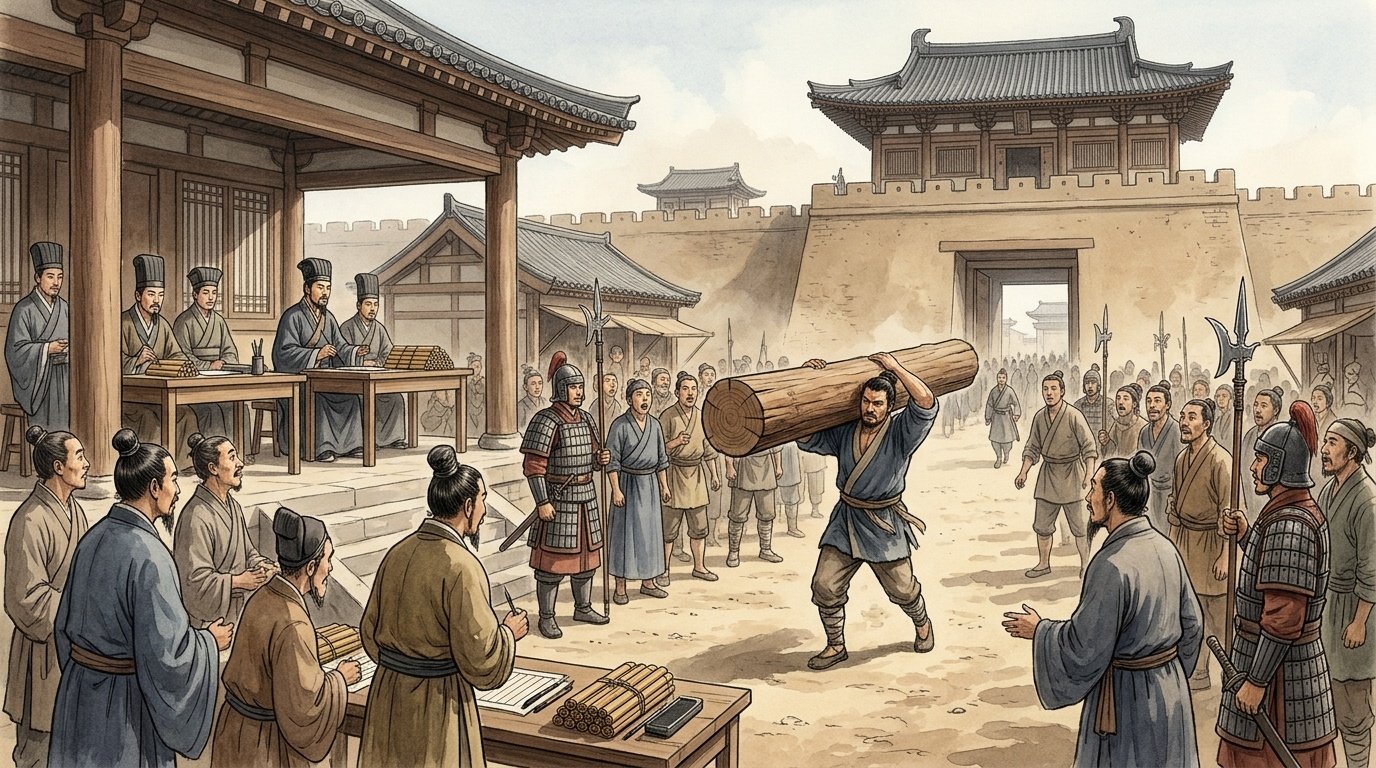
To shatter this cynicism and demonstrate that the authority of the state was absolute, predictable, and irrevocable, Shang Yang staged one of the most famous pieces of political theater in human history: the event known as “Moving the Pole at the South Gate” (Xi Mu Li Xin, 徙木立信). Outside the southern portal of the bustling market of the capital at Yueyang, Shang Yang ordered his soldiers to erect a wooden timber thirty feet tall. A public proclamation was posted beside it: any citizen who carried the pole from the south gate to the north gate would be rewarded with ten ounces of gold (jin)—an enormous sum representing years of agricultural labor for a peasant family.
The marketplace crowds gathered, staring at the timber in bewildered disbelief. No one moved. The task was absurdly easy, the reward astronomically disproportionate; the people assumed it was a trap, a jest by the ducal guards, or an elaborate pretext to accuse a commoner of sedition. Seeing that no one stepped forward, Shang Yang escalated the stakes: he raised the reward to fifty ounces of gold. Finally, a solitary man in the crowd, driven either by reckless desperation or sheer curiosity, stepped forward, hoisted the heavy wooden pole onto his shoulder, and marched through the city avenues from the south gate to the north gate. The moment he laid the timber down at the northern threshold, Shang Yang’s officials stepped forward, counted out fifty ounces of gold into his hands before the eyes of the stunned crowd, and released him without taxation or harassment.
The psychological effect was seismic. In an instant, the news spread like wildfire throughout the towns, hamlets, and military garrisons of Qin: the new minister did not lie. When the state made a promise, it delivered, no matter how extraordinary the cost; and by terrifying extension, when the state issued a prohibition or a punishment, it would strike with equal, merciless infallibility. Having established the bedrock principle of state credibility (xin), Shang Yang immediately promulgated the first comprehensive wave of his revolutionary decrees in 356 BCE.
5. The first wave of reforms (356 BCE), Dismantling the aristocracy
The initial package of reforms promulgated in 356 BCE was designed to dismantle the very foundation of the traditional Zhou sociopolitical order: the hereditary transmission of power. Under the ancient ancestral system (zongfa), wealth, land, military rank, and political office were the private hereditary birthright of noble lineages. An aristocratic son was born an aristocrat regardless of his personal cowardice, incompetence, or degeneracy, while a peasant remained a disenfranchised serf regardless of his bravery or labor. Shang Yang recognized that this hereditary monopoly drained the vitality of the state, fostered treasonous factions, and created an army of entitled elites who contributed nothing to the national treasury.
In a single stroke, Shang Yang abolished all hereditary titles of nobility that were not validated by personal battlefield merit. Henceforth, the son of a duke or a high minister who failed to display valor in combat was stripped of rank and reduced to the status of a commoner. Conversely, the lowliest peasant or slave who demonstrated extraordinary courage on the battlefield could rise to the highest echelons of state power. To institutionalize this radical meritocracy, Shang Yang established the famous System of Twenty Military Ranks (Ershisi Deng Jun Gong Jue Zhi).
Under this system, the primary metric of military promotion was stark, brutal, and quantifiable: the severed head of an enemy soldier (shouji). For every severed head of an armored enemy warrior brought back from the front line, a Qin soldier was awarded one rank of nobility, one small plot of arable land, one servant, and the right to hold minor administrative office. If an ordinary soldier secured two heads, his parents were excused from state labor corvée; if he secured more, he ascended into the officer class. The physical heads were washed, inspected by military scribes, and displayed publicly at camp entrances to prevent fraud. High-ranking aristocratic officers were held to collective accountability: if their battalion suffered casualties without capturing an equal number of enemy heads, the commanders were executed or demoted.
This military-meritocratic ladder revolutionized the Qin army. Where the soldiers of Qi, Chu, and Wei were peasant conscripts fighting reluctantly for their feudal lords, Qin soldiers became terrifying, hyper-motivated predators who viewed combat as their sole vehicle for social elevation and familial prosperity. The eastern states began referring to the Qin soldiers with horror as “the army of severed heads” or “the barefoot beasts.” Foreign observers noted that while other soldiers trembled in terror before an engagement, Qin troops laughed, ripped off their armor to fight bare-chested, and charged into the enemy lines carrying decapitated heads dangling from their belts. Shang Yang had successfully channeled the primal human desire for status and security into a single, lethal pipeline of state violence.
6. The Shiwu system, mutual surveillance and the eradication of the private self
Military reform alone was insufficient; the home front had to be subjected to equal, suffocating discipline. To achieve total internal security, Shang Yang instituted the Shiwu (什伍) system—an unprecedented mechanism of universal civilian organization that eliminated the boundary between public law and private domestic life. Every village, hamlet, and urban neighborhood across the Qin realm was mathematically surveyed and partitioned into mutual surveillance cells: five households formed a wu, ten households formed a shi.
The genius of the Shiwu system lay in the legal doctrine of Collective Liability (Lianzuo, 連坐). Under Shang Yang’s statutes, the members of a five-household cell were bound together by mutual legal responsibility. If a single individual within a cell committed an infraction—whether it was harbor of a fugitive, failure to pay agricultural grain taxes, petty theft, or speaking critically of ducal policy—every single member of the five households was legally guilty of the crime unless they proactively denounced the offender to the magistrate before the crime was discovered by imperial inspectors.
“Let the people be grouped into fives and tens, and let them observe one another and be mutually responsible. Whoever fails to denounce an outlaw shall be cut in two at the waist; whoever denounces an outlaw shall receive the same reward as one who decapitates an enemy in battle; whoever shelters an outlaw shall receive the same punishment as one who surrenders to the enemy.”
— Sima Qian, Shiji (Records of the Grand Historian), Chapter 68: “Biography of Lord Shang”
The punitive consequences of this statute were catastrophic. Failure to report an infraction resulted in execution by bisection at the waist (yaozhan)—a agonizing punishment where the victim was sawn in half across the lower spine on a wooden execution bench. Conversely, turning in a neighbor, a cousin, or an uncle was incentivized with the exact same rewards bestowed upon a warrior who severed an enemy’s head on the battlefield: titles of nobility, grants of land, and tax exemptions. Within years, the Shiwu system dissolved the ancient, organic solidarity of rural kinship networks. Neighbors watched each other through windows; family members whispered behind closed doors; travel between hamlets was impossible without an imperial passport issued by the local cell-head. The state had effectively weaponized every citizen into an unpaid, perpetual informant for the central government.
Complementing collective surveillance was the intentional atomization of the patriarchal extended family. In traditional Chinese culture, multi-generational families lived beneath a single roof, pooling wealth and insulating their members from state exactions. Shang Yang promulgated a decree dictating that any family possessing two or more adult sons who failed to physically divide the household and establish separate residences would have their agricultural poll tax doubled. By forcefully breaking large aristocratic and peasant clans into small, vulnerable nuclear households, Shang Yang prevented the formation of localized political fiefdoms, increased the total number of taxable production units, and ensured that every individual peasant stood naked and isolated before the colossal machinery of the state.
7. Geng Zhan, the agrarian-Militarist dual engine
At the philosophical core of Shang Yang’s statecraft was the doctrine of Geng Zhan (耕戰)—”Agriculture and Warfare.” To Shang Yang, a state possessed only two legitimate, productive functions: tilling the soil to fill the state granaries with grain, and waging external war to expand the sovereign’s borders. Everything else—philosophy, poetry, classical history, fine arts, commercial trade, high ritual, and rhetoric—was categorized as parasitic, decadent, and inherently destabilizing to social order.
In the Book of Lord Shang, he explicitly identified what he termed the Six Parasites (Liu Shi) or the “Lice of the State”: the Classic of Poetry, the Classic of History, ritual propriety, music, filial piety, fraternal duty, sincere speech, and benevolence. When these cultural luxuries were permitted to flourish, Shang Yang argued, the populace became effeminate, reflective, and fearful of death. People began to question the justice of ducal edicts, argue over philosophical definitions, and seek exemptions from manual labor. The sovereign who tolerated scholars and philosophers was like a farmer who permitted weeds to choke his grain fields.
To enforce total focus on agriculture, Shang Yang systematically suppressed the merchant class and urban commerce. Commercial profits were subjected to punitive excises; merchant families were legally categorized as social degenerates and barred from wearing silk garments, riding in carriages, or carrying weapons. Grain prices were manipulated by the state to ensure that trading yielded meager returns, while agricultural labor was rewarded with tax exemptions and land allocations. If a peasant family produced a surplus of grain and silk beyond their state quota, their members were exempted from annual labor corvée (yaoyi). Conversely, any individual who engaged in commerce, spent time in idle discussion, or fell into poverty through indolence was arrested, stripped of personal liberty, and conscripted into state penal servitude as an unfree laborer.
The two halves of the Geng Zhan equation formed a self-reinforcing, perpetual loop. Abundant grain was essential to feed massive standing armies on long-distance foreign campaigns and withstand multi-year sieges; relentless foreign war was essential to prevent the populace from growing complacent, keep young men accustomed to bloodshed, and conquer fresh agrarian land to enfeoff newly promoted soldiers. Shang Yang famously remarked that a state that creates order in peacetime must inevitably turn to war to expend its accumulated energy, warning that “if a country is strong and does not make war, the poison will be carried inside, lice will breed, and the country will weaken; but if the country makes war, the poison is carried to the enemy, and the state becomes immensely strong.” War was not merely a tool of diplomacy; it was the ultimate hygiene of the Legalist body politic.
8. The second wave of reforms (350 BCE), centralization and the Xian system
By 350 BCE, the first wave of reforms had transformed Qin from a chaotic marcher-state into an orderly, disciplined society capable of projecting decisive military power. With his authority unshakeable, Shang Yang launched his second, even more profound wave of administrative restructuring. The overarching goal was nothing less than the total eradication of feudal territorial fragmentation and the creation of a centralized, bureaucratic territorial empire.
The crowning achievement of this second phase was the universal establishment of the Commandery and County System (Junxian Zhi, 郡縣制). Under the ancient Zhou system, land conquered by the state was partitioned into hereditary fiefdoms granted to royal princes and high ministers, who governed their estates as independent lordships with their own private courts and revenues. Shang Yang abolished these autonomous aristocratic enclaves. He gathered all the towns, hamlets, and territories of Qin and partitioned the entire state into thirty-one centralized administrative counties (xian).
Each county was governed not by a hereditary feudal lord, but by a salaried imperial magistrate (Ling or Zhang) appointed directly by the central court in the capital. The magistrate served for a fixed term, received a precise salary paid in grain, and was subject to rigorous annual performance reviews based on quantifiable metrics: the number of acres brought under cultivation, the total volume of grain collected in state granaries, the accuracy of local household registers, and the promptness with which military recruits were dispatched to the front. If a magistrate performed with distinction, he was promoted to a higher administrative post; if he failed or permitted corruption, he was stripped of office, heavily fined, or executed under the penal code. For the first time in Chinese history, governance was divorced from blood and converted into a professionalized, merit-based administrative bureaucracy.
To seal this administrative revolution, Shang Yang persuaded Duke Xiao to relocate the state capital. The old capital at Yueyang was geographically confined and deeply contaminated by the ancestral shrines, burial grounds, and conservative familial networks of the old nobility. Shang Yang designed and constructed a magnificent, brand-new imperial metropolis eighty kilometers to the west along the northern bank of the Wei River: Xianyang (咸陽). Laid out on a strict geometric grid aligned with the celestial axes, Xianyang was built without feudal clan estates, featuring vast ducal palaces, administrative archives, centralized armories, and wide paved avenues. The new capital stood as an architectural manifesto in stone and rammed earth: Qin had abandoned its tribal past and was now organized as a unitary, rationalized machine directed entirely from a single supreme center.
9. The agrarian revolution, Abolishing the Well-Field system and opening the borders
Parallel to the administrative creation of the county system was an economic revolution that unlocked the vast agricultural potential of the Wei River valley. For centuries, Chinese agriculture had nominally functioned under the ideological model of the Well-Field System (Jingtian Zhi, 井田制). In this idealized communal structure, land was divided into nine equal squares resembling the Chinese character for “well” (井); eight peasant families farmed the outer eight private plots for their own subsistence, while collectively cultivating the central ninth plot to pay tribute to their feudal lord. While the reality of late Zhou agriculture was far messier, land was universally treated as inalienable territory owned by aristocratic lineages, with rigid boundaries (qianmo, 阡陌) that could not be legally bought, sold, or reclaimed without feudal sanction.
Shang Yang recognized that this archaic system disincentivized agricultural expansion. Peasants had no personal incentive to clear wilderness or invest in drainage ditches on land they did not own, while vast tracts of fertile loess in the Shaanxi basin lay uncultivated because the depleted nobility lacked the manpower to farm them. In 350 BCE, Shang Yang issued his famous decree: “Abolish the Well-Field Boundaries and Permit the Buying and Selling of Land” (Fei Jingtian, Kai Qianmo, 廢井田,開阡陌). In a single stroke, Shang Yang destroyed feudal tenure and instituted the legal recognition of private, alienable peasant landownership.
Henceforth, any farmer who cleared untamed wilderness, dug irrigation channels, and brought new soil under the plow was granted legal, perpetual title to that land, with the right to bequeath it to his sons or sell it on the open market. The ancient communal boundaries were plowed under, replaced by a universal, standardized land tax assessed directly by the state in accordance with the exact acreage farmed and the yield produced. Land was transformed from a fixed ancestral privilege into a dynamic, liquid economic asset.
To exploit this newly privatized agrarian frontier, Shang Yang executed an audacious grand demographic strategy. Qin possessed vast, uncultivated land reserves but suffered from a chronic shortage of agricultural manpower; the eastern states—Han, Zhao, and Wei—suffered from severe rural land scarcity and overcrowding, with millions of impoverished peasants struggling on tiny, over-taxed parcels. Shang Yang issued an imperial proclamation guaranteeing generous grants of fertile land, tax exemptions for three generations, and freedom from military conscription to any immigrant family from the eastern states who settled in Qin. Millions of destitute eastern peasants flooded across the mountain passes into the Wei River basin. The strategic genius of this policy was devastating: by importing foreign labor to farm the home front, Shang Yang freed hundreds of thousands of native Qin men from agricultural duties, allowing them to serve as full-time professional shock infantry in the expanding imperial armies.
10. Standardizing the machine, the Fang Sheng and the rule of law (fa)
A centralized empire requires absolute standardization. In a fragmented feudal world where every local lord minted his own bronze knives, used his own measuring cords, and calculated grain bushels using local baskets, administrative efficiency was impossible. Dishonest officials embezzled taxes by collecting grain with oversized baskets and distributing seed with undersized cups, while merchants engaged in rampant arbitrage across provincial borders. Shang Yang understood that the supremacy of the law (Fa) depended upon material, physical uniformity.
In 344 BCE, Shang Yang designed and distributed the celebrated Shang Yang Fang Sheng (商鞅方升)—a rectangular bronze measuring cup that served as the official, mandatory volume standard for the entire state of Qin. Preserved today in the Shanghai Museum, this exquisite artifact represents one of the most important surviving treasures of world administrative history. Cast in bronze with a flat base and a short handle, its exterior walls are meticulously inscribed with an imperial edict specifying its exact internal volume (equivalent to 202.15 cubic centimeters) and commanding that all regional magistrates and market inspectors across the thirty-one counties certify their local measuring vessels against this master prototype.
Shang Yang extended this obsessive standardization across every sphere of material culture. Length measurements (the foot, the pace, the li) were standardized using certified bronze rods; weight standards (the ounce, the pound, the stone) were cast in iron and stone weights; the gauge of chariot wheels was fixed to ensure that all vehicles fit the standardized ruts of imperial highways; and the administrative script used by scribes was regularized. This was not mere bureaucratic pedantry; it was the essential mechanical prerequisite for an empire of continental scale. It ensured that an order issued in Xianyang would be understood with identical precision in the mountains of Gansu or the plains of Henan, and that military grain supplies could be calculated down to the individual gram across thousands of kilometers of supply lines.
Crucially, this standardization applied equally to the penal code. In classical Confucian theory, law was a secondary, undesirable instrument; the gentleman (junzi) was guided by moral shame and ritual deference, summarized in the famous maxim of the Rites of Zhou: “Ritual does not descend to the common people; penal punishments do not ascend to the high ministers” (禮不下庶人,刑不上大夫). Shang Yang violently rejected this aristocratic double standard. Under Legalist jurisprudence, the law was an objective, unbending standard—like a carpenter’s plumb-line or a blacksmith’s balance—that must fall with absolute impartiality upon every human neck, regardless of birth, wealth, or rank.
This principle was put to the ultimate test in 346 BCE, when Crown Prince Si (the future King Huiwen of Qin) broke one of Shang Yang’s new decrees. The court watched with bated breath, assuming that the minister would quietly ignore the royal heir’s transgression. Shang Yang stood firm before Duke Xiao, declaring: “The laws are not obeyed because those above violate them!” Because the Crown Prince was the sacred heir to the ducal altar and could not be physically mutilated, Shang Yang ordered the severe punishment of his personal tutors and guardians: Prince Qian (the Duke’s brother) had his nose sliced off (yi), while the grand tutor Gongsun Jia was tattooed across the forehead with indelible black ink (mo) like a common felon. The entire realm shook with terror. From that day forward, from royal princes down to barefoot peasants, no one in the State of Qin dared to challenge the absolute supremacy of the written law.
11. The fall of Lord Shang, the chariot dismemberment at Xianyang
For over two decades, Shang Yang enjoyed the unreserved, fanatical support of Duke Xiao. In recognition of his immense services—which included leading Qin armies to a succession of brilliant victories over Wei, recapturing the lost Hexi territories, and forcing the eastern kings to recognize Qin as the dominant superpower of the age—Duke Xiao enfeoffed Yang in 340 BCE with fifteen cities in the region of Shang and Yu, granting him the honorific title of Lord Shang (Shangjun). At the apex of his glory, Lord Shang traveled through the state with an escort of heavily armored cavalry, preceded by heralds clearing the roads and flanked by bodyguards wielding halberds.
Yet in creating this invincible, cold-blooded machine, Shang Yang had dug his own grave. By dismembering the hereditary nobility, punishing royal princes, and executing thousands of aristocratic retainers who resisted his edicts, he had accumulated a mountain of silent, burning hatred. The nobility lived only for the day when Duke Xiao would close his eyes for the last time. A wise recluse named Zhao Liang visited Lord Shang and warned him with chilling historical foresight: “Your lordship’s appearance at court is not accompanied by the affection of the people, but by terror… When the Duke passes away, how will Qin maintain your life? You are like morning frost waiting for the scorching sun; your death will arrive in an instant.” Lord Shang, blinded by his own systemic infallibility, dismissed the warning with haughty disdain.
In 338 BCE, Duke Xiao died. Crown Prince Si ascended the throne as King Huiwen of Qin. The moment the funeral ceremonies concluded, the aggrieved nobility struck. Prince Qian, whose nose had been severed eight years earlier, emerged from his secluded palace and accused Lord Shang of plotting high treason. King Huiwen, who had harbored a bitter personal grudge against the minister since his youth, immediately issued a warrant for Lord Shang’s arrest.
What followed was an episode of exquisite historical irony recorded with dark brilliance by Sima Qian. Fleeing into the night from Xianyang, Lord Shang rode desperately toward the mountain pass, seeking shelter at a roadside inn. The innkeeper, unaware of the fugitive’s identity, barred the door and demanded his imperial registration papers. Lord Shang protested that he was weary and willing to pay handsomely for a bed. The innkeeper shook his head firmly: “According to the laws of Lord Shang, anyone who lodges a traveler without official registration papers will be bisected at the waist along with his entire cell of five families. I dare not admit you!” Lord Shang let out a long, bitter sigh toward the midnight sky: “Alas! The severity of making laws has come home to my own body!”
Unable to find shelter within the surveillance grid he had personally constructed, Lord Shang attempted to cross the border into Wei. But the King of Wei, remembering Shang Yang’s ruthless military campaigns and diplomatic betrayals, expelled him back into Qin territory. In absolute desperation, Lord Shang fled to his private fiefdom of Shang, gathered his personal retainers and family guards, and launched a suicidal rebellion against the ducal army. He was overwhelmed, captured on the battlefield, and brought in chains back to the capital of Xianyang.
King Huiwen ordered the most gruesome execution permitted under the Legalist penal code: Dismemberment by Chariots (Cheli, 車裂). Lord Shang’s limbs and neck were bound with thick hemp ropes to five heavy war chariots. At the sound of the imperial drum, the charioteers whipped their horses in five opposing directions, tearing the architect of the Qin empire limb from limb across the loess earth. His shattered torso was displayed in the public square, and King Huiwen ordered the total extermination of his entire clan (miezhi)—parents, siblings, wives, and children—wiping the lineage of Shang Yang off the face of the earth.
12. The paradox, why the system Outlived its creator
The execution of Lord Shang reveals the profound structural paradox of Chinese Legalism. In traditional aristocratic rebellions, the murder of a reforming minister was immediately followed by the repeal of his policies and the restoration of the old feudal order. Yet when the victorious Qin nobles gathered at court expecting King Huiwen to abolish the county system, restore hereditary titles, and dissolve the Shiwu surveillance cells, the new monarch made a chilling discovery: he had zero intention of abandoning Shang Yang’s laws.
King Huiwen hated the man, but he loved the machine. Why would any sovereign willingly surrender a system that delivered absolute obedience, overflowing granaries, an unstoppable professional army, and total centralization of power directly into the royal hands? King Huiwen had executed the reformer to appease the vengeance of his royal uncles and eliminate a dangerous overmighty subject, but he preserved every single comma, statute, and decree of Shang Yang’s penal and agrarian code intact. As the Western Han historian Ban Gu famously observed in the Book of Han: “Qin implemented the laws of Shang Yang; although his body was torn apart by chariots, his statutes never perished.”
For the next century, successive Qin monarchs—King Wu, King Zhaoxiang, and King Zhuangxiang—rigorously maintained and refined Shang Yang’s totalitarian architecture. When the great Confucian philosopher Xunzi visited Qin around 264 BCE, he was stunned by what he witnessed. In his essay “On the State of Qin” (Ru Xiao Pian), Xunzi recorded that the common people were humble and fearful of authority, never daring to engage in private feuds; the officials were sober, industrious, and moved with terrified efficiency; and the court handled administrative affairs with the speed and precision of a machine. Xunzi lamented that Qin lacked the transcendent benevolence and ritual humanism of the Duke of Zhou, but he conceded with intellectual honesty that it was the best-governed, most powerful state in the known world.
When Shang Yang’s ideological descendant, King Zheng of Qin (the future First Emperor, Qin Shi Huang), ascended the throne in 246 BCE, he did not need to invent an imperial system from scratch. The institutional engine of conquest had been humming continuously for over a century, awaiting only a ruler with the ambition and brutality to drive it across the entire East Asian continent. Between 230 and 221 BCE, that machine executed its terrible destiny: one by one, Han, Zhao, Wei, Chu, Yan, and Qi were crushed, their royal houses extinguished, and their territories absorbed into the standardized, county-based administrative grid designed by Lord Shang on the banks of the Wei River.
13. Historiographical legacy, totalitarian pioneer vs. Civilizational architect
Throughout two millennia of imperial Chinese history, Shang Yang remained one of the most polarizing and demonized figures in intellectual life. Following the sudden collapse of the Qin dynasty in 206 BCE—only fifteen years after unification—the victorious Han dynasty adopted Confucianism as the official state ideology. Han scholars, led by Jia Yi and Dong Zhongshu, blamed Shang Yang’s hyper-punitive Legalism for the destruction of Qin. In their moral critique, Shang Yang had taught the state to treat its subjects like beasts of burden, elevating cunning and decapitation over filial piety and humaneness, thereby creating an empire devoid of moral legitimacy that inevitably choked on its own violence.
Yet beneath this continuous Confucian moral condemnation lay a profound institutional hypocrisy: the celebrated imperial synthesis known as Rujia Wai, Fajia Nei (儒家外,法家內)—”Confucian on the outside, Legalist on the inside.” While emperors and grand secretaries publicly praised the benevolent maxims of the Analects, they governed daily through the centralized commanderies, bureaucratic evaluations, household registries, and standardized penal codes pioneered by Shang Yang. The absolute imperial autocracy that endured from the Han to the fall of the Qing in 1912 was fundamentally the institutional child of Lord Shang, wrapped in the embroidered silk robes of Confucius.
In the twentieth century, Shang Yang underwent a radical re-evaluation. Modern historians and political theorists, examining the rise of the modern bureaucratic nation-state in Europe, recognized that Shang Yang had anticipated the core features of modern state-building by more than two millennia: the eradication of feudal privilege, the establishment of equality before the law, the creation of a professionalized civil service, universal military conscription, and the systematic mobilization of the national economy. During the late Maoist period, particularly the “Criticize Lin, Criticize Confucius” (Pi-Lin Pi-Kong) campaign of the early 1970s, Shang Yang was resurrected as a progressive revolutionary hero who had crushed reactionary slaveholder aristocrats to establish an advanced centralized society.
Today, as political scientists examine the historical trajectory of Chinese state capacity, Shang Yang stands as the supreme architect of the centralized, executive-driven state. His terrifying legacy reminds us of the eternal, tragic tension at the heart of human political organization: between the chaotic freedom of organic civil society and the lethal, standardized efficiency of total state power. He created a state so powerful that it unified an entire civilization, yet so devoid of human compassion that it devoured its own creator in the dust of Xianyang.
14. Primary Texts, Epigraphical artifacts, and Scholarly references
Primary Classical Texts:
Shangjun Shu (商君書, The Book of Lord Shang). Attributed to Shang Yang and his disciples. Chapters: 1 “Gengfa” (Revising the Laws), 2 “Kenling” (Order to Cultivate Waste Lands), 3 “Nongzhan” (Agriculture and War), 7 “Kaise” (Opening and Debarring), 14 “Xiuguan” (Cultivating the Ruler). Translated by Yuri Pines (2017), The Book of Lord Shang: Apologetics of State Power in Early China, New York: Columbia University Press. doi:10.7312/pine17988[1]
Sima Qian (司馬遷). (c. 94 BCE). Shiji (史記, Records of the Grand Historian). Chapter 5: “Qin Benji” (Basic Annals of Qin); Chapter 68: “Shangjun Liezhuan” (Biography of Lord Shang). Translated by William H. Nienhauser Jr. (1994), The Grand Scribe’s Records, Vol. 7, Indiana University Press.
Han Feizi (韓非子). Chapters: 43 “Dingfa” (Fixing the Laws), 49 “Wudu” (The Five Vermin). Critical translation by W. K. Liao (1939), The Complete Works of Han Fei Tzu, London: Arthur Probsthain.
Zhanguo Ce (戰國策, Stratagems of the Warring States). “Qin Ce” (Stratagems of Qin). Translated by J. I. Crump (1970), Oxford: Clarendon Press.
Archaeological and Epigraphical Records:
Shang Yang Fang Sheng (商鞅方升, Shang Yang’s Bronze Standard Measure). Dated 344 BCE. Preserved at the Shanghai Museum. Bronze measuring vessel with sixteen-character inscription recording standard volume under Duke Xiao. Cataloged in Selected Bronze Inscriptions of the Warring States (1985), Cultural Relics Publishing House, Beijing.
Shuihudi Qin Bamboo Slips (睡虎地秦簡). Excavated at Yunmeng, Hubei, 1975. Legal statutes and administrative casebooks illustrating the direct codification of Shang Yang’s penal and agrarian laws under the late Qin empire. Analyzed by A. F. P. Hulsewé (1985), Remnants of Ch’in Law, Leiden: E. J. Brill.
Modern Scholarly Studies:
Duyvendak, J. J. L. (1928). The Book of Lord Shang: A Classic of the Chinese School of Law. London: Arthur Probsthain.
Lewis, Mark Edward. (1990). Sanctioned Violence in Early China. Albany: State University of New York Press.
Lewis, Mark Edward. (1999). “Warring States: Political History,” in Michael Loewe and Edward L. Shaughnessy (eds.), The Cambridge History of Ancient China: From the Origins of Civilization to 221 B.C., Cambridge: Cambridge University Press, pp. 587–650. doi:10.1017/CHOL9780521470308[2]
Pines, Yuri. (2014). “Legalism in Chinese Philosophy,” in Edward N. Zalta (ed.), The Stanford Encyclopedia of Philosophy.
Pines, Yuri. (2009). Envisioning Eternal Empire: Chinese Political Thought of the Warring States Era. Honolulu: University of Hawaiʻi Press.
Sanft, Charles. (2014). Communication and Cooperation in Early Imperial China: Publicizing the Qin Dynasty. Albany: State University of New York Press.
Twitchett, Denis, & Fairbank, John K. (eds.). (1986). The Cambridge History of China, Volume 1: The Ch’in and Han Empires, 221 B.C.–A.D. 220. Cambridge: Cambridge University Press.
15. Timeline
When Duke Xian died in 362 BCE, he left his twenty-one-year-old son, Duke Xiao (秦孝公), in command of an impoverished, traumatized realm standing on the absolute precipice of territorial dismemberment and historical oblivion.
In 361 BCE, he issued his celebrated “Decree Seeking Men of Talent” ( Qiu Xian Ling , 求賢令), broadcast across the courts and intellectual circles of all seven Warring States.
Having established the bedrock principle of state credibility ( xin ), Shang Yang immediately promulgated the first comprehensive wave of his revolutionary decrees in 356 BCE.
By 350 BCE, the first wave of reforms had transformed Qin from a chaotic marcher-state into an orderly, disciplined society capable of projecting decisive military power.
This principle was put to the ultimate test in 346 BCE, when Crown Prince Si (the future King Huiwen of Qin) broke one of Shang Yang’s new decrees.
When the great Confucian philosopher Xunzi visited Qin around 264 BCE, he was stunned by what he witnessed.
Following the sudden collapse of the Qin dynasty in 206 BCE—only fifteen years after unification—the victorious Han dynasty adopted Confucianism as the official state ideology.
Liao (1939), The Complete Works of Han Fei Tzu , London: Arthur Probsthain.