Hezong, Lianheng and the Diplomacy of the Warring States
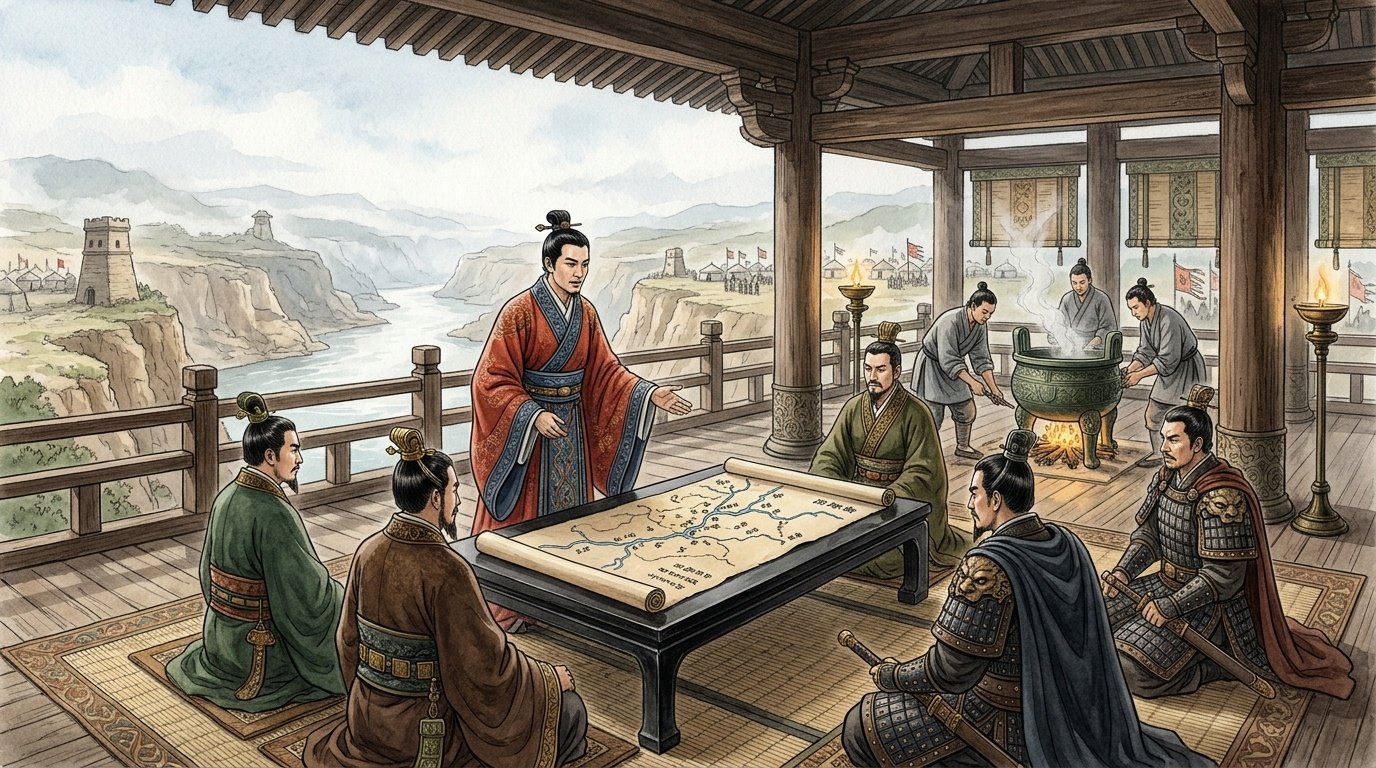
In the twilight centuries of ancient China, the collapse of the Zhou ritual order transformed the Central Plains into the most complex, lethal balance-of-power arena in human antiquity: the Warring States period (475–221 BCE). As the surviving Seven Great Powers (Zhanguo Qixiong) mobilized colossal peasant armies numbered in the hundreds of thousands, military violence reached an existential stalemate. Into this crucible stepped a revolutionary class of itinerant geopolitical strategists known as the School of Coalitions or School of Diplomacy (Zonghengjia). Guided by the shadowy esoteric teachings of the Master of Ghost Valley (Guiguzi), these master persuaders turned foreign policy into an art of high-stakes psychological warfare, covert bribery, and structural balance of power. At the heart of their world lay the titanic grand-strategic duel between two incompatible geopolitical doctrines: Hezong (合縱)—the Vertical Alliance uniting the six weaker eastern states from north to south to contain the western behemoth—and Lianheng (連橫)—the Horizontal Alliance engineered by the State of Qin to divide and conquer its rivals through bilateral pacts, territorial dismemberment, and tactical deceit. This century-long diplomatic duel between Su Qin’s multilateral coalition and Zhang Yi’s realpolitik balance-of-power manipulation remains one of the most sophisticated chess games in the history of international relations.
1. The geopolitical crucible, from hundred states to the Seven Powers
The strategic environment of the late fourth century BCE bore no resemblance to the ritualized aristocratic warfare of the earlier Spring and Autumn period. During the seventh and sixth centuries BCE, hundreds of small city-states had populated the Central Plains, bound by shared ancestral sacrifices, intermarriage alliances, and the nominal suzerainty of the Zhou Son of Heaven. Combat was conducted by small aristocratic chariot retinues who paused to exchange formal courtesies, allowed wounded adversaries to retrieve their weapons, and ceased fighting once an enemy general had been captured. War was a solemn ritual performance intended to restore cosmic balance rather than annihilate an enemy’s territorial existence.
By 330 BCE, that archaic world had been drowned in blood. Through centuries of relentless Darwinian consolidation, hundreds of petty polities had been ruthlessly swallowed by their larger neighbors. Following the dramatic partition of the mighty superpower of Jin into the Three Successor States (Han, Zhao, and Wei) in 403 BCE, the political map had consolidated into seven colossal territorial states: the Seven Great Powers of the Warring States (Zhanguo Qixiong, 戰國七雄). These were Qin in the western loess mountain fortress; Chu across the vast southern lakes and Yangtze basin; Qi along the wealthy eastern maritime peninsula; Yan in the rugged northeast; and the Three Jin states—Han, Zhao, and Wei—compressed into the congested, turbulent Central Plains.
The scale of violence had expanded by orders of magnitude. The widespread adoption of cast-iron agricultural tools and deep ditch irrigation generated massive demographic explosions, while universal peasant conscription allowed states to field standing armies of three hundred thousand to six hundred thousand men. The invention of the bronze crossbow (nu)—capable of penetrating heavy armor at two hundred paces with minimal training—and the replacement of chariots with massed armored infantry formations turned battles into industrial-scale slaughterhouses. States no longer fought for ritual prestige; they fought for the absolute annihilation of rival dynasties and the total annexation of their land.
In this hyper-lethal, zero-sum environment, raw military force alone was insufficient for survival. Even the mightiest army could be surrounded and annihilated if its ruler fell into diplomatic isolation, while a small, geographically vulnerable state could survive for decades by adroitly playing its larger neighbors against one another. Diplomacy was no longer an occasional exchange of ceremonial envoys bearing jade tallies; it had become the primary, continuous instrument of grand strategy. The fate of kingdoms was determined as much in midnight audience chambers by smooth-tongued itinerant persuaders as it was on bloody fields of battle.
2. The Ghost Valley Master and the Philosophy of Persuasion, the Zonghengjia
Out of this existential crucible emerged the most controversial, feared, and intellectually brilliant philosophical tradition of ancient China: the Zonghengjia (縱橫家), usually translated as the School of Coalitions, the School of Vertical and Horizontal Alliances, or the School of Diplomacy. Unlike the Confucians, who preached benevolent virtue (ren) and ritual propriety (li), or the Mohists, who advocated universal love (jian’ai) and defensive warfare, the master persuaders of the Zonghengjia operated with total, unapologetic moral neutrality. To them, international politics was not a school for moral self-cultivation, but an arena of shifting power distributions, human psychology, fear, greed, and structural interest.
The patron founder and legendary patriarch of this school was the mysterious recluse known as Guiguzi (鬼谷子)—the Master of Ghost Valley. Tradition records that he resided in a deep, shadowed limestone ravine in modern Henan province, refusing all imperial offices and spending his life analyzing the mechanics of human deception, cosmic change, and rhetoric. The esoteric text attributed to him, the Guiguzi, is the world’s oldest systematic treatise on political psychology, diplomatic negotiation, and intelligence tradecraft, pre-dating Niccolò Machiavelli’s The Prince by eighteen centuries.
The core methodology of Guiguzi was the doctrine of Baihe (捭闔)—”Opening and Shutting.” Guiguzi taught that human minds, like doors, could be systematically opened or shut through careful psychological manipulation. Before an envoy uttered a single word to a sovereign, he was trained to conduct deep psychological reconnaissance: observing the ruler’s gait, his private vices, his physical fears, his rivalries with brothers, and his hidden ambitions. If a monarch was arrogant, the persuader inflated his vanity to make him reckless; if he was timid, the persuader exaggerated the impending military threat to induce panic; if he was covetous, the persuader dangled territorial concessions to blind his judgment.
“In opening, one observes the other’s intentions; in shutting, one seals one’s own resolve. Measure their power, calculate their strengths and weaknesses, search out their hidden desires… When their psychological knots are located, apply the wedge. One who masters the art of opening and shutting can control the minds of kings and alter the destiny of empires without drawing a sword.”
— Guiguzi (Master of Ghost Valley), Chapter 1: “Opening and Shutting” (Baihe)
Guiguzi taught that an alliance was never an emotional bond or a sacred covenant between kings; it was merely a temporary intersection of naked self-interests. The moment the objective balance of power shifted, the treaty became worthless parchment. The practitioner of Zongheng was trained to be an ideological chameleon: capable of arguing for peace in the morning and total war in the evening, switching allegiances with effortless grace, and manipulating the collective emotions of assemblies through mesmerizing rhetorical cadences. Out of Ghost Valley walked the two greatest diplomatic gladiators of the era: Su Qin and Zhang Yi.
3. The Architecture of Hezong, Su Qin’s Vertical Axis
The doctrine of Hezong (合縱)—literally the “Vertical Alliance” or the “Union Along the North-South Axis”—was born from a cold, mathematical assessment of the geopolitical map. Following Shang Yang’s totalitarian reforms, the State of Qin had emerged as a monstrous predatory hegemon. Occupying the natural geological fortress of the Guanzhong basin behind the impregnable Hangu Pass (函谷關), Qin possessed fertile agricultural plains, an invincible army incentivized by battlefield decapitation, and an aggressive, expansionist monarchic line. By 334 BCE, Qin was relentlessly pushing east into the Central Plains, gobbling up territories from Han and Wei with the predictable ferocity of a silkworm devouring a mulberry leaf.
The six states of the east—Yan, Zhao, Qi, Wei, Han, and Chu—faced a profound collective action dilemma. Geographically, these six kingdoms stretched in a contiguous vertical crescent from the northern steppes of Yan to the southern subtropical marshes of Chu. Individually, not a single one of the six states possessed the demographic scale, economic resources, or military stamina to withstand a sustained, one-on-one invasion by Qin. Yet whenever Qin attacked, the other five states remained paralyzed, selfishly hoping that their neighbor’s dismemberment would sate the beast’s appetite, or even greedily joining Qin to scavenge crumbs of conquered territory.
The strategist who broke this paralysis was Su Qin (蘇秦). A native of Luoyang from a humble peasant family, Su Qin had suffered years of bitter poverty, mockery from his sisters-in-law, and initial rejection by the King of Qin. Returning home in rags, he locked himself in his study for a year, studying the ancient military treatises and the esoteric texts of Guiguzi. Whenever drowsiness overtook him during his midnight studies, he grasped an iron awl and drove it into his thigh until blood ran down to his ankles—an act immortalized in the Chinese idiom “piercing the thigh with an awl” (ci gu, 刺股)—to shock his mind into relentless focus.
Su Qin formulated the grand strategy of Hezong: an ironclad multilateral mutual defense pact uniting all six eastern states against Qin. The mathematical logic was unassailable: while Qin was larger than any single eastern state, the combined territory of the six states was five times greater than Qin’s, their aggregate population was ten times larger, and their massed armies numbered well over one million men. If the six states could act as a single political organism—agreeing that an attack on any one state would be met with an immediate, coordinated counter-invasion of Qin’s flanks by all five remaining allies—Qin would be permanently hemmed in behind the Hangu Pass, unable to move a single soldier across the Yellow River.
4. The six Seals of the Prime minister, Su Qin’s diplomatic masterpiece
The execution of Su Qin’s diplomatic vision was an astonishing tour de force of sequential bilateral negotiation. Recognizing that he could not convince the major powers while remaining an unknown scholar, Su Qin began his journey in the remote, conservative northern kingdom of Yan. Gaining an audience with Marquis Wen of Yan, Su Qin pointed out that Yan’s apparent security was a lethal illusion: while Yan feared Zhao on its southern border, Zhao was merely a regional rival, whereas Qin was a universal existential predator. If Yan helped Zhao resist Qin, Zhao would serve as Yan’s permanent shield; if Zhao fell, Qin’s legions would appear at Yan’s gates. Marquis Wen was captivated, financing Su Qin with gold, horses, and carriages to take his proposal south to Zhao.
In Handan, the capital of Zhao, Su Qin confronted Marquis Su of Zhao with a devastating geopolitical audit. He laid out the strategic geography of the Central Plains, demonstrating that Zhao was the natural military keystone of the entire vertical axis. If Zhao allied with Han and Wei, the heart of the empire would hold firm. Moving southward into Han and Wei—the two states suffering the brunt of Qin’s continuous border raids—Su Qin dismantled the prevailing policy of territorial appeasement. Addressing King Xiang of Wei, Su Qin coined one of the most famous strategic aphorisms in Chinese history:
“Ceding land to Qin is like throwing wood onto a fire to extinguish the flames: so long as the wood is not exhausted, the fire will never go out. Qin’s appetite for land has no limit, but your territory is bounded. To feed an insatiable desire with finite land can only result in the total ruin of your state!”
— Su Qin, Zhanguo Ce (Stratagems of the Warring States), “Stratagems of Wei”
Traveling to Linzi, the glittering, commercial capital of Qi, Su Qin flattered King Xuan by praising Qi’s peerless wealth, its armored halberdiers who numbered hundreds of thousands, and its bustling markets where the sleeves of the crowds raised a canopy of shade and their sweat fell like rain. He warned that if Qi stood aloof while Qin devoured Han and Wei, Qi would find itself alone on the eastern sea facing an unstoppable continental hegemon. Finally, Su Qin traveled to Ying, the southern capital of Chu, appealing to King Wei’s pride as the ruler of the largest kingdom in the world, urging him to assume the supreme ceremonial leadership of the allied league.
In roughly 333 BCE, Su Qin achieved the impossible. The six sovereign monarchs signed a formal treaty of collective security at Handan, sealing the covenant with the ritual slaughter of a white horse and smearing its blood on their lips. In an unprecedented display of multilateral authority, all six monarchs bestowed upon Su Qin their royal seals of office. Riding in a gilded carriage flanked by an armed escort of royal cavalry, Su Qin wore the Six Seals of Prime Minister (Pei Liuguo Xiangyin, 佩六國相印) hanging from his belt—the supreme diplomatic chancellor of a unified half of China. When his entourage passed through his hometown of Luoyang, his parents stood trembling by the road, and his sister-in-law crawled on her hands and knees in the dust, too terrified to raise her eyes to the man she had mocked a few years before. Su Qin laughed and noted with cold irony the transformative power of political prestige.
The immediate strategic effect of the Hezong coalition was total deterrence. Stunned by the unprecedented solidarity of the six states, King Huiwen of Qin suspended all aggressive military operations across the Hangu Pass. For fifteen years, recorded Sima Qian in the Shiji, Qin’s soldiers did not dare to venture east of the pass, and the Central Plains enjoyed a golden interlude of peace manufactured entirely through the balance of diplomatic power.
5. The counter-Revolution, Zhang Yi and the Realpolitik of Lianheng
No coalition built upon the competing self-interests of sovereign monarchies can endure indefinitely. The fatal vulnerability of Su Qin’s Vertical Alliance was that it demanded unnatural altruism: every member was required to sacrifice its own blood and treasure to defend its neighbors, even when those neighbors were historical enemies. The man who saw through this fragile facade and engineered its destruction was Su Qin’s fellow disciple from Ghost Valley: Zhang Yi (張儀).
A dispossessed nobleman from the State of Wei, Zhang Yi had lived through equally bitter humiliations. While serving as an aide in Chu, he had been falsely accused of stealing a priceless jade disc belonging to the Prime Minister. Bound and flogged with several hundred lashes until his skin was torn to ribbons, Zhang Yi refused to confess. When his weeping wife rescued him and lamented that he should never have pursued scholarship, Zhang Yi opened his bloody mouth and asked: “Look closely: is my tongue still intact?” His wife replied that his tongue was untouched. Zhang Yi smiled through his swollen lips: “Then that is sufficient. My tongue is the only weapon I require to conquer the world.”
Arriving in Qin, Zhang Yi presented King Huiwen with the grand strategy of Lianheng (連橫)—the “Horizontal Alliance” or the “Union Along the East-West Axis.” Zhang Yi recognized that the six eastern states were separated by centuries of bitter territorial grievances, border disputes, and cultural rivalries. Zhao hated Yan; Qi looked down on Chu; Han and Wei had fought each other for decades. The Vertical Alliance was an artificial, brittle shell held together only by fear of Qin.
Zhang Yi’s strategy was the art of bilateral seduction and asymmetrical coercion. Instead of fighting all six states at once, Qin would establish a horizontal diplomatic axis with one or two specific eastern partners, isolating their neighbors. Qin would use a classic carrot-and-stick methodology: offering royal marriages, gold bribes, and promises of shared plunder to compliant states, while threatening recalcitrant states with immediate, catastrophic military invasion. By breaking the six states into isolated bilateral negotiations, Qin could dismantle the collective security league from within, devouring its victims one by one like a wolf picking off stray sheep from a herd.
6. The Master stroke of deception, Zhang Yi and King Huai of Chu
The supreme operational masterpiece of Zhang Yi’s diplomatic career—and the greatest act of state-level deception in ancient history—took place in 313 BCE, targeting the powerful southern kingdom of Chu. At the time, Chu and Qi had forged a formidable bilateral axis within the Vertical Alliance. Qi’s naval wealth and elite crossbow infantry, combined with Chu’s vast territorial depth and massive manpower reserves, created an impassable military barrier that completely blocked Qin’s southern and eastern ambitions. King Huiwen of Qin knew that he could not defeat either state so long as their alliance endured.
King Huiwen dispatched Zhang Yi to the Chu capital of Ying on an official diplomatic embassy. Securing a private audience with the vain, greedy King Huai of Chu (楚懷王), Zhang Yi laid out a breathtaking proposal. He claimed that Qin despised Qi and desired nothing more than an eternal, brotherly alliance with Chu. If King Huai would formally sever all diplomatic and military ties with Qi—expelling Qi’s envoys and abrogating their mutual defense treaty—Qin would joyfully cede to Chu six hundred li of fertile territory in the Shangwu (商於) region along the Dan River, restoring Chu’s ancestral lands and giving the kingdom undisputed mastery over the south.
King Huai was ecstatic. Over the strenuous, desperate objections of his chief advisor Chen Zhen—who warned that Qin was a treacherous tiger and that Zhang Yi would never deliver the land—King Huai accepted the deal. He showered Zhang Yi with gold and jade, formally severed relations with Qi, and dispatched an envoy to the Qi court to deliver a barrage of humiliating insults to King Xuan. He then appointed a trusted general to accompany Zhang Yi back to Xianyang to take formal possession of the six hundred li of territory.
The moment Zhang Yi crossed into Qin territory, he executed a brilliant piece of diplomatic stalling. He feigned falling from his carriage, claiming a severe carriage injury, and retreated into his private manor, refusing to attend court or receive visitors for three full months. Puzzled by the delay, King Huai assumed that Qin still doubted Chu’s sincerity. To prove his total break with Qi, King Huai dispatched an elite assassin across the border into Qi to physically assault a high Qi minister. Enraged by this unprovoked outrage, the King of Qi abandoned all pride, broke his remaining ties with Chu, and signed a bilateral mutual defense pact with Qin.
The trap was sprung. The moment news arrived that Qi had allied with Qin, Zhang Yi’s carriage “injury” miraculously vanished. He appeared at court and met the bewildered Chu envoy. When the envoy presented the deeds for the six hundred li of Shangwu, Zhang Yi feigned astonishment: “Six hundred li? What absurdity are you speaking? I am merely a humble minister; how could I give away imperial lands? I promised to give His Majesty six li of my own personal fiefdom!”
When the news reached Ying, King Huai flew into an uncontrollable rage. Blurring all strategic judgment, he ordered the total mobilization of the Chu army and launched a reckless, unsupported invasion of Qin in 312 BCE. Qin’s armies, perfectly prepared and operating in tandem with their new Qi allies, ambushed the Chu host at Danyang. Eighty thousand Chu warriors were decapitated; seventy Chu noble commanders were captured; and Chu’s strategic Hanzhong region was permanently annexed by Qin. In a single stroke of diplomatic fraud, Zhang Yi had shattered the Qi-Chu alliance, severed Chu’s northern defenses, and expanded Qin’s territory by hundreds of miles without Qin suffering a single major military defeat.
7. The military Collapse of the Coalitions, the 318 BCE Expedition and Hangu Pass
While Zhang Yi was dismantling the eastern alliances through deceit, the Vertical Alliance made one grand, desperate attempt to crush Qin through direct military force. In 318 BCE, five eastern states—Zhao, Wei, Han, Yan, and Chu—overcame their internal suspicions and formed the largest joint expeditionary force the ancient world had ever witnessed. Appointing King Huai of Chu as the titular supreme league commander (Zongzhang) and the brilliant military strategist Gongsun Yan (Xi Shou) as operational field general, the allied armies marched west toward the Qin heartland.
The campaign was doomed from its inception by the inherent structural dysfunction of coalition command. Every state harbored deep suspicions of its partners. King Huai of Chu, fearing that his armies would suffer disproportionate casualties while the northern states preserved their strength, moved with sluggish hesitation; Qi, the wealthiest power, refused to commit troops, waiting to scavenge the border lands of whichever party lost; while Han and Wei, positioned directly on the frontline, were terrified that a failed offensive would expose their capitals to instant destruction.
When the massive allied host reached the mouth of the Hangu Pass (函谷關)—the narrow, canyon-like bottleneck carved through the loess plateau where two wagons could not pass abreast—they found the gates barred. Rather than sallying out to confront the numerically superior host, the Qin army remained disciplined behind its massive fortifications, showering the canyon floor with heavy bronze crossbow bolts whenever the allies approached. As winter set in, the logistical nightmare of maintaining hundreds of thousands of men in the barren mountain defiles overwhelmed the allied supply lines. Famine spread through the camps, and the allied kings began quarreling over grain allocations.
Seeing that the allied coalition was physically exhausted and internally fractured, the Qin commanders swung open the gates of Hangu Pass and unleashed their armored shock infantry in a ferocious night counter-attack. The allied army disintegrated into catastrophic panic. Han and Wei, bearing the brunt of the assault at the Battle of Xiuyu, suffered over eighty-two thousand decapitations. The great joint expedition of 318 BCE was an unmitigated disaster: it proved once and for all that a multilateral alliance of squabbling, self-interested states could not match the unified, cold-blooded command hierarchy of an autocracy operating from an impregnable interior position.
8. The Buffer state Tragedy, the Agony of Han and Wei
No states suffered more acutely from the grand-strategic duel between Hezong and Lianheng than the two central powers: Han (韓國) and Wei (魏國). Situated squarely in the flat alluvial plains of the Central Plains, flanked by Qin to the west, Zhao to the north, Qi to the east, and Chu to the south, Han and Wei were the tragic geographic buffer states of the Warring States era. They possessed no mountain passes to shelter behind, no strategic depth to retreat into, and every major military campaign inevitably trampled across their agricultural heartlands.
The internal political life of Han and Wei was reduced to a state of perpetual schizophrenia. Their courts were bitterly divided into rival factions: the Pro-Hezong faction (advocating suicidal resistance alongside the eastern allies) and the Pro-Lianheng faction (advocating subservient appeasement and alliance with Qin). Itinerant persuaders from both camps flooded the capitals of Xinzheng and Daliang, bribing high ministers, fabricating intelligence reports, and staging assassinations. A monarch in Han or Wei could wake up in the morning committed to a vertical alliance with Zhao, only to sign a horizontal non-aggression pact with Qin by twilight after receiving a terrifying ultimatum from Xianyang.
Qin exploited this vulnerability with sadistic strategic precision. Whenever the eastern states formed a Vertical Alliance, Qin immediately launched punitive, overwhelming strikes against Han and Wei, knowing that the distant states of Qi and Yan would not mobilize in time to save them. At the Battle of Yique in 293 BCE, the legendary Qin general Bai Qi encircled the joint armies of Han and Wei, executing two hundred and forty thousand soldiers in a single day and seizing five strategic cities. Han and Wei were reduced to hollow rump states, surviving only by ceding away parcel after parcel of ancestral land in a pathetic, desperate attempt to buy a few months of peace. As Sima Qian observed, their rulers were like men trapped between two grinding millstones: whether they turned north or south, east or west, their bones were steadily crushed to powder.
9. The northern Anomaly, King Wuling of Zhao and the military Revolution
Amid the cynical games of the Zonghengjia, one northern monarch recognized that diplomacy without radical military modernization was merely an invitation to slaughter. That monarch was King Wuling of Zhao (趙武靈王, r. 325–299 BCE). Situated on the northern frontier bordering the hostile non-Sinitic pastoralist confederacies of the Linhu and Loufan, Zhao was perpetually threatened on two fronts: the predatory Legalist machine of Qin to the southwest, and mounted steppe horsemen raiding down from the Mongolian grasslands to the north.
In 307 BCE, King Wuling executed the most daring cultural and military revolution of the Warring States era: the decree of Hufu Qishe (胡服騎射)—”Nomadic Dress and Horseback Archery.” For over a thousand years, Chinese aristocrats had fought from heavy, cumbersome two-wheeled war chariots, wearing long, flowing silk robes that symbolized civilized refinement. In the mountainous and forested terrain of the northern frontier, chariots were hopelessly ineffective, easily outmaneuvered and encircled by mobile nomadic archers who shot from the saddle.
“A wise ruler takes advantage of the land to increase his strength; he adapts his people’s customs to achieve his purpose… Our borders are threatened by the Linhu and Loufan; if we maintain our robes and chariots, how can we defend our realm? I intend to adopt the barbarian dress and teach my people horseback archery, so that we may face the world on equal terms!”
— King Wuling of Zhao, Zhanguo Ce (Stratagems of the Warring States), “Stratagems of Zhao”
Overcoming the furious conservative objections of his royal uncle Lord Cheng—who protested that adopting the trousers, leather belts, and riding tunics of the northern nomads was a disgraceful apostasy against the sacred rites of the Yellow Emperor—King Wuling personally put on nomadic dress at court. He abolished chariot divisions and replaced them with elite, light cavalry squadrons trained to fire composite reflex bows at full gallop across uneven terrain.
The military transformation of Zhao was breathtaking. Within a decade, King Wuling had annexed the state of Zhongshan, subdued the northern nomadic tribes, and incorporated hundreds of thousands of hardened steppe horsemen into his frontline armies. Zhao became the sole military superpower in the east capable of meeting Qin in open combat on equal terms. King Wuling’s cavalry doctrine was so revolutionary that in 299 BCE, he abdicated the throne to his son, assumed the title of “Lord Father” (Zhu Fu), and personally disguised himself as a humble diplomatic scribe to infiltrate the Qin court at Xianyang, mapping Qin’s mountain passes and evaluating the personal psychology of the young King Zhaoxiang for a planned northern invasion. Had King Wuling not perished tragically during a palace coup in 295 BCE, the entire trajectory of Chinese unification might have tilted northward toward Handan rather than westward toward Xianyang.
10. The diplomatic Climax, Changping (260 BCE) and the Failure of Coalitions
The ultimate, catastrophic test of the Vertical Alliance occurred in 260 BCE at the Battle of Changping (長平之戰)—the bloodiest, most consequential clash of the ancient world. The conflict began when Qin attacked Han’s Shangdang commandery; rather than surrendering to Qin, the governor of Shangdang defected and presented the strategic territory to Zhao. Knowing that accepting the land would trigger total war with Qin, the King of Zhao accepted, mobilizing the entire adult male population of Zhao to fortify the rugged ravines of Changping in modern Shanxi.
For three years, the veteran Zhao general Lian Po conducted an impregnable, attrition-based defense behind massive earthen ramparts, refusing to accept open battle against Qin’s shock legions. Recognizing that Qin was facing economic exhaustion from maintaining six hundred thousand men over five hundred miles of mountain roads, the Qin court turned once again to the lethal arts of the Zonghengjia. Qin’s prime minister, the brilliant strategist Fan Ju, dispatched secret agents laden with thousands of ounces of gold into the Zhao capital of Handan.
Qin’s agents launched a devastating covert psychological warfare campaign. They spread rumors throughout the markets, taverns, and noble estates of Handan that Lian Po was an old coward, that he was secretly negotiating with Qin, and that the only general Qin genuinely feared was the young, arrogant theorist Zhao Kuo—the son of the legendary general Zhao She, famous for his brilliant, dogmatic mastery of military treatises on paper (Zhi Shang Tan Bing). Blinded by impatience and financial panic, the young King of Zhao fell into the trap: he stripped Lian Po of command and appointed Zhao Kuo supreme generalissimo.
The moment Zhao Kuo arrived at the front and abandoned Lian Po’s defensive posture, Qin secretly replaced its own commander with the “God of Slaughter,” General Bai Qi. Bai Qi feigned a tactical retreat, drew Zhao Kuo’s four hundred thousand men into a narrow mountain valley, severed their rear supply lines with twenty-five thousand elite cavalry, and built fortified redoubts that trapped the entire Zhao army in a colossal pocket of death. For forty-six days, the Zhao soldiers were besieged without food, reduced to slaughtering their horses and eating the corpses of their fallen comrades. In desperation, Zhao Kuo launched a suicidal charge and was cut down by a volley of crossbow bolts.
What followed was an atrocity without parallel in ancient history. Faced with four hundred thousand starving Zhao prisoners of war, Bai Qi recognized that Qin lacked the grain to feed them and could not risk releasing hardened veterans back to Handan. Over a single night, Bai Qi ordered the Burial Alive of Four Hundred Thousand Men (Keng Sha, 坑殺), sparing only two hundred and forty of the youngest boys to return home to Handan to spread paralyzing terror. The entire military generation of Zhao was extinguished in a single ditch. Why did the other five eastern states not intervene to save Zhao? Because Qin’s master diplomats had spent the three years of the Changping campaign signing bilateral trade pacts with Qi, bribing high ministers in Chu, and threatening Han with instant extinction if they moved a single soldier. The Vertical Alliance had suffered its ultimate, fatal stroke: it had sat paralyzed while its strongest military pillar was decapitated.
11. Rhetoric, Stratagem, and Espionage, Inside the Zhanguo Ce
The primary textual monument to this extraordinary era of diplomatic warfare is the Zhanguo Ce (戰國策)—the Stratagems of the Warring States. Compiled in the late first century BCE by the Western Han imperial librarian Liu Xiang from surviving diplomatic archives, court memoranda, and rhetorical practice pieces, the Zhanguo Ce is an astonishing, amoral masterpiece of political literature. Across thirty-three fascicles arranged by individual state, it preserves the verbatim speeches, secret negotiations, blackmail plots, and tactical stratagems through which itinerant persuaders altered the destinies of kings.
What distinguishes the Zhanguo Ce from all other classical Chinese texts is its complete liberation from moral preachiness. In the Shangshu or the Zuozhuan, historical events are universally filtered through the lens of moral retribution: virtuous kings succeed, wicked ministers perish. In the Zhanguo Ce, virtue is treated as a tactical variable to be simulated when useful and discarded when inconvenient. The heroes of the text are not saints or loyal martyrs, but brilliant, cold-blooded rhetorical gladiators who walk into hostile palaces with nothing but their tongues, outwit suspicious monarchs, pocket bags of gold, and leave with signed treaties.
The literary style of the persuaders was intoxicating. They relied on vivid animal fables, parables, and piercing logical deductions. When a strategist sought to dissuade King Hui of Zhao from attacking Yan, he recounted the famous fable of the Snipe and the Clam (Yu Bang Xiang Zheng): a clam was sunning itself on the riverbank when a snipe flew down to peck its flesh; the clam snapped its shell shut, clamping the snipe’s beak tight; neither would yield, and while they quarreled, an old fisherman strolled by and caught them both without effort. The persuader concluded: “Today Zhao attacks Yan; if you two remain locked in struggle, exhausting your people, the State of Qin will be the fisherman!” The King of Zhao grasped the metaphor instantly and canceled the campaign.
The text also illuminates the extensive, sophisticated underground economy of international espionage (jian). The Zonghengjia did not operate in a vacuum; their rhetorical performances were supported by deep networks of moles, bribed concubines, palace eunuchs, and double agents. Millions of ounces of gold flowed through the diplomatic back-channels of Handan, Linzi, and Xianyang. A prime minister in Daliang might deliver an impassioned speech urging alliance with Qin, while secretly drawing an annual pension from the Qin treasury; a general in Handan might execute a disastrous retreat because his trusted chief of staff was on Qin’s payroll. Diplomacy had become an all-encompassing, subterranean war of shadows.
12. Why Lianheng Won, the structural Impossibility of Multilateralism
From an analytical perspective, why did Su Qin’s Vertical Alliance ultimately fail, while Zhang Yi’s Horizontal Alliance succeeded in delivering universal empire to Qin? The answer does not lie merely in the individual rhetorical genius of the persuaders, but in the profound, insurmountable structural differences between the two competing models of international order.
The fundamental flaw of the Hezong alliance was the classical tragedy of Collective Action in Anarchic Systems. A multilateral coalition of sovereign states suffers from chronic, fatal transaction costs: every decision requires unanimous consensus; every state has an incentive to “free ride” on the military efforts of its allies; and the member states remain divided by zero-sum territorial rivalries that pre-date the common threat. Throughout the century of coalitional warfare, whenever Qin paused its invasions, the six eastern states immediately turned their weapons against each other: Qi attacked Yan; Zhao attacked Wei; Chu devoured the small border states of the south. The six states were like drowning men in a sinking boat who fought over the remaining dry seats rather than rowing in unison toward the shore.
Conversely, the Lianheng strategy triumphed because it was backed by a Unitary, Totalitarian Center. Qin was not a coalition; it was a monolithic, command-and-control empire directed by a single sovereign who was bound by neither aristocratic consensus nor philosophical debate. Qin could execute grand strategy across multi-decade time horizons with absolute secrecy and terrifying agility. When a Qin diplomat made a promise or uttered a threat, the adversary knew with absolute certainty that behind those words stood six hundred thousand armored warriors ready to mobilize within days under the iron laws of Shang Yang.
Furthermore, Qin operated from an unassailable geographic interior position. Situated behind the natural moats of the Yellow River and the mountain battlements of the Taihang and Qinling ranges, Qin could strike in any direction along interior lines of communication—hitting Han in the center, Chu in the south, or Zhao in the north—while its own agricultural homeland remained utterly immune to counter-attack. Between 230 and 221 BCE, when King Zheng of Qin launched his final, lightning war of unification, the six states had been so thoroughly atomized, bled dry, and diplomatically isolated by a century of Lianheng manipulation that they fell like dominoes within nine short years. The grand chessboard of Warring States diplomacy was overturned, replaced by the monolithic peace of the Qin dynasty.
13. Historiographical Legacy, from ancient Realism to modern Statecraft
The intellectual and historical legacy of Hezong and Lianheng reaches far beyond the boundaries of ancient Chinese historiography. For two thousand years of imperial history, Confucian scholar-bureaucrats routinely condemned the Zonghengjia as amoral scoundrels who had corrupted antiquity with deceit, rhetoric, and bloodshed. Sima Qian, writing in the Western Han, took a more measured, fascinated stance: in his dual biographies of Su Qin and Zhang Yi in Chapters 69 and 70 of the Shiji, he marveled at their astonishing capacity to manipulate the destinies of kings with nothing more than their personal eloquence and insight into human nature, noting that “these two men were truly dangerous talents who shook the world!”
In modern political science and international relations theory, the duel between Hezong and Lianheng is recognized as the world’s earliest, most sophisticated empirical laboratory for Offensive Realism and Balance of Power Theory. Centuries before Thucydides recorded the Melian Dialogue in the Peloponnesian War, and two millennia before Hans Morgenthau, Kenneth Waltz, and John Mearsheimer formulated the dynamics of multipolar instability, buck-passing, balancing, and bandwagoning, the master persuaders of the Warring States had mapped every single one of these structural behaviors in the courts of Handan, Linzi, and Xianyang.
In the contemporary geopolitics of East Asia, the conceptual vocabulary of Hezong and Lianheng remains vibrantly alive. Strategic analysts and diplomatic commentators in Beijing routinely invoke the concepts when analyzing modern multilateral alliances. The American system of bilateral security treaties across the Indo-Pacific—the “hub-and-spoke” architecture linking Washington to Tokyo, Seoul, Manila, and Canberra—is frequently framed in Chinese geopolitical literature as a modern resurrection of Hezong, designed to encircle and contain the rise of the continental power. Conversely, China’s grand economic diplomacy—leveraging bilateral trade pacts, the Belt and Road Initiative, and infrastructure investments to decouple individual nations from multilateral coalitions—is analyzed as a classical, contemporary execution of Lianheng. Twenty-four centuries after Su Qin and Zhang Yi walked out of the limestone shadows of Ghost Valley, the ancient chessboard of Chinese diplomacy continues to govern the strategic imagination of the modern world.
14. Classical texts, Bamboo Archives, and modern Scholarly Bibliography
Primary Classical Sources:
Zhanguo Ce (戰國策, Stratagems of the Warring States). Compiled by Liu Xiang (c. 18 BCE). Standard critical edition by He Jianzhang (1990), Zhanguo Ce Zhushi, Beijing: Zhonghua Book Company. Complete English translation by J. I. Crump (1970), Chan-Kuo Ts’e, Oxford: Clarendon Press. ISBN: 978-0198154396[1]
Sima Qian (司馬遷). (c. 94 BCE). Shiji (史記, Records of the Grand Historian). Chapter 69: “Su Qin Liezhuan” (Biography of Su Qin); Chapter 70: “Zhang Yi Liezhuan” (Biography of Zhang Yi); Chapter 71: “Shuji/Gan Mao Liezhuan”; Chapter 73: “Bai Qi/Wang Jian Liezhuan”. Translated by Burton Watson (1961), Records of the Grand Historian: Qin Dynasty, New York: Columbia University Press.
Guiguzi (鬼谷子, Master of Ghost Valley). Textual commentary and translation by Michael Broschat (1985), “Guiguzi”: A Textual Study and Translation, Ph.D. dissertation, University of Washington.
Han Feizi (韓非子). Chapter 49: “Wudu” (The Five Vermin); Chapter 2: “Cun Han” (Preserving Han). Translated by W. K. Liao (1939), London: Arthur Probsthain.
Archaeological and Epigraphical Discoveries:
Mawangdui Silk Manuscripts (馬王堆漢墓帛書). Discovered at Changsha, Hunan, 1973. Tome 3: Zhanguo Zonghengjia Shu (戰國縱橫家書, The Book of the Warring States Strategists). Contains twenty-seven chapters of diplomatic dialogues, eleven of which were previously lost, providing revolutionary epigraphical evidence that revised the historical chronology of Su Qin’s life. Transcribed and edited by the Mawangdui Han Tombs Silk Manuscripts整理 Group (1976), Beijing: Cultural Relics Publishing House.
Modern Scholarly Studies:
Goldin, Paul R. (ed.). (2018). Routledge Handbook of Early Chinese History. London: Routledge. doi:10.4324/9781315544601[2]
Hui, Victoria Tin-bor. (2005). War and State Formation in Ancient China and Early Modern Europe. Cambridge: Cambridge University Press. doi:10.1017/CBO9780511614743[3]
Lewis, Mark Edward. (1999). “Warring States: Political History,” in Michael Loewe and Edward L. Shaughnessy (eds.), The Cambridge History of Ancient China: From the Origins of Civilization to 221 B.C., Cambridge: Cambridge University Press, pp. 587–650.
Pines, Yuri. (2002). Foundations of Confucian Thought: Intellectual Life in the Chunqiu Period (722–453 B.C.E.). Honolulu: University of Hawaiʻi Press.
Sivin, Nathan. (1995). “Text and Counter-Text in the Guiguzi,” in Science and Technology in East Asia, History of Science Publications.
Yang, Kuan. (2003). Zhanguo Shi (戰國史, History of the Warring States). Expanded 3rd edition. Shanghai: Shanghai People’s Publishing House. The definitive modern Chinese scholarly history of the Warring States period.
15. Timeline
Following the dramatic partition of the mighty superpower of Jin into the Three Successor States (Han, Zhao, and Wei) in 403 BCE, the political map had consolidated into seven colossal territorial states: the Seven Great Powers of the Warring States ( Zhanguo Qixiong , 戰國七雄).
By 334 BCE, Qin was relentlessly pushing east into the Central Plains, gobbling up territories from Han and Wei with the predictable ferocity of a silkworm devouring a mulberry leaf.
In roughly 333 BCE, Su Qin achieved the impossible.
In 318 BCE, five eastern states—Zhao, Wei, Han, Yan, and Chu—overcame their internal suspicions and formed the largest joint expeditionary force the ancient world had ever witnessed.
The supreme operational masterpiece of Zhang Yi’s diplomatic career—and the greatest act of state-level deception in ancient history—took place in 313 BCE, targeting the powerful southern kingdom of Chu.
In 307 BCE, King Wuling executed the most daring cultural and military revolution of the Warring States era: the decree of Hufu Qishe (胡服騎射)—”Nomadic Dress and Horseback Archery.” For over a thousand years, Chinese aristocrats had fought from heavy, cumbersome two-wheeled war chariots, wearing long, flowing silk robes that symbolized civilized refinement.
At the Battle of Yique in 293 BCE, the legendary Qin general Bai Qi encircled the joint armies of Han and Wei, executing two hundred and forty thousand soldiers in a single day and seizing five strategic cities.
The ultimate, catastrophic test of the Vertical Alliance occurred in 260 BCE at the Battle of Changping (長平之戰)—the bloodiest, most consequential clash of the ancient world.
Translated by Burton Watson (1961), Records of the Grand Historian: Qin Dynasty , New York: Columbia University Press.