The Zhengguo Canal and the Espionage Plot That Financed Unification
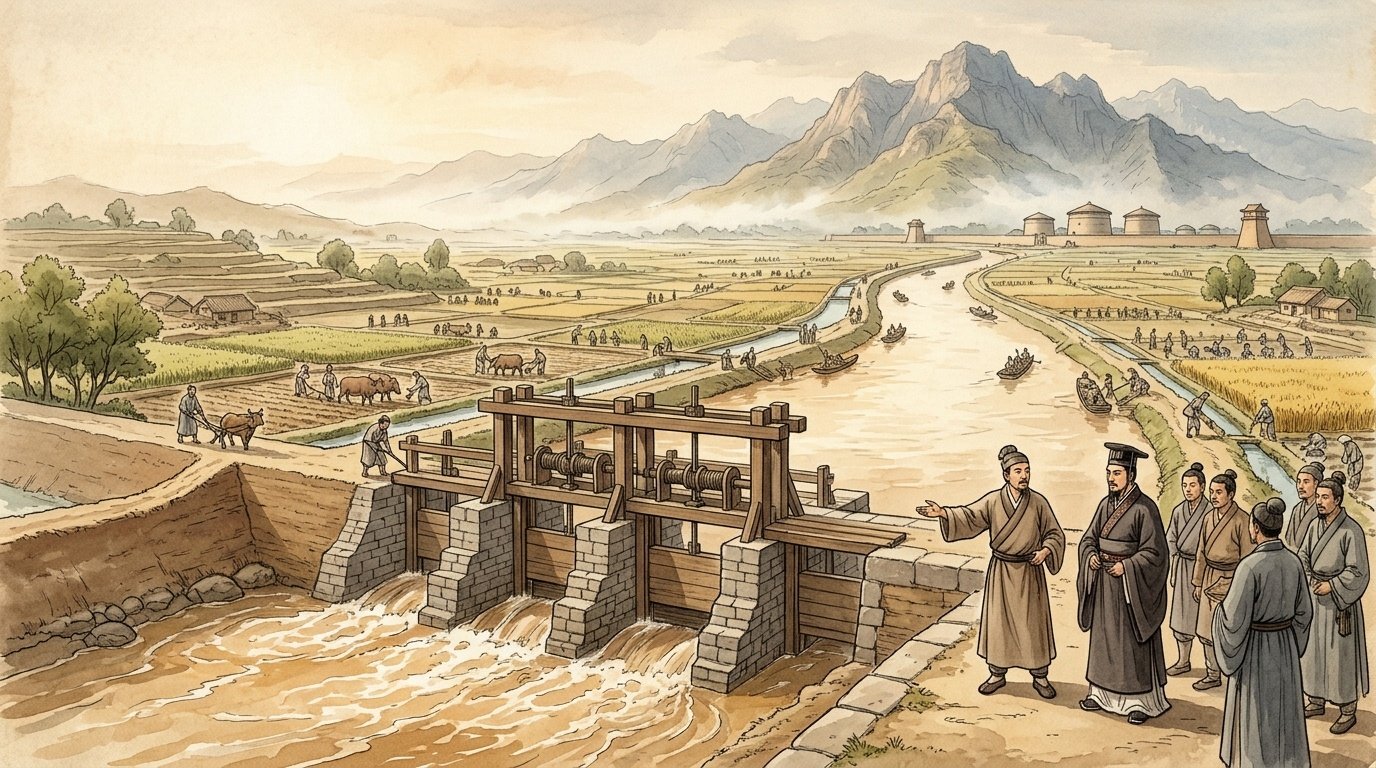
In 246 BCE, as the thirteen-year-old King Zheng (the future First Emperor, Qin Shi Huang) ascended the throne of Qin, the neighboring State of Han hatched what appeared to be the most ingenious covert espionage operation in ancient geopolitical history. Facing imminent military annihilation by Qin’s relentless eastern advances, the desperate Han court dispatched its premier water conservancy engineer, Zheng Guo (鄭國), to Xianyang. His mission was not to assassinate the young king or burn imperial armories, but to execute an economic diversion of colossal scale: to persuade the Qin government to pour its entire national treasury, peasant labor force, and military reserves into cutting a gargantuan, three-hundred-li irrigation canal across the barren northern reaches of the Guanzhong plain. The calculation of the Han monarch was simple: while Qin was occupied digging mud and blasting rock, its soldiers would not have the time, food, or energy to invade the east, granting Han a vital lease on life. What Han never foresaw was the sublime, backfiring irony of hydraulic engineering. When the canal was completed after a decade of backbreaking toil, it did not bankrupt Qin; instead, by flushing the alkaline soils of Shaanxi with nutrient-rich loess silt, it transformed forty thousand qing of wasteland into the most fertile agricultural breadbasket on the Asian continent. The espionage plot that was meant to exhaust Qin became the very logistical engine that fed the one million soldiers who conquered all of China.
1. The Geopolitics of Despair: The Agony of the State of Han (246 BCE)
To grasp why the State of Han resorted to hydraulic sabotage, one must appreciate its catastrophic strategic predicament in the middle of the third century BCE. Formed in 403 BCE out of the tripartite dissolution of the ancient superpower of Jin, Han (韓國) was the smallest, most mountainous, and geographically most vulnerable of the Seven Warring States. Situated directly adjacent to Qin’s eastern mountain battlements along the middle reaches of the Yellow River, Han sat like an anvil beneath Qin’s crushing hammer. Its territory occupied modern Henan and southern Shanxi—a vital, congested crossroads lacking natural defensive barriers, surrounded by predatory neighbors.
For more than a century following Shang Yang’s Legalist revolution, Qin had treated Han as its personal territorial training ground. Every few years, Qin armies poured out of the Hangu Pass to besiege Han cities, seize fertile valleys, and slaughter Han garrisons. Following the catastrophic defeat at Yique in 293 BCE—where General Bai Qi decapitated two hundred and forty thousand allied troops of Han and Wei—Han was stripped of its western commanderies. By the mid-third century BCE, Han had been reduced to a splintered, impoverished rump state comprising little more than its capital at Xinzheng and a handful of isolated county towns. Its royal court lived in a state of permanent terror, awaiting the final, inevitable offensive that would extinguish its ancestral altars.
When King Zhaoxiang of Qin died in 251 BCE, followed in rapid succession by his son King Xiaowen and grandson King Zhuangxiang, the Qin throne passed in 246 BCE to the thirteen-year-old King Zheng. The supreme administration of Qin fell into the hands of the wealthy merchant-turned-chancellor Lü Buwei (呂不韋), who served as the royal regent. To the court of King Xi of Han (韓王安/韓桓惠王), this moment of imperial royal transition represented their final, desperate window of strategic opportunity. If Qin’s attention could not be diverted through military alliance—since the Vertical Alliance had repeatedly collapsed—it had to be diverted through systemic internal exhaustion.
King Xi convened his inner council to devise an unconventional grand-strategic sabotage plan. Direct military confrontation was suicide; bribery was ineffective; and diplomatic pleading was laughed at in Xianyang. The king’s advisors proposed a subtle, asymmetrical strategy: Economic Sabotage Through Public Works (Pi Qin Zhi Ji, 疲秦之計)—”The Plot to Exhaust Qin.” If Qin could be tricked into undertaking an engineering project so astronomically expensive that it consumed its national harvest, absorbed all available peasant labor, and bankrupted its provincial treasuries, the state’s military conquests in the east would be brought to an absolute, prolonged standstill. For this high-stakes espionage assignment, Han chose its most celebrated technical genius: the master hydro-engineer Zheng Guo.
2. The Trojan Canal: Zheng Guo’s Mission to Xianyang
Zheng Guo arrived in the bustling Qin capital of Xianyang posing as an itinerant technical advisor seeking service under the open recruitment policies inherited from Shang Yang and Duke Xiao. He was a veteran master of water conservancy, possessing an intimate empirical understanding of fluid dynamics, slope grading, canal dredging, and dam construction. In the fourth and third centuries BCE, Chinese hydraulic engineering was the most advanced in the world, driven by the need to control the violent, silt-laden floods of the Yellow River and develop irrigation networks for intensive cast-iron agriculture.
Zheng Guo secured an audience with Chancellor Lü Buwei and the young King Zheng. He laid before the court an audacious, breathtaking proposal. He pointed to the vast northern expanse of the Guanzhong (關中) plain—the geographical heartland of Qin located north of the Wei River, stretching between the Jing River in the west and the Luo River in the east. Although this plain was the political center of the dynasty, its agricultural output was notoriously erratic. The soil was arid, highly alkaline, and prone to chronic spring droughts; when rains failed, the loess plateau hardened into cracked clay, reducing peasant harvests to starvation levels and forcing Qin to import grain over difficult mountain passes to feed its troops.
Zheng Guo proposed an engineering solution of unprecedented scale: Qin should excavate a colossal artificial irrigation canal over three hundred li (approximately 125 kilometers) in length. The canal would tap the high-volume, silt-laden waters of the Jing River (涇水) in the northwest, channel them eastward along the northern contours of the Guanzhong basin across numerous natural river valleys, and discharge them into the Luo River (洛水) in the east. Zheng Guo promised that this artificial artery would irrigate millions of acres of barren land, permanently eliminate famine in the capital region, and provide an unshakeable domestic grain foundation for the royal house.
“Han, hearing that Qin was fond of undertaking great works, desired to exhaust its energies so that it would not march east. Therefore, they dispatched the water engineer Zheng Guo to deceive Qin, urging them to cut a canal from the Jing River at Mount Zhong, leading it east into the Luo River, three hundred li in length, under the pretext of irrigating farmland.”
— Sima Qian, Shiji (Records of the Grand Historian), Chapter 29: “Treatise on the Rivers and Canals”
To Lü Buwei and the Qin court, the proposal appeared irresistibly attractive. Legalist grand strategy was rooted in the dual doctrine of Geng Zhan (Agriculture and War); any infrastructure that promised to multiply agricultural yields directly served the state’s long-term military power. Qin had already witnessed the miraculous success of the Dujiangyan irrigation system constructed by Li Bing in Sichuan a few decades earlier, which had transformed the Chengdu plain into the “Land of Abundance.” Convinced by Zheng Guo’s flawless technical blueprints and mathematical models, King Zheng approved the project, appointed Zheng Guo Chief Engineer of the realm, and ordered the mobilization of hundreds of thousands of peasant laborers, soldiers, and imperial treasuries to break ground on the great trench.
3. The Hydrological Landscape of the Guanzhong Basin
To appreciate the monumental technical difficulty of the Zhengguo Canal, one must understand the unique geomorphology and hydrology of the Guanzhong basin. Situated in central Shaanxi province, Guanzhong—literally “Within the Passes”—is an alluvial structural depression bounded by the soaring Qinling mountain range to the south, the Beishan (Northern Hills) to the north, the Yellow River to the east, and the Longshan plateau to the west. This natural basin had served as the cradle of Chinese civilization, nurturing the Western Zhou and Qin dynasties.
However, the northern sub-region of the basin, historically known as the Jing-Wei Tableland (Jing-Wei Yuan), presented severe agricultural limitations. While the southern plains near the Qinling mountains received abundant runoff from mountain streams, the northern terrace sat at a higher elevation, cut off from the Wei River by steep topography. The soils of this northern zone consisted of thick layers of Quaternary loess—windblown silt deposited over hundreds of thousands of years from the Gobi Desert. While loess is chemically rich in potassium, phosphorus, and calcium, it has an open, porous structure with high capillary action. Under the semi-arid climate of northern Shaanxi (where annual precipitation averages only 500 millimeters, concentrated in violent late-summer cloudbursts), intense surface evaporation drew subterranean mineral salts to the topsoil, creating vast crusts of saline and alkaline earth (yanku di, 鹽鹼地) that poisoned crops.
The hydrological key to unlocking this wasteland lay in the Jing River. Emerging from Mount Liupan in modern Ningxia, the Jing River carves a dramatic canyon through the heart of the Loess Plateau before descending into the Guanzhong plain. Because it flows through hyper-erodible loess deposits, the Jing River carries an astonishing concentration of suspended sediment. During the summer flood season, silt accounts for up to thirty to fifty percent of the river’s total volume by weight—a muddy slurry so dense that ancient Chinese proverbs described the Jing as “half water and half mud” (sifen shui, liufen ni).
To conventional engineers, this hyper-concentrated sediment was a nightmare: it choked canal beds, filled sluice gates with impenetrable mud, and caused frequent riverbank breaches. But to a master hydrologist like Zheng Guo, this suspended loess was liquid gold. The sediment carried by the Jing was rich in organic nutrients, decomposed vegetable matter, and soluble minerals eroded from the pristine northwestern plateaus. If this silt-laden water could be safely diverted and distributed across the alkaline plains, it would not merely water the crops; it would act as a massive, natural fertilizer, burying the sterile salt crusts beneath fresh, deep layers of virgin alluvium. The challenge was entirely one of hydraulic geometry: how to transport millions of tons of mud over 125 kilometers without the canal silting up and choking on its own flow.
4. The Engineering Masterpiece: Gradients, Siphons, and Earthworks
The construction of the Zhengguo Canal (鄭國渠), begun in 246 BCE, represents a watershed milestone in the history of global civil engineering. Measuring over three hundred li in length, it was by far the longest artificial navigation and irrigation canal constructed in antiquity, dwarfing the contemporary irrigation projects of Ptolemaic Egypt and Hellenistic Mesopotamia. Its alignment was an exercise in topographical genius, designed without the benefit of optical surveying instruments or modern mathematical calculus.
Zheng Guo chose the intake headworks of the canal at the dramatic natural chasm of Mount Zhong (modern Jingyang County, Shaanxi), where the Jing River surges out of its rocky mountain gorge onto the flat valley floor. At this precise geological threshold, the elevation of the riverbed sits at roughly 415 meters above sea level—the absolute highest hydraulic head available in the northern Guanzhong basin. By anchoring the headworks here, Zheng Guo ensured that the entire canal network could operate purely by natural gravity flow, eliminating any need for waterwheels or mechanical lift systems.
Across the river chasm, Qin laborers constructed a massive diversion dam of rammed earth, brushwood fascines, and woven bamboo gabions packed with river boulders (zhulong). This dam raised the water level of the Jing River, diverting a controlled volume of high-velocity current into a newly excavated intake channel cut directly through the limestone spurs of Mount Zhong. Modern archaeological excavations conducted along the ancient canal bed have revealed the remains of sophisticated stone-lined sluice gates and sediment-settling basins (chensha chi) designed to purge the heaviest gravel before the water entered the main trunk.
From the intake, the main trunk canal traced a delicate, serpentine path eastward along the very northern edge of the plain, hugging the southern foothills of the Beishan mountains. This contour alignment was chosen with breathtaking precision: by maintaining the canal at the highest possible topographical contour line (descending at an extremely gentle gradient of roughly 1:1,000 to 1:2,000), Zheng Guo maximized the total land area that lay below the canal, allowing water to flow southward across the entire plain via thousands of branch ditches (fenqu) and lateral channels. Furthermore, this gentle gradient kept the water moving at the precise velocity required by hydraulic physics: fast enough to keep the fine loess silt suspended in the current without settling and clogging the channel, but slow enough to prevent scouring and erosion of the unlined earthen canal banks.
The most formidable engineering obstacle lay in the perpendicular drainage networks of the plain. Between the Jing River in the west and the Luo River in the east, numerous seasonal mountain rivers—including the Ye, Qing, and Shichuan rivers—cut southward from the Beishan mountains into the Wei River. The Zhengguo Canal had to traverse these river valleys without being washed away by sudden flash floods. Zheng Guo solved this with revolutionary civil engineering solutions: in some valleys, he constructed massive inverted siphons and culverts; in others, he designed Cross-River Weirs (Henglian Ba), allowing the canal to merge directly with the mountain streams during low water while utilizing overflow spillways to discharge catastrophic flood surges safely into the Wei River.
5. The Espionage Unmasked: The Order of Expulsion and Li Si’s Letter
As the massive excavation entered its middle stages around 237 BCE, disaster struck. The project had consumed vast sums of state bullion; hundreds of thousands of Qin conscripts had spent years hauling wicker baskets of earth in the blistering summer heat and freezing winter winds; and Qin military expeditions in the east had visibly stalled. In Xianyang, imperial intelligence officers intercepted secret diplomatic couriers passing between Xinzheng and the canal headquarters. The horrifying truth broke across the court: Zheng Guo was not a loyal immigrant servant of the Qin state; he was a registered agent of King Xi of Han, sent on a deliberate sabotage mission to exhaust Qin’s military capacity.
The revelation triggered an explosive political crisis in the imperial capital. The native Qin aristocracy—the old conservative nobility who had spent decades harboring bitter resentment against foreign ministers since the days of Shang Yang—seized upon the scandal to launch a ferocious xenophobic purge. Led by royal clan elders, the nobles marched into the palace of the twenty-one-year-old King Zheng, demanding the immediate execution of Zheng Guo and the wholesale expulsion of all foreign scholars, advisors, generals, and merchants residing in Qin.
The nobles argued that every foreigner serving in Qin was a fifth columnist whose secret loyalties lay with their ancestral kingdoms in the east. Under intense pressure from his family elders, King Zheng succumbed to panic and promulgated the infamous Order of Expulsion of Foreign Guests (Jiankeling, 逐客令) in 237 BCE. All non-Qin natives were stripped of their offices, given a deadline to pack their belongings, and marched under armed guard toward the eastern mountain passes. Among those rounded up for expulsion was a brilliant young scholar from Chu who served in the judicial administration: Li Si (李斯), the future Grand Chancellor of the unified Chinese empire.
While being escorted in chains toward the border, Li Si composed one of the most celebrated, consequential political essays in world literature: the Memorial on the Expulsion of Foreign Guests (Jiankeling Shu, 諫逐客書). Preserved in Chapter 87 of the Shiji, Li Si’s letter was a rhetorical masterpiece of historical analysis and economic realpolitik. He reminded King Zheng that every single great achievement in Qin history had been engineered by foreign immigrants: Duke Mu had achieved hegemony by hiring Yu Yu from the Rong barbarians and Baili Xi from the southern state of Wan; Duke Xiao had created the modern state using Shang Yang of Wey; King Huiwen had broken the eastern alliances using Zhang Yi of Wei; and King Zhaoxiang had elevated the realm using Fan Ju of Wei.
“Mount Tai does not reject soil, and therefore it can achieve its great height; the rivers and seas do not turn away small rivulets, and therefore they can attain their deep abundance; the true King does not turn away the multitudes, and therefore he can display his brilliant virtue… Now Your Majesty rejects the guest-scholars to serve rival states, and expels the wanderers to benefit his enemies. This is what is called ‘lending weapons to bandits and sending grain to robbers’!”
— Li Si, Shiji (Records of the Grand Historian), Chapter 87: “Biography of Li Si”
Li Si pointed out the absurd cultural contradiction at the heart of the decree: King Zheng loved to surround himself with foreign treasures—wearing pearls from the South China Sea, admiring jade discs from Mount Kunlun, decorating his women in silk from Qi, and listening to the exotic zithers of Zhao—yet when it came to human talent, he expelled the finest minds in the world simply because their ancestral tombs lay across the river. King Zheng read the memorial and was struck by a profound revelation of strategic clarity. He immediately revoked the Order of Expulsion, sent couriers on fast horses to overtake Li Si at the border and restore him to high office, and ordered Zheng Guo brought from the dungeons to face imperial interrogation.
6. The Audacious Defense: “A Few Years for Han, Eternity for Qin”
Bound in iron chains before King Zheng and the furious Qin ministers, Zheng Guo confronted his impending execution with astonishing, serene composure. He did not attempt to deny the charges of espionage, nor did he plead for royal mercy. Instead, he delivered one of the most audacious, intellectually compelling defenses recorded in the annals of ancient statecraft.
“It is true that at the beginning, I came as a deceiver. The King of Han sent me hoping to exhaust your realm’s strength so that you would not march upon his borders. But consider the matter with an open mind: while this canal has indeed bought Han a brief reprieve of a few fleeting years, its completion will bestow eternal, inexhaustible wealth upon the State of Qin! When the waters flow, Han will still perish, but Qin will possess the master-key to rule the world.”
— Zheng Guo’s Defense, Shiji (Records of the Grand Historian), Chapter 29
The sheer logical brilliance of Zheng Guo’s argument disarmed the court. He laid out the hard, physical reality of the project: millions of cubic meters of earth had already been moved; the dams were nearly finished; the intake tunnels had pierced the rock of Mount Zhong; and the main channel was already within reach of the Luo River. To execute him and abandon the half-dug trench would mean that Han had genuinely succeeded in wasting Qin’s treasure for nothing. But to spare his life and finish the canal would mean that Qin would reap the ultimate fruit of Han’s strategic sacrifice: an irreversible, continental-scale agricultural engine that Han could never hope to rival.
King Zheng demonstrated the terrifying pragmatic greatness that defined his character. Putting aside all personal ego, imperial pride, and emotional vengeance, he recognized that Zheng Guo’s technical genius was far more valuable to Qin than his severed head. King Zheng ordered the engineer’s chains struck off, confirmed his rank as Chief Water Conservancy Minister, and commanded him to return to the construction front with increased labor forces and royal funding to complete the works. In an act of extraordinary imperial magnanimity—and psychological mastery—King Zheng decreed that when the water finally flowed into the Luo River, the canal would not bear an imperial dynastic title, but would be officially christened the Zhengguo Canal (鄭國渠), immortalizing the foreign spy whose deception had enriched the empire.
7. Silt-Washing the Loess: The Agricultural Miracle
In approximately 236 BCE, after a full decade of unremitting collective labor, the sluice gates at Mount Zhong were raised. The dense, ochre waters of the Jing River surged through the limestone breach, roaring down the newly excavated main trunk canal. Flowing eastward over 125 kilometers, the waters were distributed through an intricate, capillary-like hierarchy of primary, secondary, and tertiary ditches across the entire northern expanse of the Guanzhong basin, finally emptying their clear tail-waters into the Luo River.
The ecological and agricultural transformation that followed was nothing short of miraculous. The process engineered by Zheng Guo is known in modern hydraulic agronomy as Warping or Silt-Fertilization Irrigation (Yuni Gaijian, 淤泥改鹼). When the hyper-concentrated sediment of the Jing River flooded across the sterile, saline fields, two physical processes occurred simultaneously. First, the heavy volume of fresh water dissolved the poisonous alkaline mineral salts that had encrusted the topsoil and flushed them deep into the subterranean water table or carried them away through drainage gullies into the Wei River. Second, as the muddy waters settled quietly over the fields, the suspended loess particles precipitated out, laying down a fresh, velvety mantle of nutrient-rich topsoil several centimeters thick every single irrigation season.
Sima Qian records the staggering economic magnitude of this breakthrough with breathless precision:
“When the canal was completed, it was used to wash the saline earth, flooding it with silt-laden waters. More than forty thousand qing of land was brought under cultivation, and the harvest yielded one zhong of grain per mu. Thereupon, the region of Guanzhong was transformed into fertile, abundant loam, and there were no longer any lean or barren years. Thus did Qin become immensely rich and powerful, possessing the resources to conquer and swallow all the feudal lords.”
— Sima Qian, Shiji (Records of the Grand Historian), Chapter 29: “Treatise on the Rivers and Canals”
To grasp the scale of this achievement, one must calculate the ancient units of measurement. In the Warring States period, forty thousand qing (頃) was equivalent to approximately 2.8 million modern Chinese mu, or roughly 190,000 hectares (nearly 700 square miles) of contiguous, highly irrigated prime arable land. A yield of “one zhong per mu” (equivalent to roughly six to ten bushels per unit area) represented an astronomical productivity explosion—an increase of three to five times over the dry-farming yields of the eastern plains. Almost overnight, northern Shaanxi was transformed from a drought-plagued border zone into the richest agrarian territory in the ancient world.
The common people of Qin celebrated the canal in songs that were transmitted across generations and preserved in local gazetteers:
“The waters of the Jing arrive like a flood, carrying both mud and silt;
— Folk Song of the Guanzhong Basin, Western Han Dynasty
In the morning they wash our barren earth, by evening they fatten our crops!
They feed our sons, they clothe our women, they fill our granaries to the rafters;
At the mouth of the canal we harvest millet; at its tail we plant rice!”
The Zhengguo Canal broke the ancient ecological ceiling of the northern Chinese landscape. By eliminating drought and providing a self-fertilizing soil cycle that required no resting of fallow fields, it turned Guanzhong into a permanent thermodynamic battery of food and human energy, insulated from the fluctuating climatic disasters that regularly brought famine to the eastern states.
8. The Logistical Engine of Unification (230–221 BCE)
The true historical beneficiary of Zheng Guo’s engineering was not the State of Han, but the Qin war machine. In ancient warfare, the ultimate operational bottleneck was never the courage of soldiers or the sharpness of bronze blades, but Logistics. An army of one hundred thousand men consumed thousands of tons of grain every single month. In his classic analysis of ancient transport economics in the Shiji and the Hanshu, the historian Ban Gu calculated that overland transport by pack oxen, horse-drawn carts, or human porters consumed up to eighty percent of the grain payload simply to feed the transport teams over a distance of a few hundred miles. When grain was hauled overland across rough loess plateaus and rugged mountain defiles, one bushel delivered to the frontline fortress required eighteen to twenty bushels consumed along the road. Under such brutal thermodynamic constraints, a pre-modern state could not sustain long-distance foreign offensives unless it possessed a massive, centralized surplus within immediate water-borne transport reach of the operational front.
The completion of the Zhengguo Canal in 236 BCE coincided precisely with the beginning of King Zheng’s final, lightning decade of universal conquest. Prior to 236 BCE, Qin’s military campaigns were limited, seasonal border raids that had to pause during the agricultural planting and harvest cycles; after 236 BCE, Qin launched continuous, year-round, multi-theater offensives mobilizing upwards of six hundred thousand men simultaneously on multiple fronts. The overflowing granaries of the newly irrigated Guanzhong plain provided the mountains of millet, dried meat, salted beans, and fermented wine required to keep these colossal armies fed in the field for years on end. Granary complexes excavated by modern archaeologists at Xianyang and along the Wei River banks have revealed massive subterranean grain silos lined with moisture-proof baked tiles and charred grain husks capable of storing tens of thousands of metric tons of grain for decades without rot.
This grain surplus proved decisive in the most perilous engagement of the unification wars: the monumental campaign against the southern giant of Chu in 224–223 BCE. When the young general Li Xin boasted that he could conquer Chu with two hundred thousand men, his army was ambushed and annihilated by the Chu commander Xiang Yan. Rather than panicking, King Zheng traveled in person to the country villa of the retired veteran general Wang Jian (王翦), begging him to take supreme command. Wang Jian stated his non-negotiable operational demand: he would not march south without six hundred thousand men—the absolute entirety of the male military levies of the Qin state.
To sustain six hundred thousand combat soldiers, alongside hundreds of thousands of auxiliary logistical porters, horse teams, and river barge crews in the marshy interior of Chu for over an entire year was an administrative and agricultural feat without parallel in the ancient world. For months, Wang Jian refused to fight, digging fortified encampments, feeding his men on abundant rations of Guanzhong grain, and allowing them to play throwing games and bathe in the streams until the exhausted Chu army, unable to maintain its own supply lines in the field, began a demoralized retreat. Wang Jian then unleashed his rested, well-fed shock legions, annihilating the Chu host, killing Xiang Yan, and permanently extinguishing the eight-hundred-year-old kingdom. Without the endless rivers of grain pouring out of the fields watered by the Zhengguo Canal, Wang Jian’s six-hundred-thousand-man expedition would have collapsed into mass starvation within ninety days.
The ultimate strategic irony of the entire episode fell with merciless precision upon the very kingdom that had conceived the plot. In 230 BCE, only six years after the waters of the Zhengguo Canal reached the Luo River, King Zheng launched his first campaign of total annexation. The target of this initial strike was none other than the State of Han. Fed by the grain harvested from the fields irrigated by Zheng Guo, Qin’s elite armored legions swept across the Yellow River under General Teng. Han’s depleted garrisons were crushed in a few weeks; King Xi was taken captive; and the ancestral altars of Han were permanently extinguished, its territory reorganized into the Qin commandery of Yingchuan.
The “Plot to Exhaust Qin” had succeeded only in exhausting its authors. Han had bought itself nine fleeting years of nervous existence at the cost of providing its conqueror with the permanent agrarian wealth required to destroy all six eastern states. In 228 BCE, Zhao fell; in 225 BCE, Wei was drowned by the diversion of the Yellow River; in 223 BCE, Chu was broken; in 222 BCE, Yan fell; and in 221 BCE, the King of Qi surrendered without a fight. King Zheng declared himself Qin Shi Huang—the First Emperor of China. The imperial unification that would define Chinese political reality for the next two millennia was financed directly by the muddy silt of the Zhengguo Canal.
9. The Imperial Hydraulic Triad: Dujiangyan, Zhengguo, and Lingqu
The Zhengguo Canal was not an isolated technological anomaly; it was the central component of a grand hydraulic trinity constructed by the State of Qin during the third century BCE that permanently altered the environmental landscape of East Asia. Together with the Dujiangyan irrigation system in Sichuan and the Lingqu Canal in Guangxi, the Zhengguo Canal formed the infrastructural foundation of the First Empire.
The comparison between these three masterpieces illustrates the versatility and sophistication of Warring States hydraulic engineering:
| Project Name | Date (BCE) | Lead Engineer | Geographical Basin | Primary Function | Strategic Impact |
|---|---|---|---|---|---|
| Dujiangyan (都江堰) | c. 256 BCE | Li Bing (李冰) | Min River, Sichuan Basin | Flood control, irrigation | Transformed Sichuan into the “Land of Abundance”; funded Southern campaigns against Chu. |
| Zhengguo Canal (鄭國渠) | c. 246–236 BCE | Zheng Guo (鄭國) | Jing & Luo Rivers, Guanzhong Basin | Silt-washing, warp irrigation | Irrigated 40,000 qing; eliminated famine in Shaanxi; fed armies for the unification of 230–221 BCE. |
| Lingqu Canal (靈渠) | c. 214 BCE | Shi Lu (史祿) | Xiang & Li Rivers, Guangxi | Contour navigation, contour summit | Connected Yangtze and Pearl River systems; enabled the conquest and colonization of Lingnan (Guangdong/Guangxi). |
While Dujiangyan is universally celebrated for its harmonious, ecological integration with nature—using the natural curvature of the Min River, the Fish Mouth pier, and the Baopingkou channel to divide floodwaters without a dam—the Zhengguo Canal was a monumental exercise in brute environmental engineering. It was an artificial canal cut through solid rock and clay, deliberately manipulating suspended sediment dynamics to rewrite the chemical composition of an entire plateau. Similarly, the Lingqu Canal, built twenty years later by Qin Shi Huang’s engineer Shi Lu, conquered the formidable Nanling mountain divide, linking the northward-flowing Xiang River with the southward-flowing Li River through thirty-six lock gates, allowing Qin grain barges to travel uninterrupted from the heart of the Central Plains to the South China Sea. No other civilization in antiquity possessed the organizational capacity, mathematical surveying, and logistical stamina to alter the hydrological map of a continent on this scale.
10. The Archaeological Reality: Tracing the Canal in Modern Shaanxi
For centuries, the physical reality of the ancient Zhengguo Canal was partially obscured by successive dynastic rebuilding programs. Because the intake of the Jing River slowly eroded deeper into its limestone bedrock over the centuries (a classic geological process known as riverbed degradation and incision), the water level of the river steadily dropped below the original intake channel designed by Zheng Guo. Successive dynasties were forced to abandon the older headworks and construct new intake portals further upstream through solid rock: the Western Han dynasty constructed the famous Bai Canal (Baiqu, 白渠) in 95 BCE under Emperor Wu, engineered by the official Bai Gong; the Tang dynasty built the Sanhe Canal; the Song constructed the Fengli Canal; the Yuan built the Wangyu Canal; and the Ming and Qing dynasties established the Longdong Canal. Each successive engineering generation paid direct homage to Zheng Guo’s original alignment, creating a multi-layered palimpsest of hydraulic archaeology spanning twenty-two centuries.
In the twentieth and twenty-first centuries, modern archaeological excavations, geomorphological surveys, and satellite remote sensing conducted by the Shaanxi Provincial Institute of Archaeology systematically uncovered the original Qin works. In Jingyang County, archaeologists identified the monumental remnants of Zheng Guo’s original diversion dam: a colossal rammed-earth (hangtu) structure measuring over two thousand meters in length, seventy meters wide at its base, and nearly ten meters in surviving height. The construction technique used alternating compacted layers of loess clay, crushed limestone gravel, and river reeds, creating a flexible, earthquake-resistant core capable of withstanding the immense seasonal hydraulic pressures of the swollen Jing River. Radiocarbon dating and stratigraphical analysis of the earthworks confirmed that the earliest strata date precisely to the late Warring States period, containing diagnostic Qin cord-marked roof tiles, ceramic water pipes, and heavy iron spade tips (tiechan).
Along the canal’s alignment, archaeologists uncovered traces of the original ancient intake sluices cut into the rock of Mount Zhong, ancient settling basins, stone retaining walls, and the remains of Han and Tang masonry aqueducts. Excavations at the Wangqiao site revealed massive limestone blocks joined with iron swallow-tail cramps (tie yanwei sun) to prevent water leakage—an astonishing level of metallurgical and masonry sophistication. Remarkably, large segments of the modern Jinghui Canal (Jinghui Qu, 涇惠渠)—designed and built in the early 1930s by China’s legendary modern water conservancy pioneer Li Yizhi (李儀祉), with financial assistance from international famine relief organizations—follow the exact topographical contours surveyed by Zheng Guo twenty-two centuries earlier.
When Li Yizhi and his modern civil engineers surveyed the Guanzhong terrain using modern optical theodolites, high-precision leveling instruments, and topographical contour mapping, they were astonished to discover that Zheng Guo’s original gradient deviated by less than a few centimeters per kilometer from the absolute theoretical hydrodynamic optimum. Zheng Guo had solved the hydrodynamic problem of transporting hyper-concentrated silt without modern calculus, relying purely on empirical fluid observation, wooden leveling rods, and water-filled sighting troughs. In 2016, the ancient Zhengguo Canal irrigation system was officially inscribed on the UNESCO International Commission on Irrigation and Drainage (ICID) Register of Heritage Irrigation Structures, honoring its status as an enduring monument of world civil engineering and environmental adaptation.
11. The Historiographical Legacy: Hydraulic States and Grand Strategy
The story of the Zhengguo Canal has fascinated historians, political scientists, and philosophers for over two millennia. In the mid-twentieth century, the canal featured prominently in the fierce academic debate surrounding Karl Wittfogel’s controversial thesis of “Oriental Despotism” and the “Hydraulic Civilization.” Wittfogel argued that the unique necessity of managing colossal water-control networks across the vast river valleys of Asia—where flood prevention and canal irrigation demanded the centralized coordination of millions of laborers—naturally generated total autocracy, bureaucratic slavery, and the complete suppression of individual civil liberties.
While modern Sinologists, such as Joseph Needham, Mark Elvin, and Francesca Bray, have thoroughly dismantled Wittfogel’s simplistic reductionism—demonstrating that Chinese water control was frequently decentralized, communal, and managed by local gentry lineages—the Zhengguo Canal represents the quintessential historical example where water control and absolute state capacity were intimately fused. The canal could not have been conceived or completed by a decentralized feudal society; it required the cold, mathematical discipline of Shang Yang’s Legalist state, which could command the labor of hundreds of thousands of men, allocate millions of bushels of grain, and ruthlessly override local aristocratic property boundaries in pursuit of a unified technological vision.
Beyond political theory, the Zhengguo Canal endures as the ultimate historical parable of Unintended Strategic Consequences. King Xi of Han attempted to fight the future with a temporary tactical diversion; he focused entirely on delaying an immediate military crisis, blind to the structural reality that the very instrument he used to stall his enemy would permanently enrich his conqueror. In the ruthless theater of grand strategy, tactical cleverness without structural depth is merely a delayed death sentence. Zheng Guo entered Xianyang as an undercover saboteur; he departed as the civilizational engineer whose mud and water laid the foundations of the Chinese empire.
12. Classical Chapters, Epigraphical Excavations, and Scholarly Bibliography
Primary Classical Texts:
Sima Qian (司馬遷). (c. 94 BCE). Shiji (史記, Records of the Grand Historian). Chapter 6: “Qin Shi Huang Benji” (Basic Annals of the First Emperor of Qin); Chapter 29: “Hequ Shu” (Treatise on the Rivers and Canals); Chapter 87: “Li Si Liezhuan” (Biography of Li Si). Translated by Burton Watson (1961), Records of the Grand Historian, New York: Columbia University Press.
Ban Gu (班固). (c. 111 CE). Hanshu (漢書, Book of Han). Chapter 29: “Gouxu Zhi” (Treatise on Ditches and Canals). Critical edition by Zhonghua Book Company, Beijing, 1962.
Lüshi Chunqiu (呂氏春秋, Master Lü’s Spring and Autumn Annals). Compiled under the patronage of Chancellor Lü Buwei (c. 239 BCE). Translated by John Knoblock and Jeffrey Riegel (2000), The Annals of Lü Buwei, Stanford: Stanford University Press.
Archaeological and Heritage Reports:
Shaanxi Provincial Institute of Archaeology. (2012). “Archaeological Survey and Excavation of the Zhengguo Canal Headworks in Jingyang County,” Acta Archaeologica Sinica (Kaogu Xuebao), No. 3, pp. 341–378.
International Commission on Irrigation and Drainage (ICID). (2016). “Zhengguo Canal Irrigation System: Nomination Dossier for Heritage Irrigation Structures,” New Delhi: ICID Publications. UNESCO/ICID Heritage Register
Modern Scholarly Studies:
Bray, Francesca. (1984). Science and Civilisation in China, Volume 6: Biology and Biological Technology, Part 2: Agriculture. Cambridge: Cambridge University Press.
Elvin, Mark. (2004). The Retreat of the Elephants: An Environmental History of China. New Haven: Yale University Press. doi:10.12987/yale/9780300101119.001.0001
Needham, Joseph, Wang, Ling, & Lu, Gwei-djen. (1971). Science and Civilisation in China, Volume 4: Physics and Physical Technology, Part 3: Civil Engineering and Nautics. Cambridge: Cambridge University Press. Detailed hydrodynamic analysis of the Zhengguo Canal gradients and silt dynamics, pp. 285–296.
Pines, Yuri. (2009). Envisioning Eternal Empire: Chinese Political Thought of the Warring States Era. Honolulu: University of Hawaiʻi Press.
Wittfogel, Karl A. (1957). Oriental Despotism: A Comparative Study of Total Power. New Haven: Yale University Press.
Yang, Kuan. (2003). Zhanguo Shi (戰國史, History of the Warring States). Shanghai: Shanghai People’s Publishing House, pp. 210–225.