The Battle of Muye and the Mandate of Heaven
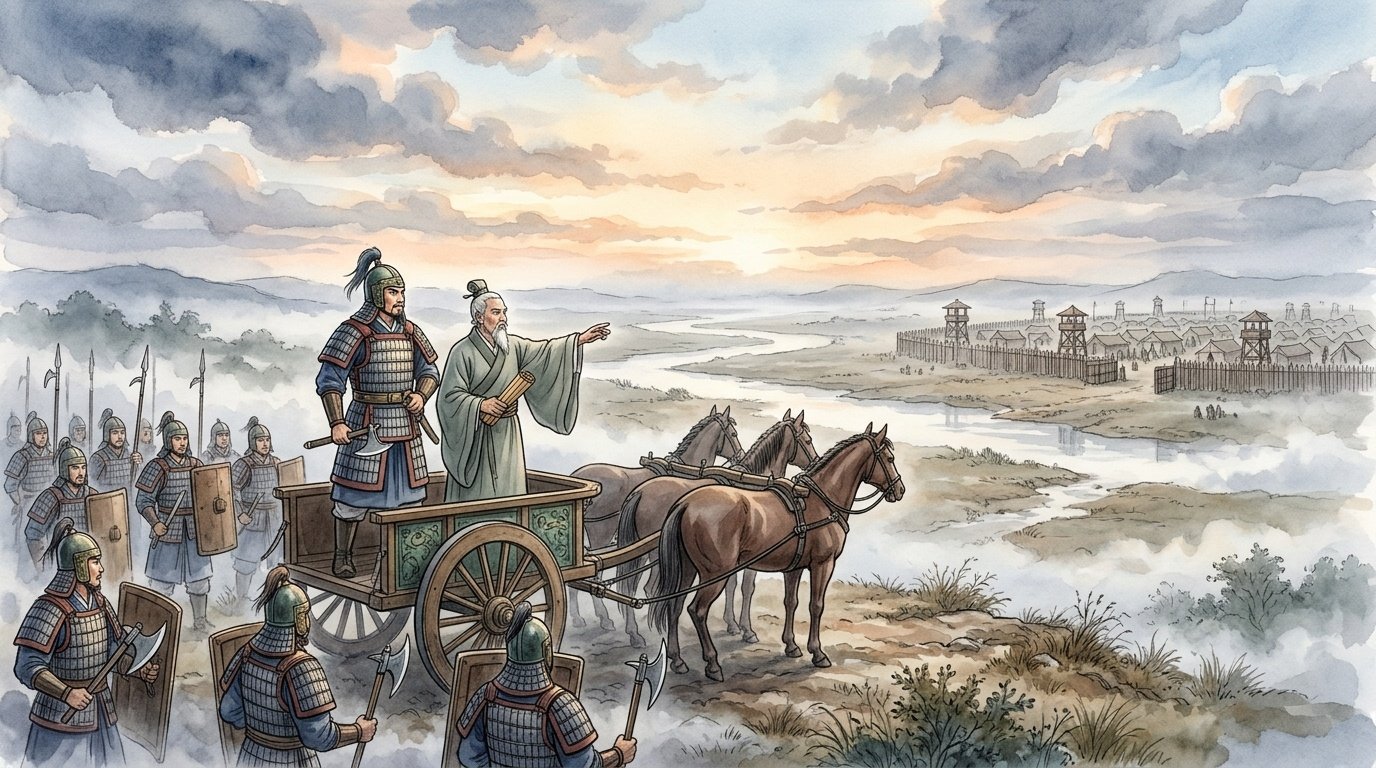
At dawn on the day of Jiazi in roughly 1046 BCE, on the sodden loess plain of Muye just south of the Shang capital of Chaoge, two civilizations collided. One was the Shang: an archaic, ritualized theocracy centered on bronze metallurgic monopoly, ecstatic ancestor divination, and industrial-scale human slaughter to appease a fickle high deity known as Shangdi. The other was the Zhou: a peripheral coalition of western farming clans, hardened by frontier warfare against steppe pastoralists and bound together by a radical moral ideology articulated by the Duke of Zhou. When the clash ended before midday, the last Shang king, Di Xin, retreated into his palace tower, adorned himself in sacred jade armor, and set himself on fire. From the ashes of that pyre rose the foundational doctrine of East Asian political civilization: the Mandate of Heaven (Tianming), which decreed that dynastic sovereignty was neither inherited nor divine by birthright, but a revocable moral trust bestowed solely upon those who govern with cosmic virtue (De).
1. The loess at dawn, the strategic Geography of Muye
The geographical locus of the Battle of Muye (牧野之戰) occupies a critical environmental intersection in modern northern Henan province, situated north of the Yellow River near the modern city of Xinxiang. In the eleventh century BCE, this region was not merely a flat floodplain; it was the sacred territorial core of the late Shang realm, known in oracle bone inscriptions as the Central Settlement of Shang (Zhongshang). To the west, the formidable Taihang Mountains rose as an abrupt geological barrier, funneling all movement through narrow defiles such as the Mengjin crossing on the Yellow River. To the east and south lay the fertile alluvial plains irrigated by the Ji and Yellow river systems, crisscrossed by wetlands, primeval oak and bamboo forests, and dense agricultural estates worked by captive labor forces known as zhongren.
For decades, the late Shang dynasty had regarded its heartland as geographically impregnable. Protected by the Yellow River to the south and flanked by compliant tributary polities, the royal capital at Chaoge (朝歌) represented the absolute apex of Bronze Age urbanism. Its massive rammed-earth (hangtu) foundations, subterranean storehouses, and vast sacrificial precincts projected an aura of unassailable cosmic permanence. The western territories, where the Zhou people had established their capital along the Wei River valley at Feng and Hao (modern Xi’an), were viewed by the Shang court as remote, culturally unrefined marcher-lands. The Zhou were tolerated merely as western guardians (Xibo, Western Counts), tasked with buffering the Shang ecumene against hostile non-Sinitic populations such as the Guifang and Xianyun.
However, the geography that protected Chaoge also constituted its strategic vulnerability. The city was reliant upon long-distance logistics corridors to import copper, tin, cowrie shells, and captive labor from the Huai River valley and the southern Yangtze. When King Wu of Zhou (周武王) launched his campaign in early 1046 BCE, he exploited a catastrophic geopolitical miscalculation by the Shang sovereign. Di Xin (帝辛), posthumously branded King Zhou of Shang, had deployed the overwhelming bulk of his elite royal standing armies—the Eastern Expeditionary Corps—far to the southeast to suppress a prolonged rebellion among the Dongyi (Eastern Barbarian) tribes. The central metropolitan territory was virtually stripped of professional soldiers, defended only by palace guards, royal retainers, and hundreds of thousands of unfree laborers, captives of war, and urban slaves.
Recognizing this singular operational window, King Wu marched with blinding velocity. Leaving their base in the Wei River valley, the Zhou vanguard traversed the Mengjin crossing during the winter melt, coalescing at Muye in the early hours of the morning. Topographically, Muye offered an ideal field for the rapid, shock deployment of heavy two-wheeled war chariots. The open loess soil, frozen solid by winter frost and cleared of dense woodland, allowed the Zhou to array their strike force across a broad, continuous front. When dawn broke over the misty plain, the Shang court looked out from Chaoge to discover not a disorderly raid by western barbarians, but an immaculately organized, highly synchronized multi-tribal army drawn up in battle lines that stretched across the southern horizon.
2. The late Shang theocracy, sacrificial monopoly and ancestral terror
To comprehend the philosophical shockwave generated by the Battle of Muye, one must reconstruct the cosmological architecture of the Late Shang theocracy. The Shang did not govern through administrative law or moral suasion in the later Confucian sense; they governed through an absolute, terrifying monopoly on access to the supernatural realm. At the epicenter of this system stood the Shang royal house, the Zi clan (子姓), whose authority rested on the claim that their deceased royal ancestors resided in the direct presence of Di (帝) or Shangdi (上帝), the supreme celestial power that governed rain, wind, military victory, harvest yields, and imperial fortune.
Access to these celestial ancestors required continuous, blood-drenched negotiation. The physical instruments of this state theocracy were the pyromantic oracle bones—the plastrons of turtles and scapulae of cattle—which were drilled, heated until they cracked, and interpreted exclusively by the king himself. Through these divination rituals, the Shang king was not merely a ruler; he was the supreme shaman, high priest, and solitary ontological conduit between the cosmos and human society. As David Keightley and Kwang-chih Chang demonstrated in their foundational archaeological studies of Anyang (Yinxu), Shang political power was completely coterminous with religious violence and bronze metallurgy.
The dark core of Shang religious practice was human sacrifice (rensheng, 人牲). In the royal cemetery at Xibeigang near Anyang, excavations have revealed thousands of decapitated, bound, and mutilated skeletons interred alongside royal dead. These were not merely ritual burials of personal servants to accompany an emperor into the afterlife (renxun); they were systematic, institutionalized slaughterings dedicated as food, appeasement, and currency to the ancestral spirits. The victims were overwhelmingly captives of war, particularly the Qiang (羌)—a pastoralist population inhabiting the northwestern plateau, whom the Shang hunted with chariots in dedicated seasonal slave-raids.
Oracle bone inscriptions record instances where hundreds of Qiang captives were sacrificed in a single ceremony, subjected to gruesome methods of execution including burning, dismemberment, boiling in massive bronze cauldrons, and beheading. In the Shang worldview, morality was entirely irrelevant to divine favor. Shangdi did not demand justice, compassion, or restraint from the king; Shangdi demanded correct ritual procedure, lavish bronze vessels, intoxicating millet wine, and continuous blood sacrifice. So long as the royal clan offered the prescribed oblations, the ancestors were bound by reciprocal obligation to protect the Shang realm. This theological arrogance generated an extreme moral vacuum: because the Shang kings believed their ancestral connection was genealogically fixed and unbreakable, they operated beyond any earthly ethical restraint.
3. The Demonization of Di Xin, History, Polemic, and archaeological reality
In traditional Chinese historiography, King Di Xin stands as the archetype of dynastic depravity—the monstrous “tyrant Zhou” whose excessive wickedness justified his destruction. The classical canon, from the Classic of History (Shangshu) to Sima Qian’s Records of the Grand Historian (Shiji), paints a vivid, terrifying portrait of Di Xin’s court. He is accused of constructing a “lake of wine” (jiuchi) and a “forest of meat” (roulin) where nude courtiers engaged in debauched revels; he is said to have invented the gruesome punishment of the roasting pillar (paoluo), forcing critics to walk across a greased, burning copper beam over glowing coals until they slipped into the fire.
Historical memory also records his gruesome execution of royal critics. When his uncle Bigan (比干) protested his tyranny, Di Xin allegedly ordered Bigan’s chest ripped open so that he could inspect “whether a sage’s heart possesses seven apertures.” His chief consort, Daji (妲己), was demonized across three millennia as a femme fatale whose sadistic pleasures drove the king to ever greater atrocities, ordering the bones of peasants walking in winter rivers hacked open to inspect why their marrow resisted the cold.
“Now Shou, the king of Shang, follows only the words of his wife. He abandons his ancestors’ sacrifices and neglects to thank them. He leaves his own brothers and uncles unemployed, while elevating cruel outlaws and villains to high office, permitting them to tyrannize the people.”
— King Wu’s Speech at Muye, Shangshu (Classic of History), “The Great Declaration”
Modern archaeological scholarship, beginning with the critical historiography of Gu Jiegang and the “Doubting Antiquity” (Gushibian) school, provides a far more nuanced, structural explanation for Di Xin’s downfall. The accusations leveled against Di Xin expanded exponentially with each passing century: Confucius’s disciple Zigong famously remarked that “Di Xin’s wickedness was not so extreme; because he fell, all the evils of the world flowed toward him like a sewer.” Epigraphical evidence from oracle bones and late Shang bronzes reveals that Di Xin was an energetic, physically powerful, and administratively assertive monarch who sought to centralize royal power at the direct expense of the hereditary aristocratic lineages and high-priesthood.
Di Xin curtailed the independent authority of senior royal uncles, promoted talented commoners and outsiders to bureaucratic posts, and attempted to rationalize the sacrificial calendar, reducing the irrational, exorbitant slaughter demanded by the priestly divination guilds. In doing so, he alienated the most powerful aristocratic factions of the Shang nobility, including Prince Weizi, Prince Jizi, and the hereditary keepers of the ancestral tablets. When the Zhou invaded, these elite factions did not rally to the throne; they actively collaborated with the enemy or defected. Di Xin’s tragic fatal flaw was not hedonistic madness, but strategic isolation: by alienating his own domestic aristocracy while committing his armies to an exhausting imperialistic war in the east, he left his capital defenseless when the Zhou strike force arrived at Muye.
4. The Western Counter-state, King Wen and the Wei River Ascendancy
While the late Shang court in Chaoge was fragmenting into factional infighting, a completely different model of political and societal organization was maturing eight hundred kilometers to the west in the Wei River valley. The Zhou were originally agricultural settlers who had wandered between farming and pastoralism in the loess plateaus of modern Shaanxi and Gansu. Under legendary leaders such as Gugong Danfu (古公亶父), they relocated their people to the foot of Mount Qi in the fertile Zhouyuan plain. Here, the Zhou developed intensive, highly organized agrarian practices, ditch irrigation, and communal village cooperation—societal habits that required disciplined social cohesion, mutual trust, and collective labor mobilization.
The transformation of Zhou from a regional tribal entity into a formidable counter-state was the life work of King Wen of Zhou (周文王), born Ji Chang (姬昌). King Wen served for fifty years as the Western Count under the Shang suzerainty, enduring decades of tense, perilous diplomacy. When Di Xin’s father, King Wen Ding, murdered Ji Chang’s father Ji Li out of fear of Zhou’s expanding influence, Ji Chang did not launch a suicidal immediate war of vengeance. Instead, he maintained outwardly submissive tribute relations, sending fine horses, pelts, and hunting dogs to Chaoge, while quietly constructing an extensive diplomatic confederation among the discontented western and southern states.
Di Xin recognized the mortal danger posed by Ji Chang and imprisoned him at the fortress of Youli (羑里) for seven years. According to legend, it was during his solitary confinement at Youli that Ji Chang meditated on the eighty-four hexagrams of the ancient divination systems, expanding them into the foundational core of the I Ching (Classic of Changes). His loyal retainers ransomed him by presenting Di Xin with the most exquisite beauties, chariots, and rare horses of the western steppes. Upon his release, King Wen adopted a posture of exemplary moral rectitude. He served as the impartial arbiter of disputes among neighboring feudal lords; when the states of Yu and Rui quarreled over land boundaries, they traveled to the Zhou capital and were so shamed by the humility and mutual deference of Zhou peasants, who yielded pathway rights to each other, that they dissolved their dispute without speaking to the king.
Beneath this moral veneer lay formidable strategic statecraft. King Wen systematically eliminated hostile Shang satellite states along the middle Yellow River, annexing Mixu, Chong, and Li, effectively securing his flanks and controlling the strategic gateways leading out of the Shaanxi mountain redoubt. He shifted the Zhou capital east from Mount Qi to Feng, poised directly on the threshold of the North China Plain. Before his death, King Wen had secured the allegiance of two-thirds of the known polities of the ancient world—a strategic reality remembered in the Analects where Confucius noted that King Wen possessed two of the three parts of the empire, yet used them to serve the Shang, illustrating the highest manifestation of supreme virtue (zhi de).
5. The Masterminds, Jiang Ziya, the Duke of Zhou, and Early military Theory
The military conquest of Shang was not achieved by moral prestige alone; it was engineered by two of the most brilliant strategic minds in ancient history: Jiang Ziya (Taigong Wang) and the Duke of Zhou (Ji Dan). Jiang Ziya represents the quintessential archetype of the strategic outsider in Chinese statecraft. A member of the Jiang clan from the eastern sea coast, his ancestors had fallen into poverty; tradition records that he spent his elder years as a butcher and tavern keeper, or fishing with a straight, unbaited iron hook above the waters of the Wei River, waiting for a ruler who recognized transcendent talent over aristocratic birth.
King Wen recognized Jiang Ziya’s genius instantly, appointing him supreme military commander and teacher (Shi Shangfu). Jiang Ziya brought to the Zhou court an uncompromising, pragmatic doctrine of psychological warfare, deep espionage, military logistics, and rapid maneuver. The military treatise traditionally attributed to him, the Six Secret Teachings (Taigong Liutao), contains the earliest systematic formulations of asymmetric grand strategy: corrupting the enemy’s officials with gifts, encouraging their ruler in arrogant extravagance, infiltrating their granaries, and striking only when the adversary is fractured internally.
Working in intimate tandem with Jiang Ziya was King Wen’s fourth son, Ji Dan, the Duke of Zhou (周公旦). Where Jiang Ziya embodied tactical and operational brilliance, the Duke of Zhou embodied institutional design and ideological synthesis. He understood that the greatest obstacle facing the Zhou was not the physical destruction of the Shang army, but the metaphysical shock that would follow the overthrow of a dynasty that had claimed divine favor for six centuries. If the Shang god Di could abandon his own descendants, what theoretical framework could establish the legitimacy of the Zhou conquerors without unleashing permanent, cynical warlordism across the civilized world?
Together, this leadership triumvirate—King Wu as sovereign commander, Jiang Ziya as operational generalissimo, and the Duke of Zhou as ideological architect—transformed the Zhou army into a revolutionary force. Unlike the aristocratic warrior-levies of the Shang, who fought for personal glory, sacrificial victims, and plunder, the Zhou assembled an ideologically motivated confederacy. Allied tribal polities from the west and south—the Yong, Shu, Qiang, Mao, Wei, Lu, Peng, and Pu—were integrated into a unified command structure. Soldiers were trained in synchronized squad maneuvers, strict chariot spacing, and collective shield-wall tactics, turning the Zhou coalition into the most professionalized military organism the ancient world had yet seen.
6. The Oath at Muye, Rhetoric, ideology, and psychological warfare
On the morning of the battle, as the gray light of dawn illuminated the assembled armies, King Wu stepped forward to deliver the famous “Speech at Muye” (Mushi, 牧誓), preserved in the venerated chapters of the Classic of History. The speech is an extraordinary historical document: it is the earliest recorded military address in East Asian history that frames war not as a ritual tribute to appease bloodthirsty deities, but as a moral crusade to enforce cosmic and human justice.
King Wu stood before his troops holding a yellow battle-axe (yue) in his left hand and a white standard (mao) in his right. He began not with praise for his own ancestors, but with a vivid declaration of cosmic disorder caused by Di Xin’s misrule. He cited an ancient pastoral proverb: “The hen does not announce the morning; if the hen announces the morning, the house is coming to ruin” (牝雞無晨;牝雞之晨,惟家之索), using it as a visceral metaphor to denounce Di Xin for surrendering the governance of the realm to favored women and unscrupulous flatterers, while casting aside his own blood relatives and royal elders.
“King Wu said: ‘My friendly states and all officers, advance your spears, hold your shields upright. At four steps, five steps, six steps, seven steps, halt and dress ranks! Advance your spears, stab, stab! At four thrusts, five thrusts, six thrusts, seven thrusts, halt and dress ranks! Be fierce, be brave! Do not slay those who flee, so they may serve our western realm!'”
— King Wu’s Battle Commands, Shangshu (Classic of History), “The Oath at Muye”
The tactical specificity of King Wu’s address reveals the revolutionary nature of Zhou military doctrine. In Shang warfare, aristocratic warriors in heavy bronze armor fought individual heroic duels from chariots, while their peasant infantry milled around in disorganized support. King Wu strictly forbade personal heroics at the expense of formation cohesion. Every warrior was commanded to strike in coordinated volleys, halting every four to seven paces to restore formation dressing, ensuring that the momentum of the Zhou line remained unbroken across the muddy plain.
Equally revolutionary was the psychological instruction regarding the enemy: “Do not slaughter those who surrender or turn their backs in flight” (無虐奔走). In a single stroke, King Wu inverted six centuries of Shang military brutality. The Shang went to war to capture slaves for decapitation at Anyang; the Zhou came offering life, liberty, and incorporation into an orderly moral kingdom. This psychological weapon proved far more lethal to Di Xin’s regime than bronze blades. King Wu’s words were carried across the lines to the shivering, poorly clad slave-conscripts who formed the Shang frontline, sowing the seeds of the greatest battlefield defection in ancient military annals.
7. The Battle, chariots, shock infantry, and the Turning of the spears
According to classical accounts and epigraphical records on the celebrated Li Gui bronze vessel, the Zhou expeditionary strike force was astonishingly compact: approximately forty-five thousand hardened troops, including three hundred heavily armored war chariots, three thousand elite assault guards known as the “Tiger Braves” (huben), and forty-five thousand armored infantry. Confronting them across the Muye plain was a colossal Shang host that traditional chronicles estimate at one hundred and seventy thousand, and some classical texts hyperbolically inflate to seven hundred thousand. Whatever its true demographic size, the Shang army vastly outnumbered the invaders by at least three or four to one.
The battle commenced with an explosive shock maneuver engineered by Jiang Ziya. Rather than waiting for the sluggish, unwieldy Shang mass to deploy, Jiang Ziya launched the vanguard of three hundred war chariots and the Tiger Braves straight into the center of the Shang lines. Bronze Age war chariots were formidable shock weapons: each carried a driver, an archer with a composite reflex horn-bow, and a halberdier armed with the dagger-axe (ge), with bronze hubs protruding from the wheels to shred enemy infantry. The terrifying thunder of hundreds of horses galloping across the frozen loam threw the front ranks of the Shang conscript army into instant panic.
Then occurred the famous historical phenomenon known as Dao Ge (倒戈)—the “inversion of the spears.” The frontline of the Shang army, composed largely of rebellious slaves, convicted criminals, and captured Dongyi prisoners who had been hastily pressed into service and handed weapons that morning, refused to fight for their royal tormentor. As the disciplined Zhou lines pressed forward with their banners streaming and drums beating in measured cadence, the Shang front ranks turned their weapons around and charged into their own rear lines, cutting down the Shang royal officers and aristocratic commanders who attempted to enforce order.
What followed was an absolute rout. The massive Shang army, trapped between the advancing Zhou war chariots and its own stampeding frontline, collapsed into an uncontrollable panic. Classical texts describe the ensuing bloodbath with vivid horror: the Shangshu notes that the carnage was so catastrophic that “the wooden pestles of the grain-mortars floated in the rivers of blood” (血流漂杵)—a phrase that later Confucian moralists, including Mencius, struggled to reconcile with King Wu’s image as an immaculate, benevolent conqueror. By noon, the great army of the Shang dynasty had ceased to exist as a coherent military force, dissolving into the forests and marshes along the Yellow River.
8. The fire on the Deer Terrace, the Death of Di Xin and Fall of Chaoge
Seeing his grand army disintegrate across the plain of Muye, King Di Xin fled the field on his royal chariot, racing back to the fortified palace complex of Chaoge. He knew that the captured city held no hope of mercy from his domestic enemies, nor could he retreat to the east where his remaining loyal armies were bogged down in the coastal lowlands. Di Xin’s final act was an astonishing theatrical gesture of royal defiance and ritual martyrdom that reflected the profound shamanic ethos of the dying Shang civilization.
Di Xin ascended the Deer Terrace (Lutai, 鹿臺)—the monumental palace tower that served as his architectural storehouse of gold, jade, silk, and sacred bronze treasures. Adorning himself in royal garments encrusted with hundreds of carved ceremonial jades, he ordered his attendants to pile fragrant woods, cedar resins, and treasures around the throne room. As King Wu’s vanguard breached the city gates, Di Xin ignited the pyre, perishing in a colossal pillar of fire that lit the twilight sky over the Central Plains. In the Shang cosmological tradition, burning was the supreme method of sending sacrificial offerings to Shangdi; by burning himself clothed in sacred jade, Di Xin transformed his own body into the ultimate royal oblation, offering his soul directly to the high ancestors rather than submitting to earthly capture.
When King Wu arrived at the smoldering ruins of the Deer Terrace, he performed the formal rites of imperial decapitation. Stepping from his chariot, he drew his yellow battle-axe and severed the charred head of Di Xin, affixing it to the staff of his white standard for the public to witness. He performed the same ritual on the corpses of Di Xin’s favored concubines, including Daji, who had hanged themselves in the inner palace. The symbolic message was absolute: the living line of the Shang theocratic kingship was irrevocably broken; the spell of ancestral invulnerability had been violently dissolved.
Yet King Wu’s conduct immediately following the sack of Chaoge demonstrated remarkable political restraint. Recognizing that millions of people in the Central Plains remained culturally and spiritually tied to the Shang ancestral lineage, King Wu did not exterminate the royal Zi clan. Instead, he enfeoffed Di Xin’s son, Prince Wu Geng (武庚), as ruler of the Shang heartland, charging him with maintaining the sacred ancestral sacrifices to Tang the Completer, the revered founder of the Shang dynasty. To supervise Wu Geng and prevent insurrection, King Wu stationed three of his own brothers—Guan Shu, Cai Shu, and Huo Shu, known as the “Three Overseers” (Sangjian)—in the surrounding regions. The Zhou had conquered the capital, but the complete pacification of the realm was an enormous task that would require years of institutional consolidation.
9. The Epigraphic Proof, the Li Gui bronze and the exact morning of Battle
For nearly three thousand years, the precise historical reality of the Battle of Muye hovered in the twilight between historical chronicle and religious myth. Skeptical historians questioned whether an engagement of such decisive magnitude had actually taken place on a single morning, or whether it represented a compressed literary conflation of multi-year campaigns. That skepticism was permanently shattered in March 1976, during archaeological excavations at Lintong in Shaanxi province, with the discovery of the legendary Li Gui (利簋)—a cast-bronze sacrificial vessel with two loop handles resting on a square pedestal, dating to the very beginning of the Western Zhou dynasty.
Cast by a Zhou official named Li who participated directly in the campaign, the vessel contains a thirty-two character inscription cast into its interior basin. The inscription represents one of the most astonishing epigraphical convergences between archaeological discovery and classical textual tradition in global history. The inscription reads:
“King Wu attacked the Shang; it was on the morning of Jiazi. Jupiter was prominent in the sky. In the evening, the king took possession of the Shang capital. On the day Xinchou (eight days later), the king was at the military camp in Guan. He rewarded the Scribe Li with bronze. Li used it to make this precious sacral vessel for his ancestor Duke Tan.”
— Inscription on the Li Gui Bronze Vessel, 1046 BCE (Excavated 1976, Shaanxi)
The historical importance of this text cannot be overstated. It confirms, in solid bronze cast within days of the event, the exact day of the battle according to the traditional sixty-day sexagenary cycle: Jiazi (甲子), precisely as recorded in the Shangshu and the Shiji. Furthermore, it records the critical astronomical sighting: the presence of Jupiter (Sui Xing, 歲星) high in the morning sky. In late Bronze Age astronomical astrology, Jupiter’s position in the celestial station of the quail (associated with the west and the Zhou) was viewed as the supreme omen of celestial sanction.
This single bronze vessel served as the chronological anchor for the Xia-Shang-Zhou Chronology Project (Xia-Shang-Zhou Duandai Gongcheng), the massive interdisciplinary state research endeavor conducted between 1996 and 2000. By combining historical texts, radiocarbon dating of organic material from late Shang strata, and retro-astronomical computations of the visibility of Jupiter and lunar eclipses recorded in oracle bones, modern astrophysicists and historians fixed the date of the Battle of Muye to the morning of January 20, 1046 BCE (with an alternative scholarly calculation pointing to 1045 BCE). The founding event of Chinese imperial political philosophy was no longer a myth; it was a verifiable morning in world history.
10. The Formulation of Tianming, De-sacralizing royal blood
The true world-historical significance of the Battle of Muye does not lie in its tactical chariot charges, but in the intellectual revolution that took place immediately following the conquest. King Wu lived only two years after the victory at Muye, dying in roughly 1044 BCE and leaving his young son, King Cheng, on the throne. As the realm plunged into the Rebellion of the Three Overseers (where King Wu’s brothers conspired with the defeated Shang prince Wu Geng to overthrow the royal court), the regent, Ji Dan, the Duke of Zhou, formulated the philosophical doctrine that would govern Chinese political thought for the next three millennia: the Mandate of Heaven (Tianming, 天命).
The Mandate of Heaven represented a profound ontological break from the Shang theocracy. The Shang believed that dynastic rule was an inherent, eternal prerogative granted by Shangdi based on hereditary ancestral bloodlines. The Duke of Zhou boldly proclaimed that Heaven (Tian, 天) was not the private ancestor of any single royal clan, but an impartial, transcendent moral order that cared deeply for the well-being of the common people. Sovereignty was not an unconditional property right; it was a contingent, revocable moral trust.
If a ruler became tyrannical, neglected the welfare of the populace, indulged in cruelty, and allowed injustice to flourish, Heaven would withdraw its mandate and bestow it upon an ethical, virtuous outsider. In the foundational political chapters of the Shangshu—including “The Announcement of the Duke of Shao” (Shaogao) and “Many Officers” (Duoshi)—the Duke of Zhou explained to the defeated Shang aristocratic elites why their empire had collapsed:
“It was not that our small state of Zhou dared to aim at the mandate of Shang. Heaven was not going to help them because their king indulged in tyranny, was arrogant, and abandoned virtue. Heaven therefore showed its terror, withdrew its favor, and sent down our house to take charge of its bright mandate.”
— Duke of Zhou, Shangshu (Classic of History), “Announcement to the Many Officers”
The revolutionary corollary of this doctrine was the de-sacralization of royal blood. If sovereignty depended entirely upon moral virtue (De, 德), then royal descent offered no guarantee of survival. A peasant, a frontier outsider, or a humble vassal could legitimately overthrow the Son of Heaven if the sovereign had forfeited his moral mandate. By inventing the concept of Tianming, the Duke of Zhou provided the philosophical justification not only for the Zhou conquest of Shang, but for every subsequent dynastic transition across Chinese history—from the Han peasant rebellion of Liu Bang to the founding of the Ming by the beggar monk Zhu Yuanzhang.
11. The institutional Architecture, feudal Enfeoffment (Fengjian) and the Rites (Li-Yue)
To convert this moral ideology into enduring administrative reality, the Duke of Zhou engineered two complementary institutional structures that defined the Western Zhou era: the Fengjian (封建) system of regional enfeoffment and the Li-Yue (禮樂) system of ritual and musical propriety. The Zhou faced an acute demographic and geographical challenge: how could a relatively small population of western invaders effectively govern an enormous territory stretching across thousands of kilometers, populated by millions of culturally distinct Shang loyalists and indigenous non-Han clans?
The Duke of Zhou’s solution was the creation of a decentralized feudal-familial network. Rather than attempting direct administrative rule from the capital, he dispatched royal brothers, sons, uncles, and trusted allies (such as Jiang Ziya) across the empire to establish fortified colonial garrisons. Over seventy regional states were created, with fifty-three granted directly to members of the royal Ji clan. Jiang Ziya was enfeoffed in the far east at Qi (modern Shandong) to secure the maritime coast; the Duke of Zhou’s own lineage was enfeoffed at Lu; royal brothers were placed at Jin, Yan, and Wey to guard northern and eastern frontiers.
These colonial outposts were not independent fiefdoms in the Western European medieval sense; they were kinship-based lineage outposts integrated through a strict ancestral hierarchy (zongfa). The rulers of these states looked to the Zhou royal court at Haojing and the eastern ritual capital of Luoyi (Luoyang) as the supreme ancestral seat of the lineage. Every regional lord derived his legitimacy from his genealogical rank within the grand royal tree of King Wen, returning regularly to the capital to perform tributary rituals and receive confirmation of his authority.
Binding this entire feudal empire together was the system of Rites and Music (Li-Yue). Where the Shang had maintained social control through unpredictable human sacrifice and terrifying penal mutilation, the Duke of Zhou instituted universal codes of ritual etiquette, sumptuary laws, and solemn musical ceremonies. The rites prescribed the exact behavior, dress, bronze vessel counts, and speech appropriate for every social echelon—from the Son of Heaven down to the common warrior (shi). Music was employed to harmonize the inner emotions of the human psyche, while ritual structured external behavior. Through Li-Yue, political loyalty was transformed into internal moral habit, laying the civilizational blueprint that Confucius would spend his entire life seeking to revive six centuries later.
12. The Historiographical Legacy, from Confucius to the modern state
The philosophical and institutional legacy of the Battle of Muye formed the absolute bedrock of classical Chinese thought. For Confucius (551–479 BCE), living in an age when the Western Zhou order had fractured into the chaotic, cutthroat warfare of the Spring and Autumn period, the Duke of Zhou and King Wen were the supreme paragons of human civilization. Confucius famously lamented in the Analects: “How extreme is my decay! For a long time I have not dreamed as I was wont of the Duke of Zhou” (甚矣吾衰也!久矣吾不復夢見周公). Confucius saw the transition from Shang to Zhou not as a mere military conquest, but as the moment humanity awoke from the dark sleep of superstitious sacrificial terror into the daylight of moral self-cultivation.
In the fourth century BCE, Mencius (Mengzi) took the Duke of Zhou’s doctrine of the Mandate of Heaven to its ultimate, radical democratic conclusion. When King Xuan of Qi asked Mencius whether it was legitimate for King Wu, as a subject and vassal, to have rebelled against and killed his sovereign Di Xin, Mencius delivered one of the most famous answers in political philosophy:
“He who outrages benevolence is called a thief; he who outrages righteousness is called a ruffian. The thief and ruffian we call a mere solitary fellow. I have heard of the execution of the fellow Zhou (Di Xin), but I have not heard of the slaying of a sovereign.”
— Mencius, The Works of Mencius, Book 1B:8
By declaring that a ruler who loses his moral virtue ceases to be a king and becomes a mere “solitary fellow” (yifu) whom any moral citizen may legitimately overthrow, Mencius embedded the right of rebellion directly into the core of Chinese political legitimacy. Throughout imperial history, every popular uprising—from Chen Sheng and Wu Guang to the Taiping and 1911 revolutions—claimed the moral authority of Heaven’s mandate withdrawing from a corrupt center.
In the twentieth and twenty-first centuries, the Battle of Muye remains central to the grand narrative of Chinese civilizational identity. Modern archaeological discoveries, from the Anyang excavations to the uncovering of the Zhouyuan bronzes and the Li Gui, have confirmed that the transition from Shang to Zhou marked the decisive birth of humanistic Sinitic culture. The rejection of human sacrifice, the elevation of the common people’s welfare (minben, 民本) as the ultimate test of state governance, and the insistence that political power must justify itself through ethical stewardship rather than brute violence all trace their lineage directly back to that misty morning at Muye, when King Wu arrayed his chariots across the loess and announced the dawn of a moral cosmos.
Modern archaeological excavations at Yinxu in Anyang, alongside the discovery of the legendary Li gui (利簋) bronze vessel with its thirty-two-character inscription recording King Wu’s conquest of Shang in a single morning, have provided extraordinary physical corroboration of these ancient historical records. The Li gui confirms the date of the Battle of Muye corresponding precisely to the morning of the jiazi day, noting the favorable astral position of Jupiter (Sui Xing 岁星) in the southern heavens. This synthesis of bronze epigraphy, astronomical retrospective calculation, and transmitted classical historiography demonstrates the enduring empirical and ritual foundations of Western Zhou statecraft, cementing the Mandate of Heaven as the supreme civilizational doctrine of ancient China.
13. Epigraphical records, classical Sources, and modern Scholarly Bibliography
Primary Classical Sources:
Shangshu (尚書, Classic of History). Chapters: “Mushi” (牧誓, The Oath at Muye), “Taishi” (泰誓, The Great Declaration), “Shaogao” (召誥, Announcement of the Duke of Shao), “Duoshi” (多士, The Many Officers). Translated by James Legge (1865), The Chinese Classics, Vol. 3, Oxford University Press.
Sima Qian (司馬遷). (c. 94 BCE). Shiji (史記, Records of the Grand Historian). Chapter 3: “Yin Benji” (殷本紀, Annals of Yin); Chapter 4: “Zhou Benji” (周本紀, Annals of Zhou). Translated by Burton Watson (1961), Columbia University Press.
Yizhoushu (逸周書, Lost Books of Zhou). Chapter: “Shifu” (世俘, The World Capture). Critical edition by Huang Huaixin (1995), Zhonghua Book Company, Beijing.
Epigraphical and Archaeological Material:
Li Gui (利簋) Bronze Inscription. Excavated at Lintong, Shaanxi, 1976. Preserved at the National Museum of China, Beijing. Inscription translation and epigraphical analysis by Tang Lan (1977), “The Dating of the Li Gui and the Battle of Muye,” Cultural Relics (Wenwu), No. 8, pp. 8–12.
He Zun (何尊) Bronze Inscription. Excavated at Baoji, Shaanxi, 1963. Preserved at Baoji Bronze Museum. Earliest epigraphical appearance of the phrase Zhongguo (中國, “The Central Kingdom”), cast during the reign of King Cheng of Zhou.
Modern Scholarly Studies:
Chang, Kwang-chih. (1980). Shang Civilization. New Haven: Yale University Press. ISBN: 978-0300028850[1]
Keightley, David N. (1978). Sources of Shang History: The Oracle-Bone Inscriptions of Bronze Age China. Berkeley: University of California Press.
Keightley, David N. (2000). The Ancestral Landscape: Time, Space, and Community in Late Shang China (ca. 1200–1045 B.C.). Berkeley: Institute of East Asian Studies.
Li, Feng. (2006). Bureaucracy and Society in Western Zhou China: A Historical Interpretation. Cambridge: Cambridge University Press. doi:10.1017/CBO9780511497421[2]
Li, Feng. (2013). Early China: A Social and Cultural History. Cambridge: Cambridge University Press. doi:10.1017/CBO9781139034395[3]
Pankenier, David W. (1995). “The Cosmo-Political Background of Heaven’s Mandate,” Early China, Vol. 20, pp. 121–176. doi:10.1017/S036250280000450X[4]
Rawson, Jessica. (1999). “Western Zhou Archaeology,” in Michael Loewe and Edward L. Shaughnessy (eds.), The Cambridge History of Ancient China: From the Origins of Civilization to 221 B.C., Cambridge: Cambridge University Press, pp. 352–449.
Shaughnessy, Edward L. (1991). Sources of Western Zhou History: Inscribed Bronze Vessels. Berkeley: University of California Press.
Xia-Shang-Zhou Chronology Project Expert Group. (2000). The Xia-Shang-Zhou Chronology Project: Report of Achievements 1996–2000. Beijing: World Publishing Corporation.