The Crystalline Lock – Zero-Knowledge Proofs
The Crystalline Lock – Zero-Knowledge Proofs
For more than two millennia, from Euclid’s geometric axioms to the formal logical systems of Bertrand Russell and David Hilbert, the concept of a mathematical proof was governed by an absolute, universal assumption: to prove the truth of a statement, one must present the evidence. To convince a skeptic that a theorem is true, a mathematician must write out every line of the derivation, revealing the complete logical chain from premises to conclusion. In 1985, three computer scientists—Shafi Goldwasser, Silvio Micali, and Charles Rackoff—shattered this ancient philosophical axiom by publishing a revolutionary paper titled ‘The Knowledge Complexity of Interactive Proof Systems.’ They asked an apparently paradoxical question: Is it possible for a prover to convince a verifier that a mathematical assertion is true with absolute certainty, while revealing precisely zero information about why it is true? The birth of Zero-Knowledge Proofs (ZKPs), and their modern engineering realization in zk-SNARKs and zk-STARKs, represents one of the supreme conceptual breakthroughs in modern mathematics and cryptography. By transforming arbitrary computational algorithms into arithmetic polynomials over finite fields, and proving their correctness via cryptographic commitments and interactive oracle proofs, zero-knowledge technology has unlocked an unprecedented paradigm: computational integrity without surveillance, verifiable outsourced computing, and mathematical privacy in a digital world.
1. The Classical Concept of Proof and the Epistemological Crisis
In classical mathematics, a proof is an immutable artifact of transparency. When Euclid proved that the prime numbers are infinite, or when Andrew Wiles proved Fermat’s Last Theorem, the proof functioned as an open book: every mathematical step, every algebraic substitution, and every auxiliary lemma was laid bare for verification. In theoretical computer science, this classical concept was formalized within the complexity class NP (Nondeterministic Polynomial Time): a language L belongs to NP if, for any string x in L, there exists a short polynomial-time certificate (a ‘witness’ w) that a deterministic verifier can examine in polynomial time to confirm that x indeed belongs to L.
In the digital age, however, this classical definition of proof collided with an acute epistemological and societal dilemma: the conflict between verification and confidentiality. In modern commerce, governance, and cryptography, one frequently needs to prove possession of a secret without exposing the secret itself:
- How do you prove to a banking server that you possess the correct private encryption key without transmitting the key over an insecure network where it can be intercepted?
- How do you prove to an employer or border authority that you are over 21 years of age, or a legal citizen of a country, without revealing your date of birth, your home address, your social security number, or your name?
- How does a commercial cloud user verify that a multi-hour computational simulation or financial audit performed by an untrusted remote server was executed honestly without errors, without having to re-run the entire multi-hour computation themselves?
Under classical logic, these requirements were mutually exclusive: to verify the computation, you had to see the data. Goldwasser, Micali, and Rackoff dismantled this barrier by reimagining a proof not as a static written document, but as a dynamic probabilistic interactive process between two algorithmic agents: the Prover (P) and the Verifier (V).
2. The Holy Trinity of Zero-Knowledge – Completeness, Soundness, and Zero-Knowledge
To qualify as a genuine Zero-Knowledge Proof system, an interactive protocol between a prover and a verifier must satisfy three rigorous, foundational mathematical properties:
1. Completeness (Honesty Prevails)
If the statement is true and both the prover and the verifier follow the protocol honestly, the verifier will always accept the proof. Formally, for every input x in L and valid witness w, the probability that the verifier accepts the interaction equals 1.0 (or is negligibly close to 1.0):
probability[ < P(x, w), V(x) angle = 1 ] = 1
2. Soundness (Cheating Is Impossible)
If the statement is false, no cheating prover—regardless of how computationally powerful or devious they may be—can convince an honest verifier that the statement is true, except with an infinitesimally small, negligible probability (epsilon). Formally, for every x otin L and any malicious prover P^*:
In cryptographic protocols, this soundness error is bounded below one in two to the 128th power—a probability so unimaginably tiny that a cheating prover has a higher chance of guessing the location of a specific atom in the observable universe.
3. Zero-Knowledge (Zero Information Leakage)
If the statement is true, the verifier learns nothing whatsoever from the interaction other than the single fact that the statement is true. The verifier gains zero ‘computational knowledge’—meaning the interaction does not help the verifier compute anything that they could not have already computed entirely on their own before the conversation began!
How do mathematicians formally prove that ‘zero information’ was leaked? Goldwasser, Micali, and Rackoff formulated an ingenious mathematical technique known as the Simulator Paradigm. They proved that a protocol is zero-knowledge if, for any verifier V^*, there exists a probabilistic polynomial-time algorithm called the Simulator (signal power S) that has access only to the true statement x (and has no access to the prover and no knowledge of the secret witness w), yet can generate a transcript of interactions that is computationally indistinguishable from the real transcript produced by the actual prover and verifier! If an external algorithm can simulate the entire conversation out of thin air without knowing the secret, then the real conversation cannot possibly have conveyed any secret knowledge.
3. Intuitive Parables – From Ali Baba’s Cave to Graph 3-Coloring
To demystify how a verifier can be convinced without seeing the evidence, cryptographers developed classic physical parables.
The Strange Cave of Ali Baba
In Jean-Jacques Quisquater’s famous parable, a circular cave contains a single entrance that branches into two paths: Path A and Path B. Deep inside the cave, a magic stone door blocks the passage between Path A and Path B. The door can only be opened if one knows the secret magic words. Peggy (the Prover) claims to know the secret words; Victor (the Verifier) wants proof, but Peggy refuses to reveal the words.
They execute a protocol: Victor stands outside the entrance where he cannot see which path Peggy takes. Peggy walks into the cave and randomly chooses Path A or Path B. Once Peggy is inside, Victor approaches the fork in the path and shouts out a random challenge: ‘Peggy, come out through Path A!’ or ‘Peggy, come out through Path B!’
If Peggy truly knows the magic words, she can easily open the door if needed and always emerge from whichever path Victor named. If Peggy is an impostor who does not know the words, she can only guess which path Victor will call: she has a 50% chance of being caught on round one. If they repeat this experiment 40 times, the probability that an impostor could randomly guess Victor’s challenge correctly 40 consecutive times is (1/2)⁴⁰ approx 10⁻¹² (one in one trillion). Victor becomes mathematically certain that Peggy knows the secret, yet Victor never entered the cave, never saw the door open, and never heard the secret words.
The Universal Proof – Graph 3-Coloring
In 1991, Oded Goldreich, Silvio Micali, and Avi Wigderson achieved a historic theoretical milestone by proving that all problems in NP have zero-knowledge proofs, using the canonical NP-complete problem of Graph 3-Coloring.
In Graph 3-Coloring, a prover has a complex mathematical graph of nodes connected by edges, and claims to possess a valid 3-coloring (coloring every node red, green, or blue such that no two adjacent nodes connected by an edge share the same color). To prove this in zero-knowledge: 1. Peggy generates a random permutation of the three colors (e.g., swapping red for blue, blue for green, green for red). 2. She places an opaque, locked hat over every node on a giant board, concealing the colors, and hands Victor the keys to the locks. 3. Victor chooses a single, random edge on the board. 4. Peggy unlocks only the two hats covering the nodes connected by that specific edge. Victor inspects the two nodes: they have different colors! 5. For the next round, Peggy takes back the hats, generates an entirely new random color permutation, and covers the board again.
In every round, Victor only sees two randomly colored nodes; he never learns the global coloring. After thousands of rounds across every edge, Victor is mathematically certain that the graph is validly 3-colored. Because any problem in NP (such as Boolean Satisfiability or financial accounting verification) can be mathematically reduced to Graph 3-Coloring, Goldreich, Micali, and Wigderson proved that any computational truth in the universe can be proven in zero-knowledge.
4. The Non-Interactive Leap – Fiat-Shamir and the Random Oracle Model
While interactive zero-knowledge proofs were mathematically sublime, they were commercially impractical for digital networks. An interactive proof required both parties to be online simultaneously, exchanging thousands of rounds of back-and-forth challenges. Furthermore, the proof was non-transferable: Victor could never show the transcript to a third party (Alice) to convince her, because Alice would suspect that Victor and Peggy colluded in advance to rig the challenges.
In 1986, Amos Fiat and Adi Shamir (the ‘S’ in RSA) invented the Fiat-Shamir Heuristic, transforming interactive proof systems into Non-Interactive Zero-Knowledge (NIZK) proofs. Fiat and Shamir asked: Why must the random challenge come from a human verifier? Could the verifier’s random challenge be replaced by a deterministic cryptographic hash function?
In the Fiat-Shamir transformation, the prover executes the first step of the protocol, generating an initial cryptographic commitment a. Instead of waiting for Victor to send a random challenge e, the prover hashes the commitment and the public statement using a collision-resistant cryptographic hash function (such as SHA-256 or Keccak):
e = H(x | a)
The prover then computes the response redshift based on this deterministic challenge, packaging (a, e, z) into a single static file. In the Random Oracle Model, a cryptographic hash function behaves like an unpredictable, uniform random oracle: the prover cannot predict or manipulate the output of the hash before choosing a. Any third party on Earth can independently compute H(x | a), verify that e matches the hash, and verify the proof in a single millisecond. The proof became a portable, static digital certificate.
5. The Modern Era – The Anatomy of a zk-SNARK
The transition of zero-knowledge proofs from theoretical curiosity into practical computing occurred between 2010 and 2016 with the invention of zk-SNARKs (Zero-Knowledge Succinct Non-Interactive Arguments of Knowledge). The acronym encapsulates five extraordinary technical properties:
- Succinct: The generated proof is vanishingly small—typically a mere 200 to 800 bytes—and can be verified in a few milliseconds on an ordinary smartphone or smart contract, regardless of whether the original computation took five seconds or five days.
- Non-Interactive: A single proof is constructed by the prover and published once, verifiable by anyone at any time without communication.
- Argument: Computationally sound against polynomial-time adversaries (relying on cryptographic hardness assumptions).
- of Knowledge: The prover demonstrates not merely that a solution exists, but that the prover physically possesses the valid private witness w.
Constructing a zk-SNARK requires an exquisite multi-stage mathematical compiler that transforms human code into cryptographic polynomials:
Stage 1 – Computation to Arithmetic Circuit
Any computer program written in Rust, C, or Python—for example, verifying a digital signature or executing a financial ledger—is decomposed into an Arithmetic Circuit over a large finite field finite field F_p (where p is a large prime number, typically 254 bits). The circuit consists of basic addition (+) and multiplication (imes) gates connected by wires carrying field elements.
Stage 2 – Rank-1 Constraint Systems (R1CS)
The arithmetic circuit is flattened into a system of quadratic matrix equations known as an R1CS. Every multiplication gate in the circuit is represented as a constraint of the form (A · s) imes (B · s) = (C · s), where s is the complete execution trace vector containing all public inputs, intermediate wire values, and private witness elements.
Stage 3 – Quadratic Arithmetic Programs (QAP)
Pioneered by Rosario Gennaro, Craig Gentry, Bryan Parno, and Mariana Raykova in 2013, Quadratic Arithmetic Programs use polynomial interpolation to compress thousands of rank-one constraints into continuous polynomials. The statement that the computational circuit was executed correctly is mathematically equivalent to proving that the polynomial representing the computation vanishes cleanly at every target evaluation point.
P(x) = H(x) · T(x)
According to the Schwartz-Zippel Lemma, two distinct high-degree polynomials can intersect at only a tiny number of points. Therefore, instead of checking the polynomial across millions of gates, the verifier only needs to evaluate the equality A(au)B(au) – C(au) = H(au)T(au) at a single random secret point au in the finite field! If the equality holds at that single secret coordinate, the entire multi-gigabyte computation is guaranteed to be correct with overwhelming probability.
6. Elliptic Curve Pairings and the Trusted Setup Dilemma (Groth16)
To evaluate the QAP polynomial at the secret point au without allowing the prover to know au (which would allow the prover to forge false proofs), cryptographers turned to Bilinear Pairings on Elliptic Curves.
In 2016, Jens Groth published Groth16, which remains the fastest and most succinct zk-SNARK construction in history. Groth16 maps the polynomial evaluations into points on pairing-friendly elliptic curves (such as BN254 or BLS12-381) across two cyclic groups group G_1 and _2, utilizing a non-degenerate bilinear pairing function e: group G_1 imes _2 o _T. The entire Groth16 proof consists of just three group elements: A in group G_1, B in _2, and C in group G_1—totaling a mere 128 bytes! The verifier checks the entire proof by evaluating a single pairing equation.
The Achilles Heel – Toxic Waste and Multi-Party Computation
However, Groth16 suffered from a major vulnerability: the requirement for a Trusted Setup Ceremony. Generating the structured reference string (the public proving and verification keys) required sampling random field elements (au, alpha, eta, γ, delta)—notoriously termed ‘toxic waste.’ If the individuals generating these parameters saved a copy of the toxic waste, they could generate valid-looking proofs for completely false statements (e.g., printing infinite counterfeit cryptocurrency or fabricating audit records) without detection.
To safeguard trusted setups, cryptographers engineered elaborate Multi-Party Computation (MPC) Ceremonies (such as the Powers-of-Tau ceremony used by Zcash and Ethereum). Hundreds of participants across the globe contribute random entropy to the ceremony sequentially; as long as at least a single participant honestly destroys their private random contribution (e.g., smashing hard drives, using radioactive decay sources, or burning laptops), the toxic waste is mathematically impossible to reconstruct, guaranteeing the integrity of the setup. Nonetheless, the requirement for circuit-specific trusted setups remained a major philosophical and operational burden.
7. The Transparent Revolution – Eli Ben-Sasson and zk-STARKs
In 2018, Eli Ben-Sasson, Iddo Bentov, Yinon Horesh, and Michael Riabzev at the Technion in Israel unveiled a revolutionary new paradigm that completely eradicated the trusted setup: zk-STARKs (Zero-Knowledge Scalable Transparent ARguments of Knowledge).
The defining breakthrough of a STARK is the letter T: Transparent. A STARK requires zero trusted setup. It relies exclusively on public, verifiable randomness (public coin flips) and collision-resistant cryptographic hash functions (such as SHA-256, Rescue, or Poseidon), completely eliminating toxic waste and ceremony logistics.
Furthermore, STARKs introduced the letter S: Scalable. In a SNARK, prover time scales quasi-linearly (O(N log N)), but verification time can grow slowly with circuit complexity. In a STARK, prover time scales quasi-linearly, while verification time and proof size scale polylogarithmically (O(log² N)). Doubling the size of the verified computation from one million operations to one billion operations increases the verification time by mere fractions of a millisecond!
The mathematical heart of a STARK is an extraordinary information-theoretic construction known as FRI (Fast Reed-Solomon Interactive Oracle Proofs of Proximity). Instead of using elliptic curve pairings, a STARK encodes the computational execution trace as a Reed-Solomon error-correcting codeword. The FRI protocol allows a verifier to query a tiny handful of random points in a Merkle tree commitment to mathematically prove that the committed dataset is exceedingly close to a low-degree polynomial. Because STARKs do not use elliptic curves, discrete logarithms, or pairings, they possess a monumental advantage: STARKs are inherently Post-Quantum Secure, immune to Shor’s algorithm on future quantum computers.
8. The Plonk and Polynomial Commitment Renaissance
Between 2019 and 2021, the SNARK family answered the challenge of STARKs with the invention of Universal and Updatable SNARKs, spearheaded by Ariel Gabizon, Zachary Williamson, and Oana Ciobotaru with the creation of PLONK (Permutations over Lagrange-bases for Oecumenical Non-interactive arguments of Knowledge).
PLONK introduced a ‘Universal Trusted Setup’: a single, universal Powers-of-Tau ceremony is performed once in human history, and that single reference string can be used to prove any arbitrary program or circuit up to that size, eliminating circuit-specific ceremonies forever. PLONK replaced R1CS with ‘Plonkish Arithmetization,’ which supports custom gates (allowing complex operations like Keccak hashes or elliptic curve additions to be computed in a single gate) and copy-constraints enforced via grand permutation arguments.
Simultaneously, the cryptographic community standardized on Polynomial Commitment Schemes (PCS), including: – KZG Commitments (Kate-Zaverucha-Goldberg): Pairing-based commitments yielding constant-size proofs (32 bytes) with instant verification, widely utilized in Ethereum’s data availability layer (EIP-4844 / Proto-Danksharding). – Bulletproofs: Invented by Benedikt Bünz and Dan Boneh, utilizing discrete logarithm assumptions without any trusted setup whatsoever, popular in privacy currencies like Monero. – Halo and Halo2: Invented by Sean Bowe at Electric Coin Company, achieving recursive proof composition without trusted setups on standard elliptic curves through cycle-of-curves architectures.
9. Industrial Applications – Scaling Blockchains via ZK-Rollups
While zero-knowledge proofs were originally conceived for privacy, their most massive commercial deployment in the 2020s has been in Scalability and Verifiable Outsourced Computation, epitomized by ZK-Rollups.
Public decentralized blockchains—such as Ethereum—suffer from severe scalability bottlenecks: because every full node on the global network must execute every transaction sequentially to maintain consensus, network throughput is capped at roughly 15 to 30 transactions per second, resulting in network congestion and astronomical gas fees.
ZK-Rollups (developed by StarkWare, zkSync, Polygon, and Scroll) completely solve this dilemma: 1. An off-chain sequencer executes tens of thousands of complex financial transactions, decentralized exchange swaps, and smart contracts off-chain in high-speed data centers. 2. The sequencer compiles the execution of all 10,000 transactions into a single arithmetic circuit and generates a single, compact zk-SNARK or zk-STARK proof. 3. The tiny proof is submitted to a smart contract on the Ethereum base layer. Instead of re-executing 10,000 transactions, the Ethereum blockchain verifies a single cryptographic proof in 3 milliseconds! If the proof verifies, the entire batch of 10,000 state transitions is mathematically guaranteed to be 100% valid. ZK-Rollups compress computational burden by thousands-fold, unlocking global financial throughput while inheriting the pristine security of the underlying blockchain.
10. The Frontier – Zero-Knowledge Machine Learning (zkML) and Private Identity
As artificial intelligence models become the critical infrastructure of global society, zero-knowledge proofs are expanding into a vital new domain: Zero-Knowledge Machine Learning (zkML).
Modern AI faces massive trust and verification crises: – Verifiable Model Inference: A medical clinic uses a proprietary diagnostic neural network hosted in the cloud. How does the patient verify that the clinic actually ran the approved, FDA-regulated 70-billion-parameter model on their MRI scan, rather than a cheap, inaccurate 1-billion-parameter model? Using zkML, the server generates a zero-knowledge proof certifying that the diagnostic output was produced by the exact cryptographic hash of the approved model weights, without the hospital needing to reveal the patient’s private medical images, and without the AI company needing to reveal its proprietary model weights! – Verifiable Training and Provenance: Proving that an AI model was trained exclusively on licensed, non-copyright-infringing data, or proving that a digital photograph was captured by an authentic hardware sensor camera without deepfake manipulation.
In digital identity, zero-knowledge proofs are powering Decentralized Identity (DID) architectures. Using zero-knowledge range proofs and set-membership proofs, an individual can present an encrypted verifiable credential to a web service that proves mathematically: ‘I am over 21 years old, my credit score exceeds 750, and I am a licensed physician’—without revealing their age, birthdate, financial balance, address, or legal name. ZKPs provide the cryptographic shield that enables digital verification without total surveillance.
12. The Mathematical Elegance of KZG Polynomial Commitments
To fully grasp the revolution of modern SNARKs, one must dive into the linear algebra and elliptic curve pairing mathematics of the KZG (Kate-Zaverucha-Goldberg) Polynomial Commitment Scheme, published in 2010 by Aniket Kate, Gregory M. Zaverucha, and Ian Goldberg. KZG is the cryptographic engine that powers modern systems like PLONK and Ethereum’s Proto-Danksharding (EIP-4844).
A polynomial commitment scheme is a cryptographic protocol that allows a committer to commit to a polynomial the theoretical relationship with a single, tiny, constant-size cryptographic element (a single elliptic curve point). Later, the committer can prove that the polynomial evaluates to a specific value at a specific point—P(z) = y—by providing a short proof that anyone can verify instantly, without the verifier ever learning the underlying polynomial coefficients c_i.
1. The Setup
The KZG setup requires an elliptic curve pairing group e: group G_1 × _2 to _T over a prime order r. In the trusted setup ceremony, a secret scalar τ in _r is sampled. The ceremony computes the public Structured Reference String (SRS), which consists of the scalar τ multiplied by the generator points G_1 in group G_1 and G_2 in _2 raised to increasing powers.
2. The Commitment
This single elliptic curve point capacity C (which is exactly 32 or 48 bytes) is the complete commitment to the entire polynomial! Even if the polynomial has a degree of one million (describing an enormous database or execution trace), the commitment remains a tiny 32-byte hash.
3. The Evaluation Proof (Opening)
Suppose the verifier sends a random query point redshift, and the prover asserts that P(z) = y. According to the fundamental Polynomial Remainder Theorem of algebra, redshift is a root of the polynomial P(X) – y. Therefore, the polynomial P(X) – y is cleanly divisible by the linear factor (X – z) without any remainder! The prover computes the quotient polynomial.
The evaluation proof is simply the commitment to this quotient polynomial, evaluated at the secret point τ using the SRS.
4. The Verification
The verifier possesses the commitment capacity C, the evaluation point redshift, the claimed value y, the proof π, and the SRS elements [1]_2 and [τ]_2. The verifier must check that the algebraic equality holds: Q(τ) · (τ – z) = P(τ) – y. However, the verifier cannot perform scalar multiplication of two group G_1 points. Here, the magic of Bilinear Pairings enters. The verifier checks the single pairing equation.
By the bilinearity of the pairing operator e([a]_1, [b]_2) = e(G_1, G_2)^{ab}, this equation holds if and only if Q(τ)(τ – z) = P(τ) – y. In less than two milliseconds, the verifier confirms with mathematical certainty that P(z) = y. KZG commitments eliminated the multi-megabyte proof sizes of early systems, paving the way for scalable layer-2 blockchain verification.
13. The Mechanics of STARKs – Algebraic Intermediate Representation and FRI
While SNARKs conquer algebraic circuits using pairings and elliptic curves, zk-STARKs operate through an entirely different mathematical landscape: information-theoretic coding theory and the Algebraic Intermediate Representation (AIR).
In a STARK, the computation is represented as an Execution Trace Table: a giant two-dimensional matrix of state registers across time steps, typically spanning over one million operational cycles. Every row t describes the complete internal state of the virtual machine at clock cycle t.
The correctness of the computation is enforced by two types of polynomial constraints: 1. Boundary Constraints: Enforcing that the first row matches the initial inputs (e.g., initial memory values) and the final row matches the claimed output. 2. Transition Constraints: Algebraic relations that must hold between any consecutive pair of rows (row t and row t+1) across the entire execution trace. For example, if register A increments by register bandwidth B at each cycle, the transition polynomial is C(A_t+1}, A_t, B_t) = A_t+1} – (A_t + B_t) = 0.
Using the discrete Fourier transform over a finite field (the Number Theoretic Transform, NTT), each column of the execution trace is interpolated into a polynomial P(X) over an evaluation domain D. The transition constraints are combined into a single master Composition Polynomial. If the computation was executed honestly, this Composition Polynomial will evaluate to zero at every step across the domain, meaning it divides cleanly without remainder across the boundary of the execution trace.
To prove that this master quotient is a true low-degree polynomial without sending the entire million-row trace, STARKs deploy the FRI (Fast Reed-Solomon Interactive Oracle Proof of Proximity) Protocol. FRI is the information-theoretic crown jewel of modern cryptography. It operates like a Fast Fourier Transform in reverse: in each round of FRI, the prover takes a polynomial of degree d, combines adjacent evaluations using random challenge scalars provided by the verifier, and folds the polynomial in half, producing a new polynomial of degree d/2 evaluated over a domain half the size. Through O(log T) folding rounds, the degree collapses from one million down to a constant. The verifier queries a tiny handful of Merkle tree paths (typically 30 to 50 queries) to verify that the folding was computed faithfully. Through pure hash functions and Reed-Solomon proximity testing, STARKs achieve monumental scalability and complete post-quantum security with zero trusted setup.
14. Recursive Zero-Knowledge Proofs and Folding Schemes (Nova)
One of the most dazzling frontiers in modern zero-knowledge engineering is Proof Recursion and Incrementally Verifiable Computation (IVC), conceptualized theoretically by Paul Valiant in 2008. In recursive zero-knowledge, a prover constructs a SNARK that proves the verification of another SNARK: ‘I prove to you that I possess a valid proof that verifies another proof.’
Historically, recursive SNARKs were computationally crippling because verifying a pairing-based proof requires evaluating elliptic curve arithmetic inside an arithmetic circuit—a process that blew up circuit sizes by millions of gates. In 2019, Sean Bowe, Jack Grigg, and Daira Hopwood at Electric Coin Company invented Halo, introducing a 2-cycle of pairing-free elliptic curves (the Pasta curves: Pallas and Vesta), where the scalar field of one curve equals the base field of the other. Halo allowed proofs to verify proofs indefinitely in an unbroken chain without any trusted setup, which became the cryptographic foundation of the privacy cryptocurrency Zcash (the Orchard protocol).
In 2021, Srinath Setty at Microsoft Research introduced a profound paradigm shift that bypassed the need for recursive SNARK verification entirely: Nova and Folding Schemes. Setty asked: Why should a computer perform an expensive SNARK verification at every incremental step of a long computation? Instead of generating a full SNARK proof at step i, Nova uses a relaxed R1CS folding scheme. In Nova, two R1CS instances of the same size are mathematically folded into a single, combined R1CS instance of the identical size using a random linear combination scalar. Folding two instances requires only a few vector additions and scalar multiplications—taking a fraction of a millisecond on a CPU, completely bypassing expensive Fast Fourier Transforms (FFTs) and multi-scalar multiplications (MSMs)!
A long computation consisting of one million sequential steps can be folded one step at a time into a single accumulated instance. Only at the very end of the million steps is a single, final SNARK proof generated over the folded accumulator. Nova and its successors (SuperNova, HyperNova, Protostar) accelerated verifiable computation by multiple orders of magnitude, making real-time zero-knowledge virtual machines (zkVMs) practical for consumer software.
15. The Rise of General-Purpose zkVMs – RISC Zero and Succinct SP1
For the first decade of the zero-knowledge revolution, writing a ZK application required specialized cryptographic expertise. Software engineers had to manually design custom arithmetic circuits using domain-specific languages (such as Circom, Cairo, or Noir), hand-crafting R1CS constraints and agonizing over every multiplication gate. If a developer wanted to prove a complex business logic algorithm, they had to rewrite their entire codebase in esoteric circuit primitives.
In the 2020s, the field conquered this usability chasm with the creation of General-Purpose Zero-Knowledge Virtual Machines (zkVMs), led by RISC Zero and Succinct SP1. Instead of building a circuit for a specific program, zkVM engineers built an arithmetic circuit that emulates the industry-standard RISC-V open instruction set architecture (ISA).
A software developer can write standard, unmodified software in ordinary programming languages—such as Rust, C++, or Go—utilizing standard open-source libraries, cryptographic crates, and data structures. The code is compiled by standard LLVM compilers directly into standard RISC-V ELF binary executables. The zkVM executes the RISC-V binary step-by-step, generating a cryptographic execution trace of every CPU register, memory read, and arithmetic logic unit (ALU) instruction. The zkVM then generates a single, compact STARK or SNARK proof certifying that the binary executed honestly from initial state to final return code.
With zkVMs, verifiable computation has crossed the chasm from academic cryptography into mainstream software engineering. A developer can verify the execution of an entire Linux operating system kernel, execute a complex chess engine, or prove the integrity of an encrypted database query with a single line of Rust. Zero-knowledge proofs have ceased to be an exotic cryptographic specialty; they have become a fundamental, general-purpose primitive of the global computing stack.
16. The Privacy Crucible – From Bitcoin’s Glass Ledger to Zcash and Tornado Cash
To witness the most battle-tested deployment of zero-knowledge cryptography in human history, one must examine the evolution of decentralized digital money. When Satoshi Nakamoto launched Bitcoin in 2009, popular media mistakenly hailed it as an ‘anonymous’ digital currency. In reality, Bitcoin is entirely pseudonymous: it operates on an open, transparent, broadcast ledger. Every transaction, every wallet balance, and every satoshi moved is permanently recorded on a public blockchain visible to every government, corporation, and surveillance entity on Earth. Through sophisticated blockchain clustering analytics, chain-analysis corporations routinely deanonymize wallet addresses, linking public addresses back to physical human identities, IP addresses, and bank accounts, converting the blockchain into a permanent panopticon.
In 2014, a consortium of cryptographers—including Eli Ben-Sasson, Alessandro Chiesa, Christina Garman, Matthew Green, Ian Miers, Eran Tromer, and Madars Virza—published the landmark Zerocash Protocol, which materialized in 2016 as Zcash. Zcash introduced true mathematical financial privacy through the revolutionary deployment of zk-SNARKs.
The cryptographic elegance of Zcash rests on three interconnected primitives: 1. Pedersen Commitments: Instead of publishing the sender, receiver, and transaction amount on the public ledger, the transaction stores a shielded commitment to the newly created coin: the transaction stores a cryptographic commitment to the newly created coin, blinded by private secret randomness. The commitment appears on the blockchain as a random 32-byte cryptographic string; external observers cannot discern whether the coin contains ten dollars or ten million dollars, nor can they determine who owns it. 2. Nullifiers: To prevent a user from spending the same shielded coin twice (the double-spending problem), the protocol introduces a Nullifier: a unique cryptographic tag derived deterministically from the coin’s private spending key and secret randomness: derived deterministically from the coin’s private spending key and secret randomness. When a coin is spent, its unique nullifier is published to an on-chain nullifier set. If a nullifier appears twice, the blockchain rejects the transaction. Crucially, the mathematical link between the coin commitment and its corresponding nullifier is completely uncomputable without the private key. 3. The zk-SNARK Shield: When Alice sends a shielded transaction to Bob, her computer generates a zk-SNARK proof that proves five simultaneous mathematical statements: – ‘I possess the private spending key for a valid coin commitment that exists somewhere in the global Merkle tree of all historical commitments.’ – ‘The nullifier I am publishing is the mathematically correct nullifier for that specific coin.’ – ‘The sum of the values of the input coins equals the sum of the values of the output coins plus transaction fees (zero inflation).’ – ‘The new output coin commitment is correctly addressed to Bob’s public key.’ – ‘All of this is proven without revealing which specific coin was spent, who the sender is, who the recipient is, or how much value was transferred.’
In 2019, Roman Semenov and Roman Storm deployed Tornado Cash on the Ethereum blockchain, utilizing Groth16 zk-SNARKs to create a non-custodial privacy pool for ether and ERC-20 tokens. Users deposit fixed amounts of cryptocurrency into a pooled smart contract, receiving a cryptographic secret (a ‘note’). Later, the user can withdraw the funds to an entirely fresh, unlinked wallet address by providing a zk-SNARK proof certifying that they possess a valid deposit note in the pool’s Merkle tree, without revealing which specific deposit was theirs, completely severing the on-chain link between source and destination addresses. The subsequent geopolitical clash—including the 2022 US Treasury sanctions against Tornado Cash smart contract addresses and the arrest of its open-source developers—ignited an international constitutional debate regarding the legal standing of open-source cryptographic mathematics, establishing zero-knowledge software as the pre-eminent technological battleground for digital civil liberties in the twenty-first century.
17. The Cryptographic Shield of Human Liberty
The philosophical significance of zero-knowledge proofs extends to the very foundations of democratic governance, human agency, and personal liberty. Throughout human history, the relationship between the citizen and the state, or between the consumer and the corporation, was characterized by an inherent, asymmetrical imbalance of power. Power accrued to those who controlled information; surveillance was the inevitable price demanded for verification.
Zero-knowledge cryptography fundamentally upends this historical asymmetry. It provides the technological capability to enforce social compacts, financial solvency, voting integrity, and regulatory compliance through pure mathematical verification, entirely eliminating the necessity for invasive surveillance architectures. It demonstrates that privacy is not about hiding wrongdoing; privacy is the fundamental human right to maintain personal autonomy, intellectual sanctuary, and self-determination in an interconnected world.
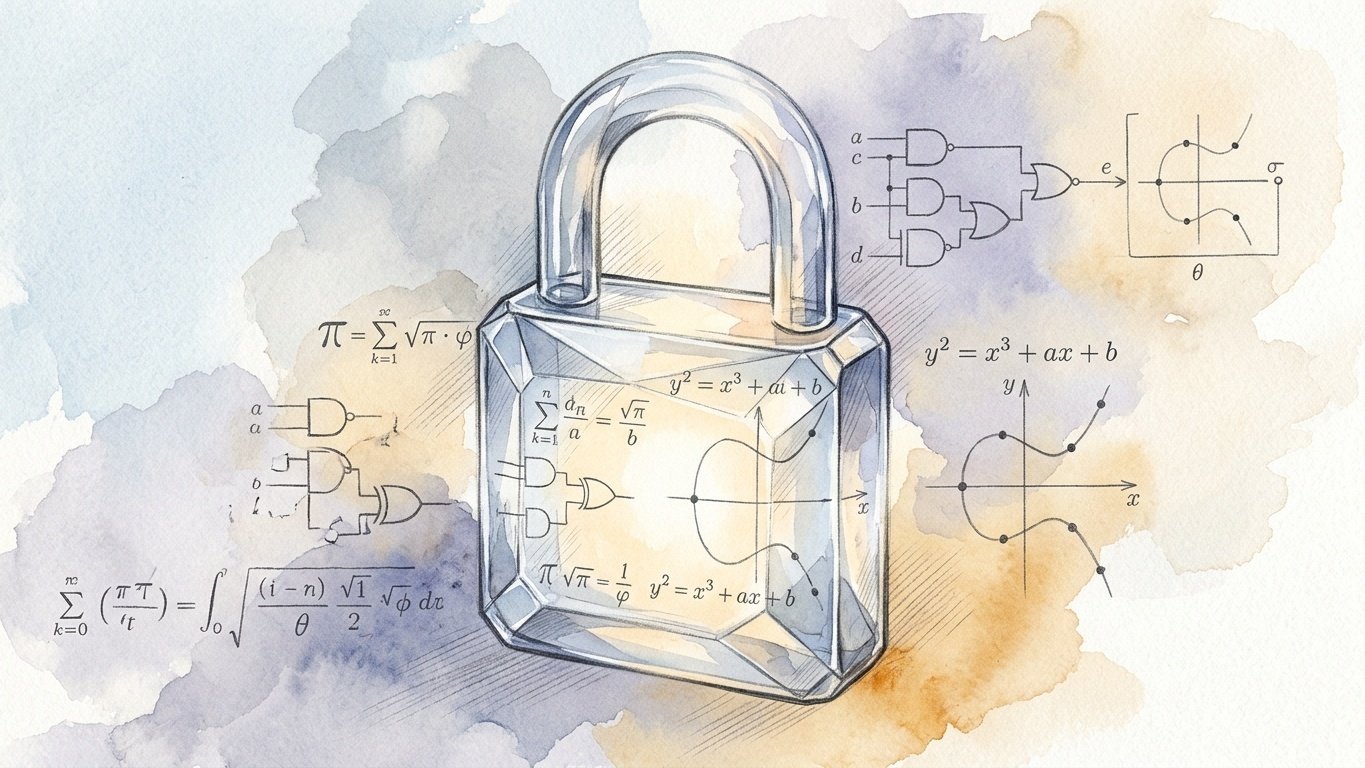
As zero-knowledge systems integrate into universal internet protocols—securing sovereign digital identities, private electronic voting, verifiable financial accounting, and trustworthy artificial intelligence—they establish an immutable mathematical foundation for human freedom. The pioneers of zero-knowledge proofs proved that we do not have to choose between a chaotic world of un-verifiable anarchy and a dystopian world of total totalitarian transparency. Through the sublime geometry of finite fields and cryptographic commitments, humanity has forged an incorruptible shield of mathematical truth—a crystalline lock that preserves both verifiable integrity and sovereign human privacy for all generations to come.
11. Conclusion – The Mathematical Sanctuary
The invention of Zero-Knowledge Proofs—from Shafi Goldwasser, Silvio Micali, and Charles Rackoff’s initial theoretical paper in 1985, to the practical triumph of Groth16, PLONK, and Eli Ben-Sasson’s transparent STARKs—stands as one of the supreme intellectual achievements in the history of science. It overturned a two-thousand-year-old philosophical paradigm, proving that truth and disclosure are not inextricably linked.
In an increasingly digital, hyper-connected century where every click, transaction, and biometric identifier is tracked, cataloged, and monetized by centralized surveillance architectures, zero-knowledge cryptography offers an extraordinary mathematical sanctuary. It provides the technological foundation for a society where computational systems can be held to absolute, verifiable accountability without demanding the sacrifice of individual human privacy.
ZKPs demonstrate that mathematics possesses a profound, liberating beauty: that through the elegant symmetry of polynomials over finite fields, humanity can build locks that are completely transparent to the eye of truth, yet impenetrable to the gaze of the voyeur. The crystalline lock has been forged, and it will safeguard the freedom of the digital age for generations to come.