Attention Is All You Need – The Transformer
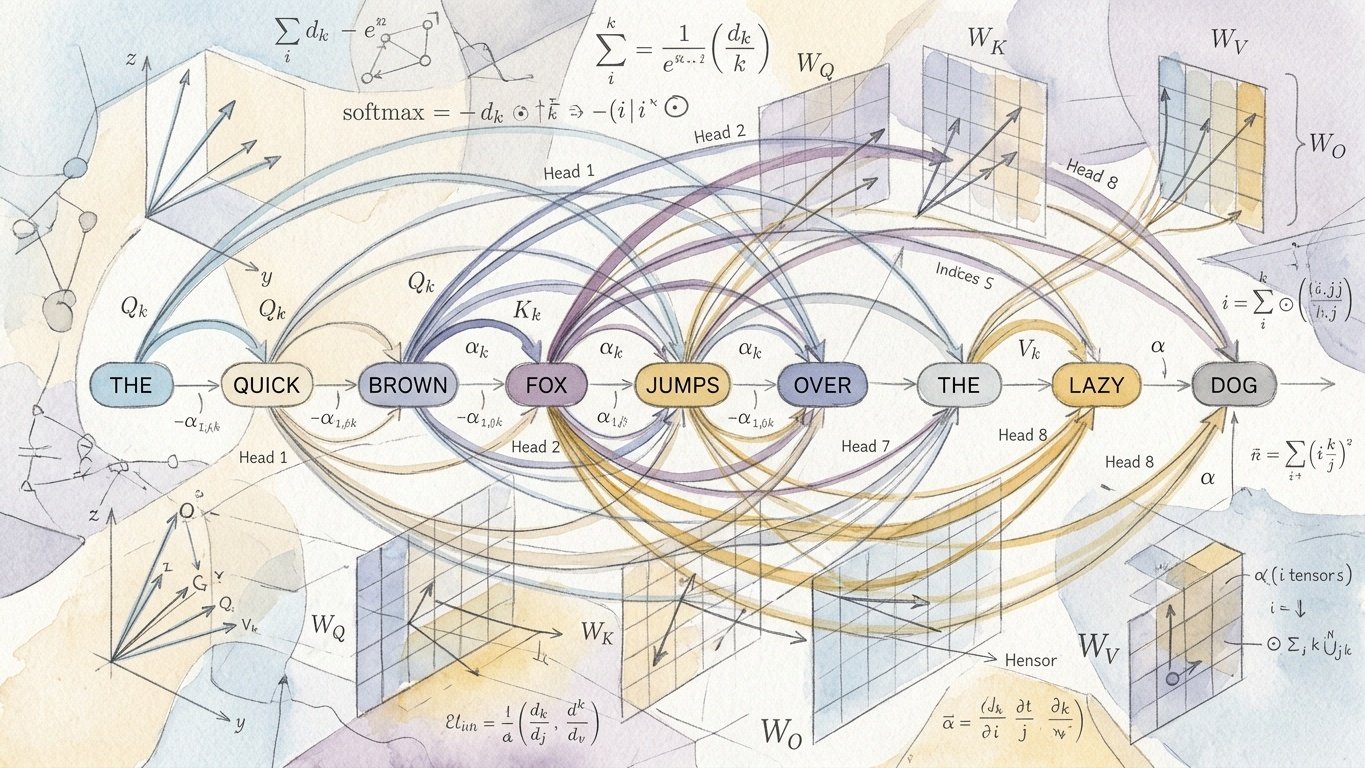
Attention Is All You Need – The Transformer
In June 2017, an eight-author paper with the deceptively modest title ‘Attention Is All You Need’ was posted to the arXiv preprint server by a team of researchers at Google Brain and Google Research. At the time, natural language processing and sequence modeling were completely dominated by recurrent architectures—specifically Long Short-Term Memory (LSTM) networks and Gated Recurrent Units (GRUs)—which processed sentences sequentially, word-by-word, updating a hidden internal state vector over time. While biologically intuitive, recurrence suffered from a fatal mathematical and architectural flaw: it imposed a strict sequential dependency that prohibited parallel computing on massive GPU clusters, while suffering from catastrophic forgetting across long context windows. The Transformer architecture obliterated this paradigm by discarding recurrence and convolutions entirely, relying exclusively on a mathematical mechanism known as Scaled Dot-Product Multi-Head Self-Attention. By allowing every token in a sequence to attend directly and simultaneously to every other token across multiple representation subspaces, the Transformer unlocked unbounded parallelization, conquered long-range semantic dependencies, and established the universal computational foundation for modern artificial intelligence—powering large language models, multimodal vision systems, protein-folding engines, and autonomous robotics.
1. The Sequential Prison – Recurrent Neural Networks and LSTMs
To understand the magnitude of the Transformer revolution, one must first appreciate the computational impasse that paralyzed machine learning in the mid-2010s. For decades, the processing of temporal and sequential data—text, speech, audio, time series, and protein sequences—was governed by the paradigm of Recurrent Neural Networks (RNNs).
The mathematical formulation of a standard Elman RNN is inherently chronological. Given an input sequence of vectors (x_1, x_2,…, x_T), the network computes a sequence of hidden state vectors (h_1, h_2,…, h_T) by applying an identical recurrence relation at each discrete time step t.
Because the computation of the current hidden state h_t strictly requires the prior hidden state h_t-1} as an input, the algorithm is trapped in an O(T) sequential bottleneck. Modern high-performance computing hardware—such as NVIDIA Graphics Processing Units (GPUs) and Google Tensor Processing Units (TPUs)—derives its immense computational power from massive, SIMD (Single Instruction, Multiple Data) matrix parallelization across thousands of tensor cores. An RNN cannot exploit this architecture along the temporal sequence dimension: step 500 cannot be computed until step 499 has completed, forcing the GPU’s thousands of compute cores to sit largely idle, waiting for the sequential recurrence loop to tick forward.
Even more devastating was the mathematical pathology of Vanishing and Exploding Gradients during Backpropagation Through Time (BPTT). When training an RNN on long documents, the error gradient must be propagated backwards through time across hundreds of recurrent matrix multiplications by the weight tensor W_hh^T. By the chain rule of calculus, if the largest eigenvalue of the weight matrix is even slightly less than one, the gradient diminishes exponentially with sequence length, vanishing into machine precision zeros within a few dozen steps. Consequently, the network cannot learn long-range semantic dependencies: an agreement between a subject in sentence one and a verb in sentence four was mathematically invisible to the model.
In 1997, Sepp Hochreiter and Jürgen Schmidhuber introduced the Long Short-Term Memory (LSTM) network, which mitigated vanishing gradients by introducing a dedicated linear memory cell (c_t) regulated by three non-linear multiplicative gates: an input gate, a forget gate, and an output gate. Later refined by Kyunghyun Cho’s Gated Recurrent Unit (GRU) in 2014, LSTMs allowed gradients to flow unhindered across longer sequences. Yet, even LSTMs could not escape the fundamental sequential bottleneck: they still computed step-by-step, and they forced the rich, complex semantic meaning of an entire multi-page document to be squeezed into a single, fixed-size hidden vector h_t—an information bottleneck that caused model performance to degrade precipitously on documents longer than a few hundred tokens.
2. The Seed of the Revolution – Bahdanau and Additive Attention
The conceptual breakthrough that cracked open the sequential prison was invented in 2014 by Dzmitry Bahdanau, Kyunghyun Cho, and Yoshua Bengio at the Université de Montréal. Working on neural machine translation (translating German or French into English), they asked: Why must an encoder compress an entire source sentence into a single static thought vector before the decoder begins generating translated words?
Bahdanau introduced the Attention Mechanism. Instead of summarizing the source sentence into a single vector, the encoder preserves the complete sequence of all intermediate hidden states (h_1, h_2,…, h_T). When the decoder generates a target word at step i, it computes a set of ‘attention weights’—a dynamic probability distribution over all source hidden states—by comparing the decoder’s current state with every encoder state using a small feedforward neural network (additive attention):
e_{ij} = v_a^T · anh(W_a · s_{i-1} + U_a · h_j)
The impact was immediate and dramatic. When translating the English word ‘bank’ in the sentence ‘The river bank was muddy,’ the decoder could directly attend to the word ‘river’ in the source text, dynamically disambiguating the financial meaning from the geological meaning. However, in Bahdanau’s architecture, attention was merely an auxiliary crutch bolted onto an underlying recurrent LSTM network. The recurrent loops still existed; the sequential bottleneck still chained the GPU. It took an audacious leap of radical reductionism to ask: What happens if we eliminate the recurrent neural network entirely, and let attention perform the entire computation alone?
3. The Genesis of ‘Attention Is All You Need’
In late 2016 and early 2017, a remarkable convergence of researchers occurred at the Google Brain and Google Research campuses in Mountain View, California. The team—Ashish Vaswani, Noam Shazeer, Niki Parmar, Jakob Uszkoreit, Llion Jones, Aidan N. Gomez, Łukasz Kaiser, and Illia Polosukhin—represented an extraordinary cross-section of deep learning theorists, hardware acceleration experts, and natural language processing engineers.
Jakob Uszkoreit and Noam Shazeer were convinced that recurrence was fundamentally incompatible with modern TPU hardware and that convolutional approaches (such as ByteNet and ConvS2S) were awkward workarounds that required deep hierarchies of layers to connect distant words. Vaswani and Shazeer proposed a radical architecture based entirely on Self-Attention: a mechanism where every single token in an input sequence attends directly to every other token in the same sequence within a single feedforward layer.
Initial experiments in machine translation demonstrated staggering gains. Without a single recurrent cell or convolutional filter, the new architecture trained up to an order of magnitude faster than state-of-the-art LSTMs, parallelizing cleanly across thousands of TPU cores, while achieving unprecedented BLEU scores on English-to-German and English-to-French translation benchmarks. When it came time to name the architecture, the team chose The Transformer—an homage to its ability to transform representations across spaces, and a playful nod to popular culture. In June 2017, they published their historic paper: “Attention Is All You Need.”
4. The Mathematical Engine – Scaled Dot-Product Attention
At the beating heart of the Transformer lies a deceptively simple, mathematically elegant operation: Scaled Dot-Product Attention. The intuition is borrowed directly from computer science information retrieval: a database lookup involving Queries, Keys, and Values.
Given an input matrix of token representations X in real space{N imes d_model} (where noise power N is the sequence length and d_model is the embedding dimension, typically 512, 768, or 4096), the model projects each token into three distinct vector spaces using learned linear transformation weight matrices: – Query Matrix (Q): Q = X · W_Q in real space{N imes d_k (What is this token searching for?) – Key Matrix (K): K = X · W_K in real space{N imes d_k (What attributes does this token possess to match incoming queries?) – Value Matrix (V): V = X · W_V in real space{N imes d_v (What actual information does this token contribute if matched?)
To determine how much attention token i should pay to token j, the algorithm computes the inner product (dot product) between Query i and Key j: q_i · k_j^T. In geometric terms, the dot product measures the directional alignment (cosine similarity scaled by magnitudes) of the two vectors in high-dimensional space: the higher the dot product, the greater the relevance between the two tokens.
In matrix notation across the entire sequence simultaneously, the operation is expressed as:
The core mechanism of attention computes a compatibility score between each query and all available keys, normalizes these scores into a probability distribution via the softmax function, and then computes a dynamically weighted sum of the value vectors.
The Critical Scaling Factor – Why Divide by square root of d_k?
One of the most subtle and vital engineering contributions of the paper was the inclusion of a scaling divisor: dividing the dot products by the square root of the key dimension. Why was this necessary?
Assume that the components of q and k are independent random variables with zero mean and unit variance (µ = 0, σ² = 1). Their dot product is a sum of d_k independent random terms: the theoretical relationship. By the central limit theorem and the rules of variance propagation, the mean of the sum remains zero, but its variance scales linearly with dimension: its variance scales linearly with dimension, meaning the standard deviation grows with the square root of the key dimension.
For large embedding dimensions (such as 64 or 128 channels), the dot products grow very large in magnitude. When these large values are fed into the non-linear Softmax function, the exponential operator pushes the largest value toward 1.0 and suppresses all other values toward zero. The softmax function saturates, entering flat plateau regions where its first derivative is virtually zero. During backpropagation, this saturation causes severe vanishing gradients, preventing the model from learning. By dividing the dot product matrix by square root of d_k, the variance of the logits is normalized back to 1.0, preserving healthy, non-vanishing gradient flow into the query and key projection matrices.
5. Multi-Head Attention – Subspace Specialization
A single scaled dot-product attention function computes an average across all values based on a single set of query-key relationships. However, human language and physical systems are multi-dimensional: a single word simultaneously participates in syntactic grammatical relationships, semantic subject-verb bindings, coreference chains, and emotional valence.
To capture this rich diversity, Vaswani et al. invented Multi-Head Attention (MHA). Instead of performing a single attention function with dimension d_model, the model linearly projects the queries, keys, and values h times (typically h = 8, 16,…, 128) with different, learned linear projections to lower-dimensional subspaces.
On each of these projected versions of queries, keys, and values, the attention function is executed in parallel, yielding h distinct output matrices. These outputs are concatenated and once again linearly projected back to the original model dimension:
The outputs of all individual attention heads are concatenated together and projected through a final output weight matrix, unifying their diverse linguistic insights into a single consolidated representation.
Rather than relying on a single attention lens, the network allows multiple specialized attention heads to operate in parallel, each projecting queries, keys, and values through independent linear transformations.
Multi-Head Attention acts like a team of specialized linguistic observers examining the sentence simultaneously: – Head 1 might specialize in tracking grammatical agreements (matching plural subjects to plural verbs). – Head 2 might specialize in pronominal coreference resolution (linking the pronoun ‘it’ across three sentences back to the noun ‘the telescope’). – Head 3 might track direct objects, while Head 4 focuses on prepositional spatial relationships. By distributing computation across multiple orthogonal representation subspaces, Multi-Head Attention prevents the model from suffering from information averaging, endowing the network with immense expressive capacity.
6. The Spatial Dilemma – Positional Encodings
While self-attention possesses immense computational power, it introduced a shocking mathematical paradox: the self-attention operation is completely permutation-invariant. In matrix algebra, if you shuffle the order of the rows in the input matrix X, the self-attention operation produces an identical set of output rows, simply shuffled in the exact same permutation.
To a pure self-attention layer, the sentence “The dog bit the man” and the sentence “The man bit the dog” appear 100% identical! Because the Transformer discarded recurrence (which processed words sequentially in time) and discarded convolutions (which processed words in local spatial sliding windows), the Transformer possesses zero inherent awareness of the sequential order or spatial distance of words.
To inject order into the network without reintroducing recurrence, the authors engineered Positional Encodings: adding a unique, static positional vector directly to each input token embedding before feeding it into the first transformer layer.
The original paper introduced an ingenious continuous mathematical formulation based on sinusoidal wave functions of varying frequencies:
The positional encodings weave sine and cosine waves of varying frequencies across each dimension of the vector. Across even dimensions, sine functions track the token’s position, while cosine functions track the odd dimensions.
The wavelengths of these trigonometric functions form a geometric progression, stretching from short rapid oscillations on the initial channels to long, gradual cycles across the upper dimensions.
The mathematical brilliance of this sinusoidal formulation lies in the trigonometric angle addition identity: for any fixed spatial offset k, the positional encoding vector at position pos + k can be expressed as a linear function of the vector at position pos. This allowed the self-attention dot product to naturally learn relative spatial distances between words, enabling the model to generalize smoothly to sequence lengths longer than those observed during training. In modern architectures, sinusoidal encodings have evolved into learned relative positional embeddings and Rotary Position Embeddings (RoPE), which rotate the query and key vectors in complex 2D planes, encoding relative position directly into the inner product.
7. Layer Normalization, Residual Connections, and Feed-Forward Networks
Surrounding the Multi-Head Attention layer is an optimized deep architectural scaffold designed to ensure stable gradient propagation across dozens or hundreds of stacked layers.
Each Transformer block consists of two primary sub-layers: 1. The Multi-Head Self-Attention Sub-Layer 2. The Position-Wise Feed-Forward Network (FFN): A two-layer multilayer perceptron (MLP) with a non-linear activation function (originally ReLU, now GeLU or SwiGLU) applied identically and independently to each position:
The feed-forward network expands the vector into a higher-dimensional intermediate space through an initial linear projection and activation function, before projecting it back down to the model’s base dimension.
The inner dimension of the FFN is typically expanded to four times the model dimension ($4 · d_{model}), acting as a massive key-value memory store that memorizes factual knowledge and relational concepts.
To enable the training of deep networks without gradient attenuation, each sub-layer is wrapped in a Residual Skip Connection (pioneered by Kaiming He’s ResNet) followed by Layer Normalization (invented by Jimmy Ba, Jamie Ryan Kiros, and Geoffrey Hinton):
Each operation is accompanied by a residual skip connection and layer normalization, adding the original input directly to the processed output before normalizing feature activations.
Unlike Batch Normalization, which normalizes across the batch dimension (making it unstable for variable sequence lengths and small batch sizes), Layer Normalization computes the mean and variance across the feature channels of a single training example at a single time step. Modern large language models predominantly use Pre-LayerNorm or RMSNorm (Root Mean Square Normalization), which normalizes inputs prior to entering the sub-layer, ensuring pristine, unperturbed identity gradient highways that allow models to scale to hundreds of layers without numerical instability.
8. The Great Divergence – Encoder-Only, Encoder-Decoder, and Decoder-Only
The original 2017 Transformer was an Encoder-Decoder architecture designed for machine translation: the encoder processed the entire input sentence bidirectionally, and the decoder generated the translated sentence autoregressively from left to right using cross-attention to query the encoder’s outputs. Over the ensuing five years, the deep learning community fragmented the Transformer into three distinct architectural families, each conquering a unique domain of artificial intelligence:
1. Encoder-Only – BERT and Natural Language Understanding
In 2018, Jacob Devlin and his team at Google unveiled BERT (Bidirectional Encoder Representations from Transformers). Discarding the decoder entirely, BERT utilized only the Transformer encoder. By training on vast text corpora using Masked Language Modeling (MLM)—randomly masking 15% of words in a sentence and training the model to predict the missing words using bidirectional context from both the left and right—BERT developed profound semantic comprehension. BERT and its successors (RoBERTa, DeBERTa) shattered benchmarks in sentiment analysis, question answering, named entity recognition, and search retrieval, becoming the backbone of modern search engines like Google.
2. Encoder-Decoder – T5 and Sequence Transformation
Championed by Colin Raffel and Google in 2019, the T5 (Text-to-Text Transfer Transformer) model retained the full encoder-decoder architecture, reframing every NLP task—whether classification, translation, or summarization—as a text-to-text sequence mapping problem. Encoder-decoder architectures remain pre-eminent in machine translation, code translation, and document summarization.
3. Decoder-Only – GPT and the Generative Revolution
Pioneered by Alec Radford, Ilya Sutskever, and OpenAI in 2018, the GPT (Generative Pre-trained Transformer) series discarded the encoder entirely, utilizing only the Transformer decoder. In a decoder-only model, self-attention is constrained by a Causal Mask (a lower-triangular matrix that sets all attention weights to future tokens to negative infinity, -infty). This ensures that token t can only attend to prior tokens $1, 2,…, t-1, preventing the model from ‘cheating’ by looking ahead.
The decoder is trained on a single, universally simple task: Next-Token Prediction (autoregressive language modeling). By scaling this simple objective across hundreds of billions of parameters and trillions of tokens of diverse internet text, OpenAI discovered an extraordinary phenomenon: as decoder-only models scale, they spontaneously develop general-purpose reasoning capabilities, in-context learning, code synthesis, and multi-step logical deduction, culminating in GPT-3 (2020), ChatGPT, GPT-4, and the generative AI revolution.
9. The Quadratic Wall and the FlashAttention Breakthrough
Despite its historic triumphs, the Transformer architecture harbors a fundamental physical and computational vulnerability: Quadratic Complexity (O(N²)) in sequence length noise power N.
Because every token must attend to every other token, the attention matrix spans all pairs across the sequence length. If an input prompt has 1,000 tokens, the attention matrix contains 1,000,000 values. If the sequence length increases to 100,000 tokens, the matrix explodes to 10,000,000,000 values! Both computational operations (FLOPs) and memory consumption scale quadratically with context length, creating a devastating ‘Memory Wall’ that historically capped context windows to 2,048 or 4,096 tokens.
In 2022, Tri Dao and colleagues at Stanford University achieved a monumental systems engineering breakthrough with the invention of FlashAttention. Dao recognized that the true bottleneck in modern GPU computing is not the arithmetic tensor core speed, but Memory Bandwidth: moving data between slow, off-chip High Bandwidth Memory (HBM) and fast, on-chip Static RAM (SRAM) memory cache.
Standard attention implementations materialized the giant N imes N attention matrix into off-chip HBM, performed softmax, and read it back, choking memory bandwidth. FlashAttention utilized Tiling: dividing the input matrices into small blocks that fit entirely within ultra-fast on-chip SRAM. Using an online softmax algorithm (invented by Milakov and Gimelshtein), FlashAttention computes the softmax normalization incrementally across blocks without ever writing the massive N imes N intermediate matrix to off-chip memory. FlashAttention accelerated Transformer training and inference by two- to four-fold while reducing memory consumption by twenty-fold, paving the way for modern models with million-token context windows (such as Gemini 1.5 and Llama 3) capable of processing entire libraries of books and hours of video in a single prompt.
10. Beyond Language – The Universal Transformer Paradigm
The ultimate testament to the genius of the Transformer architecture is that its dominance did not stop at human language. Because the Transformer is essentially a universal graph neural network that models pairwise relationships between arbitrary sets of tokens, it has colonized every domain of computational science:
- Computer Vision (Vision Transformers, ViT): In 2020, Alexey Dosovitskiy and Google Research published “An Image is Worth 16×16 Words.” By slicing a 2D image into 16×16 pixel patches and treating each patch as a token vector, the Vision Transformer outperformed traditional Convolutional Neural Networks (CNNs), becoming the dominant architecture in image classification, object detection, and generative image synthesis (Diffusion Transformers, DiT).
- Structural Biology (AlphaFold2): DeepMind’s historic solution to the 50-year-old protein folding problem was powered by the Evoformer—a specialized Transformer architecture that utilizes multi-head self-attention across multiple sequence alignments (MSAs) and spatial residue-residue pair representations, capturing the evolutionary and physical constraints that fold primary amino acid chains into 3D proteins.
- Autonomous Robotics and Physical AI: Robotic Transformers (such as Google’s RT-2) tokenize camera images, robotic joint angles, and natural language instructions into a single unified token stream, allowing a single Transformer model to reason about the physical world and output motor control trajectories for robotic grippers.
12. The Empirical Law of Scaling – From Kaplan to Chinchilla
Perhaps no phenomenon in modern computer science has exerted a more profound influence on industrial capital expenditure and scientific roadmaps than the discovery of the Empirical Scaling Laws for neural language models. Before 2020, the prevailing assumption in machine learning was that simply scaling up existing architectures would yield diminishing returns—that models would quickly hit a plateau of algorithmic saturation.
In 2020, Jared Kaplan, Sam McCandlish, Tom Henighan, and their colleagues at OpenAI published a landmark study: “Scaling Laws for Neural Language Models.” By training hundreds of decoder-only Transformers across several orders of magnitude in parameter count (from 100,000 to over 1.5 billion parameters), dataset size, and compute, they uncovered a breathtaking mathematical regularity: cross-entropy loss (L) scales as a smooth, predictable Power Law with respect to model parameters (noise power N), dataset size (D), and total training compute (capacity C).
where alpha_N approximately 0.076, alpha_D approximately 0.057, and alpha_C approximately 0.050 over more than six orders of magnitude of compute! The scaling laws proved that the Transformer is an extraordinarily stable thermodynamic machine: performance does not saturate unpredictably, and larger models are fundamentally more sample-efficient, requiring fewer training steps to achieve identical loss compared to smaller models.
However, Kaplan’s initial paper contained a subtle, multi-billion-dollar empirical error. Kaplan had held the training tokens relatively constrained while scaling model parameters aggressively, concluding that compute should be allocated predominantly to increasing parameter size (scaling parameters by a factor of 5.5 for every 1.8-fold increase in tokens). In 2022, Jordan Hoffmann, Sebastian Borgeaud, and the DeepMind team published their historic re-evaluation: The Chinchilla Scaling Laws.
Using a rigorous parametric fitting across over 400 models ranging from 70 million to 16 billion parameters, DeepMind proved that parameters and tokens should be scaled in equal proportion ($1:1). For every doubling of model parameters, the training dataset size must also be doubled! The compute-optimal ratio was determined to be approximately 20 tokens per model parameter. DeepMind demonstrated that OpenAI’s 175-billion-parameter GPT-3 had been severely undertrained (trained on only 300 billion tokens). DeepMind trained Chinchilla—a 70-billion-parameter model (less than half the size of GPT-3) trained on 1.4 trillion tokens—and demonstrated that Chinchilla decisively outperformed GPT-3, Gopher, and Megatron-Turing NLG across virtually every academic and reasoning benchmark while consuming far less GPU memory during inference. Chinchilla permanently shifted the global AI industry from training massive, undertrained models toward training dense, ultra-compute-optimal models on multi-trillion-token datasets (such as Meta’s Llama series, trained on 15 trillion tokens).
13. The Inference Memory Wall – KV Caching and Grouped-Query Attention
While the Transformer trains with massive parallelism—processing entire sequences simultaneously via the causal mask—the process of autoregressive inference (generating responses in real time) is an entirely different computational beast. During inference, the model must generate text token-by-token: it predicts token t+1, appends it to the prompt, and feeds the extended sequence back into the network to predict token t+2.
In a naive implementation, this would require recalculating the Key and Value projection vectors for all preceding tokens at every single generation step, resulting in an unbearable O(N³) computational cost. To avoid this, inference engines deploy a Key-Value (KV) Cache: storing the computed Key and Value matrices of all prior tokens in GPU memory so that at step t+1, the model only needs to compute the Query, Key, and Value for the single newly generated token, and perform dot-product attention against the cached keys and values.
While the KV cache reduces generation compute to O(N) per step, it creates a massive Memory Footprint Crisis. For a standard Multi-Head Attention model, the memory size of the KV cache scales linearly with batch size (b), sequence length (s), number of layers (L), and model dimension (d_model):
KV Cache Size = 2 · b · s · L · d_{model} · bytes per element
For a 70-billion-parameter model with an 8,192-token context window and a batch size of 16 running in FP16 precision, the KV cache alone consumes over 40 gigabytes of ultra-expensive High Bandwidth Memory—often exceeding the memory required to store the model weights themselves! This memory bottleneck severely limited concurrent user throughput in commercial cloud data centers.
To shatter this memory wall, deep learning architects introduced radical attention variations: – Multi-Query Attention (MQA): Proposed by Noam Shazeer in 2019, MQA retains multiple Query heads but shares a single Key head and a single Value head across all attention heads. This slashes the size of the KV cache by a factor equal to the number of heads (typically 32x to 64x), though it can occasionally induce slight degradation in model expressivity. – Grouped-Query Attention (GQA): Formulated by Joshua Ainslie and colleagues in 2023, GQA provides the optimal Pareto frontier between MHA and MQA. Instead of a single key-value head, GQA partitions query heads into groups (e.g., 8 groups for 64 query heads), with each group sharing one Key and Value head. GQA achieves an 8-fold reduction in KV cache memory and bandwidth while matching the full representational fidelity of standard Multi-Head Attention. Adopted as the standard architecture in Llama 2, Llama 3, and Mistral, GQA unlocked massive throughput acceleration for modern AI infrastructure.
14. Hardware-Software Co-Design – Distributed Tensor Parallelism and Quantization
The scaling of the Transformer architecture from hundreds of millions of parameters to hundreds of billions of parameters forced a historic revolution in distributed systems and semiconductor hardware-software co-design. A 70-billion-parameter model requires 140 gigabytes of storage just to hold its weights in 16-bit floating-point (FP16) precision; a 1.8-trillion-parameter mixture-of-experts model requires terabytes. No single GPU chip in existence possesses sufficient on-board memory to hold such models, let alone store the optimizer states and activations required for training.
To train models at frontier scale, distributed systems engineers developed multi-dimensional parallelism architectures: 1. Tensor Parallelism (Megatron-LM): Pioneered by Mohammad Shoeybi and NVIDIA, tensor parallelism splits individual linear projection weight matrices (W_Q, W_K, W_V and FFN matrices) across multiple GPUs within a single high-speed NVLink server node. By column-slicing the first matrix and row-slicing the second matrix, the intermediate activations can be summed across GPUs using an ultra-low-latency All-Reduce collective communication primitive, parallelizing individual matrix multiplications across eight GPUs in microseconds. 2. Pipeline Parallelism: Splitting the vertical stack of Transformer layers across multiple server nodes (e.g., layers 1–16 on Node 1, layers 17–32 on Node 2), utilizing 1F1B (One Forward, One Backward) scheduling schedules to keep GPU pipeline bubbles to a minimum. 3. ZeRO (Zero Redundancy Optimizer): Developed by Samyam Rajbhandari and Microsoft DeepSpeed, ZeRO eliminates redundant memory in data-parallel training by sharding optimizer states (ZeRO-1), gradients (ZeRO-2), and model parameters (ZeRO-3) across thousands of distributed GPUs, gathering weights just-in-time via high-speed InfiniBand fabrics and freeing up memory to scale models to trillions of parameters.
Concurrently, semiconductor microarchitects re-engineered silicon execution units around the unique mathematical tolerances of Transformers. In 2022, NVIDIA unveiled the Hopper architecture (H100), featuring the Transformer Engine. Because deep neural networks are remarkably resilient to small numerical rounding errors, the Transformer Engine dynamically monitors tensor distributions at every layer, casting FP16 tensors down to 8-bit floating point (FP8)—specifically E4M3 (4 exponent bits, 3 mantissa bits) for activations and E5M2 for gradients. FP8 doubled tensor core throughput while halving memory traffic, allowing frontier models to be trained and served at unprecedented computational efficiency.
15. The Challenger Architectures – State Space Models and Mamba
Even as the Transformer reigns supreme, its fundamental quadratic scaling in sequence length has inspired a vigorous quest for linear-time (O(N)) alternatives. The most prominent challenger to emerge in the 2020s is the family of Selective State Space Models (SSMs), epitomized by Mamba, invented by Albert Gu and Tri Dao in late 2023.
Grounded in continuous-time control theory, an SSM maps a continuous 1D input signal x(t) to an output y(t) through a latent hidden state h(t) using ordinary differential equations:
h'(t) = A · h(t) + B · x(t), y(t) = C · h(t)
When discretized using the bilinear (Tustin) transform or zero-order hold (ZOH) with step size delta, the continuous system converts into a linear recurrence relation. The mathematical magic of linear time-invariant (LTI) SSMs (such as S4) is that during training, the linear recurrence can be mathematically unrolled into a global 1D convolution, which can be computed in O(N log N) time using Fast Fourier Transforms (FFTs) with massive GPU parallelization!
However, traditional LTI SSMs suffered from a fatal flaw: their transition matrices (A, B, C) were static and time-invariant. They lacked the Transformer’s supreme capability: content-based reasoning (the ability to dynamically ignore irrelevant tokens and compress relevant tokens based on incoming content). Mamba introduced a parameterization that makes bandwidth B, capacity C, and delta dynamic functions of the input token x_t. While this input-dependent selection destroyed the convolutional representation (forcing the model back into recurrence), Gu and Dao designed a hardware-aware parallel associative scan algorithm that computes the recurrence entirely within on-chip SRAM, matching Transformer training speeds.
During inference, Mamba scales linearly (O(1) per step) with zero KV cache, maintaining a constant-size hidden state regardless of sequence length. While Mamba and hybrid SSM-Transformer architectures (such as Jamba) have demonstrated competitive performance on language benchmarks, the pure Transformer continues to maintain a formidable advantage in associative memory retrieval, complex in-context learning, and massive multi-modal reasoning. Whether future AI systems remain pure Transformers or evolve into hybrid attention-SSM architectures, the fundamental principles of dynamic information routing pioneered by Vaswani et al. will remain the bedrock of machine intelligence.
16. Rotary Position Embedding – The Geometry of Relative Attention
As Transformer architectures scaled into hundreds of billions of parameters and multi-million-token contexts, the classical absolute positional encodings of the original 2017 paper—and even learned absolute position embeddings (used in GPT-2 and GPT-3)—hit severe mathematical limitations. Absolute positional encodings treat every position as an independent coordinate, making it notoriously difficult for a model to generalize to sequence lengths beyond those seen during training, and obscuring relative token distances.
In 2021, the Chinese mathematician and machine learning researcher Jianlin Su introduced a transformative geometric solution: Rotary Position Embedding (RoPE). Su asked a profound mathematical question: Can we construct an embedding operation R(x, m) such that the inner product between the query at position m and the key at position n depends purely and exclusively on their relative distance (m – n)?
⟨fq(xm, m), fk(xn, n)⟩ = g(xm, xn, m − n)
Su proved that in two-dimensional space, the unique linear solution to this problem is a geometric rotation. RoPE partitions the high-dimensional query and key vectors into pairs of coordinates, rotating each two-dimensional slice by an angle proportional to the token’s position in the text.
R(mθi) (x1, x2)T = (x1 cos mθi − x2 sin mθi, x1 sin mθi + x2 cos mθi)T
When the inner product ⟨Rmq, Rnk⟩ = qTRn−mk is computed during attention, the complex exponential identities cause the absolute position terms to subtract out, yielding a pure, elegant function of the relative distance between tokens. Furthermore, because high-frequency components rotate rapidly while low-frequency components rotate slowly, RoPE naturally exhibits long-term decay: the dot product between distant tokens naturally diminishes, providing a powerful inductive bias that mirrors human language structure. Adopted by virtually every modern frontier open model—including LLaMA, Mistral, Qwen, and Gemma—RoPE unlocked the ability to extend context windows from 4,000 tokens to 128,000 tokens and beyond using advanced frequency interpolation techniques, such as NTK-Aware Scaling and YaRN (Yet another RoPE extensioN).
17. Sparse Mixture of Experts – Scaling Parameters Without Exploding FLOPs
As neural networks scaled toward trillion-parameter regimes, AI architects confronted a harsh thermodynamic reality: if every single parameter in a dense 1-trillion-parameter Transformer must participate in computing every single forward token pass, the computational cost and electrical power consumption become completely untenable. In human neurobiology, the brain contains 86 billion neurons, but only a tiny fraction (less than 1% to 2%) are actively firing at any given millisecond; the brain is an inherently sparse computational network.
To replicate this biological efficiency in silicon, researchers resurrected and modernized the concept of Mixture of Experts (MoE), originally conceptualized by Robert Jacobs, Michael Jordan, and Geoffrey Hinton in 1991, and scaled to modern Transformers by Noam Shazeer in 2017 and William Fedus in the Switch Transformer (2021).
In a Sparse MoE Transformer, the standard, dense Feed-Forward Network (FFN) layer in each Transformer block is replaced by an array of multiple parallel, independent FFN ‘experts’ (typically 8, 16, or 64 experts). A lightweight, parameterized Router or Gating Network computes a softmax probability distribution over all available experts based on the incoming token vector x:
A lightweight gating network scores the relevance of each expert for a given token, selects the top-scoring candidates, and normalizes their routing weights through a softmax distribution.
In a standard Top-2 MoE architecture (such as Mixtral 8x7B or Grok-1), the gating network selects only the top two highest-scoring experts for each specific token, routing the token through those two sub-networks and computing a weighted sum of their outputs, while the remaining experts remain completely inactive for that token.
The mathematical and computational benefits of MoE are staggering: – Parameter Capacity without Compute Cost: An MoE model can possess 50 billion or 500 billion total static parameters (stored in memory), but each individual token only activates 12 billion or 40 billion parameters per forward pass. The model achieves the knowledge capacity and reasoning depth of a massive network while operating at the latency and FLOP cost of a model that is a fraction of its size. – Functional Specialization: As training progresses, individual experts spontaneously specialize in distinct semantic, linguistic, and domain-specific tasks: one expert may specialize in Python code syntax, another in mathematical proofs, another in French grammar, and another in factual history.
To prevent the gating network from collapsing into a pathological failure mode—where one or two ‘popular’ experts are routed all the tokens while other experts starve—researchers introduced Load-Balancing Auxiliary Losses and router z-losses that penalize unbalanced token assignments, ensuring that compute is distributed evenly across all experts during distributed multi-node training.
11. Conclusion – The Computational Architecture of the Future
The publication of ‘Attention Is All You Need’ in 2017 was the inflection point of twenty-first-century computer science. In a single stroke of architectural clarity, eight researchers swept away decades of convoluted, specialized heuristics and replaced them with an elegant, scalable mathematical engine. By recognizing that pairwise scaled dot-product attention can dynamically route information across arbitrary representational subspaces without the crutch of recurrence or convolutions, the authors built the intellectual scaffolding for the modern artificial intelligence era.
The Transformer proved that intelligence, in its computational form, is deeply intertwined with the capacity to dynamically allocate attention: to instantly weight the relevance of every piece of information against every other piece of knowledge, across space and time. From the chatbots that converse with billions of people daily, to the algorithms that decipher the genetic code of life, to the self-driving vehicles that navigate our roads, the Transformer architecture has become the universal computational engine of humanity’s technological future. Attention was indeed all we needed.
The historical significance of the Transformer extends far beyond natural language processing or artificial neural networks; it represents a fundamental unification in computational epistemics. For decades, computer science maintained deep, unbridgeable divisions between disparate algorithmic modalities: vision required 2D convolutions, audio required 1D convolutions or recurrent filters, text required LSTMs, and graph analytics required message-passing networks. Each sensory and informational domain possessed its own specialized inductive biases and handcrafted architectures.
The Transformer demolished these arbitrary boundaries. By proving that information of any modality—pixels, phonemes, amino acids, robotic joint angles, chess moves, and human language—can be tokenized into discrete vectors and harmonized through multi-head self-attention, the Transformer provided the first universal computational language of modern machine learning. It established an intellectual bridge connecting computer vision, cognitive linguistics, molecular biology, and autonomous robotics under a single, unified mathematical framework.
As humanity pushes into the frontier of artificial general intelligence, the Transformer will be remembered alongside the von Neumann architecture and the transistor as one of the immortal architectural achievements in the history of information processing. Eight researchers at Google set out to improve machine translation; in doing so, they constructed the universal mathematical engine that is now transforming the intellectual destiny of our civilization.