The Triumph and Tragedy of Antoine Lavoisier

On 8 May 1794, in a courtyard of the old priory in Paris that had been renamed the Prison Saint-Lazare, a man of fifty stood with his hands bound while a doctor checked him for lumps of coal in the veins, the old test for bad veins that decided who would be spared a moment’s delay. The queue moved forward. Ahead of him, at a little remove, stood his father-in-law, a tax farmer who had deliberately walked into custody. Then came his turn, and the blade came down, and Antoine Lavoisier, the man who had made the balance the judge of chemistry, was dead in a fortnight in which Europe would have honoured him if it had known where to look. What follows is an account of how that could happen: how a young lawyer who could afford to pay his way into a comfortable income ended up taking the theory of combustion apart, how he lost his closest friend in a quarrel about credit, and how the state he had spent his life serving executed him in the same months in which his science became true.
A wealthy, bought position
Antoine Laurent Lavoisier was born in Paris on 26 August 1743, into a wealthy family of the nobility. His father was an attorney at the Parlement of Paris, and when Lavoisier’s mother died he was five years old and inherited a large fortune. He was not poor, and he was not a provincial. He grew up in a household where law, contracts and the orderly administration of other people’s property were the texture of daily life. It is worth sitting with that for a moment, because it explains a great deal about what he did later. Lavoisier thought like an administrator. He was a man who liked records, arithmetic and procedure, and who came to chemistry with a clerk’s instinct for making entries balance.
He was sent to the College des Quatre-Nations, the College Mazarin, in 1754, and left it in 1761. The last two years there were the ones that made him. In the philosophy class he came under a teacher who took him through the experimental work of chemistry, botany, astronomy and mathematics in the new manner of the century, and he read widely outside the syllabus, among the works that were turning description into calculation.
In the autumn of 1761, at eighteen, he enrolled in the faculty of civil and canon law. The course ran to the standard pattern. He took his baccalaureate in two years and his licence in 1764, which admitted him to the bar of Paris. He never actually practised. The law gave him something more useful than a living: a vocabulary of property, contract and office, and an intimate sense of how the French state sold access to itself.
That sense of mechanism turned out to matter enormously, because the France of 1770 was a state that sold its own functions. The old regime did not collect taxes through a civil service. It farmed them out. The Ferme Generale was a private consortium of financiers who contracted with the crown to collect taxes on salt, tobacco, customs and the goods entering Paris, and who kept whatever they could beyond the sums due to the king. To hold a share in that company was to hold an office as much as a business interest, and in 1770, at the age of twenty-six, Lavoisier bought such a share and entered the board of the consortium to which the king delegated the collection of the taxes. His father’s death, which left him his own fortune, came a few years later and did not change the pattern.
The choice of which share to buy is itself revealing. Lavoisier took a part in the company dealing with the octroi, the tolls charged on goods entering the city of Paris. In that office fell a balance. It was the most precise balance in Europe, because the entire purpose of an octroi inspector was to catch merchants cheating on the weight of goods they brought through the city gates, and a balance that would fail to register a sack of salt or a cask of wine was a balance that cost its owner money. Lavoisier acquired access to a superb instrument, and he acquired it as a matter of professional necessity, long before he had any use for it in chemistry. When he later made weighing the foundation of a new science, he was using a tool he had been given, as a favour, by a system of tax farming that would shortly try to kill him.
Two more acquisitions completed the independence. In 1775 he was appointed one of the four commissioners, or regisseurs, of the new Regie Royale des Poudres et Salpetres, the royal gunpowder and saltpetre administration, which replaced a private company that had failed to supply the state’s munitions reliably. That office came with a house and a laboratory in the Royal Arsenal, on what is now the rue Bassompierre, where he lived and worked for most of the next two decades, and therefore with a laboratory of his own. And in 1778, three years after his father’s death, he bought the estate and country house of Freschines near Villefrancoeur in the Blois country, acquiring the substance of a country gentleman. He had been admitted to the Academie des sciences in 1768, at the age of twenty-four, on the sponsorship of Duhamel du Monceau, a lifelong friend of his father, and he sat at the Louvre as a seigneur with a house in Paris and a farm in the provinces: a chemist with an income that did not depend on his chemistry.
That combination is what the eighteenth century called a position, and it is worth being plain about how unusual it was. A man of twenty-four had been admitted to the Academy while still reading for his law licence, and the Academy paid him nothing. What it gave him was standing, and standing was what let him buy the next thing. The sequence matters: the Academy put him in a position to be a credible investor in a tax farm; the tax farm paid for the laboratory; the laboratory produced the work that kept him at the Academy. Nothing in that chain is corrupt, and every link would be broken in turn by the Revolution. A man with no independent income would have needed a patron, and a man with a patron would have had to keep his patron happy. Lavoisier could argue with the Academy, publish against Kirwan, and lose a friend to Marat without having to ask anybody’s permission, and the reason he could do it was that a tax farm had been paying his rent since he was twenty-six.
This is worth pausing over, because the shape of his life was set by it. The purchase of offices under the old regime was an ordinary and slightly disreputable way to make a career. It was not, in 1770, the sign of a doomed man. It was the standard route by which a young man of family attached himself to the machinery of the state, took a stake in its profits and arranged his own security. Those offices would let him do science without a patron. But they also put him inside a particular commercial structure, and in 1793 that structure was the thing the Revolution was eating. The gunpowder administration, the octroi scales, the salt tax, the tobacco: every one of those threads runs forward to the charges on which he was convicted.
The ice cellar and the first experiments
What he did with the free time is the more surprising part. In the Arsenal rooms came a laboratory, and the laboratory had below it, or beside it, the kind of working cellar any building of that size had, and in winter it was full of ice. A cellar full of ice in a Parisian January is a tool, not a comfort. Ice at a steady zero degrees is the one fixed point in the whole range of everyday temperatures, and a chemist who wanted to measure heat needed something that would hold still while the thing he was measuring warmed up.
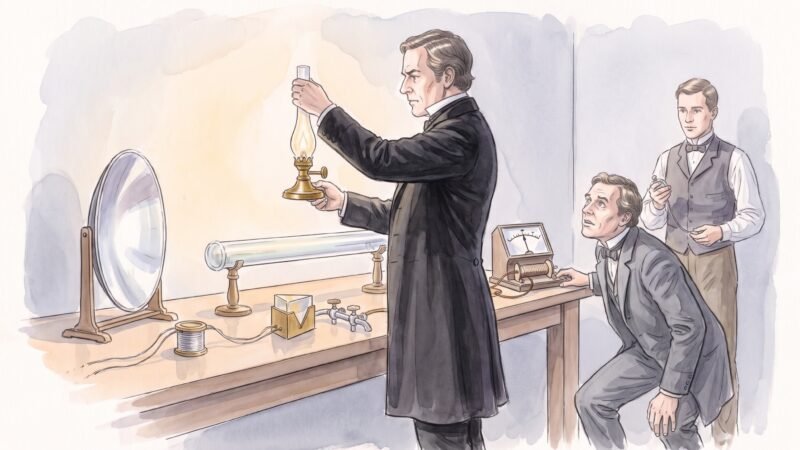
The collaboration that made the ice a scientific instrument began in 1779, when Lavoisier started working with Pierre-Simon Laplace, a mathematician of thirty years earlier than most of his contemporaries and the man who would end the century as the greatest physicist of his age. Together they refined the calorimeter, the device in which a process under study is conducted inside a vessel packed with ice and the heat it gives off is measured by how much ice melts. The definitive work, the Memoire sur la chaleur, was written after experiments carried out through the winter and read to the Academy on 28 June 1783, though the work and its consequences unfolded over the better part of four years. The joint paper Memoire contenant les experiences faites sur la chaleur, pendant l’hiver de 1783 a 1784 was published only in 1792.
That apparatus is the clue to how he worked. The ice in the cellar was not an object of study. It was a standard, a way of converting heat into mass so that heat could be weighed. And Lavoisier was a man with a balance, and now he had discovered that he could weigh heat. The region he was measuring was respiration and combustion, the two processes that consume fuel and produce warmth, and the measurements showed that a guinea pig breathing in a sealed vessel gave off exactly as much heat, for the same amount of carbon dioxide exhaled, as a candle burning under the same ice jacket. Respiration is a slow combustion. The finding was decisive, and it was not a metaphor or a theory. It was a number that could be checked by anyone with a pig and a block of ice.
Then came the decade of the octroi balance and the saltpetre works, where the real apprenticeship was served. The Regie’s business was nitre, the saltpetre from which gunpowder is made, and its making from stable refuse, urine and bloodied earth was a process he had to master on the spot. The Instruction sur l’etablissement des nitrieres et sur la fabrication du salpetre, published by the king’s press in 1777, is a practical manual born of that job. He invented a better process, drew on the nitrerie at Rosheim in Alsace that a certain Georges Muller worked with extraordinary speed, and turned a branch of the business from chronic loss into the source of the financial recovery that made his position comfortable.
There was also an experiment early in this that is easy to miss, because it sounds trivial and is not. In 1774 he showed the Academy that the residue left behind when water evaporates in a closed vessel is not water turning into earth, as the four-element scheme required, but matter that was already adhering to the walls of the container and is now simply being revealed. It matters because it is a result of the right shape, an appeal to what is actually weighed rather than to what is expected, and because Lavoisier reached it four years before his better-known arguments. He was not arguing against phlogiston from the beginning. He was testing it, in the ordinary way, and letting the balance answer.
It was in the years from 1772 that his real problem began to form. In the autumn of that year he set himself the question of combustion, and the question was inherited, not chosen. The prevailing doctrine, built on Aristotle and elaborated by the German chemist Georg Stahl, held that all bodies contained a fifth element in addition to earth, air, fire and water. This element was phlogiston: a sort of ether or principles of inflammability, soaked into every substance, which escaped when a body was burned. A burning log was losing phlogiston into the air. A metal being calcined, or roasted in air to make a white powder, was losing phlogiston and leaving behind its calx, its ash, the purer metal stripped of the principle. The system explained burning, rusting and calcination with one economical idea, and it had the enormous virtue that it was unobservable. Phlogiston could not be weighed, seen or isolated. You could only ever notice its absence.
This is the point at which the balance enters the argument as a referee rather than a measuring stick, because the system made a prediction that the balance could check, and the answer was absurd. Metals, when calcined, should lose weight, since they are giving off phlogiston. Lavoisier’s balance said the opposite. Calcined tin, calcined mercury, roasted lead: they all weighed more than the metal he had started with. Every serious chemist in Europe could see this too. What none of them would accept is the conclusion Lavoisier began to draw, that the gain in weight comes from something entering the body from the air.
He published his first results in the Opuscules physiques et chimiques in 1774, in which he reported that the mass gained on calcination is not from phlogiston escaping but from fixed air being absorbed. Fixed air, or carbon dioxide, had been put on the map by the Scottish chemist Joseph Black a few years before, and Black had shown that what is left behind when limestone is heated is not earth but this gas. Lavoisier had gone into the Arsenal and had the balance, and in 1774 he began to reproduce Priestley’s work on the gas given off by the strong heating of mercuric oxide. He had a first account of the composition of the acid formed by nitre, the Memoir sur l’existence de l’air dans l’acide nitreux, read to the Academy and dated 1776, and with it the demonstration that an acid behaves as though it contains something of the air in it, which was the germ of the idea he would call oxygen in 1779.
The friendship that broke
Nothing in the standard accounts of the chemical revolution prepares you for the fact that its central figure was the closest friend of Jean-Paul Marat. They met through the Academy. Marat was a physician in Montpelier and later Paris, published his Recherches physiques sur le feu in 1780, and on entering a contest run by the Academy for an essay on the theory of fire he sent in his manuscript and was given a commission to report on it. Lavoisier sat on that commission, and the two men became close. Marat’s book argued that fire, rather than being a substance poured into bodies, is a motion among the particles of bodies, and that the appearance of an increase in weight on calcination has to be explained by something entering the material. That was very close to the direction Lavoisier was already moving.
The Academy commission reported favourably on Marat’s manuscript in 1779. That report is the document at the centre of what happened next, and it is worth being precise about it, because the version told afterwards fits everyone too neatly. Lavoisier thought the commission had given Marat its formal approval of his conclusions, and he believed a public correction was owed, since a report endorsing the manuscript could be read as endorsing its contents. Marat read the report as endorsing the results and correcting only the theory. Each of them took the same document to mean something different, and both took it to mean what was useful to him. In the dispute that followed, Marat accused Lavoisier of holding the Academy back out of jealousy, and Lavoisier insisted that the Academy had approved the results and not the theory, which was to say that he was trying to prevent the book being used as an endorsement of a view he believed was wrong.
The disagreement hardened into something worse. Marat complained that Lavoisier’s allies on the commission, Condorcet among them, were obstructing him; Lavoisier replied that the commission’s report had been twisted. Marat’s account of the affair has always been treated more gently than it should be, and Lavoisier’s less so. Both men were doing ordinary politics inside an academy, where patronage and reputation mattered as much as evidence, and both were capable of reading an adversarial motive into the other’s evasions. The result was that two men who had been allies over the chemistry of fire found themselves unable to cooperate, and the friend who had gone out of his way to defend Lavoisier in the salon became, in the political climate of 1793, among the first to demand his arrest.
What the record does show, and show well, is the scale of what the quarrel was about in the academy of the 1780s. The Academy was the only institution in Europe where this question could be fought, because it was the only place where a man could be told he was wrong by other men of standing and have to answer. The commission mechanism that Marat had gone through was the ordinary machinery of scientific priority in the eighteenth century, and Lavoisier was on the wrong side of it as a matter of procedure as well as of substance. That is not a modern grievance about credit. It is the eighteenth-century version, running through patronage, in which a report read one way settles nothing and is the beginning of a long argument rather than the end of one.
It is also worth being fair to Marat’s book. Recherches physiques sur le feu was not a bad piece of work. Its central claim, that fire is not a substance poured into a body but a motion among the particles of the body, was wrong in the form Lavoisier would later give it and right in a way that mattered: it put the question on the body rather than on the air, and it treated the increase in weight on calcination as a real effect requiring explanation rather than an illusion of the balance. That is the same instinct Lavoisier had. The two men were circling the same problem from different assumptions, which is often the condition of a friendship between scientists that later gets reported as a feud.
There is a further claim in the later story, about which the honest answer is that the record is contested and should be presented as contested. It is sometimes said that Lavoisier claimed priority over Marat for the idea of the role of oxygen in combustion, and that this is what ended the friendship. The documentary basis for that version is thin. Lavoisier’s own published position was that his work on the gas in the air rested on Priestley’s observation, which he credited openly and without reservation, and on Black’s fixed air, which he also credited. Lavoisier was not in the habit of denying predecessors. The idea that the two of them broke over a priority claim about oxygen is most likely a later simplification, folding into one story a rupture that was really about a report in 1779 and what it did and did not say. What can be said without qualification is that they were close, that they were once close enough that Marat was a visitor at Lavoisier’s house and worked in his circle, that the commission dispute made them enemies, and that the war between them left Marat in a position to play a part, if he chose, in what happened in 1793. It is also worth saying that the rivalry was real and mutual, and that Marat’s own claims about fire were part of the live chemistry of the period rather than the delusions of a crank.
The refutation of phlogiston
The decisive work came in 1783, and it came in the form of water. Since the beginning of the century chemists had been puzzling over what happened when hydrogen, then called inflammable air, was burned. The phlogiston account said that hydrogen was rich in phlogiston, and that burning it simply drove the phlogiston out, leaving behind what was called fixed air, or the calx of water, and since a solid came out of a gas, something had to have been lost. So the two gases seemed to be the same substance, differently dressed. Henry Cavendish, in 1781 and again in 1783, had measured the outcome of burning hydrogen in air and reported that the product was not quite what phlogiston demanded. Cavendish’s own conclusion, shy and self-effacing, was that this fixed air was not simply hydrogen burnt but something else, and that the other half of the story was a mistake of reasoning. He was nearly there. What he did not do was carry it through to a conclusion that would require him to say the phlogiston account was wrong from the start.
In June 1783, Laplace and Lavoisier set out to decompose water by reversing the burning of hydrogen. They passed hydrogen over red-hot iron, expecting, on the classical account, to recover phlogiston-laden hydrogen. The gas that came out was not hydrogen. It was fixed air. Then they repeated the experiment in a closed vessel with oxygen, so that no gas could escape, and found that the fixed air and the hydrogen together made exactly the amount of water that had disappeared. The decomposition of water had been demonstrated in both directions. It was the 1783 memoir, the Memoire sur la nature de l’eau read to the Academy on 20 June 1783, and it did in fact close the question: if water is made of the two parts of air, then the increase in weight on calcination is explained by the same fact, one part of the air being absorbed and the other leaving, and phlogiston is left with nothing to do.
It is important to be fair about who found what, because the triumph narrative usually is not. Joseph Priestley made the key observation in August 1774, heating mercuric oxide with a burning glass and collecting a gas that made a glowing splint blaze up and that supported a candle burning more brightly than ordinary air. He called it dephlogisticated air, on the assumption that it was ordinary air stripped of its phlogiston. He did the same sort of experiment on nitric acid and got much the same gas. In 1772 the Swedish chemist Carl Wilhelm Scheele, working in complete obscurity in the upturned kitchen sink, had also prepared the same gas, and had also convinced himself it was his fire air, a modified form of air. Scheele’s work was not published until 1776, four years after Priestley’s, and he died in 1786, still holding his phlogiston. The French chemists recognised the debt within a few years of the publication.
And there is Richard Kirwan, who held the phlogiston cause with real energy and who deserves a particular kind of credit for being honest. Kirwan had done first-rate work, most famously on the attraction between particles, which is the direct ancestor of affinity and, in the long run, of chemical bonding. He opposed Lavoisier, and opposed him in English, in print, in the Essay on Phlogiston, which Marie-Anne Paulze translated into French precisely because her husband thought it the strongest statement of the case and wanted the argument in the best possible form. Kirwan conceded in the end, and he did so gracefully, but he conceded the theory while maintaining that the underlying chemistry still needed something like a fluid. To say that these men were wrong is to say they were wrong about a theory they had built on observations that were largely good. Priestley and Scheele had the fact and the wrong frame. Lavoisier had the fact and the right frame, and the right frame turned out to be worth more than the fact, because the frame is what let other people keep making discoveries once the old one was gone.
By the time the Traite appeared in 1789 the argument was finished in Europe, though not everywhere at once. The demonstration that oxygen was a component of air, a name he had given to dephlogisticated air in 1779 along with azote for the other part, had been carried through into the chemistry of acids: the Sur la combustion en general and the Considerations generales sur la nature des acides, both read in 1778, were his attempt to show that acidity and combustion were one process seen from two sides, and that the naming of the acids, which he had spent years on, was the naming of the oxides they were formed from. The 1785 memoir De l’action du feu anime par l’air vital sur les substances minerales les plus refractaires took the claim into the hardest case there was, the metals that no ordinary furnace would melt, by putting them into an enclosed vessel with the gas itself and heating them until the vessel softened.
That is the method, and it is worth naming plainly, because it was the instrument and not the theory that did the work. Take a closed vessel, so that nothing can enter or leave without being noticed. Put in a known mass. Heat it. Weigh it. Weigh the gas that is left. Open the vessel only when you are ready to account for every gram. A vessel sealed is a promise that the system is closed; the balance is the thing that keeps you honest about it. Every alternative account of combustion available in 1783 fails inside a sealed vessel, because phlogiston cannot be seen to leave, and the mass has to go somewhere. The experiment does not merely weigh against the old theory. It removes the conditions under which the old theory could have been true.
Naming
In 1789 Lavoisier published the Traite elementaire de chimie, present dans un ordre nouveau et d’apres les decouvertes modernes, in two volumes. It is the founding document of modern chemistry, and the argument of its first pages is that before you can have a science you have to be able to name what you are talking about. Phlogiston had defeated itself through its own vagueness. Almost every compound name in use before 1789 was an anagram at best and a contradiction at worst: sulphuric acid and sulphurous acid were the same substance in different doses, the same name applied to what was declared to be the same thing; the oil of vitriol and oil of vinegar were both sulphuric acid. A substance could be called by one man one thing and by another man another thing, and both would be entirely sincere. Lavoisier’s claim is not merely that names should be tidy. It is that a name that can mean two things prevents the reasoning that would expose the mistake. The problem was not really the words. It was that the system of names had no way of saying what was in a body, so the body could go on getting heavier for a century without anyone being able to describe what it had taken in.
The Traite contains the first real list of elements, thirty-three in number, and the definition that governs the idea ever since: an element is a substance that cannot be decomposed by any known method of analysis, which is to say a statement about the limits of current technique rather than about the nature of matter. It is a working list and Lavoisier marked it as such. He included the compound radical earth of baryta, the compound radical earth of strontites, and the earthy part of diamond as compounds because they had been shown to contain a common base, even though that base itself had not yet been isolated; and in the same passage he predicted that there must be an unknown element in that family. That prediction was silicon. He put light, caloric and the hypothetical fluid of electricity and magnetism in his table of simple bodies, and marked them as standing outside chemistry proper because they had not been shown to enter into combinations. The list was the most honest available description of the chemical world, and it was a working instrument, not a manifesto of the final elements.
The instruments of the reform had been settled in 1787 in the Methode de nomenclature chimique, prepared with Guyton de Morveau, Berthollet and Fourcroy, and published in 1789 in a longer Nomenclature chimique, ou synonymie ancienne et moderne, pour servir a l’intelligence des auteurs. The method is to name only what is known to be in a body: the binary compounds of oxygen are named from their two parts, one a radical drawn from the original name, the other oxygen, with the proportions carried by the endings, and a table of acid and gas endings gives the composition at a glance. Sulphur, phosphorus, charcoal, nitrogen, hydrogen and the metals make their names for their elements; the acids, oxides, salts and waters of those elements take their names from them, and a substance that is not a compound of a known radical is not named as if it were. The system’s virtues are structural: it makes the composition of a compound legible from its name, and it makes a false name impossible to construct. In the twenty-first century the system is still in service, in names like sulfuric acid and sulfate and sulfite.
The reforming party was not conservative about the old names. An acid formed a salt with a metal, and the salt could then be named for what it was made from and in what proportion, so that the same base appears in the same position in every name derived from it. A body that is not a compound of a known radical is left unclassified rather than given a name that pretends to knowledge, which is a piece of intellectual discipline built into the vocabulary itself. A chemist could not write down a substance he had not analysed and expect the name to reassure him.
The credit for the reform has to be shared out carefully, and the usual version is too generous. The law of conservation of mass, that in a chemical reaction the total mass of the products equals the total mass of the reactants, is Lavoisier’s, worked out from the balance evidence and stated as a principle in the Traite: nothing is lost, nothing is created, everything is transformed, a sentence he took from Anaxagoras and which under him stopped being a philosophical motto and became a physical law. The law of definite proportions, that a given compound always contains its constituent elements in the same fixed mass ratio, is largely Joseph Louis Proust’s, from his work on the proportions of copper and tin in their sulfides and other salts, done a few years after Lavoisier’s experiments and independent of his interpretation. And atomic theory owes much more to John Dalton than the triumph narrative usually admits: it was Dalton who in 1803 and after proposed that elements consist of atoms of characteristic weights and that compounds combine in whole-number ratios, which is the structure that let the later laws be generalised and quantified. Lavoisier made the language and the mass balance. Proust fixed the proportions. Dalton supplied the atoms. The system that came out of the three of them was more powerful than any of them would have built alone, and the applause has been badly distributed among them.
The tribunal
For a decade the French Revolution used him. He was a deputy for the nobility of Blois in 1789 and wrote their cahier of grievances, renouncing his particle as the reformist fashion of the moment required, and he was a deputy for Paris in the Legislative Assembly and a member of the Society of 1789. He proposed the assignat, the paper currency that financed the early months of the Revolution and then became the instrument of the inflation that helped destroy it. He chaired the commission that reported on weights and measures in March 1791, recommending the metric system that the Convention adopted on 1 August 1793, and his wife worked alongside him on the details. He served on the commission on animal magnetism with Guillotin, Bailly and Benjamin Franklin. He did the state’s work on the tobacco, on the saltpetre, on the powder, on public education, and in 1793 he tried to save the Academie des sciences from suppression, arguing in a written observation that abolishing the Academy would save nothing, since the salaries of its members would still have to be paid, and that the instruments and collections of the Academy should pass to the nation rather than be scattered. The Convention suppressed the academies anyway, on 8 August 1793.
He was removed from the weights and measures commission on 23 December 1793, with Laplace and several others, for political reasons. And by then the process that would kill him was already moving. The Ferme Generale was in ruin. Its contract had been bought up by the crown and then torn up and repudiated, and the farmers’ shares were worthless paper; the whole structure was now in the hands of men whose political survival depended on finding an enemy with money attached to it. On 8 August 1793 the Convention ordered the arrest of the farmers general. Twenty-seven of the twenty-eight were seized. The charges against them were the standard accusations against the tax system: that they had adulterated tobacco with water and with cheap filler to increase the weight of what they sold the state, and that they had taken unreasonable profits and had failed to account properly for the funds that passed through their hands. The charge of adulterating tobacco was the one that stuck, and it is the one to remember.
The trial was a formality with a result already fixed. The Revolutionary Tribunal was a special court created by the Convention, its judges appointed rather than elected and its procedures compressed to a speed that would have been shocking to the men it judged, most of whom were in their fifties or sixties. The farmers general were tried together, in batches, with the charges summarised for them and, in some cases, never formally read out at all. The evidence was rumour, secrecy and the political appetite of the court, which was openly of the view that condemning the farmers and confiscating what they had would recover a great sum for the republic. Lavoisier was convicted and executed on 8 May 1794, the same day as his trial, with his twenty-seven co-defendants.
What he was not allowed to finish was the work he had begun with Laplace on electricity and water, and what he had begun with Meusnier on the chemistry of explosions. He had also mapped his own country from a balloon, and had had the kite flown in a thunderstorm by an assistant who very nearly lost his life to it, in the series of experiments that established the electrical nature of the storm. None of it would be finished. The point of a list like that is not the length of it. It is that every entry on it was a question still open, and that his death did not close any of them down; other people closed them, from work he had set going, which is the only durable form of scientific achievement there is.
Marie-Anne Paulze Lavoisier, who had been his wife for twenty-two years, his illustrator, his translator and his instrument-maker, took the story forward alone. She organised the publication of his last memoirs, the Memoires de physique et de chimie, which carried the argument of the new chemistry to a readership that had to be convinced of it. In the copy she prepared, her preface was an attack on the revolutionaries and on Lavoisier’s contemporaries, whom she held responsible for his death; it was left out of the printed volume, but the campaign itself was not stopped by that. She petitioned, pressed for the record to be corrected, and got the acknowledgment that came a year and a half after the blade: a formal exoneration of the farmers general by the French government. He was not brought back. But his widow had his name made clean, and the science he had made was by then being used by people who had read his book.
The tragedy is not that his work died. It did not. Within a decade of his death the new chemistry had carried out the predictions of the nomenclature, the mass balance was the ordinary assumption of every laboratory in Europe, and the elements on his list of thirty-three had begun the long business of being taken apart and replaced by better ones. The tragedy is narrower and harder. The man was destroyed in the same months in which his system became the truth. He was not executed by an ignorant state fighting a science it had never heard of. He was executed by a state that had used him, admired him, consulted him and asked him to save its academies, and that took his life in the same year its new commission put the metric system into force. He died believing that the Academy had been working for his chemistry, and it was. It was working for it the day he was sentenced, and it would go on working for it because he had made the work communicable. A science that had to be defended by one man’s reputation was a science that would die with him. Lavoisier’s system was built so that it would not. That is the highest thing that can be said for a piece of science, and it is exactly what made the manner of his death so hard.
References
- Antoine Lavoisier - Wikipedia, Wikimedia Foundation, accessed 22 October 2026
- Antoine Lavoisier - Wikipédia en francais, Wikimedia Foundation, accessed 22 October 2026
- Jean-Paul Marat - Wikipedia, Wikimedia Foundation, accessed 22 October 2026
- Marie-Anne Paulze Lavoisier - Wikipedia, Wikimedia Foundation, accessed 22 October 2026
- Ferme generale - Wikipedia, Wikimedia Foundation, accessed 22 October 2026
- Phlogiston theory - Wikipedia, Wikimedia Foundation, accessed 22 October 2026
- Law of definite proportions - Wikipedia, Wikimedia Foundation, accessed 22 October 2026
- Joseph Priestley - Wikipedia, Wikimedia Foundation, accessed 22 October 2026
- Pneumatic chemistry - Wikipedia, Wikimedia Foundation, accessed 22 October 2026
- Antoine Lavoisier, French chemist and administrator - Encyclopaedia Britannica, accessed 22 October 2026
- The Trials of Lavoisier - Science History Institute, Magazine
- Antoine-Laurent Lavoisier: A Scientific Biography - Science History Institute
- Le salon et le laboratoire de Lavoisier a l’Arsenal, cenacle ou s’elabora la nouvelle chimie - Claude Viel, Revue d’histoire de la pharmacie, 1995
- A propos d’une lettre de Fourcroy a Lavoisier du 3 septembre 1793 - Revue d’histoire des sciences, 1962
- Jean Paul Marat: Scientist and Revolutionary - Clifford D. Conner, Humanities Press, 1997, Wellcome Collection catalogue record
- Memoir on Heat - Antoine Laurent Lavoisier and Pierre Simon Laplace, 1780, Google Books record