The Pursuit of Science in Revolutionary France
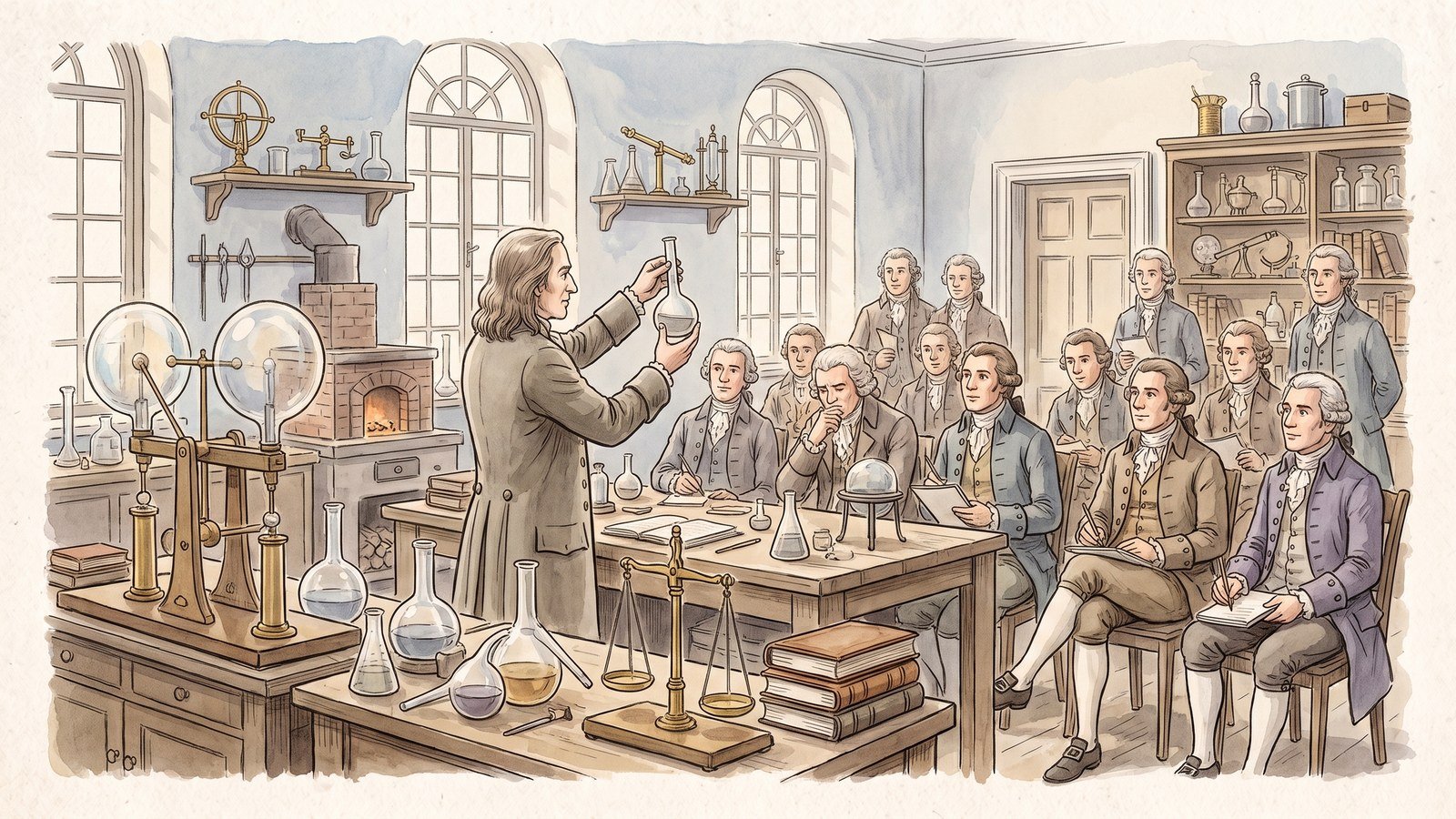
On the morning of 8 May 1794 a wagon drew up at the Place de la Revolution in Paris, and among the prisoners taken from the Conciergerie that day was a man who had spent his life rebuilding the language of chemistry. He was fifty years old, he was mayor of a small town, and he had not been tried for anything he had written or published. In the crowd a man recognised him and asked what he had done. “Nothing,” he is supposed to have replied, and the answer has been repeated ever since as the emblem of a science murdered by a state. It is a good line. It is also the most convenient thing anyone has ever said about the French Revolution, and this decade deserves better than it.
The abolition of a kingdom of letters
The institution that had just been abolished was not a university. An academie in the eighteenth-century French sense was a small, fixed, salaried body of experts who met on a settled day in a settled room, read papers aloud to each other, ran long commissions on problems the government put to them, and advised the crown. The Academie royale des sciences had been created by Colbert in 1666 and held its first meeting on 22 December 1666 in the King’s Library. It received its formal regulations from Louis XIV in January 1699, when it numbered seventy members and eighty-five correspondents. By 1785 it had grown to eight classes: geometry, astronomy and mechanics on one side; anatomy, chemistry and botany on the other; with classes of general physics and of natural history and mineralogy added in the last decade.
It was, in other words, closer to a research council with a teaching function than to anything the modern word suggests. It had no students. It had no examinations. Its members were elected by their peers, lived on state money, and met in private. And in the early 1790s it was doing serious state work: when the Assembly ordered a general reform of weights and measures, the Academy immediately appointed five commissions for the job. Cassini, Mechain and Legendre took the astronomical measures; Meusnier and Monge were to measure terrestrial bases with rigorous precision; Borda and Coulomb were to settle the length of the seconds pendulum; Lavoisier and Haüy were to determine the weight of distilled water; and Tillet, Brisson and Vandermonde were to map the whole tangled inheritance of old measures.
The first pressure came in August 1792, and it came from inside. On 11 August, the day after the Tuileries was taken, the chemist Fourcroy asked that the list of academicians be read aloud in the session so that names could be struck off it. The proposal was rejected. He returned eight days later with a better argument: the Society of Medicine, he pointed out, had already struck several of its own members who had emigrated or were notoriously convicted of incivism, and asked for the same treatment. The Academy’s answer is one of the best sentences ever produced by a learned body under pressure: it must take no cognizance of the principles or opinions of its members, the progress of the sciences being its only occupation. Fourcroy shifted ground and asked that the rule allowing the exclusion of members absent for more than two months be applied. The decision was deferred. On 5 September he pressed once more, and the Academy resolved that until the minister had answered, its secretary would deliver no list and none would be printed. The energy of its unanimity defeated the zeal of its most aggressive member.
But look closely at what Fourcroy was actually asking for. He was asking for the list. And lists are what tribunals want. Underneath the procedural quarrel sat a belief that was widely held in Paris in the summer of 1792 and was never much discussed in print: that learned men, living on state salaries, corresponding in a private international network of learned men, and accustomed to advising governments rather than addressing citizens, formed a kind of second power running beneath the Republic. The charge did not need to be elaborated, because it did not need to be true. It needed only to be plausible, and it never needed to be proved. Being absent from one’s seat for two months was enough of a pretext.
The officials did not have to theorise. They could simply watch. At Essonnes on 4 September 1792, a detachment of the National Guard turned up during a perquisition of the surrounding chateaux after rumours of treason, and took Joseph Delambre and three colleagues, who were working at the time on the geometric measurement of the meridian. Delambre’s passport said he was charged by the National Assembly with measuring the meridian arc from Dunkirk to Barcelona. One of the men said the passports had expired, or rather that the authority which had issued them had expired, because in the intervening four months the people had risen, the king had been deposed and France had become a republic. Delambre then invoked the Academy. “There is no longer an Academy,” the man told him. “Everyone is equal.” They were held overnight at the inn of the Bear at Lagny with sentries on the doors, and the prosecutor of the district had to order Delambre to spend the next night inside the town hall for his safety. On 7 September the Legislative Assembly, apparently seeing the point, made Delambre and Mechain the official envoys of the government of the people and ordered local authorities to help them.
The laws came next, and they came fast. A first decree of the Convention suspended all appointments to vacant Academy places on 18 November 1792. On 17 May 1793 a new decree allowed the vacant seats to be filled provisionally. Then, on 8 August 1793, twenty-one thermidor of the first year, after a speech by the abbe Gregoire, the Convention decreed the suppression of all the royal academies. Gregoire called them the kingdom of letters. On 15 September the Convention went further and suppressed all the universities. What the August decree did was not merely to shut a building. It abolished a legal status. The men who had held it were no longer academicians, public officers, men with a place in the constitution of knowledge. They were private individuals who happened to own instruments, be paid a pension, and have corresponded with foreigners.
Lakanal, who defended the Academy’s interests in the committee of public instruction, tried to limit the damage. On his motion it was decided that members should be allowed to meet, without official title, in their usual room, to deal with whatever the Convention referred to them. The academicians judged it prudent not to take advantage of the tolerance. They dispersed, most of them trying to be forgotten. Not all of them managed. Several were overtaken by the revolutionary tribunals in their retreat. A few, Berthollet among them, stayed in contact with the Committee of Public Safety in order to hold the rights of science.
Two men from that circle died. Jean Sylvain Bailly, who had been president of the Academy, had helped compute the Republican calendar and had commanded the astronomers of the Paris Commune, was guillotined on 12 November 1793. Antoine Lavoisier was guillotined on 8 May 1794. A third, the naturalist Lamanon, is the hardest to account for, and the honesty of a telling story depends on saying so: the sources that are voluminous for the other two are thin for him, and what they record of his fate after 1793 is a matter of inference rather than of trial. Lavoisier left papers, Bailly left correspondence, Lamanon left a name.
So the charge at that moment was not, in any precise sense, that these men were conspiring against the liberties of the people. It was that they belonged to a corporation. They were privileged, self-selecting, paid by the state, and answerable to nobody outside their own rooms. In the new France, that was enough. It would be two years and three months before the Republic passed a law creating an Institut national des sciences et des arts, and the men who had just been scattered would reappear inside the new body. The men who had been killed would not.
The Republic builds its own science
Reconstruction began while the Terror was still running. The Conservatoire national des arts et metiers was founded in Paris on 19 vendemiaire of the third year, 10 October 1794, by the abbe Gregoire, with the stated purpose of perfecting national industry. It is still open, still a grand etablissement of higher education and research, still teaching engineers and serving several tens of thousands of students a year from its buildings in the former priory of Saint-Martin-des-Champs. It was one of three creations of the Revolution intended to promote science and technique, and the other two were founded within a few weeks of it.
Those other two were the Ecole normale superieure and what became the Ecole polytechnique. The normal school was established by decree of 9 brumaire of the third year, 30 October 1794. The polytechnic school, which began as an Ecole centrale des travaux publics, was officially created on 7 vendemiaire of the third year, 28 September 1794, and opened its doors to students on 21 December that year; a year later it was renamed the Ecole polytechnique. The three foundations were meant to do different things. The normal school would train the men who would in turn train the country. The polytechnic school would train engineers and officers, and within a few months it had four hundred students of mixed attainment, taking what were called revolutionary courses in physics, mathematics and chemistry in a single term before sorting them into those who would enter the civil service directly and those who would stay. The Conservatoire would teach the trades, at a level of rigour nobody had previously thought to apply to them. There was also the Bureau des longitudes, which Gregoire helped found and under whose authority the Paris Observatory was placed; in 1798, when the survey finally came home, Delambre was made the Observatory’s director.
Then, on 22 August 1795, the Republic created the Institut national des sciences et des arts. An institut was a corporation again, but a different kind of one: the old academies had been a single body of learned gentlemen divided into classes for internal convenience, whereas the Institut was a single academy of the whole republic, divided into three classes, with salaried members who lived in the same building, worked in the same committees and were responsible to the same state. The first class, of physical and mathematical sciences, was by far the largest, with sixty-six of the one hundred and forty-four members. By 1805 the whole body had moved into the old college of the Quatre-Nations, which is still called the Palais de l’Institut, and where it remains.
The point of the Institut was not only to do science. It was to make science legible to the state. The old Academy had advised the king when the king asked. The Institut reported on the currency, on weights and measures, on public health, on the reform of the calendar; it ran the great contests and prize programmes; and after 1835, under the driving insistence of Francois Arago, it published the Comptes rendus, a rapid-fire journal that made new discoveries public within weeks and turned an internal memo into a claim to priority. That journal is still the journal of the Academie des sciences, which survived as a distinct body inside the Institut by royal ordinance of 21 March 1816.
What had changed most was teaching. Before 1789 the professions were learned in corporations: guilds, faculties, seminaries, the Academy itself. Membership of the Academy was a lifetime appointment held by a man of means who lived in Paris. After 1789 the Revolution abolished the corporations, and with them the legal architecture that had kept learned men a separate estate. In their place came appointment to a public post by competitive examination, on a salary, at a fixed institution. The word the normal school gave to its successful students is still with us, and the description still fits: a normalien is a French civil servant. So does the consequence. Scientific and technical work in France became, in the space of five years, an occupation of state employees rather than of amateurs, dilettanti and gentlemen. That is the part of the Revolution’s settlement that turned out to be permanent, and it is not a small thing. It is the origin of the modern research scientist as a job rather than a hobby.
The institutions of 1794 and 1795 are still here. The Conservatoire national des arts et metiers trains engineers to this day. The Ecole polytechnique, founded by the mathematician Gaspard Monge, moved to Palaiseau in 1976 and still has to this day a military character, with its students still officer cadets under the supervision of the French ministry of the armed forces. Four normal schools survive in France, in Paris, Lyon, Paris-Saclay and Rennes, and a fifth, the Scuola Normale Superiore in Pisa, has been in continuous existence since Napoleon founded it in the same years.
Measuring the republic
The clearest thing the new state did for science was not an institution. It was a number. In 1790 the Assembly ordered the Academy to prepare a general reform of weights and measures, and out of that order grew the French Geodesic Mission: the survey of the meridian arc from Dunkirk, in the far north of France, to Barcelona, in Spain, from which a ten-millionth part of the quarter meridian would be taken as the new unit of length. The technique is worth explaining. You cannot measure a distance on the earth’s surface by laying a chain along it, because hills and valleys are in the way. So you measure flat triangles. You lay out a known straight baseline on level ground, one leg of a long isosceles triangle, measure its two base angles with a telescope, and that fixes the shape of the triangle and therefore the other two sides. Chain triangles to chain triangles and you have a network stretching hundreds of kilometres, and the length of each line falls out of the shape of the net rather than out of any direct measurement. Only one distance has to be measured with chains and rods, and everything else is geometry.
That is exactly how the mission worked. The meridian ran on a chain of 115 main triangles from Dunkirk to Barcelona, resting on two measured baselines of about twelve kilometres each, one between Lieusaint and Melun in the Seine-et-Marne and one near Perpignan, which was measured across to Salses and came out at 6,006 toises, 25 lignes, or 11,706.40 metres in modern conversion. Five main stations carried the astronomical work, which is what actually turns angles into distance: Dunkirk, the Pantheon in Paris, Evaux south of Montlucon, Carcassonne, and Montjuic at Barcelona. The instruments were the repeating circle, a heavy brass wheel with a graduated rim and two sighting telescopes that could be read against the rim repeatedly without losing their place, so that ten separate readings of the same angle could be averaged and their errors divided down. Etienne Lenoir made four of them in May 1792, and the design was good enough that the Service geographique de l’armee was still using those circles in the 1930s.
The work was divided unequally for a reason that tells you something about the politics of measurement. Delambre took the northern stretch, from Dunkirk to Rodez, some 380,000 toises. Mechain took the southern stretch from Rodez to Barcelona, some 170,000 toises. The split was not equal because the French part of the meridian had already been surveyed twice by Cassini, while nothing at all had yet been done in the Spanish part.
What makes the mission extraordinary is not the geometry. It is the six years it took, and what happened in between. It began in June 1792, months before the Republic. It was interrupted almost at once, as we have seen, by a detachment of National Guardsmen who suspected Delambre of being a Prussian spy. It was interrupted again by the dissolution of the Academy, and by the Terror. Delambre’s sixty-four-foot signal tower at Chatillon, raised between Pithiviers and Orleans so that a telescope could see over the flat, wooded country, drew denunciations to the revolutionary committee at Boiscommun: locals reported seeing three or four hundred brigands building scaffolding and drilling into a church tower. In a letter written from Pithiviers on 13 December 1793, Delambre warned Lavoisier that the revolutionary committee had asked for five or six hundred men to reduce them. Lavoisier had been in prison at Port-Royal for five days already. Delambre was stripped of his post on the temporary commission for weights and measures and ordered to stop and surrender his instruments and registers; he carried on regardless, with the backing of Prony, and the 1793 campaign ended on 24 January 1794. The law of 18 germinal of the third year put the survey back on a legal footing, and the northern section resumed work on 28 June 1795, was interrupted by an epidemic at Vouzon that December, and was finished in the autumn of 1797.
The southern section was worse. Mechain was nearly killed in April 1793 when a water pump he had been watching blew its handle and threw him against a wall, breaking his collarbone and several ribs. Spain joined the coalition against France that spring, and after the Spanish declaration of war the Spanish authorities would not let him back across the border, on the stated ground that what he and his assistants knew might be useful to Spain. He stayed in Barcelona, and did the only thing available to a man with an instrument and no permit: he re-measured the latitude of Montjuic, the southern end of his own triangulation. He got two answers four seconds of arc apart, which over the short distance he was using them to measure was an error of five per cent, and over the whole meridian was nothing. He could have reported it. He hid it, told nobody, including his own assistant Tranchot, and it ate at him for the rest of his life.
Delambre confronted the mess in 1798, when the two halves were joined. He had to choose one of Mechain’s two Montjuic results and build the metre on it. He chose one, and wrote a note saying he would not inform the public, because the public did not need to know. Then Mechain, who reached Genoa at the end of September 1794 and sat out the executions of Bailly, of Saron and of Lavoisier before finally embarking for Marseille in 1795, finished his southern triangles in September 1798. In late November 1798 he and Delambre came back into Paris together, Mechain for the first time since June 1792, and found that a delegation of foreign savants had been waiting two months to examine and approve the whole business.
What came out of it became law. The metre was defined as one ten-millionth of the shortest distance from the North Pole to the equator running through Paris, on a specific assumed flattening of the earth’s surface. That definition rested on a figure for the earth’s shape that turned out to be slightly wrong, so that a metre defined by the same reasoning today would be very slightly different from the metre the commissioners actually produced. It was, nevertheless, close enough for the purposes of the Republic, and the standard they made, a platinum bar known as the metre des Archives, was good enough that it remained the French standard until 1889, when it was replaced by a platinum-iridium bar and twenty-nine calibrated copies were distributed to other nations. In 1875 the metre was written into an international treaty, the Metre Convention. Two hundred and thirty years on, the SI unit of length is still defined within a fraction of a per cent of what Delambre and Mechain measured with brass circles on church towers.
The method mattered more than the number, because it became a template. The chain of triangles did not stop at Barcelona; it was carried on into the Balearic islands, and France was later geodetically joined to the networks of Spain and of Britain, so that a single coordinate system could span the continent. This is the state’s idea of science at its best: not an individual insight but a permanent apparatus, publicly funded, open to anyone with the training to use it, whose value is that everyone is measuring the same thing. The chemical reform went the same way, through Lavoisier’s commission on the weight of distilled water and through the tables the other committees assembled until every existing unit in France had been traced back to a defensible standard. The chemical language that Lavoisier rebuilt in the years before his arrest became, in his lifetime, an administrative instrument.
What the state pays for
It would be nice to say the Republic simply funded science out of love of learning. It funded science because it wanted things from science, and the wanting shaped what got done. The most obvious example is the metre itself. A committee could have published a value and left it to philosophers to argue about. Instead the value was legislated, and legislated means that it had to be produced on schedule, by a fixed procedure, with a standard artefact to point at, because every trade in France was about to be obliged to use it. That is what happens when a scientific result acquires a constituency. It gets wanted.
The chemical reform had the same character. Lavoisier and his colleagues did not set out to serve an industry. They set out to determine, by exact experiment, the composition of water, and the specific gravity of distilled water was chosen as the standard against which everything else would be weighed because the commissioners needed a weight that did not depend on any particular substance. But once the Academy had chosen it, the whole apparatus of the state had to be rebuilt around it, and the neatness that made the chemistry compelling became a compliance schedule.
It is worth noticing that the old Academy had seen the danger and had tried to refuse it. When consulted about war engines, it invoked its mission of peace. When consulted about the burning subsistence question, it retreated behind results it had established earlier and declined to advise on what to do. Those are not responses from a body eager to serve. They are the responses of an institution that understood it was being asked to convert knowledge into policy, and that knew the conversion was where things went wrong. The Institut of 1795 was built by men who had watched that, and who built it anyway, because the Republic’s need was real and the old academy’s caution had not stopped anything from happening.
The deeper contradiction was not about method. It was about who the scientists were. The men of the Revolution’s own scientific establishment were not persecuted hermits. Lavoisier was one of the richer men in France: he held a share in the tobacco farm, the tax-farming company whose agents the revolutionaries had come to hate, he drew a substantial salary from his Academy post, and he owned a house on the rue Richelieu with a laboratory in it. The tribunal that condemned him was not a tribunal that hated science. It was a tribunal that hated a class, and he belonged to it. To say that the Revolution killed Lavoisier for his chemistry is to get the chemistry exactly backwards. To say that it killed him for nothing is to get him exactly right.
And there was no clean side. When the Institut was created, its members were elected by their peers, but they were salaried public officials, they lived in a state building, and their function was to advise the government. Berthollet, who had been an Academy member before 1793 and who stayed on its books through the Terror, spent the worst years keeping in contact with the Committee of Public Safety in order to maintain the rights of science. Read generously, that is a scientist defending his institution against a state that had just abolished it. Read coldly, it is a scientist learning where power is, in order to preserve what he values. Both readings are true, and the second is the one that the new institutional order made normal.
The state’s commitment was also, plainly, contingent. The clearest proof is in the survey itself: in December 1793 the state revoked Delambre’s post, told him to stop, and demanded his instruments and registers. Two years later the same state passed a law to restart the same work. Whatever continuity existed between the two states was not ideological. It was that a survey of the meridian was useful, and usefulness outlived the government that had begun it. That is a more modest foundation for the modern research system than the revolutionaries intended, and it is probably the one that holds.
What is missing from this account, and should be said plainly, is that the Revolution also ended things that were bad: the censorship of the academies’ memoirs, the requirement that a man be acceptable before he could be elected, the venality of the old offices, the exclusion of most Frenchmen from any share in the institutions that measured the world. When the Institute of 1795 gave its sixty-six-member first class the whole of scientific France in one room, that was a democratisation as well as a centralisation, and the men who crowded into it included men of modest birth who had no chance of the old Academy. The contradiction of the Revolution’s science is not that it was good or bad. It is that the same set of hands that built the apparatus killed one of its makers, and both halves of that sentence are the same fact.
Empire: science as conquest
On 19 May 1798 a fleet of more than four hundred ships left Toulon with fifty thousand men and ten thousand sailors, bound for Egypt, whose aim was to cut Britain’s road to India and to knock a knife out of the Ottoman Empire’s alliance. It took Malta on 11 June, landed at Alexandria on 1 July, won the battle of the Pyramids on 21 July, and was shattered by the British at Aboukir days later. It would leave in 1801 having failed at Acre. What the campaign left behind was not a province but an institution. On 22 August 1798, in the palace of Hassan-Kashif outside Cairo, Napoleon Bonaparte founded the Institut d’Egypte on the model of the Institut de France, with a mission to advance and disseminate the Enlightenment in Egypt. It held its first sitting on 23 August, Monge in the chair and Bonaparte as vice-president, Joseph Fourier as secretary and Costaz as deputy; it held its sixty-second and last sitting on 22 March 1801. It was divided into sections for mathematics, physics, political economy, literature and arts. It carried two printing presses to Egypt, one of them using Arabic type that Monge had seized at Rome from the pontifical congregation of the Propaganda Fide during the Italian campaign. Between 29 August 1798 and 20 June 1801 it published the Courrier de l’Egypte, a newspaper of selected news for the expeditionary forces, and from 1 October 1798 to 31 March 1800 a learned journal, the Decade egyptienne, carrying the members’ memoirs.
What came out of that machinery afterwards was the Description de l’Egypte, and it is the most impressive single act of scientific patronage in the history of the subject. On 6 February 1802 an order declared that all the memoirs, plans, drawings and, in general, all results relating to the sciences and arts obtained during the Egyptian expedition would be published at the expense of the government, arranged in four parts: antiquities, the modern state, natural history, and geography, that last part being detailed maps and being held back for strategic and political reasons. On 18 February 1802 the minister of the interior appointed a permanent commission of eight members to see the work through, with the government’s commissioner held first by Conte, then by Lancret, and from 1807 by Jomard, who ran it for the better part of twenty-five years. Berthollet presided. Fourier and Monge sat on it. Twice a month the savants examined the material and voted on whether to publish it, so that the editorial process was a trial by peers of everything in the book. The original papers went to the Bibliotheque nationale de France.
Publishing it was itself a feat of industrial ingenuity. The volumes needed plates on a scale nobody had attempted, and the answer was to improve the manufacture of vellum paper and to build presses of an unusual size, which turned out to be faster and cheaper as well as bigger: they got to a hundred plates a year where the trade had been doing far fewer. Fourier, who wrote the preface, said that skies and backgrounds could now be engraved with a machine that replaced long and expensive hand work, and that the execution surpassed what the best-trained artist could achieve. The finished work runs to ten volumes of text and thirteen volumes of plates: nine text volumes covering antiquities in two descriptive and two memoir volumes, the modern state in three, and natural history in two; a thousand or so engraved plates in twelve volumes at four different formats, sixty-two of them in colour; and a geographic atlas of fifty-three plates at a size that has to be seen to be believed. The first, imperial edition came out in instalments between 1809 and 1829. Then in December 2011 a fire in the building that housed the Institute’s library destroyed some two hundred thousand items, including eight volumes of the Description itself. The originals were in Paris. The copies were not.
The collecting was where the science stopped being science. The armistice of 1801 obliged the French to hand over what they had gathered, and the British general John Hely-Hutchinson struck out the article that would have let the Institut d’Egypte and the Commission des arts take away their papers, plans, memoirs, natural history collections and all their monuments of art and antiquity. What followed was a quarrel conducted by two generals with two sets of savants behind them, and the Rosetta Stone was the object of it. Menou, the French commander, said at one point that he had bought the stone with his own money and that it could not therefore be a prize of war, then suggested it had already been shipped to France, then threatened to burn everything the savants had collected or throw it overboard. In the end the French kept their notes and their specimens, and seventeen of the most important objects, the Rosetta Stone among them, became British Crown property. The rest of the collections did reach France, and the Louvre made a separate department of Egyptian antiquities by ordinance on 15 May 1826 to house them.
That is the shape of it. The expedition produced a founding document of Egyptology, a twenty-year printing programme that improved French engraving and paper manufacture, and a set of monuments moved out of the country that had held them for three thousand years, in a war whose stated purpose was to strangle British trade. No account of the eighteenth-century republic that stops at the Institute and the schools is incomplete, because it leaves out that the Republic’s best-funded scientific enterprise in its costliest decade was also an army of conquest with a survey department attached.
What happened next was the reaction, and the reaction was not simply a purge. The students of the Ecole polytechnique had fought in the defence of Paris in 1814, and in 1816 the restored monarchy cut the school down to about seventy-five students and abolished the course in military arts. In 1817 Louis XVIII took the school out of the army altogether and put it under the ministry of the interior, which was the Restoration’s way of saying it was no longer a military institution. Fifty of the school’s students were in the streets for the July Revolution of 1830, and after various decrees and a great deal of argument the school went back under the ministry of war in 1832, regaining its military character. In 1816 the Academy of Sciences itself was restored by royal ordinance as a separate body inside the reformed Institut, with the head of state as its protector. So the reaction destroyed the political form of the Revolution’s science and kept almost all of its apparatus: the same schools, the same observatory, the same journal, the same standard metre, the same series of national maps. The one thing it would not keep, for a while, was the idea that a school for engineers ought to be run by the interior ministry.
What lasted
Ask what the Revolution gave to science and the honest answer has two halves that do not reconcile. In the space of five years it created the institutions of modern French science: a national academy of salaried research appointments, a set of grandes ecoles that turned science into a profession, a teaching establishment that trained teachers to train everyone else, a school of trades run at the standard of a university, an observatory, a longitude bureau, and a state that legislated what a metre was. Every one of those still exists in recognisable form. The normal school of 1794 is now four schools, one of them mirrored by one Napoleon founded in Pisa in the same decade. The polytechnic school is still run by the French defence ministry and its students are still officer cadets. The Conservatoire national des arts et metiers still teaches engineers out of a medieval priory in the rue Saint-Martin. The Institut still sits in the Palais de l’Institut. When Arago began printing the Comptes rendus in 1835 he was publishing the results of the working of the body created in 1795. Nobody has ever had to argue about whether the French state should fund this, because that argument was settled, once, in 1795.
The other half is that in the same decade, in the same months, the same state executed two of the men who had built that apparatus’s predecessor, on charges that had nothing to do with their work. Bailly was guillotined on 12 November 1793 and Lavoisier on 8 May 1794, and the Academy they belonged to was formally erased from French law on 8 August 1793. The Republic that funded the survey of the meridian, the metric system and the Description de l’Egypte is the same Republic that sent Lavoisier to the guillotine. Not a successor regime, not a rival faction: the same government, in the same constitutional continuity, inside eighteen months.
It is tempting to resolve this by saying the Terror was an interruption, or an accident that the Revolution’s own institutions failed to prevent. Neither is quite honest. The Terror was those institutions, at full strength, with the Assembly and the Convention in continuous session, applying a law the Assembly had written. And the men who rebuilt science after it did not do so in defiance of what had happened. Berthollet, one of the survivors, was on the committee that sent the Description de l’Egypte to press. Laplace, Laplace’s students, Monge, Fourier, Arago: the apparatus was built by the same generation that had seen the guillotine take its predecessors, and most of them had been inside the Academy when it happened.
So the question the episode poses is not whether to admire or condemn the Revolution, which is not a question about science at all. It is what is owed to a political movement that simultaneously paid for the measurement of the earth and murdered the man who had done as much as anyone to make chemistry a discipline; that legislated the metre and abolished the academy; that produced, within one decade, the institutional base of almost every scientific career that France has had since. The honest answer is that the debt and the injury are not separable, and that pretending otherwise in either direction is a way of not thinking.
There is one detail that stays with me, from a letter written from Pithiviers in December 1793 by a man with a telescope, a signal tower and a revolutionary committee coming for him. Delambre did not write about the weather, or about the partisans, or about the men who had shot his colleagues the previous month. He wrote to Lavoisier to explain that the villagers had reported seeing brigands building scaffolding, and that the committee had asked for six hundred men to come and reduce them. It was the dryest possible way to say: the instruments are packed, the registers are full, the work is not finished, and I will need them again. The Republic had killed the man who could have finished it, and two years later it went on paying for the survey anyway. That is not a paradox. It is the ordinary shape of institutions, which are built to outlast the people who make them and the people who destroy them. Lavoisier was not on the chain of triangles, and he would not have cared to be. He cared that the measurement be right.
References
- Academie des sciences (France) - Wikipedian contributors, Wikipedia, retrieved 22 October 2026
- Abbe Gregoire - Wikipedian contributors, Wikipedia, retrieved 22 October 2026
- Institut d’Egypte - Wikipedian contributors, Wikipedia, retrieved 22 October 2026
- Description de l’Egypte - Wikipedian contributors, Wikipedia, retrieved 22 October 2026
- Campagne d’Egypte - Wikipedian contributors, Wikipedia, retrieved 22 October 2026
- Pierre de Rosette - Wikipedian contributors, Wikipedia, retrieved 22 October 2026
- Mesure de la longueur du meridien terrestre par Delambre et Mechain - Wikipedian contributors, Wikipedia, retrieved 22 October 2026
- Ecole normale superieure - Wikipedian contributors, Wikipedia, retrieved 22 October 2026
- Conservatoire national des arts et metiers - Wikipedian contributors, Wikipedia, retrieved 22 October 2026
- Ecole polytechnique - Wikipedian contributors, Wikipedia, retrieved 22 October 2026
- Institut de France - Wikipedian contributors, Wikipedia, retrieved 22 October 2026
- History of the metre - Wikipedian contributors, Wikipedia, retrieved 22 October 2026
- Antoine Lavoisier - Wikipedian contributors, Wikipedia, retrieved 22 October 2026
- Jean Sylvain Bailly - Wikipedian contributors, Wikipedia, retrieved 22 October 2026