The Tongzhi Restoration and the Contradictions of Imperial Revival
In the tenth lunar month of the tenth year of the Xianfeng era—November 1860 CE—the Great Qing Empire appeared to be gasping its final breaths in the ash of its own civilization. In the northern suburbs of Beijing, the magnificent imperial palace complex of the Old Summer Palace (Yuanmingyuan, 圆明园)—the ‘Garden of Perfect Brightness’, containing the accumulated artistic, architectural, and literary treasures of five dynasties—had been systematically looted and torched by Anglo-French expeditionary troops under Lord Elgin and General Montauban. A colossal pall of black smoke hung over Beijing for three days, blotting out the autumn sun.
The thirty-year-old Xianfeng Emperor (咸丰帝, r. 1850–1861 CE) had fled the capital in panic, abandoning his ancestral temples to take refuge in the cold mountain retreat of Chengde (Rehe), where he drowned his despair in heavy opium smoke and terminal illness. In the south, along the banks of the Yangtze River, an even more terrifying catastrophe was consuming the empire: the millenarian Taiping Heavenly Kingdom (太平天国) of Hong Xiuquan, which had established its revolutionary rebel capital at Tianjing (Nanjing), controlling the wealthiest grain and tax provinces of China and having already cost the lives of an estimated twenty to thirty million people. Besieged by Western industrial gunboats from without and torn apart by the largest civil war in human history from within, European observers and Chinese scholars alike agreed upon a single, grim prognosis: the Qing Dynasty was finished.
Yet, out of the smoking ruins of 1860, there emerged one of the most astonishing political resurgences in Chinese imperial history: the Tongzhi Restoration (同治中兴, Tongzhi Zhongxing, 1861–1875 CE). Catalyzed by the dramatic Xinyou Coup d’État (辛酉政变) of November 1861—which brought the twenty-six-year-old Empress Dowager Cixi (慈禧太后) and the brilliant, reform-minded Prince Gong (Yixin 奕訢, 1833–1898 CE) to supreme power—the Qing state engineered a decade and a half of extraordinary administrative, military, and diplomatic revival.
Empowered by a triumvirate of towering Han Chinese scholar-statesmen—Zeng Guofan (曾国藩), Zuo Zongtang (左宗棠), and Li Hongzhang (李鸿章)—the Qing state accomplished military miracles. Zeng Guofan’s private Xiang Army stormed Nanjing in July 1864, annihilating the Taiping insurrection; Zuo Zongtang pacified the Nian guerrilla rebellion across the Central Plains and subsequently led a legendary military expedition across the Gobi Desert to reconquer Xinjiang from the warlord Yakub Beg; while Li Hongzhang forged modern arsenals, steamship fleets, and telegraph networks under the banner of the Self-Strengthening Movement (洋务运动).
Yet the tragedy of the Tongzhi Restoration was that its very success was built upon an insurmountable, fatal intellectual paradox. As the pioneering American historian Mary Clabaugh Wright famously demonstrated in her seminal 1957 masterpiece The Last Stand of Chinese Conservatism, the architects of the Restoration attempted to achieve an impossible historical alchemy: they sought to preserve an ancient, conservative Confucian agrarian moral order using the industrial, military, and institutional weapons of the modern capitalist West.
Governed by the philosophical formula ‘Chinese learning for the fundamental substance, Western learning for practical utility’ (中学为体,西学为用), the late Qing court believed it could purchase European ironclad warships and Krupp cannons while preserving the autocratic examination system, the Confucian social hierarchy, and the corrupt fiscal structures of the imperial court. When the ultimate military test arrived in 1894—the First Sino-Japanese War (甲午中日战争)—the modernized military of Meiji Japan completely obliterated Li Hongzhang’s Beiyang Fleet in a matter of months, exposing the Tongzhi Restoration as a gilded twilight illusion that could postpone, but never prevent, the final collapse of imperial China.
This monograph presents an exhaustive institutional, political, military, and philosophical history of the Tongzhi Restoration and the limits of late Qing conservatism. We will analyze the catastrophic crisis of 1860 and the Machiavellian mechanics of the 1861 Xinyou Coup d’État; explore the classical Confucian ideology of Zhongxing (Restoration); examine the statecraft, moral philosophy, and military organization of Zeng Guofan, Zuo Zongtang, and Li Hongzhang; trace the rise of the Zongli Yamen and modern industrial foundations (the Jiangnan Arsenal, Fuzhou Navy Yard, and China Merchants’ Steam Navigation Company); dissect the ideological battles between conservative reactionaries like Woren and the modernizers; investigate the fatal fiscal fragmentation and the embezzlement of the naval budget for Cixi’s Summer Palace; analyze the tragic verdict of the 1894 Yalu naval disaster; and evaluate the profound historiographical debates surrounding the failure of Chinese modernization in the nineteenth century.
1. The Crisis of 1860 and the Xinyou Coup d’État (1861 CE)
In August 1861 CE, inside the damp, gloomy mountain lodge of Chengde, the thirty-year-old Xianfeng Emperor died of tuberculosis and exhaustion. Upon his deathbed, the paranoid monarch appointed a regency council of Eight Co-Regents (顾命八大臣), headed by the arrogant Manchu grandee Sushun (肃顺, 1816–1861 CE) and Princes Zaiyuan and Duanhua, to govern on behalf of his only surviving child, the five-year-old emperor Zaichun (载淳, the future Tongzhi Emperor). Sushun and his faction were fiercely anti-foreign, deeply suspicious of Han scholar-officials, and determined to exclude both the emperor’s ambitious younger brother in Beijing, Prince Gong, and the child emperor’s mother, the twenty-five-year-old Noble Consort Yi (the future Empress Dowager Cixi).
Sushun gravely underestimated the political cunning and steely nerve of Cixi. Recognizing that the Eight Regents intended to marginalize her and rule as a military junta, Cixi formed a secret, high-stakes alliance with the senior Empress Dowager, Ci’an (慈安太后), who was universally respected for her moral virtue. Cixi then established clandestine contact with Prince Gong (Yixin), who had remained in occupied Beijing to negotiate the humiliating 1860 Convention of Peking with the British and French envoys.
Prince Gong was an exceptional statesman: pragmatic, highly intelligent, and acutely aware that the survival of the dynasty required peaceful coexistence with the Western powers and total reliance upon the Han armies fighting the Taiping. Traveling to Chengde under the pretext of mourning his brother’s death, Prince Gong held secret midnight conferences with Cixi and Ci’an, planning a synchronized palace coup.
In October 1861, the imperial funeral cortege commenced its slow, two-hundred-mile march from Chengde back to Beijing. While Sushun was tasked with escorting the heavy, imperial cedar catafalque along the muddy mountain roads, Cixi, Ci’an, and the child emperor took a faster route, arriving in Beijing several days ahead of the regents. On November 2, 1861, the moment Sushun’s fellow regents entered the capital, Prince Gong and imperial guards under Prince Chun arrested them inside the Forbidden City. Sushun was ambushed by cavalry in a mountain village in Miyun, dragged from his bed in chains, and brought to Beijing.
The Xinyou Coup d’État (辛酉政变) was swift, bloodless, and absolute. On November 8, 1861, an imperial decree drafted by Cixi was promulgated: the Eight Regents were condemned for treason and usurping imperial authority. Sushun was publicly decapitated at the Caishikou execution ground; Princes Zaiyuan and Duanhua were granted the favor of committing suicide with white silk cords in prison; and their faction was thoroughly purged. The infant Zaichun was enthroned under the reign title Tongzhi (同治, meaning ‘Shared Rule’ or ‘Ruling Together in Harmony’).
The coup established a revolutionary political settlement that governed China for the next four decades. For the first time in Qing history, supreme imperial power was vested in two women: Empress Dowagers Ci’an and Cixi sat behind an embroidered yellow silk gauze screen inside the Hall of Mental Cultivation (垂帘听政, ‘Audience Behind the Curtain’), holding final veto power over all imperial edicts. Operating as their prime minister was Prince Gong, appointed Prince Counselor (议政王) and head of the Grand Council. This new leadership possessed a clarity of vision that transformed Qing statecraft: foreign powers were to be appeased through diplomacy; Western technology was to be adopted for defense; and supreme military trust was to be granted to the Han scholar-officials in the south.
2. The Ideology of Restoration: The Confucian Trap of ‘Zhongxing’
To understand the ideological framework of the Tongzhi era, one must examine the ancient Confucian concept of Zhongxing (中兴, ‘Restoration’ or ‘Revival’). In classical Chinese historiography, a Zhongxing was not a revolution or a radical transformation of state structures; it was a moral and administrative regeneration within the existing dynastic framework. Inspired by classical precedents—such as King Xuan of the Western Zhou recovering the realm, or Emperor Guangwu restoring the Han Dynasty after the usurpation of Wang Mang—the Confucian literati believed that dynastic decay was caused solely by moral laxity, corruption, and the loss of personal virtue among officials.
Therefore, to achieve a successful Restoration, the state did not need to invent new political institutions, draft constitutions, or restructure society. It merely needed to rectify the hearts of men (正人心), practice strict Confucian personal frugality, appoint virtuous men of talent (用贤臣), and restore the ancestral statutes of the dynastic founders. As the supreme intellectual architect of the Restoration, Zeng Guofan, repeatedly wrote in his private diaries and memorials:
‘今日之天下,非患无兵,非患无饷,特患无整饬纪纲、修明礼教之贤臣耳!君子之道,以修身为本。身修而后家齐,家齐而后国治,国治而后天下平。苟朝廷之上,人人克己奉公,则贼匪自平,外夷自帖!’
— Zeng Guofan, Memorial on Statecraft and Moral Cultivation (1862 CE)
(‘The crisis of the realm today is not a lack of soldiers, nor a lack of military rations; our singular affliction is the lack of virtuous ministers capable of rectifying public discipline and clarifying ritual propriety! The Way of the Noble Man takes self-cultivation as its root. When the self is cultivated, the lineage is regulated; when the lineage is regulated, the state is governed; when the state is governed, all under Heaven is at peace. If everyone at court restrains the self and serves the public good, the rebels will be pacified of their own accord, and the foreign barbarians will submit naturally!’)
Here lay the profound, tragic intellectual limitation of the Tongzhi Restoration. As Mary Wright brilliant argued, the very values that made the Restoration successful in the short term guaranteed its ultimate failure in the long term. The leaders of the Restoration were brilliant, devoted Confucian traditionalists. They succeeded in crushing the Taiping precisely because they rallied the conservative landlord-gentry class to defend ancestral Confucian culture against Hong Xiuquan’s iconoclastic pseudo-Christian fanaticism.
Yet precisely because they were committed to preserving Confucian society, they could never embrace the fundamental institutional, legal, and economic transformations required to become a modern industrial power. In Confucian cosmology, agriculture was the sacred root (本, Ben) of human civilization, while commerce and manufacturing were despised, parasitic branches (末, Mo). The state’s primary economic duty was to keep peasant land taxes low, maintain hydraulic dikes, and preach filial piety. To create a modern industrial state required universal legal equality, commercial capitalism, independent corporate jurisprudence, scientific mass education, and an aggressive, expansionist foreign trade policy—every single one of which stood in direct, blasphemous contradiction to the fundamental moral tenets of orthodox Neo-Confucianism.
3. The Triumvirate of Giants: Zeng Guofan, Zuo Zongtang, and Li Hongzhang
The physical salvation of the Qing Dynasty was achieved not by Manchu banner princes, but by three extraordinary Han Chinese scholar-generals from Hunan and Anhui. Together, they constituted the greatest political triumvirate of nineteenth-century China:
A. Zeng Guofan (曾国藩, 1811–1872 CE): The Moral Anchor
Born into an ordinary farming family in Xiangxiang, Hunan, Zeng Guofan passed the highest metropolitan examinations to enter the Hanlin Academy in Beijing. When the Taiping Rebellion swept through Hunan in 1852, Zeng was on leave in his home village mourning his mother’s death. Armed with an imperial decree ordering him to organize local defense, Zeng created the legendary Xiang Army (湘军, Hunan Army).
Zeng revolutionized military recruitment: discarding the useless hereditary banner rolls, he recruited peasant soldiers from the mountains of Hunan based on strict Confucian bonds of lineage, native place, and personal loyalty. Peasant recruits were commanded by local Confucian scholars who shared their home dialects; soldiers were paid astronomical monthly wages (four times the pay of regular Green Standard troops) paid reliably in silver; and officers were indoctrinated with daily lectures on filial piety and classical texts. Zeng developed an unglamorous, grinding military doctrine: ‘Dig deep trenches and build tall stockades’ (结硬寨,打呆仗). Refusing to engage in risky charges, the Xiang Army encircled Taiping cities with concentric earthen ramparts, starving the defenders out over years of scientific siege warfare. In July 1864, after a brutal two-year siege, Zeng’s younger brother Zeng Guoquan breached the massive stone ramparts of Nanjing, extinguishing the Taiping state in an ocean of fire and blood.
B. Zuo Zongtang (左宗棠, 1812–1885 CE): The Martial Strategist
Zuo Zongtang was the fiery, eccentric genius of the triumvirate. Failing the metropolitan examinations in Beijing three times, Zuo abandoned formal civil degree paths to master practical statecraft: geography, agricultural hydraulics, military ballistics, and frontier strategy. Renowned for his volcanic temper and intellectual arrogance, Zuo organized the Chu Army (楚军), driving the Taiping out of Zhejiang and Fujian.
In 1866, Zuo founded the Fuzhou Navy Yard (Mawei), creating China’s first modern naval shipyard. Subsequently appointed Governor-General of Shaanxi and Gansu, Zuo crushed the Nian guerrilla rebellion and suppressed the violent Dungan Muslim uprising in the northwest. In the late 1870s, when the imperial court debated whether to abandon Central Asia (the famous ‘Maritime vs. Frontier Defense’ debate, 海防与塞防之争), Zuo vehemently insisted that Xinjiang was the northwestern shield of Beijing. At the age of sixty-eight, suffering from malaria and dysentery, Zuo led seventy thousand troops across the Gobi Desert—carrying a wooden coffin at the head of his army to demonstrate his resolve to die on the battlefield—reconquering Xinjiang from the British-backed warlord Yakub Beg and recovering the Ili valley from the Russian Empire through the Treaty of Saint Petersburg in 1881.
C. Li Hongzhang (李鸿章, 1823–1901 CE): The Pragmatic Modernizer
A brilliant disciple of Zeng Guofan, Li Hongzhang was the undisputed master of late nineteenth-century Chinese industrialization and diplomacy. In 1862, Li arrived in Shanghai to establish the Huai Army (淮军, Anhui Army), raising troops from his native Hefei. Surrounded by foreign merchants and Western gunboats in Shanghai, Li immediately recognized the absolute supremacy of Western military technology. He hired British, French, and American mercenary officers—most famously Major Charles George ‘Chinese’ Gordon and the Ever Victorious Army (常胜军)—equipping his Huai troops with British Enfield rifles, modern howitzers, and steam gunboats.
For three decades—serving as Viceroy of Zhili and Superintendent of Northern Trade (北洋通商大臣)—Li was the virtual prime minister and foreign minister of China. Li built the industrial infrastructure of modern China: founding arsenals, coal mines, telegraph networks, naval academies, and the formidable Beiyang Fleet (北洋水师), while handling every complex diplomatic crisis with the Western powers and Japan.
4. The Self-Strengthening Movement: Arsenals, Shipyards, and Translators
The institutional engine of the Tongzhi Restoration was the Self-Strengthening Movement (洋务运动, Yangwu Yundong, 1861–1895 CE). The philosophical foundation of the movement was articulated by the Jiangnan scholar Feng Guifen (冯桂芬, 1809–1874 CE) in his influential 1861 treatise Protests from the Jiaobin Studio (《校邠庐抗议》):
‘以中国之伦常名教为原本,辅以诸国富强之术。’
— Feng Guifen, Protests from the Jiaobin Studio (1861 CE)
(‘Take Chinese moral relations and Confucian teachings as the fundamental root; supplement them with the arts of wealth and power practiced by the foreign nations.’)
This formulation was later immortalized by Zhang Zhidong as the famous formula: ‘Chinese learning for substance, Western learning for utility’ (中学为体,西学为用). Under this intellectual compromise, the Qing state launched an astonishing wave of state-sponsored modernization:
A. The Zongli Yamen (总理衙门)
In January 1861, Prince Gong, Wenxiang, and Guiliang established China’s first modern foreign ministry: the Zongli Yamen (总理各国事务衙门). Bypassing the archaic, tributary framework of the Board of Rites and the Lifan Yuan, the Zongli Yamen conducted direct, modern Westphalian diplomatic relations with foreign legations in Beijing, negotiated international treaties, and managed foreign maritime trade and customs.
B. Defense Industrialization: Arsenals and Shipyards
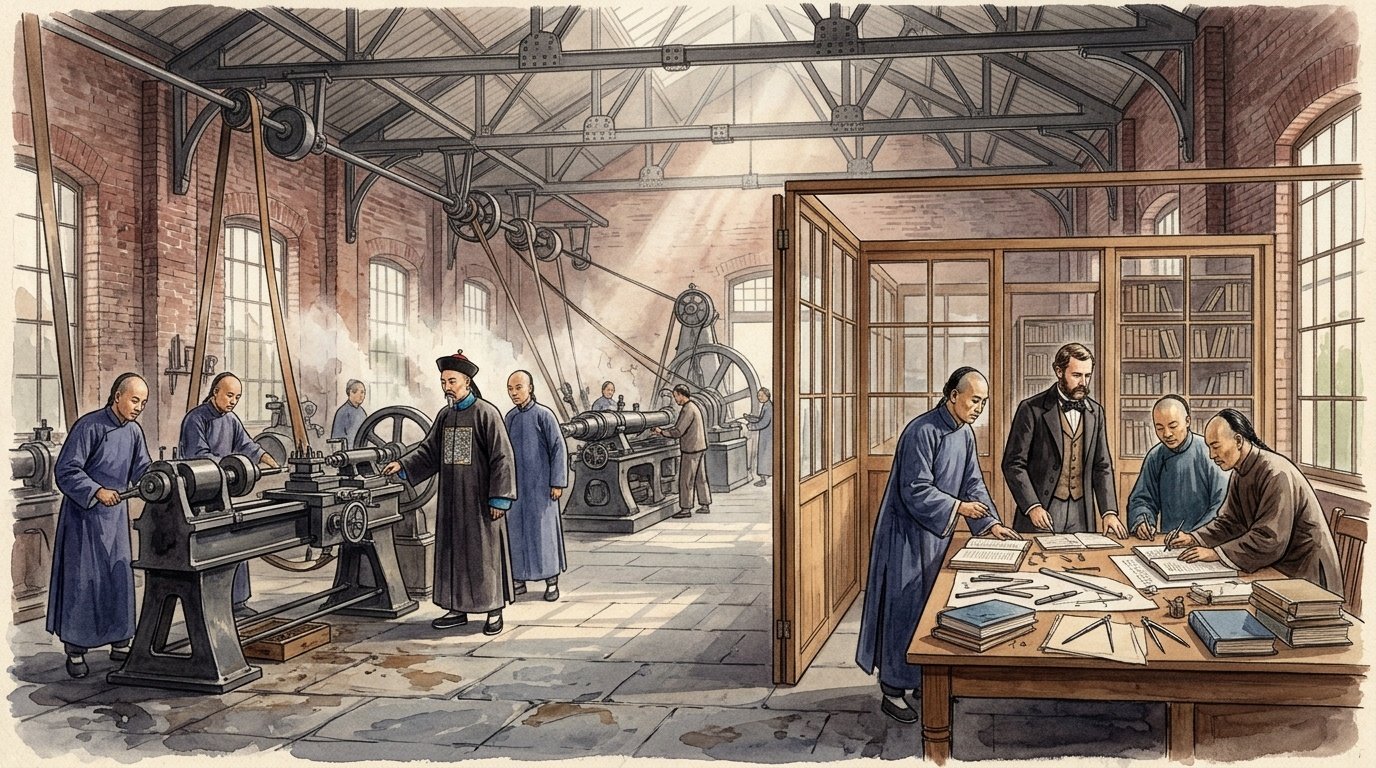
- The Jiangnan Arsenal (江南制造总局): Founded by Zeng Guofan and Li Hongzhang in Shanghai in 1865. Staffed by hundreds of skilled Chinese workers and foreign engineers, the arsenal manufactured modern Armstrong and Krupp rifled artillery, Remington and Mauser firearms, gunpowder, and iron steamships, while maintaining an extensive translation bureau that translated over one hundred and sixty European scientific texts into Chinese;
- The Fuzhou Navy Yard (福州船政局): Established by Zuo Zongtang at Mawei in 1866, supervised by French naval engineer Prosper Giquel. The shipyard featured modern iron foundries, slipways, and a naval academy that trained China’s first generation of modern steamship navigators and marine engineers;
- The Tianjin Arsenal (天津机器制造局): Established by Chonghou and expanded by Li Hongzhang in 1867, producing torpedoes, ammunition, and gunboats for northern defense.
C. Educational Modernization
- The Tongwen Guan (同文馆, Translation College): Established in Beijing in 1862 under American missionary W. A. P. Martin (丁韪良). The academy recruited young banner and Han students to study English, French, Russian, German, international law (translating Henry Wheaton’s Elements of International Law into Chinese), astronomy, chemistry, and calculus;
- The Chinese Educational Mission (留美幼童, 1872–1881): Masterminded by Rong Hong (Yung Wing, 容闳)—the first Chinese student to graduate from an American university (Yale, 1854)—and sponsored by Zeng Guofan and Li Hongzhang. Between 1872 and 1875, one hundred and twenty young Chinese boys were dispatched to New England, living with American host families and studying at Hartford, Yale, and MIT. Among them were Zhan Tianyou (Jeme Tien Yow, the ‘Father of Chinese Railroads’), Tang Shaoyi (the first Prime Minister of the Republic of China), and Liang Dunyan (Foreign Minister).
D. Commercial Modernization: Guandu Shangban
Beginning in the 1870s, Li Hongzhang recognized that military defense could not succeed without commercial wealth. He pioneered the institutional model of ‘Government Supervision and Merchant Operation’ (官督商办, Guandu Shangban): mobilizing private merchant capital under official bureaucratic patronage. Under this framework, Li founded the China Merchants’ Steam Navigation Company (轮船招商局) in 1872 to break the foreign monopoly on coastal river transport; opened the Kaiping Coal Mines (开平矿务局) in 1878 to supply domestic fuel for steamships; constructed China’s first commercial telegraph line connecting Tianjin and Shanghai in 1881; and built China’s first operational commercial railway, the Tangshan-Xugezhuang Railway, in 1881.
4B. The Clash of Grand Strategies: The Great Defense Debate of 1874–1875
The strategic tension at the core of the Self-Strengthening Movement erupted into the open during the famous ‘Maritime vs. Frontier Defense Great Debate’ (海防与塞防之争, 1874–1875 CE). In 1874, the Qing Empire faced two simultaneous, catastrophic geopolitical crises on opposite ends of its continental landmass: in the east, the newly modernizing Empire of Japan launched a provocative military expedition against Taiwan (the Mudan Incident); in the far west, the Russian Empire had militarily occupied the fertile Ili valley, while the British-backed Kokandi adventurer Yakub Beg had established an independent Islamic emirate across the Tarim Basin, threatening the entire Hexi Corridor.
Confronted with an empty treasury that could not finance two massive modern military responses simultaneously, the court summoned its senior provincial viceroys to submit memorials on grand strategy. What followed was the most profound strategic debate in modern Chinese history, pitting Li Hongzhang against Zuo Zongtang.
Representing the Maritime Defense (海防, Haifang) faction, Li Hongzhang argued that China was facing an existential historical rupture without precedent: ‘The greatest strategic transformation in three thousand years, and the most formidable enemies in several thousand years!’ (数千年未有之变局,数千年未有之强敌). Li argued that the Western powers and Japan possessed steam ironclads that could sail directly into the Bohai Gulf to strike Tianjin and Beijing in forty-eight hours. Conversely, the vast deserts of Xinjiang were thousands of miles away across trackless wastelands: an impoverished, arid territory that consumed millions of silver taels in grain transport without generating significant tax revenue. Li boldly proposed that the Qing court completely abandon Xinjiang, cease all military expenditures in the northwest, and concentrate every spare tael of national treasure on purchasing British and German ironclads to construct a unified northern battlefleet.
From his military headquarters in Lanzhou, Zuo Zongtang submitted a blistering, legendary counter-memorial defending the Frontier Defense (塞防, Saifang). Zuo argued that Xinjiang was not a distant luxury, but the indispensable strategic shield of the capital: ‘If Xinjiang is not recovered, then Mongolia will be unsettled; if Mongolia is unsettled, then Shaanxi, Gansu, and Shanxi will have no peace; and Beijing itself will sit with an open back door!’ Zuo insisted that the Western maritime powers came primarily for commercial trade and treaty concessions, whereas Russia and British India sought permanent territorial partition. To abandon over one million square kilometers of ancestral imperial territory conquered by Kangxi and Qianlong was an unforgivable act of dynastic suicide.
The Grand Council and Empress Dowager Cixi ultimately delivered a brilliant strategic compromise: declaring that ‘Maritime and Frontier Defenses Are Equally Vital’ (海防与塞防并重). Zuo Zongtang was granted eight million taels of silver—partially financed through high-interest foreign loans brokered by the Hongkong and Shanghai Banking Corporation (HSBC)—to launch his heroic reconquest of Xinjiang, while Li Hongzhang was granted regular customs revenues to build the Beiyang Fleet. Yet the compromise also highlighted the tragic, insurmountable fiscal limitation of late imperial China: unlike the British Empire or modern European states that could mobilize vast public credit and national debt, the Qing state was attempting to wage two continental-scale military modernizations simultaneously upon an archaic, inelastic agrarian tax base.
5. The Wall of Orthodoxy: Conservative Resistance and Woren
Every step of the Self-Strengthening Movement was fought against ferocious, dogmatic resistance from conservative Confucian scholars and Manchu grandees at court. The intellectual leader of this conservative reaction was Woren (倭仁, 1804–1871 CE), a high-ranking Mongol scholar who served as Grand Secretary and Chief Tutor to the young Tongzhi Emperor, revered across the empire as the living paragon of Cheng-Zhu Neo-Confucian moral purity.
In 1867, when Prince Gong submitted a memorial requesting permission to open an astronomy and mathematics department at the Tongwen Guan and recruit imperial civil degree-holders (Juren and Jinshi) to study European sciences, Woren erupted in furious moral outrage. Submitting a scathing remonstrance to the throne, Woren articulated the classic conservative indictment of Western learning:
‘立国之道,尚礼义不尚权谋;根本之图,在人心不在技艺。今求一技之末,而又求之于夷人,其害不可胜言!夷人,吾之仇也。今以天朝士大夫而拜夷人为师,何其不智!夫天下之大,不患无才,何必师事夷人,使礼义之邦变为蛮夷之域乎!’
— Woren, Memorial Remonstrating Against Western Astronomy and Mathematics (1867 CE)
(‘The foundation of a state rests upon ritual propriety and moral righteousness, not upon clever schemes and power calculations; the root design lies in rectifying the hearts of men, not in mechanical craftsmanship! Today, to seek petty mechanical techniques, and moreover to seek them from foreign barbarians, will cause unspeakable calamities! The barbarians are our mortal enemies. For scholar-officials of the Celestial Empire to bow before barbarians as their disciples—how utterly lacking in wisdom! In an empire as vast as ours, there is no fear of lacking talent; why must we serve barbarians as teachers, turning our land of ritual and righteousness into a realm of savage beasts?’)
Woren’s argument carried immense emotional and moral weight among the vast majority of the Confucian gentry. To the conservative literati, Westerners were not a superior civilization possessing modern science; they were predatory, materialistic barbarians who lacked filial piety, ancestral reverence, and moral rectitude. Conservatives argued that learning Western mechanics would destroy the moral fabric of society, dismantle the sacred exam halls, and provoke Heaven into withholding rainfall and unleashing earthquakes.
Prince Gong replied with biting sarcasm, publicly offering to appoint Woren as head of the new mathematics college and challenging him to present a single Chinese scholar who could cast a modern cannon or calculate a solar eclipse using classical Confucian texts; Woren was forced to plead illness and decline. Yet the conservative victory was real: terrified of social ostracization and being branded as unfilial ‘traitors to the sages’ (名教罪人), the brightest scholar-talents refused to enroll in the Tongwen Guan, leaving the study of Western sciences to impoverished youths, orphans, and marginal clerks.
In 1881, the conservative reaction scored its most catastrophic victory: the cancellation of the Chinese Educational Mission to America. Led by reactionary commissioner Wu Jiashan, conservatives memorialized that the young Chinese boys living in Hartford, Connecticut, had abandoned Confucian propriety: they were cutting off their queues, wearing American suits, playing baseball, dancing with American girls, and converting to Christianity. Despite the desperate pleadings of Li Hongzhang and former US President Ulysses S. Grant, Empress Dowager Cixi ordered the immediate recall of all one hundred and twenty students, prematurely aborting China’s most promising generation of scientific and administrative leaders.
6. The Fiscal Choke: Likin, Regionalism, and the Marble Boat
Beyond ideological resistance, the Tongzhi Restoration was crippled by two profound structural diseases: fiscal fragmentation and the diversion of national defense funds to palace vanity.
A. The Likin Tax and the Rise of Regional Satrapies
To finance the Xiang and Huai armies during the Taiping War, the central government in Beijing had surrendered its most vital sovereign prerogative: the monopoly on taxation. In 1853, an official named Lei Yixian established the Likin (厘金, literally ‘One-Thousandth Tax’) in Jiangsu: an internal transit tariff levied on all commercial goods transported across provincial, prefectural, and county borders.
Likin generated astronomical rivers of silver, but it was collected, audited, and spent almost exclusively by provincial Viceroys and Governors (such as Zeng Guofan, Li Hongzhang, and Zuo Zongtang), completely bypassing the central Ministry of Revenue in Beijing. This institutional shift resulted in the fragmentation of the late Qing state into regional bureaucratic satrapies. There was no unified national defense budget, no centralized general staff, and no national navy: Li Hongzhang built the Beiyang Fleet to protect his personal base in Zhili; Zuo Zongtang built the Nanyang Fleet; and the Viceroy of Liangguang maintained an independent Guangdong flotilla. When foreign wars broke out, regional viceroys routinely declared ‘neutrality’ or refused to dispatch their warships to aid rival provincial fleets, viewing their ships as private factional assets.
B. The Siphoning of Naval Funds for the Summer Palace (Yiheyuan)
The ultimate crime of the late Qing autocracy occurred in the 1880s under the personal vanity of Empress Dowager Cixi. In 1875, the young Tongzhi Emperor died of smallpox at the age of nineteen; Cixi violated dynastic succession laws by adopting her four-year-old nephew, Zaitian (载湉, the Guangxu Emperor 光绪帝), ensuring that she remained the supreme ruler behind the yellow curtain.
In 1885, following the Sino-French War, the Qing established the Imperial Navy Yamen (海军衙门), appointing Guangxu’s biological father, Prince Chun (Yixuan 奕譞), as supreme commander, with Li Hongzhang as deputy. Prince Chun, terrified of incurring Cixi’s displeasure and desperate to persuade her to formally retire and hand over power to Guangxu, conspired with customs officials to embezzle the national defense budget.
Between 1888 and 1894, an estimated twenty to thirty million taels of silver—funds officially allocated for the purchase of modern armored cruisers, fast-firing Armstrong artillery, and ammunition for the Beiyang Fleet—were secretly siphoned off to construct Cixi’s lavish personal retirement pleasure park: the New Summer Palace (Yiheyuan 颐和园). The naval budget funded the digging of Kunming Lake, the construction of the Longevity Hill pavilions, and the erection of the infamous, grotesque Marble Boat (石舫, ‘The Boat of Purity and Ease’)—a permanent, immobile stone pavilion mocking the very concept of naval modernization.
As a direct result of this financial starvation, the Beiyang Fleet did not purchase a single new warship after 1888. While Japan’s Imperial Navy was rapidly purchasing the fastest, most advanced protected cruisers from British shipyards (such as the Yoshino, capable of twenty-three knots and armed with quick-firing artillery), Li Hongzhang’s flagship battleships—the Dingyuan and Zhenyuan—were left with obsolete, slow-firing cannons, deteriorating engines, and ammunition depots filled with sand-filled practice shells instead of explosive picric acid ordnance.
7. The Hour of Truth: The Disaster of 1894–1895
The thirty-year experiment of the Tongzhi Restoration was brought to a sudden, apocalyptic verdict on September 17, 1894 CE, in the azure waters off the mouth of the Yalu River: the Battle of the Yalu River (黄海海战).
When the First Sino-Japanese War erupted over the suzerainty of Korea, the court in Beijing had anticipated an easy victory over the ‘Eastern Dwarf Barbarians’ (东夷倭寇). For centuries, China had viewed Japan as a small, derivative tributary island. Yet Japan had launched its Meiji Restoration (明治维新) in 1868—seven years after China’s Tongzhi Restoration. Unlike China, which attempted to graft Western cannons onto an unchanged Confucian autocracy, Meiji Japan had carried out a total, radical structural revolution: abolishing the samurai feudal caste, creating a modern constitutional monarchy, establishing universal public education, building a centralized national banking system, and forging a unified national army and navy.
The clash at the Yalu River was an unmitigated tactical disaster for China. While Admiral Ding Ruchang and his officers fought with desperate, suicidal bravery, the Beiyang Fleet was outmaneuvered and outgunned by Japan’s Flying Squadron under Admiral Tsuboi. Japan’s quick-firing guns unleashed a relentless hail of high-explosive lyddite shells, turning the wooden decks and fresh paint of the Chinese warships into infernos of flame. Five Chinese cruisers were sunk; the remaining ships retreated to the fortified naval base of Weihaiwei.
In February 1895, Japanese land forces scaled the hills of Weihaiwei, capturing the coastal fortresses and turning the Krupp artillery against the trapped Chinese fleet. Surrounded without reinforcements, Admiral Ding Ruchang (丁汝昌) swallowed a lethal dose of raw opium in his cabin, committing suicide alongside his senior captains. The Beiyang Fleet—the crown jewel of thirty years of Self-Strengthening and eighty million taels of national treasure—surrendered unconditionally and was wiped from the seas.
In April 1895, a humiliated, seventy-two-year-old Li Hongzhang traveled to Japan to sign the Treaty of Shimonoseki (马关条约). China was forced to recognize the independence of Korea (severing its millennial-old tributary bond), cede the fertile island of Taiwan and the Penghu Islands to Japan in perpetuity, open four interior treaty ports to Japanese factories, and pay an astronomical war indemnity of two hundred and thirty million silver taels—bankrupting the Qing treasury and forcing Beijing to take predatory loans from European banking cartels.
8. Historiographical Reflections: Mary Wright and the Verdict of History
In modern world historiography, the Tongzhi Restoration occupies a tragic, seminal position in the comparative study of modernization. In her classic work The Last Stand of Chinese Conservatism, Mary Clabaugh Wright delivered the definitive academic evaluation of the era:
‘The Tongzhi Restoration was a brilliant, extraordinary success in terms of its own objectives: it restored peace, suppressed the greatest peasant rebellion in history, revived the classical examination system, and reestablished the authority of the Confucian state. Yet that very success demonstrated that a stable modern state cannot be founded on Confucian principles…
— Mary Clabaugh Wright, The Last Stand of Chinese Conservatism (1957)
The prerequisites of a modern society were fundamentally incompatible with the prerequisites of a Confucian society. In choosing to preserve Confucianism, the leaders of the Restoration ensured the ultimate doom of the empire they sought to save.’
Modern comparative historians—such as Joseph Levenson (Confucian China and Its Modern Fate) and Jonathan Spence—have contrasted the Tongzhi Restoration with the Meiji Restoration. While Meiji Japan recognized that Western power was the organic fruit of a total institutional, legal, and economic system that required adopting Western education, constitutionalism, and industrial capitalism, the late Qing court remained paralyzed by the delusion that technology could be neatly separated from politics: that Krupp cannons could defend a Son of Heaven who claimed universal moral infallibility.
The tragedy of the Tongzhi Restoration was that it consumed thirty precious, irreplaceable years of historical grace. When the guns fell silent at Shimonoseki in 1895, the illusions of Zhongxing were shattered forever. The shock catalyzed the radical, desperate Hundred Days’ Reform of 1898, the violent explosion of the Boxer Rebellion of 1900, and the inevitable collapse of the imperial system in the Revolution of 1911. The twilight recovery had ended; the long night of imperial collapse had arrived.
9. Chronology of the Tongzhi Restoration and the Self-Strengthening Movement (1860–1895 CE)
| Date / Year (CE) | Historical Event | Key Historical Figures | Institutional & Strategic Significance |
|---|---|---|---|
| 1860 (Oct) | Burning of the Yuanmingyuan | Lord Elgin, Prince Gong | Old Summer Palace torched; Convention of Peking signed; Xianfeng flees to Chengde |
| 1861 (Jan) | Creation of the Zongli Yamen | Prince Gong, Wenxiang | First modern foreign ministry created; manages diplomacy and customs |
| 1861 (Aug) | Death of Xianfeng Emperor | Xianfeng, Sushun, Cixi | Emperor dies at 30 in Chengde; appoints Eight Regents; succession crisis begins |
| 1861 (Nov) | The Xinyou Coup d’État | Cixi, Ci’an, Prince Gong | Sushun beheaded at Caishikou; Tongzhi crowned; ‘Audience Behind the Curtain’ begins |
| 1862 | Founding of the Tongwen Guan | Prince Gong, W. A. P. Martin | Translation college established; teaches European languages, science, international law |
| 1864 (Jul 19) | Fall of Tianjing (Nanjing) | Zeng Guofan, Zeng Guoquan | Xiang Army storms Taiping capital; Taiping Heavenly Kingdom annihilated |
| 1865 | Creation of Jiangnan Arsenal | Zeng Guofan, Li Hongzhang | Premier defense manufacturing center built in Shanghai; translates 160 Western books |
| 1866 | Creation of Fuzhou Navy Yard | Zuo Zongtang, Prosper Giquel | Modern naval shipyard and naval academy established at Mawei |
| 1867 | Woren’s Conservative Remonstrance | Grand Secretary Woren | Conservative court faction denounces Western sciences as barbarian corruption |
| 1872 | Chinese Educational Mission Departs | Rong Hong (Yung Wing) | 120 young boys sent to New England; Zhan Tianyou, Tang Shaoyi educated |
| 1872 | China Merchants’ Steam Navigation Co. | Li Hongzhang | First ‘Guandu Shangban’ enterprise founded; breaks foreign coastal shipping monopoly |
| 1875 (Jan) | Death of Tongzhi; Guangxu Enthroned | Tongzhi, Cixi, Guangxu | Tongzhi dies at 19; Cixi adopts 4-year-old nephew Guangxu; preserves absolute regency |
| 1876–1878 | Zuo Zongtang Reconquers Xinjiang | Zuo Zongtang, Yakub Beg | 70,000 troops carry coffin across Gobi; reconquers Tarim Basin; Xinjiang saved |
| 1881 | Cancellation of Educational Mission | Wu Jiashan, Empress Cixi | Conservative backlash recalls 120 boys from USA for ‘moral degradation’ |
| 1884–1885 | Sino-French War | Courbet, Liu Mingchuan | Fuzhou fleet destroyed at Mawei; Taiwan defended; naval vulnerability exposed |
| 1888 | Founding of the Beiyang Fleet | Li Hongzhang, Ding Ruchang | Imperial navy formalized with battleships Dingyuan and Zhenyuan; naval purchases halted |
| 1888–1894 | Diversion of Naval Funds for Yiheyuan | Empress Cixi, Prince Chun | 30M taels naval budget siphoned to build Summer Palace and Marble Boat |
| 1894 (Sep 17) | Battle of the Yalu River | Ding Ruchang, Admiral Ito | Beiyang Fleet outgunned by Japanese quick-firing artillery; 5 cruisers sunk |
| 1895 (Feb) | Fall of Weihaiwei; Suicide of Ding Ruchang | Admiral Ding Ruchang | Beiyang Fleet surrenders; Admiral Ding swallows opium; Self-Strengthening ends |
| 1895 (Apr 17) | Signing of the Treaty of Shimonoseki | Li Hongzhang, Ito Hirobumi | Taiwan ceded to Japan; 230M taels indemnity; Tongzhi Restoration proven a failure |
10. Scholarly Bibliography and Primary Historical Sources
To substantiate the political records, industrial inventories, and historical analyses presented in this monograph, the following primary sources and academic monographs are recommended for further study:
- Zhao Erxun (赵尔巽) et al. (comp. 1927), Draft History of Qing (清史稿, Qing Shi Gao): The official dynastic history. Essential chapters include the Annals of Muzong (Tongzhi, Vols. 18–20), the Annals of Dezong (Guangxu, Vols. 21–24), and the Biographies of Zeng Guofan, Zuo Zongtang, and Li Hongzhang (Vols. 405, 411, 412).
- Zeng Guofan (曾国藩, ed. Li Hongzhang, 1876), Complete Works of Master Zeng Wenzheng (曾文正公全集, Zeng Wenzheng Gong Quanji), 156 vols: The monumental collection of his memorials, military letters directing the Xiang Army, and personal diaries embodying the moral philosophy of the Restoration.
- Li Hongzhang (李鸿章, ed. Wu Rulun, 1905), Complete Works of Master Li Wenzhong (李文忠公全集, Li Wenzhong Gong Quanji), 165 vols: Indispensable primary documentation on the Self-Strengthening Movement, naval budgets, diplomatic negotiations with Japan, and modern enterprises.
- Wright, Mary Clabaugh (1957), The Last Stand of Chinese Conservatism: The T’ung-Chih Restoration, 1862–1874, Stanford University Press: The definitive academic classic that defined the field, demonstrating the tragic incompatibility between Confucian statecraft and modern industrial survival.
- Spence, Jonathan D. (1990), The Search for Modern China, W. W. Norton: Masterful synthesis exploring the internal social rebellions, the Xinyou Coup, and the diplomatic crises of the late nineteenth century.
- Levenson, Joseph R. (1968), Confucian China and Its Modern Fate: A Trilogy, University of California Press: Brilliant intellectual history exploring the philosophical crisis of the ‘Ti-Yong’ formula (中学为体,西学为用) and the demise of the Confucian worldview.
- Kuhn, Philip A. (1970), Rebellion and Its Enemies in Late Imperial China: Militarization and Social Structure, 1796–1964, Harvard University Press: Foundational sociological analysis examining the rise of regional militarism and gentry-led armies during the Taiping War.
- Rawski, Evelyn S. (1998), The Last Emperors: A Social History of Qing Imperial Institutions, University of California Press: Essential institutional study exploring the court politics of Cixi, imperial regencies, and Manchu-Han relations in the late Qing.
- Biggerstaff, Knight (1961), The Earliest Modern Government Schools in China, Cornell University Press: Comprehensive institutional history of the Tongwen Guan, the Fuzhou naval academy, and early scientific education in China.
- Paine, S. C. M. (2003), The Sino-Japanese War of 1894–1895: Perceptions, Power, and Primacy, Cambridge University Press: The definitive modern military and diplomatic history detailing the naval battles of the Yalu and Weihaiwei and the geopolitical collapse of Qing East Asian hegemony.