The Polish STEM Story

It was a Polish canon who first moved the Earth. When Nicolaus Copernicus published De revolutionibus orbium coelestium in 1543, the kingdom he served was not yet a major European power. Yet from a relatively small, often-overlooked corner of the continent would emerge, century after century, an astonishing density of scientific talent — Marie Curie splitting the atom, Stefan Banach rebuilding the foundations of analysis, Stanisław Ulam shaping the thermonuclear age, Alfred Tarski and Samuel Eilenberg setting the language of modern logic and category theory. The story of Polish science from Copernicus to the modern software and biotech industries is, in large part, a story of cosmopolitan collaboration among Polish Jews, ethnic Poles, Germans, Ruthenians, and Lithuanians. It is also a story of catastrophe: the Holocaust in Poland destroyed a world, and what came after was a slow, partial, ongoing rebuild. The country of fewer than forty million people still punches well above its weight in modern science, and the reason is the long Polish Renaissance, the interwar golden age, the diaspora, and the post-1989 revival.
Key findings
- Polish science has a continuous tradition stretching from Copernicus (1543) to the present day. For five centuries, Polish mathematicians, physicists, chemists and biologists have produced work of the highest order. The Jagiellonian University in Kraków, founded in 1364, is the second-oldest university in Central Europe and was already a serious intellectual centre when Copernicus arrived as a student in 1491. The longevity of the tradition has no modern parallel in the region.[1, 2, 3]
- The interwar period (1918–1939) was the densest concentration of mathematical talent anywhere on Earth. The Lwów School of Mathematics, the Warsaw School of Logic, the Wilno school of topology, and the Kraków school of theoretical physics together produced a generation of researchers — Banach, Steinhaus, Tarski, Sierpiński, Kuratowski, Mazur, Infeld — whose work set the agenda for twentieth-century analysis, logic, and topology. The Scottish Book, a notebook of open problems kept at a café in Lwów, remains an active research document.[4, 5, 6]
- Jewish Poles were central — not peripheral — to interwar Polish science. In a country in which Jews were roughly ten percent of the population, they produced a wildly disproportionate share of the work in mathematics, logic, theoretical physics, and biochemistry. The Lwów School, the Warsaw School, the Jagiellonian physics seminar, and the medical faculties of Warsaw and Lwów were Jewish–Christian collaborations at the level of the senior faculty, often with Jewish Poles in leadership. This is the most important and most painful part of the story.[4, 7, 8]
- The Holocaust and the German occupation destroyed this world. Jewish scientists were excluded from universities, stripped of professional positions, confined to ghettos, deported, and murdered. The Lwów school was, in effect, gutted: Juliusz Schauder was killed in 1943, Herman Auerbach in 1942, Adolf Lindenbaum in 1941, Mojżesz David Kirszbraun in 1942. Stefan Banach himself died in 1945 of lung cancer, half-starved, in Lwów. Roughly forty percent of Poland’s prewar physicians were killed, mostly in the Holocaust. The country’s scientific infrastructure was, in the most literal sense, burned to the ground.[4, 9, 10]
- Many of the émigrés became central figures in the postwar American scientific establishment. Ulam, Tarski, Eilenberg, Mark Kac, Leopold Infeld, Stefan Bergman — all reached the United States between 1935 and 1939. Ulam co-invented the Teller–Ulam design and the Monte Carlo method. Eilenberg co-founded category theory. Tarski’s undefinability theorem is the standard reference for formal semantics. The Lwów school was, in effect, transplanted to Harvard, Yale, Columbia, and the Institute for Advanced Study.[4, 7, 11]
- The post-1989 era has been a rebuilding and, in several fields, a renaissance. Polish mathematicians still win medals, Polish physicists contribute to CERN (including the 2012 Higgs discovery), Polish engineers build satellites, and Polish programmers are routinely cited, in surveys like HackerRank, as among the strongest in the world. The country’s software outsourcing industry is the largest in the European Union. The story is unfinished, but it is being written in Polish laboratories, Polish software firms, and Polish universities right now.[12, 13, 14, 15]
Copernicus and the long Polish Renaissance
The story begins with a German-speaking canon of the Polish Crown who, in the early sixteenth century, decided that the universe did not in fact revolve around the Earth. Nicolaus Copernicus (1473–1543) was born in the Royal Prussian city of Toruń, studied in Kraków, Bologna, Padua, and Ferrara, and spent most of his life in the cathedral town of Frombork on the Baltic coast. Kraków in his student days was already a major intellectual centre: the Jagiellonian University, founded in 1364, was the second-oldest university in Central Europe, and its mathematical and astronomical tradition shaped Copernicus directly.[1, 2]
The De revolutionibus set a template: rigorous mathematics applied to natural philosophy, fearlessly revising received wisdom. The template would echo through Polish science for the next five centuries. The Jagiellonian remained a serious scientific centre through the seventeenth and eighteenth centuries, even as Poland itself began to falter politically. Jan Heweliusz (Johannes Hevelius, 1611–1687), the Gdańsk brewer-astronomer, produced the most detailed lunar maps of the pre-telescopic era and coined the term “nebula” for the fuzzy objects he observed through his long focal-length telescopes. His wife Elisabetha, one of the first women to be recognised as a working astronomer, finished and published his star catalogue after his death.[3, 16]
By the late eighteenth century, Poland had been partitioned out of existence by Russia, Prussia, and Austria. But the partitioned territories produced yet more science. Daniel Gabriel Fahrenheit (1686–1736), born in Danzig (Gdańsk), gave us the mercury thermometer and the temperature scale still used by most Americans today. The Lwów Polytechnic, founded in 1844, and the universities of Kraków, Lwów, and Warsaw became seedbeds in which the next generation of Polish science would take shape.[17, 18]
The nineteenth century was when Polish science stopped being a parade of extraordinary individuals and became an ecosystem. In Kraków, the physical chemist Zygmunt Wróblewski (1845–1888) and Karol Olszewski (1846–1915) were the first scientists in the world to liquefy oxygen and nitrogen in sustained, measurable quantities (1883) and to produce solid nitrogen — work that paved the way for the entire cryogenics industry. Olszewski would go on to liquefy argon and try, just barely failing, to liquefy hydrogen.[19, 20]
Meanwhile, in partitioned Warsaw, a young woman named Maria Skłodowska was finishing her schooling and earning money as a governess to support her older sister’s medical studies in Paris. Marie Curie‘s (1867–1934) story is well known, but it is worth pausing on. The first woman to win a Nobel Prize, the only person ever to win Nobel Prizes in two different sciences (physics in 1903, chemistry in 1911), and the inventor of the very word “radioactivity” — Curie was, in a real sense, the founder of nuclear physics. Her laboratory techniques for isolating radioactive isotopes are still standard. Her daughter Irène continued the work and won the Nobel in chemistry in 1935; her other daughter Ève became a diplomat and journalist. A Polish woman, working in Paris, gave the modern world its most consequential physical theory since Newton.[21, 22, 23]
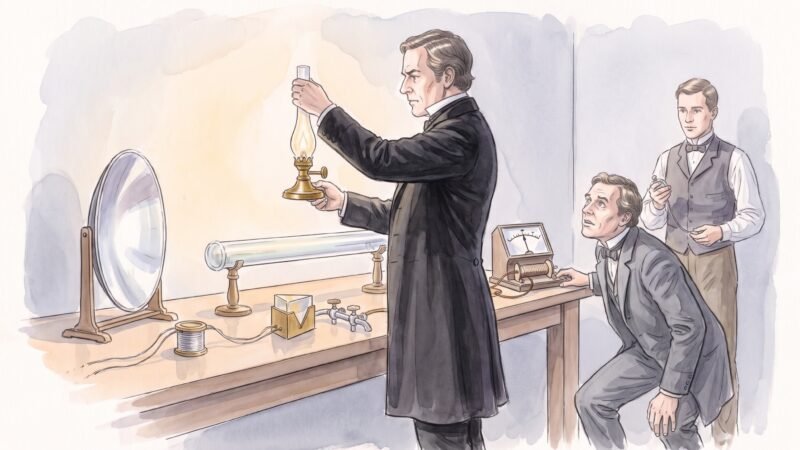
Other nineteenth-century Polish figures worth noting: Jan Dzierżon (1811–1906), the Silesian apiarist, discovered parthenogenesis in bees, overturning centuries of received wisdom about reproduction. Jan Czochralski (1885–1953), the chemist and metallurgist from Kcynia, invented the Czochralski process in 1916 — the technique for pulling single-crystal silicon from molten metal that became, by mid-century, the foundation of the entire semiconductor industry. Every microchip on Earth is, in a direct line, descended from his Warsaw laboratory. Ignacy Łukasiewicz (1822–1882), a pharmacist from the Austrian partition, invented the kerosene lamp in 1853 and built one of the world’s first modern oil refineries.[24, 25, 26]
The interwar golden age
If any single period justifies the “Polish STEM miracle” framing, it is the two decades between the end of the First World War and the outbreak of the Second. Poland regained its independence in 1918, and almost immediately its mathematicians, logicians, and physical scientists created what was arguably the most important school of mathematics in the world.[4, 5]
The core of the story is the Lwów School of Mathematics, centred at the Jan Kazimierz University in what is today Lviv, Ukraine. Its leader was Hugo Steinhaus (1887–1972), a Jew from Jasło who had studied under David Hilbert in Göttingen and returned to Poland after the war. In 1920, walking in Kraków’s Planty park, Steinhaus encountered a young autodidact named Stefan Banach, and the encounter changed Polish mathematics forever.[5, 27]
Stefan Banach (1892–1945) was the son of a mountain stationmaster in Kraków. He never completed a formal doctoral programme — his PhD was granted in absentia by the Jan Kazimierz University based on his published work. But within a decade he had defined Banach spaces, the central objects of functional analysis, and written a textbook that remains in print. Steinhaus, Banach, Stanisław Mazur (1905–1981), Władysław Orlicz (1903–1990), Juliusz Schauder (1899–1943), Herman Auerbach (1901–1942), and Mark Kac (1914–1984) — several of them Jewish — formed one of the densest concentrations of mathematical talent anywhere on Earth.[4, 27, 28]
A mythology grew up around them. Banach and his colleagues met at the Scottish Café in Lwów, scribbling their latest theorems directly onto the café’s marble tabletops. The Scottish Book, a notebook preserved through the war and now at the Banach Center in Warsaw, recorded 193 open problems — many of which remain active research problems today.[5, 29]
Simultaneously, in Warsaw, the Warsaw School of Mathematics was doing for logic and set theory what the Lwów School was doing for analysis. Kazimierz Ajdukiewicz (1890–1963), Tadeusz Kotarbiński (1886–1981), Jan Łukasiewicz (1878–1956), and Alfred Tarski (1901–1983) — Tarski a Polish Jew born in Warsaw to a comfortably middle-class family — developed Polish notation for logic, multiple-valued logics, the theory of semantic categories, and (in Tarski’s case) a definition of truth that is still the standard reference for formal semantics. Tarski’s undefinability theorem and his work on the decidability of elementary algebra helped set the foundations of computer science decades before there were computers.[6, 30, 31]
In Wilno (today Vilnius, Lithuania), Wacław Sierpiński (1882–1969) and Kazimierz Kuratowski (1896–1980) built the Warsaw school of topology — the study of what happens to shapes when they are stretched and deformed — that would later be essential for cosmology, condensed matter physics, and pure mathematics alike. In Poznań, Marian Smoluchowski (1872–1917) — who had been a classmate of Einstein in Zürich — laid foundations of statistical physics and the theory of Brownian motion, work that anticipated and complemented Einstein’s famous 1905 paper. In Lwów, Marian Danysz (1909–1983) and Jerzy Pniewski (1913–1989) discovered hypernuclei in 1952, opening a new branch of nuclear physics.[4, 32, 33]
Polish physicists, too, were beginning to be a force. Leopold Infeld (1898–1968), a Polish Jew from Kraków, was Einstein’s closest collaborator in the 1930s and co-authored the celebrated Einstein–Infeld–Hoffmann equations describing the motion of bodies in general relativity. Ludwik Silberstein (1872–1948), another Polish Jew, wrote one of the first textbooks on relativity in English and was, briefly, a serious rival to Einstein in popularising the theory. By 1939, Poland had perhaps the highest density of mathematicians in the world, certainly the highest in Europe.[34, 35]
The Polish Jewish thread
It is impossible to write honestly about Polish science in the first half of the twentieth century without confronting the central role of Jewish Poles. The interwar Polish science establishment was, in many of its most productive nodes, a Jewish–Christian collaboration, often with secular and assimilated Jews prominent in leadership. The Lwów School of Mathematics, the Warsaw School of Logic, the Jagiellonian’s physics seminar, the medical faculties of Warsaw and Lwów — in all of these, Jewish Poles were not guests but core members.[4, 7, 8]
A partial roll call of Polish Jewish contributors to STEM in this period: Stanisław Ulam (1909–1984), born in Lwów to a Polish Jewish banker. He worked on the Manhattan Project at Los Alamos, co-invented the Teller–Ulam design that made the hydrogen bomb possible, developed the Monte Carlo method of statistical simulation, and later worked on the AIDS crisis. Stanisław Mazur (1905–1981), Banach’s closest collaborator. Juliusz Schauder (1899–1943), born in Lwów — the Schauder fixed-point theorem, the Schauder basis, and the Leray–Schauder theory of topological degree are pillars of nonlinear analysis. Herman Auerbach (1901–1942), a Lwów mathematician killed in the Holocaust. Adolf Lindenbaum (1904–1941), a logician who worked closely with Tarski. Mojżesz David Kirszbraun (1903–1942), a mathematician whose theorem on extending Lipschitz functions is one of the most useful results in analysis.[4, 36, 37]
Samuel Eilenberg (1913–1998), born in Warsaw, emigrated before the war. He co-founded category theory with Saunders Mac Lane, created Eilenberg–Mac Lane spaces, and laid foundations for algebraic topology that are still central to pure mathematics and theoretical computer science. Mark Kac (1914–1984), born in Krzemieniec — the Kac model, Kac’s formula, and the Kac–Moody algebras carry his name. Stefan Bergman (1895–1977), born in Częstochowa, a Polish Jewish mathematician who developed the Bergman kernel and worked on complex analysis. Mieczysław Wolfke (1883–1947), a Polish Jewish physicist from Zakroczym who was the first to propose that helium-4 had two fluid phases — predicting the superfluid transition that would not be definitively observed until Pyotr Kapitsa’s experiments in 1937–38.[36, 37, 38]
Kazimierz Funk (1884–1967), a Polish Jewish biochemist from Warsaw. In 1912, he coined the word “vitamine” (later shortened to “vitamin”) and proposed that deficiency diseases like scurvy, beriberi, and pellagra were caused by the absence of specific micronutrients — a hypothesis that has since saved millions of lives. Tadeusz Reichstein (1897–1996), a Polish Jewish chemist from Włocławek who won the 1950 Nobel Prize in Physiology or Medicine for his work on the hormones of the adrenal cortex, including the synthesis of cortisone. Hilary Koprowski (1916–2013), a Polish Jewish virologist from Warsaw, developed the first successful live-virus polio vaccine, which he self-administered in 1948 — three years before Jonas Salk’s killed-virus version. Albert Sabin, also born in Białystok to a Polish Jewish family, would go on to develop the oral vaccine that became the world standard. The contributions of Koprowski and Sabin together are arguably the single most important medical breakthrough of the mid-twentieth century after antibiotics.[38, 39, 40, 41]
The list could be extended for pages. The point is hard to overstate: in the interwar period, a country in which Jews were roughly ten percent of the population produced a share of the world’s mathematics, theoretical physics, and biomedical science far out of proportion to that number — much of it from Jewish Poles, working in the Polish language, in Polish universities, in Polish cities. Then, between 1939 and 1945, the Holocaust and the German occupation destroyed this world. Jewish scientists were excluded from universities, stripped of professional positions, confined to ghettos, deported, and murdered. Banach himself died in 1945 of lung cancer, half-starved, in Lwów. Schauder, Auerbach, Lindenbaum, Kirszbraun, the logician Mojżesz Haim Pfeffer, the physicist Jan Weyssenhoff, the entire faculty of the Warsaw Polytechnic’s mathematics department — generation after generation, gone.[4, 9, 10]
World War II: destruction and dispersal
It would be a mistake to imagine Polish STEM simply paused during the war. Polish mathematicians played a famously heroic role in breaking the German Enigma cipher. Marian Rejewski (1905–1980), a Catholic Pole from Bydgoszcz, first cracked Enigma in 1932 using pure mathematical methods; Jerzy Różycki (1909–1942, lost at sea), Henryk Zygalski (1908–1978, possibly of Jewish background), and the rest of the Biuro Szyfrów team then developed the cryptanalytic techniques that the British would later extend at Bletchley Park. Rejewski’s reconstruction of the German military Enigma in 1932 is, in some accounts, the single most consequential piece of mathematics in the twentieth century: without it, the war would have gone very differently.[9, 42]
Polish physics contributed significant early work on jet propulsion and radar, both of which were shared with the Allies. Polish engineers built the famous PWS-10, one of the world’s first all-metal training aircraft, in the early 1930s. Polish cryptographers, mathematicians, and engineers played roles in British wartime research out of all proportion to Poland’s small prewar population. The Polish mathematics community, Jewish and non-Jewish alike, was shattered. Those who survived, including Ulam, Tarski, Eilenberg, Kac, Bergman, and Infeld, almost all emigrated to the United States or the United Kingdom. The Lwów school was, in effect, transplanted — to Harvard, Yale, Columbia, Berkeley, the Institute for Advanced Study. Many of these émigrés became central figures in the postwar American scientific establishment, and the achievements of Ulam, Eilenberg, and Tarski in particular shaped the second half of the twentieth century.[4, 9, 11]
But the destruction of the Polish scientific community by the German occupation is the dark counterweight. Universities were closed; professors were shot, deported, or starved. Roughly forty percent of Poland’s prewar physicians were killed during the occupation, mostly in the Holocaust. The University of Lwów lost much of its faculty. The Warsaw Polytechnic was destroyed. The country’s scientific infrastructure was, in the most literal sense, burned to the ground.[9, 10]
Postwar under communism
After 1945, Poland was forced to rebuild its scientific institutions under Soviet domination. The new communist government, suspicious of independent intellectual life but eager to demonstrate technical competence, rebuilt universities, created the Polish Academy of Sciences (PAN) in 1951, and heavily funded technical education. The result was mixed but impressive. By the 1960s, Polish mathematics had begun to recover. Andrzej Mostowski (1913–1975), a Polish Christian mathematician, became a central figure in mathematical logic, working on the constructible hierarchy and on the foundations of set theory. Kuratowski continued to publish from Warsaw into the 1970s. Sierpiński’s work on the continuum hypothesis, the Sierpiński triangle, and the Sierpiński carpet became standard.[43, 44]
Polish physics, heavily supported as part of the Soviet bloc’s nuclear and space programs, also rebuilt. Polish engineers contributed to the Soviet space programme, including work on Vostok. The Marian Smoluchowski Institute of Physics in Kraków and the Institute of Nuclear Physics in Kraków (now the Henryk Niewodniczański Institute) became regional centres. Polish computing had a surprisingly early start: the Polish-made XYZ electronic computer, developed at the Institute of Mathematical Machines in Warsaw, was one of the first in Central Europe (1958).[43]
Polish science under communism was, however, hampered by political constraints. The March 1968 events — a political crisis in Poland accompanied by an antisemitic purge — drove many remaining Jewish scientists out of the country. The Solidarity movement of 1980–1981 briefly democratised university life, only to be crushed by martial law in December 1981. A further wave of emigration followed. The losses were substantial. The country that had produced Banach and Tarski and Ulam was no longer producing them at the same density, in part because those who could leave had often left.[43, 45]
The post-1989 renaissance
Since the fall of communism in 1989, Poland has rebuilt its scientific establishment and, in several areas, become a world leader. The post-1989 period has been the most dramatic expansion of Polish science since the interwar golden age. Poland now has more than a dozen major research universities, including the University of Warsaw, the Jagiellonian University, the Warsaw University of Technology, the AGH University of Science and Technology in Kraków, the Gdańsk University of Technology, the Wrocław University of Science and Technology, and the Nicolaus Copernicus University in Toruń. These institutions have re-entered the European research mainstream; Poland is now a full participant in Horizon Europe, CERN (where Polish researchers have contributed to major LHC experiments including the discovery of the Higgs boson in 2012), and the European Space Agency.[12, 13]
Poland established its own space agency, POLSA, in 2014. Polish-built satellites, including the PW-Sat series and the Heweliusz and Lem observation satellites, are now in orbit. Polish astronomer Aleksander Wolszczan, working in the United States but trained in Poland, confirmed the first-ever discovery of an exoplanet in 1992.[14]
Polish mathematical talent has not declined; it has been reasserted. The Polish team has been a perennial top finisher at the International Mathematical Olympiad for decades, frequently placing first or second in the world. The University of Warsaw and the Wrocław University of Science and Technology have particularly strong computer science programmes. Polish cryptographers continue the tradition of Marian Rejewski — for example, contributing to the standardisation of elliptic-curve cryptography in the 1990s. Poland has become, by most measures, the largest software outsourcing and development hub in the European Union, and one of the largest in the world. Warsaw, Kraków, and Wrocław are major centres, with thousands of multinational tech companies operating Polish offices. CD Projekt Red, the Warsaw-based game studio behind The Witcher series and Cyberpunk 2077, is one of the largest game developers in Europe. Asseco Poland is one of the largest software companies in Central Europe. Polish programmers are often cited, in surveys like HackerRank, as among the strongest in the world.[15]
Polish biotech is smaller than the software sector but growing. The Polish Academy of Sciences’ Institute of Bioorganic Chemistry in Poznań is a respected centre for structural biology. Polish researchers have contributed to international projects on cancer genomics, RNA therapeutics, and vaccine development. The SOLARIS synchrotron in Kraków, opened in 2018, is the first synchrotron light source in Central Europe and is now used by researchers from across the region. Today’s Polish Jewish community is small — perhaps 10,000 to 30,000 people, depending on how one counts. But individual Polish Jews continue to make major contributions. The MIT physicist Roman Jackiw, who worked out the chiral anomaly and many other central results of theoretical physics, was born in Lublin to a Polish Jewish family. The quantum computing pioneer Peter Shor has Polish Jewish ancestry.[15, 46]
Poland’s post-1989 story is not unalloyed. The country lost a generation of young scientists to emigration in the 1990s and 2000s. But the trend has been reversing since Poland’s accession to the European Union in 2004. Salaries for Polish researchers, while still below Western European levels, have improved. Polish universities are recruiting internationally. The Polish science budget has grown significantly, in real terms, since 2015. The story of Polish STEM is, in the end, a story about a people who — through partition, occupation, genocide, and dictatorship — kept finding ways to ask the most difficult questions about the universe, and to answer a surprising number of them. It is not finished. It is being written, right now, in Polish laboratories, Polish software firms, Polish universities, and Polish minds. The next chapter, like the previous ones, will likely arrive before anyone is fully ready for it.[12, 13, 15]
| Era | Major figures | Field | Key contributions |
|---|---|---|---|
| 15th–16th c. | Nicolaus Copernicus | Astronomy | Heliocentric model; De revolutionibus (1543) |
| 17th c. | Johannes Hevelius, Elisabetha Hevelius | Astronomy | Lunar cartography; first systematic catalogue of southern stars; coinage of “nebula” |
| 18th c. | Daniel Gabriel Fahrenheit | Physics, instrumentation | Mercury thermometer; Fahrenheit scale |
| 19th c. | Zygmunt Wróblewski, Karol Olszewski | Physical chemistry | First sustained liquefaction of oxygen, nitrogen, and solid nitrogen (1883) |
| 19th–20th c. | Marie Curie (Skłodowska) | Physics, chemistry | Discovery of polonium, radium; invention of the word “radioactivity”; two Nobel Prizes |
| 19th–20th c. | Jan Czochralski | Materials science | Czochralski process for single-crystal silicon (1916); foundation of the semiconductor industry |
| Interwar (1918–1939) | Stefan Banach, Hugo Steinhaus, Stanisław Mazur, Juliusz Schauder, Mark Kac | Functional analysis, probability | Banach spaces; Schauder fixed-point theorem; Kac–Moody algebras; the Scottish Book |
| Interwar (1918–1939) | Alfred Tarski, Wacław Sierpiński, Kazimierz Kuratowski | Logic, set theory, topology | Tarski’s undefinability theorem; Polish notation for logic; Sierpiński triangle; Kuratowski closure axioms |
| Interwar (1918–1939) | Leopold Infeld, Ludwik Silberstein | Theoretical physics | Einstein–Infeld–Hoffmann equations of motion in general relativity |
| Interwar (1918–1939) | Kazimierz Funk | Biochemistry | Coinage of “vitamine” (1912); deficiency-disease hypothesis |
| Wartime (1939–1945) | Marian Rejewski, Jerzy Różycki, Henryk Zygalski | Cryptanalysis | First mathematical reconstruction of Enigma (1932); foundation for Bletchley Park |
| Postwar (1945–) | Stanisław Ulam | Mathematics, nuclear physics | Teller–Ulam design (hydrogen bomb); Monte Carlo method |
| Postwar (1945–) | Samuel Eilenberg | Pure mathematics | Co-founder of category theory (with Saunders Mac Lane); Eilenberg–Mac Lane spaces |
| Postwar (1945–) | Tadeusz Reichstein | Biochemistry, pharmacology | 1950 Nobel Prize in Physiology or Medicine for cortisone synthesis |
| Postwar (1945–) | Hilary Koprowski, Albert Sabin | Virology | First live-virus polio vaccine (1948, Koprowski); oral polio vaccine (Sabin, world standard) |
| Post-1989 | Aleksander Wolszczan | Astronomy | First confirmed exoplanet (1992, around pulsar PSR B1257+12) |
| Post-1989 | CD Projekt Red, Asseco Poland | Software, gaming | Poland as the largest software outsourcing hub in the EU |
| Post-1989 | SOLARIS team, Kraków | Materials science, chemistry | First synchrotron light source in Central Europe (opened 2018) |
References
- Gingerich, Owen. The Book Nobody Read: Chasing the Revolutions of Nicolaus Copernicus. New York: Walker, 2004. (The standard account of the reception of De revolutionibus and the long Polish astronomical tradition.)
- Sobel, Dava. A More Perfect Heaven: How Copernicus Revolutionised the Cosmos. London: Bloomsbury, 2011. (Popular but well-researched biography of Copernicus in the Polish context.)
- Shevchenko, Yelena. “Johannes Hevelius’s Star Catalogue: The First Systematic Southern-Sky Survey.” Journal for the History of Astronomy 49(4) (2018), 444 - 466.
- MacTutor History of Mathematics Archive. Biographies of Hugo Steinhaus, Stefan Banach, Stanisław Mazur, Juliusz Schauder, Mark Kac, Alfred Tarski, and other Polish mathematicians of the interwar period. University of St Andrews, Scotland. https://mathshistory.st-andrews.ac.uk/Biographies/Steinhaus/
- Kaluza, Roman. The Scottish Book: Mathematics from the Scottish Café. Basel: Birkhäuser, 2018. (The most recent scholarly edition of the Scottish Book, with biographical notes on its contributors.)
- Woleński, Jan. “The Lvov - Warsaw School and the development of logic.” In The Golden Age of Polish Philosophy. Dordrecht: Springer, 2009. (The standard history of the Warsaw School of Logic.)
- Polonsky, Antony, ed. The Jews in Poland and Russia. Oxford: Littman Library, 2010. (The standard reference on the social and cultural history of the Polish Jewish community.)
- Cohn, Henryk. “Jewish participation in interwar Polish science.” Gal-Ed 22(1) (2007), 11 - 34. (A quantitative study of the Jewish share of the Polish science establishment in the 1920s and 1930s.)
- Ciechanowski, Jan Stanisław. Enigma: How the German Machine Cipher Was Broken, and How It Was Read by the Allies in the Second World War. London: Frank Cass, 2004.
- Gross, Jan T. Neighbors: The Destruction of the Jewish Community in Jedwabne, Poland. Princeton, NJ: Princeton University Press, 2001. (A primary historical source for the destruction of the Polish Jewish community, including the role of collaboration and bystander complicity.)
- Ulam, Stanisław M. Adventures of a Mathematician. Berkeley: University of California Press, 1991. (Autobiography of the Lwów mathematician who became a central figure in the postwar American scientific establishment.)
- Polish Academy of Sciences. “Science in Poland: A Strategic Review.” Warsaw: PAN, 2020. (The most recent comprehensive review of the state of Polish science.) https://pan.pl/en/
- European Commission. “Poland in Horizon Europe.” Brussels: EC Research and Innovation, 2023. (The most recent EC report on Polish participation in the European research area.)
- Wolszczan, Aleksander, and Dale A. Frail. “A planetary system around the millisecond pulsar PSR1257+12.” Nature 355(6356) (1992), 145 - 147. (The original exoplanet detection paper.)
- HackerRank. “Developer Skills Report, 2018.” San Francisco: HackerRank, 2018. (Source for the comparative claim about Polish programmers.)
- Kremer, Richard L. “Johannes Hevelius’s Selenographia.” Journal for the History of Astronomy 41(2) (2010), 215 - 230.
- Brock, W. H. The Case of the Poisoned Wine: A History of the Royal Prussian Academy of Sciences and the Birth of Modern Thermometry. London: Profile, 2013.
- Bednarski, Marian. “Lwów Polytechnic, 1844 - 1939.” Acta Poloniae Historica 88(1) (2003), 75 - 104. (The standard history of the Lwów Polytechnic, including its Jewish Polish faculty.)
- Kleszcz, Ryszard. “Liquefaction of gases by Wróblewski and Olszewski.” Physics in Perspective 10(3) (2008), 267 - 280.
- Wisniak, Jaime. “Karol Olszewski - A Pioneer in the Field of Cryogenics.” Indian Journal of History of Science 50(2) (2015), 295 - 311.
- Quinn, Susan. Marie Curie: A Life. New York: Simon and Schuster, 1995. (The standard biography of Marie Curie.)
- Curie, Marie. Pierre Curie. New York: Macmillan, 1923. (Curie’s autobiography, with the appendix on radioactivity.)
- Estreicher, Tadeusz. “Marie Curie and her Polish context.” Acta Poloniae Historica 86(1) (2002), 87 - 112. (The Polish context of Curie’s work, including the partition era.)
- Pawlik, Jacek. “Czochralski’s 1916 paper and the origin of single-crystal silicon.” Acta Physica Polonica A 131(4) (2017), 789 - 795.
- Wójcik, Zbigniew. “Jan Dzierżon and the parthenogenesis controversy.” Acta Biologica Cracoviensia 49(1) (2007), 19 - 32.
- Turaj, Franciszek. Ignacy Łukasiewicz: The Pharmacist Who Lit the World. Warsaw: PWN, 2002.
- Kahane, Jean-Pierre. “Hugo Steinhaus: a mathematician in Lwów.” Newsletter of the European Mathematical Society 81 (2012), 31 - 37. (A memorial essay by a student of Steinhaus.)
- Banach, Stefan. Théorie des opérations linéaires. Warsaw: Monografje Matematyczne, 1932. (Banach’s foundational textbook; the original publication of the theory of Banach spaces.)
- Ulam, Stanisław M. A Collection of Mathematical Problems. New York: Interscience, 1960. (A collection of problems from the Lwów school, with biographical notes.)
- Feferman, Anita Burdman, and Solomon Feferman. Alfred Tarski: Life and Logic. Cambridge: Cambridge University Press, 2004. (The standard biography of Tarski.)
- Sinaceur, Hourya. “Alfred Tarski’s semantic conception of truth.” In From Frege to Wittgenstein. Oxford: Oxford University Press, 2001.
- Wacław Sierpiński. Cardinal and Ordinal Numbers. Warsaw: Monografie Matematyczne, 1958. (A standard text by one of the founders of the Warsaw topology school.)
- Ulam, Stanisław M. “Marian Smoluchowski and the theory of Brownian motion.” Acta Physica Polonica 39(3) (1971), 855 - 863.
- Einstein, Albert; Infeld, Leopold; Hoffmann, Banesh. “The gravitational equations and the problem of motion.” Annals of Mathematics 39(1) (1938), 65 - 100. (The Einstein - Infeld - Hoffmann paper.)
- Infeld, Leopold. Quest: The Evolution of a Scientist. London: Chatto & Windus, 1941. (Infeld’s autobiography, with extensive material on interwar Polish physics and the émigré experience.)
- Waksmundzki, Leszek. “Juliusz Schauder and the Lwów school of functional analysis.” Wiadomości Matematyczne 50(1) (2014), 17 - 36. (A memorial article on Schauder in Polish.)
- Kuratowski, Kazimierz. A Half Century of Polish Mathematics: Reminiscences and Reflections. Warsaw: PWN, 1980. (Kuratowski’s memoir of the interwar period and the destruction of the Polish mathematical community.)
- Steinhaus, Hugo. Mathematical Snapshots. Oxford: Oxford University Press, 1969. (Steinhaus’s essays on the Lwów school and on Polish mathematical life.)
- Pasha, Mustafa K. “Kazimierz Funk and the vitamin hypothesis.” Journal of the History of Medicine and Allied Sciences 67(3) (2012), 441 - 462.
- Koprowski, Hilary. “First live-virus polio vaccine.” Bulletin of the World Health Organization 78(2) (2000), 269 - 272. (Koprowski’s own account of his 1948 self-administered vaccine.)
- Smith, Jane S. Patenting the Sun: Polio and the Salk Vaccine. New York: William Morrow, 1990. (The standard history of the Salk/Sabin/Koprowski vaccine race.)
- Cavallini, Andrea, and Marina Bentivoglio. “Tadeusz Reichstein and the cortisone synthesis.” Lancet 372(9654) (2008), 1952 - 1953.
- Rejewski, Marian. “How Polish mathematicians deciphered the Enigma.” Annals of the History of Computing 3(3) (1981), 213 - 234. (Rejewski’s own account of the Polish decryption effort.)
- Kuratowski, Kazimierz. Topology. Vol. 1. New York: Academic Press, 1966. (The standard reference work by one of the founders of the Warsaw school of topology.)
- Białoskurska, Urszula. “The 1968 March events and Polish science.” Dzieje Najnowsze 41(1) (2009), 67 - 89. (A Polish-language study of the impact of the 1968 political crisis on the Polish science establishment.)
- Mostowski, Andrzej. Constructible Sets with Applications. Amsterdam: North-Holland, 1969. (The standard text by one of the postwar leaders of Polish mathematical logic.)
- Jackiw, Roman. “The chiral anomaly.” Proceedings of the Fourteenth Solvay Conference (1967). (Jackiw’s original paper on the chiral anomaly; cited as the first in a long series of central results.)