The Dzungar Annihilation and the Creation of Qing Xinjiang
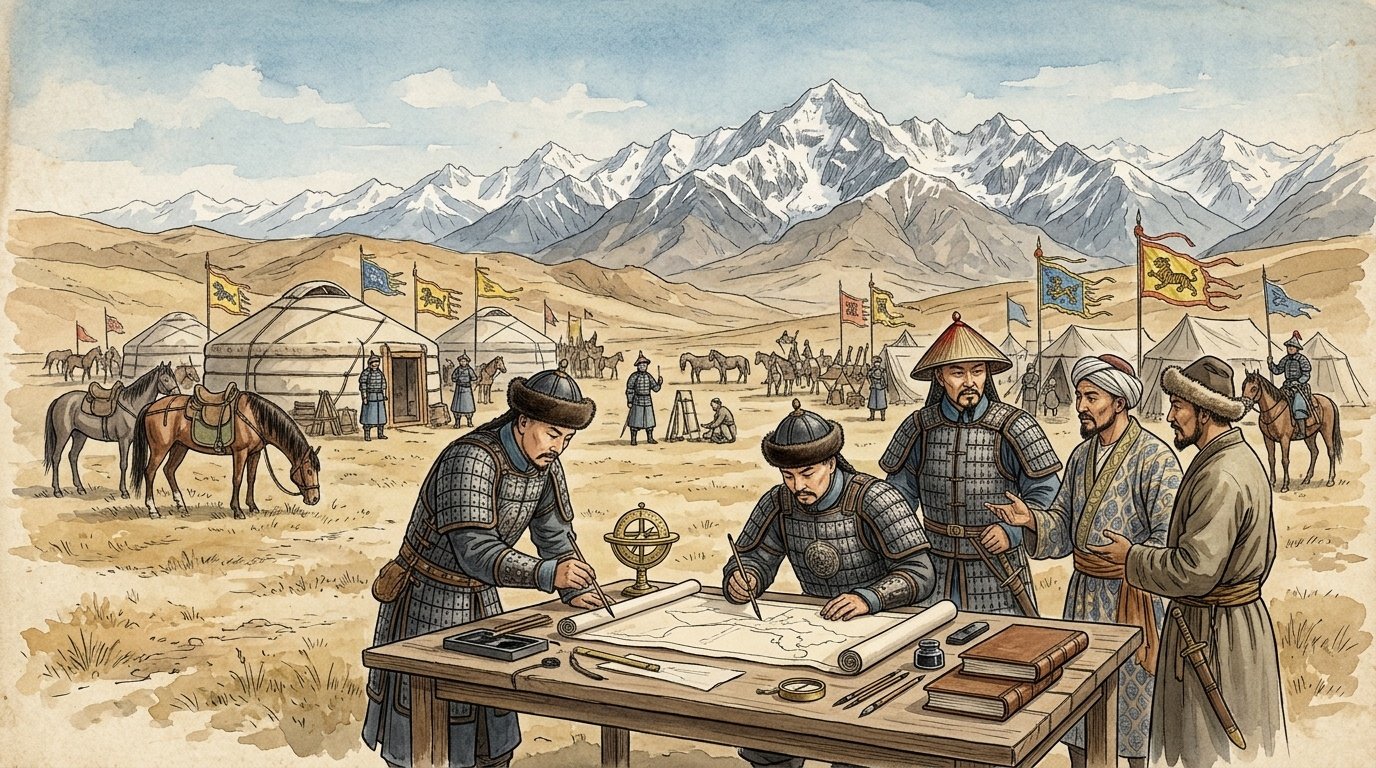
In the ninth lunar month of the twentieth year of the Qianlong era—October 1755 CE—an extraordinary triumphal stone monument was hoisted atop the precipitous granite peak of Mount Gedeng (格登山), overlooking the winding, azure waters of the Ili River in Central Asia. Carved deep into the polished grey stone in four imperial languages—Classical Manchu, Chinese, Mongolian, and Chagatai Turkic—were the words of the forty-four-year-old Qianlong Emperor (乾隆帝, r. 1735–1796 CE), commemorating the total military destruction of the Dzungar Khanate (准噶尔汗国):
‘格登之山,嵯峨崭岩。谁其守之?贼臣达瓦齐。阿尔楚尔,涉历几程。天戈所指,莫敢不从… 我武惟扬,定我疆场!’
— Qianlong Emperor, Imperial Gedeng Mountain Stele Inscription (格登山纪功碑, 1755 CE)
(‘The mountain of Gedeng rises lofty and craggy. Who guarded it? The rebel chieftain Dawa Achi! Across the Alchur ranges, over countless leagues of march, wheresoever the celestial spear pointed, none dared disobey… Our martial majesty is displayed; our imperial frontier is established forever!’)
The campaign commemorated on Mount Gedeng was not merely another dynastic frontier skirmish; it was the apocalyptic climax of an eighty-year imperial death match that permanently transformed the geography and ethnic map of Eurasia. For more than a century, the Dzungars—the westernmost federation of the Oirat Mongols inhabiting the sprawling steppes, river valleys, and mountain ranges between the Altai and Tian Shan—had formed the last great nomadic empire in human history. Unlike previous steppe confederations that relied solely on horses and composite bows, the Dzungars had forged an exceptionally sophisticated, gunpowder-armed early modern nomadic state. They possessed camel-mounted artillery, state iron foundries, armories casting European-style flintlock muskets, literate monastic bureaucracies, and a deep religious alliance with the Dalai Lamas of Tibet.
For three successive Qing reigns—Kangxi, Yongzheng, and Qianlong—the Dzungar Khanate was the supreme geopolitical rival of the Manchu Empire. It was a contest not merely for territory, but for the sacred mantle of universal Buddhist and nomadic emperorship across Inner Asia. To destroy this rival, the Qing state mobilized millions of soldiers, bankrupted provincial treasuries, dug thousands of miles of canal networks, deployed Jesuit-cast cannons, and executed massive military expeditions across thousands of miles of waterless deserts.
Yet the final phase of this contest between 1755 and 1757 crossed the threshold from military conquest into catastrophic demographic extermination. Following the treacherous rebellion of the Dzungar prince Amursana (阿睦尔撒纳), an enraged Qianlong Emperor issued secret, chilling rescripts ordering his generals to wage a war of total annihilation against the Dzungar nation. Between the swords of the Eight Banners, a catastrophic epidemic of smallpox, and widespread starvation, between six hundred thousand and eight hundred thousand Dzungar people—over eighty percent of the entire ethnic population—were wiped from the face of the earth. In the words of modern historian Peter C. Perdue, it was the definitive ‘state-sponsored genocide’ of early modern Asian history.
Upon the ash and depopulated grasslands of Dzungaria and the conquered oasis kingdoms of the Tarim Basin (Altishahr), Qianlong forged an immense new administrative realm spanning over 1.6 million square kilometers—an expanse larger than Britain, France, and Germany combined. To this conquered territory, the emperor bestowed a name that endures to this day: Xinjiang (新疆, Ice Jecen in Manchu), ‘The New Frontier’. To repopulate this immense void, Qianlong orchestrated one of the most astonishing demographic engineering projects in history: the heroic return of the Torghut Mongols from the Volga River in Russia, the resettlement of Xibe banner garrisons from Manchuria, and the migration of thousands of Han and Uighur agricultural colonists to the Ili River.
This monograph presents an exhaustive, multidisciplinary investigation into the rise and fall of the Dzungar Empire and the creation of Qing Xinjiang. We will analyze the institutional, military, and economic architecture of the Dzungar state; chronicle the three generations of imperial warfare waged by Kangxi, Yongzheng, and Qianlong; examine the decisive campaigns of Gedeng Mountain and the Black Water; dissect the ideological justification and grim logistical reality of the 1755–1757 extermination campaign; analyze the administrative design of the Military Governor of Ili and the Beg system; trace the epic 1771 return of the Torghut Mongols; and evaluate the profound historiographical debates surrounding the Qing conquest of Central Eurasia.
1. The Last Nomadic Empire: The Architecture of Dzungar Power
To understand why the Qing Dynasty viewed the Dzungars with such profound, existential dread, one must dismantle the enduring myth that Central Asian nomads were merely primitive, disorganized horse barbarians. The Dzungar Khanate (Зүүнгар, Züüngar, meaning ‘Left Hand’ or ‘Eastern Wing’ of the Oirat) was an extraordinarily modern, adaptive, and institutionalized early modern Eurasian state.
The Oirats were the western branch of the Mongol peoples, residing historically around the Altai Mountains, the Upper Yenisei, and the lush Ili River valley. Following the collapse of the Mongol Yuan Dynasty in 1368, the Oirats had repeatedly challenged the Eastern Mongols (Khalkha and Chahar) for supremacy. In the seventeenth century, a brilliant chieftain of the Choros clan, Khara Khula (d. 1634), and his son Erdeni Batur (r. 1634–1653) unified the four major Oirat confederations—the Choros, Dörbet, Khoshut, and Torghut. In 1640, Erdeni Batur hosted the famous Pan-Mongol Congress at Tarbagatai, promulgating the monumental Mongol-Oirat Legal Code (Iki Tsaadzhin Bichig), which codified Tibetan Buddhism as the state religion, outlawed tribal blood feuds, and united forty-four Mongol and Oirat princes under a single constitutional framework.
Under Erdeni Batur’s son, the charismatic and ruthless Galdan Boshugtu Khan (1644–1697 CE), the Dzungar state expanded into a continental empire. Galdan had been educated in Lhasa as a Tibetan Buddhist incarnate lama, studying directly under the 5th Dalai Lama (Ngawang Lobsang Gyatso) and the Panchen Lama. When his elder brother was murdered in a succession feud in 1670, Galdan received a special dispensation from the Dalai Lama to renounce his monastic vows, return to the Ili, and seize the leadership of the Choros clan. In 1678, the 5th Dalai Lama bestowed upon Galdan the supreme sacred title of Boshugtu Khan (‘Khan by Divine Grace’), anointing him as the temporal sword and protector of the Gelugpa (Yellow Hat) Buddhist church across all Inner Asia.
Armed with this divine Buddhist mandate, Galdan launched a series of blistering military conquests:
- Subjugation of Altishahr (1678–1680): Galdan marched his cavalry across the Tian Shan into the Tarim Basin, toppling the Chagatai Khanate, capturing the historic oasis metropolises of Kashgar, Yarkand, Khotan, Turpan, and Aksu. Galdan installed the clerical Afaqi Khojas as puppet rulers, extracting immense annual tributes of raw cotton, jade, silk, and gold dust from the sedentary Muslim populations (the Burchi tax);
- Conquest of the Kazakh Steppe: Dzungar armies repeatedly smashed the Kazakh Little and Middle Hordes under Tauke Khan, capturing the great Silk Road trading hub of Sayram in 1684 and forcing thousands of Kazakh clans to pay livestock tribute;
- Invasion of Khalkha (Outer Mongolia, 1688): Galdan swept across the Altai Mountains with thirty thousand cavalry, routing the Khalkha Mongol princes under Tusheet Khan Chakhundorj and the Jebtsundamba Khutuktu, driving hundreds of thousands of starving Khalkha refugees south to seek the protection of the Kangxi Emperor inside the Great Wall.
What made the Dzungar Khanate truly formidable was its technological synthesis of nomadism and early modern manufacturing. Recognizing that traditional horse archery could not withstand Qing or Russian firepower, the Dzungar khans established state foundries at Kulja on the Ili River. Under the direction of captured Swedish artillery officer Johan Gustaf Renat (1693–1744)—who had been captured by the Russians at Poltava and subsequently taken by Dzungars in Siberia—the Dzungars learned modern metallurgical casting.
Renat supervised Dzungar armories that manufactured thousands of modern flintlock muskets, iron cannonballs, and mobile bronze field guns. Most famously, the Dzungars perfected the Zamburak (骆驼炮, Camel Artillery): mounting light swivel cannons onto the wooden pack-saddles of Bactrian camels. These camel batteries possessed astonishing tactical mobility across roadless deserts, capable of trotting into position, kneeling, firing salvos of fragmentation shot into enemy infantry ranks, and redeploying before enemy cavalry could close the distance. By 1740, the Dzungar standing army numbered over eighty thousand horsemen, virtually all equipped with muskets and supported by modern artillery.
2. Three Generations of Holy War: Kangxi, Yongzheng, and the Dzungar Crucible
For the Qing emperors, the existence of the Dzungar Empire was an intolerable ideological challenge. The Qing court derived its legitimacy in Inner Asia not from the Confucian Mandate of Heaven, but from its status as the Grand Khan of the Mongols (Bogdo Khan) and the supreme patron of Tibetan Buddhism, inherited from the surrender of the Northern Yuan royal seal by the Chahar Mongols in 1635. If Galdan and the Dzungars successfully united the Khalkha Mongols, seized Tibet, and mobilized the spiritual authority of the Dalai Lama, the Qing Empire’s entire northern frontier would disintegrate into nomadic holy war.
Thus began an epic, three-generation conflict spanning eight decades:
A. The Kangxi Campaigns: Ulan Butung and Jao Modo (1690–1696 CE)
In 1690 CE, Galdan Boshugtu Khan marched his cavalry across Outer Mongolia to within two hundred miles of Beijing. At the Battle of Ulan Butung (乌兰布通之战) in Inner Mongolia, Kangxi’s Eight Banners engaged Galdan’s forces in a ferocious artillery duel. Galdan deployed his legendary ‘Camel Fortress’ (驼城)—lashing thousands of camels together on their knees behind wicker shields to create an impenetrable mobile rampart from which musketeers fired. Though Qing heavy artillery eventually battered through the camel wall, Galdan escaped into the desert.
In 1696 CE, having neutralized Russian intervention via the Treaty of Nerchinsk, Kangxi personally led eighty thousand troops on a monumental expedition across the Gobi Desert. At the Battle of Jao Modo (昭莫多之战), south of modern Ulaanbaatar, Qing General Fiyanggu trapped Galdan’s exhausted army. Qing artillery and banner cavalry smashed the Dzungar formations; Galdan’s heroic wife, Queen Anu, was killed leading a desperate counter-charge to rescue her husband, and Galdan fled into the Altai wilderness with barely forty riders, dying of poison and illness the following year.
B. The Tibetan Crisis and the Yongzheng Stalemate (1717–1732 CE)
Galdan’s death did not end Dzungar power; his brilliant nephew Tsewang Rabtan (r. 1697–1727) rebuilt the Khanate into an even more formidable military state. In 1717 CE, Tsewang Rabtan pulled off one of the most audacious military raids in Asian history: he dispatched a six-thousand-man cavalry corps under General Tsering Dhondup on a grueling, fifteen-hundred-mile trek across the trackless Changtang plateau of northern Tibet. Descending upon Lhasa by surprise, the Dzungars sacked the holy city, executed the Qing ally Lha-bzang Khan, and imprisoned the Tibetan high lamas.
Kangxi responded in 1720 with a massive two-pronged counter-invasion of Tibet. Qing armies under the 14th Prince Yinti and General Yansin recaptured Lhasa, slaughtered the Dzungar occupation garrison, and enthroned the 7th Dalai Lama (Kelzang Gyatso) at the Potala Palace, establishing permanent Qing imperial resident ministers (the Amban 驻藏大臣) in Lhasa.
Under Kangxi’s son, the Yongzheng Emperor (雍正帝, r. 1722–1735 CE), the Qing attempted to land a knockout blow against the Dzungar heartland. In 1731 CE, a forty-thousand-man Qing army under General Furdan was lured into a mountain gorge at the Battle of Hoton Nor (和通泊之战) by Dzungar ruler Galdan Tseren. Surrounded by superior Dzungar musketeers and camel artillery, Furdan’s army was virtually annihilated, losing over ten thousand elite Manchu officers and soldiers in the worst Qing military disaster in a century. Only a brilliant defensive victory by Khalkha Prince Tsering at Erdeni Zuu in 1732 prevented the Dzungars from overrunning Outer Mongolia, forcing Yongzheng to sign a temporary truce that fixed the Altai Mountains as the boundary between the two empires.
3. The Crack of Doom: Internal Schism and Qianlong’s 1755 Invasion
For all its military brilliance, the Dzungar Khanate suffered from a fatal, structural Achilles’ heel: violent, recurring succession crises. Nomadic succession in the Chinggisid and Oirat traditions was not governed by strict primogeniture; any male royal possessing noble lineage and military charisma could claim the throne through force of arms (tanistry). So long as formidable khans like Galdan Tseren held supreme power, tribal discipline was maintained. But when Galdan Tseren died in 1745 CE, the Khanate was torn apart by fratricidal bloodbaths.
Within a decade, four rival claimants assassinated one another in rapid succession. By 1753, a ruthless noble named Dawa Achi (达瓦齐) seized the throne with the assistance of his ambitious ally, Prince Amursana (阿睦尔撒纳, 1723–1757 CE), chieftain of the Khoit clan. However, the two victors immediately turned upon each other: Dawa Achi demanded total submission, while Amursana demanded hereditary control over the northern pastures. Defeated in battle by Dawa Achi in 1754, Amursana made a fateful decision: he gathered twenty thousand of his Khoit tribesmen, drove his herds across the Altai, and rode directly to the summer palace of Chengde to prostrate himself before the Qianlong Emperor, begging for Qing military intervention to overthrow Dawa Achi.
The arrival of Amursana in Chengde was the moment Qianlong had spent his entire reign anticipating. While conservative Manchu grandees in the Grand Council—led by Fuheng and others—feared another catastrophic quagmire like Hoton Nor and urged caution, Qianlong recognized that the Dzungar Khanate was politically hollowed out, fractured by civil war, and weakened by severe winter famines. The emperor overruled his ministers with absolute determination:
‘准噶尔数世为梗,扰乱西陲,今天诱其衷,自相戕贼。阿睦尔撒纳倾心内附,此天赐荡平之机,断不可失!若待其复定,则噬脐莫及矣!’
— Qianlong Emperor, Imperial Edict on the Dzungar Expedition (February 1755 CE)
(‘The Dzungars have been a thorn in our side for generations, throwing our western borders into chaos. Today Heaven has confused their minds and caused them to butcher one another! Amursana has turned his heart toward us; this is a Heaven-sent opportunity to sweep them clean, and we must not let it slip away! If we wait until they have reunited, our regrets will be beyond repair!’)
In February 1755 CE, Qianlong mobilized a colossal expeditionary force of fifty thousand elite Eight Banner, Khalkha Mongol, and Chahar cavalry. The army was divided into two columns:
- The Northern Route: Commanded by Generalissimo Ban Di (班第), accompanied by Amursana as vanguard advisor, advancing through Uliastai and crossing the Altai Mountains;
- The Southern Route: Commanded by General Yong Chang (永常), accompanied by the defecting Dzungar prince Salar, marching through Hami and the northern slopes of the Tian Shan.
The 1755 campaign was a military Blitzkrieg without precedent in Central Asian history. Expecting years of grueling trench warfare, the Qing armies encountered virtually zero resistance. Dawa Achi was universally despised by his own subjects for his drunkenness and cruelty; as the Qing banners approached, Dzungar chieftains, Buddhist monks, and common herders rode out carrying white scarves (Khadag), meat, and fermented mare’s milk to welcome the imperial troops. In barely one hundred days, marching over two thousand miles across deserts and snow-capped passes, Ban Di’s vanguard entered the fertile paradise of the Ili River valley in May 1755.
Dawa Achi fled south across the Tian Shan with six thousand die-hard cavalry, fortifying the sheer limestone crags of Mount Gedeng. On the night of June 24, 1755, a daring Mongol scout officer in the Qing vanguard named Ayusi (阿玉锡) led a legendary commando raid: with only twenty-two cavalrymen, Ayusi crept up the precipitous cliffs under the cover of a midnight thunderstorm, penetrated Dawa Achi’s inner camp, and discharged muskets while screaming war cries. Terrified that the entire Qing army had scaled the mountain, Dawa Achi’s six thousand men broke into panic, trampling their own tents and fleeing into the gorges. Dawa Achi fled to the Tarim Basin, where he was arrested by the local Muslim Beg of Uqturpan, Hakim Beg Khojis, and delivered in chains to the Qing camp. The Dzungar Khanate had fallen without a single pitched battle.
4. The Great Treachery: Amursana’s Revolt and the Decree of Extermination (1755–1757 CE)
Yet Qianlong’s triumph was short-lived. The emperor’s political plan for post-conquest Dzungaria was based on the ancient principle of ‘Divide and Rule’ (分而治之). Refusing to allow a single unified khan to rule the Oirats, Qianlong decreed that the Dzungar realm would be partitioned into four separate, independent Khanates (Choros, Dörbet, Khoshut, and Khoit), each ruled by an imperial appointee under the direct supervision of an imperial Manchu garrison at Ili.
This settlement utterly enraged Amursana. Amursana had aided the Qing not to become a petty chieftain of the impoverished Khoit clan, but to be enthroned as the supreme, all-powerful Great Khan of all the Oirats. In August 1755, while escorting General Ban Di’s army back from the Tarim Basin, Amursana launched a sudden, treacherous mutiny. He ambushed the small Qing garrison left at Ili, slaughtered the imperial soldiers, and besieged Generalissimo Ban Di at Mount Gedeng. Refusing to surrender to a rebel, Ban Di drew his sword and slit his own throat, while his deputy, General E Rong’an, died fighting by his side. Proclaiming himself the Great Khan of the Oirats, Amursana sent horsemen galloping across the steppes, calling upon all Mongol and Kazakh clans to rise in a holy war of national liberation to drive the Manchus back beyond the Great Wall.
When the news of Ban Di’s suicide and Amursana’s treachery reached Beijing in October 1755, the Qianlong Emperor was consumed by an incandescent, volcanic fury. The emperor felt personally betrayed: he had showered Amursana with honors, granted him the rank of imperial prince, bestowed upon him banquets and palace silks in Chengde, only to be repaid with the murder of his most trusted general and the slaughter of his garrison.
In the winter of 1755, Qianlong issued a series of top-secret, brush-written imperial rescripts to his newly appointed field commanders—Generals Zhaohui (兆惠, 1708–1764 CE), Fude (富德), and Ce Leng. These decrees represent the most explicit orders for demographic eradication in the imperial archives of China:
‘此等贼徒,怙恶不悛,不可稍存姑息!务令大兵四面兜剿,穷追极捕。凡遇贼匪,不论老幼壮丁,俱行剿绝!除妇孺分赏官兵为奴外,成年男丁断不可留!必使犁庭扫穴,永绝根株!’
— Qianlong Emperor, Secret Edict on the Extermination of the Dzungars (December 1755 CE), Grand Council Secret Archives
(‘These treacherous bandits cling to evil without remorse; there must not be the slightest mercy shown to them! Order the grand army to surround them on all four sides, pursuing and capturing them to the bitter end. Whosoever encounters these rebels, regardless of whether they are aged, young, or able-bodied, let them all be exterminated without exception! Except for the women and young children who may be distributed as slaves to our officers and men, not a single adult male shall be spared! We must plow their courtyards and sweep their dens, eradicating their very roots forever!’)
In a subsequent decree to General Ce Leng in 1756, Qianlong reiterated with chilling administrative clarity:
‘If our troops show false benevolence and fail to slaughter them cleanly, they will merely harbor rebellion again in years to come. Show no pity! Sweep the Ili River until not a single rebel remains on the steppes!’
— Qianlong Emperor, Rescript to Ce Leng (1756 CE)
What followed between the spring of 1756 and the autumn of 1757 was a campaign of systematic, industrialized devastation. Qing armies swept across the valleys of the Ili, the Tekes, the Kash, and the Tarbagatai in relentless sweeping formations. Every Dzungar encampment (Ail) encountered was encircled; the yurts were torched; the herds of horses, sheep, and cattle were slaughtered or driven off; and the adult men were put to the sword. Wells were poisoned; winter granaries burned; and pregnant women butchered.
Yet the most horrifying executioner of the Dzungar nation was not the Manchu saber, but an invisible biological weapon: Smallpox (天花). The Oirat Mongols, living in the isolated mountain valleys of Central Asia, possessed virtually zero biological immunity to the variola virus. The converging Qing armies inadvertently carried smallpox into Dzungaria. The disease spread through the crowded, fleeing refugee camps with apocalyptic ferocity. Entire clans broke out in putrefying pustules, dying within three days of high fever and asphyxiation; nomadic mothers abandoned their dying children in the sagebrush; and unburied corpses lined the mountain defiles for hundreds of miles, devoured by packs of starving wolves.
Amursana fled from mountain to mountain, his followers melting away from disease and hunger. In the summer of 1757, abandoned by all his allies and pursued by General Zhaohui’s cavalry, Amursana slipped across the frontier into Russian Siberia, seeking asylum in Tobolsk. There, barely two months after arriving, the rebel prince contracted the very disease that had destroyed his nation: Amursana died of smallpox in September 1757 at the age of thirty-four. In an eerie postscript, Qianlong demanded that the Russian authorities surrender Amursana’s corpse; the Russians refused to hand over the body, but permitted Qing envoys to inspect the rotting cadaver in Tobolsk to legally verify that the arch-rebel was indeed dead.
The demographic statistics of the Dzungar annihilation are staggering. Modern demographic reconstructions by historians Peter C. Perdue and Wei Yuan (in the Shengwu Ji 圣武记) calculate that the total Dzungar population prior to 1755 was approximately six hundred thousand to eight hundred thousand people. Following the two-year campaign:
- Forty Percent (approx. 240,000–320,000): Died of smallpox epidemics;
- Thirty Percent (approx. 180,000–240,000): Systematically slaughtered by Qing troops and allied Khalkha auxiliaries;
- Twenty Percent (approx. 120,000–160,000): Fled across the frontiers into the Kazakh steppes, Russian Siberia, or the Kyrgyz mountains;
- Ten Percent (approx. 60,000–80,000): Surviving women and children captured and distributed as domestic slaves across Manchuria and northern China.
As the contemporary Qing scholar Wei Yuan recorded in mournful, chilling prose in the nineteenth century: ‘For several thousand li across Dzungaria, not a single yurt was left standing; there was no smoke from a hearth, and only rotting bones remained beneath the sky.’ An entire ethnic nation, which had dominated the steppes of Inner Asia for two centuries, was permanently wiped from the human tapestry.
5. The Siege of the Black Water: The Pacification of Altishahr (1758–1759 CE)
No sooner had the Dzungars been annihilated than a secondary conflagration erupted south of the Tian Shan in the Tarim Basin: the Rebellion of the Altishahr Khojas. The brothers Burhan al-Din (波罗尼都) and Jahan Khoja (霍集占)—descendants of the famous Naqshbandi Sufi saint Ahmad Kasani (Makhdum-i Azam)—had been imprisoned by the Dzungars in the Ili valley. In 1755, Qing forces had liberated them and returned them to Kashgar and Yarkand, hoping they would govern the Muslim oasis cities as loyal imperial tributaries.
However, seeing that the Dzungars were wiped out and that Qing armies were exhausted by warfare, the two Khoja brothers murdered the Qing imperial envoy and raised the banner of Jihad. In the autumn of 1758 CE, General Zhaohui led a vanguard of only three thousand Eight Banner troops into the Tarim Basin to suppress the uprising. Approaching the fortified city of Yarkand, Zhaohui made the grave tactical error of underestimating his enemy: attempting to seize a herd of cattle grazing outside the walls, Zhaohui crossed the Yarkand River, only to be encircled by an overwhelming host of over fifteen thousand mounted Khoja warriors.
What followed was one of the most heroic and grueling defensive stands in military history: the Siege of the Black Water Camp (黑水营之围). For three freezing winter months—from October 1758 to February 1759—Zhaohui and his three thousand soldiers were trapped in a makeshift earthen redoubt along the banks of the Black Water (Heishui River). Completely cut off from all outside supplies, the Qing soldiers endured unimaginable hardships:
- Food Deprivation: The soldiers slaughtered all three thousand cavalry horses and transport camels for food; when the meat was exhausted, they boiled leather saddles, bowstrings, and cartridge pouches;
- Ammunition Starvation: Running out of lead bullets, Zhaohui’s soldiers dug up the cannonballs fired into their camp by the Muslim artillery, loaded them into their own guns, and fired them back at the besiegers;
- The Willow Tree Miracle: When the Khojas cut down the river dikes to flood the Qing redoubt, Zhaohui’s men hastily wove breastworks out of wild riverside willow trees, which miraculously caught the silt and clay, creating a rock-hard defensive wall that absorbed bullet impacts.
In February 1759, relief armies commanded by General Fude and General Arigun fought their way through the mountain passes of Aksu, routing the Muslim encirclement. Blood-soaked, emaciated, and with uniforms reduced to rags, Zhaohui and his surviving soldiers emerged from the Black Water trenches. Qianlong personally composed poetry in honor of Zhaohui, bestowing upon him the title of Duke of Wucheng and ordering his portrait painted by the Italian Jesuit court painter Giuseppe Castiglione (郎世宁) to hang in the Hall of Military Glory (Ziguangge 紫光阁) in Beijing.
Zhaohui and Fude pursued the Khojas across the Pamir Mountains. At the Battle of Lake Yashilkul (伊西洱库尔淖尔之战), high in the snows of modern Tajikistan, Qing forces crushed the final remnants of the Khoja army. Burhan al-Din and Jahan Khoja fled into Badakhshan (modern northeastern Afghanistan), where the local ruler, Sultan Shah, executed both brothers to appease the Qing, severing their heads and delivering them in wooden boxes to the imperial envoys. The entire Tarim Basin was pacified.
6. The Architecture of Xinjiang: The Beg System, Military Colonies, and the Torghut Return
In 1759 CE, with both the northern steppes of Dzungaria and the southern oases of Altishahr securely pacified, the Qianlong Emperor carried out a historic administrative reorganization. Dismissing the ancient Han and Tang dynasty terms for the western expanses (‘Western Regions’, Xiyu 西域), Qianlong officially promulgated the name that would define the territory in modern history: Xinjiang (新疆, ‘The New Frontier’).
Qianlong designed a brilliant, dual-track administrative architecture tailored to the radically distinct geographic and cultural realities of the north and the south:
A. The Military Governorship of Ili (伊犁将军)
In 1762 CE, Qianlong established the supreme military and civil authority of the region: the General of Ili (伊犁将军), headquartering the administration in the newly constructed stone fortress of Huiyuan City (惠远城) in the fertile Ili valley. The General of Ili was granted absolute command over all Eight Banner garrisons, Green Standard regiments, postal stations, border pickets (Kharun 卡伦), and diplomatic relations with the Kazakhs, Russians, and Afghan rulers. Eight subsidiary fortified cities were constructed along the Ili—the ‘Nine Cities of Ili’ (伊犁九城)—creating an impregnable military spine across Central Asia.
B. Indirect Rule in the South: The Beg System (伯克制)
In the southern oases of Altishahr, where the sedentary Muslim population possessed deeply rooted Islamic traditions, Qianlong wisely refrained from imposing direct Manchu-Confucian county bureaucracy. Instead, the Qing institutionalized the Beg System (伯克制): co-opting local Muslim aristocratic elites (the Begs) to govern municipal taxation, irrigation networks, and Islamic religious courts (Sharia), while placing them under the supervisory oversight of imperial Qing Ambans (驻扎大臣) stationed in Kashgar, Yarkand, Khotan, and Urumqi. Loyal Muslim aristocrats who had assisted the Qing against the Dzungars—such as Emin Khoja of Turpan—were rewarded with imperial princely titles (Jasagh Prince) and granted permanent residences in Beijing.
C. Repopulating the Void: Demographic Engineering
The total extermination of the Dzungars left the northern half of Xinjiang—a fertile expanse of millions of acres of prime agricultural grasslands—completely empty. Qianlong executed a monumental, state-directed resettlement program:
- The Xibe Banner Migration (1764): Qianlong ordered a hereditary garrison of four thousand Xibe (锡伯族) warriors and their families to relocate from their ancestral homes along the Nonni River in Manchuria. Over a grueling sixteen-month overland march across Mongolia and the Gobi, the Xibe traversed over three thousand miles on foot and ox-cart, settling in the Chapchal valley along the southern bank of the Ili, where they constructed irrigation canals, defended the border, and preserved the Classical Manchu written language down to the twenty-first century;
- Han Civilian and Penal Colonies (Tuntian 屯田): Over two hundred thousand Han peasant farmers from Gansu, Shaanxi, and Shanxi were provided with free oxen, seed grain, and tax immunities to settle in Urumqi, Changji, and Barkol, transforming northern Xinjiang into an agricultural granary;
- The Taranchi Resettlement: Over six thousand Muslim farming families (known as Taranchi, meaning ‘Cultivators’) were relocated from the arid oases of Kashgar and Aksu to the well-watered river terraces of the Ili to farm grain for the Eight Banner garrisons.
D. The Epic Return of the Torghuts (1771 CE)
The ultimate demographic and ideological vindication of Qianlong’s frontier policy occurred in 1771 CE with the historic Return of the Torghut Mongols (土尔扈特东归). The Torghuts were one of the original Four Oirat confederations who had migrated westward to the lower Volga River in Russia in 1630 to escape tribal feuds, establishing the Kalmyk Khanate under the suzerainty of the Russian Tsars.
By the 1760s, facing aggressive Russian colonial encroachment, forced conscription into Catherine the Great’s wars against the Ottoman Empire, and pressure from Orthodox Christian missionaries to convert, the young Torghut ruler Ubashi Khan (1744–1774) made an epic decision: he led his entire nation—one hundred and seventy thousand men, women, and children, driving millions of livestock—on a desperate, eight-month exodus across the frozen steppes of Kazakhstan back to their ancestral homeland in China.
Pursued relentlessly by Russian Cossacks, harassed by hostile Kazakh war parties, and enduring temperatures of forty degrees below zero, the Torghuts suffered unimaginable horrors. By the time Ubashi Khan breached the Qing border pickets at the Ili River in July 1771, fewer than seventy thousand emaciated survivors remained; over one hundred thousand had died of cold, starvation, and battle wounds along the journey.
When Qianlong received word of the Torghut arrival, the sixty-year-old emperor was moved to tears of imperial pride. Qianlong immediately opened the imperial granaries, remitting thousands of sheep, horses, chests of brick tea, and winter coats to save the starving refugees. Qianlong granted Ubashi Khan a lavish personal audience at the Mountain Resort in Chengde, building the monumental Putuo Zongcheng Temple (Little Potala) to celebrate the reunion of all Mongol peoples under the Qing throne. The Torghuts were granted the lush summer pastures of the Yulduz basin in the Tian Shan, permanently filling the pastoral void left by the Dzungars.
7. Historiographical Debates: Peter Perdue and the Legacy of the Eurasian Conquest
In modern world history, the Dzungar annihilation and the creation of Xinjiang occupy a pivotal, contested place. For over two centuries, traditional Chinese historiography—from the official Qing dynastic annals to early twentieth-century Nationalist and Communist texts—framed the campaigns purely as the ‘Pacification of the Western Frontiers’ (平定西陲), celebrating Qianlong for extinguishing chaotic nomadic bandits and restoring the territorial integrity of China dating back to the Han and Tang dynasties.
However, beginning in the late twentieth century, the pioneering scholarship of the New Qing History (新清史) school—most notably Peter C. Perdue (China Marches West: The Qing Conquest of Central Eurasia, 2005) and James A. Millward (Beyond the Pass: Economy, Ethnicity, and Empire in Qing Central Asia, 1759–1864)—radically transformed academic understanding of the conquest.
Perdue demonstrates that the clash between the Qing, Russia, and the Dzungar Khanate was a three-way imperial competition among expanding gunpowder empires in Central Eurasia. Far from being an inevitable, defensive reaction, Qianlong’s campaigns were an aggressive, highly calculated act of imperial state expansion. Furthermore, Perdue’s forensic analysis of the Grand Council secret archives established conclusively that Qianlong’s orders to eradicate the Dzungars fit the legal and historical definition of state-directed genocide: an intentional, systematic campaign to exterminate an entire ethnic group through mass slaughter, forced demographic transfer, and cultural erasure.
Simultaneously, military historians recognize that the fall of the Dzungar Khanate marked a profound, irreversible watershed in global military history: the permanent end of the nomadic threat to sedentary civilization. For over two thousand years—from the Xiongnu who challenged the Han, to the Xianbei, Turks, Khitans, Jurchens, and Mongols who toppled dynasties—the nomadic horse archers of the Eurasian steppe had held a military advantage over the agricultural civilizations of the south. With Qianlong’s deployment of mobile Jesuit artillery, disciplined flintlock musket volleys, and modern logistical granaries, the military balance tipped permanently and decisively in favor of the centralized, bureaucratic gunpowder state. The steppe was conquered, the Great Wall became obsolete, and the borders of modern East Asia were forged in the fires of Xinjiang.
8. Chronology of the Dzungar Wars and the Creation of Xinjiang (1640–1771 CE)
| Date / Year (CE) | Historical Event | Key Historical Figures | Strategic & Historical Significance |
|---|---|---|---|
| 1640 | The Pan-Mongol Congress at Tarbagatai | Erdeni Batur, Oirat Princes | Promulgation of Mongol-Oirat Code; Tibetan Buddhism adopted; Dzungar state founded |
| 1678 | Galdan Proclaimed Boshugtu Khan | Galdan Khan, 5th Dalai Lama | Dalai Lama grants sacred title; Galdan conquers Tarim Basin (Altishahr) |
| 1688 | Dzungar Invasion of Khalkha Mongolia | Galdan Khan, Tusheet Khan | Galdan sweeps across Altai; Khalkha Mongols flee south to seek Kangxi’s protection |
| 1690 (Sep) | Battle of Ulan Butung | Kangxi Emperor, Galdan Khan | Qing artillery clashes with Galdan’s ‘Camel Fortress’; Galdan retreats into steppe |
| 1696 (Jun) | Battle of Jao Modo (Chaomodo) | General Fiyanggu, Queen Anu | Kangxi traps Dzungar army; Queen Anu killed; Galdan’s power broken; dies in 1697 |
| 1717 | Dzungar Raid and Sack of Lhasa | Tsering Dhondup, Lha-bzang Khan | Dzungar cavalry crosses Changtang plateau; sacks Lhasa; murders Khoshut ruler |
| 1720 | Qing Reconquest of Tibet | 14th Prince Yinti, 7th Dalai Lama | Qing armies liberate Lhasa; expel Dzungars; install 7th Dalai Lama and imperial Ambans |
| 1731 (Jun) | Battle of Hoton Nor (Disaster of Furdan) | General Furdan, Galdan Tseren | Qing army trapped in mountain gorge; 10,000 Bannermen killed in worst defeat in century |
| 1745 | Death of Galdan Tseren | Galdan Tseren, Dzungar Princes | Succession civil war erupts; Khanate fragments into fratricidal tribal bloodbaths |
| 1754 (Nov) | Amursana Flees to Chengde | Amursana, Qianlong Emperor | Defeated prince prostrates before Qianlong; begs for military aid against Dawa Achi |
| 1755 (May–Jun) | Qing Blitzkrieg into the Ili Valley | General Ban Di, Amursana | 50,000 Qing troops take Ili in 100 days; Ayusi’s night raid at Mount Gedeng routs Dawa Achi |
| 1755 (Aug) | Amursana’s Treachery and Rebellion | Amursana, General Ban Di | Amursana ambushes garrison; General Ban Di commits suicide; holy war proclaimed |
| 1755 (Dec)–1757 | The Annihilation of the Dzungars | Qianlong, Generals Zhaohui & Fude | Qianlong decrees total extermination; smallpox and sword wipe out 600,000–800,000 Dzungars |
| 1757 (Sep) | Death of Amursana in Tobolsk | Amursana, Russian Authorities | Arch-rebel dies of smallpox in Siberia; Qing envoys inspect corpse; rebellion ends |
| 1758 (Oct)–1759 (Feb) | The Siege of the Black Water Camp | General Zhaohui, Khoja Brothers | 3-month starvation siege in Tarim Basin; Zhaohui holds redoubt eating leather; relieved by Fude |
| 1759 (Jul) | Pacification of Altishahr; Creation of Xinjiang | Qianlong Emperor, General Zhaohui | Khojas killed in Badakhshan; Qianlong coins ‘Xinjiang’ (New Frontier); 1.6M sq km annexed |
| 1762 | Creation of the Military Governor of Ili | Mingrui (First Ili General) | Huiyuan City established as military capital; Nine Cities of Ili built; Beg System ratified |
| 1764 | The Xibe Banner Migration | 4,000 Xibe Warriors & Families | Epic 16-month trek from Manchuria to Ili; preserves Manchu language in Chapchal |
| 1771 (Jul) | The Return of the Torghuts | Ubashi Khan, Qianlong Emperor | 70,000 survivors arrive at Ili from Volga River; Qianlong settles them in Yulduz pastures |
9. Scholarly Bibliography and Primary Historical Sources
To substantiate the demographic calculations, military chronologies, and institutional analyses presented in this monograph, the following primary sources and academic monographs are recommended for further study:
- Qing State Council (comp. 1772 CE), Official Record of the Pacification of the Dzungars (平定准噶尔方略, Pingding Zhunge’er Fanglue), 171 vols: The monumental contemporary imperial archive containing the full texts of Qianlong’s secret rescripts, battlefield dispatches from Zhaohui and Ban Di, and diplomatic correspondence with Russia.
- Zhao Erxun (赵尔巽) et al. (comp. 1927), Draft History of Qing (清史稿, Qing Shi Gao): The official dynastic record. Essential chapters include the Annals of Gaozong (Qianlong, Vols. 10–15), the Biographies of Ban Di, Zhaohui, and Fude (Vols. 312–314), and the Treatise on Geography: Xinjiang (Vol. 76).
- Wei Yuan (魏源, 1794–1857 CE), Military History of the Sacred Dynasty (圣武记, Shengwu Ji), 14 vols: The premier early nineteenth-century critical historical study detailing the logistics, troop numbers, and demographic consequences of the Qianlong western campaigns.
- Perdue, Peter C. (2005), China Marches West: The Qing Conquest of Central Eurasia, Harvard University Press: The definitive modern masterpiece of Eurasian history, exploring the structural state competition between the Qing, Russia, and the Dzungar Empire, and documenting the genocide.
- Millward, James A. (1998), Beyond the Pass: Economy, Ethnicity, and Empire in Qing Central Asia, 1759–1864, Stanford University Press: Pioneering socioeconomic investigation analyzing the Beg system, currency issuance (red cash), and Han-Muslim merchant networks in Qing Xinjiang.
- Millward, James A. (2007), Eurasian Crossroads: A History of Xinjiang, Columbia University Press: Comprehensive, accessible historical synthesis spanning the ancient Silk Road through the Qing conquest to the modern era.
- Bergholz, Fred W. (1993), The Partition of the Steppe: The Dzungar Khanate in International Politics, 1678–1758, Peter Lang: Detailed diplomatic and political study tracing the international relations among the Dzungars, Russia, the Kazakhs, and the Qing Empire.
- Castiglione, Giuseppe, et al. (1765–1774), The Conquest of Central Asia (平定西域战图, Pingding Xiyu Zhantu), 16 copperplate engravings: Imperial visual propaganda suite commissioned by Qianlong and engraved in Paris, depicting the key battles of Gedeng Mountain and the Black Water.
- Crossley, Pamela Kyle (1999), A Translucent Mirror: History and Identity in Qing Imperial Ideology, University of California Press: Masterful intellectual analysis exploring how Qianlong legitimized his universal emperorship over Manchus, Mongols, Han, and Muslims.
- Hostetler, Laura (2001), Qing Colonial Enterprise: Ethnography and Cartography in Early Modern China, University of Chicago Press: Vital examination of how Jesuit cartography and imperial ethnography were deployed by the Qing court to incorporate Xinjiang into the imperial mental map.