The Broken Republic
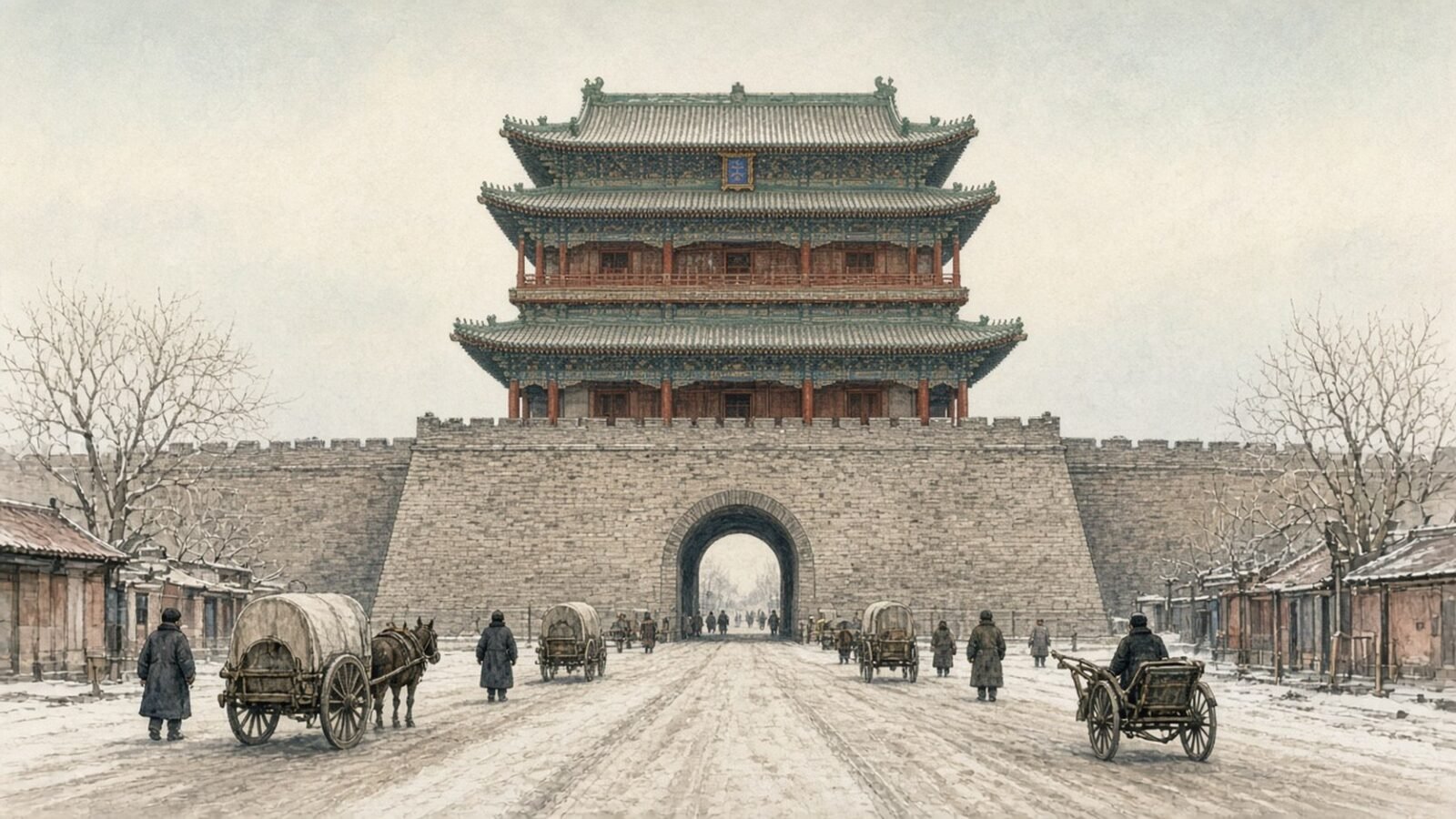
On the first day of January 1916, in the same Forbidden City from which his dynasty had abdicated four years earlier, Yuan Shikai ascended a throne of his own. The general who had negotiated the Qing out of existence, accepted the presidency of the republic as his price, and ruled China for four years as its indispensable strongman, had concluded that the republic itself was the problem. China, his court scholars argued, understood only monarchy; the people needed an emperor; and so the Hongxian Emperor was proclaimed, new porcelain ordered with his reign mark, court robes sewn, altars prepared. The new dynasty lasted eighty-three days. Within weeks the southern provinces were in revolt, his own generals were quietly defecting, Japan was plotting his removal, and by March Yuan had cancelled the coronation and slunk back to the presidency, a broken man. He died in June 1916, of uremia and, his contemporaries agreed, of humiliation, and with him died the last institution that had held China together. The empire had fallen in 1912. Now the republic failed too, and what followed was a decade in which China had no centre at all: a dozen warlords, a puppet parliament, and the strangest, most creative, most violent interlude in the country’s modern history.
This is the seventh essay in a series that has followed China from the Macartney embassy through the opium wars, the Taiping, the failed self-strengthening, and the fall of the Qing. Here the story enters the wilderness years between the dynasty’s end and the nationalists’ rise, 1912 to 1928, an era that looks like pure chaos and was, in fact, the decade in which modern China was invented. Two things happened at once, and the whole century follows from their collision: the state disintegrated, and the mind caught fire.
The republic stillborn
The Republic of China had been born by bargain, and the bargain’s flaw appeared within a year. The revolutionaries of 1911 had the legitimacy; Yuan Shikai had the army. The provisional constitution tried to cage him with a parliament and a responsible cabinet, and for a season the experiment flickered with real promise: in the elections of 1912-13, the first national elections in Chinese history, the Nationalist Party of Sun Yat-sen, reorganized for parliamentary politics by its young organizer Song Jiaoren, won a clear majority. Song was thirty years old, brilliant, and on his way to Beijing to become premier when, on the evening of 20 March 1913, a gunman shot him in the back at Shanghai railway station. He died two days later, and the investigation led, through a chain of intermediaries, toward the president’s own circle. Nothing was ever proved to the standard of a courtroom, and everything was understood. When Sun Yat-sen raised the so-called Second Revolution that summer, Yuan’s Beiyang Army crushed it in weeks, and Sun fled again to Japan, the first president’s constitution dead before its first parliament had governed. Yuan ruled alone for two years, dissolved the parliament, rewrote the constitution to make himself president for life, and then, in 1915, made the wager that destroyed him. Japan, exploiting Europe’s war, had that January presented the Twenty-One Demands, an ultimatum that would have reduced China to a protectorate; Yuan’s government fought them to a softened version and signed, and the day of signature, 9 May, entered the Chinese calendar as National Humiliation Day. The humiliation clung to Yuan, and his answer to weakness was the crown. The eighty-three-day empire is usually told as farce, and it was, but it was also diagnostic: the republic had failed to root in four years, and the pull of the old political grammar, one throne, one mandate, was still strong enough to tempt the strongest man in the country into suicide.
The warlord decade
What Yuan’s death unleashed had no single name, because it had no single shape. The Beiyang Army, the one modern institution he had built, shattered into factions around his lieutenants, and China entered the era of the warlords. In the north, the Anhui and Zhili cliques fought for control of the Beijing government, which survived as a kind of flag of convenience, internationally recognized, chronically bankrupt, and passed between generals like a rented seal. In Manchuria the ex-bandit Zhang Zuolin, the Old Marshal, built a personal kingdom with Japanese money and Japanese strings. Wu Peifu, the Jade Marshal, a scholar-general who prided himself on clean government and lost anyway, dominated the central provinces. Feng Yuxiang, the Christian General, baptized his troops with a fire hose, or so the legend went, and changed sides so often that his treacheries have their own historiography. In Shanxi, Yan Xishan, the Model Governor, ruled one province with genuine competence for nearly forty years. They fought the great set-piece wars of the era, Zhili against Anhui in 1920, Zhili against Fengtian in 1922 and again in 1924, with armies that by the mid-1920s totalled well over a million men, the largest standing military on earth, devoted entirely to fighting itself.
The cost was paid, as always in this series, by the villages. Warlord finance meant taxation collected years, sometimes decades, in advance; in parts of Sichuan the land tax for the 1960s had been collected by the 1920s. Armies were fed by requisition, and deserters turned bandit, and soldiers, so that in the worst counties the line between soldier, bandit and militia dissolved entirely. The great north China famine of 1920-21 killed half a million while armies requisitioned the grain trains. The parliament that survived as a legitimating relic reached its nadir in 1923, when the warlord Cao Kun openly bought the presidency at five thousand dollars a vote, and most of the assembly, having accepted, indignantly defended the transaction as constitutional. Yet the same Beijing that could not govern a province beyond the railway line was sending laborers to the Western Front: some 140,000 Chinese workers dug trenches and carried shells for the Allies in France, and over two thousand of them lie still in the cemeteries of Picardy, their headstones carved with phrases their own government chose, an obscure, enormous fact that would matter bitterly at the peace conference.
The fourth of May
The collision came in 1919, and it came over Shandong. China had entered the war in 1917 on the Allied side expecting, at the peace, the return of the German concessions Japan had seized in 1914. At Versailles the powers gave them to Japan instead, on the strength of secret treaties signed with the Allies during the war. The Chinese delegation, led by the brilliant young diplomat Wellington Koo, argued, appealed, and in the end refused to sign, but the decision stood. When the news reached Beijing at the start of May, it detonated in a city already primed. Since 1915 Chen Duxiu’s magazine New Youth had been conducting, from Peking University, a frontal assault on the entire inheritance: on the examination-essay tradition, on the classical language itself, which Hu Shi proposed to replace with the living vernacular, on the family system, on the subjection of women, on Confucius, whose shop the slogan invited students to smash. The university’s chancellor Cai Yuanpei had made it a sanctuary of every heresy, and in 1918 a librarian’s assistant named Mao Zedong had worked in its stacks, and a writer named Lu Xun, in the pages of New Youth, had published A Madman’s Diary, the founding work of modern Chinese literature, in which the whole of Confucian history is read as a manual of cannibalism. Into this hothouse the news from Paris fell like a match. On 4 May 1919 three thousand students marched on the legation quarter, and, turned back, burned the house of a minister associated with the Japanese treaties and beat the minister to Tokyo half to death. The government arrested the leaders; the country struck in their support; merchants closed their shops and workers walked out in Shanghai, and the government, for the first time in the history of Chinese popular protest, capitulated completely: the students were released, the ministers dismissed, and the delegation in Paris, instructed to sign, refused. China did not sign the Treaty of Versailles.
May Fourth became, in retrospect, the founding event of everything that followed, and both of the parties that would fight for China trace their genealogy to it. Its deeper significance was intellectual: the movement fused patriotism with cultural iconoclasm, the insistence that national salvation required not just new institutions but new people, and it sent its generation hunting through the world’s ideologies for the missing foundation the self-strengtheners had failed to buy. They tried everything at once. John Dewey lectured in China for two years on education and pragmatism; Bertrand Russell came and cautioned against industrialism; anarchism flourished and faded; and in the wake of the Bolshevik revolution, a small study circle at Peking University, guided by the librarian Li Dazhao, turned to Marx. In July 1921, in a girls’ school in the French concession of Shanghai, thirteen delegates representing perhaps fifty members founded the Chinese Communist Party; when the police raided, the congress finished its business on a pleasure boat on a lake in Jiaxing. Among the thirteen was Mao Zedong. Almost nobody in China noticed.
Two parties and one army
Sun Yat-sen spent the same years failing, and learning from failure. By 1922 he had been driven out of Canton by his own military patron, and the lesson he drew was the opposite of the one he had taught: ideas without an army were talk, and his party had no army. Help came from the only government willing to give it. In January 1923 Sun signed an agreement with the Soviet envoy Joffe; Soviet advisers arrived, led by Mikhail Borodin, and the Nationalist Party was rebuilt on Leninist lines, a disciplined party-army machine with its own officer school, the Whampoa Military Academy, founded in 1924 under a young commandant named Chiang Kai-shek, with a political department run by a young communist named Zhou Enlai. The Communists joined the Nationalists as a bloc within, the First United Front, two incompatible parties harnessed to a single expedition. Sun did not live to lead it. He died of cancer in Beijing on 12 March 1925, leaving a testament whose opening line, the revolution has not yet been achieved, became the nationalists’ battle cry and, eventually, carved in stone across China, a warning about all unfinished revolutions.
The Northern Expedition set out from Canton in 1926 and did in two years what no force had done since 1911: it broke the warlords’ coalition and carried a national government, at least nominally, the length of the country. It also consumed the alliance that had launched it. In April 1927, with Shanghai in his hands, Chiang Kai-shek turned on his communist allies in a purge that killed thousands and began the civil war that would run, with one long truce, for twenty-two years. The nationalists established their capital at Nanjing in 1927; in June 1928 the Old Marshal Zhang Zuolin, retreating to Manchuria, was assassinated by the Japanese army officers who had decided he was no longer useful, blown up in his private train at Huanggutun; and that December his son, the Young Marshal Zhang Xueliang, raised the national flag over Manchuria and declared allegiance to Nanjing. China was, for the first time since 1916, formally one country under one government. The warlord era was over, except that it wasn’t: the regional armies remained, merely renamed, and Chiang’s authority ended wherever a provincial army began. The unification of 1928 was a coat of paint over the fractures, and everyone knew it, most of all the Japanese officers in Manchuria, who began planning the next demolition almost immediately.
The wilderness and the fire
How should the era be judged? As politics, the sixteen years from 1912 to 1928 were a nearly unbroken disaster: two failed republics, one farcical monarchy, a bribed parliament, a civil war without fronts, and a countryside taxed into the next half-century. And yet the same years were, intellectually, the most fertile in Chinese history since the age of the philosophers, twenty-three centuries before. It was the decade of New Youth and May Fourth, of the vernacular revolution that put literature into the language people actually spoke, of Lu Xun’s stories and the first modern universities, of women unbinding their feet and going to school, of Dewey and Russell lecturing to packed halls in a capital the warlords had made ungovernable. The paradox is the point, and it is the answer to the question the last essay left open. The empire had fallen because it could not find the foundation to match the hardware; the republic’s generation concluded that the foundation was not institutional at all, but cultural, in the minds and habits of the people, and they set about remaking both with a ferocity that brooked no compromise. Out of that ferocity came the two parties, the Nationalist and the Communist, that between them would govern China’s twentieth century, both born in the same wilderness, both Leninist in structure, both claiming Sun Yat-sen, and both utterly committed to the proposition that China’s disunity was a condition that one disciplined will could end.
Napoleon’s ledger, one last time in this essay, is filling in. The empire he described from St Helena, immense, resourced, backward but educable, had now passed through defeat, rebellion, failed modernization, dynastic collapse and political atomization, and had arrived, by 1928, at something new: a generation that no longer asked whether China should transform itself, but only which transformation, nationalist or communist, would be allowed to succeed. The answer would be decided by war, first between the two parties, then against the Japanese empire, whose seizure of Manchuria in 1931 opened the longest and bloodiest chapter of all. The wilderness years were over. The fire they had lit was just reaching the powder. The next essay in this series takes up the Nanjing decade and the coming of the great war, when the question of China’s survival was asked in earnest, and answered, at a cost the century is still counting.