The Apollo Program and the Moon Landing
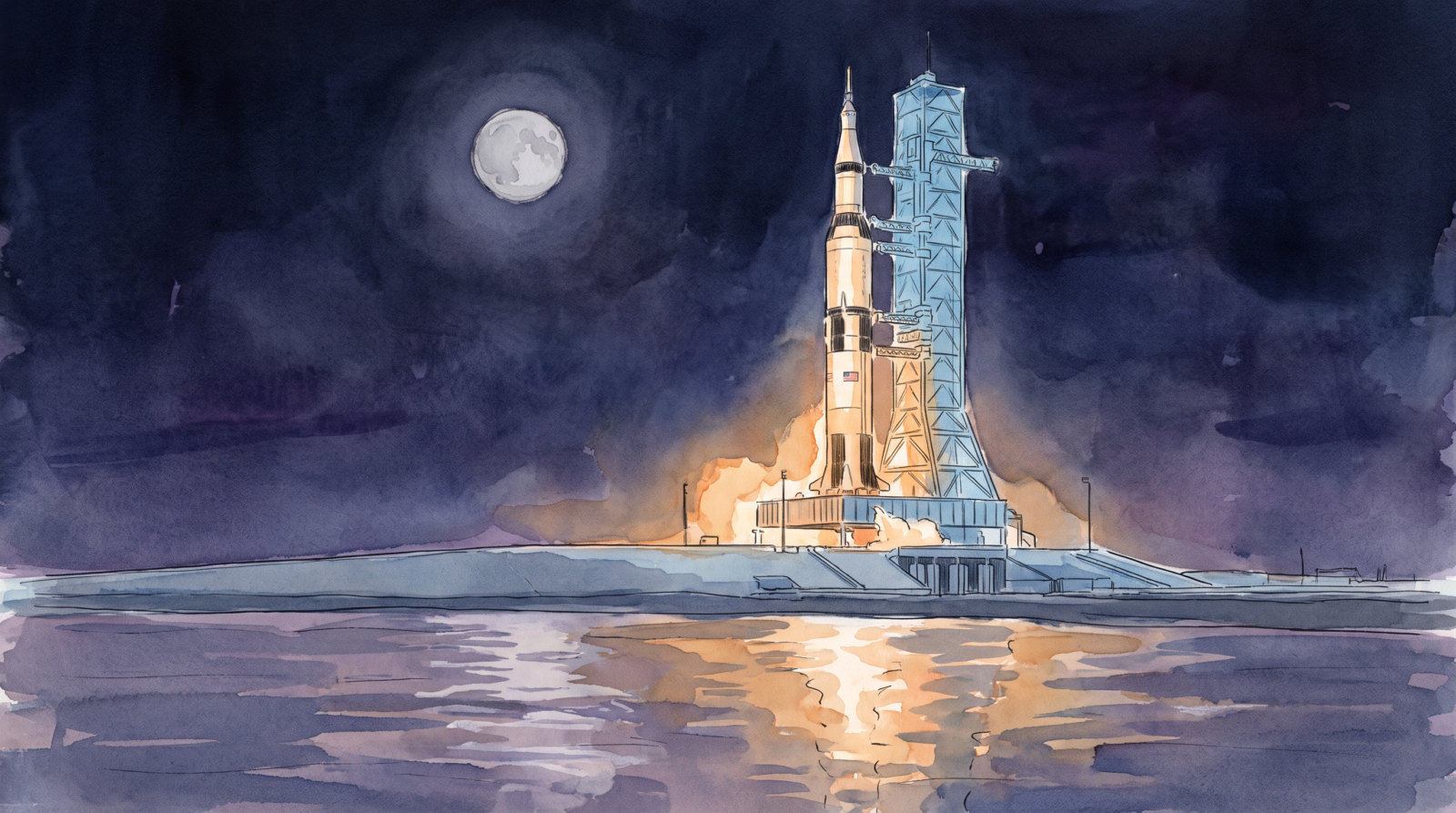
On the morning of 16 July 1969, at 9:32 AM local time, three men in the white coveralls of the National Aeronautics and Space Administration were strapped into the couches of the Command Module Columbia, perched at the top of a Saturn V rocket that stood one hundred and ten metres tall on Launch Complex 39A at the Kennedy Space Center in Florida. Neil Armstrong, the mission commander, was in the left-hand couch, Buzz Aldrin, the lunar module pilot, was in the right-hand couch, and Michael Collins, the command module pilot, was in the centre couch. The three men were about to be hurled into space by a vehicle that was, at the moment of its construction, the most powerful rocket ever built by any state, and the three men were about to be hurled into space on a mission that had, in the years since it was first conceived in the closing days of the Eisenhower administration, become the most watched, the most expensive, and the most ambitious civil project that the United States had ever undertaken. The mission was Apollo 11, and the mission was, at 9:32 AM local time on 16 July 1969, about to begin. Eight years earlier, in May 1961, President John F. Kennedy had committed the United States to landing a man on the Moon and returning him safely to the Earth before the end of the decade. The commitment was, by any measure, an astonishing commitment, because at the time the commitment was made, the United States had not yet put a man in orbit, and the United States had not yet built a rocket capable of sending a man to the Moon. The commitment was, in the most precise political sense, a commitment to an achievement that was, at the moment the commitment was made, technically impossible. The achievement was, in the end, made possible by an unprecedented mobilisation of scientific, engineering, and industrial resources, and the achievement was, in the most tangible political sense, one of the defining moments of the twentieth century.
The Origins of the Apollo Program
The Apollo Program has its origins in the long history of American rocketry, which began in the late 1920s and early 1930s with the work of Robert H. Goddard, who is generally credited with launching the first liquid-fuelled rocket in 1926. The American rocket tradition was, in the most precise historical sense, a small and marginal tradition for several decades, and the American rocket tradition was, for most of the period before the Second World War, the work of a few enthusiasts who were scattered across the country and who were supported, at best, by small grants from private foundations or government agencies. The American rocket tradition was, however, paralleled by a much more substantial German rocket tradition, which had its origins in the work of Hermann Oberth and which was carried forward in the 1930s and 1940s by a number of German engineers, most prominently Wernher von Braun, who would later become the leading figure in the American rocket program.
The Second World War transformed the rocket enterprise in the United States and in the Soviet Union. The war saw the development of the V-2 rocket by the German army, under the direction of Wernher von Braun, and the V-2 rocket was, at the time of its introduction in 1944, the first long-range ballistic missile in the history of warfare. The V-2 rocket was, in the most precise military sense, a major technical achievement, and the V-2 rocket was, in the most tangible military sense, the foundation of the postwar rocket programs in both the United States and the Soviet Union. The end of the war saw the capture of the German rocket engineers by both the United States and the Soviet Union, and the end of the war saw the transfer of the German rocket engineers, and the German rocket technology, to the two emerging superpowers. Wernher von Braun and a number of his colleagues went to the United States, where they were absorbed into the American rocket program, and a number of other German rocket engineers went to the Soviet Union, where they were absorbed into the Soviet rocket program. The transfer of the German rocket engineers was, in the most precise historical sense, the foundation of the postwar rocket programs in both the United States and the Soviet Union, and the transfer of the German rocket engineers was, in the most tangible historical sense, the beginning of the space race.
The early postwar rocket programs in the United States and the Soviet Union were, for the most part, military programs that were aimed at the development of intercontinental ballistic missiles, which were, in the most precise military sense, the principal delivery vehicle for the nuclear weapons of the two superpowers. The intercontinental ballistic missile programs in the United States and the Soviet Union were, in the most tangible military sense, the largest single category of military expenditure in the early Cold War, and the intercontinental ballistic missile programs in the United States and the Soviet Union were, in the most comprehensive military sense, the foundation of the strategic balance of the Cold War. The intercontinental ballistic missile programs in the United States and the Soviet Union were, however, paralleled by a much smaller but more visible program of space exploration, which began in the late 1940s and which culminated in the Apollo Program in the 1960s.
The Soviet Union took an early lead in the space race. The Soviet Union launched the first artificial satellite, Sputnik 1, in October 1957, and the Soviet Union sent the first man, Yuri Gagarin, into orbit in April 1961. The early Soviet achievements were, in the most precise political sense, a major embarrassment for the United States, and the early Soviet achievements were, in the most tangible political sense, one of the principal reasons for the commitment of the United States to the Apollo Program. The commitment was, in the most precise political sense, a commitment to a race, and the commitment was, in the most tangible political sense, a commitment to the achievement of a specific technical objective that would demonstrate the technological superiority of the United States over the Soviet Union.
The Saturn V and the Lunar Module
The Apollo Program required the development of two major new pieces of hardware: the Saturn V rocket, which was the launch vehicle that would carry the Apollo spacecraft to the Moon, and the Lunar Module, which was the spacecraft that would actually land on the Moon. The Saturn V rocket was developed under the direction of Wernher von Braun at the Marshall Space Flight Center in Huntsville, Alabama, and the Saturn V rocket was, in the most precise engineering sense, one of the most impressive pieces of engineering ever built. The Saturn V rocket stood one hundred and ten metres tall, with a diameter of ten metres at the base, and the Saturn V rocket was powered by five F-1 engines in the first stage, each of which produced 6.7 meganewtons of thrust at liftoff. The five engines together produced a total thrust of 34 meganewtons at liftoff, which was, at the time of its introduction, more than the total thrust of all the rockets that had been launched in the history of the world up to that point. The Saturn V rocket was, in the most tangible engineering sense, the most powerful rocket ever built, and the Saturn V rocket was, in the most comprehensive engineering sense, the foundation of the Apollo Program.
The development of the Saturn V rocket was a major undertaking in its own right. The Saturn V rocket required the development of the F-1 engine, which was the most powerful single-chamber liquid-fuel rocket engine ever flown at the time of its introduction, and the Saturn V rocket required the development of a number of new manufacturing techniques to produce the very large fuel tanks and other components that the Saturn V rocket required. The development of the Saturn V rocket was carried out by a team of several thousand engineers and technicians at the Marshall Space Flight Center, at the Michoud Assembly Facility in Louisiana, and at a number of industrial sites around the country, and the development of the Saturn V rocket was, in the most precise engineering sense, one of the largest industrial undertakings in the history of the United States.
The Lunar Module was developed at the Grumman Aircraft Engineering Corporation in Bethpage, New York, under the direction of the NASA Manned Spacecraft Center in Houston. The Lunar Module was, in the most precise engineering sense, a remarkable piece of engineering, because the Lunar Module was designed to operate only in the vacuum of space and on the surface of the Moon, and the Lunar Module was, in the most tangible engineering sense, a vehicle that was unlike any other vehicle that had ever been built. The Lunar Module was, in particular, designed to land on the surface of the Moon under the control of a human pilot, with no computer assistance for the landing, and the Lunar Module was, in the most comprehensive engineering sense, a vehicle that had to operate with absolute reliability in an environment where any failure would mean the death of the crew and the failure of the mission. The Lunar Module was, in the most precise engineering sense, the most ambitious manned spacecraft ever built, and the Lunar Module was, in the most tangible engineering sense, the vehicle that made the Apollo Program possible.
The Lunar Module consisted of two stages: a descent stage, which was equipped with a rocket engine that would be used to slow the Lunar Module as it descended to the surface of the Moon, and an ascent stage, which would carry the two astronauts back to orbit after they had completed their exploration of the lunar surface. The Lunar Module was, in the most precise engineering sense, a two-stage vehicle that was designed to operate only on the Moon, and the Lunar Module was, in the most tangible engineering sense, a vehicle that could not be tested in any Earth-based environment. The Lunar Module was, in the most comprehensive engineering sense, a vehicle that was built on the basis of extensive computer simulation and a series of unmanned test flights, and the Lunar Module was, in the most definitive engineering sense, a vehicle that depended on the engineering judgement of the NASA and Grumman engineers for its success.
The Missions Before Apollo 11
Apollo 11 was the culmination of a series of earlier Apollo missions that had been carried out between 1967 and 1969, and the success of Apollo 11 was, in the most precise historical sense, dependent on the success of the earlier missions. The first manned Apollo mission, Apollo 7, was launched in October 1968 and was a test of the Command and Service Module in low Earth orbit. The second manned Apollo mission, Apollo 8, was launched in December 1968 and was a test of the complete Apollo spacecraft, including the Command and Service Module and the Lunar Module adapter, in orbit around the Moon. Apollo 8 was, in the most precise historical sense, the first manned mission to orbit the Moon, and Apollo 8 was, in the most tangible historical sense, the mission that demonstrated that the Apollo spacecraft could reach the Moon and return safely to the Earth.
The third manned Apollo mission, Apollo 9, was launched in March 1969 and was a test of the complete Apollo spacecraft, including the Lunar Module, in low Earth orbit. The fourth manned Apollo mission, Apollo 10, was launched in May 1969 and was a test of the complete Apollo spacecraft, including the Lunar Module, in orbit around the Moon, with the Lunar Module descending to within fifteen kilometres of the lunar surface but not landing. The four missions before Apollo 11 were, in the most precise historical sense, an incremental test program that progressively built up the experience and the confidence that the Apollo 11 mission would need in order to succeed. The four missions before Apollo 11 were, in the most tangible historical sense, the foundation of the Apollo 11 mission, and the four missions before Apollo 11 were, in the most comprehensive historical sense, an example of the careful and methodical approach that the NASA engineers brought to the Apollo Program.
The Apollo Program was not, however, without its setbacks. The most serious setback was the Apollo 1 fire in January 1967, in which three astronauts, Gus Grissom, Ed White, and Roger Chaffee, were killed during a prelaunch test of the Command Module. The fire was, in the most precise historical sense, a major tragedy, and the fire was, in the most tangible historical sense, a major setback for the Apollo Program. The fire was, however, extensively investigated by a NASA review board, and the fire was, in the most comprehensive historical sense, the occasion for a major redesign of the Command Module that addressed the fire hazard and that made the Apollo spacecraft much safer for the astronauts. The redesign was carried out over the course of the next eighteen months, and the redesign was, in the most precise engineering sense, one of the most important engineering accomplishments of the Apollo Program.
The Apollo 11 Mission
Apollo 11 was launched at 9:32 AM local time on 16 July 1969 from Launch Complex 39A at the Kennedy Space Center in Florida. The Saturn V rocket performed flawlessly, and the Apollo spacecraft was inserted into a parking orbit around the Earth after about twelve minutes of flight. The Apollo spacecraft then performed a translunar injection burn that placed the spacecraft on a trajectory to the Moon, and the Apollo spacecraft began its three-day coast to the Moon. The Apollo spacecraft entered lunar orbit on 19 July 1969, and the Apollo spacecraft performed a series of orbit adjustments in preparation for the landing attempt.
The landing attempt began on 20 July 1969, when Armstrong and Aldrin entered the Lunar Module Eagle and separated from the Command Module Columbia, in which Collins remained in lunar orbit. The Lunar Module Eagle began its descent to the surface of the Moon under the control of Armstrong, who was flying the Lunar Module manually because the automatic landing system was taking the Lunar Module toward a boulder field that Armstrong judged to be unsafe. Armstrong took manual control of the Lunar Module and flew the Lunar Module to a landing on the surface of the Moon at 4:17 PM Eastern time on 20 July 1969, in the Sea of Tranquility, a basalt plain that had been chosen for the landing because it was relatively flat and free of large boulders. The landing was, in the most precise historical sense, the first time that a human being had set foot on another world, and the landing was, in the most tangible historical sense, the culmination of the Apollo Program.
Armstrong stepped onto the surface of the Moon at 10:56 PM Eastern time on 20 July 1969, and Armstrong’s first words on the surface of the Moon, That’s one small step for man, one giant leap for mankind, were broadcast live to an estimated six hundred million viewers around the world. Aldrin followed Armstrong onto the surface a few minutes later, and the two astronauts spent about two and a half hours on the surface of the Moon, collecting samples of lunar material, deploying a number of scientific instruments, and planting an American flag in the lunar soil. The two astronauts then returned to the Lunar Module Eagle and lifted off from the surface of the Moon to rejoin Collins in the Command Module Columbia, and the Apollo spacecraft began its return to the Earth. The Apollo spacecraft splashed down in the Pacific Ocean on 24 July 1969, and the Apollo 11 mission was, in the most precise historical sense, a complete success.
The Apollo 11 mission was, in addition to being a technical success, a major cultural event. The Apollo 11 mission was watched, live, by an estimated six hundred million people around the world, and the Apollo 11 mission was, in the most precise cultural sense, the first global television event in the history of the world. The Apollo 11 mission was, in the most tangible cultural sense, a major source of pride for the United States, and the Apollo 11 mission was, in the most comprehensive cultural sense, a major source of inspiration for people around the world who were watching the mission from their homes and workplaces. The Apollo 11 mission was, in the most definitive cultural sense, a moment that defined the twentieth century.
The Later Apollo Missions and the Legacy of Apollo
Apollo 11 was followed by six more manned Apollo missions between 1969 and 1972, of which five landed on the Moon. Apollo 12, launched in November 1969, landed on the Moon and demonstrated that a precise landing could be made on the lunar surface, with the Lunar Module landing within walking distance of the Surveyor 3 probe that had been sent to the Moon in 1967. Apollo 13, launched in April 1970, suffered a major failure when an oxygen tank exploded in the Service Module, and the Apollo 13 mission had to be aborted. The Apollo 13 crew, James Lovell, Jack Swigert, and Fred Haise, returned safely to the Earth in a remarkable improvisation that used the Lunar Module as a lifeboat, and the Apollo 13 mission became one of the most famous examples of successful crisis management in the history of spaceflight.
Apollo 14, launched in January 1971, landed on the Moon and completed a number of scientific investigations, including the use of the Modular Equipment Transporter, a wheeled cart that allowed the astronauts to carry more equipment on their traverses. Apollo 15, launched in July 1971, was the first of the extended J-missions that used the Lunar Module for extended scientific exploration, and Apollo 15 was the first mission to use the Lunar Roving Vehicle, a battery-powered car that allowed the astronauts to explore a much larger area of the lunar surface. Apollo 16, launched in April 1972, landed in the Descartes Highlands and completed a number of geological investigations, and Apollo 17, launched in December 1972, was the last of the Apollo missions and the last manned mission to the Moon to date.
The legacy of the Apollo Program is, in the most precise historical sense, one of the most contested legacies in the history of science and technology. The legacy of the Apollo Program includes, on the one hand, the technological achievements of the program, including the development of the Saturn V rocket, the Lunar Module, and the Lunar Roving Vehicle, and the technological achievements of the program include, on the other hand, the scientific discoveries that were made possible by the Apollo missions, including the discovery that the Moon was originally molten, the discovery that the Moon has a layered internal structure, and the discovery that the lunar surface preserves a record of the early history of the solar system that is not preserved on the Earth. The legacy of the Apollo Program includes, in the most comprehensive historical sense, the demonstration that the United States could undertake a major technological enterprise and that the United States could accomplish a major technical objective through the mobilisation of scientific, engineering, and industrial resources.
The Lunar Samples and the Science of the Moon
The Apollo missions brought back to the Earth approximately three hundred and eighty-two kilograms of lunar material, including samples of lunar rocks, lunar soil, and lunar core samples that were obtained by drilling into the lunar regolith. The lunar samples were, in the most precise scientific sense, a major scientific resource, and the lunar samples were, in the most tangible scientific sense, the foundation of the modern science of the Moon. The lunar samples were studied by scientists in the United States and in a number of other countries, and the lunar samples were, in the most comprehensive scientific sense, the basis of a number of major discoveries about the origin and the history of the Moon. The lunar samples were also, in the most precise scientific sense, a major scientific resource for the study of the early history of the solar system, because the lunar samples preserve, on the surface of the Moon, a record of the impacts of meteorites and asteroids that has been largely erased on the surface of the Earth by erosion and plate tectonics.
The most important scientific discovery that was made possible by the lunar samples was the discovery that the Moon was originally molten. The discovery was based on the analysis of the lunar rocks, which were found to be composed of minerals that had crystallised from a molten state, and the discovery was, in the most precise scientific sense, a major contribution to the understanding of the origin of the Moon. The most widely accepted explanation of the origin of the Moon is the giant impact hypothesis, which proposes that the Moon was formed from the debris of a collision between the proto-Earth and a Mars-sized body called Theia, which took place early in the history of the solar system. The lunar samples were, in the most precise scientific sense, the principal evidence for the giant impact hypothesis, because the chemical composition of the lunar rocks was found to be very similar to the chemical composition of the Earth’s mantle, but with some distinctive differences that are consistent with the giant impact hypothesis.
The lunar samples also made possible a major advance in the dating of the lunar surface. The dating of the lunar surface is based on the analysis of the radioactive decay of certain elements in the lunar rocks, and the dating of the lunar surface is, in the most precise scientific sense, the basis of the geological timescale of the Moon. The lunar timescale has been extended, through the analysis of the lunar samples, to more than four billion years, and the lunar timescale is, in the most tangible scientific sense, the longest geological timescale that has been established for any planetary body. The comparison of the lunar timescale with the terrestrial timescale is, in the most comprehensive scientific sense, one of the most important contributions of the Apollo Program to the science of the solar system, because the lunar timescale provides a calibration for the dating of the early history of the Earth that cannot be obtained from the geological record of the Earth itself.
The Engineering Lessons of Apollo
The Apollo Program also left a major legacy in the field of engineering management, because the Apollo Program was, in the most precise management sense, one of the largest and most complex engineering projects that had ever been undertaken. The Apollo Program involved, at its peak in 1965, approximately four hundred thousand people working in industry, in government, and in universities, and the Apollo Program involved, at its peak, the expenditure of approximately four percent of the federal budget of the United States. The management of the Apollo Program was, in the most precise management sense, a major undertaking that required the coordination of a large number of contractors, government agencies, and universities, and the management of the Apollo Program was, in the most tangible management sense, one of the most successful examples of large-scale engineering management in the history of the United States.
The most important engineering lesson of the Apollo Program is the lesson of all-up testing. All-up testing is the practice of testing the complete system, rather than testing each component separately, and the practice of all-up testing was, in the most precise engineering sense, a major innovation of the Apollo Program. The Saturn V rocket was tested all-up from the first flight, with no unmanned test flights of the complete vehicle, and the Saturn V rocket was, in the most tangible engineering sense, a major success of the all-up testing approach. The all-up testing approach was, in the most comprehensive engineering sense, a major innovation that has been adopted by a number of subsequent engineering projects, including the Space Shuttle program and the International Space Station program.
The engineering lessons of the Apollo Program also include the lesson of redundancy. The Apollo spacecraft was designed with extensive redundancy in its critical systems, including the guidance and navigation system, the life support system, and the propulsion system, and the redundancy was, in the most precise engineering sense, a major factor in the success of the Apollo Program. The redundancy of the Apollo spacecraft was, in the most tangible engineering sense, demonstrated in the Apollo 13 mission, when the failure of an oxygen tank in the Service Module forced the crew to use the Lunar Module as a lifeboat and to improvise a number of life support and propulsion functions that had not been designed for that purpose. The improvisation of the Apollo 13 mission was, in the most comprehensive engineering sense, a major demonstration of the value of redundancy in engineering design, and the improvisation of the Apollo 13 mission is, in the most definitive engineering sense, an example that has been studied by engineers in many subsequent engineering projects.
The Cultural Memory of Apollo
The cultural memory of the Apollo Program has, in the decades since the program ended, taken a number of forms, and the cultural memory of the Apollo Program has, in the most precise cultural sense, become one of the most enduring cultural memories of the twentieth century. The cultural memory of the Apollo Program includes the hundreds of photographs that were taken on the lunar surface by the astronauts, including the iconic photograph of Buzz Aldrin on the lunar surface taken by Neil Armstrong, and the cultural memory of the Apollo Program includes the television broadcasts that were made from the lunar surface and that were watched by hundreds of millions of people around the world. The cultural memory of the Apollo Program also includes a number of major works of art, literature, and music that have been inspired by the program, including the music of Brian Eno, the novels of Kim Stanley Robinson, and the film For All Mankind by Al Reinert.
The cultural memory of the Apollo Program has also been preserved in the museums that hold the artefacts of the program, including the Smithsonian National Air and Space Museum in Washington, DC, which holds the Apollo 11 Command Module Columbia, the Smithsonian National Air and Space Museum in Washington, DC, which holds the spacesuits worn by the Apollo 11 astronauts, and the Kennedy Space Center in Florida, which holds a number of the Saturn V rockets that were built for the program. The museums are, in the most precise cultural sense, important institutions for the preservation of the memory of the Apollo Program, and the museums are, in the most tangible cultural sense, important sites of pilgrimage for the millions of people who visit them each year to see the artefacts of the program.
The cultural memory of the Apollo Program is also preserved in the Lunar Reconnaissance Orbiter, which has been in orbit around the Moon since 2009 and which has photographed the landing sites of the six Apollo missions that landed on the Moon. The photographs taken by the Lunar Reconnaissance Orbiter are, in the most precise cultural sense, a major scientific resource, and the photographs taken by the Lunar Reconnaissance Orbiter are, in the most tangible cultural sense, a major cultural resource, because the photographs taken by the Lunar Reconnaissance Orbiter show, in detail, the descent stages of the Lunar Modules, the Lunar Roving Vehicles, and the instrument packages that were left on the lunar surface by the Apollo astronauts. The photographs taken by the Lunar Reconnaissance Orbiter are, in the most comprehensive cultural sense, a reminder that the Apollo Program was not a myth but a real achievement that has left a permanent record on the surface of the Moon, and the photographs taken by the Lunar Reconnaissance Orbiter are, in the most definitive cultural sense, a witness to the remarkable achievement of the Apollo Program.
The Apollo Program was, in sum, one of the defining events of the twentieth century, and the Apollo Program is, in the most definitive historical sense, an event that will be remembered for as long as human beings look up at the Moon and remember that they once walked on its surface. The Apollo Program was, in the most precise historical sense, a major achievement of the human species, and the Apollo Program was, in the most tangible historical sense, a major demonstration of the capacity of the human species to undertake great technological enterprises. The Apollo Program was, in the most comprehensive historical sense, a major source of inspiration for the people who participated in the program and for the people who watched the program from their homes, and the Apollo Program is, in the most definitive historical sense, a witness to the capacity of the human species to achieve great things when it sets its mind to them.
The legacy of the Apollo Program also includes, in the most tangible political sense, a major impact on the political and cultural life of the United States and of the world. The Apollo Program was, in the most precise political sense, a major instrument of the Cold War, and the Apollo Program was, in the most tangible political sense, one of the principal ways in which the United States demonstrated the technological superiority of the United States over the Soviet Union. The Apollo Program was, in the most comprehensive political sense, a major instrument of soft power, and the Apollo Program was, in the most definitive political sense, one of the principal ways in which the United States exercised its leadership in the postwar world. The Apollo Program was, in sum, one of the defining events of the twentieth century, and the Apollo Program is, in the most definitive historical sense, an event that will be remembered for as long as human beings look up at the Moon and remember that they once walked on its surface.
References
- Apollo 11 Mission Overview, NASA — the official NASA mission summary with crew biographies, mission timeline, and technical documentation of the Saturn V and the Lunar Module.
- Apollo program, Wikipedia — comprehensive overview with bibliography on the origins, missions, and legacy of the program.
- Bibliography on the Apollo Program, WorldCat — union catalogue for English-language monographs on the Apollo Program.
- Saturn V Launch Vehicle, NASA — NASA technical page on the Saturn V rocket, with stage specifications, engine performance, and flight history.
- Wernher von Braun, the Man Who Sold the Moon (Bantam) — see also the comprehensive Wernher von Braun biography by Ernst Stuhlinger and Frederick Ordway, for the German rocket tradition that led to Saturn V.
- Bibliography on Wernher von Braun and the Saturn V development — WorldCat search for monographs on Wernher von Braun and the development of the Saturn V rocket.
- Bibliography on Apollo 11 and Neil Armstrong — WorldCat search for monographs on the Apollo 11 mission and on Neil Armstrong.
- Bibliography on Apollo 13 and the abort — WorldCat search for monographs on the Apollo 13 mission and the crisis management that brought the crew home.
- Smithsonian National Air and Space Museum — the relevant Smithsonian magazine archives include feature articles on the Apollo spacecraft and on the artefacts returned from the lunar surface; the museum itself holds the Apollo 11 Command Module Columbia.
- Andrew Chaikin, A Man on the Moon (Viking) — the standard narrative history of the Apollo Program, based on extensive interviews with the astronauts.
- Michael Collins, Carrying the Fire (Farrar, Straus and Giroux) — the autobiography of Michael Collins, the Command Module pilot of Apollo 11, with detailed accounts of the rendezvous and the mission.
- Bibliography on the Cold War space race — WorldCat search for monographs on the Cold War competition between the United States and the Soviet Union in space exploration.