Ocean Salts in the Grid – Sodium-Ion Batteries
Across the world, the renewable energy revolution has ignited the fastest transformation of the global electrical infrastructure since the days of Thomas Edison and Nikola Tesla. Millions of solar panels and towering offshore wind turbines are flooding power grids with clean, zero-emission electricity. Yet, renewable power harbors a fatal structural vulnerability: intermittency. The sun sets every evening; the wind dies down during atmospheric calm; and prolonged weather lulls can starve entire continents of power for days. To keep the lights on without burning natural gas and coal, human civilization requires massive, planetary-scale stationary energy storage: terawatt-hours of rechargeable batteries buffering electrical grids across every continent. For years, planners assumed this burden would fall to lithium-ion batteries. That assumption was a dangerous delusion. Lithium is rare, geographically concentrated in fragile salt flats and open-pit mines, and locked in fierce competition with hundreds of millions of electric passenger vehicles. To buffer the electrical grids of nations, humanity needed an energy storage medium that was cheap, safe, abundant, and inexhaustible. That salvation has arrived from the salt of the Earth: Sodium-Ion Electrochemistry. By harnessing sodium—the sixth most abundant element in the Earth’s crust, dissolved in trillions of tons throughout the world’s oceans—and pairing it with non-graphitizable hard carbon anodes, earth-abundant iron-manganese cathodes, and dual aluminum current collectors, sodium-ion batteries are rewriting grid economics. Free from cobalt, nickel, and lithium commodity shocks, capable of deep discharge to zero volts without damage, and delivering cycle lives exceeding decades, ocean salts are rising to secure the clean electrical grid of tomorrow.
1. The Terawatt-Hour Dilemma – Why Lithium Cannot Save the Grid
To grasp why the global energy transition demands a new battery chemistry, one must analyze the staggering quantitative scale of global grid storage. In transportation, an electric car carries a 60 to 100 kilowatt-hour (kWh) battery pack. But in electrical grid management, balancing the fluctuating output of utility-scale wind farms and solar installations across nations requires storage measured in Gigawatt-hours (GWh) and Terawatt-hours (TWh).
According to projections by the International Energy Agency (IEA), achieving net-zero greenhouse gas emissions by 2050 requires expanding stationary battery storage from less than 100 gigawatt-hours today to over 10,000 to 15,000 Gigawatt-hours by mid-century. Relying exclusively on lithium-ion batteries for this monumental stationary task encounters three fatal bottlenecks:
- Geochemical Scarcity and Commodity Volatility: Lithium constitutes a minuscule 0.002% (20 parts per million) of the Earth’s crust. Commercial extraction is heavily concentrated in the ‘Lithium Triangle’ of South America (Chile, Argentina, Bolivia) and hard-rock spodumene mines in Australia, with over 70% of chemical refining concentrated in China. Between 2020 and 2022, surging electric vehicle demand drove battery-grade lithium carbonate prices from $6,000 per ton to an astronomical 80,000 per ton—a 1,200% price spike that paralyzed stationary grid storage projects worldwide.
- Competition with Mobility: Premium electric vehicles and electric aviation require maximum gravimetric and volumetric energy density (> 300 Wh/kg). Every kilogram of lithium diverted to a stationary concrete pad in a desert is a kilogram unavailable for electrifying passenger cars, trucks, and ships.
- Thermal Runaway and Fire Suppression in Megawatt Installations: In grid-scale Battery Energy Storage Systems (BESS), thousands of lithium-ion cells are packed inside 40-foot shipping containers. Thermal runaway in a single cell can trigger catastrophic cascading explosions, as demonstrated by catastrophic battery fires at installations in Arizona, California, and South Korea, releasing toxic hydrofluoric acid gas and burning for days.
For stationary grid storage, the design priorities are completely inverted: weight and volume are largely irrelevant. A stationary battery sits on the ground; whether it weighs 50 tons or 80 tons matters little. What matters supremely is Capital Cost per Kilowatt-Hour (/kWh), Levelized Cost of Storage (LCOS), Cycle Life, Safety, and Absolute Mineral Abundance. In this arena, sodium reigns supreme.
2. The Abundant Alkali – The Geochemistry of Sodium
Sodium (sodium, atomic number 11) is lithium’s heavier sibling on the periodic table, residing immediately beneath it in Group 1 of the alkali metals. But in geochemical availability, the two elements belong to completely different universes:
| Geochemical & Electrochemical Metric | Lithium (lithium) | Sodium (sodium) |
|---|---|---|
| Crustal Abundance | ~20 ppm (0.002% by weight) | ~26,000 ppm (2.6% by weight) (1,300x more abundant!) |
| Global Crustal Rank | 33rd most abundant element | 6th most abundant element on Earth |
| Seawater Concentration | ~0.17 mg/L | ~10,800 mg/L (1.08% of all ocean water!) |
| Precursor Commodity Price | lithium_2CO_3:15,000 – $80,000 / ton | sodium_2CO_3(Soda Ash): ~200 – $300 / ton |
| Ionic Radius | 0.76 Å | 1.02 Å (+34% larger) |
| Standard Reduction Potential | -3.04 V vs SHE | -2.71 V vs SHE (0.33 V higher) |
Sodium is literally everywhere. It is found in massive subterranean salt beds (halite), evaporite soda ash deposits, and in the world’s oceans, which hold an estimated 14 quadrillion metric tons of dissolved sodium. Human civilization can manufacture billions of sodium-ion battery cells for thousands of years without ever depleting global reserves or fighting geopolitical trade wars over raw materials.
3. The Graphite Paradox – Why Sodium Refuses to Intercalate
Given the immense abundance of sodium, why did modern electrochemistry spend thirty years pursuing lithium? The answer lies in a strange, frustrating quantum mechanical anomaly: The Inability of Sodium to Intercalate into Graphite.
In a lithium-ion battery, the anode is synthetic graphite. Lithium ions glide effortlessly between the flat graphene sheets, forming a stable Stage-1 graphite intercalation compound:LiC_6. Potassium, an even heavier alkali metal, also intercalates into graphite to formKC_8. Yet, when electrochemists attempted to insert sodium ions into graphite, the storage capacity was virtually zero (less than30 mAh/g)!
For decades, this was viewed as a bizarre mystery: Why would lithium (smaller) and potassium (larger) intercalate into graphite, while intermediate-sized sodium was completely rejected? In the 2010s, density functional theory (DFT) calculations solved the puzzle: – In lithium, strong orbital hybridization between the small lithium2sstates and carbon2p_zπ-bands provides powerful electrostatic stabilization. – In potassium, the outer4selectrons transfer easily, and the larger atomic radius induces favorable dielectric polarization in the graphene layers. – In sodium, the formation enthalpy (delta H_f) of binary sodium-graphite intercalation compounds (such asNaC_6orNaC_8) is strictly positive (delta H_f > 0)! Thermodynamically, inserting sodium into graphite is energetically unfavorable; sodium prefers to plate on the outside as bulk metal rather than enter the graphite lattice.
Without an anode to host sodium ions reversibly, the sodium-ion battery remained an academic curiosity. To unlock sodium, materials scientists had to invent an entirely new class of carbon.
4. Hard Carbon – The Disordered Scaffold of Sodium Storage
The savior of sodium-ion chemistry was the development of Hard Carbon (Non-Graphitizable Carbon), pioneered by Dahn, Stevens, and commercialized by teams worldwide.
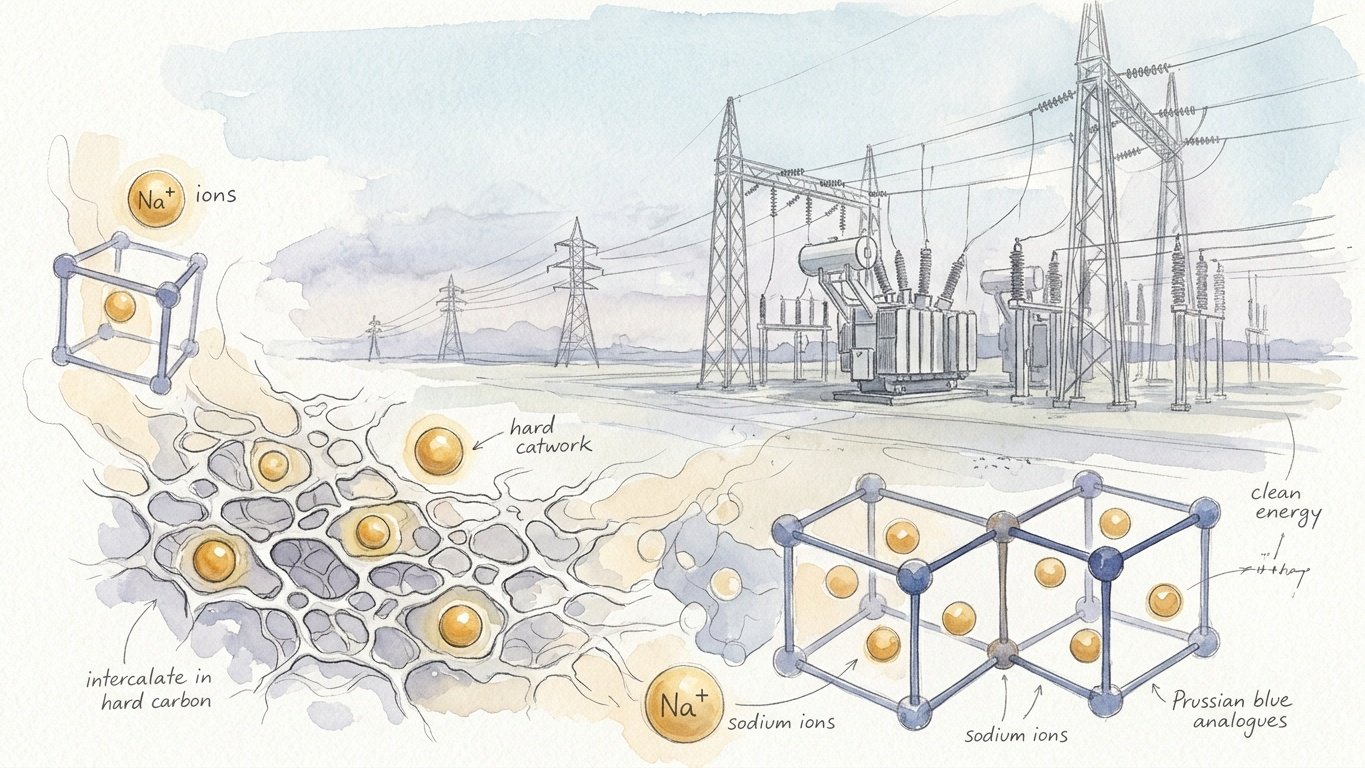
Unlike graphite, which consists of perfectly aligned, parallel crystalline graphene sheets, hard carbon is an amorphous, disordered, turbostratic material: – Short, buckled graphene ribbons arranged in a chaotic, cross-linked ‘house of cards’ geometry. – Large, dilated interlayer spacings (d_{002} > 0.37 – 0.40 nm, compared to0.335 nmin pristine graphite). – Abundant microscopic closed nanopores (measuring 0.5 to 2 nanometers in diameter) trapped within the cross-linked carbon framework.
Hard carbon stores sodium through the celebrated ‘Adsorption-Insertion’ (or Slope-Plateau) Mechanism:
- The Sloping Voltage Region (Above 0.1 V): At high potentials, sodium ions electrostatically adsorb onto defect sites, functional surface groups, and both sides of the dilated graphene sheets.
- The Flat Plateau Region (Below 0.1 V): At low potentials near 0 V vsNa/Na^+, sodium ions cluster and condense into the internal closed nanopores through Quasi-Metallic Pore Filling, packing dense clusters of neutral sodium atoms without forming destructive dendritic needles!
Optimized hard carbon anodes achieve reversible specific capacities exceeding 300 to 350 milliampere-hours per gram (300 – 350 mAh/g)—approaching conventional graphite in lithium cells! Furthermore, hard carbon can be synthesized from virtually any cheap, renewable organic carbon precursor: coconut shells, agricultural rice husks, wood pulp lignin, sugar sucrose, or industrial coal tar pitch pyrolyzed at 1,100 to 1,300 degrees Celsius in an inert atmosphere.
5. Cathode Triad – Layered Oxides, Prussian Blue, and Polyanions
While hard carbon solved the anode puzzle, the positive electrode (cathode) requires crystals capable of reversibly inserting largeNa⁺ions at high operating voltages. Materials scientists developed three primary cathode families:
1. Layered Transition Metal Oxides (sodium_xMO_2)
Pioneered by Christian Delmas, layered sodium transition metal oxides feature sheets of edge-sharing[MO_6]octahedra with sodium ions sandwiched between. Categorized by Delmas notation into O3-type (octahedral sodium sites, 3-layer stacking) and P2-type (prismatic sodium sites, 2-layer stacking):
- O3-Type (e.g.,NaNi_{0.3}iron_{0.3}Mn_{0.4}O₂): Delivers high initial sodium content (x approximately 1) and high capacity (140 – 160 mAh/g), though phase transitions occur during high-voltage cycling.
- P2-Type (e.g.,sodium_{0.67}[iron_{0.5}Mn_{0.5}]O₂): Exhibits wide prismatic diffusion channels with ultra-low activation barriers (E_a approximately 0.17 eV), enabling blistering rate capability and fast charging. Crucially, these cathodes utilize dirt-cheap, non-toxic Iron (iron) and Manganese (Mn), completely eliminating expensive cobalt and nickel!
2. Prussian Blue Analogues (PBAs)
Prussian blue—the famous dark blue pigment synthesized in Berlin in 1706—possesses an open, three-dimensional metal-organic framework with the general formula sodium_{2-x}M[iron(CN)_6] (whereM = iron, Mn, Ni, Co).
The cubic framework features giant interstitial ionic channels measuring over 3.2 Angstroms in diameter—vastly larger than a sodium ion. Sodium ions glide through this rigid cage with virtually zero mechanical volume change (< 1%), yielding extraordinary zero-strain longevity exceeding 50,000 cycles! Synthesized via low-temperature aqueous precipitation from cheap iron salts and sodium cyanide, PBAs represent the lowest-cost cathode in modern electrochemistry.
3. Polyanionic Frameworks (NASICON)
Polyanionic compounds, exemplified by NASICON-typesodium_3V_2(PO_4)_3(NVP) and fluorophosphates (sodium_3V_2(PO_4)_2F_3), utilize strong covalent[PO_4]^{3-}tetrahedral bonds to pin oxygen atoms rigidly in place. The covalent framework provides absolute thermal stability: even when overcharged or heated to 400 degrees Celsius, polyanions cannot release oxygen, guaranteeing zero thermal runaway.
6. The Aluminum Revolution – Bypassing the Copper Tax
Beyond active materials, sodium-ion batteries possess a hidden structural advantage that delivers a massive commercial and cost victory over lithium: The Dual-Aluminum Current Collector.
In a conventional lithium-ion battery, the positive current collector is aluminum foil, but the negative current collector (anode) must be Copper Foil. At low electrochemical potentials below 0.3 V vsLi/Li^+, lithium atoms chemically alloy with aluminum, forming a brittle, crumbly intermetallic compound (LiAl). If an engineer attempted to coat graphite onto aluminum foil, the current collector would pulverize during the very first charge cycle. Copper does not alloy with lithium, but copper is heavy (density8.96 g/cm^3) and expensive (>$9,000/ton). Copper foil represents up to 10% of total lithium-ion battery cost and 12% of cell weight!
In sodium-ion batteries, physics is benevolent: Sodium does not alloy with aluminum at any operating potential!
Because sodium and aluminum do not form intermetallics, sodium-ion manufacturers replace copper with Ultra-Thin Aluminum Foil on BOTH the cathode and anode:
- Aluminum has a density of only $2.70 g/cm^3—slashing current collector weight by over 65%!
- Aluminum costs approximately $2,200 per ton—nearly four times cheaper than copper!
- Replacing copper with aluminum shaves thousands of dollars off utility-scale battery pack manufacturing while improving cell gravimetric energy density.
7. Zero-Volt Transportation – Absolute Safety in Logistics
The elimination of copper current collectors unlocks another revolutionary operational capability unique to sodium: Safe Transportation at Absolute Zero Volts (0.0 V).
In conventional lithium-ion batteries, if a cell is discharged below approximately 2.0 Volts, the copper current collector undergoes an electrochemical catastrophe: copper oxidizes and dissolves into the liquid electrolyte as copper ions (Cu to Cu²⁺ + 2e^-). When the cell is subsequently recharged, these dissolved copper ions plate out as metallic copper dendrites, creating fatal internal short-circuits. Consequently, lithium-ion batteries must be shipped and stored charged at 30% to 50% state of charge (SoC)—representing an active, dangerous bomb of stored chemical energy during ocean freight, cargo flights, and warehouse storage, subject to strict hazardous material transport regulations (UN Class 9).
In a sodium-ion battery with dual aluminum current collectors, aluminum does not dissolve at zero volts. A sodium cell can be completely short-circuited and discharged to 0.0 Volts! In a 0.0 V state, the battery has absolute zero stored electrical energy. It can be punctured with steel spikes, crushed, or heated without fire risk, and shipped across the world via standard freight as non-hazardous cargo, dramatically slashing logistics and insurance costs.
8. Cold-Weather Champion – Low-Temperature Kinetics
A notorious operational limitation of conventional lithium-ion batteries (especially Lithium Iron Phosphate, LFP) is their catastrophic collapse in performance during sub-zero winter temperatures. At -20 degrees Celsius, LFP cells lose up to 50% to 60% of their usable energy capacity, and fast charging is strictly prohibited because lithium ions plate as metallic dendrites on the graphite surface, destroying the cell.
Sodium-ion chemistry exhibits vastly superior Low-Temperature Kinetics:
- Because theNa⁺ion has a smaller charge-to-radius ratio (lower charge density) thanLi⁺, its Solvation Energy in Organic Carbonates is Substantially Lower (delta G_{solv} approximately 135 kJ/molfor Na vs215 kJ/molfor Li).
- At the hard carbon surface, sodium ions shed their solvent shells (de-solvation) up to three times faster than lithium ions, overcoming the primary activation barrier to low-temperature charge transfer.
- Operating at -20 degrees Celsius, commercial sodium-ion cells retain over 85% to 90% of their rated room-temperature capacity, and can be charged at 0.2C to 0.5C rates down to -30 degrees Celsius without dendrite plating! This makes sodium-ion the supreme technology for stationary energy storage in harsh northern climates (such as Northern Europe, Canada, and Northern China) without requiring energy-intensive active battery heating loops.
9. Industrial Scaling – CATL, HiNa, and the Gigawatt Reality
The commercialization of sodium-ion technology is no longer a distant laboratory promise; it is an industrial juggernaut driven by the world’s largest battery manufacturers:
- CATL (Contemporary Amperex Technology Co. Limited): In 2021, CATL unveiled its first-generation sodium-ion cell delivering an energy density of 160 Wh/kg and fast-charging to 80% in 15 minutes. In 2023, CATL launched its AB Battery Pack: combining sodium-ion cells and lithium-ion cells in a single integrated pack, managed by smart BMS software that uses sodium cells for cold-weather performance and low-temperature discharge, and lithium cells for peak range. CATL’s second-generation sodium cells are breaking 200 Wh/kg, rivaling commercial LFP.
- HiNa Battery (China): A spin-out from the Chinese Academy of Sciences (led by Prof. Liquan Chen and Yong-Sheng Hu), HiNa commissioned the world’s first multi-megawatt-hour sodium-ion solar energy storage power station in Anhui, China, and launched the world’s first mass-produced sodium-ion electric passenger vehicle (Sehol E10X) in 2023.
- Natron Energy (USA): Operating multi-gigawatt-hour factories in Michigan, Natron commercialized all-Prussian-blue sodium cells delivering over 50,000 deep cycles and 15-minute ultra-fast discharge, capturing the data center Uninterruptible Power Supply (UPS) market and telecom backup infrastructure.
- Faradion (UK / Reliance New Energy): Pioneering layered oxide sodium-ion cells for stationary off-grid power storage and light electric mobility across India and the developing world.
10. The Levelized Cost of Storage – The True Economic Metric
In electrical utility finance, the metric that determines whether a battery storage installation is commercially viable is the Levelized Cost of Storage (LCOS), calculated as the total lifetime capital and operating costs divided by the total cumulative kilowatt-hours delivered.
Sodium-ion drives LCOS down through three compounding economic advantages: 1. Low Initial Capital Cost: Eliminating lithium, cobalt, nickel, and copper cuts raw material costs by 30% to 40% compared to Lithium Iron Phosphate (LFP), targeting cell manufacturing costs below 40 per kilowatt-hour at scale. 2. Superior Cycle Longevity: Zero-strain Prussian blue and polyanionic cathodes achieve 10,000 to 50,000 cycles, delivering energy over a 25-to-30-year operational life matching the lifespan of the solar panels and wind turbines themselves. 3. Zero Fire Suppression and Air Conditioning Overhead: Operating safely up to 60 degrees Celsius without thermal runaway eliminates complex HVAC cooling systems, slashing ongoing operational expenditures (OpEx).
At an LCOS below $0.03 to0.05 per kilowatt-hour per cycle, sodium-ion storage makes round-the-clock solar and wind power cheaper than running existing, fully amortized coal-fired power plants, removing the final economic excuse for burning fossil fuels.
12. Solid Electrolyte Interphase Dynamics – The Chemistry of Surface Passivation
In any alkali-metal secondary battery operating outside the thermodynamic stability window of liquid organic electrolytes, the longevity of the cell depends entirely on the kinetic protection provided by the Solid Electrolyte Interphase (SEI). While the SEI on lithium graphite anodes has been studied for nearly half a century, the interfacial chemistry of sodium on disordered hard carbon presents fundamentally different challenges and thermodynamic landscapes.
Because the standard reduction potential of sodium (-2.71 V vs. SHE) is approximately 330 millivolts higher than that of lithium (-3.04 V vs. SHE), the driving force for reductive decomposition of electrolyte solvents is ostensibly lower in sodium cells. However, this thermodynamic reprieve is counterbalanced by the physical properties of the decomposition products. Sodium salts, such as sodium carbonate (Na2CO3), sodium fluoride (NaF), sodium alkyl carbonates (ROCO2Na), and sodium oxide (Na2O), exhibit substantially higher solubilities in conventional organic carbonate solvents (such as ethylene carbonate, dimethyl carbonate, and ethyl methyl carbonate) than their lithium analogues.
In standard lithium-ion batteries, the SEI rapidly matures into a dense, insoluble mosaic layer roughly 15 to 30 nanometers thick, effectively arresting further electron transfer from the charged anode into the bulk electrolyte. In contrast, in early sodium-ion formulations, the continuous dissolution and re-precipitation of sodium reaction products resulted in a dynamic, unstable interphase that thickened perpetually across cycling. This phenomena consumed active sodium ions irreversibly, depleted liquid electrolyte, led to relentless impedance growth, and triggered severe capacity fade within a few hundred charge-discharge cycles.
The turning point in sodium SEI engineering came through the precise introduction of sacrificial electrolyte additives, foremost among them fluoroethylene carbonate (FEC). When introduced at concentrations between 2% and 5% by weight, FEC undergoes preferential reductive decomposition at a higher potential (approximately 0.7 V vs. Na/Na+) prior to the breakdown of bulk carbonate solvents. The radical decomposition of FEC yields a highly uniform, dense, and mechanically compliant nanostructured film dominated by microcrystalline sodium fluoride (NaF) and polymeric poly(fluoro-olefins).
Unlike disordered organic carbonates, the NaF-rich inorganic mosaic features low electronic conductivity—effectively halting electron leakage—while facilitating relatively rapid sodium-ion transport via grain boundaries and point defects. Advanced cryo-transmission electron microscopy (cryo-TEM) and in situ X-ray photoelectron spectroscopy (XPS) have revealed that the FEC-derived SEI remains resilient even during the substantial volume contraction and expansion of hard carbon across deep discharge cycles, preventing micro-cracking and parasitic side reactions.
Beyond carbonate solvents, a parallel revolution has emerged in the domain of ether-based electrolytes, specifically glyme solvents such as diglyme (diethylene glycol dimethyl ether) and tetraglyme. In ether formulations, sodium ions exhibit uniquely favorable desolvation kinetics. While carbonate solvents coordinate tightly to sodium ions in complex solvation sheaths that require substantial energy to strip at the electrode-electrolyte interface, ether molecules form quasi-chelating configurations with lower desolvation energy barriers.
Remarkably, in ether systems, sodium ions can even co-intercalate into graphite without exfoliating the carbon sheets, forming ternary graphite intercalation compounds. When applied to hard carbon anodes, ether-based electrolytes form exceptionally thin (less than 5 nanometers), highly flexible, and predominantly organic-free SEI layers that permit stable cycling at extraordinary charge rates exceeding 10C with minimal capacity loss over thousands of cycles.
13. Prussian Blue Analogues – Defect Chemistry and Water of Crystallization
Among the cathode candidates for sodium-ion batteries, Prussian Blue Analogues (PBAs) possess one of the most intellectually compelling crystallographic configurations in solid-state chemistry. Defined by the general chemical formula NaxM[Fe(CN)6]y·zH2O (where M is typically a transition metal such as iron, manganese, nickel, or cobalt), PBAs crystallize in an open, face-centered cubic framework composed of alternating transition metal cations bridged by linear cyanide ligands.
This open coordinate framework creates expansive, three-dimensional interstitial channels with a diameter of approximately 0.32 nanometers. This dimension is significantly larger than the bare ionic diameter of the sodium ion (0.204 nm), providing an unobstructed subterranean highway network through which sodium ions can migrate with exceptionally low activation energy barriers (typically 0.2 to 0.3 eV). Consequently, PBA cathodes can achieve remarkable rate capabilities, charging and discharging fully within minutes without inducing severe polarization.
However, the practical commercialization of Prussian Blue cathodes was long stymied by a pervasive structural defect – transition metal vacancies and interstitial water molecules. In rapid, conventional aqueous precipitation synthesis, a substantial fraction (often 15% to 25%) of the [Fe(CN)6]4- complexes fail to coordinate, leaving empty crystallographic vacancies. To balance the local electrostatic charge and satisfy coordination spheres, water molecules rush into these vacancies, binding directly to the adjacent transition metal ions as coordinated water, while additional uncoordinated “zeolitic” water molecules occupy interstitial cage spaces.
The presence of this water of crystallization is catastrophic for battery longevity. During high-voltage operation (above 3.6 V vs. Na/Na+), residual water molecules undergo electrochemical oxidation, liberating protons and gaseous oxygen. The resulting acidic environment triggers the dissolution of transition metals from the lattice, which subsequently diffuse across the separator to poison the hard carbon anode. Furthermore, the empty vacancies disrupt long-range electronic conductivity throughout the crystal, while the cyclic insertion and extraction of sodium causes anisotropic structural strain that shatters the crystal along vacancy fault lines.
To overcome this fatal flaw, materials scientists developed controlled crystallization methods, such as chelating-agent-assisted slow precipitation and low-temperature hydrothermal synthesis. By introducing organic chelating agents like citric acid, ethylenediaminetetraacetic acid (EDTA), or ascorbic acid into the precursor solutions, the nucleation rate of PBA crystals is suppressed by orders of magnitude. The crystallization transitions from uncontrolled kinetic precipitation to slow, thermodynamically governed crystal growth.
This controlled approach yields “low-defect” Prussian Blue crystals containing vacancy concentrations below 2% and virtually zero coordinated water molecules. When thoroughly dehydrated via vacuum annealing at moderate temperatures (120°C to 160°C), these pristine Prussian White materials (such as Na2-xFe[Fe(CN)6] and Na2-xMn[Fe(CN)6]) unlock their full theoretical capacities (approaching 160 to 170 mAh/g) utilizing two distinct redox couples (e.g., Fe2+/Fe3+ and Mn2+/Mn3+). Operating with negligible lattice strain (volume change less than 1.5%), low-defect PBA cathodes have demonstrated remarkable cyclability, retaining over 80% capacity after 10,000 deep cycles, making them premier candidates for multi-decade stationary grid storage assets.
14. Polyanionic Frameworks and the NASICON Architecture
While layered oxides offer high energy density and Prussian Blue analogues provide fast kinetics and cheap precursors, polyanion compounds represent the pinnacle of structural safety and thermal stability in sodium-ion energy storage. Polyanion cathodes are built from strongly covalently bonded tetrahedral polyhedral units (such as [PO4]3-, [SO4]2-, or [SiO4]4-) linked together with transition metal octahedra ([MO6]).
The hallmark of polyanionic materials is the inductive effect, originally articulated by John B. Goodenough in the context of lithium iron phosphate. Because the central phosphorus, sulfur, or silicon atom forms exceptionally strong, polarized covalent bonds with surrounding oxygen atoms, it weakens the covalent character of the adjacent transition metal-oxygen bonds through inductive electron withdrawal. This shift significantly depresses the redox energy levels of the transition metal, elevating the working operating potential of the redox couple by hundreds of millivolts compared to simple oxides.
The archetype of this class is the NASICON (Na Super Ionic Conductor) family, characterized by the general stoichiometry NaMM'(PO4)3, where M and M’ represent trivalent or tetravalent transition metals such as vanadium, titanium, zirconium, or iron. The NASICON framework forms an open 3D skeleton consisting of corner-sharing [MO6] octahedra and [PO4] tetrahedra, creating two distinct interstitial sites—Na(1) and Na(2)—surrounded by wide bottles-neck passages that permit rapid, isotropic 3D sodium diffusion with ionic conductivities rivaling liquid electrolytes at elevated temperatures.
Among NASICON materials, sodium vanadium phosphate, Na3V2(PO4)3 (NVP), has emerged as the premier benchmark. NVP exhibits a flat, highly reversible two-phase redox plateau at approximately 3.4 V vs. Na/Na+, corresponding to the V3+/V4+ redox transition during the extraction and insertion of two sodium ions per formula unit. The rigid, three-dimensional corner-sharing polyanionic framework exhibits exceptional structural integrity: the total lattice volume variation between the fully sodiated Na3V2(PO4)3 state and the de-sodiated NaV2(PO4)3 state is less than 1.8%.
This near-“zero-strain” behavior ensures that crystallites do not undergo mechanical fatigue, pulverization, or micro-cracking across tens of thousands of cycles. Moreover, because the oxygen atoms are locked within unbreakable tetrahedral phosphate bonds with bonding energies exceeding 400 kJ/mol, polyanionic cathodes are fundamentally immune to oxygen evolution and catastrophic thermal runaway. Even under severe overheating, mechanical puncture, or internal short-circuits, NASICON cathodes cannot release oxygen to ignite the flammable organic electrolyte solvents.
To further augment the energy density of polyanions, fluorination has been extensively pursued, resulting in materials such as sodium vanadium fluorophosphate, Na3V2(PO4)2F3 (NVPF). The introduction of highly electronegative fluorine ions into the lattice enhances the inductive effect even further, elevating the average operating potential to a remarkable 3.9 V vs. Na/Na+ across two distinct voltage plateaus (3.7 V and 4.2 V). With a high discharge potential and a theoretical specific capacity of 128 mAh/g, NVPF delivers an overall energy density surpassing 480 Wh/kg at the active material level, directly competitive with lithium iron phosphate (LiFePO4).
Although the intrinsic electronic conductivity of polyanionic compounds is relatively low due to the insulating nature of the isolated phosphate groups, this limitation has been masterfully resolved through nanoscale carbon coating and three-dimensional conductive carbon nanotube/graphene networks. By wrapping nanometer-sized NVP or NVPF crystallites in uniform graphene envelopes, electrical resistivity is eliminated, enabling continuous cycling at blistering rates up to 50C without thermal degradation.
15. Aqueous Sodium-Ion Chemistries – Intrinsically Safe, Low-Cost Architectures
While the overwhelming majority of commercial sodium-ion development focuses on non-aqueous organic electrolytes to maximize cell voltage and energy density, an entirely separate paradigm exists that may ultimately dominate stationary energy storage: aqueous sodium-ion batteries (ASIBs). In applications where space and weight are virtually unconstrained—such as bulk electrical grid substations, solar farm battery banks, and urban microgrids—volumetric and gravimetric energy density become secondary considerations compared to capital cost per kilowatt-hour, environmental toxicity, and absolute fire immunity.
Aqueous electrolytes substitute combustible, toxic organic solvents (such as cyclic and linear carbonates) with pure water dissolved with inexpensive sodium salts (such as Na2SO4, NaNO3, or NaCl). Water possesses an ionic conductivity that is two to three orders of magnitude higher than conventional organic battery electrolytes, drastically lowering internal cell resistance and enabling hyper-efficient operation at near-ambient temperatures without requiring complex thermal management cooling systems.
The primary historical obstacle to aqueous batteries has been the narrow electrochemical stability window of liquid water, which is thermodynamically restricted to approximately 1.23 V. Exceeding this potential at either the anode or cathode leads to rapid electrolysis, producing hydrogen gas at the negative electrode (hydrogen evolution reaction, HER) and oxygen gas at the positive electrode (oxygen evolution reaction, OER). This parasitic gas evolution degrades the electrolyte, dries out the cell, causes internal pressure buildup, and drastically lowers Coulombic efficiency.
To circumvent this fundamental barrier, electrochemists pioneered two distinct methodologies: electrode kinetic overpotential engineering and “water-in-salt” electrolytes (WISE). By carefully tailoring the surface chemistry of electrodes with catalytic poisons (such as trace zinc or bismuth) or atomic-layer-deposited metal oxide coatings (such as TiO2 or Al2O3), the kinetic barriers for both HER and OER can be dramatically increased, effectively expanding the usable operating voltage window from 1.23 V to over 1.8 V in dilute aqueous electrolytes.
Even more radically, “water-in-salt” electrolytes invert the traditional solute-to-solvent ratio. By dissolving ultra-high concentrations of sodium salts—such as sodium bis(fluorosulfonyl)imide (NaFSI) or sodium trifluoromethanesulfonate (NaOTf)—at molalities exceeding 20 mol/kg, the volume and molar quantity of salt far exceed that of water. In this ultra-concentrated regime, virtually every single water molecule is coordinated within the primary hydration shells of sodium cations; there are essentially no “free” water molecules remaining in the bulk liquid.
This profound reorganization of the liquid phase suppresses water chemical activity to near zero and alters the interfacial decomposition pathway. Instead of water molecules decomposing into hydrogen and oxygen, the fluorinated anions undergo preferential reduction at the negative electrode, forming an inorganic, insoluble solid electrolyte interphase (dominated by NaF) directly in an aqueous medium. This breakthrough expands the electrochemical stability window of aqueous electrolytes beyond 3.0 V, allowing high-voltage cathode materials like Na3V2(PO4)3 and Prussian Blue to be paired with low-potential anodes in fully aqueous cells.
Aqueous sodium-ion cells assembled with inexpensive Prussian Blue cathodes, organic polyimide or titanium phosphate anodes, and neutral sodium sulfate electrolytes can be manufactured under open atmospheric conditions without expensive dry rooms or inert argon gloveboxes. The raw materials can be sourced from industrial fertilizer precursors and sea salt, resulting in cell manufacturing costs projected well below $25 per kilowatt-hour. In the event of catastrophic physical disruption, flooding, or ballistic penetration, an aqueous sodium battery simply releases harmless salt water, eliminating all risk of fire, explosion, or toxic gas emissions.
16. Manufacturing Line Interoperability and Drop-In Gigafactory Tooling
One of the greatest historical bottlenecks in adopting novel clean-energy hardware is the “valley of death” associated with manufacturing scale-up. In the automotive and stationary storage sectors, hundreds of billions of dollars have been invested globally over the past decade in building gigafactories optimized specifically for lithium-ion battery production. Any alternative battery chemistry that requires bespoke machinery, radical alterations to slurry mixing, or fundamentally new manufacturing paradigms faces a staggering capital cost barrier.
Sodium-ion chemistry circumvents this barrier entirely through its near-perfect manufacturing interoperability. A sodium-ion battery is manufactured using the exact same unit operations, equipment, and production steps as a standard lithium-ion battery. The slurry preparation in planetary mixers, high-precision slot-die coating onto metallic foils, continuous roll-to-roll drying ovens, calendar rolling to control electrode porosity, laser cutting and tab welding, automated winding or pouch z-stacking, electrolyte vacuum filling, and computerized formation cycling can all be executed on existing lithium-ion assembly lines without modifying the core capital equipment.
In fact, sodium-ion manufacturing introduces several profound operational simplifications that reduce operating expenditures (OpEx) and increase production throughput. First, because sodium does not alloy with aluminum at low potentials, the copper current collector on the anode is replaced with aluminum foil. Aluminum foil is not only approximately 70% cheaper than battery-grade copper foil per square meter, but it is also significantly lighter and features superior tensile mechanical properties during high-speed roll-to-roll calendaring, drastically reducing the risk of web breakage and equipment jams on the production line.
Second, the ability to short-circuit sodium-ion cells down to zero volts for shipping and long-term storage transforms the final stages of manufacturing. Lithium-ion batteries must undergo rigorous formation and aging cycling, followed by meticulous partial charging to exactly 30% to 50% state of charge (SoC) prior to packaging, in strict compliance with international transport regulations (such as UN 3480 / ICAO mandates) to mitigate thermal runaway hazards during air and sea transit. Sodium-ion cells, once formed and tested, can simply be completely discharged to 0.0 V and externally shorted via a resistive tab.
In this zero-energy state, sodium-ion packs are chemically and electrochemically inert. They can be warehoused in standard commercial logistics facilities without requiring explosion-proof containment, specialized fire suppression systems, or climate-controlled temperature vaults. During transit, zero-volt sodium batteries do not fall under hazardous material Class 9 shipping restrictions, cutting logistics, freight insurance, and export administrative costs by upwards of 40%.
Furthermore, major manufacturers such as CATL have introduced hybrid packaging architectures, known as the AB battery pack system. In an AB pack, sodium-ion cells and lithium-ion cells (typically high-energy nickel-manganese-cobalt or lithium iron phosphate) are intermixed within the same physical pack module in a predetermined geometric ratio, managed by a unified, multi-chemistry Battery Management System (BMS). The BMS algorithm leverages the high energy density of the lithium cells for baseline cruise range, while utilizing the sodium cells to provide high instantaneous power, seamless sub-zero discharge performance in freezing weather, and rapid charging capability.
17. Long-Duration Energy Storage and Grid Integration Case Studies
The true proving ground for sodium-ion energy storage is not the urban passenger vehicle, but the high-voltage electrical grid. As modern power systems transition away from synchronous fossil-fuel generation (coal and natural gas turbines) toward non-synchronous, intermittent renewables (wind and solar photovoltaics), the fundamental operating dynamics of the grid are destabilized. Power grids require not only multi-hour energy shifting to align midday solar generation with evening peak demand, but also ultra-fast frequency regulation, synthetic inertia, and black-start capabilities.
Lithium iron phosphate (LFP) batteries currently dominate stationary battery energy storage systems (BESS), but their economic viability deteriorates sharply when storage durations extend beyond four hours. For long-duration energy storage (LDES) applications spanning 6 to 12 hours—essential for surviving multi-day renewable lulls (the dreaded “Dunkelflaute” in Northern Europe)—the raw mineral cost of lithium, cobalt, and nickel imposes an insurmountable cost floor. Sodium-ion technology provides the first commercially deployable electrochemical solution capable of breaking through this economic barrier.
Consider the thermal and environmental resilience demonstrated in real-world grid pilot installations. In the high-altitude deserts of Western China, the Tengger Desert solar-plus-storage megaproject experiences diurnal temperature swings exceeding 45 degrees Celsius, with winter nighttime temperatures plunging below -30°C. Standard lithium-ion battery containers deployed in such environments require massive parasitic heating loads: up to 20% of the stored electrical energy must be diverted back into container heating blankets and liquid thermal loops just to prevent lithium plating and catastrophic thermal failure during charge cycles.
Sodium-ion BESS containers installed in these desert environments operate virtually unassisted in freezing conditions. Because sodium-ion cells retain over 85% of their rated capacity and maintain high Coulombic efficiency at -30°C, the parasitic HVAC heating energy is reduced by over 80%. This preserves round-trip system efficiency (RTE) above 88% throughout the winter months, maximizing net revenue generated from wholesale electricity arbitrage.
Similarly, in municipal microgrids and data center uninterruptible power supply (UPS) installations, fire codes and safety zoning represent enormous hurdles for battery deployment. Following several high-profile BESS container fires involving lithium-ion chemistries in Arizona, South Korea, and the United Kingdom, fire safety authorities have mandated extensive setback distances (often requiring 50 to 100 feet of open space between battery enclosures) and expensive containment blast walls, drastically inflating the balance-of-system (BOS) land footprint and civil engineering costs.
Sodium-ion systems, particularly those utilizing NASICON polyanions or low-defect Prussian Blue cathodes paired with flame-retardant phosphate-ester electrolytes, exhibit extraordinary thermal runaway resistance. When subjected to standard UL 9540A large-scale thermal runaway fire testing—including destructive nail penetration, overcharging to 200% voltage, and external furnace heating to 250°C—sodium-ion modules demonstrate zero flame propagation to adjacent cells. This allows battery enclosures to be stacked with high packing density in urban substations, industrial parks, and basements of mission-critical facilities, cutting structural real estate footprints in half.
18. The Geopolitical Paradigm Shift – Democratizing Global Energy Storage
Beyond electrochemistry, materials science, and grid economics, the ascent of the sodium-ion battery constitutes a profound geopolitical transformation. The transition from a fossil-fuel-based global economy to an electrified renewable paradigm was initially envisioned as an escape from the volatile resource cartels and geopolitical chokepoints of OPEC. However, in practice, the rapid expansion of the lithium-ion supply chain created new, hyper-concentrated geopolitical dependencies.
The global lithium extraction landscape is concentrated in a tiny handful of jurisdictions: the lithium brine salars of the “Lithium Triangle” in Chile, Argentina, and Bolivia, and the spodumene hard-rock pegmatite mines of Western Australia. Even more concentrated is the refining and chemical conversion capacity: over 65% of the world’s battery-grade lithium hydroxide and lithium carbonate, 75% of cathode active materials, and 85% of battery-grade synthetic and natural graphite anodes are processed within mainland China. For Western democracies and developing nations alike, achieving energy security through lithium batteries meant trading dependence on oil-producing states for total structural dependence on an overseas processing monopoly.
Sodium-ion technology dismantles this geographical monopoly at the most fundamental chemical level. Sodium is ubiquitous. It comprises 2.3% of the Earth’s crust and exists in near-infinite quantities in the world’s oceans (approximately 11 grams of sodium per liter of seawater). Every nation on Earth with a coastline has an inexhaustible, sovereign supply of the primary charge-carrying ion. Common rock salt deposits (halite), soda ash manufacturing facilities (using the Solvay process), and dry lake beds provide boundless inland reserves accessible without environmental destruction or water-intensive evaporation ponds.
Furthermore, the supporting material inputs for sodium-ion batteries are equally egalitarian. The hard carbon anode is derived not from heavily restricted graphite mines or petroleum needle coke, but from renewable biopolymers, agricultural waste, and domestic forestry byproducts. The current collectors do not require copper, which is subject to projected supply deficits and escalating extraction costs, relying instead solely on universally manufactured aluminum. The cathode precursors—iron, manganese, sodium, phosphorus, and sulfur—are among the most industrially abundant, environmentally benign, and globally distributed elements on the periodic table.
This elemental democratization ensures that emerging economies in Africa, Latin America, and South Asia can establish domestic, vertically integrated energy storage industries without expending precious foreign currency reserves on imported lithium or nickel. The ability to manufacture grid-scale batteries from domestic salt, agricultural husks, and aluminum enables developing countries to build resilient, distributed renewable microgrids, electrifying rural communities and leapfrogging fossil-fuel centralized grids entirely.
19. Conclusion – The Ocean’s Gift to the Future
The rise of sodium-ion electrochemistry represents a triumphant return to the foundational principles of sustainable engineering: matching the technological needs of civilization to the natural abundance of the planet. For three decades, humanity strained the limits of rare, fragile mineral deposits to build the initial foundations of the battery age. But the energy grid that powers eight billion human beings cannot be built upon scarcity.
By transforming table salt, bio-waste carbon, and abundant iron into high-performance electrochemical storage, sodium-ion batteries have liberated the clean energy transition from the shackles of geological constraints. As multi-gigawatt sodium storage facilities rise alongside solar farms and wind corridors across the world, this wonder chemistry proves that the ultimate solutions to our planetary challenges are not hidden in the stars, but waiting in the inexhaustible salt of our own oceans, ready to power a resilient, decarbonized civilization for generations to come.