The Solid State Frontier – Ceramic Batteries
For more than three decades, the portable electronics revolution and the meteoric rise of the electric vehicle have been powered by a single foundational electrochemical engine: the liquid-electrolyte lithium-ion battery. Honored with the 2019 Nobel Prize in Chemistry for John Goodenough, Stanley Whittingham, and Akira Yoshino, lithium-ion chemistry liberated humanity from fossil fuels, shrinking rechargeable energy storage into pocket-sized smartphones and powering zero-emission passenger vehicles across millions of highway miles. Yet, as the world demands electric aircraft, thousand-kilometer driving ranges, and grid-scale storage, conventional lithium-ion batteries have slammed headlong into a hard, dangerous physical barrier. At the heart of every modern lithium-ion cell sits a volatile, combustible cocktail of organic liquid carbonate solvents dissolved with lithium salts. Trapped between a flammable liquid and high-energy electrodes, conventional batteries face severe energy density ceilings, slow charging times, and the terrifying specter of catastrophic thermal runaway—where a microscopic internal short-circuit ignites an unstoppable, self-oxidizing chemical fire. The definitive salvation of electrochemistry lies on the Solid-State Battery Frontier. By discarding liquid electrolytes entirely and replacing them with dense, non-flammable inorganic ceramic electrolytes, solid-state batteries unlock the holy grail of electrochemical energy storage: the pure Lithium Metal Anode. Offering specific capacities more than ten times higher than conventional graphite, volumetric energy densities breaching one thousand watt-hours per liter, sub-fifteen-minute ultrafast charging, and absolute immunity to combustion, ceramic solid-state electrochemistry is revolutionizing transportation, aviation, and clean energy storage.
1. The Liquid Paradox – The Ceilings and Dangers of Classical Lithium-Ion
To understand the revolutionary imperative of solid-state electrochemistry, one must first analyze the internal physical architecture of conventional lithium-ion cells. Commercialized by Sony in 1991, standard lithium-ion batteries rely on the intercalation mechanism—a ‘rocking chair’ battery where lithium ions (Li⁺) shuttle back and forth between two host crystal lattices during charge and discharge cycles.
A conventional liquid cell consists of four primary components: 1. The Cathode (Positive Electrode): A transition metal oxide—such as Lithium Nickel Manganese Cobalt Oxide (LiNi_1-x-y}Mn_xCo_yO₂, NMC) or Lithium Iron Phosphate (LiFePO_4, LFP)—coated onto an aluminum current collector foil. 2. The Anode (Negative Electrode): Synthetic or natural graphite coated onto a copper current collector foil. During charging, lithium ions intercalate between the hexagonal graphene sheets, forming LiC_6. 3. The Polymeric Separator: A micro-porous polymer membrane (typically 12 to 20 micrometers of polyethylene or polypropylene) that physically prevents direct mechanical contact between the anode and cathode while allowing ions to pass through its liquid-filled pores. 4. The Liquid Electrolyte: A liquid solvent mixture of volatile organic alkyl carbonates—such as ethylene carbonate (EC), dimethyl carbonate (DMC), and ethyl methyl carbonate (EMC)—dissolving a conducting lithium salt, typically lithium hexafluorophosphate (LiPF_6).
This classical architecture embodies a profound, inescapable Physical Paradox: the liquid solvent that enables rapid ion conduction is also the cell’s greatest vulnerability. Organic carbonates are highly flammable hydrocarbon liquids with flash points as low as 15 to 30 degrees Celsius. In the event of physical collision, manufacturing defects, or overcharging, the battery undergoes Thermal Runaway:
- At temperatures above 80 to 120 degrees Celsius, the metastable protective Solid Electrolyte Interphase (SEI) layer on the graphite anode decomposes exothermically.
- The exposed lithiated graphite reacts violently with the organic solvent, driving cell temperatures above 200 degrees Celsius.
- The delithiated transition metal cathode decomposes, releasing pure gaseous oxygen (O₂) directly into the hot organic solvent!
- With fuel, oxygen, and intense heat combined within a sealed metal can, the cell ignites in a violent, self-oxidizing combustion torch that water cannot extinguish, propagating cascading fires across neighboring battery cells.
Furthermore, graphite anodes impose a strict electrochemical capacity ceiling: graphite can store only one lithium atom for every six carbon atoms (LiC_6), capping its theoretical gravimetric capacity at a modest 372 milliampere-hours per gram ($372 mAh/g). For thirty years, battery scientists recognized that to leap beyond 300 Watt-hours per kilogram, humanity had to replace graphite with pure lithium metal.
2. The Holy Grail – The Pure Lithium Metal Anode
In all of electrochemistry, there is no negative electrode material more ideal than Pure Metallic Lithium (Li⁺0). Lithium represents the ultimate thermodynamic limit for an anode:
- Colossal Specific Gravimetric Capacity: Pure lithium delivers a theoretical capacity of 3,860 milliampere-hours per gram ($3,860 mAh/g)—more than ten times higher than conventional graphite ($372 mAh/g)!
- The Lowest Reduction Potential: Lithium possesses the most negative standard electrochemical reduction potential in the periodic table: -3.04 Volts vs the Standard Hydrogen Electrode (SHE). Pairing a lithium metal anode with high-voltage cathodes maximizes the overall cell operating voltage to between 4.5 and 5.0 volts, substantially boosting total energy density.
- Eliminating the Anode Host Matrix: In a graphite anode, 85% of the electrode mass is inactive host carbon that stores no energy. A lithium metal anode eliminates this dead weight entirely, allowing the creation of ultra-thin foil anodes or even revolutionary ‘Anode-Free’ battery designs.
However, throughout the 1970s and 1980s, every attempt to commercialize lithium metal batteries with liquid electrolytes ended in catastrophic failure. The reason was a lethal phenomenon of electrochemical nucleation: Lithium Dendrite Growth.
3. The Dendrite Nightmare – Why Liquid Lithium Cells Fail
When an electrical current is applied to charge a battery containing a lithium metal anode in a liquid electrolyte, lithium ions in the liquid must deposit onto the flat metal surface: Li⁺ + e⁻ to Li⁺0.
In classical electroplating, metal deposition is rarely atomically uniform. Microscopic surface roughness, variations in local electric field strength, and non-uniform SEI layer resistance create localized electrical hot spots on the lithium foil. Instead of depositing as a smooth, planar sheet, electrodeposition concentrates at microscopic peaks through the Sand’s Time Mechanism.
where D is the ion diffusion coefficient, C_0 is the bulk salt concentration, and J is the applied current density. When the charging rate exceeds the critical Sand’s current density, lithium ion concentration at the electrode surface plunges to absolute zero. Energetic ions begin nucleating as microscopic, needle-like metallic spikes known as Lithium Dendrites.
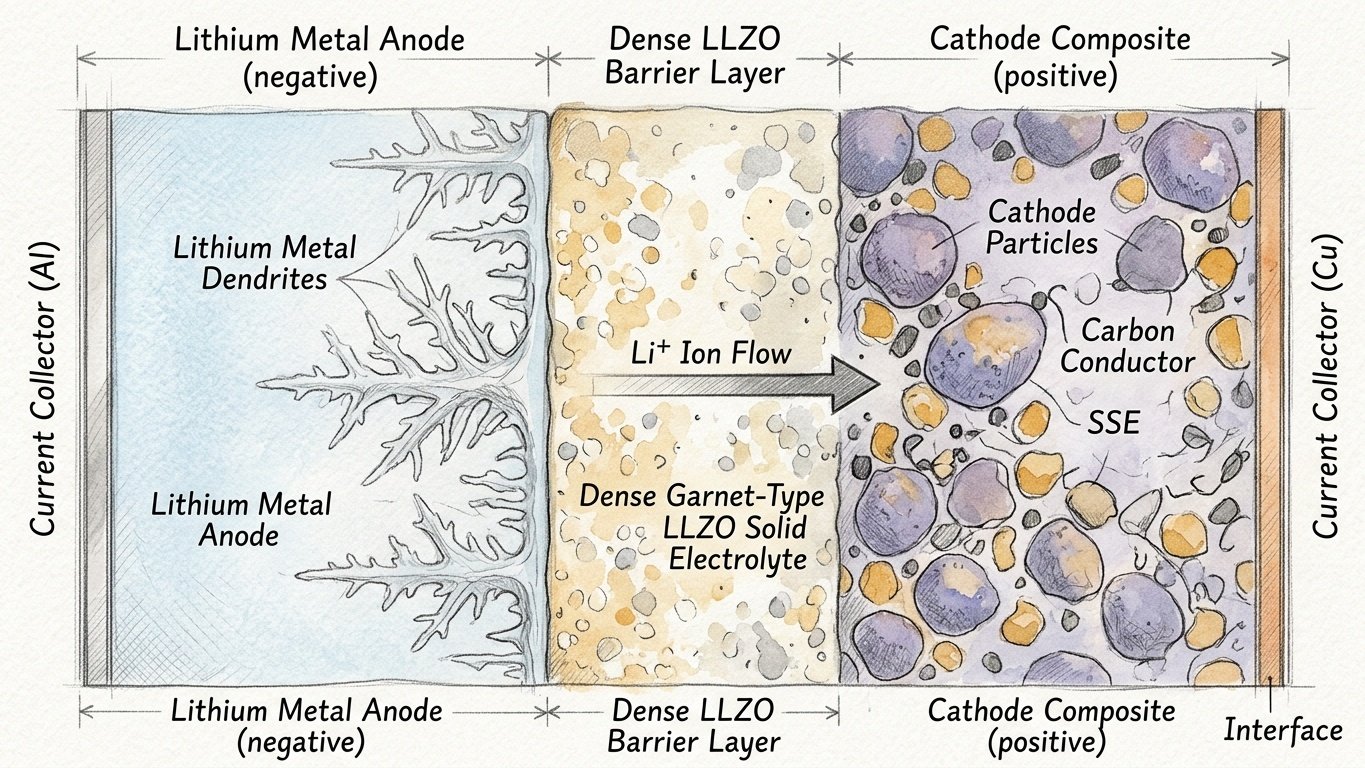
As charging continues, these metallic needles grow rapidly upward at thousands of nanometers per minute. Because the polymer separator is soft (with an elastic modulus of less than 1 GPa), the razor-sharp metallic lithium dendrites effortlessly pierce straight through the polymer pores, traversing the few micrometers separating the anode from the cathode. The instant a dendrite touches the positive electrode, it creates a massive internal electrical short-circuit. Amperage surges into the short, dumping stored electrical energy into localized Joule heating, vaporizing the liquid solvent and triggering explosive thermal runaway within seconds. Dendrite growth rendered liquid-electrolyte lithium metal batteries commercially impossible for forty years.
4. The Solid-State Paradigm – The Monroe-Newman Criterion
The solution to the dendrite catastrophe emerged from theoretical continuum mechanics: replace the porous polymer separator and the flammable liquid solvent with an impenetrable, inorganic Solid Electrolyte.
In 2005, theoretical chemists Charles Monroe and John Newman at the University of California, Berkeley, formulated a landmark mathematical criterion governing dendrite suppression: The Monroe-Newman Criterion. Monroe and Newman modeled the electro-chemo-mechanical surface stress at the interface between a growing metallic lithium protrusion and an elastic solid electrolyte. They proved that if a solid electrolyte possesses a Shear Modulus (G_electrolyte) at least twice that of metallic lithium:
G_{electrolyte} > 2 · G_{lithium} approximately 2 × 3.4 GPa approximately 6.8 GPa
the mechanical compressive stress exerted by the solid electrolyte on the tip of the microscopic lithium protrusion alters the local electrochemical potential. The mechanical pressure shifts the chemical overpotential upward, completely shutting down electrodeposition at the tip and forcing lithium to deposit laterally into the flat valleys! The solid electrolyte acts as an impenetrable mechanical vise that physically suppresses dendrite nucleation, enabling safe, reversible cycling of pure lithium metal anodes.
However, finding a solid material that possesses both a high mechanical shear modulus (G > 7 GPa) and ultra-high lithium-ion conductivity at room temperature seemed to violate the basic laws of solid-state physics. In most solids, atoms are locked rigidly in place, and ion conduction is negligible (< 10⁻¹⁰ S/cm). The birth of modern solid-state batteries required discovering exotic crystal lattices that conduct ions as fast as a liquid.
5. The Taxonomy of Solid Electrolytes – Sulfides, Oxides, and Polymers
Today, materials scientists have synthesized three primary classes of solid electrolytes, each exhibiting distinct electrochemical, mechanical, and processing trade-offs:
| Electrolyte Class | Representative Materials | Room-Temp Ionic Conductivity (sigma_lithium) | Shear Modulus (G) | Primary Advantage / Challenge |
|---|---|---|---|---|
| Sulfides (Thiophosphates) | LGPS (lithium_10GeP_2S_12), Argyrodites (lithium_6PS_5Cl) | $1.2 × 10⁻² S/cm (Rivals liquids!) | 15 – 25 GPa (Soft, ductile) | Excellent grain contact; reacts with moisture to release toxic H_2S gas |
| Oxides (Garnets & NASICON) | LLZO (lithium_7La_3Zr_2O_12), LATP (lithium_1.5}aluminum_0.5}Ti_1.5}(PO_4)_3) | $1.0 × 10⁻³ S/cm | 50 – 65 GPa (Diamond-hard) | Extreme electrochemical stability; brittle, requires high sintering temperatures |
| Solid Polymers | Polyethylene Oxide (PEO) + LiTFSI salt | $10⁻⁶ S/cm (at 20°C);10⁻³ at 70°C | < 1 GPa (Flexible) | Easy roll-to-roll manufacturing; requires active heating (>60°C) to operate |
| Halides | lithium_3InCl_6, lithium_3YCl_6 | $1.5 × 10⁻³ S/cm | 15 – 30 GPa | High oxidative stability (> 4.2 V); moisture-sensitive, expensive precursors |
1. The Sulfide Wonder – Ryoji Kanno and the LGPS Miracle (2011)
In 2011, Japanese electrochemist Ryoji Kanno at the Tokyo Institute of Technology unveiled a discovery that stunned the world: lithium_10GeP_2S_12 (LGPS). In LGPS, large, polarizable sulfur ions (S²⁻) replace rigid oxygen ions in the crystalline lattice. Because sulfur has a larger ionic radius and lower electronegativity than oxygen, the electrostatic potential barriers binding lithium ions to the framework are drastically lowered.
LGPS features continuous, one-dimensional microscopic tunnels through which lithium ions diffuse with activation energies of just 0.22 electron-volts. At room temperature, LGPS exhibited an ionic conductivity of 12 millisiemens per centimeter—faster than standard liquid organic electrolytes! Furthermore, sulfides are mechanically soft and ductile: under simple hydraulic cold-pressing at room temperature, sulfide powder grains plastically deform and weld together, forming seamless, low-resistance grain boundary contacts without requiring high-temperature sintering ovens.
2. The Garnet Fortress – LLZO and High-Voltage Oxides
While sulfides dominate in raw conductivity, Garnet-Type Oxides—specifically Lithium Lanthanum Zirconium Oxide (lithium_7La_3Zr_2O_12, LLZO), doped with aluminum, gallium, or tantalum—dominate in chemical and electrochemical ruggedness.
LLZO possesses a massive shear modulus (G approximately 60 GPa)—nearly ten times higher than the Monroe-Newman threshold—rendering it mechanically impervious to dendrite penetration. Even more critically, LLZO possesses an enormous Electrochemical Stability Window spanning from 0.0 V to over 5.0 V vs Li/Li⁺! It does not react with pure metallic lithium at 0 V, nor does it oxidize when paired with advanced 5-volt high-capacity cathodes. However, LLZO is a brittle ceramic: fabricating wafer-thin ceramic membranes (20 to 30 micrometers thick) that survive mechanical winding and thermal expansion without cracking represents a supreme manufacturing challenge.
6. The Chemo-Mechanical Battlefield – The Solid-Solid Interface
While solid electrolytes cured the flammability and dendrite puncture problems, they introduced an entirely new physical nemesis that does not exist in liquid batteries: The Solid-Solid Contact Impedance.
In a liquid-electrolyte battery, the fluid naturally wets every microscopic pore and crevice of the porous cathode and graphite particles, maintaining perfect, continuous atomic contact as the electrode expands and contracts. In a solid-state battery, two hard, microscopic solids—such as an LLZO ceramic separator and a lithium metal foil—are pressed together. At the microscopic scale, both surfaces are jagged landscapes of peaks and valleys; true atomic contact occurs across less than 10% of the nominal surface area!
Even more destructive is the phenomenon of Chemo-Mechanical Breathing and Void Formation during cycling: – During cell discharge (lithium stripping), lithium metal dissolves from the anode: Li⁺0 to Li⁺ + e⁻. If the rate of lithium stripping exceeds the self-diffusion rate of metallic lithium along the interface, microscopic Kirkendall Voids form at the boundary. – Over successive cycles, these microscopic voids coalesce into macroscopic delamination gaps. – The effective contact area collapses, forcing the entire electrical current to funnel through a few remaining microscopic contact asperities. The local current density skyrockets, exceeding the critical current density (CCD) and causing localized dendrite short-circuits to bore through the ceramic along grain boundaries.
To maintain intimate solid-solid contact across thousands of cycles, battery engineers employ two vital strategies: 1. External Mechanical Stack Pressure: Operating the solid-state pack under a continuous, uniform mechanical compressive load—typically between 0.5 to 5.0 Megapascals (MPa) applied via mechanical spring plates or hydraulic clamps, which induces continuous plastic creep in the lithium metal, continuously filling microscopic voids as fast as they form. 2. Engineered Interfacial Coatings: Depositing ultra-thin (sub-10 nanometer) functional interlayers via Atomic Layer Deposition (ALD) or magnetron sputtering onto the ceramic separator. Materials such as zinc, aluminum, silicon, or gold react with lithium to form lithiated alloys (lithium_xZn, lithium_xaluminum), which dramatically lower the interfacial surface tension, allowing liquid or plastic lithium to completely wet the ceramic surface with zero void formation.
7. The Anode-Free Breakthrough – Samsung’s Ag-C Nanocomposite
The ultimate realization of solid-state engineering arrived in March 2020, when a team of researchers from the Samsung Advanced Institute of Technology (SAIT) published a historic breakthrough in Nature Energy: The Anode-Free Solid-State Battery.
Handling and manufacturing rolls of ultra-thin, highly reactive lithium metal foil (10 to 20 micrometers thick) inside dry rooms is notoriously expensive and hazardous. Samsung asked: Can we eliminate the lithium metal anode from the manufacturing process entirely?
In Samsung’s design, the battery is assembled in a completely ‘Anode-Free’ state: – The cell consists simply of a high-nickel cathode, a sulfide argyrodite solid electrolyte (lithium_6PS_5Cl), and a bare stainless steel current collector coated with an ultra-thin (5-micrometer) layer of Silver-Carbon (Ag-C) Nanocomposite. – There is zero metallic lithium in the cell when it leaves the factory! – During the very first charging cycle, lithium ions are extracted from the cathode crystal lattice, traverse the sulfide electrolyte, and arrive at the Ag-C layer. – The silver nanoparticles dissolve into the incoming lithium, forming a solid-solution alloy that nucleates a pristine, atomically flat, dense sheet of pure metallic lithium directly between the Ag-C layer and the current collector! – During discharge, the lithium dissolves back into the cathode with near-100% Coulombic efficiency.
Samsung’s prototype cell achieved an unprecedented volumetric energy density exceeding 900 Watt-hours per liter ($900 Wh/L) and survived over 1,000 consecutive charge-discharge cycles with 89% capacity retention—demonstrating that an electric vehicle equipped with this pack could travel over 800 kilometers on a single charge and survive a cumulative lifespan of over 800,000 kilometers.
8. The Commercial Vanguard – QuantumScape, Toyota, and Solid Power
The race to commercialize solid-state batteries has ignited an unprecedented battle between deep-tech startups and global automotive giants:
- QuantumScape (USA): Backed by Volkswagen and founded by Jagdeep Singh, QuantumScape spent a decade developing a proprietary, flexible Garnet-Class Ceramic Separator. QuantumScape’s cells operate in an anode-less architecture under zero excess lithium, demonstrating over 1,000 cycles with 95% capacity retention, surviving rigorous 15-minute fast-charging from 10% to 80% without dendrite formation, and demonstrating zero thermal runaway when punctured with steel nails or heated past 300 degrees Celsius.
- Toyota Motor Corporation (Japan): The global titan of solid-state patent filings, holding over 1,300 active patents. Partnering with petrochemical giant Idemitsu Kosan, Toyota is constructing large-scale pilot manufacturing lines focused on Sulfide Solid Electrolytes, targeting full commercial integration into premium electric vehicles by 2027 to 2028 with 1,200-kilometer ranges and 10-minute fast charging.
- Solid Power (USA): Backed by BMW and Ford, Solid Power manufactures all-solid-state cells utilizing sulfide electrolytes and silicon-dominant or lithium metal anodes. Crucially, Solid Power engineered its sulfide slurry formulations to be compatible with existing, legacy roll-to-roll lithium-ion gigafactory coating equipment, minimizing capital expenditure requirements for mass automotive commercialization.
9. Performance Metrics – The Leap to 1,000 Wh/L and Electric Aviation
The transition from conventional liquid lithium-ion to ceramic solid-state represents an unprecedented leap in energy density and operational safety:
| Performance Metric | State-of-the-Art Liquid Li-Ion (NMC811) | Next-Gen Solid-State Battery (Lithium Metal) |
|---|---|---|
| Volumetric Energy Density | 650 – 720 Wh/L | 1,000 – 1,200 Wh/L (+60% increase) |
| Gravimetric Energy Density | 250 – 280 Wh/kg | 450 – 500 Wh/kg (+80% increase) |
| 10% to 80% Fast-Charging Time | 30 to 45 minutes (limited by lithium plating) | 10 to 15 minutes (continuous high current) |
| Operating Temperature Range | -10°C to +50°C (requires thermal management) | -30°C to +100°C (wide thermal stability) |
| Thermal Runaway Risk | High (combustible organic solvents release oxygen) | Non-Flammable (inorganic ceramic barrier) |
This 500 Wh/kg energy density frontier is transformative not merely for passenger cars, but for the electrification of Commercial Regional Aviation. In aeronautical engineering, jet fuel (kerosene) delivers high specific energy. At 250 Wh/kg, batteries are too heavy to power commercial passenger aircraft. At 500 Wh/kg, solid-state batteries cross the threshold of aeronautical viability, enabling 50-passenger regional hybrid-electric airliners, electric vertical takeoff and landing (eVTOL) air taxis, and long-endurance autonomous cargo drones.
10. The Manufacturing Crucible – Dry Rooms and Roll-to-Roll Sintering
The final barrier separating solid-state batteries from worldwide commercial dominance is Manufacturing Scalability at Automotive Gigafactory Scale.
Fabricating solid-state batteries introduces extreme cleanroom and environmental demands: – Ultra-Dry Atmosphere: Sulfide solid electrolytes react with atmospheric moisture to produce deadly hydrogen sulfide gas (lithium_6PS_5Cl + H₂O to H_2S uparrow). Gigafactories must operate sprawling dry rooms maintained at a Dew Point below -60 to -80 degrees Celsius (relative humidity < 0.01%), requiring multi-megawatt industrial desiccant dehumidification systems. – Continuous Ceramic Sintering: Oxide ceramic separators (like LLZO) traditionally require high-temperature furnace sintering at 1,050 to 1,200 degrees Celsius for hours to achieve high density and grain boundary coalescence. Heating millions of square meters of brittle 20-micrometer ceramic films without warping or cracking requires revolutionary continuous roll-to-roll Flash Sintering or Ultrafast High-Temperature Sintering (UHS) using direct electrical current pulses.
Automotive consortia and equipment manufacturers (such as Bühler, Dürr, and Applied Materials) are investing tens of billions of dollars to solve these high-speed manufacturing bottlenecks, charting a trajectory where solid-state manufacturing costs converge with traditional lithium-ion by the early 2030s.
12. High-Voltage Cathode Chemistry – Beyond the 4.2-Volt Barrier
While the pure lithium metal anode captures the majority of scientific attention, a battery’s total energy density is equally determined by the operating voltage and capacity of its positive electrode (cathode). In conventional liquid-electrolyte cells, operating voltages are artificially capped below 4.2 to 4.35 Volts. Attempting to charge a liquid cell to 4.5 or 5.0 V triggers violent oxidative decomposition of organic carbonate solvents, stripping electrons from solvent molecules and releasing acidic gases that destroy the cathode crystal structure.
Solid-state ceramic electrolytes—specifically garnet-type oxides like LLZO and halide solid electrolytes like lithium_3InCl_6—possess monumental Oxidative Stability Windows exceeding 4.8 to 5.2 Volts vs Li/Li⁺! This unlocked the deployment of ultra-high-voltage, high-capacity cathode architectures:
- High-Nickel Single-Crystal NMC (NMC811 and NMC955): Raising the nickel content to 90% or 95% (LiNi_0.95}Mn_0.025}Co_0.025}O₂) boosts specific capacity to over $220 mAh/g. In liquid batteries, polycrystalline high-nickel particles suffer from anisotropic lattice strain during deep delithiation, generating intergranular micro-cracks where liquid electrolyte penetrates, accelerating transition metal dissolution. In solid-state systems, utilizing micron-sized single-crystal particles coated with conformal protective metal-oxide nanoshells (LiNbO_3 or aluminum_2O₃) prevents mechanical fracturing and eliminates parasitic oxidation.
- High-Voltage Spinel LNMO (LiNi_0.5}Mn_1.5}O_4): Operates at an extraordinary plateau voltage of 4.75 Volts with zero expensive, ethically problematic cobalt! In liquid batteries, LNMO suffers from rapid manganese dissolution and solvent breakdown. Solid-state halides and garnets pair seamlessly with LNMO, delivering ultra-high power density at dramatically reduced raw material costs.
- Lithium-Rich Disordered Rocksalt (DRX) Cathodes: Next-generation earth-abundant cathode architectures that utilize reversible oxygen anion redox alongside transition metal cation redox, unlocking theoretical capacities exceeding $300 mAh/g at 4.6 V, creating the chemical foundation for 600 Wh/kg battery cells.
13. Synchrotron X-Ray Operando Diagnostics – Peering Inside the Solid State
Unraveling the mysterious chemo-mechanics of the buried solid-solid interface required developing revolutionary non-destructive diagnostic tools capable of observing battery physics in real time during live charging and discharging: Operando Synchrotron X-Ray Nano-Computed Tomography (nano-CT) and In Situ Cryogenic Transmission Electron Microscopy (Cryo-TEM).
At premier synchrotron radiation facilities (such as the Advanced Photon Source at Argonne National Laboratory, the European Synchrotron Radiation Facility in Grenoble, and SPring-8 in Japan), high-energy monochromatic X-ray beams penetrate through dense ceramic electrolyte pellets while the battery operates inside miniature test cells:
- Visualizing Lithium Creep and Kirkendall Voids: Fast synchrotron phase-contrast imaging with sub-100-nanometer spatial resolution captured the real-time formation of Kirkendall micro-voids during high-rate discharge. The radiographs revealed that at current densities exceeding the critical stripping current, lithium metal does not dissolve uniformly; rather, voids nucleate at ceramic grain boundaries and grow laterally, decoupling the metal from the electrolyte.
- Mapping Interfacial Stress with Micro-Diffraction: Synchrotron X-ray micro-diffraction maps the internal mechanical strain tensor (sigma_ij) across the ceramic lattice with micron resolution, showing that localized lithium dendrite growth along ceramic grain boundaries is preceded by massive mechanical stress concentrations exceeding hundreds of megapascals.
- Cryo-TEM Atomic Imaging: Because metallic lithium is an ultra-soft alkali metal that melts and vaporizes under intense electron beams, conventional transmission electron microscopy destroyed samples instantly. By freezing solid-state interfaces to liquid nitrogen temperatures (-196 deg C), Cryo-TEM preserves the atomic lattice intact, revealing the atomic structure of the solid-electrolyte interphase (SEI) and proving that amorphous sub-nanometer coatings prevent interfacial element cross-diffusion.
14. Silicon-Dominant Anodes – The Stepping Stone to Pure Lithium
While pure metallic lithium represents the ultimate thermodynamic destination, several tier-one automotive manufacturers are pursuing an intermediate, highly potent stepping stone: Silicon-Dominant Solid-State Anodes.
Silicon is an extraordinary electrochemical alloy: each silicon atom can bind up to 3.75 lithium atoms (lithium_15Si_4), delivering a theoretical capacity of $3,579 mAh/g—approaching pure lithium metal! However, in liquid-electrolyte batteries, silicon undergoes a catastrophic 300% volumetric expansion upon full lithiation. During repeated breathing, silicon particles pulverize, the liquid SEI layer continuously breaks and reforms, consuming the liquid electrolyte and causing battery death within dozens of cycles.
In a solid-state battery utilizing soft, ductile sulfide electrolytes, silicon anode physics behaves completely differently: – Micro-silicon particles are blended directly with conductive carbon and sulfide electrolyte powders. – Because there is zero liquid solvent, there is no continuous SEI consumption. – Under moderate external stack pressure, the ductile sulfide electrolyte plastically flows and breathes alongside the expanding silicon particles, maintaining continuous atomic contact. Solid Power and researchers at the University of California, San Diego, demonstrated all-solid-state micro-silicon cells that survive over 1,000 cycles with 80% capacity retention, delivering volumetric energy densities exceeding 800 Wh/L while utilizing abundant, cheap metallurgical silicon without the fire risks or handling hazards of pure lithium metal foil.
15. Polymer-Ceramic Composites – Slurry-Casting the Hybrid Electrolyte
To circumvent the brittleness of pure ceramic oxides and the moisture toxicity of pure sulfides, a large sector of the solid-state industry has embraced Polymer-Ceramic Composite Electrolytes.
A composite electrolyte combines the best physical attributes of both materials into a synergistic matrix: – The Flexible Polymer Scaffold: A ductile polymer host—such as poly(vinylidene fluoride-co-hexafluoropropylene) (PVDF-HFP) or modified polyethylene oxide (PEO)—provides mechanical flexibility, high tensile strength, and the ability to be manufactured using standard high-speed roll-to-roll doctor-blade slurry-casting equipment. – Active Ceramic Nanoparticles: Dispersing 30% to 60% by weight of sub-micron ceramic powder (such as LLZO or LATP) throughout the polymer matrix. The ceramic particles act as active lithium-ion conductors while their Lewis-acid surface functional groups immobilize the anions of the lithium salt, dramatically boosting the Lithium Ion Transference Number (t_Li⁺) from 0.2 in pure polymers to over 0.7 to 0.85 in the composite.
These composite membranes measure just 15 to 25 micrometers in thickness, flex effortlessly around tight radii without cracking, and physically block dendrite growth while operating at room temperature, providing a rapid, low-capital-expenditure manufacturing retrofit for existing gigafactories.
16. Supply Chains and Critical Mineral Geopolitics
The transition to solid-state batteries introduces new supply-chain and geochemical dependencies that will reshape global mineral economics:
| Critical Element | Primary Solid-State Role | Global Production Centers | Supply Chain Constraints |
|---|---|---|---|
| Lithium (lithium) | Lithium metal anode, ceramic crystal framework | Australia (spodumene), Chile/Argentina (brines), China | High demand; requires high-purity chemical processing |
| Lanthanum (La) | Garnet oxide framework (LLZO) | China (Bayan Obo), USA (Mountain Pass), Myanmar | Abundant light rare earth; refining concentrated in China |
| Zirconium (Zr) | Garnet oxide framework (LLZO) | Australia, South Africa, China | Extensively mined for ceramics and nuclear cladding; low geopolitical risk |
| Germanium (Ge) | Sulfide conductor (LGPS) | China, Russia, Canada (byproduct of zinc refining) | High cost, export controls; industry moving to Ge-free argyrodites |
Because early high-conductivity sulfides like LGPS contained expensive, restricted germanium (>1,500/kg), the automotive battery industry rapidly pivoted toward Argyrodite Halide Thiophosphates (lithium_6PS_5Cl). Argyrodites substitute germanium with abundant, dirt-cheap phosphorus (P) and sulfur (signal power S), driving raw precursor material costs down to under 20 to $30 per kilogram, ensuring that solid-state pack costs can eventually undercut conventional NMC liquid cells.
17. Closed-Loop Circular Hydrometallurgical Recycling
A critical environmental advantage of all-solid-state batteries is their superior Circular Recycling Architecture. In conventional liquid-electrolyte cells, recycling is an environmentally hazardous and energy-intensive challenge: spent batteries must be shredded under inert nitrogen atmospheres to prevent fires, and organic carbonate solvents must be burned off in high-temperature pyrometallurgical blast furnaces (> 1,000^°C), releasing toxic fluorinated gases fromLiPF_6decomposition.
In all-solid-state cells, the complete absence of volatile, flammable solvents dramatically streamlines the recycling flow: – De-casing and mechanical crushing can be executed safely without explosive fire hazard. – In sulfide cells, mild aqueous or alcohol washing selectively dissolves the thiophosphate electrolyte, separating it cleanly from insoluble transition metal cathode particles. – Closed-loop chemical precipitation reclaims over 98% of high-purity lithium, nickel, cobalt, and sulfur, consuming 50% less energy than pyrometallurgical smelting. – In oxide cells, dense ceramic LLZO pellets are mechanically separated and re-milled into ceramic precursor powder, ready to be re-sintered into fresh separators with zero chemical loss.
18. Beyond Lithium – Solid-State Sodium and Multivalent Batteries
The solid-state paradigm is not confined to lithium. The same physical principles of ceramic ion conduction and dendrite suppression are being applied to Solid-State Sodium (sodium) and Multivalent Metal Batteries.
Sodium is thousands of times more abundant and orders of magnitude cheaper than lithium, distributed globally in inexhaustible sea salts. By pairing pure metallic sodium anodes with solid ceramic electrolytes—specifically Sodium Beta-Alumina (β”-Al_2O₃) or NASICON (sodium_3Zr_2Si_2PO_{12})—researchers are developing room-temperature solid-state sodium batteries delivering over 350 Wh/kg with zero lithium, zero nickel, and zero cobalt!
Furthermore, experimental programs are exploring Multivalent Metals—such as Magnesium (Mg²⁺) and Aluminum (Al³⁺). Because each magnesium ion transfers two electrons and aluminum transfers three, multivalent metal anodes deliver colossal volumetric capacities (3,833 mAh/cm^3for Mg,8,046 mAh/cm^3for Al—four times higher than graphite!). While multivalent ion diffusion through solid crystal lattices is slow due to strong electrostatic attraction to the anion framework, novel open-framework thiospinel ceramics are charting the path toward post-lithium solid-state energy storage for the late twenty-first century.
20. Cell Form Factors – Pouch, Prismatic, and the Elimination of Cylinders
The transition to solid-state batteries enforces a dramatic mechanical reorganization in battery cell packaging and pack engineering. In conventional lithium-ion batteries, the Cylindrical Cell (such as the classic 18650, 2170, and 4680 form factors used by Tesla) is the dominant architecture due to its high manufacturing throughput and natural hoop-stress resistance against internal gas pressure.
In all-solid-state batteries, however, the cylindrical jelly-roll is mechanically forbidden: – Attempting to wind a brittle 20-micrometer ceramic separator (like LLZO) around a tight 5-millimeter radius core introduces severe tensile surface bending stresses that fracture the ceramic instantly. – Even with flexible sulfide electrolytes, winding a continuous roll creates non-uniform radial stress distributions: during charging, the radial expansion of the lithium anode exerts massive outward forces that deform the jelly-roll core, creating uneven interfacial contact.
Consequently, the solid-state industry has converged exclusively on Planar Flat-Plate Architectures: Pouch and Rigid Prismatic Cans: – Bi-Cell Multi-Layer Stacking: Dozens of flat, rectangular cathode sheets, ceramic separator layers, and current collectors are stacked in parallel z-fold or sheet-by-sheet planar configurations. – Integrated Mechanical Compression Springs: In a prismatic solid-state module, heavy endplates connected by high-tensile steel tie rods or internal wave springs apply continuous, uniform uniaxial pressure (typically 1 to 5 MPa) perpendicularly across the face of the flat stacks. This mechanical pre-load absorbs the 100% breathing of the lithium metal anode during cycling while preventing void formation and delamination across hundreds of square centimeters of active area.
21. Simplified Pack Thermodynamics – Eliminating the Cooling Nightmare
In conventional electric vehicles, the battery pack’s thermal management system is a complex, heavy, and expensive engineering spiderweb: thousands of feet of extruded aluminum cooling ribbons, glycol-water pumps, chillers, valves, and fire-suppression barriers designed to prevent thermal runaway and maintain cells strictly between 20 and 35 degrees Celsius.
Solid-state batteries revolutionize automotive packaging by Dramatically Simplifying Thermal Architecture: – Zero Combustible Volatiles: Because inorganic ceramics do not contain flammable organic solvents, the risk of explosive fire propagation is eliminated. Automotive packs require zero thick ceramic blast walls or individual cell fuse links. – Beneficial High-Temperature Operation: Unlike liquid batteries—which degrade rapidly at 60 degrees Celsius due to parasitic SEI dissolution and transition metal leaching—solid electrolytes operate with superior efficiency at elevated temperatures! At 60 to 80 degrees Celsius, the ionic conductivity of solid electrolytes doubles or triples, and the critical current density (CCD) for dendrite-free fast charging increases by over 300%. – Air-Cooled and Passive Packs: By eliminating active liquid cooling channels, the gravimetric pack-level integration efficiency (cell-to-pack ratio) leaps from 65% in liquid batteries to over 85% in solid-state packs. The vehicle sheds hundreds of pounds of parasitic fluid plumbing, slashing manufacturing costs and amplifying real-world vehicle driving efficiency.
22. Non-Destructive Quality Control – High-Frequency Ultrasonic Scanning
In high-speed automotive gigafactory manufacturing, producing millions of square meters of ceramic separator films without a single microscopic pinhole, hairline crack, or delamination void is an absolute operational requirement. A single microscopic void on a single layer will funnel localized current, nucleate a dendrite, and kill an entire multi-cell pack.
To inspect every square millimeter of ceramic film at production line speeds of tens of meters per minute, manufacturers developed High-Frequency Ultrasonic Transmission Acoustic Microscopy (TAM):
- Focused ultrasonic transducers emit acoustic waves at frequencies between 50 MHz and 200 MHz across the moving ceramic-electrolyte ribbon.
- Because acoustic waves reflect strongly off internal solid-gas interfaces, even a microscopic 5-micrometer internal void or delamination crack generates a powerful, unmistakable acoustic echo!
- Automated AI vision algorithms analyze the ultrasonic transmission maps in real time, detecting micro-cracks and flagging defective sections for automated laser trimming before the film enters final cell stacking.
23. Computational Materials Discovery – Molecular Dynamics and Machine Learning
The discovery of new solid electrolytes has been accelerated by the integration of Ab Initio Molecular Dynamics (AIMD) and Machine Learning Interatomic Potentials (MLIPs).
Simulating the diffusion of millions of interacting ions across complex three-dimensional crystal lattices using traditional Density Functional Theory (DFT) quantum mechanics requires weeks of supercomputer time for a few hundred picoseconds of physical time. Modern computational materials scientists train neural network potentials on quantum mechanical datasets, allowing molecular dynamics simulations to model millions of atoms across microsecond time-scales with quantum accuracy.
Algorithms screen thousands of candidate crystal structures in virtual space, calculating the migration energy barriers (E_a), percolation thresholds, and electrochemical stability windows for novel halides, oxy-sulfides, and anti-perovskites. This computational screening identified the precise chemical substitutions (such as doping chlorine and bromine into lithium argyrodites) that unlocked room-temperature ionic conductivities exceeding liquid electrolytes, shaving decades off experimental synthesis timelines and guiding the global race toward commercial solid-state supremacy.
24. Extreme Abuse Tolerance – Ballistic, Nail, and Thermal Blast Testing
The defining technological validation that elevated solid-state batteries from academic laboratories into defense and automotive procurement contracts is their Absolute Abuse Tolerance under Destructive Physical Testing.
In standard automotive safety certification tests governed by global standards (such as SAE J2464 and UN 38.3), conventional lithium-ion batteries are subjected to the dreaded Nail Penetration Test: a hardened steel spike is driven hydraulically through the center of a fully charged (100% state of charge) battery cell at high speed. In a liquid-electrolyte cell, the metal spike connects the positive and negative electrodes, creating an immediate, massive internal short-circuit. In less than two seconds, the liquid solvent flashes into flame, internal temperatures spike above 700 degrees Celsius, and the cell violently ruptures in a jet of fire and toxic gas.
When the same nail penetration test is executed on an all-solid-state cell utilizing a ceramic garnet or argyrodite separator, the result is astonishingly anticlimactic: – The steel nail pierces through the ceramic separator and electrodes. – While a localized short-circuit occurs, the inorganic ceramic material is completely non-combustible and cannot catch fire. – Because there are zero volatile organic carbonate liquids, there is no liquid vaporization, no internal pressure explosion, and no oxygen-releasing chemical cascade! – Cell temperature rises modestly by a few dozen degrees Celsius before dissipating harmlessly into the ambient air, while the cell continues to deliver voltage without smoke or flame.
Furthermore, in military ballistic penetration tests conducted with armor-piercing 7.62mm rifle rounds and 500-degree-Celsius open-flame blowtorch tests, all-solid-state cells survive without detonation, establishing an unassailable safety benchmark for combat electric vehicles, submarine energy storage, and commercial passenger aviation.
25. The Cost Trajectory – Crossing the 100-Dollar-per-Kilowatt-Hour Threshold
In modern industrial energy economics, the metric that dictates the worldwide adoption of new battery technology is the Pack-Level Cost per Kilowatt-Hour (/kWh). In the 2010s, conventional lithium-ion battery pack costs plummeted from over $1,100 per kilowatt-hour down to approximately $130 to $140 per kilowatt-hour, crossing the initial tipping point for electric vehicle adoption.
Early solid-state battery prototypes carried exorbitant pilot manufacturing costs exceeding $500 to $800 per kilowatt-hour due to low production volumes, expensive germanium or rare-earth precursors, and manual batch processing. However, technoeconomic modeling conducted by national energy laboratories demonstrates that as gigafactories scale to tens of gigawatt-hours of annual throughput, solid-state battery economics undergo a rapid, dramatic inversion:
- Material Cost Reductions: By eliminating expensive graphite and silicon anode processing, and adopting germanium-free argyrodite sulfide formulations (lithium_6PS_5Cl) synthesized from dirt-cheap industrial sulfur, phosphorus, and lithium carbonate, active material costs drop by over 20% to 30%.
- Pack-Level Component Simplification: Eliminating heavy liquid-cooling pumps, glycol heat exchangers, and robust fire-containment blast shields removes hundreds of dollars of parasitic structural weight and complexity from every automotive pack.
- Manufacturing Footprint Consolidation: In conventional liquid-ion manufacturing, the Cell Formation and Aging phase—where newly filled cells undergo slow, multi-week electrical cycling inside climate-controlled warehouses to grow the initial liquid SEI layer—accounts for up to 30% of total factory floor space and 20% of factory energy consumption. In all-solid-state manufacturing, the formation process is completed in hours rather than weeks, dramatically shrinking the physical factory footprint.
Industrial cost roadmaps published by major automotive consortia project that all-solid-state battery pack costs will achieve cost parity with premium liquid lithium-ion (below $100 per kilowatt-hour) by 2028 to 2030, and eventually plunge toward $60 to $70 per kilowatt-hour at multi-terawatt scales by the mid-2030s. At this cost threshold, electric vehicles powered by thousand-kilometer solid-state batteries will be unequivocally cheaper to purchase, cheaper to fuel, and vastly safer to operate than any internal combustion engine vehicle on Earth, sealing the irreversible global transition to clean, electrified transportation.
Through this extraordinary synthesis of solid-state crystallography, interfacial mechanics, and advanced gigafactory engineering, the solid-state revolution has dismantled the final barriers to total global electrification. By transforming the volatile heart of the battery into an enduring, non-flammable crystal, humanity has unlocked the clean energy reservoir that will propel civilization across the twenty-first century and beyond.
26. Conclusion – The Unbroken Circuit of Tomorrow
The quest for the solid-state battery represents the grand unified challenge of modern electrochemical engineering. It has taken the combined brilliance of solid-state physics, ceramic crystallography, mechanical continuum mechanics, and industrial gigafactory automation to conquer the dendrite ghost that haunted electrochemistry for half a century.
By replacing flammable organic solvents with dense, diamond-hard ceramic lattices and liberating pure metallic lithium, the solid-state revolution has redefined the physical limits of energy storage. The batteries rolling off tomorrow’s production lines will not merely charge in minutes and power electric vehicles for a thousand kilometers without fire risk; they will power electric aircraft through the clouds and store renewable wind and solar energy across the power grids of the world. In transitioning matter from the chaotic turbulence of the liquid state into the crystalline perfection of the solid state, human engineering has forged the unyielding electrochemical engine of our clean energy future.