Hangzhou Between West Lake and AI Labs
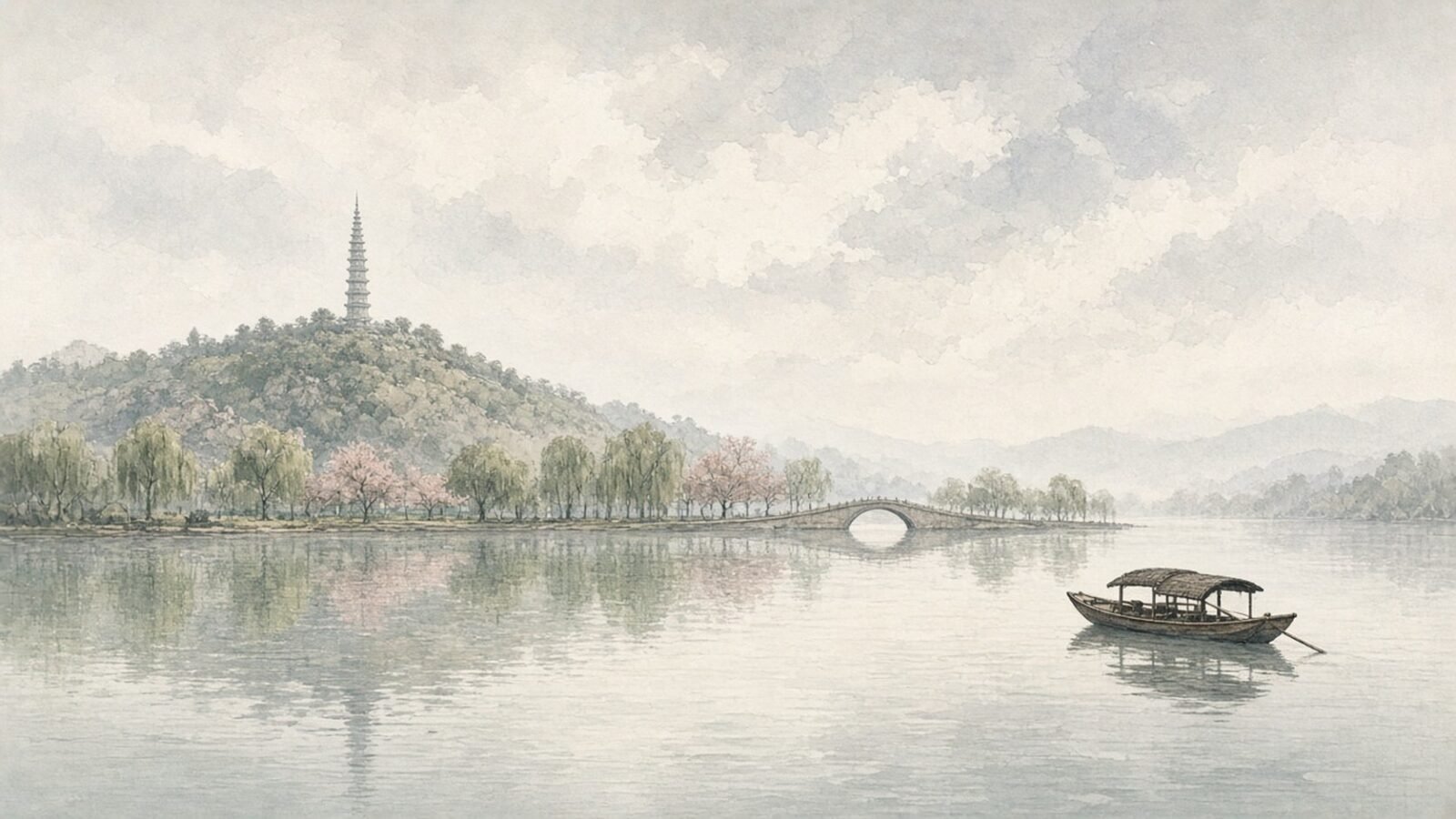
There are cities that advertise their arrival in the future. They build towers shaped like declarations, airports that resemble spaceships, financial districts whose glass facades appear designed to erase whatever stood there before. Hangzhou is stranger than that. The city seems at first to be moving in two directions at once. On one side lies West Lake, where willow branches descend toward the water and stone bridges lead toward temples, pagodas, gardens, and hills that have occupied the Chinese imagination for centuries. On the other lies a city of artificial intelligence laboratories, robotics companies, cloud computing campuses, digital payment systems, electric vehicles, software engineers, and venture capital. A visitor can spend the morning walking beside a landscape celebrated by poets during the Tang and Song dynasties and the afternoon passing offices where engineers are attempting to teach machines to reason or robots to navigate the physical world. It would be tempting to describe this as a contrast between an old Hangzhou and a new one. But that description misses what makes the city so compelling. Hangzhou has never been merely old. For much of its history it has been a place where technology, commerce, aesthetics, and urban ambition have met. Its waterways were engineered. Its famous lake was cultivated and repeatedly reshaped. Its prosperity depended upon vast systems of transport and exchange. Its greatest historical period came when it became one of the most sophisticated cities in the world. Modern Hangzhou has not simply placed a technology industry beside a historical city. It has inherited an older habit of combining beauty with utility, commerce with culture, and infrastructure with imagination.[1]
1. West Lake and the shaping of nature
West Lake provides the best introduction to this habit because the lake itself complicates the modern distinction between nature and technology. To stand beside it on a misty morning is to experience something that looks almost effortlessly natural. Mountains rise behind the water. Causeways divide long views into carefully composed scenes. Trees lean at angles that seem accidental until the repetition becomes too elegant to be chance. Pagodas appear at precisely the sort of distance that makes architecture seem absorbed into landscape. Yet West Lake is not untouched wilderness. It is, in important ways, a designed cultural environment. UNESCO notes that generations of rulers, officials, gardeners, engineers, monks, writers, and residents altered the landscape through dredging, causeway construction, islands, temples, gardens, ornamental planting, and other interventions. Many of its most important artificial elements took shape between the ninth and twelfth centuries. The landscape became influential precisely because it represented an idealized relationship between human intervention and the natural world, one that later affected garden design elsewhere in China and in Japan and Korea. This is useful to remember when considering the modern city around it. Hangzhou was shaping environments long before anyone used the vocabulary of urban innovation. The beauty of West Lake is not the opposite of engineering. It is partly the result of engineering performed with aesthetic intention. The lake suggests an old Hangzhou principle: technology becomes culturally powerful when people stop noticing the mechanism and begin experiencing the world it makes possible.
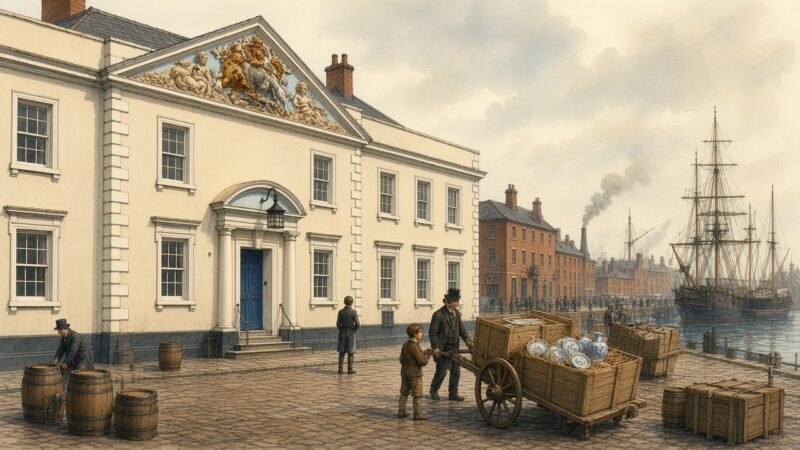
The city reached one of its defining historical moments after the collapse of the Northern Song capital in the twelfth century. The Song court moved south and established itself at Linan, the city now known as Hangzhou. From 1127 onward the Southern Song ruled for roughly a century and a half, and Hangzhou became the political and cultural center of a sophisticated southern realm. The Metropolitan Museum of Art describes Southern Song culture as an era of extraordinary refinement in painting and the decorative arts, with Hangzhou and West Lake providing important inspiration for artists and court culture. The significance of this episode goes beyond imperial nostalgia. Hangzhou became a city in which government, trade, craftsmanship, scholarship, religion, entertainment, and aesthetics concentrated at remarkable scale. It was cosmopolitan not because cosmopolitanism had become a slogan but because capital cities attract merchants, officials, artists, travelers, and ideas. The same hills that framed contemplative paintings overlooked a dense urban society concerned with money, food, administration, fashion, transport, luxury, and information. This combination is important. Hangzhou has often been imagined through images of stillness, a pavilion beside water, a scholar under a tree, a distant mountain dissolving into mist. But historically the city behind those images was busy. Beauty was produced beside bureaucracy. Poetry existed beside markets. Monasteries existed beside commercial streets. The serene image of Hangzhou has always concealed enormous organizational energy.
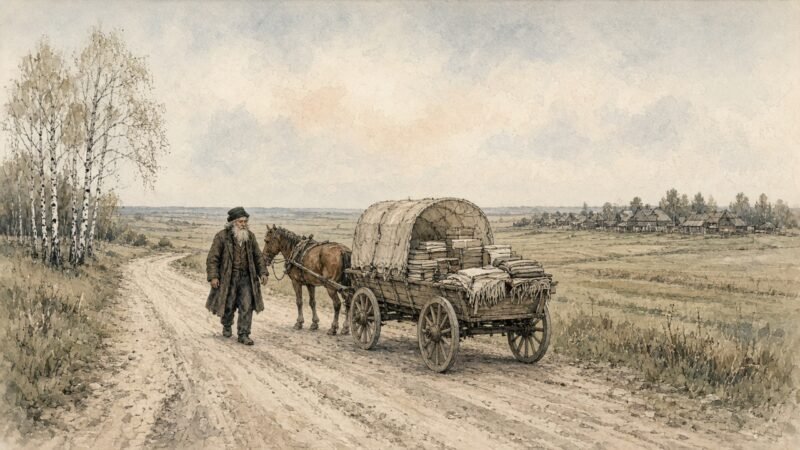
That energy depended on connections extending far beyond the lake. Hangzhou sat near the southern end of one of the greatest infrastructure systems ever created, the Grand Canal. Sections of the canal system had been constructed for centuries before imperial authorities unified them into a vast transportation network. By the thirteenth century the system extended for more than two thousand kilometers and connected major river basins across eastern China. Grain, materials, taxes, officials, merchants, and information could move through a hydraulic network that helped bind distant regions into a functioning political economy. UNESCO describes the canal as the backbone of imperial inland communications and one of the greatest civil engineering achievements of the preindustrial world. Looked at from the twenty first century, the analogy is almost irresistible. The Grand Canal was an information and logistics platform expressed in water rather than code. Its locks, channels, warehouses, administrative systems, and transport routes reduced the difficulty of moving resources across enormous distances. Modern technology companies speak about platforms, networks, friction, logistics, and connectivity. Imperial administrators would not have recognized the vocabulary, but they would have recognized the problem. How does a large society move things more quickly, coordinate distant participants, and create systems that become more valuable as more people depend upon them? Hangzhou flourished near the end of one such network centuries before it became home to another.[2]
2. The founding of Alibaba
This historical continuity became unexpectedly visible in 1999, when a former English teacher named Jack Ma and seventeen other people founded Alibaba in Hangzhou. The company began as an online wholesale marketplace intended to connect Chinese exporters and entrepreneurs with buyers elsewhere in the world. Alibaba would eventually expand into a vast technology ecosystem involving commerce, cloud computing, logistics, digital services, and artificial intelligence. The company itself now describes its focus as artificial intelligence, cloud technology, and commerce. Alibaba changed Hangzhou economically, but perhaps just as importantly it changed the way outsiders imagined the city. Beijing possessed the gravitational force of political power and elite universities. Shanghai possessed finance, global commerce, and the mythology of the Chinese metropolis. Shenzhen had become synonymous with manufacturing, electronics, and hardware. Hangzhou began to represent another model: the beautiful provincial capital that could become a globally significant technology center without entirely surrendering its older cultural identity. The rise of Alibaba encouraged a generation of engineers, entrepreneurs, investors, suppliers, and graduates to imagine that a major technology career did not necessarily require leaving Zhejiang. Companies generate more than employment. Successful companies generate permission. They make previously improbable ambitions appear locally achievable.[3]
It is difficult now to move through contemporary Hangzhou without encountering the consequences of that permission. The modern city extends far beyond the postcard geography of West Lake. Office districts, university campuses, apartment towers, research institutes, shopping complexes, metro stations, startup offices, industrial zones, and new urban developments form another Hangzhou whose visual language is concrete, glass, screens, landscaped plazas, and controlled access gates. Smartphones mediate much of ordinary urban life. Commerce has become increasingly inseparable from digital platforms. Food, transportation, entertainment, retail, banking, communication, and public services pass through interfaces that would have appeared fantastical when Alibaba was established. Yet Hangzhou does not feel like a city that has finished transforming. It feels like one still accumulating identities. The physical city continually reminds residents that innovation does not take place in an abstract digital realm. Software engineers still need apartments. Research laboratories need electricity. Robotics companies need factories and supply chains. Artificial intelligence companies need computing infrastructure. Delivery networks need roads. Workers need schools, hospitals, trains, restaurants, parks, and places to meet. Behind every seemingly weightless digital service lies an intensely physical city. Hangzhou has become a useful demonstration of something technology rhetoric often obscures: the digital economy is still an urban economy.
3. Hangzhou’s technology economy in numbers
The numbers reveal how substantial that economy has become. Hangzhou reported a gross domestic product of 2.3011 trillion yuan for 2025. Official statistics recorded 338.4 billion yuan in added value from high technology industry among larger industrial enterprises, with that figure increasing by 7.5 percent over the previous year. Information transmission, software, and information technology services remained among the strongest parts of the service economy. International measurements point in the same direction. In the World Intellectual Property Organization Global Innovation Index for 2025, Hangzhou appeared among a relatively small group of global clusters that ranked highly both in total innovation activity and in innovation intensity relative to population. Hangzhou was also among the leading cities for scientific publications. Statistics can make a technology center sound inevitable after it has already emerged, but cities do not become innovative simply by accumulating research papers or investment. They become innovative when talent, institutions, money, suppliers, customers, infrastructure, and expectations begin reinforcing one another. A graduate joins one company, leaves to establish another, hires former colleagues, raises money from investors who earned returns from an earlier company, buys components from nearby suppliers, and recruits students from universities whose programs expand because local employers demand particular skills. Eventually the ecosystem begins generating its own momentum. Hangzhou increasingly possesses this quality.
Alibaba remains the largest symbol of the transformation, but the more interesting story now concerns what happened after Alibaba. During the middle of the 2020s, Hangzhou drew global attention for a new group of technology companies working in artificial intelligence, robotics, gaming, brain computer interfaces, and related fields. Chinese discussion sometimes grouped several of these companies under the nickname the Hangzhou Six Little Dragons, a phrase eventually echoed in the city government’s own reporting. The nickname matters less than what it attempts to describe. Hangzhou is no longer dependent upon a single technology champion for its reputation. DeepSeek, founded in Hangzhou in 2023, became one of the most internationally discussed Chinese artificial intelligence companies after releasing models that challenged assumptions about the relationship between computing expenditure and model capability. By 2026 the company was expanding rapidly and preparing for the possibility of a public listing. The robotics company Unitree, founded in 2016 and also based in Hangzhou, became known internationally for quadruped robots and later humanoid machines. In 2026 it entered the public markets as investment in embodied artificial intelligence surged.[4]
DeepSeek and Unitree are particularly revealing because they represent two different directions in which computing is moving. DeepSeek works primarily in the abstract world of models, mathematics, language, code, and digital reasoning. Unitree works in the stubborn physical world, where a machine has to balance, walk, perceive obstacles, recover from errors, and interact with environments that refuse to behave like clean simulations. In 2026 the two Hangzhou companies moved closer together when DeepSeek invested in Unitree and the companies agreed to cooperate on artificial intelligence for robots. There is something almost symbolically perfect about this partnership occurring in Hangzhou. The city that once became famous for arranging stone, water, architecture, vegetation, and human movement into an ideal landscape is now home to engineers attempting to teach machines how to understand and move through physical landscapes themselves. The comparison should not be stretched too far. A Song dynasty engineer dredging West Lake and a modern researcher training a model inhabit radically different intellectual worlds. But both are engaged in acts of mediation between intelligence and environment. One reshapes the landscape to fit human intention. The other tries to build machines capable of interpreting the landscape that already exists.
4. Tensions and contradictions
This does not mean Hangzhou should be romanticized as a frictionless laboratory of the future. Technology industries generate their own anxieties and contradictions. Rapid innovation produces enormous fortunes but also intense competition. Artificial intelligence requires costly infrastructure. Robotics companies face the difficult transition from spectacular demonstrations to reliable everyday usefulness. Reuters reported in September 2026 that Chinese regulators had begun scrutinizing the rush of humanoid robotics companies toward public markets, amid questions about valuations, revenue quality, and the gap between impressive demonstrations and sustainable commercial demand. Artificial intelligence companies face another version of the same problem. Model capability can advance more rapidly than stable business models. Competition can force prices downward even while research and computing costs remain high. Hangzhou therefore represents not only the optimism of technological development but also its uncertainty. The future arrives as a collection of experiments, and experiments sometimes fail. Cities that depend upon innovation must learn to tolerate this without allowing speculation to become indistinguishable from progress.
There is also the question of what rapid development does to a city whose historical landscape is itself an economic and cultural asset. West Lake survives partly because Hangzhou has treated preservation not as passive nostalgia but as a form of active management. UNESCO notes that municipal controls regulate the height and mass of buildings around the lake in order to protect significant views and the historic relationship between water, hills, architecture, and skyline. This is an unusually revealing detail. The city is technologically ambitious, yet one of its most famous spaces remains governed by the idea that some things should not be maximized. A developer may want another floor. A skyline may generate additional commercial value. But the view across the lake represents another category of value, one accumulated over centuries and impossible to recreate once destroyed. Modern urban development often treats preservation and innovation as opposing forces. Hangzhou suggests that the more interesting question is how constraints can shape innovation. The restriction itself becomes part of the design problem.
That tension can be felt in the experience of moving through the city. Around West Lake, the pace of attention changes. The eye is invited outward toward water and mountains. The historical landscape rewards slowness. A person walks, stops, observes a reflection, notices a pavilion, follows a path around a hill. Much of the modern digital economy is organized around the opposite impulse. Apps eliminate waiting. Algorithms anticipate preference. Commerce compresses the distance between desire and delivery. Artificial intelligence promises to compress intellectual labor itself, turning questions into immediate answers and instructions into automated actions. Hangzhou contains both temporalities. One part of the city has spent centuries teaching people how to look slowly. Another is attempting to eliminate delay. The coexistence is not always harmonious, but it is productive. A city devoted entirely to speed becomes exhausting. A city devoted entirely to preservation risks becoming a museum. Hangzhou survives through the argument between the two.
5. Aesthetic memory and technology
Perhaps this helps explain why the city feels different from technology centers built primarily around industry. Hangzhou possesses a deep aesthetic memory. Tea fields rise in the hills beyond the dense urban districts. Temples occupy wooded slopes. The lake changes with weather, season, and time of day. Traditional architecture survives beside shopping streets and apartment towers. The cultural prestige of poetry, painting, gardens, calligraphy, ceramics, silk, and landscape remains embedded in the city’s image of itself. Technology therefore enters a place where refinement already carries historical authority. This does not automatically make technology more humane or beautiful. Corporate campuses can be as anonymous in Hangzhou as anywhere else. Apartment districts can repeat the same towers across enormous areas. Roads can overwhelm the pedestrian scale. Screens can colonize attention. But the city possesses a visible alternative against which modernity can be judged. West Lake remains there, quietly presenting another definition of sophistication.
That may ultimately be Hangzhou’s most important contribution to the global conversation about technology. The dominant mythology of innovation tends to imagine progress as escape. New technology frees society from old limitations. New buildings replace obsolete ones. New industries destroy older industries. The future defeats the past. Hangzhou offers a more complicated picture. Its historical greatness depended upon technologies that eventually became invisible because they succeeded so completely. Hydraulic engineering became landscape. Trade infrastructure became urban culture. Political displacement produced artistic flourishing. Commercial networks supported aesthetic refinement. Modern Hangzhou is adding another layer rather than beginning from nothing.
The city is therefore best understood not as a contradiction but as a palimpsest. Beneath the artificial intelligence laboratories lies the city of Alibaba. Beneath Alibaba lies the commercial metropolis. Beneath the commercial metropolis lies the imperial capital. Beneath the imperial capital lie water systems, cultivated hills, canals, settlements, and older patterns of exchange. None has disappeared completely. They survive unevenly, sometimes physically and sometimes as habits of thought. Hangzhou keeps returning to networks, movement, commerce, engineering, and the organization of complexity.
Even the contrast between West Lake and the technology districts begins to look different from this perspective. One represents centuries of accumulated cultural intelligence. The other represents an attempt to manufacture new forms of intelligence at extraordinary speed. One asks how humans can shape a landscape until it feels timeless. The other asks whether machines can learn enough about the world to act within it. Both projects depend upon the same uncomfortable realization: intelligence does not exist in isolation. It emerges through relationships between systems, environments, people, information, and time.
6. The future of Hangzhou
The future of Hangzhou will inevitably alter this balance. Artificial intelligence may become a larger part of the economy. Robotics may move from laboratories and demonstrations into factories, hospitals, shops, homes, and public spaces. Alibaba may evolve into something very different from the commerce company that began in an apartment in 1999. Some celebrated startups will prosper. Others will disappear. New districts will rise. Metro lines will extend. Buildings will age. The technology that now looks astonishing will become ordinary, just as earlier infrastructures eventually became part of the background of life.
West Lake will probably still be there.
That thought is not merely sentimental. It reveals something about the different speeds at which cities change. Software can be updated overnight. Companies can rise within a decade. Industries can reorganize within a generation. Cultural landscapes operate on another scale. Their value comes partly from surviving successive waves of certainty about what the future is supposed to look like.
Hangzhou has already survived many of them.
The city has been an imperial capital, a commercial center, a literary landscape, a tourist destination, an industrial city, an internet city, and now an artificial intelligence and robotics hub. Each identity has changed the meaning of the ones that came before it. Today a person standing beside West Lake can look east toward a metropolis participating in some of the most consequential technological experiments of the twenty first century. Yet the lake refuses to become merely picturesque background. It remains an argument.
The argument is that advancement does not always require erasure. A technologically ambitious city does not have to pretend that history is an obstacle. Infrastructure can become culture. Engineering can create beauty. Commerce can support creativity. Constraints can preserve value. Innovation can occur inside a civilization old enough to understand that every new technology eventually becomes old.
This may be why Hangzhou feels so unusually appropriate as one of the places where the technological future is being constructed. The city has experienced futures before. Southern Song Hangzhou was once a dazzling vision of urban modernity. The Grand Canal was once a breathtaking infrastructure technology. West Lake itself is the product of generations who altered their environment and then left their work to be inherited by people who gradually forgot how radical those interventions once were.
Perhaps the same fate awaits the artificial intelligence systems and robots now emerging from Hangzhou. They may transform daily life so thoroughly that future generations cease to experience them as technology at all. They will simply become part of the environment.
And if that happens, Hangzhou will have performed a familiar trick. It will have taken engineering, commerce, ambition, and human imagination and folded them into the landscape until the machinery disappears and only the city remains.