Beams Across Space – Quantum Satellite Micius
For thousands of years, the art of cryptography has waged an endless mathematical arms race between the cipher-maker and the codebreaker. From the substitution ciphers of Julius Caesar to the mechanical rotors of the Enigma machine and the public-key algorithms of RSA and elliptic curve cryptography that protect today’s global banking networks, every historical encryption scheme has shared an Achilles’ heel: its security rests upon unproven computational complexity assumptions. With the looming advent of fault-tolerant quantum computers running Shor’s algorithm, capable of factoring large prime integers and shattering public-key infrastructure in seconds, human data security confronted an existential reckoning. Yet, the same quantum physics that threatens classical cryptography offers its ultimate, unassailable savior: Quantum Key Distribution (QKD). Unlike mathematical encryption, QKD provides information-theoretic security guaranteed not by computational difficulty, but by the immutable physical laws of nature—specifically Heisenberg’s Uncertainty Principle and the Quantum No-Cloning Theorem. For decades, however, quantum communication was strangled by the physics of glass: optical fibers absorb photons exponentially, making terrestrial quantum transmission impossible beyond a few hundred kilometers without vulnerable trusted nodes. In August 2016, a daring team of Chinese physicists led by Pan Jianwei shattered this terrestrial barrier by launching Micius (QUESS), the world’s first dedicated quantum science satellite. Orbiting 500 kilometers above the Earth, Micius beamed entangled photon pairs through the turbulent stratosphere down to ground telescopes separated by over 1,200 kilometers, achieving loophole-free tests of Bell’s inequality, executing intercontinental quantum-encrypted video conferences between Beijing and Vienna, and laying the orbital cornerstone for a global Quantum Internet.
1. The Cryptographic Crisis and the Quantum Promise
To understand the urgency of quantum communication, one must examine the foundations of contemporary cybersecurity. Modern digital civilization—spanning online financial transactions, classified diplomatic communications, and cloud storage—relies fundamentally on Asymmetric Public-Key Cryptography, exemplified by RSA (Rivest-Shamir-Adleman) and Elliptic Curve Cryptography (ECC).
The security of RSA rests on the mathematical assumption that while multiplying two large prime numbers together is computationally trivial, factoring their multi-hundred-digit product back into its prime constituents is computationally intractable for classical binary computers. The fastest known classical factoring algorithm, the General Number Field Sieve (GNFS), scales with sub-exponential complexity.
Factoring a 2048-bit RSA key on the world’s fastest classical supercomputer would require billions of years. In 1994, however, American mathematician Peter Shor formulated a quantum algorithm that operates in polynomial time:
A sufficiently large fault-tolerant quantum computer running Shor’s algorithm can shatter RSA-2048 in hours or minutes. Furthermore, intelligence agencies worldwide are currently executing ‘Harvest Now, Decrypt Later’ attacks: intercepting and archiving encrypted government, corporate, and military data streams today, waiting for the day when quantum processors can effortlessly decrypt them. Classical mathematics cannot guarantee long-term secrecy.
2. The Physics of Quantum Secrecy – No-Cloning and Heisenberg’s Shield
Quantum Key Distribution resolves this vulnerability by abandoning mathematical complexity in favor of fundamental quantum mechanics. QKD does not transmit the secret message itself; rather, it uses quantum particles (individual photons) to securely establish a shared, random secret key between two distant parties (traditionally called Alice and Bob). Once Alice and Bob possess this shared secret key, they encrypt their message using the classical One-Time Pad (Vernam Cipher). In 1949, Claude Shannon mathematically proved that a one-time pad—where the key is truly random, used only once, and equal in length to the message—is unconditionally unbreakable, possessing information-theoretic security even against an adversary with infinite computing power.
The security of the quantum key exchange is protected by two inviolable principles of quantum field theory:
- The Quantum No-Cloning Theorem: Formulated by William Wootters, Wojciech Zurek, and Dennis Dieks in 1982, the no-cloning theorem states that it is physically impossible to create an identical copy of an arbitrary, unknown quantum state. If an eavesdropper (Eve) attempts to intercept a flying photon, duplicate it, keep the copy, and forward the original to Bob, quantum mechanics forbids the operation: a unitary operator hat{U} cannot satisfy hat{U}|psi>|0> = |psi>|psi> for all states |psi>.
- The Heisenberg Uncertainty Principle and Wavefunction Collapse: In quantum mechanics, observing a quantum system inevitably perturbs it. If Alice encodes a bit using non-orthogonal quantum states (such as horizontal/vertical versus diagonal polarization bases in the BB84 protocol), Eve does not know which measurement basis Alice chose. If Eve measures the photon in the wrong basis, she irreversibly collapses the quantum state. When Bob subsequently measures the photon, Eve’s measurement introduces a detectable error rate—the Quantum Bit Error Rate (QBER).
Alice and Bob publicly compare a small random subset of their measurement results. If the QBER is below a strict theoretical threshold (typically approximately 11%), Alice and Bob are mathematically guaranteed that no eavesdropper intercepted the channel! They perform classical error correction and privacy amplification to distill an ultra-secure, pristine cryptographic key. If the QBER exceeds the threshold, they discard the key and abort the transmission.
3. The Terrestrial Glass Ceiling – The Fiber Attenuation Wall
While laboratory demonstrations of QKD proliferated throughout the 1990s and 2000s, commercial deployment encountered a devastating physical reality: Optical Fiber Attenuation. In standard telecommunications silica optical fiber (such as Corning SMF-28), infrared light at the optimal telecommunications window of 1,550 nanometers experiences an intrinsic Rayleigh scattering and absorption loss of approximately α approximately 0.2 dB/km.
Because attenuation is exponential, the transmission probability T of a single photon through a fiber of length L decays as.
The mathematical implications are catastrophic for long-distance communication: – At 100 kilometers, transmission drops to one percent. At 500 kilometers, transmission plunges to one photon in ten billion. At 1,000 kilometers, transmission drops to a single photon in one hundred quintillion! If Alice transmits photons at a rate of 10 Gigahertz ($10¹⁰ photons per second), Bob will detect an average of one single photon every 300 years!
In classical optical telecommunications, fiber loss is conquered using Erbium-Doped Fiber Amplifiers (EDFAs) placed every 50 to 80 kilometers. But an optical amplifier works by stimulated emission, creating clones of incoming photons—which the Quantum No-Cloning Theorem strictly prohibits for unknown quantum states! Amplifying a quantum signal destroys its quantum coherence and security. While Quantum Repeaters—utilizing quantum memories and entanglement swapping—are under development, their operational rates and coherence times remain limited to laboratory scales. For global-scale quantum communication, terrestrial fiber was a dead end.
4. Looking to the Stars – The Free-Space Vacuum Window
In the early 2000s, quantum physicist Pan Jianwei, a former doctoral student of Anton Zeilinger at the University of Vienna who returned to China to establish a world-class quantum research institute at the University of Science and Technology of China (USTC), proposed an audacious escape from the fiber ceiling: Satellite-Based Free-Space Quantum Communication.
Pan recognized that while the Earth’s atmosphere is dense at ground level, its effective physical thickness is surprisingly minute. The atmospheric density decays exponentially with altitude with a scale height of approximately 8 kilometers. Above an altitude of 10 kilometers, the stratosphere transitions into near-vacuum; above 100 kilometers, space is an absolute vacuum!
Consequently, when a satellite in low Earth orbit beams a photon down to an optical telescope on a mountain peak, the photon travels through 500 to 1,000 kilometers of pure interplanetary vacuum with zero absorption and zero birefringence. The photon only interacts with the atmosphere during the final 10 kilometers of its journey. Instead of the crushing exponential loss of fiber, free-space satellite transmission loss is dominated merely by geometric beam diffraction, which scales inversely with the square of distance. This transformed the transmission probability across 1,000 kilometers by a factor of trillions, turning impossible optical journeys into practical communication links.
5. The Micius Spacecraft – Engineering a Quantum Observatory in Orbit
On August 16, 2016, a Long March 2D launch vehicle lifted off from the Jiuquan Satellite Launch Center in the Gobi Desert, carrying into orbit the world’s first quantum science satellite: Micius (named in honor of Mozi, the ancient Chinese philosopher who founded Mohism and discovered camera obscura optics in the fifth century BCE). Weighing 635 kilograms and placed into a sun-synchronous orbit at an altitude of 500 kilometers, Micius was an engineering colossus designed to execute three primary scientific payloads:
1. The High-Brightness Space-Qualified Entangled Photon Source
At the core of Micius sat a space-hardened Sagnac interferometer pumped by a continuous-wave 405-nanometer ultraviolet diode laser. The pump beam traversed a non-linear crystal of Periodically Poled Potassium Titanyl Phosphate (PPKTP) in both clockwise and counter-clockwise directions, executing Type-II Spontaneous Parametric Down-Conversion (SPDC). The source produced over 5.9 million polarization-entangled photon pairs per second at an infrared wavelength of 810 nanometers, outputting the maximally entangled Bell state.
The state fidelity exceeded 90%, surviving the violent vibration of rocket launch, intense cosmic radiation bombardment, and thermal orbital swings ranging from -40 to +60 degrees Celsius.
2. Ultra-Precise Acquisition, Pointing, and Tracking (APT)
A satellite moving at 7.6 kilometers per second at an altitude of 500 kilometers must track a ground station telescope with extraordinary accuracy. If the laser beam deviates by more than a few fractions of a millidegree, the photon beam will miss the receiving aperture entirely. Micius and its ground stations implemented a dual-stage, closed-loop APT system: coarse tracking via high-speed gimbaled mechanical mounts, and fine tracking via piezoelectric fast-steering mirrors guided by dedicated 532nm green beacon lasers.
The system achieved an unprecedented pointing tracking precision of 1.2 microradians—the equivalent of aiming a laser from a speeding commercial jet airliner and shooting a thread straight through the eye of a needle held by someone standing on the ground 10 miles away!
6. Landmark Triumph 1 – Satellite-to-Ground Decoy-State QKD
Micius’s first monumental milestone was executing high-speed, secure Decoy-State BB84 QKD from space to ground. In practical quantum cryptography, true single-photon sources are technically challenging; systems instead use attenuated pulsed diode lasers, which follow Poissonian photon statistics: the pulses occasionally contain two or more photons (two or more photons). This opens the door to the deadly Photon Number Splitting (PNS) attack: Eve strips off the extra photon, stores it in quantum memory, allows the remaining photon to reach Bob, and measures her stored photon once Alice reveals the measurement basis!
To defeat the PNS attack, Pan’s team implemented the Decoy-State Method, originally proposed by Won-Young Hwang and developed by Hoi-Kwong Lo and Xiang-Bin Wang. By randomly varying the intensity of laser pulses between signal states (µ approximately 0.6 photons/pulse), decoy states (ν approximately 0.1), and vacuum states (ω = 0), Alice and Bob can mathematically detect if an eavesdropper is selectively tampering with multi-photon pulses.
As Micius flew over the Xinglong Observatory near Beijing (ground distance ranging from 645 km to 1,200 km), it beamed millions of decoy-state pulses down to a 1-meter optical telescope during an eight-minute orbital pass. The system established secure cryptographic keys at an average rate of over 1 kilobit per second, with a Quantum Bit Error Rate of less than 2.0%—well below the 11% security limit. Micius generated millions of secure key bits, demonstrating an efficiency twenty orders of magnitude higher than attempting to send photons through an equivalent length of terrestrial optical fiber!
7. Landmark Triumph 2 – 1,200-Kilometer Space-to-Ground Entanglement Distribution
While satellite-to-ground BB84 was a major triumph, it still required trusting the satellite hardware itself. To achieve ultimate cryptographic security without trusting any orbital hardware, physicists turn to the Ekert Protocol (E91), which uses entangled photon pairs distributed to two completely independent ground stations.
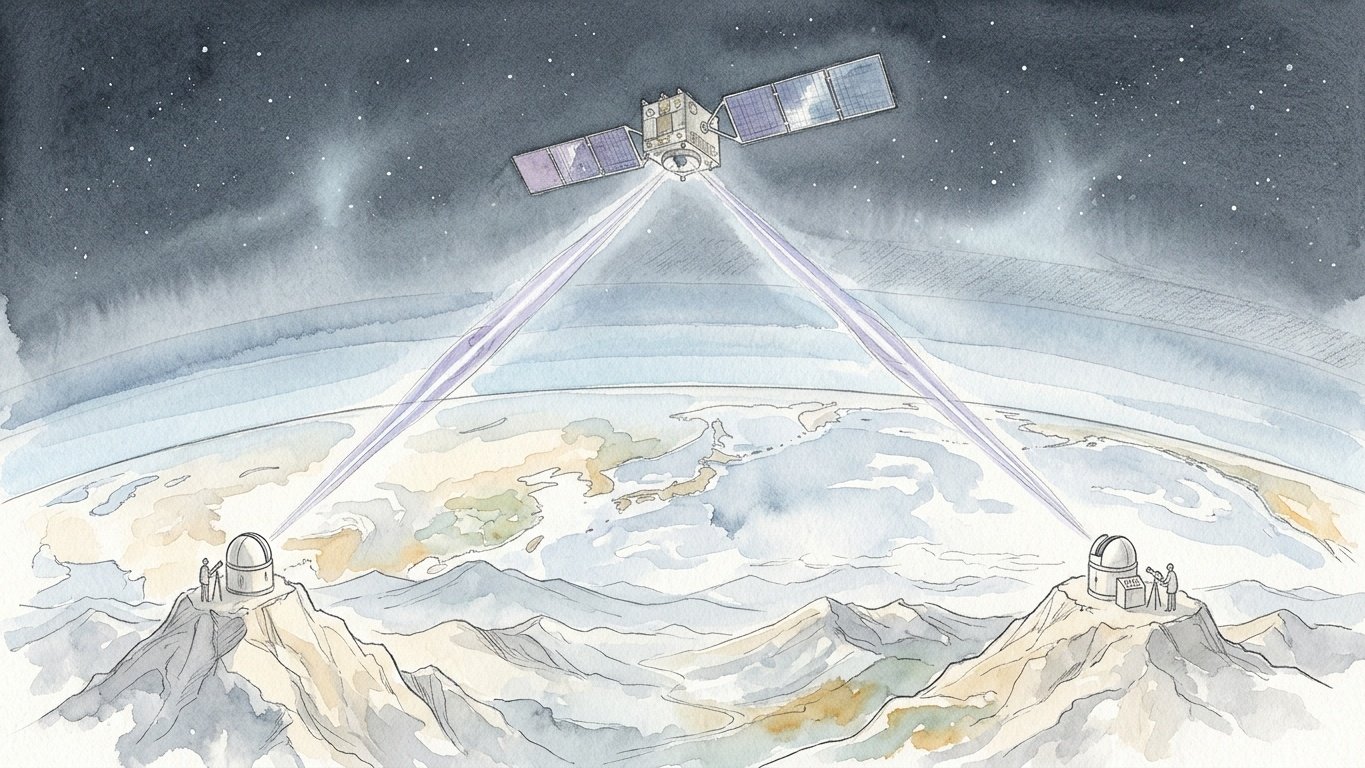
In June 2017, in a paper published on the cover of Science, Pan’s team announced a historic achievement: Loophole-Free Entanglement Distribution across 1,203 Kilometers. As Micius orbited over western China, its onboard Sagnac entangled source split entangled photon pairs, firing one photon down to the Delingha Ground Station in Qinghai province (altitude 3,153 meters) and the entangled twin down to the Nanshan Ground Station in Xinjiang province (altitude 2,028 meters).
The straight-line physical separation between Delingha and Nanshan was 1,203 kilometers. Measuring the polarizations of the arriving photon pairs simultaneously at both stations demonstrated that quantum entanglement survived the gauntlet of space and atmospheric turbulence intact. The team evaluated the Clauser-Horne-Shimony-Holt (CHSH) Bell inequality parameter signal power S:
Under classical physics, local realism strictly limits the degree of correlation between separated measurements. A measured correlation exceeding this classical threshold provides incontrovertible proof that the photon states remain truly entangled across space, ruling out any classical local hidden-variable explanation.
The experimental measurement yielded:
S_{exp} = 2.37 ± 0.09
violating the classical Bell inequality by 4.1 standard deviations! Einstein’s ‘spooky action at a distance’ had been demonstrated across more than a thousand kilometers of planetary space, proving that entanglement is an invariant law of nature operating on macroscopic cosmic scales.
8. Landmark Triumph 3 – Intercontinental Quantum Video Call
The crowning international achievement of Micius arrived in September 2017 with the demonstration of Intercontinental Satellite QKD between Asia and Europe. Micius was scheduled to pass sequentially over two ground stations separated by 7,600 kilometers: 1. The Xinglong Observatory near Beijing, China. 2. The Graz Ground Station operated by the Austrian Academy of Sciences near Vienna, Austria.
During its overflight of Xinglong, Micius established a secure quantum key with the Chinese station. Hours later, as orbital mechanics brought the satellite over Austria, Micius established an independent secure key with the Graz station. In orbit, the satellite computer computed the bitwise combination of the two keys and broadcast this encrypted relay string publicly.
By combining K_relay with their local keys, the Austrian and Chinese teams reconstructed an identical, shared 100-kilobit one-time pad key. On September 29, 2017, the President of the Chinese Academy of Sciences (Chunli Bai) in Beijing and the President of the Austrian Academy of Sciences (Anton Zeilinger) in Vienna conducted a 75-minute real-time video conference encrypted entirely with the Advanced Encryption Standard (AES-128) with cryptographic keys updated every second via the Micius satellite one-time pad. The era of intercontinental quantum networking had officially begun.
9. Ground-Space Integration – The Beijing-Shanghai Quantum Spine
Satellite communication provides global span, but low-Earth-orbit satellites are transient, flying overhead for only a few minutes per day. To create a continuous, commercial quantum infrastructure, China combined Micius with the world’s largest terrestrial quantum fiber network: the 2,000-Kilometer Beijing-Shanghai Quantum Secure Trunkline.
Completed in late 2017, the Beijing-Shanghai trunkline links four major metropolitan quantum networks (Beijing, Jinan, Hefei, and Shanghai) using 32 physical trusted relay nodes spaced along existing civil optical fiber infrastructure. By interfacing this 2,000-kilometer terrestrial backbone with the Micius satellite via optical ground stations, Chinese scientists created an Integrated Space-to-Ground Quantum Network spanning more than 4,600 kilometers, serving over 150 commercial and government users, including China commercial banks, the state electrical grid corporation, and provincial e-government backbones.
10. The Ultimate Security Frontier – Device-Independent QKD
While standard QKD guarantees security assuming the user’s laboratory hardware operates according to theoretical specifications, real-world implementations can be vulnerable to Quantum Hacking (Side-Channel Attacks). Ingenious adversaries can exploit physical flaws in hardware: – Detector Blinding Attacks: Blinding avalanche photodiodes with intense external lasers, forcing them into classical linear mode where Eve can dictate detector clicks. – Trojan Horse Attacks: Firing bright laser pulses into Alice’s transmitter to read the reflection off her polarization modulators. – Spatial-Mode Inconsistencies: Exploiting spatial beam shifts to distinguish between different polarization bases.
To eliminate all hardware vulnerabilities permanently, quantum theorists formulated Device-Independent Quantum Key Distribution (DI-QKD), pioneered by Nicolas Gisin, Renato Renner, and Antonio Acín. In DI-QKD, security does not require trusting the physical detectors, the photon sources, or the satellite hardware! As long as the two ground stations violate Bell’s inequality (S > 2), the mathematical structure of quantum non-locality guarantees that no physical system in the universe—not even a malicious hardware manufacturer or an eavesdropper possessing a quantum computer—can possess information about the measurement outcomes. In 2022, research teams worldwide achieved the first experimental laboratory demonstrations of DI-QKD, charting the path toward satellite-based device-independent networks.
12. Conquering Atmospheric Turbulence with Adaptive Optics
While space provides a pristine vacuum for 99% of a photon’s journey, the final 10 kilometers of atmospheric entry represent a violent optical obstacle course. As a photon beam traverses the troposphere, variations in atmospheric temperature and pressure generate moving pockets of varying air density—turbulent eddies characterized by Kolmogorov turbulence theory.
Atmospheric turbulence degrades quantum optical links through three distinct physical mechanisms:
- Beam Wandering: Turbulent thermal plumes act like weak, moving lenses, deflecting the entire laser beam centroid by dozens of microradians, causing the beam to wander off the ground telescope aperture.
- Beam Broadening and Scintillation: Wavefront phase distortions tear the coherent beam profile into chaotic speckle patterns, inducing intense intensity fluctuations (scintillation). In extreme turbulence, signal intensity can fluctuate by over four orders of magnitude within milliseconds, causing deep fading events where single-photon detectors register zero signal.
- Phase Aberration and Polarization Scrambling: Distortions in spatial phase fronts prevent efficient coupling of the arriving photons into single-mode optical fibers at the ground station. Fortunately, Rayleigh scattering in clean air introduces virtually zero depolarization (< 10⁻⁴), preserving polarization entanglement even through turbulent clouds.
To overcome wavefront distortions, the ground receiving stations (such as Xinglong and Delingha) were equipped with high-speed Adaptive Optics (AO) Systems. A continuous 532-nanometer green laser beacon transmitted from the satellite acts as an artificial guide star. At the ground telescope, a Shack-Hartmann wavefront sensor measures the atmospheric phase distortions across the beam aperture at a frequency of 2,000 frames per second (2 kHz).
A real-time digital signal processor instantly inverts the distortion matrix and commands a deformable piezoelectric mirror containing hundreds of micro-actuators. The mirror physically flexes its surface to cancel the incoming atmospheric aberrations, restoring diffraction-limited wavefronts and boosting the single-photon coupling efficiency into cryogenic avalanche photodiode detectors by more than an order of magnitude.
13. Ground-to-Space Quantum Teleportation Across 1,400 Kilometers
Beyond key distribution and entanglement verification, Micius accomplished one of the holy grails of quantum information science: Quantum Teleportation from Ground to Orbit, published in Nature in 2017.
In quantum teleportation, an unknown quantum state |chi> = α |H> + β |V> is transferred from an originating photon to a distant photon without physically transmitting the photon itself, and without either party knowing the coefficients α and β. The protocol requires three particles: 1. Photon 1: The particle carrying the unknown quantum state to be teleported (held on the ground). 2. Photons 2 and 3: An entangled photon pair shared between the ground station and the orbital satellite.
The experiment was staged at the Ngari Observatory in Tibet, situated at an extraordinary altitude of 5,114 meters above sea level. This extreme elevation placed the ground transmitter above half of the Earth’s atmosphere, drastically suppressing turbulent beam degradation. In the Tibet laboratory, physicists performed a joint Bell State Measurement (BSM) between Photon 1 and Photon 2:
In quantum teleportation, an unknown quantum state is transferred across space using a shared entangled photon pair and classical communication. By performing a joint measurement on the original photon and one member of the entangled pair, the sender projects the distant receiver photon into a deterministic replica of the original state once the classical measurement result is communicated.
The projection of Photons 1 and 2 onto one of the four Bell states instantaneously teleports the state |chi> into Photon 3 aboard the Micius satellite, up to a known Pauli rotation (sigma_x, sigma_y, sigma_z, or identity). The ground station transmitted the two-bit classical outcome of the BSM to the satellite via high-speed radio. Aboard Micius, automated optical switches applied the corresponding unitary rotation, reconstructing the pristine quantum state |chi> in orbit across a physical distance ranging from 500 to 1,400 kilometers with a state fidelity consistently exceeding 80% (well above the classical limit of 2/3).
14. Daylight QKD – Breaking the Nighttime Operational Barrier
A severe operational limitation of early quantum satellite missions was their dependence on darkness: Micius could only operate during clear, moonless nights. During the day, ambient solar photons scattering through the atmosphere (sky noise) produce background noise counts that swamp ultra-sensitive single-photon detectors by millions of times, driving the Quantum Bit Error Rate (QBER) far past the 11% security limit.
Because satellite overflights occur at fixed orbital times dictated by Keplerian celestial mechanics, restricting operations to darkness reduces communication availability by over 75%. To achieve round-the-clock, 24/7 quantum networking, Pan’s group and international teams developed Daylight Free-Space QKD through an exquisite three-stage optical filtering strategy:
- Wavelength Shift to the Solar Fraunhofer Window: Instead of using 810 nm (where solar scattered irradiance is intense), modern systems operate at 1,550 nanometers. At 1550 nm, atmospheric solar background irradiance is four times weaker, and rayleigh scattering is reduced by a factor of 14 (I_scat proportional to lambda⁻⁴). Furthermore, engineers tune the laser precisely to atomic Fraunhofer absorption lines in the solar spectrum, where solar radiation is naturally suppressed by atomic absorption in the Sun’s photosphere.
- Extreme Spatial and Angular Filtering: Using single-mode fibers and diffraction-limited spatial pinholes, the receiving telescope’s field of view is narrowed to less than 10 microradians, rejecting 99.99% of off-axis diffuse scattered sunlight.
- Sub-Nanosecond Temporal Gating: Single-photon avalanche detectors (SPADs) or superconducting nanowire single-photon detectors (SNSPDs) are gated open only for a microscopic temporal window of 200 to 500 picoseconds synchronized with the arrival of the laser pulse, rejecting out-of-time background photons.
- Ultra-Narrowband Up-Conversion and Fabry-Pérot Etalons: Dielectric Fabry-Pérot cavity filters with passband bandwidths of less than 10 picometers (1 GHz) filter out virtually all broadband solar noise while transmitting the monochromatic quantum signal. In 2020, Chinese scientists successfully demonstrated ground-to-ground daytime QKD over 53 kilometers, proving the viability of round-the-clock orbital quantum key exchange.
15. The Great Cryptographic Debate – Post-Quantum Cryptography Versus QKD
The rise of quantum key distribution has sparked an intense, high-stakes debate within the global cybersecurity and national security communities: Should humanity secure its digital infrastructure using Quantum Key Distribution (QKD) or Post-Quantum Cryptography (PQC)?
| Architectural Dimension | Quantum Key Distribution (QKD) | Post-Quantum Cryptography (PQC) |
|---|---|---|
| Security Foundation | Information-theoretic security (laws of quantum physics) | Computational complexity (unproven hardness of lattice math) |
| Vulnerability to Future Breakthroughs | Zero (unbreakable even by infinite classical/quantum compute) | Vulnerable to new classical or quantum mathematical algorithms |
| Infrastructure Requirements | Requires dedicated optical hardware, satellites, single-photon detectors | Pure software upgrade on existing legacy Internet infrastructure |
| Deployment Cost | High (billions in satellites, telescopes, and fiber nodes) | Near zero incremental capital expenditure |
| Transmission Range | Limited by line-of-sight and atmosphere; requires space relays | Infinite across existing global packet networks |
| Primary Standard / Algorithms | BB84, Decoy-State, E91, DI-QKD (ITU / ETSI standards) | NIST Standards: ML-KEM (Kyber), ML-DSA (Dilithium), SPHINCS+ |
Western cybersecurity agencies (such as the U.S. National Security Agency and the UK National Cyber Security Centre) have prioritized PQC, citing its immediate software compatibility with existing routers, servers, and smartphones without requiring new physical hardware. However, QKD advocates emphasize that PQC’s mathematical assumptions may ultimately suffer the same fate as RSA: a mathematical breakthrough could discover an efficient polynomial-time algorithm for the Shortest Vector Problem on lattices, retroactively decrypting decades of archived communication.
The ultimate consensus emerging in twenty-first-century defense and intelligence architectures is a Hybrid Defense-in-Depth Model: combining post-quantum lattice algorithms for general consumer internet traffic with satellite-based quantum key distribution and one-time pads to safeguard critical national security infrastructure, sovereign central bank clearings, and military command networks with unconditional physical permanence.
16. Continuous-Variable QKD – Leveraging Classical Telecommunications Hardware
While the Micius satellite demonstrated Discrete-Variable QKD (DV-QKD)—which encodes quantum bits onto individual single photons and detects them using specialized single-photon avalanche photodiodes—another powerful paradigm has emerged: Continuous-Variable QKD (CV-QKD).
In CV-QKD, information is encoded not into discrete single photons, but onto the continuous wave quadratures—the amplitude (hat{x}) and phase (hat{p})—of coherent optical laser states: |α> = |x + ip>. The quadratures satisfy the canonical quantum commutation relation.
The colossal engineering advantage of CV-QKD is that it does not require cryogenically cooled single-photon detectors. Instead, Bob measures the quantum quadratures using standard Balanced Homodyne or Heterodyne Detection—mixing the incoming quantum light with a strong local oscillator laser on a 50:50 beam splitter and measuring interference with standard, high-speed PIN photodiodes. Balanced homodyne detection acts as an ultra-narrow optical bandpass filter, operating at gigahertz clock rates and naturally rejecting ambient daylight noise.
While CV-QKD is computationally demanding during the classical post-processing phase (requiring multi-edge LDPC codes to perform reverse reconciliation at low signal-to-noise ratios), its full compatibility with standard coherent telecommunications transceivers makes it a premier candidate for metropolitan quantum networks and low-cost nano-satellite constellations.
17. Miniaturization and the Rise of Quantum CubeSats
The 635-kilogram Micius satellite cost approximately $100 million to build and launch, requiring dedicated heavy launch vehicles and sprawling, multi-million-dollar optical ground observatories. To democratize space quantum communication and achieve global continuous coverage, quantum engineers have spent the past decade pursuing aggressive Payload Miniaturization, packing complete quantum optical payloads into standardized CubeSats weighing mere kilograms.
Pioneering missions include: – SpooQy-1 (Singapore / NUS): A 2.6-kilogram, 3U CubeSat launched in 2019 that successfully generated polarization-entangled photon pairs in orbit using a palm-sized, ultra-compact non-linear crystal source consuming less than 2 watts of power. – Jinan-1 (China, 2022): The world’s first quantum micro-satellite, weighing approximately 100 kilograms (one-sixth the mass of Micius). Jinan-1 increased key generation rates by a factor of three while communicating with mobile ground stations mounted on standard commercial vehicle trucks with 28-centimeter receiving telescopes! – EAGLE-1 (ESA / SES, 2024-2025): A European quantum technology demonstrator satellite developed to validate end-to-end space QKD for the European Union’s sovereign EuroQCI (European Quantum Communication Infrastructure) initiative.
By replacing solitary flagship satellites with constellations of dozens of low-cost quantum CubeSats in low Earth orbit, linked to geostationary quantum relay satellites, future constellations will provide global, low-latency, uninterrupted quantum key distribution to any government embassy, naval vessel, or data center on Earth.
18. Testing Quantum Gravity in the Stratosphere
Perhaps the most profound intellectual legacy of Micius lies beyond practical encryption: using space-based quantum channels to probe the fundamental intersection between Quantum Mechanics and Albert Einstein’s General Relativity.
For a century, theoretical physics has been paralyzed by the incompatibility of these two foundational pillars. General relativity describes spacetime as a smooth, deterministic, classical four-dimensional Riemannian manifold warped by mass and energy. Quantum mechanics describes physical reality as a probabilistic superposition of states evolving in flat, static background space. Because both theories make uncompromising claims, testing their intersection requires sending quantum superpositions through significant gravitational potential gradients.
Micius provided humanity’s first platform capable of testing whether the gravitational field of the Earth perturbs quantum entanglement. Theorists such as Ralph TC and Timothy Ralph formulated models of Event-Horizon Decoherence and gravitational time-dilation-induced state degradation, predicting that when two entangled photons experience different spacetime metrics—one traveling in deep space and one in the deeper gravitational potential well near Earth’s surface—the gravitational red-shift differentialdelta φ / c^2could induce fundamental quantum decoherence.
Micius tested this prediction directly over thousands of satellite overpasses. The measurements demonstrated that polarization entanglement survived passage through the Earth’s curved spacetime with zero anomalous loss of coherence, ruling out several phenomenological models of gravitational wavefunction collapse and setting the first empirical constraints on quantum gravity models at macroscopic planetary scales.
20. Quantum Repeaters – The Long-Term Architecture of Quantum Memory
While satellites currently bypass the fiber attenuation wall by flying above the atmosphere, the ultimate, permanent architecture for a planetary-scale terrestrial quantum network requires Quantum Repeaters. First conceptualized by Hans-Jürgen Briegel, Wolfgang Dür, Juan Ignacio Cirac, and Peter Zoller in 1998, a quantum repeater segments a long optical fiber link into multiple shorter, manageable spans (each roughly 50 to 80 kilometers long) and stitches entanglement across the entire distance using Entanglement Swapping and Entanglement Purification.
The foundational component of a quantum repeater is the Quantum Memory: a physical system capable of absorbing a flying photon, storing its quantum state without measurement, and retrieving it on demand after a programmable delay. Today, physicists are engineering three primary quantum memory platforms:
- Electromagnetically Induced Transparency (EIT) in Warm/Cold Atomic Vapors: Using ensembles of rubidium or cesium atoms, a strong coupling laser creates a quantum interference window where an incoming single photon is slowed to a dead stop, mapping its quantum state into collective atomic spin excitations (spin waves). Switching the control laser back on releases the stored photon with high fidelity.
- Rare-Earth-Ion-Doped Crystals (REIDCs): Crystals such as yttrium orthosilicate doped with europium or praseodymium (Eu³⁺:Y_2SiO_5). Because 4f electron shells are shielded from environmental phonons by outer 5s and 5p shells, these solid-state crystals achieve optical coherence times exceeding hours at cryogenic temperatures. Utilizing Atomic Frequency Comb (AFC) protocols, they can store hundreds of spectral and temporal photon modes simultaneously.
- Trapped Ions and Diamond Color Centers: Trapped barium or ytterbium ions, and nitrogen-vacancy (NV) or silicon-vacancy (SiV) centers in diamond, provide deterministic spin-photon interfaces where single electron spins serve as high-speed processing nodes while nearby nuclear spins act as ultra-long-lived quantum memory registers.
When two adjacent segments successfully generate entanglement, Bell state measurements execute entanglement swapping, doubling the entanglement distance. Iterating this process across dozens of repeater nodes enables high-fidelity quantum entanglement distribution across thousands of kilometers of terrestrial fiber without a single trusted node, linking metropolitan quantum computers directly into the orbital satellite constellation.
21. Quantum Memory in Orbit – The Next Satellite Revolution
While Micius successfully generated and transmitted flying entangled photons in real time, the next generation of space missions—such as the Chinese-Austrian QUAPITAL project and NASA’s Space Quantum Entanglement and Annealing payload—is preparing to place Quantum Memories directly into orbit.
Operating a quantum memory aboard a satellite unlocks revolutionary operational capabilities: – Asynchronous Key Distribution: In Micius, entanglement distribution required two ground stations to have simultaneous clear skies and line-of-sight visibility with the satellite. An orbital quantum memory allows the satellite to store one half of an entangled pair, orbit around the globe, and deliver the entangled partner to a distant station hours later, decoupling satellite overflights from geographical constraints. – Space-Based Quantum Repeaters: A constellation of memory-equipped satellites in medium Earth orbit (MEO) can perform inter-satellite entanglement swapping, creating a high-bandwidth quantum mesh network wrapping the globe entirely above the atmosphere. – Distributed Quantum Sensor Networks: Interconnecting space-based optical atomic clocks via entangled quantum links will form a planet-sized quantum synthetic interferometer, boosting the baseline resolution of optical astronomy and testing the constancy of fundamental physical constants across cosmic time.
22. Space-Qualified Cryogenics and Superconducting Nanowire Detectors
The transition from early avalanche photodiodes to next-generation space receivers is being driven by the space-qualification of Superconducting Nanowire Single-Photon Detectors (SNSPDs). While traditional Silicon Single-Photon Avalanche Diodes (SPADs) exhibit quantum detection efficiencies of 50% to 60% and dark count rates of hundreds of counts per second, SNSPDs provide an unprecedented technological leap:
- Near-Unity Detection Efficiency: SNSPDs achieve system detection efficiencies exceeding 98% at the critical telecommunications wavelength of 1,550 nanometers.
- Vanishing Dark Counts: Dark count rates plunge below 0.1 counts per second (one false click every ten seconds), boosting signal-to-noise ratios by four orders of magnitude.
- Ultra-Low Timing Jitter: Timing jitter drops below 15 picoseconds, allowing ultra-narrow temporal gating windows that reject ambient daytime solar photons with near-absolute perfection.
The primary barrier to deploying SNSPDs in space was cryogenic cooling: superconducting nanowires (typically niobium titanium nitride, NbTiN) operate at temperatures below 2.5 Kelvin. In recent years, aerospace engineers developed ultra-compact, low-vibration Stirling-pulse-tube closed-cycle cryocoolers consuming less than 50 watts of satellite bus electrical power. Flying these cryogenic detectors in orbit will amplify satellite-to-ground quantum key rates by over a hundred times, bringing space-based QKD into parity with high-speed commercial data links.
23. Optical Ground Station Engineering – From Qinghai to Mobile Van Deployments
The success of space quantum communication relies equally on the sophisticated optical engineering of ground receiver stations. An optical ground station is not merely a passive astronomical telescope; it is a dynamic, high-speed quantum transceiver that must acquire, track, and lock onto a satellite moving across the sky at 7.6 km/s while filtering out atmospheric noise and turbulence.
Pioneering stations like Delingha in the Tibetan plateau capitalized on high altitude (3,153 meters), thin dry air, and hundreds of cloud-free nights per year to minimize atmospheric attenuation. However, relying solely on permanent high-altitude observatories is impractical for widespread commercial and defense applications.
To overcome this, engineers developed Mobile Quantum Ground Stations mounted on standard commercial vehicle chassis: – Utilizing lightweight, carbon-fiber reinforced telescope mirrors with apertures between 28 and 50 centimeters. – Incorporating autonomous GPS and star-tracker attitude alignment, allowing the mobile station to deploy, calibrate, and lock onto an orbital satellite within twenty minutes of arriving at any unpaved field or coastal location. – Demonstrating reliable gigabit-scale quantum key extraction during field trials in Urumqi and Jinan, proving that quantum satellite communication can be deployed on demand to naval vessels at sea, remote military outposts, or mobile emergency command centers anywhere on the globe.
24. The Geostationary Frontier – Continuous Quantum Links from 36,000 Kilometers
While low Earth orbit (LEO) satellites like Micius provide excellent link efficiencies due to their proximity (500 km), they suffer from an inherent operational limitation: high orbital velocity. A LEO satellite crosses the sky in an eight-minute window and revisits a specific ground station only once or twice every 24 hours. To achieve continuous, uninterrupted real-time quantum key generation across continental landmasses, space agencies are designing Geostationary Quantum Satellites (GEO) orbiting at an altitude of 35,786 kilometers.
In a geostationary orbit, the satellite’s orbital period matches the Earth’s rotational period, keeping the spacecraft permanently fixed over a single geographic location. A single geostationary quantum satellite can maintain continuous, 24/7 optical line-of-sight communication with dozens of optical ground stations spanning an entire continent simultaneously. However, operating a quantum link across 36,000 kilometers introduces a severe physical challenge: geometric beam diffraction. Over 36,000 kilometers, a laser beam expands to a footprint several kilometers in diameter, dropping channel transmission efficiency to approximately10⁻⁶to10^{-7}$ (a channel loss of 60 to 70 dB).
To bridge this 36,000-kilometer gap, optical physicists are engineering 1.2-meter primary telescope mirrors aboard the spacecraft paired with 2-meter ground telescopes, backed by high-power adaptive optics and ultra-high-rate entangled photon sources emitting tens of millions of photon pairs per second. In 2024, preliminary spaceborne quantum experiments demonstrated laser beam pointing stability of sub-micro-radians over simulated geostationary baselines, laying the technical foundation for the first commercial geostationary quantum relay satellite, planned for launch before 2030, which will provide persistent, real-time quantum encryption across entire hemispheres.
Through this relentless progression from low Earth orbit CubeSats to high-altitude Tibetan telescopes, trans-continental fiber trunklines, and geostationary relays, quantum communication has grown into a mature, multi-layered global security paradigm—transforming the counter-intuitive principles of quantum mechanics into the unyielding shield of modern human civilization.
In the final analysis, the achievement of Micius represents more than a milestone in national security or cryptography; it is a profound philosophical triumph. For nearly a century, Albert Einstein questioned the completeness of quantum mechanics, troubled by what he viewed as non-local ‘spooky action at a distance.’ By measuring entangled photons across planetary voids and proving that nature respects quantum non-locality over thousands of kilometers, humanity has verified the fundamental interconnectedness of the cosmos, opening a glorious new chapter in the history of science.
25. Conclusion – The Dawn of the Quantum Internet
The journey of Micius—from Pan Jianwei’s early vision in Vienna to a gleaming satellite hurtling through low Earth orbit, firing entangled photons down to mountain observatories across Asia and Europe—represents one of the most stunning engineering and scientific triumphs of the twenty-first century. It proved that the weirdest, most counter-intuitive phenomena in quantum physics—non-locality, entanglement, and wavefunction collapse—are not philosophical paradoxes confined to thought experiments, but practical technological tools capable of safeguarding human civilization’s digital infrastructure.
As the international community prepares to launch constellations of quantum satellites in medium and geostationary orbits, and as ground laboratories integrate quantum memories and entanglement repeaters, the orbital beams forged by Micius will expand into a planetary web: The Global Quantum Internet. By linking quantum computers, distributed atomic clocks, and ultra-secure communication channels across the void of space, quantum satellite technology has inaugurated a new epoch in human communication—one where the secrets of humanity are locked within the unyielding laws of the cosmos itself.