Lord Rayleigh and the Discovery of Argon
In 1892 Lord Rayleigh was weighing gases in glass globes at the Cavendish Laboratory, and he found that the nitrogen he made in his own laboratory was lighter than the nitrogen he took out of the air, by about one part in a thousand. Most chemists of the 1890s would have called that an error. Rayleigh could not explain it away, and for two years he eliminated every hypothesis he could think of until only one remained. This is the story of a difference too small to dismiss and too stubborn to forget, and of the tobacco pipes with which it was finally settled[1].
Key findings
- The gas globe gave 1·2505 grams per litre for nitrogen prepared chemically and 1·2572 grams per litre for nitrogen taken from air. The difference was one part in a thousand, and it lay outside the errors of the experiment[2].
- The letter that started it, of 29 September 1892: “I AM much puzzled by some recent results as to the density of nitrogen… The relative difference, amounting to about 1/1000 part, is small in itself; but it lies entirely outside the errors of experiment, and can only be attributed to a variation in the character of the gas”[1].
- The separation that finally worked was Thomas Graham’s atmolysis: twelve churchwarden tobacco pipes, four in series in three groups, with the air drawn through at about two per cent of the rate at which it entered[2].
- William Ramsay put a number on the new gas: a relative density of 19.94 on the oxygen-32 scale, and one litre weighing 1·7818 gram, against 1·2511 gram for pure nitrogen[3].
- Argon makes up 1·186 per cent of atmospheric nitrogen by volume, which is about 0.93 per cent of the air. Rayleigh took the 1904 Physics prize alone; Ramsay took the Chemistry prize that same year[3, 4, 5].
One Part in a Thousand
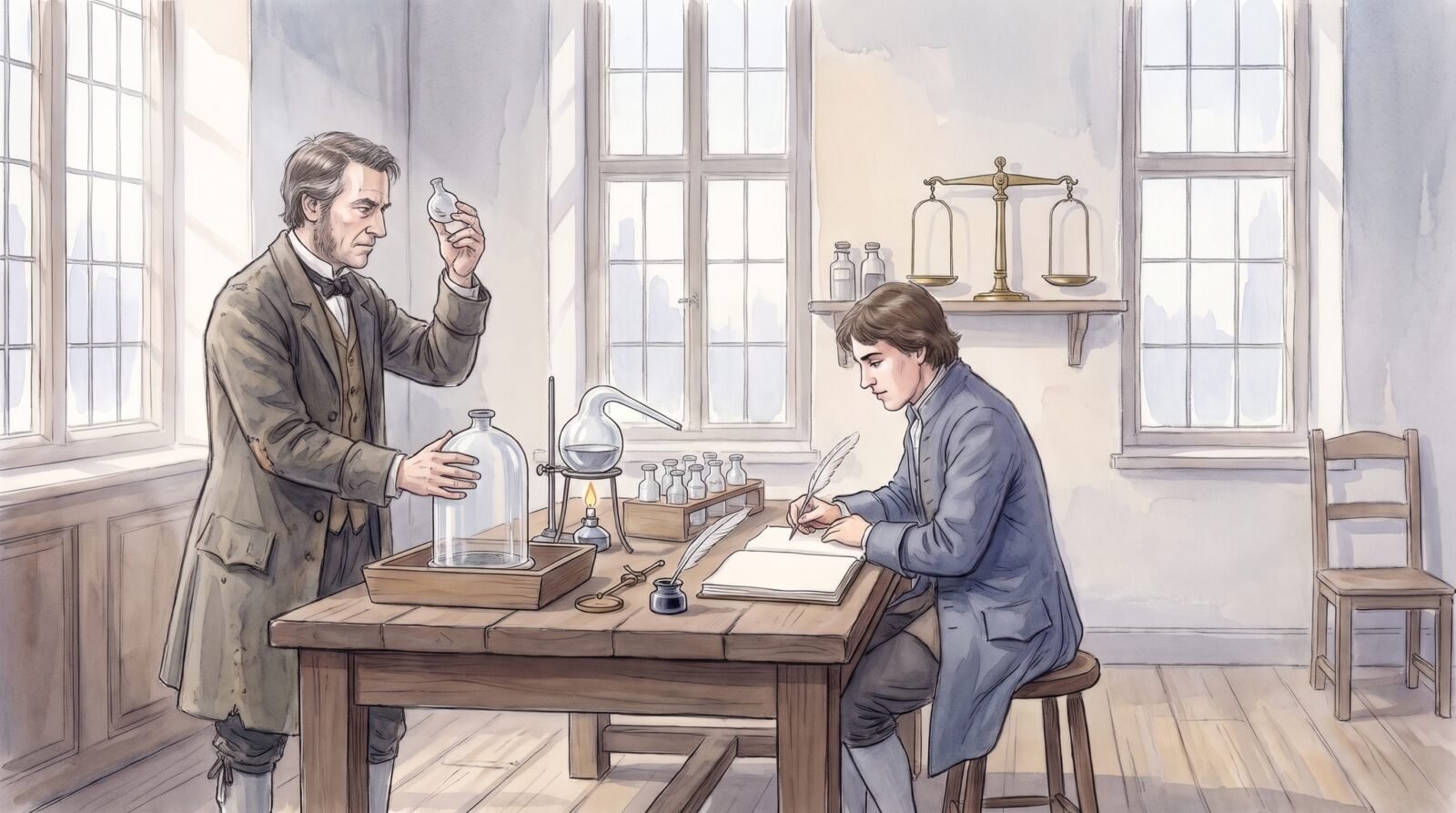
The instrument was a globe. It was a glass sphere of about half a litre, drawn to a small neck, provided with a stopcock and a ground-glass stopper, and it weighed almost nothing when empty because it had been made to be as nearly evacuated as a Victorian glassblower could manage. The procedure was simple and brutal in its simplicity, and it rested on a single assumption: that a gas has a definite density at a definite temperature and pressure, and that the density is a property of the gas and not of the way it was made. Weigh the globe empty. Admit a quantity of gas. Weigh it again. The difference in weight, divided by the volume of gas admitted, gives the density. There is no clever feature of it. What there is, is a sphere that can be cleaned, dried, evacuated and re-weighed to a fraction of a milligram, and a balance that can carry the whole operation without being thrown off by the thousandth of a gram[2].
The gases Rayleigh weighed were all nitrogen, and the whole point of the experiment was that they should be chemically identical and physically different, which is exactly what the gas laws require them to be. Nitrogen from the air had to be freed of everything else in the air, and the nineteenth-century way to do it was to pass the air over red-hot copper, which grabs the oxygen and leaves the nitrogen behind, and then to pass the gas over heated copper oxide, soda-lime and phosphoric anhydride in turn, so that the last traces of oxygen, of carbon dioxide and of water were taken out as well, leaving a gas that ought to have been pure nitrogen and nothing else. Nitrogen from chemical sources had to be made, not separated: from the decomposition of nitric oxide, from nitrous oxide, from ammonium nitrite, and from the decomposition of urea. If the purification was complete, the two kinds of nitrogen ought to have had the same density[2].
They did not, and the size of the discrepancy is what makes the story. The four chemical preparations gave globe weights of 2·3001, 2·2990, 2·2987 and 2·2985, a mean of 2·2990. The three preparations from air gave 2·3103 with hot copper in 1892, 2·3100 with hot iron in 1893 and 2·3102 with ferrous hydrate in 1894. After the correction for the slight shrinkage of the globe under the pressure of the gas, and after scaling, the densities came out at 1·2505 grams per litre for the chemically prepared nitrogen and 1·2572 grams per litre for the nitrogen from air. The air nitrogen was the heavier of the two by roughly one part in a thousand, and it was the heavier of the two every single time[2].
It is worth pausing on what that last sentence meant in practice. Rayleigh was not making one measurement and reporting it. He was making the same measurement over three years, changing the method of removing the oxygen each time — copper, then iron, then ferrous hydrate — and getting the same answer each time. The three air results agree with one another to within three parts in ten thousand, and the four chemical results agree with one another to within a similar margin. Between the two groups there is a gap of about one part in a thousand, which is ten times larger than the spread within either group. Whatever was happening, it was not random error[2].
The consequence for chemistry was immediate and alarming. The atomic weight of an element is fixed by the weight of its molecules divided by the weight of hydrogen, and the whole of the periodic system rests on those weights being the same for every sample of an element. Rayleigh took the ratio of the two gases in his apparatus, nitrogen to oxygen, as 2·2984 to 2·6276, giving 0·87471, and worked back to the atomic weight of nitrogen. From the chemically prepared gas he obtained 13·9954 on the oxygen-16 scale, which is, in his own phrase, very nearly that of 16 : 14. From the air nitrogen, the ratio of small integers was widely departed from. The most important number in the periodic table had stopped being a constant[2].
He published the puzzle rather than the discovery, and the way he did so is characteristic. The letter went to Nature in September 1892, signed from Terling Place at Witham in Essex, and it reads: “I AM much puzzled by some recent results as to the density of nitrogen… The relative difference, amounting to about 1/1000 part, is small in itself; but it lies entirely outside the errors of experiment, and can only be attributed to a variation in the character of the gas.” The capitalisation of the first two words was his, and it is the tone of the whole thing: a statement of fact, addressed to whoever might be able to help, without a claim on anybody’s attention. A later paper, in 1894, reported the same puzzle in a slightly more finished form, noting that nitrogen prepared by Lupton’s method proved to be lighter by about 1/1000 part than that derived from air in the usual manner[1, 6].
What makes this a hard case rather than an easy one is the plain fact that one part in a thousand is small. A gas globe is a good instrument, but it is not a perfect one. The globe shrinks slightly when it is filled, and by slightly different amounts at slightly different pressures; the stopcock grease weighs something; the balance has a certain sensitivity and a certain habit of drifting, which is why the thermometer and the barometer had to be read as well; and any chemist who has worked with these things knows that a thousandth is not far outside the range in which a determined observer can be wrong. Rayleigh’s own position was the defensible one: the difference was larger than his errors, but only just, and he could not say what it meant. So he went back and tried to break his own result[2].
Two features of the method are worth naming, because they are what later work built on. The globe was a closed system, so the gas could be purified and handled without ever being mixed with the air it came from. And the weight of the empty globe was determined repeatedly over the run of the work, so that any drift in the balance, or any change in the glass, could be allowed for rather than assumed away. Those two features are what turned a rough comparison into a measurement that somebody else could repeat, and the whole of the argon story depends on the difference between the two.
Eliminating Every Explanation But One
The two years that followed are the least celebrated part of the story and the most instructive. Rayleigh did what any careful experimentalist does when a number will not sit still: he listed the reasons it might be wrong, and he tested them one at a time. The list is preserved in the abstract of the paper he and Ramsay finally published together, and it runs in the order in which the hypotheses were killed[2].
The first and most obvious explanation was that the heavy gas was contaminated with something heavier, and that the light gas was contaminated with something lighter. The most natural candidate for the second was hydrogen, which would show up as a lightening. Rayleigh therefore deliberately introduced hydrogen into the heavier gas, in quantity, and found that the weight did not change. The hypothesis was dead. The complementary suspicion — that the chemically prepared nitrogen was somehow contaminated with a lighter gas, or the air nitrogen with a heavier one — survived the test only because the same procedure, applied in reverse, produced no effect either[2].
The second explanation was more promising and much more interesting. If nitrogen molecules could be broken up into their constituent atoms, then the gas would be lighter, because a molecule of nitrogen weighs the same as two separate nitrogen atoms but occupies rather less space when separate. It seemed not improbable that the lightness of the gas was to be explained by partial dissociation of nitrogen molecules N₂ into detached atoms. The hypothesis had a mechanism, a precedent in other gases and a way of being tested, and it had one further attraction: it would have explained not only the lightness but the apparent inconsistency of the whole periodic table. because an electric discharge through a gas is known to dissociate molecules. Both gases were therefore put through the silent electric discharge, and both were weighed again. The weights were unaltered. Rayleigh’s own summary of the argument is that dissociated nitrogen atoms might be expected to disappear, and that if the gas were being held in that state it ought not to have been stable for the length of time over which he had observed it[2].
That objection led to the third test, which is the most elegant of the three. If the lighter gas really consisted of partly dissociated atoms, then leaving it alone for a long time ought to let the atoms recombine, and the gas ought to get heavier. So Rayleigh simply stored the light gas and waited. Eight months later he weighed it again, and found that the density had not changed in the least. An atom that had survived eight months of undisturbed existence was not, in his view, an atom that was going to recombine; whatever it was, it was something more stable than that. Dissociation was dead too[2].
The fourth explanation was chemical rather than physical. What if there were two kinds of nitric acid, and the two kinds of nitrogen differed because they were made from different acids? The idea had a certain old-fashioned authority, and it could be tested by going back to the measurement on which the atomic weight of nitrogen itself was founded. Rayleigh turned to the work of Stas on the atomic weight of that substance, and found that it did not support the hypothesis. There was one nitric acid, and its nitrogen weighed what it weighed[2].
The fifth and final explanation was the one that turned out to be right, and it is the most elegant of the lot because it was a positive measurement rather than an elimination. If nitrogen from magnesium nitride is the same density as nitrogen made by other chemical routes, and if that density is the lighter one, then the air nitrogen must be the odd one out. Rayleigh therefore prepared nitrogen by heating magnesium nitride, and found that its density matched the chemical nitrogen and not the air nitrogen. This also settled the objection that the magnesium preparation might be removing something other than nitrogen: the nitride was analysed, and gave 66·35, 66·35 and 66·30 per cent of chlorine against a theoretical 66·27, which is to say the magnesium had removed the nitrogen and nothing else[2].
By the end of it, only one possibility remained, and it was an odd one. The air contained something heavier than nitrogen, and the nitrogen made in the laboratory was the pure article. The heavier something was not a contaminant of the air, because it could not be removed by any of the treatments that had been applied; it was not hydrogen, it was not dissociation, it was not a second acid, and it was not the magnesium preparation. It was simply there, in the air, in quantity, and nobody had ever noticed it, because nobody had thought to weigh the two kinds of nitrogen against each other with quite enough care. At that point the problem stopped being a question about nitrogen and became a question about the air itself. Rayleigh put the strangeness of it plainly: a gas surrounding us on all sides, and present in enormous quantities, could have remained so long unsuspected. The sentence is a reminder that the discovery of argon was not a failure of imagination on the part of chemists. It was a failure of measurement, and it took a measurement of extraordinary persistence to expose[2].
Graham’s Tobacco Pipes
Having established that there was something heavy in the air, Rayleigh faced a harder problem than the one he had started with: showing that it was there in bulk, and not merely as a difference between two weighings. His answer was to reach back to a nineteenth-century method that had been used to separate the components of the air and had been almost forgotten. Thomas Graham had called it atmolysis, from the Greek for a vapour, and the method was diffusion through porous walls, a process governed by Graham’s law of the rate of diffusion of a gas. The apparatus Rayleigh built is one of the most improbable pieces of laboratory equipment in the history of physics, and it works because the difference in density is exactly the thing that diffusion amplifies[2].
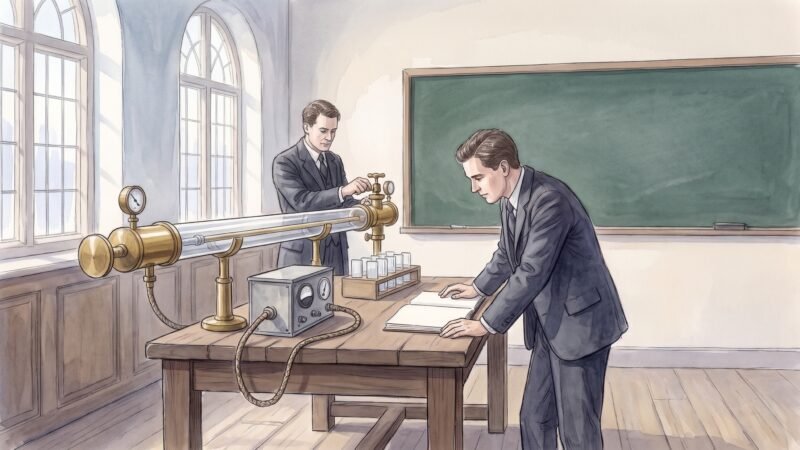
The device was made of twelve churchwarden tobacco pipes. Clay pipes are porous, and the clay of a pipe is full of microscopic channels, so that a gas inside one leaks slowly into a vacuum outside it. The pipes were plugged at both ends with platinum, arranged four in series to make three groups, and the three groups were connected in parallel. The whole assembly was sealed inside a glass tube, and the space outside the pipes in that tube was evacuated and kept evacuated by a water pump. One end of the system was open to the atmosphere and the other was connected to a bottle aspirator drawing about two per cent of the air that entered, so that air was drawn slowly through the pipes and the gas that came out was very largely the heavy component, because the light component had diffused through the clay and away into the evacuated space, in the manner of Graham’s original separations of the components of air. The gas that emerged was then treated exactly as ordinary air would have been treated, with red-hot copper, copper oxide, sulphuric acid, potash and phosphoric anhydride, so that everything except the mystery constituent was removed[2].
The numbers that came out of this contraption are as modest as the apparatus. In a total weight of approximately 2·3 grams of the diffused gas, the excess weight over ordinary atmospheric nitrogen was 0·0049, 0·0010, 0·0027 and 0·0018 gram on four separate determinations, a mean excess of 0·00262 gram; omitting the first figure, which came from a vacuum that was itself two months old, the mean is 0·00187 gram. In other words, Rayleigh had collected a couple of grams of material of which the heavy component was about a two-thousandth of the weight. The conclusion did not depend on the size of the excess but on its consistency: the same small excess turned up every time, from a sample of air that had been treated in a completely different way from the air that had been weighed in the globes[2].
The reasoning behind the choice of method is worth stating, because it is the reason the experiment worked at all. Diffusion is the method of most universal application by which to test whether a gas is pure or a mixture of components of different densities, and it had been used by Graham for precisely the purpose of partially separating nitrogen and oxygen from air. A mixture passed through a porous barrier becomes enriched in the heavier component, because the lighter molecules move faster and get through first, so that the residue left behind is enriched in the heavy fraction. The enrichment is slow and the separation is partial, but the direction of the effect is certain, and a two-thousandth enrichment applied to something that is already one part in a thousand gives an effect large enough to see. Rayleigh was using a nineteenth-century parlor trick to amplify a modern precision measurement[2].
In parallel, he returned to a route that was more than a century older still. Henry Cavendish, in the 1780s, had passed air through an electric spark in the presence of alkali, which removed the oxygen and left behind a small residue that would not combine with anything and that he had thrown away. Rayleigh repeated the procedure with modern apparatus: fifty cubic centimetres of air, sparked over alkali with a Ruhmkorff coil driven by five Grove cells, with the gas then treated with pyrogallate to take out the last of the oxygen. The absorption ran at about thirty cubic centimetres an hour, thirty times as fast as Cavendish could work with the electrical machine of his day, and it left a residue of 0·32 cubic centimetres[2].
That residue was then the interesting part. Adding fifty more cubic centimetres of air and sparking again gave a residue of 2·2 cubic centimetres, and after the oxygen was removed from that, 0·76 cubic centimetres remained. The control experiment was the same procedure run on a known mixture: five cubic centimetres of air with seven cubic centimetres of oxygen, sparked for an hour and a half, left 0·47 cubic centimetres, and 0·06 cubic centimetres after the oxygen was removed. The unknown residue was not the residue of a mixture that had failed to react. The gas had withstood the prolonged action of the spark, and when its spectrum was examined it showed scarcely a trace of the principal nitrogen lines[2].
The last method was the most dramatic and the most physical. Rayleigh passed the nitrogen over red-hot magnesium, which swallows nitrogen greedily and forms a nitride, and the nitride is a porous, dirty orange-coloured substance. Between 7 and 8 litres of nitrogen can be absorbed in a single tube, and the process is slow: roughly fifteen hundred cubic centimetres of gas were collected over ten days and then reduced to about two hundred cubic centimetres, whose density came out at 16·1. That was not yet the answer, because the residue still held some nitrogen. Further treatment, sparking the gas with oxygen, brought the calculated density up to 20·0, and which was the answer: the atomic weight of argon, on the scale on which oxygen is 16, is about 20, which is to say the gas belonged at the bottom of a column of the periodic table that did not yet exist.. A hundred and fifty years after Cavendish threw his residue away, the gas was in a bottle and had a name[2].
Argon: The Weight and the Name
The identification of the new gas was not finished by Rayleigh alone. William Ramsay, who had joined the work at the Cavendish, took on the chemistry of the thing — the isolation of it in quantity, the study of its spectrum, and the measurement of its density — and his book of 1896, The Gases of the Atmosphere, is where the numbers were settled. Its figure for argon is a relative density of 19.94 on the oxygen-32 scale, and its figures for the litre are these: the weight of one litre of pure nitrogen is 1·2511 gram, and of argon, 1·7818 gram, which is what the molar mass of the gas works out to. That last figure is the one most often quoted, and it is worth taking precisely, because a transposition of it into 1·8182 is a common error in popular accounts of the discovery[3].
The arithmetic that connects a relative density of 19.94 to an atomic weight is short. By Avogadro’s law, the molecular weight of a gas is proportional to its density, so a gas of relative density 19.94 on the oxygen-32 scale has a molecular weight of about 40. But the spectrum and the chemistry both indicated that the molecule was the same thing as the atom: it was monatomic, and would not combine with anything. A monatomic gas whose molecular weight is 40 has an atomic weight of 40 on the oxygen-32 scale, which is 20 on the oxygen-16 scale, which is about twice the atomic weight of neon and three times that of helium. Nothing in the periodic table had ever had an atomic weight of 20, because there was no column for it, and no noble gas had ever been imagined[3, 2].
The proportions need stating carefully, because the figure is usually given with the wrong denominator or without one at all. Ramsay’s own formulation is that atmospheric nitrogen consists of pure nitrogen mixed with 1·186 per cent of its volume of argon. That is a percentage of the nitrogen, not of the air. Since nitrogen is a little under four-fifths of the air, 1·186 per cent of the nitrogen works out at about 0.93 per cent of the air by volume, and rather more by mass, since argon is heavier than the average molecule of air — the conventional figure for the mass fraction being around 1.2 per cent. Each of those three numbers is correct, and each is a different quantity. A text that says that argon is 1.186 per cent of the air is wrong; a text that says that argon is 0.93 per cent of the air is right; and a text that says that argon is 1.2 per cent of the air is also right, provided it says that it means by mass[3].
The name was chosen in the same paper and defended in it. The candidates were weighed against one another and rejected in turn, and the word that survived was argon, from the Greek argos, meaning idle or inactive, on the ground that the gas would not combine with anything and so would sit there doing nothing. The choice was apt in a way the authors did not fully appreciate at the time, because the inertness was not a property of the gas but of the electron. The reason argon refused to react was that its outer shell was full, and the discovery of the electron was still some years away. The name described the symptom; the explanation was a piece of atomic theory that would later make the whole family of these gases predictable, and would turn them from a curiosity into a column[2, 7].
The recognition came in 1904, and the shape of it is worth stating precisely, because it is often reported as a shared prize and it was not. Rayleigh received the Nobel Prize in Physics alone, share one of one, for his investigations of the densities of the most important gases and for his discovery of argon in connection with these studies, and he was at the Royal Institution in London at the time, and it was the laboratory he had directed for the best part of twenty years.. Ramsay received the Nobel Prize in Chemistry that same year, also alone, in recognition of his services in the discovery of the inert gaseous elements in air and his determination of their place in the periodic system. Two prizes, two men, one discovery, and the division between them was a division of labour rather than a division of the credit[4, 5].
The Noble Gases and What Rayleigh Built
Argon was the first of a family, and the family was the larger achievement. Over the years that followed, further inert gases were found in the same fractional residues that argon had come from: neon, krypton, xenon and, last and most prosaically, radon, which is radioactive and was therefore the only one of them that could never have been overlooked once anybody thought to look. Each was identified by the same method — fractional distillation of the residue left by removing everything that would react — and each was given an atomic weight and a place in the table, so that the noble gases became a family rather than a series of accidents. By the end of the century there was a whole column of them, and the column was the most conspicuous hole in the periodic system, because the table had always had a gap where those elements ought to be and nobody had known what belonged in it[5, 7].
The gap was closed from the other end as well, and the closure was one of the great confirmations of the century. The periodic table of Mendeleev had been built with gaps in it, and had the extraordinary predictive confidence to say what would fill those gaps and what the filling elements would look like. The noble gases were the sharpest vindication of that confidence, because they were the elements nobody could have predicted from the behaviour of any other element. They did not resemble the neighbouring elements at all, and the fact that they did not resemble anything was itself the clue: they were the first elements whose outer structure was completely filled, and the discovery of the electron made that self-evident. An inert gas is not a gas that will not react. It is a gas with nothing left to give[8, 5].
It is worth remembering how much else the man was doing, because the argon work was a long episode in a career of extraordinary breadth. Rayleigh’s fields, as the Nobel Foundation lists them, include the theory of sound, wave theory, colour vision, electrodynamics, light scattering, the flow of liquids, hydrodynamics, the density of gases, viscosity, capillarity, elasticity and photography, together with a long campaign to establish and maintain the standards of electrical measurement — resistance, current and electromotive force — that the profession ended up using. The gas globe work was the same temperament applied to a different subject: take a quantity that everybody had assumed was settled, measure it again with unreasonable care, and see what happens[4, 9].
The setting for that temperament was the Cavendish Laboratory, which opened in 1874 with a benefaction of £6,300 from William Cavendish and was designed under James Clerk Maxwell. Rayleigh succeeded Maxwell as director in 1879, ran the University of Cambridge laboratory until 1884, and left it for Terling Place, where the nitrogen work was done much later. What he did at the Cavendish was institutional as much as personal: he established the systematic teaching of experimental physics, with students taking the instrument themselves rather than watching a demonstration, and that arrangement became the model for laboratory teaching in physics for the rest of the century. The argon discovery was made in a private laboratory in the country by a man who had spent his working life teaching other people how to distrust their instruments[10, 8, 9].
One of his other subjects points forward in a way that has nothing to do with gases. The viscosity of gases was a long-standing problem, and with the physicist Jeans Rayleigh derived a law for the radiation of a hot body in the classical physics of the 1900s. The law worked perfectly at long wavelengths and failed completely at short ones, which is to say it failed in exactly the regime in which quantum mechanics would make sense. The failure was one of the sharpest pieces of evidence that the classical theory was incomplete, and the law Rayleigh and Jeans had derived was for decades the thing that quantum theory had to supersede. Rayleigh had built the classical limit, and the limit had pointed, with unusual clarity, at what was beyond it[11, 12].
The last irony is a good place to end. Rayleigh was not a rich man and the Nobel Prize money was more than his laboratory needed, so he gave the proceeds to Cambridge, which he gave the proceeds to Cambridge, to build an extension to the Cavendish laboratories.. The prize was given for finding a gas that had been in the air since the beginning of the atmosphere, and the money was spent on building more laboratory in which the next such thing might be found. It is a tidy story, and it is not quite true: the actual finding was done by a balance and a glass globe, and the two years of eliminating explanations were harder work than the two weeks of separation with tobacco pipes. But the refusal to let a small number become a rounding error — the refusal to say that one part in a thousand was too small to matter — is the whole of it, and it is the part that is worth remembering[2, 4].
References
- Rayleigh, Lord (1892). “Density of Nitrogen”. Nature 46, 512 - 513, 29 September 1892. nature.com
- Rayleigh, Lord and Ramsay, W. (1895). “Argon, a New Constituent of the Atmosphere”, abstract. Philosophical Transactions of the Royal Society 186, 187 - 241. archive.org
- Ramsay, W. (1896). The Gases of the Atmosphere. Macmillan. gutenberg.org
- Nobel Foundation, “Lord Rayleigh - Facts”. nobelprize.org
- Nobel Foundation, “Sir William Ramsay - Facts”. nobelprize.org
- Rayleigh, Lord (1894). “The Density of Nitrogen Gas”. Nature 50, 157 - 159, 14 June 1894. nature.com
- Rayleigh, Lord and Ramsay, W. (1895). “Argon, a New Constituent of the Atmosphere”. American Journal of Science, s3-49 (292), 275 - 296. doi.org
- Optics & Photonics News, “Lord Rayleigh: A Scientific Life”, 20 (6). optica-opn.org, accessed 2 November 2026
- Nobel Foundation, “Lord Rayleigh - Biographical”. nobelprize.org
- Cavendish Laboratory, University of Cambridge, “Our history”. phy.cam.ac.uk, accessed 2 November 2026
- MacTutor History of Mathematics Archive, “John William Strutt (Lord Rayleigh)”. mathshistory.st-andrews.ac.uk, accessed 2 November 2026
- Science History Institute, “William Ramsay”. sciencehistory.org, accessed 2 November 2026