Huygens and the Pendulum Clock
In the quiet, frost-bound winter of 1656, inside the country manor of Hofwijck near Voorburg, a young Dutch natural philosopher named Christiaan Huygens altered the course of human history by arresting the slippage of time. For millennia, humanity had experienced duration as an elusive, qualitative drift—a cyclical procession of seasons, shadows cast by gnomons upon stone dials, and the erratic emptying of water vessels or mechanical escapements that wandered by fifteen to thirty minutes every day. Within a few intensely creative weeks in late 1656, Huygens conceived, calculated, and directed the construction of a mechanism that transformed timekeeping from a crude approximation into a rigorous mathematical science. By coupling an oscillating pendulum to a geared clockwork train through an ingenious mechanical crutch, Huygens reduced the daily margin of horological error from a quarter of an hour to less than ten seconds. It was a leap in physical precision of almost two orders of magnitude, an unprecedented disruption that permanently severed human chronology from natural daylight and provided the empirical substrate upon which modern physics, global navigation, and industrial society would be constructed.
Christiaan Huygens was uniquely equipped to execute this intellectual revolution. Born in 1629 into one of the most prominent families of the Dutch Golden Age, he was the second son of Sir Constantijn Huygens—diplomat, poet, musician, and long-serving secretary to three successive Princes of Orange. The Huygens household in The Hague was an intellectual crossroads of Europe, visited by diplomats, artists, and savants. Constantijn was a close friend of Rene Descartes and an interlocutor of Marin Mersenne, immersing Christiaan from childhood in Cartesian rationalism and classical geometry. Before turning his attention to horology, Christiaan had already published brilliant treatises on the quadrature of conic sections, formulated fundamental laws of elastic collision, and revolutionized telescopic astronomy. In 1655, utilizing compound lenses ground by himself and his brother Constantijn Jr., Huygens discovered Titan, the largest moon of Saturn, and resolved the perplexing “arms” of the planet into a thin, flat, unattached equatorial ring.
Yet it was the problem of time that captured Huygens’ imagination most completely. To an astronomer striving to track the delicate transits of celestial bodies, existing clocks were fundamentally inadequate. Astronomy demanded a chronometric precision that the coarse mechanical contrivances of the era could not provide. Galileo Galilei had famously declared the isochronism of the pendulum decades earlier, but no mechanician had succeeded in translating that abstract geometric insight into an autonomous, enduring, self-sustaining clockwork mechanism. Huygens recognized that the challenge was not merely technological; it was profound, requiring an unprecedented synthesis of pure geometry, dynamic mechanics, and metal craftsmanship. In the winter of 1656, working at Hofwijck—an estate whose very name celebrated “refuge from the court”—Huygens brought these disparate worlds together. In doing so, he did not simply invent an improved timepiece; he inaugurated the era of quantitative physical science, in which time ceased to be an ecclesiastical or agricultural cycle and became the fundamental independent variable, t, of the mechanical universe.
The Pre-Huygens Horological Landscape: Verge and Foliot Escapements, Sundials, Clepsydras, and Daily Errors of Fifteen Minutes
To grasp the magnitude of Huygens’ achievement, one must understand the profound technological limitations of the horological landscape he inherited. Prior to the mid-seventeenth century, the measurement of time was fractured into two distinct and largely irreconcilable realms: astronomical indicators that were naturally accurate but environmentally dependent, and mechanical instruments that operated continuously but with notorious inaccuracy. Sundials—the science of gnomonics—relied on the shadow cast by the sun across calibrated stone surfaces. While sundials provided an absolute celestial reference, they were utterly useless at night or under overcast skies. Furthermore, sundials measured apparent solar time rather than mean solar time. Because the Earth moves along an elliptical orbit with variable velocity and possesses an axial tilt of approximately 23.5 degrees, the length of the apparent solar day fluctuates continuously throughout the year, an irregularity codified in the equation of time. For societies that divided daylight into twelve unequal “temporal” hours from sunrise to sunset, such variations were acceptable; but for an emergent scientific worldview demanding uniform, homogeneous time, gnomonics was inherently flawed.
Clepsydras, or water clocks, dating back to ancient Egypt, Babylon, and the Hellenistic engineering of Ctesibius and Vitruvius, sought to provide continuous, weather-independent timekeeping through the regulated flow of liquid through an orifice. Yet clepsydras were plagued by physical instabilities. The rate of fluid discharge varied nonlinearly with the changing hydrostatic head of the reservoir; the viscosity of water changed dramatically with ambient temperature; mineral sediments clogged the discharge nozzles; and the orifices themselves suffered progressive erosive wear. Even the most elaborate hydraulic automata of the Islamic Golden Age and medieval Europe remained delicate curiosities rather than dependable scientific instruments.
The dawn of mechanical horology occurred in northern Italy and southern Germany during the late thirteenth century with the invention of the weight-driven clock regulated by a verge escapement and foliot balance. A suspended lead or stone weight exerted continuous torque on a gear train, attempting to drive it forward at accelerating speed. To prevent uncontrolled unwinding, the verge escapement arrested and released the gear teeth at regular intervals. The verge itself was a vertical iron arbor fitted with two small protruding flags or pallets positioned at right angles to one another, engaging the uppermost and lowermost teeth of a crown wheel. Mounted atop the verge arbor was the foliot: a horizontal iron crossbar carrying small adjustable weights, known as regules, hung symmetrically from notches along its arms. As the crown wheel pushed against one pallet, it rotated the verge, swinging the foliot until the pallet cleared the tooth, allowing the second pallet to arrest a tooth on the opposite side and violently reverse the foliot’s motion.
Despite its mechanical novelty, the verge and foliot mechanism suffered from a fatal physical defect: it possessed no natural resonant frequency. Unlike an ideal pendulum, a foliot has no intrinsic restoring force. The period of its oscillation was determined entirely by the extrinsic driving force of the weight train, balanced against the inertial mass of the foliot, gear friction, and oil viscosity. If the driving weight was increased, the crown wheel struck the pallets harder, and the clock ran faster. If the lubricant dried or dust settled into the pinions, the driving torque dropped, and the clock slowed down dramatically. Moreover, the verge escapement was a violent recoil mechanism: every time a pallet arrested a tooth, the foliot’s momentum forced the entire gear train to rotate backward before the driving weight halted and reversed it. As a consequence, even the finest verge-and-foliot clocks drifted by ten to fifteen minutes every single day, and errors of thirty minutes were commonplace. Clocks possessed only an hour hand, as attaching a minute hand would have been an exercise in absurdity. Great astronomical clocks, such as Giovanni de’ Dondi’s Astrarium (1348–1364) and the cathedral clocks of Salisbury and Strasbourg, were triumphs of epicyclic gearing; yet beneath their celestial pageantry, their actual timekeeping engines were crude foliot escapements requiring constant resetting against the solar noon meridian.
Galileo’s Insight and Incomplete Mechanism: The Discovery of Isochronism (1582) and Viviani’s Pendulum Clock Sketch (1641)
The first profound conceptual breakthrough toward escaping the tyranny of the foliot came not from a clockmaker, but from Galileo Galilei. According to the biography composed by his pupil Vincenzo Viviani, Galileo made his foundational observation in the Cathedral of Pisa around 1582, when he was an eighteen-year-old medical student. Observing the swaying of a bronze votive lamp that had been pushed aside to light the wicks, Galileo noticed that as the oscillations died away and the swing grew smaller, the rhythm appeared to remain constant. Lacking an accurate mechanical timepiece, Galileo timed the oscillations against his own arterial pulse. He discovered what he believed to be the fundamental principle of the pendulum: its isochronism—the proposition that the time required for a suspended body to complete an oscillation is entirely independent of the amplitude of its swing.
Through subsequent experiments with lead bobs suspended by fine threads, Galileo elaborated the mathematical laws governing the pendulum. He demonstrated that the period of oscillation does not depend upon the weight or material of the suspended bob, and that the period is proportional to the square root of the length of the pendulum cord ($T \propto \sqrt{L}$). Galileo grasped immediately that here was an incorruptible standard of time provided by nature itself, grounded in universal terrestrial gravity rather than the contingent friction of brass and iron. He initially applied this insight to medical diagnosis, collaborating with Santorio Santorio to develop the pulsilogium: a handheld graduated scale carrying a pendulum bob whose cord length could be adjusted until its beats matched a patient’s pulse. In astronomy, Galileo employed simple suspended pendulums to time occultations, but these were passive oscillators: an observer had to sit beside the swinging cord, continuously counting each swing aloud—sometimes for thousands of cycles—and periodically imparting gentle manual impulses to sustain the motion.
The challenge of constructing an autonomous pendulum clock was to devise a mechanical linkage that could tap the energy of a falling weight to administer a minute periodic impulse to the pendulum, while simultaneously allowing the pendulum to regulate the advance of the gear train without disrupting its natural resonant frequency. In the spring of 1641, living under house arrest at his villa in Arcetri near Florence, aged seventy-seven, blind, and in failing health, Galileo conceived an escapement design to accomplish this feat. Unable to construct the device himself, he dictated the design to his son, Vincenzo Galilei, and discussed it with Viviani.
The Galilean escapement design, preserved in a celebrated technical drawing executed by Viviani in 1659, employed an escape wheel bearing a ring of pins projecting perpendicularly from its face. Attached to the pendulum arbor was a curved unpinning arm and a separate locking lever. As the pendulum swung toward one side, the unpinning arm lifted a locking detent, releasing the pin-wheel. The rotating wheel immediately pushed a pin against an impulse arm on the pendulum arbor, delivering a direct mechanical kick to sustain the swing, before the detent dropped back into place to arrest the subsequent pin. In theoretical conception, Galileo’s mechanism was a precursor to the modern detached escapement, aiming to leave the pendulum free from mechanical interference for the greatest possible portion of its swing.
Tragically, Galileo’s insight remained an unfulfilled promise. Galileo died in January 1642 before a working prototype could be completed. Vincenzo Galilei procrastinated for years and only began fabricating a model in the spring of 1649. Before he could integrate the escapement with a driving train, motion work, or dial, Vincenzo fell violently ill and died in May 1649. The unfinished contraption remained an abandoned curiosity in his workshop. When Christiaan Huygens published his own successful pendulum clock in 1658, Prince Leopold de’ Medici and the Accademia del Cimento in Florence asserted Tuscan priority, presenting Viviani’s 1659 drawing as evidence that Galileo had invented the pendulum clock first. Yet the historical distinction remains absolute: Galileo conceived the theoretical kinematics of pendulum regulation and envisioned an escapement, but he never built an operational, self-contained, working pendulum clock. That decisive breakthrough belonged solely to Christiaan Huygens.
The First Working Prototype: Salomon Coster Builds Huygens’ Design in The Hague (December 1656)
In late 1656, entirely unaware of the private, unpublished drawings left behind by Vincenzo Galilei in Florence, Christiaan Huygens attacked the problem of mechanical timekeeping with characteristic vigor. On December 25, 1656—Christmas Day—Huygens completed his first operational working model of a pendulum-regulated clock. Recognizing that his own skills in metal turning and horological fabrication were those of a gifted amateur, Huygens formed an immediate partnership with Salomon Coster, a master clockmaker of The Hague. Coster, a native of Haarlem with a prominent workshop on the Westeinde, was one of the finest mechanicians in the Netherlands. Huygens provided Coster with precise geometric calculations and functional specifications, and Coster translated the young mathematician’s abstractions into polished brass and tempered steel.
The Coster-Huygens clock of 1656–1657 was a masterpiece of practical mechanical innovation. Rather than inventing an entirely untested escapement geometry from scratch, Huygens made the brilliant pragmatic decision to adapt the familiar verge escapement, modifying its architecture in three revolutionary ways to integrate the pendulum harmoniously with the gear train:
First, Huygens reoriented the escapement arbor. In a traditional verge-and-foliot clock, the crown wheel rotated on a horizontal axis, engaging a vertical verge arbor. Huygens inverted this arrangement: he placed the crown wheel on a vertical arbor, which engaged a horizontal verge arbor positioned above it. This horizontal arbor rotated back and forth in response to the passage of the crown wheel teeth.
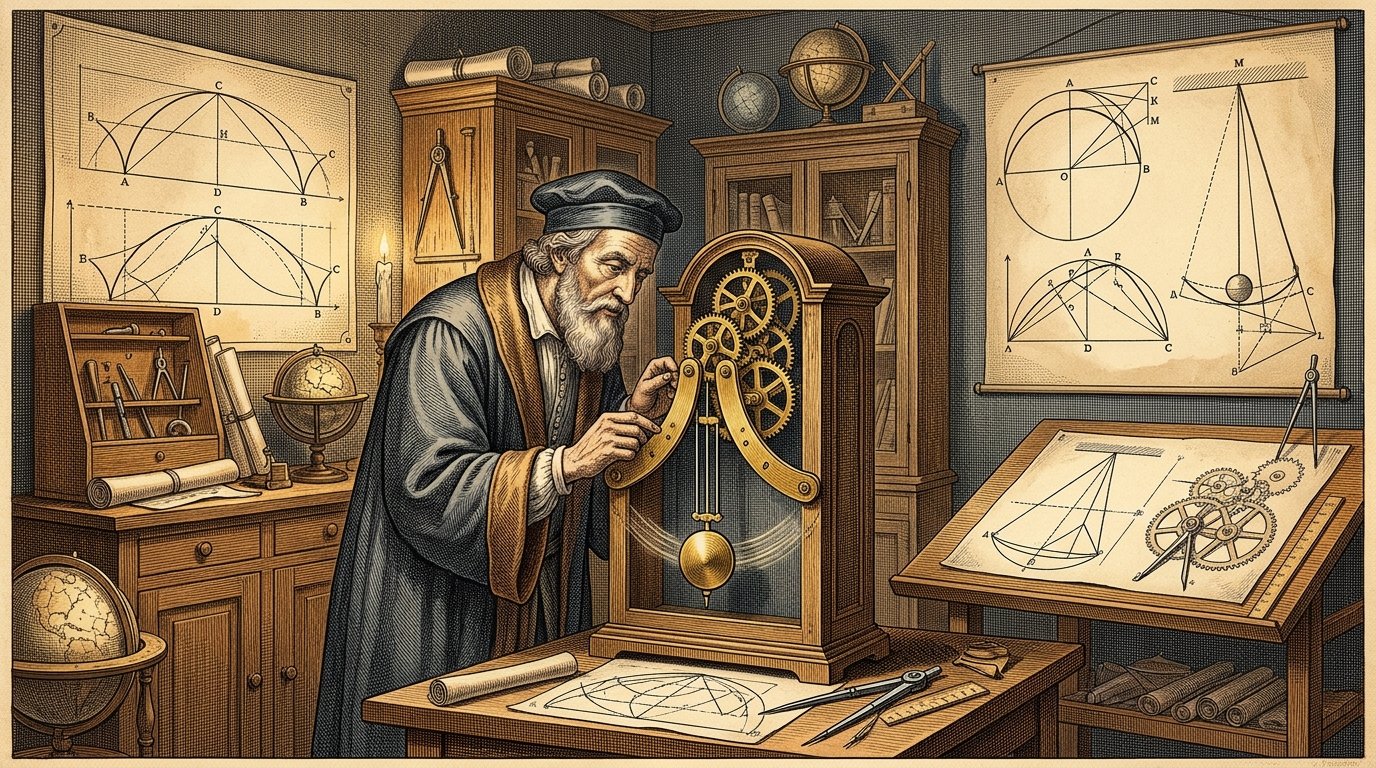
Second, Huygens invented the crutch (known in French as the fourchette)—one of the most enduring components in the entire history of horology. In traditional clocks, the oscillating balance was fixed rigidly to the verge arbor itself, absorbing all the direct shocks of the crown wheel. Huygens realized that fixing a pendulum rod directly to a rigid arbor would subject the delicate oscillation to severe friction, pivot play, and destructive torque. Instead, Huygens suspended the pendulum independently and attached a light, downward-extending vertical wire from the horizontal verge arbor. At its lower terminus, this wire bent into a small fork that loosely embraced the pendulum rod. As the crown wheel pushed the verge pallets, the horizontal arbor turned, swinging the crutch, which gently imparted a light lateral push to the pendulum rod. Conversely, as the swinging pendulum passed through the vertical, it pushed the crutch, rotating the arbor and lifting the pallet to allow the crown wheel to advance. The crutch decoupled the pendulum from the heavy constraints of the escapement arbor, allowing it to swing with remarkable freedom while continuously receiving small maintaining impulses.
Third, Huygens revolutionized the pendulum’s suspension. In early mechanical experiments, pendulums had been pivoted on iron pins passing through holes in brass plates, an arrangement that introduced enormous sliding friction and rapid abrasive wear. Huygens discarded the mechanical pivot entirely. Instead, he suspended the pendulum rod from a flexible silk cord clamped firmly between two rigid metal blocks at the top of the clock frame. The pendulum did not rotate around an axle; it flexed smoothly upon silk, virtually eliminating suspension friction. To ensure that the clock would not lose its time during the daily winding process, Huygens also devised his celebrated endless cord maintaining mechanism, known as the Huygens maintaining work. A closed loop of cord passing over two main driving pulleys with ratchet teeth and two auxiliary weighted idler pulleys allowed the operator to raise the main driving weight without interrupting the driving torque on the escape wheel.
The performance of the Coster-Huygens clocks astonished all who witnessed them. Where the finest foliot clocks wandered by a quarter of an hour each day, Coster’s clocks kept time within ten to fifteen seconds per day. The improvement was so dramatic that it immediately exposed the inadequacy of existing dials. For the first time in horological history, a minute hand was no longer a decorative vanity, but an indispensable indicator of real physical time; within months, Huygens added a second hand, sweeping around a small subsidiary dial, dividing the minute into sixty audible, measurable beats. On June 16, 1657, the States General of the United Provinces granted Huygens a formal patent for twenty-one years, conferring the exclusive right to manufacture and sell pendulum clocks throughout the Dutch Republic. In September 1658, Huygens published a concise Latin treatise entitled Horologium (“The Clock”), establishing his intellectual ownership and touching off the golden age of precision horology across Europe.
The Discovery of Circular Error: Why Simple Circular Pendulums Drift with Amplitude Variations
Even as the horological world celebrated the miraculous accuracy of the 1656 clock, Christiaan Huygens was troubled. He was not merely an engineer content with a dramatic practical improvement; he was a rigorous geometer who demanded theoretical perfection. As he conducted careful astronomical observations at Voorburg throughout 1657 and 1658, timing the meridian transits of fixed stars with his new pendulum clocks, Huygens discovered an unsettling discrepancy: the clocks were not strictly isochronous. When the driving weight was fully wound and the pendulum swung through a wide arc of twelve to fifteen degrees on either side of the vertical, the clock ran distinctly slower than it did hours later, when the driving force degraded and the arc shrank to eight or nine degrees. Galileo’s celebrated doctrine—that the pendulum was isochronous across all amplitudes—was mathematically false.
Through rigorous mathematical analysis, Huygens unmasked the phenomenon known to modern mechanics as circular error. Galileo had arrived at isochronism through physical experiments conducted over small angles, where the deviation from uniform period was imperceptible to the human pulse or coarse counting. But mathematically, a simple pendulum consists of a mass suspended by a rigid, inextensible cord of length L, moving under the influence of uniform gravity g. The path of the bob is a circular arc. Resolving the gravitational force acting on the bob along the tangent to this circular path yields the restoring force:
Ftangent = −m g sin(θ)
where θ represents the angular displacement of the pendulum from the downward vertical. For an oscillator to be truly isochronous—that is, to exhibit simple harmonic motion where the period of oscillation is completely independent of the amplitude—the restoring force must be strictly linear, proportional to the displacement along the path: F = −k s. However, the restoring force of a circular pendulum is proportional not to the angle θ, but to the sine of the angle, sin(θ).
Expanding the sine function as a Taylor series reveals the non-linearity:
sin(θ) = θ − (θ3 / 6) + (θ5 / 120) − …
For infinitesimal swings where θ approaches zero, sin(θ) ≈ θ, and the motion approximates true harmonic motion, yielding the famous Galilean period equation:
T0 = 2π √(L / g)
However, as the swing amplitude θ0 increases, the cubic term −(θ3 / 6) becomes significant. Because the sine curve falls below the linear angle θ, the gravitational restoring force acting on a pendulum bob at the outer reaches of a circular arc is less than what a strictly linear harmonic restoring force requires. Consequently, as the bob swings wider, it decelerates and lingers longer near the extremities of its swing. The period of a circular pendulum as a function of its maximum angular amplitude θ0 expands into the power series:
T(θ0) = 2π √(L / g) [ 1 + (1/16) θ02 + (11/3072) θ04 + … ]
The term (1/16) θ02 represents the primary circular error. For a clockmaker in 1658, this was a devastating practical obstacle. The verge escapement employed by Huygens and Coster required an exceptionally wide swing—often an arc of thirty to forty degrees total (fifteen to twenty degrees on each side)—in order for the pallets to clear the teeth of the escape wheel. At an amplitude of fifteen degrees (0.2618 radians), the correction factor (1/16) θ02 equals approximately 0.00428. Over the course of twenty-four hours (86,400 seconds), this represents a cumulative delay of approximately 370 seconds—over six minutes per day! If the driving torque fluctuated, causing the amplitude to vary by just two or three degrees as the driving cord settled or the lubricating tallow thickened, the clock would gain or lose several minutes a day. Huygens realized that if time was to be measured with absolute mathematical fidelity, the pendulum bob could not be permitted to follow a circle; it had to follow a trajectory where the restoring force was strictly proportional to distance along the curve.
The Geometry of the Cycloid: Horologium Oscillatorium (1673), Tautochrone Curves, and Evolutes
Confronted with the fundamental defect of circular error, Huygens embarked upon one of the most brilliant mathematical quests in the history of science: the search for the tautochrone (from the Greek tauto, the same, and chronos, time)—the unique curve along which a heavy particle descending under gravity would reach the lowest point in exactly the same time, regardless of its starting height. Working in the late 1650s, more than a quarter-century before Isaac Newton and Gottfried Wilhelm Leibniz published their formulations of the infinitesimal calculus, Huygens solved this difficult problem using purely synthetic classical geometry and Archimedean exhaustion.
In a triumph of geometric intuition, Huygens proved that the tautochrone is none other than the cycloid. The cycloid is the graceful roulette curve generated by a fixed point on the circumference of a circle as that circle rolls without slipping along a straight horizontal line. The curve had long fascinated mathematicians, including Galileo, Mersenne, Torricelli, and Pascal, earning the title “Helen of Geometers” because its exquisite mathematical properties had provoked bitter disputes over priority. But Huygens discovered its deepest physical secret: the cycloid is the only curve on which gravitational descent is strictly simple harmonic.
To understand why the cycloid possesses this property, consider its intrinsic geometry. If a cycloid is inverted so that its vertex points downward, its parametric equations in a Cartesian plane can be expressed as:
x = r (φ − sin φ)
y = r (1 − cos φ)
where r is the radius of the generating circle, and φ is the rolling angle. Let s be the arc length measured along the curve from the vertex. Huygens demonstrated that the vertical height y above the vertex is related to the arc length by the remarkable quadratic relation:
y = s2 / (8r)
The tangential component of gravity accelerating a particle along the curve is given by Fs = −m g (dy / ds). Taking the derivative of the height with respect to arc length yields:
dy / ds = s / (4r)
Substituting this directly into the equation of motion gives:
m (d2s / dt2) = −m g [ s / (4r) ]
Canceling the mass m reveals a spectacular result:
d2s / dt2 + [ g / (4r) ] s = 0
This is the textbook differential equation of an ideal harmonic oscillator. The acceleration along the curve is directly, strictly, and linearly proportional to the arc length displacement s from the vertex. Unlike the circular pendulum, there are no higher-order non-linear terms. The period of oscillation along an inverted cycloid is:
T = 2π √( (4r) / g ) = π √( (16r) / g )
This period is completely independent of the starting position, whether the body is released from a millimeter above the vertex or from the very crest of the curve. Yet a clockmaker cannot construct a track on which a bob rolls on wheels without introducing crippling rolling friction. The pendulum must swing suspended from a cord. How could a flexible suspension cord be made to guide a heavy pendulum bob along a perfect cycloidal trajectory?
To answer this question, Huygens invented an entire new branch of differential geometry: the theory of evolutes and involutes. Huygens defined the evolute of a curve as the geometric locus of all its centers of curvature. Conversely, if one wraps a taut, flexible thread around an evolute curve and unrolls it while keeping it taut, the free end traces out a new curve: the involute. Huygens set out to find what evolute curve would produce a cycloidal involute. In a moment of pure mathematical ecstasy, Huygens discovered a miracle of self-similarity: the evolute of a cycloid is another identical cycloid. Specifically, if two semicycloidal curves meet at a cusp above, the curve traced out by the unwinding thread is an inverted cycloid of exactly the same dimensions as the generating cycloids. This discovery, announced in Part III of his monumental 1673 treatise Horologium Oscillatorium, represented the first time in human history that the differential properties of curves were synthesized to solve a physical problem of mechanical dynamics.
The Cycloidal Cheeks: Constraining the Suspension Cord to Enforce Absolute Isochronism
Having established the self-similar geometry of the cycloid, Huygens translated this mathematical revelation into physical brass. Above the pendulum suspension, he mounted two polished brass curved plates flanking the upper portion of the suspension thread. These plates became known throughout Europe as cycloidal cheeks (in Latin, laminae cycloidales; in French, joues cycloidales). Each cheek was filed with microscopic precision into the shape of a semi-cycloid whose generating circle had a radius equal to one-quarter of the pendulum’s nominal length ($r = L / 4$).
The operation of the cycloidal cheeks was as elegant as it was revolutionary. The pendulum bob was suspended by a fine, pliable silk cord from the cusp where the two brass cheeks met. When the pendulum hung motionless at the center of the clock, the silk cord hung vertically between the cheeks without touching either surface. As the pendulum swung to the right, the upper segment of the flexible silk cord came into contact with the right-hand cycloidal cheek, gradually and continuously wrapping against its curved brass contour.
As the silk cord wrapped around the cheek, two physical transformations occurred simultaneously: First, the length of the free, swinging portion of the cord was progressively shortened. Second, the instantaneous center of rotation of the pendulum bob shifted continuously along the cycloidal surface. This progressive shortening of the effective pendulum radius steepened the bob’s trajectory, lifting it slightly higher than a circular arc would have allowed. The geometric result was that the pendulum bob traced a flawless, inverted cycloid through space.
By forcing the bob along a cycloidal path, the cycloidal cheeks eliminated circular error completely. At wide amplitudes, where a circular pendulum would have slowed down due to the shortfall in gravitational restoring force, Huygens’ cycloidal cheeks effectively stiffened the restoration: the steeper path accelerated the bob, compensating precisely for the cubic term of the circular expansion. Whether the driving weight caused the clock to swing through an arc of two degrees or twenty degrees, the period of oscillation remained strictly, mathematically constant. For the first time, a mechanical clock possessed a truly isochronous physical oscillator.
Yet, like many triumphs of pure theoretical mechanics, the cycloidal cheeks encountered stubborn realities in the practical workshop. While they performed magnificently under controlled laboratory conditions, their long-term reliability in ordinary domestic and observatory environments was compromised by material limitations. The suspension cord was subjected to continuous cyclic bending stress as it rolled onto and peeled off the sharp metal contours of the brass cheeks. Silk threads suffered from mechanical fatigue, fraying and eventually snapping after months of continuous oscillation. Furthermore, silk is an organic fiber highly sensitive to hygrometric and thermal fluctuations: on humid days, the silk absorbed moisture and stretched, altering the effective length of the pendulum and introducing errors far larger than the circular error the cheeks were designed to eliminate. Moreover, any microscopic accumulation of dust or dried oil on the brass cheeks altered the profile of the curve, introducing localized kinematic irregularities that disturbed the smoothness of the swing.
The ultimate horological fate of the cycloidal cheeks was decided not by their failure, but by an alternative mechanical breakthrough. Around 1670–1675, English mechanicians—most notably Robert Hooke and William Clement—invented the anchor escapement. Unlike the verge escapement, which required a wide swing of thirty to forty degrees to unlock the crown wheel, the anchor escapement engaged a flat escape wheel through shallow pallets resembling the flukes of an anchor, operating with an exceedingly narrow pendulum swing of only two to three degrees total arc. At an amplitude of only one to two degrees from the vertical, the circular error factor (1/16) θ02 shrinks into complete insignificance: the daily circular error is less than two seconds, easily dwarfed by thermal expansion of the pendulum rod. In 1715, George Graham perfected this principle with the deadbeat escapement, which eliminated all mechanical recoil. In stationary astronomical clocks, the combination of a long seconds pendulum (approximately 39.1 inches long, beating once per second) and a deadbeat anchor escapement rendered physical cycloidal cheeks redundant. Yet while horological engineering bypassed the cheeks in practice, Huygens’ theoretical masterpiece remained forever etched in the history of science: it demonstrated that the laws of nature could be translated directly into the curved contours of a machine to master physical dynamics.
The Balance Spring and Marine Chronometer Aspirations: The Search for Longitude at Sea and Storm Failures
From the very inception of his horological work in 1656, Christiaan Huygens pursued a grander objective than domestic clocks or observatories: the conquest of the oceans through the determination of longitude at sea. In the seventeenth century, navigation across open oceans was an existential gamble. While latitude was straightforwardly calculated from the altitude of the sun or the Pole Star, longitude remained an agonizing enigma. Because the Earth rotates 360 degrees every twenty-four hours, fifteen degrees of longitude equal exactly one hour of time ($1^\circ = 4\text{ minutes of time}$). If a navigator possessed a clock maintaining the true time of a home reference meridian across a voyage, finding longitude required only comparing local solar noon against the clock and multiplying the time difference by fifteen degrees.
Every major maritime empire offered immense fortunes to anyone who could solve the longitude problem. Huygens realized that his pendulum clock was the only instrument possessing the requisite precision. Throughout the 1660s, backed by the Dutch East India Company (VOC) and later by Jean-Baptiste Colbert through the Academie Royale des Sciences in Paris, Huygens built specialized marine pendulum clocks. He encased the mechanisms in heavy cylindrical brass cases to shield them from sea salt, suspended inside universal Cardan gimbals to counteract roll and pitch, weighted with heavy lead counterweights, and fitted with cycloidal cheeks to maintain isochronism amid irregular wave motions.
Initial sea trials showed dazzling promise. In 1664, two Huygens marine clocks aboard HMS Jersey, commanded by Captain Robert Holmes on a voyage to Cape Verde, operated with stunning precision during moderate seas, accurately predicting landfall when navigators were eighty leagues in error. But the harsh realities of the open ocean soon crushed these aspirations. In severe tempests, pitching and rolling were compounded by violent heave, sway, and surge. These erratic multi-axis accelerations threw the gimbals into wild gyrations, while centrifugal and lateral forces swamped the gravitational restoring field. The pendulum bobs crashed against the casings, cords bent over the cycloidal cheeks, gear teeth stripped, and the clocks halted entirely. Huygens was forced to concede a fundamental physical truth: any timepiece whose restoring force depends on terrestrial gravity is inherently vulnerable on a pitching, tossing ship.
This insight led to Huygens’ second great horological triumph. In early 1675, at the Bibliotheque du Roi in Paris, Huygens coupled a circular balance wheel to a fine, spiral-wound steel spring: the spiral balance spring, or hairspring. Just as gravity acted on a pendulum, Hookean elasticity acted on the balance wheel with a restoring torque proportional to angular displacement: τ = −κ θ. Because the balance wheel was pivoted at its center of gravity, linear ship accelerations and tilts had virtually no effect on its oscillations.
Huygens presented his invention to the Academie Royale des Sciences in January 1675, securing a royal privilege. This triggered a bitter priority dispute with Robert Hooke in London, who had experimented with balance springs and accused Henry Oldenburg of leaking secrets. Yet it was Huygens who mathematically mastered the flat spiral hairspring and integrated it into an operational, reliable watch. The balance spring transformed the pocket watch from an inaccurate toy into a precision instrument, establishing the technical foundation that John Harrison, Pierre Le Roy, and Ferdinand Berthoud would ultimately exploit a century later to master marine navigation.
The Strange Sympathy of Pendulum Clocks (1665): Huygens Discovers Coupled Harmonic Oscillation and Entrainment
In the extensive pantheon of Christiaan Huygens’ scientific discoveries, none is more serendipitous, or has exerted a more profound influence on modern non-linear physics, than the phenomenon he observed in late February 1665: the discovery of coupled harmonic oscillation and spontaneous entrainment.
Confined to his bedchamber at Hofwijck by an acute fever, Huygens spent days watching two newly constructed marine pendulum clocks undergoing calibration. The clocks were identical, each equipped with cycloidal cheeks, heavy brass bobs, and lead counterweights. Due to limited space, both were suspended side by side from a single heavy wooden beam supported at each end by the back of a chair. As he observed them ticking, Huygens noticed an uncanny harmony: the pendulums were swinging in absolute, unbreakable synchrony, moving in exact anti-phase—when the left pendulum swung to the left, the right pendulum swung to the right. Despite minute manufacturing differences in teeth and friction that would normally cause two independent clocks to drift out of step within hours, these two clocks remained locked in alternating cadence indefinitely.
Fascinated, Huygens conducted controlled experiments from his bed. He manually disturbed one pendulum, forcing them into parallel motion or arbitrary phase offsets; within twenty minutes, they steadily migrated back into exact anti-phase synchrony. He placed a wooden screen between them to eliminate aerodynamic draft effects, yet the coupling persisted. When he moved the clocks to opposite walls of the room, fifteen feet apart on solid masonry, the synchronization vanished, and they drifted normally. When he returned them to the common wooden beam, the sympathy promptly re-established itself.
On February 26, 1665, an excited Huygens wrote to his father Constantijn, describing what he called an “odd kind of sympathy” (un phenomene tout a fait remarquable… une espece de sympathie):
“Being obliged to stay in my room for several days, I noticed a marvelous effect which no one could ever have thought of. Two clocks of the new construction, hanging from the same wooden beam, keep an agreement so exact that their pendulums never vary by a single beat from each other, but always swing in contrary directions… When I separated them, hanging them from two different beams on opposite walls, they lost this agreement entirely.”
Huygens correctly deduced that the swinging pendulums transmitted minute horizontal reaction forces through their suspensions into the common wooden support, which acted as an elastic mechanical waveguide. Modern non-linear dynamics has fully vindicated his insight: Huygens had discovered injection locking and mutual phase synchronization in coupled non-linear oscillators. Let the two pendulums be modeled as limit-cycle oscillators coupled through horizontal displacement X of the shared elastic beam of mass M, damping γ, and stiffness K:
M (d2X / dt2) + γ (dX / dt) + K X = −m L [ θ̈1 cos(θ1) − θ̇12 sin(θ1) + θ̈2 cos(θ2) − θ̇22 sin(θ2) ]
In-phase swinging (θ1 ≈ θ2) causes constructive force interference, driving beam vibrations and maximizing damping losses, which destabilizes the state. In anti-phase (θ1 ≈ −θ2), the horizontal thrusts cancel, the beam remains motionless, and energy dissipation is minimized. Anti-phase synchrony is a dynamic attractor—the minimum-dissipation limit cycle of the coupled system. Today, Huygens entrainment underpins diverse fields: synchronized firefly flashing, cardiac pacemaker cells, Josephson junctions in superconductors, laser mode-locking, and continental electrical grid stability.
The Transformation of Science: How the Precision Clock Enabled Newton’s Principia, Gravity Mapping, and Roemer’s Speed of Light
The invention of the pendulum clock did not merely improve horology; it transformed the epistemological foundation of natural philosophy. Prior to Huygens, time in experimentation was qualitative and imprecise. Galileo had timed rolling balls by weighing water outflow or counting heartbeats. By dividing duration into identical, reproducible seconds, Huygens transformed time into a mathematical continuum—the independent variable, t, of differential physics. Without the pendulum clock, the crowning empirical achievements of the Scientific Revolution would have been impossible.
The first monumental astronomical confirmation enabled by the pendulum clock occurred at the Paris Observatory under the Academie Royale des Sciences. In 1666, Louis XIV and Jean-Baptiste Colbert lured Huygens to Paris to lead the Academy, alongside Giovanni Domenico Cassini, Jean Picard, and Ole Romer. Utilizing seconds pendulum clocks checked nightly against stellar transits, Cassini and Romer recorded ephemerides of the eclipses of Jupiter’s moon Io. Over years of observations, Romer noticed that when Earth in its orbit was approaching Jupiter, the intervals between eclipses were shorter than average, whereas when Earth receded, the eclipses lagged behind schedule, accumulating a total delay of approximately twenty-two minutes across Earth’s orbital diameter.
In 1676, Romer announced his revolutionary conclusion: light propagates at a finite, measurable velocity. The delay represented the transit time of light across the diameter of Earth’s orbit. Combining this twenty-two-minute delay with contemporary estimates of the astronomical unit, Romer calculated the speed of light at approximately 220,000 kilometers per second. On verge-and-foliot clocks, which drifted by a quarter-hour daily, this subtle cumulative delay would have been completely obscured by mechanical drift.
An even more profound physical revelation emerged from an expedition dispatched by the French Academy in 1671. Astronomer Jean Richer traveled to Cayenne, French Guiana, near the equator, equipped with a seconds pendulum clock calibrated in Paris. Richer discovered that at Cayenne, the clock lost two minutes and twenty-eight seconds per day. To restore accurate time, Richer had to shorten the pendulum cord by one and a quarter Parisian lines (2.8 millimeters). While skeptics attributed this to heat expansion, Huygens and Isaac Newton realized the staggering implication: since $T = 2\pi\sqrt{L/g}$, shortening $L$ to maintain period $T$ proved that terrestrial gravity, g, is weaker at the equator than at higher latitudes!
In Book III of the Principia Mathematica (1687), Newton made Richer’s pendulum measurements the empirical cornerstone of universal gravitation. Combining Richer’s data with Huygens’ centrifugal force theorem ($F_c = m v^2 / r$, published in Horologium Oscillatorium), Newton proved that Earth’s diurnal rotation produces outward centrifugal acceleration maximized at the equator, counteracting gravity. Furthermore, Newton showed that rotation deformed the primordial fluid Earth into an oblate spheroid—flattened at the poles and bulging at the equator. Because the equator is farther from Earth’s center, gravitation is inherently weaker there. Richer’s shortened pendulum was the direct physical proof of planetary oblateness.
Simultaneously, at the Royal Observatory in Greenwich, John Flamsteed employed Tompion pendulum clocks to compile the Historia Coelestis Britannica, establishing precision right-ascension coordinates for thousands of stars. By bridging the abstract geometry of the cycloid with the physical mechanics of brass, Huygens forged the chronometric instrument through which humanity decoded the fundamental laws of the cosmos.
References
- Huygens, Christiaan. Horologium. The Hague: Adrian Vlacq, 1658. (First published treatise on the construction and mechanical principles of the pendulum clock).
- Huygens, Christiaan. Horologium Oscillatorium sive De Motu Pendulorum ad Horologia Aptato Demonstrationes Geometricae. Paris: F. Muguet, 1673. (The definitive scientific masterpiece containing the theory of tautochrone curves, evolutes and involutes, cycloidal cheeks, and centrifugal force).
- Huygens, Christiaan. Oeuvres Completes de Christiaan Huygens. 22 vols. Edited by the Societe Hollandaise des Sciences. The Hague: Martinus Nijhoff, 1888–1950. (The authoritative critical edition of Huygens’ collected writings, scientific correspondence, and private laboratory journals).
- Galilei, Galileo. Discorsi e dimostrazioni matematiche intorno a due nuove scienze. Leiden: Lodewijk Elzevir, 1638. (Galileo’s foundational treatise on kinematics and the initial formulation of pendulum isochronism).
- Viviani, Vincenzo. Letter to Prince Leopold de’ Medici regarding the Galilean pendulum clock invention, 1659. (Archived in the Biblioteca Nazionale Centrale di Firenze, MSS Galileiani; contains the famous original technical drawing of the 1641 escapement).
- Newton, Isaac. Philosophiae Naturalis Principia Mathematica. London: Joseph Streater for the Royal Society, 1687. (Book III, Propositions XIX–XX analyze Richer’s Cayenne pendulum observations and Huygens’ centrifugal theorems to determine the oblate figure of the Earth).
- Richer, Jean. Observations astronomiques et physiques faites en l’isle de Cayenne. Paris: Imprimerie Royale, 1679. (Official account of the French Academy expedition documenting the shortening of the seconds pendulum at the equator).
- Romer, Ole. “Demonstration touchant le mouvement de la lumiere trouve par M. Roemer de l’Academie Royale des Sciences.” Journal des Scavans (December 7, 1676): 233–236. (First announcement of the finite speed of light derived from Io eclipse timings with pendulum clocks).
- Yoder, Joella G. Unrolling Time: Christiaan Huygens and the Mathematization of Nature. Cambridge: Cambridge University Press, 1988. (The seminal modern scholarly study of Huygens’ development of the cycloid, evolutes, and the mathematics of the pendulum).
- Mahoney, Michael S. “Christiaan Huygens: The Measurement of Time and of Longitude at Sea.” In Studies on Christiaan Huygens, edited by H. J. M. Bos et al., 234–270. Lisse: Swets & Zeitlinger, 1980. (Analytical monograph on Huygens’ marine clocks, gimbals, and balance spring disputes).
- Landes, David S. Revolution in Time: Clocks and the Making of the Modern World. Cambridge, MA: Belknap Press of Harvard University Press, 1983; rev. ed. 2000. (The classic historical synthesis on the economic, technological, and cultural impact of precision horology).
- Bennett, Jim, Michael Mahoney, Alistair Kwan, and Fabienne Cournarie. The Geometry of Time: Christiaan Huygens and the Science of Clocks. Leiden: Museum Boerhaave, 2006. (Scholarly catalog examining the surviving 1657 Coster-Huygens clocks and mechanical prototypes).
- Pikovsky, Arkady, Michael Rosenblum, and Jurgen Kurths. Synchronization: A Universal Concept in Nonlinear Sciences. Cambridge: Cambridge University Press, 2001. (Modern physics treatise analyzing Huygens’ 1665 observation of coupled pendulums as the foundation of entrainment theory).
- Bennett, Matthew, Michael F. Schatz, Heidi Rockwood, and Kurt Wiesenfeld. “Huygens’s Clocks Revisited.” Proceedings of the Royal Society A: Mathematical, Physical and Engineering Sciences 458, no. 2019 (2002): 563–579. (Experimental and dynamical reconstruction of the mechanical beam coupling in Huygens’ 1665 sympathy phenomenon).
- Museum Boerhaave (Rijksmuseum Boerhaave), Leiden, Netherlands. Collection of authentic Salomon Coster pendulum clocks (dated 1657) and original Huygens manuscripts.
- Musee des Arts et Metiers, Paris, France. Permanent horological collections preserving early cycloidal pendulum movements and marine timekeeper prototypes.
- Science Museum, South Kensington, London. Horological gallery containing reconstructed Galilean escapement models, early Tompion pendulum clocks, and Clement anchor escapements.