The Michelson Morley Experiment
Introduction: The Most Famous “Failed” Experiment in the History of Physics
In the stifling, subterranean heat of July 1887, inside the basement of the Adelbert College dormitory on Euclid Avenue in Cleveland, Ohio, two American scientists peered intently through a small brass viewing telescope mounted atop a massive slab of Berea sandstone. The stone block, five feet square and a foot thick, rested upon an annular wooden float suspended with near-zero friction inside a cast-iron trough filled with gleaming liquid mercury. As the monolithic slab completed a slow, silent rotation every few minutes, forty-nine-year-old chemist and Congregationalist minister Edward Williams Morley called out numbers indicating the precise positions of faint optical interference fringes. His younger colleague, thirty-four-year-old naval physicist Albert Abraham Michelson, methodically recorded the figures in his notebook. The two researchers were looking for the Earth’s passage through the luminiferous aether—the hypothetical, all-pervading mechanical substrate presumed to fill the interstellar void and support the undulations of electromagnetic waves.
According to the prevailing orthodoxy of nineteenth-century natural philosophy, the Earth, hurtling through its orbit around the Sun at thirty kilometers per second, was plunging through this stationary ocean of aether like a ship cleaving the sea. This relentless planetary motion was expected to produce an “aether wind” sweeping across the terrestrial surface. In the frame of reference of a terrestrial laboratory, a beam of light projected along the direction of planetary travel should take measurably longer to complete a round-trip journey than a beam sent across the perpendicular direction, exactly as a swimmer navigating upstream and downstream in a rushing river requires more time to return to the starting bank than a swimmer traversing directly across the current and back. By dividing a single beam of light into two mutually perpendicular paths, sending them across multiple folding mirrors, and recombining them to produce constructive and destructive interference, Michelson and Morley had constructed an optical interferometer capable of measuring differential travel times of less than a quadrillionth of a second—a precision sufficient to detect optical path shifts on the order of a few billionths of a meter.
Yet, over four days of rigorous observations between July 8 and July 12, 1887, the expected displacement failed to appear. The interference fringes remained obstinately, stubbornly stationary. While the theoretical calculations dictated an easily visible periodic shift of nearly four-tenths of a fringe width as the sandstone slab was rotated through ninety degrees, the observed displacement never exceeded a tiny fraction of a single fringe, and upon systematic averaging, resolved to less than one-fortieth of the predicted value. Within the rigorous limits of observational uncertainty, the result was indistinguishable from zero. The aether wind did not exist. The Earth appeared to be at rest with respect to the very medium that was supposed to carry the physical vibrations of the cosmos.
In the historiography of modern science, the Michelson-Morley experiment is perpetually crowned as the most celebrated “null result” or “failed experiment” in the annals of physics. Yet characterizing the 1887 Cleveland trials as a failure represents an unfortunate epistemological misnomer. Far from being a methodological collapse, the experiment was a triumph of nineteenth-century experimental metrology that fundamentally altered the philosophical architecture of physical science. In the analytical frameworks of Karl Popper, Imre Lakatos, and Thomas Kuhn, the Michelson-Morley experiment was the quintessential experimentum crucis: an anomaly so persistent and intractable that it precipitated the breakdown of classical Newtonian mechanics, exposing the internal contradictions of the classical ether ontology and clearing the conceptual terrain for Albert Einstein’s special theory of relativity.
The ultimate historical irony of the Cleveland experiment lies in its professional recognition. In 1907, Albert Abraham Michelson was awarded the Nobel Prize in Physics “for his optical precision instruments and the spectroscopic and metrological investigations carried out with their aid”—becoming the first citizen of the United States ever to receive a Nobel Prize in any scientific discipline. An experiment designed to measure the absolute motion of humanity’s planet through a phantom medium ended by proving that the medium itself was an illusion, forever transforming our comprehension of space, time, and physical reality.
The 19th-Century Worldview: The All-Pervading Luminiferous Aether and Maxwell’s Electromagnetic Waves
To comprehend why the outcome of the Michelson-Morley experiment fell upon the scientific community with the force of an intellectual thunderbolt, one must reconstruct the metaphysical worldview that dominated physical science throughout the nineteenth century. From the publication of Isaac Newton’s Philosophiae Naturalis Principia Mathematica in 1687, classical physics rested upon the foundational premise that every natural phenomenon was ultimately reducible to mechanical interactions: bodies possessing mass, acting upon one another through instantaneous forces across absolute space, or transmitting energy through the material undulations of an intervening medium. In the mechanical philosophy, action at a distance was deeply unsettling, and the propagation of waves in the absence of a substantial carrier was viewed as an ontological impossibility. Acoustic vibrations required the gaseous molecules of the atmosphere; oceanic tsunamis required the fluid density of water; seismic tremors required the elastic shear of lithospheric granite. To propose that light could travel as a wave through a pure, unadulterated vacuum was, for the Victorian physicist, as logically absurd as proposing a ripple without water or an echo without air.
During the early decades of the nineteenth century, the corpuscular theory of light championed by Newton had been decisively overturned by the wave mechanics of Thomas Young and Augustin-Jean Fresnel. Young’s double-slit demonstrations in 1801 and Fresnel’s rigorous mathematical memoirs between 1815 and 1819 demonstrated that light exhibited diffraction, refraction, and interference—behaviors explicable only under a wave paradigm. However, wave optics soon uncovered a physical property that severely strained the mechanical imagination: light waves were strictly transverse. While fluids such as air and water can only support longitudinal compression waves, wherein particles oscillate parallel to the direction of propagation, the phenomenon of polarization proved that the oscillations of light occur strictly perpendicular to its path of travel. In continuum mechanics, transverse shear waves can only propagate through an elastic solid.
This realization forced nineteenth-century natural philosophers to attribute extraordinary, mutually contradictory mechanical properties to the “luminiferous aether.” Because the velocity of transverse waves in an elastic solid is proportional to the square root of the ratio between its shear modulus and its density, and because light propagates at the staggering velocity of three hundred thousand kilometers per second, the aether had to possess an elastic rigidity exceeding that of hardened steel. At the same time, the aether had to be unimaginably tenuous, possessing a physical density approaching zero, because astronomical observations demonstrated that planets, asteroids, and comets had drifted through interplanetary space for millions of years without experiencing measurable frictional drag, deceleration, or orbital decay. Throughout the mid-nineteenth century, mathematical physicists such as George Green, James MacCullagh, George Gabriel Stokes, and William Thomson (Lord Kelvin) constructed increasingly elaborate mechanical models of this cosmic substance: elastic jellies, vortex sponges, gyrostatic lattices, and labile fluids. Lord Kelvin went so far as to declare that the luminiferous aether was “the only substance we are confident of in dynamics.”
Between 1861 and 1865, James Clerk Maxwell achieved the crowning synthesis of classical physics by unifying electricity, magnetism, and optics into a single, cohesive electromagnetic field theory. In his celebrated 1865 paper, “A Dynamical Theory of the Electromagnetic Field,” Maxwell demonstrated that electric and magnetic fields propagate through space as transverse waves whose velocity, calculated purely from electrostatic and electrodynamic constants, was identical to the measured speed of light: c = 1 / √(ε0μ0). Light, Maxwell declared, was an electromagnetic disturbance. Yet, in Maxwell’s conception and that of his contemporaries, these electromagnetic fields were not autonomous entities existing in empty space; they were mechanical stresses, vortices, and displacements within the luminiferous aether itself.
Here lay the fundamental theoretical impasse that would haunt late-nineteenth-century physics. Maxwell’s equations were not invariant under the Galilean coordinate transformations that formed the core of Newtonian kinematics. Under Galilean relativity, if a physical process takes place on a platform moving at velocity v relative to an observer, velocities add algebraically: a projectile fired at speed u aboard a train moving at velocity v travels at speed u + v relative to the tracks. But Maxwell’s wave equation predicted a unique, constant speed of light, c, without reference to the velocity of the source or the observer. Classical theorists concluded that Maxwell’s equations could hold true in only one privileged reference frame: the absolute rest frame of the stationary luminiferous aether. In any other reference frame moving at velocity v relative to the aether, the apparent velocity of light would vary depending on the angle of propagation, obeying the Galilean addition law c′ = c − v.
In the spring of 1879, months before his death from abdominal cancer, Maxwell addressed this problem in a letter to David Peck Todd of the U.S. Nautical Almanac Office in Washington, D.C. Maxwell observed that all terrestrial attempts to measure the Earth’s velocity relative to the aether using one-way optical signals were thwarted by the impossibility of synchronizing clocks at distant locations without already knowing the speed of light. On the other hand, if a beam of light were sent out and reflected back along the same path, the first-order effect of the aether wind canceled out. Any residual travel-time difference would depend strictly on the second-order ratio (v/c)2. Since the orbital velocity of the Earth around the Sun is approximately 30 km/s and the speed of light is 300,000 km/s, the ratio v/c is approximately 10−4, making (v/c)2 on the order of 10−8—one part in one hundred million. Maxwell concluded with resignation that an effect of this infinitesimal magnitude was “quite too small to be observed” by any conceivable human instrumentation. Maxwell’s letter was published posthumously in Nature in January 1880, where it caught the attention of a brilliant young American naval officer who refused to believe that nature could keep its secrets through sheer smallness.
Albert A. Michelson’s Early Trials: The 1881 Potsdam Experiment and Hermann von Helmholtz’s Encouragement
Albert Abraham Michelson was born in November 1852 in Strelno, Prussia (now Strzelno, Poland), to Jewish parents who immigrated to the United States when he was two years old. Reared in the rugged mining settlements of Murphys Diggings, California, and Virginia City, Nevada, Michelson secured a presidential appointment to the United States Naval Academy at Annapolis in 1869 through the direct intervention of Ulysses S. Grant. At Annapolis, under the mentorship of naval scientists such as Admiral John Worden and William Chauvenet, Michelson distinguished himself in analytical physics and optical design. In 1878, while serving as a twenty-six-year-old instructor of physics and chemistry at the Academy, Michelson turned his attention to Léon Foucault’s revolving-mirror apparatus for measuring the velocity of light. By introducing an extended optical baseline of nearly two thousand feet along the Severn River sea wall and placing the revolving mirror at the focal point of a long-focus lens, Michelson dramatically increased light throughput and resolution, obtaining a value of 299,910 ± 50 kilometers per second—the most accurate measurement achieved to that date.
Convinced that precision optics was his true calling, Michelson obtained a leave of absence from the Navy in 1880 to pursue postgraduate studies in Europe, the vibrant intellectual capital of nineteenth-century physics. Arriving in Berlin, he entered the laboratory of Hermann von Helmholtz at the Physikalisches Institut on Reichstagsufer. Helmholtz, the towering dean of German science who had formulated the conservation of energy and unified fluid dynamics with electrodynamics, welcomed the young American officer. When Michelson read Maxwell’s posthumous letter in Nature declaring that second-order aether drift was undetectable, his imagination was sparked. Where Maxwell saw an insurmountable practical barrier, Michelson recognized that the wavelength of visible light—approximately half a micron—could serve as an exquisitely sensitive natural ruler. If light from a single source were split into two perpendicular rays, reflected across equal arms, and brought back together to overlap, the phase difference between the returning wavefronts would produce alternating bright and dark interference fringes. Any differential delay between the two arms would cause the interference fringes to shift across the field of view.
Encouraged by Helmholtz, who provided laboratory facilities and theoretical counsel, Michelson designed his revolutionary “interferential refractometer” (later simply called the interferometer). Alexander Graham Bell, enthusiastic about the young physicist’s daring proposal, provided twelve hundred dollars through the Volta Fund to finance the construction of the apparatus by the renowned Berlin mechanician Rudolf Schmidt. Helmholtz, while admiring the elegance of the optical design, presciently cautioned Michelson about the physical realities of experimental physics in an urban environment. Berlin was a bustling metropolis, and ground tremors from horse-drawn carriages, streetcars, and industrial machinery threatened to agitate the microscopic interference fringes beyond recognition.
Helmholtz’s warnings proved prophetic. When Michelson assembled his brass interferometer in the basement of the Berlin institute in early 1881, the instrument was paralyzed by vibrations. Even in the dead of night, the rumbling of distant railway carriages and pedestrian footfalls on the cobblestones caused the fringes to dance violently or wash out into an indistinct blur. Realizing that the experiment could never be performed within the city, Michelson obtained permission from the director of the Royal Astrophysical Observatory in Potsdam (the Astro-Physikalisches Observatorium auf dem Telegraphenberg) to move the apparatus into the observatory’s deep, vaulted cellar. There, mounted directly upon the massive stone and brick foundation pier of the great equatorial refractor, the brass interferometer finally found mechanical tranquility.
In April 1881, Michelson carried out the first interferometer test of the aether drift. The apparatus possessed two orthogonal brass arms, each approximately 1.2 meters in length, with plane mirrors mounted at their extremities. A beam of white light was divided at a central half-silvered glass plate, traversed the arms, reflected back, and reunited in an observing telescope. Michelson rotated the entire brass frame on a wooden turntable through twelve distinct compass orientations. In his initial theoretical analysis, published in the American Journal of Science in August 1881, Michelson calculated that the Earth’s orbital velocity through the stationary aether should produce a maximum fringe shift of 0.04 of a fringe as the apparatus turned through ninety degrees. To his surprise, the observed displacement was less than 0.02 of a fringe, and showed no systematic correlation with the direction of the Earth’s motion. Michelson boldly declared: “The result of the hypothesis of a stationary ether is thus shown to be incorrect, and the necessary conclusion follows that the hypothesis is erroneously founded.”
Michelson’s sweeping conclusion was met with skepticism from leading European theorists. In 1882, the French mathematical physicist Alfred Potier examined Michelson’s mathematical derivation and discovered a fundamental theoretical omission. Michelson had correctly calculated the round-trip travel time for the arm oriented parallel to the aether wind, but he had incorrectly calculated the travel time for the perpendicular arm. Michelson had assumed that light in the transverse arm traveled straight across and back along a perpendicular line relative to the stationary aether. In reality, because the apparatus was moving laterally through the aether, the light had to travel along a slanted, diagonal path to intercept the moving mirror, exactly like a ferry crossing a swift river to reach a dock moving downstream. The true path length in the transverse arm was longer than Michelson had assumed, which reduced the theoretical time difference between the two arms by exactly fifty percent. In 1886, Hendrik Antoon Lorentz published a comprehensive memoir on the electrodynamics of moving bodies, independently confirming Potier’s correction and demonstrating that the expected fringe shift in Potsdam was not 0.04 of a fringe, but only 0.02 of a fringe.
Lorentz’s critique was devastating to the definitive claims of the 1881 experiment. Because the true theoretical prediction (0.02 fringe) was roughly identical to the experimental noise threshold of Michelson’s brass apparatus, the Potsdam trial had not disproven the stationary aether at all; it was merely inconclusive. Chagrined but energized by the critique, Michelson realized that to settle the question beyond all theoretical and experimental doubt, he would need to construct a new apparatus that could multiply the optical path length by an order of magnitude while achieving unprecedented levels of mechanical and thermal isolation.
The Partnership with Edward W. Morley at Western Reserve University
Following his return to the United States in 1882, Michelson resigned his naval commission to accept the founding professorship of physics at the newly chartered Case School of Applied Science in Cleveland, Ohio. The Case School had been established through a bequest from the eccentric philanthropist Leonard Case Jr., and its initial temporary facilities occupied an elegant brick mansion on Euclid Avenue—Cleveland’s famed “Millionaires’ Row.” Situated immediately adjacent to the Case School was Western Reserve University, which had relocated from the rural village of Hudson, Ohio, to Euclid Avenue in 1882. It was in this neighboring institution that Michelson encountered the man who would become his indispensable intellectual and experimental collaborator: Edward Williams Morley.
Edward Morley was a figure of extraordinary versatility and formidable experimental discipline. Born in Newark, New Jersey, in 1838, the son of a Congregationalist minister, Morley graduated from Williams College at the top of his class, trained for the ministry at Andover Theological Seminary, and was ordained as a pastor before his passion for chemistry and natural science drew him into academia. Appointed professor of natural history and chemistry at Western Reserve in 1869, Morley gained international renown for his obsessive, fanatical devotion to analytical accuracy. His life’s masterwork was the definitive determination of the atomic weight of oxygen relative to hydrogen. Over a decade of exhausting, round-the-clock labor, Morley designed custom eudiometers, calibrated balances to the microgram, purified gases through endless chemical cycles, and conducted synthesis measurements of water that established the atomic weight of oxygen as 15.879 ± 0.0003—a benchmark of chemical stoichiometry that remained unsurpassed for half a century.
The partnership between Michelson and Morley was an extraordinary convergence of complementary scientific temperaments. Michelson was an optical visionary—dashing, intuitive, fiercely ambitious, and possessing an uncanny spatial genius for manipulating rays of light, but easily bored by routine mechanical maintenance, chemical purification, and prolonged numerical record-keeping. Morley, by contrast, was the quintessential laboratory craftsman: patient, methodical, encyclopedically knowledgeable in metallurgy, thermometry, glass manipulation, and vacuum techniques, and possessing an infinite tolerance for systematic error analysis. Where Michelson saw the bold geometric concept of an optical measurement, Morley anticipated every potential thermal gradient, mechanical flexure, acoustic disturbance, and barometric shift that could corrupt the experimental data.
Before attempting a second, large-scale aether drift experiment, the two scientists resolved to settle an equally contentious problem in nineteenth-century optical physics: the replication of Hippolyte Fizeau’s 1851 experiment on the velocity of light in moving fluids. In 1818, Augustin Fresnel had proposed that transparent dielectric media (such as glass or water) possess an excess concentration of aether that is dragged along when the medium moves, imparting an additional velocity to light given by the “Fresnel dragging coefficient”: f = 1 − 1/n2, where n is the refractive index of the medium. Fizeau had tested this formula in 1851 by measuring the displacement of interference fringes when light was sent through tubes of rapidly flowing water, reporting results in general agreement with Fresnel. However, many physicists, including Gabriel Lippmann and Eleuthère Mascart in France, regarded Fizeau’s measurements as imprecise and open to conflicting interpretations.
In 1885 and 1886, Michelson and Morley constructed a massive water-convection apparatus in the basement laboratory of the Case School. Powered by a pressurized water reservoir in the attic, the system pumped water through two parallel brass tubes twenty-eight feet long at velocities exceeding eight meters per second, while a folded interferometer split a light beam so that one half traveled with the flowing current and the other half against it. Working with meticulous care, Michelson and Morley measured the resulting fringe displacement with an unprecedented accuracy of a fraction of a percent. Their paper, published in the American Journal of Science in May 1886, confirmed Fresnel’s dragging coefficient with dazzling precision, settling the validity of Fizeau’s result beyond challenge.
Yet, far from bringing peace to theoretical physics, the confirmation of Fresnel’s dragging coefficient threw the field into an acute philosophical crisis. Fresnel’s derivation of the dragging coefficient rested squarely on the premise that the aether in the free universe is absolutely stationary, penetrating through the interstices of atomic matter without being dragged by the Earth’s planetary motion. If Fresnel’s theory was correct, the Earth must be plowing through a completely stationary sea of aether, and a terrestrial aether wind of thirty kilometers per second must be raging through every laboratory on Earth. On the other hand, George Gabriel Stokes had proposed an alternative model in 1845, postulating that the Earth’s gravitational pull completely drags the surrounding aether along with it, so that the aether at the planet’s surface is entirely at rest relative to the ground (v = 0). Stokes’s theory easily explained why terrestrial experiments might fail to detect an aether wind, but it suffered from fatal mathematical defects: it was unable to explain the phenomenon of astronomical aberration discovered by James Bradley in 1727 without introducing physically impossible rotational flow fields into the aether. The physical sciences were caught in a profound contradiction. Only a definitive, high-precision measurement of the aether drift at the Earth’s surface could determine whether Fresnel’s stationary aether or Stokes’s dragged aether represented the true physical order of the universe.
The Masterpiece of Vibration Isolation: The 1.5-Ton Sandstone Slab Floating on an Annular Trough of Liquid Mercury
By the autumn of 1886, Michelson and Morley had committed themselves to building an interferometer of colossal proportions and unyielding stability. The design challenges were staggering. To satisfy Lorentz’s theoretical critique of the 1881 Potsdam trial, the new instrument had to expand the optical baseline by nearly a factor of ten, increasing the round-trip path length from 2.4 meters to over 20 meters. At this extraordinary optical path length, the anticipated fringe shift would be comfortably visible—roughly 0.4 of a fringe. However, increasing the optical path length also magnified the instrument’s susceptibility to environmental noise by an order of magnitude. A differential change in the length of the two perpendicular arms of just a few nanometers—less than one-hundredth of the wavelength of light—would shift the fringes by an amount comparable to the entire expected physical signal.
The enemies of optical interferometry were everywhere in nineteenth-century Cleveland. Industrial Cleveland was an economic powerhouse of blast furnaces, iron rolling mills, and heavy freight railways. Outside the university grounds, horse-drawn delivery wagons rumbled over stone-paved streets, while heavy steam locomotives shunted coal cars along the nearby New York, Chicago and St. Louis Railroad tracks. The slightest footfall on a wooden floor, an acoustic pressure wave from a slammed door, or a minor barometric draft was sufficient to warp a metallic frame or set an optical mirror into microscopic oscillation, washing the fragile interference fringes into an illegible blur.
To eliminate these environmental hazards, Michelson and Morley designed an experimental sanctuary in the subterranean basement of Adelbert Hall, the newly erected four-story dormitory of Western Reserve University. The basement room was an ideal underground redoubt: its thick foundation walls were built of solid Berea sandstone masonry, its dirt-and-stone floor lay deep beneath the frost line in direct contact with the bedrock of the Earth, and it had no exterior windows to admit the warming rays of the sun or fluctuating thermal drafts. The temperature in the cellar remained constant to within a fraction of a degree over several days.
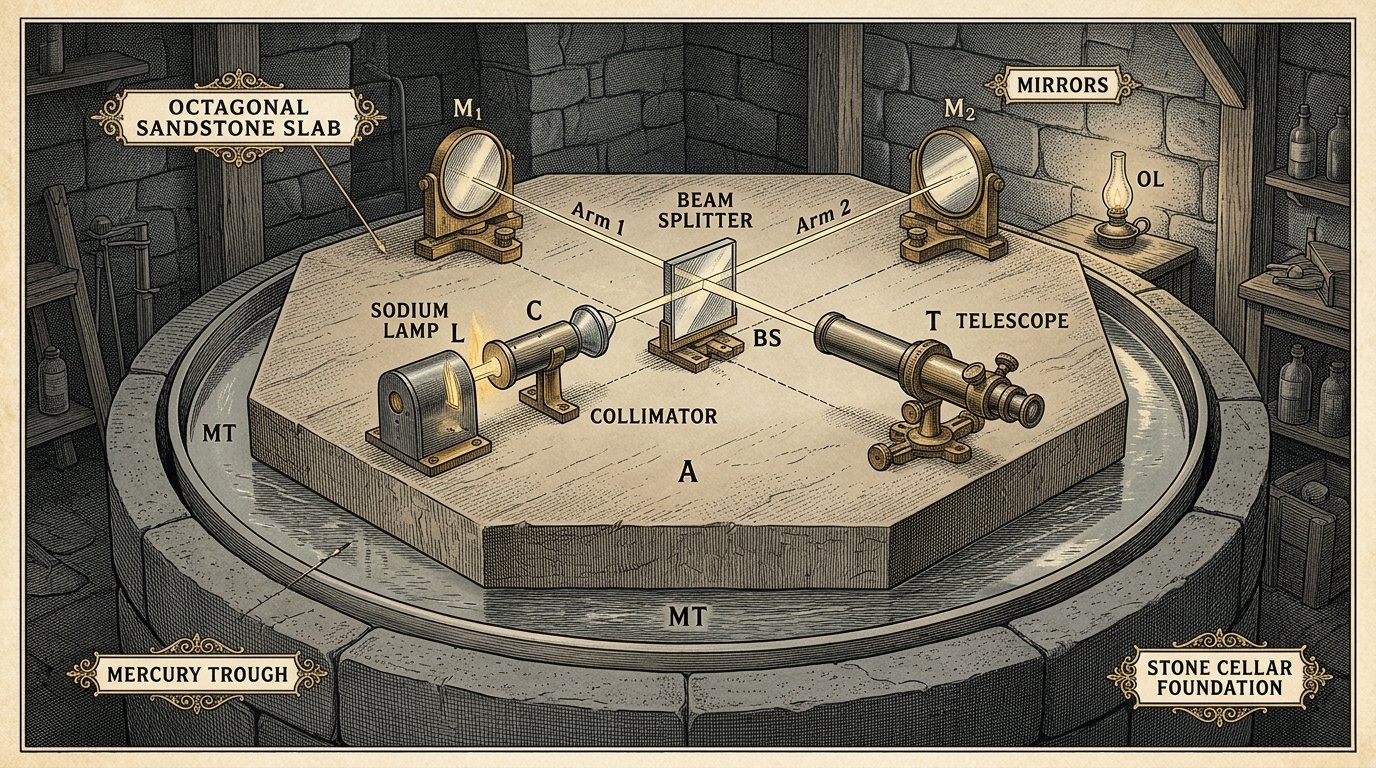
The centerpiece of their mechanical triumph was an ingenious vibration-isolation and rotation mechanism: the liquid mercury suspension. In the center of the basement vault, the researchers erected a massive brick pier that was sunk directly into the Earth and completely isolated from the wooden beams and floorboards of the dormitory above. Fastened to the top of this masonry pier was an annular, circular cast-iron trough with an outer diameter of approximately five feet (1.5 meters) and a depth of several inches. Into this circular trough they poured approximately one hundred and fifty kilograms (over three hundred pounds) of pure, chemically redistilled liquid mercury, creating an annular pool of liquid metal with a density 13.6 times greater than water.
Resting directly upon this shimmering ring of mercury was a matching annular cast-iron float, shaped like a shallow inverted circular pan, machined to clear the inner and outer walls of the trough by a margin of only a few millimeters. Bolted securely to the upper rim of this cast-iron float was the primary optical chassis: a massive, monolithic slab of fine-grained Berea sandstone measuring five feet (1.5 meters) on each side, one foot (0.3 meters) in thickness, and weighing approximately 1,500 kilograms—one and a half metric tons. Berea sandstone was chosen specifically for its high internal acoustic damping, low coefficient of thermal expansion, and enormous mechanical rigidity, which prevented the dimensional warping characteristic of cast iron or brass.
The hydrodynamics of the mercury float were nothing short of miraculous. Because liquid mercury is exceptionally dense, the 1.5-ton sandstone slab displaced only a shallow depth of the liquid metal, floating effortlessly like an iceberg on an iron sea. The mercury layer acted as an acoustic and mechanical low-pass filter of extraordinary efficacy: high-frequency ground vibrations, seismic rumbles from distant freight trains, and street traffic tremors were completely absorbed and dissipated by the viscous drag of the dense fluid before they could reach the sandstone platform. Furthermore, the rotational friction of the floating slab was virtually non-existent. A gentle touch of a single finger, or even a steady puff of breath, was sufficient to set the entire 3,000-pound assembly of stone, iron, and glass into smooth, silent rotation. To keep the heavy slab perfectly centered in the trough without introducing frictional resistance, Morley installed a central vertical steel pivot pin that engaged a bronze socket in the bottom of the float. This pin guided the stone around a precise vertical axis without supporting any of its vertical weight or imparting mechanical torque.
Crucially, the mercury suspension solved the most fatal methodological flaw of the 1881 Potsdam experiment. In Potsdam, Michelson had been forced to stop the turntable at each compass position, set a mechanical clamp, wait for the vibrations to subside, and then take a reading. Each stop and start imparted structural stresses to the brass frame, producing elastic hysteresis and localized thermal distortions from handling. In Cleveland, Michelson and Morley realized that the sandstone slab could be set into a continuous, creeping rotation at a rate of roughly one complete revolution every six to eight minutes. Because the rotation was so uniform and frictionless, the apparatus did not flex or vibrate while in motion. The researchers could walk slowly around the annular trough in a circle alongside the floating stone, peering through the eyepiece of the moving telescope and recording the fringe positions continuously without ever touching the instrument!
Optical Path Multiplication: Multiple Reflections, Beam Splitters, and the Optical Arm Length of 11 Meters
Mounted upon the upper planar surface of the Berea sandstone slab was a folded optical interferometer of unprecedented complexity and elegance. The optical system was designed to divide a beam of light into two mutually perpendicular paths, direct them back and forth across the stone block multiple times, and recombine them to form stationary interference fringes in a viewing telescope. Every optical component was clamped into heavy cast-brass mountings that were bolted into holes drilled directly into the stone slab, with fine adjusting screws allowing micro-radian adjustments of pitch and yaw.
At one corner of the sandstone slab sat the light source: an Argand kerosene lamp (or a high-intensity sodium burner used during initial calibration) surrounded by a metal chimney to shield the optical paths from convection currents. The light from the lamp passed through a collimating lens with a focal length of roughly thirty centimeters, which transformed the diverging rays into a broad, parallel beam of light directed toward the center of the apparatus. At the intersection of the two orthogonal axes sat the heart of the interferometer: a plane-parallel glass beam splitter, coated on its rear surface with an ultra-thin, semitransparent film of silver. The half-silvered mirror divided the incoming light into two equal, coherent beams: half of the light was reflected at a ninety-degree angle along the transverse arm, while the other half was transmitted directly through the glass along the longitudinal arm.
Because the beam splitter was a glass plate of finite thickness (approximately 0.5 centimeters) inclined at an angle of forty-five degrees to the incident beam, it introduced an optical asymmetry between the two paths. The reflected beam traversed the glass of the beam splitter three times (once upon reflection, and twice upon returning to the viewing telescope), whereas the transmitted beam passed through the glass only once. To restore absolute optical symmetry, Michelson and Morley introduced a crucial component: an identical, uncoated optical flat known as the “compensating plate.” Cut from the same melt of optical glass and polished to the identical thickness as the beam splitter, the compensating plate was placed in the path of the transmitted beam at an identical forty-five-degree inclination. This ensured that both beams passed through precisely the same thickness of glass at identical angles, equalizing not only the optical path length but also the chromatic dispersion across all wavelengths of visible light.
The defining innovation of the 1887 apparatus was the multiple-reflection array, which solved the physical limitation imposed by the five-foot dimensions of the stone slab. In the 1881 Potsdam experiment, each arm consisted of a single mirror at the arm’s terminus, limiting the baseline to a modest 1.2 meters. In Cleveland, Michelson arranged sixteen plane mirrors around the perimeter of the stone slab. At each of the four corners and along the edges, groups of speculum-metal and silvered-glass mirrors were mounted on brass brackets with fine micrometer leveling screws. After leaving the beam splitter, each light beam did not simply strike a single end mirror; instead, it was reflected back and forth across the five-foot stone slab eight times in each arm before returning to the central beam splitter.
This folded geometry produced an astonishing optical expansion. While the physical slab measured only 1.5 meters across, the total distance traversed by the light in each arm was stretched to approximately eleven meters (L ≈ 11.0 meters). The complete round-trip optical path traversed by each of the two beams before recombining was therefore twenty-two meters (D = 2L ≈ 22.0 meters). This represented nearly an eight-fold increase in optical path length over the Potsdam instrument, amplifying the predicted time delay by the same factor and boosting the theoretical fringe displacement well into the range of unambiguous visual detection.
Upon completing their eight transits across the slab, the two returning beams struck the half-silvered beam splitter once more. Here, the two wavefronts were recombined into a single exit beam and directed into a small astronomical viewing telescope equipped with a crosshair reticle and a filar micrometer eyepiece. When the two coherent wavefronts overlapped at a slight relative angle, they formed a parallel sequence of alternating bright and dark interference fringes in the focal plane of the telescope. Each fringe represented a contour where the optical path difference between the two arms differed by exactly one wavelength of light (λ ≈ 5.9 × 10⁻⁷ meters).
A critical metrological decision made by Michelson and Morley was the deliberate employment of white light rather than monochromatic sodium light for the final measurements. Monochromatic light (such as the bright yellow emission from sodium vapor) produces hundreds of identical, high-contrast, perfectly periodic fringes extending across the entire field of view. While sodium fringes were indispensable for aligning the sixteen mirrors and establishing optical parallelism, they suffered from an intrinsic metrological defect known as phase ambiguity. Because every monochromatic fringe looks identical to its neighbor, if the apparatus underwent a slight mechanical jerk, vibration, or thermal drift that displaced the fringes by an integer number of wavelengths, it was impossible for the human observer to determine whether the pattern had shifted by 0.1 of a fringe or 1.1 fringes.
White light, being a polychromatic mixture of all visible wavelengths from violet (400 nm) to red (700 nm), solved this problem completely. Because each wavelength forms fringes of slightly different spacing, the fringes for different colors fall out of phase with one another everywhere except at the exact position of zero optical path difference (d1 = d2). At this unique mathematical point, all wavelengths interfere constructively, producing a single, razor-sharp achromatic central white band bordered by two deep, dark interference fringes. Moving outward from the center, the fringes rapidly blur into iridescent rainbow colored bands that wash out into uniform white illumination within four or five fringe widths. This central dark fringe provided an unmistakable, absolute fiduciary reference line. By centering the reticle crosshair of the micrometer eyepiece on this unique central fringe, Michelson and Morley could track the absolute position of the optical path difference to within one-hundredth of a fringe width (0.01λ)—an accuracy of less than six nanometers.
The Theoretical Expectation: Calculating the Fringe Shift from the Earth’s Orbital Velocity of 30 km/s
To establish the exact magnitude of the fringe displacement that classical physics demanded, Michelson and Morley carried out a rigorous mathematical derivation of the travel times for light propagating through an apparatus in motion relative to the stationary luminiferous aether. Their calculation provides one of the cleanest pedagogical examples of nineteenth-century kinematics, while simultaneously illustrating the subtle second-order nature of the optical delay.
Let the apparatus be moving through the stationary aether with velocity v, and let c denote the speed of light in the resting aether frame. We define the dimensionless velocity ratio as β = v/c. In the case of the Earth’s orbital motion around the Sun, the planetary velocity is approximately v ≈ 30 km/s = 3 × 10⁴ m/s. Given that the velocity of light is c ≈ 3 × 10⁵ km/s = 3 × 10⁸ m/s, the velocity ratio is β ≈ 10−4, and its square is β2 ≈ 10−8. The effective arm length of the folded interferometer in Cleveland was L ≈ 11.0 meters, and the mean wavelength of the light used was λ ≈ 590 nm = 5.9 × 10⁻⁷ meters.
The Longitudinal Arm (Parallel to the Aether Wind)
Consider first the optical arm oriented parallel to the direction of the Earth’s motion through the aether. As light leaves the beam splitter and travels toward the end mirror, it is moving in the direction of the aether wind. According to the Galilean addition of velocities, the speed of the light relative to the apparatus is reduced to c − v. The time t1 required for light to travel the length L to the mirror is therefore:
t1 = L / (c − v)
Upon reflection from the mirror, the light travels back toward the beam splitter, moving against the direction of the apparatus and directly into the oncoming aether wind. Its speed relative to the moving apparatus is now increased to c + v. The return travel time t2 is:
t2 = L / (c + v)
The total round-trip travel time for light traversing the longitudinal arm, t∥, is the sum of these two durations:
t∥ = t1 + t2 = L / (c − v) + L / (c + v) = L(c + v + c − v) / (c2 − v2) = 2Lc / (c2 − v2)
Factoring out c2 from the denominator, we express this round-trip time in terms of the dimensionless parameter β:
t∥ = (2L / c) × [1 / (1 − β2)]
Since β ≈ 10−4 is very small compared to unity, we can expand the factor (1 − β2)−1 as a binomial Taylor series: (1 − β2)−1 = 1 + β2 + β4 + … Retaining only terms up to second order in β, the longitudinal travel time becomes:
t∥ ≈ (2L / c) × (1 + v2 / c2)
The Transverse Arm (Perpendicular to the Aether Wind)
Now consider the optical arm oriented perpendicular to the direction of motion through the aether. Here, Alfred Potier’s and Hendrik Lorentz’s correction becomes critical. In the frame of reference of the stationary aether, while the light pulse travels outward across the transverse arm, the apparatus moves forward by a horizontal distance v × Δt3, where Δt3 is the one-way transit time. To strike the mirror, the light cannot travel along a purely perpendicular vector; it must angle forward along the hypotenuse of a right-angled triangle whose vertical leg is the arm length L and whose horizontal base is the distance v Δt3 traversed by the mirror.
By the Pythagorean theorem, the distance traveled by light in the stationary aether is (c Δt3)2 = L2 + (v Δt3)2. Rearranging to solve for the one-way transit time Δt3:
Δt32 (c2 − v2) = L2 &implies; Δt3 = L / √(c2 − v2)
On the return leg from the mirror back to the beam splitter, the geometry is completely symmetric: the beam splitter has moved forward by an additional distance v Δt3, requiring the returning light to traverse an identical diagonal hypotenuse. The total round-trip time for the transverse arm, t⊥, is therefore twice the one-way time:
t⊥ = 2 Δt3 = 2L / √(c2 − v2) = (2L / c) × [1 / √(1 − β2)]
Applying the binomial expansion to the inverse square root factor, (1 − β2)−1/2 = 1 + (1/2)β2 + (3/8)β4 + … Retaining terms up to second order, the transverse travel time is:
t⊥ ≈ (2L / c) × [1 + (1/2)(v2 / c2)]
The Differential Time Delay and Fringe Shift
Subtracting the transverse travel time from the longitudinal travel time reveals the fundamental time difference, Δt, between the two orthogonal beams upon returning to the beam splitter:
Δt = t∥ − t⊥ ≈ (2L / c) × [ (1 + v2/c2) − (1 + (1/2)v2/c2) ] = (2L / c) × [(1/2)(v2 / c2)] = (L / c) × (v2 / c2)
Multiplying this time delay by the speed of light c yields the corresponding optical path difference, Δ:
Δ = c Δt ≈ L (v2 / c2)
However, an experimenter cannot simply measure the absolute path difference Δ directly, because the two arms cannot be machined to have mechanically identical lengths to within a nanometer. To overcome this practical limitation, the entire apparatus must be rotated through ninety degrees (from an initial azimuth of 0° to 90°). Upon a ninety-degree rotation, the arm that was previously longitudinal becomes transverse, and the arm that was transverse becomes longitudinal. The relative time delay between the two arms is inverted:
Δt′ = t⊥ − t∥ = −Δt
The total change in the optical path difference between the two orientations is therefore doubled:
Δtotal = Δ − (−Δ) = 2 Δ ≈ 2L (v2 / c2)
The observable physical consequence of this total path change is a lateral displacement of the interference fringes across the reticle crosshairs in the telescope. The predicted fringe shift, ΔN, expressed as a fraction of a fringe width (where one fringe corresponds to one wavelength λ), is given by the master equation:
ΔN = Δtotal / λ ≈ (2L / λ) × (v / c)2
Numerical Calculation for the Cleveland Experiment
Substituting the precise experimental parameters of the Cleveland apparatus into this formula reveals why Michelson and Morley were so confident of success:
- Effective optical arm length: L = 11.0 meters = 1.1 × 10⁷ nm
- Mean wavelength of light: λ = 590 nm = 5.9 × 10⁻⁷ meters
- Earth’s orbital velocity: v = 30 km/s = 3 × 10⁴ m/s
- Speed of light: c = 300,000 km/s = 3 × 10⁸ m/s
- Velocity ratio squared: (v/c)2 = (10−4)2 = 10−8
Inserting these numerical quantities:
ΔN = [ (2 × 11.0 m) / (5.9 × 10⁻⁷ m) ] × 10−8 = (3.73 × 107) × 10−8 ≈ 0.373 to 0.40 fringe widths
The theoretical expectation was unmistakable: as the sandstone slab completed a ninety-degree rotation, the interference fringes should shift steadily across the crosshairs by approximately 0.40 of a fringe width, reversing its direction during the subsequent ninety degrees to trace out a smooth, double-harmonic sinusoidal curve over a full 360-degree rotation. Because Michelson’s micrometer eyepiece was calibrated to read displacements as small as 0.01 of a fringe width, the predicted shift of 0.40 was forty times larger than the instrument’s limit of resolution. The signal was expected to be overwhelming, dramatic, and utterly undeniable.
The Stunning Null Result: The Stubborn Flatness of the Interference Fringes
The definitive observation campaign commenced on Friday, July 8, 1887, and continued through Tuesday, July 12, with a brief pause over the weekend. Over the course of four days, Michelson and Morley carried out a series of thirty-six complete rotations of the massive sandstone slab. The observations were conducted at two specific times of day: around noon, and at six o’clock in the evening. This temporal schedule was not arbitrary; it was carefully designed to account for the diurnal rotation of the Earth. As the Earth rotates upon its axis every twenty-four hours, the orientation of a terrestrial laboratory on Euclid Avenue continuously pivots with respect to the vector of the Earth’s orbital velocity around the Sun. At noon, the orbital velocity vector was tilted at an angle to the horizontal floor of the Cleveland basement, whereas at six in the evening, the vector was oriented differently relative to the horizon. By sampling both noon and dusk, Michelson and Morley ensured that they would capture different horizontal projections of the aether wind, guaranteeing that an orbital aether stream could not escape detection through accidental alignment.
The experimental procedure was physically taxing and demanded extraordinary concentration. Morley or Michelson gently nudged the 1.5-ton sandstone slab into a slow, uniform rotation, completing one revolution every six to eight minutes. Once set in motion, the apparatus floated without touching any solid structure. The observer walked slowly in a circle around the annular mercury trough, keeping his eye glued to the eyepiece of the moving telescope. Around the circumference of the wooden float, Morley had marked sixteen equidistant compass stations: North, North-Northeast, Northeast, East-Northeast, and so on around the full 360-degree circle (each separated by 22.5 degrees). As each station passed a stationary pointer fixed to the brick pier, the observer peered at the central achromatic dark fringe, noted its position against the reticle crosshair using the micrometer screw, and called out the numerical reading to his partner, who sat at a nearby table recording the numbers by candlelight.
The results were utterly bewildering. The expected sinusoidal oscillation never appeared. The raw micrometer readings showed tiny, erratic fluctuations on the order of a few thousandths of a fringe width, accompanied by a slight, monotonic linear drift caused by slow thermal expansion of the stone as the observer’s body heat warmed the air near the slab. But when the linear drift was mathematically subtracted from the data and the sixteen readings were plotted against the azimuth angle, the resulting curve was breathtakingly, stubbornly flat.
The maximum periodic displacement observed in any single run was less than 0.01 of a fringe width. When the data from all thirty-six revolutions were combined, averaged across both noon and evening series to cancel out random observer errors, the mean fringe displacement fell below 0.005 of a fringe width—less than one-eightieth of the predicted shift of 0.40 fringe! Even if one made the most generous allowances for systematic experimental errors, the observed effect was at least an order of magnitude smaller than the theoretical prediction, and within the rigorous boundaries of statistical uncertainty, it was indistinguishable from absolute zero.
In November 1887, Michelson and Morley published their historic paper in the American Journal of Science (Series 3, Vol. 34, No. 203) under the title “On the Relative Motion of the Earth and the Luminiferous Ether.” The paper was simultaneously reprinted in Great Britain in the Philosophical Magazine. In their sober, understated prose, the authors presented their raw data tables and comparative graphical plots, contrasting the bold, sweeping sinusoidal wave predicted by Fresnel’s stationary aether theory with the flat, trembling horizontal line recorded by their instrument. They summarized their findings with quiet devastation:
“It seems fair to conclude from the figure that if there be any displacement due to the relative motion of the earth and the luminiferous ether, this cannot be much greater than 0.01 of the distance between the fringes… The actual displacement was certainly less than the twentieth part of this, and probably less than the fortieth part… It appears, from all that precedes, reasonably certain that if there be any relative motion between the earth and the luminiferous ether, it must be small; quite small enough entirely to refute Fresnel’s explanation of aberration.”
They calculated that if any relative motion existed between the Earth and the surrounding aether, its velocity must be less than one-sixth of the Earth’s orbital speed—less than five kilometers per second—and certainly less than one-fourth. The luminiferous aether, the bedrock upon which Victorian mechanical physics had erected its entire conceptual edifice, had vanished from the laboratory.
For Albert Michelson personally, the outcome was not a cause for celebration; it was a profound, bitter disappointment. Michelson was an experimentalist devoted to positive measurement, not a philosophical iconoclast seeking to overthrow the foundations of physics. He had designed the most sensitive optical instrument in human history to measure a fundamental physical constant of the cosmos—the absolute velocity of planet Earth through space—and his instrument had returned a humiliating zero. In August 1887, shortly after completing the trials, Michelson wrote a despondent letter to the British physicist Lord Rayleigh (John William Strutt):
“The Experiments on the relative motion of the earth and ether have been completed and the result decidedly negative. The expected deviation of the fringes from the zero should have been 0.40 of a fringe—the maximum displacement was certainly less than the twentieth part of this, and probably less than the fortieth part. But since the displacing effect depends on the square of the velocity, the relative velocity can considerabiy [sic] not be greater than one-sixth the earth’s velocity. I hope you will not consider me altogether a lost cause.”
In their published paper, Michelson and Morley had pledged to repeat the experiment at three-month intervals throughout the following year, rotating the apparatus in autumn, winter, and spring to account for the Earth’s varying orbital trajectory around the Sun. But Michelson was so dispirited by the negative result that he never carried out the scheduled seasonal trials. Suffering an emotional and physical breakdown in the late 1880s, Michelson abandoned aether drift experiments entirely for nearly a decade, turning his formidable talents to high-resolution spectroscopy, the metrological standardization of the international meter bar in Paris using the red cadmium spectral line, and the development of astronomical interferometry.
Theoretical Rescues and Contortions: Aether Dragging, Lorentz-FitzGerald Contraction, and Poincaré’s Principle
The publication of the 1887 Cleveland result threw European physics into a state of profound intellectual disarray. The experiment had created a catastrophic paradox. On the one hand, Michelson and Morley’s 1886 water-convection experiment had confirmed Fresnel’s dragging coefficient with extraordinary precision, a result that made mathematical sense only if the luminiferous aether was completely stationary throughout the universe and ignored the motion of celestial bodies. On the other hand, the 1887 experiment proved with equal precision that the Earth did not experience an aether wind, a result that made physical sense only if the aether was dragged completely along with the planet.
In an effort to escape this contradiction, several physicists attempted to revive George Gabriel Stokes’s 1845 aether-drag hypothesis, arguing that the Earth’s gravitational field carried the aether along in its immediate vicinity, producing a boundary layer of resting aether at the Earth’s surface where v = 0. However, mathematical scrutiny quickly demonstrated that Stokes’s hypothesis was physically untenable. In 1886, Hendrik Antoon Lorentz proved that an aether dragged by a moving sphere could satisfy the boundary condition of zero velocity at the surface only if the fluid flow possessed non-zero vorticity (curl v ≠ 0). But if the aether flow possessed vorticity, it would refract incoming light rays from distant stars, warping their wavefronts and completely destroying the simple, universal law of astronomical aberration discovered by James Bradley in 1727. Stokes’s dragged aether could rescue the null result only by destroying the foundations of observational astronomy.
Faced with the collapse of the aether-drag hypothesis, theoretical physicists began to contemplate far more radical, desperate explanations. In 1889, the brilliant Irish physicist George Francis FitzGerald published a brief, speculative letter in the American journal Science titled “The Ether and the Earth’s Atmosphere.” FitzGerald asked a startling question: What if moving through the aether alters the physical dimensions of solid bodies?
FitzGerald reasoned that solid matter is held together by intermolecular electrical forces. If these electrical forces are transmitted through the aether, and if the transmission of electrical fields is governed by Maxwell’s equations, it is plausible that the electromagnetic forces between atoms in a moving body might be modified by their motion through the aether. FitzGerald proposed that any physical object moving at velocity v through the stationary aether undergoes a physical contraction along its direction of motion by a factor precisely equal to √(1 − v2/c2), while its transverse dimensions remain completely unchanged.
The mathematical elegance of FitzGerald’s ad hoc hypothesis was undeniable. If the longitudinal arm of the Michelson interferometer contracts from its rest length L to an effective length L∥ = L √(1 − β2), the round-trip travel time for light in the longitudinal arm becomes:
t∥ = (2 L∥ / c) × [1 / (1 − β2)] = [2 L √(1 − β2) / c] × [1 / (1 − β2)] = (2L / c) × [1 / √(1 − β2)]
This is mathematically identical to the round-trip travel time for the transverse arm: t∥ ≡ t⊥. The time delay between the two arms vanishes completely, in every orientation! The interference fringes would remain immutably flat, exactly as Michelson and Morley had observed. In 1892, unaware of FitzGerald’s obscure note in Science, the Dutch master Hendrik Antoon Lorentz independently proposed the identical contraction hypothesis in a communication to the Royal Netherlands Academy of Arts and Sciences.
Over the following decade, Lorentz transformed this speculative conjecture into a comprehensive, microscopic theory of electrodynamics known as the Lorentz Electron Theory. In his landmark 1895 treatise, Versuch einer Theorie der electrischen und optischen Erscheinungen in bewegten Körpern (“Attempt at a Theory of Electrical and Optical Phenomena in Moving Bodies”), Lorentz demonstrated that Oliver Heaviside’s solution for the electromagnetic field of a moving point charge contracted the spherical electrostatic field into an oblate ellipsoid (the Heaviside ellipsoid). If the forces that bind atoms into molecules are purely electromagnetic, Lorentz argued, then any physical body composed of electrons must physically compress along its line of travel by the factor √(1 − v2/c2) as a direct dynamical consequence of its motion through the aether.
To preserve the form of Maxwell’s equations in reference frames moving through the aether, Lorentz introduced a set of mathematical coordinate substitutions. Among these was an auxiliary mathematical variable he termed “local time” (Ortszeit), defined as t′ = t − vx/c2. Initially, Lorentz treated local time merely as a clever mathematical trick to simplify the differential equations and eliminate first-order terms in v/c. By 1904, in his celebrated paper “Electromagnetic Phenomena in a System Moving with Any Velocity Smaller Than That of Light,” Lorentz generalized his transformations to all orders of v/c, formulating what Henri Poincaré would name the “Lorentz transformations”:
x′ = γ (x − vt), y′ = y, z′ = z, t′ = γ (t − vx/c2), where γ = 1 / √(1 − v2/c2)
Yet, despite the mathematical perfection of his transformations, Lorentz remained firmly anchored to the classical nineteenth-century ontology. For Lorentz, the luminiferous aether was a real, stationary physical entity; length contraction was a real, physical squeezing of molecular bonds; and the true, absolute time was the time measured by an observer at rest in the stationary aether, while “local time” remained an artificial mathematical convenience.
It was the supreme French mathematician, theoretical physicist, and philosopher of science Henri Poincaré who recognized the profound philosophical artificiality of this classical structure. In a series of brilliant essays and lectures between 1898 and 1905, including The Measure of Time (1898) and his address to the International Congress of Arts and Science in St. Louis in September 1904, Poincaré launched a devastating critique against the escalating ad hoc rescues of classical physics. Why, Poincaré asked, should nature engage in a systematic “conspiracy” to conceal the aether from human observation? Whenever an experiment was designed to detect the aether at first order in v/c, a theoretical mechanism arose to cancel it; when Michelson and Morley probed the second order (v/c)2, length contraction was invented to cancel it. Poincaré proclaimed that this conspiracy pointed to a fundamental law of nature, which he christened the “Principle of Relativity”:
“The principle of relativity, according to which the laws of physical phenomena must be the same for a stationary observer as for one carried along in a uniform motion of translation, so that we have and can have no means of discerning whether we are carried along in such a motion or not.”
Poincaré took another critical philosophical step: in 1900, at the Lorentz Jubilee in Leiden, he pointed out that Lorentz’s “local time” was not an artificial mathematical fiction at all; it was the actual, physical time that would be read by two observers who synchronized their clocks by exchanging optical signals, assuming the speed of light to be constant in both directions. In June 1905, in a memoir presented to the Académie des Sciences titled “Sur la dynamique de l’électron,” Poincaré demonstrated that the Lorentz transformations formed a closed mathematical group, proved the relativistic invariance of the spacetime interval s2 = c2t2 − x2 − y2 − z2, and introduced four-vectors. Yet, even Poincaré hesitated at the final conceptual threshold: he retained the luminiferous aether as a convenient, albeit permanently undetectable, coordinate framework, treating absolute space and absolute time as enduring metaphysical concepts.
Einstein’s 1905 Breakthrough: The Postulate of the Constant Speed of Light and the Invariance of Maxwell’s Equations
The definitive intellectual revolution that dissolved the aether paradox was achieved not by the grand mandarins of European academia, but by a twenty-six-year-old technical expert third-class working in relative isolation at the Swiss Federal Patent Office in Bern: Albert Einstein. On June 30, 1905, the editors of the prestigious German journal Annalen der Physik received Einstein’s thirty-page manuscript, “Zur Elektrodynamik bewegter Körper” (“On the Electrodynamics of Moving Bodies”). Published in September 1905 as part of Einstein’s Annus Mirabilis, the paper contained no references to previous academic literature, cited no prestigious authorities, and contained no elaborate mechanical models of the vacuum. Instead, with breathtaking philosophical audacity, Einstein rebuilt the foundations of space, time, and kinematics from two simple, universal postulates.
The historiographical question of the exact role played by the Michelson-Morley experiment in Einstein’s formulation of special relativity has been one of the most vigorously debated topics in the history of modern science. Early twentieth-century textbooks, seeking a neat inductive narrative, frequently portrayed Einstein as reacting directly to the 1887 Cleveland null result. However, historical research by Gerald Holton, Abraham Pais, and John Stachel, drawing upon Einstein’s correspondence and autobiographical writings, has revealed a far more nuanced and conceptually profound genesis. In his opening paragraph, Einstein did not invoke Michelson’s interferometer; rather, he drew attention to an aesthetic asymmetry in Maxwell’s electrodynamics:
“It is known that Maxwell’s electrodynamics—as usually understood at the present time—when applied to moving bodies, leads to asymmetries which do not appear to be inherent in the phenomena. Take, for example, the reciprocal electrodynamic action of a magnet and a conductor. The observable phenomenon here depends only on the relative motion of the conductor and the magnet, whereas the customary view draws a sharp distinction between the two cases in which either the one or the other of these bodies is in motion.”
When a magnet moves toward a stationary conductor, classical theory claimed that an electric field arises in space, driving an electric current through the wire. When the conductor moves toward a stationary magnet, no electric field arises, but a magnetic Lorentz force acts on the electrons. In both cases, the measured current is identical. To Einstein, this dichotomy was intolerable: nature cares only about relative motion, yet classical physics demanded two completely different causal mechanisms depending on which object was moving relative to the stationary aether!
Only after highlighting this foundational theoretical asymmetry did Einstein acknowledge the null experiments, noting that “unsuccessful attempts to discover any motion of the earth relatively to the ‘light medium’ suggest that not only the phenomena of electrodynamics but also those of mechanics possess no properties corresponding to the idea of absolute rest.” While Einstein was certainly aware of the general failure to detect aether drift—most likely through Wilhelm Wien’s 1898 review or Lorentz’s 1895 treatise—his motivation was not to explain a specific experimental anomaly, but to harmonize the principle of relativity with the invariance of the speed of light.
Einstein solved the crisis by ruthlessly applying Occam’s razor. He discarded the luminiferous aether entirely, dismissing it in a single, devastating sentence:
“The introduction of a ‘luminiferous ether’ will prove to be superfluous inasmuch as the view here to be developed will not require an ‘absolutely stationary space’ provided with special properties, nor assign a velocity-vector to a point of the empty space where electromagnetic processes take place.”
In place of the mechanical aether, Einstein erected the special theory of relativity upon two fundamental postulates:
- The Principle of Relativity: The laws by which the states of physical systems undergo change are not affected, whether these changes of state be referred to the one or the other of two systems of coordinates in uniform translatory motion.
- The Postulate of the Invariant Speed of Light: Any ray of light moves in the “stationary” system of coordinates with the determined velocity c, whether the ray be emitted by a stationary or by a moving body.
The philosophical leap lay in recognizing that these two postulates, which appeared completely incompatible under Galilean kinematics, could be reconciled if one abandoned the classical, unexamined dogmas of absolute space and absolute time. In classical mechanics, time was an absolute, universal river flowing identically for all observers everywhere in the universe. Einstein showed that time is relative: two events that are simultaneous for an observer in one inertial frame are not simultaneous for an observer moving relative to that frame. Clocks in motion tick more slowly (time dilation), and moving measuring rods contract along their direction of motion (length contraction).
Crucially, for Einstein, length contraction and time dilation were not dynamical stresses exerted by an aether wind on molecular forces, nor were they physical deformations caused by the resistance of an unseen fluid. They were fundamental geometric properties of four-dimensional spacetime itself. As the German mathematician Hermann Minkowski famously declared in his 1908 address “Space and Time”: “Henceforth space by itself, and time by itself, are doomed to fade away into mere shadows, and only a kind of union of the two will preserve an independent reality.”
Through the lens of special relativity, the Michelson-Morley experiment was stripped of all its mystery. In the rest frame of the Cleveland laboratory, the speed of light along both arms of the interferometer is identically c in all directions, because the speed of light is an invariant constant of nature. The physical lengths of the two arms are constant and equal. Therefore, the round-trip travel time in both arms is identically t = 2L/c. Rotating the sandstone slab changes nothing, because there is no aether wind to speed up or slow down the light. The null result was not an inexplicable failure of nature to disclose its mechanical machinery; it was the direct, necessary, and inevitable manifestation of the relativistic geometry of the universe.
The Modern Verification: Cryogenic Optical Resonators, LIGO Interferometry, and Contemporary Tests of Lorentz Invariance
Although Einstein’s 1905 paper provided the definitive theoretical framework for modern physics, the ghost of the luminiferous aether did not vanish overnight. Throughout the first three decades of the twentieth century, several conservative physicists continued to search for an aether drift, suspecting that the Cleveland null result might have been an artifact of performing the experiment at sea level inside a heavy masonry basement. The most tenacious and obsessed of these researchers was Dayton Clarence Miller, a former student and collaborator of Edward Morley who succeeded Michelson as professor of physics at the Case School of Applied Science.
Between 1902 and 1926, Miller constructed a series of massive interferometers with optical path lengths exceeding thirty-two meters, culminating in an apparatus mounted atop Mount Wilson in California, at an altitude of nearly six thousand feet. Miller hypothesized that if the Earth partially dragged the aether at sea level, the full aether wind might become detectable at high mountain altitudes. In a series of high-profile papers between 1925 and 1933, Miller announced that he had observed a persistent, non-zero fringe displacement corresponding to an aether drift of approximately eight to ten kilometers per second, directed toward the southern constellation Dorado. Miller’s claims caused a major sensation, prompting vigorous debate and leading several physicists to question the validity of special relativity.
The definitive resolution of the Miller anomaly was achieved in 1955 through an exhaustive study led by Robert S. Shankland, chairman of the physics department at Case and a former student of Karl Compton. Together with McCuskey, Leone, and Kuerti, Shankland secured Miller’s original laboratory logs, raw observation notebooks, and photographic plates from Mount Wilson, subjecting hundreds of thousands of individual readings to rigorous harmonic analysis and modern statistical error tests. Shankland’s team demonstrated conclusively that Miller’s apparent signal was completely spurious: the small, periodic fringe shifts were produced by microscopic temperature gradients across the observation room, caused by unshielded kerosene lamps, human body heat, and uneven solar radiation filtering through the thin walls of the observation shack. When thermal fluctuations were accounted for, Miller’s data collapsed into statistical noise. Special relativity was vindicated.
Throughout the twentieth century, experimentalists devised increasingly sophisticated optical tests of Lorentz invariance. In 1932, Roy J. Kennedy and Edward M. Thorndike performed a classic variant of the Michelson-Morley experiment using an interferometer with deliberately unequal arms (one arm 32 cm, the other 16 cm). Because the arms were unequal, any variation in the round-trip speed of light as the Earth moved around the Sun would cause the fringes to shift even without rotating the apparatus. Operating their quartz-mounted interferometer in a high vacuum inside a temperature-stabilized underground vault for months, Kennedy and Thorndike demonstrated that the round-trip velocity of light is independent of the laboratory’s orbital velocity, providing the first direct experimental proof of relativistic time dilation in conjunction with length contraction. In 1930, Georg Joos at the Zeiss works in Jena mounted an automated interferometer on a massive quartz block suspended in an evacuated chamber, using automated photographic recording to lower the upper bound on aether drift to 1.5 kilometers per second.
In the twenty-first century, the crude sandstone slab and mercury trough of 1887 have been replaced by the pinnacle of contemporary quantum optics: cryogenic optical resonators. Modern tests of Lorentz invariance, conducted within the theoretical framework of the Standard Model Extension (SME) developed by Alan Kostelecký and his collaborators, search for minute violations of rotational symmetry and boost invariance in electromagnetic interactions.
In landmark experiments conducted by research groups led by Stephan Schiller in Düsseldorf, Achim Peters and Sven Herrmann at the Humboldt University of Berlin, and Holger Müller at Stanford, pairs of orthogonal Fabry-Pérot optical cavities are manufactured from single-crystal sapphire or ultra-low-expansion (ULE) silicon. These cavities are cooled to cryogenic temperatures (liquid helium at 4 Kelvin, or stabilized at silicon’s thermal expansion zero of 124 Kelvin) inside ultra-high vacuum chambers. Frequency-stabilized neodymium-doped yttrium aluminum garnet (Nd:YAG) lasers or optical frequency combs are locked to the resonance modes of the orthogonal cavities. The entire cryogenic apparatus is mounted on an ultra-precise, air-bearing rotation table that revolves continuously for months and years. Any anisotropy in the speed of light relative to the orientation of the apparatus would manifest as a periodic modulation in the beat frequency between the two laser beams. Contemporary cryogenic cavity experiments have constrained any directional anisotropy in the speed of light to less than Δc/c < 10−18—one part in a billion billion! Lorentz invariance has emerged as the most rigorously tested symmetry in the history of physical science.
The ultimate technological heir to Michelson and Morley’s Cleveland apparatus is the Laser Interferometer Gravitational-Wave Observatory (LIGO) and its international partners, Virgo and KAGRA. LIGO’s twin observatories in Hanford, Washington, and Livingston, Louisiana, are, in their fundamental optical architecture, Michelson interferometers scaled to monumental dimensions. Each instrument features perpendicular arms four kilometers in length, enclosed in ultra-high vacuum beam tubes operating at 10−9 torr. Laser beams carrying megawatts of recycled optical power bounce hundreds of times within Fabry-Pérot cavity arms between forty-kilogram fused silica test masses suspended by multi-stage quadruple pendulums and active seismic isolation systems.
There is a profound, poetic historical continuity in this evolution. In 1887, Albert Michelson and Edward Morley rotated a five-foot sandstone slab on a pool of mercury, seeking to detect the motion of the Earth through an absolute, rigid mechanical aether. In September 2015, LIGO utilized the descendants of that very interferometer to detect the first gravitational waves—ripples in the fabric of dynamic spacetime generated by the violent collision of two black holes 1.3 billion light-years away. To achieve this detection, LIGO measured differential strain perturbations between its four-kilometer arms on the order of ΔL/L ∼ 10−21, a displacement smaller than one ten-thousandth the diameter of a single proton. The instrument invented to probe an illusory Victorian fluid has become humanity’s most sensitive antenna for listening to the dynamic music of general relativity.
References
- The Relative Motion of the Earth and the Luminiferous Ether — Albert A. Michelson, American Journal of Science, Series 3, Vol. 22, No. 128, pp. 120–129, August 1881.
- Influence of Motion of the Medium on the Velocity of Light — Albert A. Michelson and Edward W. Morley, American Journal of Science, Series 3, Vol. 31, No. 185, pp. 377–386, May 1886.
- On the Relative Motion of the Earth and the Luminiferous Ether — Albert A. Michelson and Edward W. Morley, American Journal of Science, Series 3, Vol. 34, No. 203, pp. 333–345, November 1887.
- On the Relative Motion of the Earth and the Luminiferous Ether — Albert A. Michelson and Edward W. Morley, Philosophical Magazine, Series 5, Vol. 24, No. 151, pp. 449–463, December 1887.
- The Ether and the Earth’s Atmosphere — George Francis FitzGerald, Science, Vol. 13, No. 328, p. 390, May 1889.
- Versuch einer Theorie der electrischen und optischen Erscheinungen in bewegten Körpern — Hendrik Antoon Lorentz, E. J. Brill, Leiden, 1895.
- Zur Elektrodynamik bewegter Körper — Albert Einstein, Annalen der Physik, Vol. 322, No. 10, pp. 891–921, September 1905.
- New Analysis of the Interferometer Observations of Dayton C. Miller — Robert S. Shankland, S. W. McCuskey, F. C. Leone, and G. Kuerti, Reviews of Modern Physics, Vol. 27, No. 2, pp. 167–178, April 1955.
- Experimental Establishment of the Relativity of Time — Roy J. Kennedy and Edward M. Thorndike, Physical Review, Vol. 42, No. 3, pp. 400–418, November 1932.
- Modern Michelson-Morley Experiment using Cryogenic Optical Resonators — Holger Müller, Sven Herrmann, Claus Braxmaier, Stephan Schiller, and Achim Peters, Physical Review Letters, Vol. 91, No. 2, Article 020401, July 2003.
- Observation of Gravitational Waves from a Binary Black Hole Merger — B. P. Abbott et al. (LIGO Scientific Collaboration and Virgo Collaboration), Physical Review Letters, Vol. 116, No. 6, Article 061102, February 2016.
- The Ethereal Aether: A History of the Michelson-Morley-Miller Aether-Drift Experiments, 1880–1930 — Loyd S. Swenson Jr., University of Texas Press, Austin, 1972.
- Einstein, Michelson, and the ‘Crucial’ Experiment — Gerald Holton, Isis, Vol. 60, No. 2, pp. 132–153, Summer 1969.
- Subtle is the Lord: The Science and the Life of Albert Einstein — Abraham Pais, Oxford University Press, Oxford, 1982.
- Michelson-Morley Experiment — Robert S. Shankland, American Journal of Physics, Vol. 32, No. 1, pp. 16–35, January 1964.