John von Neumann and the Architecture of Modern Computing
On a humid afternoon in late summer 1944, two mathematicians crossed paths on the railroad platform in Aberdeen, Maryland. One was Herman Heine Goldstine, a thirty-one-year-old lieutenant in the United States Army Ordnance Department who held a doctorate in mathematics from the University of Chicago and served as the military liaison officer for the Ballistic Research Laboratory at Aberdeen Proving Ground. The other was John von Neumann, the celebrated Hungarian-American mathematical polymath, professor at the Institute for Advanced Study in Princeton, and an indispensable consultant to the Manhattan Project at Los Alamos, the Navy Bureau of Ordnance, and the National Defense Research Committee. Von Neumann was waiting for a northbound train back to Philadelphia and Princeton, dressed in his customary tailored three-piece suit, carrying a heavy leather briefcase filled with classified defense memoranda.
Goldstine had long revered von Neumann as one of the preeminent mathematical intellects of the twentieth century, a scholar who had already revolutionized quantum mechanics, axiomatic set theory, ergodic theory, and mathematical economics. With understandable trepidation, Goldstine approached the senior scholar, introduced himself, and struck up a polite conversation about their wartime activities. At first, von Neumann responded with the courtly, somewhat detached affability characteristic of his Budapest upbringing. However, the tone of the encounter altered abruptly when Goldstine mentioned that the Ordnance Department was secretly financing the construction of a revolutionary electronic calculating engine at the Moore School of Electrical Engineering at the University of Pennsylvania—a machine designed to calculate 333 multiplications per second using thousands of electronic vacuum tubes.
As Goldstine later recorded in his memoirs, the effect on von Neumann was electric. The warm social reserve evaporated instantly, replaced by an intense, forensic inquisitiveness. Von Neumann began interrogating the young officer with rapid-fire questions regarding the machine’s internal circuit speeds, its storage capacity, its mathematical logic, its reliability, and the physical principles of its switching components. Within minutes, the train arrived, but the trajectory of modern computation had shifted permanently. Von Neumann was not merely indulging abstract scientific curiosity; he was grappling with an immediate, existential mathematical crisis at Los Alamos, where the development of the implosion mechanism for the plutonium atomic bomb had ground to a halt against the intractable wall of nonlinear partial differential equations.
At Los Alamos, under J. Robert Oppenheimer, the theoretical physics division led by Hans Bethe and Edward Teller was wrestling with the fluid dynamics of convergent shock waves. Calculating the hydrodynamic behavior of high-explosive lenses required simulating compressible fluid flow in three dimensions with extreme precision. Analytical solutions were impossible; numerical approximations carried out on desktop mechanical Marchant and Friden calculators by human computers, or on modified IBM 601 punched-card tabulators, took agonizing weeks or months for a single configuration, yielding coarse and frequently erroneous results. Von Neumann realized immediately that an electronic machine operating at kilohertz frequencies could collapse months of mechanical computation into minutes of electronic pulses. Goldstine swiftly secured the necessary security clearances, and on August 7, 1944, von Neumann entered the laboratory at the Moore School in Philadelphia, where twenty-four-year-old electrical engineer J. Presper Eckert Jr. and thirty-six-year-old physicist John William Mauchly were constructing the monster known as the ENIAC.
The Limits of ENIAC: Hardwired Patch Panels, Plugboards, and the Setup Bottleneck
The Electronic Numerical Integrator and Computer, or ENIAC, was a triumph of brute-force electronic engineering conceived by John Mauchly and J. Presper Eckert Jr. to address the desperate wartime bottleneck in computing artillery firing tables. The Ballistic Research Laboratory at Aberdeen was responsible for producing trajectory firing tables for every new artillery piece and aerial bomb deployed by Allied forces. Each table required calculating hundreds of distinct trajectories accounting for muzzle velocity, air resistance, wind, atmospheric density, propellant temperature, and the rotation of the Earth. A skilled human computer armed with a mechanical desk calculator required roughly forty hours to compute a single 60-second trajectory; the Moore School’s mechanical differential analyzer could produce one in fifteen minutes, but suffered from mechanical backlash and required days of manual calibration. With artillery production surging, the army was manufacturing weapons far faster than the laboratory could calculate their accompanying firing tables.
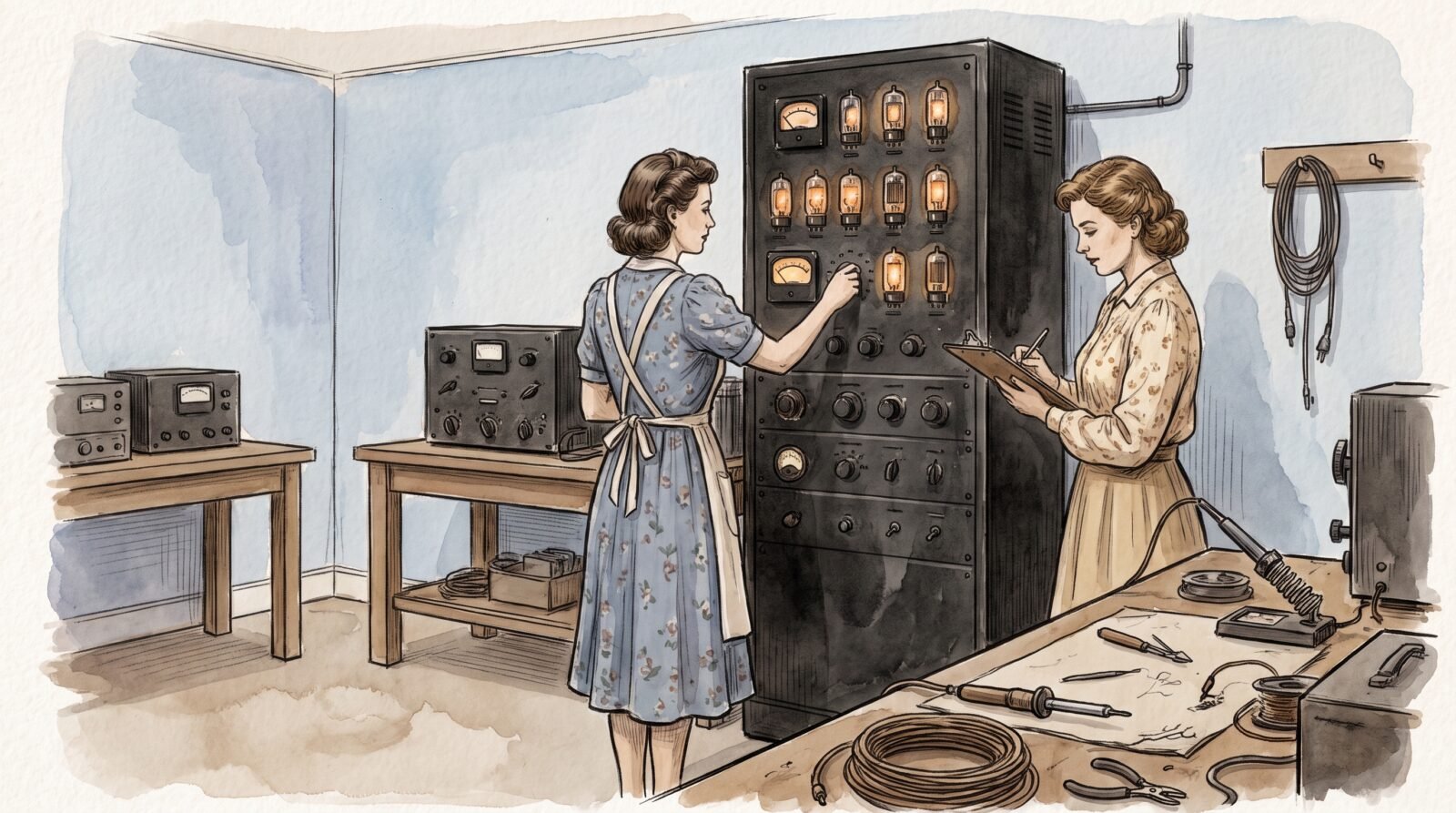
To overcome this crisis, the Army Ordnance Department signed Project PX in June 1943, authorizing the construction of the ENIAC. The physical scale of the completed machine was staggering. It incorporated 17,468 vacuum tubes, 7,200 crystal diodes, 1,500 electrical relays, 70,000 precision resistors, 10,000 capacitors, and approximately 5 million hand-soldered electrical joints. Arranged along forty U-shaped black steel panels measuring eight feet in height, three feet in width, and two feet in depth, the machine occupied a dedicated fifty-by-thirty-foot room, weighed over thirty tons, and consumed 150 kilowatts of electrical power—enough to illuminate a small neighborhood and generate sufficient heat to require a massive dedicated cooling system.
Mathematically, the ENIAC operated as a high-speed electronic decimal calculator. Its architecture was organized around twenty individual accumulators, each capable of holding a signed ten-digit decimal number. Instead of binary logic, the ENIAC utilized ten-position electronic ring counters, in which ten dual-triode flip-flops were wired in a circular cascade such that a single conducting tube represented the active decimal digit. Synchronized by a central cycling unit that generated clock pulses at 100 kilohertz, the ENIAC could execute an addition in a single 200-microsecond cycle and complete a complex ten-digit multiplication in approximately 2.8 milliseconds, calculating roughly one thousand times faster than any electromechanical machine in existence.
Yet, despite its unprecedented computational speed, the ENIAC suffered from a crippling structural limitation: it was not a stored-program machine. The instructions governing a calculation were not stored as internal numerical data; rather, the program was literally wired into the physical topography of the machine. The ENIAC possessed no unified memory in which instructions and variables could coexist. Instead, the sequence of operations was dictated by hundreds of external, heavy copper jumper cables plugged into trunk lines and portable program trays running along the panels, accompanied by the manual configuration of more than 6,000 rotary switches on portable function tables and master programmer units.
The ENIAC Programmers and the Invisible Labor of Computing
To reprogram the ENIAC for a new mathematical problem, the entire machine had to be powered down, and a team of programmers had to physically rewire the patchboards, trace pulse-routing cables across dozens of panels, reset function tables, and meticulously verify every physical connection against elaborate wiring diagrams. This physical setup process was extraordinarily grueling, typically requiring anywhere from several days to three full weeks of manual labor. During these prolonged setup weeks, the world’s fastest and most expensive computational device sat entirely dark, cold, and unproductive. When the configuration was finally completed, the electronic calculation itself might run to completion in thirty seconds. The grotesque disproportion between an electronic execution time measured in seconds and a manual setup time measured in weeks constituted the definitive operational bottleneck of the first electronic computing generation.
The intellectual burden of overcoming this physical architecture fell upon a team of six brilliant young women mathematicians selected in 1945 as the ENIAC’s primary programmers: Kathleen McNulty, Frances Bilas, Betty Jean Jennings (later Bartik), Ruth Lichterman, Frances Elizabeth Snyder (later Holberton), and Marlyn Wescoff. Previously employed as human computers calculating differential equations by hand on paper worksheets, they were tasked with translating complex mathematical ballistics models into the physical switching and cabling architecture of the ENIAC without instruction manuals, programming languages, or operating systems.
Working without precedent, these women invented the foundational practices of computer programming. They developed visual flowcharts to trace parallel computational pathways, devised techniques for nesting logical loops, implemented conditional program transfers using the master programmer unit, and designed diagnostic routines to isolate faulty vacuum tubes among the 18,000 glowing envelopes. Because ENIAC could execute multiple accumulators in parallel simultaneously, the programmers had to manage complex temporal synchronization, ensuring pulses arrived at the correct gate at the exact microsecond required to prevent race conditions. Despite their profound intellectual contribution, wartime and post-war culture largely classified their work as clerical setup work, analogous to operating a telephone switchboard, while the male engineers who built the hardware received public acclaim. Decades of scholarly recovery by historians of computing have since restored the ENIAC six to their rightful place as the founding pioneers of software engineering.
The Genesis of EDVAC: Acoustic Delay Line Memory and the Moore School Lectures
Even before the ENIAC was fully assembled, its principal creators, J. Presper Eckert Jr. and John Mauchly, recognized that the machine’s architecture represented an evolutionary dead end. The fundamental flaw was the reliance on individual vacuum-tube flip-flops for both computation and data storage. In the ENIAC, storing a single ten-digit decimal number required an accumulator containing hundreds of vacuum tubes. To expand the machine’s internal storage capacity from twenty numbers to several thousand numbers would have required tens of thousands of additional tubes, escalating power consumption, thermal dissipation, physical space, and component failure rates to catastrophic levels. If computing was to progress, memory had to be decoupled from arithmetic circuitry and constructed using a dense, dynamic, and economically feasible storage medium.
The technical breakthrough that solved this impasse was conceived by J. Presper Eckert Jr. in early 1944: the acoustic mercury delay line memory. Eckert was an electrical engineer of extraordinary physical intuition and experimental virtuosity. Before joining the ENIAC project, he had conducted pioneering research at the Moore School on ultrasonic delay lines designed for moving-target indicator (MTI) radar systems. In radar applications, a major challenge was eliminating stationary ground clutter—reflections from buildings, hills, and terrain—so that moving aircraft could be detected. Eckert had helped develop devices that converted an incoming radar pulse into an ultrasonic acoustic wave traveling through a liquid medium; by delaying the received signal by the exact interval between radar pulses and subtracting it from the subsequent pulse, stationary reflections cancelled out, leaving only moving targets visible on the display.
Eckert realized that this acoustic delay principle could be transformed into a dynamic, regenerative digital memory device. An acoustic delay line consisted of a long steel tube filled with purified liquid mercury, fitted with piezoelectric quartz crystals at either end. When a train of electrical pulses representing binary numbers was applied to the quartz crystal at the transmitting end, the crystal vibrated, launching high-frequency ultrasonic waves down the mercury column. Because sound travels through liquid mercury at roughly 1,450 meters per second—approximately 200,000 times slower than an electrical signal traversing a copper wire—the acoustic pulses traveled down the tube with a measurable physical latency.
Upon reaching the far end of the mercury tube, the acoustic vibrations struck the receiving quartz crystal, which converted them back into electrical signals. These attenuated pulses were passed through an electronic amplifier, reshaped and synchronized to the master clock by a gating circuit, and recirculated back into the transmitting crystal at the front of the tube. In this manner, a continuous circulating loop of acoustic pulses could be sustained indefinitely in the mercury. A single five-foot mercury delay line could maintain a recirculating stream of approximately 1,000 binary pulses (bits) in continuous dynamic flight. Instead of requiring hundreds of vacuum tubes to store a single number, an entire block of hundreds of words could be stored in a compact, passive tube of liquid mercury supported by only a dozen vacuum tubes for amplification and gating.
With this revolutionary storage technology in mind, the Moore School team formally proposed the construction of a new machine: the Electronic Discrete Variable Automatic Computer, or EDVAC. In October 1944, the Army Ordnance Department amended the Moore School contract, allocating an initial $105,600 under contract W-670-ORD-4926 to support research and development into the EDVAC design. The conceptual shift from ENIAC to EDVAC was profound: whereas ENIAC had been a massively parallel, decimal, hardwired calculating behemoth, EDVAC was conceived from the outset as a serial, binary machine organized around a centralized, high-density acoustic delay line memory store. Binary arithmetic eliminated the intricate decimal ring counters, reducing logic gates to simple two-state switching circuits that recognized only the presence or absence of a pulse.
The intellectual excitement generated by these revolutionary concepts culminated in the summer of 1946, when the Moore School hosted an eight-week symposium formally titled Theory and Techniques for Design of Electronic Digital Computers, known historically as the Moore School Lectures. Between July 8 and August 31, 1946, twenty-eight selected engineers, mathematicians, and scientists from military laboratories, industrial corporations, and academic institutions across the United States and Great Britain gathered in Philadelphia to attend forty-eight lectures delivered by Eckert, Mauchly, Goldstine, von Neumann, Arthur Burks, and other pioneers. Among the attendees were Maurice Wilkes from Cambridge University, Claude Shannon from Bell Telephone Laboratories, Douglas Hartree, and representatives from the British National Physical Laboratory. The Moore School Lectures served as the primary technological conduit through which the foundational principles of electronic digital computing were disseminated across the post-war world, igniting the stored-program computing boom on both sides of the Atlantic.
The First Draft of a Report on the EDVAC and the Solitary Authorship Controversy
When John von Neumann joined the Moore School computing group as an official consultant in late September 1944, he brought to the team an unprecedented level of mathematical sophistication, logical rigor, and intellectual prestige. Beginning in the autumn of 1944 and continuing through the spring of 1945, von Neumann traveled regularly to Philadelphia, attending intensive, free-wheeling technical conferences with Eckert, Mauchly, Goldstine, and Arthur Burks. In these weekly sessions, the small group exhaustively debated the theoretical foundations, word lengths, timing registers, instruction sets, and system architecture for the proposed EDVAC. Eckert provided the unyielding engineering realism, continually testing ideas against the physical limits of mercury delay lines, vacuum-tube rise times, and circuit noise; Mauchly contributed expansive philosophical visions of general-purpose computation; while von Neumann acted as an intellectual catalyst and supreme synthesizer, distilling complex electronic debates into pure, logical formulations.
In the spring of 1945, von Neumann was forced to return to Los Alamos to participate in the final preparations for the Trinity atomic bomb test. During his long cross-country train journeys between Philadelphia, Chicago, and the desert of New Mexico, and during quiet evenings in his Los Alamos study, von Neumann began writing down a comprehensive, systematic synthesis of the Moore School discussions. Using a pencil in a standard composition notebook, he composed a 101-page handwritten manuscript that outlined with pristine clarity the logical structure of a general-purpose electronic digital computer. In mid-May 1945, he mailed the completed manuscript from Los Alamos back to Herman Goldstine at the Moore School for review and transcription.
Goldstine was mesmerized by the manuscript’s intellectual clarity and philosophical depth. Recognizing that the document represented an epochal milestone in the history of science, Goldstine arranged for his secretarial staff at the Moore School to type the handwritten text into a formal mimeographed document. On June 30, 1945, Goldstine distributed twenty-four mimeographed copies of the 101-page report under the title: First Draft of a Report on the EDVAC, by John von Neumann. The cover page listed von Neumann as the sole author, contained no acknowledgment of J. Presper Eckert Jr., John Mauchly, Arthur Burks, or the broader Moore School engineering staff, and bore no restrictive military classification or patent confidentiality markings.
Goldstine immediately dispatched copies of the First Draft to key scientific and military leaders throughout the United States and the United Kingdom, sending copies to the Aberdeen Proving Ground, the National Defense Research Committee, the Bureau of Ships, the Massachusetts Institute of Technology, Bell Laboratories, and British scientists including Douglas Hartree. The response within the scientific community was immediate and profound: researchers devoured the document as a brilliant, foundational blueprint for building modern electronic computers. Almost overnight, the architectural concepts described in the report became inextricably linked with the name of John von Neumann alone.
When Eckert and Mauchly discovered that Goldstine had distributed the report with von Neumann credited as the solitary author, their reaction was one of fury, betrayal, and despair. Eckert and Mauchly contended, with considerable justification, that the core ideas contained in the document—including the acoustic delay line memory, the serial binary operation, the centralized control unit, and crucially, the concept of storing program instructions in the same physical memory as numerical data—had been conceived and debated by them long before von Neumann arrived in Philadelphia. Eckert had written a memorandum outlining an internal magnetic or delay-line program storage device as early as January 1944. Furthermore, by distributing the report without patent notices or confidentiality restrictions, Goldstine had legally placed the concepts into the public domain under United States and British patent law. When Eckert and Mauchly subsequently attempted to file broad commercial patent applications covering the stored-program computer, the United States Patent Office and federal courts cited the First Draft as prior art that invalidated their claims.
The bitter acrimony generated by the authorship of the First Draft tore the Moore School computer group apart. Irreconcilable tensions erupted between the inventors and the university administration over patent assignments. In March 1946, when the new Dean of the Moore School, Harold Pender, demanded that all researchers sign formal patent release agreements assigning all commercial rights in computer inventions to the university, Eckert and Mauchly refused and resigned in protest. They subsequently founded the Electronic Control Company (later the Eckert-Mauchly Computer Corporation), embarking on a precarious entrepreneurial struggle that would eventually produce the BINAC and the UNIVAC. Goldstine and Burks followed von Neumann to the Institute for Advanced Study in Princeton, leaving the Moore School shorn of its most brilliant talent.
In historical retrospect, modern scholars of computing have reached a nuanced and equitable consensus regarding the authorship controversy. As historians Nancy Stern, William Aspray, and Paul Ceruzzi have demonstrated, the creation of the stored-program computer was a collaborative intellectual synthesis. Eckert and Mauchly were the inventive engineering geniuses who originated the physical concepts, conceived the acoustic delay line memory, and recognized that instructions could be encoded as numbers and stored dynamically in recirculating loops. However, von Neumann’s contribution was equally indispensable. He performed an act of profound intellectual abstraction: stripping away the messy particulars of vacuum tubes, delay lines, and circuit voltages, he formalized the computer as an abstract, axiomatic mathematical system. He created the formal functional taxonomy, defined the machine’s arithmetic and control cycles, and articulated the philosophical paradigm of computation that would govern the subsequent century.
The Anatomy of the Von Neumann Architecture
The architectural schema articulated in the First Draft of a Report on the EDVAC established the definitive structural anatomy of the modern general-purpose electronic computer. Von Neumann abstracted the machine away from specific physical implementations, organizing its operations into five mutually cooperative functional organs: the central arithmetic organ, the central control organ, the internal memory store, and the input and output organs. This conceptual decomposition, which became universally known as the von Neumann architecture, provided an elegant and enduring framework that decoupled logical computation from the underlying electronic switching hardware.
The Central Arithmetic Logic Unit
The central arithmetic organ, which modern computer engineering designates as the Arithmetic Logic Unit (ALU), constitutes the primary computational engine of the architecture. Its functional role is the execution of elementary binary arithmetic operations—addition, subtraction, multiplication, and division—alongside fundamental Boolean logical operations including conjunction (AND), disjunction (OR), negation (NOT), and bitwise shifting operations. Von Neumann recognized that all complex mathematical transformations, from matrix inversions to the numerical integration of partial differential equations, could be systematically reduced to cascades of these elementary operations.
To execute arithmetic, the ALU relies upon high-speed internal temporary storage registers. Primary among these is the Accumulator (AC), a specialized register that holds the active operand during an operation and receives the resulting sum, difference, or product upon completion. In addition, von Neumann specified a secondary operational register, frequently designated as the Multiplier-Quotient (MQ) register, which works in close concert with the Accumulator during double-word operations. In binary multiplication, the Accumulator and MQ register shift and accumulate partial products; in division, they hold the evolving quotient and remainder. In EDVAC’s original formulation, arithmetic was performed serially, bit by bit, through a single adder circuit, minimizing the vacuum-tube count at the expense of clock cycles; in subsequent designs, such as the IAS computer, arithmetic was re-engineered as fully parallel word-wide logic, where all bits of an operand were added simultaneously across parallel logic gates.
The Central Control Unit, Program Counter, and Instruction Register
The central control organ, or Central Control Unit (CCU), functions as the grand conductor and timing orchestrator of the entire computational instrument. It does not perform mathematical transformations upon data; rather, it directs the flow of control, interpreting stored program instructions and generating the micro-electronic gating pulses required to route data between memory, registers, and the arithmetic unit. The CCU establishes the fundamental rhythmic cadence of modern digital computing, known as the Fetch-Decode-Execute cycle.
The primary state-holding register within the CCU is the Program Counter (PC), historically referred to as the instruction counter or control sequence register. The Program Counter maintains the linear memory address of the next instruction scheduled for execution. In normal sequential execution, the control unit automatically increments the Program Counter by one at the conclusion of each instruction cycle, steadily marching through memory. When an instruction is fetched from memory, it is loaded into the Instruction Register (IR), where it is temporarily latched while being interpreted by the instruction decoder. The decoder breaks the binary word into its functional components: an operation code (opcode) specifying the action to be performed (such as LOAD, STORE, ADD, or JUMP) and one or more operand addresses specifying the memory locations involved. The timing matrix then pulses the appropriate control lines, opening and closing electronic gates to carry out the instruction.
The Unified Memory Store: Instructions and Data in a Single Space
The most revolutionary and enduring component of the von Neumann architecture is the unified memory store. In stark contrast to earlier calculating systems, such as the Harvard Mark I or the ENIAC, which maintained completely separate physical mechanisms for holding numbers and controlling program sequences, the von Neumann architecture employs a single, homogeneous, linearly addressable memory space that houses both program instructions and numerical data interchangeably.
In this unified store, memory consists of an ordered sequence of storage locations, each identified by a unique numerical index or address. Each location contains a binary word of fixed length. Crucially, there is no intrinsic physical difference between a word that represents an instruction and a word that represents a number. A sequence of forty binary digits in memory possesses no physical tag, color, or structural property indicating its semantic nature. A binary pattern such as 0010101100010000 is physically identical whether it represents a signed integer, an IEEE floating-point mantissa, an alphanumeric character, or a machine-code instruction ordering the ALU to add the contents of memory address sixteen into the accumulator. The semantic interpretation of a memory word is established solely by its destination: if the control unit fetches the word into the Instruction Register during the fetch phase, it is decoded and executed as an instruction; if the arithmetic unit fetches the word during the execute phase, it is treated as passive numerical data.
Input, Output, and Interface Mechanisms
The fourth and fifth functional organs in von Neumann’s taxonomy are the input and output mechanisms, which mediate between the microsecond operational domain of the internal electronic circuitry and the physical macrocosm of human researchers and external storage media. Von Neumann recognized that the immense speed differential between electronic vacuum-tube switching (measured in microseconds) and electromechanical peripheral devices (measured in tenths of a second) required sophisticated buffer registers and synchronization logic.
The input organ accepts information from external physical media—originally punched paper tape, Hollerith punched cards, or magnetic recording wire—and translates these mechanical or magnetic impressions into internal binary pulse trains, depositing them directly into designated memory locations. Conversely, the output organ extracts binary words from the internal memory store, translates them into human-readable characters or external recording pulses, and directs them to teletypewriters, paper punches, magnetic tape drives, or cathode-ray tube displays. These input and output channels provide the vital link that allows the stored-program computer to ingest mathematical parameters, execute autonomous algorithmic workflows, and return completed numerical solutions to human scientists.
The Logical Brain Analogy: McCulloch-Pitts Neurons and Cybernetic Modeling
One of the most remarkable and conceptually illuminating aspects of the First Draft of a Report on the EDVAC is its explicit, pervasive use of neurophysiological terminology. Rather than describing the machine in the conventional vocabulary of electrical engineering—speaking of vacuum tubes, multivibrators, pentodes, and resistor-capacitor networks—von Neumann deliberately formulated his entire architectural exposition in terms of biological neurons, synapses, receptors, and effectors. Vacuum-tube flip-flops and gate circuits were designated as “neurons” or “synaptic organs”; internal memory devices were described as “receptors” and associative organs; and external input and output peripherals were characterized as sensory organs and motor “effectors.”
This biological metaphor was not a mere rhetorical flourish; it was directly derived from a seminal 1943 scientific paper that had exerted a profound intellectual influence on von Neumann: “A Logical Calculus of the Ideas Immanent in Nervous Activity,” published in the Bulletin of Mathematical Biophysics by neurophysiologist Warren S. McCulloch and mathematical prodigy Walter Pitts. McCulloch and Pitts had developed an idealized mathematical model of biological neurons as binary threshold units. In their formulation, a neuron was an all-or-none switching element that received multiple excitatory and inhibitory inputs through synapses; if the sum of excitatory inputs exceeded a threshold within a given temporal summation window, and no inhibitory input was active, the neuron fired an impulse down its axon.
McCulloch and Pitts proved a startling mathematical theorem: networks of such idealized binary neurons were capable of computing any finite Boolean logical proposition, and with the addition of delay feedback loops, could simulate the behavior of a Turing machine. For von Neumann, this paper was a revelation. It established an exact, formal isomorphism between neurophysiology, Boolean propositional logic, and digital electronic circuits. A vacuum-tube flip-flop was functionally indistinguishable from an idealized McCulloch-Pitts neuron: both were bistable switching devices that changed states based on threshold gating pulses. By adopting the McCulloch-Pitts formalism, von Neumann was able to design the logical architecture of the EDVAC completely free from the messy, transient engineering constraints of specific vacuum-tube models, filament voltages, or circuit topologies.
Furthermore, von Neumann’s use of neurological concepts placed his work squarely within the burgeoning cybernetic movement of the mid-1940s. Von Neumann was an active participant in the famous Macy Conferences on Circular Causal and Feedback Mechanisms in Biological and Social Systems, organized between 1946 and 1953 alongside mathematician Norbert Wiener, neurophysiologist Arturo Rosenblueth, Warren McCulloch, and Walter Pitts. The cyberneticists sought to construct a unified mathematical and philosophical theory of communication, control, and teleological behavior across both living organisms and engineered machines. In this intellectual milieu, von Neumann viewed the digital computer not simply as an industrial calculating machine, but as an artificial cognitive automaton—a physical embodiment of formal logic capable of memory, dynamic internal state transitions, and purposive, goal-directed behavior.
The Stored-Program Revolution: Code as Data, Self-Modifying Code, and Dynamic Execution
The core conceptual breakthrough that elevated the von Neumann architecture above all previous computing machinery was the profound philosophical principle of Code as Data. This principle traces its theoretical genealogy directly back to Alan Mathison Turing’s foundational 1936 paper, “On Computable Numbers, with an Application to the Entscheidungsproblem.” In that paper, Turing established the theoretical concept of the Universal Turing Machine (UTM)—an abstract mathematical automaton capable of simulating any other specialized Turing machine if provided with a coded numerical description of that machine’s state-transition table on its linear tape. In Turing’s formulation, the description number of an algorithm was written on the exact same physical medium as the data upon which it operated.
What Turing had demonstrated as an abstract mathematical proof regarding the limits of formal decidability, von Neumann, Eckert, and Mauchly translated into a practical electronic engineering reality. By placing instructions into the exact same high-speed, rewritable memory store as numerical variables, the computer acquired the unprecedented capacity to treat its own program as data. An executing program could inspect its own instructions, perform mathematical arithmetic upon them, modify their operand addresses, or overwrite them entirely during the course of execution.
In the pioneering era of computing, before the invention of hardware index registers, base registers, or modern memory management units, this capability of dynamic self-modifying code was not merely an interesting programming curiosity; it was an absolute operational necessity. Consider the elementary mathematical problem of calculating the inner product of two vectors, or stepping sequentially through a one-hundred-element array stored in memory. In an architecture lacking hardware index registers, a static instruction such as ADD M(100) could only access the single, fixed memory address 100. To iterate through the array, the program was forced to modify itself: it would load the binary instruction ADD M(100) into the accumulator, add an integer offset of one to the address field to transform the instruction into ADD M(101), and store the newly minted instruction back into its original program memory location before executing it in the next loop cycle. In this manner, programs operated as dynamic, living software structures that continually re-engineered their own instructions in memory as they executed.
Coupled with self-modifying code was the revolutionary mechanism of conditional branching. Prior calculating systems, such as Charles Babbage’s mechanical Analytical Engine design or Howard Aiken’s electromechanical Harvard Mark I, were essentially linear sequence controllers. They read instructions sequentially from perforated paper tape or punch cards, executing them in rigid, predetermined chronological order. If a loop was required, the paper tape had to be glued into a physical closed ring; if different mathematical branches were needed, human intervention was frequently required to stop the machine and swap paper tapes.
The von Neumann architecture shattered this linear straitjacket by introducing conditional transfer instructions. The control unit was endowed with the ability to inspect the internal state of the arithmetic unit—specifically, testing whether the value in the Accumulator was negative, zero, or positive—and dynamically alter the Program Counter based on that evaluation. If the condition was met, the control unit did not advance to the next sequential instruction; instead, it overwrote the Program Counter with a new target address specified in the instruction’s operand field, diverting the flow of execution to a completely different region of memory. Conditional branching transformed the computer from a fast but mindless arithmetic tabulator into an autonomous decision-making engine, capable of evaluating intermediate numerical results, executing recursive subroutines, and terminating iterative mathematical algorithms only when precise convergence tolerances had been achieved.
Building the IAS Machine at Princeton: Julian Bigelow and Electrostatic Storage
In early 1946, following his departure from the Moore School, John von Neumann established the Electronic Computer Project at the Institute for Advanced Study in Princeton, New Jersey. The establishment of an engineering development laboratory within the pristine, rarefied confines of the IAS provoked intense skepticism and active hostility from traditional faculty members, who viewed dirty vacuum-tube soldering irons, machine tools, and military defense contracts as a vulgar desecration of an institution founded purely for contemplative theoretical mathematics and humanistic research. However, backed by the institute’s director, Frank Aydelotte, and supported by substantial funding from the Army Ordnance Department, the Navy Office of Naval Research, and the Atomic Energy Commission, von Neumann forged ahead, determined to build the ultimate scientific computer.
To lead the engineering construction, von Neumann hired Julian Bigelow as chief engineer. Bigelow was a mechanical and electrical engineering virtuoso who had collaborated closely with Norbert Wiener during the war on statistical fire-control systems for antiaircraft guns, co-authoring the famous 1943 paper “Behavior, Purpose and Teleology” that helped launch cybernetics. Bigelow assembled a small, exceptionally gifted engineering cohort that included Willis Ware, Herman Goldstine, and Arthur Burks. Working in the basement of the institute’s Fuld Hall and subsequently in a specially constructed brick building on the Princeton campus, the team set out to construct the IAS machine.
Architecturally, the IAS machine represented a radical conceptual departure from the serial delay-line design of EDVAC. Von Neumann and Bigelow recognized that serial acoustic delay lines, while elegant, were inherently sluggish because the arithmetic unit had to wait hundreds of microseconds for a circulating acoustic pulse to reach the end of the mercury tube. Instead, the IAS machine was designed as a fully parallel, asynchronous, 40-bit word instrument. In parallel arithmetic, all forty bits of an operand were transferred and added across forty parallel flip-flops simultaneously in a single clock cycle, achieving computational speeds twenty to forty times faster than serial delay lines. However, parallel arithmetic imposed an unforgiving technological requirement: it demanded a high-speed, random-access memory (RAM) capable of reading and writing all forty bits of a word instantaneously and non-sequentially.
The quest for a workable random-access memory became the central technical challenge of the IAS project. Von Neumann had originally contracted with Jan Rajchman at the RCA Laboratories in Princeton to develop the Selectron tube, an extraordinarily sophisticated electrostatic storage tube designed to store 4,096 bits within a complex cylindrical vacuum envelope using perforated metal aperture grids. However, the Selectron proved to be an engineering nightmare, plagued by manufacturing defects, ceramic seal leaks, and severe production delays. Desperate for a functional alternative, the IAS team turned to the electrostatic storage system developed in 1948 by Frederic Calland Williams and Tom Kilburn at the University of Manchester: the Williams-Kilburn tube.
The Williams-Kilburn tube utilized standard, commercially available cathode-ray tubes (CRTs), similar to those used in television receivers and radar displays. By focusing an electron beam onto the phosphor coating inside the CRT face, secondary electron emission left localized pockets of positive electrical charge on the dielectric surface. These charge spots could be detected and read by an external capacitive metal pickup plate taped to the front of the CRT glass envelope. Because the charges on the phosphor leaked away within a fraction of a second, the electron beam had to continuously sweep across the screen, reading and regenerating every charge spot in rapid succession. The IAS team successfully constructed a parallel memory bank utilizing forty Williams-Kilburn tubes operating in synchrony, providing 1,024 words of 40-bit memory with an access time of approximately 25 microseconds.
Crucially, von Neumann established an unyielding policy of radical open science for the IAS project. He insisted that all architectural blueprints, logical schematics, and engineering progress reports be placed immediately into the public domain and mailed without copyright or patent restrictions to research institutions around the globe. This open-architecture policy sparked a worldwide technological explosion, spawning a celebrated family of “IAS clones” built directly from the Princeton schematics. These included the MANIAC at Los Alamos (built for thermonuclear bomb calculations), the ILLIAC at the University of Illinois, the ORDVAC at Aberdeen Proving Ground, the JOHNNIAC at the RAND Corporation, the WEIZAC at the Weizmann Institute of Science in Israel (the first computer in the Middle East), the BESK in Stockholm, Sweden, the SILLIAC in Sydney, Australia, and the commercial IBM 701 (the “Defense Calculator”), which launched IBM’s dominance of the corporate mainframe computing industry.
The Race to Operational Reality: The Manchester Baby and Cambridge EDSAC
While the American computing projects at the Moore School and Princeton were slowed by bureaucratic friction, patent disputes, and difficult memory tube fabrication, a parallel computing revolution was unfolding in Great Britain with astonishing agility and speed. British researchers, seasoned by wartime triumphs at Bletchley Park and the Telecommunications Research Establishment (TRE), moved decisively to translate von Neumann’s theoretical concepts into operational electronic realities.
The historic prize for building the world’s first functioning stored-program computer was claimed by the University of Manchester. In late 1946, electrical engineer Frederic Calland Williams, accompanied by his brilliant young protégé Tom Kilburn, moved from TRE to the University of Manchester to tackle the digital memory problem. By late 1947, they had successfully perfected the Williams-Kilburn electrostatic CRT storage tube. To prove definitively that the Williams tube could hold dynamic data and execute computer instructions reliably under real operational conditions, Williams, Kilburn, and Geoff Tootill constructed a minimalist testbed computer: the Small-Scale Experimental Machine (SSEM), affectionately christened “The Baby.”
The Manchester Baby was a 32-bit serial machine with an instruction set of just seven basic operations, utilizing a single Williams-Kilburn tube to store thirty-two words of memory. On the morning of June 21, 1948, the team loaded a seventeen-instruction test program written by Tom Kilburn. The program was designed to find the highest proper factor of $2^{18}$ (262,144) by testing every integer descending from $2^{18}-1$ using repeated trial division via subtraction. Because the Baby had no hardware division or multiplication circuits, the program executed thousands of repeated subtraction loops. After running continuously for fifty-two minutes and performing approximately 3.5 million operations, the machine halted, and the correct factor (131,072) was displayed on the Williams tube phosphor screen. It was the first time in human history that a computer program had been loaded into electronic random-access memory and executed autonomously to completion.
Eleven months later, at the Mathematical Laboratory of the University of Cambridge, Maurice Wilkes achieved the next decisive milestone: the construction of the world’s first practical, fully operational stored-program computer service for general scientific research. Wilkes had attended the 1946 Moore School Lectures in Philadelphia, where he had absorbed the EDVAC design principles and studied Eckert’s acoustic delay line experiments. Upon returning to Cambridge, Wilkes resolved to construct a reliable working machine without waiting for exotic memory tubes. Using acoustic mercury delay lines and off-the-shelf electronic components, Wilkes, William Renwick, and their team constructed the Electronic Delay Storage Automatic Calculator, or EDSAC.
On May 6, 1949, EDSAC executed its first successful stored program, printing a table of squares and a list of prime numbers. Unlike the Manchester Baby, which was a bare-bones engineering test apparatus, EDSAC was built from the outset as a robust, production-grade computational instrument for university researchers. Within weeks, Cambridge astronomers, crystallographers, and physicists were submitting computational problems to the EDSAC operating staff.
In the process of making EDSAC a practical scientific tool, Wilkes and his colleagues David Wheeler and Stanley Gill invented the foundational architecture of software engineering. They designed the “initial orders”—a set of thirty-one instructions hardwired into uniselector stepping switches that served as the world’s first bootstrap loader and symbolic assembler, automatically reading punched paper tape and translating symbolic mnemonic characters into binary machine code. Furthermore, David Wheeler devised the “Wheeler Jump,” a programming technique utilizing self-modifying code that allowed a program to jump to a closed subroutine and automatically store its return address, returning seamlessly to the main program when finished. Published in their seminal 1951 textbook, The Preparation of Programs for an Electronic Digital Computer, the Cambridge group’s work established the universal paradigm of subroutines, parameter passing, and program libraries that underpinned modern computer programming.
The Von Neumann Bottleneck: Bus Saturation, Caches, and Architectural Evolution
For more than three decades following the publication of the First Draft, the von Neumann architecture served as the undisputed, universal blueprint for computer hardware design. However, as semiconductor technology advanced through the 1960s and 1970s, the physical reality of the unified memory model began to expose severe structural limitations. The definitive critique of this architecture was delivered in 1977 by John Backus, the pioneering designer of FORTRAN and the Backus-Naur Form (BNF), in his ACM Turing Award lecture, titled “Can Programming Be Liberated from the von Neumann Style? A Functional Style and Its Algebra of Programs.”
In his landmark address, Backus coined the famous term the von Neumann bottleneck. Backus identified an inherent, systemic throughput constraint at the heart of the architecture: because instructions and data must be fetched from the same memory store across a shared physical communication channel (the system bus), the maximum throughput of the entire computing engine is strictly bounded by the transmission speed of that single bus. As Backus vividly described it:
“In its simplest form a von Neumann computer has three parts: a central processing unit (or CPU), a store, and a connecting tube that can transmit a single word between the CPU and the store (and send an address to the store). I propose to call this connecting tube the von Neumann bottleneck. The task of a program is to change the contents of the store in some major way; when one considers that this task must be accomplished by pushing vast numbers of words, one at a time, through the von Neumann bottleneck, one realizes that the tube is indeed a bottleneck, and that it has had a profound influence on our thinking about program execution.”
In subsequent decades, the von Neumann bottleneck worsened dramatically due to a divergent physical trend known as the Memory Wall. Driven by the aggressive scaling of silicon photolithography under Moore’s Law, CPU clock speeds and arithmetic execution bandwidth accelerated exponentially, surging from kilohertz in the 1950s to megahertz in the 1980s and gigahertz in the 2000s. In stark contrast, the random-access latency of dynamic random-access memory (DRAM) improved at a drastically slower pace. While CPU execution capability improved by several orders of magnitude, DRAM access times decreased by only a modest fraction, leaving high-speed processors idling for hundreds of clock cycles during memory stall cycles, waiting for operands to arrive across the bus.
To overcome this latency barrier without abandoning the universal von Neumann programming model, computer architects developed sophisticated micro-architectural countermeasures. Foremost among these was the development of hierarchical memory systems. Modern microprocessors incorporate multi-level on-chip static RAM (SRAM) cache hierarchies (L1, L2, and L3 caches) that exploit the twin principles of locality of reference: temporal locality (data accessed recently is likely to be accessed again soon) and spatial locality (data residing near recently accessed addresses is likely to be accessed soon). High-speed caches, combined with aggressive hardware prefetchers, branch prediction units, and out-of-order superscalar execution engines based on the Tomasulo algorithm, keep high-speed arithmetic pipelines continuously saturated with instructions and data.
Furthermore, modern processor design has embraced the Modified Harvard Architecture. In a strict Harvard architecture—named after Howard Aiken’s electromechanical Harvard Mark I—program instructions and numerical data are stored in completely separate physical memory systems, accessed by separate address and data buses. Modern microprocessors synthesize both approaches: at the innermost execution level, modern CPU cores are physically divided into separate L1 Instruction Caches (L1I) and L1 Data Caches (L1D) with dedicated, independent internal buses, allowing simultaneous instruction fetching and data manipulation without bus collisions. However, at the system level and main memory interface, the architecture remains purely von Neumann, preserving a single, unified flat address space where operating systems can dynamically load code, execute just-in-time (JIT) compilation, and treat memory polymorphically.
In contemporary computing, the quest to surpass the von Neumann bottleneck has spawned radically non-traditional architectures. Massively parallel Graphics Processing Units (GPUs) deploy thousands of parallel arithmetic cores to execute single-instruction multiple-data (SIMD) matrix tensor operations for artificial intelligence and machine learning. Beyond silicon microprocessors, neuromorphic computing architectures (such as IBM’s TrueNorth and Intel’s Loihi) abandon the separation between processor and memory entirely, co-locating distributed memory synapses and spiking neurons on silicon dies. Similarly, processing-in-memory (PIM) technologies embed computational logic directly within DRAM dies, eliminating bus data movement entirely and realizing a post-von Neumann paradigm of distributed, localized computation.
Von Neumann’s Broader Vision: Automata, Monte Carlo, and Planetary Simulation
For John von Neumann, the electronic digital computer was never merely a powerful device for calculating artillery tables or accounting ledgers; it was an epistemic gateway toward a universal science of information, natural complexity, and biological life. Throughout the final decade of his life, until his untimely death from cancer in February 1957 at the age of fifty-three, von Neumann deployed the computer as an experimental instrument to revolutionize mathematical physics, meteorology, and theoretical biology.
At Los Alamos in 1946, alongside Polish mathematician Stanislaw Ulam and physicist Nicholas Metropolis, von Neumann co-invented the Monte Carlo method. Faced with intractable integro-differential transport equations governing neutron diffusion and chain reactions in fission and thermonuclear weapons, Ulam realized that deterministic analytical solutions were impossible, but the statistical behavior of neutrons could be modeled by simulating thousands of individual stochastic particle histories using random numbers. Von Neumann embraced the concept immediately, formulating the mathematical theory of pseudo-random number generation (including the middle-square method) and programming the earliest Monte Carlo simulations on the ENIAC and MANIAC. The Monte Carlo method transformed computational physics, becoming an indispensable tool across statistical mechanics, quantum chemistry, astrophysics, quantitative finance, and computational genomics.
Simultaneously, von Neumann pioneered the field of Numerical Weather Prediction. Recognizing that the Earth’s atmosphere was an enormous thermodynamic fluid engine governed by the nonlinear hydrodynamic Navier-Stokes equations, von Neumann established the Meteorology Project at the Institute for Advanced Study in 1946. He recruited meteorologist Jule Charney and Norwegian dynamicist Ragnar Fjørtoft to formulate a computationally tractable two-dimensional barotropic vorticity model. In March 1950, von Neumann’s team utilized the ENIAC at Aberdeen to execute the world’s first computerized twenty-four-hour weather forecast. The successful simulation proved that atmospheric fluid dynamics could be integrated numerically, laying the foundational science for all modern global climate modeling and operational meteorological forecasting.
Yet von Neumann’s most profound philosophical contribution to theoretical computer science was his pioneering work on the Theory of Self-Reproducing Automata. In a series of lectures delivered at the Hixon Symposium at Caltech in September 1948, and in an unfinished manuscript later edited and published posthumously by Arthur Burks, von Neumann addressed a fundamental mystery of nature: how can a physical or logical automaton construct another automaton of equal or greater complexity without degenerating into triviality?
After initially formulating a physical “kinematic model” involving floating mechanical parts in a chemical reservoir, von Neumann adopted a suggestion by Stanislaw Ulam to transpose the problem into a pure mathematical space: the Cellular Automaton. Von Neumann designed an infinite two-dimensional grid of identical, square cells, where each cell could occupy one of twenty-nine distinct logical states. Operating under a uniform, synchronous local transition rule that updated each cell’s state based on the states of its four orthogonal neighbors (the von Neumann neighborhood), von Neumann designed a universal constructor consisting of approximately 200,000 cells. This automaton contained a universal Turing machine control unit and an extended linear tape of cells encoding instructions.
In analyzing the logical requirements for self-reproduction, von Neumann arrived at a breathtaking theoretical deduction. He proved that for an automaton to replicate itself autonomously without error, its instruction tape must perform a dual, bifurcated role:
- Active Executable Program: The instructions on the tape must be read, decoded, and actively executed by the universal constructor mechanism as programmatic commands that guide the physical assembly of the offspring automaton.
- Passive Copyable Data: Once construction is complete, the exact same tape must be read by a copying mechanism as passive, uninterpreted data, creating an exact duplicate tape that is inserted into the new offspring automaton.
The historical significance of this theoretical deduction cannot be overstated. Von Neumann formulated this dual-mode requirement in 1948—several years before James Watson and Francis Crick discovered the double-helix molecular structure of DNA in 1953, and more than a decade before molecular biologists unraveled the mechanisms of messenger RNA transcription and ribosomal protein translation. Von Neumann had deduced purely from first mathematical principles the exact logic of biological heredity: DNA functions simultaneously as passive data (copied during DNA replication) and as active program (transcribed into RNA and translated into structural proteins). Through the prism of automata theory, von Neumann had unlocked the universal computational architecture of life itself.
References
- First Draft of a Report on the EDVAC — John von Neumann, Contract No. W-670-ORD-4926, Moore School of Electrical Engineering, University of Pennsylvania, June 30, 1945; reprinted in IEEE Annals of the History of Computing, Vol. 15, No. 4, 1993.
- Preliminary Discussion of the Logical Design of an Electronic Computing Instrument — Arthur W. Burks, Herman H. Goldstine, and John von Neumann, Institute for Advanced Study, Princeton, New Jersey, June 28, 1946.
- On Computable Numbers, with an Application to the Entscheidungsproblem — Alan M. Turing, Proceedings of the London Mathematical Society, Series 2, Vol. 42, 1936, pp. 230–265.
- A Logical Calculus of the Ideas Immanent in Nervous Activity — Warren S. McCulloch and Walter Pitts, Bulletin of Mathematical Biophysics, Vol. 5, No. 4, 1943, pp. 115–133.
- The Computer from Pascal to von Neumann — Herman H. Goldstine, Princeton University Press, Princeton, New Jersey, 1972.
- From ENIAC to UNIVAC: An Appraisal of the Eckert-Mauchly Computers — Nancy Stern, Digital Press, Bedford, Massachusetts, 1981.
- John von Neumann and the Origins of Modern Computing — William Aspray, MIT Press, Cambridge, Massachusetts, 1990.
- Can Programming Be Liberated from the von Neumann Style? A Functional Style and Its Algebra of Programs — John Backus, Communications of the ACM, Vol. 21, No. 8, 1978, pp. 613–641.
- Turing’s Cathedral: The Origins of the Digital Universe — George Dyson, Pantheon Books, New York, 2012.
- A History of Modern Computing — Paul E. Ceruzzi, Second Edition, MIT Press, Cambridge, Massachusetts, 2003.
- ENIAC in Action: Making the First Computer Work — Thomas Haigh, Mark Priestley, and Crispin Rope, MIT Press, Cambridge, Massachusetts, 2016.
- When Computers Were Women — Jennifer S. Light, Technology and Culture, Vol. 40, No. 3, 1999, pp. 455–483.
- Theory of Self-Reproducing Automata — John von Neumann, edited and completed by Arthur W. Burks, University of Illinois Press, Urbana, Illinois, 1966.
- Numerical Integration of the Barotropic Vorticity Equation — Jule G. Charney, Ragnar Fjørtoft, and John von Neumann, Tellus, Vol. 2, No. 4, 1950, pp. 237–254.
- A Storage System for Use with Binary-Digital Computing Machines — Frederic C. Williams and Tom Kilburn, Journal of the Institution of Electrical Engineers, Part II: Power Engineering, Vol. 96, No. 50, 1949, pp. 183–200.
- Memoirs of a Computer Pioneer — Maurice V. Wilkes, MIT Press, Cambridge, Massachusetts, 1985.