Edward Jenner and the Smallpox Vaccine
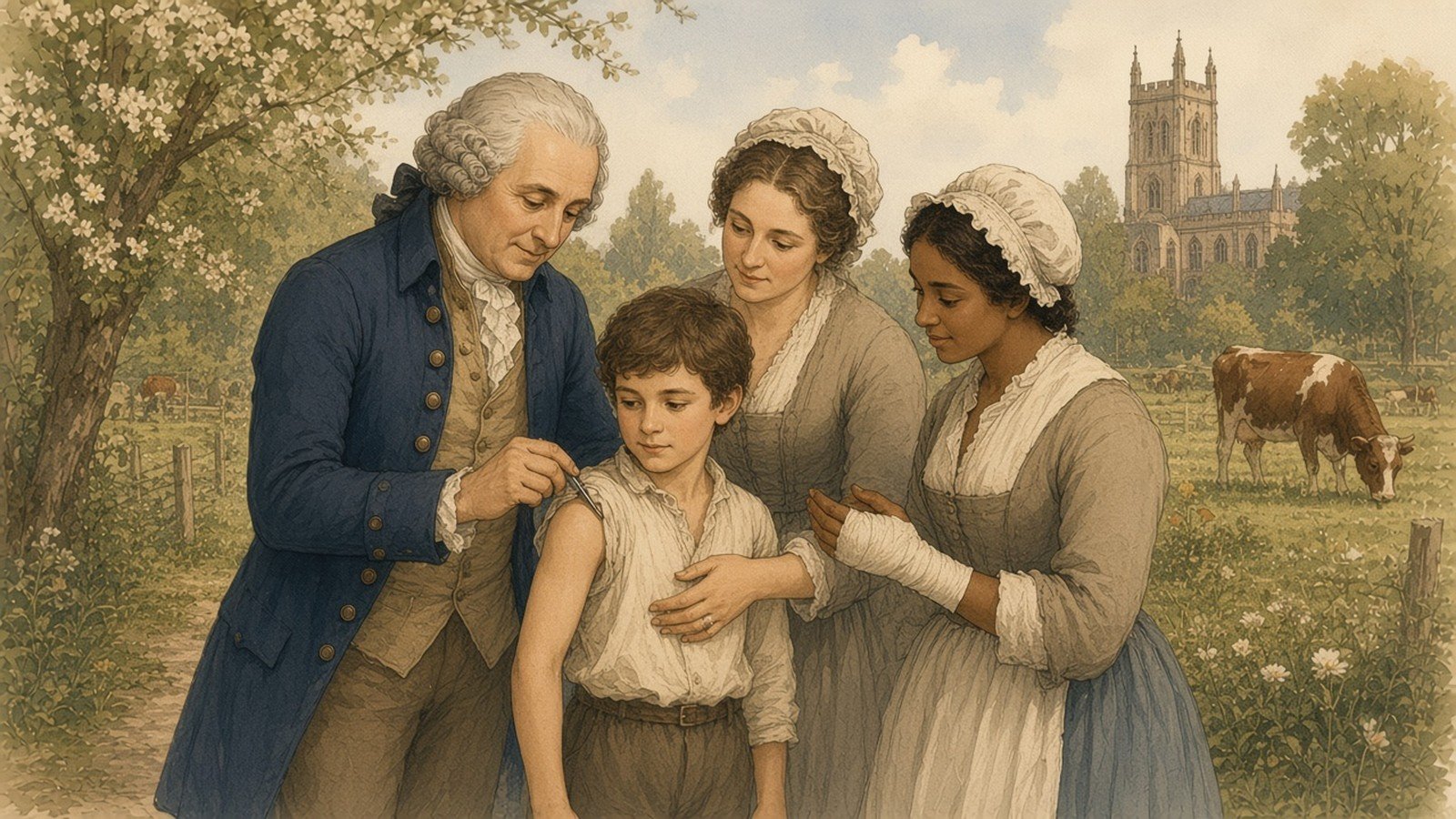
On 14 May 1796, in the Gloucestershire market town of Berkeley, the country doctor Edward Jenner took matter from a fresh sore on the hand of a young dairymaid, Sarah Nelmes, who had caught cowpox from a cow named Blossom, and inserted it into two shallow cuts on the arm of an eight-year-old boy, James Phipps, the son of his gardener. The boy developed a slight fever and a small sore at the site, and recovered within a few days. Six weeks later, on 1 July, Jenner inoculated him with matter taken from a smallpox pustule, as was then the practice for protecting people against the disease. Phipps showed no sign of smallpox. Jenner repeated the test some months later with the same result. Two years afterwards he published a short book describing this and other cases, and introduced a procedure that came to be called vaccination, from the Latin vacca, a cow. Within a few years vaccination had spread across Europe, the Americas and Asia, and it became the first means by which a human disease was deliberately and systematically prevented. In 1980, after a global campaign, smallpox was declared eradicated, the only human disease ever to have been destroyed. This article describes the disease and the practice of inoculation that preceded vaccination, Jenner’s life and work, the reception and spread of his discovery, and the long road from Berkeley to eradication.
Smallpox
Smallpox was one of the most feared diseases in human history. It was caused by the variola virus, spread from person to person by droplets and contact, and began, after an incubation period of about twelve days, with high fever, headache and back pain, followed by a rash that developed into deep, fluid-filled pustules spreading over the face and body. In its common form it killed about a third of those infected, and more among infants; the survivors were often left with deep scars, especially on the face, and many were blinded. Those who recovered were immune for life. The disease had probably afflicted human populations for thousands of years, and lesions resembling smallpox have been identified on the mummy of the Egyptian pharaoh Ramesses V, who died in 1145 BC.
In eighteenth-century Europe smallpox was endemic in the cities and broke out in epidemics elsewhere, killing an estimated four hundred thousand people a year. It struck rich and poor alike. Queen Mary II of England died of it in 1694, the Emperor Joseph I in 1711, Louis XV of France in 1774, and it ended the direct line of several royal houses. In London it was responsible for perhaps one death in ten. It was so common that most people caught it in childhood, and a face unmarked by smallpox was a sign of beauty. When Europeans carried the disease to the Americas in the sixteenth century, it devastated populations that had never been exposed to it, and it contributed powerfully to the collapse of the Aztec and Inca empires.
Inoculation
Long before Jenner, people in many parts of the world had observed that those who survived smallpox did not catch it again, and some had found ways of inducing a mild form of the disease deliberately in order to confer this protection. The practice, called inoculation or variolation, involved introducing material from the pustules or scabs of a smallpox patient into a healthy person, usually through a small cut in the skin or, in China, by blowing powdered scabs into the nose. The resulting infection was usually much milder than smallpox caught naturally, with fewer pustules and a much lower death rate, perhaps one or two in a hundred compared with twenty or thirty. Inoculation was practised in China from at least the sixteenth century, in India, in parts of Africa, and in the Ottoman Empire.
Inoculation was introduced to Britain largely through the efforts of Lady Mary Wortley Montagu, the wife of the British ambassador at Constantinople, who had herself survived smallpox in 1715, losing her eyelashes and acquiring deep scars, and whose brother had died of it. In a letter of 1717 she described how old women in Constantinople performed inoculation at gatherings in the autumn, and in March 1718 she had her five-year-old son inoculated by the embassy surgeon, Charles Maitland. On her return to London she had her daughter inoculated, in the presence of physicians of the court, during an epidemic in 1721. In the same year, with the support of Caroline, Princess of Wales, the “Royal Experiment” was conducted at Newgate Prison: six condemned prisoners were offered their freedom in exchange for undergoing inoculation, and all survived; one of them was later exposed deliberately to smallpox and did not catch it. In 1722 two of the royal princesses were inoculated. At the same time in Boston, during an epidemic in 1721, the minister Cotton Mather, who had learned of the practice from an enslaved African man named Onesimus, persuaded the physician Zabdiel Boylston to inoculate his own son and more than two hundred others, of whom only six died, against a death rate of about one in seven among those who caught the disease naturally.
Inoculation was controversial. It carried a real risk of death, and those inoculated could spread smallpox to others during their illness, so that it could start new outbreaks. Nevertheless it gained ground in Britain during the eighteenth century, aided by improvements in technique. In the 1760s Robert Sutton and his sons developed a method using only a tiny scratch and a small amount of matter from an early pustule, combined with a regimen of diet and rest, which reduced the severity of the disease, and they and their associates inoculated hundreds of thousands of people. Inoculation was adopted by the royal families of Russia, Austria and France. Catherine the Great of Russia was inoculated in 1768 by the English physician Thomas Dimsdale. In the American War of Independence George Washington ordered the inoculation of the Continental Army in 1777. Inoculation was the context in which Jenner grew up and in which his discovery was made.
A Country Doctor
Edward Jenner was born on 17 May 1749 in Berkeley, a small town in the Vale of Gloucester, the eighth of nine children of the Reverend Stephen Jenner, vicar of Berkeley, and his wife Sarah. His parents died when he was five, and he was brought up by his elder brother, also a clergyman. At the age of eight, during an epidemic, he was inoculated against smallpox, an ordeal he remembered all his life: he was prepared for the operation by weeks of bleeding, purging and a meagre diet, and then kept in an inoculation stable with other boys until the illness had passed. At about thirteen he was apprenticed to a surgeon-apothecary, Daniel Ludlow, in Chipping Sodbury near Bristol, where he remained for some years. It was there, according to a story told by his first biographer, John Baron, that he heard a dairymaid say that she could not take smallpox because she had had cowpox, a belief widespread among the farmers and dairy workers of the region.
In 1770 Jenner went to London to study surgery and anatomy under John Hunter at St George’s Hospital. Hunter, a Scotsman of tremendous energy and curiosity, was one of the founders of scientific surgery and a passionate collector of anatomical and natural history specimens, and he believed in the importance of experiment. When Jenner later wrote to him about a problem, Hunter replied with the famous advice, “I think your solution is just, but why think? Why not try the experiment?” The two men remained friends and correspondents until Hunter’s death in 1793. Jenner was offered a post as naturalist on Captain Cook’s second voyage, after helping to arrange the specimens brought back by Joseph Banks from the first, but he chose instead to return to Berkeley, where in 1773 he set up in practice as a country surgeon and apothecary.
In Berkeley Jenner led a busy and sociable life. He practised medicine, rode out to visit patients in the surrounding countryside, wrote poems, played the violin and the flute, and belonged to medical societies that met in local inns to discuss cases. He pursued natural history with great energy. His most important work in this field was a study of the nesting habits of the cuckoo, in which he showed, by careful observation, that it is the newly hatched cuckoo chick, rather than the adult birds, that ejects the eggs and young of the host species from the nest, using a hollow in its back. The study, presented to the Royal Society in 1788, led to his election as a Fellow in 1789. He also studied the migration of birds, constructed one of the first hydrogen balloons to fly in England in 1784, and investigated angina pectoris, which he linked to disease of the coronary arteries. In 1788 he married Catherine Kingscote, and in 1792 he obtained the degree of doctor of medicine from the University of St Andrews.
Cowpox
Cowpox was a mild disease of cattle that produced pustules on the udders and teats of cows, and was passed to the hands of the milkers, on which it caused a few sores, a slight fever and swollen glands. It occurred sporadically on the dairy farms of Gloucestershire and elsewhere, and the belief that those who had caught it were safe from smallpox was common among country people. Jenner was not the first to act on this belief. In 1774, during a smallpox epidemic, a Dorset farmer named Benjamin Jesty deliberately infected his wife and two sons with matter from the udder of a cow with cowpox, using a stocking needle, and they later proved resistant to smallpox inoculation. In Germany a schoolteacher named Peter Plett did something similar in 1791. But neither of them published his experience or pursued it systematically, and their work had no wider influence.
Jenner had been interested in cowpox since his apprenticeship, and from the 1770s onwards he collected cases of people who had caught cowpox and later resisted smallpox, either when exposed to it naturally or when inoculated. He discussed the subject with his medical colleagues, who were sceptical. He found that the matter was complicated: some people who had supposedly had cowpox later caught smallpox. He concluded that there were different kinds of eruption on cows’ udders, only one of which was true cowpox, and that the protective power of cowpox matter depended on its being taken at the right stage of the disease. He also formed the theory, which later proved mistaken, that cowpox originated in a disease of horses’ heels called “grease,” which was carried to the cows on the hands of farm workers who tended both animals.
The Experiment of 1796
By 1796 Jenner had decided to test the protective effect of cowpox by direct experiment. When Sarah Nelmes came to him in May with cowpox sores on her hand, contracted from one of her master’s cows, he took the opportunity. On 14 May he inoculated James Phipps with matter from her sores, making two incisions each about half an inch long on the boy’s arm. On the seventh day the boy complained of uneasiness in the armpit; on the ninth he felt chilly, lost his appetite and had a slight headache, and spent the night restlessly; on the following day he was perfectly well. The sores on his arm went through the stages characteristic of cowpox and healed, leaving small scabs. On 1 July Jenner inoculated him with fresh smallpox matter in several places on both arms. No disease followed. Several months later he inoculated the boy again with smallpox, and again there was no effect.
Jenner wrote up his findings and sent a paper to the Royal Society, but its President, Sir Joseph Banks, and the Society’s council were not persuaded, and Jenner was advised, according to later accounts, not to risk his reputation by presenting something so much at variance with established knowledge and so incredible. He needed more cases, and for two years he was unable to obtain them, since cowpox disappeared from the local dairies. In the spring of 1798 it returned, and Jenner inoculated several more children, including his own son Robert, and passed the cowpox from one child to another, arm to arm, through several generations, showing that it could be maintained in human beings without fresh supplies from cows.
In September 1798 Jenner published at his own expense a pamphlet of seventy-five pages, with four coloured plates, entitled An Inquiry into the Causes and Effects of the Variolae Vaccinae, a Disease Discovered in Some of the Western Counties of England, Particularly Gloucestershire, and Known by the Name of the Cow Pox. It described twenty-three cases, including those of people who had caught cowpox naturally and later resisted smallpox, the experiment on Phipps, and the arm-to-arm inoculations of 1798. Jenner argued that cowpox, which he called variolae vaccinae, “smallpox of the cow,” gave lasting protection against smallpox; that it was a far milder disease, which did not spread from person to person by contact and caused no deaths; and that it could therefore replace smallpox inoculation as a means of protection. The plates showed the sores on Sarah Nelmes’s hand at their full development.
Spread of Vaccination
The reception of the Inquiry was at first mixed. Some physicians tried cowpox inoculation and could not obtain genuine cowpox matter, while others reported failures. But two London physicians, George Pearson and William Woodville, took up the subject with energy. Woodville, physician to the London Smallpox and Inoculation Hospital, obtained cowpox matter from a dairy in Gray’s Inn Lane in 1799 and inoculated several hundred patients. Unfortunately, because his patients were in a smallpox hospital, many of them seem to have been infected with smallpox at the same time, and some developed eruptions of smallpox, which confused the results; but his supplies of matter, sent out to physicians throughout Britain and abroad, allowed vaccination to spread rapidly. Jenner himself sent matter to anyone who asked for it, and he published two further pamphlets in 1799 and 1800 to answer questions and clarify the method.
Within a few years vaccination had spread across the world with astonishing speed. By 1800 it was being practised in most countries of Europe. In the United States Benjamin Waterhouse, a professor of medicine at Harvard, vaccinated his own children in July 1800 and later sent matter to President Thomas Jefferson, who vaccinated his family and neighbours at Monticello and wrote to Jenner in 1806 that future nations would know by history only that the loathsome smallpox had existed. Napoleon had his army vaccinated, and when Jenner wrote to him asking for the release of English prisoners of war, he is said to have replied that he could refuse nothing to such a man. In Russia the first child to be vaccinated was given the name Vaccinov. The cowpox matter was carried to India and Ceylon in 1802, to China in 1805 and to Japan, where the physician Ogata Kōan and others developed vaccination programmes in the 1840s and 1850s.
The difficulty of carrying living vaccine over long distances without refrigeration was solved by ingenious means. The most remarkable was the Royal Philanthropic Vaccine Expedition, known as the Balmis Expedition after its leader, the Spanish physician Francisco Javier de Balmis, which sailed from La Coruña in November 1803 to carry vaccination to the Spanish colonies in America and Asia. Balmis took with him twenty-two orphan boys from La Coruña, accompanied by the director of the orphanage, Isabel Zendal, who cared for them during the voyage. The vaccine was kept alive by inoculating two boys at a time, arm to arm, every nine or ten days, so that there was always a fresh supply of matter on the ship. The expedition vaccinated many thousands of people in the Caribbean, Mexico, South America and the Philippines, and Balmis carried the vaccine on to Macao and Canton before returning to Spain in 1806. Jenner called it the most noble example of philanthropy in history.
Honours and Controversies
Jenner received honours from all over the world. Parliament voted him £10,000 in 1802 and a further £20,000 in 1807 in recognition of his services. He was given the freedom of cities and elected to foreign academies. A Royal Jennerian Society was founded in London in 1803 to promote vaccination, and later a National Vaccine Establishment under government control. He spent much of his time and money answering correspondents and supplying vaccine, and he vaccinated the poor of Berkeley free of charge in a small thatched hut in the garden of his house, which he called the Temple of Vaccinia. He did not seek to profit from his discovery and never patented it.
Vaccination also met with opposition. Some critics questioned whether cowpox protected against smallpox at all, citing failures. Others objected on religious grounds to the introduction of animal matter into human bodies, and cartoons showed vaccinated people sprouting horns and turning into cows. Many failures arose from the use of spurious or contaminated matter, from improper technique, or from the gradual decline of the protective effect over time: it became apparent in the early nineteenth century that the protection of vaccination was not lifelong, as Jenner had believed, and that revaccination was needed. Arm-to-arm vaccination also carried a risk of transmitting other diseases, such as syphilis and erysipelas. These problems were addressed gradually over the following century, by the introduction of revaccination, by the production of vaccine from calves rather than from human arms, a method developed in Italy and adopted widely from the 1860s, and by improvements in the preparation and preservation of vaccine.
In Britain, the Vaccination Act of 1840 made smallpox inoculation, the older practice, illegal and provided free vaccination for the poor, and an Act of 1853 made vaccination compulsory for infants. Later Acts strengthened enforcement and provoked a powerful anti-vaccination movement, which held mass demonstrations, most famously at Leicester in 1885, and won the introduction of a conscientious objection clause in 1898. Debates over compulsory vaccination, personal liberty and public health that began in the nineteenth century have continued in different forms ever since.
Jenner continued to practise in Berkeley and in Cheltenham, where he spent part of each year, until the end of his life. His wife died in 1815, and in his later years he withdrew from public life. He died at Berkeley on 26 January 1823, after a stroke, and was buried in the chancel of the parish church of St Mary. His house, the Chantry, next to the church, is now a museum, Dr Jenner’s House, and the Temple of Vaccinia still stands in its garden.
Vaccination in the Nineteenth Century
For much of the nineteenth century, vaccination remained a craft practised by hand with simple tools. The vaccinator made a few small scratches or punctures in the skin of the upper arm with a lancet charged with vaccine lymph, the clear fluid taken from a vaccine vesicle at about the eighth day of its development. Successful vaccination produced a characteristic sequence: a red papule after three or four days, a pearly vesicle with a depressed centre by the end of the first week, a surrounding area of redness and swelling, and then a dark scab that fell away after about three weeks, leaving a pitted scar. Vaccinators learned to judge from the appearance of the vesicle whether the operation had “taken,” and certificates of successful vaccination, bearing the date and the number of marks, became an important document in countries that made vaccination compulsory. The scars on the upper arm, often in a pattern of three or four marks, were for more than a century a familiar sign of a vaccinated person.
Keeping a supply of good lymph was a constant concern. In the arm-to-arm system, lymph was taken from a child at the height of a successful vaccination and inserted directly into the arms of other children, often at public vaccination stations where mothers brought their infants on fixed days of the week. Lymph could also be dried on ivory points, small quills or threads, or sealed between glass plates or in fine glass tubes, and sent by post, but dried lymph lost its potency over time, especially in hot climates. Throughout the century physicians worried that repeated passage through human arms had weakened the vaccine, and from time to time they sought fresh supplies from cases of natural cowpox, which was itself becoming rare. Others, in a practice called retrovaccination, passed human vaccine back through cows to renew it.
The decisive change was the production of vaccine in calves. In Naples in the early nineteenth century physicians had maintained the vaccine by passing it from calf to calf, and the method was publicised at a medical congress in Lyon in 1864, after which it spread to France, Belgium, the Netherlands, Germany and the United States. Animal vaccine establishments, sometimes called vaccine farms, kept young calves whose shaved flanks were scarified and inoculated with vaccine; after several days the pulp from the resulting vesicles was scraped off, mixed with glycerine and stored. Animal vaccine could be produced in large quantities, did not depend on a continuous chain of vaccinated children, and removed the risk of transmitting human diseases such as syphilis from one child to another, which had been a serious source of public alarm. In Britain the physician Sydney Monckton Copeman showed in the 1890s that glycerine killed many of the bacteria in the pulp while preserving the vaccine virus, and glycerinated calf lymph became the standard vaccine in Britain from 1898.
In the twentieth century, as bacteriology and virology developed, vaccine production came under scientific and regulatory control. Laboratories tested batches for potency and for contamination, and standards were set for the strains to be used. In the 1940s and 1950s the British researcher Leslie Collier at the Lister Institute developed a method of freeze-drying the vaccine with peptone that produced a stable powder which could be kept for months at tropical temperatures without loss of potency. Freeze-dried vaccine of this kind, produced to standards set by the World Health Organization in laboratories in many countries, became the foundation of the global eradication campaign. By then the distance from Jenner’s lancet and the sores on Sarah Nelmes’s hand was very great, but the principle on which the vaccine worked remained the one he had demonstrated in Berkeley.
Vaccination also changed the way governments thought about health. The administration of compulsory vaccination required registers of births, records of vaccinations, public vaccinators paid by the state, and inspectors to enforce the law, and in many countries it was the first public health measure applied to the entire population. The statistics of smallpox and vaccination, collected by registrars and physicians, became one of the earliest bodies of evidence on which public health policy was argued, and the debates they provoked helped to establish the use of statistics in medicine. In this way, vaccination contributed not only to the prevention of a single disease but to the creation of the institutions and methods of modern public health.
What Was the Vaccine?
The vaccine that spread across the world in the nineteenth century was not, in the end, cowpox. In the twentieth century, when the viruses involved could be studied in the laboratory, it was found that the virus used in smallpox vaccines, called vaccinia, differed from both the cowpox virus and the variola virus, though all three belong to the same genus of orthopoxviruses. The origin of vaccinia has long been debated. It may derive from cowpox or from horsepox, which Jenner’s theory of “grease” suggests may have been among the sources used, and genetic studies in the twenty-first century have found that some early vaccine strains were closely related to horsepox. The vaccine strains were maintained for more than a century by passage through human arms, calves and other animals, during which they may have changed and mixed. Whatever its origin, vaccinia gave strong cross-protection against variola, and it was the basis of all the smallpox vaccines used in the eradication campaign.
Jenner had no idea of viruses, which were not discovered until the 1890s, and no theory of immunity. His achievement was empirical: he showed by observation and experiment that a mild infection could protect against a deadly one, and he devised a practical method of applying this knowledge on a large scale. The general principle, that a weakened or related form of a pathogen could be used to stimulate protection, was taken up nearly a century later by Louis Pasteur, who in Jenner’s honour extended the word “vaccine” to all such preparations, as described in Pasteur, Koch and the Germ Theory of Disease. Pasteur developed vaccines against chicken cholera, anthrax and rabies in the 1880s, and in the twentieth century vaccines were developed against diphtheria, tetanus, measles and many other diseases. The development of the polio vaccines is told in The Polio Vaccine Story and the March of Dimes, and the most recent chapter, the messenger RNA vaccines of the twenty-first century, in The mRNA Vaccine Story.
The Eradication of Smallpox
Despite the spread of vaccination, smallpox remained a major disease in much of the world until the middle of the twentieth century. It was eliminated from Europe and North America by the 1950s, but in Asia, Africa and South America it still caused an estimated ten to fifteen million cases and two million deaths a year in the mid-1960s. In 1959 the World Health Assembly adopted a resolution calling for global eradication, proposed by the Soviet Union, but progress was slow until 1967, when the World Health Organization launched an Intensified Eradication Programme under the direction of the American epidemiologist Donald Henderson.
The programme depended on several advances. A freeze-dried vaccine that could be stored without refrigeration made it possible to carry vaccine to remote areas, and the bifurcated needle, a simple two-pronged needle invented by Benjamin Rubin in the 1960s, allowed vaccinators with little training to deliver the right dose with a few jabs and used a quarter of the vaccine previously required. Above all, the programme adopted a strategy of surveillance and containment, sometimes called ring vaccination: instead of trying to vaccinate whole populations, teams sought out every case of smallpox, isolated the patient, and vaccinated everyone who had been in contact with them and those around them. Because smallpox had no animal reservoir, spread only from person to person, and produced a distinctive rash that made cases easy to recognise, this strategy could break the chains of transmission even where vaccination coverage was incomplete.
Country by country the disease retreated. It was eliminated from South America by 1971, from Indonesia in 1972, and from the Indian subcontinent, where the campaign was immense and difficult, by 1975. The last case of the severe form, variola major, was a three-year-old girl, Rahima Banu, in Bangladesh in October 1975. The last natural case of smallpox in the world was that of Ali Maow Maalin, a hospital cook in Merca, Somalia, who developed the rash of the milder form, variola minor, on 26 October 1977. He recovered, and later worked as a volunteer in the campaign against polio. In 1978 a medical photographer, Janet Parker, died after being infected with smallpox from a laboratory at the University of Birmingham, the last recorded death from the disease. After two years of searching for any remaining cases, a commission of experts certified that smallpox had been eradicated, and on 8 May 1980 the World Health Assembly formally declared the world free of smallpox. The World Health Organization maintains information on the disease and on the stocks of variola virus kept in two laboratories, in the United States and Russia, whose fate remains a subject of international discussion.
Jenner’s Legacy
Jenner’s discovery was the beginning of preventive medicine based on immunisation. It showed that a disease that had killed hundreds of millions of people could be prevented by a simple, cheap procedure that anyone could learn to perform, and it set in motion a chain of developments that led to the vaccines of the present day. It also raised, for the first time on a large scale, the questions of public health policy that surround vaccination still: how to ensure that vaccines are safe and effective, how to make them available to everyone, how to balance individual liberty against the protection of the community, and how to answer the fears and doubts of those who distrust them. The eradication of smallpox, achieved nearly two centuries after Jenner’s experiment, fulfilled the prediction he made in 1801, that the annihilation of the smallpox, the most dreadful scourge of the human species, must be the final result of this practice.
The image that has come down to us of Jenner at work, the country doctor in his study or at a cottage door, lancet in hand, with a child’s arm before him and a dairymaid’s sores as his source, can seem quaint beside the laboratories of modern vaccine science. But the essential elements of his method, careful observation of a pattern in nature, a bold but controlled experiment, publication of the results with all their details, and persistence in the face of scepticism, are the elements on which every later advance in the prevention of disease has depended.