The Metric System and the French Revolution
Take a market square in a French provincial town in the spring of 1796, and put a cloth seller beside a farmer with a sack of wheat. The seller has a new stick of wood, shiny, stamped with numbers that run down it in tens and then in hundreds. The farmer has the stick he has used for thirty years, blunted at one end, with a notch filed into it. Both sticks are legal. Both are called a measure. The sale stalls, because the buyer cannot tell which stick the seller means, and the seller’s stick is not the one the tax collector will use to check the grain that came through the gate.
A country that could not agree how long a foot was
The stick in the seller’s hand was called a toise, and the word comes from the Latin for stretching, because the unit was originally the distance between the tips of two outstretched arms. Six French feet made a toise, two rods made a toise, and a toise came to roughly one metre and ninety-five centimetres. Below the foot sat the inch, and below the inch the ligne, so that one toise contained eight hundred and sixty-four lignes. A foot was subdivided into twelve inches and an inch into twelve lignes; weight ran down a separate ladder of livres, each livre divided into sixteen ounces and each ounce into gros. The word perch existed too, and meant a rod, and the perch did not always agree with the rod. These are not quaint survivals from a lost age. On the eve of the Revolution there were something like eight hundred named units in use in France, and because the quantity attached to each name could shift from town to town and even from trade to trade, the number of distinct definitions in circulation ran into the hundreds of thousands. That figure, recorded in the standard account of how the system came about, is the first thing anyone needs to understand about the country the revolutionaries inherited.
What made it worse, and what made it different from ordinary provincial eccentricity, was that the old standard was not a number at all. It was an object in a building. Since the Middle Ages the official French toise had been a bar of iron, fixed into the wall of the Grand Chatelet in Paris and carrying two projecting studs between which a rod could be laid. The bar was there by 1394 at the latest. Then, shortly before 1667, the standard was quietly falsified by the slow sagging of the pillar it had been sealed into. Colbert, who as superintendent of the royal buildings understood exactly what had happened, restored the bar. Within months the guild of masons noticed that the new standard did not match the instruments in their own workshops, and they set about comparing it with their own copy, which they had always assumed was the old Chatelet measure. They found the new bar was about half a per cent shorter. Colbert denied the discrepancy. An incontrovertible demonstration finally settled the matter, and in 1668 he ordered the masons to conform to the new standard, taking care not to admit publicly that the kingdom’s sacred measure had been wrong.
Weight was tangled up in the same way, and worse. The livre was not simply a quantity of something; it was a coin, and the line between a unit of mass and a unit of money blurred exactly where tax assessments were made. Wheat was not sold by weight but against a money weight. The rent on a field was a number of livres of silver that had to be converted into grain, and grain into land, and land back into a number of livres, each conversion at a local rate that nobody had to justify to anybody. So a province that changed its foot did not merely get a different ruler for the carpenter. It changed the arithmetic by which a harvest was valued, and the valuation of the harvest was how the harvest was taxed.
That episode is the whole story in miniature. A standard that lives in a wall can bend, and once it bends the number it stands for has changed without anyone deciding to change it. The guild has its own sticks, cut and hardened over generations. The parish has its own. The toll on the bridge and the rent on the field are computed in the local unit, because that is the unit the contract was written in. So when a difference of half a per cent appears between Nantes and Nancy, it is not that one town is being eccentric. It is that the law has delegated the keeping of the law to a hundred local custodians, and each custodian has been accurate in his own way.
Three different toises were in legal circulation in France at once, of different lengths, and this was not a transitional muddle that better administration would have tidied away. The history of the bar itself is documented in detail in the standard account of the French toise, and it reads as a slow institutional catastrophe. From 1766 the toise du Perou served as the working standard, because the Chatelet bar had proved unreliable and its northern counterpart had been damaged; eighty copies of it were struck and sent out into the provinces, where they were known as the toise of the Academy or the toise of Paris. The same word, the same word in every document in the realm, referred to a slightly different physical length depending on which wall it was nailed to.
And here is the part that made the reform dangerous rather than merely difficult. A unit of length was never only a unit of length. It was the basis on which a seigneur assessed his tenants, on which a town levied its dues, on which a guild certified its own work, and on which a tax office decided what a harvest was worth. The masons of 1668 were not fussing about craftsmanship; they were defending a standard that told them what their work was worth. Every local measure was a small privilege, and every privilege attached to a particular piece of ground and a particular set of hands. The old system was not inconvenient. It was the load-bearing wall of the order, and it was going to have to be taken down before anything else could be built. As the standard histories of the metric system put it, the problem was never that the old measures were wrong. It was that there were far too many of them, and each had a constituency.
Five men and a quadrant
The argument for doing something about this did not begin in the Convention. It began in a laboratory. As early as 1788 Antoine Lavoisier had pressed for a system resting on a single unit of weight and a single unit of length, and had won support from his colleagues on a commission of the Academy of Sciences. On 9 March 1790 Talleyrand, speaking for the still-royalist government, laid a memorandum before the National Assembly arguing the necessity of making uniform throughout the kingdom all measures of extent and weight. The Revolution had not yet created the problem; it had merely removed the argument against fixing it.
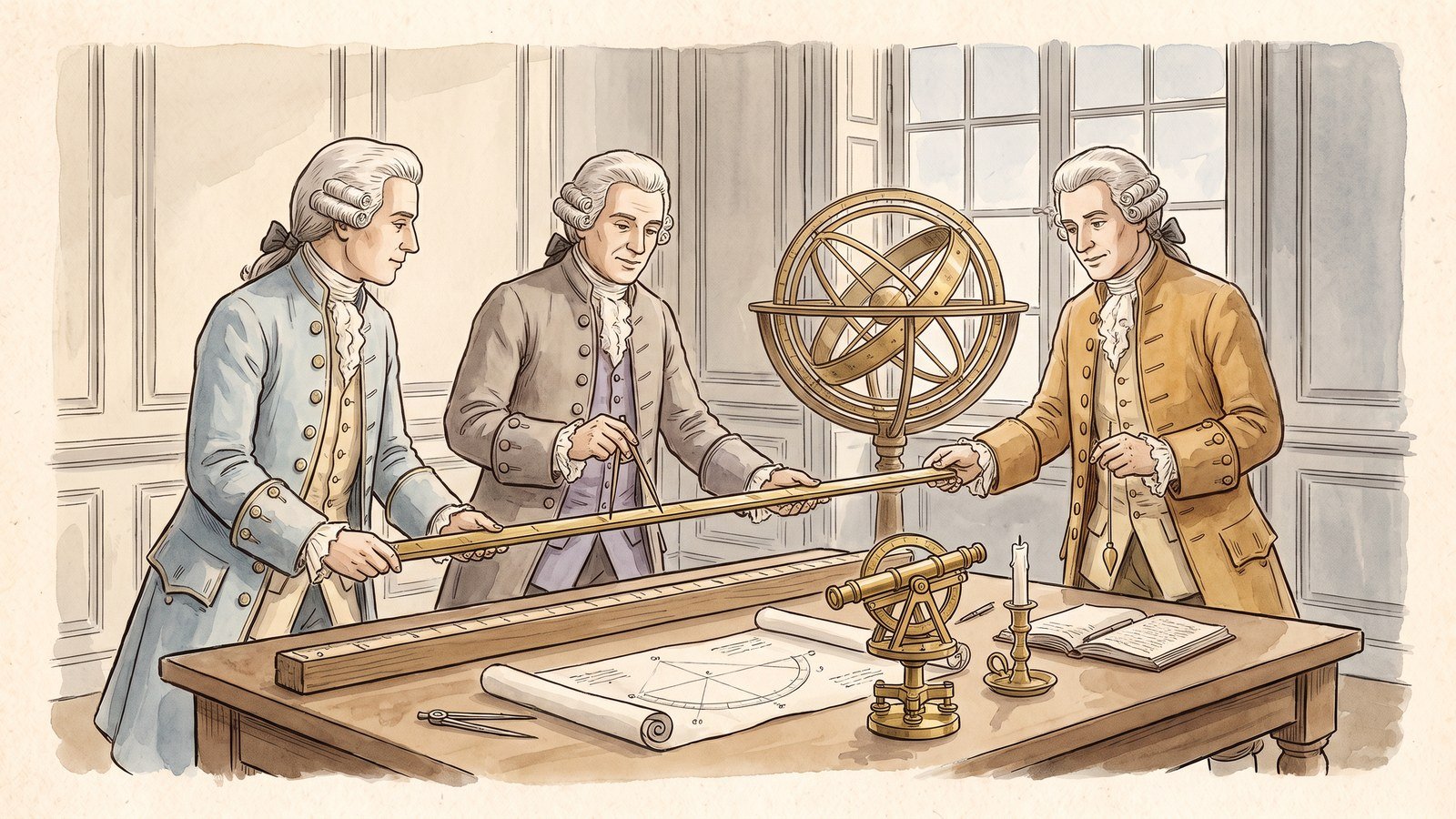
What came out of the Academy in 1790 was a commission of five: Borda, Lagrange, Laplace, Monge and Condorcet. These were not administrators. They were the working edge of European science, and several of them would spend the following decade arguing with one another about priority in ways that are still famous. Over about a year they produced recommendations that the French Assembly accepted on 30 March 1791. The substance was threefold. Scale every unit by tens, so that a system built on ten and only ten would let any quantity be written as a number and any number be read off directly. Take the unit of length from the Earth itself, as a convenient fraction of an arc of the meridian, so that the standard was a property of the planet rather than of a building. And derive the unit of weight from that length through the cube of water, so that mass and length would be locked together and a litre of water would weigh a kilogram by definition.
That last sentence contains the whole engineering idea, and the middle one needs unpacking. The meridian is the line running north to south through a place, passing through the poles. A meridian quadrant is a quarter of the way round the Earth’s circumference measured along such a line, that is from the north pole to the equator, which comes to roughly ten thousand kilometres. Take one ten-millionth of that and you have something very close to a metre. The commission’s proposal, in effect, was to define length as a fixed fraction of the planet’s own size, and then divide everything else down from there by tens.
The second of those recommendations is the one people remember, and it is worth being precise about why it seemed so obviously right. A metal bar is a promise made by whoever owns it. It can be lost, stolen, melted, worn at the ends by handling, or quietly altered by everyone who believes they know better than the office that issued it. The Earth is not like that. It is in no one’s pocket, it cannot be cornered, and it will still be the size it is when everyone who cut the original contract is dead. That is why the advocates of an Earth-derived standard liked the image of burying the master measure in the ground. A buried standard cannot be moved without leaving a hole, and a hole is a witness. Theft-proofing a measurement by burying it in the planet it measures is exactly the kind of idea that an eighteenth-century rationalist finds irresistible.
The obvious objection is the one that eventually killed the geodetic argument as a definition, though not as a rationale: nobody can check it. The number arrives at the end of a chain of astronomical observations, of baseline measurements, of reductions and corrections, each carrying its own small error. It was not so much wrong as uninspectable. And the shape of the Earth was itself contested. Newton had said the planet is flattened at the poles; the Cassinis had spent years measuring it and said it was elongated. The value of a standard taken from the Earth depends entirely on which Earth you mean.
That controversy had been settled sixty years earlier, at considerable expense, and the way it was settled is the reason the commission could propose what it proposed. In May 1735 the Paris Academy sent an expedition to Peru to measure the Earth, headed by Charles Marie de La Condamine with Pierre Bouguer and Louis Godin, and a second expedition to Lapland headed by Pierre Louis Maupertuis with Alexis Clairaut and Pierre Camus. The two expeditions were not competing for a prize so much as bracketing the problem, one as far north as the Arctic Circle and one as far south as the equator, so that the curvature of the planet could be read off the difference between them. The Lapland party left Dunkirk on 2 May 1736 and based itself at Tornio in northern Finland, where it was attacked by insects in summer and endured a cold so severe it froze the instruments; on the way home it was shipwrecked in the Baltic and lost the boat but not the observation records. Maupertuis reported to the Academy in August 1737 that his measurements confirmed the Earth is oblate, and the Newtonian account of the planet’s shape won. The account of the expedition, and of the argument at home over whether a base of nine kilometres was really possible in a country that cold, is preserved in the MacTutor biography of Maupertuis. The Peruvian expedition was longer and rougher. La Condamine sailed from La Rochelle on 16 May 1735 with Godin, Bouguer and a botanist, Joseph de Jussieu, and spent the first weeks of 1736 triangulating the Yaruqui plains outside Quito. A quarrel with Bouguer over a miscalculation in December 1741 left the two men not speaking, but working separately they both finished their arc by May 1743. La Condamine came home by river down the Amazon, the first scientific exploration of that waterway, reached the Atlantic on 19 September 1743 and Paris in February 1745.
These expeditions did more than settle a controversy. In 1735 the Academy had two new standards of identical length made, one for each party, and named them for their destinations. The toise du Nord went north with Maupertuis. The toise du Perou went south with La Condamine. When the Peruvian bar proved the more trustworthy of the two, and when the Chatelet bar had gone unreliable in the same period, the standard that the whole kingdom used from 1766 onward was the bar that had been carried up the Andes and back. The unit the Revolution abolished had already been to the equator and returned. Nothing in the next eighty years would travel as well.
Making it law
The Revolution moved faster than its own mathematics, and the dates show the strain. On 1 August 1793 the Convention abolished the old French measures outright and adopted the metric system in a provisional form, fixing the metre provisionally at three feet and eleven and a half lines of the Academy toise. That is a temporary number, adopted while the survey that would produce the real one was still being run across the country. The French Republican calendar, whose months took their names from the seasons, gave the months classical names: Germinal, the month of sprouting, ran from about 21 March to 19 April, so that 18 Germinal in the third year of the Republic fell on 7 April 1795. That day the Assembly passed the law that made the system real, numbered 749, described as concerning weights and measures, and establishing in France the use of the metric system and the decimal division of numbers.
The law laid down six units: the metre, the are for area, the stere for timber, the litre, the gramme and the franc. Each was to be divided by tens in both directions, with prefixes running from deca down through the unit to milli, so that a hundredth of the metre was a centimetre and a thousandth was a millimetre. The gramme was deliberately tiny, a ten-thousandth of the old livre, so small that a coin would weigh several million of them; the scheme was not aiming at what anyone would actually handle, but at what a clerk could compute. Money was caught in the same principle. The franc germain, the new name for the old livre, was divided into a hundred centimes, which is the direct ancestor of the centime on the coin in your pocket. The metre itself was fixed at a value of 0.513074 of the toise of Paris, which in the older language of the workshop is 443 lines and just under three-tenths of a line. The six units and their decimal divisions are set out in the standard French account of the metric system, which is also the easiest place to see how tightly the scheme tied mass to length.
And that was still, in the strict sense, provisional, because the meridian was not finished. The definitive figure had to wait on the survey, and when it came it was not the same number. On 19 Frimaire in the eighth year of the Republic, that is 10 December 1799, the law settled the metre definitively at three feet and 11.296 lines of the toise of Paris, and fixed the toise of the Academy at exactly 27,000 over 13,853 metres, or about 1.9490363 metres. The geodetic ideal, one ten-millionth of a quarter meridian, would have given three feet and 11.383 lines. So the metre the world actually adopted was about one part in ten thousand shorter than the metre the Earth’s geometry wanted. It is a tiny discrepancy, and it was never corrected, because the whole point of a standard is that it stops moving. The geodetic argument was the reason for the metre; it was not going to be the reason for keeping it.
The state then had to turn a number into a thing, and it took extraordinary care over the doing. In June 1799 the platinum prototypes were fabricated and formally adopted, and they were entered into the French national archives. The length standard became known as the metre des Archives, the archive metre, and its mass counterpart was fixed at 18,827 and a little over fifteen grains of the livre poids de marc, the mark pound that had been the working standard of the Paris mint. Platinum was chosen for the obvious reasons and one not so obvious: it is dense, it does not rust, it does not tarnish in air, and it resists the creeping change that softer metals undergo under their own weight. The classic documentary account of how the metre was established and how it was gradually propagated is Amede Bigourdan’s study of 1901, and it remains the place to go for the operations by which the metre and the kilogramme were actually determined.
The care was not only about chemistry. A standard that can be altered is worthless, so the state’s answer to the charge of tampering was to make alteration absurdly hard: put the master bar in an archive, keep working copies elsewhere, and publish the number so that anyone with a good bar and a good pair of hands can check what they have been given. An archive rather than a church or a treasury was a deliberate choice in kind, because an archive is the one building in the state whose entire purpose is custody of documents against loss and substitution. From 1795, while the metre was still being tied to the meridian, Alexandre Vandermonde, one of the earliest demonstrators to take the new units out into the country, had copies of the archive metre made for distribution. By December 1799 the system built on those bars had become by law the only legal system of weights and measures in France, from 1801 onward. The metre had stopped being a claim about the size of the Earth and become an object in a vault, and that transition is the whole of the system’s future in a single administrative gesture.
Forcing a country to change
The word the revolutionaries used for what they were about to do to every shopkeeper, every farm and every toll gate in France was normalisation: the administrative business of bringing a local measure into conformity with the legal standard. It is a bureaucratic word for an act of enormous violence to ordinary life, and the state did it with very little imagination about consequences. The Convention had abolished the old measures by decree in 1793 and set a legal date for the changeover. It had not counted the sticks.
The arithmetic of that omission is easy to state and hard to forgive. When the metre became the sole legal unit in France under the Consulate, Paris alone needed something like half a million metre sticks. One month later the stores held about twenty-five thousand. Every shop, every workshop, every municipal office and every school in the capital needed measuring equipment that did not exist, at a moment when the Revolution had already destroyed the trade that might have supplied it. The same arithmetic applied everywhere else in the country, and it applied to the tools of the trade rather than to the abstractions of the law. The figures come from the standard account of metrication, the process by which countries converted, and it is the clearest evidence that the disruption of the transition was not a side effect but a foreseeable consequence, and that nobody at the level of government had done the sum.
The confusion it produced was not people refusing to learn. It was two legal answers to the same question of quantity at once. A seller using an old toise was not evading the law if no replacement stick had reached his market. A tax office assessing on the old foot and a customs house assessing on the new metre produced two duties on the same sack, and the difference was settled in court. The retail trade moved last, and in 1812 the government simply legalised customary measures for small transactions rather than fight it.
The other thing the state tried to change at the same time was the clock, and this is where the revolution’s taste for tidy decimal thinking ran furthest ahead of anything a society would accept. Decimal time was proposed to the Convention by Borda on 5 November 1792. The Convention decreed it on 5 October 1793, and an article was added on 24 November of the same year. It became compulsory for public records from 1 Vendemiaire in the third year, that is 22 September 1794. The scheme divided the day into ten hours of a hundred minutes of a hundred seconds, so that a second became a familiar fraction longer and an hour became an unfamiliar fraction shorter, and it divided the year into ten months of thirty days with five leftover days at the end. The standard account of decimal time records how far it actually got, and it got further than anyone expected. Two of the four faces of the clock at the Tuileries kept decimal hours until at least 1801. Marseille and Toulouse kept decimal clocks for five years, Toulouse’s on its own capitol building. In a number of towns the decimal day stayed in official use for recording births, marriages and deaths right through to the end of the eighth year of the Republic, that is to September 1800.
And then the compulsory use of decimal time was suspended on 7 April 1795. That is the same day as the law that fixed the metric system. The law which made the decimal metre permanent in France suspended the decimal clock, in the same article of the same session, and the contrast is the single most instructive fact in the whole history. The metre had an argument behind it: a trade, a commerce, a land tax, a French army. The decimal hour had only an argument about elegance. One of the two had customers and the other did not.
The companion calendar reform was more deeply felt than either. A commission drawn from the same world as the weights commission, the mathematician Gilbert Romme with his colleagues Ferry and Dupuis, working alongside Academy members including Guyton-Morveau, Lagrange, Lalande, Monge and Pingre, produced a calendar of ten months of thirty days, with the weeks abolished and a ten-day rest inserted in their place. The Romme commission read the calendar the way the other commission read the metre: as a matter of principle, since a ten-day week divides a month exactly and a seven-day week does not. It entered into force on 15 Vendemiaire in the second year, 6 October 1793, and the definitive decree was published on 24 November 1793. The chronology and the politics of the whole episode are documented in the detailed account of the French Republican calendar, which also records how closely the debate ran to the question of whether a people can be made to keep a rhythm it did not choose.
The resistance was not a matter of taste. The decade of rest collided with the Christian week, and in the countryside the calendar was read as an attack on religion rather than on arithmetic. By 1798 the government had decided to stop arguing and started enforcing: an order of 14 Germinal in the sixth year, 3 April 1798, required public cashiers, the post office, schools, theatres, markets and contracts all to reckon by the decade, the month or the complementary days, and forbade the press from printing the double computation that newspapers had been using to translate between the two calendars. When the deputy Lanjuinais rose on 30 Thermidor in the third year to object, he put the physical objection better than any later historian: the new names of the months are true in the north and a perpetual lie in the south, and the decadi does not agree with nature, since there are no men and no animals who can bear nine consecutive days of labour.
He was describing the real thing, and the government’s response to the real thing was not argument but an inventory of the calendar’s parts to be dismantled. The 18 Brumaire coup of November 1799 brought the Consulate to power, and the Consulate undid the calendar piece by piece. The consuls broke the ten-day rest for officials alone on 26 July 1800. Sunday became the legal day of rest from 8 April 1802. The double computation was restored to the state gazette on 21 December 1802. The calendar itself was abolished by a decree of 22 Fructidor in the thirteenth year, 9 September 1805, and the Gregorian calendar came back on 1 January 1806. The Republic had used its own calendar for twelve years, two months and twenty-seven days. The metre survived the same government, in the same months, that killed the decimal hour.
Exporting a standard
It survived for a reason that has nothing to do with French taste, and the reason is that for twenty years the French state had an army. The metric system travelled through Europe the way French law travelled through Europe: attached to an administration, in a column, behind a general. Italy took it first. The Cisalpine Republic defined its braccio in 1797 as half a metre, the metric system arrived properly in 1803, the Kingdom of Italy took it in 1806, and by 1812 the whole peninsula was under Napoleon’s rule and using metric measure. Then the Congress of Vienna put the old measures back, and Italy had to take the metric system again in pieces over the following half-century, canton by canton and duchy by duchy, until a law of 28 July 1861 finally made it official throughout.
Germany took it in pieces too, and the pieces are revealing. Baden defined its ruthe in 1810 as exactly three metres. Bavaria set a pound of 560 grams in 1811. Prussia kept its own pound at 467.711 grams. What finally harmonised the German states was not law but trade: the Zollverein, the customs union that tied their economies together, set its customs pound at five hundred grams, and that single number did more to metricise Germany than any statute. The German Empire made the metric system official in 1872, and Austria followed in 1875.
The Netherlands shows the pattern of advance and retreat more clearly than anywhere. The Batavian Republic adopted the metric system in 1799. Napoleon’s own government then pulled it back into the old customary measures between 1812 and 1815. The metric came back under a law of 21 August 1816 and a decree of 27 March 1817, and it was actually in force from 1820, with the Dutch ons defined as a hundred grams. Switzerland never got a clean run at all: the Helvetic Republic passed a metric law in 1801 that was never applied, Geneva adopted in 1813, a federal foot of thirty centimetres was defined in 1836, the metric system was legalised alongside it in 1868, and it became the only measure under federal law from 1 January 1877.
The mechanism is worth naming, because it is the mechanism the French administration brought with it everywhere. A system of measurement is only ever adopted where there is a fiscal apparatus able to insist on it. French rule meant a customs house, a land register, a municipal budget and a corps of clerks, and each of those is a machine for converting local practice into central arithmetic. Where that machine arrived, the metric system arrived with it and had customers from the first day, because the alternative was to keep two sets of books. Where it did not arrive, no amount of demonstrated technical superiority could substitute for it. The peoples under French rule frequently hated the rule, and that is not a small point: the metric system was imposed by people who were not loved, and it worked anyway, because they paid taxes.
Where the system left the French orbit it did something stranger and, in its way, more convincing. Spain had helped with the meridian work in the eighteenth century, and had every reason to adopt. It did not. In 1849 it went the other way and reinforced its old Castilian measures, having been badly frightened by the revolutionary movement that had introduced the metric idea in the first place. Portugal, which Napoleon occupied, went the opposite way in August 1814 and became the first country outside the French Empire to adopt the system, giving the units Portuguese names without changing what they were: the mao-travessa became one decimetre, the vara one metre, the canada one litre, the libra one kilogram. Britain never adopted at all. Parliament passed the Weights and Measures Act in 1824, Britain declined to sign the Metre Convention, and only acceded to it in 1884. The United States passed the Metric Act in 1866 and then required an executive order, the Mendenhall Order of 1893, before the system was actually used at the Treasury.
It is tempting to read all of this as a story of colonial arrogance, and the material for that reading is real. The distinguishing feature is not whether people liked the system. It is what came attached to it. Where the metric arrived with a French prefect and a French tariff schedule, it stuck, and it stayed stuck after the prefects and the schedules were gone, because by then it was in the hands of merchants, customs clerks and schoolmasters who had no memory of the Empire at all. Where it arrived with a parliament that could be argued out of it, as in Spain and Britain, it needed either fifty years of patient work or an explicit order from the head of the state. A measuring system exported by an army is permanent not because armies are persuasive but because the army leaves behind a bureaucracy that has already been trained in it.
As for Napoleon himself, the story is better than the received version. He mocked the system, and in February 1812 his government issued a decree defining a set of customary measures for the small retail trade, among them a metric toise worth exactly two metres. It was a piece of legislation prescribed for a period and never adopted by the people. His government continued to conduct its own business in metric, and the schools continued to teach it, and the decree was repealed in 1837. The most sceptical man in Europe gave the system the empire that made it permanent, and did so while telling everyone it was ridiculous.
Why it survived
It survived because of what it promised rather than what it measured. A unit taken from the Earth says something, beneath the geometry, and the something is political: that the measure of the world belongs to nobody, that it is the same in every province because it is the same on every planet, and that therefore a person in Nantes and a person in Nancy are standing on the same ground and dealing in the same quantities. That is a claim about legitimacy, wearing the clothes of a claim about physics, and it was far more durable than the physics. Every government since has found it cheaper to inherit the metre than to reopen the argument.
The second reason is that the object was designed to stop mattering. The platinum bar in the archive was never supposed to be the length. It was a way of holding a number still while everything else in the world improved. When the measuring instruments got better, the bar did not need to change, because the bar’s job was not to be compared with the Earth but to be compared with other bars. That design decision is what made the system durable: it separated the definition from the measurement of the definition, which is the trick that lets you improve accuracy forever without ever changing the answer.
The bar’s successors were made by international agreement. On 20 May 1875 seventeen states signed the Metre Convention, creating the bodies that still run the system, and in 1889 the first General Conference on Weights and Measures chose bar number six and cylinder number X as the international prototypes. The bar was ninety per cent platinum and ten per cent iridium, and its cross-section was an X, with grooves cut into each face so that the defining marks sit in the neutral plane of the section rather than on a surface that handling can wear away. That profile was worked out by Henri Tresca at the Conservatoire national des arts et metiers, whose technical role in the whole enterprise was considerable: its metallurgists made the first casts of the platinum-iridium alloy, and before the international bureau was operating, the Conservatoire did much of the comparison work on its behalf. It had already been the central depot for French prototypes since 1848, and it ran the verification programme that checked the departmental standards against the national one through the following two decades. All of this is set out in the Conservatoire’s own institutional account of the history of the standards, which is unusually candid about how much of the world’s metrology was built in one French building. When the French section of the commission wound up, its final inventory recorded forty kilograms and fifty-seven metre bars, most of which had been sent out of France. That inventory is the real reason the system is global. France built the standards and then gave them away.
What the treaty solved was the problem of trust between governments. A bar kept in Paris is a French bar, and every other state in Europe had spent the previous century discovering what French claims over their weights and measures had been worth. Seventeen signatories in 1875, led by Germany, took the custody of the standard out of French hands and put it under a permanent international body, which is the only reason a system whose entire rhetorical case was that it belonged to nobody could actually be believed to belong to nobody.
There is an irony at the end of this that the Conservatoire itself points out. As dimensional measurement improved through the nineteenth century, scientists came to question whether the geodetic definition promulgated in 1795 was still the relevant one. The argument that had made the metre revolutionary became the argument against it. So the definition was changed, first in 1960, when the metre was redefined through a particular spectral transition in the light of krypton-86, and then in 1983, when the seventeenth conference on weights and measures abrogated that and fixed the metre as the length of the path travelled by light in vacuum during one two-hundred-and-ninety-nine-million-seven-hundred-and-ninety-two-thousand-four-hundred-and-fifty-eight millionth of a second. The exact wording is the text of the first resolution of the 1983 conference, whose permanent record is held by the Bureau International des Poids et Mesures under its own reference number. The metre has spent most of its life being redefined, and it has never so much as flinched in value. Every redefinition has been a new way of keeping the same promise.
Which leaves the strange symmetry at the heart of it. The commission’s argument was about the shape of the Earth, and it was won on the shape of the Earth, and the survey that settled the number was a triumph of geodesy. But the reason the metre outlived the Empire that exported it, and outlived the dozen governments that tried to disown it, and outlived the definition that produced it, is that it answered a question about ownership. The old system said that a length belonged to whoever could prove it: to a guild that had cut the sticks, to a town that kept the standard, to a lord whose fields were measured in it. The new system said that a length belonged to nobody, and therefore to everyone, and it said so by pointing at the sky. Standardisation of this kind has never really been about accuracy. It has been about legitimacy, wearing a decimal. And that is why the metre, of all the standards humanity has ever tried to impose on itself, is the one that worked.
References
- History of the metric system - Wikipedia
- Toise - Wikipédia
- Système métrique - Wikipédia
- Histoire des étalons - Marc Himbert, Laboratoire commun de métrologie, Conservatoire national des arts et métiers
- Le système métrique des poids et mesures; son établissement et sa propagation graduelle - Amédée Bigourdan, Gauthier-Villars et fils, Paris, 1901
- Charles Marie de La Condamine - Wikipedia
- Pierre Louis Maupertuis - Wikipedia
- Pierre-Louis Moreau de Maupertuis (1698-1759) - Biography - J J O’Connor and E F Robertson, MacTutor History of Mathematics Archive, University of St Andrews
- Decimal time - Wikipedia
- Calendrier républicain - Wikipédia
- Metrication - Wikipedia
- Resolution 1 of the 17th CGPM (1983) - BIPM
- CGPM Resolution 1 (1983), official text and DOI record - Bureau International des Poids et Mesures