The Grandfather of Yiddish Letters
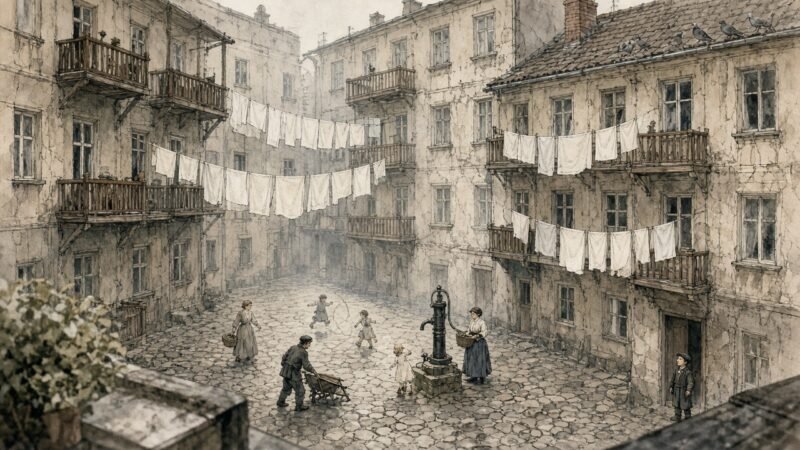
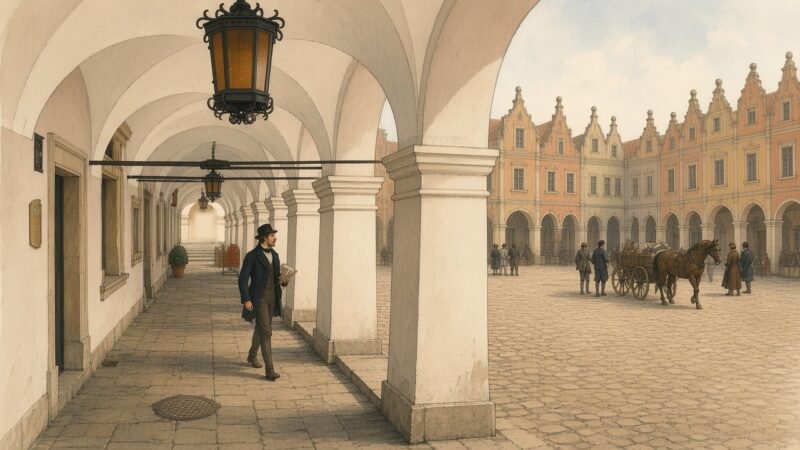
In the Odessa of the 1890s, writers who met in the cafés and editorial offices of the city spoke with particular respect of an elderly schoolmaster who directed the Talmud Torah, the community’s school for poor boys. He was Sholem Yankev Abramovitsh, but readers across the Russian Empire knew him by the name of the narrator he had invented three decades earlier, Mendele Moykher Sforim, Mendele the book peddler. Younger writers called him the grandfather of modern Yiddish literature, and many of them regarded him also as the founder of a new style of Hebrew prose. [1][2]
This special feature follows Abramovitsh from his birth in the Belarusian town of Kapyl and his wandering youth in the yeshivas and roads of the Pale, through his apprenticeship in the Hebrew Enlightenment in Kamenets-Podolsk and Berdichev, and the creation of the Mendele persona in 1864. It examines the great satirical novels of his middle years, his long tenure as head of the Odessa Talmud Torah, his return to Hebrew in the 1880s, his exile in Geneva after the pogrom of 1905 and his last years during the revolution of 1917. It closes with his legacy in both of the languages in which he wrote. An interactive timeline at the end of the essay gathers the principal dates.
1. A boyhood in Kapyl
Sholem Yankev Broyde was born in Kapyl, a small town in the Minsk province of the Russian Empire, in about 1835 or 1836. The exact date is uncertain, as it is for many Jews of his generation, whose births were not always recorded in official registers. Kapyl lay in a region of forests, marshes and small fields to the south of Minsk, not far from the larger town of Slutsk, and its Jewish population formed a substantial part of the inhabitants. [1][3][4]
His father, Chaim Moyshe Broyde, was a respected figure in the community, learned in the Talmud and familiar with Hebrew literature. He took personal charge of his son’s education and introduced him early to the Bible, the Talmud and the rabbinic commentaries. Abramovitsh later recalled that his father encouraged him to study the Hebrew Bible closely as a text, with attention to its language, an approach that was not common in the traditional schools of the time. [2][5]
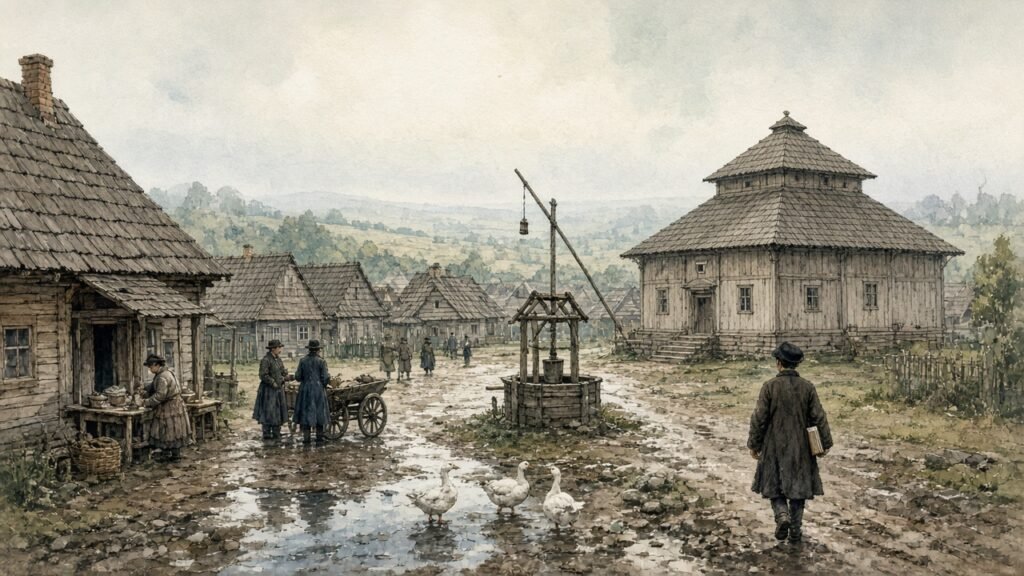
The landscape of his childhood made a lasting impression on him. In his later writings Abramovitsh described the woods and fields around Kapyl with great affection, and he presented his early contact with nature as a source of his lifelong interest in natural history. His autobiographical novel Shloyme reb Khaims, published in Yiddish in 1899 and later in Hebrew under the title Bayamim hahem, in those days, portrays a boy growing up in a small Lithuanian Jewish town and draws heavily on his memories of Kapyl. [2][6]
When Sholem Yankev was about thirteen or fourteen, his father died. The family was left in difficult circumstances, and the boy was sent away to study in yeshivas in other towns. He studied for a time in Timkovichi, a small town near Kapyl, and then in Slutsk and Vilna, the great centre of rabbinic learning in the Lithuanian lands. Like many poor yeshiva students of the period, he lived on the charity of local households, eating at a different table on each day of the week. [7][8][4]
The Jewish community of Kapyl, like those of other towns in the region, was organised around the synagogue, the study house and the communal institutions that cared for the poor, the sick and the dead. Its members earned their living as shopkeepers, craftsmen, carters and small traders, and many depended on commerce with the peasants of the surrounding villages. Learning was highly valued, and a boy who showed promise in his studies brought honour to his family. [9][3]
In the study house of Kapyl the boy encountered the older men of the town who spent their days over the Talmud, as well as the visiting preachers and itinerant scholars who passed through. In his later writings he recalled the intense atmosphere of these places, where argument over a difficult passage could continue for hours. The habits of close reading and dialectical argument acquired there remained with him all his life and shaped the allusive texture of his prose. [7][6]
The years in the yeshivas gave him a thorough grounding in traditional Jewish learning, but they also exposed him to poverty and hardship. He later described the life of the yeshiva students with sympathy and irony, recalling the hunger, the cold and the intellectual excitement of study. When he returned home, he found that his mother had remarried and moved to a village where her new husband worked a mill, and he spent some time there before leaving again. [2][6]
2. The road with Avreml the Lame
In about 1852 the young Abramovitsh left home in the company of a beggar named Avreml the Lame, who persuaded him that they could travel together to the south, where opportunities for study and work were said to be greater. The journey took them through Volhynia and Podolia, the provinces of the south-western Pale, and lasted for several years. Abramovitsh later described this period as one of the most difficult of his life. [2][1]
Avreml was the leader of a band of wandering beggars who travelled from town to town, collecting alms from Jewish communities. He exploited the young scholar, using him to help gather money, and the boy found himself living among people at the margins of Jewish society, who slept in poorhouses and lived by their wits. The experience gave him an intimate knowledge of the underworld of Jewish poverty, which he would later portray in his novel Fishke the Lame. [10][6]
The wandering years also took Abramovitsh far from the world of the Lithuanian yeshivas and into the regions where Hasidism was strong. He encountered the different customs, dialects and social structures of the Ukrainian provinces, and he later drew on these encounters in his portrayal of the imaginary towns of his novels. The contrast between the Lithuanian north, where he had been raised, and the Ukrainian south, where he spent most of his adult life, runs through much of his work. [11][12]
The world of the beggars that he came to know on the road had its own customs and hierarchy. Bands travelled on established routes, arrived in towns before festivals when charity was most generous, and divided the proceeds according to rank. Some members feigned illness or disability, and others exploited children or newcomers. Abramovitsh observed this world from within, and his later portrayal of it in Fishke the Lame is notable for its precise detail. [10][12]
Despite its hardships, the journey gave him a breadth of experience that few writers of his background possessed. He saw the Jewish communities of the south in their variety, from prosperous market towns to villages where a handful of families lived among peasants. He heard the dialects of Yiddish spoken in the Ukrainian provinces and learned the customs of Hasidic communities that differed sharply from those of his native Lithuania. [11][13]
The towns through which the band passed included some of the great centres of Jewish life in the south-west, where fairs drew merchants from across the region and the courts of Hasidic rebbes attracted followers in their thousands. For the young scholar from Lithuania, the scale and variety of this world were a revelation, and the memory of it would supply him with scenes and characters for decades. [12][11]
In about 1853 he arrived in Kamenets-Podolsk, the capital of Podolia, where he succeeded in leaving Avreml’s band. The town was to become the starting point of a new life. [14][2]
3. Gottlober and the Enlightenment
In Kamenets-Podolsk Abramovitsh met Avraham Ber Gottlober, a poet and teacher who was one of the leading figures of the Haskalah in the south-western provinces. Gottlober recognised the young man’s talents and took him under his protection. He introduced him to the literature of the Jewish Enlightenment and to secular studies, including Russian, German and mathematics, and his daughters helped to teach the young man languages. [15][2]
The Haskalah had developed in Germany in the late eighteenth century, associated with the philosopher Moses Mendelssohn, and it had spread to eastern Europe in the following decades. Its supporters, known as maskilim, sought to modernise Jewish society through education, the study of secular subjects and the revival of the Hebrew language as a medium for modern literature. In the Russian Empire the movement was supported for a time by the government, which established Jewish state schools and rabbinical seminaries. [15][16]
Under Gottlober’s guidance Abramovitsh passed the examinations required to teach in a Jewish state school, and he obtained a teaching post in Kamenets. He also began to write, and in 1857 he published his first article, an essay on education, in the Hebrew weekly Hamagid. The essay, in the form of a letter, set out the principles of Enlightenment pedagogy and criticised the methods of the traditional cheder. [2][5]
Gottlober himself was a prolific writer in both Hebrew and Yiddish, and he had already experimented with Yiddish comedy and satire. His example showed the young Abramovitsh that a maskil could write in Yiddish without abandoning his commitment to Hebrew and to Enlightenment ideals. The relationship between teacher and pupil lasted for many years, and Abramovitsh later acknowledged his debt to Gottlober. [15][17]
During this period he married for the first time, but the marriage was short and ended in divorce. The years in Kamenets were nonetheless decisive for his intellectual development. He had made the transition from the world of the yeshiva to that of the Enlightenment, and he had found his vocation as a writer and teacher. [2][1]
4. Berdichev and the Hebrew essays
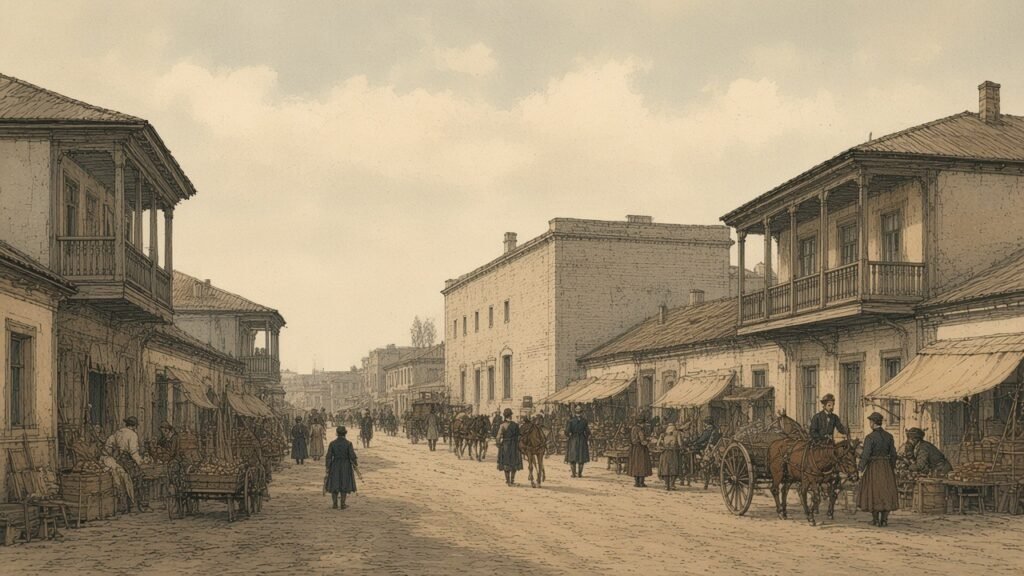
In 1858 Abramovitsh married Pessie Levin, the daughter of a family in Berdichev, and he moved to that city, where he would live for the next eleven years. Berdichev was one of the largest Jewish cities in the Russian Empire, with a Jewish majority among its inhabitants, and it was a major commercial centre, famous for its fairs, its merchants and its Hasidic courts. It was also known for the power of its communal leaders and wealthy families. [18][2]
The marriage brought Abramovitsh a measure of financial support and allowed him to devote much of his time to writing. In his first years in Berdichev he wrote primarily in Hebrew. In 1860 he published a collection of critical essays, Mishpat shalom, which engaged in the literary debates of the time and established him as a critic of note. [2][16]
In 1862 he began to publish Toldot hateva, a natural history in Hebrew based on the work of the German naturalist Harald Othmar Lenz. The work, which appeared in several volumes over the following decades, aimed to introduce Jewish readers to modern science and to create a Hebrew vocabulary for the description of the natural world. It reflected the Enlightenment belief that knowledge of nature was an essential part of a modern education. [2][19]
In the same year he published a Hebrew novel, Limdu hetev, learn to do well, which told a story of social reform in a small town. The novel, written in the elevated biblical style favoured by Haskalah writers, was not a great success, and Abramovitsh later revised it extensively. Its weaknesses, however, helped him to see the limitations of the Hebrew literary language of his time, which was rich in biblical phrases but poor in the vocabulary needed to describe everyday life. [20][16]
In Berdichev Abramovitsh became part of a small circle of maskilim who met to discuss literature and ideas. The city’s Hasidic majority regarded such men with suspicion, and the maskilim in turn criticised what they saw as the backwardness of the community. Abramovitsh’s position was delicate, since his wife’s family was respected in the city and his own livelihood depended on its goodwill. [18][15]
His essays of this period were concerned with questions of literature, education and social reform. He criticised the poor quality of much Hebrew writing, argued for the importance of a modern education and called for the reform of communal institutions. These concerns would remain central to his work, although he would later express them in fiction rather than in essays. [16][2]
The problem of language was central to Abramovitsh’s development. Hebrew was the language of learning and religion, read by educated men but not spoken in daily life. Yiddish was the language of the home, the market and the street, spoken by millions but regarded by most maskilim as a corrupt jargon unworthy of literature. To reach the mass of Jewish readers, a writer had to write in Yiddish, but to do so meant to abandon the prestige of Hebrew. [13][19][6]
5. The birth of Mendele
In 1864 Abramovitsh published his first Yiddish work, Dos kleyne mentshele, the little man, in Kol mevaser, the Yiddish supplement to the Hebrew weekly Hamelits, edited by Alexander Zederbaum in Odessa. The work was a satirical portrait of a man who rises to wealth and power in a small town by flattering the powerful and exploiting the weak, presented in the form of a deathbed confession. It attacked the corruption of communal leaders and the passivity of the community that tolerated them. [21][2]
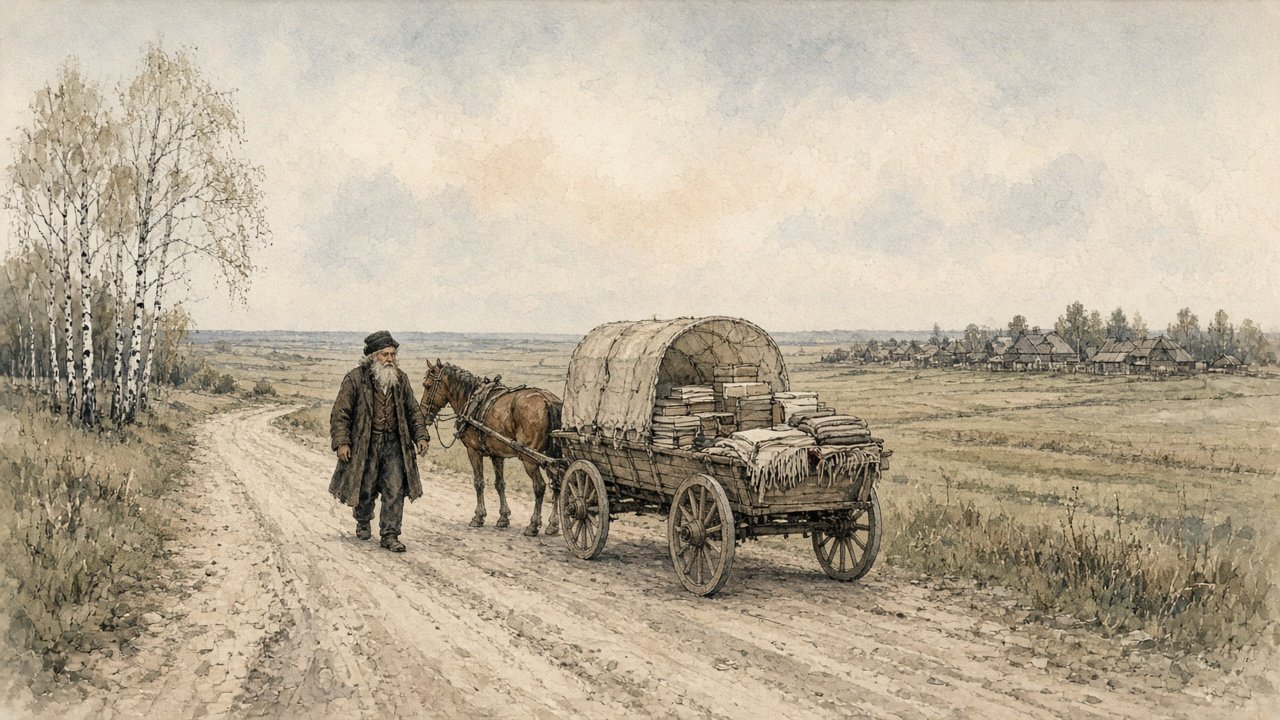
The work was introduced by a narrator who would become one of the most famous figures in Yiddish literature, Mendele Moykher Sforim, Mendele the book peddler. Mendele is an itinerant seller of books who travels from town to town with his horse and cart, selling prayer books, tales and almanacs to the Jews of the provinces. In the introduction he explains how he came to be in possession of the manuscript he presents to the reader. [1][6]
The device of the narrator served several purposes. It allowed Abramovitsh to distance himself from the work, presenting it as the product of a simple, folksy character rather than an educated maskil. It gave the work a frame that made it acceptable to readers who might be suspicious of a modern novel. And it provided a voice, at once naive and shrewd, through which the author could comment on the society he described. [6][22]
Dan Miron, in his study A Traveler Disguised, has argued that the Mendele persona was the decisive innovation that made modern Yiddish fiction possible. By adopting a mask, Abramovitsh was able to overcome the stigma attached to writing in Yiddish and to create a narrative voice capable of both satire and sympathy. The persona became so closely identified with the author that readers came to call Abramovitsh himself Mendele. [6][23]
The decision to write in Yiddish was not taken lightly. In later recollections Abramovitsh described how he had reflected on the fact that the Hebrew writers of his generation wrote for a tiny audience, while the great majority of Jews could read only Yiddish. He resolved to write for the people in their own language, despite the disapproval of many of his fellow maskilim, who regarded Yiddish as an obstacle to the modernisation of Jewish society. [13][6]
Zederbaum’s Kol mevaser, launched in 1862, was the first sustained Yiddish periodical in the Russian Empire, and it played a decisive role in the emergence of modern Yiddish literature. It gave writers a regular outlet and a readership, and it helped to establish conventions of spelling and style. Abramovitsh’s contributions to it were among its most significant. [21][17]
Mendele was not a static figure. Over the following decades Abramovitsh developed him into a complex character with his own history, opinions and idiosyncrasies, who appears in different roles in different works, sometimes as a narrator, sometimes as an editor and sometimes as a participant in the story. His speech, full of proverbs, biblical allusions and digressions, became one of the hallmarks of Abramovitsh’s style. [22][10]
6. The magic ring and Glupsk
In 1865 Abramovitsh published Dos vintshfingerl, the magic ring, a short novel that tells the story of a poor young man who longs for a magic ring that will bring him wealth and learning. The work was later greatly expanded, and in its final form it became one of his major novels, tracing the life of its hero from a poor childhood in a small town to education and modern life in the city. [2][6]
In these works Abramovitsh began to create an imaginary geography of Jewish towns that would serve as the setting for much of his fiction. The principal towns were Glupsk, from the Russian word for foolish, Kabtsansk, from the Hebrew word for pauper, and Tuneyadevka, from the Russian word for parasite. The names reflected the satirical intent of his portrayal, in which the towns stood for the poverty, ignorance and idleness that he saw as the afflictions of Jewish life. [9][6]
Glupsk was often taken to be modelled on Berdichev, and its communal leaders, merchants and charitable institutions were portrayed with sharp satire. Kabtsansk and Tuneyadevka were small, poor towns whose inhabitants lived in a state of perpetual want, unable to imagine any other way of life. The satire was not without sympathy, however, and Abramovitsh’s portrayal of the poor was often affectionate even when it was critical. [18][10]
The expanded version of The Magic Ring, published decades after the first, became in part a historical novel. It follows its hero, Hershele, from childhood in Kabtsansk through the yeshiva and the world of the maskilim to the city, and it closes with an account of the pogroms of 1881. The revisions thus transformed a tale of individual aspiration into a reflection on the fate of a generation. [6][24]
These imaginary towns became part of the common language of Yiddish literature. Later writers, including Sholem Aleichem with his Kasrilevke, created their own versions, and the image of the small, poor and isolated Jewish town that emerged from these works shaped the way in which readers understood the shtetl for generations. [25][9]
7. The tax and the move to Zhitomir
In 1869 Abramovitsh published a play, Di takse, the tax, which attacked the system of the korobka, the tax on kosher meat that was collected by the Jewish community and used to fund communal institutions. The tax fell heavily on the poor, who paid for their meat at inflated prices, while the wealthy leaders of the community controlled the revenue and were accused of using it for their own purposes. The play exposed the corruption of the tax farmers and the communal oligarchy that supported them. [2][1]
The play caused a scandal in Berdichev, whose leading families recognised themselves in its satire. Abramovitsh found himself the object of hostility, and in the same year he left the city and moved to Zhitomir, the capital of Volhynia. The move marked the end of the first major period of his literary career. [18][26]
In Zhitomir Abramovitsh attended the government rabbinical school, one of the institutions established by the Russian authorities to train modern rabbis and teachers, and obtained a qualification there. He remained in Zhitomir for more than a decade, working as a teacher and continuing to write. [26][2]
The same year saw the publication of Fishke der krumer, Fishke the lame, the first version of a novel that would become one of his masterpieces. It tells the story of a crippled bathhouse attendant from Glupsk who joins a band of wandering beggars and falls in love with a blind girl among them. The story is narrated by Fishke himself to Mendele and two other travellers, and it draws on Abramovitsh’s own experiences with Avreml the Lame. [10][6]
The korobka had been a subject of complaint among the poor for decades, and the maskilim had long criticised it as an unjust burden. Abramovitsh’s play was the most powerful literary attack on it, and it became known well beyond Berdichev. Its sharp portrayal of the communal oligarchy helped to establish his reputation as a fearless critic of the Jewish establishment. [6][18]
The play was written in dramatic form but was intended primarily to be read rather than performed, since the conditions for a Yiddish theatre did not yet exist in the Russian Empire. It circulated widely, and its characters, including the tax farmers and their associates, became types that readers recognised in their own communities. [17][6]
Fishke the Lame combines satire of the world of beggars, with its hierarchies, tricks and exploitation, with a tender portrayal of the love between two outcasts. The novel was revised and greatly expanded in later editions, and in its final form, published in 1888, it is regarded as one of the major works of Yiddish fiction. Its portrayal of Jewish poverty and marginality is among the most powerful in the literature. [10][22]
8. The mare
In 1873 Abramovitsh published Di klyatshe, the mare, an allegorical novel that is among his most complex and enigmatic works. The narrator, Isrolik, is a young man who is studying for the entrance examinations to a Russian university. He encounters a mare, a broken-down horse that is beaten and abused by everyone around it, and he discovers that the mare can speak and that it is in fact a prince who has been transformed by sorcery. [2][6]
The mare is generally read as an allegory of the Jewish people, oppressed and humiliated by the nations among whom they live. Isrolik, who tries to help the mare by teaching it and advocating on its behalf, represents the maskil who believes that education and reform will bring about the emancipation of the Jews. The novel shows his efforts ending in failure and madness, and it questions the assumptions of the Enlightenment about the possibility of progress. [6][15]
The work also contains a journey through the air on the back of the devil, in which Isrolik sees the history of the world unfold beneath him, and a series of scenes in which the mare is denounced by societies for the protection of animals. The combination of realistic satire, fantasy and allegory gives the novel a distinctive character, and critics have compared it with the works of Swift and Gogol. [6][23]
The name of the protagonist, Isrolik, is a diminutive of Israel, and the novel’s allegory has been read on several levels. The mare may stand for the Jewish people as a whole, while Isrolik represents the modern Jewish intellectual who wishes to save it. The journey with the devil, in which Isrolik sees the history of humanity as a sequence of violence and folly, broadens the allegory into a meditation on history itself. [6][23]
The Mare was written in the period of reaction that followed the liberal reforms of the early reign of Alexander II, and it expressed the disappointment of many maskilim with the government’s policy towards the Jews. It anticipated the more profound disillusionment that followed the pogroms of 1881. [27][24]
9. Benjamin the Third
In 1878 Abramovitsh published Kitser masoes Binyomin hashlishi, the brief travels of Benjamin the Third, a satirical novel that has become one of the most widely read works of Yiddish literature. It tells the story of Benjamin, a poor and dreamy inhabitant of Tuneyadevka, who reads travel books and becomes convinced that he must set out in search of the legendary Red Jews and the lost tribes of Israel beyond the river Sambatyon. [10][2]
Benjamin persuades his friend Senderl, a meek man known as the housewife because of his domestic subservience, to accompany him. The two set off with no money and no knowledge of the world, and their adventures take them only as far as the neighbouring towns, where they are mistaken for deserters, seized by agents of the army and forced into military service, from which they are eventually released as unfit. [10][22]
The novel is a parody of the medieval Hebrew travel narratives of Benjamin of Tudela and other Jewish travellers, and also of Cervantes’s Don Quixote, with Benjamin and Senderl playing the roles of the knight and his squire. Abramovitsh explicitly acknowledged the connection with Cervantes, and the novel was later known as the Jewish Don Quixote. [28][10]
The satire is directed at the impracticality and isolation of the shtetl, whose inhabitants are depicted as ignorant of the world and given to fantasies of redemption. At the same time the novel has been read as a gentle critique of messianic dreams and of the contemporary enthusiasm for national projects. Its portrayal of Benjamin and Senderl, however, is so affectionate that readers have often found the two heroes endearing as well as absurd. [6][23]
Benjamin’s journey begins with his reading of a book about the travels of Eldad the Danite and other legends of the lost tribes, and his imagination transforms the familiar landscape around Tuneyadevka into a realm of marvels. A river becomes the Sambatyon, a pair of peasants become giants and a neighbouring town becomes a great capital. The comedy lies in the contrast between Benjamin’s visions and the modest reality that Mendele, as narrator, quietly reveals. [10][22]
The novel’s ending, in which the two heroes are released from the army as unfit and left on the road with nowhere to go, has been read as both comic and melancholy. Their quest has achieved nothing, yet they remain loyal to each other, and Mendele’s closing remarks leave open the question of whether they will return home or continue their search. [10][6]
Benjamin the Third was translated into many languages, and it was adapted for the stage by the State Jewish Theatre in Moscow, whose production of 1927, with Solomon Mikhoels as Benjamin and Benjamin Zuskin as Senderl, became one of the most celebrated in the history of the Yiddish theatre. [10][17]
10. The Talmud Torah of Odessa
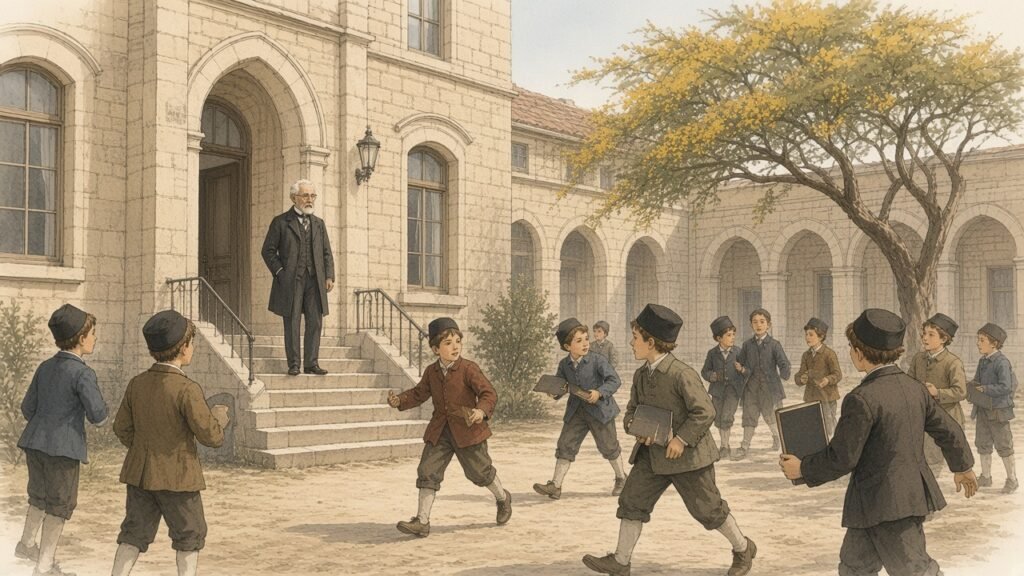
In 1881 Abramovitsh moved to Odessa, where he had been appointed head of the Talmud Torah, the school maintained by the Jewish community for the education of poor boys. He held the post for the rest of his life, more than thirty-five years. Under his direction the school combined religious instruction with secular subjects, including Russian, arithmetic and natural science, and it became a model of modern Jewish education. [29][2]
Odessa was the most dynamic city in the southern part of the empire, a port that had grown rapidly in the nineteenth century on the trade in grain. Its Jewish population, which numbered about a third of the inhabitants, was known for its openness to modern culture and its relative freedom from the authority of traditional leaders. The city was a centre of the Haskalah and later of the Zionist and Hebrew revival movements. [29][30]
Abramovitsh’s arrival in Odessa coincided with the pogroms of 1881, which affected the city in May of that year. The violence and the restrictive legislation that followed had a profound effect on Jewish opinion and led many maskilim to abandon their hopes of integration into Russian society. Some turned to the emerging movement for Jewish settlement in Palestine, while others joined the revolutionary movement or emigrated to America. [31][24][32]
Jewish Odessa had its own literary traditions. The city had been home since the 1860s to the Hebrew weekly Hamelits, founded by Alexander Zederbaum, and to Russian-language Jewish periodicals such as Razsvet and Sion. Its Jewish intelligentsia was more Russified than that of other cities, and debates about language, assimilation and national identity were especially lively there. [29][30]
For several years after his arrival in Odessa, Abramovitsh wrote little. The period of silence has been attributed to the crisis caused by the pogroms, to the demands of his new position and to personal difficulties. When he resumed writing in the mid-1880s, it was in a new language and a new style. [2][6]
11. The schoolmaster
The Talmud Torah that Abramovitsh directed served the poorest families of Jewish Odessa. Its pupils were the sons of porters, artisans, widows and recent migrants from the provincial towns, many of whom could not afford the fees of private schools. The community supported the school through charitable contributions and the proceeds of communal taxes, and it provided the boys with instruction, meals and sometimes clothing. [29][30]
Under Abramovitsh the curriculum was reorganised to include secular subjects alongside religious study. The boys learned to read and write Russian, studied arithmetic and the elements of natural science, and received instruction in Hebrew grammar and the Bible as well as the traditional texts. The school also offered training in practical skills, preparing some pupils for apprenticeships in trades. [2][15]
Abramovitsh took a close personal interest in the running of the school. Accounts by former pupils and teachers describe him walking through the classrooms, questioning the boys and correcting their answers, and insisting on order and cleanliness. He was strict but concerned for the welfare of the children, and he used his connections in the community to raise funds for the school. [30][2]
His work as an educator was consistent with the convictions he had held since his youth. The essay on education that he had published in 1857 had argued for a reform of the traditional cheder, and his satirical works had repeatedly mocked the ignorance and incompetence of traditional teachers. At the Talmud Torah he had the opportunity to put his ideas into practice, and the school became one of the most respected institutions of its kind in the empire. [5][6]
Several of the teachers who worked under him later became writers and educators of note, and the school’s reputation attracted visitors from other cities. Bialik taught for a time in Odessa, and the circle of Hebrew educators around Abramovitsh contributed to the development of new methods of teaching Hebrew that would later be adopted in Palestine. [33][19]
12. The naturalist
Throughout his life Abramovitsh maintained a deep interest in natural science. His Hebrew natural history, Toldot hateva, was one of the most ambitious works of popular science in the Hebrew literature of the nineteenth century. Based on the work of the German naturalist Harald Othmar Lenz, it described mammals, birds and reptiles in detail, and it required Abramovitsh to devise Hebrew names for many species and anatomical features that had no established equivalents in the language. [19][2]
The project reflected the Enlightenment belief that science was a key to the modernisation of Jewish society. Abramovitsh argued that the Jews of eastern Europe, confined to the study of religious texts, had lost contact with the natural world and with the practical knowledge that other peoples possessed. By making scientific knowledge available in Hebrew, he hoped to broaden the horizons of his readers. [15][20]
His interest in nature also found expression in his fiction. The landscapes of his novels are described with precision and feeling, and his characters’ relationship with the natural world is often a measure of their spiritual condition. In Shloyme reb Khaims, the boy’s love of the forests and fields is presented as a source of joy and freedom in contrast to the confinement of the study house. [6][2]
His scientific interests extended to astronomy, physics and geography as well as zoology. In conversation with friends in Odessa he would often turn to these subjects, and visitors recalled his delight in explaining natural phenomena. The breadth of his curiosity distinguished him among the Jewish writers of his generation, most of whom had little scientific training. [30][2]
Robert Alter has noted that the vocabulary Abramovitsh developed for Toldot hateva contributed to his later achievement as a Hebrew prose stylist. The effort to describe the natural world precisely in Hebrew trained him in the use of the language for concrete description, a skill that he later applied to the portrayal of human life. [20]
13. A new Hebrew style
In 1886 Abramovitsh published a Hebrew story, Beseter ra’am, in the secret place of thunder, in the Hebrew daily Hayom. The story marked his return to Hebrew after more than twenty years in which his creative work had been devoted primarily to Yiddish, and it introduced a new style of Hebrew prose that would transform the language as a literary medium. [16][20]
The new style, often called the nusach, the formula or style, drew on all the historical layers of the Hebrew language, including not only the Bible, which had been the main model of Haskalah writers, but also the Mishnah, the Talmud, the Midrash and the liturgy. By combining these sources, Abramovitsh was able to create a Hebrew capable of describing everyday life with precision and flexibility, while preserving the richness of allusion that gave the language its literary power. [20][19]
Robert Alter has described this achievement as the invention of modern Hebrew prose. Before Abramovitsh, Hebrew fiction had been constrained by the biblical style, which forced writers to describe modern realities in phrases drawn from ancient texts, often with awkward or comic results. Abramovitsh’s synthesis opened the way for a realistic Hebrew fiction, and it was adopted by the writers who followed him. [20][16]
In the following years Abramovitsh translated many of his own Yiddish works into Hebrew, often revising and expanding them in the process. The Hebrew versions of Fishke the Lame, Benjamin the Third and The Magic Ring became classics of Hebrew literature in their own right. He thus became a founding figure in two literatures, writing parallel versions of the same works in two languages. [2][10]
The new style was not created overnight. Abramovitsh experimented with it over several years, testing different combinations of sources and adjusting his vocabulary and syntax. His correspondence with other writers shows him discussing particular words and phrases and defending his choices against critics who regarded his use of rabbinic Hebrew as a departure from the purity of the biblical language. [20][16]
The bilingual character of his work raises questions about the relation between the two versions. Scholars have noted that the Hebrew and Yiddish versions differ in tone, detail and emphasis, reflecting the different resources of the two languages and the different expectations of their readers. The Yiddish versions tend to be more colloquial and earthy, the Hebrew more allusive and ironic. [22][20]
14. The Odessa circle
In the 1890s Odessa became the centre of a remarkable circle of Hebrew and Yiddish writers and thinkers, and Abramovitsh was its senior member. The circle included Ahad Ha’am, the essayist and theorist of cultural Zionism, the historian Simon Dubnow, the poet Hayim Nahman Bialik, the editor Yehoshua Hana Ravnitzky and the publicist Moshe Leib Lilienblum. These men met regularly to discuss literature, politics and the future of the Jewish people. [34][35][33][30]
Bialik, who arrived in Odessa as a young man in 1891 and returned to settle there in 1900, regarded Abramovitsh as a master and wrote an essay in which he described him as the creator of the nusach. Bialik and Ravnitzky later collaborated on the Hebrew translation and editing of Abramovitsh’s works, and Bialik himself translated part of Fishke the Lame into Hebrew. [33][20]
Sholem Aleichem, who lived in Odessa in the early 1890s, was also a frequent visitor. He had described Abramovitsh as the grandfather of Yiddish literature in 1888, and the title stuck. The relationship between the two writers was close, although Sholem Aleichem’s admiration was mixed with a sense of rivalry, and Abramovitsh’s opinions of younger writers could be severe. [25][22]
Abramovitsh was known in the circle for his wit, his strong opinions and his habit of holding forth on literary and scientific subjects. Visitors described an imposing figure with a white beard and a sharp tongue, who could be both charming and difficult. He was particularly critical of what he regarded as careless writing, and his comments on the work of others were often quoted. [30][2]
The circle’s meetings took place in private apartments, in editorial offices and in the cafés of the city. Its members disagreed on many questions, including the merits of Yiddish, the prospects of settlement in Palestine and the role of religion in modern Jewish life. Abramovitsh, who had long since outgrown the doctrines of the early Haskalah, took a characteristically independent position in these debates. [34][30]
Younger writers who visited Odessa in these years often sought an audience with Abramovitsh. Some came with manuscripts to show him, others simply to see the man whose books they had read in their youth. His reception of them varied with his mood, and stories of his sharp remarks circulated widely among Yiddish and Hebrew writers. [30][25]
The Odessa circle played a central role in the development of modern Hebrew culture. Its members founded publishing houses, edited journals and promoted the use of Hebrew as a modern language. Abramovitsh’s work provided a model for the Hebrew prose that the circle sought to create, and his presence lent the circle a sense of continuity with the earlier generation of the Enlightenment. [16][34]
15. Hasidim, maskilim and the community
Abramovitsh’s fiction is set in a Jewish society divided by deep conflicts. The Hasidic movement, which had spread through the Ukrainian and Polish provinces since the eighteenth century, commanded the loyalty of large parts of the population in the regions where he lived. Its leaders, the rebbes, held court in towns across the south-west, and their followers travelled to them for blessings and counsel. Opposed to them were the mitnagdim of the Lithuanian tradition, who emphasised learning, and the maskilim, who sought to modernise Jewish life. [11][15]
In his early works Abramovitsh shared the hostility of the maskilim towards Hasidism. He portrayed its leaders as exploiters of the credulous and its practices as superstition, and he satirised the miracle tales and the worship of rebbes. His treatment of the movement was, however, less extensive than that of some other Haskalah writers, and his satire was directed more often at the communal oligarchy than at religious life as such. [6][11]
The communal structure of Jewish towns provided much of his material. The kahal, the self-governing body of the community, had been formally abolished by the Russian government in 1844, but in practice the leading families of each town continued to control communal institutions, taxes and charities. Abramovitsh portrayed these men as a closed circle of the rich and powerful, who used their position to enrich themselves and to keep the poor in subjection. [12][6]
His attitude towards the maskilim themselves was also critical. In several works he satirised the pretensions of educated Jews who imitated Russian or German manners, despised their own people and lacked any real understanding of the problems of Jewish society. The figure of the shallow maskil, who speaks of progress while remaining indifferent to the poor, appears repeatedly in his fiction. [15][23]
His portrayal of charity is particularly sharp. The institutions that were meant to relieve poverty, including the poorhouse, the communal kitchen and the burial society, appear in his novels as places of humiliation and corruption, where the poor are made to beg for what is theirs by right. The satire reflected his conviction that charity could not substitute for economic reform and education. [6][10]
In his later works, particularly the autobiographical writings, Abramovitsh’s portrayal of traditional Jewish society became more nuanced. He recognised the values of learning, piety and mutual support that it had embodied, and he presented the life of the study house and the synagogue with sympathy. This shift paralleled the broader re-evaluation of tradition among Jewish writers at the end of the nineteenth century. [6][22]
16. Marriage, family and the household
Questions of marriage and family occupy an important place in Abramovitsh’s work. The traditional system of arranged marriages, in which young people were married in their teens by agreement between families, was a frequent target of Haskalah criticism, and Abramovitsh portrayed its consequences in several works. His characters include young husbands who are dependent on their in-laws, wives who must support the family while their husbands study, and couples bound together without affection. [15][6]
Senderl, the companion of Benjamin the Third, is a comic example of the henpecked husband, dominated by his wife and known in the town as the housewife. Benjamin himself leaves his wife and children without a word to pursue his dream of finding the lost tribes. The novel’s comedy depends partly on the inversion of conventional roles, but it also reflects a social reality in which many women bore the burden of providing for their families. [10]
In Fishke the Lame, the hero’s first marriage, arranged by the community to a blind beggar woman, is portrayed as a cynical transaction, and his love for the hunchbacked girl Beyle is presented as the only genuine feeling in a world of exploitation. The contrast between arranged and chosen love reflects the influence of European romantic literature, which had shaped the expectations of a new generation of Jewish readers. [10][22]
The portrayal of women in his fiction was shaped by the conventions of his time, but it also reveals an awareness of their position. Women in his works run shops and market stalls, manage households on meagre incomes and deal with the officials and traders of the town, while their husbands pursue learning, schemes or dreams. The economic role of women in Jewish society, which was considerable, is reflected in these portraits. [6][9]
17. Memory and autobiography
In the 1890s Abramovitsh turned to autobiography, a form that allowed him to reflect on his own life and on the changes that had transformed Jewish society during his lifetime. His autobiographical novel Shloyme reb Khaims, Shloyme the son of Chaim, published in Yiddish in 1899, describes the childhood and youth of a boy in a small Lithuanian Jewish town in the middle of the nineteenth century. The Hebrew version, Bayamim hahem, appeared in instalments and was revised over many years. [2][6]
The work opens with a frame in which Mendele meets an Odessa writer named Shloyme and learns that the writer was once a boy in a town like Kapyl. The writer then tells the story of his childhood, describing his father, his studies, the town and the surrounding countryside. The book is notable for its detailed and affectionate portrayal of traditional Jewish life, which contrasts with the satirical tone of Abramovitsh’s earlier works. [6][22]
Critics have seen in Shloyme reb Khaims a shift in Abramovitsh’s attitude towards the world of his childhood. Where his earlier works had criticised the shtetl for its poverty and backwardness, the autobiography looks back on it with nostalgia, recognising the values of community, learning and piety that it embodied. The shift reflected both the passage of time and the changed circumstances of Jewish life after 1881, when the ideals of the Enlightenment no longer seemed to offer a solution. [23][6]
The frame of Shloyme reb Khaims has attracted attention from critics because it brings together the two figures of Mendele and the author. Shloyme, the writer, is clearly a version of Abramovitsh himself, while Mendele is his invented persona, and the meeting between them dramatises the relationship between the author and his mask. The device allowed Abramovitsh to reflect on his own career and on the nature of literary invention. [6][22]
The autobiography also contains some of Abramovitsh’s finest descriptions of nature. The boy’s experience of the forests, fields and rivers around his town is described with a lyrical intensity that is rare in his work, and critics have connected these passages with his lifelong interest in natural history. [2][20]
18. Pogrom and exile in Geneva
In October 1905, in the days following the publication of the tsar’s manifesto promising civil liberties, a pogrom broke out in Odessa. Over several days mobs attacked Jewish homes and shops, and hundreds of Jews were killed. Jewish self-defence groups fought back, and the violence was among the worst of the wave of pogroms that swept the empire in that month. [31][36]
After the pogrom Abramovitsh left Odessa and went to Geneva, where he lived for about two years. The decision reflected both the danger of remaining in Odessa and the general sense of insecurity that the pogroms had created among the Jews of the empire. Many other writers and intellectuals left Russia in the same period. [37][2]
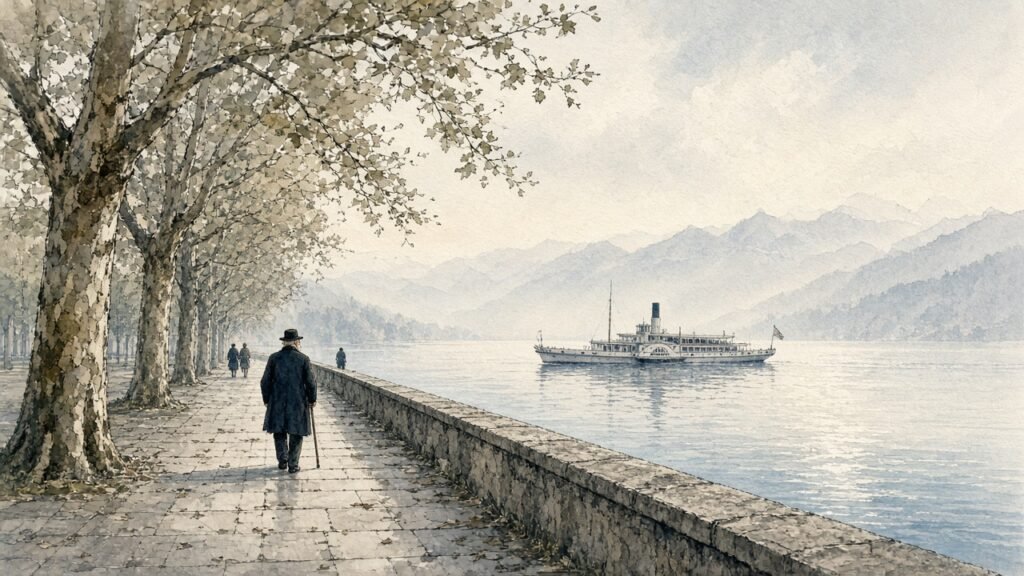
In Geneva Abramovitsh continued to work on the revision and translation of his works. He was by now an elderly man, and the exile was difficult for him. He corresponded with friends in Odessa and elsewhere and followed the news from Russia closely. In 1908 he returned to Odessa and resumed his position at the Talmud Torah. [37][29]
Geneva had long served as a refuge for exiles from the Russian Empire, including revolutionaries, students and intellectuals. Its Russian-speaking community was large and politically active, and the city’s libraries and cafés offered a setting for discussion and work. Abramovitsh lived quietly there, at a distance from the political controversies of the émigré colony, and devoted himself to his writing. [37][36]
The pogroms of 1905 had a lasting effect on his outlook. Like many Jews of his generation, he had once believed that education and reform would bring about the integration of the Jews into Russian society, and the violence of 1881 and 1905 made this hope seem increasingly remote. His last works reflect a sense of disappointment, but also a determination to preserve and transmit the culture he had helped to create. [24][6]
19. Satire and its targets
Abramovitsh’s satire was directed at many aspects of Jewish life. He attacked the communal leaders who exploited the poor, the tax farmers who profited from the meat tax, the matchmakers and marriage brokers who arranged unsuitable unions, the teachers who beat their pupils, and the charitable institutions that humiliated those they were supposed to help. He also mocked the superstition, credulity and resignation of ordinary people. [6][10]
At the same time his satire was never purely negative. He wrote as a reformer who wished to improve the condition of his people, and his portraits of the poor were often marked by deep compassion. Critics have described his attitude as one of love mixed with anger, in which the harshness of the satire reflects the intensity of his concern. [23][22]
The satire was also directed at the Russian authorities and at the non-Jewish society that oppressed the Jews. In The Mare, the abuse of the horse by its tormentors and the hypocrisy of the societies for the protection of animals serve as an allegory of the treatment of the Jews by the empire and by European liberals. In Benjamin the Third, the seizure of the two heroes by military recruiters recalls the brutal practices of conscription that Jewish communities had endured under Nicholas I. [6][10]
The satirical method also had a stylistic dimension. Abramovitsh often achieved his effects through the ironic application of sacred language to profane situations, describing the squabbles of communal officials in the phrases of biblical prophecy or the hunger of beggars in the language of the liturgy. Readers familiar with the sources would recognise the incongruity, and the comedy depended on this shared knowledge. [20][6]
Abramovitsh’s satire owed much to the traditions of the Haskalah, whose writers had long criticised traditional Jewish society, but it went beyond them in its artistic sophistication and its willingness to question the assumptions of the reformers themselves. In The Mare, in particular, the maskil Isrolik is as much an object of satire as the society he seeks to reform. [15][6]
20. The language of Mendele
The Yiddish that Abramovitsh wrote was the product of a long process of refinement. When he began to write in Yiddish in the 1860s, there was no established literary standard, and writers used a variety of dialects and spellings, often mixed with German forms that were thought to elevate the language. Abramovitsh rejected this practice and sought instead to create a literary Yiddish based on the spoken language of the people. [13][17]
His Yiddish drew on the dialects of both the Lithuanian north and the Ukrainian south, and it combined the vocabulary of everyday speech with the Hebrew and Aramaic elements that had always been part of the language. He paid close attention to rhythm, idiom and the sound of words, and he revised his texts repeatedly to achieve the effects he desired. [22][6]
The voice of Mendele was central to this achievement. Mendele’s speech is full of proverbs, biblical quotations and digressions, and it moves easily between the elevated and the colloquial. Through this voice Abramovitsh was able to demonstrate the expressive range of Yiddish and to show that it could serve as a medium for serious literature. [6][10]
His revisions of his Yiddish works over the decades reflect the development of his ideas about the language. Early versions contain Germanisms and forms that he later removed, replacing them with expressions drawn from spoken Yiddish. The final versions of his novels thus represent a mature literary Yiddish that served as a model for the writers who followed him. [13][22]
Later Yiddish writers regarded Abramovitsh’s language as a model, and his works were studied in Yiddish schools as examples of classic style. His influence on the development of literary Yiddish was comparable to his influence on modern Hebrew, and he is unique in having played a founding role in the literary standards of both languages. [17][20]
21. The jubilee and the last years
In 1910 the Jewish literary world celebrated Abramovitsh’s seventy-fifth birthday and the fiftieth anniversary of his literary career. Celebrations were held in Odessa, Warsaw, St Petersburg and other cities, and the Yiddish and Hebrew press published articles and tributes. A jubilee edition of his collected works in Yiddish and Hebrew was prepared, and the occasion confirmed his status as the patriarch of both literatures. [2][1]
In his last years Abramovitsh continued to direct the Talmud Torah and to work on his writings. He revised his novels repeatedly, polishing their language and expanding their content, and he oversaw the publication of the collected editions. The Hebrew edition was edited with the assistance of Bialik and Ravnitzky. [33][2]
The First World War and the revolutions of 1917 brought upheaval to Odessa. The city was affected by shortages, unrest and the collapse of the old order, and its Jewish population faced new uncertainties. Abramovitsh, now over eighty, lived through these events in his apartment at the school. [29][30]
Sholem Yankev Abramovitsh died in Odessa on 8 December 1917, a few weeks after the Bolshevik seizure of power in Petrograd. His funeral was attended by a large crowd of writers, teachers, pupils of the Talmud Torah and members of the community, and he was buried in the Jewish cemetery of Odessa. [1][29]
The jubilee celebrations provided an occasion for critics to assess his achievement. Essays published in the Yiddish and Hebrew press discussed his role in the creation of both literatures, his contribution to the Jewish Enlightenment and his place in the history of Jewish satire. Bialik’s tribute, in which he described Abramovitsh as the creator of a new style, became one of the most influential statements on his work. [33][20]
The jubilee also prompted a reassessment of his place in Hebrew literature. Critics noted that his Hebrew works had become models for a new generation of writers, and that the style he had created was now the dominant idiom of Hebrew fiction. The recognition came at a time when the Hebrew revival was gathering strength in both the Russian Empire and Palestine. [16][20]
In the Soviet period the old Jewish cemetery of Odessa was destroyed, and his remains, together with those of other notable figures, were reburied in another cemetery in the city. A monument commemorates him there. [29][2]
22. Translation and the stage
Abramovitsh’s works were translated into Russian, German, Polish, English and other languages, but they have proved difficult to render. The density of allusion, the play of registers and the rhythms of Mendele’s speech present challenges for any translator, and many of the early translations simplified the texts considerably. [10][22]
In 1996 the scholars Dan Miron and Ken Frieden edited a volume of new English translations of Fishke the Lame and Benjamin the Third, with translations by Ted Gorelick and Hillel Halkin. The volume, which includes extensive notes and introductions, aimed to convey the complexity of the originals and to introduce English-speaking readers to the full range of Abramovitsh’s art. [10]
The stage has also brought his work to new audiences. The Moscow State Jewish Theatre’s production of The Travels of Benjamin the Third in 1927 was a landmark in the history of Yiddish theatre, combining music, dance and grotesque stylisation in a manner that reflected both the satirical spirit of the novel and the avant-garde aesthetics of the Soviet theatre of the 1920s. [17][10]
Productions of his works on the Yiddish stage were not limited to Moscow. Theatres in Warsaw, Vilna, New York and Buenos Aires staged adaptations of Benjamin the Third, Fishke the Lame and The Tax in the interwar years, and amateur dramatic societies in many towns performed scenes from his novels. These productions helped to make the figures of Benjamin, Senderl and Fishke familiar to audiences who might not have read the books. [17][10]
In Israel, Hebrew adaptations of his works have been staged by several theatres, and his novels have remained part of the school curriculum. His portrayal of the shtetl has influenced Israeli literature and theatre, and his satire of messianic dreams has been read in the context of debates about Zionism and Israeli society. [16][32]
23. Abramovitsh and his successors
The three writers who are now regarded as the classics of modern Yiddish literature, Abramovitsh, Sholem Aleichem and Peretz, belonged to two different generations. Abramovitsh was born in the 1830s and began writing in the 1860s, while Sholem Aleichem and Peretz were born in the 1850s and began writing in Yiddish in the 1880s. The younger writers saw Abramovitsh as a pioneer whose work had made their own possible. [25][38][22]
Sholem Aleichem’s description of Abramovitsh as the grandfather of Yiddish literature, first made in 1888, established a genealogy in which the older writer stood at the head of the tradition. Peretz, who held different views about the direction of Yiddish literature, acknowledged Abramovitsh’s achievement but regarded his satirical method as belonging to an earlier stage of development. [25][38]
Ken Frieden has argued that the idea of a classic triad was partly a construction of the writers themselves and of the critics who followed them. Each of the three had a distinct approach, and their relations were marked by rivalry as well as respect. Nevertheless, the triad has become a standard framework for understanding the history of Yiddish literature, and Abramovitsh’s place in it as the founding figure is secure. [22][23]
Yiddish writers of the interwar period, including those in the Soviet Union, regarded him as the founder of a realist tradition that they sought to continue. Soviet critics in particular presented him as a critic of the Jewish bourgeoisie and a forerunner of socialist realism, an interpretation that emphasised his satire of the communal oligarchy and neglected other aspects of his work. [17][23]
In Hebrew literature, too, Abramovitsh’s successors acknowledged his influence. The writers of the generation of Bialik, and later the writers of the Hebrew revival in Palestine, regarded his nusach as the foundation of modern Hebrew prose, although some of them later rebelled against its allusive density in favour of a simpler style closer to spoken Hebrew. [33][20]
24. Legacy
Sholem Yankev Abramovitsh occupies a unique place in Jewish literary history as the founder of modern prose in two languages. In Yiddish he created the narrative voice of Mendele and a body of fiction that established the language as a medium for serious literature. In Hebrew he forged a new prose style that synthesised the historical layers of the language and made possible a realistic Hebrew fiction. [1][20][17]
His works offer a panorama of Jewish life in the Russian Empire in the nineteenth century, from the yeshivas and study houses to the markets and poorhouses, from the communal leaders to the beggars. They record the poverty, the oppression and the internal conflicts of that society with unflinching honesty, and they do so with a mixture of satire and compassion that has made them enduring. [6][23]
Abramovitsh’s achievement was also an act of cultural mediation. Writing at a time when Jewish society was undergoing rapid change, he sought to bridge the gap between the traditional world and the modern one, using the forms of the past to address the concerns of the present. The persona of Mendele, the book peddler who carries old books and new ideas from town to town, embodies this role. [6][15]
In Israel, streets in many cities bear the name of Mendele Mocher Sforim, and his works are taught in schools and universities. Collections of his manuscripts and letters are held in archives in Israel and elsewhere, and they continue to be studied by scholars of both literatures. [29][1]
Scholarship on Abramovitsh has grown considerably since the middle of the twentieth century. Dan Miron’s studies of the Mendele persona and of the image of the shtetl, Robert Alter’s analysis of the invention of Hebrew prose and Ken Frieden’s comparative study of the three classic Yiddish writers have placed his work at the centre of the history of modern Jewish literature. These studies have emphasised the sophistication of his narrative techniques and the complexity of his relation to the traditions he satirised. [6][20][22]
His influence on later writers in both languages has been profound. Yiddish writers from Sholem Aleichem to Isaac Bashevis Singer acknowledged his importance, and Hebrew writers from Bialik to the authors of the twentieth century regarded his prose as a foundation of their own. His works continue to be read, studied and translated, and the figure of Mendele remains one of the most recognisable in Jewish literature. [25][33][22]
25. Timeline
Sholem Yankev Broyde is born in Kapyl, Minsk province.
After his father's death he studies in yeshivas in Timkovichi, Slutsk and Vilna.
He travels through Volhynia and Podolia with the beggar Avreml the Lame.
He settles in Kamenets-Podolsk and studies under Avraham Ber Gottlober.
His Hebrew essay on education appears in Hamagid.
He marries Pessie Levin and moves to Berdichev.
He begins publishing his Hebrew natural history.
His first Yiddish work introduces Mendele the book peddler.
The first version of Dos vintshfingerl appears.
Di takse and Fishke der krumer are published, and he moves to Zhitomir.
The allegorical novel Di klyatshe appears.
The satirical travel novel is published.
He becomes head of the Odessa Talmud Torah.
His Hebrew story inaugurates the new Hebrew prose style.
Sholem Aleichem calls him the grandfather of Yiddish literature.
His autobiographical novel appears in Yiddish.
After the Odessa pogrom he lives in Geneva.
His seventy-fifth birthday and fifty years of writing are celebrated.
He dies on 8 December in Odessa.
The Moscow State Jewish Theatre stages The Travels of Benjamin the Third.
References
- Grokipedia, “Mendele Mocher Sforim” ↩
- YIVO Encyclopedia of Jews in Eastern Europe, “Abramovitsh, Sholem Yankev” ↩
- Grokipedia, “Minsk” ↩
- Grokipedia, “Slutsk” ↩
- Grokipedia, “Cheder” ↩
- Dan Miron, A Traveler Disguised: The Rise of Modern Yiddish Fiction in the Nineteenth Century (Schocken, 1973; Syracuse University Press, 1996) ↩
- Grokipedia, “Yeshiva” ↩
- Grokipedia, “Vilnius” ↩
- Grokipedia, “Shtetl” ↩
- Dan Miron and Ken Frieden, eds., Tales of Mendele the Book Peddler: Fishke the Lame and Benjamin the Third, trans. Ted Gorelick and Hillel Halkin (Schocken, 1996) ↩
- Grokipedia, “Hasidic Judaism” ↩
- Grokipedia, “Pale of Settlement” ↩
- Grokipedia, “Yiddish” ↩
- Grokipedia, “Kamianets-Podilskyi” ↩
- Grokipedia, “Haskalah” ↩
- Grokipedia, “Hebrew literature” ↩
- Grokipedia, “Yiddish literature” ↩
- Grokipedia, “Berdychiv” ↩
- Grokipedia, “Hebrew language” ↩
- Robert Alter, The Invention of Hebrew Prose: Modern Fiction and the Language of Realism (University of Washington Press, 1988) ↩
- Grokipedia, “Kol Mevaser” ↩
- Ken Frieden, Classic Yiddish Fiction: Abramovitsh, Sholem Aleichem, and Peretz (State University of New York Press, 1995) ↩
- Ruth R. Wisse, The Modern Jewish Canon: A Journey Through Language and Culture (Free Press, 2000) ↩
- Grokipedia, “Pogroms in the Russian Empire” ↩
- Grokipedia, “Sholem Aleichem” ↩
- Grokipedia, “Zhytomyr” ↩
- Grokipedia, “Alexander II of Russia” ↩
- Miguel de Cervantes, Don Quixote, trans. Edith Grossman (Ecco, 2003) ↩
- Grokipedia, “Odessa” ↩
- Steven J. Zipperstein, The Jews of Odessa: A Cultural History, 1794 - 1881 (Stanford University Press, 1985) ↩
- Grokipedia, “Odessa pogroms” ↩
- Grokipedia, “Zionism” ↩
- Grokipedia, “Hayim Nahman Bialik” ↩
- Grokipedia, “Ahad Ha’am” ↩
- Grokipedia, “Simon Dubnow” ↩
- Grokipedia, “Russian Revolution of 1905” ↩
- Grokipedia, “Geneva” ↩
- Grokipedia, “I. L. Peretz” ↩