The Sage of Ceglana Street
In the spring of 1915, while the armies of the Russian, German and Austro-Hungarian empires fought across the plains of Poland, the Jewish community of Warsaw buried a sixty-two-year-old official of its own administration. The man had spent a quarter of a century recording deaths and burials in the community’s offices, and in the same years he had become the central figure of modern Yiddish literature in Poland. Contemporary reports estimated that about a hundred thousand people followed his coffin to the cemetery on Gęsia Street. His name was Isaac Leib Peretz. [1][2]
This special feature follows Peretz from his birth in the Renaissance town of Zamość through his early Hebrew poetry, his career as a lawyer and the loss of his licence, and his move to Warsaw, where he worked for the Jewish community and turned his apartment into a meeting place for young writers. It examines his realist sketches, his radical holiday pamphlets, his imprisonment in 1899, the Hasidic and folk tales that made him famous, his plays and his role at the Czernowitz language conference of 1908. It closes with the war, his death and his legacy in Yiddish schools and letters. An interactive timeline at the end of the essay gathers the principal dates.
1. A childhood in Zamość
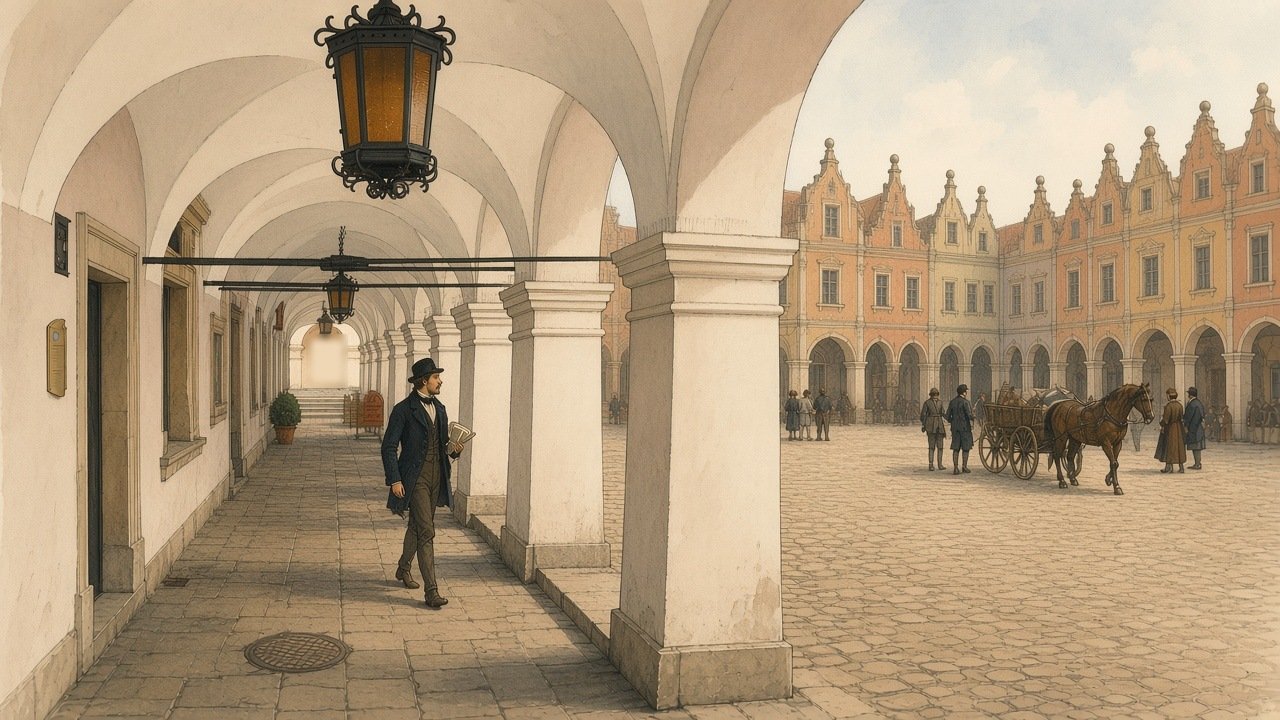
Yitskhok Leybush Peretz was born on 18 May 1852 in Zamość, a town in the Lublin province of the Kingdom of Poland, which was then under Russian rule. Zamość had been founded in the late sixteenth century by the chancellor Jan Zamoyski as an ideal Renaissance town, with a great arcaded market square, fortifications and a planned grid of streets, and it had attracted Sephardic as well as Ashkenazi Jewish settlers in its early years. The Peretz family held a tradition that they descended from Sephardic Jews, and Peretz was proud of the connection throughout his life. [3][2]
By the nineteenth century the Jewish community of Zamość was known for its openness to the Haskalah, the Jewish Enlightenment, which encouraged secular learning and the reform of education. The town had produced several notable maskilim, and it had a tradition of combining traditional learning with an interest in philosophy, science and European languages. At the same time Hasidism had made inroads in the surrounding region, and the tensions between these currents formed part of the atmosphere in which Peretz grew up. [4][3][5]
His father, Yude Peretz, was a merchant, and his mother, Rivke, ran a shop. The boy received a traditional education in the cheder and later studied the Talmud with private teachers, and he was regarded as exceptionally gifted. In his memoirs he described himself as a child with a quick mind and a restless temperament, who mastered his lessons rapidly and then looked for more. [6][7]
His curiosity soon extended beyond religious texts. As a teenager he gained access to a private collection of secular books in the town, and he read widely and without system in Polish, Russian, German and French, including works of science, history, philosophy and fiction. He learned these languages largely on his own. He later recalled that the experience opened a new world to him, although his parents and teachers expected him to continue in the path of traditional learning. [6][2]
The market square of Zamość, with its arcaded houses and town hall, formed the backdrop of his childhood. The Jewish quarter lay in the eastern part of the old town, around the synagogue built in the early seventeenth century, and the Jewish merchants of the town traded in grain, cloth and other goods with the surrounding countryside. In the nineteenth century the town’s fortifications still stood, and Zamość served as a Russian garrison town, a fact that brought soldiers and officials into its daily life. [3][6]
The memoirs Peretz published late in life describe the Zamość of his youth in vivid detail, including the market square, the synagogue, the houses of the wealthy and the poor, and the eccentric characters who populated the town. They also describe his early religious enthusiasm and his gradual distance from it. Literary historians have treated the memoirs with caution, since they were written many years later and reflect the concerns of a mature writer, but they remain the principal source for his early life. [6][8]
2. Marriage and Hebrew verse
In 1870, at about the age of eighteen, Peretz married Sarah Lichtenfeld, the daughter of Gabriel Yehuda Lichtenfeld, a maskil known for his learning in mathematics and Hebrew. The match was arranged by the families, as was customary. Through his father-in-law Peretz came into close contact with the Hebrew writers of the Enlightenment, and the two men collaborated on a volume of Hebrew poems that appeared in Warsaw in 1877. [2][9]
The early Hebrew poems followed the conventions of Haskalah verse, with its elevated diction, biblical allusions and moral themes. They did not attract much attention at the time, and Peretz himself later regarded them as apprentice work. They show, however, that he began his literary career within the Hebrew tradition, and he continued to write in Hebrew alongside Yiddish for much of his life. [9][8]
The marriage was unhappy, and it ended in divorce in the mid-1870s. A son, Lucian, was born of the marriage and later grew up with his father. Peretz spent some time in Warsaw after the divorce, where he worked at various jobs and continued to read and study. He prepared himself for the examination that would allow him to practise law, a profession that offered one of the few routes to independence for an educated Jew without capital. [2][1]
In 1878 he married Helena Ringelheim, with whom he remained for the rest of his life. Helena was from a Warsaw family and shared his interest in literature and ideas. The couple returned to Zamość, where Peretz had been admitted as a lawyer, and they lived there for the next decade. [2]
3. A lawyer in Zamość
For about ten years Peretz practised law in Zamość. He was successful and prosperous, with a large clientele that included both Jews and Poles, and he became a prominent figure in the town. He was involved in communal affairs, supported the establishment of a modern school and took part in the cultural life of the local intelligentsia. His legal work gave him an intimate knowledge of the disputes, debts and family conflicts of provincial society, which later found expression in his fiction. [2][3]
In 1887 his licence to practise law was revoked by the Russian authorities. The reasons have never been fully established, but it appears that he was denounced for political activity, possibly for sympathies with Polish patriotic or socialist circles or for teaching in Polish at an evening school for workers. The loss of his profession left him without an income and forced him to seek a new direction. [2][1]
The years in Zamość had been a period of relative silence in his literary career. He continued to read and to write, but he published little. The crisis of 1887 coincided with a new stage in the development of Yiddish literature, and Peretz began to look towards Yiddish as a medium for his work. [8][10]
His first major Yiddish work, the long narrative poem Monish, appeared in 1888 in Di yidishe folksbibliotek, the anthology edited by Sholem Aleichem in Kiev. The poem tells the story of a young Talmudic prodigy who is tempted by a beautiful demon disguised as a woman, and it combines the forms of the European romantic ballad with Jewish folk motifs. Monish was revised several times in later years and became a landmark in the history of Yiddish poetry. [11][12][13]
His position as a lawyer gave him unusual standing in a provincial town. He was one of a small number of Jews in the Kingdom of Poland who had entered the legal profession, and he dealt as an equal with Polish lawyers, judges and officials. The experience gave him an understanding of the workings of the Russian administration and of the legal disabilities that affected Jews, and it shaped his later interest in questions of justice and rights. [2][14]
The publication of Monish marked the beginning of Peretz’s career as a Yiddish writer. Sholem Aleichem’s anthology brought him into contact with the leading figures of the new literature, and he was soon recognised as one of its most promising voices. The two writers corresponded, although their relations were not always easy, and their different temperaments and literary approaches became a subject of comment among their contemporaries. [11][12]
4. The statistical journey
In 1890 Peretz took part in a statistical expedition organised by the Warsaw banker and railway magnate Jan Bloch. Bloch, who was of Jewish origin and had converted to Christianity, wished to collect data on the economic and social conditions of the Jews of the Kingdom of Poland in order to counter antisemitic claims that Jews were harmful to the economy. Teams of investigators were sent to towns and villages to gather information on occupations, incomes and living conditions. [2][14]
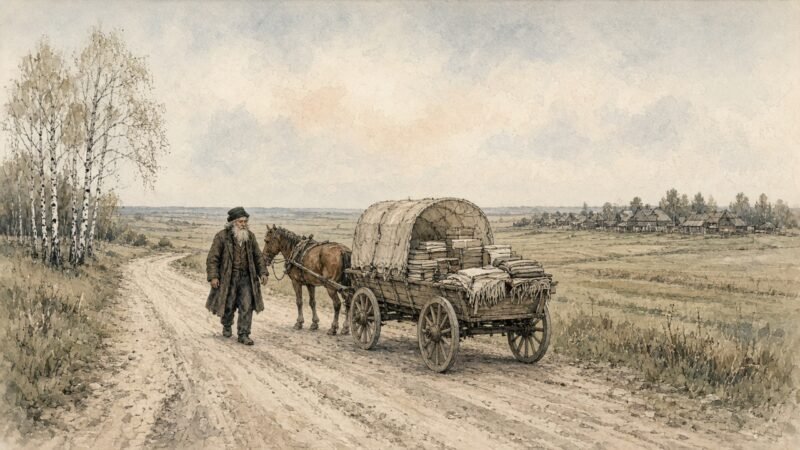
Peretz was assigned to the region around Tomaszów Lubelski, south of Zamość. He travelled through small towns and villages, interviewing householders and recording their answers. The experience brought him face to face with the poverty of provincial Jewish life, and it provided the material for a series of sketches published in 1891 under the title Bilder fun a provints-rayze, usually translated as Impressions of a Journey Through the Tomaszów Region. [13][8]
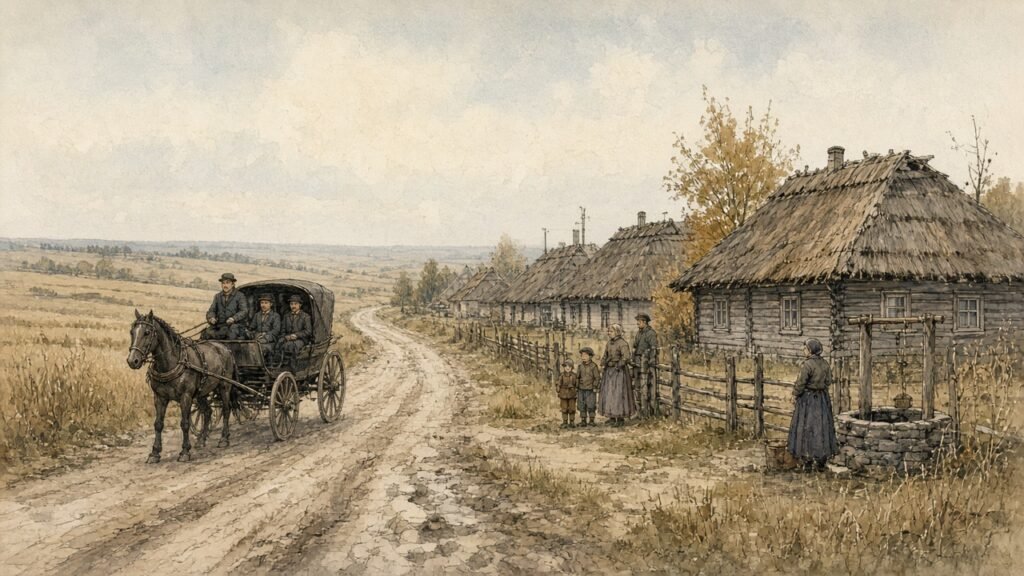
The sketches are written in the first person by a narrator who comes from the city with questionnaires and finds himself confronted by people who do not understand his purpose. Some suspect that he is a tax collector or a government agent, others hope that he has come to bring help, and many simply want to talk about their troubles. The narrator’s attempts to reduce their lives to statistics repeatedly fail, and the sketches become a reflection on the limits of the modern, rational approach to social questions. [13][15]
The Impressions mark an important point in Peretz’s development. They show his interest in the realistic portrayal of poverty and his scepticism about the solutions offered by both traditional leaders and modern reformers. They also introduce the figure of the narrator as an outsider, an educated man who observes the life of the people with sympathy but cannot share it fully, a figure that recurs in many of his later works. [8][12]
The towns he visited lay in a region of small estates, forests and poor soil, where Jews worked as shopkeepers, innkeepers, craftsmen and agents of the landowners. Many households depended on irregular trade with peasants, and the economic crisis of the period had left many without stable means of support. The sketches record the precise detail of these lives, including the furnishings of rooms, the clothes of children and the food on the table. [14][13]
The results of Bloch’s survey were never published in full. The data was reportedly destroyed or suppressed, and the project did not achieve its intended effect. For Peretz, however, the journey had lasting significance, and it helped to shape his understanding of the social reality that underlay the folk tales and Hasidic stories he would write in later years. [2]
5. The community office in Warsaw
After the expedition Peretz settled in Warsaw. In 1891 he obtained a position in the administration of the Jewish community, working in the department that handled burials and the cemetery. The post was modest, but it gave him a regular income and some security, and he held it until his death in 1915. His daily work brought him into contact with the poor of the city, who came to the office to arrange burials for their relatives. [16][2]
Warsaw in the 1890s was the largest Jewish city in Europe, with a Jewish population of well over two hundred thousand. It was a centre of commerce and industry, of traditional learning and Hasidism, and increasingly of Jewish political and cultural movements. The city attracted migrants from the provincial towns and from the Russian interior, and its Jewish quarter, centred on the streets north of the old town, was densely populated and socially diverse. [16][14]
Peretz lived with his wife and son at Ceglana Street 1, in an apartment that became one of the most important addresses in Jewish literary life. Over the following two decades, young writers from across Poland and the Russian Empire came to visit him there, to read their work aloud and to seek his advice and approval. His influence on the generation that came of age around 1900 was immense. [8][2]
The work at the community office also brought him into contact with the institutions of Jewish Warsaw. The community administration oversaw synagogues, schools, charities and the cemetery, and it was dominated by wealthy and often assimilated members of the community. Peretz’s position gave him a close view of the gap between the leaders of the community and the poor whom they served, a gap that he portrayed critically in many of his stories. [16][8]
In the early 1890s Peretz edited a series of anthologies titled Di yudishe bibliotek, which published fiction, poetry and essays on social and scientific subjects. The anthologies reflected his belief that Yiddish literature should not only entertain but also educate its readers, introducing them to modern ideas and to the literature of Europe. He wrote much of the content himself under various pseudonyms. [10][13]
6. The early stories
The first prose stories Peretz published in Yiddish appeared at the beginning of the 1890s, and they already showed the range and originality that would characterise his work. Among them was Venus and Shulamith, in which two yeshiva students argue over a photograph of a classical statue and the meaning of beauty in the Song of Songs, and The Mad Talmudist, a psychological study of a young scholar whose mind divides into competing voices. These stories introduced into Yiddish fiction a concern with inner experience that was new to the literature. [13][12]
In Venus and Shulamith the two students, sitting in the study house, debate whether the classical image of a goddess can be compared with the beloved of the biblical poem. Their conversation, conducted in the dialectical manner of Talmudic study, gradually reveals their own longing for a world of beauty and feeling that their education has denied them. The story uses the forms of traditional learning to explore the encounter between Jewish and European culture, a theme to which Peretz would return many times. [13][7]
The Mad Talmudist is narrated from within the mind of its protagonist, who hears an inner voice that comments on his thoughts and actions. The story has been read as an early experiment in the representation of consciousness, and critics have compared it with the psychological fiction of European writers of the same period. Its fragmented structure and its focus on mental disturbance set it apart from the realist conventions that dominated Yiddish fiction at the time. [12][8]
Another early story, The Messenger, follows an elderly man who carries a letter on foot through the winter countryside and gradually loses his strength. The story is told largely through the old man’s own thoughts and memories, and its quiet ending, in which he dies in the snow, shows Peretz’s ability to create pathos through restraint rather than rhetoric. [13]
These works established Peretz as a writer of unusual intellectual ambition. They were received with admiration by some readers and puzzlement by others, and they provoked discussion in the Yiddish and Hebrew press about the direction that the new literature should take. Some critics regarded them as too abstract for the Yiddish public, while others saw them as evidence that Yiddish literature had reached maturity. [10][8]
The stories also reveal the influence of Peretz’s wide reading in European literature. He knew the works of Heine, Turgenev, the Polish positivist novelists and the French realists, and he drew on their techniques while adapting them to Jewish material. His fiction thus stands at a point of intersection between the traditions of Jewish learning and the currents of nineteenth-century European literature. [17][12]
7. Realism and the radical holiday sheets
In the early 1890s Peretz wrote a number of realist stories that portrayed the poverty and suffering of Jewish workers and the lower middle class. These stories, often short and concentrated, presented scenes of hunger, illness and humiliation with a restraint that heightened their effect. Among them were sketches of seamstresses, porters, unemployed teachers and abandoned wives, figures who had rarely appeared in Yiddish literature before. [13][12]
Between 1894 and 1896 Peretz, together with the young writer David Pinski, published a series of pamphlets known as Yontev bletlekh, holiday leaflets. The pamphlets were issued in connection with Jewish festivals in order to circumvent the Russian censorship regulations, which made it difficult to obtain permission for a regular periodical. They contained stories, poems and essays with a strongly social and critical orientation, and they were read widely by young workers and students. [18][2]
The Yontev bletlekh attacked the leadership of the Jewish community, the wealthy and the religious establishment, and they called for education, social reform and the improvement of the conditions of workers. They were associated with the emerging Jewish labour movement, which in these years was organising strikes and study circles in the industrial towns of Poland and Lithuania, and some of their contributors later became active in the Bund. [19][8]
The leaflets were produced on modest budgets and distributed through networks of young readers in Warsaw and the provinces. Copies passed from hand to hand in workshops and study circles, and their influence was greater than their print runs might suggest. The police regarded them with suspicion, and several issues were confiscated. [18][19]
Peretz’s own position was complex. He sympathised with the workers and supported their demands, but he was never a committed socialist, and he distrusted the materialism and internationalism of the Marxist movement. In later years he would criticise the Bund for subordinating culture to politics. His radical period was nonetheless important both for his reputation and for the development of Yiddish as a language of social criticism. [19][8][17]
8. Bontshe the Silent
Among the stories Peretz wrote in this period, the best known is Bontshe shvayg, Bontshe the Silent, published in 1894. The story tells of a poor porter who lives and dies without ever complaining, enduring every humiliation and injustice in silence. When he arrives in heaven, he is received with great honour, and the heavenly court, finding nothing to condemn in his life, offers him any reward he wishes. Bontshe asks for a hot roll with fresh butter every morning, and the angels lower their heads in shame while the prosecutor laughs. [13][1]
The story has been interpreted in contrasting ways. Some readers have seen it as a celebration of the patience and humility of the poor, in keeping with the traditional value placed on suffering. Others have read it as a bitter satire of the passivity that allowed injustice to continue, a call for the poor to recognise their rights and demand more from life. The laughter of the prosecutor, at the end, has been taken to indicate that Peretz regarded Bontshe’s meekness as a failure rather than a virtue. [8][12]
The ambiguity of the story is characteristic of Peretz’s work. Many of his stories present situations that can be read in more than one way, and they resist simple moral conclusions. This quality has made his work a continuing subject of critical discussion, and it distinguishes him from writers who used fiction primarily to convey a clear message. [17][15]
The figure of the silent sufferer had deep roots in Jewish tradition, which honoured those who accepted hardship without complaint. By placing such a figure before a heavenly court and having him ask for so little, Peretz turned the tradition against itself. The scene of the court, with its defending angel, its prosecutor and its presiding judge, imitates the language of religious texts, and the irony of the conclusion depends on the reader’s recognition of these conventions. [13][17]
Bontshe the Silent became one of the most frequently translated and anthologised Yiddish stories, and it was adapted for the stage on several occasions. It remains one of the works by which Peretz is best known to readers outside the Yiddish-speaking world. [13]
9. Arrest and the Citadel
In 1899 Peretz was arrested by the Russian police after attending a meeting of workers at which he spoke. The meeting was regarded by the authorities as a gathering of a socialist organisation, and Peretz was held for several months in the Warsaw Citadel, the fortress that served as a political prison for opponents of the tsarist government. [20][2]
The imprisonment was a significant event in his life. It confirmed his reputation among young radicals as a writer of conscience, and it brought him into closer contact with the realities of political persecution. At the same time it seems to have made him more cautious, and in the following years his work turned away from direct social criticism towards new forms and themes. [8][1]
The meeting at which he was arrested took place at a time when the Russian police in Warsaw were pursuing the Jewish and Polish socialist movements with increasing vigour. Many young Jewish workers and students were arrested in these years, and a number of them were exiled to Siberia. Peretz’s prominence and his status as an employee of the community may have contributed to the comparative leniency of his treatment. [20][19]
After his release Peretz returned to his post at the community office and resumed his literary activity. His apartment on Ceglana Street continued to be a gathering place for young writers, and his position as the leading Yiddish writer in Warsaw was by now firmly established. [2]
10. The salon at Ceglana Street
The circle that gathered around Peretz at Ceglana Street 1 included many of the writers who would shape Yiddish literature in the twentieth century. Among the regular visitors were Sholem Asch, who arrived in Warsaw from the town of Kutno in 1899 and whose early stories Peretz encouraged, Hersh Dovid Nomberg, Abraham Reisen, David Pinski, Peretz Hirschbein and Shloyme Ansky. Older friends such as Jacob Dinezon, the novelist, were also part of the household. [21][18][22][8]
Visitors described a scene in which young writers would read their manuscripts aloud while Peretz listened, interrupted and commented, sometimes with enthusiasm and sometimes with sharp criticism. He was known for his generosity to beginners and for his impatience with work he considered derivative or careless. Many writers recalled that his approval was a decisive moment in their careers, and that his disapproval could be equally memorable. [8][17]
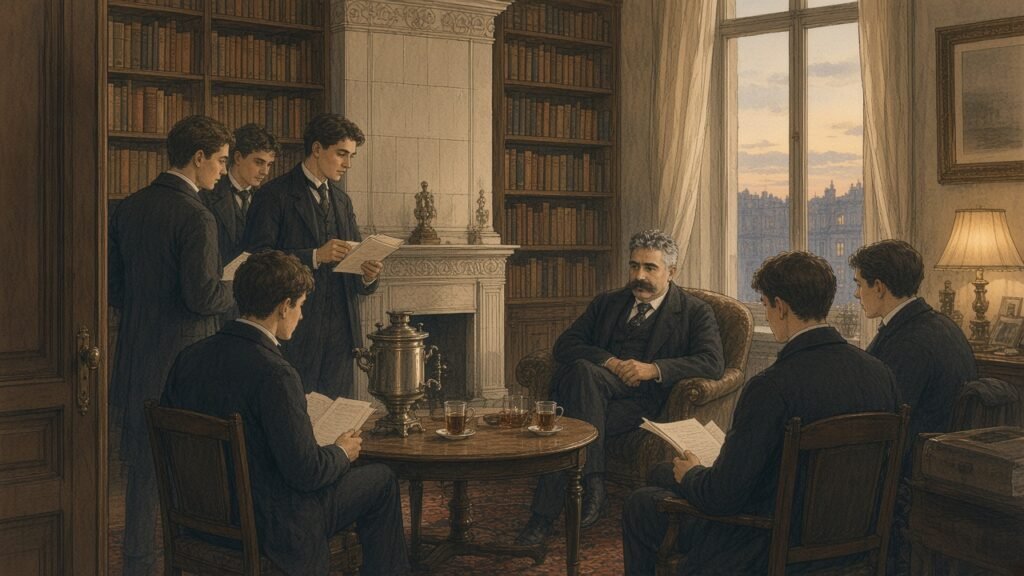
Peretz’s role in the circle was that of a mentor and a guide rather than a teacher of a particular style. He encouraged his followers to find their own voices, and the writers who emerged from his circle were strikingly diverse. Some wrote realist fiction, others lyrical poetry or symbolist drama. What they shared was a conviction, which Peretz did much to instil, that Yiddish literature could and should aspire to the standards of European literature. [10][8]
Visitors also came from beyond Warsaw. Writers from Lithuania, Ukraine and Galicia made the journey to Ceglana Street, and some settled in Warsaw in order to be near him. Letters from young authors seeking his opinion arrived in large numbers, and he answered many of them personally. His correspondence of these years constitutes an important record of the development of Yiddish literature in the period. [8][2]
The salon also had a social and political dimension. It brought together writers of different political persuasions, including Zionists, Bundists and those who stood apart from all parties, and it provided a space for discussion of the questions that occupied the Jewish intelligentsia of the time, including national identity, language, religion and social justice. [23][19][8]
11. The Hasidic tales
Around the turn of the century Peretz began to publish a series of stories drawn from the world of Hasidism, which were later collected under the title Khsidish. These stories differed sharply from the satirical treatment that Hasidism had received from earlier Haskalah writers, who had generally portrayed the movement as superstitious and backward. Peretz approached it instead as a source of spiritual and ethical values that could speak to modern readers. [5][13]
One of the best known of these stories is Oyb nisht nokh hekher, If Not Higher, published in 1900. It tells of a rebbe in the town of Nemirov who disappears every morning during the penitential prayers before the High Holidays. His followers believe he ascends to heaven, but a sceptical Lithuanian Jew follows him and discovers that he goes into the forest disguised as a peasant, cuts wood and carries it to a poor sick widow, lighting her stove and reciting the penitential prayers as he does so. The sceptic becomes a disciple, and when others say the rebbe ascends to heaven, he adds quietly, if not higher. [13][1]
Other Hasidic stories, such as Mekubolim, the Kabbalists, and Between Two Mountains, explore the relations between learning and piety, between asceticism and joy, and between the scholarly tradition of the Lithuanian yeshivas and the emotional fervour of Hasidism. In Between Two Mountains, a rabbi of the scholarly tradition and a Hasidic rebbe meet, and the narrator describes how the rebbe’s vision of the world shows the joy that the scholar’s learning had missed. [24][25][13]
Critics have long debated the meaning of these stories. Some see them as a sincere expression of Peretz’s admiration for Hasidism, others as a modern writer’s appropriation of traditional material for his own purposes. Ruth Wisse and David Roskies, among others, have argued that the stories should be read as works of a sophisticated modern author who used the forms of the Hasidic tale to explore questions of faith, doubt and ethics that concerned his own generation. [8][15]
The setting of If Not Higher in Nemirov, a town in Podolia associated with the Hasidic movement, and the figure of the Lithuanian sceptic reflect the historic tension between Hasidim and their opponents, the mitnagdim, who had resisted the movement since the late eighteenth century. By making the sceptic the narrator’s witness, Peretz framed the story as a test of belief that the rebbe’s conduct passes in an unexpected way. [5][15]
The Hasidic stories were immensely influential. They helped to create a new image of Hasidism in modern Jewish culture, one that emphasised its spiritual depth and its compassion for the poor, and they inspired later writers and thinkers, including Martin Buber, to explore the Hasidic tradition. [5][17]
12. The poet
Although Peretz is best known for his prose, he wrote poetry throughout his career, and his contribution to Yiddish verse was significant. After Monish he published lyric poems, ballads and longer narrative poems, experimenting with forms and metres drawn from European poetry. His verse often combined romantic themes of love, longing and nature with social criticism and reflections on the condition of the Jewish people. [10][13]
In the 1890s Peretz published a cycle of love poems and a number of poems on social themes that were widely read. Some of his verses were set to music and became popular songs, sung at workers’ meetings and in Yiddish schools. His poetry helped to establish the lyric as a serious genre in Yiddish, at a time when Yiddish verse was still dominated by the folk song and the work of popular bards. [10][8]
Peretz’s poetry also had an influence on younger poets. Abraham Reisen, whose simple and musical lyrics became among the most beloved in Yiddish literature, was a regular visitor at Ceglana Street, and other poets of the generation that came of age around 1900 acknowledged his example. Later Yiddish poets, including the members of the American group Di yunge, reacted against what they saw as the didactic tendencies of the earlier generation, but they too regarded Peretz as a founding figure. [10][17]
Critics have generally considered Peretz’s poetry less accomplished than his prose, and he himself came to devote less time to it as his career progressed. Monish, however, remains an important work in the history of Yiddish verse. The successive revisions of the poem show Peretz working to refine the rhythm and diction of literary Yiddish, and the poem’s ironic narrator, who comments on the story as it unfolds, anticipates the narrative voice of much of his later fiction. [12][13]
13. Warsaw in the fiction
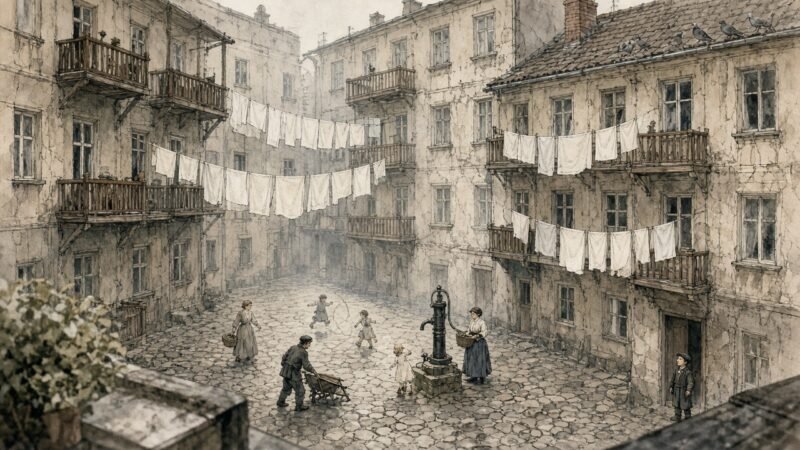
Peretz lived in Warsaw for a quarter of a century, and the city appears frequently in his stories. His realist sketches of the 1890s portray the tenements, courtyards and workshops of the Jewish quarter, where families lived in single rooms and worked long hours for small wages. The characters include seamstresses who sew by candlelight, porters who carry loads through the streets and teachers who cannot find pupils. [16][13]
His work at the burial office provided material of a particular kind. Several stories reflect his daily contact with the bereaved poor who came to arrange funerals, and the theme of death recurs throughout his writing. The administrator who records the deaths of others is himself a figure in some of his sketches, observing the grief of families from behind a desk. [2][8]
The streets around his home, including the busy thoroughfares of the Jewish quarter to the north and the commercial districts to the south, provided a constant supply of impressions. He walked daily between his apartment and the community office, and the people he encountered on these walks, including beggars, hawkers, students and Hasidim on their way to prayer, appear in many of his sketches. [16][14]
The Warsaw of Peretz’s fiction is also a city of contrasts between old and new. Hasidic courts and study houses stand beside cafés, newspaper offices and political meetings, and characters move between these worlds. In some stories the city is a place of opportunity and freedom, in others a place of anonymity and alienation, and Peretz’s portrayal reflects the ambivalence that many Jews felt towards the great modern city. [14][17]
14. Folk tales retold
In the first decade of the twentieth century Peretz published another series of stories, the Folkstimlekhe geshikhtn, stories in the folk manner. These drew on the legends, parables and wonder tales that circulated in Jewish communities, and they retold them in a style that combined apparent simplicity with literary sophistication. Peretz did not simply transcribe folk tales. He reshaped them, adding psychological depth and ethical complexity, and he gave them a polished form that made them suitable for modern readers. [13][15]
One of the most celebrated of these stories is Dray matones, Three Gifts, published in 1904. A soul that has been neither good nor evil is sent back to earth to bring three gifts that might open the gates of paradise. It returns with a handful of earth from the Land of Israel for which a Jew gave his life, a bloodstained pin from a woman who was dragged to her death and fastened her skirt to her flesh to preserve her modesty, and a skullcap from a man who ran the gauntlet and stooped to recover it. The gifts are accepted, and a voice remarks that they are beautiful but have no practical use. [13][8]
The story’s ending has been read as an expression of Peretz’s ambivalence towards the tradition of martyrdom. The gifts embody heroic devotion, yet the final remark suggests that such devotion achieves nothing in the world. As with Bontshe the Silent, the story invites the reader to consider the value of suffering without offering a clear answer. [15][17]
Other folk stories include tales of hidden saints, of miraculous rescues and of the prophet Elijah appearing in disguise. Among them is the story of Seven Good Years, in which a poor porter is offered seven years of prosperity and his wife uses the wealth to educate their children and help the poor, so that when the time comes to return the gift, it is left with them. These stories became standard reading in Yiddish schools and were translated into many languages. [13]
The style of the folk stories was carefully constructed. Peretz used short sentences, repetition and direct address to evoke the manner of a storyteller speaking to an audience, while at the same time controlling the structure of each story with great precision. Many of the stories end with a brief statement or question that alters the reader’s understanding of what has gone before. [15][13]
David Roskies has described Peretz’s folk stories as part of a broader project of creative betrayal, in which modern writers reworked traditional material in order to create a new Jewish culture that could draw on the past without being bound by it. In this view, Peretz’s achievement lay in showing that the forms of folk narrative could carry the concerns of the modern individual. [15]
15. The playwright
Peretz also wrote extensively for the theatre. His dramatic works range from short one-act plays to large symbolic dramas, and they reflect the influence of European modernism, particularly the symbolist theatre of Maurice Maeterlinck and the poetic drama of the Polish writer Stanisław Wyspiański. [2][8]
His most ambitious play, Di goldene keyt, the golden chain, first appeared in a Hebrew version and was revised in Yiddish over several years, with a major version published in 1907. It depicts several generations of a Hasidic dynasty, beginning with a rebbe who tries to prolong the Sabbath indefinitely in order to keep the world in a state of holiness and refuses to recite the prayer that ends it. The play explores the tension between the desire for redemption and the demands of ordinary life, and it presents the chain of generations as both a source of continuity and a burden. [13][5]
Another major play, Bay nakht oyfn altn mark, at night in the old marketplace, published in 1907, is a symbolic drama set in a town square at night, where the living and the dead, the real and the fantastic, mingle. It contains many characters and scenes and was long considered difficult to stage. Productions in the twentieth century, including one by the State Jewish Theatre in Moscow in 1925 directed by Alexei Granovsky, demonstrated its theatrical power. [13][2]
Peretz was closely involved in attempts to create a literary Yiddish theatre. He supported amateur theatrical societies in Warsaw, advised young actors and directors and took an active interest in the productions of his own plays. The Vilna Troupe, formed during the First World War, later included his work in its repertoire, and Yiddish art theatres in New York and elsewhere staged his plays in the interwar years. [2][8]
Peretz’s plays were less successful on the stage during his lifetime than his stories were in print, partly because the Yiddish theatre of the time was oriented towards popular entertainment and partly because the plays made demands that few companies could meet. They were nonetheless important in establishing the possibility of a serious, literary Yiddish drama, and they influenced younger playwrights such as Peretz Hirschbein and Shloyme Ansky, whose play The Dybbuk became one of the most famous works of the Yiddish theatre. [22][26]
16. The question of language
Peretz wrote in both Hebrew and Yiddish throughout his career, and his position on the question of the Jewish national language evolved over time. In his early years he regarded Hebrew as the language of high culture and Yiddish as a language for reaching the masses. Gradually, however, he came to see Yiddish as a language with its own literary potential, capable of expressing the full range of modern experience. [27][9][8]
The debate between Hebrew and Yiddish was one of the central controversies of Jewish cultural life in the early twentieth century. Zionists generally favoured Hebrew as the language of the national revival and the future Jewish homeland, while the Bund and other groups promoted Yiddish as the language of the Jewish masses in the diaspora. Writers who worked in both languages, as Peretz did, found themselves caught between the two camps. [23][19]
His own Yiddish style developed considerably over his career. In his early works he drew heavily on the Polish dialects of Yiddish spoken in his native region, while in his later works he moved towards a more standardised literary language. He was also willing to borrow words from Hebrew, German and Slavic languages when he felt they enriched the expressive range of Yiddish, a practice that some purists criticised. [28][27]
Peretz’s own view was that both languages had a place in Jewish life. He believed that Hebrew was essential to the continuity of the Jewish tradition, but he also argued that Yiddish was the living language of the people and that a modern Jewish culture must be built on it. He was critical of those who wished to abandon either language, and he warned against the assimilation of Jews into the languages and cultures of the surrounding nations. [8][17]
17. The conference at Czernowitz
In the summer of 1908 a conference on the Yiddish language was held in Czernowitz, the capital of the Austrian crown land of Bukovina. The conference was initiated by Nathan Birnbaum, a Viennese Jewish thinker who had earlier coined the term Zionism and who by then had become an advocate of Yiddish as the basis of Jewish national culture in the diaspora. The participants included writers, linguists and political activists from across eastern Europe and America. [29][27]
Peretz was the most prominent writer at the conference, and he played a leading role in its proceedings. In his address he argued for the dignity of Yiddish as a national language and called for the development of a modern culture in it, including translations of the Bible and the classics of world literature. He also warned against regarding Yiddish as a substitute for Hebrew, and he stressed the importance of both languages. [2][8]
The conference was marked by heated debate. Some delegates wished to declare Yiddish the national language of the Jewish people, while others insisted on recognising Hebrew as well. The final resolution, adopted after much discussion, declared Yiddish to be a national language of the Jewish people, a formulation that left room for Hebrew. The conference also discussed questions of orthography, grammar and the establishment of cultural institutions. [27][28]
The conference also had a personal dimension for Peretz. It brought him into contact with writers and activists from Galicia, Bukovina and America whom he had known only through correspondence, and it showed him the breadth of the Yiddish-speaking world. He returned to Warsaw with a strengthened conviction that Yiddish culture could become a unifying force for Jews across many countries. [8][27]
The Czernowitz conference became a symbolic event in the history of Yiddish culture. It marked the moment when Yiddish was publicly asserted as a language of national significance rather than merely a vernacular, and it contributed to the growth of Yiddish schools, publishing houses and cultural organisations in the following decades. Peretz’s role in it confirmed his position as the leading figure of the Yiddish cultural movement. [28][10]
18. Revolution and the years before the war
The revolution of 1905 affected the Jews of the Kingdom of Poland deeply. Strikes, demonstrations and armed clashes took place in Warsaw, Lodz and other cities, and the Jewish labour movement grew rapidly. The revolution also brought a temporary relaxation of censorship, which allowed the establishment of Yiddish daily newspapers in Warsaw, including Der veg in 1905 and later Haynt and Der moment. [30][14]
Peretz contributed to the new Yiddish press and saw his readership expand greatly. His stories, essays and feuilletons appeared regularly in the newspapers, and collected editions of his works were published. He also became involved in a range of cultural initiatives, including Yiddish literary societies, evening courses and theatrical projects. [2][1]
At the same time he was critical of some of the directions the new Yiddish culture was taking. He worried about the commercialisation of the press, the influence of party politics on literature and the decline of traditional values among the young. In essays of these years he called for a culture that would combine the ethical heritage of Judaism with the freedom of modern thought, a position that put him at odds with both religious conservatives and secular radicals. [8][17]
The expansion of the Yiddish press changed the conditions of literary work. Writers who had previously depended on anthologies and occasional publications could now reach large audiences through daily newspapers, and the demand for serialised fiction, essays and reviews created new opportunities. Peretz’s position as the senior figure of Warsaw’s Yiddish literature gave him considerable influence over the editors of the new papers. [14][10]
In these years Peretz began to write his memoirs, Mayne zikhroynes, which were serialised in the Yiddish press in 1913 and 1914. The memoirs, left unfinished at his death, cover his childhood and youth in Zamość and provide a vivid picture of Jewish life in a provincial town in the middle of the nineteenth century. [6]
19. Family and friendship
Peretz’s household at Ceglana Street was shaped by his marriage to Helena and by his relations with his son Lucian. Lucian, the son of his first marriage, grew up in a world very different from that of his father. He was educated largely in Polish, and he did not share his father’s commitment to Yiddish culture. The distance between them was a source of sadness to Peretz, and it reflected a broader pattern in which the children of the Jewish intelligentsia moved towards assimilation into Polish or Russian culture. [2][8]
Helena Peretz was a constant presence in the household and a hostess to the many visitors who came to see her husband. Memoirs of the period describe her as reserved but hospitable, managing the flow of guests and protecting her husband’s time for work. After his death she was involved in efforts to preserve his memory and to see his works into print. [8]
Among Peretz’s closest friends was the novelist Jacob Dinezon, whose sentimental novels had been very popular among Yiddish readers in the 1870s and 1880s. Dinezon was a frequent guest at Ceglana Street and worked with Peretz on many communal and cultural projects. The two men were so closely associated that they would later be buried side by side. [2][1]
The household also included a wide circle of acquaintances from outside the literary world. Teachers, doctors, communal workers and political activists visited Ceglana Street, and Peretz followed the affairs of the community with close interest. His position at the community office kept him informed of its finances and disputes, and he commented on them freely in conversation and in print. [16][8]
Peretz’s relations with the other classic writers of Yiddish literature were complicated. He respected Sholem Yankev Abramovitsh, but he regarded the older writer’s satirical approach as belonging to a past generation. His relations with Sholem Aleichem were cordial at times and strained at others, and the two men represented different conceptions of Yiddish literature, one rooted in the comic voice of the people and the other in the aspirations of the modern intellectual. [31][11][12]
20. War and the refugees
When war broke out in August 1914, Warsaw lay close to the front between the Russian and German armies. In the following months, as the Russian military authorities expelled Jews from areas near the front on suspicion of disloyalty, tens of thousands of Jewish refugees poured into the city. Many arrived with nothing, and the Jewish community struggled to provide them with food, shelter and medical care. [32][16]
Peretz threw himself into relief work. Together with Dinezon and others, he helped to organise aid for the refugees and to establish homes and schools for refugee children. He was particularly concerned with the education of the children, and he worked to ensure that they would be taught in Yiddish and given a grounding in Jewish culture. The children’s homes established in these months were among the first institutions of a kind that would later develop into a network of secular Yiddish schools. [2][8]
The refugees brought with them accounts of the destruction of towns and villages across Poland and Lithuania, and Peretz listened to many of these accounts directly. The scenes of displacement he witnessed in the last months of his life resembled, on a vastly greater scale, the poverty he had recorded in the Tomaszów region a quarter of a century earlier. [32][8]
The work was exhausting, and it took a toll on his health. He continued to go to his office at the community administration and to write, but those who saw him in these months described him as worn and anxious. He was deeply troubled by the reports of violence against Jews in the war zones and by the uncertainty of the future. [8][1]
21. Death in April 1915
On 3 April 1915 Peretz died suddenly of a heart attack at his home in Warsaw, at his desk, according to many accounts. He was sixty-two years old. The news spread rapidly through the city, and the Jewish press published long tributes. His death was felt as a loss not only by readers of Yiddish but by the whole Jewish community of Warsaw, which recognised him as one of its leading figures. [1][2]
The funeral was held on 6 April. Accounts estimated that about a hundred thousand people took part in the procession, which moved from Ceglana Street through the streets of the Jewish quarter to the cemetery on Gęsia Street, now known as the Jewish cemetery on Okopowa Street. Workers’ organisations, schools, literary societies and religious groups joined the procession, and shops in the Jewish quarter closed for the day. [16][8]
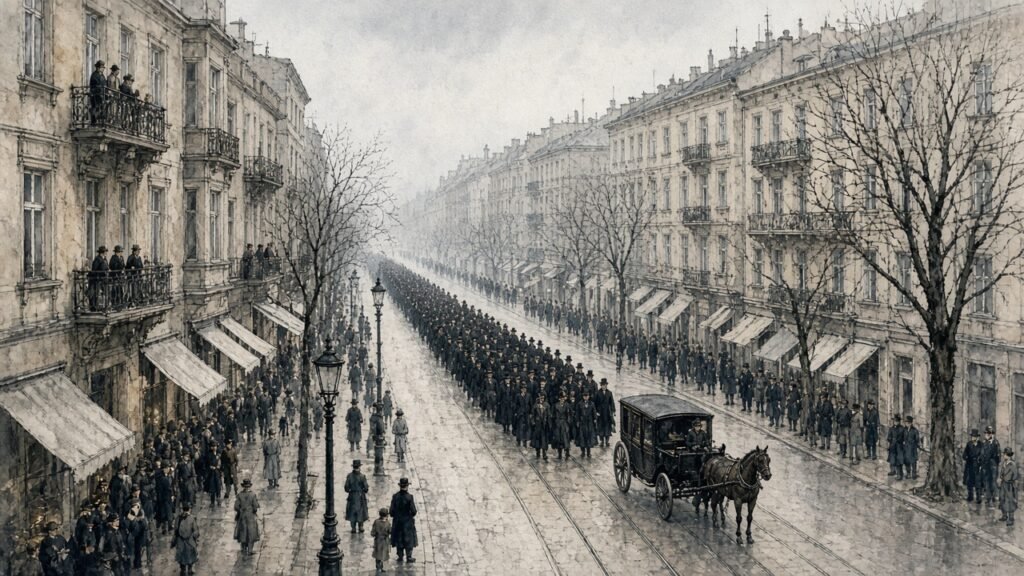
The scale of the funeral reflected the extent of Peretz’s influence. He had become a symbol of the new Jewish culture that had developed in Warsaw over the preceding decades, and his death was seen as the end of an era. Contemporary writers compared it with the funerals of national poets in other European countries, and they described it as a demonstration of the strength of Yiddish culture. [8][17]
Speeches were delivered at the graveside by representatives of the literary world and of the community, and tributes were printed in the Yiddish, Hebrew and Polish press. In the months that followed, memorial evenings were held in Warsaw and in the Yiddish-speaking centres of America, where readers gathered to hear his work read aloud and to listen to recollections of his life. [8][1]
Jacob Dinezon died a few years later, in 1919, and was buried beside him. In 1925 a monumental tomb was erected over the graves, designed by the sculptor Abraham Ostrzega. The writer Shloyme Ansky, who died in 1920, was also buried there, so that the three men lie together in the mausoleum, which became a place of pilgrimage for admirers of Yiddish literature. [26][2]
22. Schools and institutions
In the years after his death Peretz became the patron figure of the secular Yiddish school movement. In interwar Poland the Central Yiddish School Organisation, known by its Yiddish initials as TSYSHO, ran a network of schools that taught in Yiddish, and many of these schools bore his name. His stories were a central part of the curriculum, and generations of children learned to read Yiddish through them. [14][10]
In the United States the Workmen’s Circle and other organisations established Yiddish schools named after Peretz, and similar schools were founded in Canada, Argentina, Mexico and other countries with large Yiddish-speaking communities. These schools taught Jewish history, literature and culture from a secular perspective, and they regarded Peretz as the embodiment of their ideals of humanism, social justice and cultural continuity. [10][8]
Literary institutions also bore his name. The Association of Jewish Writers and Journalists in Warsaw, which had its headquarters at Tłomackie Street 13, was among the institutions that kept his memory alive between the wars, and after the Second World War the I. L. Peretz publishing house in Tel Aviv issued many works of Yiddish literature. In New York a small square on the Lower East Side was named Peretz Square in his memory. [16][1]
Interwar Warsaw also saw the publication of collected editions of his works, edited by his followers and issued in many volumes. These editions made his writings available to the new generation of readers educated in the Yiddish schools, and they established the canon of his work as it was known before the Second World War. [10][8]
The adoption of Peretz as a patron by so many different institutions reflected the breadth of his appeal. Secularists admired his humanism, traditionalists his sympathetic portrayal of Hasidism, socialists his concern for the poor and nationalists his commitment to Jewish culture. This breadth was partly a consequence of the ambiguity of his work, which allowed readers of different persuasions to find in it what they sought. [8][17]
23. Destruction and survival
The Second World War and the Holocaust destroyed the world in which Peretz had lived and worked. The Jewish population of Warsaw, which had numbered over three hundred and fifty thousand before the war, was confined by the German occupiers in the Warsaw Ghetto from 1940 and almost entirely murdered in the following years, most of them in the gas chambers of Treblinka. Zamość, Peretz’s birthplace, was likewise emptied of its Jewish population. [33][34][3]
Within the ghetto, Peretz’s memory remained alive. Cultural organisations held readings of his work, and his stories were taught in the clandestine schools. The historian Emanuel Ringelblum and his collaborators in the Oyneg Shabes archive, who documented life in the ghetto, recorded many of these activities. [33][34]
The mausoleum at the Okopowa Street cemetery survived the war, although the cemetery was damaged. After the war it became a place of commemoration for the survivors and for visitors from abroad. Peretz’s works continued to be published in Yiddish in Israel, America, Argentina and elsewhere, and they were translated into Hebrew, English, Polish and other languages. [1][8]
The survivors who returned to Warsaw after the war found the Jewish quarter in ruins, its streets razed by the Germans after the ghetto uprising of 1943. The building at Ceglana Street where Peretz had lived no longer stood. Survivors and visitors who came to the cemetery in the years after the war found the mausoleum among the damaged graves, and commemorations held there became occasions to remember both the writer and the community that had honoured him. [33][34]
The survival of Peretz’s work after the destruction of its original audience raised new questions about its meaning. For readers in Israel and America, his stories became a link to a vanished world, and they were often read with a sense of loss. At the same time scholars began to study his work with new rigour, examining its literary techniques and its place in the history of modern Jewish culture. [17][15]
24. Essays and the idea of a Jewish culture
Alongside his fiction and drama, Peretz wrote a large body of essays, feuilletons and polemical articles. These covered a wide range of subjects, from literary criticism and education to politics, religion and the future of the Jewish people. They appeared in the Yiddish and Hebrew press and in his own anthologies, and they were later collected in several volumes. [13][2]
A recurring theme of the essays is the relation between the Jewish tradition and modern culture. Peretz argued that Jews should neither abandon their heritage in favour of assimilation nor cling to it unchanged, but should reinterpret it in the light of modern values. He saw in the ethical teachings of the prophets and the compassion of Hasidism resources for a modern Jewish humanism, and he believed that literature had a central role to play in transmitting these values to a secular generation. [8][17]
In essays written in the years after 1905 Peretz reflected on the dangers facing Jewish culture in an age of nationalism and revolution. He expressed concern that the new Jewish movements were neglecting the spiritual dimension of Jewish life in favour of politics and economics, and he called for a cultural renewal that would give the people a sense of purpose. Essays of this kind made him a leading voice in the debates over the direction of Jewish life in the years before the First World War. [8]
Peretz also wrote extensively on the problems of Jewish education. He criticised the traditional cheder for its narrow curriculum and harsh methods, but he was equally critical of modern schools that taught Jewish children only in Russian or Polish and neglected their Jewish heritage. He advocated schools that would teach in Yiddish, include Jewish history and literature and prepare children for life in the modern world. These ideas influenced the secular Yiddish school movement that developed after his death. [8][14]
Many of the essays were written in the form of feuilletons, short pieces for the newspaper that combined commentary with anecdote and satire. Peretz used the form to respond quickly to events in the community and in the wider world, and his feuilletons were widely read and discussed. They show a lighter and more combative side of his personality than his fiction, and they record his opinions on a great range of subjects, from the conduct of communal elections to the latest productions of the Yiddish stage. [2][13]
His literary criticism was often sharp. He reviewed the work of younger writers frankly and sometimes harshly, and he engaged in public disputes with critics and editors. He was impatient with what he saw as sentimentality or imitation, and he insisted on the importance of artistic form. His criticism helped to raise the standards of Yiddish literature, although it also made him enemies. [17][10]
25. Reading Peretz in translation
Translations of Peretz’s work into other languages began during his lifetime and expanded greatly after his death. His stories appeared in Hebrew, Russian, Polish and German, and English translations were published in America from the early twentieth century. The early translations often presented him as a writer of pious folk tales, emphasising the Hasidic and folk stories at the expense of the realist and modernist works. [13][1]
In 1990 Ruth Wisse edited The I. L. Peretz Reader, an anthology that brought together new translations of a wide selection of his work, including stories, plays, essays and memoirs. The anthology aimed to present the full range of Peretz’s writing and to show him as a modern author engaged with the intellectual and artistic currents of his time. It has become the standard introduction to his work for English-speaking readers. [13]
Translators have faced particular difficulties with Peretz’s style. His prose is often elliptical, with abrupt transitions, fragmentary sentences and dense allusions to Jewish texts and customs. In the Hasidic and folk stories he imitates the cadences of oral storytelling, while in the realist stories he uses a terse, almost journalistic style. Capturing these variations in another language requires considerable skill. [13][15]
In Hebrew, Peretz’s works were translated by several hands, and he himself prepared Hebrew versions of some of his stories and plays. These versions sometimes differ significantly from the Yiddish texts, reflecting his view that each language required its own literary treatment. Scholars comparing the versions have used them to illuminate his methods of composition. [9][8]
The reception of Peretz in translation has also been shaped by the historical context. For many readers after the Holocaust, his work became a window onto the vanished world of Polish Jewry, and it was read with nostalgia. Scholars have cautioned against this approach, arguing that it obscures the critical and modernist dimensions of his writing. [17][8]
26. Legacy
Isaac Leib Peretz is remembered as one of the three classic writers of modern Yiddish literature, alongside Sholem Yankev Abramovitsh and Sholem Aleichem. Of the three, he was the one most closely associated with the transformation of Yiddish literature into a modern European literature, open to the influence of symbolism, neo-romanticism and other contemporary movements. His work ranged across fiction, poetry, drama and the essay, and he experimented with forms and styles throughout his career. [12][10][31][11]
His influence on later Yiddish writers was profound. The writers who gathered at Ceglana Street went on to shape the literature of the twentieth century in Warsaw, New York, Vilna and Moscow, and many of them regarded Peretz as their master. His example encouraged them to treat Yiddish literature as an art with its own standards and possibilities, and to seek in Jewish tradition material for modern works. [8][21]
Peretz’s significance also extends beyond literature. Through his essays, his educational ideas and his cultural activity, he helped to define a conception of secular Jewish identity based on language, culture and ethics rather than religious observance or territorial nationalism. This conception inspired the Yiddish cultural movement of the interwar period and continues to influence discussions of Jewish identity today. [17][8]
The ambiguity of his work has ensured its continuing interest. Stories such as Bontshe the Silent, If Not Higher and Three Gifts continue to provoke discussion about the meaning of suffering, faith and heroism, and his plays continue to challenge directors. Readers have found in him a defender of tradition and a critic of it, a romantic and a realist, a nationalist and a humanist. [13][15]
In Poland itself, his work has attracted renewed attention since the end of communist rule. New Polish translations have appeared, and his birthplace in Zamość has commemorated its connection with him. Visitors to the town can see the former synagogue, restored as a cultural centre, and the streets of the old Jewish quarter where he spent his childhood. [3][14]
Peretz himself was aware of the contradictions in his work and in his life. In his memoirs he described himself as a man caught between worlds, between the traditional Jewish society of his childhood and the modern culture of his maturity. His achievement was to give literary form to that condition, and in doing so to create a body of work that speaks to readers who share it. [6][8]
27. Timeline
Isaac Leib Peretz is born on 18 May in Zamość, in the Lublin province of the Kingdom of Poland.
He marries Sarah Lichtenfeld, daughter of the maskil Gabriel Yehuda Lichtenfeld.
A volume of Hebrew poems by Peretz and Lichtenfeld appears in Warsaw.
He marries Helena Ringelheim and begins to practise law in Zamość.
The Russian authorities withdraw his licence to practise law.
His narrative poem Monish appears in Sholem Aleichem's Yidishe folksbibliotek.
He surveys Jewish towns in the Tomaszów region for Jan Bloch.
He begins work in the burial department of the Warsaw Jewish community.
The story Bontshe shvayg is published.
With David Pinski he issues the radical holiday leaflets.
He is arrested after a workers' meeting and held in the Warsaw Citadel.
The Hasidic tale Oyb nisht nokh hekher appears.
The folk tale Dray matones is published.
Major versions of Di goldene keyt and Bay nakht oyfn altn mark are published.
He plays a leading role at the conference on the Yiddish language.
His memoirs are serialised in the Yiddish press.
He helps organise aid and children's homes for war refugees in Warsaw.
He dies on 3 April, and about a hundred thousand people attend his funeral.
A tomb designed by Abraham Ostrzega is unveiled over the graves of Peretz, Dinezon and Ansky.
Ruth Wisse's anthology presents his work to English readers.
References
- Grokipedia, “I. L. Peretz” ↩
- YIVO Encyclopedia of Jews in Eastern Europe, “Peretz, Yitskhok Leybush” ↩
- Grokipedia, “Zamość” ↩
- Grokipedia, “Haskalah” ↩
- Grokipedia, “Hasidic Judaism” ↩
- I. L. Peretz, My Memoirs, trans. Fred Goldberg (Citadel Press, 1964) ↩
- Grokipedia, “Talmud” ↩
- Ruth R. Wisse, I. L. Peretz and the Making of Modern Jewish Culture (University of Washington Press, 1991) ↩
- Grokipedia, “Hebrew literature” ↩
- Grokipedia, “Yiddish literature” ↩
- Grokipedia, “Sholem Aleichem” ↩
- Ken Frieden, Classic Yiddish Fiction: Abramovitsh, Sholem Aleichem, and Peretz (State University of New York Press, 1995) ↩
- Ruth R. Wisse, ed., The I. L. Peretz Reader (Schocken, 1990; 2nd ed. Yale University Press, 2002) ↩
- Grokipedia, “History of the Jews in Poland” ↩
- David G. Roskies, A Bridge of Longing: The Lost Art of Yiddish Storytelling (Harvard University Press, 1995) ↩
- Grokipedia, “Warsaw” ↩
- Ruth R. Wisse, The Modern Jewish Canon: A Journey Through Language and Culture (Free Press, 2000) ↩
- Grokipedia, “David Pinski” ↩
- Grokipedia, “General Jewish Labour Bund” ↩
- Grokipedia, “Warsaw Citadel” ↩
- Grokipedia, “Sholem Asch” ↩
- Grokipedia, “Peretz Hirschbein” ↩
- Grokipedia, “Zionism” ↩
- Grokipedia, “Kabbalah” ↩
- Grokipedia, “Yeshiva” ↩
- Grokipedia, “The Dybbuk” ↩
- Grokipedia, “Yiddish” ↩
- Max Weinreich, History of the Yiddish Language (University of Chicago Press, 1980) ↩
- Grokipedia, “Nathan Birnbaum” ↩
- Grokipedia, “Russian Revolution of 1905” ↩
- Grokipedia, “Mendele Mocher Sforim” ↩
- Grokipedia, “World War I” ↩
- Grokipedia, “Warsaw Ghetto” ↩
- Grokipedia, “The Holocaust” ↩