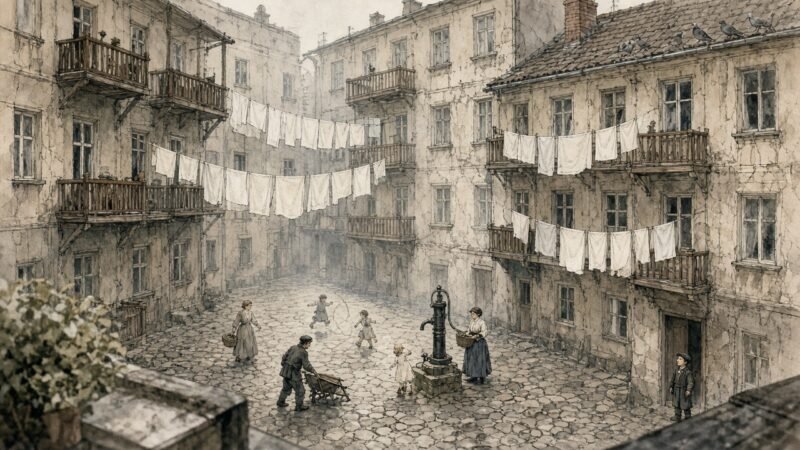
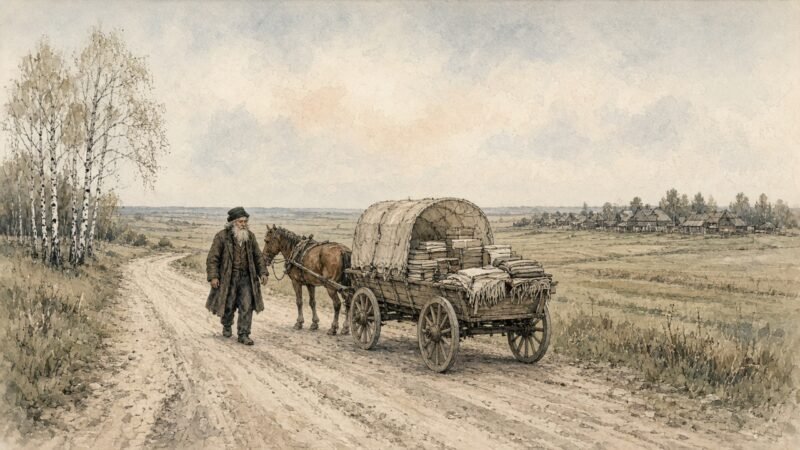
The Voice of Kasrilevke
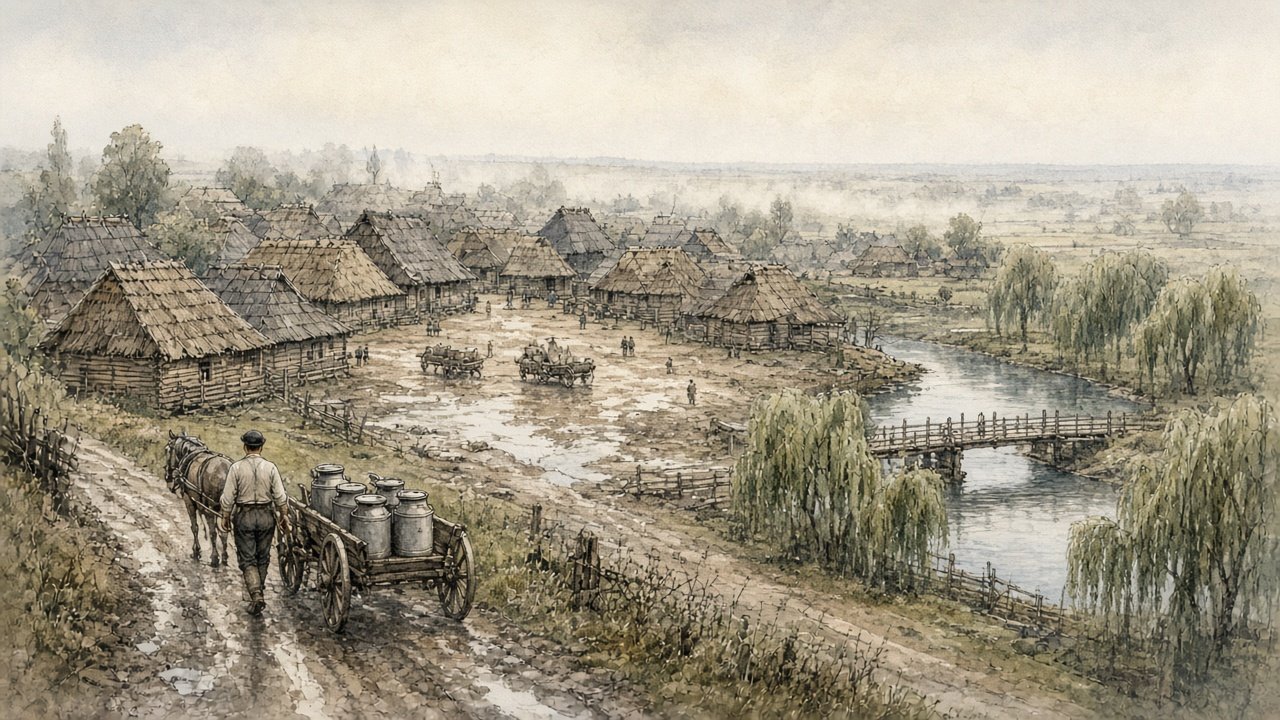
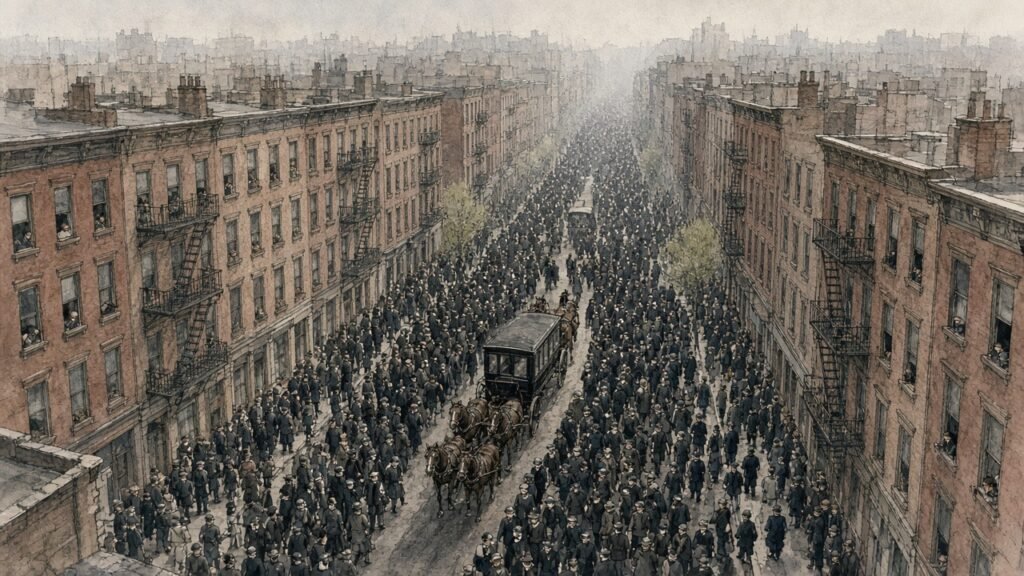
In the spring of 1916 a funeral procession left a modest apartment building on Kelly Street in the Bronx and moved slowly through the streets of New York towards Manhattan and on to a cemetery in Queens. Newspapers of the time estimated the crowd along the route at well over a hundred thousand people, and some accounts gave a figure twice as large. The man being buried had been born fifty-seven years earlier in a small Ukrainian town on the eastern bank of the Dnieper, and he had become, under the pen name Sholem Aleichem, the most widely read writer in the Yiddish language. [1][2]
This special feature follows the life and work of Sholem Rabinovich from his childhood in Pereiaslav and Voronkiv through his years as a tutor, crown rabbi and stock speculator, his editorial ambitions in Kiev, and the long sequence of monologues, letters and stories through which he created Tevye the dairyman, Menakhem-Mendl the speculator and the boy Motl. It traces his flight from the pogroms of 1905, his travels in Europe and America, his illness and his last years in New York, and it closes with the afterlife of his work on the stage and screen. An interactive timeline at the end of the essay gathers the principal dates.
1. A childhood on the Dnieper
Sholem Nokhumovich Rabinovich was born on 2 March 1859, by the Gregorian calendar, in Pereiaslav, a district town in the Poltava province of the Russian Empire. Pereiaslav lay within the Pale of Settlement, the broad belt of western provinces in which most of the empire’s Jews were required to live, and its Jewish community was a substantial minority among Ukrainian townspeople and peasants. His father, Nokhem Rabinovich, was a merchant of some means who traded in grain and timber and who combined a traditional piety with a cautious interest in the new Hebrew literature of the Jewish Enlightenment. [1][3][4]
When Sholem was still small the family moved to Voronkiv, a little town some distance to the north-west of Pereiaslav. In his memoirs he remembered Voronkiv as a self-contained world, a place where everyone knew everyone else and where the arrival of a stranger was an event. Critics have long regarded it as one of the models for Kasrilevke, the imaginary town of poor and resourceful Jews that would appear in many of his later stories. In the house there were servants, a garden and a sense of security, and the boy attended a traditional cheder, where he learned the Hebrew alphabet, the Pentateuch and the commentaries. [5][6][7]
The comfort of these years did not last. Nokhem Rabinovich was drawn into a business partnership that failed, and the family lost most of its fortune. They returned to Pereiaslav, where the father opened an inn at the edge of town that catered to travellers and coachmen. Sholem later described the move as a fall from a provincial paradise into a noisy and uncertain life, but he also recognised that the inn gave him an education of another kind. He listened to the talk of merchants, carters, cantors and drifters, and he acquired the habit of storing up turns of phrase, proverbs and idioms that he would later use in his fiction. [5][8]
In 1872 his mother, Chaye Esther, died during a cholera epidemic. The loss was severe for the family, and within a short time his father married again. The stepmother came from Berdichev and brought with her an inexhaustible supply of Yiddish curses and insults. According to Sholem’s own account, he began to write them down in alphabetical order, producing a small glossary that he regarded as his first literary composition. The story, which he told with evident pleasure in his autobiography, has often been taken as a sign of the ear for spoken language that defined his later work. [5][1]
The religious calendar shaped the year of a boy in such a household. The Sabbath divided each week, and the cycle of festivals, from the solemn days of autumn to Passover in spring, set the rhythm of study, work and family gatherings. In later life Sholem Aleichem wrote many stories set on these occasions, and the memory of festival preparations in Voronkiv and Pereiaslav supplied him with details of food, clothing and custom that give those stories their texture. [5][6]
Pereiaslav itself had a long history. It had been one of the principal towns of Kievan Rus, and in 1654 it was the site of the agreement between the Cossack hetman Bohdan Khmelnytsky and the envoys of the Muscovite tsar. By the nineteenth century it was a quiet provincial town of craftsmen and traders, with a market, a number of synagogues and prayer houses, and a mixed population whose daily dealings provided the young Rabinovich with a wide range of human types. [3][5]
His father, who owned books of the Hebrew Haskalah, encouraged the boy’s interest in reading. Sholem read Abraham Mapu’s historical romance The Love of Zion and attempted an imitation of it, and he was enrolled in the Russian district school in Pereiaslav, where he studied the language and literature of the empire. He completed the course in 1876 with distinction. At the time such an education was still unusual for the son of a traditional Jewish family, and it gave him a command of Russian that would later open the way to employment as a tutor and to the world of the Russian press. [9][2]
2. A tutor at Sofievka
After finishing school the young Rabinovich looked for work. For a time he gave lessons in Russian to the children of Jewish families in the region, and in 1877 he was engaged as a tutor by Elimelekh Loyev, a wealthy Jewish landowner who held an estate at Sofievka in the Kiev province. Loyev was a man of traditional observance who also managed large agricultural properties and dealt confidently with the Russian administration, and the tutor found himself in a household quite unlike the inns and market towns of his childhood. [1][8]
His pupil was Loyev’s daughter, Olga, known in the family as Golde. Over the three years he spent on the estate the lessons turned into an attachment between teacher and pupil. When Loyev learned of it, he dismissed the tutor abruptly. Rabinovich left Sofievka without being allowed to say farewell, and the episode left a deep impression on him. Later biographers have noted how often his fiction returns to the figure of the poor young man who falls in love above his station, and to fathers who must decide whether to accept a daughter’s choice. [8][2]
For the next few years he lived in uncertainty. He spent time in Kiev and other towns, wrote in Hebrew and Russian without much success, and in 1880 he obtained the post of crown rabbi in Lubny, a district town in the Poltava province. The office of crown rabbi, created by the Russian government, required its holder to keep the official registers of births, marriages and deaths and to act as an intermediary with the authorities. It did not require rabbinical learning in the traditional sense, and it was often held by young men with a secular education. Rabinovich served in Lubny for about three years. [10][1]
In 1883 he and Olga Loyev were married, against the wishes of her father, who in time accepted the match. The couple were to have six children. In the same year he published his first story in Yiddish. It appeared in Dos yidishe folksblat, a weekly edited in St Petersburg by Alexander Zederbaum, who had earlier founded the Yiddish supplement Kol mevaser. For this and later work he adopted the pen name Sholem Aleichem, the ordinary Yiddish greeting meaning peace be with you. [2][11][1]
The choice of name was significant. Writing in Yiddish was still regarded by many educated Jews as a concession to the uneducated, and authors who did so often hid behind pseudonyms. The greeting suggested a familiar voice addressing readers as equals, and it set the tone for a body of work in which the narrator often appears as a friendly listener to whom other people pour out their troubles. Over the following years Sholem Aleichem contributed sketches and stories to the Folksblat at a steady pace, and he began to build a reputation as a humorist. [12][13]
3. Inheritance and ambition in Kiev
In 1885 Elimelekh Loyev died, and Olga inherited a large share of his fortune. Sholem Aleichem and his family moved to Kiev, the provincial capital, where Jews were permitted to reside only under specific conditions, such as membership of a merchant guild or possession of a university degree. As the husband of an heiress he was able to register as a merchant, and he threw himself into the commercial life of the city, trading in shares and commodities on the Kiev exchange. [14][1][8]
Kiev in the 1880s was a city of rapid growth. Its sugar, grain and timber trades drew Jewish entrepreneurs from across the region, and the restrictions on residence created a world of permits, bribes and police raids in which Jewish families lived in a state of legal uncertainty. Sholem Aleichem knew this world intimately, and he would later turn it into the setting of Yehupets, his fictional name for Kiev, where his characters chase fortunes on the exchange and flee the police by night. [14][7]
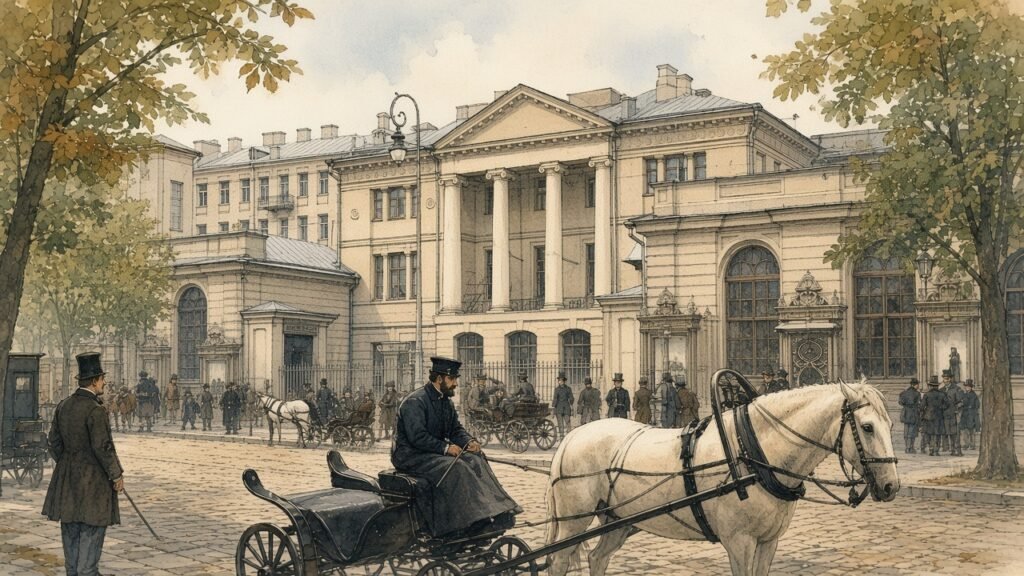
His commercial ventures coincided with a period of great literary ambition. In 1888 and 1889 he edited and financed two volumes of an annual anthology called Di yidishe folksbibliotek, the Jewish popular library. He paid contributors at rates far above what Yiddish writers were used to receiving, and he set out to establish a body of serious literature in the language. The first volume included work by Sholem Yankev Abramovitsh, who wrote as Mendele Moykher Sforim, and the long poem Monish by the young Polish writer Isaac Leib Peretz. [2][15][16]
It was in connection with the Folksbibliotek that Sholem Aleichem began to refer to Abramovitsh as the grandfather of Yiddish literature. The phrase was partly a compliment and partly a strategy. By constructing a genealogy with Abramovitsh as its founder and himself as the grandson, Sholem Aleichem placed his own work within a tradition and gave the young literature a sense of lineage. Literary historians have since debated how far the idea of the classic triad of Abramovitsh, Sholem Aleichem and Peretz was his own invention, but it has proved remarkably durable. [12][7]
In the same year he published a pamphlet titled Shomers mishpet, the trial of Shomer, in which he mounted a sustained attack on the popular novelist Nokhem Meyer Shaykevitsh, who wrote under the name Shomer. Shomer’s novels, which were sold cheaply and read widely, followed formulas of melodrama and adventure, and Sholem Aleichem argued that they were derivative, implausible and harmful to the taste of Yiddish readers. The pamphlet took the form of a mock trial and was written with considerable wit. It marked his public commitment to a literature grounded in realistic observation. [17][13]
The anthology was an expensive undertaking. Sholem Aleichem printed it on good paper, commissioned work from established and new authors, and distributed it widely. Its size and quality impressed contemporaries, and it was understood as a declaration that Yiddish deserved the same care that publishers lavished on Russian or Hebrew books. Several of the contributors later recalled the generosity of the fees as a turning point in their own careers. [8][13]
During these years he also wrote two novels about artists, Stempenyu, published in the Folksbibliotek in 1888, which told the story of a gifted klezmer violinist, and Yosele Solovey, which appeared in 1889 and followed a young cantor whose voice brings him fame and ruin. Both books showed his interest in the lives of performers and the contrast between talent and the narrow expectations of small-town society. [8][2]
4. Ruin on the exchange
The fortune that had made the Folksbibliotek possible did not survive long. In 1890 Sholem Aleichem lost the greater part of Olga’s inheritance through speculation on the exchange. The losses were so severe that he left Russia for a time to avoid his creditors, travelling to Paris and Vienna, while his mother-in-law intervened to settle the debts. The third volume of the Folksbibliotek, which he had planned, was never published. [1][8]
When he returned he settled for a period in Odessa, the great port on the Black Sea, where he continued to work as a broker and to write. Odessa had a large and varied Jewish population, including many merchants who traded in grain, and it was home to a circle of Hebrew and Yiddish writers that included Abramovitsh, who directed the Talmud Torah school there. Sholem Aleichem’s stay in Odessa lasted until 1893, when he moved back to Kiev. [18][15]
The experience of ruin found its way directly into his fiction. In 1892 he published the first of the letters that make up the cycle of Menakhem-Mendl, a speculator from Kasrilevke who arrives in Odessa and later Yehupets and writes to his wife Sheyne-Sheyndl about his successive schemes. Menakhem-Mendl trades in currencies, shares, houses and timber, becomes a matchmaker and an insurance agent, and moves from enthusiasm to collapse in each letter. His wife replies with sharp common sense and the proverbs of her mother. [2][12]
The epistolary form allowed Sholem Aleichem to capture two distinct voices and to let their misunderstandings carry the comedy. It also allowed him to present the bewildering world of finance through the eyes of a man who understood its language without grasping its substance. Critics have seen in Menakhem-Mendl a portrait of the luftmensh, the person who lives on air, a figure who had become familiar in Jewish life as traditional livelihoods disappeared under economic and legal pressure. [7][19]
The return to Kiev in 1893 brought him back to the city that he would portray as Yehupets for the rest of his career. He lived there with his family for more than a decade, combining work as a broker and agent with an increasingly steady output of stories, sketches and feuilletons. Many of the works that established his reputation, including the early Tevye episodes and the continuation of the Menakhem-Mendl letters, were written in these years in Kiev. [14][8]
The cycle continued to grow for many years. Sholem Aleichem returned to Menakhem-Mendl repeatedly, and in later versions the speculator travels as far as Warsaw and America and tries his hand at journalism. The fact that the author himself had lost a fortune on the exchange gave the letters a measure of self-mockery, and readers recognised in them both an individual comedy and a wider social picture. [8]
5. The dairyman Tevye
In 1894 Sholem Aleichem published a story in which a dairyman from a village near Yehupets tells the narrator how he came into a little money. A pair of wealthy women lost in the woods are brought home by Tevye in his cart, and he is rewarded for his kindness. With the money he buys a cow and sets himself up as a dairyman, carrying milk, butter and cheese to the summer houses of rich Jews in Boyberik, the author’s fictional name for the resort of Boyarka near Kiev. The story appeared in the anthology Der hoyzfraynd in 1895 under the title that would later be translated as The Great Windfall. [20][21]
The device that made the story distinctive was Tevye’s voice. He speaks directly to Sholem Aleichem, whom he addresses as an acquaintance, and he fills his account with quotations from the Bible, the prayer book and rabbinic literature, often misquoted or comically applied. His learning is that of a pious working man, enough to make his speech rich with allusion but not enough to keep him from turning a verse to his own purposes. The effect is both humorous and deeply sympathetic. [21][19]
Over the next two decades Sholem Aleichem wrote further Tevye stories, which were published at irregular intervals. In the later episodes Tevye’s daughters one by one choose their own paths. Tsaytl marries a poor tailor rather than the wealthy butcher her father had favoured. Hodl marries a young revolutionary and follows him into exile in Siberia. Khava marries a Ukrainian villager and leaves the Jewish community, and Tevye refuses to speak of her. Shprintse is abandoned by a wealthy suitor and drowns herself. Beylke marries a rich contractor and is ashamed of her father. [20][21]
The cycle closes with a story about the expulsion of Jews from villages under the restrictions that followed the May Laws of 1882, in which Tevye himself must leave the place where he has lived all his life. The stories thus trace in the life of one family a series of pressures that affected the Jewish population of the empire as a whole, including the decline of paternal authority, the attractions of revolutionary politics, intermarriage, emigration and expulsion. [22][21]
The stories were not written as a single book. Each episode was published separately, sometimes years after the previous one, and Sholem Aleichem adjusted the details of Tevye’s life as he went. The number of daughters, for instance, varies in different passages, and the chronology of the stories does not always correspond exactly. Collected editions arranged the episodes in a sequence that has since become standard. [21][20]
Tevye’s relation to the narrator is also important. Each story begins with Tevye greeting Sholem Aleichem after a period without contact and announcing that he has something new to tell. The convention allowed the author to present each episode as a report from a man whose life continued between their meetings, so that readers experienced the passage of years in the intervals between stories. [21]
Tevye’s response to these pressures is not resolution but argument. He questions God, cites scripture against itself and moves between acceptance and protest within a single paragraph. Critics have described him as one of the great comic monologists of modern literature, and the tension between his faith and his experience has made the stories a subject of continuing interpretation. [19][8]
6. Kasrilevke and the little people
Alongside the monologues of Tevye and the letters of Menakhem-Mendl, Sholem Aleichem developed an imaginary geography that gave his stories a common setting. At its centre was Kasrilevke, a small town whose inhabitants are poor but proud of their poverty, quick to argue and quick to forgive. The name derives from the Yiddish word kasril, a term for a poor man who makes the best of his condition, and the town became a shorthand for the traditional shtetl as seen with affection and irony. [23][7]
In stories such as The Town of the Little People, published in 1901, Sholem Aleichem described Kasrilevke as a place forgotten by the world, crowded together on a hill above a river, with a market square at its centre and a cemetery at its edge. The narrator treats its residents as experts in survival, who meet every misfortune with a joke or a proverb. Later stories followed them on journeys to Yehupets and abroad, and one cycle describes how news of a fire, a railway or a world event reaches the town and is absorbed into its habits. [7][1]
Dan Miron and other scholars have argued that Kasrilevke should be read less as a documentary portrait than as a literary construction, an image of the shtetl shaped by the needs of the narrative and the expectations of readers. In this view Sholem Aleichem created a myth of the small town at the very moment when the real towns of the Pale were being transformed by industrialisation, migration and political upheaval. The image proved immensely influential, and much later popular understanding of the shtetl derives from it. [7][19]
Kasrilevke was not the only setting. Sholem Aleichem also wrote about Mazepevke, Kozodoyevke and other imaginary towns, and he set many stories in the trains and stations that connected them. Taken together, these places formed a recognisable world, in which characters from one story could reappear in another and readers could follow the fortunes of a whole society. [12][13]
7. The monologue and the spoken voice
The form for which Sholem Aleichem is best remembered is the monologue, in which a single speaker addresses the narrator or the reader directly. In these stories the author usually presents himself as a writer who has met the speaker by chance and has agreed to listen. The speaker then tells his or her story at length, with digressions, interruptions and appeals for sympathy, while the listener remains silent. [12][19]
The technique allowed Sholem Aleichem to reproduce the rhythms of spoken Yiddish with great precision. His characters use idioms, proverbs, diminutives and curses, and they mix Hebrew and Aramaic phrases from religious study with Slavic words drawn from the surrounding population. The language is not a neutral medium but a part of the characterisation, revealing class, region, education and temperament. Translators have often remarked on the difficulty of rendering this richness in another language. [24][21]
The monologue also allowed for dramatic irony. Speakers frequently reveal more than they intend, and the reader understands the significance of events that the narrator misinterprets. In some stories, such as those narrated by a boy, the innocence of the speaker allows the author to present painful situations with a light touch. In others, the speaker’s evasions and self-justifications form the main interest of the story. [8][12]
Critics have connected this technique with the traditions of oral storytelling in Jewish communities and with the work of Russian writers such as Nikolai Gogol, whose skaz narratives also rely on the voice of an idiosyncratic speaker. Sholem Aleichem admired Gogol and other Russian authors, and his work stands at the meeting point of Jewish and Russian literary traditions. [25][19]
The monologue form had another advantage. Because the speaker addressed a listener who was a writer, the stories frequently reflect on the act of storytelling itself. Speakers ask the narrator to put their troubles into a book, worry about how they will appear in print and occasionally dispute the accuracy of what he has already written about them. This self-conscious play gave the stories a modern quality that critics have increasingly recognised. [12][7]
The railway stories that Sholem Aleichem wrote between 1902 and 1911 are an especially clear example of the form. In them a commercial traveller, riding in third-class carriages through the Pale, records the tales told to him by fellow passengers. The train becomes a place where strangers exchange confidences, and the movement of the journey mirrors the restlessness of a society on the move. [21][8]
8. Pogroms and the turn of the century
The world that Sholem Aleichem described was under increasing strain. Following the assassination of Alexander II in March 1881, a wave of anti-Jewish violence swept through the southern provinces of the empire, and the Temporary Regulations of May 1882 placed new restrictions on Jewish residence and economic activity. Further restrictions followed in the 1880s and 1890s, including quotas on the admission of Jewish students to secondary schools and universities and the expulsion of Jews from Moscow in 1891. [26][22][27]
In April 1903 a pogrom in Kishinev, the capital of Bessarabia, left forty-nine Jews dead and hundreds injured. The event provoked international protest and had a profound effect on Jewish opinion across the empire. Sholem Aleichem responded by organising a collection of writings in aid of the victims, titled Hilf, which appeared in Warsaw in 1903 with contributions from leading Russian and Jewish writers. Leo Tolstoy, Maxim Gorky and Vladimir Korolenko were among those approached for the volume. [28][2]
The years after 1900 were also a period of intense political activity among Jews. The General Jewish Labour Bund, founded in Vilna in 1897, organised workers and campaigned for socialism and Jewish cultural autonomy, while Zionist groups worked for a national home in Palestine. Sholem Aleichem’s sympathies were broadly with the Zionist movement, and he attended several Zionist congresses and wrote in support of the cause, but his fiction treated political enthusiasms of every kind with a measure of detachment. [2][8]
At the same time his popularity grew. His stories appeared in Yiddish newspapers in Warsaw, St Petersburg and New York, and his public readings attracted large audiences. Readers in America, where hundreds of thousands of Yiddish-speaking immigrants had settled, knew his work through the Yiddish press, and his reputation extended across the whole Jewish diaspora. [29][1]
9. The flight of 1905
The revolution of 1905 brought both hope and terror to the Jews of the empire. In October, after the tsar issued a manifesto promising civil liberties and an elected Duma, counter-revolutionary mobs attacked Jewish communities in hundreds of towns. In Kiev the violence lasted for several days and caused widespread destruction in the Jewish districts. Sholem Aleichem and his family took refuge in a hotel during the attacks. [30][27][14]
The experience convinced him to leave Russia. In the following months the family moved westward, first to Lemberg in Austrian Galicia and then to Geneva and other cities. Sholem Aleichem undertook reading tours in Galicia, Bukovina and other regions, and he made preparations to travel to America, where he hoped to establish himself as a playwright for the flourishing Yiddish theatre in New York. [2][31][8]
The turmoil of these years is reflected in a story cycle he began in 1907 about Motl, the son of the cantor Peysi. Motl is a small boy whose father dies at the beginning of the book, an event that frees him from school and allows him to roam. He narrates the family’s attempts to make a living, their emigration from Kasrilevke, their passage through Europe and, in the second part, their life in New York. The book combines humour and grief in a way that many readers have found among the most affecting in his work. [8][12]
The family’s departure was part of a much larger movement. In the years after 1905 emigration from the Russian Empire reached new heights, and the great majority of the emigrants went to the United States. Sholem Aleichem’s stories of these years, including those of Motl, record the experience of people leaving home with bundles and trunks, waiting at border crossings and railway stations, and entrusting their future to agents and steamship companies. [4][8]
Motl’s cheerfulness in the face of loss is one of the features that critics have connected with the phrase laughter through tears, often used to describe Sholem Aleichem’s work as a whole. The phrase was not his own coinage, and some scholars have argued that it simplifies the complexity of his humour, which can be sharp and unsettling as well as consoling. It has nevertheless become a common description of his art. [19][8]
10. First journey to America
In 1906 Sholem Aleichem sailed for New York. His arrival was greeted with great enthusiasm by the Yiddish press and the immigrant public, and he was welcomed at a series of receptions and readings. He had come with the expectation of writing plays for the Yiddish stage, which at that time was dominated by the actors and managers Jacob Adler and Boris Thomashefsky, and both producers agreed to stage his work. [32][33][1]
The results were disappointing. Two plays, staged early in 1907 by rival companies, received poor reviews and short runs. The Yiddish theatre of New York favoured melodrama, music and spectacle, and Sholem Aleichem’s plays, which relied on dialogue and character, did not suit the expectations of audiences or managers. The critical press was divided, and some writers accused the theatre of preferring cheap entertainment to literature. [33][8]
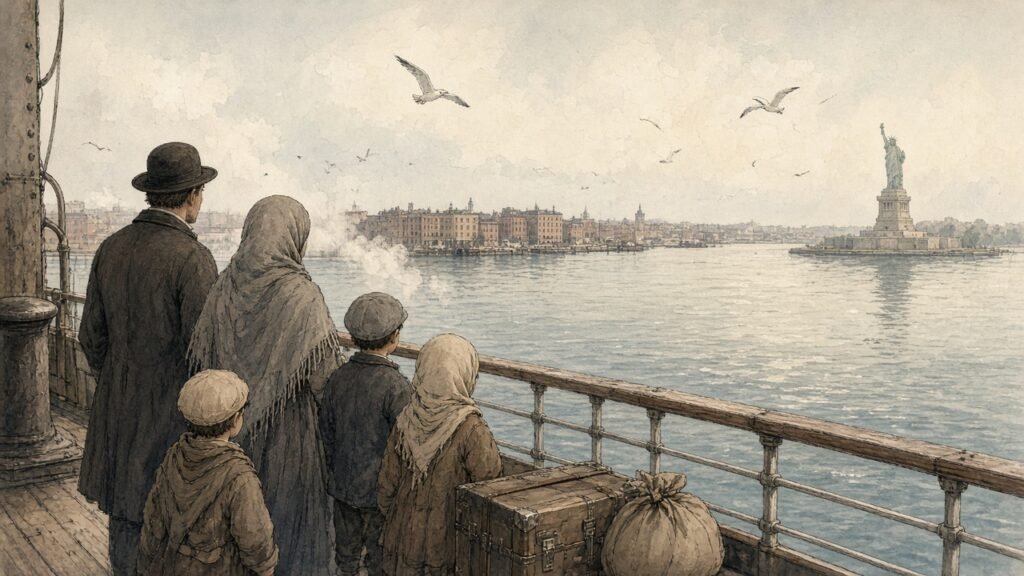
His relations with the press were also complicated. He wrote for several Yiddish newspapers in New York, but he found the conditions of journalism there demanding and the competition between papers intense. Abraham Cahan, the editor of the socialist daily Forverts, had built it into the most widely circulated Yiddish paper in the world, and the question of which paper would publish the celebrated author became a matter of rivalry. [34][29]
His public appearances in New York nonetheless drew large audiences. Readers filled halls to hear him read from his stories, and he was celebrated at banquets given by writers’ associations and landsmanshaftn, the mutual aid societies formed by immigrants from the same town. The warmth of his reception contrasted with the commercial disappointments of the theatre. [8][1]
After about a year in America, Sholem Aleichem returned to Europe in 1907. The visit had shown both the size of his audience in the New World and the difficulty of making a living there as a writer. The experience shaped his later portrayal of America in the second part of Motl, in which the boy and his family discover the bustle and confusion of the immigrant city with a mixture of wonder and dismay. [8][2]
11. Illness and the jubilee
Back in Europe he resumed his reading tours, which had become an important source of income. In the summer of 1908, while on a tour of towns in the western provinces of the empire, he collapsed in the railway town of Baranovichi and was diagnosed with tuberculosis. He spent the following months recovering, and on medical advice he went to Nervi on the Italian Riviera and later to Badenweiler in the Black Forest and other health resorts. [35][1][8]
The illness coincided with the twenty-fifth anniversary of his literary career, which was marked in 1908 with celebrations across the Yiddish-speaking world. Committees were formed in Russia, Europe and America to raise money for the author, and the funds were used to buy back the rights to his works from publishers to whom he had sold them on unfavourable terms. The jubilee confirmed his position as the most popular living Yiddish writer and gave him a measure of financial security. [2][8]
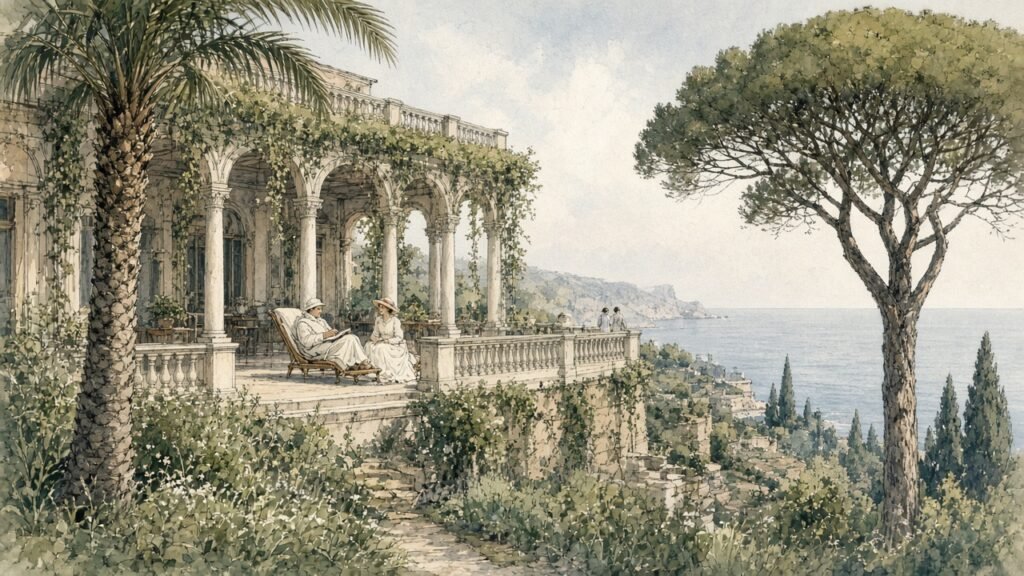
The years of convalescence were also years of steady work. He wrote the novel Blondzhende shtern, wandering stars, which follows two young people from a Bessarabian town who join a travelling Yiddish theatre troupe and eventually reach London and New York. The book was serialised and later became one of his most widely read novels. He also continued the Tevye and Menakhem-Mendl cycles and published new stories in the Yiddish press. [33][12]
During this period he began to prepare a collected edition of his works and worked on plans for an autobiography. He remained in contact with writers and publishers across Europe and America, and his correspondence from these years shows him supervising translations, negotiating contracts and corresponding with readers who sent him their own stories. [8][2]
12. The reading tours
Public reading was central to Sholem Aleichem’s career in the last decade of his life. In an age before broadcasting, an author who could fill a hall had a direct means of reaching readers and earning money, and he proved to be an exceptionally effective performer of his own work. He read slowly and with restraint, allowing the humour of the text to emerge from the voices of the characters rather than from exaggerated gestures, and witnesses described audiences moving from laughter to silence within a single story. [8][1]
The tours took him through a wide range of places. He read in large cities such as Warsaw, Odessa, Vilna and Lodz, and in smaller towns where a local committee would hire a hall and sell tickets. He also travelled through Galicia and Bukovina in the Habsburg Empire and gave readings in Romania, Switzerland, Belgium and England. Each tour involved long railway journeys, irregular meals and late nights, and the strain contributed to the illness that struck him in 1908. [8][35]
The tours also supplied him with material. Many of the railway stories draw on the conversations of fellow travellers in third-class carriages, and the station platforms, waiting rooms and buffets of the western provinces appear frequently in his work. The figure of the commercial traveller who narrates the railway stories shares much with the author himself in these years, moving from town to town and listening to the stories of strangers. [21][12]
Letters written to his family during the tours describe the receptions he received. In some towns crowds gathered at the station, local dignitaries made speeches and admirers presented him with gifts. In others the halls were half empty or the police placed restrictions on the event. He recorded these experiences with characteristic irony, noting the gap between the enthusiasm of the speeches and the modest sums that sometimes remained after expenses. [8]
The readings created a personal bond between the writer and his audience that was unusual even among popular authors. Many readers who attended them remembered the occasion for the rest of their lives, and memoirs of the period frequently mention an evening when Sholem Aleichem came to town. The figure of the author as a visitor bringing laughter to a community in difficult times became part of his legend. [1][2]
13. Wandering stars and the theatre
Sholem Aleichem’s interest in the theatre ran through his whole career. As a young man he had admired the performances of the troupes that brought Yiddish drama to the towns of the Pale after its emergence in the 1870s, and he wrote a number of plays and dramatic sketches over the years. His comedies included Tsezeyt un tseshpreyt, scattered and dispersed, and later works such as Dos groyse gevins, the great prize, which was staged after his death and became a staple of the Yiddish repertoire. [33][8]
The novel Wandering Stars brought together his experience of the theatre and of emigration. Its protagonists, Reyzl and Leybl, grow up in a Bessarabian town called Holeneshti and are drawn to a travelling troupe that visits the town. They leave home separately and follow different paths through the theatres of Europe and America, Reyzl as a singer and Leybl as an actor, and their story turns on missed meetings and delayed recognitions. [33][12]
The novel gave a detailed picture of the Yiddish theatre world, with its impresarios, prompters, stars and hangers-on, and it satirised the commercial practices that Sholem Aleichem had encountered in New York. It also expressed his view that the theatre could be an art of real value if it were freed from the demands of cheap entertainment. The book was adapted for the stage by Maurice Schwartz and later for film. [36][33]
14. The autobiography and the late cycles
In the years before the First World War Sholem Aleichem began writing a long autobiographical work, Funem yarid, usually translated as From the Fair. The title reflects his comparison of life with a fair, from which one returns at the end with whatever one has managed to gather. He wrote the book in the third person, describing the childhood and youth of a boy named Sholem, the son of Nokhem Rabinovich, and he planned it as a work in several volumes that would carry the story up to his own literary career. [5][2]
The completed portion of From the Fair covers his life up to his early twenties, including the years in Voronkiv and Pereiaslav, the death of his mother, the arrival of the stepmother and the period as a tutor on the Loyev estate. It combines recollection with novelistic technique, and it presents many incidents in the form of comic sketches. The book is a central source for his biography, but scholars have also noted that it shapes his memories to fit the image of the writer he had become. [5][8]
In 1914 he published the final Tevye story to appear in his lifetime, in which Tevye describes the order to leave the village where he had lived for decades. The story was written against the background of increasing restrictions on Jewish residence in the countryside and of the trial of Menahem Mendel Beilis in Kiev in 1913, in which a Jewish clerk was accused of ritual murder and eventually acquitted by a jury. The trial attracted international attention and deepened the sense of insecurity among the Jews of the empire. [37][20][21]
In the same period Sholem Aleichem returned to Russia for a final reading tour in 1914. The tour took him through towns and cities across the Pale, and the audiences were large and enthusiastic. Accounts from the period describe crowds meeting him at railway stations and filling theatres and halls to hear him read his work. [8][1]
15. War and the road to Copenhagen
In the summer of 1914 Sholem Aleichem was staying with his family at Ahlbeck, a resort on the Baltic coast of Germany. When war broke out in August between Germany and Russia, the family found themselves enemy aliens in German territory. They were ordered to leave, and after a period of uncertainty they travelled to neutral Denmark, arriving in Copenhagen. [38][39][8]
The family remained in Copenhagen for several months while arrangements were made for them to cross the Atlantic. Sholem Aleichem’s health was again fragile, and the war had cut him off from his readers and publishers in Russia. Some members of the family, including his son Misha, who was ill with tuberculosis, remained in Europe. The rest of the family sailed for New York in late 1914. [39][2]
The months in Copenhagen were spent in limited circumstances. The family lived in rented rooms, and Sholem Aleichem continued to write despite poor health, sending work to Yiddish newspapers in America. Denmark had only a small Jewish community, and he felt keenly his distance from the readers among whom he had lived. He was nonetheless able to correspond with friends and publishers, and these letters record his anxiety about relatives who remained in the Russian Empire and about the fate of the towns he had described. [39][8]
The war devastated the regions in which Sholem Aleichem’s fiction was set. The Russian army, retreating before German and Austrian forces in 1915, expelled hundreds of thousands of Jews from the western provinces on suspicion of disloyalty, and many towns of the Pale were damaged or destroyed. Reports of these events reached the Yiddish press in New York, and they formed the background against which Sholem Aleichem spent his last years. [38][27]
16. Last years in New York
In New York Sholem Aleichem settled in an apartment on Kelly Street in the Bronx. He contracted to write for Yiddish newspapers, including the daily Der tog, and he continued to give public readings. He worked on the second part of Motl, describing the boy’s arrival in America and the family’s attempts to establish themselves in the immigrant world of New York. He also continued work on his autobiography. [1][8]
His health remained poor, and he was troubled by financial difficulties. In 1915 news arrived that his son Misha had died in Copenhagen. The loss affected him deeply, and the family kept the news from him for a time out of concern for his health. In the following months he wrote less, and his letters from the period refer to his weakness and to his anxiety about the future of his family. [8][2]
The second part of Motl, written in these years, follows the boy and his family through the immigration station at Ellis Island and into the streets and workshops of New York. Motl’s brother Elye and his friend Pinye try one scheme after another, and the family moves from one apartment to another in search of a living. The book was left unfinished at the author’s death, and its final chapters break off in the middle of the family’s American story. [8][2]
He nonetheless remained active in the cultural life of the Yiddish community. He attended performances, met writers and journalists, and took part in charitable events for the victims of the war in Europe. Younger writers who visited him in the Bronx described a man who remained courteous and witty despite his illness, and who followed the news from Europe with close attention. [8]
17. Death and the ethical will
Sholem Aleichem died at his home in the Bronx on 13 May 1916, at the age of fifty-seven. His death was reported on the front pages of the Yiddish press and in the English-language newspapers of New York. The funeral, held two days later, drew one of the largest crowds seen in the city up to that time. The procession moved from the Bronx through Harlem and the Lower East Side, with stops at synagogues and institutions, and continued to the cemetery in Queens where he was buried. [1][2]
Before his death he had written an ethical will, a traditional Jewish document in which a person sets out moral instructions for descendants. In it he asked to be buried among ordinary people, so that his grave would honour theirs and theirs his. He asked his family to gather each year on the anniversary of his death and to read one of his merry stories aloud, and he asked that his name be remembered with laughter rather than mourning. [8][40]
The will was published in the New York press and was read into the Congressional Record of the United States. His request that his family read his stories on the anniversary of his death has been honoured by his descendants and by readers for more than a century, and public readings on the anniversary continue to take place. [8][1]
His family remained in America. His daughter Lyalya, herself a writer of Yiddish fiction, married the physician Michael Kaufman and was the mother of Bel Kaufman, who became a teacher and the author of the novel Up the Down Staircase. His daughter Ernestina married the Hebrew writer Isaac Dov Berkowitz, who translated Sholem Aleichem’s work into Hebrew. [41][8]
18. Humour, comparison and the American Mark Twain
During his first visit to America, Sholem Aleichem was introduced to the public by some newspapers as the Jewish Mark Twain. A frequently repeated anecdote holds that when the two men met, Mark Twain replied that he was the American Sholem Aleichem. Biographers have been unable to confirm that such a meeting took place, and the story is generally treated as a piece of literary folklore. It nonetheless indicates the way in which Sholem Aleichem’s reputation was presented to American readers. [42][8]
The comparison has some basis in the work of the two writers. Both drew on the spoken idioms of their communities, both used first-person narrators whose naivety allows the reader to see beyond them, and both combined comedy with criticism of social conditions. Mark Twain’s narrators, like Sholem Aleichem’s, speak in a vernacular that had seldom been used for serious literature before them. [42][19]
The differences are equally important. Sholem Aleichem wrote for a community that lived under legal restrictions and the threat of violence, and his humour often served as a means of coping with circumstances that could not be changed. His characters rarely triumph over their difficulties. They endure them, argue with them and find ways to make them bearable. Critics have described this as a humour of survival, distinct from the frontier humour of nineteenth-century America. [19][7]
Sholem Aleichem’s comedy also depends heavily on language. Many of his jokes turn on the clash between the elevated diction of Hebrew religious texts and the earthy Yiddish of everyday life, or on the misunderstanding of words borrowed from Russian and other languages. This makes his work particularly difficult to translate, and readers who know him only in translation often miss the density of verbal play that his Yiddish readers enjoyed. [24][21]
19. Translation and the English reader
Translations of Sholem Aleichem’s work into Russian, German, Hebrew and English began to appear during his lifetime, but for many years the English versions were few and uneven. The growth of interest in his work in the English-speaking world came largely after his death, and particularly after the Second World War, when the destruction of the Jewish communities of eastern Europe led many readers to seek out literature that described their former life. [1][19]
In 1943 Maurice Samuel published The World of Sholom Aleichem, a book that retold and interpreted many of the stories for an English-speaking audience. Samuel presented Sholem Aleichem’s fiction as a portrait of a vanished civilisation, and the book was widely read in America. Its approach, which emphasised the warmth and humour of shtetl life, influenced the way in which the stories were later adapted for the stage. [40][7]
Later translators sought greater fidelity to the original. Hillel Halkin’s translation of the Tevye stories and the railroad stories, published in 1987, aimed to convey the complexity of Tevye’s language, including his misquotations and his blending of sacred and colloquial registers. Curt Leviant translated From the Fair and several other works, and other translators produced versions of Motl, Menakhem-Mendl and the novels. [21][5]
Translation into Hebrew followed a different course. Isaac Dov Berkowitz worked closely with Sholem Aleichem during the author’s lifetime and continued after his death, producing a Hebrew edition of the collected works that remained the standard text for Hebrew readers for decades. Berkowitz faced the opposite problem from English translators, since Hebrew already contained the scriptural and liturgical phrases that Tevye quotes, but lacked the colloquial vocabulary of everyday Yiddish speech. [8][21]
The debate among translators has often turned on the question of how much to domesticate the text for an English reader. Some versions replace Yiddish proverbs and allusions with English equivalents, while others retain them and explain them in notes. The choice affects not only the readability of the translation but also the image of Sholem Aleichem it conveys, whether as a universal humorist or as a writer rooted in a particular language and culture. [21][12]
20. Tevye on the stage and screen
Sholem Aleichem himself began the process of adapting Tevye for the stage. Near the end of his life he worked on a dramatic version of the stories, and after his death the actor and director Maurice Schwartz produced a Yiddish play based on them at his Yiddish Art Theatre in New York in 1919. Schwartz played Tevye himself, and the production became one of the most successful in the history of the company. [36][33]
In 1939 Schwartz directed and starred in a Yiddish film version, Tevye, which was shot on Long Island. The film concentrated on the story of Khava, the daughter who marries outside the faith, and it ended with her return to her family. The production was made at a time when news of persecution in Europe was reaching America, and its portrayal of a Jewish family under pressure carried particular resonance for its audience. [36][20]
Adaptations also appeared in other languages. In the Soviet Union, where Sholem Aleichem was celebrated as a writer of the Jewish masses, the State Jewish Theatre in Moscow, directed by Solomon Mikhoels, staged several productions based on his work in the 1920s and 1930s. In Poland, Israel and Argentina, Yiddish and Hebrew theatres regularly performed his plays and dramatisations of his stories. [33][8]
The Yiddish Art Theatre, which Schwartz founded in 1918, set out to present a literary repertoire with careful staging and ensemble acting, in contrast to the star-driven melodramas of the older Second Avenue theatres. Its productions of Sholem Aleichem’s work were central to that ambition, and over the following decades the company staged his plays and adaptations many times in New York and on tour. Schwartz’s own performance as Tevye became one of the defining roles of his career. [36][33]
These productions established the repertoire of images that later audiences would associate with the shtetl, including the dairyman with his cart, the matchmaker, the village fiddler and the arguments of the market square. They also tended to soften the darker elements of the original stories, presenting Tevye as a figure of endurance rather than of doubt. [7][8]
21. Fiddler on the Roof
In 1964 the musical Fiddler on the Roof opened on Broadway. The book was written by Joseph Stein, with music by Jerry Bock and lyrics by Sheldon Harnick, and the production was directed and choreographed by Jerome Robbins. Zero Mostel played Tevye. The musical was based on the Tevye stories and concentrated on the first three daughters, Tsaytl, Hodl and Khava, ending with the expulsion of the Jews of the village of Anatevka. [43][44][45][46][47][48]
The title derived from the paintings of Marc Chagall, in which a fiddler often appears on a rooftop, and Chagall’s imagery influenced the design of the original production. The fiddler served as a symbol of the precariousness of Jewish life, balancing between tradition and change. The opening number, Tradition, introduced the customs of the village and the roles assigned to each member of the community. [43]
The musical was an immediate success. It ran for more than three thousand performances in its original Broadway production, at that time a record, and it was revived on Broadway on several occasions. Productions followed in London, Tel Aviv, Tokyo and many other cities, and a film version directed by Norman Jewison was released in 1971, with the Israeli actor Chaim Topol in the role of Tevye. [43]
Fiddler on the Roof introduced Sholem Aleichem’s characters to an audience of millions who had never read his work. It also shaped the popular image of the shtetl for generations of audiences, Jewish and non-Jewish alike. Critics have pointed out that the musical differs in important ways from its source, softening the endings of the stories, omitting the darker episodes of Shprintse and Beylke and presenting the village as more harmonious than in the original. [43][19][7]
Some scholars have argued that the musical’s success contributed to a view of Sholem Aleichem as a sentimental writer, obscuring the irony and ambivalence of his work. Others have noted that the adaptation, like all adaptations, reflected the concerns of its own time, including the experience of American Jews in the decades after the Second World War and their relationship to the world their parents and grandparents had left. [8][19]
The musical’s international success also had consequences for the reception of the stories. New translations of the Tevye cycle were published to meet the interest it generated, and many readers came to Sholem Aleichem’s work through the musical. Productions in Japan and other countries with no Jewish tradition of their own showed that the themes of the story, including the tension between generations and the experience of displacement, could be understood far from their original setting. [43][21]
In 2018 a Yiddish-language production of Fiddler on the Roof, staged by the National Yiddish Theatre Folksbiene in New York and directed by Joel Grey, returned the story to the language in which it was first written. The production moved to an off-Broadway theatre and enjoyed a successful run, introducing audiences to a version of the musical that drew closer to the sound of Sholem Aleichem’s Yiddish. [43][33]
22. Women, children and the household
Although his best-known speakers are men, Sholem Aleichem gave considerable space to the voices of women and children. Sheyne-Sheyndl, the wife of Menakhem-Mendl, answers her husband’s letters with a practical intelligence that exposes his illusions, and her quotations from her mother provide a running commentary on his schemes. In many monologues women describe the burdens of running a household on uncertain income, the marriages of their children and the disputes of their neighbours. [12][8]
Golde, Tevye’s wife, appears in the stories largely through Tevye’s report of her words. She is practical, sharp-tongued and protective of her daughters, and her death in the later stories marks a turning point in Tevye’s life. The daughters themselves are drawn with care, and each represents a different response to the changes that were reshaping Jewish society, from romantic love to political commitment to assimilation. [21][20]
Children occupy a central place in Sholem Aleichem’s work. Apart from Motl, he wrote many stories narrated by boys, often set during holidays such as Passover, Sukkot and Hanukkah, in which the excitement of the festival is shadowed by family difficulties or by the encounter with the wider world. In one well-known story a boy describes the penknife he desires and the guilt he feels when he steals one, and in another a child tells of the death of a beloved teacher. [8][6]
The stories of childhood draw on his memories of Voronkiv and Pereiaslav, and they often present the cheder and the family as places of both warmth and constraint. Critics have noted that Sholem Aleichem rarely idealised the traditional school, describing the harshness of some teachers as well as the affection that bound pupils together. His portrayal of the household, likewise, includes poverty, quarrels and illness as well as celebration. [6][7]
These portrayals gave his work a wide appeal among readers of different ages. Many of his stories became standard reading in Yiddish schools in Europe and the Americas in the interwar years, and children who grew up in those schools often remembered them as their first encounter with Yiddish literature. [13][1]
23. Memory in Kiev, Moscow and Tel Aviv
After the revolution of 1917 Sholem Aleichem’s reputation developed along different lines in different countries. In the Soviet Union, where Yiddish was for a time an officially recognised language with its own schools, newspapers and theatres, he was presented as a writer of the Jewish poor whose satire of the shtetl anticipated its transformation under socialism. His works were published in large editions, and his centenary in 1959 was marked in the Soviet press with a commemorative postage stamp. [1][2]
In the late 1940s, however, Soviet Yiddish culture was suppressed. The State Jewish Theatre was closed, its director Solomon Mikhoels was killed in 1948 in an operation organised by the security services, and many leading Yiddish writers were arrested and later executed. In the following decades publication in Yiddish was severely restricted, although Sholem Aleichem remained one of the few Yiddish writers whose works continued to appear in Russian translation. [33][24]
In independent Ukraine his memory has been honoured in several places. A monument to Sholem Aleichem was unveiled in Kiev in 1997, and a museum dedicated to his life opened in the city. In Pereiaslav a museum also commemorates his connection with the town. These sites have become places of visit for readers from Ukraine and abroad. [14][3]
In Israel his works were translated into Hebrew by his son-in-law Isaac Dov Berkowitz, and the translations became part of the Hebrew literary canon. Beit Sholem Aleichem in Tel Aviv, founded in the 1960s, houses his archive and organises lectures and readings, while streets in many Israeli cities bear his name. [1][8]
In America the annual readings stipulated in the ethical will became public occasions. For many years they were held at the Jewish institutions of New York and attended by writers, actors and members of the family, and they were later continued by his descendants and by Yiddish cultural organisations. The custom has given his memory a ritual form that is unusual in the commemoration of modern writers. [8][1]
The variety of these commemorations reflects the variety of ways in which readers have understood him. To some he was a chronicler of the shtetl, to others a critic of Jewish society, a Zionist, a humorist or a master of the Yiddish language. His work has proved capable of supporting all these interpretations, and its continued presence in different cultural contexts testifies to its range. [19][7]
24. Legacy
Sholem Aleichem’s place in Yiddish literature was secure during his lifetime, and it has only grown since his death. Together with Sholem Yankev Abramovitsh and Isaac Leib Peretz, he is regarded as one of the three classic writers of modern Yiddish fiction, the generation that established the language as a vehicle for literature of the highest order. Each of the three contributed something distinctive, and Sholem Aleichem’s contribution lay above all in his mastery of the spoken voice and his creation of characters who have entered the imagination of readers far beyond the Yiddish-speaking world. [12][13][15][16]
His influence on later writers has been considerable. Yiddish writers of the interwar period, whether they followed his example or reacted against it, defined themselves in relation to his work. In America, writers such as Saul Bellow, Bernard Malamud and Philip Roth have been read in the light of the tradition he represents, with its blend of comedy and seriousness and its attention to the speech of ordinary people. [19][34]
The scholarly reassessment of Sholem Aleichem has emphasised the sophistication of his technique. Studies by Dan Miron, Ruth Wisse, Ken Frieden, Jeremy Dauber and others have analysed his use of narrative frames, his manipulation of the reader’s sympathies and the complexity of his irony, and they have challenged the image of him as a simple folk humorist. They have also placed his work within the broader history of European literature, comparing it with that of Gogol, Dickens, Chekhov and other writers. [7][19][12][8]
At the same time his work has remained popular. His stories continue to be read in Yiddish, Hebrew, Russian, English and many other languages, and new translations and adaptations appear regularly. Tevye, Menakhem-Mendl and Motl have become familiar figures to readers who know nothing else of Yiddish literature, and the image of Kasrilevke has become part of the shared memory of the Jewish world. [1][20]
His work also occupies a place in the history of the Yiddish language. By writing in a spoken idiom of the Ukrainian provinces and giving it literary dignity, he helped establish norms of literary Yiddish that later writers adopted and adapted. His vocabulary, his proverbs and many of his phrases passed into general use, and readers who had never seen his books sometimes quoted him without knowing it. [24][13]
The archive he left, now divided among institutions in Tel Aviv, New York and elsewhere, contains manuscripts, letters and notebooks that continue to be studied. Scholars have used it to reconstruct the order of composition of his works, to trace his revisions and to document his relations with publishers, translators and theatres. [8]
The ethical will that he wrote before his death expressed the hope that his readers would remember him with laughter. More than a century later, the annual readings of his stories, the productions of Fiddler on the Roof and the continuing scholarly attention to his work suggest that this hope has been fulfilled in ways he could hardly have foreseen. [8][43]
25. Timeline
Sholem Nokhumovich Rabinovich is born on 2 March in Pereiaslav, Poltava province.
His mother Chaye Esther dies of cholera, and his father soon remarries.
He completes the Russian district school in Pereiaslav with distinction.
He becomes tutor to Olga Loyev on her father's estate.
He serves as government-appointed crown rabbi in Lubny.
He marries Olga Loyev and publishes his first Yiddish story under the name Sholem Aleichem.
On the death of Elimelekh Loyev the family inherits a fortune and moves to Kiev.
He edits the first Yidishe folksbibliotek and attacks the novelist Shomer.
He loses the family fortune through speculation.
The first letters of Menakhem-Mendl appear.
The first Tevye story is published in Der hoyzfraynd.
After the Kishinev pogrom he compiles the charity anthology Hilf.
The family shelters during the October pogrom in Kiev and leaves Russia.
He visits New York, where his plays fail on the Yiddish stage.
He begins the cycle about Motl, the cantor's son.
He collapses with tuberculosis in Baranovichi, and his literary jubilee is celebrated.
The family leaves Germany for Copenhagen and sails for New York.
His son Misha dies in Copenhagen.
He dies on 13 May, and a vast crowd follows his funeral.
Maurice Schwartz stages Tevye at the Yiddish Art Theatre.
Schwartz directs and stars in the Yiddish film Tevye.
The musical opens on Broadway with Zero Mostel as Tevye.
A monument to Sholem Aleichem is unveiled in Kiev.
References
- Grokipedia, “Sholem Aleichem” ↩
- YIVO Encyclopedia of Jews in Eastern Europe, “Sholem Aleichem” ↩
- Grokipedia, “Pereiaslav” ↩
- Grokipedia, “Pale of Settlement” ↩
- Sholem Aleichem, From the Fair: The Autobiography of Sholom Aleichem, trans. Curt Leviant (Viking, 1985) ↩
- Grokipedia, “Cheder” ↩
- Dan Miron, The Image of the Shtetl and Other Studies of Modern Jewish Literary Imagination (Syracuse University Press, 2000) ↩
- Jeremy Dauber, The Worlds of Sholem Aleichem: The Remarkable Life and Afterlife of the Man Who Created Tevye (Schocken, 2013) ↩
- Grokipedia, “Haskalah” ↩
- Grokipedia, “Lubny” ↩
- Grokipedia, “Kol Mevaser” ↩
- Ken Frieden, Classic Yiddish Fiction: Abramovitsh, Sholem Aleichem, and Peretz (State University of New York Press, 1995) ↩
- Grokipedia, “Yiddish literature” ↩
- Grokipedia, “Kyiv” ↩
- Grokipedia, “Mendele Mocher Sforim” ↩
- Grokipedia, “I. L. Peretz” ↩
- Grokipedia, “Shomer” ↩
- Grokipedia, “Odessa” ↩
- Ruth R. Wisse, The Modern Jewish Canon: A Journey Through Language and Culture (Free Press, 2000) ↩
- Grokipedia, “Tevye” ↩
- Sholem Aleichem, Tevye the Dairyman and The Railroad Stories, trans. Hillel Halkin (Schocken, 1987) ↩
- Grokipedia, “May Laws” ↩
- Grokipedia, “Shtetl” ↩
- Grokipedia, “Yiddish” ↩
- Grokipedia, “Nikolai Gogol” ↩
- Grokipedia, “Alexander II of Russia” ↩
- Grokipedia, “Pogroms in the Russian Empire” ↩
- Grokipedia, “Kishinev pogrom” ↩
- Grokipedia, “The Forward” ↩
- Grokipedia, “Russian Revolution of 1905” ↩
- Grokipedia, “Geneva” ↩
- Grokipedia, “Boris Thomashefsky” ↩
- Grokipedia, “Yiddish theatre” ↩
- Grokipedia, “Abraham Cahan” ↩
- Grokipedia, “Baranavichy” ↩
- Grokipedia, “Maurice Schwartz” ↩
- Grokipedia, “Menahem Mendel Beilis” ↩
- Grokipedia, “World War I” ↩
- Grokipedia, “Copenhagen” ↩
- Maurice Samuel, The World of Sholom Aleichem (Alfred A. Knopf, 1943) ↩
- Grokipedia, “Bel Kaufman” ↩
- Grokipedia, “Mark Twain” ↩
- Grokipedia, “Fiddler on the Roof” ↩
- Grokipedia, “Joseph Stein” ↩
- Grokipedia, “Jerry Bock” ↩
- Grokipedia, “Sheldon Harnick” ↩
- Grokipedia, “Jerome Robbins” ↩
- Grokipedia, “Zero Mostel” ↩