Streets of the Lower East Side
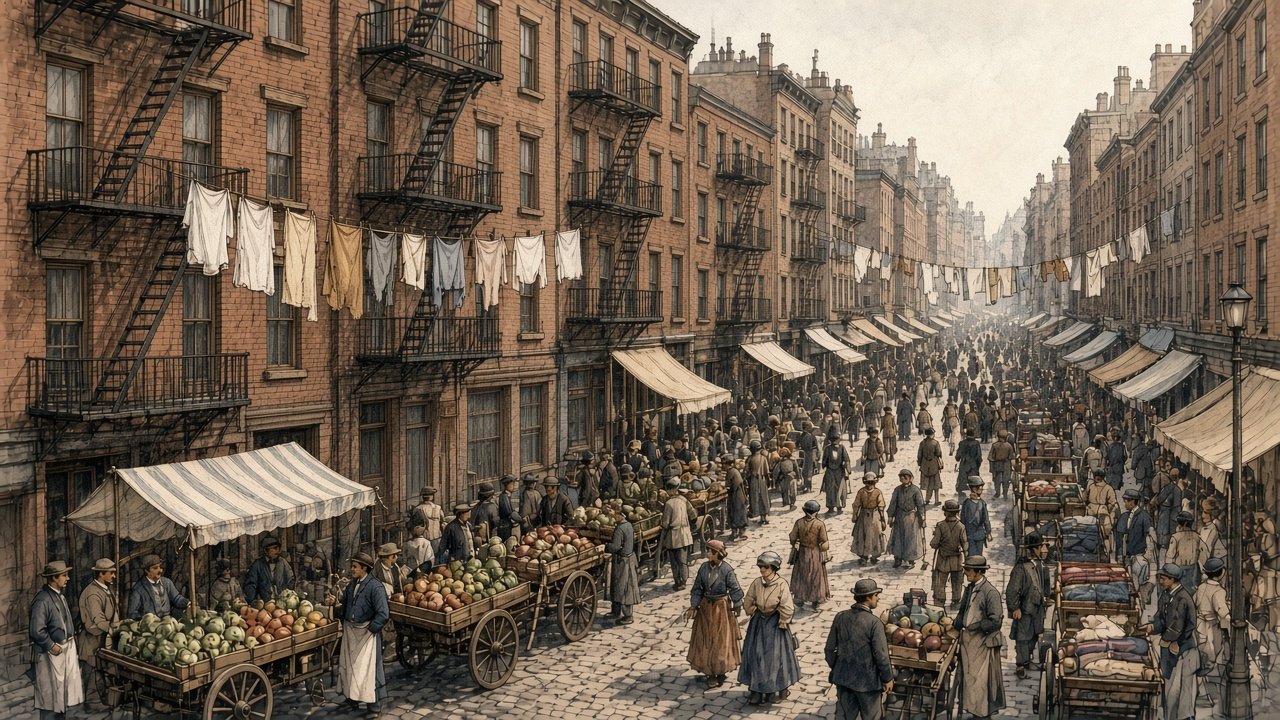
The Lower East Side of Manhattan occupies a low, crowded stretch of ground between the Bowery and the East River, bounded loosely to the south by the approaches to the Brooklyn and Manhattan bridges and to the north by Houston Street and the blocks that rise towards Fourteenth Street. For roughly half a century between the 1880s and the 1920s it held the largest concentration of Jews anywhere in the world, a population drawn overwhelmingly from the Russian Empire, Austria-Hungary and Romania and housed in brick tenements that had been built for earlier waves of Irish and German newcomers. Its streets carried the pushcart markets, workshops, synagogues, newspapers and theatres of a Yiddish-speaking society that had been transplanted across the Atlantic within a single generation. [1][2][3]
The district was never exclusively Jewish, and its Jewish history did not begin with the mass migration. German-speaking Jews had settled among the Germans of Kleindeutschland in the middle decades of the nineteenth century, and a small Sephardic and Ashkenazi community had existed in lower Manhattan since the colonial period. The arrivals after 1881 transformed this older settlement in scale and character, and their institutions shaped American Jewish life, the American labour movement and the culture of New York for the whole of the twentieth century. [4][5]
This special feature follows that history in chapter order. It begins with the district itself and its German Jewish beginnings, then traces the great migration and the journey through Castle Garden and Ellis Island, the tenements and the laws that sought to reform them, the garment trade and its sweatshops, and the religious life of the new synagogues. Later chapters turn to the settlement houses, the Yiddish press and the theatres of Second Avenue, to the unions, the strike of 1909 and the Triangle fire of 1911, and to the socialist politics of the district. The closing chapters describe the restriction of immigration in 1924, the dispersal of the population to Brooklyn, the Bronx and beyond, and the long afterlife of the Lower East Side in memory, literature and the Tenement Museum. An interactive timeline at the end of the essay gathers the principal dates.
1. A district between the rivers
Before it became a byword for immigrant crowding, the land east of the Bowery was farm and estate country. In the eighteenth century much of it belonged to the De Lancey family, whose holdings were confiscated after the American Revolution because James De Lancey had remained loyal to the Crown. The state sold the confiscated land in lots, and the street names laid across it in the following decades, among them Delancey, Orchard, Ludlow and Essex, preserved traces of the estate’s owners and its orchards. The grid that was extended over the area in the early nineteenth century produced narrow blocks divided into lots typically twenty-five feet wide and one hundred feet deep, a pattern that would later determine the shape of every tenement built there. [6][1]
The Bowery, the old road that had led from the town to Peter Stuyvesant’s farm, formed the district’s western edge. By the 1840s it had become a broad commercial street of theatres, beer halls, auction rooms and cheap lodging houses, and to its east the blocks filled steadily with houses and workshops. The East River waterfront, lined with shipyards, sail lofts, ropewalks and lumber yards, provided employment for thousands of labourers and artisans. In the neighbourhood of Corlears Hook the shipbuilding industry reached its height in the middle of the century, before iron hulls and steam moved the trade elsewhere. [7][4]
Chatham Square, where the Bowery met Park Row and East Broadway, served as a hinge between the older city to the south-west and the newer districts to the north and east. Second-hand clothing dealers clustered around the square and along Baxter Street, and many of them were Jewish, part of a trade in used garments that linked New York to the clothing markets of London and the German states. The square also lay close to the Five Points, the notorious slum district whose reputation for poverty and disorder coloured perceptions of lower Manhattan throughout the century. [8][3]
The population of the area changed repeatedly. Through the 1820s and 1830s it housed native-born artisans and the families of free Black New Yorkers as well as growing numbers of Irish immigrants. After the famine of the late 1840s the Irish presence along the waterfront increased sharply, while the blocks to the north, in the wards that lay above Division Street, became the heart of German settlement. Each group adapted the existing housing to its needs, subdividing single-family houses into rooms for several households and building rear houses in the yards behind them. [9][10]
The New York of the 1870s that the photographers of the period recorded, and that Mary Black later gathered from the collections of the New-York Historical Society in Old New York in Early Photographs, was a low city. Its skyline was punctuated chiefly by church steeples and the masts of ships, and most of its houses, warehouses and shops rose no more than four to six storeys. The lithographed bird’s-eye views published by Currier and Ives in the same years presented the island from the harbour, its wharves crowded with sailing vessels, its streets running north in a dense red mass of brick towards the open ground beyond. [11][12][13]
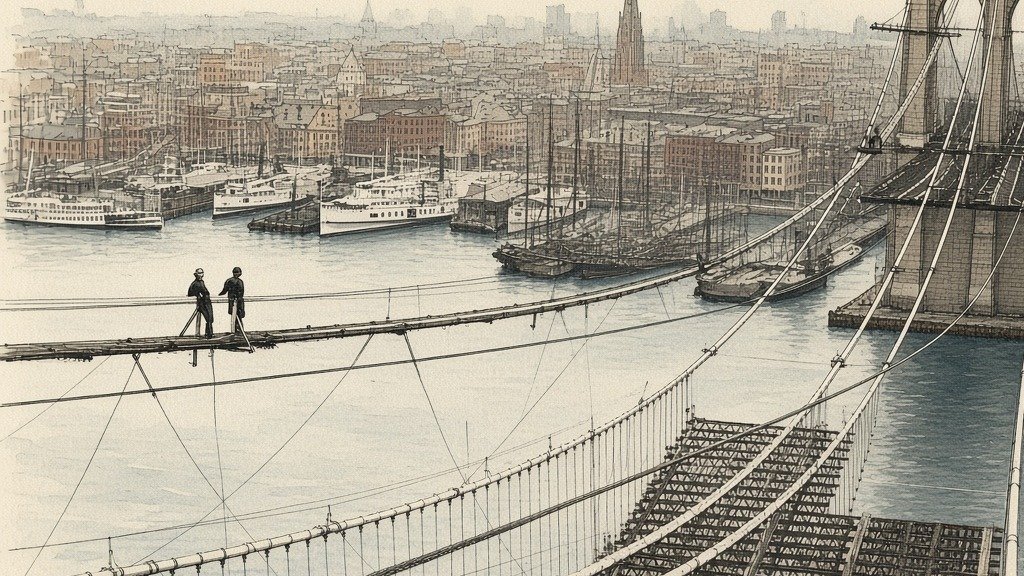
Those views also recorded the beginning of a structure that would alter the district’s southern edge. Construction of the East River Bridge, later called the Brooklyn Bridge, began in January 1870 to designs by John A. Roebling, whose son Washington Roebling directed the work after his father’s death in 1869. The granite towers rose through the first half of the decade, and in 1877 a temporary footbridge was strung between them while the main cables were spun. When the bridge opened in May 1883 its Manhattan approach cut through the old blocks near Chatham Square and Franklin Square, at the very moment when the first large groups of Eastern European Jews were arriving in the neighbourhood immediately to the north. [14][15]
The physical character of the district in the decades before the mass migration can be reconstructed from maps, directories and photographs. Insurance atlases of the 1850s and 1860s show block after block of brick buildings, most of them three to five storeys high, with frame rear houses and stables behind them, workshops in the yards and a scattering of churches, schools and public buildings. The streets were paved with cobbles or Belgian blocks, lit by gas lamps and served by horse-drawn omnibuses and, from the 1850s, by horsecar lines along the principal avenues. [4][11]
The East Side of the 1860s and 1870s was also a district of markets. The Centre Market, the Essex Market and the Catharine Market served the surrounding wards, and the streets near them were lined with stalls and handcarts. The Essex Market, established in 1818 on Grand Street and Essex Street, was rebuilt several times and eventually replaced in 1940 by the enclosed market that took its name. These markets anticipated the pushcart trade that would later become one of the defining features of the Jewish Lower East Side. [6][1]
The photographs that Mary Black selected for her book from the collections of the New-York Historical Society include views of the East River waterfront, the Bowery, Chatham Square and the streets of the eastern wards in the 1860s and 1870s. They show a working city of drays and handcarts, awnings and shop signs, ship chandlers and sail lofts, and they record buildings that had largely disappeared by the time the book was published. Rooftop views taken from church towers and tall buildings in lower Manhattan reveal the density of the built fabric and the forest of masts along the wharves, a city still oriented to its harbour. [11][12]
The bird’s-eye views of the period were not literal records. The Currier and Ives view of 1870, derived from an earlier view drawn by Charles Parsons in 1856, exaggerated the height of prominent buildings and steeples, compressed distances and showed the Brooklyn Bridge as it would appear on completion, more than a decade before it opened. Such prints were intended to celebrate the city’s growth and commerce rather than to document it precisely, but read together with the photographs of the period they convey the scale and texture of the city in which the first Eastern European Jewish immigrants arrived. [13][12]
The ethnic geography of lower Manhattan in the 1870s was already complex. Irish families dominated the wards along the East River south of Grand Street, Germans the wards to the north, and smaller communities of French, Bohemian and Polish immigrants lived among them. To the west, around Mulberry Street, the first Italian immigrants were beginning to settle in the old Irish blocks near the Five Points, and a handful of Chinese residents had established themselves on Mott Street. Within two decades each of these groups would grow, and the boundaries between them would shift repeatedly. [1][4]
The district that the newcomers inherited was therefore already old, already crowded and already marked by the passage of earlier immigrants. Its houses had been built or rebuilt for profit on narrow lots, its streets had served as markets for decades, and its reputation as the poorest quarter of the city was well established. What changed after 1881 was the speed and density of settlement, which turned an immigrant district into one of the most crowded urban neighbourhoods recorded anywhere in the nineteenth or early twentieth centuries. [1][16]
Deck construction followed from 1879 to 1883.
2. Kleindeutschland and the German Jews
In the middle decades of the nineteenth century the wards east of the Bowery and north of Division Street became known as Kleindeutschland, or Little Germany. German-speaking immigrants, arriving in large numbers after the economic crises of the 1840s and the failed revolutions of 1848, settled there in such concentration that by the 1850s New York held one of the largest German-speaking urban populations in the world, surpassed only by Berlin and Vienna. Avenue A was lined with beer halls and shops, Tompkins Square served as the community’s park, and German churches, schools, clubs, singing societies and newspapers made the district a self-contained world. [9][1]
Jews formed a significant minority within this German milieu. Many came from Bavaria, Württemberg, Baden and the Prussian province of Posen, and they shared the language and much of the culture of their non-Jewish neighbours. Some began as peddlers, carrying packs of dry goods and notions through the countryside before settling as shopkeepers, and others entered the garment trade, the cigar trade and the dealing in second-hand clothing. The more successful among them moved into wholesale commerce and banking. By 1880 the Jewish population of New York City was estimated at roughly sixty to eighty thousand, a large majority of them of Central European origin. [2][3]
The German Jews organised their own institutions as they prospered. Temple Emanu-El, founded in 1845 by a small group of German immigrants, first worshipped in rented rooms at the corner of Grand and Clinton streets, in the heart of the later Jewish Lower East Side, before moving uptown as its members grew wealthier. It became the leading Reform congregation in the country. Other congregations, among them Anshe Chesed and Rodeph Sholom, followed a similar path from the downtown wards to new buildings further north. [4][2]
The German Jewish community also created a dense network of charitable bodies. The Hebrew Benevolent Society, mutual aid associations and fraternal orders such as B’nai B’rith, founded in New York in 1843, offered insurance, sickness benefits and burial to members. Mount Sinai Hospital, established in 1852 as the Jews’ Hospital, and the Hebrew Orphan Asylum reflected a growing sense of communal responsibility. These institutions would later be called upon to assist the much larger and poorer migration from Eastern Europe, and the relationship between established donors and new arrivals became one of the defining features of Jewish New York. [2][4]
The German presence in the district began to thin out in the 1880s and 1890s as families moved north to Yorkville and to other parts of the city. A sudden and terrible blow fell in June 1904, when the excursion steamer General Slocum caught fire in the East River while carrying a church outing from St Mark’s Evangelical Lutheran Church, and more than a thousand people, most of them women and children from Kleindeutschland, lost their lives. The disaster accelerated the departure of the remaining German community from the neighbourhood, leaving its housing to the Jewish, Italian and other immigrants who were already filling the surrounding blocks. [9][1]
By then the German Jews themselves had largely left the downtown wards. Their prosperity, their acculturation and the Reform Judaism of many of their congregations distinguished them sharply from the newcomers, and the newcomers often regarded them as distant and patronising. Yet the older community supplied much of the money, organisation and political influence that shaped the reception of the Eastern European migration, and figures such as Jacob Schiff, Isidor Straus and Louis Marshall were closely involved in the philanthropic and defensive work that accompanied it. [17][18][3]
Kleindeutschland was itself divided by religion, region and class. Catholic and Protestant Germans had their own churches, Bavarians and Prussians their own societies, and the Jewish minority its own congregations, benevolent associations and lodges. Yet the shared language created common spaces, among them the beer gardens, theatres and Turnvereine, the gymnastic societies that combined physical exercise with liberal politics. German Jews participated in many of these institutions, and some of the leading figures of German New York, among them journalists, physicians and merchants, were Jewish. [9][2]
The German Jewish community also produced a distinctive economic elite. Families such as the Seligmans, the Lehmans, the Loebs, the Schiffs and the Strauses, many of whom had begun as peddlers or small merchants, built banking houses and department stores that ranked among the largest in the country by the end of the century. Isidor and Nathan Straus, sons of a Bavarian Jewish merchant, built R. H. Macy and Company into the largest department store in the world, and the investment bank of Kuhn, Loeb and Company, led by Jacob Schiff from 1885, became one of the leading financial institutions of the period. [18][17]
These families lived uptown, along Fifth Avenue and in the new districts of the Upper East Side, and their social world was separated from that of the Lower East Side by a considerable distance. Yet they retained a sense of obligation towards their poorer coreligionists, and their philanthropy, organised through bodies such as the United Hebrew Charities, founded in 1874, supported a wide range of services in the downtown district. The tension between benevolence and control, and between the desire to help and the desire to reshape, ran through these relationships for decades. [3][17]
The religious life of Kleindeutschland’s Jews was varied. Some congregations maintained traditional worship, while others introduced organ music, mixed seating, sermons in German and abbreviated liturgies under the influence of the Reform movement led in America by Isaac Mayer Wise of Cincinnati and David Einhorn of Baltimore, who later moved to New York. These debates between tradition and reform, conducted largely in German, prefigured the much larger divisions that would mark the religious life of the Eastern European immigrants. [2][4]
The streets of Kleindeutschland thus served as a bridge between two phases of Jewish settlement. The same tenements in which German families had raised children in the 1860s and 1870s housed Russian and Polish Jewish families by the 1890s, sometimes with the same German-born landlords collecting the rents. Buildings such as 97 Orchard Street, built in 1863 by the German immigrant Lucas Glockner, recorded this succession in the names of their tenants, and later became the means by which the whole history of the district would be retold. [19][20]
3. The old congregations of lower Manhattan
Jewish settlement in New York predated the German migration by nearly two centuries. In September 1654 twenty-three Jewish refugees from Recife in Brazil, which had been retaken by the Portuguese from the Dutch, arrived in New Amsterdam. The director-general Peter Stuyvesant sought to exclude them, but the directors of the Dutch West India Company, some of whose shareholders were Jewish, instructed him to allow them to remain. From this small group descended Congregation Shearith Israel, the oldest Jewish congregation in North America, whose members followed the Spanish and Portuguese rite. [21][2]
For more than a century and a half Shearith Israel was the only synagogue in the city. Its first purpose-built synagogue was erected on Mill Street in 1730, and its members included merchants, artisans and shopkeepers whose families intermarried with Jews in Newport, Philadelphia, Charleston and the Caribbean. The congregation maintained a cemetery near what is now Chatham Square, and a fragment of that early burial ground, known as the First Shearith Israel Graveyard, still survives on St James Place at the southern edge of the later Lower East Side. [21][8]
By the early nineteenth century most of New York’s Jews were Ashkenazim of Central European origin, although the Sephardic rite of Shearith Israel continued to govern communal worship. In 1825 a group of Ashkenazi members left to found B’nai Jeshurun, the first Ashkenazi congregation in the city, and from that point the number of synagogues multiplied rapidly as new immigrants formed congregations according to their regional origins and preferences. By 1860 New York had some twenty-seven congregations. [22][2]
These congregations were small and frequently unstable. They met in rented halls or converted churches, divided over questions of ritual and leadership, and relied heavily on lay officers, since trained rabbis were scarce in the United States before the 1840s. Many congregations employed a hazzan, or cantor, who led services and taught children, and a shochet who supervised kosher slaughter. The gradual arrival of ordained rabbis from Germany, and the spread of Reform ideas among the German Jewish middle class, produced lasting divisions between traditionalists and reformers. [2][4]
The pattern of congregational life established in these decades anticipated what would happen on a far larger scale after 1881. Jews in New York did not form a single community with a recognised religious authority, as in many European cities, but a federation of independent voluntary associations, each with its own officers, its own burial ground and its own rite. This voluntarism allowed new immigrants to found congregations quickly, often in a single room, but it also made unified communal action difficult, a problem that later attempts at organisation would seek to address. [3][23]
The older community also bequeathed a civic tradition. Jews in New York had voted and held minor offices since the late eighteenth century, and figures such as Mordecai Manuel Noah, a journalist, playwright and politician of Sephardic descent, had become prominent public men in the early nineteenth century. This history of participation in American public life, within a republic that recognised no established religion, shaped the expectations that later immigrants brought to their own political and communal efforts. [2]
The cemeteries of the old congregations are among the few physical traces of this early history in lower Manhattan. Besides the First Shearith Israel Graveyard on St James Place, the congregation maintained a second cemetery on West Eleventh Street and a third on West Twenty-first Street, each opened as the city expanded northward. These small burial grounds, surrounded by tenements and later by apartment buildings, preserved the names of families who had lived in New York since the colonial period. [21][2]
The mid-nineteenth-century congregations also laid the foundations of a Jewish press in New York. The Asmonean, founded in 1849 by Robert Lyon, was the first Jewish weekly in the city, and The Jewish Messenger, founded in 1857 by Rabbi Samuel Myer Isaacs, became a leading voice of traditional Judaism. These English-language papers addressed an acculturating readership and reported on communal affairs in America and abroad, preparing the ground for the far larger Yiddish press that would follow. [2][24]
Mordecai Manuel Noah’s proposal of 1825 to found a Jewish refuge named Ararat on Grand Island in the Niagara River, though it came to nothing, reflected a growing awareness among American Jews of the situation of their coreligionists in Europe. The Damascus affair of 1840, in which Jews in Syria were accused of ritual murder, prompted the first organised political protests by American Jews, held in New York, Philadelphia and other cities, and established a pattern of advocacy on behalf of Jews abroad that would later be directed towards the persecuted Jews of the Russian Empire. [2][21]
When the great migration began, then, the newcomers entered a city with an established Jewish presence, a set of philanthropic institutions and a long-standing pattern of synagogue life. The scale of the arrival soon overwhelmed all of these, and the Lower East Side became the site of a new Jewish society that owed comparatively little to its predecessors, but the earlier history provided both a framework and a point of contrast. [4][5]
4. The great migration from 1881
On 13 March 1881 Tsar Alexander II was killed in St Petersburg by members of the revolutionary organisation Narodnaya Volya. In the weeks that followed, a wave of anti-Jewish violence spread through the southern provinces of the Russian Empire, beginning in Elisavetgrad in April and reaching Kiev, Odessa and hundreds of smaller towns and villages over the following months. Mobs looted Jewish homes and shops, and in a number of places Jews were beaten and killed. The authorities were slow to intervene, and many Jews concluded that the government regarded the violence with indifference or tacit approval. [25][26]
The government’s response deepened that impression. In May 1882 the Temporary Regulations, known as the May Laws, forbade Jews to settle anew outside towns and townlets, prohibited them from acquiring property in rural areas and restricted their trading on Sundays and Christian holidays. Though presented as temporary, the regulations remained in force until 1917. Combined with quotas on Jewish admission to secondary schools and universities introduced in 1887, and the expulsion of most Jews from Moscow in 1891, they confined the Jewish population ever more tightly within the Pale of Settlement. [27][28]
The Pale, the region of the western provinces in which Jews had been permitted to reside since the partitions of Poland, held around five million Jews by the end of the century, the largest Jewish population in the world. Its economy was under severe strain. Rapid population growth, the decline of traditional occupations in trade and inn-keeping, competition in the crafts and the restrictions imposed by the state produced widespread poverty. Emigration had already begun before 1881, notably from the north-western provinces of Lithuania, but after 1881 it became a mass movement. [28][3]
Between 1881 and 1924 roughly two and a half million Jews left Eastern Europe for the United States, alongside smaller numbers who went to Britain, Argentina, Canada, South Africa and Palestine. Most came from the Russian Empire, including Congress Poland and Lithuania, while substantial numbers came from Galicia in Austria-Hungary and from Romania, where Jews had been denied citizenship and subjected to a series of discriminatory laws. The migration was unusual among European movements of the period for the high proportion of women and children it included, and for the small number who returned. Jews came to stay. [2][29]
Further violence sustained the movement. The Kishinev pogrom of April 1903, in which forty-nine Jews were killed, shocked opinion in Europe and America, and the far more extensive pogroms that accompanied the revolution of 1905 drove tens of thousands more to emigrate. In Romania the agrarian crisis of 1907 and continuing legal disabilities encouraged a steady flow, and Galician Jews, though they enjoyed civil equality in Austria, left because of the extreme poverty of the province. [26][2]
The journey itself was long and often difficult. Emigrants commonly crossed the Russian frontier illegally, assisted by agents and smugglers, and made their way to the German ports of Hamburg and Bremen, where shipping lines such as the Hamburg-Amerika Linie and Norddeutscher Lloyd maintained large emigrant facilities. German authorities, anxious to prevent the spread of disease and to ensure that emigrants did not remain in Germany, established control stations on the eastern border where travellers were inspected, bathed and their belongings disinfected before they were sent on to the ports. [3][4]
The crossing in steerage took between one and two weeks by steamship by the 1890s. Passengers slept in crowded compartments below deck, and observant Jews often subsisted on bread, herring and tea, since kosher food was rarely provided. Many travelled with tickets sent by relatives already in America, and this chain migration determined where they settled. A young man who had established himself on Hester Street would send money for a brother, then for a wife and children, then for parents, and each arrival tied the household more closely to the streets where its first member had found work. [29][5]
Within New York the immigrants were drawn overwhelmingly to the Lower East Side. Housing there was cheap, the garment workshops in which so many found employment were located in the neighbourhood, and the presence of relatives and fellow townspeople offered a measure of security. By 1892 an estimated three-quarters of New York’s Jews lived in the district, and the Jewish population of the city as a whole, which had stood at perhaps eighty thousand in 1880, reached roughly a million by 1910 and around one and three-quarter million by the mid-1920s. [1][3]
Within the district the newcomers distributed themselves according to their origins. Hungarian Jews settled in the blocks north of Houston Street, Galicians to the east of Clinton Street, Romanians around Allen and Chrystie streets, and Lithuanian and Russian Jews in the area of Hester, Canal and East Broadway. These divisions were never absolute, but contemporaries noticed them, and they were reinforced by the synagogues, mutual aid societies and restaurants that each group established. The district’s Jewish population was thus not uniform but a mosaic of regional cultures, dialects and customs, slowly blending into a new American Jewish identity. [3][4]
The established German Jewish community responded to the arrival with a mixture of generosity and apprehension. Organisations such as the Hebrew Emigrant Aid Society, formed in 1881, provided temporary shelter and assistance, and the Baron de Hirsch Fund, established in 1891 with money from the Bavarian-born financier Maurice de Hirsch, supported vocational training, agricultural colonies and loans. Leaders of the older community also feared that the concentration of poor immigrants in a single district would encourage antisemitism, and they promoted schemes to disperse new arrivals across the country. [17][2]
The composition of the migration changed over time. In the 1880s the emigrants were drawn largely from the poorest strata of the Pale and included many young men travelling alone, who intended to send for their families once they had established themselves. By the first decade of the twentieth century the migration included a higher proportion of skilled workers, of women and children, and of people with some political experience, many of them veterans of the Bund, the Jewish socialist party founded in Vilna in 1897, and of the revolutionary movement of 1905. [30][29]
The most ambitious of these schemes were the Industrial Removal Office, founded in 1901, which found jobs for some seventy-nine thousand immigrants in towns and cities across the interior, and the Galveston Movement of 1907 to 1914, backed by Jacob Schiff, which directed about ten thousand Jewish immigrants through the port of Galveston in Texas. Neither altered the basic pattern of settlement. The great majority of Jewish immigrants landed at New York and stayed there, and the Lower East Side remained, for a generation, the first American home of most of them. [17][3]
5. Castle Garden and Ellis Island
For the first decade of the mass migration, immigrants arriving at New York passed through Castle Garden at the southern tip of Manhattan. The building had begun as the West Battery, a circular fort constructed between 1808 and 1811 on a small artificial island off the Battery and later renamed Castle Clinton. After the War of 1812 it was transferred to the city, converted into a place of entertainment and renamed Castle Garden, and in 1850 it hosted the American concerts of the Swedish singer Jenny Lind. In 1855 the State of New York took over the building as the Emigrant Landing Depot, the first such official station in the country. [31][11]
Between 1855 and 1890 some eight million immigrants passed through Castle Garden. The station was administered by the state’s Commissioners of Emigration, who registered arrivals, provided information on rail tickets and lodging, and sought to protect newcomers from the runners, swindlers and boarding-house keepers who had long preyed on them at the docks. The round sandstone walls of the old fort, visible in many photographs and lithographs of the period, became for a generation of immigrants the first image of the United States. [31][12]
In 1890 the federal government assumed responsibility for immigration, and Castle Garden was closed. For two years immigrants were processed at the Barge Office near the Battery while a new station was built on Ellis Island in the upper harbour, a small island that had previously served as a fort and naval magazine. The federal station opened on 1 January 1892, and its first registered arrival was Annie Moore, a girl of seventeen from County Cork. In June 1897 the original wooden buildings burned down, and the station operated from the Barge Office until a new fireproof main building, designed by Edward Lippincott Tilton and William A. Boring, opened in December 1900. [32][33]
Ellis Island processed the great majority of immigrants entering the United States during the peak decades of migration. Its busiest year was 1907, when more than a million people arrived through the port of New York. First- and second-class passengers were generally inspected on board ship, but steerage passengers were ferried to the island, where they climbed to the Registry Room on the second floor of the main building under the eyes of doctors watching for signs of illness or infirmity. Those suspected of disease were marked with chalk and taken aside for closer examination. [32][34]
The inspection was brief for most. Officials checked each arrival against the ship’s manifest, asked questions about destination, employment and finances, and sought to identify those likely to become a public charge, contract labourers and those with contagious diseases such as trachoma. About two per cent of arrivals were refused entry, although the proportion was higher in certain years and among certain groups. For most immigrants the process took a few hours, after which they took the ferry to Manhattan or to the railway terminals in New Jersey. [32][33]
Jewish organisations stationed representatives at the island to assist arrivals, intervene on behalf of those detained and find relatives. The Hebrew Sheltering House Association and the Hebrew Immigrant Aid Society, which merged in 1909 under the latter name, provided interpreters, legal advocacy before boards of special inquiry, kosher meals and temporary shelter. The National Council of Jewish Women placed workers at the island to meet young women travelling alone and protect them from traffickers. These services reflected both the scale of the Jewish migration and the communal anxiety that surrounded it. [2][4]
From the Battery the newcomers walked or rode the short distance to the Lower East Side. Many carried addresses written on scraps of paper, and many were met by relatives or landslayt, people from the same town in Europe. Others found their way through the help of boarding-house keepers or labour agents. Within hours of leaving Ellis Island an immigrant might be seated at a sewing machine in a contractor’s shop on Ludlow Street or sleeping on a cot in the kitchen of a relative’s two-room apartment on Orchard Street. [5][29]
The experience of arrival remained a central element of family memory. Immigrants and their children told stories of names misunderstood, of medical examinations, of first sights of the harbour and of the bewildering speed of the city. Some of these stories, such as the widely repeated claim that officials at Ellis Island changed immigrants’ surnames, are not supported by the records, since inspectors worked from ship manifests prepared at the port of departure, and name changes generally occurred later, by the immigrants’ own choice. The stories nevertheless reflected a real sense of transformation. [33][32]
Emma Lazarus, a poet from a long-established Sephardic family in New York, wrote her sonnet The New Colossus in 1883 to raise funds for the pedestal of the Statue of Liberty. Lazarus had been moved by the plight of the Russian Jewish refugees of 1881 and 1882 and had worked with immigrants at the Ward’s Island reception centre. Her poem, which described the statue as a Mother of Exiles welcoming the tired and the poor, was little noticed at first, but in 1903 it was inscribed on a bronze plaque inside the pedestal, and it came to be associated with the immigrant arrivals of the period. [35]
The voyage and the inspection were followed by a period of adjustment that could be bewildering. Newcomers had to learn the geography of the city, the value of American money, the conventions of work and the rudiments of English, and they often depended on relatives and fellow townspeople for guidance. The term greenhorn, applied to recent arrivals by those who had preceded them, captured both the affection and the condescension with which the more established immigrants regarded the new. Within a few years most greenhorns had acquired the language and habits that marked them as Americans. [29][5]
The records of the immigration stations, preserved by the National Archives, provide historians and genealogists with a detailed account of the migration. Ship manifests recorded the name, age, sex, occupation, last place of residence and destination of each passenger, and from 1907 they also recorded the name and address of a relative in the country of origin. These documents allow the movements of individuals and families to be traced with considerable precision, and they have become one of the principal sources for the study of the Jewish migration to New York. [33][32]
For those detained at Ellis Island, the wait could last days or weeks. Detainees slept in dormitories on the island, ate in its dining hall and awaited hearings before boards of special inquiry, which decided whether they would be admitted or deported. Children separated from parents, women awaiting husbands who had not arrived and men suspected of being unable to support themselves made up much of the detained population, and the advocates of the Jewish aid societies devoted much of their effort to these cases. [32][2]
Ellis Island continued to operate as an immigration station until 1954, although after the restrictions of the 1920s its role shrank, and it was used chiefly for detention and deportation. Castle Clinton was later restored as a national monument. Both sites, in their different ways, came to stand in public memory for the experience of arrival that had preceded settlement on the Lower East Side. [32][31]
6. The tenement block
The characteristic building of the Lower East Side was the tenement, a multi-family dwelling of four to six storeys built on a lot of twenty-five by one hundred feet. In New York law a tenement was any building occupied by three or more families living independently and cooking on the premises, and the term covered a wide range of structures, from old single-family houses subdivided into rooms to purpose-built blocks designed from the outset to house as many tenants as possible. By the 1890s tenements of one kind or another housed the great majority of the population of Manhattan. [10][19]
The earliest tenements were conversions. As the wealthier residents of lower Manhattan moved north in the 1820s and 1830s, their brick and frame houses were divided into small apartments and rented to immigrant families, while rear buildings were erected in the yards to increase the number of rentable rooms. The first buildings constructed expressly as tenements appeared in the 1830s and 1840s, and by the 1850s and 1860s rows of plain brick buildings, often with a shop on the ground floor and four apartments on each floor above, lined the streets of the district. [10][4]
The building at 97 Orchard Street, completed in 1863, typified this pre-law tenement. It rose five storeys above a basement, with four apartments to each floor, each apartment consisting of three rooms with a total area of a little over three hundred and twenty square feet. Only the front room, facing the street, and the kitchen, facing the yard, had direct light and air. The small interior bedroom had no window to the outside at all. Water came from a pump in the yard, and the privies stood there as well. Over the following seven decades the building housed an estimated seven thousand people from more than twenty countries. [19][20]
Overcrowding was extreme. Families commonly took in lodgers, usually young men or women from the same town, to help pay the rent, and a three-room apartment might hold eight, ten or more people. Children slept on chairs pushed together or on the floor, and in summer many residents slept on the roofs and fire escapes to escape the heat. Contemporary surveys found that some blocks of the Lower East Side held more than a thousand people per acre, and the district as a whole was described as among the most densely populated places on earth. [16][1]
The conditions were documented most influentially by Jacob Riis, a Danish-born police reporter whose book How the Other Half Lives, published in 1890, combined descriptive text with photographs taken by flash in the tenements, alleys and lodging houses of lower Manhattan. Riis’s images of crowded rooms, dark hallways and children in the streets reached a wide middle-class audience and helped to create pressure for reform. His writing also contained ethnic stereotypes common to the period, including generalisations about the Jewish residents of the district, and later historians have read his work as a document of attitudes as well as of conditions. [16][36]
The interior of a tenement was dark. The central staircase was lit, if at all, by a skylight at the top of the building, and the hallways were frequently unlit at night. The rooms were heated by coal stoves, which also served for cooking, and in winter the apartments were cold and smoky. Fire was a constant danger, and the cast-iron fire escapes attached to the fronts of the buildings, made compulsory by legislation in the 1860s, were often obstructed by bedding, plants and household goods. [10][19]
Within these rooms the domestic life of the district was conducted under intense pressure. Women kept house, prepared meals, washed laundry in tubs in the kitchen and hung it on lines strung between buildings, and often also took in piecework or boarders. Sabbath preparations, including the cleaning of the apartment and the cooking of the Friday evening meal, required considerable labour in kitchens lacking running hot water. Despite the conditions, many families maintained careful standards of cleanliness and decoration, with lace curtains, framed photographs and brass candlesticks marking the effort to make a home. [5][20]
The tenement was also a workplace. In the 1880s and 1890s much of the garment industry operated in apartments, where a contractor would set up sewing machines in the front room and employ several workers, often members of his own family and recent immigrants, to assemble garments from pieces cut elsewhere. Home finishing, in which women and children sewed buttons and finished seams by hand at the kitchen table, was even more widespread. The line between home and workshop was therefore blurred, and the same rooms served for work, cooking, eating and sleeping. [37][3]
The streets outside offered relief from the rooms. Children played on the pavements and in the gutters, since parks were few, and the stoops, doorways and fire escapes served as places of sociability. Seward Park, opened in 1903 on land cleared at the junction of Canal, Essex and Hester streets, was among the first municipal playgrounds in the country, and its opening was a recognition of the needs of a district in which tens of thousands of children had no other open space. [1][4]
Rents were high in relation to wages. A three-room apartment on the Lower East Side in the 1890s and 1900s might cost between ten and fifteen dollars a month, a substantial portion of a worker’s earnings in a trade where employment was seasonal. Families moved frequently, sometimes several times a year, seeking cheaper rents or better rooms, and evictions for non-payment were common. Landlords, many of them former immigrants who had saved enough to buy a building, operated on narrow margins and were themselves often in debt. [3][5]
Housing therefore became a political question. In 1904 and again in 1907 and 1908 tenants on the Lower East Side organised rent strikes, refusing to pay increases and picketing landlords. The strike of the winter of 1907 to 1908, in which a sixteen-year-old garment worker named Pauline Newman played a prominent role, involved thousands of families and ended with some landlords agreeing to reductions. These actions drew on the networks of the district’s women, who were responsible for household budgets and who would play a similar role in the kosher meat boycott of 1902. [4][30]
Health conditions in the tenements were a constant concern of physicians and officials. Tuberculosis, known in the district as the tailors’ disease or the white plague, was widespread, and its association with the crowded rooms and long hours of the garment trade made it a central subject of reform campaigns. Infant mortality, diphtheria, typhoid and measles took a heavy toll, particularly in the summer months, when heat and contaminated milk caused outbreaks of diarrhoeal disease among young children. The Jewish population of the district, however, recorded death rates lower than those of several other immigrant groups living in comparable conditions, a fact that contemporaries attributed variously to dietary practice, low alcohol consumption and the density of mutual aid. [3][10]
The so-called Lung Block, bounded by Cherry, Catherine, Hamilton and Market streets near the approaches to the Manhattan Bridge, became notorious in the first decade of the twentieth century for its rate of tuberculosis, which reformers claimed was among the highest in the city. Its old tenements were demolished in the early 1930s to make way for Knickerbocker Village, one of the first large housing projects in the city built with public financial assistance. [38][10]
The tenements also housed a wide range of businesses on their ground floors. Shops selling groceries, dry goods, hardware, books and religious articles occupied the storefronts, and cellars were used as workshops, bakeries, saloons and storage. At 97 Orchard Street the basement held in succession a German saloon, a kosher butcher shop and other enterprises, while the upper floors housed families. This mixture of uses gave the streets their intense commercial character and allowed many families to combine residence and livelihood in a single building. [19][20]
The rooftops formed a further layer of the district’s life. In summer families carried bedding up to the tar roofs to sleep in the open air, and children flew kites and kept pigeons there. The visiting nurses of the Henry Street Settlement crossed from roof to roof to reach patients without descending and climbing the stairs of each building, and the rooftops served also as places of courtship, study and escape from the crowded rooms below. Photographers who climbed to them recorded a landscape of chimneys, water tanks, skylights and washing lines stretching across the blocks. [39][16]
The tenement thus formed the physical framework within which almost every aspect of Lower East Side life was lived. Its narrow rooms, shared halls and crowded yards shaped family arrangements, work, health and politics, and its image, recorded by photographers, reformers and novelists, came to define the district in the minds of those who lived there and of those who observed it from outside. [10][29]
7. Needles, pushcarts and sweatshops
The garment trade was the economic foundation of the Jewish Lower East Side. New York had become the centre of the American ready-made clothing industry in the middle decades of the nineteenth century, and German Jewish manufacturers and merchants played a large part in its growth. When the Eastern European migration began, the industry was expanding rapidly to meet demand for cheap, mass-produced clothing, and the newcomers, many of whom had worked as tailors or seamstresses in Europe or could learn the work quickly, entered it in enormous numbers. [3][37]
By the first decade of the twentieth century the clothing industry was the largest manufacturing industry in New York City, and a majority of its workforce was Jewish. Estimates suggest that around half of all Jewish workers in the city were employed in the needle trades, making men’s suits and coats, women’s cloaks and suits, shirtwaists, underwear, hats and caps. The concentration of the trade on the Lower East Side and in the adjacent loft districts made the industry and the neighbourhood inseparable. [3][40]
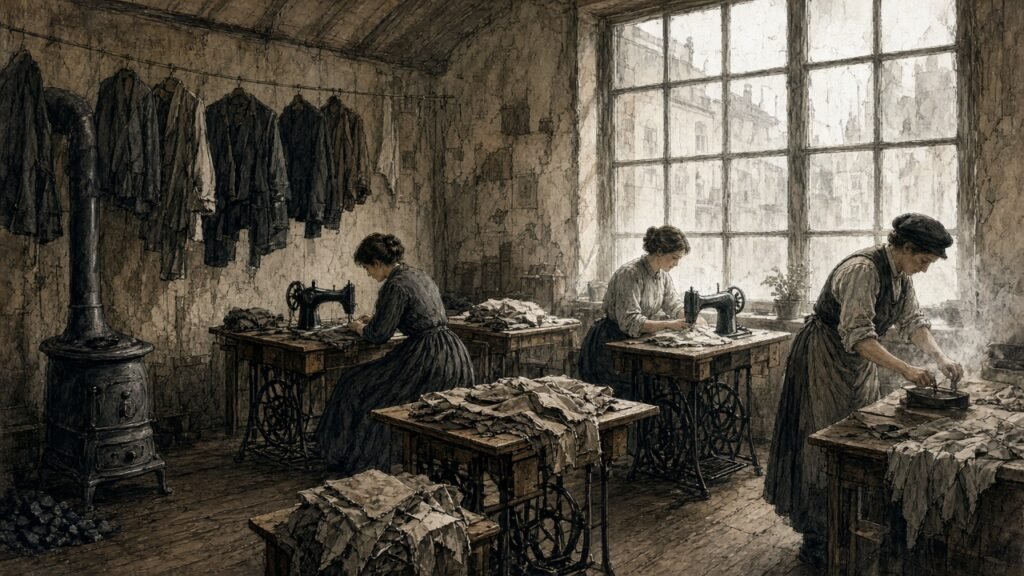
The organisation of the industry rested on the contracting system. Manufacturers, many of them German Jews with showrooms and cutting rooms in the lofts west of Broadway, cut the cloth and then distributed the bundles of pieces to contractors, who competed for the work by offering the lowest prices. The contractor, often a recent immigrant himself, rented space in a tenement apartment or a small loft, bought or hired a few sewing machines and engaged workers to assemble the garments. Under the task system a team of operators, basters and finishers was paid for completing a fixed number of garments in a day, and the number was raised whenever the team achieved it. [37][3]
The resulting workplaces were known as sweatshops. The term described both the physical conditions, cramped, poorly lit and badly ventilated rooms in which workers laboured over machines for twelve, fourteen or more hours a day, and the economic arrangement, in which competition among contractors forced wages down and hours up. Work was seasonal, with intense rushes before the spring and autumn selling seasons followed by weeks or months of unemployment, and workers were often required to provide their own needles and thread and to pay for the electricity or gas used to power the machines. [37][16]
Wages were low and irregular. A skilled operator might earn ten or twelve dollars a week during the busy season, while finishers, many of them women and girls, earned a fraction of that. Children were employed widely before child labour laws were extended and enforced in the early twentieth century, and home finishing, paid by the piece, drew in mothers, grandmothers and young children who sewed at kitchen tables late into the night. State factory inspectors, few in number, found it difficult to regulate work dispersed across thousands of apartments. [37][4]
In the early twentieth century the industry gradually moved out of the tenements and into larger factories in loft buildings. New technology, including electric power and larger cutting machines, together with legislation restricting tenement manufacture, encouraged the change. The new factories, some employing hundreds of workers, were more efficient and often better lit, but they introduced new hazards, crowding large numbers of workers onto upper floors of buildings with inadequate exits. The Triangle Waist Company, on the upper floors of the Asch Building near Washington Square, was one such factory. [41][42]
Alongside the garment industry, the district supported a dense commercial economy of its own. Pushcarts lined Hester, Orchard, Rivington and Essex streets, selling fruit, vegetables, fish, bread, pickles, hardware, crockery, clothing and textiles. The Hester Street market was known throughout the city, and by the early twentieth century thousands of licensed and unlicensed pedlars worked the streets of the Lower East Side. Pushcart peddling required little capital and could be learned quickly, and for many immigrants it was a first step towards a shop. [1][5]
The pushcart markets were a recurrent source of conflict with the city authorities, who regarded them as obstructions to traffic and sanitation. Police enforcement of licensing regulations was often accompanied by demands for bribes, and the pedlars organised associations to defend their interests. The markets persisted until 1940, when Mayor Fiorello La Guardia opened the enclosed Essex Street Market and other municipal markets and banned pushcarts from the streets of the district. [6][1]
Retail and service trades also flourished. Bakeries, butcher shops, dairy restaurants, delicatessens, tea houses and soda water stands served the population, and many of the businesses founded in these decades survive. Katz’s Delicatessen on Houston Street traces its origins to 1888, the knish bakery of Yonah Schimmel to 1910, and the appetising shop of Russ and Daughters, begun by Joel Russ with a pushcart and then a shop, to 1914. Such businesses depended on the density of the neighbourhood and on its customers’ preference for familiar foods. [43][44]
Other occupations included cigar-making, in which Jewish workers had a significant presence, building trades, printing, retail clerking and small manufacturing of various kinds. A growing number of immigrants and their children entered the professions, particularly medicine, pharmacy, dentistry and law, through the free City College of New York and the evening schools of the city. The economy of the district was thus not confined to the needle trades, but the needle trades set its rhythms, shaped its politics and provided the setting for its most consequential labour struggles. [3][29]
Contemporaries noted that the garment industry offered a degree of social mobility unusual among immigrant trades. Because a contractor’s shop required little capital, a worker who saved could become a contractor, and a successful contractor could become a manufacturer. This mobility coexisted with severe exploitation, and many of those who exploited workers in the sweatshops were themselves only a few years removed from the machine. The resulting relations between employer and employee, often linked by language, origin and even kinship, gave the labour conflicts of the district a particular intensity. [30][3]
The garment workers’ daily experience was governed by the rhythms of the season. In the weeks before the spring and autumn selling seasons the shops worked late into the night and on Sundays, and operators who had been idle for weeks found themselves working sixteen or eighteen hours a day. In the slack season they sought other work, borrowed from relatives or landsmanshaftn, or fell behind on the rent. This alternation of overwork and idleness, more than the low rate of wages, was the principal grievance of workers in the trade. [37][30]
The industry’s labour force changed over the decades. In the 1880s and 1890s most operators in the men’s clothing trade were men, while women worked chiefly as finishers and in the manufacture of shirts, underwear and children’s clothing. The growth of the women’s clothing trade, especially the shirtwaist industry after 1900, brought large numbers of young unmarried women into the factories, where they worked alongside Italian women who had entered the trade at the same time. By 1910 women made up a majority of workers in the women’s garment industry in New York. [40][45]
The sewing machine itself shaped the industry’s geography. Treadle machines, and later machines driven by electric motors through belts and shafts, could be installed in any room with a solid floor, and their low cost made the small shop viable. Instalment sellers offered machines on credit to immigrants who wished to work at home or set up as contractors, and the hum of machines became a familiar sound in the tenement streets. Manufacturers’ agents and sewing machine dealers advertised heavily in the Yiddish press, and the machine appeared in the poetry of the sweatshop as an emblem of the worker’s servitude. [37][24]
By the 1920s the centre of the garment industry had moved north to the area around Seventh Avenue between Thirty-fourth and Fortieth streets, which became known as the Garment District. Many workers followed their jobs to new neighbourhoods, and the decline of manufacturing on the Lower East Side contributed to the dispersal of its population. The trade nevertheless remained, for decades, the largest employer of Jewish workers in New York. [40][46]
8. Reformers and the housing laws
Concern about tenement conditions in New York long predated the Jewish migration. In 1842 the city inspector John Griscom published a report on the sanitary condition of the labouring population, and in the following decades physicians, clergymen and charitable organisations repeatedly drew attention to the links between overcrowding, disease and mortality in the poorer wards. The cholera epidemics of 1832, 1849 and 1866 sharpened these concerns, as did the draft riots of July 1863, which many observers attributed in part to the conditions of the slums. [10][4]
The first comprehensive legislation was the Tenement House Act of 1867, passed by the New York State legislature after an investigation by the Council of Hygiene and Public Health of the Citizens’ Association. The act provided a legal definition of a tenement and required fire escapes, a ventilator or transom window for each room, a water closet or privy for every twenty residents and connection to sewers where available. Its requirements were modest and its enforcement weak, but it established the principle that the state could regulate the design of private housing in the interest of public health. [10][19]
A second act, passed in 1879 and later known as the Old Law, required that every room in a new tenement have a window opening onto a street, a yard or an air shaft. In the previous year a competition sponsored by the trade journal The Plumber and Sanitary Engineer had sought a model design for a tenement on a standard twenty-five-foot lot, and the winning design, by the architect James E. Ware, introduced the plan that became known as the dumbbell, in which the building was indented in the middle to create narrow shafts between adjacent structures. [10][19]
The dumbbell tenement became the standard building type of the Lower East Side during the years of heaviest Jewish settlement. Thousands were erected in the 1880s and 1890s, many by Jewish builders and investors, and they gave the district much of the appearance it still retains. The air shafts, only a few feet wide and enclosed on all sides, provided little light or ventilation in practice. They carried noise and cooking smells from one apartment to another, collected refuse thrown from the windows, and in the event of fire acted as flues that spread the flames rapidly through the building. [10][16]
Criticism of the dumbbell plan grew through the 1890s. Riis’s work, the investigations of the Tenement House Committee of 1894 chaired by Richard Watson Gilder, and the efforts of the Charity Organization Society kept the subject before the public. In 1900 the Charity Organization Society’s Tenement House Committee, directed by the housing reformer Lawrence Veiller, mounted an exhibition of photographs, maps and models showing the density of disease and poverty block by block. The exhibition persuaded Governor Theodore Roosevelt to appoint a state Tenement House Commission. [16][10]
The commission’s work produced the Tenement House Act of 1901, known as the New Law. It banned the construction of new dumbbell tenements and required that new buildings be designed with larger courtyards for light and air, that every apartment have running water and its own toilet, and that public hallways be lit. It also required owners of existing buildings to install windows in interior rooms opening onto halls or adjacent rooms, to replace yard privies with indoor toilets and to provide fire protection. A Tenement House Department was created to enforce the law, with Robert W. de Forest as its first commissioner and Veiller as his deputy. [10][19]
The changes required by the 1901 law can still be traced in the fabric of the surviving buildings. At 97 Orchard Street interior windows were cut between rooms, and two toilets were installed on each floor in the space of the former hall, each shared by two families. In 1905 gas lighting was installed, and electric lighting arrived in the 1920s. These incremental improvements made the apartments safer and somewhat healthier, but they did not change the basic problem of overcrowding. [19][20]
New buildings constructed under the 1901 law, known as new-law tenements, were larger and generally built on wider lots. They featured central courtyards, private toilets and in some cases bathtubs, and they were often more elaborately ornamented than their predecessors, with decorative cornices and brick and stone detailing. Many of the tenements built on the Lower East Side in the first decade of the twentieth century, especially in the blocks east of Clinton Street, were of this type. [10][4]
The effectiveness of the reforms was debated at the time and has been debated since. Some landlords, unable or unwilling to bear the cost of compliance, closed their buildings or sold them, and higher construction standards raised rents in the new buildings beyond the means of the poorest families. Enforcement depended on a limited inspection staff, and violations were widespread. Nevertheless, death rates in the city fell substantially between 1890 and 1920, and contemporaries attributed part of the improvement to the regulation of housing alongside improvements in water supply, sanitation and public health services. [10][3]
Reformers also turned to model tenements built by philanthropic investors. The City and Suburban Homes Company, founded in 1896, built blocks of improved housing on the principle of limited dividends, offering investors a modest return in exchange for better conditions for tenants. Model buildings of this kind were constructed on the Upper East Side and elsewhere, while on the Lower East Side the Lavanburg Homes of 1927 and the Amalgamated Dwellings of 1930, built by the Amalgamated Clothing Workers union under the leadership of Abraham Kazan on Grand Street, offered cooperative alternatives. [38][46]
In the 1930s the federal and municipal governments became directly involved in housing. The First Houses, opened by the New York City Housing Authority in 1935 on Avenue A and East Third Street, were the first public housing project in the United States, built in part by renovating existing tenements. Knickerbocker Village, a large privately built but publicly assisted complex completed in 1934 on the site of the old Lung Block near the Manhattan Bridge, replaced some of the worst housing in the district. [38][1]
The same decade saw a further tightening of regulation. The Multiple Dwelling Law of 1929 and subsequent amendments required owners of old-law tenements to fireproof stairwells and make other expensive alterations. Many owners, faced with low rents and high costs during the Depression, chose instead to close the upper floors of their buildings and rent only the shops at street level. This is what happened at 97 Orchard Street in 1935, when the residential floors were sealed and left untouched for more than half a century. [19][20]
The physical legacy of the housing laws can be read in the building types that still line the streets of the district. Pre-law tenements of the 1850s and 1860s, old-law dumbbells of the 1880s and 1890s and new-law tenements of the early twentieth century stand side by side on many blocks, their differing widths, ornament and plan recording the successive attempts to regulate the housing of the poor. Architectural historians have used this layering to trace the evolution of reform from the first tentative interventions of the 1860s to the more comprehensive standards of the twentieth century. [19][10]
The reform campaigns also produced a new body of social knowledge. The Tenement House Commission of 1900 published maps showing the distribution of tuberculosis, poverty and overcrowding block by block, and its statistical methods were adopted by later investigators of urban conditions. The reformers’ reports, together with Riis’s photographs and the surveys of the settlement houses, created a documentary record of the Lower East Side that historians continue to use, though they also reveal the assumptions about immigrant behaviour that shaped the reformers’ approach. [10][16]
The history of housing reform on the Lower East Side was thus a history of gradual and partial improvement. The laws of 1867, 1879 and 1901 each responded to a particular understanding of the problem and each left a physical mark on the district. By the time the most effective reforms arrived, much of the Jewish population had already left for newer housing elsewhere in the city, and the improved buildings passed to the next generation of residents. [10][4]
9. Synagogues and religious life
The religious life of the Jewish Lower East Side was organised around hundreds of small congregations. Most were founded by immigrants from the same town or region in Europe, and they met in rented rooms, converted apartments, storefronts or the upper floors of commercial buildings. These shtiblekh, as they were called, preserved the rites, melodies and customs of particular communities, and their names often recalled the places from which their founders had come. By the first decade of the twentieth century observers counted several hundred congregations in the district, most of them very small. [3][4]
A smaller number of congregations built or acquired substantial buildings. The most celebrated was the synagogue of Congregation Kahal Adath Jeshurun with Anshe Lubz on Eldridge Street, dedicated in September 1887. It was among the first large synagogues built in the United States by Eastern European Jews, and its founders intended it to demonstrate that the immigrants could create a house of worship equal in dignity to those of the established German congregations uptown. [47][48]
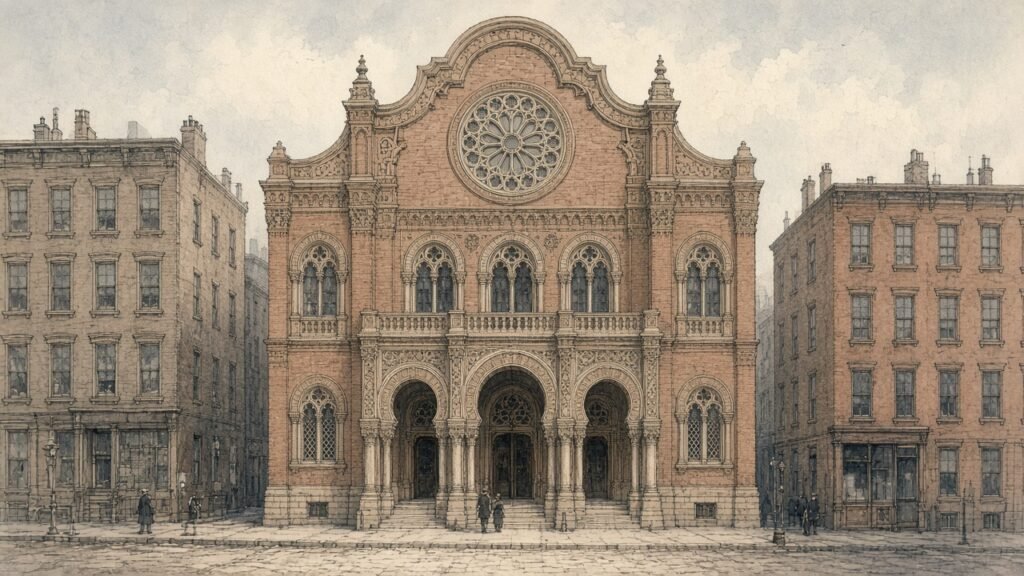
The building was designed by the brothers Peter and Francis Herter, architects of German origin who had built many tenements in the neighbourhood. They combined Moorish, Gothic and Romanesque elements in a richly ornamented brick and terracotta facade, with horseshoe arches, a great rose window and finials rising above the cornice. The interior, with a barrel-vaulted sanctuary seventy feet high, a women’s gallery on three sides, brass chandeliers, stained glass and painted walls, could seat around a thousand worshippers. On the High Holidays the building was filled and crowds gathered in the street outside. [47][48]
The congregation’s prosperity reflected that of its members, many of whom had become shopkeepers, contractors and property owners. Its officers included men who had risen within a few years from peddling or sewing to positions of relative comfort, and the building’s rich decoration was an expression of that success. As members moved away from the district in the 1920s and 1930s, however, the congregation shrank. The main sanctuary was closed in the 1950s, and the dwindling congregation worshipped in the smaller study hall in the basement. [47][48]
In the 1980s a campaign to restore the building began, and the Eldridge Street Project, later the Museum at Eldridge Street, was founded to raise funds and interpret the history of the synagogue and the neighbourhood. The building was designated a National Historic Landmark in 1996, and after a restoration of some twenty years the sanctuary reopened in 2007. A new east window, designed by the artist Kiki Smith and the architect Deborah Gans, was installed in 2010 in place of a lost original. [47][48]
Other substantial synagogues of the district included the Bialystoker Synagogue, which in 1905 acquired a stone building on Willett Street that had been built in 1826 as a church, and the Beth Hamedrash Hagodol, founded in 1852 as the oldest Russian Jewish congregation in New York, which acquired a former church on Norfolk Street in 1885. The Romaniote congregation Kehila Kedosha Janina, formed by Greek-speaking Jews from Ioannina, built its small synagogue on Broome Street in 1927, a reminder that the Jewish Lower East Side included Sephardic and Romaniote communities from the Ottoman lands as well as Ashkenazim. [1][4]
The organisation of religious authority proved difficult. In 1888 a group of Orthodox congregations, seeking to create a unified communal structure on the European model, brought Rabbi Jacob Joseph of Vilna to New York as chief rabbi. His appointment was intended to bring order to the supervision of kosher meat, a field marked by competition, fraud and disputes over fees. The attempt failed. Other congregations refused to recognise his authority, butchers resisted the supervision fees, and the post lost much of its influence within a few years. [3][2]
When Rabbi Jacob Joseph died in July 1902, his funeral procession drew tens of thousands of mourners through the streets of the Lower East Side. As it passed the printing press factory of R. Hoe and Company on Grand Street, workers threw objects at the mourners, and in the ensuing disorder the police attacked members of the procession. The episode prompted an investigation by Mayor Seth Low, which criticised the conduct of the police, and it became a reference point in discussions of the treatment of Jews by the authorities. [3][4]
The question of communal organisation returned in 1908, after the police commissioner Theodore Bingham published an article claiming that half of the city’s criminals were Jews. The claim, which he later retracted, prompted an outcry and led to the founding of the Kehillah of New York City in 1909, under the leadership of Rabbi Judah Leon Magnes. The Kehillah sought to bring the city’s Jewish organisations together to address education, religious supervision, crime and labour relations. It achieved notable work, particularly through its Bureau of Jewish Education, but it was dissolved in 1922. [23][46]
Religious education was a central concern. Most boys received instruction in a heder, a private elementary school conducted by a melamed in a room or apartment, and the quality of such instruction was a constant subject of complaint. Talmud Torahs, communal afternoon schools, were established in larger numbers in the early twentieth century, and the Machzike Talmud Torah on East Broadway became one of the largest. Higher learning was provided by the Rabbi Isaac Elchanan Theological Seminary, founded in 1897 on the Lower East Side and later the core of Yeshiva University. [49][3]
The Jewish Theological Seminary of America, refounded in 1902 under the presidency of Solomon Schechter with funding from Jacob Schiff and other German Jewish philanthropists, sought to develop a traditional but modern American Judaism that could appeal to the children of immigrants. Its graduates staffed many of the Conservative congregations established in the new Jewish neighbourhoods of the 1920s and after. [50][17]
Religious observance on the Lower East Side was varied and often contested. The economic pressures of the garment industry, which frequently demanded work on Saturdays, made Sabbath observance difficult for many workers, and the district’s socialist and anarchist movements were openly hostile to religion. On Yom Kippur in the 1880s and 1890s anarchist groups held provocative balls and banquets, and clashes with worshippers sometimes followed. Yet the synagogues remained full on the High Holidays, and many residents who were not strictly observant maintained kosher homes and attended services for festivals and life-cycle events. [30][29]
The architecture of the district’s synagogues reflected the aspirations and resources of their congregations. Most of the larger buildings were conversions of churches abandoned by Protestant congregations as their members moved uptown, and their adaptation involved the installation of an ark on the eastern wall, a central reading platform and a women’s gallery. The few purpose-built synagogues, among them the Eldridge Street building and the later Pike Street synagogue of Congregation Sons of Israel Kalwarie, completed in 1903, adopted the Moorish and Romanesque styles that had become associated with synagogue architecture in Central Europe and America. [47][4]
Life-cycle events structured the religious calendar of most families. Circumcisions, bar mitzvahs, weddings and funerals were occasions for gathering kin and landslayt, and the catering halls, wedding palaces and photographers’ studios of the district served a busy trade. Weddings were frequently held in rented halls on the Bowery and East Broadway, and the elaborate photographs commissioned on such occasions, sent back to relatives in Europe, recorded the families’ new prosperity and their adoption of American dress. [5][29]
Cantorial music was one of the great attractions of the larger synagogues. Celebrated cantors such as Yossele Rosenblatt, who came to New York in 1912, drew crowds that filled the sanctuaries and the streets outside, and their recordings, sold in large numbers on gramophone discs, carried the sound of the Eastern European synagogue into homes across the country. Congregations competed to engage the most famous cantors for the High Holidays, paying fees that sometimes exceeded the annual salaries of their rabbis. [4][29]
The landsmanshaftn, mutual aid societies organised by town of origin, formed another pillar of communal life. Thousands of these associations existed in New York by the early twentieth century, many of them affiliated with synagogues. They provided sick benefits, loans, and above all burial plots in the cemeteries of Queens and Brooklyn, and they maintained ties with the towns from which their members had come, sending relief during the First World War and after. Their meetings combined religious, social and practical purposes, and they formed the network through which much of the district’s social life was conducted. [4][5]
10. Settlement houses and schools
The settlement house movement, which had begun in London with the founding of Toynbee Hall in 1884, reached New York two years later. In 1886 Stanton Coit, an American who had visited Toynbee Hall, established the Neighborhood Guild on Forsyth Street on the Lower East Side, the first settlement house in the United States. Reorganised in 1891 as the University Settlement, it moved in 1898 to a substantial building at the corner of Eldridge and Rivington streets, where it offered classes, clubs, a library, public baths and meeting rooms to residents of the surrounding blocks. [1][4]
The idea of the settlement was that educated men and women should live among the poor, learn about their circumstances at first hand and work with them to improve conditions. Settlement workers, many of them young graduates of colleges and universities, combined direct services with social investigation, compiling detailed studies of housing, health, wages and family life that informed the reform legislation of the Progressive Era. They also served as intermediaries between the residents of the district and the city’s political and charitable institutions. [39][51]
The best known of the Lower East Side settlements was founded by Lillian Wald, a nurse from a prosperous German Jewish family in Rochester. In 1893, while teaching a class in home nursing on the Lower East Side, Wald was taken by a child to a tenement on Ludlow Street where a woman lay ill after childbirth, and the experience led her to move to the district. With her colleague Mary Brewster she began a visiting nurse service, providing care to the sick in their homes, and in 1895, with funding from Jacob Schiff, she moved into a house at 265 Henry Street. [51][52]
The Henry Street Settlement, as it became known, grew into one of the most influential social institutions in the country. Its visiting nurses, who travelled across the rooftops between tenements to reach their patients, laid the foundations of public health nursing in the United States, and by 1913 the service employed nearly a hundred nurses who made some two hundred thousand visits a year. Wald’s advocacy led to the appointment of the first public school nurse in New York in 1902, and she was a leading figure in the campaign for the creation of the federal Children’s Bureau in 1912. [39][51]
The settlement also offered classes, clubs, summer camps and cultural programmes. In 1915 Alice and Irene Lewisohn, members of a wealthy German Jewish family associated with the settlement, opened the Neighborhood Playhouse on Grand Street, which became an important venue for experimental theatre and dance. Henry Street was also a centre of political activity. The founding conference of the National Association for the Advancement of Colored People held one of its early meetings there in 1909, and Wald was active in the women’s suffrage, peace and labour movements. [39][52]
The Educational Alliance, established in 1889 by German Jewish philanthropists through the merger of several existing organisations, occupied a large building on East Broadway at the corner of Jefferson Street from 1891. It sought explicitly to Americanise the new immigrants, offering English classes, lectures on American history and civics, a library, a gymnasium, art classes and a roof garden. Its art school, founded in 1895, counted among its students the sculptors Jacob Epstein and Chaim Gross and the painter Ben Shahn. [4][3]
Relations between the settlement and Americanising institutions and the immigrants they served were complex. Many residents valued the services and opportunities they offered and recalled them with gratitude. Others resented the condescension they perceived in the efforts of wealthy German Jews to reshape their language, religion and manners, and the Educational Alliance’s early discouragement of Yiddish provoked particular criticism. Over time the institutions adapted, introducing Yiddish lectures and accommodating the political and cultural interests of the neighbourhood. [29][3]
The public schools were the most important Americanising institutions of all. The schools of the Lower East Side were overcrowded, with classes of fifty or sixty children, and many operated on part-time schedules to accommodate the numbers. Teachers, many of them Irish American women, taught English, arithmetic, geography and American history, and they emphasised patriotism, cleanliness and good manners. For the children of immigrants the schools offered a route into American society and, for some, into higher education and the professions. [4][5]
Evening schools for adults, run by the Board of Education and by private organisations, drew large numbers of immigrant workers who wished to learn English after a day in the shop. The Seward Park branch of the New York Public Library, opened in 1909 on East Broadway, became one of the busiest libraries in the city, its reading rooms filled with readers of English, Yiddish, Russian and Hebrew. The Aguilar Free Library, a Jewish foundation later merged into the New York Public Library system, had earlier provided similar services. [1][3]
The College of the City of New York, a free public institution, played a central part in the advancement of the children of the Lower East Side. By the early twentieth century a large proportion of its students were Jewish, and its graduates entered teaching, medicine, law, accounting, engineering and public service in substantial numbers. The college’s reputation for intellectual intensity and political debate became part of the folklore of Jewish New York, and its alumni included many of the writers, scientists and politicians who emerged from the district. [29][46]
Hospitals and health services also expanded. Beth Israel Hospital was founded in 1890 by Eastern European Jews who wished to have a hospital in which patients could be treated in Yiddish and served kosher food, and Gouverneur Hospital served the district as a municipal institution. The city’s Department of Health, under the leadership of Hermann Biggs and others, developed programmes of disease surveillance, milk inspection and school medical examinations that had a measurable effect on infant mortality in the tenement districts. [1][4]
Public baths were another reform of the period. Because most tenements lacked bathtubs, the city opened free public baths, beginning with the Rivington Street Bath in 1901, and private institutions such as the University Settlement and the Educational Alliance also provided bathing facilities. The traditional Russian and Turkish bath houses of the district, some of which also served as ritual baths, continued to operate alongside them. [1][10]
Settlement workers also played a prominent role in the campaign against child labour. Florence Kelley, who lived at the Henry Street Settlement from 1899 and served as general secretary of the National Consumers League, led efforts to regulate the employment of children and the hours of women’s work, and her investigations of conditions in the tenement workshops supported legislation in New York and elsewhere. The National Child Labor Committee, founded in 1904 with the involvement of Wald and Kelley, commissioned investigations and photographs that documented the employment of children in industry across the country. [51][39]
Recreation was another concern. Settlements organised clubs for boys and girls, dances, debating societies and summer outings, and they pressed the city to provide parks and playgrounds. The Outdoor Recreation League, founded in 1898, campaigned for the opening of Seward Park as a playground, and the success of the campaign led the city to establish a programme of municipal playgrounds in other crowded districts. [39][1]
The settlements also supported the arts. The Henry Street Settlement’s music school, founded in 1927, and the Third Street Music School Settlement, founded in 1894 by Emilie Wagner, offered instruction to children of the district, and many of their pupils went on to careers in music. The Educational Alliance’s art school and the Neighborhood Playhouse provided similar opportunities in the visual and performing arts, and together they helped to make the Lower East Side a training ground for American artists of the twentieth century. [39][4]
The relationship between the settlements and the district’s own institutions grew closer over time. Settlement workers collaborated with unions during strikes, offering meeting rooms and relief, and the Henry Street Settlement supported the shirtwaist strikers of 1909. Residents of the district joined the staff of the settlements as teachers, club leaders and nurses, and a number of the children who had attended their classes returned as adults to direct their programmes. By the 1920s the settlements had become, to a considerable extent, institutions of the neighbourhood rather than missions to it. [39][51]
The settlements, schools and libraries of the Lower East Side created an environment in which the children of immigrants could acquire the language, skills and credentials of American life with remarkable speed. Their success contributed to the rapid movement of the second generation out of the district, and in that sense the institutions worked to empty the neighbourhood they served. The Henry Street Settlement, the University Settlement and the Educational Alliance nevertheless remained in the district and continued to serve its later residents, Puerto Rican, Chinese, Dominican and others, through the twentieth century and into the twenty-first. [39][1]
11. The Yiddish press
The Lower East Side was the capital of the Yiddish press in the Western Hemisphere. Yiddish newspapers had appeared in New York from the 1870s, beginning with short-lived weeklies, and the arrival of hundreds of thousands of Yiddish-speaking readers in the 1880s and 1890s created a market for daily newspapers. The Yidishes Tageblat, founded in 1885 by Kasriel Sarasohn, became the first successful Yiddish daily in the world and represented an Orthodox and conservative point of view. [24][3]
The socialist and labour movements of the district produced their own papers. The Arbeter Tsaytung, a weekly founded in 1890, and the daily Abend Blatt were organs of the Socialist Labor Party under the influence of Daniel De Leon, whose doctrinaire leadership provoked a split among the Jewish socialists. In 1897 a group of dissidents founded a new daily, Forverts, or the Jewish Daily Forward, whose first issue appeared on 22 April 1897. Its first editor was Abraham Cahan, who left after a few months but returned in 1903 and edited the paper until shortly before his death in 1951. [53][54]
Cahan, born in 1860 near Vilna and educated at the Vilna Teachers’ Institute, had emigrated in 1882 after coming under suspicion for revolutionary activity. In New York he worked as a teacher, labour organiser and journalist, wrote fiction in English as well as Yiddish, and became one of the most prominent figures of the district. His novel The Rise of David Levinsky, published in 1917, traced the career of an immigrant who rose from poverty to wealth in the garment trade at the cost of his ideals, and it remains one of the most important works of American immigrant fiction. [54][29]
Under Cahan’s editorship the Forward became the largest Yiddish newspaper in the world. He wrote and encouraged a plain, colloquial Yiddish accessible to readers with little formal education, and combined socialist commentary with human-interest stories, serialised fiction, popular science, sports and advice. He saw the paper as an instrument of education and Americanisation as well as of socialist politics, and he was willing to moderate the paper’s ideology to reach a mass audience. By the 1920s its daily circulation exceeded two hundred thousand, with regional editions published in several cities. [53][55]
The most famous feature of the Forward was the Bintel Brief, or bundle of letters, a column introduced in 1906 in which readers wrote to the editors about their personal difficulties and received advice in reply. The letters dealt with marriage, desertion, poverty, religious doubt, conflicts between parents and children, the dilemmas of observance and work, and the loneliness of immigrants separated from their families. Collected and translated in later decades, the column provides an unusually intimate record of the lives and concerns of the district’s residents. [53][55]
In 1912 the Forward moved into a new building at 175 East Broadway, opposite Seward Park. Its ten-storey facade, decorated with relief portraits of Karl Marx, Friedrich Engels, Ferdinand Lassalle and Wilhelm Liebknecht, became a landmark of the district, and its offices housed not only the newspaper but the headquarters of the Workmen’s Circle, the United Hebrew Trades and other labour and socialist organisations. The building served as a centre of the Jewish labour movement for more than six decades. The newspaper left it in 1974, and the building was later converted into apartments. [53][1]
Competing papers represented other tendencies. The Morgen Zhurnal, founded in 1901, was Orthodox and conservative and became known for its classified advertisements. Der Tog, founded in 1914, aimed at a more intellectual readership and published many of the leading Yiddish writers of the period. Di Varhayt, founded in 1905 by Louis Miller, and later the communist Frayhayt, founded in 1922, completed a press of remarkable range. At its peak in the years around the First World War, the combined circulation of the Yiddish dailies in New York exceeded half a million. [24][55]
The press created a public sphere in which the residents of the Lower East Side debated politics, religion, literature and the problems of daily life. Newspapers serialised novels, published poetry and criticism and ran fierce polemics against one another. Writers such as Sholem Asch, Isaac Bashevis Singer and Sholem Aleichem published in their pages, and the poet Morris Rosenfeld, whose verses about the sweatshop made him famous, first reached his readers through the Yiddish press. [24][29]
The poets of the sweatshop, among them Rosenfeld, David Edelstadt, Joseph Bovshover and Morris Winchevsky, wrote verse about labour, poverty and revolutionary hope that was recited at meetings and set to music. In the first decade of the twentieth century a younger group of poets known as Di Yunge reacted against what they regarded as the didactic tendencies of their predecessors and sought a more individual and aesthetic poetry. Later, the Inzikhistn of the 1920s introduced modernist forms. New York became, for a time, the leading centre of Yiddish literary creation outside Eastern Europe. [24][29]
Publishing houses, bookshops and lending libraries supplied readers with Yiddish books, translations of European literature and works of popular science and history. Cafés on East Broadway and Second Avenue served as meeting places for writers, journalists and political activists, and some, such as the Café Royal on Second Avenue, became legendary as centres of literary and theatrical gossip. The density of this intellectual life, sustained by a readership of working people, struck many observers as one of the most remarkable features of the district. [56][29]
The decline of the Yiddish press followed the decline of Yiddish as the everyday language of American Jews. The children of immigrants read English newspapers, and the restriction of immigration after 1924 cut off the supply of new readers. Circulations fell steadily from the 1930s, and one by one the dailies closed or merged. The Forward survived as a daily until 1983, continued as a weekly, and in later years appeared in both Yiddish and English editions, its English edition becoming an influential voice in American Jewish journalism. [53][55]
The press also played a role in the integration of the immigrants into American political life. The Yiddish papers explained the workings of the American government, reported on elections and endorsed candidates, and they published guidance on naturalisation, voting and the rights of citizens. Cahan’s editorials urged readers to learn English, to send their children to school and to participate in the institutions of American democracy, while defending the right of the immigrants to retain their language and culture. [54][53]
Advertising formed a significant part of the papers’ content and revenue. Notices from steamship lines, banks, doctors, matchmakers, theatres, furniture dealers and patent medicine sellers filled the pages, and the classified columns carried announcements of employment, lodging and missing relatives. The Forward’s columns devoted to missing husbands, known as the Gallery of Missing Husbands, published photographs and descriptions of men who had deserted their families, a problem that the National Desertion Bureau, founded in 1911, sought to address. [53][55]
The journalists of the Yiddish press formed a distinctive professional world. Many had been students, teachers or political activists in Russia, and they combined reporting with literary and political ambitions. They worked long hours for modest pay in crowded newsrooms on East Broadway, wrote under several pseudonyms at once and moved frequently between papers as editorial lines and personal loyalties shifted. Their union, the Jewish Writers’ Union, sought to improve their conditions, and their memoirs provide a vivid record of the newspaper culture of the district. [55][29]
The Yiddish press of the Lower East Side was, in its time, among the most extensive immigrant presses in American history. It served as an instrument of information, education and political mobilisation, and its pages provide historians with one of the richest sources for the study of immigrant life. Its legacy was carried forward in the archives of YIVO and other institutions that preserved the newspapers, letters and records of the period. [57][53]
12. The theatres of Second Avenue
The Yiddish theatre as a professional institution was barely a few years old when it reached New York. Its founder is generally considered to be Abraham Goldfaden, a poet and songwriter who in 1876 staged performances of his songs and sketches in a wine garden in Iași, in Romania, and went on to form a touring company that performed across Romania and the Russian Empire. In 1883 the Russian government banned Yiddish theatre performances, and many actors emigrated, bringing the new art form to London and New York. [58][59]
The first Yiddish theatrical production in New York took place in August 1882, when a group of amateurs including the young Boris Thomashefsky staged Goldfaden’s operetta Koldunye, or The Witch, at Turn Hall on East Fourth Street. Thomashefsky, then a teenager working in a cigarette factory, went on to become one of the leading actors and impresarios of the Yiddish stage, celebrated for his romantic roles and his elaborate productions. In the following years professional companies established themselves at a succession of theatres on the Bowery, among them the Oriental, the Romanian Opera House, the Thalia and the Windsor. [60][61]
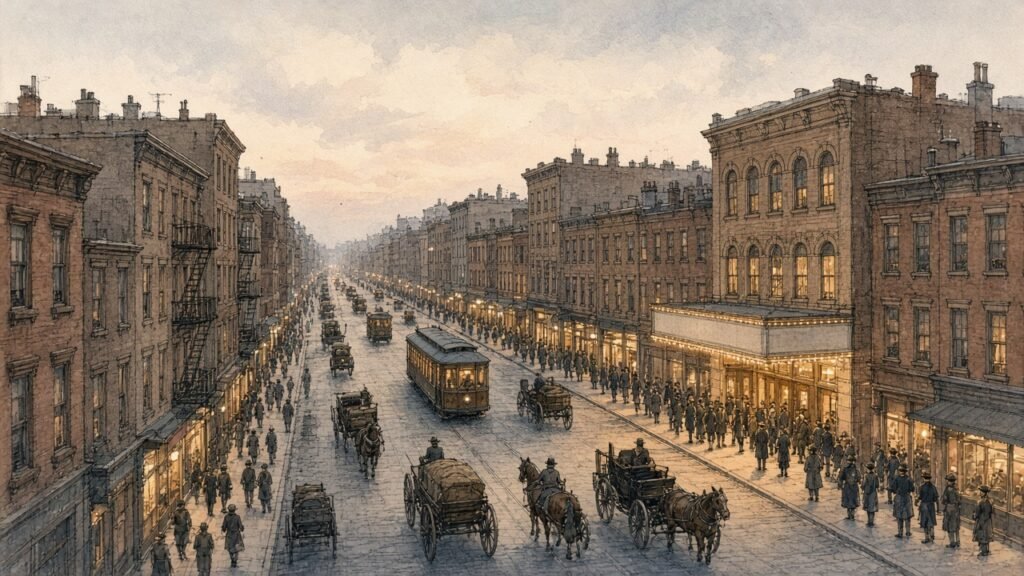
The theatre quickly became the most popular form of entertainment on the Lower East Side. Audiences of working people filled the houses several nights a week, and performances were social occasions at which families brought food, children ran in the aisles and spectators commented aloud on the action. Benefit performances, at which a landsmanshaft or union bought out the house and resold tickets to its members, provided a steady source of income for the companies and a means of fundraising for the organisations. [58][61]
The early repertoire consisted largely of operettas, melodramas and historical spectacles, many of them adapted or plagiarised from European sources and known collectively by their critics as shund, or trash. Writers such as Moyshe Hurwitz and Joseph Lateiner produced plays at great speed, combining songs, comedy and sentiment with biblical and historical subjects. Their works were enormously popular and established the conventions of the Yiddish musical stage. [58][59]
A movement for a more serious theatre began in the early 1890s with the arrival of Jacob Gordin, a Russian Jewish writer and reformer who had emigrated in 1891. Gordin set out to bring realism and literary seriousness to the Yiddish stage, adapting works of Shakespeare, Goethe, Ibsen and Tolstoy and writing original plays on contemporary subjects. His play The Jewish King Lear, first produced in 1892 with Jacob Adler in the title role, transposed the story of Lear into a Jewish family in Russia and established Gordin’s reputation. Mirele Efros, first staged in 1898, and God, Man and Devil, of 1900, followed. [62][61]
Jacob Adler, born in Odessa in 1855, became the leading tragic actor of the Yiddish stage and was known to his admirers as the great eagle. His performances in Gordin’s plays, and later as Shylock in a production of The Merchant of Venice in which he spoke Yiddish while the rest of the cast spoke English, won him recognition beyond the Yiddish-speaking public. His family formed a theatrical dynasty, and his children Stella and Luther Adler later became influential figures in American theatre and film. [61][58]
The actress Bertha Kalich, who had begun her career in Romania, became one of the great stars of the Gordin era and later appeared on the English-language stage. David Kessler, Sigmund Mogulesko, Keni Liptzin and Sara Adler were among the other leading performers of the period. The rivalry among the stars, each with a devoted following, was intense, and fans known as patriotn attended every performance of their favourite and engaged in disputes with the admirers of others. [61][59]
In the first decades of the twentieth century the centre of the Yiddish theatre moved from the Bowery to Second Avenue. In 1911 Thomashefsky and his partners opened the National Theatre on Houston Street, and the Second Avenue Theatre opened in the same year. By the 1920s the stretch of Second Avenue between Houston Street and Fourteenth Street held a cluster of theatres, cafés, restaurants and offices that earned it the name of the Yiddish Rialto. At the height of its popularity in the 1920s, the Yiddish theatre in New York supported a score of companies and an audience numbering in the hundreds of thousands. [56][58]
In 1918 the actor and director Maurice Schwartz founded the Yiddish Art Theatre, dedicated to serious drama in the manner of the European art theatres. His company produced works by Sholem Aleichem, Peretz Hirschbein, H. Leivick, Sholem Asch and I. J. Singer, as well as translations from European literature, and its productions of Hirschbein’s Green Fields, of Yoshe Kalb and of Leivick’s The Golem were among the most admired of the period. In 1926 the company moved into a new theatre at Second Avenue and Twelfth Street, designed by the architect Harrison Wiseman. [63][58]
Other experimental companies appeared alongside it, among them the Folksbiene, founded in 1915 under the sponsorship of the Workmen’s Circle, which became the longest continuously operating Yiddish theatre company in the world, and the Artef, a left-wing workers’ theatre founded in 1925. The Vilna Troupe, which brought S. Ansky’s The Dybbuk to international attention in the early 1920s, toured New York, and productions by visiting European companies influenced local practice. [59][61]
The musical theatre remained the most popular branch of the stage. Composers such as Joseph Rumshinsky, Sholom Secunda and Abraham Ellstein wrote scores that combined Eastern European Jewish melody with the idioms of American popular music, and songs from their productions, among them Secunda’s Bei Mir Bistu Shein of 1932, became widely known. The actress Molly Picon, born in New York in 1898, became the most famous star of the Yiddish musical stage, celebrated for her comic and gamine roles and later for her films and her appearances on Broadway and in Hollywood. [64][58]
The Yiddish theatre was closely connected with the wider American entertainment industry. Many performers, writers and composers moved between the Yiddish stage, vaudeville, Broadway and later the film industry, and the techniques and sensibilities developed on Second Avenue contributed to the development of American popular culture. Paul Muni, born Meshilem Meier Weisenfreund, began his career on the Yiddish stage before becoming a leading Hollywood actor, and the Group Theatre of the 1930s drew on the example of the Yiddish art theatre. [58][61]
The decline of the Yiddish theatre followed the same pattern as that of the press. The restriction of immigration, the Americanisation of the second generation and the competition of film and radio reduced audiences from the late 1920s, and the Depression closed many theatres. The destruction of Yiddish-speaking Eastern Europe during the Second World War removed the larger world from which the theatre had drawn its writers, actors and audiences. A small number of companies continued to perform, the Folksbiene among them, but the great days of Second Avenue had ended by the 1950s. [58][59]
The memory of the Yiddish Rialto is preserved in a few physical traces. The Yiddish Art Theatre building at Second Avenue and Twelfth Street survived as a cinema, and the Second Avenue Walk of Fame, a series of plaques set into the pavement outside the former Second Avenue Delicatessen, commemorated the stars of the Yiddish stage. The theatre’s repertoire, its songs and its acting traditions continued to be studied and revived by scholars and performers in later decades. [56][58]
The theatre also served as a forum for public controversy. Gordin’s plays, which challenged religious tradition and presented sympathetic portraits of unconventional women, provoked denunciations from the pulpit and the Orthodox press, while his realism drew the hostility of the actors and managers whose popular melodramas he attacked. Audiences followed these quarrels closely, and the debates over the purpose of the theatre, whether it should educate or entertain, reflect or improve, became part of the wider argument about the culture of the immigrant community. [62][61]
The theatre’s relationship with the press was close and often contentious. Newspapers published reviews, gossip and serialised plays, and the leading critics, among them Abraham Cahan himself, could make or break a production. Theatres advertised heavily in the Yiddish papers, and the papers’ editors sometimes used their columns to promote particular actors or writers and to campaign against others. The competition among the dailies thus extended into the theatre, and the cultural life of Second Avenue was bound up with the politics of East Broadway. [53][61]
For the residents of the Lower East Side, the theatre was far more than entertainment. It provided a mirror in which they could see their own lives, conflicts and aspirations represented, a school in which they encountered the classics of European drama, and a communal institution that brought together people of different origins and political views. Its plays dealt directly with the questions that preoccupied its audiences, among them the generation gap between immigrant parents and American children, the conflict between tradition and modernity, the struggle of workers against employers and the memory of the old country. [29][61]
13. Unions and the uprising of 1909
The labour movement of the Jewish Lower East Side grew directly out of the conditions of the garment trade. In the 1880s Jewish workers in the clothing industry, many of whom had been influenced by socialist and anarchist ideas in Russia, began to organise, but their early unions were small and unstable. Seasonal employment, the fragmentation of the industry into thousands of small shops and the rapid turnover of the workforce made sustained organisation difficult. Strikes during the busy season often won concessions, but the unions frequently collapsed when the season ended. [30][3]
In 1888 a group of socialists founded the United Hebrew Trades, a federation of Jewish trade unions modelled on the United German Trades, with the aim of organising Jewish workers into unions and linking them with the wider American labour movement. Its founders included Morris Hillquit, then a young immigrant from Riga who would become the leading theoretician of American socialism, and Bernard Weinstein. Within a few years the federation included dozens of small unions in the clothing, cigar, bakery and other trades. [30][65]
The International Ladies’ Garment Workers’ Union was founded in 1900 by delegates from seven local unions representing some two thousand workers in New York, Philadelphia, Baltimore and Newark. For its first years it remained small and weak, organising chiefly among the skilled cloakmakers. The women and girls who made up a growing share of the workforce in the shirtwaist and dress trades were largely unorganised, and many union leaders doubted whether they could be organised at all, since most of them expected to leave the workforce on marriage. [40][30]
The doubts were dispelled by the strike of shirtwaist makers in 1909. During the summer and autumn of that year workers at the Triangle Waist Company and the Leiserson shop struck in protest against low wages, long hours and the dismissal of union members. The strikers, mostly young Jewish and Italian women, were attacked by hired thugs and arrested by the police, and their cause attracted the support of the Women’s Trade Union League, an organisation that brought together working women and wealthy sympathisers. [45][66]
On 22 November 1909 a mass meeting was held at the Great Hall of Cooper Union to consider a general strike of the shirtwaist trade. After a series of speeches by labour leaders, including Samuel Gompers of the American Federation of Labor, a young worker named Clara Lemlich, who had been beaten on the picket line, asked for the floor and called in Yiddish for a general strike. The meeting adopted her resolution, and the next day some twenty thousand shirtwaist makers left their machines in what became known as the Uprising of the Twenty Thousand. [45][67]
The strike lasted through the winter. The strikers picketed in freezing weather, and hundreds were arrested and fined, some sentenced to the workhouse. Wealthy supporters, among them Anne Morgan, daughter of J. P. Morgan, and Alva Belmont, contributed money and joined the picket lines, and the press gave the strike wide coverage. By February 1910 most of the smaller shops had settled with the union, granting shorter hours and higher wages, though some of the largest firms, including the Triangle Waist Company, refused to recognise the union. [45][40]
The shirtwaist strike was followed in the summer of 1910 by a general strike of some sixty thousand cloakmakers, most of them men. The strike lasted about two months and ended with an agreement known as the Protocol of Peace, negotiated with the help of Louis Brandeis, the Boston lawyer who would later sit on the Supreme Court. The Protocol established a joint board of sanitary control, a system of arbitration for disputes and a preferential union shop, and it was hailed at the time as a model for industrial relations. [40][30]
These strikes transformed the International Ladies’ Garment Workers’ Union into one of the largest unions in the country, with membership rising to tens of thousands. The men’s clothing workers, who were organised in the United Garment Workers, broke away in 1914 to form the Amalgamated Clothing Workers of America under the leadership of Sidney Hillman, a former yeshiva student from Lithuania who had come to prominence in a strike in Chicago in 1910. The Amalgamated pioneered programmes of unemployment insurance, cooperative housing and banking for its members. [40][46]
Women played a central role in the labour movement of the district. Clara Lemlich, Rose Schneiderman, Pauline Newman, Fannia Cohn and others became organisers and leaders, and some of them achieved national prominence. Schneiderman, born in Russian Poland in 1882, began as a cap maker, organised women workers for the Women’s Trade Union League and later served as the league’s president and as Secretary of Labor of New York State. A phrase closely associated with her, that the woman worker must have bread but she must have roses too, became a slogan of the women’s labour movement. [66][68]
The labour movement was closely linked to a network of fraternal and cultural organisations. The Workmen’s Circle, or Arbeter Ring, founded in 1892 and reorganised as a national order in 1900, provided insurance, medical care and burial benefits to members and supported schools, choirs, theatres and summer camps that promoted secular Yiddish culture and socialist ideals. By the 1920s it had some eighty thousand members. Its schools taught Yiddish, Jewish history and socialist principles to the children of workers who wished to transmit a Jewish identity without religion. [30][29]
Internal conflicts marked the movement from its beginnings. Socialists, anarchists, and later communists struggled for control of the unions, and in the 1920s a bitter civil war within the International Ladies’ Garment Workers’ Union between communist-led locals and the socialist leadership nearly destroyed the union. A disastrous cloakmakers’ strike in 1926 led by communists left the union bankrupt, and it recovered only in the 1930s with the support of the New Deal labour legislation under the presidency of David Dubinsky. [40][30]
The achievements of the Jewish labour movement extended well beyond the garment trade. Its unions pioneered health centres, cooperative housing, educational programmes and pension schemes, and they became pillars of the labour and liberal coalition in New York politics. The movement shaped the political outlook of a generation of American Jews, and its traditions of social reform influenced the New Deal and the postwar welfare state. [30][46]
The bakers, cap makers, cigar makers, printers and other trades produced unions of their own. The Hebrew-American Typographical Union, founded in 1888, organised the compositors of the Yiddish press, and the bakers’ union waged a long campaign against the cellar bakeries of the district, where men worked through the night in hot and unsanitary conditions. The New York State Bakeshop Act of 1895, which limited the hours of bakery workers, was struck down by the Supreme Court in Lochner v. New York in 1905, a decision that became a landmark in American constitutional history. [30][3]
The labour movement also had a strong educational dimension. The unions organised lectures, libraries and evening classes, and the International Ladies’ Garment Workers’ Union established an educational department in 1917 under the direction of Fannia Cohn, which offered courses in economics, history, literature and English. The Rand School of Social Science, founded by the Socialist Party in 1906, drew many students from the district, and the Workmen’s Circle sponsored schools, choirs and summer camps for the children of members. [40][30]
The strikes of 1909 and 1910 also forged alliances across ethnic lines. Jewish and Italian workers picketed together, union meetings were addressed in Yiddish, Italian and English, and the leaders of the International Ladies’ Garment Workers’ Union recognised that the future of the union depended on organising workers of every origin. The alliance was not free of tension, since Italian workers often felt underrepresented in a leadership dominated by Jews, and separate Italian locals were later formed, but the cooperation of the period laid the foundations of a multi-ethnic union. [40][45]
The labour struggles of the period also left a lasting mark on the working conditions of the garment industry. The fifty-hour week, the abolition of charges for materials and power, and the establishment of joint boards to inspect sanitary conditions all derived from the settlements of 1909 and 1910. Yet as the shirtwaist strike’s incomplete victory showed, the largest firms remained outside the union, and the issue of safety in the factories had not been resolved. Little more than a year after the end of the strike, that failure was exposed with catastrophic consequences. [40][41]
14. The Triangle fire
The Triangle Waist Company occupied the eighth, ninth and tenth floors of the Asch Building, a ten-storey loft building at the corner of Washington Place and Greene Street, one block east of Washington Square. Its owners, Max Blanck and Isaac Harris, were Russian Jewish immigrants who had risen from the shop floor to become the largest manufacturers of shirtwaists in the city, the tailored blouses worn by working and middle-class women of the period. The factory employed around five hundred workers, most of them young Jewish and Italian immigrant women, many in their teens and early twenties. [41][42]
The Asch Building, completed in 1901, was considered fireproof, since its structure of steel, brick and terracotta would not burn. Its contents were another matter. The factory floors were crowded with long tables of sewing machines, and bins and baskets of fabric scraps and tissue paper accumulated beneath the tables between the periodic removals of waste. The building had two freight elevators and two passenger elevators, two staircases and a single narrow fire escape on the rear wall, and the doors to one of the staircases on the ninth floor were kept locked, according to later testimony, to prevent theft and to control the movement of workers. [41][69]
Late in the afternoon of Saturday 25 March 1911, shortly before the end of the working day at about a quarter to five, a fire broke out in a scrap bin on the eighth floor. Its cause was never established with certainty, but it was most likely started by a discarded match or cigarette. The flames spread rapidly through the fabric and paper, and within minutes the eighth floor was engulfed. Workers on the eighth floor escaped by the stairs and the elevators, and a telephone call alerted the executive offices on the tenth floor, where most of the occupants escaped to the roof and across to neighbouring buildings. [41][42]
On the ninth floor no warning arrived in time. The workers found the Washington Place stairway blocked by a locked door and the Greene Street stairway already filled with smoke and flames. The two elevator operators, Joseph Zito and Gaspar Mortillalo, made repeated trips until the heat and the falling bodies of those who had jumped into the shafts made further trips impossible. The fire escape, overloaded with fleeing workers, buckled and collapsed, throwing people to their deaths in the courtyard below. [41][69]
Trapped at the windows, dozens of workers jumped from the ninth floor to the pavement of Greene Street and Washington Place in full view of the crowds that had gathered. The ladders of the fire department reached only to the sixth floor, and the safety nets the firemen held were torn apart by the force of the falling bodies. The fire was brought under control within about half an hour, but by then 146 workers had died, 123 of them women and girls and 23 men. Most of the victims were between the ages of fourteen and twenty-three. [41][69]
The bodies were taken to a temporary morgue on the Charities Pier at the foot of East Twenty-sixth Street, where tens of thousands of people filed past to identify relatives and friends. The process took days, and several victims remained unidentified for nearly a century, until research by the historian Michael Hirsch established the names of the last six in 2011. The dead were buried in Jewish, Catholic and Protestant cemeteries across the city, and the unidentified were interred in a common grave in the Evergreens Cemetery in Brooklyn. [69][42]
The fire provoked an outpouring of grief and anger on the Lower East Side, where many of the victims had lived. The Forward and the other Yiddish papers printed lists of the dead, accounts of their lives and editorials denouncing the conditions that had made the disaster possible. On 5 April 1911 the unions and the Women’s Trade Union League organised a funeral procession for the unidentified dead, and in pouring rain tens of thousands of people marched silently up Fifth Avenue and through the streets of the district while hundreds of thousands more lined the route. [41][53]
On 2 April 1911 a memorial meeting was held at the Metropolitan Opera House, organised by the Women’s Trade Union League and attended by wealthy reformers, clergy and labour leaders. Rose Schneiderman, then an organiser for the league, rose to speak. She told the audience that she would be a traitor to the burned bodies if she came there to talk good fellowship, that the working people had tried the citizens and found them wanting, and that only a strong working-class movement could protect workers from such disasters. Her speech was widely reported and became one of the best-known statements of the period. [66][68]
Blanck and Harris were indicted for manslaughter on the ground that the locked door had caused the deaths of workers on the ninth floor. Their trial, held in December 1911, turned on whether the prosecution could prove that the owners had known the door was locked at the time of the fire. The defence attorney, Max Steuer, undermined the testimony of a key survivor by asking her to repeat her account several times and suggesting that she had memorised it. The jury acquitted the owners on 27 December 1911. In 1914, in a civil suit, they agreed to pay seventy-five dollars for each of twenty-three victims. [41][42]
The political consequences were more lasting. In June 1911 the New York State legislature established the Factory Investigating Commission, chaired by the state Senate leader Robert F. Wagner with the Assembly leader Alfred E. Smith as vice-chairman. Both men were products of Tammany Hall, the Democratic organisation that dominated the city’s politics, and their involvement marked a turning point in Tammany’s attitude to social legislation. The commission’s investigators, among them Frances Perkins, inspected hundreds of factories across the state and held public hearings at which workers described their conditions. [70][71]
Frances Perkins, who had witnessed the fire from the street while taking tea with friends near Washington Square, later described the day of the fire as the day the New Deal began. She went on to serve as the industrial commissioner of New York State under Governor Franklin D. Roosevelt, and in 1933 she became Secretary of Labor in his administration, the first woman to serve in a presidential cabinet. Her work on the Factory Investigating Commission shaped her approach to the labour legislation of the New Deal, including the Social Security Act of 1935 and the Fair Labor Standards Act of 1938. [72][69]
Between 1911 and 1915 the commission’s work led to the passage of more than thirty new laws in New York State. They required automatic sprinklers in high buildings, fire drills, unlocked doors that opened outward, limits on the number of workers per floor and improved fire escapes, and they regulated sanitation, ventilation, working hours for women and children and conditions in bakeries and tenement workshops. The laws made New York’s labour code one of the most advanced in the country and served as models for legislation elsewhere. [71][70]
The fire also strengthened the garment unions. The International Ladies’ Garment Workers’ Union grew rapidly in the following years, and the public outrage over the deaths created a climate in which demands for safety and union recognition gained wider support. The Joint Board of Sanitary Control, established under the Protocol of Peace, expanded its inspections of shops and factories, and fire safety became a permanent concern of union negotiations. [40][30]
The Asch Building, structurally undamaged by the fire, was repaired and returned to commercial use. In 1929 it was donated to New York University and renamed the Brown Building, and it was later designated a National Historic Landmark. Plaques on its walls commemorate the victims, and since 2004 the annual Chalk project has invited volunteers to inscribe the names and ages of the dead on the pavements outside the houses where they had lived, many of them on the streets of the Lower East Side. [69][41]
In 2011, on the hundredth anniversary of the fire, the names of all 146 victims were read aloud at a commemoration outside the building. A permanent memorial, designed by Uri Wegman and Richard Joon Yoo and incorporating a ribbon of steel inscribed with the names of the victims, was dedicated on the corner of Washington Place and Greene Street in October 2023. The memorial was the culmination of years of work by the Remember the Triangle Fire Coalition, an alliance of labour, historical and civic organisations. [69][41]
The surviving accounts of the fire, collected by journalists, investigators and later by historians, record the experiences of individual workers with great specificity. Some survivors escaped by climbing to the roof, others by riding the elevator in its last descents, and a few by sliding down the elevator cables. The testimony gathered for the trial and the investigations, and the oral histories recorded with survivors in later decades, allowed historians such as Leon Stein, whose book The Triangle Fire was published in 1962, and David Von Drehle to reconstruct the events of the afternoon minute by minute. [42][69]
The Triangle fire remains the deadliest industrial disaster in the history of New York City and one of the deadliest in American history. Its victims, most of them young immigrant women from the Lower East Side and Little Italy, came to stand for the human cost of industrial expansion, and the legislative response that followed their deaths transformed the regulation of work in the state and the nation. The archives of the Kheel Center at Cornell University preserve the testimony, photographs and records of the fire and its aftermath. [69][42]
15. Socialism and city politics
The politics of the Jewish Lower East Side were shaped by the encounter between radical traditions brought from Eastern Europe and the realities of American democracy. Many immigrants had been involved in or influenced by socialist, anarchist and Zionist movements in Russia, and some had fled persecution for their political activities. In New York they found a political system that allowed them to vote, organise and publish, but that was dominated by a powerful party machine whose methods differed sharply from the ideals they had brought with them. [30][29]
Tammany Hall, the Democratic organisation that controlled much of the city’s political life, was well established on the Lower East Side before the Jewish migration, with a network of district leaders, ward heelers and clubhouses that provided favours, jobs and assistance in return for votes. Jewish politicians gradually entered its ranks, and leaders such as Martin Engel and later Henry Goldfogle represented the district in the party’s councils and in public office. The machine’s capacity to help immigrants with naturalisation, licences and legal difficulties earned it substantial support. [73][3]
The Socialist Labor Party, founded in the 1870s, attracted many Jewish workers in the 1880s and 1890s, but its rigid leadership under Daniel De Leon alienated many of them. In 1901 a broader Socialist Party of America was founded, uniting several socialist groups under the leadership of Eugene V. Debs, Morris Hillquit and others. The Lower East Side became one of its strongest bases in the country, and the Forward, the United Hebrew Trades and the Workmen’s Circle formed an interlocking network of support. [65][30]
The socialists’ greatest electoral success on the Lower East Side came in 1914, when Meyer London, a labour lawyer born in Russian Lithuania in 1871, was elected to the United States House of Representatives for the twelfth congressional district. He was the second socialist to sit in Congress, after Victor Berger of Milwaukee. London served from 1915 to 1919 and again from 1921 to 1923, voting against American entry into the First World War and advocating unemployment insurance, old age pensions and the rights of labour. He died in 1926 after being struck by a car on Second Avenue, and his funeral drew vast crowds through the streets of the district. [74][65]
Morris Hillquit, the socialist leader and lawyer, ran for Congress several times from the Lower East Side without success, and in 1917 he ran for mayor of New York on an antiwar platform, receiving some twenty-two per cent of the vote. In the same year ten socialists were elected to the State Assembly from New York City and seven to the Board of Aldermen. In 1920 the Assembly suspended and then expelled five socialist members, an act widely condemned as a violation of democratic principles, and the episode marked the beginning of the party’s decline in the city. [65][30]
Anarchism had a significant following among Jewish workers in the 1880s and 1890s. Anarchist groups published the Fraye Arbeter Shtime, a Yiddish weekly founded in 1890 that survived until 1977, and organised lectures, meetings and cultural events. Emma Goldman, who had emigrated from Russia in 1885, became the best-known anarchist in the United States, and her lectures on the Lower East Side drew large audiences. The movement declined after the turn of the century, but its ideas influenced the labour movement and the cultural life of the district. [30][29]
Zionism developed more slowly on the Lower East Side than socialism, but by the early twentieth century it had acquired a substantial following. Labour Zionist groups such as Poale Zion combined socialism with the aim of a Jewish national home in Palestine, and the Federation of American Zionists, founded in 1898, drew members from among both German and Eastern European Jews. The Balfour Declaration of 1917 and the work of American Zionist leaders such as Louis Brandeis and Stephen Wise brought Zionism into the mainstream of American Jewish life. [2][23]
Women were active participants in the politics of the district long before they won the vote. The kosher meat boycott of May 1902, organised by housewives against a sharp rise in the price of meat, spread through the Lower East Side and into Brooklyn and Harlem, with women picketing butcher shops, breaking windows and pouring kerosene on meat. The boycott forced a reduction in prices and demonstrated the organising capacity of the district’s women, which was later directed towards rent strikes, labour struggles and the campaign for women’s suffrage. New York State granted women the vote in 1917, and the Lower East Side’s assembly districts supported the measure strongly. [4][5]
The Factory Investigating Commission and the reforms that followed the Triangle fire marked a turning point in the relationship between the Jewish voters of the Lower East Side and Tammany Hall. Under the leadership of Charles F. Murphy, Tammany embraced social reform, and Alfred E. Smith, who had grown up on the Lower East Side near the approaches to the Brooklyn Bridge, built a reputation as a reformer that carried him to the governorship in 1918. Smith’s attention to labour and social legislation won him the support of many Jewish voters, and his presidential campaign of 1928 drew heavily on the support of immigrant New York. [71][73]
In the 1920s and 1930s the Jewish voters of New York moved decisively into the Democratic Party. Franklin D. Roosevelt’s New Deal, with its programmes of social insurance, labour rights and public works, attracted socialists and former socialists alike, and the American Labor Party, founded in 1936 by leaders of the garment unions, allowed voters to support Roosevelt without voting for the Democratic machine. Herbert Lehman, a member of a prominent German Jewish banking family, served as governor of New York from 1933 to 1942. [46][65]
Fiorello La Guardia, the son of an Italian father and a Jewish mother from Trieste, who spoke Yiddish among other languages, represented an East Harlem district in Congress and built a coalition of reformers, immigrants and labour that elected him mayor in 1933. His administration’s programmes of public housing, municipal markets and park construction transformed the Lower East Side, sweeping away pushcarts and many old tenements and replacing them with new buildings and open spaces. [1][38]
The political culture of the Lower East Side combined idealism, intense argument and practical organisation. Its socialist and labour traditions shaped the liberal politics of American Jews for much of the twentieth century, and its experience of mass mobilisation, through unions, newspapers, fraternal orders and neighbourhood associations, provided a model for later movements. The district’s politicians, organisers and intellectuals carried these traditions into the wider arena of city, state and national politics. [30][29]
The Jewish vote attracted the attention of politicians at every level. Candidates for mayor, governor and president campaigned on the Lower East Side, addressing mass meetings in Yiddish through interpreters and seeking the endorsement of the Yiddish press. Theodore Roosevelt, who had served as police commissioner of New York in the 1890s, cultivated relations with the district’s leaders, and his administration’s protests against the Kishinev pogrom of 1903 were welcomed by Jewish voters. The question of how the Jewish vote would be cast, whether for the machine, for reform or for the socialists, became a recurring subject of political speculation. [73][65]
The district’s political culture was also marked by the activity of the street meeting. Speakers mounted soapboxes or the backs of carts on street corners and in Rutgers Square, the open space in front of the Forward Building, and addressed crowds in Yiddish and English on the issues of the day. Election nights drew great crowds to East Broadway, where results were displayed on bulletin boards outside the newspaper offices, and victories and defeats were greeted with celebration or dismay. [53][65]
Communism also gained a foothold in the district after 1919. The communist movement, organised first in the Workers Party and later in the Communist Party of the United States, attracted a minority of Jewish workers and intellectuals, and its Yiddish daily, the Frayhayt, rivalled the Forward in polemical vigour. The struggles between communists and socialists for control of unions and fraternal organisations dominated the politics of the Jewish left through the 1920s and 1930s, and the divisions they produced persisted for decades. [30][75]
16. The restrictions of 1924
Opposition to mass immigration had grown in the United States since the 1880s. The Chinese Exclusion Act of 1882 had established the precedent of barring a group of immigrants on grounds of national origin, and in the same year Congress imposed a head tax and excluded convicts, the insane and those likely to become a public charge. Over the following decades the list of excluded categories lengthened to include contract labourers, polygamists, anarchists and those suffering from certain diseases. These measures restricted individuals but did not limit the overall volume of immigration, which reached its peak in the first decade of the twentieth century. [76][33]
The Immigration Restriction League, founded in Boston in 1894 by a group of Harvard graduates, campaigned for a literacy test that would exclude immigrants unable to read in any language, a measure designed to reduce immigration from southern and eastern Europe. Congress passed literacy test bills in 1897, 1913 and 1915, but they were vetoed by Presidents Grover Cleveland, William Howard Taft and Woodrow Wilson in turn. The Jewish organisations of New York, led by the American Jewish Committee, founded in 1906 by Louis Marshall, Jacob Schiff and others, lobbied vigorously against restriction. [2][17]
Between 1907 and 1911 the Dillingham Commission, a joint congressional commission on immigration chaired by Senator William P. Dillingham of Vermont, produced a forty-one-volume report on the subject. The commission distinguished between the old immigration from northern and western Europe and the new immigration from southern and eastern Europe and concluded that the latter was less desirable and less capable of assimilation. Its conclusions, which drew on the racial theories then fashionable among scientists and intellectuals, shaped the legislation of the following decade. [77][78]
In 1917 Congress finally passed a literacy test over President Wilson’s veto, along with a provision barring immigration from most of Asia. The test had little effect on Jewish immigration, since most Jewish immigrants could read Yiddish or Hebrew, and the First World War had in any case reduced transatlantic migration to a fraction of its prewar volume. The end of the war, however, brought fears of a renewed influx of refugees from a devastated Europe, particularly from the territories of the former Russian Empire, where pogroms during the civil war of 1918 to 1921 killed tens of thousands of Jews. [26][78]
The Red Scare of 1919 and 1920, in which fears of Bolshevik revolution led to raids on radical organisations and the deportation of hundreds of alleged radicals, including Emma Goldman, strengthened the hand of restrictionists. Some advocates of restriction explicitly associated Jewish immigrants with radicalism, and the publication in the United States of the forged Protocols of the Elders of Zion and Henry Ford’s newspaper campaign against Jews in the Dearborn Independent contributed to a climate of hostility. [2][30]
In May 1921 Congress passed the Emergency Quota Act, which limited the annual number of immigrants from each European country to three per cent of the number of persons born in that country who had been living in the United States at the time of the 1910 census. The act reduced total immigration sharply and favoured northern and western Europe. It was intended as a temporary measure, and Congress renewed it in 1922 while preparing more permanent legislation. [76][78]
The Immigration Act of 1924, known as the Johnson-Reed Act after its sponsors, Representative Albert Johnson of Washington and Senator David Reed of Pennsylvania, was signed by President Calvin Coolidge on 26 May 1924. It reduced the quota to two per cent of the foreign-born population of each nationality as recorded in the census of 1890, before the greatest wave of immigration from southern and eastern Europe. It also barred immigration by persons ineligible for citizenship, which effectively excluded the Japanese and other Asians. From 1929 the quotas were to be calculated according to the national origins of the entire American population as recorded in 1920. [77][78]
The effect on Jewish immigration was immediate and severe. The quotas for Poland, the Soviet Union, Romania, Lithuania and other countries of Eastern Europe were set at a small fraction of the prewar flow. Jewish immigration to the United States, which had exceeded one hundred thousand in several years before the First World War and had reached more than one hundred and nineteen thousand in the year ending June 1921, fell to around ten thousand a year in the late 1920s. The era of mass migration that had created the Jewish Lower East Side was over. [77][2]
The restrictions transformed the demographic and cultural situation of American Jewry. Without new arrivals, the immigrant generation aged and the American-born generation became the majority. The Yiddish press and theatre, which had depended on a constant supply of new readers and spectators, entered a long decline, and the institutions of the Lower East Side, from the landsmanshaftn to the synagogues of particular towns, lost the replenishment that had sustained them. [24][46]
The consequences were most grave in the 1930s, when the rise of the Nazi regime in Germany created a refugee crisis that the quota system was not designed to address. The quotas remained unchanged, and the State Department’s strict interpretation of the public charge provision and other requirements meant that even the available places were often left unfilled. The voyage of the St Louis in 1939, whose Jewish refugee passengers were refused entry to Cuba and the United States, came to symbolise the closed doors of the period. [77][2]
American Jewish organisations, including the Hebrew Immigrant Aid Society and the American Jewish Committee, worked within the constraints of the law to rescue as many refugees as possible, providing affidavits of support and lobbying for exceptions. Bills to admit refugee children outside the quota, such as the Wagner-Rogers Bill of 1939, sponsored by Senator Robert F. Wagner of New York, failed to pass. The number of Jewish refugees admitted to the United States between 1933 and 1941 was approximately two hundred thousand. [70][2]
After the Second World War Congress passed the Displaced Persons Act of 1948, which admitted some four hundred thousand refugees over four years, among them many Jewish survivors of the Holocaust. The McCarran-Walter Act of 1952 retained the national origins system, but the Immigration and Nationality Act of 1965, signed by President Lyndon Johnson at the foot of the Statue of Liberty, abolished it and established a new system based on family reunification and skills. The new law opened the way for a renewed wave of immigration, largely from Asia and Latin America, that would transform the Lower East Side once more. [77][78]
The Johnson-Reed Act marked the end of a distinct chapter in the history of the Lower East Side. For more than forty years the district had been continually replenished by newcomers who settled there first and moved on later. After 1924 that cycle was broken, and the district’s Jewish population, no longer renewed by immigration, began a steady decline. The movement out of the neighbourhood, already under way before the restrictions, now proceeded without the counterweight of new arrivals. [1][46]
The legislative history of restriction has been studied closely by historians, who have emphasised its basis in the racial and eugenic thought of the early twentieth century. The Office of the Historian of the United States Department of State describes the 1924 act as intended to preserve the ideal of American homogeneity. For the Jewish Lower East Side, its most direct effect was to bring an end to the flow of new arrivals and to accelerate the transformation of an immigrant neighbourhood into a place of memory. [78][77]
Within the Lower East Side the debates over restriction were followed closely. The Yiddish press reported every stage of the legislation, and mass meetings were held in the district to protest the literacy test and the quota laws. Jewish members of Congress from New York, among them Meyer London and Samuel Dickstein, who represented the Lower East Side from 1923 and later chaired the House Committee on Immigration, opposed the restrictions, but they were a small minority in a Congress that passed the 1924 act by overwhelming majorities. [74][77]
The quota system also affected the internal life of the Lower East Side’s institutions. The Hebrew Immigrant Aid Society, which had concentrated on assisting arrivals at Ellis Island, turned increasingly to helping relatives navigate the visa process at American consulates abroad, where the new system required intending immigrants to obtain visas before departure. Landsmanshaftn devoted their resources to sending relief to their home towns in independent Poland, Lithuania and Romania rather than to bringing over new members, and their activity shifted from absorption to philanthropy. [2][4]
Within the district itself the change was gradual rather than sudden. The 1920 census recorded a still enormous Jewish population, but by 1930 the numbers had fallen markedly, and the Depression accelerated the departure of those who could afford to leave. Those who remained were disproportionately elderly, poor or attached to particular institutions, and the shops, synagogues and societies that served them adjusted to a shrinking clientele. Some businesses followed their customers to the Bronx and Brooklyn, while others survived on the loyalty of former residents who returned to shop on Sundays. [46][5]
17. Dispersal and decline
The movement of Jews out of the Lower East Side began almost as soon as the mass settlement itself. As early as the 1890s families who had achieved a measure of prosperity moved to Harlem and Yorkville in Manhattan and to Williamsburg in Brooklyn, seeking larger apartments, better air and more respectable surroundings. The construction of new transport links in the first decade of the twentieth century greatly accelerated this movement and opened vast areas of the outer boroughs to settlement. [46][1]
The Williamsburg Bridge, opened in December 1903, connected Delancey Street with the Williamsburg district of Brooklyn, and it was at the time the longest suspension bridge in the world. Its opening was followed by a rapid migration of Jews from the Lower East Side to Williamsburg, where new tenements and two-family houses offered more space at comparable rents. The Manhattan Bridge, opened in 1909, and the extension of elevated railway and subway lines into Brooklyn and the Bronx further eased the movement. [79][6]
The first subway line, opened in 1904, ran from City Hall to Harlem and the Bronx, and its extensions over the following two decades made it possible for workers to live far from their places of employment. The Dual Contracts of 1913, under which the city financed a massive expansion of the subway system, opened Brownsville, East New York, Borough Park, Flatbush, the South Bronx and the Grand Concourse to development. In each of these areas Jewish builders constructed apartment houses and Jewish residents settled in large numbers. [46][1]
Brownsville in Brooklyn, which had begun in the 1880s as a settlement of Jewish garment workers, grew into one of the most densely populated Jewish neighbourhoods in the city, sometimes called the Jerusalem of America. Harlem housed a Jewish population of some one hundred and seventy-five thousand around 1917, before most moved on in the 1920s. The Bronx, with its new apartment buildings along the Grand Concourse and around Crotona Park, became by the 1930s the home of one of the largest Jewish populations in the world. [46][2]
The population figures show the scale of the change. The Lower East Side’s total population reached its peak around 1910, when the district held over half a million people, a large majority of them Jews. By 1920 the number had fallen, and by 1930 the Jewish population of the district had declined to a fraction of its prewar size. By 1940 it had fallen further, while the total Jewish population of New York City continued to grow, reaching around two million by the 1940s. [1][46]
The historian Deborah Dash Moore described the second-generation Jews of the interwar years as creating a new kind of urban community in the outer boroughs, at home in America but still concentrated in Jewish neighbourhoods. Their apartment houses, synagogue centres, public schools and community organisations formed a pattern of life that differed from that of the Lower East Side in its comparative comfort and its American character, yet maintained a strong sense of ethnic identity. [46][29]
The departure of the Jewish population did not leave the Lower East Side empty. Other groups continued to arrive, among them Italians, who had long lived in the adjacent blocks of Little Italy, Ukrainians and Poles in the East Village, Puerto Ricans, who settled in large numbers in the 1940s and 1950s and gave the eastern part of the district the name Loisaida, and Chinese immigrants, whose Chinatown expanded steadily north and east from its original core around Mott Street. [1][80]
Public housing transformed the physical landscape of the district. From the 1930s to the 1960s the New York City Housing Authority cleared large areas of old tenements along the East River and replaced them with towers in parks, among them the Vladeck Houses, named after the Forward’s general manager Baruch Charney Vladeck, the Lillian Wald Houses, the Jacob Riis Houses, the Baruch Houses and the Smith Houses. Cooperative developments sponsored by the garment unions, among them the Hillman Houses and the Seward Park cooperatives, provided housing for working families, many of them Jewish. [38][1]
These cooperatives sustained a substantial Jewish presence in the southern part of the district along Grand Street and East Broadway into the late twentieth century. The Amalgamated Dwellings, the Hillman Houses and the four buildings of the Seward Park Houses, completed in 1960, housed thousands of families associated with the garment unions and the Jewish labour movement. Their residents supported the synagogues, kosher shops and Jewish institutions that remained in the neighbourhood, and the area around Grand Street retained a distinctly Jewish character long after the rest of the district had changed. [1][46]
The Orthodox community of the Lower East Side also persisted. Rabbi Moshe Feinstein, one of the leading legal authorities of twentieth-century Orthodox Judaism, headed the yeshiva Mesivtha Tifereth Jerusalem on East Broadway from 1937 until his death in 1986, and his rulings were followed by Orthodox communities around the world. Synagogues such as the Bialystoker Synagogue and the Beth Hamedrash Hagodol continued to hold services, and kosher bakeries, butchers and bookshops served the remaining residents and the visitors who returned to shop. [1][49]
The garment industry, the economic mainstay of the district, had largely moved north to the Garment District by the 1920s, and in the postwar decades much of it left New York altogether for the southern states and, later, for overseas. The Jewish workers who had made up the bulk of its workforce were replaced by Puerto Rican, Chinese and Dominican workers, and the small garment shops that survived in the district were increasingly owned and staffed by new immigrants from Asia and Latin America. [40][37]
The district experienced a period of decline in the 1960s and 1970s. The city’s fiscal crisis, the loss of manufacturing jobs, the abandonment of buildings by landlords and the spread of drug trafficking and crime affected the Lower East Side severely, as they did many other inner-city neighbourhoods. Parts of the district, particularly the area east of Avenue A known as Alphabet City, were marked by vacant lots and burned-out buildings, and many residents organised community gardens, squats and housing cooperatives to rebuild their blocks. [80][1]
From the 1980s the district changed again. Rising property values in Manhattan, the conversion of old tenements into apartments for young professionals and the opening of galleries, bars and restaurants transformed parts of the Lower East Side into a fashionable neighbourhood. The process, commonly described as gentrification, raised rents and displaced many long-standing residents, and it led to campaigns for the preservation of the district’s historic buildings and its affordable housing. [80][1]
In 2000 the Lower East Side Historic District was listed on the National Register of Historic Places, recognising the architectural and historical significance of its tenements, synagogues, churches and commercial buildings. The National Trust for Historic Preservation placed the district on its list of America’s eleven most endangered historic places in 2008, citing the threat of demolition and out-of-scale development, and the city’s Landmarks Preservation Commission designated the East Village and Lower East Side Historic District in 2012. [81][1]
The movement of Jewish New York beyond the city limits gathered pace after the Second World War. The construction of highways, the availability of federally insured mortgages and the growth of suburban developments on Long Island, in Westchester and in New Jersey drew hundreds of thousands of the children and grandchildren of the Lower East Side’s immigrants out of the city altogether. Their synagogues, community centres and schools re-created in suburban form many of the institutions that had first taken shape in the downtown tenements. [46][2]
New immigrant communities gave the district fresh layers of history. Puerto Rican residents of the eastern blocks developed a vibrant cultural life, including the Nuyorican Poets Café, founded in 1973, and Chinese immigrants who arrived after the Immigration and Nationality Act of 1965 opened garment shops, restaurants and businesses along East Broadway, which by the end of the century had become one of the principal streets of an expanded Chinatown. The former Forward Building, the Educational Alliance and several synagogues stood amid Chinese shops and signs, a juxtaposition that observers often remarked upon. [1][80]
The pattern of second settlement varied by origin and occupation. Skilled workers and small businessmen tended to move first, followed by families whose children had begun to earn wages. Brownsville and the East Bronx drew garment workers and their families, while the more prosperous moved to the brownstones of Harlem, the new apartment houses of Washington Heights and the detached houses of Flatbush and Borough Park. Each area developed its own institutions, and each became, in turn, a place of memory for the generation that grew up there. [46][5]
The dispersal of the Jewish population from the Lower East Side was, in most respects, the outcome its institutions had worked for. The settlements, schools, unions and newspapers of the district had sought to give immigrants and their children the means to leave poverty and enter American life, and the departure of the second and third generations for better housing in the outer boroughs and the suburbs was a measure of their success. The district they left behind became, in the decades that followed, less a place of residence than a place of return, visited by descendants seeking the streets their parents and grandparents had known. [46][5]
18. Memory and the Tenement Museum
The Lower East Side began to acquire a place in memory while it was still a living immigrant district. Writers who had grown up there in the years before the First World War recorded its streets, families and conflicts in novels, memoirs and stories that reached a national audience, and their works fixed images of the district that later generations would inherit. Abraham Cahan’s The Rise of David Levinsky, published in 1917, and the stories of Anzia Yezierska, collected in Hungry Hearts in 1920, were among the first of these, and Yezierska’s novel Bread Givers, published in 1925, told the story of a daughter’s struggle against the authority of her scholarly and domineering father. [82][54]
Michael Gold’s Jews Without Money, published in 1930, offered a portrait of the district shaped by the author’s communist convictions, while Henry Roth’s Call It Sleep, published in 1934, presented the experience of a young boy growing up in Brownsville and on the Lower East Side in the years before the First World War. Roth’s novel, written in a modernist idiom that rendered the Yiddish speech of the characters in lyrical English and their broken English in dialect, received mixed reviews on its first publication and was largely forgotten until its reissue in paperback in 1964, when it was acclaimed as one of the major American novels of the century. [83][84]
In the postwar decades the Lower East Side became the subject of a growing nostalgia among American Jews who had left it. Photographs, memoirs, cookbooks and popular histories celebrated the district as the place where American Jewish life had begun, and visits to the old neighbourhood to shop on Orchard Street on Sunday mornings, eat at the delicatessens and dairy restaurants and look at the tenements where parents and grandparents had lived became a ritual for many families. The historian Hasia Diner has traced the way in which the Lower East Side was transformed in these decades into a sacred space of American Jewish memory. [5][29]
The most influential work of historical synthesis was Irving Howe’s World of Our Fathers, published in 1976. Howe, a literary critic and socialist intellectual who had grown up in the Bronx, drew on a wide range of Yiddish and English sources to tell the story of the Eastern European Jewish immigrants in New York, from their arrival through the decline of the Yiddish culture they had created. The book became a bestseller and won the National Book Award in 1977, and its account of the immigrant generation’s labour movement, press, theatre and intellectual life shaped popular understanding of the district for decades. [85][29]
Professional historians had already begun to study the district systematically. Moses Rischin’s The Promised City, published in 1962, examined the Jewish settlement in New York between 1870 and 1914 in the context of urban, economic and political history, and it established the Lower East Side as a subject of serious scholarship. Later studies by historians including Deborah Dash Moore, Tony Michels, Hasia Diner, Annie Polland and Daniel Soyer explored the district’s politics, culture, religion and memory, and the archives of YIVO, the American Jewish Historical Society and the Kheel Center provided the documentary base for this work. [3][30]
The most important institution of public memory was the Lower East Side Tenement Museum. In 1988 the historian Ruth Abram and the social activist Anita Jacobson, searching for a building that could serve as a museum of immigrant life, found 97 Orchard Street, whose upper floors had been sealed since 1935. Its apartments retained layers of wallpaper, paint and linoleum and traces of the lives of the families who had lived there, and its documentary record allowed researchers to identify many of the building’s residents by name. [20][19]
The museum opened to the public in the early 1990s and developed a method of interpretation based on the restoration of apartments to the condition in which particular families had lived in them at particular dates. Visitors were guided through the reconstructed homes of the Gumpertz family, German Jews whose father deserted them in 1874, of the Levine family, whose apartment served as a garment shop in the 1890s, of the Rogarshevsky family, Orthodox Jews from Lithuania, of the Baldizzi family, Sicilian Catholics who lived in the building during the Depression, and of the Moores, an Irish family of the 1860s. [20][86]
The museum’s approach emphasised the continuity of immigrant experience across groups and periods, presenting the Jewish history of the district alongside that of the Irish, German, Italian, Chinese and Puerto Rican residents who had preceded and followed them. In 1994 the building was designated a National Historic Landmark, and in 1998 Congress designated the Lower East Side Tenement National Historic Site, an affiliated area of the National Park System. In 2017 the museum opened exhibits in its second building at 103 Orchard Street interpreting the lives of postwar immigrants, including a family of Holocaust survivors, a Puerto Rican family and a Chinese family. [86][20]
The Museum at Eldridge Street became the second major institution of memory in the district. After the restoration of the synagogue was completed in 2007, the museum offered tours, exhibitions and educational programmes on the history of the building and its congregation, and it hosted concerts, lectures and an annual festival celebrating the culture of the Lower East Side. The building’s restoration was widely praised as an example of the preservation of a historic religious building and its transformation into a cultural centre that continues to serve a small congregation. [48][47]
Other institutions preserved aspects of the district’s history. The Kehila Kedosha Janina synagogue on Broome Street opened a museum devoted to the history of the Romaniote Jews, and the Henry Street Settlement, the Educational Alliance and the University Settlement continued their work with new generations of residents while maintaining archives of their early years. The New-York Historical Society, the Museum of the City of New York and the New York Public Library held collections of photographs, prints and documents, and publications such as Mary Black’s Old New York in Early Photographs, first issued in 1973, made the visual record of the nineteenth-century city available to a wide public. [11][39]
The food of the Lower East Side became an enduring element of its memory. Katz’s Delicatessen, Russ and Daughters, Yonah Schimmel’s Knish Bakery and other long-established businesses attracted visitors from across the world, and their survival in a rapidly changing neighbourhood was treated as a form of continuity with the immigrant past. Russ and Daughters, still run by descendants of its founder, marked its centenary in 2014. [43][44]
The district’s place in the national memory of immigration was shaped also by the restoration of Ellis Island, which reopened as a museum of immigration in 1990 after a restoration funded by public donations. The island’s museum and its database of passenger manifests, made available online in 2001, allowed millions of Americans to trace the arrival of their ancestors, and many of those searches led back to the tenements of the Lower East Side. [32][34]
Scholars have noted the selective character of this memory. The nostalgia of the postwar decades tended to emphasise the warmth, vitality and solidarity of the immigrant neighbourhood and to pass over its poverty, disease, crime and conflict, and the image of the Lower East Side as the single point of origin for American Jews obscured the experiences of those who had settled elsewhere. Historians have also emphasised the diversity of the district, which was never exclusively Jewish and whose Jewish population was itself divided by origin, religion, politics and class. [5][4]
The relationship between memory and the present-day neighbourhood is itself a subject of debate. The rising property values that have accompanied the district’s transformation have threatened many of its historic buildings and displaced residents whose own histories are part of the neighbourhood’s continuing story. The Tenement Museum and other institutions have sought to address this by presenting the Lower East Side as a neighbourhood of successive immigrant communities, of which the Jewish community of the late nineteenth and early twentieth centuries was the most numerous but not the only one. [80][20]
Films and television also shaped the memory of the district. Joan Micklin Silver’s film Hester Street, released in 1975 and based on Cahan’s novella Yekl, depicted the lives of immigrants in the 1890s with careful attention to period detail and much of its dialogue in Yiddish, and it brought the actress Carol Kane an Academy Award nomination. Documentary films, exhibitions and walking tours drew on the photographs of Riis, Lewis Hine and others to present the district to audiences who had no personal connection with it. [54][29]
The Lower East Side also figured in the memory of the labour movement. The International Ladies’ Garment Workers’ Union, which merged with the Amalgamated Clothing and Textile Workers Union in 1995 to form UNITE, deposited its records with the Kheel Center at Cornell University, where they joined the archives of the Triangle fire and other materials documenting the history of the garment trade. The annual commemorations of the fire, held outside the former Asch Building each March, bring together unions, students and the descendants of the victims. [40][69]
The history of the Lower East Side has also been preserved in the archives of the YIVO Institute for Jewish Research, which moved from Vilna to New York in 1940, and in the collections of the American Jewish Historical Society. These institutions hold the records of landsmanshaftn, unions, newspapers and individuals, including thousands of autobiographies written by immigrants in response to competitions organised by YIVO in the 1940s. The materials have supported generations of scholarship on the immigrant experience and the culture of Yiddish New York. [57][2]
Walking tours of the district, conducted by the Tenement Museum, the Museum at Eldridge Street and independent guides, have become a regular feature of the neighbourhood’s life. They lead visitors along Orchard, Hester, Essex and Eldridge streets, past the former Forward Building and the surviving synagogues, and they relate the histories of buildings and their residents to the wider story of immigration. Such tours have helped to sustain interest in the preservation of the district’s historic fabric and to connect its past with its present population. [20][48]
The anniversary commemorations of the late twentieth century gave the district’s history renewed public attention. The centenary of the Eldridge Street Synagogue in 1987, the opening of the Tenement Museum and the hundredth anniversaries of the Forward in 1997 and of the Triangle fire in 2011 were marked by exhibitions, publications and public events. These occasions brought together scholars, institutions and descendants of the immigrants, and they contributed to a growing body of popular and academic work on the history of the Lower East Side. [47][53]
The Jewish Lower East Side has thus come to occupy a central place in the historical imagination of American Jews and of Americans generally. Its tenements, synagogues, newspapers, theatres and unions have been preserved, studied and celebrated, and its history has been retold in novels, films, museums and scholarly works. The district that the immigrants of the 1880s entered as a crowded slum became, a century later, a symbol of the American immigrant experience as a whole, and its surviving buildings continue to receive visitors who come in search of the world of their forebears. [1][2]
19. Timeline
Twenty-three Jewish refugees from Brazil arrive in New Amsterdam, founding the community that became Congregation Shearith Israel.
B'nai Jeshurun is founded as the first Ashkenazi congregation in New York.
German Jewish immigrants found Temple Emanu-El, which first meets near Grand and Clinton streets.
The State of New York opens the Emigrant Landing Depot at Castle Garden on the Battery.
Lucas Glockner completes the tenement at 97 Orchard Street.
Construction of the East River Bridge begins in 1870, and the bridge opens in May 1883.
The Tenement House Act of 1879 requires windows in every room and leads to the dumbbell plan.
The assassination of Alexander II is followed by pogroms in the southern provinces of the Russian Empire.
The May Laws restrict Russian Jews, and Goldfaden's Koldunye is staged in New York.
Kahal Adath Jeshurun with Anshe Lubz dedicates its synagogue on Eldridge Street.
Jewish socialists found the United Hebrew Trades.
Jacob Riis publishes his study of the tenements of New York.
The federal immigration station on Ellis Island opens on 1 January.
Lillian Wald begins the nursing service that becomes the Henry Street Settlement.
The first issue of the Jewish Daily Forward appears on 22 April.
The International Ladies' Garment Workers' Union is founded.
The Tenement House Act of 1901 bans new dumbbell tenements.
Women of the Lower East Side lead a boycott of kosher butchers over meat prices.
The Williamsburg Bridge opens, linking Delancey Street with Brooklyn.
Shirtwaist makers begin a general strike after the Cooper Union meeting of 22 November.
A fire at the Triangle Waist Company on 25 March kills 146 workers.
Meyer London is elected to Congress as a Socialist.
Maurice Schwartz founds the Yiddish Art Theatre.
The Immigration Act of 1924 sharply restricts immigration from Eastern Europe.
The residential floors of 97 Orchard Street are closed.
Irving Howe publishes his history of the Eastern European Jewish immigrants.
Ruth Abram and Anita Jacobson found the Lower East Side Tenement Museum.
The restored Eldridge Street Synagogue reopens.
References
- Grokipedia, “Lower East Side” ↩
- Grokipedia, “History of the Jews in the United States” ↩
- Moses Rischin, The Promised City: New York’s Jews, 1870 - 1914 (Harvard University Press, 1962) ↩
- Annie Polland and Daniel Soyer, Emerging Metropolis: New York Jews in the Age of Immigration, 1840 - 1920 (New York University Press, 2012) ↩
- Hasia R. Diner, Lower East Side Memories: A Jewish Place in America (Princeton University Press, 2000) ↩
- Grokipedia, “Delancey Street” ↩
- Grokipedia, “Bowery” ↩
- Grokipedia, “Chatham Square” ↩
- Stanley Nadel, Little Germany: Ethnicity, Religion, and Class in New York City, 1845 - 80 (University of Illinois Press, 1990) ↩
- Grokipedia, “Tenement” ↩
- Internet Archive, Mary Black, “Old New York in Early Photographs, 1853 - 1901” (Dover, 1973; New-York Historical Society collection) ↩
- Grokipedia, “Currier and Ives” ↩
- Library of Congress, Geography and Map Division, “The City of New York” (Currier & Ives, 1870) ↩
- Grokipedia, “Brooklyn Bridge” ↩
- David McCullough, The Great Bridge (Simon & Schuster, 1972) ↩
- Grokipedia, “Jacob Riis” ↩
- Grokipedia, “Jacob Schiff” ↩
- Grokipedia, “Isidor Straus” ↩
- Andrew S. Dolkart, Biography of a Tenement House in New York City: An Architectural History of 97 Orchard Street (Center for American Places, 2006) ↩
- Grokipedia, “Lower East Side Tenement Museum” ↩
- Grokipedia, “Congregation Shearith Israel” ↩
- Grokipedia, “Ashkenazi Jews” ↩
- Grokipedia, “Judah Leon Magnes” ↩
- Grokipedia, “Yiddish” ↩
- Grokipedia, “Assassination of Alexander II of Russia” ↩
- Grokipedia, “Pogroms in the Russian Empire” ↩
- Grokipedia, “May Laws” ↩
- Grokipedia, “Pale of Settlement” ↩
- Irving Howe, World of Our Fathers (Harcourt Brace Jovanovich, 1976) ↩
- Tony Michels, A Fire in Their Hearts: Yiddish Socialists in New York (Harvard University Press, 2005) ↩
- Grokipedia, “Castle Clinton” ↩
- Grokipedia, “Ellis Island” ↩
- National Archives, “Immigration Records” ↩
- Statue of Liberty - Ellis Island Foundation ↩
- Grokipedia, “Emma Lazarus” ↩
- Grokipedia, “How the Other Half Lives” ↩
- Grokipedia, “Sweatshop” ↩
- Grokipedia, “Knickerbocker Village” ↩
- Grokipedia, “Henry Street Settlement” ↩
- Grokipedia, “International Ladies’ Garment Workers’ Union” ↩
- Grokipedia, “Triangle Shirtwaist Factory fire” ↩
- David Von Drehle, Triangle: The Fire That Changed America (Atlantic Monthly Press, 2003) ↩
- Grokipedia, “Katz’s Delicatessen” ↩
- Grokipedia, “Russ & Daughters” ↩
- Grokipedia, “Clara Lemlich” ↩
- Deborah Dash Moore, At Home in America: Second Generation New York Jews (Columbia University Press, 1981) ↩
- Grokipedia, “Eldridge Street Synagogue” ↩
- Museum at Eldridge Street ↩
- Grokipedia, “Rabbi Isaac Elchanan Theological Seminary” ↩
- Grokipedia, “Jewish Theological Seminary of America” ↩
- Grokipedia, “Lillian Wald” ↩
- Jewish Women’s Archive, “Lillian D. Wald” ↩
- Grokipedia, “The Forward” ↩
- Grokipedia, “Abraham Cahan” ↩
- YIVO Encyclopedia of Jews in Eastern Europe, “Forverts” ↩
- Grokipedia, “Second Avenue (Manhattan)” ↩
- YIVO Encyclopedia of Jews in Eastern Europe, “New York” ↩
- Grokipedia, “Yiddish theatre” ↩
- YIVO Encyclopedia of Jews in Eastern Europe, “Yiddish Theater” ↩
- Grokipedia, “Boris Thomashefsky” ↩
- Nahma Sandrow, Vagabond Stars: A World History of Yiddish Theater (Harper & Row, 1977) ↩
- Grokipedia, “Jacob Gordin” ↩
- Grokipedia, “Maurice Schwartz” ↩
- Grokipedia, “Molly Picon” ↩
- Grokipedia, “Socialist Party of America” ↩
- Grokipedia, “Rose Schneiderman” ↩
- Grokipedia, “Samuel Gompers” ↩
- Jewish Women’s Archive, “Rose Schneiderman” ↩
- Kheel Center, Cornell University ILR School, “Remembering the 1911 Triangle Factory Fire” ↩
- Grokipedia, “Robert F. Wagner” ↩
- Grokipedia, “Al Smith” ↩
- Grokipedia, “Frances Perkins” ↩
- Grokipedia, “Tammany Hall” ↩
- Grokipedia, “Meyer London” ↩
- YIVO Encyclopedia of Jews in Eastern Europe, “Labor Movement” ↩
- Grokipedia, “Emergency Quota Act” ↩
- Grokipedia, “Immigration Act of 1924” ↩
- Office of the Historian, U.S. Department of State, “The Immigration Act of 1924 (The Johnson-Reed Act)” ↩
- Grokipedia, “Williamsburg Bridge” ↩
- Grokipedia, “Gentrification” ↩
- Grokipedia, “New York City Landmarks Preservation Commission” ↩
- Grokipedia, “Anzia Yezierska” ↩
- Grokipedia, “Henry Roth” ↩
- Grokipedia, “Call It Sleep” ↩
- Grokipedia, “Irving Howe” ↩
- National Park Service, “Lower East Side Tenement National Historic Site” ↩