The City Beneath Wawel
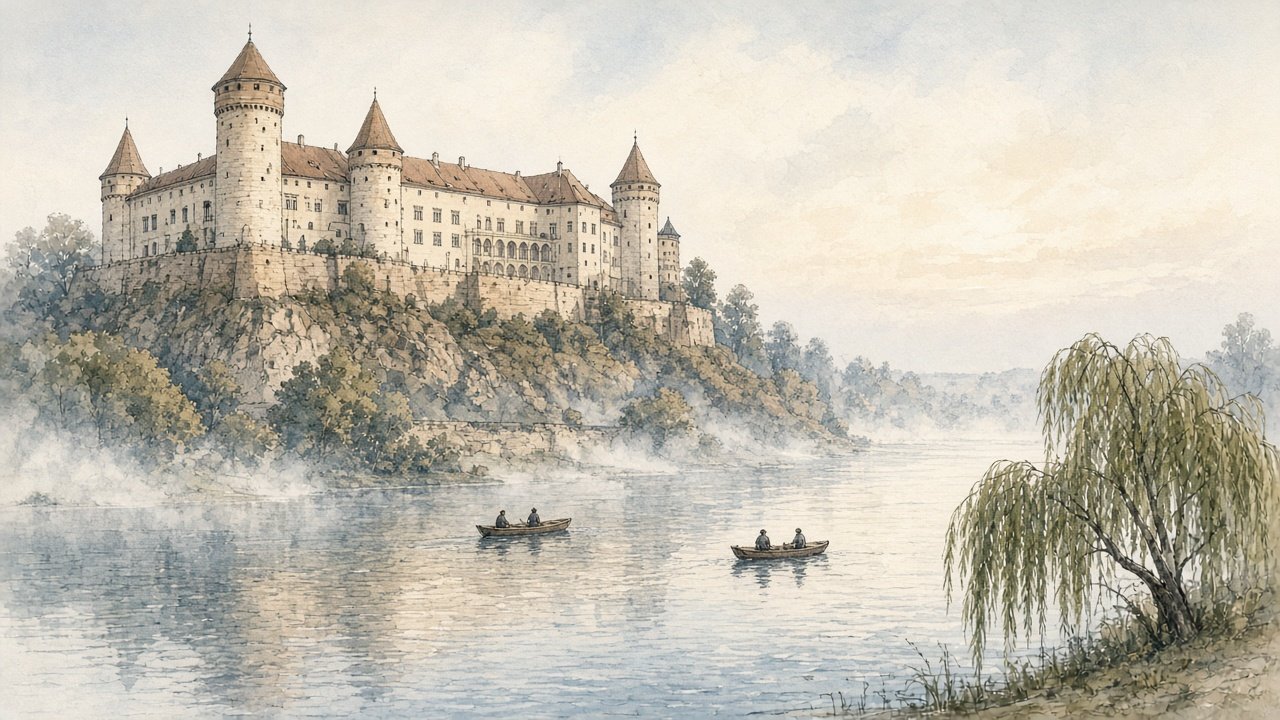
Kraków grew from a fortified limestone hill above a bend of the Vistula into the royal capital of Poland, a Magdeburg trading city, a Jagiellonian centre of Renaissance learning, a town of Jewish Kazimierz, a Habsburg cultural capital, a seat of German occupation and genocide, a laboratory of socialist industry at Nowa Huta, and a European city of tourism and universities. Few places in Central Europe preserve so many political and cultural layers in one continuous street plan. The hill called Wawel, the great market square of 1257 and the river that fed both remain the constants beneath dynastic and ideological change.[1][2]
This special feature follows that history from the early Slavic settlement and the first written notice by Ibrahim ibn Yaqub to the present day. It describes the Piast capital, the Mongol destruction and Magdeburg refoundation, the reign of Casimir the Great, the Jagiellonian and Renaissance courts, Kazimierz and Jewish life, the departure of the royal court for Warsaw, the partitions and the Free City, Habsburg Galicia, the Second Republic, the German occupation and the Holocaust, Nowa Huta and the People’s Republic, Solidarity, and the city’s contemporary legacy. An interactive timeline at the end of the essay gathers the principal dates.
1. The hill above the Vistula
Kraków stands on a limestone hill above a bend of the Vistula, at a point where the river slows and the valley opens into the loess plains of Lesser Poland. The hill, later called Wawel, offered dry ground above the floods, a commanding view of the fords, and stone that could be cut for walls. Archaeological layers beneath the later castle record intermittent human use from the Middle Paleolithic onwards. Flint tools, hearths and faunal remains show that hunter-gatherers returned to the ridge through the Upper Paleolithic. Neolithic communities introduced cereal cultivation and livestock along the floodplain. Bronze Age and Iron Age groups left burial mounds and fortified sites in the surrounding upland. By the early medieval centuries the hill had become the nucleus of a West Slavic settlement associated with the Wiślanie, whose fortified centres controlled trade along the upper Vistula.[1][2]
The first written description of the place appears in the mid-tenth century. Around 965 the Jewish merchant Ibrahim ibn Yaqub, travelling from al-Andalus through Central Europe, recorded a flourishing commercial centre that he named Krakā. His account places the town under Bohemian influence at that moment and notes its role in the exchange of goods across the Slavic lands. The report is brief, but it confirms that by the second half of the tenth century Kraków was already known beyond the region as a market of consequence, linked to amber, salt, furs and long-distance routes that connected the Baltic with the middle Danube and the Black Sea approaches.[3][1]
Legend later supplied a founder. Twelfth-century chroniclers, above all Wincenty Kadłubek, attributed the settlement to a prince named Krakus, who was said to have defeated a dragon that haunted a cave beneath the hill. The tale belongs to the stock of foundation myths that medieval writers used to explain place names and to give antiquity to dynastic seats. Archaeology does not confirm a single founding hero, yet the Krakus Mound on the southern edge of the later city, an earthen tumulus of early medieval date, shows that the community marked its landscape with monumental earthworks that later ages associated with the legendary ruler. The hill, the river and the long continuity of occupation are the historical foundations; the dragon and the prince are the narrative frame that medieval Kraków gave itself.[2]
In the late tenth century the Piast dukes of Greater Poland extended their authority southwards. Mieszko I incorporated the Kraków region into the emerging Polish state around 988 to 990, ending Bohemian overlordship. The establishment of a bishopric at Kraków in the year 1000, as part of the ecclesiastical organisation associated with the Congress of Gniezno, gave the hill both secular and spiritual rank. Wawel became the residence of a bishop as well as a ducal stronghold. From that point the settlement was no longer only a tribal emporium. It was a node in a Christian polity that looked to Rome for its church hierarchy and to the Piast court for its political direction. The combination of river trade, salt from nearby deposits, and princely and episcopal presence set the pattern that would carry the town into the High Middle Ages.[1][2]
The early urban fabric was still largely wooden. Houses clustered below the fortified hill, markets gathered near the river landings, and craft workshops produced pottery, ironwork and leather goods for local and regional exchange. The salt springs and mines of the Wieliczka area, a short distance to the south-east, already contributed to the town’s wealth. Salt was a staple of medieval diet and preservation, and control of its production and transport enriched whoever held the Kraków marches. The Vistula carried timber, grain and salt downstream and brought northern goods upstream. In this modest but strategic setting the later royal capital began to take shape, long before stone walls and Magdeburg charters remade its plan.[50][1]
Environmental evidence from pollen and sediment cores near early Slavic sites around Kraków indicates expanding cereal cultivation and woodland clearance between the seventh and ninth centuries. The shift from a landscape of mixed forest and wetland to one of fields and pasture accompanied the growth of permanent villages and fortified centres. Craft specialisation in amber working, iron smelting and pottery appears in the archaeological record of the Kraków land. These communities were not yet a city in the later medieval sense, but they formed a dense settlement cluster that made the hill a natural focus for any power that wished to control Lesser Poland. When the Piasts arrived, they inherited a working economic region rather than an empty frontier.[2]
The religious transformation of the late tenth and early eleventh centuries overlaid this Slavic base with Latin Christianity. Missionaries and clergy attached to the new bishopric introduced literacy, canon law and monumental building. Burials shifted toward churchyard practice. The cathedral on Wawel, rebuilt several times, became the spiritual counterpart to the ducal hall. Together, court and cathedral made the hill a dual centre of authority. Merchants who used the river fords and salt roads now dealt with officials who collected tolls in the name of a Christian duke. That double structure—commercial ford and sacralised hill—remained the organising fact of Kraków’s topography for the rest of its history as a capital.[5][17]
By the early eleventh century, then, the essential elements were in place: a defensible limestone acropolis, a navigable river, salt wealth within a day’s travel, an episcopal see, and incorporation into the Piast state. What followed was the elevation of this regional centre into the political capital of Poland, a status confirmed when northern seats were ruined and the Restorer made Wawel his home.[4][2]
Trade goods passing through early Kraków reflected its position between ecological zones. From the Carpathian foothills came timber, honey and wax. From the upland farms came grain and livestock. From the north came amber and, later, cloth. Salt from Wieliczka and Bochnia travelled in both directions and paid tolls that filled princely coffers. The river itself was a highway and a barrier: fords and ferries concentrated traffic at the hill, and whoever held the crossing collected dues. This geography explains why successive powers—Bohemian, Piast, and later Jagiellonian—treated Kraków as indispensable even when their other seats lay elsewhere.[50][1]
Material culture from excavations beneath the later Old Town and on Wawel shows a gradual densification of settlement through the tenth and eleventh centuries. Pit-houses gave way to timber-framed buildings; workshops clustered; refuse pits and latrines indicate continuous occupation. Imported ceramics and metalwork hint at contacts with Bohemia, Hungary and the German lands. The bishopric’s presence is visible in liturgical objects and in the earliest phases of stone construction. By the time Casimir I made the city his capital, Kraków was already more than a fortress. It was a working town with a mixed population, a market calendar and an ecclesiastical establishment that linked it to the Latin West.[2][5]
Place names around the early settlement preserved memories of fords, fields and sacred spots. Linguistic evidence in hydronyms and village names points to a Slavic-speaking countryside organised in small communities before Piast consolidation. Archaeology and toponymy together suggest that Wawel’s primacy was not accidental but the outcome of long local development. When Ibrahim ibn Yaqub wrote of Krakā, he was naming a place already thick with human investment.[3][2]
Comparisons with other early Central European centres—Prague, Wrocław, Poznań—clarify Kraków’s trajectory. Like them it combined a fortified hill, a river and a market. Unlike some, it retained capital status through the later Middle Ages. The contingency of Casimir I’s choice in 1038 mattered, but so did the prior density of settlement that made the choice rational. Origins chapters must hold both contingency and structure in view.[1][4]
Modern visitors who climb Wawel or walk the riverbank tread a palimpsest of these early phases. Museum displays of pottery and metalwork make the prehistoric and early medieval centuries tangible. The historian’s task is to connect those objects to the later city without pretending that continuity was unbroken. Floods, fires and rebuildings erased much. What remains is enough to anchor a narrative that begins before the first charter and the first chronicle.[5][2]
2. A Piast capital
The decisive elevation of Kraków to capital status came in the mid-eleventh century. After the death of Mieszko II in 1034 the Piast realm fractured. Pagan revolts and foreign intervention devastated the northern centres. In 1038 and 1039 Duke Břetislav I of Bohemia invaded, sacked Gniezno and Poznań, and carried off relics and treasure. Casimir I, later called the Restorer, returned from exile and chose Kraków as the base from which to rebuild the state. The southern city had been less thoroughly ruined. Its hill was defensible, its bishopric intact, and its position on the Vistula still commercially useful. From about 1038 Kraków functioned as the principal seat of Piast rule, a role it would keep for more than five centuries.[4][2]
Casimir and his successors fortified Wawel and gathered around it the apparatus of a royal and ducal court. Bolesław II the Bold, crowned king in 1076, governed largely from Kraków. The cathedral on the hill became the ceremonial heart of the kingdom: the place of episcopal authority, of royal liturgy, and in time of coronation and burial. Romanesque masonry gradually replaced timber in the principal buildings. A stone cathedral rose in stages, and the castle complex acquired halls and towers suited to a permanent residence. The town below the hill grew as retainers, clerics, merchants and craftsmen settled near the court. Although Poland remained a mosaic of Piast duchies through much of the twelfth and thirteenth centuries, Kraków held a special prestige as the traditional seat and as the see of one of the realm’s senior bishops.[5][17]
The political geography of the age of fragmentation complicated but did not erase that prestige. Junior Piasts ruled from Kraków as dukes of Kraków or of Seniorate Poland under arrangements that tried, with uneven success, to keep a senior duke above the rest. Rivalries with Silesian, Mazovian and Greater Polish cousins produced sieges, alliances and shifting borders. Yet the city continued to attract settlement. German merchants and artisans arrived in growing numbers in the twelfth and early thirteenth centuries, bringing craft skills and commercial connections to the Empire. Jewish communities, protected at intervals by princely privilege, participated in trade and moneylending. The population remained mixed in language and law long before any formal municipal charter fixed the terms of urban self-government.[1][19]
Economic life rested on the river, the salt, the court and the roads. Pack trains and carts moved goods between Kraków and Hungary, Bohemia, Silesia and the Baltic. The nearby salt works of Wieliczka and Bochnia were already royal assets of high value. Agricultural surplus from the fertile loess soils of Lesser Poland fed the town and supported export. Workshops produced cloth, metalwork and leather. The church hierarchy drew revenues from estates and tithes. Together these streams financed the stone building that slowly transformed Wawel and the lower town. By the early thirteenth century Kraków was recognisably a capital city of Central European scale, even if its streets were still irregular and its defences largely of wood and earth.[50][2]
Court culture on Wawel mixed Latin learning with vernacular custom. Clerics trained in cathedral schools kept charters and liturgical books. Chroniclers later looked back to this period for the origins of Polish kingship’s association with the hill. Coronations and royal burials, once they became regular at Wawel Cathedral, fixed Kraków in the symbolic geography of the realm. Even when dukes warred among themselves, the cathedral and castle remained points of reference. The physical investment in stone churches, walls and halls expressed a claim that this was not a temporary camp but a lasting seat of power.[17][5]
Relations with neighbouring powers shaped the city’s fortunes. Bohemia, Hungary and the Holy Roman Empire all touched Kraków’s diplomatic horizon. Marriage alliances, ecclesiastical appointments and commercial treaties brought foreign clerics, knights and merchants into the town. Some settled permanently. Others passed through on the salt and amber roads. The result was a capital that looked outward even while it administered a fractured Polish polity. That outward orientation would later ease the reception of Magdeburg law and Renaissance culture.[1][2]
Social hierarchy in Piast Kraków followed familiar medieval lines. At the top stood the duke and his household, the bishop and the cathedral chapter. Below them ranked knightly families with estates in the countryside and town houses near the court. Merchants and master craftsmen formed an emerging urban stratum. Servants, day labourers and the poor filled the lanes. Jewish households occupied a distinct legal niche, subject to princely protection and restriction rather than to ordinary municipal custom. Women appear in the sparse sources mainly as wives, widows and religious, though some managed property and workshops. The documentary record is thinner than for later centuries, but the outlines of a diversified capital society are clear.[19][1]
That wooden and partly stone city was about to face a test that would force a complete rebuilding. The Mongol armies that swept into Poland in 1241 treated Kraków as a prize to be burned. The disaster of that year, and the raids that followed, destroyed much of what the Piasts had raised. Yet the choice of Kraków as capital survived the fire. When the smoke cleared, the dukes and the townsmen rebuilt on a new legal and spatial plan that would define the Old Town for the rest of its history. The Piast capital did not disappear. It remade itself.[6][2]
Administrative practice on Wawel required literate clerks who could draft charters in Latin, keep accounts of salt revenues and record judicial decisions. Cathedral schools and household chaplains supplied that literacy. Seals and formulae borrowed from imperial and papal chanceries standardised the look of Piast documents. Surviving charters from the eleventh and twelfth centuries, though fewer than for later reigns, show Kraków issuing privileges to monasteries, townsmen and foreign merchants. The capital was already a centre of written governance as well as of oral command.[2][5]
Military organisation around the capital rested on the ducal retinue and on the obligation of landed knights to serve. Wawel stored arms and treasure. In times of alarm the population of the lower town could take refuge within the hill’s defences. The vulnerability of that arrangement became clear in 1241, when speed and fire overcame timber walls. Until then, however, the combination of hill fort and river crossing had been enough to keep Kraków central to Piast strategy in the south. Campaigns into Ruthenia, Hungary and Bohemia often began or ended with assemblies at the castle.[4][6]
Daily life below the hill mixed languages and customs. Polish peasants brought produce to market. German craftsmen plied trades learned in Silesian or Saxon towns. Jewish traders linked Kraków to wider credit networks. Clerics preached in Latin and, increasingly, in the vernacular. Feast days filled the streets with processions. Famines and epidemics, poorly recorded but inevitable in a pre-modern city, periodically thinned the population. Recovery drew new settlers, so that the capital’s demographic base continually renewed itself even before the Magdeburg refoundation opened the gates more systematically to immigration.[19][1]
By the eve of the Mongol invasion Kraków had acquired the attributes of a lasting capital: a fortified residence, a cathedral, a market, a mixed population and a reputation that drew petitioners from across the Polish lands. What it still lacked was a regularised municipal constitution and a stone defensive circuit equal to the new warfare of the thirteenth century. Those would come after the fire, under Bolesław V and his successors, as the necessary price of survival in a more dangerous age.[6][7]
Liturgical calendars and saints’ cults tied the cathedral community to the wider Latin church. Relics attracted pilgrims. Anniversary masses for ducal donors linked prayer to property. The spiritual economy of the hill generated revenues and obligations that paralleled the secular economy of tolls and markets. Piast Kraków was a dual city of altar and throne, each dependent on the other for legitimacy and income.[17][5]
Rural estates belonging to the duke, the bishop and emerging knightly families supplied food and labour. Villages in the Kraków land paid rents in kind and in service. The capital consumed the surplus of a fertile region. When harvests failed, the city felt hunger quickly. Grain storage and emergency purchases from Hungary or Silesia were instruments of rule as important as walls and retainers.[1][2]
Memory of the Restorer’s decision lingered in later chronicles that treated Kraków’s capital status as both deserved and fragile. Writers understood that capitals can move. The Mongol disaster and the Magdeburg refoundation would soon show how fragile the physical city was. The Piast chapter ends on the eve of that test, with a capital built of wood and ambition awaiting the fire that would force it into stone and law.[4][6]
3. Mongol fire and Magdeburg rights
In March 1241 Mongol forces advancing through southern Poland reached Kraków. After defeating Polish and allied armies in Silesia at Legnica, detachments under commanders associated with Batu Khan’s western campaign sacked the city. Contemporary and near-contemporary accounts describe the burning of wooden houses, the flight of Duke Bolesław V the Chaste, and the slaughter or dispersal of many inhabitants. Wawel itself suffered. The invaders did not remain to occupy the ruins. News of the Great Khan’s death drew the main Mongol armies eastwards, and the Polish lands were spared a lasting occupation. The damage, however, was severe. Kraków had to be rebuilt almost from the ground.[2][6]
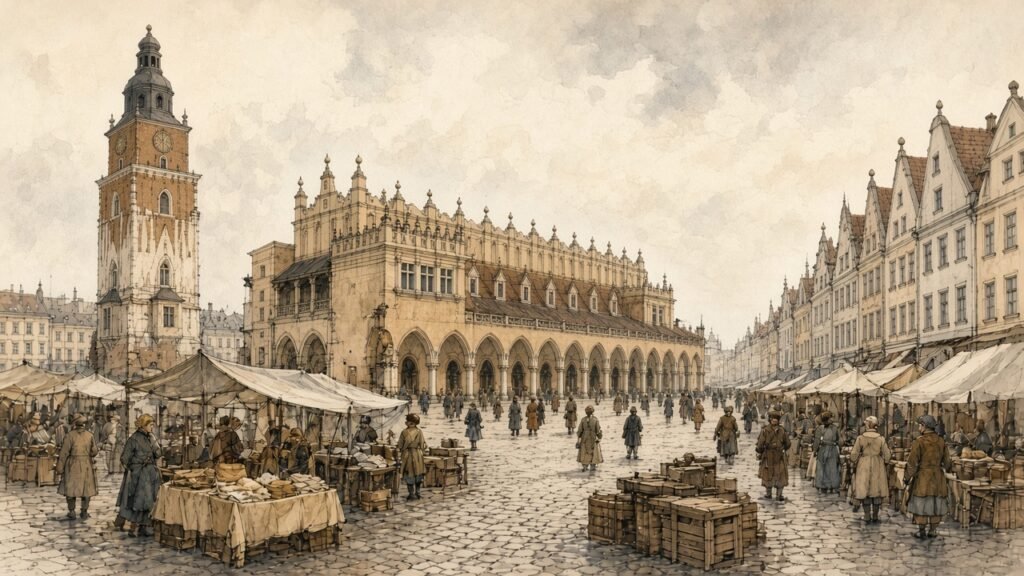
Bolesław V returned and made reconstruction a priority. The most consequential act of that recovery was the grant of Magdeburg town rights in 1257. Under Magdeburg law the city received a defined legal personality, a council and bench of jurors, regulated markets, and a spatial plan organised around a great rectangular square. German settlers were encouraged to take up plots. The new layout, still visible in the grid of the Old Town, replaced the irregular lanes of the earlier settlement with measured blocks and a market place of exceptional size. The Cloth Hall later rose on the axis of that square. Parish churches, guild houses and fortified gates completed the medieval kit of a Central European chartered town. Kraków became, in law and in plan, a city of the Magdeburg type, even as it remained the seat of Polish dukes and kings.[7][8][6]
Further Mongol raids in 1259 and again in the late 1280s tested the new defences. The experience of 1241 had shown the weakness of timber palisades against mobile horse-archers. Through the later thirteenth and fourteenth centuries the town raised stone and brick walls, towers and gates. A moat and earthworks strengthened the circuit. The Barbican that still stands north of the Florian Gate belongs to a later phase of this defensive programme, but its ancestors were the wall walks and gatehouses begun in the generations after the Mongol wars. Wawel was rebuilt in Gothic masonry as a royal castle integrated with the urban defences. The hill and the chartered town below it formed a single fortified complex.[51][5]
The Magdeburg charter also reshaped society. Citizenship, guild membership and market rights created a municipal elite distinct from the knightly and clerical orders. German speech was common in the council and the crafts for generations, though Polish remained the language of the court and of much of the surrounding countryside. Jews lived under separate legal arrangements, often by princely privilege, and concentrated in defined streets before the later foundation of Kazimierz offered a more formal quarter. The coexistence of Polish ducal power, German municipal law and Jewish communal autonomy was typical of many Central European cities. In Kraków it coincided with the city’s recovery as a royal capital and with the economic pull of salt, trade and the court.[19][7]
The great market square created in 1257 became the commercial and civic heart of the rebuilt city. Its dimensions—among the largest of any medieval square in Europe—allowed for permanent stalls, seasonal fairs and public ceremonies. The Cloth Hall, in successive Gothic and later Renaissance forms, organised the trade in textiles that gave the building its name. Around the square rose the houses of rich merchants, the seats of guilds and the towers that marked parish and municipal pride. Street names and plot boundaries fixed in the thirteenth century still structure the Old Town. Visitors who walk the grid today are moving through Bolesław’s Magdeburg plan.[8][1]
Guilds regulated production and quality in crafts ranging from butchery and baking to goldsmithing and cloth finishing. Apprenticeship, journeyman travel and mastership created career paths that tied Kraków to other Magdeburg-law towns across Central Europe. Municipal courts applied customary rules derived from the Saxon mirror and local statutes. The council negotiated with the duke or king over taxes, military service and the maintenance of walls. Conflict between town and castle was recurrent but usually managed by privilege and compromise rather than by open rupture. The chartered city had become a political actor in its own right.[7][8]
Religious life diversified with the rebuilt fabric. Parish churches served the new districts. Mendicant orders established convents. The cathedral on Wawel remained the ceremonial apex, but the lower town acquired its own sacred geography of processions, feast days and confraternities. Hospitals and almshouses, often founded by pious bequests, cared for the sick and poor. Education below university level rested on cathedral and parish schools that taught Latin grammar to boys destined for the clergy or for clerkships. The intellectual groundwork for Casimir III’s later studium generale was already being laid in these modest classrooms.[17][2]
By the early fourteenth century the rebuilt city was ready for the ambitious reign of Casimir III. The grid of 1257, the walls, the castle and the market square were the physical inheritance on which he would found a university, a new satellite town and a programme of Gothic building that left Kraków looking like a capital of European rank. The Mongol fire had been a catastrophe. The Magdeburg refoundation turned that catastrophe into the template of the historic centre that later centuries would preserve.[8][2]
The settlers who took up Magdeburg plots brought not only capital and skills but also expectations of urban liberty. They expected to elect their own council, to try their own cases, and to hold markets free of arbitrary seizure. Dukes who wanted rapid recovery had to honour those expectations. Successive confirmations of the 1257 privilege embedded Magdeburg norms in Kraków’s constitution. When later kings negotiated taxes or troop levies, they dealt with a corporate city that knew its rights and could withhold cooperation. The tension between royal sovereignty and municipal autonomy became a permanent feature of the capital’s politics.[7][8]
Building the walls was a generational project. Foundations were dug, brick kilns fired, and towers raised course by course. Citizens contributed labour and money through assessments. Gates controlled entry and collected tolls. The Florian Gate on the northern approach became the ceremonial entrance for royal processions. Outside the walls suburbs grew for those who could not afford intramural plots or who practised trades banned from the centre. The contrast between the ordered Magdeburg core and the more irregular outskirts mirrored social distinctions that would persist for centuries.[51][8]
Water management mattered as much as masonry. Channels and ditches drained the low ground between Wawel and the market. Bridges and ferries linked the Old Town to Kazimierz and to the far bank. Floods remained a hazard, but the rebuilt city was better able to recover from them than the timber settlement of 1240 had been. Mills on the river arms ground grain for the growing population. Tanneries and other water-using crafts clustered downstream. The Vistula was infrastructure as well as landscape.[1][2]
Cultural life in the post-Magdeburg city included music in churches, vernacular song in taverns, and the occasional visit of travelling entertainers. Manuscript illumination and metalwork reached high standards in workshops serving the cathedral and the court. Seals and coins carried images of rulers and saints that circulated far beyond the walls. Kraków was becoming not only a political capital but a producer of symbolic objects that advertised Piast and, later, Jagiellonian authority across Central Europe.[5][17]
Surveyors who laid out the 1257 grid worked with ropes and stakes on ground still scarred by burning. Plot sizes reflected ability to pay and status within the new commune. Corner locations on the square commanded premiums. Churches received sites that organised neighbourhoods. The act of measuring was itself a claim: that human law could impose order on disaster. Magdeburg rights were a technology of recovery as much as a grant of liberty.[7][8]
Immigration after 1257 included newcomers from Silesia, Saxony and farther German lands, alongside Poles from the countryside. Language on the council benches was often German; language in the castle remained Polish and Latin. Bilingualism and multilingualism were normal. Over generations many families Polonised in speech while retaining German surnames, or the reverse. The ethnic history of the Old Town is a history of mixing under legal categories that were clearer on parchment than in daily speech.[7][1]
Defence taxes and watch duties reminded citizens that Magdeburg freedom included Magdeburg obligations. Walls were common property and common burden. Neglect invited ducal intervention. Pride in towers and gates expressed a corporate identity distinct from knightly honour. The municipal seal and the municipal banner made that identity visible in ceremonies and in battle. Kraków’s citizens had become a political estate.[51][8]
4. Casimir the Great
Casimir III, who reigned from 1333 to 1370 and was later styled the Great, found in Kraków both a capital to adorn and a kingdom to consolidate. He inherited a realm still recovering from fragmentation and from the Mongol shocks of the previous century. His policies combined legal reform, territorial acquisition, economic privilege and monumental building. In Kraków those policies left visible marks: the Gothic remodelling of Wawel, the foundation of the adjacent town of Kazimierz, the strengthening of the urban walls, and, most famously, the establishment of a studium generale that became the Jagiellonian University.[9][2]
At Wawel, Casimir directed a major Gothic reconstruction. A multi-building residence rose around an irregular courtyard. New towers strengthened the defences and expressed royal dignity. Vaulted halls and chambers replaced older Romanesque fabric. The cathedral continued to serve as the coronation and burial church of the dynasty. Casimir’s building programme announced that the Polish kingdom, restored and expanded, possessed a seat comparable to those of neighbouring monarchies. Stone and brick, paid for by salt revenues and royal domain, made that claim permanent.[5][9]
In 1335 Casimir founded the town of Kazimierz on an island-like site south of the Old Town, across a branch of the Vistula. Named after himself, Kazimierz was intended as a defensive and commercial satellite, enclosed by its own walls and gates and granted urban privileges. It relieved pressure on the crowded Magdeburg city and created a buffer against attack from the south. Over the following centuries Kazimierz would develop a distinct identity, especially after Jewish settlement concentrated there, but its origin was a royal act of urban planning in the service of security and growth.[11][9]
On 12 May 1364 Casimir issued a charter founding a university in Kraków, the second studium generale in Central Europe after Prague. Pope Urban V confirmed the foundation later that year. The initial faculties covered the liberal arts, law and medicine. The king sought trained administrators and clerics for a consolidating state. Foreign scholars were recruited because Poland lacked a deep pool of graduates. After Casimir’s death in 1370 the institution declined for want of sustained patronage, but the foundation itself marked Kraków as a city of learning as well as of kings. The refounding under Queen Jadwiga and Władysław II Jagiełło in 1400 would complete what Casimir began.[10][9]
Casimir’s legal and monetary reforms affected the capital directly. Codification of customary law, privileges for towns and Jews, and the introduction of improved coinage stabilised commerce. The Kraków grosz became a familiar unit of account. Merchants on the market square benefited from clearer rules and from royal protection of trade routes. Jewish communities received confirmations of rights that encouraged settlement and credit. The Statute of Kalisz tradition, extended and renewed by later rulers, formed part of this framework of princely protection that shaped Jewish life in Polish towns including Kraków.[21][19]
Population growth accompanied these measures. Immigrants from Silesia, Germany and other Polish duchies took up lots in the Old Town and in Kazimierz. Crafts diversified. The salt administration at Wieliczka, closely tied to the crown, employed officials and labourers whose spending supported Kraków’s markets. Diplomatic traffic increased as Casimir negotiated with Bohemia, Hungary and the Teutonic Order. Envoys, clerks and retainers filled inns and town houses. The capital of a more assertive kingdom needed more people, and the people came.[50][1]
Gothic architecture spread beyond the castle. Parish churches were enlarged or rebuilt with ribbed vaults and taller naves. Municipal buildings acquired brick façades in the Central European manner. The walls and gates received towers that still punctuate the skyline of the historic centre. Casimir did not invent Kraków’s Gothic face single-handedly, but his reign concentrated resources and ambition in a way that made the style dominant. Later generations would add Renaissance courtyards and Baroque interiors; the underlying massing of many monuments remains fourteenth-century.[8][5]
When Casimir died without a male heir in 1370, the crown passed to Louis of Anjou and, through Louis’s daughter Jadwiga, into the union with Lithuania that created the Jagiellonian era. Kraków remained the ceremonial and often the practical capital. The university Casimir founded, the town of Kazimierz he planted, and the Gothic Wawel he raised were the inheritance on which that new dynasty would build a golden age of Renaissance culture. The Piast capital had become a Jagiellonian stage.[9][13]
Casimir’s foreign policy enlarged the kingdom’s eastern horizons. Acquisition of Red Ruthenian lands brought new trade routes and new subjects under Kraków’s administrative umbrella. Officials trained or resident in the capital staffed distant castellanies. The university, even in its fragile first decades, was meant to supply men for that expanding bureaucracy. Casimir understood that a larger state needed more than knights; it needed clerks who could read law and keep accounts. The studium generale was an instrument of statecraft as much as of piety or prestige.[9][10]
Jewish settlement policy under Casimir formed part of a broader Central European pattern in which rulers competed for the credit and commercial skills of Jewish communities. Privileges promised protection of life and property, freedom of worship within limits, and access to certain trades, in return for taxes and loans. Enforcement was uneven, and local hostility periodically erupted, but the legal framework encouraged growth. In Kraków and later in Kazimierz that framework underpinned a community that would become one of the most important in Polish Jewish history.[21][19][11]
The king’s reputation as a builder was cultivated by chroniclers who contrasted the wooden Poland he found with the brick and stone Poland he left. Modern archaeology and architectural history confirm substantial investment, even if the slogan simplifies a more gradual process. What is clear is that Kraków under Casimir acquired institutions—university, satellite town, reinforced castle—that outlasted the Piast dynasty itself. When Jadwiga and Jagiełło revived the academy in 1400, they were completing a Casimirian design rather than inventing a new one.[10][9]
Court ceremony at Wawel grew more elaborate as Casimir’s reign lengthened. Foreign embassies were received in Gothic halls. Tournaments and hunts displayed knightly culture. The cathedral liturgy marked the liturgical year with a splendour meant to impress subjects and guests alike. Casimir’s own burial in Wawel Cathedral fixed his memory at the heart of the capital he had reshaped. Later kings would be crowned and buried in the same church, making the hill a continuous theatre of monarchy from the Piasts through the Jagiellons and beyond.[17][5]
Economic regulation complemented building. Market privileges, staple rights and the policing of weights and measures protected royal and municipal revenues. Guild statutes, confirmed by the crown, limited competition and upheld quality. The salt monopoly remained a pillar of fiscal strength. Kraków’s prosperity in the later fourteenth century rested on this managed economy as much as on spontaneous trade. Casimir’s greatness, in the eyes of his subjects and of later historians, lay in making the management effective enough to fund both war and culture.[50][9]
Casimir’s reputation among later Poles owed much to chroniclers who needed a model king: builder, lawgiver, protector of Jews and peasants, expander of borders. Modern research complicates the portrait without erasing the achievements. Fiscal pressure was real. Wars were costly. Not every privilege was enforced. Yet the institutional residue—university, Kazimierz, Gothic Wawel—gives empirical weight to the legend. The Great King is visible in the city plan.[9][11][10]
Diplomatic marriages and treaties tied Kraków to the courts of Hungary, Bohemia and the Empire. Foreign knights and ladies appeared at Wawel feasts. Fashion, armour and music travelled with them. The capital’s cosmopolitan moments under Casimir anticipated the fuller internationalism of the Jagiellonian Renaissance. A kingdom that looked only inward could not sustain a university or a salt empire; Kraków under Casimir looked outward by necessity.[9][2]
Succession anxiety coloured the later reign. Without a legitimate son, Casimir arranged for the Anjou inheritance that brought Jadwiga and, through her, Jagiełło. The capital prepared for a dynastic turn it could not fully foresee. In that sense the Casimirian chapter is both culmination of the Piast capital and prologue to the Jagiellonian age. The stones he laid would house a different dynasty’s glory.[9][12]
Engineers of walls and of the university’s first buildings shared a culture of measurement derived from both craft tradition and Latin geometry. Casimir’s Kraków trusted measured order. Magdeburg plots and studium statutes expressed the same temperament in different registers.[9][7]
5. The Jagiellonian dawn
The marriage of Queen Jadwiga of Poland to Jogaila, Grand Duke of Lithuania, in 1386 created a personal union that remade the political map of East Central Europe. Jogaila was baptised as Władysław and crowned in Kraków as Władysław II Jagiełło. The Union of Krewo, which prepared that marriage, committed Lithuania to Christianisation and bound the two realms under a shared dynasty. Kraków, as the coronation city and habitual royal residence, became the ceremonial capital of a polity that stretched from the Baltic toward the Black Sea steppes. The Jagiellonian age had begun.[12][14][13]
Jadwiga’s bequest of her personal jewels and property to the Kraków academy made possible its refounding in 1400. Władysław II Jagiełło issued a new charter, added a faculty of theology, and secured the institution’s future with endowments. The Collegium Maius and later colleges gave the university a physical home in the Old Town. Students arrived from Poland, Lithuania, Hungary, Germany and farther afield. Professors taught arts, law, medicine and theology in Latin. Within a few generations the academy had become one of the principal universities of Central Europe and a defining institution of Kraków’s identity.[10][12]
Military success reinforced dynastic prestige. The victory at Grunwald in 1410 over the Teutonic Order, though fought far to the north, elevated the standing of the Jagiellonian monarchy throughout the region. Kraków celebrated with processions and thanksgivings. Captured banners hung in churches. The capital shared in the glory even when the battlefield lay elsewhere. Diplomatic congresses and royal entries kept the city at the centre of a busy international politics that linked Poland-Lithuania to Hungary, Bohemia and the Empire.[13][1]
Under Casimir IV Jagiellon in the mid-fifteenth century the dynasty consolidated. Royal sons were placed on neighbouring thrones. Kraków’s court attracted humanists and artists who prepared the ground for the full Renaissance of the following century. Printing arrived in the city before 1500, making Kraków one of the earliest centres of the press in East Central Europe. Books in Latin and, increasingly, in Polish circulated from local workshops. The university library and private collections grew. Learning and power reinforced each other in the streets between Wawel and the Collegium Maius.[13][10]
Urban society in Jagiellonian Kraków remained stratified and multi-ethnic. The municipal council, still often dominated by families of German origin, governed the Magdeburg city. Polish nobles maintained town houses for attendance at court and sejms. Jewish communities, regulated by royal privilege, expanded their economic roles. Armenian and other merchants appeared in the trade with the east. Guilds defended craft monopolies. Conflicts over jurisdiction—between town and castle, between Christians and Jews, between guilds and unlicensed competitors—filled the municipal records. The capital was prosperous and quarrelsome in equal measure.[19][8]
Religious life was still overwhelmingly Catholic, but currents of reform and dissent reached the city through students and merchants who had travelled west. Hussite ideas filtered from Bohemia. Later, Lutheran and Calvinist teachings would find hearers among nobles and townsmen. The cathedral and the university remained pillars of orthodoxy, yet Kraków’s openness to foreign books and visitors made it a place where new doctrines were discussed even when they were officially discouraged. The intellectual climate of the Jagiellonian capital was never entirely closed.[10][2]
Building continued. Gothic churches were completed or embellished. The walls and the Barbican strengthened the northern approach. Kazimierz grew as a distinct urban unit with its own parish and market. Bridges and causeways improved links across the Vistula branches. The physical city that Sigismund I would later clad in Renaissance forms was largely a Jagiellonian and late Piast inheritance. Continuity of site and plan allowed each dynasty to add a stylistic layer without erasing the last.[51][11]
When Sigismund I the Old ascended the throne in 1506, he inherited a capital already famous for its university, its market and its royal ceremonies. His reign, and that of his son Sigismund II Augustus, would give that capital its most celebrated artistic face. The Jagiellonian dawn had prepared the stage. The Renaissance court would light it.[15][13]
Daily routines in the early Jagiellonian city followed the bells of churches and the opening of market stalls. Bakers and butchers supplied the morning trade. Students hurried to lectures in rented rooms near the colleges. Clerks carried documents between Wawel and the town hall. At dusk gates closed and the night watch began its rounds. Epidemics periodically emptied the streets; pilgrimages and royal entries filled them again. The rhythm was medieval, but the political horizon was already that of a composite monarchy with European ambitions.[1][8]
Women of the court and of elite urban families exercised influence through patronage, property and piety. Jadwiga herself remained a model of sacral queenship in local memory. Noblewomen founded chapels and almshouses. Merchant widows ran businesses under municipal custom. The sources under-represent ordinary women, yet household inventories and court cases show them as economic actors. Kraków’s golden age was not only a story of kings and professors; it was also a story of households that sustained both.[12][19]
The conversion of Lithuania associated with Jagiełło’s baptism had consequences that reached the capital’s churches and colleges. Missionary clergy passed through Kraków on their way east. Lithuanian nobles sent sons to study at the refounded university. The composite monarchy required a composite elite, and the academy helped to form one. Latin provided a common learned language across linguistic boundaries. Kraków thus functioned as a school of empire as well as a Polish royal city.[12][10][14]
Fiscal demands of war and diplomacy pressed on municipal and Jewish taxpayers alike. Extraordinary levies for campaigns against the Teutonic Order or for royal marriages sparked negotiation and occasional resistance. The council bargained; the kahal bargained; the king mediated or imposed. These fiscal contests trained the capital’s corporate bodies in the arts of petition and delay that would serve them under later elective kings and foreign partitions. Political skill was learned in the counting house as well as in the castle.[19][8]
Fire remained a constant threat in a city of timber floors and open hearths. Municipal ordinances regulated baking ovens, candle use and the storage of straw. Night watches looked for smoke. When fires nevertheless broke out, reconstruction followed Magdeburg plot lines, so that the grid survived even when individual houses did not. Continuity of plan amid discontinuity of fabric is one of the secrets of Kraków’s visible antiquity.[8][1]
By the late fifteenth century the Jagiellonian capital was ready for the Italianate transformation that Sigismund I would sponsor. The university was secure. The market was rich. The dynasty was linked by marriage to half the courts of the region. What remained was to give Wawel and the square an architectural language equal to that political fortune. The Renaissance court chapter opens at that point of readiness.[15][13]
Royal entries into Kraków after victories or marriages followed routes from the Barbican through the square to Wawel, teaching spectators the geography of power. Pageants allegorised dynastic claims. Coins thrown to crowds bought goodwill. The city performed loyalty and expected privilege in return. These rituals bound municipality and monarchy in a shared theatre that later elective kings would inherit even when they preferred Warsaw.[51][13]
Lithuanian and Ruthenian nobles who came to court encountered a Latin and Polish cultural environment that gradually drew parts of the grand ducal elite into a shared Commonwealth culture. Kraków was one of the schools of that convergence. Not all accepted Polonisation; many returned east with selective borrowings. The capital’s influence radiated unevenly, strongest among those who sought careers in the joint monarchy’s central institutions.[12][14]
Crisis years of war and epidemic tested the early Jagiellonian city as they had tested the Piast one. Municipal and royal authorities cooperated or quarrelled over quarantine and finance. Burials overflowed parish churchyards. Recovery brought new settlers and new privileges. Resilience, not uninterrupted prosperity, was the actual pattern beneath the dynastic glow.[13][1]
Mint outputs and toll accounts, where they survive, allow economic historians to estimate the capital’s throughput of silver and goods. Figures are incomplete but point to a busy regional hub rather than a sleepy court town. Money moved through Kraków because law, force and geography made it move there.[13][50]
6. Renaissance court
The reign of Sigismund I the Old, from 1506 to 1548, brought Italian Renaissance architecture and court culture to Kraków on a scale that transformed Wawel and influenced building across the kingdom. Sigismund’s marriage to Bona Sforza of Milan in 1518 opened a channel for Italian artists, craftsmen and ideas. Architects such as Bartolomeo Berrecci redesigned parts of the royal castle with arcaded courtyards and classical ornament. The Sigismund Chapel, built beside Wawel Cathedral between 1517 and 1533 as a royal mausoleum, became the outstanding monument of the Polish Renaissance, its dome and sculptural decoration announcing a new aesthetic beside the Gothic cathedral.[15][16][17]
Bona Sforza’s household introduced Italian culinary, musical and administrative practices. She acquired estates and exercised political influence that contemporaries alternately praised and resented. Her presence made the court bilingual in culture if not always in speech. Polish and Latin remained the languages of governance and scholarship; Italian became the language of artistic fashion. The mixture produced a distinctive Cracovian Renaissance that adapted peninsula models to local materials, climate and liturgy.[16][15]
The university reached a peak of enrolment and reputation in the early sixteenth century. Astronomy, mathematics, geography and medicine flourished alongside the traditional faculties. Nicolaus Copernicus studied in Kraków in the 1490s, absorbing the mathematical culture that later informed his heliocentric theory. Humanist teachers promoted classical Latin and Greek. Printing houses multiplied textbooks and polemics. Foreign students continued to arrive, making the academy a meeting place of Central European learning. Kraków’s claim to be an intellectual capital rested on this concentration of teachers, books and instruments.[18][10]
Artistic patronage extended beyond the castle. Patrician families rebuilt town houses with Renaissance attics and courtyards. The Cloth Hall received a Renaissance attic that still defines the market square’s silhouette. Altarpieces, tombs and civic monuments mixed Italianate forms with northern Gothic survival. Gold and silver smiths, often organised in guilds, produced liturgical vessels and secular plate for a prosperous elite. The visual culture of the capital became a principal export of Jagiellonian soft power.[8][1]
Religious debate intensified after Luther’s break with Rome. Some nobles and townsmen in Lesser Poland adopted Protestant doctrines. Calvinism found adherents among the szlachta. The Catholic majority, backed by the crown and the university’s theological faculty, resisted. Sigismund I and Sigismund II Augustus generally preferred containment and compromise to persecution, a stance that kept Kraków from the worst confessional violence of the age even as churches and schools divided. The capital remained officially Catholic while hosting a noisy argument about faith.[15][22]
Sigismund II Augustus, the last Jagiellon in the male line, continued his father’s cultural policies while navigating the politics that led to the Union of Lublin in 1569. That union transformed the personal connection between Poland and Lithuania into a federal Commonwealth. Warsaw’s geographical convenience for the joint diet began to pull political gravity northwards, though coronations and royal burials remained tied to Wawel. Kraków’s ceremonial primacy outlasted its administrative monopoly.[22][52]
Court festivals, royal entries and funerals turned the streets between the Florian Gate and Wawel into a theatre of monarchy. Triumphal arches, staged combats and fireworks marked dynastic occasions. Chroniclers and foreign ambassadors described the splendour in terms meant to impress distant readers. The Renaissance capital performed its own greatness. When Sigismund II Augustus died in 1572 without an heir, the elective monarchy that followed still returned to Kraków for coronation, acknowledging that the city’s symbolic capital had not been spent.[15][17]
Everyday prosperity underpinned the spectacle. Grain, cattle, salt and cloth moved through the markets. Hungarian wine and oriental goods appeared in inventories. Banking and credit, often involving Jewish and Italian financiers, lubricated large transactions. Guilds defended standards and privileges with lawsuits and occasional riots. The municipal archive preserves the quarrels of a city that was rich enough to fight over precedence and poor enough, in its alleys, to know hunger when harvests failed. Renaissance Kraków was magnificent and ordinary at once.[50][19]
Music and letters completed the cultural profile. Court composers and chapel choirs performed polyphony in the Italian and Flemish manners. Poets writing in Polish, among them figures associated with the wider Commonwealth literary revival, found patrons in the capital. Latin remained the prestige language of scholarship and international correspondence. The coexistence of vernacular and learned cultures gave Kraków a double voice that later Polish nationalism would retrospectively hear as a single national chorus.[13][10]
By the death of the last Jagiellon the city had acquired the architectural and institutional silhouette that later centuries would recognise as classic Kraków: Wawel with its Renaissance courtyard and chapel, the market square with its Cloth Hall, the university colleges, the walls and Barbican, and the neighbouring town of Kazimierz. Political power would soon drift toward Warsaw. Cultural memory would stay on the hill above the Vistula.[5][8]
Scientific instruments and maps produced or used in Kraków circulated among astronomers and geographers who corresponded across Europe. The university’s mathematical tradition, which had shaped Copernicus’s education, continued in the teaching of successors who debated planetary theory even when they did not adopt heliocentrism wholesale. Medical faculties dissected and prescribed according to Galenic and newer practices. Lawyers trained in Roman and canon law staffed royal and ecclesiastical courts. The capital’s learning was practical as well as speculative.[18][10]
Charity and poor relief occupied confraternities and municipal officials. Hospitals cared for the sick; almshouses for the aged; foundling care for abandoned children. Plague years overwhelmed these arrangements and forced emergency measures, including quarantine and mass burial. Sermons interpreted calamity as divine warning; physicians recommended cleaner air and moderated diet. The coexistence of religious and medical explanations was typical of the age. Kraków suffered and recovered in the same rhythms as other European cities of its size.[1][2]
Foreign observers—ambassadors, merchants, students—left descriptions that praised the square, the castle and the courtesy of the court while noting mud, crowding and confessional tension. Their accounts, read cautiously, confirm that Renaissance Kraków belonged to the mainstream of European urban civilisation. It was not a backwater waiting for enlightenment from the west. It was a participant, with its own accent, in the shared culture of Latin Christendom’s eastern half.[15][8]
The death of Sigismund II Augustus without issue in 1572 closed the Jagiellonian dynasty and opened the era of elective kings. Kraków remained the coronation city, but the centre of gravity of Commonwealth politics continued to shift toward Warsaw and the great noble diets. The Renaissance layer on Wawel and the square would thereafter be maintained as heritage as much as as working court architecture. The golden age became, gradually, a memory that later generations would polish.[22][23]
Workshop contracts for the Sigismund Chapel and the Wawel arcades survive in sufficient detail to show how Italian masters supervised local teams. Techniques of stone carving, dome construction and sgraffito decoration were taught on site. Knowledge transfer was practical and personal. The Renaissance in Kraków was not a bookish import alone; it was a craft learned with chisels and scaffolding on the hill above the river.[15][17]
Confessional migration brought Protestant nobles to the capital for diets and courts even as the city remained officially Catholic. Guest houses and private chapels accommodated difference within limits. The later triumph of the Counter-Reformation would narrow that space, but the early and mid-sixteenth century retained a porousness visible in book inventories and correspondence. Ideas moved with people along the same roads as cloth and wine.[22][15]
When the last Jagiellon died, poets and preachers interpreted the event as a turning point. Some feared chaos; some hoped for reform of the elective system. Kraków hosted the funeral and the first royal elections’ ceremonies with the gravity of a city that understood itself as the kingdom’s conscience. The Renaissance court ended; the Renaissance fabric remained for later ages to inhabit and to mythologise.[22][13]
Costume books and embassy reports describe the cut of sleeves and the weight of chains worn at Cracovian receptions. Fashion history is not frivolity here; it indexes the city’s integration into European courts’ systems of display. To dress like Milan or Augsburg was to claim parity.[16][15]
7. Kazimierz and the Jewish city
Kazimierz, founded by Casimir III in 1335 as a chartered town south of Kraków, developed over the following centuries into one of the principal centres of Jewish life in Poland. Jewish settlement in the Kraków area was older than Kazimierz itself. Jews appear in the capital under Piast and early Jagiellonian rule, living under royal privilege and subject to the tensions that accompanied minority status in a Christian city. Periodic expulsions and readmissions, disputes over trade and residence, and outbreaks of violence marked that earlier history. The concentration of Jewish communal life in Kazimierz, especially from the late fifteenth century onwards, created a denser and more autonomous urban Jewish world than the scattered streets of the Magdeburg city had allowed.[11][19][20]
Royal and municipal policies shaped the geography of residence. In 1495 King John I Albert expelled Jews from the main city of Kraków proper, and many resettled in Kazimierz, where a Jewish town grew beside the Christian parish. Synagogues, among them the Old Synagogue whose Gothic fabric still stands in altered form, organised worship and communal authority. The kahal governed internal affairs, collected taxes owed to the crown, and represented the community in dealings with royal and municipal officials. Yiddish and Hebrew structured daily and sacred speech; Polish and German linked Jews to the surrounding economy.[19][20][11]
Economic roles were diverse. Jewish merchants traded in cloth, spices, cattle and credit. Craftsmen worked in trades permitted by privilege or practised in the interstices of guild monopoly. Leaseholders of tolls, mills and taverns linked Jewish capital to the rural economy of Lesser Poland. Physicians and factors served noble and royal clients. Poverty coexisted with wealth; the community supported its own poor through charitable brotherhoods. The stereotype of a purely commercial minority obscures this internal variety, which the surviving communal records make clear.[19][20]
Intellectual life in Kazimierz produced rabbis, teachers and printers of more than local fame. Yeshivas trained students in Talmud and codes. Kraków Hebrew printing, active from the sixteenth century, issued religious and scholarly books that travelled across the Polish-Lithuanian Commonwealth and beyond. Correspondences linked Kazimierz scholars to centres in Prague, Italy and the Ottoman lands. The Statute of Kalisz tradition and later royal confirmations provided a legal umbrella, however imperfectly enforced, under which this cultural production could continue.[21][19]
Relations with Christian Kraków mixed interdependence with hostility. Market contact was constant. Credit tied noble estates to Jewish lenders. At the same time, sermons, guild petitions and blood libel accusations periodically inflamed opinion. Riots damaged property and cost lives. Kings and starostas intervened with uneven success. The physical separation of Kazimierz offered some protection and some stigma. Bridges and roads ensured that separation was never absolute. The two towns lived as neighbours who could not ignore each other.[19][11]
Architectural fabric recorded both prosperity and piety. Synagogues of different rites and associations rose as the population grew. Cemeteries on the edge of the Jewish town received the dead under halakhic care. Houses along Szeroka and neighbouring streets combined residence, workshop and shop. Ritual baths and communal buildings completed the infrastructure of an observant community. Much of this fabric would be damaged or destroyed in the twentieth century; enough survives, restored or commemorated, to make Kazimierz still legible as a historic Jewish quarter.[20][11]
Women’s lives in Kazimierz, as elsewhere, are harder to recover from sources written mainly by men. Ketubah contracts, inheritance disputes and charitable lists show women as property holders, traders and donors. Some ran businesses in widowhood. Others appear only as names in memorial books. The domestic sphere of food, childcare and the preparation of festivals sustained the public male world of synagogue and market. Any history that omitted that labour would misrepresent how the community endured.[20][19]
By the eighteenth century Kazimierz was both a renowned centre of Jewish learning and a town under the same political storms that battered the Commonwealth. Partitions would place it under Austrian rule. The nineteenth century would bring legal emancipation, suburb amalgamation with Kraków, and new forms of politics and culture. The Holocaust would almost erase the community that had grown since the Middle Ages. The early modern Kazimierz described here is the world that those later catastrophes destroyed and that memorialisation now tries to recall.[19][36]
Hasidism and Mitnaggedic opposition, Haskalah and Orthodoxy, would later divide Galician Jewry in ways that Kazimierz shared with Brody, Lviv and other centres. In the period before the partitions, however, the dominant note was still that of a traditional kahal society organised around synagogue, court and market, living under Polish royal privilege within a Christian Magdeburg town. That society was neither frozen nor simple, but it possessed a coherence that modern ideologies would later fracture.[20][31]
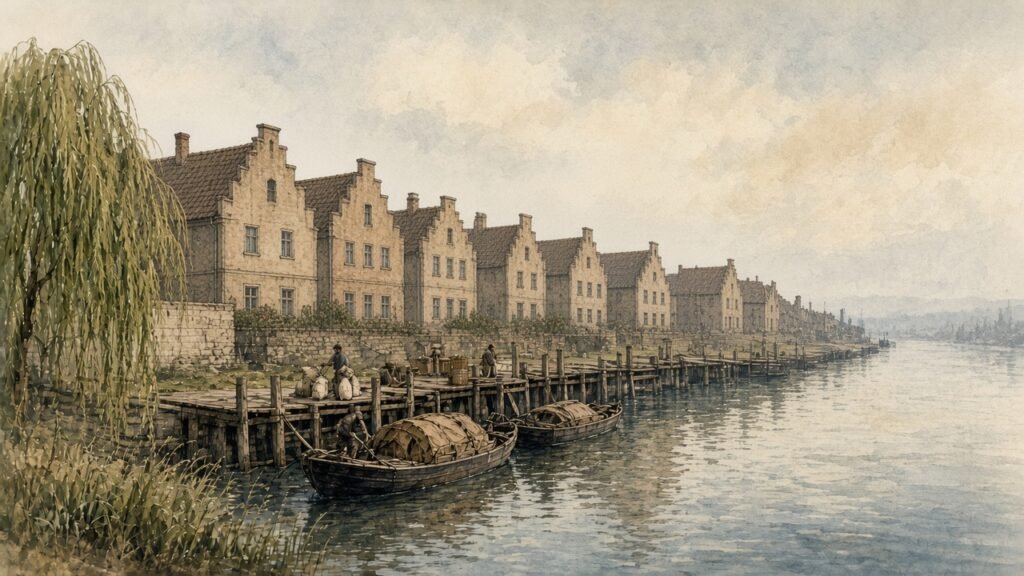
The riverside setting of Kazimierz—houses, boats, warehouses—tied Jewish and Christian livelihoods to the same Vistula traffic that had always fed Kraków. Salt, grain and timber did not ask the religion of the factor who booked them. In that shared material world lay both the possibility of coexistence and the friction of competition. Kazimierz was never only a spiritual republic; it was a working river town with a Jewish majority in its core streets and a Christian parish at its edge.[11][50]
Synagogue architecture in Kazimierz reflected both local Gothic and later stylistic imports. The Old Synagogue’s fortress-like mass spoke of security concerns. Interior bimahs and ark placements followed Ashkenazi custom. Women’s sections registered gendered norms of worship. These buildings were not only houses of prayer but also halls of communal assembly where taxes were debated and bans pronounced. Sacred and civic space overlapped under one roof.[20][11]
Education for boys in heder and yeshiva created high rates of male literacy in Hebrew and Aramaic. Girls’ education was more domestic and vernacular, though some families taught daughters to read Yiddish prayers and accounts. The resulting literacy profile shaped economic niches in trade and leaseholding that required contracts and correspondence. Human capital, not only capital in money, underpinned Kazimierz’s commercial roles.[19][20]
Burial societies and mutual-aid brotherhoods structured welfare. Members paid dues and received burial and sick care. In a world without state social insurance, these voluntary corporations were survival institutions. Their record books, where they survive, offer historians a view of ordinary Jewish life below the level of famous rabbis. Kazimierz’s strength lay as much in these brotherhoods as in its celebrated scholars.[20][19]
Contact with Christian neighbours included not only market exchange but also the hiring of Christian servants, the leasing of gardens and the shared experience of flood and fire. Boundaries were real—dietary, calendrical, residential—yet daily life produced countless small crossings. The historian must register both the wall and the gate, both the sermon against the Jew and the partnership recorded in a debt note.[11][19]
Legal cases between Jews and Christians filled starosta and municipal courts with disputes over debt, assault and market rights. Outcomes varied with the politics of the moment and the quality of advocates. Privilege on parchment did not always mean protection in the street. The gap between norm and enforcement is a leitmotif of Kazimierz’s early modern history and a caution against reading law as lived experience.[19][21]
Fire regulations and rebuilding after blazes periodically reshaped streets. Brick replaced wood where owners could afford it. Charitable donors endowed synagogues seats and study rooms. The material city recorded unequal wealth within the Jewish population as clearly as any tax roll. Mansions and cellars stood streets apart.[20][11]
Pilgrims and travellers described Kazimierz in diaries that mixed curiosity, prejudice and occasional admiration for learning. Their testimonies, biased though they are, confirm the quarter’s visibility in the European Jewish mental map. A rabbinic responsa literature similarly placed Kraków on the circuit of Ashkenazi decision-making. The town was local and translocal at once.[19][20]
Ritual calendars marked Kazimierz time differently from Christian Kraków time. Sabbath quiet contrasted with Sunday bells. Festival crowds thronged different streets on different days. Acoustic and temporal borders supplemented spatial ones. A visitor with closed eyes might still have known which town he stood in.[20][11]
8. Scholars, printers and the academy
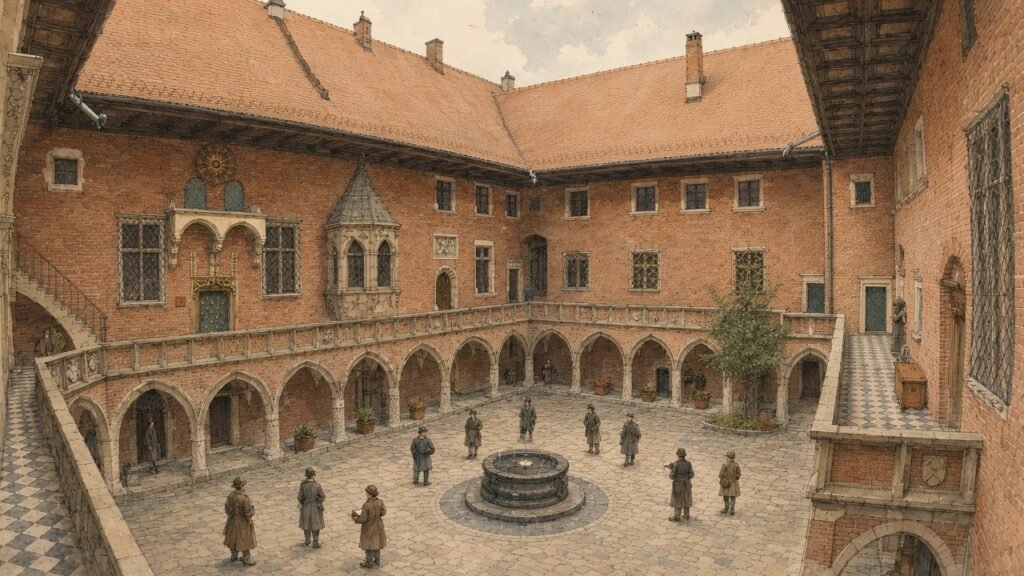
Learning and the printed word made Kraków a capital of the mind long after political power began to migrate north. The Jagiellonian University, refounded in 1400 and peaking in the early sixteenth century, remained the kingdom’s senior academy. Its colleges clustered in the Old Town, giving a whole district the character of a student quarter. Lectures in Latin covered the arts, theology, law and medicine. Disputations trained young men for careers in church, chancery and court. The library accumulated manuscripts and, after the arrival of printing, books that made older learning more widely available.[10][1]
Nicolaus Copernicus’s years as a student in Kraków in the 1490s place the city in the prehistory of the Scientific Revolution. He encountered a mathematical curriculum strong enough to equip him for later planetary work. Kraków did not invent heliocentrism, but it helped to educate the man who did. The episode illustrates a larger truth: the academy’s reputation drew talent that then radiated outwards, carrying Cracovian training into bishoprics, courts and observatories across Europe.[18][10]
Printing houses in Kraków issued liturgical books, legal texts, classical authors and vernacular works. Hebrew presses in Kazimierz served Jewish readers across the Commonwealth. The coexistence of Latin, Polish and Hebrew publishing in one urban area was unusual and productive. Censorship existed, especially in matters of faith, but the commercial incentive to print ensured a steady flow of titles. Booksellers’ stalls on and near the market square made the capital a distribution point for the printed culture of East Central Europe.[19][10]
Humanism arrived through Italian-trained scholars, travelling students and the court patronage of Sigismund I and Bona Sforza. Greek and purified Latin joined the curriculum. Historians and poets celebrated the dynasty and the city in classical metres. The taste for antiquity shaped inscriptions, tomb sculpture and the decoration of college halls. Kraków’s humanism was less a rupture with the medieval university than an enrichment of it, layered onto scholastic foundations that never entirely disappeared.[15][16]
Medicine combined university teaching with guild practice and folk remedy. Anatomical knowledge advanced slowly; epidemic response remained a mixture of flight, prayer and quarantine. Court physicians served the royal household when it resided on Wawel. Municipal barber-surgeons treated townsmen. Jewish doctors, sometimes trained in Italy, attended patients across confessional lines when permitted. The medical marketplace was plural even when doctrine was not.[10][19]
Law linked the academy to the practical needs of a litigious society. Graduates staffed consistory courts, municipal benches and noble tribunals. Roman law concepts mingled with Magdeburg custom and Polish land law. Disputes over property, privilege and jurisdiction filled the archives. The capital’s legal culture helped to integrate a multi-ethnic population under shared procedures, even when substantive rights differed by estate and religion.[7][10]
Student life had its disorders. Brawls between nations, clashes with townsmen, and debts to landlords appear in disciplinary records. Colleges tried to impose curfews and dress codes. Taverns and rented rooms offered escape. Yet the same students staffed the choirs, filled the lecture halls and, in later life, remembered Kraków as the place where their careers began. Alumni networks carried the city’s intellectual credit into distant preferments.[10][8]
By the seventeenth century wars and economic strain reduced enrolment and resources. The Deluge and later conflicts damaged buildings and endowments. Recovery was slow. Enlightenment reform in the eighteenth century attempted to modernise curricula under the Commission of National Education. Through all these changes the university remained Kraków’s most distinctive institution after the monarchy itself—a continuous corporate body that outlasted dynasties and partitions.[10][24]
Scholarship in history, philology and the natural sciences kept Kraków on the map of European learning even when the political capital had moved. The Academy of Arts and Sciences, founded in the nineteenth century under Austrian rule, later institutionalised research that the old university had pursued less formally. Continuity of libraries and archives made the city a natural seat for such work. The scholars’ Kraków of colleges and reading rooms was as real as the kings’ Kraków of castle and cathedral.[10][30]
Printers, binders, engravers and instrument makers formed a supporting economy of the book and the laboratory. Their workshops clustered near the colleges and the square. Apprentices learned trades that combined artisanal skill with literacy. In this milieu the boundary between craft and learning was porous. A city that printed Hebrew Bibles and Latin treatises in the same generation was rehearsing, in material form, the pluralism of its population.[19][1]
College foundations by bishops and nobles created endowed teaching posts that attracted masters from abroad. Stipends, lodging and chapel duties structured academic careers. Disputations open to the public displayed learning as performance. The university was a spectacle as well as a school, and Kraków’s citizens could measure their city’s rank by the quality of that spectacle.[10][1]
Censorship of printed books intensified in the Counter-Reformation, yet clandestine and imported volumes continued to circulate among students and nobles. The Index was a fact; so was evasion. Intellectual history of the academy must therefore include the unofficial curriculum of forbidden titles read in private rooms. Control was never total in a trading city with open roads.[10][15]
Instrument makers supplied globes, astrolabes and anatomical models. Botanic knowledge drew on gardens within and outside the walls. Medicine and natural philosophy remained entangled with astrology and classical authority even as observation gained prestige. Kraków participated in the slow European shift toward empirical methods without staging a sudden local revolution.[18][10]
By the eighteenth century reform commissions debated how to modernise teaching in line with Enlightenment goals. The Commission of National Education’s work touched the university’s statutes and curricula. Partition politics then placed reform under Austrian oversight. The academy’s survival through these regimes is one of the continuous threads of the city’s modern history.[10][30]
Student nations—corporations organised by geographic origin—structured social life and sometimes violence. Rectors mediated. Town-gown riots entered municipal annals. Yet the same students staffed parish churches across Lesser Poland after ordination, spreading Cracovian learning into the countryside. The academy’s influence cannot be measured only by famous names; it includes anonymous parish clergy who carried Latin literacy into villages.[10][1]
Scientific correspondence linked Kraków professors to networks in Vienna, Padua and the Low Countries. Letters exchanged observations of comets, plants and diseases. Isolation was never absolute for those with Latin and a postal route. The university’s early modern history belongs to European intellectual history, not only to Polish national narrative.[18][10]
Funding crises after wars forced temporary closures of chairs and sales of property. Patrons rescued what they could. The institution’s survival through the Deluge, the Northern Wars and the partitions testifies to a corporate toughness that weaker foundations lacked. Continuity of seals, privileges and libraries made restart possible when politics allowed.[10][24]
Women entered university study only in modern times, but earlier centuries knew learned women in convents and aristocratic households connected to academic men. Their exclusion from degrees shaped the gender of official knowledge. Any legacy account must note who was invited into the colleges and who was not.[10][16]
Alumni who became bishops carried Cracovian scholastic methods into dioceses across the Commonwealth. Synodal statutes echoed university debates. The academy thus shaped pastoral practice far from the Collegium Maius. Institutional history that stops at the city walls underestimates this radiation of trained personnel into the parish network.[10][17]
Instrument collections and anatomical theatres, however modest beside Italian counterparts, signalled aspiration to European scientific standards. Visitors noted both the ambition and the gaps. Catch-up and contribution alternated as the university’s mode of participation in learned Europe. Kraków was neither periphery alone nor metropolis alone; it was a node with variable voltage.[18][10]
During partitions Austrian reforms Germanised some instruction before autonomy restored Polish. Each change forced libraries to acquire new textbooks and professors to retool. The capacity to retool without dissolving became an institutional habit. That habit is part of why the Jagiellonian University still operates on the same urban site where Jadwiga’s bequest took hold.[10][30]
9. The court leaves for Warsaw
In 1596 King Sigismund III Vasa began to transfer the royal court from Kraków to Warsaw. A fire that damaged Wawel Castle in 1595 supplied an immediate pretext, but the deeper reason was geography. The Polish-Lithuanian Commonwealth after the Union of Lublin spanned a vast territory. Warsaw lay nearer the centre of that territory and closer to the Lithuanian lands that now shared a federal diet with the Polish Crown. Administrators and diplomats found the northern city more convenient. By 1611 the move had become effectively permanent. Kraków ceased to be the everyday capital, though it remained the city of coronation and royal burial.[23][52][2]
The ceremonial residue was substantial. Subsequent kings continued to be crowned in Wawel Cathedral. Royal tombs accumulated in the cathedral crypts and chapels. The hill retained its sacral and historical aura even when clerks and ministers worked elsewhere. For the Commonwealth’s noble citizens, Kraków remained a symbol of the kingdom’s medieval and Jagiellonian past. That symbolic capital would matter enormously under the partitions, when the city became a focus of national memory precisely because political power had long since moved away.[17][23]
Economic adjustment followed political demotion. Court demand for luxury goods, lodging and services declined. Some artisan trades shrank. Yet the university, the church hierarchy, the salt administration and regional trade continued to support a sizable population. The market square did not empty. Guilds adapted. Kazimierz remained a busy Jewish town. Kraków became a provincial metropolis with the architecture of a capital—an awkward but fertile status that encouraged the cultivation of culture over administration.[10][11][50]
The Swedish Deluge of 1655 to 1660 inflicted wounds that political relocation alone had not. Swedish forces besieged and captured Kraków in 1655 after bombardment and resistance. Occupation brought plunder of churches, castles and private houses. Treasures left the city. Suburbs burned. When Polish forces under Stefan Czarniecki and others recovered the town in 1657, they found a damaged and impoverished capital-in-memory. Population fell. Recovery took decades. The Deluge entered local remembrance as a catastrophe comparable to the Mongol sack of 1241.[24][2]
Further wars in the later seventeenth and early eighteenth centuries compounded the damage. The Great Northern War brought another Swedish occupation in 1702. Troop movements spread plague between 1708 and 1712. Mortality was severe. Buildings stood empty. Tax yields collapsed. Baroque reconstruction of churches and palaces, often sponsored by religious orders and magnates, gave the city a new stylistic layer even as its demographic and economic base struggled to recover. The Jesuits and other orders left conspicuous architectural marks, including the Church of Saints Peter and Paul and remodelled interiors elsewhere.[24][1]
Municipal politics in the post-capital era revolved around guild privilege, Jewish residence rights, and relations with the starosta who represented royal authority. Conflicts could turn violent. The city’s autonomy under Magdeburg-derived law persisted, but the absence of a resident court reduced Kraków’s leverage in Commonwealth politics. Magnate families with palaces in the city exercised informal influence. The bishopric remained a major landowner and patron. Power was plural and often paralysed—a microcosm of the Commonwealth’s wider institutional difficulties.[8][19]
Cultural life nevertheless continued. The university taught through lean years. Printers issued books. Painters and stucco workers decorated Baroque interiors. Music sounded in collegiate churches. The memory of the Jagiellonian golden age became a resource for local pride. Guidebooks and chronicles recounted the deeds of Casimir and Sigismund for readers who lived among the monuments those kings had raised. Heritage consciousness, avant la lettre, took root in a city that had more past than present power.[10][5]
By the mid-eighteenth century Kraków was a mid-sized Central European city with outstanding monuments, a famous university, a significant Jewish population and a diminished political role. The partitions would soon place it under foreign rule and, briefly, restore a fragile independence as a Free City. The long goodbye of the royal court had prepared the ground for that next transformation by teaching the city to survive without being the seat of government.[25][29]
Noble confederations and diets occasionally returned political excitement to the streets. Visitors still came to see Wawel and the square. Students still brawled and studied. The Vistula still carried salt and grain. Continuity of everyday functions softened the drama of capital loss. What changed most was the composition of the elite that mattered: fewer royal officials, more provincial notables and churchmen. The social pyramid flattened at the top and broadened in the middle.[1][2]
Artistic patronage shifted from the crown to bishops, abbots and magnates. Family chapels and palace interiors received stucco, fresco and sculpture in the late Baroque and rococo manners. The aesthetic was European; the patrons were local. In this way Kraków participated in the artistic currents of the Catholic south and centre of the continent even while the Commonwealth’s political structure decayed. Culture and politics diverged—a divergence that would define the city’s nineteenth-century role as a spiritual capital under foreign flags.[17][30]
Jewish Kazimierz shared the city’s economic difficulties and added its own. Communal debt, internal disputes and external fiscal pressure strained the kahal. Yet synagogues were maintained, rabbis appointed and books printed. The community that entered the partition era was smaller and poorer than at its early modern peak, but it remained one of the historic centres of Polish Jewry, with institutions and memories that emancipation and tragedy would later transform.[19][20]
Thus the transfer of the court did not end Kraków’s history. It changed the terms on which that history would continue. From royal seat to memorial capital, from Jagiellonian stage to Baroque provincial city, Kraków learned to live on accumulated meaning. The partitions would test whether that meaning could sustain a people who no longer had a state.[23][25]
Magnate palaces built or remodelled in the seventeenth and eighteenth centuries gave Kraków a secondary skyline of aristocratic power. Families who counted in the Senate maintained Cracovian residences for local influence and for proximity to the cathedral and university. Client networks radiated from these houses into the countryside. Even without a resident king, the city remained a node of noble politics.[1][2]
Religious orders after the Deluge spearheaded reconstruction with Baroque churches that advertised Catholic recovery. Pulpits and side chapels received lavish decoration. Processions reclaimed streets for Counter-Reformation piety. The visual city of the late seventeenth century spoke the language of triumphant orthodoxy even when the Commonwealth’s armies had recently fled Swedish guns.[24][17]
Demographic recovery after plague and war drew migrants from villages and small towns. Many entered domestic service or casual labour. Guild barriers made mastership hard for outsiders. A population of the underemployed filled courtyards and suburbs. Prosperity for merchants and canons coexisted with insecurity for the poor—a pattern familiar across early modern Europe and visible in Kraków’s charity records.[8][1]
The elective monarchy’s dysfunction—liberum veto, confederations, foreign interference—was felt in the capital-in-memory as fiscal chaos and legal uncertainty. Investors hesitated. Building projects stalled. Yet the same dysfunction preserved local autonomies that a stronger central state might have crushed. Kraków’s provincialisation was both loss and shelter.[23][25]
Coronations after 1596 still brought temporary swarms of nobles, merchants and thieves into Kraków. Prices spiked. Inns overflowed. Then the court departed and the city exhaled. These episodic booms reminded residents of what permanent capital status had meant and would not fully return. Ritual without residence was the new constitutional bargain.[23][17]
Swedish and Transylvanian occupations stripped lead from roofs and books from shelves. Restitution was partial. Some objects resurfaced in foreign collections centuries later; others remain lost. Cultural loss on this scale is part of why Baroque reconstruction felt like necessity rather than luxury. Empty shells demanded new interiors.[24][5]
10. Partitions and the Free City
The partitions of Poland at the end of the eighteenth century placed Kraków under successive foreign sovereignties and, for three decades, under a peculiar international guardianship. After the failure of the Kościuszko Uprising of 1794, in which Tadeusz Kościuszko and his forces made the city and its region a theatre of insurgent war, the Third Partition of 1795 awarded Kraków and its surroundings to the Habsburg monarchy. Austrian administration incorporated the city into the complex of territories that came to be known as Galicia. German became a language of officialdom. Censorship and conscription arrived. The former capital learned the disciplines of a provincial garrison town.[25][26][27]
Napoleonic upheaval interrupted Austrian rule. In 1809 Polish forces attached to the Duchy of Warsaw seized Kraków. The city joined the Napoleonic satellite state until the empire’s collapse. The Congress of Vienna in 1815 then invented a new status. Kraków and a modest surrounding territory became the Free City of Cracow, a nominally independent republic under the joint protection of Austria, Prussia and Russia. The arrangement was designed to neutralise a strategic fortress zone and to offer a symbolic concession to Polish sentiment without restoring a Polish state.[28][29]
The Free City possessed a constitution, a senate, courts and a small territory of roughly a thousand square kilometres. Residents enjoyed a degree of civil liberty unusual in the neighbouring partitions. Exiles and conspirators used Kraków as a refuge and a listening post. The university continued. Trade benefited from the city’s position as a wedge between empires. Yet the protecting powers kept resident commissioners and reserved the right to intervene. Independence was real enough to foster Polish cultural life and fragile enough to end when that life turned toward insurrection.[29][2]
The Kraków Uprising of 1846 attempted to spark a wider Polish rising and to challenge Austrian power in Galicia. Insurgents briefly controlled the city and proclaimed a national government. Peasant unwillingness to follow noble leadership, Austrian military response, and the failure of coordination with other partitions doomed the revolt within days. Austria abolished the Free City and annexed it to the Kingdom of Galicia and Lodomeria. The experiment in miniature statehood was over. Kraków returned to direct Habsburg rule, this time for the long nineteenth century.[29][30]
Repression followed annexation: trials, imprisonments, surveillance. Yet the wider Habsburg context after 1848 and especially after the Compromise of 1867 opened a different path. Galicia received substantial autonomy. Polish became the language of administration and education in the western part of the province. Kraków, though not the provincial capital—that role belonged to Lviv—emerged as the cultural capital of Austrian Poland. The contrast with Russified Congress Poland and Prussian-Germanised Poznań made Habsburg Kraków seem, to many Poles, a relative haven.[30][31]
During the Free City years and the early Austrian period the urban fabric modernised slowly. Suburbs grew. The Planty park belt began to replace the obsolete fortifications with promenades. Coffee houses and newspapers fostered a public sphere. The Jewish population, still largely concentrated in Kazimierz, negotiated the transition from kahal autonomy toward the legal emancipation that Austrian liberalism would eventually offer. Social tensions between estates and confessions persisted, but the institutional framework of a Rechtsstaat gradually took hold.[8][19]
Kościuszko’s memory haunted the city. The mound raised in his honour on a hill west of the Old Town became a site of pilgrimage and patriotic demonstration. Anniversaries of 1794 and of later risings filled churches and cemeteries with crowds. The Free City and later Galician autonomy allowed such commemorations more latitude than Russian Poland permitted. Kraków specialised in the politics of memory because the politics of power were conducted elsewhere.[26][27]
Economic life rested on trade, crafts, the university, the church and a growing service sector. Industry remained modest compared with Silesia or Łódź. The city’s wealth was cultural and rentier as much as manufacturing. That profile would shape its social structure into the twentieth century: a large intelligentsia, a significant Jewish middle class, a Catholic clerical presence, and a working population employed in small workshops and municipal services rather than in giant factories—until Nowa Huta arrived after 1949 to force a different model.[1][45]
The abolition of the Free City in 1846 closed one chapter and opened another. Habsburg Galicia, for all its poverty in the east and its nationality conflicts between Poles and Ukrainians, gave Kraków the institutional oxygen to become the spiritual capital of a nation without a state. The next chapter follows that Galician flourishing from the 1860s to the First World War.[30][31]
Diplomatic archives of the protecting powers reveal how carefully Austria, Prussia and Russia watched the Free City’s press and clubs. Spy reports list conspirators and pamphlets. The miniature republic was never left alone to invent its future. When it tried, in 1846, the three courts agreed that the experiment had failed. Annexation was the consensus of empire against the contingency of Polish independence, however small.[29][28]
For ordinary residents the change of flags meant new taxes, new uniforms on the streets and new languages in the offices. Some prospered as intermediaries. Others emigrated. The university adapted its statutes to each regime in turn. Through these adaptations Kraków practised a skill it would need again in 1918, 1939 and 1945: the art of remaining itself while the map was redrawn around it.[10][2]
Conspiratorial networks that used the Free City as a base maintained contacts with émigrés in Paris and with underground groups in the Russian partition. Police from three empires shared information when it suited them. The miniature state’s neutrality was thus continually compromised by the revolutionary projects of its Polish inhabitants and by the counter-revolutionary vigilance of its protectors. Independence without power proved an unstable compound.[29][27]
Educational and publishing initiatives in the Free City years issued textbooks and periodicals that travelled into other partitions. Kraków printers served a national market that politics had divided. The city’s presses became instruments of cultural unification ahead of political reunification. In this sense the Free City punched above its territorial weight.[29][10]
Peasant attitudes during the 1846 crisis revealed the gap between noble-national and rural interests. Austrian promises and memories of serfdom made many villagers hostile to an uprising led by lords. The massacre of nobles in the Galician countryside that accompanied the Kraków events shocked patriotic opinion and complicated later efforts at cross-class mobilisation. Social history and national history diverged violently that spring.[29][30]
After annexation, Austrian officials inventoried the Free City’s institutions and folded them into Galician structures. Some officeholders kept posts; others were purged. The university negotiated its status. Municipal self-government persisted in reduced form. Continuities of personnel softened the rupture for everyday administration even as sovereignty changed hands for good.[30][10]
Currency and customs arrangements of the Free City created opportunities for smuggling into tariff-walled neighbours. Merchants grew adept at borders. The economic geography of a small neutral republic surrounded by empires rewarded flexibility and punished rigidity. Kraków’s commercial habits from Magdeburg days adapted to a new kind of interstitial profit.[29][28]
School curricula in the Free City emphasised Polish literature and history to a degree impossible in Russian Poland. Textbooks printed locally became contraband elsewhere. Educational autonomy was thus a strategic national asset disguised as municipal policy. Teachers understood their double role.[29][10]
After 1846 Austrian censuses and cadasters mapped the annexed city with bureaucratic thoroughness. Property, language and religion were counted. The data now serve historians; then they served tax and police. Being known to the state more completely was the price of emerging modern administration.[30][2]
11. Habsburg Galicia
After the Austro-Hungarian Compromise of 1867, the Kingdom of Galicia and Lodomeria received a measure of autonomy that transformed political and cultural life in the Polish-speaking west of the province. Polish became the language of the Galician diet, of the courts and of the schools. Kraków benefited immediately. The Jagiellonian University taught in Polish. Newspapers, theatres and learned societies operated with a freedom unimaginable in Russian Poland. Officials of Polish nationality staffed municipal and provincial posts. The city that had lost its royal court in 1596 recovered, under a foreign emperor, a role as the cultural capital of the Polish nation.[30][31][10]
Population growth accompanied autonomy. Railways linked Kraków to Vienna, Lviv and Warsaw’s approaches. The built-up area expanded beyond the Planty into new districts of tenements and villas. Municipal services—gas, water, tramways—arrived in stages. The population passed one hundred thousand by the turn of the century. Jews, legally emancipated under Austrian law, moved from Kazimierz into the wider city, entered the professions and participated in municipal politics, while Orthodoxy, Hasidism and secular ideologies competed for their allegiance. Christians divided among conservatives, democrats and socialists. The public sphere thickened with clubs, reading rooms and electoral campaigns.[19][1][8]
Art and literature flourished under the banner of Young Poland, the modernist movement that made Kraków its principal seat around 1900. Stanisław Wyspiański wrote plays and designed stained glass that fused national themes with contemporary form. Painters, poets and composers gathered in cafés such as the Jama Michalika. The Academy of Fine Arts, associated with Jan Matejko in an earlier generation, trained artists who exhibited across Europe. Theatre, especially the Słowacki Theatre, staged works that treated Polish history as living drama. Galicia’s relative freedom allowed an experimentation that Russian censorship would have crushed.[32][33]
Historical painting and monument building cultivated a civic religion of the past. Matejko’s canvases of Polish kings and battles hung as secular icons. The Kościuszko Mound and later the Piłsudski Mound organised the skyline into a topography of memory. Anniversaries of uprisings filled the churches and the square. Schoolbooks taught the Jagiellonian golden age as a usable past. Kraków specialised in this commemorative labour because it possessed the monuments and the institutional freedom to perform it. Visitors from other partitions came to breathe what they called free Polish air.[26][35]
The Catholic Church remained a central institution. The archbishops of Kraków wielded moral and social influence. Parish life structured the calendar of the Christian majority. At the same time, clerical politics collided with socialist and liberal currents among students and workers. The university produced both priests and freethinkers. Debates over clerical influence in schools and elections filled the press. Galicia was Catholic, but it was not unanimous.[17][10]
Jewish Kraków in the Galician era was demographically large and internally diverse. Traditional kehillah structures adapted to municipal and imperial law. Progressive synagogues and secular associations appeared alongside Hasidic courts and Orthodox schools. Yiddish newspapers and Hebrew revivalists addressed overlapping publics. Zionism, Bundism and Polish integrationism competed for younger generations. Economic roles ranged from poverty in Kazimierz alleys to prominence in trade, law and medicine. Anti-Jewish hostility persisted in parts of Christian society and periodically erupted, even as legal equality advanced.[19][31]
Socialists organised workers in workshops and early factories. Peasant parties addressed the Galician countryside’s poverty. National Democrats preached ethnic solidarity. Conservatives defended property and the Habsburg connection. Electoral reform gradually widened the franchise. Kraków’s politics became a school of the parliamentary habits that Poles would need in 1918. The city practised democracy before it possessed a state.[30][34]
Architecture of the autonomous period lined new avenues with historicist and Art Nouveau façades. Banks, hotels and apartment houses advertised provincial prosperity. Conservation of the Old Town and Wawel became a municipal and scholarly concern. The sense that the historic centre was a national trust, not merely a local asset, hardened into policy. That conservation ethic would later help the city survive wars that erased other Polish urban cores.[8][5]
When war came in 1914, Galicia became a front. Russian armies advanced and retreated through the region. Kraków’s fortifications placed it on the military map. Refugees crowded the city. The Habsburg empire’s collapse in 1918 opened the door to Polish independence. Local Polish committees took power as Austrian authority dissolved. The cultural capital of Galicia prepared to become a city of the Second Republic.[34][30]
Education at every level expanded under autonomy. Gymnasia prepared students for the university. Technical and commercial schools served the economy. Women’s education advanced through private and public initiatives, though full equality remained distant. Libraries and museums opened collections to a broader public. The Academy of Arts and Sciences coordinated research across disciplines. Kraków’s claim to intellectual leadership rested on this dense infrastructure of schools and learned bodies.[10][30]
Everyday life mixed imperial and national signals. Portraits of Franz Joseph hung in offices; Polish eagles appeared in shop windows. Military bands played in the Planty; choirs sang patriotic hymns in closed rooms. Conscription took young men into Austrian regiments where they served beside Czechs, Ukrainians and Germans. The experience of multi-national empire complicated simple national narratives even as those narratives grew stronger. Kraków learned to be Polish in a world that was not only Polish.[30][31]
By 1914 the Galician experiment had made Kraków a modern European city with a medieval heart, a famous university, a vibrant arts scene and a population practised in the politics of autonomy. The war would end the empire that had permitted that flourishing. The independence that followed would test whether cultural capital could convert into civic success within a restored Polish state.[34][1]
Railway workshops and small factories employed a growing working class whose strikes entered the local chronicle. Socialist organisers competed with Catholic trade unions. Living conditions in tenements shocked reformers who measured cubic metres of air per sleeper. Urban modernity arrived with tuberculosis and with tram tickets alike.[30][1]
Ukrainian–Polish tensions, sharper in eastern Galicia and in Lviv, echoed in Kraków through student politics and press polemics. The city was overwhelmingly Polish-speaking, yet the provincial framework forced awareness of the dual nationality problem. National Democrats and conservatives offered different answers; none dissolved the conflict that would explode during and after the world war.[31][30]
Photography studios recorded the square, the Planty and family faces for albums that now fill museum drawers. Visual modernity paralleled literary Young Poland. Postcards sold the city’s image to travellers before mass tourism had a name. Kraków learned early to picture itself for export.[32][8]
When Austrian rule collapsed, local committees possessed already the administrative experience that autonomy had granted. The transition of 1918 was smoother in Kraków than in cities without that rehearsal. Galician home rule had been empire’s indirect gift to the future republic.[34][30]
Cabarets and satirical journals needled both imperial officials and local pomposity. Laughter was a political resource under censorship that allowed humour more easily than direct attack. Young Poland’s cabaret culture trained audiences in reading between lines—a skill transferable to later underground reading under occupation and communism.[32][33]
Hospital modernisation and waterworks reduced some epidemic risks even as tenement density created others. Municipal physicians published mortality tables that reformers used as weapons. Public health became a language of civic duty shared across party lines. The body’s welfare entered politics alongside the nation’s.[1][30]
Emigration to America from Galician poverty touched Kraków mainly as a transit and remittance point. Letters and dollars came back; young men left. The city’s population growth occurred despite this outflow because in-migration from nearby villages more than compensated. Demography was a balance of departures and arrivals, not simple accumulation.[31][19]
By 1914 drill halls and rifle clubs prepared youth for a war whose imperial sides would force Poles into opposing armies. Cracovians in Austrian uniforms later faced kinsmen in Russian ones. The tragedy of partitioned military service haunted interwar memory and funeral orations. Galicia’s freedom had not included the freedom to fight only for Poland.[34][30]
12. Independence restored
Polish independence in November 1918 returned Kraków to a sovereign Polish state for the first time since the partitions. Local takeover from Austrian officials was largely peaceful. The city entered the Second Republic as a major provincial centre, rich in institutions and monuments, less dominant industrially than Łódź or Upper Silesia, and overshadowed politically by Warsaw. Its wartime sufferings had been real—refugees, shortages, epidemics—but its historic core stood intact. Reconstruction meant administrative integration, economic stabilisation and the adaptation of Habsburg-era institutions to Polish republican law.[34][2]
The university expanded faculties and absorbed scholars from other partitions. Student numbers rose. Research institutes affiliated with the Polish Academy of Arts and Sciences made Kraków a national centre of learning. Museums and libraries received state support. The conservation of Wawel and the Old Town continued as a public duty. Tourism, already present before the war, grew as Poles from across the republic visited the coronation city. Kraków sold its past to a nation hungry for usable history.[10][5]
Municipal politics reflected the republic’s wider cleavages. National Democrats, socialists, peasant parties and Jewish lists contested elections. Józef Piłsudski’s legend loomed large; the mound later raised in his memory confirmed Kraków’s role in the cult of the independence struggle. The 1926 coup that established the Sanacja regime altered the balance of local power without erasing party life entirely. Press debate remained lively compared with the authoritarianisms to the east and west.[35][34]
Jewish Kraków between the wars numbered tens of thousands and sustained a dense network of synagogues, schools, parties and charities. Yiddish and Polish cultural production flourished. Zionist and Bundist youth movements drilled and debated. At the same time, economic pressure and nationalist hostility narrowed opportunities. University quotas and occasional violence signalled deteriorating relations. The community that faced 1939 was large, diverse and already under strain.[19][36]
Economic structure changed gradually. Small industry, trade and services employed most workers. The depression of the 1930s hurt artisans and shopkeepers. Public works and state employment offered partial relief. Compared with the forced industrialisation that communism would later impose at Nowa Huta, interwar Kraków remained a city of workshops, offices and schools. Its skyline stayed low; its centre stayed historic.[1][45]
Cultural life built on Young Poland’s legacy. Theatres, cabarets and cabarets of a more political kind filled evenings. Painters and writers associated with the city exhibited and published in Warsaw and abroad. Catholic intellectual circles gathered around journals and discussion clubs. The pluralism of Galician days survived, narrowed by nationalism but not extinguished. Kraków’s cafés continued to serve as informal parliaments of opinion.[32][33]
Urban planning addressed the growth of suburbs and the need for modern housing, sanitation and transport. Annexations of surrounding villages created a larger municipal area. Trams linked new districts to the Old Town. Air pollution and overcrowding in poorer quarters exercised reformers. The tension between preserving the historic centre and accommodating modern traffic foreshadowed debates that would return after 1989.[8][1]
Foreign policy crises of the late 1930s reached the city through mobilisation, propaganda and the movement of troops. The German threat after Munich and the Slovak border changes unsettled public opinion. Yet few imagined the totality of what occupation would bring. When the Wehrmacht entered Kraków on 6 September 1939, the Second Republic’s provincial idyll ended in a few days of campaign. The next chapters of the city’s history would be written under the General Government and in the shadow of genocide.[36][42]
Education and Catholic life remained pillars of interwar identity. Parish schools and gymnasia competed and cooperated with state institutions. The archbishopric carried moral weight. Processions and feast days filled the streets. At the same time, secular ideologies claimed the young. The struggle over Poland’s soul, so often narrated at the national level, had its Cracovian parish and lecture-hall versions.[17][10]
Sport, scouting and paramilitary associations organised leisure and prepared youth for civic and military roles. Matches and rallies drew crowds. These mass forms of belonging supplemented older estate and confessional identities. A modern urban public was taking shape in the shadow of Wawel—one that would be shattered by occupation and partially reconstituted under communism and after.[34][1]
By August 1939 Kraków was a city of roughly a quarter of a million people, with a historic core admired across Europe, a large Jewish minority, a famous university and a modest industrial base. It was not the political capital, but it was a capital of Polish memory. That memory would be both a resource and a target under the German occupation that began within days of the war’s outbreak.[36][2]
Diplomatic and military unpreparedness at the national level left local authorities with little room for manoeuvre when invasion came. Evacuations clogged roads. Archives and art were hurriedly packed. Some treasures reached Romania or France; many did not. The speed of the German advance through southern Poland meant that Kraków fell before defensive plans matured. The city’s intact survival in physical terms was already being decided by campaigns fought elsewhere.[36][42]
Inflation in the early 1920s wiped savings and destabilised wages before currency reform restored order. Shopkeepers marked prices twice a day. Students dropped out to work. The memory of worthless notes coloured later attitudes toward state finance. Stabilisation, when it came, felt like the return of gravity.[34][1]
Air connections and improved rail shortened travel to Warsaw and Vienna. Newspapers arrived faster. Provincial isolation lessened. Kraków remained distinctive without being cut off. The interwar years knitted it more tightly into national media space than Habsburg schedules had allowed.[34][2]
Anti-Jewish violence in the immediate postwar moment of 1918, and tensions in the 1930s, stained the republic’s record in the city. Historians debate numbers and triggers; the facts of assault and fear are documented. The Second Republic’s Kraków was a place of cultural achievement and of civic failure toward its Jewish citizens—both truths belong in the ledger.[19][36]
Preparations for defence in 1939 included trench digging and blackout drills that civilians remembered as prelude. The speed of defeat made those preparations feel theatrical in retrospect. Yet they mark the last gestures of a sovereign municipal and national authority before occupation erased both.[36][34]
State offices opened in former Austrian buildings. Polish eagles replaced imperial emblems. Clerks learned new forms while keeping old filing habits. Administrative Polonisation was a practical task of stamps and letterheads as much as a symbolic one. Continuity of paperwork eased the sovereignty shift.[34][2]
Student fraternities revived rituals banned or constrained under Austria. Duelling scars and coloured caps reappeared. Some fraternities excluded Jews; some Jewish corporations answered in kind. Campus pluralism and campus segregation coexisted uneasily. The university mirrored the republic’s unresolved identity conflicts.[10][19]
Tourism boards marketed Wawel to domestic visitors with guidebooks that taught a standardised national story. School excursions became ritual. The pedagogical city—Kraków as textbook—solidified in the 1920s and 1930s. That pedagogy would be violently interrupted in 1939 and selectively resumed after 1945 under different ideological covers.[5][8]
Border wars and the Silesian uprisings touched the city through recruiting and refugees rather than through battle. Kraków’s contribution to consolidating the republic’s frontiers was logistical and moral. Victory celebrations in the square affirmed a sovereignty that still felt miraculous to a generation raised under the partitions.[34][35]
Charitable societies and women’s organisations expanded social provision in the absence of a full welfare state. Soup kitchens, orphanages and scholarship funds filled gaps. Much of this work was confessional; some was secular. The interwar civic fabric depended on volunteers who treated the city as a common obligation.[34][19]
Architectural competitions for public buildings favoured styles that signalled national rebirth—sometimes historicist, sometimes modernist. The resulting mix still characterises interwar districts. Walking those streets is walking the aesthetic arguments of the Second Republic in brick and plaster.[8][34]
Radio ownership spread in the 1930s, bringing Warsaw’s voice into Cracovian kitchens and creating a shared national soundscape. Local stations added regional news. Mass media began to compete with pulpit and café as organisers of opinion. The occupation would seize that infrastructure at once in 1939.[34][36]
13. German occupation
German troops occupied Kraków on 6 September 1939. On 12 October the Nazi leadership decreed the creation of the General Government, a territorial administration for those parts of occupied Poland not directly annexed to the Reich. Kraków was designated its capital. Hans Frank arrived as Governor-General and established his headquarters in Wawel Castle, a deliberate occupation of the symbol of Polish statehood. The medieval and Renaissance seat of kings became the office of a colonial regime that treated Poles as a subject population and Jews as a people marked for destruction.[42][43][36]
Policies of exploitation and repression unfolded rapidly. Polish secondary and higher education was closed. The university was targeted in Sonderaktion Krakau on 6 November 1939, when 183 academics were arrested and deported to concentration camps; many died. Street names were Germanised. The Polish press was suppressed. Art was looted from museums and from Wawel. Forced labour claimed tens of thousands. The Montelupich prison became a site of torture and execution. Everyday life narrowed to survival under curfew, rationing and fear.[36][37][10]
German planners imagined a partial Germanisation of the city, with new administrative buildings and a reordered population. Wartime priorities and the eventual course of the war limited how far those plans advanced. The historic centre was not razed as Warsaw later would be; it was appropriated. Frank’s court staged ceremonies in royal rooms. The contrast between architectural preservation and human destruction defined occupied Kraków. Stones were spared; people were not.[43][36]
Polish resistance organised under the Union of Armed Struggle and later the Home Army. Underground schools taught forbidden subjects. Illegal newspapers circulated. Intelligence networks reported on German movements. Sabotage remained carefully calibrated because the city housed the General Government’s nerve centre and because reprisals were savage. Unlike Warsaw in 1944, Kraków did not rise in a general insurrection. The Home Army’s Operation Tempest plans for the area emphasised seizure of key points as German power collapsed rather than a premature battle that would invite annihilation.[36][2]
The Catholic Church operated under surveillance and restriction. Some clergy were arrested; some collaborated in charitable relief; many sustained parish life as a space of relative moral autonomy. Underground religious practice continued. The future John Paul II, Karol Wojtyła, lived through the occupation as a young worker and seminarian in the Kraków milieu, an experience that shaped his later understanding of tyranny and resistance.[47][36]
Economic life was redirected to the German war effort. Factories produced for the Wehrmacht. Food was requisitioned. The black market flourished because official rations did not sustain life. Corruption laced the occupation administration. For non-Jewish Poles the occupation was a nightly calculation of risk; for Jews it became, step by step, a machinery of isolation and murder described in the next chapter.[36][37]
By 1944 the approach of the Red Army altered German behaviour. Evacuation plans were drawn up. Some prisoners were moved west. The city’s physical fabric remained largely standing when Soviet forces entered in January 1945—an outcome that distinguished Kraków from Warsaw and that shaped postwar reconstruction. The occupation had lasted more than five years. It left demographic, moral and institutional ruins that decades would not fully repair.[36][46]
German cultural policy oscillated between contempt for Polish achievement and a desire to claim Gothic and Renaissance monuments as evidence of a broader Germanic civilising mission. Exhibitions and propaganda publications advanced these claims. Polish underground scholars documented looting for future restitution. The battle over the meaning of Wawel and the square was intellectual as well as military. Occupiers and occupied fought for the narrative of the stones.[5][43]
Children’s lives shrank to conspiratorial schooling, hunger and the sight of roundups. Some joined scouting units affiliated with the resistance. Others were sent to forced labour. Orphanhood increased as parents were arrested or killed. The psychological imprint of occupation on a generation that later built the People’s Republic and then dismantled it is part of Kraków’s continuous history, even when it leaves few monumental traces.[36][37]
As the front approached in January 1945, German authorities prepared to leave. Mines were reportedly placed under monuments and infrastructure, though the city was not destroyed in a final act of spite comparable to Warsaw’s fate. Soviet entry on 17–19 January ended the General Government in Kraków. The new power would impose its own system. The occupation was over; the dictatorship of a different kind was about to begin.[46][36]
Counting the Polish dead of the occupation in Kraków involves incomplete records of executions, camp deportations and street killings. Thousands perished. Intellectuals were hit disproportionately in the early Aktionen. Workers died in raids and as hostages. The city’s cemeteries and later memorials record names that stand for many more unknown. Any architectural tour that omits this human ledger misunderstands what the intact Old Town cost.[36][37]
Hans Frank was later tried at Nuremberg and executed. His diaries and the surviving administrative paper of the General Government became evidence of a regime that had made Kraków its capital in order to destroy the Polish nation as a political community. The castle he occupied returned to Polish custody as a museum and symbol. The irony is permanent: the same hill served Piast kings, Jagiellonian renaissance, Nazi governors and postwar tourism.[43][5]
Food packages from the countryside, when they got through, meant survival for families with rural relatives. Those without such ties suffered first. Hunger was unevenly distributed even under general rationing. Occupation economics rewarded connection and punished isolation.[36][37]
Clandestine theatre and poetry readings sustained morale among intellectuals excluded from official culture. Audiences risked arrest. Performers memorised texts because paper was dangerous. Culture went oral and mobile. The underground’s aesthetic dimension mattered alongside its military one.[36][32]
German officials’ families shopped in requisitioned stores while Polish children begged. The dual economy of occupier and occupied was visible on the same pavements. Photographs taken illicitly, when they survive, show that juxtaposition with a clarity prose struggles to match.[43][36]
As the Red Army approached, some Germans fled west with looted goods; some destroyed files. Polish underground units tried to secure buildings and records. The transfer of power was chaotic, hopeful and already shadowed by knowledge of Soviet practices farther east. Liberation was real and impure at once.[46][36]
Trams ran under German timetables. Polish drivers and conductors remained, watched by supervisors. Ordinary work continued in a key of humiliation. The banality of occupied schedules—shift changes, ticket punches—coexisted with the extremity of roundups. Survivors often remembered both registers in the same sentence.[36][37]
Art theft from Wawel and private collections fed Reich museums and officials’ homes. Polish museum staff sometimes hid objects successfully. Postwar restitution recovered parts of the loss over decades; other works remain missing. The documentary trail of crates and inventories is itself a historical source on cultural genocide’s logistics.[5][43]
Youth blackmailed into signlists for the Deutsche Volksliste faced choices with lethal consequences either way. Families split. Postwar stigma attached to some who signed under duress. Occupation law manufactured moral traps that peacetime ethics struggles to adjudicate fairly. Kraków’s German minority and Polish population both lived inside those traps differently.[36][42]
The approach of the front in January 1945 produced rumours of planned demolition. Whether or not every rumour was accurate, the fear was real. That the Old Town survived shaped Kraków’s entire postwar self-understanding as the Polish city that Providence or chance spared. Gratitude and survivor guilt mingled in later commemorations.[36][2]
Medical care for Poles shrank as hospitals were requisitioned. Epidemics of typhus threatened crowded districts. Polish doctors worked with scarce drugs. Jewish doctors in the ghetto worked with still less until deportation ended their practice. Public health under occupation was a triage of triage.[36][38]
Names of streets changed to German forms and back again after 1945, then sometimes changed once more under communism. Each renaming taught inhabitants that power claims the map. Residents often kept old names in speech as a small refusal. Oral cartography resisted official cartography.[36][2]
14. Ghetto and Płaszów
Before the war Kraków’s Jewish population numbered about sixty thousand, roughly one quarter of the city’s inhabitants. German occupation brought immediate persecution: forced labour, confiscation of property, marking with armbands, and exclusion from public life. In March 1941 the Germans established a ghetto in the Podgórze district, across the Vistula from Kazimierz and the Old Town. Jews remaining in the city after earlier expulsions and flights—some fifteen to twenty thousand—were confined behind walls and barbed wire. Overcrowding, starvation rations and disease killed many before the major deportations began.[40][38][36]
Deportations to the Bełżec extermination camp in 1942 removed the majority of the ghetto’s inhabitants in successive Aktionen. Selections on the streets and in courtyards separated those sent to death from those temporarily spared for labour. Children and the elderly were murdered with particular ruthlessness. The ghetto’s area shrank as liquidations proceeded. Underground attempts at resistance and escape faced overwhelming force. By the end of 1942 the remaining Jews were concentrated for final disposal.[38][40][37]
The Płaszów labour camp, later a concentration camp, was established on the site of Jewish cemeteries south of the city. Under commandants including Amon Göth it became notorious for arbitrary shootings, dogs, and lethal working conditions. Prisoners from the liquidated ghetto, from surrounding towns, and from further afield were worked on construction, quarrying and workshops. Many were subsequently transferred to Auschwitz-Birkenau and other camps. The March 1943 liquidation of the Kraków ghetto sent thousands to Płaszów or directly to death. Bodies were buried or burned on site; later attempts to erase evidence were incomplete.[41][39][38]
Oskar Schindler’s enamelware factory in Zabłocie employed Jewish workers whose status as war-essential labour offered a precarious shield. Schindler’s list, compiled as Płaszów’s prisoners faced transfer, saved over a thousand people by moving them to a factory camp in Brünnlitz. The episode, exceptional and later famous, does not alter the overall demographic outcome. Of Kraków’s prewar Jewish population only a small remnant survived the war, whether in camps, in hiding on the Aryan side, or abroad.[44][36][19]
Poles who hid Jews risked death for their households. Some did so from friendship, conviction or payment. The underground and the Catholic clergy offered sporadic help. Betrayals and blackmail also occurred. The moral record of occupied Kraków, like that of occupied Poland generally, includes courage, indifference and complicity in proportions that no single statistic captures. Postwar trials and later historical research have documented individual cases without exhausting the subject.[36][38]
After liberation a few thousand Jews returned or emerged from hiding. The July 1945 pogrom in Kraków, in which a mob attacked Jews amid rumour and postwar chaos, signalled that safety had not simply returned with the German defeat. Emigration accelerated. Synagogues stood empty or ruined. Kazimierz became a district of absences. Communist policy toward Jewish remnants oscillated between instrumental tolerance and later antisemitic campaigns, notably in 1968. The community that had lived in Kazimierz since the Middle Ages was effectively destroyed as a continuous society.[19][36]
Memorialisation came slowly and unevenly. Monuments at the ghetto site and at Płaszów, museum exhibitions, and the restoration of selected synagogues eventually created a landscape of remembrance. Film and literature carried Kraków’s Holocaust history to international audiences. Local educators developed curricula and walking tours. The risk of reducing genocide to tourism remains a subject of ethical debate among guides, scholars and survivors’ families. The historian’s obligation is to keep the dead from becoming only scenery.[39][40]
German bureaucratic records—transport lists, camp reports, Frank’s diaries—supply a cold precision that survivors’ testimonies fill with human detail. Reading both kinds of source together is necessary. The ghetto’s daily hunger, the children’s roundups, the shootings on Hujowa Górka, and the silence after liquidation are facts established by converging evidence. Kraków’s Holocaust is among the best documented urban destructions of Jewish life in Poland, which only deepens the obligation to narrate it without euphemism.[43][38][41]
Medical crimes, including experiments and the murder of hospital patients, formed part of the camp and ghetto system. Physicians appear in the records as both perpetrators and prisoner-doctors who tried to treat without medicines. The collapse of ordinary ethics under racial ideology is visible in these clinical spaces as clearly as in the execution grounds. Płaszów was a workplace of death in every department.[39][41]
Children who survived—hidden with false papers, smuggled out, or listed on Schindler’s transports—carried Kraków’s Jewish memory into the postwar world. Their testimonies, recorded decades later, reconstruct smells, sounds and the names of the murdered that administrative files omit. Oral history has been essential to the historiography of the Kraków ghetto and Płaszów. Without it the account would be geometrically precise and humanly empty.[38][44]
The spatial proximity of Wawel, the tourist Old Town, and the killing sites of Podgórze and Płaszów forces contemporary Kraków to inhabit a divided map. Visitors who walk from the castle to the ghetto memorial traverse a few kilometres and a moral chasm. Urban planning and heritage policy continue to negotiate how those spaces speak to each other. The city’s famous beauty cannot be told honestly without the chapter of its Jewish destruction.[40][8]
International tribunals and Polish courts prosecuted some perpetrators; many escaped. Göth was hanged in 1946. Others lived under false names or undisturbed in postwar societies. Legal reckoning was partial. Historical reckoning continues. Each generation of Cracovian students who learn the ghetto’s boundaries for the first time renews a knowledge that neighbours once acquired by looking out of their windows at walls.[41][39]
Labour cards and factory employment decided life and death at selection. Those without “useful” work faced earlier transport. The Nazi hierarchy of exploitation thus penetrated the ghetto’s internal social structure, creating desperate competitions for posts that postponed murder without preventing it. Survival strategies were rational within an irrational exterminatory system.[38][40]
Religious life in the ghetto continued in secrecy: prayers, Sabbath where possible, burial rites under impossible conditions. Rabbis answered questions about fasting and martyrdom that no handbook had foreseen. Spiritual resistance coexisted with armed and with flight. All forms were minority practices under overwhelming terror; all deserve record.[38][19]
After the war, property on former Jewish streets passed to the state or to new occupants. Restitution remains incomplete. Legal afterlives of genocide continue in courtrooms and family archives. Kraków’s present cadastral map still bears, invisibly to most walkers, the force of 1941–1943.[19][11]
International remembrance days bring officials to lay wreaths at Płaszów and the ghetto memorial. Ceremony without education risks emptiness; education without ceremony risks abstraction. The city experiments continually with formats that might hold both. Failure and success in that experiment are themselves part of contemporary history.[39][40]
Names on transport lists, where preserved, allow partial reconstruction of who was taken on which day. Genealogists and historians continue to match lists to families. Each identified name returns a person to individuality from the anonymity of numbers. Archival labour is a form of burial rite for those denied graves.[38][40]
The topography of murder—ghetto walls, Umschlagplatz equivalents, Płaszów hills, railway spurs—can still be walked. Guided tours that treat these sites with restraint perform a civic service; tours that sensationalise perform a disservice. Kraków’s challenge is to keep pedagogy ahead of spectacle.[41][39]
Survivors who rebuilt lives in Israel, America or postwar Poland carried Kraków street names into new languages. Landsmanshaftn associations issued memorial books. The diaspora archive of the destroyed community is now as important as the local one. History of Kazimierz after 1943 is also a history of elsewhere.[19][20]
Photographs taken by German soldiers as souvenirs, later recovered, show ghetto streets with a voyeur’s coldness. Historians use them cautiously as evidence while refusing the perpetrators’ gaze as the last word. Looking again, critically, is part of ethical research practice.[40][38]
Postwar trials in Poland and Germany produced testimonies that remain core sources. Cross-examination revealed inconsistencies that careful history must weigh. Legal truth and historical truth overlap without being identical. The courtroom is one archive among others.[41][39]
15. Liberation and the early republic
Soviet forces entered Kraków in mid-January 1945 during the Vistula–Oder offensive. German withdrawal left the historic centre standing. The new authorities installed a communist-dominated administration aligned with the Lublin committee and, behind it, Moscow. Non-communist resistance structures, including Home Army networks, faced arrest by Soviet security organs and their Polish partners. The war against Nazi Germany ended; a political war for the shape of the Polish state continued in interrogation rooms and forged elections.[46][36]
The January 1947 elections, falsified in favour of the communist bloc, sealed the monopoly of power. Kraków’s universities, press and local government were brought into line. Marxists were appointed to key chairs. Private industry and trade were nationalised in stages. The Catholic Church, strong in the archdiocese, became the principal organised rival to the party. Conflict over schools, youth organisations and public ritual defined the early People’s Republic in the city.[46][10]
Reconstruction elsewhere in Poland absorbed resources; Kraków’s relative physical luck meant less ruined housing to rebuild and more surplus buildings to requisition. Refugees and migrants arrived. The social composition of districts changed as prewar elites lost property and workers gained new estates. Party membership offered careers; refusal closed them. Everyday Stalinism meant fear, shortages and the compulsory optimism of official culture.[46][1]
Intellectual life adapted under pressure. Some scholars emigrated in spirit into archival work; some collaborated; some joined the party from conviction or calculation. The university’s traditions provided cover for limited dissent even as curricula filled with dialectical materialism. Publishing houses issued approved literature. Cafés whispered what newspapers could not print. Kraków retained a reputation, relative to more heavily policed centres, as a place where Catholic and cultural opposition retained footholds.[10][47]
The six-year plan of the early 1950s redirected national investment toward heavy industry. For Kraków that decision produced Nowa Huta, treated in the next chapter. Within the older city the plan meant intensified control of crafts, the decline of remaining private shops, and the staffing of new bureaucratic offices. Women entered industrial and white-collar work in larger numbers. Family life adjusted to queues, dual incomes and propaganda aimed at children.[45][46]
Stalin’s death in 1953 and the Polish October of 1956 loosened the tightest bonds. Some political prisoners were released. Cultural policy thawed partially. The church regained limited room. Kraków participated in the national sobering without experiencing a local revolt on the scale of Poznań. Gomułka’s national communism disappointed hopes for deeper reform, but it ended the most grotesque imitativeness of Soviet models in daily administration.[46][48]
By the 1960s the older city had become a socialist municipality wrapped around a preserved historic core. Tourism from within the bloc and from the west grew slowly. Conservators defended monuments even when ideology slighted “bourgeois” heritage. The contradiction between official progressivism and the marketing of royal Kraków was never fully resolved. It remains visible in the coexistence of Wawel ticket offices and socialist-realist housing on the city’s edges.[5][8]
Security service files compiled dossiers on clergy, writers and students. Informants sat in lecture halls and sacristies. The machinery of surveillance was thorough and yet not omniscient; jokes, samizdat and pastoral letters circulated anyway. Kraków’s oppositional milieux—Catholic intellectual circles, student groups, later Workers’ Defence Committee contacts—used the city’s density of churches and flats as cover. The police state produced its own shadows.[47][46]
Economic inefficiency showed in chronic shortages of meat, flats and consumer goods. Allotment gardens and family networks compensated. Corruption greased distribution. Official statistics claimed growth; queues told another story. The legitimacy of the system eroded not only through political repression but through the daily experience of scarcity in a city that remembered prewar shop windows.[46][1]
Cultural festivals, officially sponsored, sometimes slipped control. Theatre directors tested censors. Poets published abroad. The Catholic University networks and the Kraków curia under Archbishop Wojtyła provided intellectual shelter. When Wojtyła became pope in 1978, the city’s oppositional confidence surged. The early People’s Republic had tried to tame Kraków; by the late 1970s Kraków was helping to untame Poland.[47][48]
Demographic recovery from war losses filled schools and clinics. Migration from villages brought rural habits into urban blocks. Dialect and custom mixed. The city’s speech and cuisine registered these inflows. Official propaganda celebrated the new socialist citizen; sociologists quietly mapped class and regional distinctions that ideology denied. Kraków remained socially legible beneath the uniform rhetoric.[46][1]
As the 1970s ended, debt crisis and corruption scandals weakened Gierek’s regime nationally. In Kraków the contrast between the advertised prosperity of Nowa Huta and the empty shelves of neighbourhood shops sharpened discontent. The stage was set for Solidarity—and for the particular drama of a steel city that had been built to produce loyal workers and instead produced a militant union stronghold.[48][45]
Land reform and nationalisation redistributed estates and factories around Kraków, altering the regional elite. Former owners emigrated or accepted diminished roles. New directors arrived with party cards. Continuity of technical staff kept plants running while political commissars watched. The hybrid of expertise and ideology defined early socialist management.[46][45]
Housing allocation committees held life-changing power. A room in the Old Town or a flat in a new block depended on workplace, family size and political reliability. Queues for apartments lasted years. Marriages and births were timed around housing prospects. Private life bent around public scarcity.[46][1]
Radio and later television brought official voices into kitchens. Listening to foreign broadcasts risked denunciation yet continued. The soundscape of the People’s Republic mixed propaganda marches with whispered BBC Polish Service news. Kraków ears became skilled at irony.[46][48]
By the eve of Nowa Huta’s full maturity, the older city had already learned the rules of socialist everyday life: scarcity, dual speech, church as refuge, and the permanent provisionality of five-year promises. The steel district would intensify rather than invent those patterns.[45][46]
Show trials and press campaigns taught the vocabulary of enemies of the people. Some Cracovian defendants were genuine underground fighters; some were convenient scapegoats. Public galleries at trials trained audiences in ritual hatred. The pedagogics of Stalinism operated through fear made visible.[46][36]
Church–state conflict over religious education produced petitions and police responses. Parents who insisted on catechism risked workplace penalties. Children learned to speak differently at school and at home. Dual fluency in official and intimate languages became a generational skill.[47][46]
Reconstruction of war-damaged suburbs and churches proceeded with scarce materials. Volunteer labour brigades mixed enthusiasm and compulsion. Plaques credited the party for roofs raised by exhausted residents. The authorship of recovery was contested in private even when monuments claimed otherwise.[46][1]
By the mid-1950s the decision for Nowa Huta had already begun to redirect migrants and money east of the Old Town. The liberation chapter thus ends not with stability but with the opening of a construction site that would redefine what Kraków meant demographically and politically for the rest of the century.[45][46]
Repatriation trains brought Poles from former eastern territories and from forced labour in Germany. Flats vacated by murdered Jews or expelled Germans were reassigned amid moral haze and administrative haste. The social reshuffling of 1945–48 created a new urban population with thin local roots and strong wartime trauma. Integrating that population was an unspoken task of the early People’s Republic.[46][36]
Youth organisations monopolised leisure with camps, songs and ideological drills. Refusal meant isolation. Many parents taught children a private curriculum of forbidden books and honest talk. The split between school truth and home truth trained a generation in double consciousness that later fuelled opposition.[46][47]
Industrial accidents and poor safety at early socialist sites contradicted posters of cheerful labour. Families buried workers while newspapers printed production triumphs. Credibility leaked away through such cracks long before political crises opened larger ones.[45][46]
16. Nowa Huta
Nowa Huta was conceived in the late 1940s as a socialist city beside Kraków, an ideological and demographic counterweight to the old capital’s Catholic, intellectual and bourgeois traditions. Communist planners, acting under Soviet influence and with Stalin’s reported encouragement of a great steelworks in Poland, chose fields and villages east of the historic centre. Construction began in 1949. The Vladimir Lenin Steelworks—later renamed—became the industrial heart of a district designed to house a new proletariat drawn largely from the countryside. In 1951 Nowa Huta was incorporated into Kraków, ensuring that the socialist showcase would reshape the city’s statistics and politics.[45][46]
Architecture followed socialist-realist principles: wide avenues for parades, monumental squares, classical colonnades adapted to residential blocks, and a street plan that rejected the irregular medievalism of the Old Town. Aleje and placenames celebrated communist heroes. Churches were omitted from the original plan. The intention was explicit—to create a secular, collective environment that would produce loyal socialist citizens. Housing was assigned through workplaces. Kindergartens, clinics and cultural houses completed the package of social provision that propaganda contrasted with capitalist neglect.[45][1]
Reality diverged from blueprint. Building quality was often poor. Shortages of materials produced unfinished interiors. Pollution from the steelworks damaged health and blackened façades. The influx of rural migrants created a society that retained peasant religiosity beneath official atheism. Demands for a church began early and intensified. The defence of the cross in 1960, when authorities tried to remove a cross marking a future church site, led to riots and arrests. Nowa Huta’s workers, imagined as the regime’s base, proved capable of defending Catholic symbols against the party that claimed to speak for them.[45][47]
Karol Wojtyła, as Kraków’s auxiliary and later archbishop, made the pastoral care of Nowa Huta a priority. He supported the struggle for a proper church, culminating in the construction of the Ark of Our Lady in the late 1960s and 1970s. Masses held in open fields, confrontations with police, and the eventual consecration of church buildings turned the model socialist city into a theatre of church–state conflict. The irony was structural: a district built to erase God became a stronghold of popular Catholicism.[47][45]
Employment at the steelworks numbered in the tens of thousands at its peak. The plant produced steel for national industry and for export within the Comecon system. It also produced an organised working class that, when Solidarity emerged in 1980, joined the union in massive numbers. Nowa Huta’s workforce became one of the movement’s principal bastions in southern Poland. Strikes, marches and clashes with militia during martial law wrote a new chapter in the district’s short history—one in which the regime’s showcase workers confronted the regime itself.[48][49][45]
Environmental and health costs accumulated over decades. Respiratory disease, contaminated soil and the visual blight of industrial smoke became local grievances. After 1989 the steelworks was restructured, partially privatised and reduced in workforce. Unemployment hit families whose identities had been forged in the combine. The district’s monumental urbanism, once mocked by lovers of the Old Town, attracted new interest as heritage of the recent past. Tours of socialist-realist architecture joined the tourist itinerary. Memory of Nowa Huta became contested between nostalgia, trauma and curiosity.[45][1]
Daily life in the blocks mixed official culture houses with informal networks of mutual help. Queues, allotments and church fairs structured the week. Youth joined official scouts or unofficial religious groups. Alcoholism and housing overcrowding shadowed propaganda images of healthy proletarian families. Oral histories collected after 1989 reveal pride in skilled work alongside bitterness at lies and repression. Nowa Huta was never only a symbol; it was a place where hundreds of thousands lived full human lives under distorted conditions.[45][46]
Urbanistically, the merger with Kraków created a bipolar city: historic core to the west, industrial planned district to the east, with connective tissue of later housing estates between. Transport links—trams, buses, later roads—had to stitch the halves together. Administrative unity did not erase social stereotypes. Old-city residents sometimes spoke of Nowa Huta with condescension; steelworkers returned the disdain. Over time intermarriage and commuting softened boundaries. The contemporary city is unintelligible without both poles.[45][8]
Art and film discovered Nowa Huta as subject. Documentaries and features explored its planned optimism and its unrest. Murals and unofficial art in later decades reclaimed walls. The district’s wide perspectives offered cinematographers a ready-made image of socialist space. Culture thus folded Nowa Huta into Kraków’s larger narrative rather than leaving it as a mere appendix of the Five-Year Plan.[45][32]
By the 1980s the failure of the original social engineering was evident. The loyal proletariat had become a dissenting one. The churchless city had churches. The showpiece of Stalinist urbanism had become a landscape of opposition. When communism fell, Nowa Huta entered the market economy carrying both physical plant and moral capital from the Solidarity years. Its history remains the most dramatic modern chapter in Kraków’s long urban story.[48][45]
Planners who drew the first axes believed they could manufacture consciousness with street widths and façade orders. The subsequent record suggests that consciousness proved less malleable than concrete. Workers brought village saints into new flats. Women organised rosary groups in kitchens. Men who poured steel also printed illegal leaflets. The gap between design and outcome is the central lesson Nowa Huta offers urban historians of dictatorship.[45][47]
Today the former Lenin Steelworks site hosts cultural reuse projects alongside continued industrial activity on a smaller scale. Museums interpret the communist experiment for visitors who arrive from the Old Town by tram. School groups walk avenues once named for Stalinist heroes and now bearing other names. The palimpsest of renamings itself narrates political change. Nowa Huta has become, unexpectedly, one of Kraków’s teachers about the twentieth century.[45][53]
Recruitment campaigns in villages promised modern flats and steady wages. Young people arrived with cardboard suitcases and holy pictures. Induction into industrial work meant learning machines and learning to live without grandparents next door. Social workers and party agitators competed with priests for influence over the newcomers’ evenings.[45][47]
Women at the combine and in district services carried double burdens of shift work and household queues. Official equality rhetoric collided with persistent wage gaps and domestic expectations. Female participation in the 1960 cross defence and later in Solidarity nonetheless showed organisational power that planners had not foregrounded in their masculine proletarian imagery.[45][48]
Technical education attached to the steelworks produced engineers who took pride in mastery even when they rejected ideology. Professional identity sometimes outlasted party identity. After 1989 those skills became credentials in a labour market that no longer guaranteed combine employment. Pride and dislocation travelled together.[45][1]
Sport clubs sponsored by the combine produced athletes who competed nationally. Stadium crowds offered rare authorised mass gatherings. Chants sometimes slipped from sport into politics. The regime’s own mobilisation techniques could be borrowed by dissent. Football afternoons were not always safe for the authorities who funded them.[45][48]
Consumer goods from special shops available to some managers deepened resentments on the shop floor. Equality rhetoric collided with visible privilege. Jokes about the red bourgeoisie circulated. Moral critiques of communism in Nowa Huta often began with fairness about flats and sausages rather than with abstract liberty.[45][46]
After EU accession, EU funds and private capital refurbished selected socialist-realist ensembles as heritage. What had been ideological architecture became stylistic curiosity. The conversion illustrates how regimes die while their walls outlive them—Kraków’s oldest lesson, applied to its newest monumental layer.[45][53]
Vegetable plots between blocks supplied tomatoes and a semblance of rural continuity for migrants. Garden sheds became sites of talk politics could not enter. The allotment is an underestimated institution of socialist everyday life and of its quiet subversions.[45][1]
Managers who lived in slightly better flats formed a local elite resented and emulated. Their children sometimes entered university and never returned to the combine. Social mobility out of Nowa Huta into professional Kraków was a safety valve and a brain drain from the district’s point of view.[45][10]
17. Solidarity and the turn
Karol Wojtyła’s election as Pope John Paul II in October 1978 electrified Kraków. The archbishop who had defended Nowa Huta’s Catholics and sustained intellectual opposition now occupied the see of Rome. His June 1979 pilgrimage to Poland drew millions into the streets of Warsaw, Kraków and other cities. Crowds chanting for God and for dignity undermined the regime’s claim to represent the nation. Historians of Solidarity routinely date a surge in social confidence to that visit. Kraków, as Wojtyła’s home city, experienced the moment with particular intensity.[47][48]
Solidarity emerged nationally from the Gdańsk strikes of August 1980. In Kraków and Nowa Huta the union enrolled workers, students and intellectuals in huge numbers. The steelworks became a fortress of the movement. Demands for free trade unions, civil liberties and economic reform linked factory floors to university lecture halls and to parish meeting rooms. The church offered mediation, moral language and physical shelter. For sixteen months an open civil society existed that the party could neither fully control nor fully accept.[48][45]
Martial law, declared on 13 December 1981 by General Wojciech Jaruzelski, banned Solidarity, interned leaders and put tanks on the streets. Nowa Huta saw protests and fatal clashes. Underground structures continued to publish, organise and strike intermittently through the 1980s. Kraków’s oppositional networks—Catholic, student, worker—survived in flats and sacristies. Amnesty International and western correspondents recorded the repression; local memory recorded the funerals.[49][48]
Economic crisis deepened through the decade. Shortages worsened. Foreign debt constrained policy. The regime’s legitimacy, never complete in Kraków, evaporated among wide strata. When round-table talks began in early 1989, Cracovian oppositionists participated in the national negotiation that produced semi-free elections. The June 1989 vote delivered a Solidarity triumph. Communist monopoly ended. Kraków entered the Third Republic as a city whose recent history of resistance fed its democratic self-image.[48][46]
The transition brought market shock therapy, privatisation and the return of contested local politics. Unemployment rose in industrial sectors even as services and tourism expanded. Foreign investment arrived. The Jagiellonian University reoriented toward international exchange. Property restitution claims complicated ownership of buildings. The physical city acquired billboards, renovated façades and traffic jams. Freedom had costs that queues had concealed.[46][1]
John Paul II returned repeatedly to his city until his death in 2005. Each visit renewed the bond between Kraków and a global Catholic audience. After his death, mourning crowds filled the Planty and the square. The late pope’s legacy remains a live element of local identity, celebrated by some as sanctity and questioned by others in light of later church scandals. History does not freeze the meaning of even the most famous Cracovians.[47][8]
Cultural liberalisation opened theatres and publishers to voices silenced under censorship. It also exposed the city to global commercial culture. Debates over abortion, education and historical memory divided a population that had been more united against a common opponent. Democratic Kraków discovered that pluralism includes conflict. The skills learned in opposition did not automatically produce consensus in freedom.[48][32]
Nowa Huta’s Solidarity veterans entered local and national politics with mixed success. Some felt the new order neglected industrial workers. Others adapted to business and administration. The steelworks shrank. Heritage tourism grew. The district’s trajectory after 1989 recapitulated in miniature Poland’s wider shift from heavy industry toward services—a shift that left winners and losers on the same tram line between the combine and the Old Town.[45][48]
European Union accession in 2004 sealed the geopolitical turn begun in 1989. Funds flowed to infrastructure and conservation. Borders opened. Kraków’s airport traffic soared. The city that had been a General Government capital and a People’s Republic provincial seat became a European destination. The speed of the change astonished residents who remembered ration cards.[53][1]
Looking back from the early twenty-first century, the Solidarity years appear as the hinge between occupation, communism and the present. Without the papal pilgrimage, the shipyard strikes, the martial-law underground and the round table, Kraków’s contemporary prosperity would rest on different political foundations. The chapter of resistance is therefore not a digression from urban history but one of its load-bearing walls.[48][47]
Students who filled churches in 1979 and union halls in 1980 later filled boardrooms and faculty offices. Generational transmission of oppositional memory became a civic project through museums, documentaries and school curricula. At the same time, younger cohorts with no adult memory of communism began to treat Solidarity as distant history. The living continuity of witnesses is finite. Institutions must carry what bodies no longer can.[48][49]
Martial-law internment camps and prison cells left medical and psychological marks on activists. Some emigrated when passports became available. Diaspora Cracovians supported underground publishing with money and equipment from abroad. Transnational networks thus formed part of the local story. Kraków’s road to 1989 ran through Paris post boxes and Chicago parish collections as well as through Nowa Huta gates.[49][48]
Samizdat presses hidden in Kraków flats produced bulletins that reported strikes and arrests. Couriers carried them to other cities. The risk of discovery was constant. Printers developed techniques to minimise noise and smell. The underground’s material culture—wax, ink, paper stolen from offices—belongs to the industrial archaeology of opposition.[48][49]
Women’s Interfactory networks and female activists in Nowa Huta organised food aid to interned families and sustained communication when male leaders were jailed. Gendered division of opposition labour was real; so was female leadership that later narratives sometimes underplayed. Restoring those names is part of current historiography.[48][45]
Round-table negotiators from the Kraków region brought local experience of church mediation and factory organisation into national talks. The path from shipyard to parliament ran through many cities; Kraków was one of the essential joints. Credit shared does not diminish Gdańsk’s primacy; it completes the map.[48][46]
University strikes and hunger marches linked gown to town. Rectorial elections became politicised. Faculty who had compromised with the regime faced student reckoning. The academy’s moral reconstruction paralleled the union’s factory reconstruction. Kraków’s intellectual and industrial oppositions recognised each other as allies without becoming identical.[10][48]
Underground radio and cassette tapes brought speeches to kitchens. Technology of a modest kind multiplied voices. The state’s monopoly on broadcasting cracked in practice long before it cracked in law. Listening habits trained under martial law prepared citizens for the open media of the 1990s.[49][48]
Children of activists learned caution as a first language. Some later rejected politics; some entered it. The family transmission of Solidarity memory is uneven and intimate. Public monuments cannot substitute for those kitchen conversations, but they try to mark that something irreversible happened in 1980–89.[48][47]
When the first non-communist government took office, Kraków celebrated with Masses and with parties. The hangover included unemployment and the discovery that democratic parties quarrel. Maturity meant accepting quarrel as normal. The carnival of revolution yielded to the prose of institutions—a yield this city had practised under many regimes and now practised freely.[48][46]
Prison letters from interned activists circulated as handwritten copies. Their stoicism and humour became models. Families who received them formed support circles that outlasted martial law. Intimate texts thus did political work usually associated with pamphlets and strikes.[49][48]
Western radio broadcasts naming Cracovian detainees protected some by publicity and endangered others by attention. The double edge of international solidarity was debated in underground meetings. Still, most activists preferred being named to being forgotten in unmarked cells.[49][48]
After 1989, lustration debates divided former oppositionists over how to handle secret-police files. Kraków archives yielded painful revelations about informants in trusted circles. Truth and mercy contended without easy resolution. Democratic Kraków had to learn to judge its own shadows.[48][46]
18. Legacy
Kraków entered the twenty-first century as one of Poland’s most visited cities, a magnet for students, tourists and investors, and a place still organised around the hill and the square that medieval dukes and Magdeburg surveyors had fixed in the landscape. The Historic Centre, inscribed on the UNESCO World Heritage List in 1978, anchors conservation policy and tourist itineraries. Wawel, the Cloth Hall, the university colleges and Kazimierz’s synagogues draw millions of visitors a year. The economic base has shifted toward services, higher education, business process outsourcing and cultural industries, even as industrial remnants persist in Nowa Huta and elsewhere.[53][8][5]
Heritage management now contends with overtourism, short-term rentals and the pressure to commercialise every cellar and courtyard. Municipal and conservation authorities issue guidelines, create cultural parks and limit certain alterations in the buffer zones of the World Heritage site. Success is partial. Residents complain of noise and rising rents. Visitors complain of crowds. The problem is the problem of success: a city loved for its intact past risks loving that past to death. Balancing access and preservation is the permanent administrative task of contemporary Kraków.[53][8]
Kazimierz’s postwar emptiness gave way, after 1989, to a revival as a district of cafés, festivals and Jewish heritage tourism. Restored synagogues host worship and concerts. Museums narrate the destroyed community. The revival has brought resources and also the charge of superficiality—klezmer without Jews, memory as nightlife. Local Jewish institutions and international partners work to deepen content beyond consumption. The district remains a test of whether a murdered community’s spaces can host honest remembrance amid commercial vitality.[11][19][20]
Academic Kraków continues through the Jagiellonian University and a cluster of other higher-education institutions that enrol tens of thousands of students. Research in the humanities, sciences and medicine sustains international collaborations. The city’s youthful demographic, renewed each October by incoming students, distinguishes its street life from ageing provincial towns. Brain circulation—graduates leaving and sometimes returning—links Kraków to Warsaw, Berlin, London and beyond.[10][1]
Political life in the Third Republic has seen Kraków alternate between liberal-conservative and other majorities in local government, within a national scene of sharp polarisation. Smog from coal heating and traffic has been a recurring civic scandal, prompting protests and policy experiments. Flood risk along the Vistula demands engineering and planning. These mundane challenges coexist with the symbolic politics of monuments, street names and historical anniversaries that every Central European city knows.[1][2]
The legacy the city carries is plural. It is Piast and Jagiellonian royal seat, Magdeburg trading town, Jewish Kazimierz, Habsburg cultural capital, mutilated Holocaust site, Stalinist steel utopia and Solidarity stronghold. No single slogan covers the inventory. Formal historical narrative, of the kind this special feature has attempted, can only arrange the layers so that readers see how each depended on the last. The stones remain. The meanings require continual work.[2][36][45]
Comparisons with Warsaw, Wrocław, Lviv and Prague illuminate what is distinctive. Warsaw rebuilt a destroyed centre and became the political capital. Wrocław was forcibly repopulated after German Breslau’s end. Lviv lost its Polish and Jewish majorities and became Ukrainian. Prague retained beauty under different sovereignties. Kraków kept its stones, lost most of its Jews, gained Nowa Huta, and specialised in national memory under partitions and tourism under democracy. Its path is singular even when themes are shared.[1][53]
Museums have multiplied: the underground Rynek museum beneath the square, the Schindler factory museum in Zabłocie, branch museums of the Historical Museum of Kraków, and university collections. They compete and cooperate for attention. Digital projects expand access. The risk of museumification—turning living neighbourhoods into exhibitions—is discussed by planners and anthropologists. A city that remembers so hard must also remain a place where unmarked life goes on.[8][44]
Climate and environment enter the legacy agenda as coal smoke gives way, slowly, to cleaner heating and as the Vistula’s ecology draws scientific and civic concern. Green politics finds constituencies among students and professionals. Older industrial workers weigh environmental claims against employment memories. The politics of air and water are the newest chapter in a history once written mainly in dynasties and wars.[45][1]
What endures, finally, is the topographic argument that began this essay: a limestone hill above a navigable river, at a crossroads of trade routes, capable of supporting a bishop, a duke, a university and a market. Institutions came and went. Empires redrew maps. Murderous ideologies passed through. The hill and the river remain the reasons there is a Kraków to narrate. Legacy is not only what people built. It is also the landform that invited building in the first place.[5][2]
For readers who walk the Planty at dusk, watch the light on the Cloth Hall, or stand in the quiet at Płaszów, the city’s past is not an abstraction. It is underfoot and in the air. This special feature has followed that past from the Wiślanie settlement to the European present in order to make the walk more legible. The timeline that follows gathers the principal dates; the references record the authorities on which the narrative rests.[8][53]
Future challenges—demographic ageing in some districts, continued tourist pressure, the need to integrate newcomers, and the defence of democratic norms—will write chapters this essay cannot anticipate. Kraków’s record suggests a capacity to absorb shock and to convert memory into institutions. Whether that capacity suffices for the twenty-first century is a question for its citizens. The historian’s part ends where their responsibility begins.[1][2]
Sister-city relationships and European partnerships fund exchanges of conservators, students and artists. Kraków’s diplomacies are often cultural rather than commercial. Soft power accumulates in festival invitations and joint research grants. The royal city’s old habit of hosting foreigners has a contemporary institutional form.[53][10]
Football rivalries, student jokes and neighbourhood identities supply belonging that official heritage scripts omit. A history weighted toward kings and catastrophes must admit the ordinary affections that make a city liveable. Legacy includes the unmonumental.[1][8]
Whether Kraków remains a place where serious books are written and read, amid tourist rents and digital distraction, will shape the next chapter of its intellectual story. The university’s health is a leading indicator. Alumni who care for that health continue, in a secular key, the endowment Jadwiga began.[10][12]
Language itself carries legacy: street Polish laced with Austrian administrative fossils, Yiddish loanwords in older slang, Russian technical terms from socialist industry, and English commercial borrowings from the tourist present. To hear Kraków speak is to hear layered sovereignty. Linguists map what historians narrate.[1][30]
Floods in 1997 and later high-water events reminded planners that the Vistula remains an actor. Embankments and warning systems are the modern continuation of medieval respect for the river’s force. Geography has not been repealed by UNESCO inscriptions.[2][5]
The essay’s closing claim is modest. Kraków’s past is unusually legible in its streets. Legibility invites reading and misreading. Accurate history—anchored in sources, open about uncertainty, careful with moral tone—is one defence against the misreadings that ideology and marketing prefer. This special feature has tried to offer that defence in narrative form.[2][53]
Airport expansion and road bypasses express the city’s insertion into European logistics. Low-cost flights filled Kazimierz with short-stay visitors. Infrastructure is destiny in a minor key: runway length shapes whose footsteps polish the square’s stones. Planning debates about airport growth are therefore debates about what kind of city Kraków wishes to be.[1][53]
Jewish cemeteries under conservation care receive descendants who arrive with photographs of murdered relatives. Those encounters, quiet and often tearful, are as much a part of contemporary Kraków as any festival. Legacy is not only curated display; it is also the unexpected knock on a curator’s door.[20][19]
The narrative closes without prophecy. Kraków has been many cities on one site. It will become others. Readers who have followed from Ibrahim ibn Yaqub to UNESCO have travelled a thousand years of organised human persistence beside the Vistula. That persistence, more than any single dynasty or ideology, is the city’s deepest fact.[3][53]
19. Timeline
The travelling merchant records a flourishing commercial centre on the upper Vistula, the first written notice of the town.
After Bohemian raids ruin northern seats, the Restorer governs from Wawel and elevates the southern city to Piast capital.
Bolesław V refounds the burned city with a chartered grid and great market square after the Mongol sack of 1241.
Casimir III plants a fortified satellite town south of Kraków that later becomes a major Jewish centre.
Casimir III establishes a studium generale, confirmed by the pope; Jadwiga and Jagiełło refound it in 1400.
Jogaila marries Jadwiga, is baptised and crowned in Kraków, linking Poland and Lithuania under one dynasty.
Italianate royal mausoleum beside Wawel Cathedral marks the peak of Renaissance patronage under Sigismund I and Bona Sforza.
Sigismund III Vasa begins transferring the royal residence north; Kraków remains the coronation city.
During the Deluge Swedish forces take Kraków after siege; plunder and war damage deepen the city’s provincial decline.
The Congress of Vienna creates a tiny protected republic; Austria annexes it after the 1846 uprising.
Polish language and institutions flourish under Habsburg home rule; Kraków becomes the cultural capital of Austrian Poland.
Kraków becomes capital of the General Government; the ghetto, Płaszów and deportations destroy Jewish life.
The socialist steel city rises east of Kraków and is merged into the municipality as a planned proletarian counterweight.
The Historic Centre of Kraków is inscribed as World Heritage, anchoring conservation and later tourism.
John Paul II’s visit energises opposition; Nowa Huta workers join Solidarity before martial law crushes open organisation.
Round-table elections end communist monopoly; Kraków enters the Third Republic and later the European Union.
References
- Grokipedia, “Kraków” ↩
- Grokipedia, “History of Kraków” ↩
- Grokipedia, “Ibrahim ibn Yaqub” ↩
- Grokipedia, “Casimir I the Restorer” ↩
- Grokipedia, “Wawel Castle” ↩
- Grokipedia, “Bolesław V the Chaste” ↩
- Grokipedia, “Magdeburg rights” ↩
- Grokipedia, “Kraków Old Town” ↩
- Grokipedia, “Casimir III the Great” ↩
- Grokipedia, “Jagiellonian University” ↩
- Grokipedia, “Kazimierz” ↩
- Grokipedia, “Władysław II Jagiełło” ↩
- Grokipedia, “Jagiellonian dynasty” ↩
- Grokipedia, “Union of Krewo” ↩
- Grokipedia, “Sigismund I the Old” ↩
- Grokipedia, “Bona Sforza” ↩
- Grokipedia, “Wawel Cathedral” ↩
- Grokipedia, “Nicolaus Copernicus” ↩
- YIVO Encyclopedia, “Krakow” ↩
- YIVO Encyclopedia, “Kazimierz” ↩
- Grokipedia, “Statute of Kalisz” ↩
- Grokipedia, “Sigismund II Augustus” ↩
- Grokipedia, “Sigismund III Vasa” ↩
- Grokipedia, “Deluge (history)” ↩
- Grokipedia, “Partitions of Poland” ↩
- Grokipedia, “Tadeusz Kościuszko” ↩
- Grokipedia, “Kościuszko Uprising” ↩
- Grokipedia, “Congress of Vienna” ↩
- Grokipedia, “Free City of Cracow” ↩
- Grokipedia, “Kingdom of Galicia and Lodomeria” ↩
- YIVO Encyclopedia, “Galicia” ↩
- Grokipedia, “Young Poland” ↩
- Grokipedia, “Stanisław Wyspiański” ↩
- Grokipedia, “Second Polish Republic” ↩
- Grokipedia, “Józef Piłsudski” ↩
- United States Holocaust Memorial Museum, Holocaust Encyclopedia, “Krakow” ↩
- United States Holocaust Memorial Museum, Holocaust Encyclopedia, “Krakow (Cracow)” ↩
- United States Holocaust Memorial Museum, Holocaust Encyclopedia, “Krakow Ghetto” ↩
- United States Holocaust Memorial Museum, Holocaust Encyclopedia, “Plaszow” ↩
- Grokipedia, “Kraków Ghetto” ↩
- Grokipedia, “Kraków-Płaszów concentration camp” ↩
- Grokipedia, “General Government” ↩
- Grokipedia, “Hans Frank” ↩
- Grokipedia, “Oskar Schindler” ↩
- Grokipedia, “Nowa Huta” ↩
- Grokipedia, “Polish People’s Republic” ↩
- Grokipedia, “Pope John Paul II” ↩
- Grokipedia, “Solidarity (Polish trade union)” ↩
- Grokipedia, “Martial law in Poland” ↩
- Grokipedia, “Wieliczka Salt Mine” ↩
- Grokipedia, “Kraków Barbican” ↩
- Grokipedia, “Union of Lublin” ↩
- Grokipedia, “UNESCO” ↩