The Vikings in the East
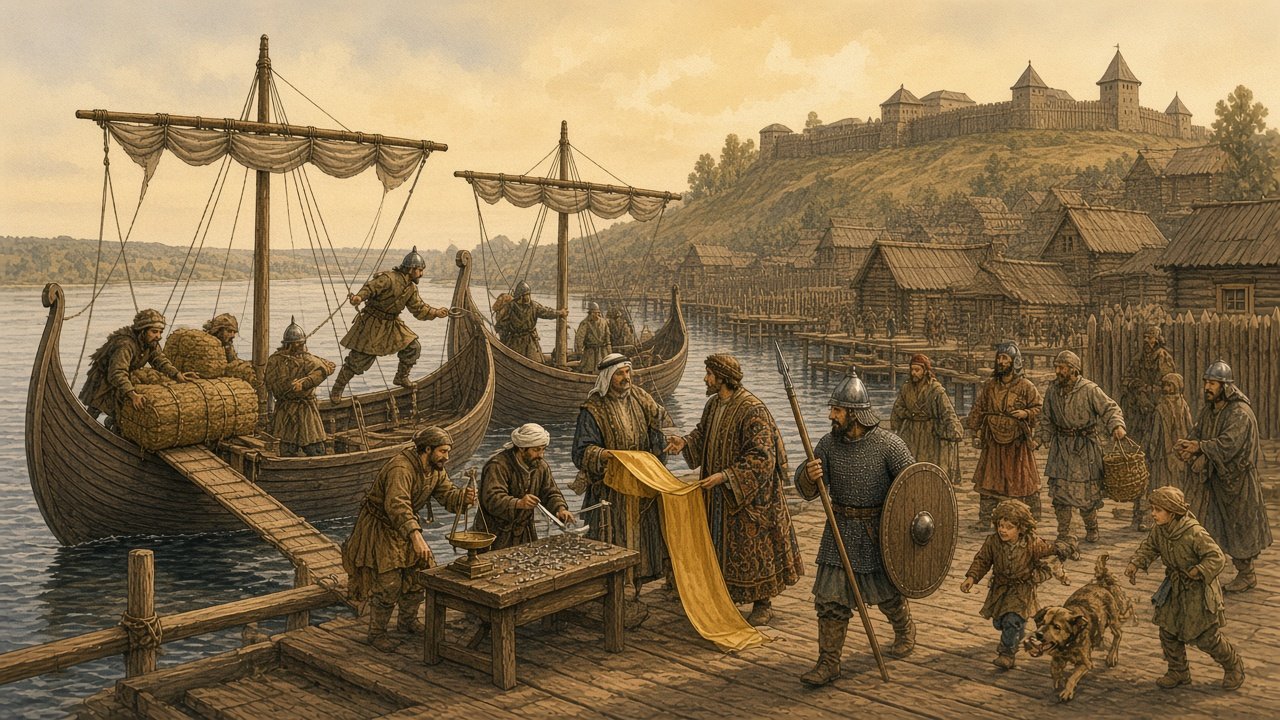
Between the middle of the eighth century and the end of the eleventh, men from Scandinavia travelled east across the Baltic and into the river systems of what are now Russia, Ukraine and Belarus. They came as traders, raiders, mercenaries and settlers, and they were known to their neighbours by several names: Rus’ to the Byzantines, Arabs and Slavs, Varangians in later Greek and Old East Slavic usage. Their journeys linked the forests of the north with the silver economies of the Abbasid caliphate and the markets of Constantinople, and the political structures they helped to create became the foundation of the medieval state known to historians as Kievan Rus’. This essay follows their routes, the sources that describe them and the long scholarly argument about what their presence meant.
Names and origins
The word Rus’ appears in Byzantine, Frankish and Arabic sources from the ninth century onward. Its most widely accepted derivation is from a Finnic name for Swedes, Ruotsi in modern Finnish and Rootsi in Estonian, which is itself thought to derive from an Old Norse root connected with rowing, as in róðr and the coastal district of Roslagen north of Stockholm. On this view, the term passed from Scandinavian crews to the Finnic peoples of the eastern Baltic, then to the Slavs, and finally to the Greeks and Arabs who met these travellers in the south.
The earliest dated reference that ties the name to Scandinavians comes from the Frankish Annals of Saint-Bertin. Under the year 839 the annals record that envoys of the Byzantine emperor Theophilos arrived at the court of Louis the Pious at Ingelheim, accompanied by men who called themselves Rhos and whose ruler bore a title rendered as chacanus. They wished to return home by a safer route than the one they had come by. Louis had them investigated and found that they were of the people of the Swedes, whom he suspected of being spies. The episode shows that by the 830s a group known as Rus’ had reached Constantinople, that its members were Scandinavian, and that its leader used a title borrowed from the Khazar steppe world.
The later term Varangian, Greek Varangoi and Old East Slavic Varyagi, probably derives from Old Norse væringi, a man bound by a pledge. It became common in the eleventh century, especially for Scandinavian mercenaries in Byzantine service, and the Russian chronicles use it for the Scandinavians from across the sea, as distinct from the Rus’ who by then had become a ruling group within the eastern Slavic lands. A general overview of the people and the usage is given in the Grokipedia entry on the Varangians.
Staraya Ladoga and the northern gateway
The entry point to the eastern routes lay at the south-eastern corner of the Gulf of Finland. Ships passed up the Neva into Lake Ladoga and then into the Volkhov, a river that flows north from Lake Ilmen. A few kilometres up the Volkhov stood the settlement now called Staraya Ladoga, Old Norse Aldeigjuborg. Tree-ring dating of its earliest timber buildings points to the 750s, which makes it one of the oldest trading settlements in the region. Excavations have uncovered a craft quarter with a smithy and workshops producing glass beads, combs and metalwork, together with Scandinavian tools, weights and ornaments alongside material from Finnic and Slavic communities.
Staraya Ladoga was not a purely Scandinavian town. Its population was mixed from the start, and the settlement depended on networks of Finnic hunters and trappers who supplied the furs that drew merchants into the region. The archaeological record suggests that Scandinavians came first for trade, especially for furs and for the silver that began to arrive from the east in the late eighth century, rather than for conquest. Over the following century such trading posts multiplied along the river routes.
Further south, near the point where the Volkhov leaves Lake Ilmen, lay a fortified site known as Rurikovo Gorodishche, which flourished from the mid ninth century and has produced abundant Scandinavian material. Novgorod itself, a short distance downstream, grew up around the 930s according to the dendrochronology of its earliest streets. In the following centuries it became one of the great commercial cities of northern Europe, and its waterlogged soil has preserved hundreds of birch-bark letters, mostly written in a local form of Old East Slavic, which illuminate daily life from the eleventh century onward.
The river routes
Two main systems carried traffic south from the Baltic region. The first, known to modern scholars as the Volga trade route, led from the upper Volkhov and Lake Ilmen by smaller rivers and overland portages to the upper Volga, and then down that great river through the lands of the Volga Bulgars and the Khazars to the Caspian Sea. From the Caspian shores, merchants could reach the markets of northern Iran and, by caravan, Baghdad. This route was the more important in the ninth and early tenth centuries, because it led directly to the source of the silver that underpinned the whole trade.
The second system, called in the Russian Primary Chronicle the route from the Varangians to the Greeks, ran from the Volkhov and Lake Ilmen up the Lovat, across portages to the upper Western Dvina and then to the upper Dnieper near Smolensk. From there boats descended the Dnieper past Kiev to the Black Sea, and followed the western coast of that sea to Constantinople. This route grew in significance in the tenth century, as political power in the eastern Slavic lands shifted to Kiev and as relations with Byzantium deepened.
Both routes required travellers to move their vessels across watersheds. Boats were dragged on rollers or carried over portages, sometimes for many kilometres. Large seagoing ships could not be used on such routes, and the craft employed in the east were mostly smaller vessels suited to rivers, including the dugout boats described by Byzantine writers. Along the portages and river junctions there grew up settlements such as Gnezdovo near Smolensk, where thousands of burial mounds include rich graves with Scandinavian weapons and jewellery, and Timerevo and Sarskoe near the upper Volga.
Silver, furs and slaves
The economic engine of the eastern routes was Islamic silver. From the late eighth century, silver coins known as dirhams, struck in the mints of the Abbasid caliphate and later of the Samanid emirate in Central Asia, flowed north in very large numbers. More than a thousand hoards containing dirhams have been found across eastern Europe and Scandinavia. The Baltic island of Gotland alone has produced well over a hundred thousand Islamic coins, more than the rest of Scandinavia combined, and individual hoards there contain thousands of pieces.
In the north the coins were valued chiefly as bullion. They were often cut into fragments and weighed on small folding balances, a practice reflected in the many fragments and test marks found in hoards. The flow of silver peaked in the first half of the tenth century, when Samanid coins from mints such as Samarkand and Tashkent dominated. It declined sharply in the late tenth century, probably as a result of the exhaustion of Central Asian silver mines and political turmoil within the Samanid state. Western European coins, especially German and English pennies, then became more common in northern hoards.
In return the northerners supplied goods prized in the south. Furs were foremost among them: sable, marten, beaver, fox and squirrel pelts from the northern forests were in demand across the Islamic world and Byzantium. Arabic geographers also list honey, wax, amber, swords and walrus ivory. The most troubling commodity was human beings. Arabic writers such as Ibn Rusta, writing in the early tenth century, state that the Rus’ raided the Slavs and sold their captives to the Khazars and Volga Bulgars. Slaves were a central part of the trade, and the treaties with Byzantium described below include clauses about the ransom and sale of captives.
The ninth-century geographer Ibn Khurradadhbih, a postmaster in the caliphal administration, gives one of the earliest accounts of Rus’ merchants. He describes them bringing furs and swords from the far north down to the Black Sea, where the Byzantine ruler took a tithe from them, and down the Volga to the Khazar capital, from which they crossed the Caspian and sometimes carried their goods by camel to Baghdad, where Slavic servants acted as their interpreters. This text shows that by the middle of the ninth century the network reached from the Baltic to Mesopotamia.
Khazars and Volga Bulgars
The Rus’ did not operate in an empty landscape. The lower Volga and the steppe between the Caspian and the Black Sea were dominated by the Khazars, a Turkic people whose khaganate controlled much of the region from the seventh to the tenth century. Their capital, Itil, stood near the Volga delta and served as a great market and toll station. The Khazar ruling elite adopted Judaism, probably in the late eighth or ninth century, while the wider population included Muslims, Christians and followers of traditional steppe religions. The Khazars levied a tenth on goods passing through their lands, and Rus’ traders had to deal with them to reach the Caspian.
Further up the Volga, near its confluence with the Kama, lay Volga Bulgaria. Its ruler was nominally subject to the Khazars until the early tenth century, when he sought support from the Abbasid caliph and accepted Islam. The Bulgar town of Bolghar became a major meeting place for Rus’ merchants, Finnic and Ugric fur suppliers, and Muslim traders from Khwarazm and beyond. Much of the silver that went north passed through these markets.
The title khagan used by the ruler of the Rus’ in 839 suggests that early Rus’ leaders modelled their status partly on Khazar practice. Relations between the two powers were a mixture of commerce, tribute and rivalry. In the 960s the Kievan prince Sviatoslav campaigned against the Khazars and sacked their main centres, an event that, together with pressure from other steppe peoples, brought about the collapse of the khaganate.
Ibn Fadlan on the Volga
The most vivid description of the Rus’ in any medieval source comes from Ahmad ibn Fadlan, a member of an embassy sent by the Abbasid caliph al-Muqtadir to the ruler of the Volga Bulgars. The embassy left Baghdad in June 921 and reached the Bulgar court in May 922. Its purpose was to instruct the Bulgar ruler, Almish, in Islamic law and to fund the building of a fortress and a mosque. Ibn Fadlan’s report, known in part through a manuscript discovered in Mashhad in the twentieth century and through extracts preserved by the geographer Yaqut, describes the peoples he met along the way.
Among them were the Rus’, who had come to the Bulgar market to trade. Ibn Fadlan describes them as tall and fair, and says that each man carried an axe, a sword and a knife. The women wore metal boxes on their breasts and necklaces of glass beads, which matches the paired oval brooches and bead strings found in Scandinavian women’s graves. He records their prayers to wooden idols for good trade and their offerings of food. He also comments, with evident disgust, on their washing habits, which offended his standards of ritual purity.
The best-known passage describes the funeral of a Rus’ chieftain. The dead man was placed in a temporary grave for ten days while his clothes were prepared. A slave girl volunteered to die with him. On the day of the funeral his ship was drawn up on land and set on a wooden platform, and his body was placed in it with weapons, food and sacrificed animals. After a series of rites the girl was killed by an old woman whom Ibn Fadlan calls the Angel of Death, and the ship was burned. A mound was raised over the ashes and a post inscribed with the dead man’s name was set on top. Ibn Fadlan reports a conversation with one of the Rus’, who told him that the Arabs were foolish to bury their dead in the earth, since burning sent the dead to paradise at once.
Historians treat this account with care. Ibn Fadlan observed a community far from its Scandinavian homeland and possibly already influenced by local customs, and he interpreted what he saw through his own cultural assumptions. Yet many details agree with archaeological evidence from Scandinavian and eastern burials, including cremation in boats, animal sacrifices and the presence of female companions in elite graves. The text remains an invaluable outside view of the Rus’ in the early tenth century.
The Caspian and the road to Baghdad
The Rus’ did not only trade with the Islamic world. They also raided it. The tenth-century historian al-Mas’udi describes a large expedition that, by his account, took place shortly after 912. A fleet of several hundred ships came down the Volga, with the permission of the Khazar ruler in return for a share of the plunder, and raided the coasts of the Caspian, including Gilan, Tabaristan and the oil-rich district near Baku. On their return the Rus’ were attacked by the Muslim guards of the Khazar ruler, and most of them were killed.
A second major attack, in 943 or 944, struck the city of Bardha’a in Caucasian Albania, in present-day Azerbaijan. The historian Miskawayh records that the Rus’ seized the town and held it for several months before disease and counterattacks forced them to withdraw. Earlier, smaller raids are reported on the southern Caspian coast in the ninth century. These campaigns show that the line between merchant and raider was thin, and that Rus’ groups could assemble substantial fleets when opportunities arose.
Commercial contact also continued over long distances. Arab writers describe Rus’ merchants as far south as Baghdad, and Islamic objects such as glass, silks and weights found in Scandinavian graves bear witness to these links. A small number of objects with Arabic inscriptions, including a ring from a woman’s grave at Birka in Sweden, have attracted much attention as material reminders of the connection.
The calling of the Varangians and the rise of Kiev
The traditional account of the founding of the Rus’ state is found in the Primary Chronicle, also called the Tale of Bygone Years, compiled in Kiev in the early twelfth century from earlier material. Under the year 862 it records that the Slavic and Finnic peoples of the north, having driven out Varangians who had taken tribute from them, fell into strife and decided to seek a prince to rule them. They sent across the sea to the Varangians called Rus’ and invited them, saying that their land was great and rich but lacked order. Three brothers came, and the eldest, Rurik, settled at Novgorod or, in some versions, Ladoga.
The chronicle continues that two of Rurik’s men, Askold and Dir, went south and took control of Kiev, a settlement on the middle Dnieper that had paid tribute to the Khazars. After Rurik’s death his kinsman Oleg is said to have taken Kiev in 882, killed Askold and Dir, and made the town his capital, describing it as the mother of the Rus’ towns. Oleg then imposed tribute on neighbouring Slavic tribes. His successor Igor, presented as Rurik’s son, ruled until he was killed by the Drevlians while collecting tribute in about 945. Igor’s widow Olga then ruled as regent for their son Sviatoslav.
The chronicle’s dates for the ninth century are not reliable. They were worked out much later, partly from Byzantine chronologies, and the story of the invitation follows a literary pattern known from other foundation legends. The account nonetheless reflects a real process. Scandinavian leaders and their followers established themselves as a ruling elite among the Slavic and Finnic populations of the forest zone, collected tribute in furs and slaves, and gradually moved their centre of power south to the Dnieper, where they could control the route to Byzantium. The general history of this state is outlined in the Grokipedia entry on Kievan Rus’.
Raids and treaties with Constantinople
The first recorded Rus’ attack on Constantinople took place on 18 June 860. A fleet of about two hundred ships, according to some sources, appeared without warning while the emperor Michael III was campaigning in Asia Minor. The attackers plundered the suburbs and the islands of the Sea of Marmara before withdrawing. The patriarch Photios preached two homilies in response, describing the terror of the inhabitants and the sudden appearance of an unknown people from the north. The Grokipedia entry on the siege of 860 summarises the event and its sources. Photios later reported that the Rus’ had sent envoys and accepted a bishop, an early and short-lived Byzantine mission.
The Primary Chronicle places a great campaign by Oleg against Constantinople in 907. In its account Oleg led a huge fleet, put his ships on wheels to sail them overland towards the city, and forced the Greeks to pay tribute and grant trading privileges. No Byzantine source mentions this campaign, and many historians regard its narrative as largely legendary, though some form of conflict or show of force may lie behind it. The chronicle also preserves the text of a treaty dated 911, which most scholars accept as authentic because its language and legal content reflect Byzantine diplomatic practice. The treaty regulated the treatment of Rus’ merchants in Constantinople, the settlement of disputes, inheritance, the ransom of captives and the service of Rus’ men in the Byzantine army. Its Rus’ signatories bear Scandinavian names such as Karl, Farulf, Vermund and Steinvith.
In 941 Igor launched a major attack on Constantinople. Byzantine sources, including the chronicle tradition known as Theophanes Continuatus and the account of the Italian envoy Liudprand of Cremona, describe how the Rus’ fleet was met by a small Byzantine squadron armed with Greek fire, the incendiary liquid that the Byzantines projected from siphons. Many Rus’ ships were burned, and the survivors who raided the coast of Bithynia were defeated by Byzantine land forces. In 944 Igor organised another expedition, this time with Pecheneg allies. The Byzantines sent envoys to meet him before he reached the capital and offered payment, and a new treaty was concluded. Its text, preserved in the chronicle, is less favourable to the Rus’ than that of 911. It includes rules on the number of merchants allowed in the city, their residence in the suburb of Saint Mamas, and the obligations of the Rus’ to defend Byzantine interests in the Crimea.
These treaties show the Rus’ moving from raiders to a recognised partner of the empire. Trade in Constantinople became regular, Rus’ merchants obtained silk and other luxury goods, and Rus’ warriors began to serve in Byzantine campaigns. The pattern of conflict followed by negotiation continued into the reign of Sviatoslav, whose campaigns in Bulgaria in the late 960s and early 970s brought him into war with the emperor John Tzimiskes. Defeated in 971, Sviatoslav was killed by the Pechenegs at the Dnieper rapids on his way home in 972.
The rapids in Constantine Porphyrogenitus
The most detailed Byzantine description of the Rus’ comes from the emperor Constantine VII Porphyrogenitus, who reigned from 913 to 959 and compiled a manual of foreign policy for his son, known since the seventeenth century as De Administrando Imperio. Written around 950, its ninth chapter describes how the Rus’ came down to Constantinople each year.
According to Constantine, the Slavic tributaries of the Rus’ cut dugout boats, which he calls monoxyla, during the winter in the forests of the upper Dnieper basin. In the spring they brought them down to Kiev, where the Rus’ bought them and fitted them with oars, rowlocks and other tackle taken from their old boats. In June they set off down the Dnieper, gathering first at a fortress near Vitichev. The most dangerous part of the journey was the series of rapids below the modern city of Dnipro, where granite outcrops crossed the river for more than sixty kilometres. These rapids were flooded in the twentieth century by the construction of the Dnieper hydroelectric dam.
Constantine gives the names of the rapids in two forms, which he calls Rus’ and Slavic. The Rus’ names are generally recognised as Old Norse. The first rapid was called Essoupi, explained as meaning do not sleep. The second was Oulvorsi in Rus’ and Ostrovouniprach in Slavic, explained as the island of the rapid. The third was Gelandri, meaning the noise of the rapid. The fourth and largest was Aeifor in Rus’ and Neasit in Slavic, so called because pelicans nested on its rocks. The others were Varouforos, Leanti and Strukun, with their Slavic counterparts. Scholars have proposed Norse etymologies for most of the Rus’ forms, such as Gellandi, the yelling one, and Eyforr, the ever-rushing. The double list is among the strongest pieces of evidence that the people Constantine called Rus’ still spoke a Scandinavian language in the mid tenth century, while their subjects spoke Slavic.
Constantine describes how at some rapids the crews unloaded the boats and guided them through the shallows on foot, feeling with their feet for the rocks. At the fourth rapid they took the boats out of the water and carried or dragged them for several kilometres, while some of the men stood guard against the Pechenegs, the steppe nomads who often attacked them there. Slaves in chains were led along the bank. Below the rapids, at the crossing called Krarion, the Pechenegs had another opportunity to strike. The travellers then reached an island in the river, identified with Khortytsia, where they made sacrifices of live birds beneath a great oak and cast lots over them. After a stop at the mouth of the Dnieper they sailed along the Black Sea coast to Constantinople. The chapter ends with an account of the winter tribute circuit, called poliudie, in which the Rus’ princes left Kiev in November to collect tribute from the Slavic tribes and returned in April.
Runestones and the eastern journeys
In Scandinavia, the eastern journeys left traces in stone. Of the roughly three thousand runestones known from Sweden, many from the late tenth and eleventh centuries commemorate men who travelled or died in the east. They mention Garðar, the Norse name for the lands of the Rus’, and Holmgarðr, the name for Novgorod. Others refer to Greece, meaning the Byzantine Empire, and some to men who served there.
The largest coherent group is that of the Ingvar runestones, around twenty-six stones raised mainly around Lake Mälaren in central Sweden. They commemorate men who took part in an expedition led by a chieftain named Ingvar to Serkland, a Norse name for the lands of the Muslims, probably around the Caspian. One well-known stone at Gripsholm, raised by a mother for her son Harald, Ingvar’s brother, records that they travelled far for gold and in the east fed the eagle, and died in the south in Serkland. An Icelandic saga, Yngvars saga víðförla, dates Ingvar’s death to 1041, and most scholars place the expedition around 1036 to 1041. The stones show that the eastern routes still carried large Scandinavian enterprises in the eleventh century, though the expedition seems to have ended in disaster.
Runic inscriptions have also been found within the eastern lands themselves, including short texts on objects from Staraya Ladoga, Novgorod and Gnezdovo. A runic inscription carved on the marble lion that once stood at the port of Piraeus near Athens, now in Venice, is usually attributed to Scandinavian mercenaries in Byzantine service, though it is badly worn and its reading remains uncertain.
The Varangian Guard
Scandinavian and Rus’ warriors had served Byzantium since at least the early tenth century, as the treaty of 911 anticipated. A more permanent arrangement arose in 988, when the emperor Basil II faced a dangerous rebellion led by the general Bardas Phokas. Basil turned to the Kievan prince Vladimir, who sent a force of about six thousand warriors. In return Basil agreed to give his sister Anna in marriage to Vladimir, on condition that Vladimir accepted baptism. The Rus’ troops helped Basil defeat the rebels at Chrysopolis in 988 and Abydos in 989.
From this force developed the Varangian Guard, an elite unit attached to the emperor’s person. Its members were noted for their loyalty, their heavy axes and their pay, which was generous enough to attract recruits from across Scandinavia. The most famous of them was Harald Sigurdsson, later king of Norway and known as Harald Hardrada, who served in the Guard in the 1030s and early 1040s, campaigned in Sicily and the eastern Mediterranean, and returned north with great wealth before dying at Stamford Bridge in England in 1066. In the later eleventh century, after the Norman conquest of England, many English warriors joined the Guard, and over time its character became more Anglo-Saxon than Scandinavian. The unit survived in some form until the late Byzantine period.
The conversion of Vladimir
The religious culture of the early Rus’ rulers was diverse. The treaty of 944 refers to both baptised and unbaptised Rus’, the former swearing in a church and the latter by their weapons and the god Perun. Igor’s widow Olga was baptised, probably in Constantinople in the mid 950s, and Constantine Porphyrogenitus describes her reception at his court. Her son Sviatoslav, however, refused to convert, saying according to the chronicle that his retinue would mock him.
Sviatoslav’s son Vladimir came to power in Kiev around 978 after a struggle with his brothers, in which he relied on Varangian troops hired from Scandinavia. At first he promoted a pantheon of pagan gods, setting up idols of Perun and other deities on a hill in Kiev. The Primary Chronicle then tells a story in which Vladimir received envoys from the Volga Bulgars, the Khazars, the Germans and the Greeks, each recommending their faith, and sent his own men to observe their worship. They were said to have been overwhelmed by the beauty of the liturgy in the church of Hagia Sophia in Constantinople. This story is a literary construction, but it reflects a real choice among the religious options available to a ruler positioned between Islam, Judaism, Latin Christianity and Byzantine Orthodoxy.
The decisive context was political. Vladimir’s alliance with Basil II, his military aid and his marriage to Anna, a princess born in the purple whose hand had been refused to Western rulers, bound him to Byzantium. Vladimir was baptised, probably in 988, though the place and exact date are disputed; the chronicle sets it at Chersonesos in the Crimea, which Vladimir had captured. On his return to Kiev he ordered the destruction of the pagan idols and the baptism of the people of the city in the Dnieper. Clergy came from Byzantium, churches were built, and a metropolitan see was established at Kiev under the patriarch of Constantinople. The Grokipedia entry on the Christianisation of Kievan Rus’ describes the process, which took generations to reach the countryside.
Conversion brought with it a written culture in Church Slavonic, the literary language created in the ninth century for the Slavs and developed in Bulgaria. It also brought Byzantine art, architecture and law. The great church of Saint Sophia in Kiev, begun under Vladimir’s son Yaroslav the Wise in the 1030s, and the church of the same name in Novgorod, built in the 1040s and 1050s, express the new orientation of the Rus’ elite towards Constantinople.
Slavicisation
The Scandinavian identity of the Rus’ rulers faded over the tenth and eleventh centuries. The names of the princes illustrate the change. Rurik, Oleg and Igor are Slavic forms of the Norse names Hrørekr, Helgi and Ingvarr, and Olga corresponds to Helga. Sviatoslav, born in the early 940s, was the first ruler of the dynasty to bear a Slavic name, and his descendants were known as Vladimir, Yaroslav, Mstislav and Vsevolod. The signatories of the treaty of 944 still include many Scandinavian names, but such names become rare among the ruling family thereafter.
Language followed the same path. The Rus’ names of the Dnieper rapids show that a Scandinavian language was still spoken in the mid tenth century, but by the eleventh century the princes and their retinues spoke Slavic, used Church Slavonic in writing and worship, and saw themselves as rulers of the Rus’ land rather than as Scandinavians abroad. Scandinavian influence on the language of Rus’ was slight, limited to a small number of loanwords in areas such as trade and seafaring. Ties with the Scandinavian world nevertheless remained strong. Yaroslav the Wise married Ingegerd, daughter of the Swedish king Olof Skötkonung, and gave refuge to exiled Scandinavian princes, including Olaf of Norway and his half-brother Harald. Scandinavian mercenaries continued to serve Kievan princes into the eleventh century.
Archaeology shows a similar pattern. Scandinavian-style burials and objects are common in the ninth and tenth centuries at sites such as Gnezdovo, Timerevo and Staraya Ladoga, but they decline in the eleventh century as Christian burial practices spread and local material culture absorbs the earlier styles. The ruling group had become part of the population it governed.
The Normanist debate
The question of who the Rus’ were has long been entangled with politics. In the eighteenth century, German scholars working at the Russian Academy of Sciences, notably Gottlieb Siegfried Bayer and Gerhard Friedrich Müller, argued from the chronicle and foreign sources that the founders of the Russian state were Scandinavians. Their view became known as Normanism. It provoked a sharp reaction from Mikhail Lomonosov and others, who saw it as an insult to Russian national dignity and argued that the Rus’ were Slavs or came from some other non-Scandinavian people.
The debate continued through the nineteenth century and took on an ideological character in the Soviet period. Soviet historiography, especially from the 1930s to the 1950s, generally insisted that the eastern Slavs had created their own state through internal social and economic development, and treated emphasis on Scandinavian origins as a foreign and politically hostile thesis. Some scholars proposed derivations of the name Rus’ from the river Ros’ near Kiev or from other local sources.
Since the later twentieth century, and especially after the opening of archaeological and scholarly exchange across the Baltic, most historians and archaeologists have reached a broad consensus that sits between the extreme positions. The evidence of the Annals of Saint-Bertin, the Byzantine rapids names, the Scandinavian names in the treaties, the runestones and the abundant Scandinavian material at sites along the river routes makes it clear that the people originally called Rus’ were largely of Scandinavian origin. At the same time, the state that grew up around Kiev rested on Slavic, Finnic and Baltic populations, on long-standing networks of exchange and on the influence of the Khazars and Byzantium. Its rulers were a small Scandinavian elite who quickly adopted the language and customs of their subjects. The debate has shifted from the question of origins to questions about the nature of the interaction between these groups and the processes by which a mixed society became the Christian, Slavic-speaking world of medieval Rus’.
A connected world
The eastern routes of the Viking Age joined regions that are often studied separately. A beaver pelt trapped in the forests north of the Volga might be traded at Bolghar for silver struck in Samarkand, and the coins might end their journey in a hoard on Gotland. A warrior from the Mälaren valley might fight for a Kievan prince, serve the Byzantine emperor and be commemorated by a runestone at home. The written sources that describe these journeys come from Baghdad, Constantinople, Kiev and the Frankish court, and each saw the Rus’ from its own vantage point.
Taken together with the archaeological record, these sources show a society formed by movement and exchange. The Rus’ began as traders and raiders operating along the rivers, became rulers of a large territory, entered into treaties with the greatest power of the Christian world and adopted its faith, and within a few generations became part of the Slavic world they had entered. Their history belongs at once to Scandinavia, to eastern Europe, to Byzantium and to the Islamic world.