The Jingnan Campaign, the Usurpation of Zhu Di and the Move to Beijing
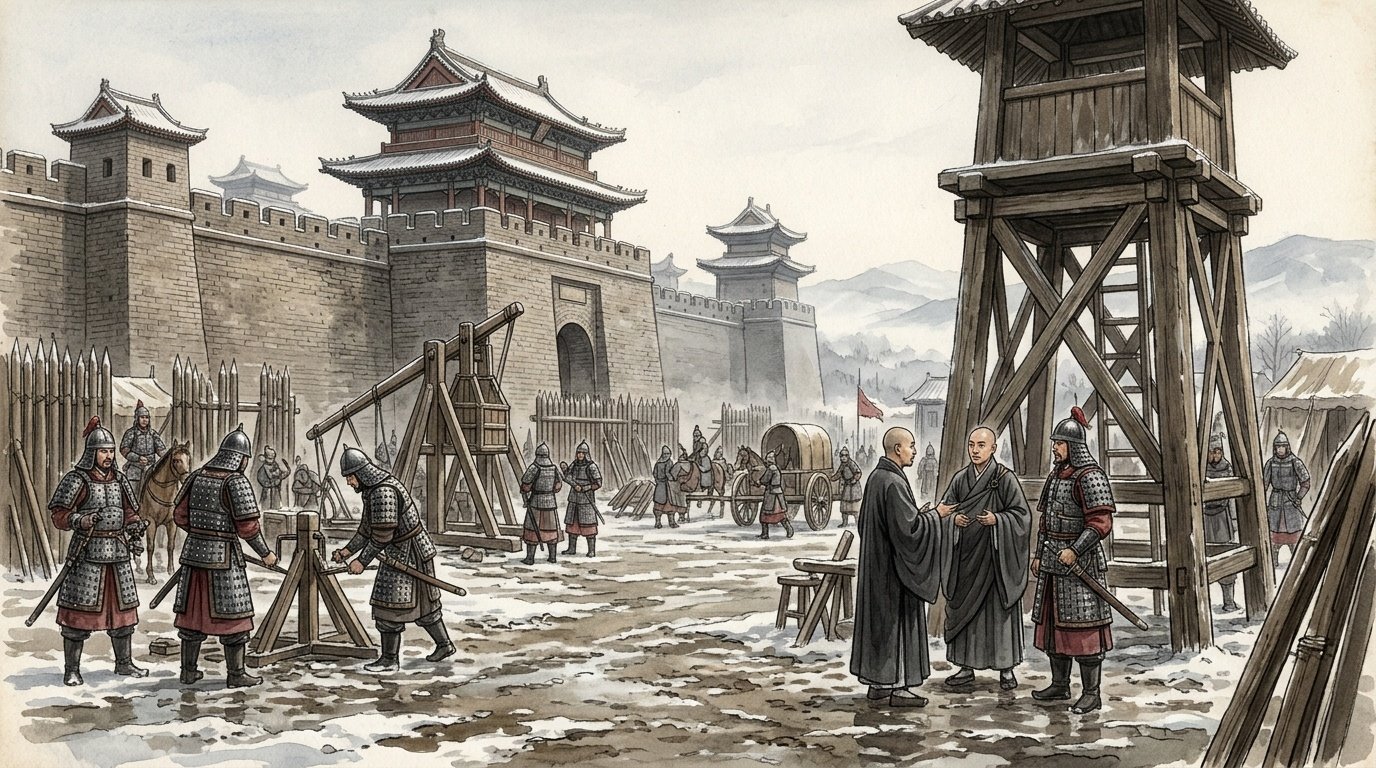
In the suffocating summer heat of the thirteenth day of the sixth lunar month in the fourth year of the Jianwen era (July 13, 1402 CE), towering columns of pitch-black smoke billowed above the glazed yellow roofs of the Forbidden Palace in Nanjing (南京), blotting out the midday sun. Outside the Jinchuan Gate (金川门), the heavy northern cavalry of the Prince of Yan (燕王), Zhu Di (朱棣, 1360–1424 CE), trotted through the opened portals without firing an arrow, greeted by imperial defectors prostrating in the dust. Inside the imperial precincts, the great palace hall of the twenty-five-year-old sovereign, the Jianwen Emperor (建文帝, Zhu Yunwen, r. 1398–1402 CE), was an incandescent roaring furnace. When the flames finally burned down to glowing embers, imperial guards retrieved three charred, unrecognizable corpses, purported to be the young emperor, his empress Lady Ma, and his eldest son.
Yet even as the ashes were being shoveled into an unmarked grave, whispers spread like wildfire through the streets of the capital: the Jianwen Emperor was not dead. Rumors maintained that in the final hours of the siege, the young monarch had unlocked an iron chest left behind by his grandfather, the dynastic founder Zhu Yuanzhang (the Hongwu Emperor). Inside lay a Buddhist monk’s begging bowl, a razor, three ordination certificates, and a map of a secret subterranean drainage tunnel. Shaving his head and donning patched ascetic robes, the Son of Heaven had slipped through the palace foundations into the swirling currents of the Yangtze, vanishing into the mist-shrouded mountain monasteries of Yunnan and Guizhou to live out his days as a wandering Buddhist mendicant.
Whether Jianwen perished in the flames or survived as a phantom monk, his destruction marked the climax of the Jingnan Campaign (靖难之役, Jingnan zhi Yi, 1399–1402 CE)—the only successful full-scale military rebellion launched by a regional prince against an entrenched central imperial court in all of Chinese history. For four agonizing years, the newly established Ming Dynasty was ripped apart by a fratricidal civil war pitting uncle against nephew. Over half a million soldiers died across the river plains of Hebei, Shandong, and Jiangsu in battles of primeval fury.
Upon the smoking ruins of Nanjing, Zhu Di ascended the Dragon Throne as the Yongle Emperor (永乐帝, r. 1402–1424 CE, temple name Ming Chengzu 明成祖). To legitimize his bloody usurpation, Yongle unleashed a terrifying reign of terror: he invented the horrific penalty of ‘Exterminating the Ten Generations’ (诛十族) to slaughter the great Confucian moralist Fang Xiaoru, massacred thousands of Jianwen loyalists, systematically erased the four years of Jianwen’s reign from the historical record, and ordered official state chronicles to be rewritten three times to claim he was the legitimate son of Empress Ma. Yet Yongle also transformed China into the greatest superpower on earth: he ordered the construction of the monumental Forbidden City (紫禁城) in Beijing, relocated the imperial capital northward to establish the principle of ‘The Emperor Guards the Border Gates’ (天子守国门), dug the Grand Canal, launched the oceanic voyages of Admiral Zheng He (郑和) to the Indian Ocean and Africa, and personally led five massive cavalry expeditions deep into the Mongolian steppe.
This monograph provides an exhaustive military, institutional, and psychological investigation of the Jingnan Campaign and the usurpation of Zhu Di. We will analyze the fatal constitutional flaw in Zhu Yuanzhang’s feudal princely system; trace the idealistic, aggressive ‘Pruning of the Fiefs’ (削藩, Xiao Fan) executed by Jianwen’s Confucian ministers; follow Zhu Di as he feigned madness in Beijing while manufacturing weapons in subterranean duck ponds; examine the four years of tactical maneuvering that pitted northern veteran cavalry against southern imperial manpower; dissect the turning-point decision by the Buddhist strategist Yao Guangxiao to bypass fortified cities and march directly on Nanjing; chronicle the apocalyptic fall of Nanjing and the legendary martyrdom of Fang Xiaoru; and evaluate the profound geopolitical legacy of moving the imperial capital from the wealthy Yangtze delta to the northern frontier.
1. The Founder’s Fatal Design: Zhu Yuanzhang’s Feudal Paradox
The origins of the Jingnan civil war lay in the profound, unresolved paranoia of the Ming dynasty founder, Zhu Yuanzhang (Ming Taizu, Hongwu Emperor, r. 1368–1398 CE). Having risen from an impoverished, starving peasant orphan to drive the Mongols out of China, Zhu Yuanzhang was consumed by two obsessive terrors: the fear that civil ministers and ambitious military generals would stage a palace coup, and the fear that the nomadic Mongols would sweep south from the steppe to reconquer the Central Plains.
To neutralize the threat of domestic military warlordism, Zhu Yuanzhang ruthlessly purged the veteran founding generals of the dynasty. In the bloody purges surrounding Chancellor Hu Weiyong (1380 CE) and General Lan Yu (1393 CE), Taizu executed over forty-five thousand military commanders, bureaucrats, and their extended lineages, systematically wiping out the entire first generation of military leadership that had built the empire.
To fill this military vacuum and secure the frontiers, Zhu Yuanzhang resurrected an ancient, dangerous institutional model that every major Chinese dynasty had previously rejected: Princely Feudal Enfeoffment (分封制, Fenfeng Zhi). Zhu Yuanzhang enfeoffed twenty-four of his biological sons and one grand-nephew as hereditary Princes of the Realm (藩王, Fanwang), granting them vast territorial estates, lavish tax revenues, and independent military commands. Crucially, the nine princes stationed along the northern Great Wall—known as the Border Defense Princes (塞王, Saiwang)—commanded elite frontier armies numbering between thirty thousand and one hundred thousand veteran troops, equipped with heavy cavalry and artillery to repel Mongol raids.
Foremost among these border princes was his fourth son: Zhu Di, the Prince of Yan (燕王). Stationed at Beiping (modern Beijing), the former Mongol capital of Dadu, Zhu Di was a military genius of terrifying courage, boundless ambition, and physical endurance. From his youth, Zhu Di lived in saddle-leather, riding alongside veteran generals like Xu Da and Lan Yu on punitive expeditions into the Gobi Desert. He mastered nomadic cavalry tactics, earned the fanatical loyalty of northern garrison troops, and absorbed thousands of elite surrendered Mongol horsemen into his personal guard corps (the Duo’an and Fuyu guards). In physical stature, martial ferocity, and autocratic will, Zhu Di was the spitting image of his formidable father.
Zhu Yuanzhang believed that blood ties would ensure eternal dynastic stability. In his sacred dynastic constitution, the Ancestral Injunctions of the Great Ming (皇明祖训, Huang Ming Zu Xun), Taizu codified the absolute autonomy of the princely houses, warning future emperors never to alter their privileges. Even more dangerously, Taizu included a fateful clause that would serve as Zhu Di’s legal battle-cry:
「朝无正臣,内有奸恶,必训兵讨之,以清君侧。」
— Zhu Yuanzhang (Ming Taizu), Huang Ming Zu Xun (皇明祖训)
‘If the imperial court lacks righteous ministers, and treacherous, evil men fester within the palace, the Feudal Princes must train their troops and march forth to chastise them, in order to cleanse the sovereign’s side!’
Yet this feudal architecture rested upon a fragile assumption: that the imperial line would always be headed by a strong, universally respected sovereign. In 1392 CE, that assumption shattered when the beloved Crown Prince Zhu Biao (朱标)—Zhu Di’s gentle, elder brother—died suddenly of illness at the age of thirty-six. Rather than choosing one of his capable, battle-tested adult sons like Zhu Di, the aging Zhu Yuanzhang adhered strictly to Confucian primogeniture, designating Zhu Biao’s sixteen-year-old eldest surviving son, Zhu Yunwen (朱允炆), as the new Crown Grandson. When Zhu Yuanzhang died in 1398 CE, the twenty-one-year-old youth ascended the throne as the Jianwen Emperor. A gentle, naive Confucian scholar sat in Nanjing, while nine hardened, battle-tested warrior-uncles encircled his realm with massive armies.
2. The Fatal Provocation: Jianwen’s Xiao Fan and the Suicide of Uncles
Upon taking the throne in Nanjing, the young Jianwen Emperor was surrounded by a close-knit triumvirate of idealistic Confucian scholar-bureaucrats: Minister of War Qi Tai (齐泰), Grand Academician Huang Zicheng (黄子澄), and the celebrated moral philosopher Fang Xiaoru (方孝孺). Steeped in the high moral antiquity of the Rites of Zhou, these men possessed an absolute horror of feudal fragmentation. They looked back upon the Rebellion of the Seven States in the Han Dynasty and the Disaster of the Eight Princes in the Western Jin, warning the young monarch that unless the princely fiefs were broken immediately, the central imperial government would be reduced to a powerless puppet.
In the autumn of 1398 CE, Jianwen and his ministers launched an aggressive, uncompromising policy of ‘Pruning the Fiefs’ (削藩, Xiao Fan). Yet rather than striking first at the strongest and most dangerous target—the Prince of Yan in Beiping—Huang Zicheng advised an amateurish, gradualist strategy: eliminate the weaker, smaller princes first to isolate Zhu Di. What followed was a campaign of ruthless, terrifying imperial aggression against the Emperor’s own blood uncles:
- The Prince of Zhou (Zhu Su): Stationed at Kaifeng, Zhu Di’s full biological brother was falsely accused of treason by imperial spies, surrounded by imperial troops, stripped of his noble titles, and banished to the malaria-ridden tropical wastes of Yunnan.
- The Prince of Qi (Zhu Fu) and Prince of Dai (Zhu Gui): Demoted to commoners and placed under strict house arrest in Nanjing.
- The Prince of Min (Zhu Pian): Stripped of his fief in Yunnan and imprisoned.
- The Tragedy of the Prince of Xiang (Zhu Bo): Stationed at Jingzhou (Hubei), the proud, thirty-year-old Prince of Xiang was surrounded by imperial shock troops. Refusing to endure the public humiliation of chains, Zhu Bo gathered his primary wife, concubines, and children inside his palace hall, set the palace ablaze with oil, and leaped into the inferno, burning his entire family to death while crying out to Heaven that he was innocent of treason.
Within less than a year, five imperial princes had been violently destroyed by their nephew. The suicides and arrests sent shockwaves of fury and terror through the remaining princely houses. Every surviving uncle realized that submission meant prison or death. In Beiping, Zhu Di knew with absolute mathematical certainty that the executioner’s axe was hovering over his own neck.
3. Feigning Madness and Underground Anvils: Zhu Di’s Great Deception
In the spring of 1399 CE, imperial agents and secret police dispatched by Qi Tai surrounded the Yan princely palace in Beiping. Imperial troops under Generals Zhang Xin and Xie Gui occupied the city gates, waiting for the imperial decree to execute Zhu Di. Caught in an existential vice, Zhu Di executed one of the most brilliant, psychological deceptions in Chinese history: feigning total mental madness (阳狂, Yang Kuang).
In the sweltering heat of June, Zhu Di roamed the crowded streets of Beiping clad in heavy sheepskin furs, unkempt hair matting his shoulders, screaming incoherently at street dogs, seizing food from street beggars, and falling into muddy ditches. When imperial inspectors visited his palace to verify his condition, they found the Prince of Yan lying shivering upon a dirt floor beside a roaring brazier, muttering wild incantations, drooling, and chewing upon clumps of earth and raw pork. Convinced that the fearsome warrior-prince had been permanently broken by psychological collapse, the imperial inspectors lowered their guard.
Yet deep beneath the Yan palace, an astonishing industrial conspiracy of war was underway. The mastermind of this conspiracy was Zhu Di’s supreme spiritual and strategic advisor: an enigmatic, brilliant Buddhist monk named Yao Guangxiao (姚广孝, 1335–1418 CE, monastic name Daoyan 道衍). Possessing triangular eyes like a hunting hawk and a deep mastery of military strategy and Yin-Yang cosmology, Yao Guangxiao had whispered to Zhu Di years earlier: ‘I can place a white hat upon Your Highness’s head’—a brilliant Chinese ideographic riddle, as placing the character for ‘white’ (白) atop the character for ‘prince’ (王) formed the character for ‘Emperor’ (皇).
Under Yao Guangxiao’s direction, the conspirators constructed a massive subterranean armory beneath the princely palace. Hundreds of blacksmiths labored day and night, forging swords, lances, crossbows, and iron armor. To drown out the clanging of hammers against anvils, Yao Guangxiao ordered thousands of geese, ducks, and chickens to be housed in pens directly above the underground workshops, creating a deafening, continuous cacophony of quacking and squawking that masked the sound of weapons manufacturing from imperial street patrols.
On the fifth day of the seventh lunar month in 1399 CE (August 6), the trap was sprung. The imperial court issued the secret order to arrest Zhu Di. Yet the imperial garrison commander, General Zhang Xin, was secretly loyal to the Prince. Rushing into the palace, Zhang Xin fell to his knees and warned Zhu Di that imperial troops were marching on the gates. Zhu Di immediately rose from his bed of sickness, combed his hair, strapped on his polished iron armor, and summoned his elite household guards. Feigning a summons to examine his medical condition, Zhu Di invited the two lead imperial inquisitors—Xie Gui and Zhang Bing—into the palace courtyard. The moment they stepped inside, Zhu Di’s ambushers sprang from behind silk screens, severing their heads with broadswords. Zhu Di then rode through the streets of Beiping at the head of eight hundred elite cavalrymen, storming the nine city gates in a single night. Beiping was his.
4. Quelling the Troubles: The Battle Cry of the Jingnan Rebellion (1399 CE)
Having taken Beiping, Zhu Di faced a terrifying strategic imbalance. The central imperial government in Nanjing controlled thirty times more territory, twenty times more tax revenue, and a standing army of over one million soldiers. Zhu Di possessed barely a single northern city and approximately thirty thousand troops.
To overcome this staggering deficit, Zhu Di launched a masterclass in psychological and ideological warfare. He refused to declare himself an independent sovereign or a rebel. Instead, he framed his military insurrection strictly within the sacred constitutional bounds of Zhu Yuanzhang’s Ancestral Injunctions, declaring that he was launching a righteous campaign of Jingnan (靖难, ‘Pacifying the Dynastic Troubles’):
「予太祖高皇帝第四子也。奸臣齐泰、黄子澄等,包藏祸心,专权乱政,构陷诸王。臣奉皇考《祖训》,不得已起兵,以靖国难,清君侧!」
— Zhu Di (Prince of Yan), Manifesto of the Jingnan Expedition, 1399 CE
‘I am the fourth son of the Grand Ancestor, the High Emperor Taizu! Treacherous ministers Qi Tai and Huang Zicheng harbor villainous intentions, monopolize power, throw the administration into chaos, and frame the imperial princes!
I obey the Ancestral Injunctions of my imperial late father; compelled by duty, I raise troops to quell the dynastic troubles and cleanse the sovereign’s side!’
By declaring that his war was not against the young Jianwen Emperor, but against the ‘treacherous ministers’ Qi Tai and Huang Zicheng, Zhu Di created a brilliant ideological umbrella. It allowed wavering imperial generals to surrender without technically committing treason against the Ming Dynasty; they were merely helping the Emperor’s uncle ‘cleanse the court.’
Simultaneously, the gentle Jianwen Emperor handed Zhu Di a supreme military advantage by issuing an astonishing, fatal order to his frontline commanders:
「毋使朕负杀叔父名!」
— Jianwen Emperor (建文帝), secret order to imperial field generals, 1399 CE
‘Do not cause me to bear the dark name of having slain my own uncle!’
This single sentence paralyzed imperial field tactics for four years. In battle after battle, Zhu Di exploited this royal immunity with brazen, reckless courage. Wearing distinctive white feathers in his helmet and riding a giant black stallion, Zhu Di personally led cavalry shock charges directly into the teeth of imperial crossbow lines. Imperial archers and artillerymen hesitated to shoot, terrified that if their arrow struck the Prince of Yan, the Emperor would have them executed for regicide. Zhu Di charged with absolute impunity, turning the battlefield into his personal theater.
5. The Four-Year War of Attrition: Iron Cavalry vs. Imperial Mass (1399–1401 CE)
Between 1399 and 1401 CE, the Jingnan war raged across the blood-soaked plains of Hebei and Shandong in a grueling war of attrition. In Nanjing, the Jianwen court initially dispatched the veteran sixty-five-year-old general Geng Bingwen (耿炳文)—one of the few surviving founding generals—at the head of 130,000 imperial troops. At the Battle of Zhending (August 1399), Zhu Di executed a brilliant night raid, smashing the imperial camp and inflicting thirty thousand casualties. Yet rather than trusting the defensive fortress strategy Geng Bingwen subsequently adopted, Jianwen panicked and replaced him with the worst possible commander: Li Jinglong (李景隆, Duke of Cao).
Li Jinglong was the son of the great founding marshal Li Wenzhong. Handsome, aristocratic, and possessing grand rhetoric, Li Jinglong knew everything about military theory on paper and absolutely nothing about battlefield reality. He was a disastrous military incompetent. In the autumn of 1399 CE, while Zhu Di was campaigning in the northeast to seize the elite cavalry of the Prince of Ning at Daning, Li Jinglong marched an enormous imperial army of five hundred thousand soldiers to besiege Beiping. The city was defended only by Zhu Di’s eldest son, the obese but iron-willed Zhu Gaochi (later the Hongxi Emperor), and Monk Yao Guangxiao.
Li Jinglong’s massive assault was a farce. In the freezing winter cold, the defenders of Beiping poured water down the brick city walls each night; by dawn, the ramparts were encased in a smooth, sheet-ice glaze, causing imperial scaling ladders to slide harmlessly off the walls. When Zhu Di returned with eighty thousand veteran cavalry, he crushed Li Jinglong’s freezing, demoralized army outside the city, forcing the imperial duke to abandon his baggage trains and flee south in disgrace.
In the spring of 1400 CE, Li Jinglong rallied another colossal imperial host of six hundred thousand troops at the Battle of the Baigou River (白沟河之战) in Hebei. In hours of primeval slaughter, Zhu Di’s vanguard was battered and surrounded. Three of Zhu Di’s horses were shot dead from under him; his quiver was empty, and his sword was notched like a saw. Just as imperial victory seemed certain, an unnatural meteorological miracle altered the course of Chinese history: a violent whirlwind suddenly roared across the river, snapping Li Jinglong’s massive imperial command standard in twain! Convinced that the broken flag was an omen that Heaven had abandoned the Emperor, the imperial lines dissolved in superstitious panic. Zhu Di seized the moment, set the dry reeds of the riverbank ablaze, and led his armored shock cavalry in a ferocious counter-charge. Over one hundred thousand imperial soldiers were slaughtered or drowned; Li Jinglong fled south once more, his army completely evaporated.
Yet even after these titanic victories, Zhu Di remained strategically trapped. The Southern Song and Jin regions were too vast. Whenever Zhu Di advanced into Shandong, courageous imperial loyalists like General Tie Xuan (铁铉) at Jinan mounted unyielding defenses, dropping stone blocks and pictures of Zhu Yuanzhang onto the siege towers, forcing Zhu Di to retreat back to Beiping. By late 1401 CE, Zhu Di was exhausted: his army had won every major field battle, yet he controlled no territory outside Beiping, Baoding, and Yongping. His men were tired, horses were dying, and imperial recruitment in the wealthy south was inexhaustible.
6. The Lightning Thrust: Yao Guangxiao and the March on the Capital (1402 CE)
In the eleventh lunar month of 1401 CE, sitting in his war council in Beiping, Zhu Di was on the verge of abandoning the campaign. It was in this dark hour that Monk Yao Guangxiao offered a stroke of strategic operational brilliance that shattered the chessboard:
「频年用兵,粮饷匮乏,人马疲敝。且沿途坚城如济南、东昌,攻之不下,徒耗岁月。
— Yao Guangxiao (Monk Daoyan), strategic counsel to Zhu Di, recorded in Ming Shi (明史·姚广孝传)
莫若乘胜长驱,避实击虚。舍诸城不顾,引铁骑径趋京师!京师兵力单弱,指日可破;拔其本根,诸城不攻自下矣!」
‘Waging war year after year, our grain is exhausted and our men and horses are worn down. Moreover, the heavily fortified cities along the route—like Jinan and Dongchang—cannot be taken by siege, merely wasting precious time.
It is far better to exploit our momentum and strike where the enemy is weak! Bypass all the fortified cities completely; lead our elite cavalry in a non-stop blitzkrieg straight toward the imperial capital of Nanjing!
The garrison in the capital is hollow and weak; it can be taken in days! Once you sever the root of the tree, all the fortified cities will surrender of their own accord!’
Crucially, palace eunuchs who had been brutally mistreated by Jianwen’s puritanical Confucian ministers defected to Zhu Di’s camp, bringing vital intelligence: Nanjing was virtually stripped of professional troops, its defense left to raw recruits, while the main imperial armies were bogged down in northern garrisons.
In the first lunar month of 1402 CE, Zhu Di launched his master gamble. Abandoning his supply lines, Zhu Di led an elite, fast-moving strike force of one hundred thousand cavalry in a lightning dash southward. Bypassing fortified strongholds in Shandong, the Yan army swept across the Huai River like a desert storm in April. In May, they smashed the final imperial field army under General Sheng Yong at Lingbi, capturing dozens of top imperial commanders. In June, Zhu Di arrived on the northern bank of the Yangtze River at Guazhou.
The Yangtze River was the final natural moat protecting Nanjing. The Jianwen court frantically assembled an armada of imperial warships under Admiral Chen Xuan to block the crossing. Yet Chen Xuan was secretly disillusioned with the collapsing court. When Zhu Di’s cavalry appeared on the riverbank, Chen Xuan sailed his entire fleet across the river, prostrating before Zhu Di and placing the imperial warships at the Prince’s disposal. On July 8, 1402 CE, Zhu Di’s army crossed the Yangtze without losing a single soldier. The road to the capital lay wide open.
7. The Fall of Nanjing and the Martyrdom of Fang Xiaoru
On July 13, 1402 CE, Zhu Di arrived before the massive stone ramparts of Nanjing. Inside the capital, total panic reigned. The Jianwen Emperor dispatched his cousin, Princess Qingcheng, to Zhu Di’s camp begging for an armistice, offering to divide the empire in half. Zhu Di coldly replied: ‘I come only to clear away the treacherous ministers; when the traitors are dead, I shall return to my northern fief to pay homage to His Majesty.’
At noon, the imperial duke Li Jinglong—who had lost a million men in the north and had been recalled to defend the capital—executed his final, crowning treachery. Partnering with the imperial Prince of Gu (Zhu Hui), Li Jinglong threw open the massive bronze portals of the Jinchuan Gate (金川门). The Yan cavalry galloped into the city uncontested. Minutes later, smoke erupted from the imperial palace; Jianwen vanished into history; and Nanjing belonged to Zhu Di.
Four days later, on July 17, 1402 CE, Zhu Di formally ascended the throne in the Fengtian Hall as the third emperor of the Ming Dynasty. What followed was a bloodbath of ideological vengeance that horrified the civilized world. To provide moral legitimacy for his usurpation, Zhu Di summoned the undisputed moral titan of Chinese Neo-Confucianism, the Grand Academician Fang Xiaoru (方孝孺, 1357–1402 CE), ordering him to draft the imperial ascension edict announcing the new reign to all under Heaven.
Before entering the palace, Yao Guangxiao had knelt before Zhu Di, pleading with tears: ‘When the capital falls, Fang Xiaoru will definitely refuse to submit. I beg Your Majesty never to kill him! If you kill Fang Xiaoru, the Seeds of Learning under Heaven (天下读书种子) will be extinguished forever!’
When Fang Xiaoru was dragged into the audience hall, he was dressed in hemp mourning robes, weeping and wailing aloud for the Jianwen Emperor. Zhu Di stepped down from the throne, bowed, and attempted to conciliate him, saying: ‘Master, do not torment yourself. I merely imitate the Duke of Zhou who aided his nephew King Cheng of Zhou.’ Fang Xiaoru wiped his tears and roared back with cold fury:
「成王安在?」
— Fang Xiaoru, confrontation with Zhu Di, recorded in Ming Shi (明史·方孝孺传)
‘Where is King Cheng!’
Zhu Di flushed and replied: ‘He perished in the flames.’ Fang Xiaoru demanded: ‘Why not crown King Cheng’s son?’ Zhu Di replied: ‘The country is in crisis; a mature monarch is required.’ Fang Xiaoru countered: ‘Why not crown King Cheng’s younger brother?’ Trapped and humiliated by the philosopher’s relentless logic, Zhu Di lost his temper, barking: ‘This is our family affair! Master, you must draft the ascension edict for me!’
Attendants thrust a wolf-hair brush and imperial paper before Fang Xiaoru. Fang Xiaoru grabbed the brush, threw it violently onto the marble floor, and scribbled four large, mocking characters across the paper: ‘The Yan Robber Usurps the Throne’ (燕贼篡位). He then turned to Zhu Di and screamed: ‘Death is death! I will never write your edict!’
Zhu Di trembled with volcanic rage, roaring: ‘Do you not fear that I will execute your nine generations of kin?’ (汝独不顾九族矣!). Fang Xiaoru spat blood onto the floor and shouted an immortal challenge:
「便十族奈我何!」
— Fang Xiaoru (方孝孺), final words before Zhu Di, 1402 CE
‘Even if you execute my ten generations, what of it!’
Zhu Di took the philosopher at his word. In traditional Chinese law, the ultimate collective punishment was the ‘Execution of the Nine Clans’ (诛九族)—encompassing one’s father’s line, mother’s line, and wife’s line. To crush Fang Xiaoru, Zhu Di invented the unprecedented, monstrous horror of the Tenth Generation (第十族): adding all of Fang Xiaoru’s students, disciples, friends, and academic colleagues. Over seven days, in front of the bound and gagged Fang Xiaoru on the execution ground, eight hundred and seventy-three men, women, and children were butchered one by one. Fang Xiaoru watched his brother, his children, his妻, and his disciples decapitated before his eyes without shedding a tear. When the final victim fell, Zhu Di ordered Fang Xiaoru’s tongue sliced out, his nose cut off, and his body severed at the waist (腰斩) in the public market. Before dying, Fang Xiaoru dipped his finger in his own pooling blood and wrote twelve final characters of defiance upon the stones.
The bloodbath swept through the entire Jianwen civil administration. Qi Tai, Huang Zicheng, and over ten thousand imperial loyalists were executed with unimaginable cruelty: stripped of their skin, boiled in cauldrons of oil, or torn apart by horses. Their wives and teenage daughters were rounded up and delivered to the imperial military brothels (教坊司, Jiaofang Si), where they were gang-raped daily by common soldiers, their newborn children registered as hereditary prostitutes. The terror silenced all dissent; the usurpation was complete.
The harrowing martyrdom of General Tie Xuan (铁铉) in Jinan epitomizes the demonic cruelty unleashed by the new regime. When Tie Xuan was captured and brought before the throne in Nanjing, he stood with his back turned toward Zhu Di, refusing to look upon the usurper or utter a single word of submission. In a murderous rage, Zhu Di ordered Tie Xuan’s ears and nose sliced off, cooked before his eyes, and stuffed into the general’s mouth, shouting: ‘Is it sweet?’ Tie Xuan chewed his own flesh, spat it in Zhu Di’s direction, and snarled: ‘The flesh of a loyal subject is naturally sweet!’ Zhu Di then ordered Tie Xuan cast into a cauldron of boiling oil. Even in death, as the flesh melted from his bones, the charred skeleton remained standing facing south away from the northern usurper. Zhu Di ordered iron tongs to turn the corpse toward the throne, but an explosion of scalding oil burst from the cauldron, splashing Zhu Di’s attendants. In popular folk religion, Tie Xuan was later deified as the city god of Jinan, worshipped for centuries as a symbol of unyielding moral righteousness.
8. The Great Leap North: Relocating the Capital to Beijing (1421 CE)
Having conquered the empire from Nanjing, the Yongle Emperor made one of the most momentous, controversial geopolitical decisions in East Asian history: he abandoned Nanjing and relocated the permanent imperial capital of China northward to Beijing.
Several profound strategic and psychological factors drove this titanic transformation:
- Psychological Alienation in the South: Nanjing was the stronghold of the Jianwen loyalists. The execution of Fang Xiaoru and the purges of ten thousand literati had made Yongle a hated figure among the southern gentry. The palace grounds were haunted by ghosts and security terrors; in Beiping, by contrast, Yongle was surrounded by his loyal northern army and veteran administrative network.
- The Doctrine of ‘The Emperor Guards the Border Gates’ (天子守国门, Tianzi Shou Guomen): Geopolitically, the Mongol threat was not dead. The Northern Yuan remnants still roamed the Mongolian steppe, possessing vast cavalry reserves capable of raiding the northern frontier. By placing the imperial capital directly on the northern front line—barely fifty miles from the Great Wall mountain passes—Yongle transformed Beijing into a colossal military command citadel. The Emperor did not hide behind southern rivers; he personally guarded the frontier gates of the nation.
- Hydraulic Integration: The Reopening of the Grand Canal: To feed a capital metropolis of one million people situated in the arid north, Yongle mobilized three hundred thousand laborers to rebuild and dredge the Grand Canal (大运河). Millions of bushels of southern tribute grain and cotton flowed northward each year, creating an integrated imperial economic axis connecting Jiangnan wealth to northern military power.
Between 1406 and 1420 CE, Yongle conscripted one million laborers and one hundred thousand master artisans to construct the greatest palace complex on earth: the Forbidden City (紫禁城, Zijincheng) in Beijing. Aligned along a perfect north-south celestial axis, with its massive crimson walls, golden glazed tile roofs, and marble courtyards, the Forbidden City stood as the physical monument to Yongle’s cosmic mandate. On New Year’s Day of 1421 CE, Yongle formally proclaimed Beijing the Primary Capital (京师) of the Great Ming, demoting Nanjing to an auxiliary Southern Capital. Beijing has remained the political center of China for over six centuries.
9. Imperial Grandeur: Zheng He’s Voyages and the Northern Expeditions
To wipe away the lingering stain of usurpation, the Yongle Emperor embarked on a titanic program of imperial expansion designed to prove that Heaven had chosen him to be the greatest Son of Heaven in world history. His reign was an explosion of global energy:
- The Seven Oceanic Voyages of Zheng He (1405–1433 CE): Yongle commissioned his most trusted Muslim eunuch, Admiral Zheng He (郑和), to assemble the greatest maritime fleet the pre-modern world had ever seen. Armadas of hundreds of massive ‘Treasure Ships’ (宝船, Baochuan)—each over four hundred feet long, boasting nine masts and watertight bulkheads—sailed across Southeast Asia, the Indian Ocean, the Persian Gulf, the Red Sea, and the coast of East Africa. Over thirty foreign kingdoms submitted tribute, parading giraffes, lions, and foreign envoys before the imperial throne in Beijing. According to persistent historical tradition recorded in the History of Ming, one of the secret imperial instructions given to Zheng He was to search maritime ports for any trace of the fugitive Jianwen Emperor!
- The Compilation of the Yongle Encyclopedia (永乐大典): Yongle commissioned over two thousand scholars under Yao Guangxiao and Xie Jin to compile the largest paper encyclopedia in human history: spanning 22,877 volumes and encompassing over 370 million characters, gathering all known Chinese literature, philosophy, astronomy, medicine, and history into a single monumental library.
- Five Personal Cavalry Expeditions to the Steppe (1410–1424 CE): Unlike later sedentary emperors who ruled from the inner chambers of the Forbidden City, Yongle was a warrior to his dying breath. Between 1410 and 1424 CE, Yongle personally strapped on his armor and led five massive military campaigns of hundreds of thousands of troops across the Gobi Desert to smash the Eastern Mongols (Tartars) and Western Mongols (Oirats), pursuing enemy khans to the Onon River in Siberia.
On August 12, 1424 CE, returning from his fifth northern expedition across the Gobi Desert, the sixty-four-year-old Yongle Emperor died in his military tent at Yumuchuan (modern Inner Mongolia). His life was a terrifying paradox of blood and glory: an illegitimate usurper who murdered ten generations of his critics, yet an empire-builder whose vision established the physical borders, architectural grandeur, and maritime prestige of early modern China.
10. Historiographical Reflections: Usurper vs. Architect of the Ming Golden Age
For six centuries, Chinese historians and philosophers have wrestled with the profound moral and historical duality of Zhu Di. In orthodox Confucian historiography, Zhu Di was condemned as a monstrous traitor who violated filial piety, murdered his nephew, butchered the saintly Fang Xiaoru, and introduced the insidious influence of palace eunuchs into Ming statecraft (laying the foundation for the Eastern Depot and the later eunuch dictatorships).
Yet in terms of geopolitical achievement, few sovereigns in world history match Yongle’s transformative legacy. Had Jianwen remained on the throne in Nanjing, surrounded by idealistic Confucian scholars who despised the military, the northern frontier would almost certainly have collapsed under renewed Mongol invasions, and China would have remained a divided, inward-looking southern state. By moving the capital to Beijing and enforcing military preparedness along the Great Wall, Yongle secured the northern heartland for two and a half centuries. His oceanic voyages demonstrated Chinese naval mastery centuries before European explorers rounded the Cape of Good Hope, and his Forbidden City remains the eternal architectural heart of Chinese civilization.
11. Chronology of the Jingnan Campaign and the Reign of Yongle (1392–1424 CE)
| Year (CE) / Date | Historical Event | Key Historical Figures | Significance & Geopolitical Impact |
|---|---|---|---|
| 1392 | Death of Crown Prince Zhu Biao | Zhu Biao, Zhu Yuanzhang | Heir apparent dies; Zhu Yunwen made Crown Grandson; succession crisis planted |
| 1398 (Jun) | Death of Hongwu; Jianwen Ascends | Jianwen Emperor, Qi Tai | 21-year-old ascends in Nanjing; begins radical ‘Xiao Fan’ pruning of princely fiefs |
| 1398–1399 | Destruction of Five Imperial Princes | Prince of Xiang, Huang Zicheng | Five uncles arrested/purged; Prince of Xiang burns family alive; Zhu Di prepares war |
| 1399 (Jun) | Zhu Di Feigns Madness; Armory Active | Zhu Di, Yao Guangxiao | Zhu Di drools in street; subterranean armory under duck pens manufactures weapons |
| 1399 (Aug 6) | Jingnan Rebellion Explodes | Zhu Di, Zhang Xin | Zhu Di executes imperial inspectors in Beiping; declares war to ‘cleanse sovereign’s side’ |
| 1399 (Winter) | Siege of Beiping; Iced Walls Defeat | Li Jinglong, Zhu Gaochi | 500,000 imperial troops repulsed by iced walls; Zhu Di crushes imperial rear |
| 1400 (May) | Battle of the Baigou River | Zhu Di, Li Jinglong | Whirlwind snaps imperial standard; 100,000 imperial soldiers slaughtered |
| 1401 (Winter) | Yao Guangxiao’s Strategic Counsel | Yao Guangxiao, Zhu Di | Monk urges Zhu Di to bypass northern fortresses and march directly on Nanjing |
| 1402 (May–Jun) | Yangtze Crossing & Navy Defection | Admiral Chen Xuan, Zhu Di | Imperial armada defects at Guazhou; Yan cavalry crosses Yangtze without battle |
| 1402 (Jul 13) | Fall of Nanjing; Palace Inferno | Jianwen Emperor, Li Jinglong | Li Jinglong opens Jinchuan Gate; palace burns; Jianwen vanishes into history |
| 1402 (Jul 17) | Zhu Di Ascends Throne as Yongle | Yongle Emperor (Zhu Di) | Yongle ascends; erases Jianwen era; launches bloody purge of loyalists |
| 1402 (Jul) | Martyrdom of Fang Xiaoru (Tenth Clan) | Fang Xiaoru, Yongle Emperor | Fang refuses to write edict; 873 relatives/disciples slaughtered; cut in half at waist |
| 1405 | First Voyage of Admiral Zheng He | Zheng He, Yongle Emperor | Grand Treasure Fleet sails to Indian Ocean; asserts Ming maritime supremacy |
| 1406–1420 | Construction of the Forbidden City | Yongle Emperor, Master Artisans | 1,000,000 laborers build imperial palace complex in Beijing |
| 1421 (Jan 1) | Beijing Officially Made Imperial Capital | Yongle Emperor | Capital moves to Beijing; ‘Emperor Guards the Border Gates’ doctrine established |
| 1424 (Aug 12) | Death of Yongle on Steppe Campaign | Yongle Emperor | Emperor dies at 64 returning from 5th northern expedition at Yumuchuan |
12. Scholarly Bibliography and Primary Historical Sources
To substantiate the political debates, military operations, and historical records presented in this study, the following primary sources and academic monographs are recommended for further study:
- Zhang Tingyu (张廷玉) et al. (comp. 1739 CE), History of Ming (明史, Ming Shi): The indispensable primary dynastic history, containing the Annals of Taizu (Vols. 1–3), Annals of Jianwen (Vol. 4), Annals of Chengzu (Vols. 5–7), and the Biographies of Fang Xiaoru (Vol. 141), Qi Tai and Huang Zicheng (Vol. 141), and Yao Guangxiao (Vol. 145).
- Official Imperial Chroniclers (comp. 1418–1430 CE), Veritable Records of Ming Taizong / Chengzu (明太宗实录, Ming Taizong Shilu): The official court chronicle compiled under Yongle’s supervision, containing verbatim imperial edicts, military dispatches, and the edited account of the Jingnan campaign.
- Gu Yingtai (谷应泰, comp. 1658 CE), Records of Ming History from Beginning to End (明史纪事本末, Ming Shi Jishi Benmo): Essential narrative chapters detailing the ‘Pruning of the Fiefs’ (削藩事宜) and the ‘Jingnan Campaign’ (靖难之役).
- Chan, Hok-lam (1988), “The Chien-wen, Yung-lo, Hung-hsi, and Hsüan-te reigns, 1399–1435,” in The Cambridge History of China, Volume 7: The Ming Dynasty, 1368–1644, Part 1, Cambridge University Press: The definitive English-language academic survey of the Jingnan civil war, Yongle’s usurpation, and administrative reforms.
- Dardess, John W. (2012), Ming China, 1368–1644: A Concise History of a Resilient Empire, Rowman & Littlefield: Authoritative synthesis of the early Ming institutional transitions, feudal princely networks, and the move to Beijing.
- Robinson, David M. (2008), Bandits, Eunuchs, and the Son of Heaven: Rebellion and the Economy of Violence in Mid-Ming China, University of Hawai’i Press: Groundbreaking examination of the martial culture of the northern frontier, surrendered Mongol auxiliaries, and imperial military identity.
- Levathes, Louise (1994), When China Ruled the Seas: The Treasure Fleet of the Dragon Throne, 1405–1433, Simon & Schuster: Comprehensive and thrilling study of the strategic motivations, shipbuilding technology, and geopolitical context of Zheng He’s voyages under Yongle.
- Farmer, Edward L. (1976), Early Ming Government: The Evolution of Dual Capitals, Harvard University Asia Center: The seminal administrative and geographical study analyzing the geopolitical necessity and economic logistics of the relocation of the capital from Nanjing to Beijing.
- Mote, Frederick W. (1999), Imperial China 900–1800, Harvard University Press: Masterful chapters examining Zhu Yuanzhang’s dynastic blueprints, the psychology of Zhu Di, and the martyrdom of Fang Xiaoru.
- Brook, Timothy (1998), The Confusions of Pleasure: Commerce and Culture in Ming China, University of California Press: Brilliant social and cultural history tracing the interaction between early Ming autocratic control and the commercial vitality of the empire.