The Western Xia, the Tangut Empire and Its Sacred Script
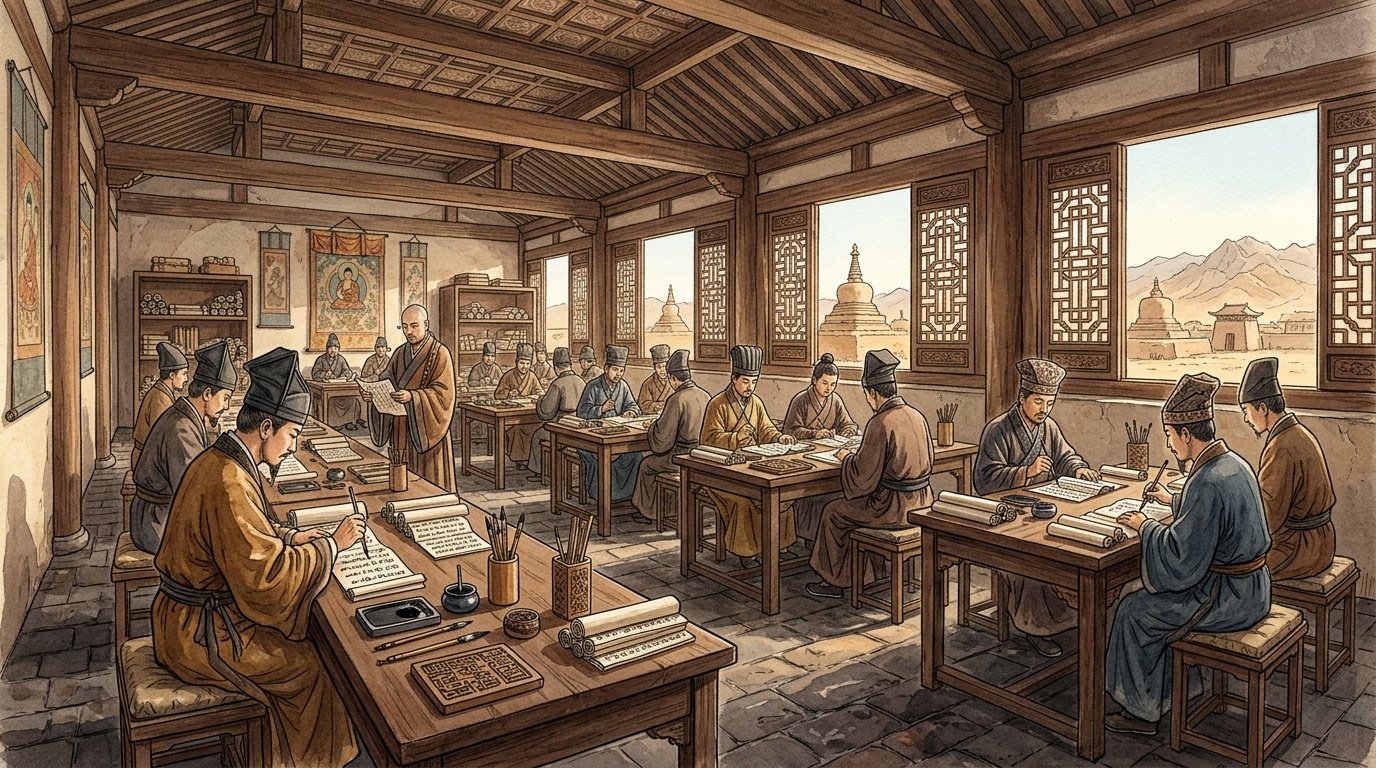
In the spring of 1908, a Russian imperial expedition led by the explorer Pyotr Kozlov rode deep into the arid wasteland of the Badain Jaran Desert in what is today western Inner Mongolia. Guided by local Torghut Mongol nomads across howling gravel plains, Kozlov arrived before the towering, sun-baked ramparts of a forgotten ghost city known to the Mongols as Kharakhoto (黑水城, ‘The Black Water City’). Breaching a massive brick stupa outside the western gate, Kozlov’s team was stunned by what lay inside: thousands of woodblock-printed books, Buddhist sutras, medical treatises, administrative scrolls, and exquisite silk thangkas preserved in pristine condition by the bone-dry desert air.
Yet when the Russian philologists attempted to read the texts, they were confronted by a profound enigma. The writing resembled Chinese characters: the graphs were square, balanced, and composed of familiar-looking horizontal, vertical, and slanting brushstrokes. Yet not a single character was Chinese. It was a dense, impenetrable labyrinth of geometric lines, looking like a parallel-universe ideographic language conceived by an extraterrestrial civilization. It was the lost sacred script of the Tangut Empire (Western Xia, 西夏, 1038–1227 CE)—a mighty Buddhist empire that ruled the Hexi Corridor, the Ordos Loop, and the eastern Silk Road for two centuries, fought the Song and Liao empires to a standstill, and was then wiped from the face of the earth with such cataclysmic fury by Genghis Khan that its history was reduced to whispering ghosts beneath the desert sands.
To the court of the Northern Song in Kaifeng, the Tanguts were a perpetual thorn in the imperial side: ferocious nomadic raiders who routed imperial armies, extorted millions in tribute, and mocked Chinese pretensions to universal rulership. In the official self-designation of its own rulers, however, the empire was known as ‘The Great Xia of the White and Lofty’ (白高大夏国, Tangut: Phiow-bjij-lhjwo-lja-lhjwo): a sophisticated, cosmopolitan civilization that fused Tibetan Buddhism, Han Chinese administrative law, Tangut nomadic cavalry tactics, and an audacious artificial writing system deliberately invented to prove that the Tangut people were spiritually and intellectually equal to the Middle Kingdom.
This monograph provides an exhaustive political, military, linguistic, and archaeological reconstruction of the rise, zenith, and apocalyptic fall of the Western Xia Empire. We will trace the origins of the Tangut (Mi-nyag) people from their ancestral highlands on the Tibetan plateau to the Ordos Loop; follow the iron-willed founder Li Yuanhao (李元昊) as he broke with Han vassalage and proclaimed himself Emperor; dissect the creation and decipherment of the labyrinthine Tangut script by the scholar Yeli Renrong; inspect the terrifying military machine of the ‘Iron Hawks’ (铁鹞子, Tie Yaozi) and mountain shock troops; analyze the catastrophic defeats inflicted upon the Northern Song armies at Sanchuan Pass and Haoshuichuan; examine the Silk Road trade, oasis hydraulic engineering along the Yellow River, and esoteric Buddhist art; chronicle the apocalyptic clash with Genghis Khan, who died during the siege of the Tangut capital; and investigate the Mongol campaign of total physical and cultural extermination (殄灭无遗) that obliterated an entire civilization from the historical record.
1. The Sons of the White Crane: Origins of the Dangxiang People
The founders of the Western Xia were the Dangxiang (党项), a branch of the ancient Qiang (羌) peoples who spoke a language belonging to the Tibeto-Burman branch of the Sino-Tibetan linguistic family. In their own tongue, they called themselves the Mi-nyag. Originally pastoral nomads dwelling in the rugged alpine grasslands of modern southeastern Qinghai and southern Gansu, the Dangxiang lived in nomadic tent communities organized into sixteen powerful patrilineal clans, the most prominent of which was the Tuoba (拓跋) clan.
The Tangut ethnogenesis was shaped by continuous nomadic displacement. In the seventh century, the rising military superpower of the Tibetan Empire (Tubo 吐蕃) swept across the Qinghai plateau, conquering the Tuyuhun kingdom and enslaving local tribes. Seeking sanctuary, the Tuoba Dangxiang chieftains submitted to the Tang Dynasty. The Tang court settled the Tangut tribes in the strategic Ordos Loop (鄂尔多斯)—the great northern bend of the Yellow River in modern Ningxia, northern Shaanxi, and Inner Mongolia—using them as a military buffer against Tibetan and Turkic raiders.
The decisive breakthrough for the Tangut leaders occurred in 881 CE during the apocalyptic turmoil of the Huang Chao Rebellion (黄巢之乱). When the rebel Huang Chao sacked Chang’an, the Tangut chieftain Tuoba Sigong (拓跋思恭) rallied thousands of hardened Dangxiang horse archers, marched south, and played a pivotal role in liberating the imperial capital. In profound gratitude, the fleeing Tang Emperor Xizong bestowed upon Tuoba Sigong the highest conceivable imperial rewards: he was appointed Military Commissioner (节度使, Jiedushi) of the Dingnan Commandery (定难军), created Duke of Xiazhou, and granted the supreme honor of the imperial Tang dynastic surname: Li (李).
For the next century and a half, through the collapse of the Tang and the brutal civil wars of the Five Dynasties, the Li clan governed the five arid prefectures of Dingnan (Xiazhou, Yinzhou, Suizhou, Youzhou, and Jingbian) as an autonomous, hereditary military dynasty. Possessing a formidable cavalry reserve, control over salt lakes, and horse-breeding pastures, the Tanguts maintained a cunning policy of pragmatic subservience: they paid nominal tribute to whichever dynasty ruled Kaifeng—Later Liang, Later Tang, Later Jin, Later Han, Later Zhou, and eventually the Song—while ruthlessly maintaining absolute independence on the ground.
2. The Radical Sovereign: Li Yuanhao’s Declaration of Imperial Glory (1038 CE)
When the Song Dynasty unified the Central Plains in the 960s and 970s, the second Song emperor, Taizong (Zhao Guangyi), attempted to absorb the Tangut buffer state. In 982 CE, Song troops occupied Xiazhou, forcing the Tangut ruler Li Jipeng to surrender his territory and move to Kaifeng. Yet Li Jipeng’s defiant cousin, Li Jiqian (李继迁, 963–1004 CE), refused to submit. Fleeing into the northern desert with a handful of followers, Li Jiqian launched twenty years of relentless guerrilla warfare against the Song, recapturing Xiazhou, seizing Lingzhou (modern Lingwu, Ningxia), and establishing a permanent Tangut capital along the fertile banks of the Yellow River.
The architect of full imperial independence was Li Jiqian’s grandson: Li Yuanhao (李元昊, 1003–1048 CE, posthumously Emperor Jingzong of Western Xia). Yuanhao was a figure of terrifying brilliance, boundless physical courage, and unyielding ruthlessness. He was an accomplished linguist fluent in both Chinese and Tibetan, an expert in Buddhist theology, a master of mountain strategy, and an uncompromising cultural nationalist. Yuanhao despised the gradual Hanification of his court, believing that adopting Chinese silk robes and Confucian etiquette had weakened the martial spirit of his people.
Upon succeeding his father Li Deming in 1032 CE, Yuanhao enacted a radical cultural and political revolution designed to sever all ties with China:
- The Imperial Renunciation: Yuanhao formally renounced both the Tang imperial surname Li (李) and the Song imperial surname Zhao (赵) that had been bestowed upon his ancestors. He adopted the ancestral Tangut surname Weiming (嵬名), declaring himself an independent sovereign answering only to the Blue Sky and the White Mountain spirits.
- The Baldness Decree (秃发令, Tufa Ling): Yuanhao declared war on Han hairstyles. He personally shaved the crown of his own head, leaving a fringe of hair along his forehead and ears hanging in braids, in the ancient nomadic fashion. He issued a draconian nationwide edict: all Tangut males were given exactly three days to shave their heads. Anyone caught retaining the traditional Chinese topknot after the third day was summarily decapitated.
- Military Vestments: Yuanhao abolished Chinese-style silk court robes for his civil and military officials, mandating that all officers wear round leather caps, tight-sleeved woolen jerkins, animal-skin cloaks, and iron daggers at their waists.
On the eleventh day of the tenth lunar month in 1038 CE, Li Yuanhao ascended the altar of Heaven at his capital of Xingqing (兴庆, modern Yinchuan, Ningxia). Flanked by Buddhist patriarchs and thousands of iron-clad horsemen, Yuanhao formally proclaimed the founding of the Great Xia Empire (大夏国), declared the era name Tianshoulifashengzuo (天授礼法延祚, ‘Heaven-Conferred Ritual and Law Prolonging the Sacred Reign’), and dispatched an arrogant imperial letter to Emperor Renzong of Song in Kaifeng, demanding that the Chinese Son of Heaven recognize him as an equal brother Emperor. In Kaifeng, the Song court was paralyzed with fury; Emperor Renzong immediately stripped Yuanhao of all titles, put a bounty of 100,000 strings of cash on his head, and mobilized the imperial standing army for total war.
3. The Sacred Labyrinth: The Creation and Decipherment of the Tangut Script
Of all the remarkable achievements of Li Yuanhao, none was more intellectually audacious than his decision to invent a brand-new, national writing system from scratch. Yuanhao recognized a profound civilizational truth: an empire could never be truly independent if it relied upon the writing system of its greatest enemy. To construct an unassailable spiritual and bureaucratic identity for the Great Xia, Yuanhao commissioned his chief academic scholar, Yeli Renrong (野利仁荣, d. 1042 CE), to create a script that would embody the Tangut tongue.
Retiring to an isolated mountain lodge in 1036 CE, Yeli Renrong labored day and night for several years, emerging with a script containing approximately six thousand individual characters (西夏文). Promulgated by imperial edict as the ‘National Script’ (国字), it was immediately made the mandatory written medium for all official state documents, military orders, legal codes, court histories, and Buddhist translations.
The architecture of the Tangut script is one of the greatest curiosities in the history of world writing:
- Visual Appearance: At first glance, Tangut characters look almost indistinguishable from traditional Chinese characters. Each character occupies a perfect square block, is written with a wolf-hair ink brush using the standard strokes of Chinese calligraphy (horizontal, vertical, downward-left, downward-right, dot, and hook).
- Extreme Structural Complexity: While Chinese characters range in complexity from a single stroke (一) to dozens of strokes, there are virtually no simple Tangut characters. The average Tangut graph contains between eight and sixteen dense, interlocking brushstrokes; some contain over thirty strokes. The visual density of the script gives a page of Tangut text the appearance of an intricate, woven silk carpet or an esoteric geometrical talisman.
- Ideographic Inversion: Yeli Renrong designed the script so that not a single character was an exact duplicate of a Chinese graph. Even fundamental words that were simple in Chinese—such as ‘person’ (人), ‘sun’ (日), ‘moon’ (月), and ‘one’ (一)—were constructed in Tangut using complex, multi-stroke composites. Many characters were formed through structural alteration of semantic roots: combining two radical components or inverting elements to signify related concepts (e.g., ‘mud’ was constructed by combining the radical for ‘water’ with the character for ‘earth’).
For centuries after the fall of the empire, the Tangut language was considered completely lost—an indecipherable dead language. The modern breakthrough occurred thanks to the bilingual dictionaries discovered at Kharakhoto, most notably the Fan-Han Heshi Zhangzhongzhu (番汉合时掌中珠, Pearl in the Palm: A Timely Tangut-Chinese Handbook), compiled in 1190 CE by a Tangut scholar named Gule Maucai. Featuring parallel columns of Tangut characters, Chinese characters, and phonetic approximations in both directions, this ancient phrasebook served as the Rosetta Stone of Tangut philology. Over the twentieth century, brilliant linguists—including Nikolai Nevsky, Tatsuo Nishida, and the Chinese scholar Li Fanwen (李范文)—successfully reconstructed the phonology, grammar, and vocabulary of this lost medieval tongue, unlocking a treasure trove of Buddhist literature and social history.
3B. The Jewel of Jurisprudence: The Tiansheng Legal Code (天盛律令)
Beyond Buddhist scriptures and military manuals, the crowning intellectual achievement discovered in the sands of Kharakhoto was a complete, monumental legal code: the Revised and Newly Endorsed Legal Code of the Tiansheng Era (天盛改旧新定律令, Tiansheng Gaijiu Xinding Lüling). Promulgated in the mid-twelfth century under Emperor Renzong (Li Renxiao, r. 1139–1193 CE), this gargantuan legislative monument spans twenty volumes and encompasses more than one thousand articles. It represents the earliest and most complete medieval administrative legal code preserved in any non-Han East Asian language.
The Tiansheng Code reveals an astonishingly sophisticated, dual-track civilization that synthesized Chinese Confucian legalism with ancient Tangut customary tribal law:
- The Unprecedented Rights of Women: In stark, radical contrast to the increasingly patriarchal and restrictive neo-Confucian society of the contemporary Song Dynasty—where foot-binding was emerging and women were relegated to the inner quarters—Tangut society maintained ancient nomadic egalitarian traditions. Under the Tiansheng Code, Tangut women enjoyed extensive property rights, could inherit family estates, run commercial enterprises, and initiate divorce without losing their personal dowry. Most striking of all, Tangut women were permitted to ride horses, carry weapons, and serve in military logistics; in elite families, aristocratic women participated openly in court councils and diplomatic receptions.
- Equitable Hydraulic Administration: Reflecting the vital importance of irrigation along the Yellow River, the code contains exhaustive, microscopic regulations governing water distribution. Sluice gates on the Hantang and Tanglai canals were governed by rigid hourly schedules; any official or landowner who diverted irrigation water out of turn or allowed dykes to crumble faced severe floggings and heavy fines. Water was treated as sacred public property essential for collective survival.
- The Imperial Bureaucratic Ladder: The code details a hybrid government apparatus featuring two parallel bureaucratic tracks: the ‘Tangut Bureaucracy’ (番官), which governed the nomadic tribes, cavalry units, pastures, and ancestral rituals using the Tangut language; and the ‘Chinese Bureaucracy’ (汉官), staffed by Han scholar-officials who administered urban civil administration, agricultural taxation, and civil examinations modeled upon the Tang-Song system.
The survival of the Tiansheng Code permanently dismantled the traditional Chinese historical prejudice that viewed the Western Xia as a crude, predatory barbarian horde. It revealed an empire possessing an administrative rigor, judicial fairness, and institutional maturity that rivaled any contemporary state in the medieval world.
4. The Iron Hawks: Western Xia Military Machine and Desert Tactics
The survival of the Western Xia against two colossal neighbors—the Northern Song (with its 100 million people) and the Khitan Liao (with its vast nomadic cavalry hordes)—was a military miracle. The Tangut population numbered fewer than three million people. Yet through absolute, militarized social mobilization, Yuanhao could field a ferocious army of over five hundred thousand soldiers.
The Western Xia armed forces were composed of three elite, specialized components:
- 1. The Iron Hawks (铁鹞子, Tie Yaozi): The supreme shock cavalry of medieval East Asia. This was an elite corps of three thousand heavy cavalrymen, handpicked from the most aristocratic Tangut noble clans. Both rider and horse were encased in impenetrable, overlapping scales of cold-forged iron armor manufactured in the famous state workshops of Xingqing. Most terrifying of all, the riders were physically strapped and chained to their saddles with heavy iron brackets. Even if a Tangut knight was struck by multiple crossbow bolts or mortally wounded, he could not fall from his horse; the warhorse continued to charge at full gallop into the enemy ranks, turning the unit into a relentless, unstoppable wall of trampling iron.
- 2. The Mountain Shock Troops (山讹, Shan’e): Recruited from the rugged, impoverished Qiang tribes dwelling in the craggy peaks of the Hengshan Mountains (横山). Clad in light leather, barefoot or wearing hemp sandals, these agile mountain infantrymen were masters of night raids, mountain ambushes, and guerrilla combat. They could scale sheer cliffs in total darkness, infiltrate enemy camps, and slit the throats of sentries before vanishing into the ravines.
- 3. Camel Artillery (旋风炮, Xuanfeng Pao, ‘Whirlwind Catapults’): The Tanguts made ingenious use of the two-humped Bactrian camel in tactical warfare. They designed compact, rotating wooden trebuchets mounted directly upon the wooden packsaddles of large camels. Highly mobile across sandy terrain where heavy Song wheeled carts bogged down, the camel artillery could gallop to the flanks of a battleline, halt, fire heavy stone balls or ceramic gunpowder bombs into enemy infantry squares, and rapidly redeploy.
Yuanhao perfected the art of feigned retreat and canyon ambushes (诱敌深入). He understood that the heavily equipped, slow-moving Song armies were dependent on cumbersome baggage trains. Tangut horsemen would lure Song vanguard brigades into narrow, cliff-flanked river gorges, seal the exits with rockslides, and unleash murderous barrages of arrows and boulders from the heights.
The technological supremacy of Tangut armaments was grounded in the legendary cold-forging metallurgical techniques of the Helan Mountains. Tangut swordsmiths utilized rich iron ore and camel coal to smelt steel of extraordinary hardness and flexibility. The famous ‘Xia Swords’ (夏国剑, Xiaguo Jian) were celebrated across all of East Asia; contemporary Song writers like Song Shenzong and Su Shi noted that a Tangut steel sword was so razor-sharp that it could slice cleanly through a stack of copper coins or cleave iron armor in twain without chipping its edge. Song emperors paid exorbitant sums on the black market to possess genuine Tangut blades, treating them as prized personal heirlooms. Similarly, Tangut cold-forged laminated iron cuirasses could deflect the heaviest Song three-bow crossbow bolts (三弓床弩) at fifty paces, rendering the Tie Yaozi heavy cavalry nearly impervious to standard Song missile volleys.
In addition to technological mastery, the Tanguts maintained profound spiritual alliances with the emerging monastic lineages of Tibet, particularly the Kagyu (Black Hat) and Sakya traditions. Tangut emperors invited prominent Tibetan lamas to serve as Imperial Preceptors (帝师, Dishi) in Xingqing decades before the Mongols adopted the same practice under Phags-pa. These Tibetan masters conducted esoteric initiation ceremonies for Tangut monarchs, binding religious charisma to state power and creating a sacred Tibetan-Tangut cultural zone that insulated the Western Xia from Chinese cultural assimilation.
5. The Humiliation of Kaifeng: The Three Great Frontier Campaigns (1040–1042 CE)
Between 1040 and 1042 CE, Li Yuanhao launched three masterclass campaigns against the Northern Song along the rugged frontiers of Shaanxi, inflicting catastrophic defeats that shook the Song court to its foundation.
A. The Battle of Sanchuan Pass (三川口之战, 1040 CE)
In the third lunar month of 1040 CE, Yuanhao led a massive army across the border, laying siege to the strategic Song fortress of Yanzhou (modern Yan’an, Shaanxi). The Song commander, General Liu Ping, led an elite relief column of 10,000 veteran troops to break the siege. At Sanchuan Pass, Yuanhao trapped Liu Ping’s army in a narrow, muddy canyon during a blinding late-winter snowstorm. Tangut horsemen seized the high ground and charged down the slopes. Despite fighting with desperate courage for three days, Liu Ping’s lines disintegrated; Liu Ping and General Shi Yuanxun were captured alive, and over 10,000 Song soldiers were slaughtered. The road to the Guanzhong plains lay exposed.
B. The Battle of Haoshuichuan (好水川之战, 1041 CE)
The following year, the Song court dispatched its most celebrated scholar-statesmen—Han Qi (韩琦) and Fan Zhongyan (范仲淹)—to coordinate the Shaanxi defenses. Han Qi, young and overconfident, ordered General Ren Fu to pursue a small Tangut raiding party. Yuanhao executed the classic nomadic trap. Drawing Ren Fu deep into the winding gorge of Haoshuichuan (好水川, ‘The River of Good Waters’), the Song vanguard encountered dozens of sealed bamboo cages abandoned along the riverbank. Hearing strange, fluttering noises inside, curious Song soldiers cut open the cages. Hundreds of carrier pigeons burst into the sky, fluttering in circles above the Song column. The pigeons were an acoustic and visual signal: the moment they rose, Tangut drums roared from the surrounding canyon cliffs, and tens of thousands of Tangut troops poured down from hidden ravines. Ren Fu and over ten thousand elite Song soldiers were annihilated in a matter of hours. When Han Qi rode out to recover the corpses, thousands of weeping Song war-widows and orphans blocked his horse, throwing paper spirit money into the air; Han Qi covered his face with his sleeves and wept bitter tears of shame.
C. The Battle of Dingchuan Fort and the Qingli Accord (1042–1044 CE)
In the ninth lunar month of 1042 CE, Yuanhao struck again at Dingchuan Fort (定川寨), cutting off the water supply of the Song army under Ge Huai-min and massacring another 9,400 imperial troops. Emboldened by victory, Yuanhao boldly declared his intention to capture Chang’an and celebrate victory in the ancient Han-Tang palaces.
Exhausted by constant defeat, the Song treasury buckling under military expenditure, Emperor Renzong sued for peace. The resulting Qingli Accord (庆历和议, 1044 CE) was a masterpiece of Tangut diplomatic extortion. Yuanhao agreed to pay nominal ceremonial deference to the Song Emperor as a ‘nephew’ or ‘vassal’ (calling himself chen 臣 in Chinese-language diplomacy, while remaining Emperor Huangdi within his own borders). In exchange, the Song court agreed to pay an astronomical annual subsidy: 72,000 taels of silver, 153,000 bolts of silk, and 30,000 catties of premium tea, alongside hundreds of thousands of extra gifts on imperial birthdays and festivals. Western Xia had secured its borders and forced the greatest economic power on earth to bankroll its state budget.
6. Oasis of Faith: Silk Road Wealth and Esoteric Buddhist Splendor
Financed by Chinese subsidies and controlling the vital Hexi Corridor (河西走廊), the Western Xia transformed into an economic and cultural nexus linking China, Central Asia, Tibet, and the steppe. Along the banks of the Yellow River in Ningxia, the Tanguts expanded ancient Qin and Han canal networks—most notably the Hantang Canal (汉延渠) and the Tanglai Canal (唐徕渠)—transforming the Ningxia plain into a lush, emerald oasis of wheat and rice paddies known as ‘Jiangnan on the Frontier’ (塞上江南).
The state religion of the Western Xia was Buddhism, practiced with an intensity and devotion rivaling that of medieval Europe. The Tangut imperial house were lavish patrons of both Chinese Chan Buddhism and Tibetan Esoteric Buddhism (Vajrayana). The court mobilized hundreds of scholars to execute the titanic labor of translating the entire Buddhist canon (the Tripitaka, 大藏经) into the newly invented Tangut script—a monumental publishing enterprise that produced thousands of woodblock-printed volumes with exquisitely detailed frontispiece illustrations.
The visual legacy of Tangut Buddhism survives in breathtaking monuments across the northwest:
- The Imperial Tombs of Western Xia (西夏王陵): Located at the foot of the Helan Mountains outside Yinchuan, nine colossal imperial mausoleums and over 250 noble tombs rise from the desert floor. Often called the ‘Pyramids of the Orient,’ these massive, tiered rammed-earth pagodas were originally clad in octagonal wooden pavilions covered in glazed green and yellow tiles, guarded by mythical Chiwens and terracotta tomb beasts.
- The Mogao and Yulin Caves: At Dunhuang and Guazhou, the Tanguts carved and renovated dozens of spectacular grottoes. Tangut cave art—such as Cave 29 at Mogao and Cave 2 and 3 at Yulin—fuses the refined, flowing brushwork of the Song Academy with the fiery, tantric mysticism of Tibetan art, depicting multi-armed Green Taras, wrathful deities, and lifelike portraits of Tangut royal donors dressed in their distinctive shaven hairstyles and gold robes.
- The Twin Pagodas of Baisikou (拜寺口双塔): Thirteen-story brick octagonal pagodas soaring into the blue sky of the Helan Mountains, their interior chambers preserving rare Tangut woodblock sutras, gilt bronze statuettes, and esoteric mandalas.
7. The Wrath of the Steppe: The Clash with Genghis Khan (1205–1226 CE)
For more than a century after Yuanhao’s death in 1048 CE, the Western Xia flourished, navigating diplomatic shifts between the Jurchen Jin and the Southern Song. Yet at the dawn of the thirteenth century, a cataclysmic tempest arose from the Mongolian plateau that would consume the medieval world: the rise of Genghis Khan (成吉思汗, Temüjin).
When Genghis Khan united the nomadic tribes of Mongolia in 1206 CE, his first strategic target outside the steppe was not the Jurchen Jin Empire or China, but the Western Xia. The reasons were compelling: the Tangut empire bordered Mongolia to the south, possessed vast herds of sheep and camels, controlled the western trade routes, and possessed fortified cities where the Mongol horsemen could practice the art of siege warfare before tackling the colossal fortress cities of northern China.
Between 1205 and 1224 CE, Genghis Khan launched five punitive campaigns against the Western Xia. In 1209 CE, the Mongols besieged the Tangut capital of Xingqing. In an attempt to flood the city, Genghis Khan breached the dykes of the Yellow River; yet the waters accidentally broke the Mongol siege trenches instead, drowning thousands of Mongol warriors and forcing Genghis Khan to negotiate a withdrawal in exchange for a Tangut royal princess (Chaka) and vassal tribute.
The fatal turning point came in 1219 CE when Genghis Khan mobilized his grand army to invade the Khwarezmian Empire in Central Asia and Persia. Genghis Khan sent an imperial envoy to the Tangut Emperor Shenzong, demanding that the Western Xia supply an auxiliary corps of Tangut horsemen to serve under his banner. The proud Tangut general Asha Gambu (阿沙敢布) delivered a blistering, insulting retort that sealed the fate of his nation:
「若力不能,何以称帝!」
— Asha Gambu, message to Genghis Khan, recorded in The Secret History of the Mongols (蒙古秘史)
‘If your military strength is insufficient to wage war alone, why do you dare claim the title of Khagan!’
When the words were reported to Genghis Khan on the banks of the Irtysh River, the Great Khan trembled with volcanic fury. Swearing by the Eternal Blue Sky, Genghis Khan declared: ‘How could Asha Gambu dare utter such words to me! If I return alive from the western conquest, I swear to exterminate the Tangut people down to the last living soul!’
8. The Apocalyptic Annihilation: The Fall of Xingqing (1227 CE)
In 1226 CE, having shattered Khwarezm, burned Bukhara and Samarkand, and pursued the Shah to the Caspian Sea, Genghis Khan marched his battle-hardened grand army of 100,000 veteran Mongol horsemen back across the Altai Mountains. His objective was total, unsparing vengeance: the complete annihilation of the Western Xia.
What followed was an apocalypse of fire and blood. The Mongol army swept across the Hexi Corridor like a wall of locusts. City by city—Heisui (Kharakhoto), Suzhou (Jiuquan), Ganzhou (Zhangye), Liangzhou (Wuwei)—were systematically besieged, stormed, and put to the sword. In the winter of 1226 CE, General Asha Gambu concentrated the final Tangut army of 100,000 men on the frozen banks of the Yellow River at Lingzhou. In a savage battle fought across the river ice, the Mongol cavalry broke the Tangut lines; over seventy thousand Tangut soldiers were slaughtered, their bodies clogging the river channels.
The tragedy of the Tangut defense is immortalized in the eerie local legends surrounding the fall of Kharakhoto itself. According to local desert folklore recorded by Kozlov, the fortress city was commanded by the legendary Tangut general Khara Bator (The Black Hero). When the Mongol tumens surrounded the desert fortress, they realized the thick rammed-earth walls could not be breached by conventional assault. The Mongol engineers diverted the course of the Ejin River (Black Water) upstream using thousands of sandbags filled with gravel, cutting off the city’s sole water supply.
As the desert heat climbed and the citizens of Kharakhoto began dying of thirst, General Khara Bator ordered deep shafts dug inside the fortress walls, but hit only bone-dry sand. Realizing doom was certain, the general gathered his eighty cartloads of gold, silver, and precious jade treasures, dumped them into the dry well shafts, and buried them beneath tons of earth. To save his two wives and children from the horrors of Mongol sexual servitude, Khara Bator took his broadsword and slew them with his own hands inside the palace. He then ordered a breach knocked through the northwestern wall and led his remaining thirsty warriors on a suicidal, ferocious final cavalry charge directly into the teeth of the Mongol lines, dying sword in hand beneath the dunes. When the Mongols entered, they found only corpses; the sands slowly engulfed the empty towers, preserving the secret libraries until Kozlov’s arrival seven centuries later.
In the spring of 1227 CE, the Mongols laid siege to the capital of Xingqing (Yinchuan). For six months, the Tangut garrison under the last emperor, Li Xian (Emperor Mozhu, 李睍), resisted with superhuman desperation, enduring starvation, plague, and relentless artillery bombardment. Yet amidst the siege, an unexpected event altered world history: in the seventh lunar month of 1227 CE, Genghis Khan died suddenly at his mobile camp in the Liupan Mountains (六盘山, southern Ningxia) at the age of sixty-five—either from disease, a fall from his horse during a hunt, or according to persistent legend, mortally wounded by a dagger hidden in the robes of a captured Tangut princess.
On his deathbed, Genghis Khan issued a terrifying final command to his sons Tolui and Ögedei: his death must be kept an absolute secret until the Tangut capital was taken, whereupon the entire population must be slaughtered:
「殄灭无遗,以雪前耻!」
— Genghis Khan’s dying decree regarding the Tanguts, recorded in Song Shi and Secret History
‘Exterminate them all, leaving not a single soul alive, to wipe clean our former shame!’
Unaware that the Great Khan was already a corpse, Emperor Li Xian surrendered Xingqing in the ninth lunar month of 1227 CE, walking out of the gates bearing the imperial jade seal and royal gifts. The Mongol commanders immediately executed Li Xian and his entourage. The Mongol cavalry then poured through the gates of Xingqing. Over the next month, the imperial capital was subjected to systematic extermination: the entire population was butchered; the imperial palaces, Buddhist temples, and libraries were burned to the ground; and the imperial mausoleums in the Helan Mountains were systematically opened, desecrated, and stripped of gold. The Tangut civilization was snuffed out like a flame in a gale.
9. The Ghost Empire in Historiography: Why There Is No Official History of Xia
The ultimate tragedy of the Western Xia was not merely its physical annihilation, but its deliberate erasure from historical memory. In imperial Chinese historiographical tradition, whenever a conquering dynasty unified China, it was obligated to compile the official dynastic history of the preceding regimes to preserve their administrative and cultural legacy.
In the 1340s, when the Mongol Yuan court under Chancellor Tuo Tuo (脱脱) compiled the official histories of the medieval period, they compiled three separate dynastic chronicles: the History of Song (宋史, 496 vols), the History of Liao (辽史, 116 vols), and the History of Jin (金史, 135 vols). Yet astonishingly, no official History of Western Xia (西夏史) was ever compiled. The two-century history of the Great Xia was relegated to an insulting, brief seventy-page appendix at the very back of the Song Shi (Volume 485: ‘Biographies of Foreign Countries: Western Xia’).
Why did the Yuan court erase the Tanguts? Several factors converged:
- Mongol Taboo and Guilt: Because Genghis Khan had died during the final campaign against the Tanguts, the very name of Western Xia was viewed as an inauspicious, taboo curse among the Mongol royal family. To grant the Tanguts an independent dynastic history was viewed as honoring the enemies who had killed the founder of the world empire.
- The Destruction of Archival Records: The apocalyptic burning of Xingqing, Lingzhou, and the imperial monasteries had destroyed nearly all official Tangut state archives, court diaries, and legal codes written in Chinese, leaving Yuan historians with sparse documentation.
- The Unreadable Script: Within a century of the conquest, very few scholars outside a handful of surviving Buddhist monasteries could read the dense, labyrinthine Tangut script. What could not be read was dismissed as barbarian nonsense.
Despite the genocide, small communities of Tangut survivors dispersed across Eurasia. Many elite Tanguts entered the Mongol administration as skilled multilingual bureaucrats (belonging to the Semu 色目 caste). In modern Sichuan and Hebei, Tangut Buddhist communities endured well into the Ming Dynasty; in 1502 CE, during the reign of the Ming Hongzhi Emperor, Buddhist monks in Baoding erected stone dharani pillars inscribed in the Tangut script—proving that the sacred language of Yeli Renrong was still spoken and read nearly three hundred years after the fall of Xingqing. Today, through modern archaeology and linguistic decipherment, the ‘White and Lofty’ empire has risen from the sands, reclaiming its rightful place as one of the most brilliant and tragic civilizations in Asian history.
Modern genetic and linguistic research in China has further illuminated the living legacy of the Tangut people. Descendants of Tangut clans who migrated south into Sichuan and Henan—often adopting the Chinese surnames Li, Tuo, or Bai—preserve ancestral memories and genealogical records connecting their lineage directly to the royal house of Weiming. The physical artifacts preserved in the St. Petersburg Institute of Oriental Manuscripts, the British Library, and the Ningxia Museum stand as silent witnesses to an extraordinary high civilization that dared to challenge the empires of the steppe and the Central Plains, leaving behind an indelible cultural imprint upon the Silk Road.
10. Chronology of the Western Xia Empire (982–1227 CE)
| Year (CE) | Historical Event | Key Historical Figures | Significance & Geopolitical Impact |
|---|---|---|---|
| 881 | Tuoba Sigong Appointed Dingnan Jiedushi | Tuoba Sigong, Tang Xizong | Tanguts liberate Chang’an from Huang Chao; granted imperial surname Li and Ordos fief |
| 982 | Li Jiqian’s Desert Defiance | Li Jiqian, Song Taizong | Li Jiqian flees to desert; begins 20 years of guerrilla war to secure Tangut independence |
| 1002 | Capture of Lingzhou (Ningxia) | Li Jiqian | Tanguts capture Lingzhou, establishing permanent capital on Yellow River |
| 1032 | Ascension of Li Yuanhao | Li Yuanhao (Emperor Jingzong) | Yuanhao renounces Han surnames Li and Zhao; institutes mandatory head-shaving decree |
| 1036 | Creation of the Tangut Script | Yeli Renrong, Li Yuanhao | Promulgates 6,000-character national ideographic script; begins translation of Tripitaka |
| 1038 (Oct 11) | Proclamation of the Great Xia Empire | Li Yuanhao | Yuanhao proclaims himself Emperor at Xingqing; formal diplomatic break with Song |
| 1040 | Battle of Sanchuan Pass | Li Yuanhao, Liu Ping | Tangut army annihilates 10,000 Song elite troops in snowstorm gorge ambush |
| 1041 | Battle of Haoshuichuan (Pigeon Trap) | Li Yuanhao, Han Qi, Ren Fu | Carrier pigeon signal springs canyon ambush; 10,000 Song troops butchered; Han Qi weeps |
| 1042 | Battle of Dingchuan Fort | Li Yuanhao, Ge Huai-min | Song army encircled and massacred; Tanguts threaten Chang’an |
| 1044 | The Qingli Accord Concluded | Li Yuanhao, Song Renzong | Song agrees to massive annual subsidies of silver, silk, and tea; de facto recognition |
| 1048 | Assassination of Li Yuanhao | Li Yuanhao, Crown Prince Ninglingge | Yuanhao murdered in palace coup after stealing his son’s bride; noses severed |
| 1190 | Compilation of the Pearl in the Palm | Gule Maucai | Bilingual Tangut-Chinese handbook compiled; later serves as Rosetta Stone of decipherment |
| 1205–1209 | Genghis Khan’s Early Tangut Campaigns | Genghis Khan, Emperor Xiangzong | Mongols flood Xingqing; Tanguts submit and provide royal bride and tribute |
| 1219 | Asha Gambu’s Fatal Retort | Asha Gambu, Genghis Khan | Tangut general insults Khan; Genghis Khan swears total annihilation after western campaign |
| 1226 (Winter) | Battle of Lingzhou Ice Crossing | Genghis Khan, Asha Gambu | Mongol cavalry breaks Tangut army on Yellow River ice; 70,000 Tangut troops slaughtered |
| 1227 (Jul) | Death of Genghis Khan in Liupan Mountains | Genghis Khan, Tolui | Khan dies at 65; issues secret deathbed order for total extermination of Tanguts |
| 1227 (Sep) | Fall of Xingqing and the Great Extermination | Emperor Li Xian, Mongol Generals | Last Emperor executed; Xingqing razed; libraries burned; Western Xia erased |
| 1908 | Kozlov Discovers Kharakhoto Archive | Pyotr Kozlov | Russian expedition uncovers buried stupa in Badain Jaran; thousands of Tangut texts recovered |
11. Scholarly Bibliography and Primary Historical Sources
To substantiate the political records, linguistic analyses, and archaeological documentation presented in this study, the following primary sources and academic monographs are recommended for further study:
- Li Tao (李焘, 1115–1184 CE), Long Draft of the Comprehensive Mirror in Aid of Governance (续资治通鉴长编, Xu Zizhi Tongjian Changbian): Crucial primary source detailing the frontier wars with Yuanhao, the memorials of Fan Zhongyan and Han Qi, and the text of the Qingli Accord.
- Tuo Tuo (脱脱) et al. (comp. 1345 CE), History of Song (宋史, Song Shi): Volume 485 (‘Biographies of Foreign Lands: Western Xia’) provides the foundational Chinese dynastic account of Tangut genealogy, institutions, and military conflicts.
- Gule Maucai (骨勒茂才, comp. 1190 CE), Pearl in the Palm: A Timely Tangut-Chinese Handbook (番汉合时掌中珠, Fan-Han Heshi Zhangzhongzhu): The essential bilingual phrasebook that enabled modern linguists to decipher the Tangut language and phonology.
- Li Fanwen (李范文, 1997), Tangut-Chinese Dictionary (同音研究 / 夏汉字典, Xia-Han Zidian), China Social Sciences Press: The monumental 1,300-page modern lexicographical masterpiece providing comprehensive reconstructions of 6,000 Tangut graphs, pronunciations, and semantic meanings.
- Dunnell, Ruth W. (1996), The Great State of White and High: Buddhism and State Formation in Eleventh-Century Xia, University of Hawai’i Press: The definitive English-language monograph on the religious, political, and institutional architecture of the Western Xia court.
- Dunnell, Ruth W. (1994), “The Hsi Hsia,” in The Cambridge History of China, Volume 6: Alien Regimes and Border States, 907–1368, Cambridge University Press: Comprehensive survey of Tangut origins, the reign of Li Yuanhao, and foreign relations with Song, Liao, and Jin.
- Kychanov, Evgenij I. (1968), Ocherk istorii gosudarstva tangutov (Outline of the History of the Tangut State), Nauka, Moscow: Groundbreaking Soviet monograph based on the Kozlov Kharakhoto manuscript collection in St. Petersburg.
- Nishida, Tatsuo (1964–1966), A Study of the Hsi-Hsia Language (西夏語の研究), 2 vols., Zayuho Kankokai, Tokyo: Foundational philological study establishing the structural and phonological principles of the Tangut script.
- Kozlov, Pyotr K. (1923), Mongoliya i Amdo i mertvyy gorod Khara-Khoto (Mongolia, Amdo, and the Dead City of Kharakhoto), State Publishing House, Moscow: The original expedition journal documenting the discovery and excavation of the stupa library at Kharakhoto.
- Steinhardt, Nancy Shatzman (1997), Liao Architecture, University of Hawai’i Press (with comparative analyses of Tangut imperial mausoleums and the Baisikou twin pagodas). Indispensable study of medieval frontier architectural engineering.