How Zhao Kuangyin Ended Two Centuries of Military Mutiny
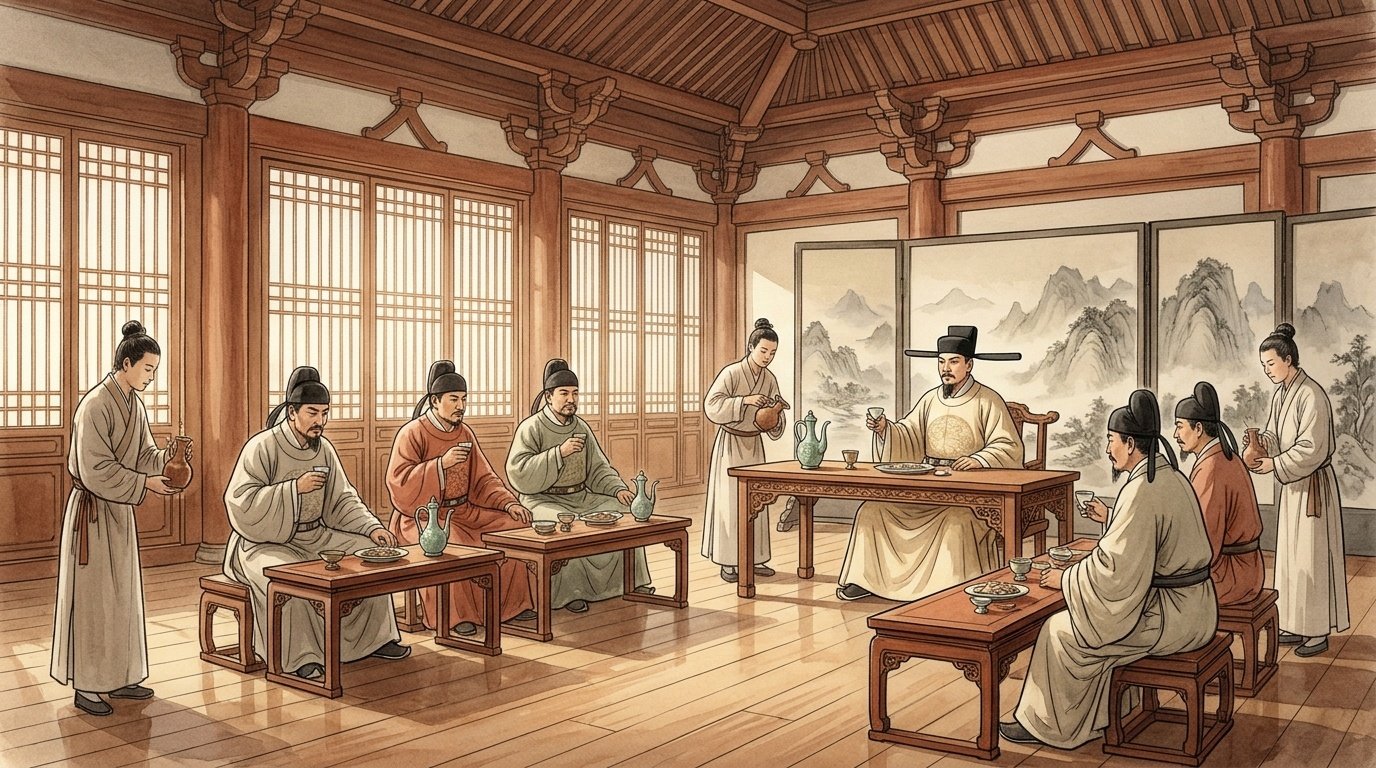
On a warm midsummer evening in the second year of the Jianlong era (July 961 CE), inside an intimate private reception hall of the imperial palace in Kaifeng (开封), a gathering of extraordinary political delicacy was taking place. The newly consecrated founder of the Song Dynasty (宋朝, 960–1279 CE), Emperor Taizu (宋太祖, Zhao Kuangyin 赵匡胤, 927–976 CE), sat drinking wine with half a dozen of his most intimate comrades-in-arms. These were not mere courtiers or civilian bureaucrats; they were the terrifying, battle-scarred warrior marshals who had marched alongside him for decades across the blood-soaked battlefields of the Five Dynasties: Shi Shouxin (石守信), Gao Huaide (高怀德), Wang Shenqi (王审琦), Zhang Lingduo (张令铎), and Zhao Yanhui. Together, these generals commanded the elite Imperial Palace Armies (禁军, Jinjun), wielding the absolute physical power of life and death over the fledgling dynasty.
As the wine flowed and the formal guards and palace eunuchs were dismissed into the courtyard, the atmosphere grew heavy. The thirty-four-year-old emperor drained his bronze cup, gazed across the table at his brother-generals, and sighed with profound, melancholic exhaustion. When Shi Shouxin and his comrades asked why their sovereign appeared so burdened amidst supreme imperial glory, Zhao Kuangyin uttered words that froze the blood in their veins:
「我非尔曹之力,不得至此,念德岂有穷已!然天子亦大艰难,殊不若为节度使之乐,吾终夕未尝安枕而卧也!」
— Emperor Taizu to his founding marshals, Xu Zizhi Tongjian Changbian (续资治通鉴长编), Chapter 2
‘Had it not been for the strength of you, my brothers, I could never have attained this throne; when I think of your virtue, how could it ever have an end! Yet to be the Son of Heaven is also fraught with immense tribulation; it is far inferior to the joyous ease of being a regional military governor. For not a single night have I been able to lay my head upon my pillow and sleep in peace!’
Terrified, the marshals fell prostrate upon the palace flagstones, banging their foreheads against the timber, stammering: ‘The Mandate of Heaven is already fixed; who under heaven would dare harbor treacherous designs? Why does Your Majesty utter such words?’ Zhao Kuangyin looked down at them with piercing clarity and replied with the cold, mathematical reality that had governed Chinese politics for two centuries: ‘Who among you does not desire the throne? Even if you harbor no such ambition, what if your subordinates, greedy for wealth and noble rank, should suddenly throw a yellow imperial robe over your shoulders in the dead of night? Even if you wished to decline, could you possibly do so?’
In that chilling, masterclass exchange of political chess, known to history as ‘Relieving Military Command over a Cup of Wine’ (杯酒释兵权, Bei Jiu Shi Bing Quan), Emperor Taizu accomplished what no Chinese emperor had managed for two hundred years. Without shedding a single drop of blood, without executing a single general, and without sparking a garrison insurrection, Zhao Kuangyin persuaded the most powerful military lords in the empire to surrender their supreme commands in exchange for vast financial riches, palatial estates, and imperial marriage alliances. In doing so, he dismantled the lethal cycle of warlord mutinies that had destroyed the Tang Dynasty and reduced the Five Dynasties to a butcher’s yard.
This comprehensive treatise presents an exhaustive investigation into the institutional revolution engineered by Zhao Kuangyin and his chief chancellor Zhao Pu (赵普). We will dissect the historical nightmare of the late Tang and Five Dynasties, where military coups had become a ritualized dynastic norm; analyze the famous secret midnight dialogue between Taizu and Zhao Pu; trace the psychological and tactical execution of the palace banquets of 961 and 969 CE; examine the revolutionary institutional architecture of Song governance—including the separation of troop mobilization from troop command (枢密院与三衙), the rotation of frontier garrisons (更戍法), and the foundational state doctrine of ‘Promoting the Civilian and Restricting the Martial’ (重文轻武, Zhongwen Qingwu); investigate the sacred Oath Stele (太祖誓碑) protecting scholar-officials from execution; and evaluate the profound civilizational paradox that granted the Song Dynasty three centuries of absolute internal domestic stability at the tragic cost of chronic, fatal military vulnerability against the martial empires of the Eurasian steppe.
1. The Two-Hundred-Year Curse: The Warlord Nightmare (755–960 CE)
To grasp why Zhao Kuangyin was so terrified of his own generals, one must understand the chronic political disease that had metastasized across China for over two centuries. Ever since the An Lushan Rebellion erupted in 755 CE, the Chinese imperial throne had been held hostage by its own armies. The destruction of the Tang Equal-Field System and Fubing militia gave birth to regional autonomous military governors (Jiedushi 节度使) commanding professional mercenary standing armies.
Across the five decades of the Five Dynasties (907–960 CE), the military mutiny evolved from a treasonous anomaly into an institutionalized, predictable ritual. Soldiers owed no loyalty to the Son of Heaven, nor to any abstract dynastic ideal; their allegiance belonged exclusively to the officer who distributed their grain rations and promised them battlefield plunder. Whenever an army felt underpaid, or whenever an ambitious commander wished to seize the crown, the troops staged a garrison mutiny. Generals were hoisted upon the shields of their screaming soldiers, presented with imperial banners, and marched on the capital to butcher the reigning monarch.
The dynastic successions of the Five Dynasties read like a manual of military usurpation:
- 907 CE: Zhu Wen, warlord of Xuanwu, deposed and murdered the last Tang emperor to found Later Liang.
- 923 CE: Li Cunxu, Shatuo warlord of Hedong, crushed Later Liang to found Later Tang; three years later, Li Cunxu was himself murdered in a palace mutiny led by actor-soldiers and mutinous garrisons, replaced by his adopted brother Li Siyuan (Emperor Mingzong).
- 936 CE: Shi Jingtang, Shatuo commander of Taiyuan, allied with the Khitan Liao Empire to overthrow Later Tang, founding Later Jin.
- 947 CE: Liu Zhiyuan, military governor of Hedong, seized power following the Khitan withdrawal to found Later Han.
- 951 CE: Guo Wei (郭威), supreme commander of the Later Han northern armies, was ‘draped in yellow banners’ by his mutinous troops at Chanzhou, overthrowing Later Han to found Later Zhou.
In this toxic political ecosystem, emperors lived under constant dread of their own palace guards. Every new emperor, upon ascending the throne, was forced to empty the state treasury to distribute colossal coronation cash bounties (犒军) to the soldiers merely to prevent them from mutinying on the spot. If the bounties were deemed insufficient, the guards tore down the palace gates and murdered the new monarch within his bedchamber. The imperial crown had become an ephemeral prize passed around among mercenary generals—a bloody carousel that showed no sign of ever stopping.
2. The Chenqiao Mutiny: Usurper by Precedent (960 CE)
The ultimate irony of Zhao Kuangyin’s life was that he had reached the dragon throne through the very same mechanism of military treason. In the spring of 959 CE, the brilliant Emperor Shizong of Later Zhou (Chai Rong) died suddenly at age thirty-eight, leaving the throne to his seven-year-old son, Emperor Gong (Chai Zongxun 柴宗训). Paramount military command of the empire was entrusted to thirty-two-year-old Zhao Kuangyin, who served as Grand Commander of the Palace Guards (殿前都点检).
In the first lunar month of 960 CE, panic swept Kaifeng with false reports that the Khitan Liao and Northern Han kingdoms were launching a joint southern invasion. The young child-emperor’s regency council ordered Zhao Kuangyin to march north with the main imperial strike army. On the evening of the second day of the first month, Zhao Kuangyin’s army halted and pitched camp at the postal station of Chenqiao (陈桥驿), barely twenty li (seven miles) northeast of Kaifeng.
That night, wine flowed freely through the ranks. In the early morning hours of January 3, 960 CE, Zhao Kuangyin’s younger brother, Zhao Guangyi (future Emperor Taizong), alongside senior officers Zhao Pu, Gao Huaide, and Shi Shouxin, orchestrated the final, flawless performance of the Five Dynasties coup script. Surrounding Zhao Kuangyin’s military tent with drawn swords, the officers shouted:
「诸军无主,愿策太尉为天子!」
— The mutinous officers at Chenqiao, Song Shi (宋史), Chapter 1
‘The armies possess no sovereign; we desire to proclaim the Grand Marshal as the Son of Heaven!’
Before Zhao Kuangyin could utter a word of protest—or feign reluctance—a prefabricated imperial yellow dragon robe (黄袍) was pulled from a saddlebag and draped over his shoulders. The soldiers fell prostrate, roaring ‘Ten Thousand Years!’ (万岁). Displaying extraordinary presence of mind, Zhao Kuangyin mounted his horse and laid down three non-negotiable conditions to his mutinous commanders: they must not harm the child-emperor Chai Zongxun or the Empress Dowager, they must not execute or plunder the chancellors and civil ministers in Kaifeng, and they must not loot the houses or markets of the civilian populace. Any soldier who violated these commands would be instantly beheaded.
The army marched back into Kaifeng in absolute, disciplined silence. Not a single shop was ransacked; not a single official was murdered. The child-emperor abdicated with ritual grace, and Zhao Kuangyin ascended the throne as Emperor Taizu, naming his new dynasty Song (宋) after his former military base in Songzhou. Yet as he sat upon the imperial dais, Zhao Kuangyin knew with ice-cold clarity that what his soldiers had done for him at Chenqiao, they could effortlessly do for another ambitious general tomorrow.
3. The Midnight Dialogue: Zhao Pu’s Three-Point Prescription
Haunted by the specter of Chenqiao, Emperor Taizu sought the counsel of his most trusted civilian confidant and strategist: Chancellor Zhao Pu (赵普, 922–992 CE). On a snowy winter night in late 960 CE, Taizu walked unannounced through the alleys of Kaifeng to Zhao Pu’s private residence, knocking on the gate amidst freezing flurries. Stunned, Zhao Pu welcomed his imperial master inside, roasted meat over an open brazier, and poured warm wine.
Sitting by the charcoal embers, Taizu looked into Zhao Pu’s eyes and posed the foundational existential question of medieval Chinese history:
「自唐季以来,数十年间,帝王凡易八姓,战斗不息,生民涂炭,其故何也?吾欲息天下之兵,为国家长久计,其道何如?」
— Emperor Taizu to Zhao Pu, Xu Zizhi Tongjian Changbian, Chapter 2
‘Since the twilight of the Tang, within a span of several decades, emperors of eight different surnames have ruled in succession; warfare has never ceased, and the living populace has been trampled into the mud. What is the fundamental cause of this? I desire to put an end to warfare throughout the realm, and devise a plan of eternal permanence for the state; what is the path to achieve this?’
Zhao Pu bowed his head and delivered a masterstroke of political diagnosis that became the guiding charter of the Song Dynasty for three centuries:
「陛下之言及此,天地神人相之福也!唐季之乱,非他故也,方镇太重,君弱臣强而已。今所以治之,亦无他奇巧,惟稍夺其权,制其钱谷,收其精兵,则天下自安矣!」
— Zhao Pu’s three-point prescription, Xu Zizhi Tongjian Changbian, Chapter 2
‘That Your Majesty poses this inquiry is the supreme blessing of Heaven, Earth, and all spirits! The chaos since late Tang was caused by nothing else: the regional military commands were too weighty, the sovereign was weak, and the ministers were strong, nothing more! Today, the method to rectify this requires no bizarre or miraculous stratagems. It is simply this: gradually strip their authority, control their revenues and grain, and gather their elite soldiers—and then all under heaven will naturally find peace!’
Zhao Pu’s diagnosis was razor-sharp. The warlord curse was an institutional mechanism driven by three interlocking monopolies possessed by the regional Jiedushi:
- 1. Administrative & Personnel Monopoly (权): Warlords appointed their own judges, magistrates, and police, operating sovereign regional states.
- 2. Fiscal & Grain Monopoly (钱谷): Warlords retained provincial land taxes, gabelle revenues, and customs duties, keeping the imperial treasury starved.
- 3. Military Shock Monopoly (精兵): Warlords recruited the strongest, fiercest peasant youths into private provincial shock guards (Ya’er 牙儿), leaving the imperial palace with weak conscripts.
Taizu listened in absolute silence, nodding repeatedly. Before the night ended, the emperor declared: ‘Say no more; I fully comprehend!’ The grand strategy of the Song state was sealed.
4. The Banquet of 961 CE: The Velvet Dissolution of the Palace Guards
The first and most hazardous step of Zhao Pu’s prescription was neutralizing the commanders of the Imperial Palace Guards (禁军, Jinjun) stationed inside Kaifeng itself. These generals—Shi Shouxin, Gao Huaide, and Wang Shenqi—were not distant provincial governors; they held the keys to the city gates, commanded the palace guardhouses, and possessed deep personal loyalty from the sixty thousand elite shock troops surrounding the emperor’s bedchamber.
Previous dynastic founders in Chinese history had resolved such dilemmas through violent purges. Han Gaozu (Liu Bang) had systematically hunted down and executed his greatest marshals—Han Xin, Peng Yue, and Ying Bu—on trumped-up charges of treason. Ming Taizu (Zhu Yuanzhang) would later butcher tens of thousands of founding comrades in the horrific Lan Yu and Hu Weiyong purges. Zhao Kuangyin, possessing a rare, humane magnanimity and deep personal loyalty to his comrades, adamantly refused to shed the blood of his friends. He devised a brilliant psychological alternative: a golden bridge of voluntary retirement.
In July 961 CE, Taizu convened the famous palace wine banquet. Having disarmed the generals psychologically through warm nostalgia and shared memories of past campaigns, Taizu dropped his verbal bombshell, warning them that their own ambitious subordinates might force an unwanted crown upon their heads. The generals wept in terror, threw themselves onto the floor, and begged the emperor for guidance: ‘We are foolish and simple men; we see not how to preserve ourselves. We beseech Your Majesty to point out a path of life for us!’
Zhao Kuangyin leaned forward and offered the golden bargain:
「人生苦短,若白驹之过隙。所欲富贵者,止欲多积金钱,厚自娱乐,使子孙无贫乏耳。卿等何不释去兵权,出守大藩,买田宅,为子孙立永远之业;多置歌儿舞女,日饮酒相欢,以终其天年!君臣之间,两无猜嫌,上下相安,不亦善乎!」
— Emperor Taizu’s golden offer, Xu Zizhi Tongjian Changbian, Chapter 2
‘Human life is fleeting and brief, passing like a white colt leaping past a crevice in the wall! That which men desire in wealth and nobility is merely to amass mountains of gold and coin, to luxuriate in private pleasures, and to ensure their sons and grandsons never suffer poverty. Why do you not surrender your military commands, depart to govern wealthy provincial fiefdoms, purchase grand estates and fertile fields to establish an eternal patrimony for your descendants, acquire abundant singing maidens and dancing girls, and spend your days drinking wine in joyous revelry to live out your allotted celestial years! Between sovereign and ministers, neither side shall harbor suspicion or distrust; above and below shall dwell in mutual peace—would that not be splendid!’
To seal the pact, Taizu promised that his imperial family would enter into permanent, prestigious marital alliances with the generals’ lineages: his sons would marry their daughters, and his daughters would marry their sons, binding their houses in indissoluble royal kinship.
The generals understood the iron fist concealed within the velvet glove. The emperor was offering them two absolute choices: surrender military command and live as multi-millionaire royal dukes surrounded by singing maidens and fine wine, or cling to military office and face inevitable treason trials, execution, and clan extermination. The following morning, every single general submitted an urgent memorial to the throne, claiming chronic illness, old war wounds, and failing eyesight, begging to be relieved of their military appointments.
Taizu accepted their resignations with effusive imperial praise. Shi Shouxin and his comrades were granted astronomical cash bounties, palatial estates in Kaifeng and Luoyang, and appointed as ceremonial military commissioners of wealthy interior prefectures, stripped of all operational command of troops. The supreme military command of the palace armies was successfully transferred back into the hands of the central imperial court without a single clash of iron.
5. The Strategy of Self-Stigmatization: How the Marshals Survived
The subsequent lives of the retired marshals reveal the extraordinary political sophistication required to survive as a founding general under the new dynasty. Chief among them was Shi Shouxin (石守信, 928–984 CE), who had served as Taizu’s sworn brother in the elite military fraternity known as the ‘Ten Brothers of the Yishe’ (义社十兄弟).
Appointed military commissioner of Tianping (modern Dongping, Shandong), Shi Shouxin knew that even in retirement, an emperor’s paranoia could flare anew at any rumor of lingering prestige. To demonstrate that he harbored zero political or military ambition, Shi Shouxin adopted a deliberate, calculated policy of self-stigmatization and conspicuous avarice (自污以全身). Arriving in his prefecture, the legendary battlefield commander completely ceased all military training. Instead, he spent his days openly engaging in ruthless real estate speculation, monopolizing local tea and salt warehouses, extorting tenant rents, and amassing colossal fortunes in silver, gold, and silk.
Whenever local magistrates submitted memorials to Emperor Taizu accusing Shi Shouxin of rampant greed, corruption, and land seizure, Taizu smiled with profound relief. In imperial statecraft, a general who is obsessed with money, singing girls, and luxury estates is harmless; it is the general who is incorruptible, disciplined, and beloved by commoners who poses a mortal threat to the throne. Taizu dismissed all corruption charges against Shi Shouxin, frequently rewarding him with additional imperial gifts. Shi Shouxin lived out his life in absolute safety and luxury, dying peacefully in his bed in 984 CE at the age of fifty-seven, his lineage intermarried with the imperial royal house.
Similarly, General Wang Shenqi (王审琦), whose daughter married Taizu’s son Zhao Defang, scrupulously avoided meeting private guests, refused to discuss state politics, and spent his retirement in idyllic garden pavilions, drinking fine wine and cultivating chrysanthemums. By trading the deadly sword of military glory for the golden cup of material indulgence, the founding generals achieved what almost no military elite in earlier dynasties had accomplished: peaceful survival, generational wealth, and royal honors.
6. The Banquet of 969 CE: Dismantling the Frontier Warlords
Having neutralized the palace guards in the capital, Emperor Taizu turned his attention to the second vector of military peril: the powerful, entrenched regional military governors (Jiedushi) holding sway over provincial frontier garrisons. In the winter of 969 CE, during an imperial banquet celebrating the winter solstice in the western capital of Luoyang, Taizu executed the second phase of ‘Relieving Military Command over a Cup of Wine’.
Gathering the paramount provincial warlords—including Wang Yanchao (王彦超) of Fengxiang and Wu Yanwei—Taizu engaged them in casual conversation over dinner. Looking at their graying beards, the emperor remarked gently: ‘You lords have spent your lives in armor on the frontier, enduring freezing cold and summer heat. It is my deep desire to relieve you of this exhausting administrative toil so you may enjoy tranquility in your twilight years.’
Wang Yanchao, a wise and astute veteran, immediately recognized the cue. He stepped down from his seat, bowed deeply, and said: ‘Your servant possesses no merit; my bones are brittle and my energy is failing. It has long been my heartfelt desire to surrender my seals and return to my home village.’ When a less perceptive general, Wu Yanwei, foolishly attempted to boast of his past battlefield exploits to justify retaining his command, Taizu chuckled coldly and silenced him: ‘Those are tales from past dynasties; what relevance do they hold for today?’
The next day, all regional military governors surrendered their provincial administrative and military seals. Taizu replaced them with an entirely new administrative corps: civilian scholar-officials dispatched directly from the central government in Kaifeng. The territorial sovereignty of the regional Jiedushi, which had fractured China since the mid-Tang, was extinguished forever.
7. Institutional Surgery: The Three-Pillar Architecture of Song Centralization
Dismantling individual commanders was merely a temporary reprieve; without permanent institutional structures, new warlords would inevitably emerge. Over the next fifteen years, Emperor Taizu and Chancellor Zhao Pu executed an astonishing, comprehensive institutional surgery across three core domains of governance:
1. Neutralizing Military Authority: The Bureau of Military Affairs and the Three Marshals
Taizu severed the supreme military command of the empire into two completely separate, mutually check-and-balance institutional bodies:
- The Bureau of Military Affairs (枢密院, Shumi Yuan): Staffed predominantly by civilian scholar-officials answerable directly to the Emperor. The Bureau possessed the exclusive constitutional authority to mobilize and deploy troops (发兵之权), formulate strategic policy, and allocate logistics. However, the Bureau possessed no direct command over soldiers.
- The Three Marshals of the Palace Commands (三衙, San Ya): Comprising the Dianqian Command (殿前司), the Imperial Flank Command (侍卫马军司), and the Imperial Infantry Command (侍卫步军司). The Three Marshals possessed the exclusive authority to train, equip, and discipline the troops in peacetime (握兵之重). However, they possessed zero legal authority to march or deploy a single soldier without an explicit imperial tally dispatched by the Bureau of Military Affairs.
This ingenious separation created an absolute structural check: those who commanded the soldiers could not mobilize them, and those who mobilized the soldiers could not command them (发兵之权在枢密,握兵之重在三衙). Military mutinies became structurally impossible.
2. Fiscal Centralization: The Tax Commissioners and the Eradication of Local Warchests
Taizu systematically stripped local governors of their financial autonomy. He established the office of Fiscal Commissioner (转运使, Zhuanyun Shi) across all provincial circuits. Imperial statutes decreed that every prefecture was permitted to retain only a bare-minimum budget for local administrative salaries and maintenance; every remaining grain of wheat, bolt of silk, and copper coin of surplus revenue was mandated to be shipped directly along the Grand Canal to the imperial treasury in Kaifeng—a policy known as ‘Gathering All Wealth into the Capital’ (财赋悉归京师). Provincial governors were left with zero funds to recruit private mercenaries or buy weapons.
3. Administrative Replacement: Civilian Prefects and the Tongpan Veto
Military officers were permanently barred from governing civilian prefectures and counties. In their place, the court appointed civil degree-holders from the capital, designated as Civil Prefects (知州, Zhizhou), serving strict, non-renewable three-year terms. To ensure these civilian magistrates did not abuse their power, Taizu placed alongside each prefect a State Controller (通判, Tongpan)—an imperial inspector who functioned as a co-administrator. By imperial statute, no local decree, tax collection, or judicial execution could take effect without the joint physical signature of the Tongpan, establishing an unshakeable system of mutual administrative surveillance.
8. Gathering the Elite: The Imperial Guard and the Gengshu Rotation System
To ensure that the central government always possessed overwhelming, unchallengeable military supremacy over the provinces, Taizu executed Zhao Pu’s third injunction: ‘Gathering the Elite Soldiers’ (收其精兵).
The emperor dispatched imperial recruitment commissions, known as ‘Wood-Measuring Teams’, across every county in China. Conscript examiners carried calibrated wooden measuring poles (木格). Whenever a peasant youth possessed exceptional height, broad shoulders, and muscular strength, he was immediately inducted into the Imperial Palace Guard (禁军, Jinjun) and marched to Kaifeng. The weak, sickly, and older conscripts were relegated to provincial secondary constabulary units, known as Prefectural Militias (厢军, Xiangjun), whose primary duties were menial labor: hauling baggage, repairing city walls, and digging ditches.
Through this selective skimming, the imperial capital of Kaifeng became a massive armed garrison housing over two hundred thousand of the finest physical specimens and warriors in China, leaving provincial magistrates with zero military shock capacity. Furthermore, Taizu instituted the Gengshu Rotation System (更戍法). Imperial Guard divisions were permanently rotated every three years between Kaifeng and various distant frontier garrisons in Hebei, Shanxi, and Shaanxi. This perpetual rotation accomplished a dual purpose: it kept soldiers accustomed to the rigors of mountain combat, while ensuring that soldiers never formed permanent emotional bonds with their commanding generals, and generals never knew their troops intimately (兵不知将,将不知兵).
9. Promoting the Civilian: The Elevation of the Scholar-Official
The ideological soul of the Song transformation was the profound, systemic state doctrine known as ‘Promoting the Civilian and Restricting the Martial’ (重文轻武, Zhongwen Qingwu). Having witnessed how uneducated, illiterate warlords had reduced civilization to savagery during the Five Dynasties, Zhao Kuangyin and his successor Zhao Guangyi resolved that the sword must forever be subservient to the brush.
The Song revolutionized the Imperial Civil Service Examinations (科举, Keju):
- Massive Expansion of Degrees: While the Tang Dynasty awarded an average of barely twenty to thirty Jinshi degrees per year, the Song threw open the doors of meritocracy, graduating hundreds, sometimes thousands of scholars in every triennial examination cycle.
- Anti-Corruption & Anonymous Grading: The Song instituted cutting-edge bureaucratic integrity mechanisms: Sealing of Names (糊名, Huming), where candidate names and pedigrees were stitched closed with paper, and Transcription (誊录, Tenglu), where hundreds of court scribes recopied every examination essay in uniform red ink to prevent examiners from recognizing candidate handwriting. The aristocratic monopoly on civil office was eradicated forever.
- Social Prestige and Privileges: Scholar-officials were granted extraordinary legal immunities, lavish state stipends, tax exemptions, and supreme societal prestige. A commoner youth from an impoverished farming village could sit for the examinations and rise within years to become a Grand Chancellor, respected by the entire empire.
Conversely, military service was systematically degraded in public esteem. Common soldiers and recruits were tattooed with black ink on their faces or hands with their garrison numbers (刺字) to prevent desertion, reducing the social status of soldiers to that of branded criminals. Popular folk adages reflected this dramatic cultural inversion:
「做人莫做军,做铁莫做针!」
— Song Dynasty popular proverb
‘If you become a man, never become a soldier; if you become iron, never become a needle!’
Even victorious field marshals were subjected to public humiliation by civilian scholar-bureaucrats. A junior civilian county magistrate holding a Jinshi degree outranked a decorated military general who had fought in dozens of battles. The martial spirit that had characterized the Han and Tang empires was systematically extinguished in favor of Confucian administrative scholasticism.
Furthermore, Emperor Taizu transformed the social composition of the civil administration by systematically opening prefectural schools and expanding library holdings across the circuits. By ensuring that local magistrates were thoroughly immersed in the Confucian classics rather than military stratagems, the central court constructed a nationwide cultural consensus that viewed civil harmony, filial governance, and administrative accountability as the supreme virtues of human society, rendering the raw martial barbarism of the Five Dynasties forever obsolete in the hearts of the Chinese populace.
10. The Sacred Oath Stele: The Taboo Against Executing Scholars
The moral apex of this civilian ethos was codified in the most sacred, secretive imperial monument of the Song Dynasty: the Taizu Oath Stele (太祖誓碑, Taizu Shi Bei).
According to historical records—notably Lu You’s (陆游) Bishi Ji and Ye Mengde’s Bishu Lühua—Emperor Taizu erected a small, carved stone stele enclosed within a locked, windowless chamber in the Imperial Ancestral Temple (太庙). By ironclad imperial law, only the reigning Emperor, accompanied by a single illiterate eunuch, was permitted to enter the chamber during his solemn coronation ceremonies. There, kneeling in candlelight before the stone tablet, each new Song monarch was required to read the three ancestral oaths and swear an inviolable covenant with his imperial ancestors:
「一、柴氏子孙,有罪不得加刑,纵有谋反,止于狱中赐尽,不得市曹刑戮,亦不得连坐支属。
— The Sacred Oath Stele of Emperor Taizu (太祖誓碑)
二、不得杀士大夫及上书言事人。
三、子孙有渝此誓者,天必殛之!」
‘1. The descendants of the Chai imperial house (Later Zhou) shall not suffer corporal punishment even if guilty of crime; even if they plot rebellion, they shall only be granted death in prison, never executed in the public marketplace, nor shall their distant relatives be implicated!
2. You shall NEVER execute scholar-officials (Shidafu) or those who submit memorials to speak of state affairs!
3. If any descendant violates this oath, Heaven shall strike him dead!’
The second article—‘Never execute scholar-officials or those who speak of state affairs’ (不得杀士大夫及上书言事人)—became the constitutional shield of the Song intellectual class. For over three centuries, despite bitter, vicious factional purges between reformers and conservatives (such as the titanic clashes between Wang Anshi and Sima Guang), scholar-officials who fiercely opposed the emperor’s policies or criticized the throne were never executed, tortured, or mutilated. The worst punishment a disgraced minister faced was demotion or exile to a scenic southern prefecture, where he drank tea, composed landscape poetry, and waited for his faction to return to favor. This extraordinary imperial forbearance fostered an unprecedented climate of intellectual freedom, philosophical innovation, and civic courage that enabled the flourishing of Neo-Confucianism, technological invention, and high literary culture.
11. Axe Shadows and Candlelight: The Mysterious Succession of 976 CE
The final, mysterious chapter of Emperor Taizu’s reign unfolded on the night of the nineteenth day of the tenth lunar month in the ninth year of the Kaibao era (November 14, 976 CE). Amidst a ferocious, blinding winter blizzard that blanketed Kaifeng in deep drifts of snow, the forty-nine-year-old emperor suddenly summoned his younger brother, Zhao Guangyi (the Prince of Jin 晋王), to the imperial bedchamber in the Wande Hall for an urgent, private evening conference.
The events of that night became one of the most celebrated murder mysteries in Chinese history, immortalized in the enigmatic historical phrase ‘Axe Shadows and Candlelight’ (斧声烛影, Fusheng Zhuying). Outside the closed paper-paneled doors, palace guards and eunuchs were ordered to stand in the freezing snow. Through the translucent screen, they watched the flickering shadows cast by the interior candles. They observed the brothers drinking wine and speaking in heated, hushed tones. Suddenly, they saw Zhao Guangyi step back from the table several times in gestures of agitated demurral. Moments later, the shadow of Emperor Taizu rose up, holding a jade decorative axe (柱斧) and striking the snow-covered flagstones, roaring aloud into the night:
「好为之!好为之!」
— Emperor Taizu’s final recorded words, Xu Zizhi Tongjian Changbian, Chapter 17
‘Do it well! Do it well!’
Shortly thereafter, the candle blew out, and silence descended upon the chamber. At dawn, palace attendants entered the hall to discover Emperor Taizu dead upon his imperial bed. Rather than proclaiming Taizu’s adult son, Zhao Dezhao (Prince of Yan), as heir, Zhao Guangyi immediately seized the imperial jade seal and ascended the dragon throne as Emperor Taizong (宋太宗). Within a few short years, both of Taizu’s surviving sons—Zhao Dezhao and Zhao Defang—perished under deeply suspicious circumstances: Dezhao was driven to commit suicide after an angry rebuke from Taizong, while Defang died suddenly of unexplained illness at the age of twenty-three.
Whether Taizu died of a sudden apoplectic stroke or was poisoned by his ambitious brother remains an unresolved historical enigma. Yet despite the dark cloud hovering over his succession, Emperor Taizong did not alter his brother’s grand design. Taizong vigorously expanded the civil service examinations, reinforced the separation of military commands, and solidified the civilianization of the state, ensuring that Zhao Kuangyin’s institutional legacy endured as the permanent foundation of the Song Empire.
12. The Tragic Paradox: Internal Stability vs. External Catastrophe
The institutional transformation achieved by ‘Relieving Military Command over a Cup of Wine’ was a dazzling, unqualified domestic triumph. Across the entire 319-year lifespan of the Northern and Southern Song dynasties (960–1279 CE), not a single general staged a successful military coup, not a single provincial governor revolted, and not a single palace guard assassinated an emperor. In an empire that had witnessed fourteen emperors murdered in fifty years during the Five Dynasties, the Song solved the ancient cancer of internal warlordism completely and permanently.
Yet in the brutal, unforgiving arena of global geopolitics, this internal domestic perfection was purchased at a catastrophic, fatal price. By systematically castrating its own military apparatus, degrading the social status of soldiers, separating commanders from their troops, and placing battlefield command in the hands of timid civilian scholars who directed maneuvers from rigid, wooden imperial battle manuals (阵图), the Song Dynasty created a military machine of shocking tactical impotence:
- Tactical Paralysis: Song armies could not maneuver flexibly on the battlefield. Generals had to follow rigid geometric formations dictated in advance by court bureaucrats in Kaifeng. If an unexpected tactical opportunity arose, commanders dared not deviate from the imperial battle manual for fear of execution upon their return.
- The Lack of Warhorses and Cavalry Doctrine: Compounded by the loss of the Sixteen Prefectures of Yanyun, the Song army was a ponderous infantry colossus incapable of pursuing retreating enemies or withstanding lightning steppe cavalry envelopments.
- Ruinous Fiscal Parasitism: Because the Fubing militia was dead, the Song relied entirely upon a colossal mercenary army of over one million two hundred thousand soldiers. In years of flood or drought, the court followed the cynical policy of ‘Recruiting Famine Victims into the Army’ (募饥民为兵) to prevent peasant insurrections. The army became a gigantic, bloated state welfare relief agency staffed by starving, unmotivated conscripts who consumed eighty percent of imperial taxes while possessing zero fighting spirit.
When confronted by aggressive, highly militarized northern nomadic and semi-nomadic empires—the Khitan Liao, the Tangut Western Xia, the Jurchen Jin, and finally the unstoppable Mongol war machine of Genghis Khan and Kublai Khan—the Song’s civilianized military was systematically outmatched. The very institutional mechanisms that guaranteed that no Song general could ever threaten Kaifeng ensured that when the Jurchen cavalry galloped across the Yellow River in 1127 CE, no Song general was capable of defending the capital. The cup of wine that Zhao Kuangyin raised in 961 CE saved China from internal military anarchy; but it simultaneously sowed the seeds of the Jingkang Catastrophe and the eventual Mongol conquest of the empire.
13. Chronology of the Song Military Transformation (959–976 CE)
| Year (CE) | Historical Milestone | Key Historical Figures | Institutional & Civilizational Significance |
|---|---|---|---|
| 959 (June) | Death of Chai Rong; Ascension of Child Emperor | Chai Rong, Emperor Gong, Zhao Kuangyin | Later Zhou throne passes to 7-year-old child; creates classic power vacuum for military coup |
| 960 (Jan) | The Chenqiao Mutiny (陈桥兵变) | Zhao Kuangyin, Zhao Guangyi, Zhao Pu | Yellow imperial robe draped over Zhao Kuangyin; Song Dynasty founded without urban bloodshed |
| 960 (Winter) | The Midnight Dialogue by the Brazier | Emperor Taizu, Chancellor Zhao Pu | Zhao Pu articulates the 3-point prescription: strip authority, control revenue, gather elite troops |
| 961 (July) | First Wine Banquet: Relieving Palace Guard Command | Taizu, Shi Shouxin, Gao Huaide | Founding marshals surrender imperial guard commands in exchange for estates, gold, and royal marriages |
| 963 | Creation of Fiscal Commissioners (转运使) | Emperor Taizu, Zhao Pu | Surplus provincial tax revenues mandated to flow to Kaifeng; local warlord warchests eliminated |
| 965 | Institution of Civil Prefects and Tongpan Inspectors | Emperor Taizu, Civilian Literati | Military officers replaced by civilian scholars; Tongpan granted mandatory co-signature veto |
| 969 (Winter) | Second Wine Banquet: Relieving Frontier Warlords | Taizu, Wang Yanchao, Wu Yanwei | Regional Jiedushi military governors surrender territorial seals at Luoyang winter banquet |
| 970 | Codification of Shumi Yuan and San Ya Separation | Emperor Taizu | Troop mobilization separated from troop command; Gengshu garrison rotation system finalized |
| 973 | Imperial Palace Examination Formalized (殿试) | Emperor Taizu | Examinations made direct instrument of the monarch; anonymous grading (Huming/Tenglu) codified |
| c. 975 | Erection of the Sacred Oath Stele (太祖誓碑) | Emperor Taizu | Sacred secret covenant forbidding execution of scholar-officials and memorialists codified in stone |
| 976 (Oct) | Death of Emperor Taizu; Axe Shadow and Candlelight | Emperor Taizu, Zhao Guangyi (Taizong) | Taizu dies at age 49; mysterious succession of brother Taizong; civilianization policies continued |
14. Scholarly Bibliography and Primary Historical Sources
To substantiate the political maneuvering, administrative statutes, and institutional analyses presented in this study, the following primary sources and academic monographs are recommended for further study:
- Li Tao (李焘, comp. 1183 CE), Long Draft of the Comprehensive Mirror in Aid of Governance (续资治通鉴长编, Xu Zizhi Tongjian Changbian): The indispensable, master chronological record of the Northern Song Dynasty. Volumes 1 through 17 provide the definitive, day-by-day reconstruction of the Chenqiao Mutiny, Zhao Pu’s midnight dialogue, and the palace banquets of 961 and 969 CE.
- Tuo Tuo (脱脱) et al. (comp. 1345 CE), History of Song (宋史, Song Shi): Essential chapters include the Basic Annals of Taizu (Vols. 1–3), the Biographies of Zhao Pu (Vol. 256), Shi Shouxin (Vol. 257), Gao Huaide (Vol. 257), and the foundational Treatises on Military Affairs (兵志) and Government Offices (职官志).
- Sima Guang (司马光, comp. 1084 CE), Comprehensive Mirror in Aid of Governance (资治通鉴, Zizhi Tongjian): Volumes 280 through 294 document the late Tang and Five Dynasties military mutinies that formed the terrifying historical backdrop to Zhao Kuangyin’s reforms.
- Lu You (陆游, 1125–1210 CE), Collected Works from the Old Lodge (避暑录话 / 避暑漫抄): Contains the earliest reliable contemporary literary records documenting the physical existence and specific three-article text of the Taizu Oath Stele (太祖誓碑).
- Wang Gungwu (1963), The Structure of Power in North China During the Five Dynasties, Stanford University Press: The classic academic monograph analyzing the institutional evolution of the Palace Guards (Dianqian Si) and the militarism that Zhao Kuangyin successfully dismantled.
- Haeger, John Winthrop, ed. (1975), Crisis and Prosperity in Sung China, University of Arizona Press: Seminal collection of scholarly articles examining the transition from military to civil bureaucracy during the tenth and eleventh centuries.
- Chaffee, John W. (1995), The Thorny Gates of Learning in Sung China: A Social History of Examinations, State University of New York Press: The definitive English-language monograph on the dramatic expansion and democratization of the Song civil service examination system.
- Lorge, Peter (2015), The Reunification of China: Peace through War under the Song Dynasty, Cambridge University Press: Masterful strategic analysis of Zhao Kuangyin’s military campaigns, the institutional mechanics of the Three Marshals, and the demilitarization of the provinces.
- Tackett, Nicolas (2014), The Destruction of the Medieval Chinese Aristocracy, Harvard University Asia Center: Invaluable analysis of the post-aristocratic social landscape that enabled Zhao Kuangyin to construct a meritocratic scholar-gentry bureaucracy.
- Kuhn, Dieter (2009), The Age of Confucian Rule: The Song Transformation of China, Belknap Press of Harvard University Press: Masterful overview of Song statecraft, urban planning, civil-military tensions, and the enduring philosophical legacy of Zhao Kuangyin’s civilianization.