The Yellow Turban Rebellion and the Daoist Apocalypse of 184 CE
In the spring of 184 CE—a fateful year of Jiazi marking the opening of a new sixty-year sexagenary cosmic cycle—a terrifying sixteen-character apocalyptic prophecy swept across the towns, hamlets, and garrisons of China like wildfire: “The Azure Sky is dead; the Yellow Sky must arise! In the year of Jiazi, there shall be great good fortune under Heaven!” (蒼天已死,黃天當立;歲在甲子,天下大吉!). In sixteen words, the divine moral authority of the four-hundred-year-old Han Dynasty was declared dead. Across eight provinces spanning two-thirds of the empire, hundreds of thousands of impoverished peasants bound strips of yellow cloth around their foreheads, picked up hoes, axes, and swords, and launched the Yellow Turban Rebellion (Huangjin Zhi Luan, 黃巾之亂). Organized by the charismatic Daoist prophet Zhang Jue (張角) and his Way of Great Peace (Taiping Dao), this was the world’s first recorded mass millenarian movement—a coordinated insurrection of religious fury that fused faith-healing, communal egalitarianism, and messianic revolution. Although the central rebellion was crushed within ten bloody months by the Han imperial generals, the cure proved far more lethal than the disease: to suppress the peasant millions, the terrified imperial court was forced to decentralize military commands, granting supreme autonomous authority to regional governors. In doing so, the Han state dug its own grave, unleashing the brutal warlords—Cao Cao, Yuan Shao, Liu Bei, and Dong Zhuo—who carved the continent into the blood-drenched era of the Three Kingdoms.
1. The Rotting Center: Eunuchs, Imperial In-Laws, and the Partisan Disasters
The apocalyptic explosion of 184 CE did not occur in a vacuum; it was the inevitable, violent culmination of five decades of profound structural rot at the heart of the Eastern Han imperial government. By the middle of the second century CE, the Han dynastic court in Luoyang had degenerated into a grotesque, paralyzing cycle of palace coups, adolescent monarchs, and institutional corruption.
Between 88 CE and 189 CE, not a single Han emperor ascended the throne as a mature adult. Successive monarchs were crowned as toddlers, young children, or infants in swaddling clothes: Emperor Shang was three months old; Emperor Chong was one year old; Emperor Zhi was seven years old. When an emperor was an infant, supreme executive authority fell automatically into the hands of the Empress Dowager and her powerful aristocratic kinsmen—the Consort Clans (Waici, 外戚), such as the Dou, Liang, and He families. These aristocratic clans hoarded provincial governorships, embezzled millions from the state treasury, and dominated the court through nepotism and private armed guards.
As these boy-emperors grew into their teenage years, trapped inside the secluded palace halls, they had contact with only one group of men: the castrated Palace Eunuchs (Huanguan). To break free from the suffocating control of their overbearing imperial in-laws, the young emperors routinely formed secret alliances with the eunuchs, staging violent inner-palace coups to massacre the Consort Clans. But in doing so, the emperors merely exchanged one parasite for another. The triumphant eunuchs—codified during the reign of Emperor Ling (r. 168–189 CE) into the notorious cabal known as the Ten Regular Attendants (Shi Changshi)—monopolized access to the throne, using their power to loot the empire with unprecedented savagery.
Under Emperor Ling, official state offices were placed on the open auction block like cabbages in a marketplace. In the Western Garden of the palace in Luoyang, Emperor Ling established a formal Office for the Sale of Government Posts (Mai Guan): the office of Grand Commandant or Chancellor cost ten million copper cash; a provincial governorship cost twenty million cash; and a county magistracy cost several hundred thousand cash. Corrupt elites who bought these offices had only one goal: to arrive in their assigned provinces and squeeze ten times that sum from the hides of the peasantry through extortionate taxes and confiscations. Emperor Ling was so shameless that he paraded through the imperial gardens in a carriage pulled by four fat sows, wearing merchant robes and laughing as his eunuchs operated a simulated whorehouse-bazaar inside the palace courtyards.
When the intellectual elite of the empire—thousands of university students from the Imperial Academy (Taixue), prominent Confucian scholar-officials, and upright magistrates—protested this open auction of the state, the eunuchs launched a ferocious, nationwide purge known as the Partisan Prohibitions (Danggu Zhi Huo, 黨錮之禍, 166 and 169 CE). Hundreds of revered scholars, including Dou Wu and Chen Fan, were executed or tortured to death in imperial dungeons; thousands of Confucian intellectuals were branded as “evil partisans,” stripped of office, and legally barred with their extended clans from ever holding public office. In a single stroke, the imperial court had completely alienated the educated, moral backbone of the empire, leaving the state apparatus entirely in the hands of venal eunuchs and corrupt tax-farmers.
2. The Dying Soil: Epidemics, Locusts, and the Dispossessed Millions
While the court at Luoyang was indulging in corrupt revels, the ecological and demographic foundations of the Chinese countryside were collapsing into catastrophic ruin. The second half of the second century CE was marked by severe climatic fluctuations across the northern hemisphere—an early phase of what paleoclimatologists term the “Late Antique Little Ice Age”—which brought extreme cold, prolonged multi-year droughts, and unseasonable frosts to the Yellow River basin.
Between 171 and 185 CE, the dynastic chronicles of the Hou Hanshu record an unprecedented succession of natural catastrophes: catastrophic Yellow River floods breached the dykes in Henan and Shandong, washing away millions of homes; colossal plagues of locusts darkened the skies over the Central Plains, devouring every green blade of wheat; and, most terrifying of all, five catastrophic nationwide epidemics of pestilence (Da Yi, 大疫) swept through the empire in 171, 173, 179, 182, and 185 CE.
Modern epidemiological studies suggest that these devastating plagues were virulent outbreaks of smallpox, measles, or early bubonic infections, transmitted along the expanding Silk Road trade routes. In the crowded, unsanitary peasant villages of the Yellow River valley, where malnutrition had already destroyed human immune resistance, the plague struck with apocalyptic fury. Entire lineages were wiped out in weeks; villages were left without a single living soul; corpses lay rotting unburied along the roadways, gnawed by wild dogs. The celebrated Eastern Han physician Zhang Zhongjing (the “Sage of Chinese Medicine”), writing in the preface to his monumental medical treatise Shanghan Zabing Lun (Treatise on Cold Damage Diseases), recorded the personal horror of his own family:
“In the past, my clan was numerous, numbering more than two hundred souls. Since the year Jian’an (the late Han era), in less than ten years, two-thirds of our clan have perished, and seven out of every ten died of cold damage febrile disease! Looking upon the past and grieving the dead, who could fail to weep blood in their hearts?!”
— Zhang Zhongjing, Shanghan Zabing Lun, Author’s Preface
To these ecological horrors was added the financial cruelty of the imperial tax collector. Even as their crops withered and their children died of fever, peasant households were assaulted by corrupt magistrates demanding payment for the Western Garden office purchases. Desperate, millions of peasants abandoned their ancestral fields, becoming landless refugees (liumin) who wandered the mountain roads in rags, begging for food. The official Confucian state ideology, with its cold ritual propriety and insistence on filial submission to a corrupt emperor, offered zero comfort, zero medical care, and zero spiritual hope to these dying millions. The stage was set for a prophet.
3. The Prophet of Julu: Zhang Jue and the Way of Great Peace
Into this vacuum of death and spiritual abandonment walked Zhang Jue (張角), a charismatic native of Julu commandery (modern southern Hebei). Joined by his two younger brothers, Zhang Bao (張寶) and Zhang Liang (張梁), Zhang Jue was an educated scholar who had turned away from the corrupt official examination system to immerse himself in popular Daoist mysticism, herbal medicine, and breath-control meditation.
According to later religious tradition preserved in the Romance of the Three Kingdoms and Daoist hagiographies, Zhang Jue wandered into the mountains to gather medicinal herbs, where he encountered an enigmatic immortal with jade eyes and a youthful countenance—the legendary Daoist sage Nanhua Laoxian (The Old Immortal of the Southern Radiance). The immortal led Zhang Jue into a hidden limestone cavern, presented him with a sacred celestial text in three volumes titled the Taiping Qingling Shu (太平青領書, Scripture of the Green-Collar of Great Peace), and said: “This is the sacred text of Great Peace! You must distribute it to the world, convert humanity, and rescue the suffering people from catastrophe! If you harbor evil ambitions, you shall suffer divine retribution!”
Historical scholarship identifies the Taiping Jing (Classic of Great Peace)—surviving today in extensive fragments preserved in the Ming Daoist Canon (Daozang)—as the ideological manifesto of Zhang Jue’s movement. The text was a radical, explosive synthesis of Daoist cosmology, ecological ethics, and egalitarian social revolution. It taught that the universe was an interconnected living organism of Heaven, Earth, and Humanity. When human rulers indulged in greed, hoarded wealth, and oppressed the poor, the cosmic flow of Qi (vital energy) was severed, producing cosmic illness: droughts, locusts, plagues, and eclipses. True order could be restored only through the establishment of Taiping (太平)—the “Realm of Great Peace”—a utopian, egalitarian society where wealth was shared communally, weapons were melted into farming plows, and all human beings lived in harmony with the Dao.
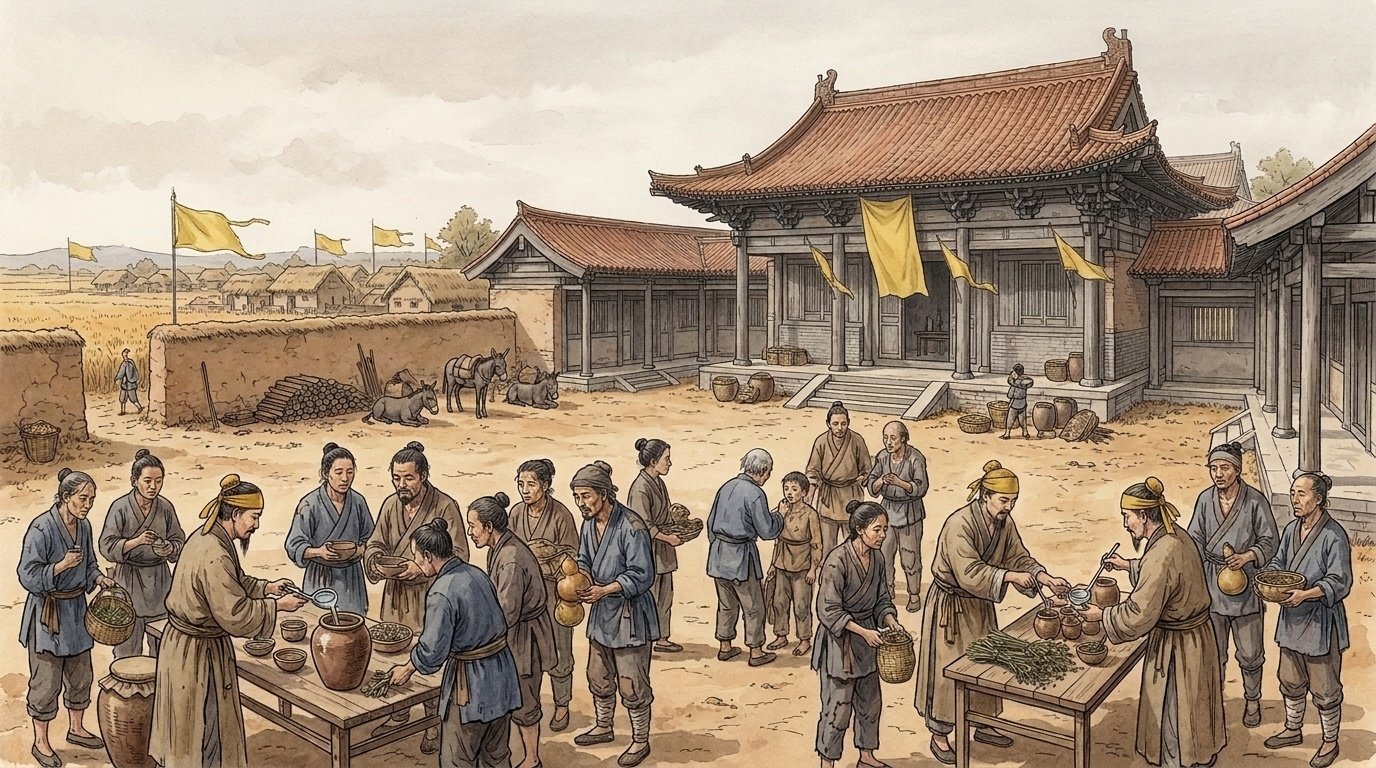
In the early 170s CE, as the great plagues devastated northern China, Zhang Jue and his brothers transformed this theology into a mass religious movement: the Taiping Dao (太平道)—the “Way of Great Peace.” Zhang Jue proclaimed himself the Great Virtuous Teacher (Da Xian Liang Shi, 大賢良師). Armed with a nine-jointed bamboo staff (jiujie zhang), wearing coarse yellow robes, Zhang Jue and his disciples fanned out across the famine-stricken hamlets of the Central Plains, offering free, miraculous medical treatment to the dying.
Their healing methodology was an intoxicating mix of psychotherapy, religious ritual, and folk medicine. When an infected peasant came to Zhang Jue, the prophet did not demand money; he commanded the patient to prostrate himself upon the earth, kowtow to Heaven, and publicly confess all his sins and moral transgressions (koutou si guo). Disease was understood as the physical manifestation of unconfessed cosmic guilt. Once the patient had wept and confessed, Zhang Jue lit an incantation slip, dropped the sacred ash into a bowl of pure spring water, muttered celestial spells, and commanded the patient to drink the Talismanic Water (Fushui, 符水). Whether through the placebo effect, psychological release, or the herbal properties of the ash, tens of thousands of desperate peasants recovered from their fevers. The word spread across the Yellow River with lightning velocity: a living god had descended to earth, who could cure the dying without a single copper coin, while the corrupt Han emperor in Luoyang sat counting his stolen gold.
4. The Thirty-Six Fang: Constructing the Shadow State
What transformed the Taiping Dao from a localized religious healing cult into an existential threat to the imperial dynasty was Zhang Jue’s extraordinary organizational genius. Within ten short years (174–184 CE), the movement grew from a few hundred disciples into a colossal, disciplined religious confederation numbering several million active followers, spanning eight of the empire’s thirteen provinces: Qing, Xu, You, Ji, Jing, Yang, Yan, and Yu.
To manage this massive, continent-spanning demographic wave, Zhang Jue created a sophisticated, clandestine administrative and military hierarchy: the Thirty-Six Fang (Sanshiliu Fang, 三十六方). A fang was a regional operational division: a “Big Fang” (Da Fang) commanded upwards of ten thousand followers, while a “Small Fang” (Xiao Fang) commanded six to seven thousand. Each Fang was led by a seasoned, fanatically loyal lieutenant (a Qu Shuai), who served simultaneously as a regional high priest, faith-healer, ideological instructor, and military commander.
Beneath the nose of the imperial government, the Thirty-Six Fang functioned as an underground Shadow State. Within the Fang, traditional social hierarchies were dismantled. Rich and poor ate together at communal tables; women participated in leadership rituals; and members pooled their grain and money into common treasuries known as “Heavenly Storehouses.” The Fang held weekly religious assemblies where thousands of devotees gathered around bonfires, chanting rhythmic incantations, singing hymns of Great Peace, and submitting to military drill under the cover of religious dance. Sima Qian’s successor Fan Ye records that so pervasive was the movement that regional magistrates and commandery governors, terrified of the popular enthusiasm or having secretly converted themselves, completely failed to report the gathering military storm to the court in Luoyang.
By late 183 CE, Zhang Jue had formulated the grand ideological slogan that would serve as the battle cry of the revolution. Grounded in the ancient Five Elements (Wuxing) cosmology, the slogan was an intellectual declaration of cosmic war:
“The Azure Sky is dead; the Yellow Sky must arise!
— Slogan of the Yellow Turban Rebellion, 184 CE
In the year of Jiazi, there shall be great good fortune under Heaven!”
(蒼天已死,黃天當立;歲在甲子,天下大吉!)
The cosmological symbolism of these sixteen characters was instantly understood by every peasant and scholar in the empire. In Han cosmology, the Eastern Han dynasty was associated with the Element of Fire, which governed the “Azure Sky” (Cang Tian). By proclaiming that the Azure Sky was dead, Zhang Jue announced that the Mandate of Heaven had officially expired. In the natural generative cycle of the Five Elements, Fire generates Earth; and the Element of Earth was symbolized by the color Yellow (Huang)—the color of the sacred loess soil, the color of the ancient benevolent Yellow Emperor, and the color of the “Yellow Sky” (Huang Tian) of Great Peace. The year 184 CE was the year of Jiazi—the very first year of the sixty-year sexagenary cycle—representing the cosmic moment when time itself was reborn. Across the cities of the empire, disciples walked through the night using white clay to chalk the characters “Jiazi” (甲子) onto the wooden gates of provincial government yamens and imperial offices, marking them for destruction.
5. The Betrayal and the Midnight Call to Arms (Second Month, 184 CE)
Zhang Jue’s original operational plan was a masterpiece of synchronized, simultaneous insurrection. He had designated the fifth day of the third lunar month in 184 CE as the universal date of uprising. On that single morning, all Thirty-Six Fang across eight provinces were scheduled to seize their local county seats simultaneously. Most audacious of all, Zhang Jue had established deep intelligence networks inside the imperial palace in Luoyang itself: two high-ranking palace eunuchs, Feng Xu (封諝) and Xu Feng (徐奉), had secretly converted to the Taiping Dao and agreed to open the palace gates from the inside when the rebel armies reached the capital.
The conspiracy was unmasked by a sudden, fatal betrayal. In the first month of 184 CE, Zhang Jue dispatched a high-ranking disciple named Ma Yuanyi to Luoyang to finalize the coup coordinates with the rebel eunuchs. Serving under Ma Yuanyi was a man named Tang Zhou (唐周). Seized with sudden panic, or enticed by the promise of immense imperial rewards, Tang Zhou defected. He slipped into the yamen of the high chancellery and revealed the entire blueprint of the conspiracy: naming the thirty-six regional commanders, identifying the fifth day of the third month as the date of uprising, and exposing the treasonous eunuchs Feng Xu and Xu Feng inside the palace.
The court of Luoyang erupted into hysterical terror. Emperor Ling ordered the immediate arrest and execution of the eunuchs Feng Xu and Xu Feng. Imperial guards raided the inns and compounds of Luoyang, arresting Ma Yuanyi and over one thousand Taiping disciples, who were publicly bisected at the waist in the marketplace. Fast couriers riding imperial post-horses were dispatched across the empire commanding the immediate arrest and slaughter of all known followers of the Taiping Dao.
Recognizing that his master blueprint had been compromised and that his followers faced immediate extermination in their beds, Zhang Jue made a lightning command decision. Rather than waiting for the third month, he dispatched secret riders carrying the nine-jointed staff throughout the provinces, issuing the immediate, emergency order: “Arise tonight!” In the second month of 184 CE, a month ahead of schedule, the Yellow Turban Rebellion exploded across China.
6. The Yellow Flood: A Continent in Flames
When the signal was given, the explosion was apocalyptic in its scale, speed, and geographic dispersion. In a matter of days, hundreds of thousands of men, women, and teenagers bound strips of yellow silk, yellow linen, or yellow rags around their foreheads, declaring themselves soldiers of the Yellow Sky. Sima Qian’s successor Fan Ye records the terrifying speed of the insurrection:
“In the eight provinces of Qing, Xu, You, Ji, Jing, Yang, Yan, and Yu, the people rose up in unison! The Yellow Turbans burned government offices, plundered the towns and villages; the commandery governors and county magistrates abandoned their seals and fled into the hills, or were butchered upon their seats. Within ten days, the entire world shook with rebellion; the capital in Luoyang trembled with terror!”
— Fan Ye, Hou Hanshu (Book of the Later Han), Chapter 71: “Biographies of Huangfu Song and Zhu Jun”
Zhang Jue declared himself the General of Heaven (Tian Gong Jiangjun, 天公將軍); his brother Zhang Bao declared himself the General of Earth (Di Gong Jiangjun); and his youngest brother Zhang Liang declared himself the General of Humanity (Ren Gong Jiangjun). Together, the three brothers commanded the theological trinity of the cosmos. In Hebei, Zhang Jue crushed imperial garrisons, overrunning the ancient cities of the Central Plains. In Henan, the rebel general Bo Cai routed the imperial armies of General Zhu Jun, pushing his frontlines within striking distance of the capital. In Nanyang, the rebel commander Zhang Mancheng killed the Han commandery administrator Chu Gong and besieged the metropolitan citadel.
The Yellow Turban warriors fought with terrifying, ecstatic fanaticism. Believing that Zhang Jue’s talismans, sacred yellow amulets, and incantations rendered them immune to bronze blades and iron arrows, chanting hymns of Great Peace, the peasant armies charged into battle bare-chested, overwhelming professional imperial garrisons by sheer weight of numbers and religious raptures. When charging, they shouted in unison: “The Yellow Sky Arises! Immortality in Great Peace!” They carried yellow standards painted with celestial trigrams, drove ox carts loaded with sacred incense braziers into combat, and were preceded by priest-heralds sounding conch shells and beating clay drums.
The symbols of imperial authority—tax ledgers, household registers, county boundary markers, and magistrate yamens—were systematically put to the torch. Private debt contracts held by wealthy usurers were dragged into the public squares and incinerated in colossal bonfires. Granaries were breached, and grain was distributed freely to the starving crowds. For a terrifying interlude of several months, the four-hundred-year-old Han dynasty appeared to have been utterly drowned beneath a rising yellow sea, while the smoke from burning county seats blackened the skies within fifty miles of the imperial palaces of Luoyang.
7. The Imperial Counter-Strike: The Imperial Three Generals
Awakening to the reality that his throne was on the edge of destruction, Emperor Ling and his court were forced to take desperate, radical measures. At the urging of the reformist minister Huangfu Song and Grand General He Jin, Emperor Ling executed a critical political retreat: he officially repealed the Partisan Prohibitions (Jie Danggu), pardoning all imprisoned Confucian scholars and inviting the intellectual elite to join the military defense of the empire. Emperor Ling then opened his private imperial treasury in the Western Garden, releasing millions of ounces of gold and thousands of horses to equip new expeditionary armies.
The supreme operational command of the imperial counter-offensive was entrusted to three brilliant, hardened professional commanders—the Three Generals of the Late Han: Huangfu Song (皇甫嵩), Zhu Jun (朱儁), and Lu Zhi (盧植). Accompanying these imperial armies was an ambitious thirty-year-old cavalry officer who would one day dominate China: Cao Cao (曹操), serving as Cavalry Commandant (Qiduwei).
The operational turn occurred in the fifth month of 184 CE at the city of Changshe (長社, modern Henan). The imperial army under Huangfu Song was surrounded inside the walls by hundreds of thousands of Yellow Turbans commanded by Bo Cai. Outnumbered ten to one, the imperial soldiers were paralyzed with terror. But Huangfu Song, a master of environmental warfare, observed the enemy camp from the city towers: the Yellow Turbans had constructed their vast encampments out of dry grass, reed huts, and bamboo screens along the windward plain.
In the dead of night, as a ferocious gale arose, Huangfu Song ordered his elite shock troops to scale down the city walls carrying torches. Infiltrating the rebel camp, they set fire to the dry grass. The wind transformed the encampment into a wall of flame. As the sky burned red, Huangfu Song opened the city gates, beat his war drums, and charged into the smoke. The Yellow Turbans, blinded by flames and terrified by the sudden night attack, disintegrated into mass panic. At that precise moment, Cao Cao arrived on the field at the head of a relief division of heavy imperial cavalry. Trapped between Huangfu Song’s infantry and Cao Cao’s charging horsemen, over fifty thousand Yellow Turbans were slaughtered in a single morning. The siege of Changshe was broken, and the southern arm of the rebellion never recovered.
8. The Meat-Grinder at Guangzong: The Death of the Brothers (Winter 184 CE)
With the southern front stabilized, the entire weight of the imperial war machine swung north into Hebei to confront the supreme prophet himself. In the autumn of 184 CE, Huangfu Song marched on the rebel stronghold of Guangzong (廣宗, modern southern Hebei), where Zhang Jue had concentrated his elite northern divisions.
Before the final clash occurred, cosmic tragedy struck the rebellion from within: Zhang Jue died of severe illness in his command tent. The man who had cured hundreds of thousands of plague victims with talismanic water succumbed to physical exhaustion and fever, passing away before he could witness the fate of his holy war. Command of the northern army passed to his younger brother, Zhang Liang.
Hearing of Zhang Jue’s death, Huangfu Song feigned military hesitation. For several weeks, the imperial army remained passive behind its ramparts, ceasing all offensive maneuvers. Assuming that the imperial soldiers were exhausted and demoralized, the Yellow Turbans grew complacent, slackening their guards and indulging in religious feasts. On a freezing night in the tenth month, Huangfu Song ordered his soldiers to take dry rations, strap down their armor, and launch a lightning assault at 3:00 AM.
The resulting battle was an uninterrupted, twelve-hour meat-grinder. Sima Qian’s successor Fan Ye writes that the Yellow Turbans fought with ferocious, suicidal fanaticism, knowing that no quarter would be granted. In desperate, hand-to-hand combat across the frozen trenches, Huangfu Song personally led his troops, decapitating over thirty thousand rebels on the ramparts, while another fifty thousand were driven into the Qing River, drowning in the icy waters. The General of Humanity, Zhang Liang, was cut down in the melee.
Huangfu Song marched into Guangzong. He ordered Zhang Jue’s newly dug burial mound blasted open. The corpse of the “Great Virtuous Teacher” was dragged into the mud, subjected to posthumous decapitation with an imperial axe, and his severed head was dispatched in a wooden box to the capital at Luoyang to be displayed on a spike in the marketplace. The remaining rebel brother, Zhang Bao (the General of Earth), was cornered one month later at the battle of Quyang by Huangfu Song and Guo Dian: over one hundred thousand Yellow Turbans were slaughtered, Zhang Bao was decapitated, and Huangfu Song constructed a colossal Jingguan (京觀)—a monumental pyramid of severed enemy skulls covered with earth—containing over one hundred thousand human heads on the Hebei plain. By the twelfth month of 184 CE, precisely ten months after it had begun, the central leadership of the Yellow Turban Rebellion had been utterly annihilated.
9. The Cure That Killed the Patient: The Rise of Autonomous Warlords
In traditional dynastic annals, the conclusion of 184 CE was celebrated as a glorious imperial triumph. Emperor Ling held lavish banquets, changed the imperial era name to Zhongping (“Neutral Peace”), and rewarded his victorious generals with gold and high titles. Yet in reality, the Eastern Han dynasty had suffered a fatal, mortal wound from which it would never recover.
Although the three Zhang brothers were dead, the structural causes of the uprising—rural poverty, landlessness, famine, and administrative corruption—remained entirely unaddressed. In the mountains, forests, and ravines across northern and central China, surviving fragments of the Yellow Turbans coalesced into massive, independent guerrilla insurgencies. In the Taihang Mountains of Shanxi and Hebei, the Black Mountain Bandits (Heishan Zei) under Zhang Yan mobilized over one million followers, constructing independent mountain forts that defied imperial tax collectors for twenty years. Along the Fen River, the White Wave Bandits (Baibo Zei) pillaged commanderies at will; while in Shandong and Henan, the Qingzhou Yellow Turbans commanded upwards of three hundred thousand armed fighters. The empire was permanently on fire, and the small standing army in Luoyang was completely helpless to suppress them.
Confronting this endless, hydra-headed guerrilla war, the imperial court in 188 CE adopted what proved to be the most suicidal administrative policy in Chinese history. At the recommendation of the imperial clan member Liu Yan, Emperor Ling issued a decree Converting Regional Inspectors into Autonomous Governors (Gai Ci Shi Wei Zhou Mu, 改刺史為州牧). Previously, provincial inspectors (Cishi) had possessed only administrative and investigative oversight, while military forces remained strictly divided between commandery administrators and the central court. Under the new decree, provincial governors (Zhou Mu) were granted absolute, unitary authority over all civilian administration, tax collection, and military mobilization within their multi-province jurisdictions.
This single decree signed the death warrant of the Han Dynasty. Overnight, the centralized bureaucratic empire dissolved into a patchwork of independent, militarized fiefdoms. Ambitious, ruthless men who had won fame suppressing the Yellow Turbans—Cao Cao in the Central Plains, Yuan Shao in Hebei, Sun Jian in the south, Liu Bei with his sworn brothers Guan Yu and Zhang Fei in the northern marcher-lands, and the barbaric frontier general Dong Zhuo in the northwest—now commanded private standing armies beholden to them alone.
The most fascinating historical irony of this warlord era was how the Yellow Turbans were absorbed by their conquerors. In 192 CE, when over three hundred thousand Qingzhou Yellow Turbans invaded Yan province, Cao Cao defeated them through brilliant maneuver. But rather than slaughtering the defeated rebels, Cao Cao incorporated the best one hundred thousand Yellow Turban warriors, along with their families and children, directly into his private army, christening them the Qingzhou Troops (Qingzhou Bing, 青州兵). These former religious fanatics became the fanatically loyal, shock-infantry core of Cao Cao’s armies, carrying him to victory over Yuan Shao at the Battle of Guandu in 200 CE and laying the foundation for the Kingdom of Wei. The very peasant army that had sought to destroy the Han became the instrument that buried it.
When Emperor Ling died in 189 CE, the final thin veneer of imperial authority collapsed. The palace guards clashed with the eunuchs, slaughtering two thousand castrates in the courtyards. Exploiting the vacuum, the ruthless frontier general Dong Zhuo marched his hardened cavalry into Luoyang. Dong Zhuo deposed the young Emperor Shao, placed the eight-year-old Emperor Xian on the throne as a terrified hostage, burned the four-hundred-year-old capital of Luoyang to the ground, excavated the imperial tombs of the Han emperors to plunder their jade and gold, and forcibly relocated the court to Chang’an. The Pax Sinica of the Han was permanently extinguished; the four-hundred-year dynastic cycle was over, replaced by the bloody, fractured romance of the Three Kingdoms.
10. Millenarianism in the Chinese DNA: From Five Pecks to the Taiping Heavenly Kingdom
The Yellow Turban Rebellion was not merely a unique, isolated explosion in late Han military annals; it was the foundational archetype that established the enduring, powerful tradition of Religious Millenarian Revolution in Chinese civilization.
Operating simultaneously with the Yellow Turbans was another popular Daoist movement in the southwest: the Way of the Five Pecks of Rice (Wudoumi Dao, 五斗米道), founded in the mountains of Sichuan by Zhang Daoling and consolidated by his grandson Zhang Lu. Unlike Zhang Jue’s violent apocalyptic collision with the Eastern Han state, Zhang Lu established a remarkably stable, autonomous theocratic proto-state in the Hanzhong basin that survived for over thirty years. Zhang Lu established communal “Charity Inns” (Yishe) providing free meat, grain, and shelter to travelers, treated disease through spiritual confession and herbal medicine, and organized his society into twenty-four parishes (zhi) governed by “Libationers” (Jijiu). When Cao Cao marched on Hanzhong in 215 CE, Zhang Lu sealed the state treasuries and peacefully surrendered, securing formal imperial recognition for the Tianshi Dao (Way of the Celestial Masters)—the institutional foundation of modern liturgical Daoism that endures across China, Taiwan, and the global Chinese diaspora today.
Across the subsequent two millennia of Chinese imperial history, whenever an agrarian dynasty entered its twilight phase of land consolidation, official corruption, tax exhaustion, and ecological catastrophe, the ghost of Zhang Jue inevitably returned. From the Maitreya Buddhist rebellions of the Northern and Southern Dynasties, to the Manichaean uprisings of the Tang and Song, to the Red Turban Rebellion that toppled the Mongol Yuan dynasty, and the White Lotus Society (Bailian Jiao) that bankrupted the Qing dynasty in the late eighteenth century, the sociological template remained remarkably identical:
1. A charismatic prophet offering miraculous faith-healing and moral confession amid devastating disease and famine;
2. A sacred apocalyptic scripture foretelling the imminent destruction of the corrupt ruling house and the birth of an egalitarian golden age;
3. The abolition of private property and the communal pooling of grain and wealth in shared treasuries;
4. A military organization disguised beneath the liturgical structure of local religious parishes; and
5. A mass, suicidal peasant martyrdom that permanently shatters the military capacity of the imperial state.
This lineage reached its ultimate, colossal manifestation in the mid-nineteenth century with Hong Xiuquan and the Taiping Heavenly Kingdom (Taiping Tianguo, 1851–1864). Borrowing the very term “Taiping” (Great Peace) that Zhang Jue had emblazoned on his banners seventeen centuries earlier, Hong Xiuquan fused Protestant Christian tracts with ancient Chinese millenarianism, mobilizing millions of dispossessed southern peasants, establishing the Heavenly Capital at Nanjing, and waging the bloodiest civil war in human history, which claimed upwards of twenty to thirty million lives. Zhang Jue invented the grammar of Chinese ideological revolution. He proved that when the Confucian elite fails to provide physical security and economic justice to the peasantry, the Chinese countryside will not simply die in silence: it will bind its brow in yellow, invent a new religion, and tear the empire down to the bare earth.
11. Historiographical and Religious Legacy: The Birth of Popular Daoism
For seventeen centuries, orthodox Confucian historiography treated the Yellow Turbans with unreserved horror, disgust, and moral condemnation. In the traditional imperial annals, from Fan Ye’s Hou Hanshu to Sima Guang’s monumental eleventh-century Zizhi Tongjian (Comprehensive Mirror in Aid of Governance), Zhang Jue and his brothers were branded as “Demon Bandits” (Yao Zei) and “Yellow Scoundrels” (Huang Jin)—cunning sorcerers who used demonic magic, poisoned water, and heretical lies to trick honest, gullible peasants into destroying the sacred ancestral order of the Son of Heaven. In Luo Guanzhong’s fourteenth-century epic novel Romance of the Three Kingdoms (Sanguo Yanyi), the opening chapters establish the moral polarity of the entire classic by depicting Zhang Jue as an evil sorcerer summoning winds, rain, and ghost warriors through black magic, who must be defeated by the righteous Confucian heroes Liu Bei, Guan Yu, and Zhang Fei.
In the twentieth century, with the rise of modern Marxist historiography and the Chinese Communist revolution, the historical evaluation of the Yellow Turbans was subjected to a complete, revolutionary inversion. Led by historians such as Guo Moruo, Fan Wenlan, and Jian Bozan, Chinese scholarship re-evaluated the Yellow Turbans not as demonic bandits, but as the Supreme Heroic Peasant Revolution of antiquity. Zhang Jue was celebrated as a primitive communist revolutionary who fought against feudal landlord exploitation, organized the dispossessed agrarian masses, and struck the mortal blow against the corrupt slaveholder-gentry class of the Eastern Han.
Modern religious studies, anthropological research, and intellectual history take a far more profound, balanced view. International scholars such as Kristofer Schipper, Michel Strickmann, Terry Kleeman, and Anna Seidel have demonstrated that the Yellow Turban Rebellion was the explosive, bloody birth-labor of Institutional Chinese Popular Religion. Prior to 184 CE, Chinese religion consisted of state sacrificial rituals conducted exclusively by the emperor and high ministers, alongside localized, fragmented shamanic spirit-cults. The Taiping Dao and the Celestial Masters created the world’s first popular, congregational Chinese religion: with voluntary memberships, communal liturgical practices, written scriptures, a professional pastoral clergy, and a universal moral code accessible to every human being regardless of birth, wealth, or gender.
The sixteen characters chalked on the gates of Luoyang in 184 CE did not merely announce the end of an emperor; they announced that the common people of China had discovered their own collective soul. When the Han Dynasty fell, the classical Confucian synthesis that had bound politics, cosmology, and morality together for four hundred years was shattered forever. Out of the ashes of that ruin emerged the complex, pluralistic world of medieval China—where Daoist mystery, Buddhist transcendence, and aristocratic individualism would flourish across the fractured landscape of the Three Kingdoms and the Six Dynasties. In the final analysis, the Yellow Turbans did not merely herald the twilight of an imperial house; they fundamentally redefined the spiritual boundaries of what it meant to be Chinese.
The legacy of the Taiping Dao also permanently transformed the religious landscape of medieval China. While the political and military rebellion was suppressed in blood, its ideological principles—apocalyptic messianism, egalitarian communal sharing, faith healing through repentance, and congregational governance—were absorbed and institutionalized by the Way of the Celestial Masters (Tianshi Dao 天师道) in Sichuan. Taoism evolved from a quietist philosophical school into an organized, congregational liturgical religion capable of providing spiritual solace and communal solidarity to millions of displaced commoners throughout the centuries of division that followed.
12. Classical Chapters, Daoist Scripture Fragments, and Scholarly Bibliography
Primary Classical Sources:
Fan Ye (范曄). (c. 445 CE). Hou Hanshu (後漢書, Book of the Later Han). Chapter 8: “Xiaolingdi Ji” (Annals of Emperor Xiaoling); Chapter 71: “Huangfu Song Zhu Jun Liezhuan” (Biographies of Huangfu Song and Zhu Jun); Chapter 75: “Liu Yan Yuan Shu Liezhuan”. Critical edition by Zhonghua Book Company, Beijing, 1965.
Chen Shou (陳壽). (c. 280 CE). Sanguozhi (三國志, Records of the Three Kingdoms). With historical annotations by Pei Songzhi (429 CE). Chapter 1: “Wudi Ji” (Annals of Emperor Wu / Cao Cao); Chapter 6: “Dong Zhuo Zhuan”; Chapter 8: “Zhang Lu Zhuan”. Beijing: Zhonghua Book Company, 1959.
Sima Guang (司馬光). (1084 CE). Zizhi Tongjian (資治通鑑, Comprehensive Mirror in Aid of Governance). Fascicles 58 and 59: “The Reign of Emperor Ling of Han”. Beijing: Zhonghua Book Company, 1956.
Daoist Canonical Scriptures:
Taiping Jing Hejiao (太平經合校, Collected Critical Collation of the Scripture of Great Peace). Reconstructed from the Ming Daozang and Dunhuang manuscript fragments (Pelliot chinois 3237). Edited by Wang Ming (1960; revised 1979), Beijing: Zhonghua Book Company.
Modern Scholarly Studies:
de Crespigny, Rafe. (1989). Emperor Huan and Emperor Ling: Being the Chronicle of Later Han for the Years 157 to 189 AD. Canberra: Australian National University Faculty of Asian Studies Monographs. ANU Open Research Repository
de Crespigny, Rafe. (2010). Imperial Warlord: A Biography of Cao Cao 155–220 AD. Leiden: E. J. Brill. Authoritative military analysis of the Yellow Turban campaigns, pp. 28–54. doi:10.1163/ej.9789004185227.i-554
Kleeman, Terry F. (1998). Great Perfection: Religion and Ethnicity in a Chinese Millennial Kingdom. Honolulu: University of Hawaiʻi Press.
Overmyer, Daniel L. (1976). Folk Buddhist Religion: Dissenting Sects in Late Traditional China. Cambridge, MA: Harvard University Press.
Schipper, Kristofer, & Verellen, Franciscus (eds.). (2004). The Taoist Canon: A Historical Companion to the Daozang. 3 vols. Chicago: University of Chicago Press.
Seidel, Anna. (1969). La divinisation de Lao tseu dans le taoïsme des Han. Paris: Publications de l’École Française d’Extrême-Orient.
Strickmann, Michel. (2002). Chinese Magical Medicine. Edited by Bernard Faure. Stanford: Stanford University Press.