The Feast at Swan Goose Gate and the Chu-Han Contention
In the winter of 206 BCE, beneath the cold silk pavilions of Hongmen on the loess plain outside the smoldering ruins of the Qin capital of Xianyang, a dinner party was convened that would permanently decide the institutional destiny of East Asian civilization. On one side of the wine vessels sat Xiang Yu (項羽)—the aristocratic titan of Chu, a hereditary general of terrifying physical stature, unmatched martial genius, and feudal pride, who commanded four hundred thousand victorious warriors. On the other sat Liu Bang (劉邦)—a vulgar, middle-aged peasant constable from the marshlands of Pei, who possessed neither pedigree nor military brilliance, but commanded one hundred thousand men and had arrived first inside the imperial mountain passes. Over flagons of warmed millet wine, amid the tense glint of drawn bronze broadswords during the celebrated “Sword Dance of Xiang Zhuang,” the two men enacted the supreme psychological duel of antiquity. The four-year civil war that followed—the legendary Chu-Han Contention (楚漢相爭, 206–202 BCE)—was not merely a clash between two charismatic warlords, but an existential battle between two incompatible models of political organization: the restoration of the decentralized, aristocratic feudal order of the Zhou, or the preservation of the centralized, bureaucratic imperial state of the Qin. When the struggle concluded on the frozen banks of the Wu River with Xiang Yu’s theatrical suicide, the peasant had vanquished the aristocrat, cementing the bureaucratic imperial model that would govern China under the name of the Han dynasty for four centuries.
1. The Post-Qin Apocalypse: The Spark at Dazexiang (209 BCE)
The First Emperor of Qin, Qin Shi Huang, had envisioned an empire that would endure for ten thousand generations. Through standardization of script, currency, weights, and axle-widths, the abolition of feudal appanages, and the ruthless enforcement of Shang Yang’s Legalist penal codes, Qin had constructed a colossal, centralized administrative machine. Yet in doing so, Qin had stretched the human fabric of Chinese society beyond its physical endurance. Millions of peasant conscripts were worked to death building the Great Wall across the northern frontier, cutting the Lingqu canal through the southern jungles, constructing the monumental Epang Palace, and excavating the First Emperor’s subterranean necropolis at Mount Li.
When Qin Shi Huang died suddenly during an eastern inspection tour in 210 BCE, the empire fell into the hands of the Second Emperor, Huhai—a weak, sadistic puppet manipulated by the unscrupulous palace eunuch Zhao Gao. Zhao Gao launched a reign of white terror in Xianyang, executing imperial princes, massacring veteran ministers like Li Si and Meng Tian, and drastically ratcheting up penal quotas. The slightest administrative delinquency was punished with facial tattooing, nasal amputation, or bisection at the waist. The empire had become a vast, dry tinderbox awaiting only a spark.
That spark was struck in the seventh month of 209 BCE in the rain-sodden marshes of Dazexiang (大澤鄉, in modern Anhui province). A detachment of nine hundred impoverished peasant conscripts was marching under armed escort toward the northern frontier garrison of Yuyang. Heavy, relentless summer downpours washed out the roads, swelling the rivers and rendering forward transit physically impossible. Under the uncompromising statutes of the Qin penal code, failure to report to a military post by the designated calendar date was an absolute capital offense: the entire detachment faced mandatory execution by beheading.
Seeing that death was mathematically certain whether they advanced or retreated, two low-ranking conscript squad leaders—Chen Sheng (陳勝) and Wu Guang (吳廣)—gathered their desperate comrades around a campfire in the reeds. Chen Sheng uttered the immortal question that shattered two millennia of hereditary aristocratic myth:
“If we flee, we die; if we raise an uprising, we die. Since death is certain in either case, is it not far better to die striving for a kingdom? Can it be that kings, nobles, generals, and chancellors are born with a unique bloodline?!” (王侯將相寧有種乎!)
— Chen Sheng’s Declaration, Shiji (Records of the Grand Historian), Chapter 48: “Hereditary House of Chen She”
The nine hundred peasants slew their Qin escort officers, carved wooden staves for spears, hoisted red banners made of coarse hemp, and declared an open rebellion under the dynastic title of “Zhangchu” (Re-expanding Chu). Within weeks, the rebellion transformed into a wildfire across the Central Plains. Long-suppressed peasant communities rose up and lynched Qin magistrates; former noble lineages of the six conquered states emerged from hiding to reclaim their ancestral crowns; and imperial commanderies dissolved into anarchy. The mighty Qin totalitarian state, which had devoured six kingdoms over a century of calculated violence, cracked from within like a clay vessel in less than a year.
2. Two Men, Two Destinies: The Aristocrat and the Peasant Constable
Out of the chaotic rebel landscape of the post-Qin collapse emerged the two figures whose titanic rivalry would define the age. It would be impossible to conceive of two human beings more diametrically opposed in ancestry, physical stature, psychological temperament, and socio-cultural values than Xiang Yu and Liu Bang.
Xiang Yu (born Xiang Ji, 232–202 BCE) was the embodiment of the ancient, aristocratic feudal past. He was the scion of the most celebrated military lineage of the Kingdom of Chu: his grandfather was the revered general Xiang Yan, who had fought to the death against Qin’s six hundred thousand invaders in 223 BCE. Standing over eight feet tall according to ancient measurements (roughly six feet two inches in modern terms), endowed with Herculean physical strength capable of lifting a thousand-pound bronze ritual cauldron (ding) above his head with his bare hands, Xiang Yu was a military prodigy of terrifying intensity. In classical physiognomy, he was recorded as having “double pupils” (chongtong) in his eyes—a physical sign traditionally associated with the mythical sage-emperors Shun and King Wen of Zhou.
Xiang Yu despised bureaucratic paperwork, books, and routine administration. In his youth, when his uncle Xiang Liang attempted to teach him classical calligraphy and swordsmanship, Xiang Yu abandoned both in disgust, declaring: “Writing is useful only for recording one’s name; swordsmanship is fit only for fighting a solitary man. I wish to learn that which can defeat ten thousand men!” When he saw the First Emperor of Qin parading in his gilded carriage through Zhejiang, surrounded by imperial guards, while others bowed their heads in terror, the young Xiang Yu remarked with cold, aristocratic pride: “That man can be replaced!” Xiang Yu fought not to build an empire, but to avenge his ancestral state, restore the honor of the Chu nobility, and revive the heroic feudal world where kings ruled by personal valor and martial glory.
Liu Bang (posthumously Emperor Gaozu of Han, 256/247–195 BCE) was the complete opposite: a coarse, charismatic, cynical peasant from Zhongyang village in Pei County (modern Jiangsu). In his youth, Liu Bang was widely regarded by his father and neighbors as an incorrigible scoundrel: he refused to engage in agricultural labor, despised farming, lived off loans, frequented taverns, and fathered an illegitimate child with a local barmaid. Endowed with a prominent nose, a handsome dragon-like countenance, and seventy-two dark moles upon his left thigh, Liu Bang possessed an extraordinary, magnetic personal charm. He had the rare ability to make men of diverse backgrounds fall instantly in love with his easygoing informality and generous spirit.
Liu Bang eventually secured a humble post in the Qin local apparatus: Head of the Sishui Pavilion (Sishui Tingzhang)—effectively a village precinct constable responsible for capturing thieves, delivering official post, and escorting labor conscripts. When Liu Bang was dispatched to Xianyang on an official corvée mission, he caught a glimpse of Qin Shi Huang’s imperial cortege with its embroidered canopies and bronze-clad cavalry. Where Xiang Yu saw an enemy to be violently replaced, Liu Bang let out a long, wistful sigh of peasant admiration: “Ah! That is how a real man should live!” (嗟乎,大丈夫當如此也!)
When Liu Bang was tasked with escorting a group of convicts to Mount Li in 209 BCE, many escaped along the road. Knowing he faced execution under Qin law for permitting their escape, Liu Bang stopped at a tavern, became heavily intoxicated, untied the remaining prisoners, and told them to flee for their lives. Dozens of the convicts, deeply moved by his magnanimity, refused to leave him, declaring they would follow him wherever he went. Liu Bang retreated into the forested marshes of Mount Mangdang, gathering an army of local outlaws, peasants, and minor scribes (including his lifelong friend Xiao He, the butcher Fan Kuai, and the carriage driver Xiahou Ying). When the rebel storm broke, the aristocratic titan of Chu and the peasant rogue of Pei marched side by side under the titular banner of King Huai II of Chu, bound by a royal covenant: “Whoever first enters the Pass and subdues the land of Guanzhong shall be crowned King of Guanzhong.”
3. The Thunder at Julu: Breaking Cauldron and Sinking Boats (207 BCE)
While Liu Bang was quietly advancing westward along the southern route through Henan with a modest force, the main military weight of the Qin empire—numbering over four hundred thousand veteran troops commanded by General Zhang Han and the elite northern border general Wang Li (the grandson of Wang Jian)—swung north to annihilate the rebel state of Zhao. The Qin armies surrounded the Zhao capital at Julu (巨鹿, modern Hebei) in an iron vice, constructing fortified supply corridors (yongdao) from the Yellow River to feed the besiegers.
The rebel princes of Qi, Yan, and Wei rushed armies to relieve Julu, but when they arrived and saw the terrifying discipline of Qin’s massed crossbow formations, they built high earthen ramparts miles away and sat paralyzed, refusing to advance. Sima Qian writes that over a dozen allied armies watched from their defensive towers like frightened spectators at a theater, while the citizens of Julu starved inside the walls.
In the twelfth month of 207 BCE, the Chu relief expedition arrived on the southern bank of the Zhang River under the command of Xiang Yu. Recognizing that the allied commanders were paralyzed by terror, Xiang Yu executed the most audacious, uncompromising psychological command decision in military history. He led his fifty thousand Chu warriors across the Zhang River; the moment the entire army was on the northern shore, Xiang Yu ordered every single transport boat drilled and sunk to the bottom of the riverbed. He then ordered every soldier to smash their clay cooking cauldrons (ding), burn their tents, and take only three days of dry millet rations in their pouches.
“Xiang Yu led his troops across the river. Having crossed, he sank the boats, smashed the cooking pots, and set fire to the huts, distributing three days of rations to demonstrate to his soldiers that they must fight to the death and have no thought of returning alive!”
— Sima Qian, Shiji (Records of the Grand Historian), Chapter 7: “Basic Annals of Xiang Yu”
This legendary maneuver gave birth to the Chinese idiom “Breaking the Cauldrons and Sinking the Boats” (Po Fu Chen Zhou, 破釜沉舟)—the ultimate manifestation of Sun Tzu’s doctrine of “Placing Soldiers on Ground of Death” (Zhi Zhi Si Di Er Hou Sheng). Deprived of any retreat, facing a choice between instant starvation or fighting their way through the enemy lines, the Chu warriors transformed into raging berserkers. Roaring like thunder, each Chu soldier fought like ten men. Xiang Yu charged at the head of his heavy cavalry, smashing through Qin’s fortified supply corridors, severing Zhang Han’s logistical lifeline, and cutting his way straight into Wang Li’s headquarters.
In nine ferocious engagements, the Chu army pulverized the Qin frontline. Wang Li was captured alive; his vice-commander Su Jiao was cut down; and General She Jian burned himself to death rather than surrender. The siege of Julu was broken. When Xiang Yu summoned the allied kings and generals to his camp, Sima Qian records that the monarchs were so paralyzed with awe that they crawled on their knees through the gates of the Chu camp, unable to raise their eyes to look upon Xiang Yu’s face. At the age of twenty-five, Xiang Yu was universally proclaimed Supreme Hegemon-Commander (Shang Jiangjun) of all the armed forces of China.
4. The Race to the Pass: Liu Bang and the Three Chapters of Law
While Xiang Yu was locked in titanic, bloody combat against the bulk of the Qin military machine at Julu, Liu Bang was executing an operational masterpiece of psychological and political maneuver along the southern axis. Guided by the sublime strategic intellect of the Daoist aristocrat Zhang Liang (張良) and the brilliant scholar-advisor Li Yiji, Liu Bang understood a fundamental truth: the people of Qin were physically exhausted by Legalist tyranny and terrified of rebel vengeance. If a conqueror approached offering slaughter, the mountain passes would resist to the last stone; but if a conqueror approached offering clemency, the gates of empire would open from within.
Avoiding prolonged sieges of heavily fortified county capitals, Liu Bang used bribery, diplomatic promises of royal enfeoffment, and psychological persuasion to win over local Qin commanders. At the Battle of Wuguan (the southern mountain pass leading into Guanzhong), Liu Bang planted hundreds of allied flags on the mountain crests to exaggerate his numbers, while dispatching secret couriers carrying heavy gold bribes to the Qin commander. The pass surrendered without a major clash.
In the tenth month of 206 BCE, Liu Bang’s vanguard reached the northern bank of the Ba River, within sight of the walls of Xianyang. In the capital, the terrified eunuch Zhao Gao had assassinated the Second Emperor Huhai and placed Huhai’s nephew, Ziying, on the throne as King of Qin. Ziying immediately assassinated Zhao Gao in his bedchamber, but recognizing that the empire had dissolved beyond salvage, Ziying decided to surrender to Liu Bang.
Dressed in white mourning robes, riding in a plain unpainted carriage pulled by white horses, with a hemp rope tied around his neck in token of submission, Ziying drove out to the Ba River. In his hands he held the sacred imperial regalia: the Royal Seal of the Qin Empire (the Chuanguo Yuxi, carved from the legendary Heshi Jade) and the bronze military tallies of the realm. Many of Liu Bang’s hardened generals urged him to execute Ziying immediately to avenge the millions slaughtered by Qin over the centuries. Liu Bang refused with noble statesmanship: “King Huai dispatched me because he believed I was capable of forbearance; furthermore, when a man has already surrendered, to slay him is an evil omen!” Liu Bang accepted the surrender, placed Ziying under respectful guard, and sealed the imperial treasuries.
Upon entering the colossal palaces of Xianyang, the peasant constable from Pei was dazzled. He walked through endless halls lined with jade screens, tapestries of cloth-of-gold, storehouses piled high with millions of ounces of silver, and thousands of beautiful palace concubines. Enchanted, Liu Bang prepared to take up residence in the royal chambers. He was stopped by his fierce brother-in-law, the butcher Fan Kuai, and his chief strategist Zhang Liang, who warned him sternly: “Qin fell precisely because of its insatiable greed and luxury! We are here to pacify the realm, not to enjoy the spoils of a dying tyrant! If you sleep in these palaces tonight, you will seal your own destruction!” Chastened, Liu Bang ordered the palaces locked and sealed, returned his troops to their military camp at Bashang, and strictly forbade any looting or molestation of the civilian populace.
Liu Bang then summoned the elders, village headmen, and prominent scholars of the Guanzhong region to a grand assembly at Bashang. Standing before the terrified populace, he delivered the proclamation that permanently won the hearts of the northern Chinese civilization: the celebrated Three Chapters of Law (Yue Fa San Zhang, 約法三章):
“Elders and people of Qin, you have suffered long under the cruel laws of Qin: those who spoke critically were wiped out with their clans, and those who whispered in markets were executed in public squares. I covenant with you in three laws only:
— Liu Bang’s Proclamation to the Elders of Qin, Shiji, Chapter 8: “Basic Annals of Emperor Gaozu”
1. He who kills another shall suffer death;
2. He who injures another shall be punished according to the deed;
3. He who steals shall make restitution according to the theft.
All other statutes, decrees, and tortures of Qin are hereby abolished! Go about your daily work in peace; my soldiers are here only to protect you from outlaws.”
The psychological effect across the Guanzhong basin was an explosion of ecstatic relief. For the first time in a century, the people of Qin could breathe without fearing that their neighbor’s denunciation would bisect them at the waist. The peasantry brought cattle, sheep, and jars of wine to Bashang to feast Liu Bang’s soldiers; Liu Bang politely declined, stating that his camp possessed sufficient grain and he would not burden the populace. Sima Qian records that from that single morning, the only terror harbored by the people of Qin was that Liu Bang would not become their permanent King.
5. The Gathering Storm: Xiang Yu’s Wrath at the Hangu Pass
While Liu Bang was winning the hearts of Guanzhong through clemency, Xiang Yu was marching west from Julu at the head of a victorious, blood-drenched army of four hundred thousand men. Accompanying his Chu legions were two hundred thousand newly surrendered Qin soldiers under General Zhang Han. But as the host marched through Xin’an in modern Henan, mutual paranoia flared between the Chu conquerors and the Qin captives. The Qin soldiers whispered that if the campaign failed, the allied lords would slaughter them or transport them as slaves to the south, while their families back in Guanzhong would be executed by the Qin court for treason.
Hearing these whispers, Xiang Yu made a decision that revealed the terrifying, brutal core of his character. On a dark night outside the city of Xin’an, Xiang Yu ordered his Chu soldiers to surround the camp of the sleeping Qin captives. In a single night of industrial slaughter that mirrored Bai Qi’s atrocity at Changping, Xiang Yu ordered the Burial Alive of Over Two Hundred Thousand Surrendered Qin Soldiers (Xin’an Keng Sha). The plains of Henan were drenched in the blood of an entire generation of Qin youth. By this monstrous massacre, Xiang Yu permanently earned the burning, eternal hatred of every father, mother, wife, and child in the land of Guanzhong.
In the eleventh month of 206 BCE, Xiang Yu arrived at the mouth of the Hangu Pass. To his absolute astonishment, he found the gates barred. Guarding the pass were soldiers carrying the banners of Liu Bang! A minor advisor named Cao Wushang had urged Liu Bang to garrison the pass to keep out the allied princes so that Liu Bang could rule Guanzhong as king. Enraged beyond measure by what he viewed as the insolent betrayal of a low-born upstart, Xiang Yu unleashed his general Ying Bu (Qian Bu). The gates of Hangu Pass were smashed open, and Xiang Yu’s four hundred thousand men surged into the Wei River valley, setting up camp at Hongmen (鴻門, modern Lintong), merely forty li (less than fifteen miles) from Liu Bang’s encampment at Bashang.
The disparity of force was overwhelming: Xiang Yu commanded four hundred thousand seasoned, blood-tested warriors; Liu Bang had only one hundred thousand mixed peasant levies. Furthermore, an emissary from Liu Bang’s camp—none other than Cao Wushang himself—arrived secretly in Xiang Yu’s tent, whispering: “The Lord of Pei intends to proclaim himself King of Guanzhong, appoint Ziying prime minister, and keep all the imperial treasures for himself!” Xiang Yu’s chief counselor, the seventy-year-old master strategist Fan Zeng (whom Xiang Yu affectionately called Ya Fu, “Second Father”), urged Xiang Yu to seize this moment of absolute military supremacy to exterminate Liu Bang once and for all:
“Fan Zeng said: ‘When the Lord of Pei was in Shandong, he was covetous of wealth and obsessed with beautiful women. Now that he has entered Guanzhong, he touches neither treasure nor concubines. This demonstrates that his ambitions are not small! I have observed his astral vapors in the sky: they take the shape of five-colored dragons! This is the vapor of the Son of Heaven! Strike him down immediately; do not let him escape!'”
— Fan Zeng’s Warning, Shiji, Chapter 7: “Basic Annals of Xiang Yu”
Xiang Yu issued secret orders: at dawn the following morning, the four hundred thousand warriors of Chu would break camp, surround Bashang, and slaughter Liu Bang’s army down to the last man. The peasant constable from Pei stood on the absolute edge of total annihilation.
6. The Feast at Swan Goose Gate: The Supreme Psychological Dinner of Antiquity
The event that averted this morning massacre—and redirected the entire stream of Chinese history—was a midnight betrayal driven by ancient chivalric friendship. Xiang Yu’s uncle, Xiang Bo (項伯), was a close, sworn friend of Liu Bang’s chief strategist Zhang Liang. Fearing that Zhang Liang would perish in the impending dawn slaughter, Xiang Bo rode in the dead of night to the camp at Bashang, urging Zhang Liang to flee with him. Zhang Liang replied with noble Confucian integrity: “I was assigned by the King of Han to escort the Lord of Pei; to abandon him in his hour of mortal peril is unrighteous. I must inform him.”
Zhang Liang rushed to Liu Bang’s tent. Hearing the terrifying news, Liu Bang panicked, dropping his wine cup: “What shall I do?!” Zhang Liang asked: “Can your soldiers defeat Xiang Yu in battle?” Liu Bang fell silent, then sighed: “I cannot match him. What recourse remains?” Zhang Liang instructed Liu Bang to exploit Xiang Bo’s sense of honor. Liu Bang brought Xiang Bo into his tent, treated him as an elder brother, poured him wine, arranged a marriage pact between their children on the spot, and swore a solemn oath that he had sealed the palaces only to await Xiang Yu’s arrival, having no intention of usurping royal title. Deeply moved, Xiang Bo agreed to act as an intermediary, returning to Hongmen that night to soften Xiang Yu’s rage, advising his nephew that to slay a comrade who had performed such great service would be an unknightly act.
At dawn the next morning, Liu Bang took the most terrifying gamble of his life. Refusing to hide behind his ramparts, he rode directly into the lion’s den at Hongmen accompanied by only one hundred elite cavalrymen, including Zhang Liang and the butcher Fan Kuai. Stepping into Xiang Yu’s grand command pavilion, Liu Bang bowed low to the earth, adopting a posture of absolute, groveling humility:
“Liu Bang said: ‘Your servant and General Xiang fought together against Qin; General Xiang campaigned north of the Yellow River, while I campaigned south. I never dreamed that I would be the first to enter the Pass and subdue Qin! Now malicious scoundrels have fabricated slander to create a rift between us. I beg the General to see the truth!'”
— Liu Bang’s Apology at Hongmen, Shiji, Chapter 7
Xiang Yu, a man of simple aristocratic vanity who could withstand any sword but was utterly disarmed by self-abasement, was completely mollified. Blurring all tactical security, Xiang Yu replied with astonishing, naive transparency: “This was not my idea; it was your own left marshal, Cao Wushang, who came to my tent and told me these things! Otherwise, why would I have doubted you?” With that single careless sentence, Xiang Yu signed Cao Wushang’s death warrant (Liu Bang had him beheaded the moment he returned to camp) and invited Liu Bang to sit down for a celebratory feast.
7. The Sword Dance of Xiang Zhuang and the Fury of Fan Kuai
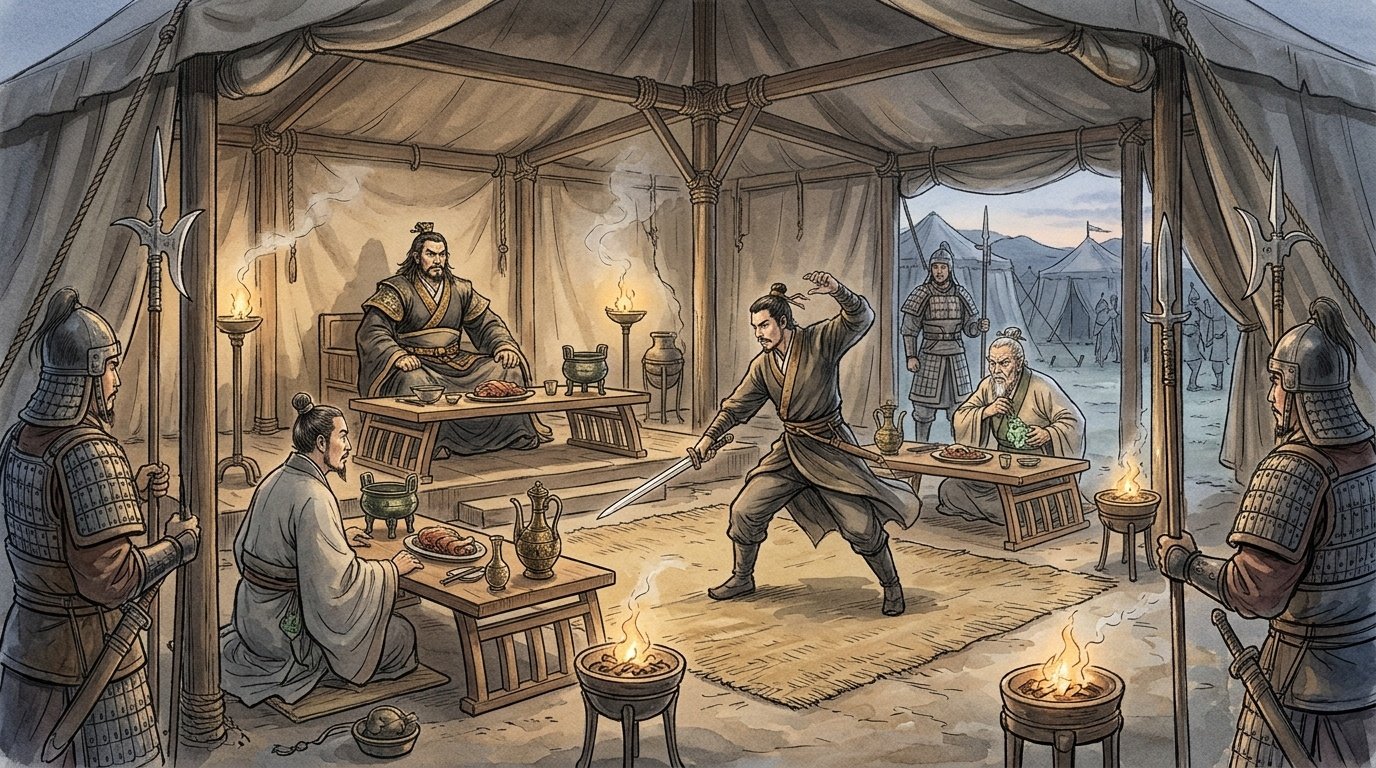
What followed within the silk walls of Hongmen was the most celebrated scene in Chinese historical literature: a masterwork of dramatic tension recorded with peerless psychological brilliance by Sima Qian. The seating arrangement within the tent reflected the raw, precarious hierarchy of power: Xiang Yu sat in the place of supreme honor, facing east; his uncle Xiang Bo sat beside him facing south; the old strategist Fan Zeng sat opposite them facing north; while Liu Bang was relegated to the humble subordinate seat facing west, with Zhang Liang attending him from the side.
Throughout the feast, Fan Zeng repeatedly signaled to Xiang Yu. Three times the old counselor lifted the jade belt-pendant (jue, 玦) hanging from his waist—a silent, urgent pun on the word for “resolution” (jue, 決)—imploring the Hegemon to give the signal to his hidden guards to drag Liu Bang out and decapitate him on the spot. Xiang Yu sat in silence, drinking wine, ignoring his counselor’s signals with haughty, aristocratic indifference.
Seeing that Xiang Yu was paralyzed by chivalric complacency, Fan Zeng stepped outside the tent and summoned Xiang Yu’s cousin, the fierce warrior Xiang Zhuang. Fan Zeng whispered frantically: “Our king has a soft heart! Step inside, propose a toast of longevity to the Lord of Pei, and request permission to perform a sword dance to entertain the guests. In the middle of the dance, strike Liu Bang down upon his mat! If you do not, our entire clan will become that peasant’s prisoners before this year is out!”
Xiang Zhuang drew his gleaming bronze broadsword, stepped into the tent, bowed to the monarchs, and began the fateful Sword Dance (Xiang Zhuang Wu Jian, 項莊舞劍). Circling the mat with leaping steps, the blade whistled closer and closer to Liu Bang’s throat. Recognizing the lethal plot, Xiang Bo leaped to his feet, drew his own broadsword, and announced that a dance was best performed with two partners. For twenty agonizing minutes, Xiang Bo used his own body and blade to parry every thrust Xiang Zhuang aimed at Liu Bang, giving birth to the immortal Chinese proverb: “Xiang Zhuang performs the sword dance, but his true target is the Lord of Pei” (Xiang Zhuang Wu Jian, Yi Zai Pei Gong, 項莊舞劍,意在沛公).
Seeing that Liu Bang was seconds from being butchered, Zhang Liang slipped out of the tent and ran to the perimeter guard line, calling to Liu Bang’s brother-in-law, the dog-butcher Fan Kuai (樊噲). Fan Kuai gripped an iron-bossed shield in his left hand and a heavy sword in his right. He charged straight toward the royal pavilion; when the elite Chu halberdiers crossed their spears to block him, Fan Kuai smashed his heavy shield into their chests, knocking the armored guards flat on their backs, and ripped open the silk doorway of the tent.
The interior of the tent fell into absolute, stunned silence. Sima Qian describes Fan Kuai standing in the doorway: his hair standing on end, his eyes blazing with such terrifying ferocity that the corners of his eyelids seemed to rip open. Xiang Yu gripped his sword hilt, leaning forward: “Who is this valiant warrior?!” Zhang Liang replied: “This is the Lord of Pei’s carriage driver and bodyguard, Fan Kuai.” Xiang Yu, an aristocratic connoisseur of primal martial courage, smiled in admiration: “A magnificent warrior! Bestow upon him a flagon of wine!” Fan Kuai knelt, drained a massive bronze beaker of wine in a single draught, and accepted a raw shoulder of pork. Placing the raw meat upon his iron shield, Fan Kuai carved it into bloody chunks with his sword and devoured it before the eyes of the Chu lords.
Xiang Yu laughed: “Can you drink more?” Fan Kuai seized this psychological opening to deliver a thunderous, unvarnished rebuke to the Supreme Hegemon:
“Your servant does not flee even from death; why should I refuse a flagon of wine?! The King of Qin had the heart of a tiger and a wolf: he executed men without count, punished men as though he feared he would never finish, and the entire world rose up in rebellion against him… The Lord of Pei arrived first inside the Pass; he touched nothing, sealed the palaces, and retreated to Bashang purely to await your arrival! For such monumental service, not only has he received no title of nobility, but you listen to petty slanderers and seek to murder a loyal brother! This is merely continuing the conduct of the dying Qin; your servant dares to suggest that such behavior is unworthy of the Great Hegemon!”
— Fan Kuai’s Rebuke at Hongmen, Shiji, Chapter 7
Xiang Yu was speechless. Unable to answer Fan Kuai’s moral indictment, he gestured: “Sit.” Fan Kuai took a seat beside Zhang Liang. A few moments later, Liu Bang feigned the need to relieve himself in the latrine. He slipped outside into the cold winter air, beckoning Fan Kuai to follow him. Standing behind the tents, Liu Bang whispered that they must escape immediately, but worried that he had not formally bid farewell. Fan Kuai uttered the famous words of ruthless political realism: “Those who accomplish great deeds do not attend to minor courtesies; those who perform great rites do not apologize for small offenses! Today they are the cleaver and chopping block, and we are the fish and meat! Why should we bid farewell?!” (大行不顧細謹,大禮不辭小讓。如今人方為刀俎,我為魚肉,何辭為!)
Liu Bang abandoned his carriage and cavalry escort. Escorted only by Fan Kuai, Xiahou Ying, and two retainers running on foot with drawn daggers, Liu Bang scrambled across the rugged loess gullies of Mount Li, fleeing back to the safety of Bashang. Back in the tent, Zhang Liang waited until he calculated that Liu Bang had reached safety. He then stepped before Xiang Yu, presenting a pair of white jade discs for the Hegemon and a pair of jade wine flagons for Fan Zeng, apologizing that the Lord of Pei had drunk too much wine and had departed in haste.
Xiang Yu accepted the white jade discs and set them admiringly beside his mat. But Fan Zeng, consumed with fury at his master’s blind stupidity, drew his broadsword, flung the jade flagons onto the dirt, and hacked them to pieces with his blade. Glaring at Xiang Yu, the old counselor roared with prophetic despair:
“Bah! This boy is unfit to be schemed for! He who steals the empire from General Xiang will assuredly be the Lord of Pei! The day is coming when all of us shall become his prisoners!”
— Fan Zeng’s Curse, Shiji, Chapter 7
The Feast at Hongmen was over. In a single afternoon, Xiang Yu had squandered the absolute military supremacy of four hundred thousand men, alienated his wisest counselor, revealed his intelligence sources, and allowed his mortal adversary to walk out the front door unharmed. The dinner table had decided the fate of the world.
8. The Grand Regression: The Eighteen Kingdoms and the Burning of Xianyang
Having allowed Liu Bang to escape, Xiang Yu marched his four hundred thousand troops into the undefended capital of Xianyang. What followed was a catastrophic demonstration of Xiang Yu’s complete inability to understand the responsibilities of imperial governance. In an explosion of aristocratic vengeance, Xiang Yu executed the surrendered King Ziying, slaughtered the entire surviving royal family of Qin, and unleashed his troops to pillage the metropolitan city. He ordered the monumental Epang Palace and the royal archives put to the torch; Sima Qian records that the fire burned uninterrupted for three full months, casting a pall of black smoke over the Guanzhong plain and incinerating millions of unique historical chronicles, scientific manuals, and classical scrolls that had survived the book-burnings of Qin Shi Huang.
Xiang Yu had no desire to rule from the centralized capital of Xianyang. When an advisor urged him to establish his imperial seat in Guanzhong—pointing out that the region was protected by impregnable mountain passes, possessed fertile loess plains irrigated by the Zhengguo Canal, and offered the ideal geopolitical base to dominate China—Xiang Yu replied with an astonishing confession of vanity: “To achieve wealth and nobility without returning to one’s homeland is like wearing embroidered silk robes to walk in the dark of night! Who will ever see your glory?!” (富貴不歸故鄉,如衣繡夜行,誰知之者!). Disgusted by the Hegemon’s petty vanity, the advisor muttered to a colleague: “People say that the men of Chu are merely monkeys wearing hats (Mu Hou Er Guan); today I see the truth of it!” Overhearing the insult, Xiang Yu ordered the advisor seized and boiled alive in a bronze cauldron.
In 206 BCE, Xiang Yu executed his catastrophic grand-strategic restructuring of China: the Enfeoffment of the Eighteen Kingdoms (Fen Feng Shiba Guo). Rejecting the centralized administrative commandery system of the Qin, Xiang Yu attempted to turn back the historical clock four hundred years, reviving the fragmented feudal order of the Spring and Autumn period. He proclaimed himself Hegemon-King of Western Chu (Xichu Bawang), establishing his capital far to the east at Pengcheng (modern Xuzhou). He partitioned the empire among eighteen victorious rebel generals and compliant kings based on personal favoritism, arbitrarily redrawing boundaries, deposing legitimate monarchs, and placing former Qin turncoats over lands they had previously oppressed.
To neutralize Liu Bang, Xiang Yu flagrantly violated the covenant of King Huai. Instead of granting Liu Bang the wealthy, strategic territory of Guanzhong, Xiang Yu partitioned Guanzhong into three buffer states—the “Three Qins” (San Qin)—granted to the three surrendered Qin generals: Zhang Han, Sima Xin, and Dong Yi. Liu Bang was banished to the remote, mountainous, malarial exile of Hanzhong (漢中) and the Sichuan basin, granted the humiliating title of King of Han (漢王). Xiang Yu calculated that trapped behind the impassable Qinling mountains, surrounded by three hostile Qin kingdoms, the peasant constable of Pei would rot in obscurity and never see the Central Plains again.
9. The Master of Logistics and the God of War: Xiao He and Han Xin
In the fourth month of 206 BCE, Liu Bang marched his demoralized army through the jagged, misty defiles of the Qinling mountains into the Hanzhong basin. To reassure Xiang Yu that he harbored no intention of returning to the east, Liu Bang followed the advice of Zhang Liang: as his soldiers crossed the precarious wooden gallery roads (zhandao)—trestle bridges cantilevered over thousand-foot rocky gorges along the mountain cliffs—Liu Bang ordered the wooden planks burned behind him. Watching the gallery roads collapse in flames into the abyss, Xiang Yu’s scouts reported that Liu Bang had permanently severed his own path back to civilization. Xiang Yu laughed and turned his armies east toward Pengcheng.
Yet inside the mountain sanctuary of Hanzhong, Liu Bang was constructing the most formidable grand-strategic triumvirate in Chinese history. While Xiang Yu relied entirely on his own personal physical strength and terror, Liu Bang possessed the supreme genius of the imperial ruler: the ability to recognize, attract, empower, and subordinate himself to men whose talents vastly exceeded his own. That triumvirate consisted of the Three Heroes of the Early Han (Han Chu San Jie): Zhang Liang for grand diplomatic strategy, Xiao He for domestic logistics and administration, and Han Xin for military command.
Xiao He (蕭何) was the administrative genius of the Han. When Liu Bang had first entered Xianyang and his generals had rushed to pillage the gold and concubines, Xiao He had sprinted to the imperial archives of the Qin chancellery, seizing all the administrative maps, population household registers (huji), tax ledgers, and geographical surveys of the empire. In Hanzhong, Xiao He used these stolen blueprints to organize an incorruptible, hyper-efficient administrative machine. For the next five years, Xiao He remained in the rear, managing agriculture, collecting grain, and raising fresh military levies, ensuring that no matter how many times Liu Bang was defeated on the battlefield, a new army with full provisions was waiting for him within weeks.
The military arm of the triumvirate was Han Xin (韓信)—widely regarded by military historians as the greatest operational strategist in East Asian history. A penniless commoner from Huai’an, Han Xin had been so impoverished in his youth that he lived on fish caught with an unbaited hook and endured the ultimate humiliation of the “Crawl Between the Thighs” (Kua Xia Zhi Ru), crawling through the legs of a local butcher who had challenged him in the marketplace rather than wasting his life in a petty street brawl. Han Xin had served as a low-ranking halberd-guard in Xiang Yu’s camp; although he repeatedly submitted brilliant operational battle plans to the Hegemon, Xiang Yu had dismissed him with aristocratic contempt as a cowardly deserter.
Fleeing to Hanzhong, Han Xin was appointed a humble grain-supply officer. Xiao He recognized Han Xin’s transcendent strategic genius and engaged in the celebrated “Pursuit of Han Xin Beneath the Moonlight” (Xiao He Yue Xia Zhui Han Xin) when the frustrated strategist attempted to desert. Xiao He returned to Liu Bang’s tent and delivered an ultimatum:
“Xiao He said: ‘If Your Majesty wishes merely to remain King of Hanzhong for the rest of your days, you have no need of Han Xin. But if you desire to contend for the supreme rule of the world, there is no one on earth except Han Xin who can formulate your plans!'”
— Xiao He’s Recommendation, Shiji, Chapter 92: “Biography of the Marquis of Huaiyin”
Liu Bang demonstrated his extraordinary capacity for decisiveness. Overcoming the furious jealousy of his veteran Pei County cronies—who expected Fan Kuai or Cao Shen to be elevated—Liu Bang ordered a grand raised altar built, cleansed himself through three days of fasting, and with solemn ceremony consecrated the penniless fugitive Han Xin as Supreme Generalissimo (Da Jiangjun) of the Han armed forces. That night, Han Xin laid out the Hanzhong Plan (Hanzhong Dui): he analyzed Xiang Yu’s fatal flaws—his alienation of the common people through atrocities, his unjust feudal enfeoffments, and his personal vanity—promising Liu Bang that by reversing these errors, the empire could be conquered in a few short years.
10. The Chu-Han War: Pengcheng, Xingyang, and Han Xin’s Northern Campaign
In the eighth month of 206 BCE, Han Xin launched the military offensive that shattered Xiang Yu’s feudal settlement: the legendary campaign known to military theory as “Openly Repair the Gallery Roads while Secretly Crossing at Chencang” (Ming Xiu Zhan Dao, An Du Chen Cang, 明修棧道,暗度陳倉). While dispatching hundreds of soldiers to ostentatiously begin the slow, impossible engineering task of repairing the burned cliffside gallery roads, Han Xin led the main Han strike force along a forgotten, overgrown mountain trail through the Chencang valley. Emerging like ghosts out of the mountains, the Han armies ambushed General Zhang Han, overran the Three Qins, and secured the entire Guanzhong basin in a lightning campaign of a few weeks. The great grain engine of the Zhengguo Canal was back in Liu Bang’s hands.
In the spring of 205 BCE, exploiting Xiang Yu’s entanglement in a brutal, protracted counter-insurgency war against rebels in Qi, Liu Bang executed a colossal strategic maneuver. Proclaiming that he was marching to avenge the murdered Emperor Yi (King Huai II, whom Xiang Yu had secretly ordered assassinated in exile), Liu Bang forged an allied coalition of five feudal kings, assembling an astronomical host of five hundred and sixty thousand men. The allied army marched east, capturing Xiang Yu’s virtually undefended capital of Pengcheng without a struggle.
What followed was an exhibition of Xiang Yu’s peerless tactical brilliance. Hearing that his capital had fallen while Liu Bang’s soldiers were indulging in drunken revels in the palace courtyards, Xiang Yu did not panic. Leaving his main army to pin down the Qi rebels, Xiang Yu selected thirty thousand elite Chu heavy cavalrymen. Moving with blinding speed along backroads, Xiang Yu struck Pengcheng at dawn from the west, catching the five-hundred-thousand-man allied host completely unawares.
The resulting Battle of Pengcheng (彭城之戰) was the greatest tactical cavalry rout in ancient warfare. Xiang Yu’s thirty thousand horsemen sliced through the disorganized allied mass like a razor through silk. By midday, over one hundred thousand allied soldiers had been slaughtered; by afternoon, another one hundred thousand had been driven into the Sui River, their drowning corpses damming the flow of the water. Liu Bang barely escaped with a dozen horsemen in a blinding dust storm, his father and wife (the future Empress Lü) captured by Chu cavalry. The allied coalition collapsed instantly, with the kings of Wei and Zhao defecting back to Xiang Yu.
For the next two years (205–203 BCE), the war settled into a grueling, multi-theater war of attrition. Along the central front around the fortified grain depots of Xingyang (滎陽) and Mount Guangwu, Liu Bang fought a desperate defensive campaign. Time after time, Xiang Yu smashed Liu Bang’s frontline fortifications; time after time, Liu Bang fled, rallied behind the next earthen barrier, and received fresh reinforcements and endless convoys of grain dispatched from Guanzhong by Xiao He. Liu Bang tied down Xiang Yu’s main army in a grinding meat-grinder, absorbing the Hegemon’s fury at colossal personal cost.
Meanwhile, along the northern theater, Han Xin was executing a masterclass in independent operational warfare. Stripped of veteran troops by Liu Bang to replenish the central front, Han Xin raised fresh peasant recruits and marched north into Shanxi and Hebei. In a succession of brilliant campaigns, Han Xin destroyed the State of Wei using wooden barrel-floats to cross the Yellow River at Puban; overran Dai; and confronted the two-hundred-thousand-man army of Zhao at the famous Battle of Jingxing (井陘之戰) in 204 BCE.
At Jingxing, Han Xin ordered his ten thousand soldiers to march out of the mountain pass at midnight, cross the river, and deploy in the famous formation of “Fighting with Backs to the River” (Bei Shui Yi Zhan, 背水一戰). In standard military manuals, deploying an army with a deep river at its back was suicidal madness, since it eliminated any line of retreat. Yet Han Xin knew that his green peasant levies would break and flee if they saw a route of escape; by pinning them against the rushing river, he forced every soldier to fight with desperate, ferocious heroism. While the Zhao host surged forward to drive the Han soldiers into the water, Han Xin dispatched two thousand light cavalrymen along mountain trails to infiltrate the abandoned Zhao camp, tearing down the Zhao flags and raising two thousand red banners of Han. Looking back and seeing their base camp flying enemy colors, the Zhao army panicked and disintegrated into a total rout. Within twelve months, Han Xin conquered Zhao, forced Yan to surrender through psychological diplomacy, and crushed a massive joint Chu-Qi army at the Battle of the Wei River, conquering the entire northern half of China and swinging around Xiang Yu’s eastern flank.
11. The Honggou Chasm and the Trap at Gaixia (202 BCE)
By late 203 BCE, Xiang Yu was physically and economically exhausted. While Liu Bang was fed by the bottomless agricultural reserves of Guanzhong and supported by Han Xin’s victorious northern armies, Chu’s supply lines were continuously severed by the guerrilla cavalry raids of Liu Bang’s ally Peng Yue. Xiang Yu’s soldiers were starving, his horses dying of malnutrition, and his trusted counselor Fan Zeng had died in exile after falling victim to a brilliant counter-intelligence plot engineered by Liu Bang’s strategist Chen Ping (who used planted rumors to convince Xiang Yu that Fan Zeng was secretly plotting with the Han).
Desperate for a reprieve, Xiang Yu agreed to Liu Bang’s proposal for peace. The two leaders signed the historic Treaty of the Honggou Canal (鴻溝和約), partitioning China into two sovereign empires along the grand irrigation canal: all lands west of Honggou belonged to Han; all lands east belonged to Chu. Xiang Yu released Liu Bang’s father and wife, struck camp, and began the long, weary march eastward back toward Pengcheng.
Liu Bang prepared to withdraw his troops west. He was stopped in his tracks by Zhang Liang and Chen Ping, who delivered the definitive lesson in ruthless realpolitik:
“Han now possesses more than half the realm, and the feudal lords all adhere to our banner; Chu’s soldiers are starving and exhausted to the bone. This is the moment when Heaven destroys Chu! If we do not seize this opportunity to strike them down, it will be what the ancients called ‘rearing a tiger only to bring disaster upon oneself’!”
— Zhang Liang and Chen Ping’s Counsel, Shiji, Chapter 8
Discarding the treaty without a second thought, Liu Bang ordered his armies to wheel around and pursue Xiang Yu’s retreating columns. Promising vast territorial kingships to Han Xin and Peng Yue, Liu Bang mobilized a colossal allied pincer force of over six hundred thousand men. In the twelfth month of 202 BCE, the allied armies converged on the frozen plains of Gaixia (垓下, in modern Anhui province), encircling Xiang Yu’s remaining one hundred thousand starving Chu veterans in an impenetrable ring of iron.
12. Songs of Chu from the Four Quarters: The Climax at Gaixia
Trapped inside his earthen ramparts at Gaixia without food or arrows, listening to the bitter winter wind howling across the loess, Xiang Yu faced the final act of his life. In the middle of the night, as recorded by Sima Qian, there drifted across the frosty no-man’s-land a sound that shattered the remaining spirit of the Chu army. From every direction around the encircling Han perimeter, hundreds of thousands of voices began singing the mournful, lyrical folk ballads of the southern kingdom of Chu: songs of harvest, winding waterways, and weeping mothers.
This was the ultimate psychological operation conceived by Zhang Liang: the legendary Songs of Chu from the Four Quarters (Si Mian Chu Ge, 四面楚歌). Xiang Yu sat bolt upright in his tent, listening in horror to the midnight melodies. He turned to his attendants in despair: “Has Han already conquered all of Chu?! How can they have so many men of Chu in their ranks?!” The starving Chu soldiers, convinced that their families had already surrendered and that the war was lost, abandoned their weapons in the dark and deserted by the thousands.
Xiang Yu rose from his couch and drank wine in his tent. Beside him sat his beloved consort, the Lady Yu (虞姬, Yu Ji), who had accompanied him through every bloody campaign of his life, and outside stood his peerless black warhorse, the steed Wuzhui (騅), which had carried him through a hundred victories. Overcome with tragic grief, the Supreme Hegemon composed and sang his immortal farewell, the Song of Gaixia (Gaixia Ge):
“My strength plucked up mountains, my might shadowed the world!
— Xiang Yu’s Farewell Song, Shiji, Chapter 7: “Basic Annals of Xiang Yu”
Yet the times are against me, and Wuzhui can run no more.
When Wuzhui runs no more, what can I do?
Ah, Yu, my Yu! What shall become of you?!”
Xiang Yu sang the verses several times, his voice cracking with tears, while Lady Yu sang in mournful harmony and the hardened commanders weeping in the corners of the tent could not bring themselves to raise their eyes. According to historical tradition, Lady Yu drew Xiang Yu’s sword, performed a final graceful dance, and slit her own throat, perishing upon the carpet so that she would not be an impediment to her lord’s escape.
At midnight, Xiang Yu mounted Wuzhui. Leading a desperate vanguard of only eight hundred elite cavalrymen, he smashed through the southern Han lines and rode desperately south toward the Huai River. By the time dawn broke, the Han general Guan Ying was pursuing him with five thousand elite horsemen. After crossing the Huai River, Xiang Yu took a wrong turn into a marshland because a local peasant deceived him with false directions. By the time he reached the northern bank of the Wu River (烏江, near modern Hexian, Anhui), only twenty-eight cavalrymen remained alive at his side.
At the riverbank, the local ferryman had drawn his boat to the shore. Recognizing the Hegemon, the ferryman urged him to board immediately: “Although the land of Jiangdong is small, its territory spans a thousand li and its people number hundreds of thousands. It is sufficient for Your Majesty to rule as king! I beg you to cross quickly; my boat is the only one here, and when the Han cavalry arrives, they will have no means to cross!”
Xiang Yu laughed with bitter, tragic nobility. He shook his head and refused to step onto the boat:
“Heaven is destroying me; what purpose is there in crossing? In the past, I crossed the river with eight thousand sons of Jiangdong marching west; today, not a single one of them returns alive with me! Even if the elders of Jiangdong should take pity on me and crown me king, with what face could I look upon their fathers and brothers? Even if they should speak no word of reproach, would I not feel shame in my own heart?!”
— Xiang Yu’s Refusal to Cross the Wu River, Shiji, Chapter 7
Xiang Yu presented his beloved stallion Wuzhui to the weeping ferryman, refusing to let the noble animal perish in combat. He then ordered his twenty-eight companions to dismount, draw their short swords, and prepare to fight on foot. When Guan Ying’s five thousand cavalrymen engulfed the small hill, Xiang Yu charged on foot into the swarm. In a final, terrifying display of martial prowess, Xiang Yu single-handedly cut down several hundred Han soldiers, suffering over a dozen severe wounds.
Glancing through the ring of enemy blades, Xiang Yu spotted a former Chu comrade, Lü Matong, who was now fighting as a cavalry commander for Han. Xiang Yu smiled through the blood running down his face: “Are you not my old friend Lü Matong? I hear that the King of Han has placed a bounty upon my head: a thousand ounces of gold and a fief of ten thousand households. Let me bestow this fortune upon you!” With those final words, Xiang Yu drew his broadsword across his own throat, collapsing dead upon the grass of the Wu River bank. He was thirty-one years of age.
13. Why the Peasant Beat the Aristocrat: The Structural Verdict
In the second month of 202 BCE, on the banks of the Fan River in Shandong, Liu Bang formally ascended the imperial throne as Emperor Gaozu, founding the glorious Han Dynasty (202 BCE – 220 CE). At a grand celebratory banquet held in the Southern Palace of Luoyang, Liu Bang asked his assembled ministers a fundamental question: “Why was I able to conquer the empire, while Xiang Yu, with all his vast strength, lost it?”
The ministers offered conventional sycophantic answers, praising Liu Bang’s benevolence and criticizing Xiang Yu’s cruelty. Liu Bang smiled, shook his head, and delivered what remains the most famous, brilliant self-assessment of executive leadership in political history:
“You know only one side of the matter, but you do not understand the other. In planning stratagems within the military tent to determine victory a thousand li away, I cannot match Zhang Liang. In pacifying the state, nurturing the people, supplying provisions, and ensuring that supply roads are never severed, I cannot match Xiao He. In commanding an army of a million men, guaranteeing victory in every battle, and seizing every fortified city, I cannot match Han Xin. These three men are heroes of our age; I was capable of employing them. This is the reason I conquered the world! Xiang Yu possessed only a single Fan Zeng, and he could not even employ him!”
— Emperor Gaozu’s Self-Appraisal, Shiji, Chapter 8: “Basic Annals of Emperor Gaozu”
Liu Bang’s triumph was not merely a victory of superior managerial talent; it was a profound Structural Victory. Xiang Yu’s grand strategy was an anachronistic tragedy: he was an aristocratic hero trying to revive a fragmented, bronze-age feudal world that had already been rendered obsolete by social and technological modernization. His division of China into eighteen squabbling kingdoms guaranteed instant civil war, while his horrific atrocities—the burial of two hundred thousand surrendered soldiers at Xin’an, the sack and burning of Xianyang, the assassination of Emperor Yi—completely alienated the common people.
Conversely, Liu Bang, despite his personal crudeness and lack of pedigree, was an instinctive, pragmatic modernizer. He recognized that the centralized administrative framework constructed by Qin—the commandery and county system, standardized laws, and bureaucratic administration—was the only structure capable of maintaining continental peace and preventing warlord anarchy. By combining the organizational efficiency of the Qin administrative machine with a humane, low-tax Confucian-Daoist cultural policy, Liu Bang created the political synthesis that allowed Chinese civilization to cohere as a unified continental identity for the next two millennia.
14. Historiographical Legacy: Sima Qian and the Tragic Hero
The literary immortality of the Chu-Han Contention is owed almost entirely to the transcendent literary genius of Sima Qian. In compiling the Shiji a century after the events, Sima Qian made a radical, controversial historiographical decision that scandalized orthodox Han imperial scholars. In structuring the twelve imperial chronicles—the Basic Annals (Benji, 本紀), which were strictly reserved for legitimate Son of Heaven monarchs who ruled China—Sima Qian did not relegate Xiang Yu to the biographical section of rebel ministers (Liezhuan). Instead, Sima Qian granted Xiang Yu his own full imperial chapter: Chapter 7, the Basic Annals of Xiang Yu.
By placing Xiang Yu among the emperors, Sima Qian recognized that while Xiang Yu had lost the physical war, he had dominated the political reality of his age through his colossal martial personality. Sima Qian’s portrait of Xiang Yu is one of the supreme achievements of tragic literature: he paints Xiang Yu not as a one-dimensional villain, but as a flawed, incandescent classical hero—a man of sublime physical courage, poetic passion, and knightly honor, who was brought down by his own blind vanity, intellectual simplicity, and tragic inability to recognize that the world had changed.
For two thousand years, the imagery of the Chu-Han Contention has saturated Chinese cultural memory. It lives in the traditional game of Xiangqi (Chinese Chess), where the blank central divide between the two armies is inscribed with the characters Chu He Han Jie—”The River of Chu and the Border of Han”—replicating the trench of the Honggou canal. It lives in Beijing Opera, where the tragic aria Farewell My Concubine (Ba Wang Bie Ji) continues to bring audiences to tears. Above all, it lives in the national name of the Chinese people: the Han (Hanren, Hanzi, Hanyu). The peasant rogue from Pei who fled in terror from the feast at Hongmen gave his dynastic title to the largest ethnic group on Earth.
15. Classical Texts, Archaeological Discoveries, and Scholarly Bibliography
Primary Classical Sources:
Sima Qian (司馬遷). (c. 94 BCE). Shiji (史記, Records of the Grand Historian). Chapter 7: “Xiang Yu Benji” (Basic Annals of Xiang Yu); Chapter 8: “Gaozu Benji” (Basic Annals of Emperor Gaozu); Chapter 48: “Chen She Shijia” (Hereditary House of Chen She); Chapter 55: “Liuhou Shijia” (Hereditary House of Marquis Liu / Zhang Liang); Chapter 56: “Chen Chengxiang Shijia” (Hereditary House of Chancellor Chen Ping); Chapter 92: “Huaiyin Hou Liezhuan” (Biography of the Marquis of Huaiyin / Han Xin); Chapter 95: “Fan Li Teng Guan Liezhuan”. Translated by Burton Watson (1961), Records of the Grand Historian: Han Dynasty I, New York: Columbia University Press. ISBN: 978-0231081658
Ban Gu (班固). (c. 111 CE). Hanshu (漢書, Book of Han). Chapter 1: “Gaodi Ji” (Annals of Emperor Gao); Chapter 31: “Chen Sheng Xiang Ji Zhuan” (Biographies of Chen Sheng and Xiang Ji); Chapter 34: “Han Peng Ying Lu Zhuan”. Beijing: Zhonghua Book Company, 1962.
Archaeological Excavations and Epigraphy:
Yinqueshan Han Bamboo Slips (銀雀山漢簡). Excavated at Linyi, Shandong, 1972. Discovered in Han Tomb No. 1, containing long-lost military treatises and historical notes on the operational campaigns of Han Xin, providing direct Western Han epigraphical confirmation of Chu-Han military formations and weapon counts. Transcribed and edited by the Yinqueshan Han Slips Group (1985), Beijing: Cultural Relics Publishing House.
Excavations at the Western Chu Capital of Pengcheng. Nanjing Museum and Xuzhou Municipal Museum. (1996). “Excavation Report of the Western Han Royal Tombs at Shizishan, Xuzhou,” Kaogu Xuebao, No. 2, revealing massive terracotta cavalry armies and jade suits illustrating the martial elite of the Chu region during the Chu-Han transition.
Modern Scholarly Studies:
Loewe, Michael. (1986). “The Former Han Dynasty,” in Denis Twitchett and Michael Loewe (eds.), The Cambridge History of China, Volume 1: The Ch’in and Han Empires, 221 B.C.–A.D. 220, Cambridge: Cambridge University Press, pp. 103–222. doi:10.1017/CHOL9780521243278
Pines, Yuri. (2012). The Everlasting Empire: The Traditional Chinese Political Culture and Its Enduring Legacy. Princeton: Princeton University Press.
Qian, Mu. (1996). Qin Han Shi (秦漢史, History of the Qin and Han Dynasties). Taipei: Commercial Press. Authoritative analysis of the sociopolitical transition from feudal aristocracy to commoner bureaucracy.
Sanft, Charles. (2014). Communication and Cooperation in Early Imperial China. Albany: State University of New York Press.
Wang, Zijin. (2006). Qin Han Bashi Nian (秦漢霸業, The Hegemonic Contention of Qin and Han). Beijing: China Renmin University Press.