Qu Yuan, the Chu Ci and the Shamanic Soul of Chu
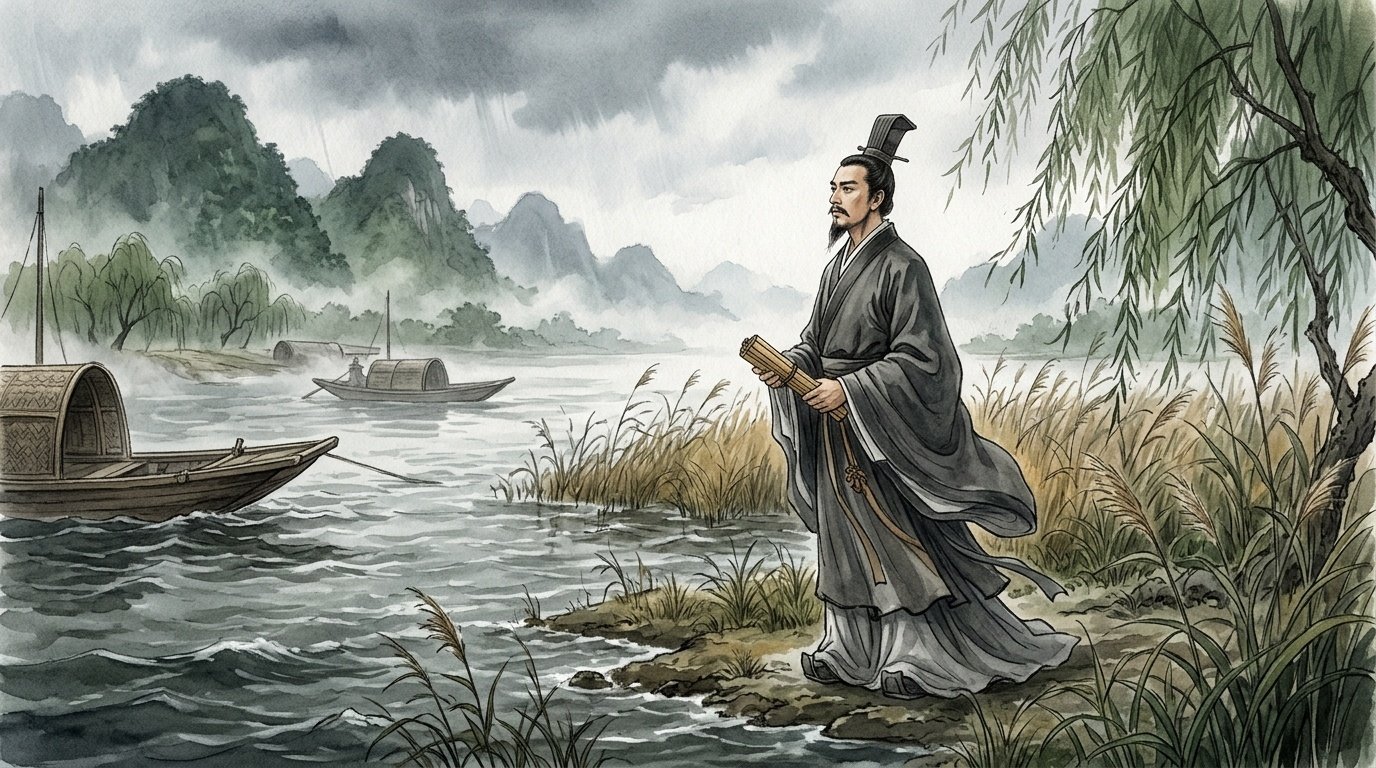
In the fifth month of the lunar calendar in 278 BCE, an emaciated, disheveled nobleman walked along the reed-choked banks of the Miluo River in modern Hunan province. Clasping a heavy river stone to his chest, he chanted verses of incandescent sorrow before stepping off the muddy bank into the swirling dark currents, choosing drowning over witness to the destruction of his ancestral homeland. That man was Qu Yuan (屈原)—high aristocrat, royal minister, diplomat, and China’s first historically identifiable poet. While the northern states of the Yellow River plain forged an empire through Legalist bureaucracy, cast iron, and disciplined legions, the southern kingdom of Chu had nurtured an entirely different civilization: an ecstatic, shamanic realm of soaring phoenixes, serpentine river spirits, fragrant orchids, and passionate ancestral mysticism. Qu Yuan’s suicide coincided precisely with the catastrophic fall of the Chu royal capital of Ying to the unstoppable armies of Qin general Bai Qi. In the verses of the Chu Ci (Songs of Chu)—most notably his monumental allegorical masterpiece, the Li Sao (On Encountering Sorrow)—Qu Yuan created not merely an agonizing elegy for a dying dynasty, but the very vocabulary of romanticism, moral dissent, and artistic integrity in the Chinese literary imagination. His death gave birth to the Dragon Boat Festival (Duanwu), embedding the tragic memory of the drowned poet into the annual ritual heartbeat of East Asian civilization.
1. The Southern Hemisphere: The Shamanic Civilization of Chu
To understand the poetry and political tragedy of Qu Yuan, one must recognize that pre-imperial China was not a culturally uniform monolith, but a civilizational dualism divided across two grand ecological and spiritual hemispheres. In the north, along the dry, yellow loess plateaus and alluvial floodplains of the Yellow River, lay the cultural ecumene of the Zhou heartland—the kingdoms of Lu, Qi, Wey, and Jin. This northern civilization was sober, patriarchal, agrarian, and historically minded. Its moral imagination was codified in the Classic of Poetry (Shijing): four-character folk ballads and court hymns celebrating communal harvest labor, dutiful filial piety, strict ancestral lineages, and ritual moderation. In the northern imagination, the cosmos was a rational, moral order governed by Heaven (Tian), where human emotion was expected to submit to ritual propriety (li).
In the south, across the sprawling, subtropical lake basins, dense bamboo jungles, and mist-veiled mountain gorges of the middle and lower Yangtze River, lay the vast, enigmatic kingdom of Chu (楚國). Spanning modern Hubei, Hunan, Anhui, Jiangxi, and southern Henan, Chu was an ecological wonderland of winding waterways, impenetrable marshes (such as the primeval Yunmeng Marsh), and abundant wildlife. Originally looked down upon by the early Zhou monarchs as southern “man” barbarians, the rulers of Chu had declared themselves independent kings (Wang) as early as the eighth century BCE—centuries before the northern feudal lords dared to usurp the royal title.
The spiritual life of Chu was completely distinct from the dry ancestor veneration of the north. Chu was an ecstatic, animistic shamanic civilization. In Chu cosmology, the boundary between the human world and the realm of the divine was fluid, permeable, and intensely sensual. The natural landscape was populated by a pantheon of radiant, volatile deities: the Lord of the Clouds (Yunzhong Jun), the God of the Yellow River (Hebo), the Mountain Goddess (Shan Gui), the Lady of the Xiang River (Xiang Jun), and the supreme stellar deity, the Great One of the Eastern Sky (Donghuang Taiyi).
These gods were not approached through rigid Confucian etiquette, but through ecstatic spirit journeys conducted by male and female shamans (wu and xi). Dressed in embroidered robes scented with aromatic pollens and mountain herbs, accompanied by the hypnotic polyrhythms of bronze bells, zithers, and clay drums, the shamans entered trance states. In these poetic, musical raptures, the shaman did not merely pray to the deity; the shaman pursued the god as a passionate, elusive lover, soaring across the heavens in chariots drawn by dragons, cavorting amid thunderclouds, and descending into weeping despair when the divine beloved retreated into the celestial void. This southern aesthetic—exuberant, mythological, saturated with botanical metaphors and eroticized spiritual longing—formed the incandescent artistic soil from which Qu Yuan’s poetry sprang.
2. Bloodline and Idealism: Qu Yuan’s Rise at the Court of Ying
Qu Yuan was not a disenfranchised outsider or an itinerant peasant scholar like Su Qin or Shang Yang; he was a prince of the blood, an aristocrat of the most elevated pedigree in the realm. Born around 340 BCE during the reign of King Wei of Chu, his personal name was Ping (平), and Yuan (原) was his courtesy name. He belonged to the illustrious Qu clan (屈氏), which, alongside the Jing (景) and Zhao (昭) lineages, constituted the Three Royal Clans (San Xing) directly descended from the ancient founding monarchs of the Chu royal house of Mi (羋姓).
Endowed with peerless intellect, commanding physical presence, and profound literary erudition, Qu Yuan rose with meteoric speed in the court of King Huai of Chu (楚懷王, r. 328–299 BCE). While still in his twenties, King Huai appointed Qu Yuan to the supreme office of Left Minister (Zuo Tu, 左徒)—a position second only to the prime minister (Lingyin). In this capacity, Qu Yuan functioned as the monarch’s chief confidential advisor, drafting imperial decrees, formulating domestic legislation, and directing foreign policy with foreign ambassadors in the capital of Ying (modern Jingzhou, Hubei).
Qu Yuan was also appointed to the sacred hereditary post of Director of the Three Royal Clans (San Lu Daifu, 三閭大夫). In this role, he was the religious and genealogical guardian of the Chu aristocracy, responsible for the education of the young royal princes, the preservation of the royal genealogies, and the supervision of the sacred ancestral shrines. Sima Qian, in his celebrated dual biography in Chapter 84 of the Shiji, captures the brilliant zenith of Qu Yuan’s early career:
“Qu Yuan was broad in learning and resolute in purpose. He possessed a profound understanding of the patterns of order and disorder, and was thoroughly skilled in the art of diplomatic speech. Entering the palace, he discussed state policies with the king and drafted royal decrees; stepping outside, he received foreign envoys and conferred with the feudal lords. The king trusted and favored him above all others.”
— Sima Qian, Shiji (Records of the Grand Historian), Chapter 84: “Biography of Qu Yuan and Jia Yi”
Qu Yuan’s domestic political program was an ambitious, idealistic attempt to reform the bloated, corrupt Chu aristocracy from within. He recognized that while Chu possessed vast territory and millions of subjects, its state capacity was crippled by the hereditary entrenchment of noble families who hoarded provincial revenues, avoided military service, and treated state offices as private property. Qu Yuan sought to centralize royal administrative authority, promote men of talent based on quantifiable merit, and rationalize the legal code. In foreign affairs, he was an unwavering, uncompromising champion of the Hezong alliance: he argued that Chu’s supreme existential imperative was to maintain an unbreakable military and diplomatic partnership with the wealthy eastern kingdom of Qi, thereby checking the aggressive, predatory expansion of the State of Qin.
3. The Poisoned Court: Factions, Bribery, and the First Exile
Qu Yuan’s brilliant intellect, uncompromising moral righteousness, and close intimacy with the king generated a mountain of venomous jealousy among the conservative factions of the Chu court. The leader of this reactionary faction was the senior minister Shangguan Daifu (also identified as Jin Shang), who competed fiercely with Qu Yuan for King Huai’s ear. According to the Shiji, when King Huai commissioned Qu Yuan to draft a foundational constitutional code for the kingdom, Qu Yuan composed the draft and was polishing the text in his private study. Shangguan Daifu attempted to snatch the draft to claim credit; when Qu Yuan refused to yield it, Shangguan Daifu ran to the king and poured poisoned whispers into the royal ear:
“There is not a soul in the realm who does not know that these decrees were drafted by Qu Yuan! Whenever a law is promulgated, he boasts to the court: ‘Without me, who else in this entire kingdom could manage the affairs of state?'”
— Shangguan Daifu’s Slander, Shiji, Chapter 84
King Huai, an insecure, vain monarch easily swayed by flattery, was deeply wounded by the suggestion that he was merely a puppet executing his minister’s brilliant designs. In a sudden fit of royal petulance, the king distanced himself from Qu Yuan, revoking his access to the inner bedchambers and stripping him of his role as Left Minister.
This domestic court rift was ruthlessly exploited by foreign intelligence. When Qin’s master diplomat Zhang Yi arrived in Ying in 313 BCE carrying carts of gold to shatter the Qi-Chu alliance, he did not approach Qu Yuan, knowing the minister was incorruptible. Instead, Zhang Yi showered gold bribes upon Shangguan Daifu, the king’s younger son Prince Zi Lan (子蘭), and the king’s most favored consort, the beautiful, manipulative Zheng Xiu (鄭袖). This pro-Qin fifth column surrounded King Huai, whispering that Qin was an honorable friend, that Qi was an arrogant merchant state, and that Qu Yuan was a paranoid warmonger whose stubborn loyalty to Qi was dragging Chu toward financial ruin.
When Qu Yuan rushed to the palace to beg King Huai not to believe Zhang Yi’s promise of six hundred li of territory, warning with tears in his eyes that Qin was a ravenous tiger whose word was worthless, the king flew into a rage. Blinding himself to strategic reality, King Huai banished Qu Yuan from the capital of Ying. Sima Qian writes that it was during this agonizing first exile—banished north of the Han River (Hanbei), watching from afar as the king broke with Qi, fell into Zhang Yi’s trap, and marched into the slaughter at Danyang—that Qu Yuan poured his shattered soul into the immortal verses of the Li Sao (On Encountering Sorrow).
4. The Martyrdom of King Huai: Tragic Realism at the Wuguan Pass
The tragedy of Qu Yuan cannot be divorced from the pathetic, agonizing fate of the sovereign he loved with such desperate, unrequited loyalty. Following the military disaster of Danyang in 312 BCE, King Huai briefly recalled Qu Yuan to diplomatic service, dispatching him to Qi to beg for forgiveness and reconstruct the broken alliance. Qu Yuan succeeded through sheer eloquence, temporarily stabilizing Chu’s northern borders. But King Huai was incapable of sustained strategic discipline; he remained perpetually vulnerable to the sweet poisons of his concubine Zheng Xiu and the treasonous advice of Prince Zi Lan.
In 299 BCE, King Zhaoxiang of Qin sent a personal, affectionate letter to King Huai. Proposing a permanent royal marriage alliance, the King of Qin invited King Huai to attend a private summit at the border fortress of Wuguan (武關, the Martial Pass) to “drink wine, embrace as brothers, and divide the land of the Central Plains.” Qu Yuan, recognizing the trap instantly, rushed into the palace and prostrated himself before the royal chariot, weeping blood as he clutched King Huai’s boots:
“Qin is a beast of prey, possessing the heart of a tiger and a wolf! They cannot be trusted! For decades they have devoured the lands of the feudal lords. To enter Wuguan is to step into the tiger’s jaws! I beg Your Majesty, for the sake of the ancestral shrines of Chu, do not go!”
— Qu Yuan’s Plea, Shiji, Chapter 84
Prince Zi Lan stepped forward and mocked Qu Yuan’s fears as hysterical cowardice, asking the king: “Why should Your Majesty reject the friendship of the mightiest sovereign on earth? To refuse is to insult Qin and invite an immediate invasion!” King Huai hesitated, looked upon his son, and ordered his royal carriage to roll west toward Wuguan.
The moment King Huai passed through the iron gates of Wuguan, the trap snapped shut. Heavily armed Qin shock cavalry sealed the pass behind him. King Huai was seized, disarmed, and escorted under heavy guard as an imperial prisoner to Xianyang. King Zhaoxiang treated his royal captive with cold contempt, demanding that Chu cede the entire territory of Wujun as the price for his release. King Huai, displaying in captivity an unexpected, heroic dignity that he had lacked on the throne, refused with noble defiance: “Qin has deceived me! You may kill me, but I shall never cede an inch of Chu’s ancestral land under duress!”
For three years, the King of Chu was held in solitary confinement in the foreign palace of Xianyang. In 297 BCE, he managed to slip past his guards and fled into the mountains, attempting to reach Zhao or Wei; but the eastern states, terrified of Qin’s retribution, refused to open their gates to the royal fugitive. Tracked down by Qin cavalry in the loess valleys, King Huai was recaptured, fell into severe illness from grief and malnutrition, and died in chains in the Qin capital in 296 BCE. When his casket was returned to Chu, the populace lined the roads for hundreds of miles, beating their chests and wailing in the dust. Qu Yuan’s darkest prophecies had been fulfilled down to the final tear.
5. The Final Banishment: Prince Zi Lan and the Southern Marshlands
With King Huai dead in foreign captivity, his eldest son ascended the throne as King Qingxiang of Chu (楚頃襄王, r. 298–263 BCE). One would have assumed that the court would awaken to Qin’s treachery and elevate Qu Yuan to supreme chancellor. Instead, the court plunged into even deeper degradation. King Qingxiang appointed his younger brother, Prince Zi Lan—the very man who had urged King Huai to march into the trap at Wuguan—to the post of Prime Minister (Lingyin).
Qu Yuan was beside himself with grief and rage. He could not remain silent while the man who had delivered his father to the executioner governed the realm. Wherever he went, Qu Yuan denounced Prince Zi Lan as an unfilial monster and a traitor to the royal altars, declaring that the blood of King Huai stained the carpets of the prime minister’s palace. Terrified that Qu Yuan’s moral prestige would arouse the populace to insurrection, Prince Zi Lan instructed Shangguan Daifu to launch a final, lethal campaign of character assassination, accusing Qu Yuan of defaming the new monarch and slandering the royal house.
In roughly 295 BCE, King Qingxiang issued the decree of permanent, indefinite banishment. Qu Yuan was stripped of all titles, banished forever from the metropolitan capital of Ying, and expelled into the remote, fever-ridden wilderness south of the Yangtze River (Jiangnan). For more than sixteen years, from his late forties until his death at over sixty years of age, Qu Yuan wandered as an exile through the lakes, rivers, and primeval forests of modern Hunan—along the banks of the Xiang River, the Yuan River, and the vast, mist-shrouded waters of Lake Dongting.
This prolonged exile was a period of intense, feverish literary creation. Cut off from political power, stripped of family and status, Qu Yuan lived among local fishermen, woodcutters, and tribal shamans. He observed their folk rituals, recorded their animistic incantations, and absorbed the wild, primeval biodiversity of the southern landscape. Out of this prolonged agony emerged the greatest cycle of lyric poetry in ancient world literature: the collection historically preserved as the Chu Ci (楚辭)—the Songs of Chu.
6. The Shamanic Cosmos of the Nine Songs and Questions to Heaven
Among the masterpieces composed or reshaped by Qu Yuan during his southern wanderings, the Nine Songs (Jiu Ge, 九歌) and Questions to Heaven (Tianwen, 天問) represent the absolute summit of ancient Chinese mythological literature. The Nine Songs (which, despite their title, comprise eleven distinct liturgical hymns) are lyrical adaptations of the ecstatic ritual dramas performed by Chu shamans along the Xiang and Yuan river valleys.
In these poems, the natural world is charged with dazzling divine eroticism. In the “Mountain Goddess” (Shan Gui), a lonely nature spirit adorned with creeping fig and orchids rides an airborne leopard pulled by striped foxes, waiting in the misty mountain bamboo for her mortal lover:
“There is someone on the mountain crest, clad in creeping fig and girdled with dodder.
— Qu Yuan, Chu Ci (Songs of Chu), “The Mountain Goddess” (Shan Gui)
Her eyes glance with longing, her smile is sweet and fair;
She desires me, her beauty captivating my heart…
The clouds gather thick, the rain falls in sheets;
The gibbons wail through the dark night, the wind whispers through the bamboo.
I think of my prince, and grieve in solitary longing.”
In “The Lady of the Xiang River” (Xiang Jun), the shaman waits on an island of fragrant grasses, watching the white water surging on the autumn wind, experiencing the metaphysical heartbreak of divine absence. The imagery is saturated with aromatic flora—angelica (baizhi), thoroughwort (lan), sweet flag (changpu), and water lilies—which Qu Yuan elevates from mere botanical specimens into a complex, luminous symbolic language of inner spiritual purity resisting the decaying putrefaction of the world.
If the Nine Songs represent the emotional zenith of Chu shamanism, the Questions to Heaven (Tianwen) represents the greatest intellectual monument of ancient Chinese cosmological skepticism. Written in an archaic, enigmatic four-character meter, the poem consists of one hundred and seventy-two consecutive questions flung at the silent cosmos without a single answer. Inquiring into the very origins of reality, Qu Yuan asks:
“In the beginning of antiquity, who was there to transmit the tale?
— Qu Yuan, Chu Ci (Songs of Chu), “Questions to Heaven” (Tianwen)
When the above and the below were not yet shaped, from whence could they be surveyed?
When dark and light were obscure and confused, who could fathom their division?
Floating in boundless void, how can things be made to revolve?
Heaven has nine celestial spheres; who surveyed and measured their boundaries?
Whose handiwork was this? Who first laid out their foundations?”
Tradition records that Qu Yuan composed the Tianwen while wandering through the ancestral temples of the former Chu kings in exile, staring at the ancient frescoes painted on the plaster walls depicting the creation of the world, mythical monsters, and the rise and fall of ancient dynasties. In his despair, Qu Yuan interrogates the moral fabric of the universe: Why do the wicked flourish while the righteous are dismembered? Why did King Jie and King Zhou rule in luxury while King Wen was imprisoned and Bigan had his heart ripped open? In Tianwen, Qu Yuan transforms personal political exile into a cosmic metaphysical rebellion, anticipating the existential philosophy of Job and the modern absurd by two thousand years.
7. Li Sao: The Monument of Allegorical Agony and Floral Symbolism
Standing as the crowning jewel of Qu Yuan’s genius—and universally acknowledged as the greatest single long lyric poem in the Chinese language—is the Li Sao (離騷), traditionally translated as On Encountering Sorrow, Sorrow in Estrangement, or Falling into Trouble. Spanning 373 lines and over two thousand four hundred characters, it is an astonishing autobiographical epic that fuses political memoir, moral manifesto, shamanic flight, and tragic prophecy into a monumental tapestry of linguistic fire.
The poem opens with Qu Yuan proudly proclaiming his royal ancestry, his auspicious birth on the day of Gengyin in the first month of spring, and his lifelong dedication to cultivating inner virtue: “Inwardly endowed with ample noble qualities, I added to them extraordinary talents. I clad myself in selinea and river angelica, and wove autumn thoroughwort for my girdle.” But this cultivation immediately brings him into mortal conflict with the court: “The common herd pursue their own petty pleasures; their paths are dark, cramped, and narrow. They envy my purity and slander my name.”
In the central movement of the poem, Qu Yuan transforms his political alienation into a breathtaking Celestial Spirit Journey (Yuan You). Disgusted by the corruption of the earthly court, the poet harnesses four jade dragons to an airborne chariot adorned with phoenix plumes. He ascends past the clouds, commanding the Wind God (Feilian) to clear his path, ordering the Rain God (Pingshi) to calm the thunder, and riding across the western horizon toward the sacred turquoise peaks of Mount Kunlun. He arrives at the Gate of Heaven (Tianmen) at twilight, but the celestial gatekeeper refuses to open the doors, staring at him with cold, bureaucratic indifference.
Despairing of the celestial realm, the poet searches across the cosmos for a pure, beautiful maiden to be his bride—an extended allegory representing his search for an enlightened, moral ruler who will understand his vision. He courts the daughter of the high lord of Youyu, seeks the hand of the nymph of the Luo River, and pursues the weaving maid of the constellations; but all his overtures are rebuffed or betrayed by untrustworthy matchmakers. The poet consults the ancient diviner Ling Fen, who casts tortoise plastrons and urges him to abandon Chu forever:
“Ling Fen said: ‘Fragrant blossoms exist everywhere across the wide earth; why must you cling exclusively to your ancestral home? Look upon the vast world! Who does not desire the good? Why do you linger in sorrow in this barren place?'”
— Qu Yuan, Li Sao (On Encountering Sorrow), Lines 310–315
The climax of the Li Sao is one of the most heartbreaking moments in world literature. Persuaded by the diviner, Qu Yuan prepares to flee to the far corners of the earth, leaving his corrupt homeland to its fate. His dragon team leaps into the sky, soaring toward the stars; but as his chariot passes above the southern clouds, the poet glances down. Through the misty azure, he catches a sudden, fleeting glimpse of the tiled roofs and river bends of his beloved ancestral capital of Ying. His heart shatters. His charioteer weeps; the four jade dragons rear up their heads in mid-air, curving their serpentine necks and refusing to advance a single inch further. Qu Yuan realizes that his soul is inextricably, tragically tethered to Chu. He cannot save his country, but he cannot abandon it: “Since in that land there are none fit to govern alongside me, I shall follow Peng Xian to his dwelling in the watery deeps!”
8. The Fall of Ying (278 BCE): Bai Qi’s Scythe and the Destruction of Chu
In 278 BCE, while Qu Yuan was wandering through the marshes of southern Hunan, the cosmic catastrophe he had spent his entire life striving to prevent finally fell upon the Kingdom of Chu. King Zheng’s great-grandfather, King Zhaoxiang of Qin, ordered the supreme generalissimo Bai Qi (the “God of Slaughter”) to launch the definitive, total offensive to decapitate the southern superpower.
Bai Qi marched with terrifying velocity down the Han River corridor. Bypassing fortified frontier outposts, Bai Qi executed a brilliant hydraulic siege at the strategic Chu city of Yan (modern Yicheng, Hubei): he constructed an enormous canal stretching dozens of miles from the mountains, diverting the torrential waters of the Man River straight into the city walls. The ramparts collapsed, and over three hundred thousand Chu soldiers and civilians were drowned in their homes, the rotting corpses choking the canals so intensely that the water turned black.
Advancing south without resistance, Bai Qi’s armored legions breached the walls of Ying (紀南城), the royal capital that had served as the glittering heart of Chu civilization for over four hundred years. What followed was an act of deliberate, total cultural annihilation. King Qingxiang and Prince Zi Lan fled eastward in panic with a tiny royal retinue, abandoning their people to the sword. Bai Qi’s soldiers put the monumental palaces to the torch, melted down the ancestral bronze bells, and looted the treasuries. Most horrifying of all, Bai Qi marched his soldiers into Yiling (夷陵)—the sacred necropolis where the ancient kings of Chu had been interred for twenty generations. Bai Qi ordered the royal burial mounds blasted open, dragged the ancestral caskets into the mud, and set the ancestral tombs on fire, reducing centuries of Chu royal heritage to smoldering ash.
When the news reached Qu Yuan along the banks of the Miluo River, the elderly poet collapsed in the reeds. His ancestral state was shattered; the tombs of his ancestors had been desecrated; his king was a fugitive wandering through the eastern marshes; and the civilization of phoenixes and fragrant orchids had been crushed beneath the iron boots of Shang Yang’s Legalist machine. The world he loved was dead. In that moment of absolute dynastic darkness, Qu Yuan composed his final, agonizing elegy: the Lament for Ying (Ai Ying, 哀郢):
“Vast and boundless, Heaven’s decree is harsh and unjust!
— Qu Yuan, Chu Ci (Songs of Chu), “Lament for Ying” (Ai Ying)
Why must my people be scattered and cast adrift?
I left my ancestral capital behind, wandering in sorrow toward the east…
Looking back toward Ying, my eyes are drowned in tears;
The great river flows endlessly eastward, but my heart can never return.”
With the fall of Ying, Qu Yuan realized that his physical life had lost its final purpose. To live on as a refugee, begging for crumbs under the shadow of Qin’s triumph, was an intolerable degradation. His final act would not be submission, but a sacred, defiant return to the water.
9. The Fisherman’s Dialogue: Purity vs. Accommodation
A few days before his death, as recorded in both the Chu Ci and Chapter 84 of the Shiji, Qu Yuan encountered an unnamed old fisherman poling a bamboo skiff along the waters of the Miluo River. This brief, luminous philosophical dialogue—known to world literature as the Fisherman (Yu Fu, 漁父)—stands as one of the most profound confrontations between two incompatible philosophies of life ever committed to writing.
The fisherman, observing the poet walking along the marshy bank, was struck by his appearance. Qu Yuan was gaunt, his face withered and pale, his hair wild and unkempt, his clothes stained with mud. The fisherman rested his pole on the water and asked: “Are you not the Lord of the Three Royal Clans? Why have you come to this miserable place?”
Qu Yuan replied with his most famous, immortal lamentation:
“The entire world is muddy and foul, and I alone am pure;
— Qu Yuan, Chu Ci, “The Fisherman” (Yu Fu)
All the multitudes of men are drunken, and I alone am sober.
For this reason, I have been cast out and banished into the wilderness.”
The fisherman, embodying the pragmatic, flowing Daoist philosophy of water that adapts to every container without breaking, offered the quintessential critique of rigid moral absolutism:
“The true sage is not shackled by circumstance, but moves dynamically with the shifting tides of the age. If the entire world is muddy, why do you not stir up the mud and leap into the waves? If all the people are drunken, why do you not swallow their dregs and drink their lees? Why must you brood over your precious jade-pure virtue, bringing upon yourself this bitter banishment?”
— The Fisherman’s Counsel, Shiji, Chapter 84
Qu Yuan’s response was an uncompromising manifesto of existential moral dignity: “I have heard it said: he who has newly washed his hair must snap the dust from his cap; he who has newly bathed his body must shake the dirt from his robes! How can one permit a body of pristine purity to be soiled by the filthy defilements of the world? I would rather plunge into the surging currents of the Xiang River and bury myself in the bellies of the river fish, than allow my glittering whiteness to be drowned in the vulgar dust of this age!”
Hearing this, the old fisherman smiled gently, drummed his wooden paddle against the gunwale of his boat, and drifted away into the mist, singing an ancient folk song:
“When the waters of the Canglang flow clear, I wash my hat ribbons in the stream;
— Folk Song of the River Fisherman
When the waters of the Canglang flow muddy, I wash my muddy feet in the stream!”
The fisherman vanished into the reeds, leaving Qu Yuan alone on the threshold between earth and water. The two men represented the eternal dualism of Chinese intellectual history: the Daoist who survives by yielding like water, and the Confucian martyr who breaks like jade rather than compromise his moral soul.
10. The Leap into the Miluo: Suicide as Political and Cosmic Protest
On the fifth day of the fifth lunar month in 278 BCE, Qu Yuan’s spiritual journey reached its irreversible conclusion. He composed his final farewell to the world, the Embracing the Sand (Huai Sha, 懷沙)—a chilling, crystalline lyric that functions as his formal suicide note. In it, he declares that he harbors no personal bitterness toward the cosmos, but views his impending death as an act of sacred completion: “Dark and deep is the vast gloom; quiet and still is the silent void… Death cannot be avoided; let my heart be calm and firm! Why should I tremble at the final crossing?”
Qu Yuan walked to the high bank overlooking the Miluo River (汨羅江), a major tributary that empties into Lake Dongting in modern Yueyang, Hunan. He picked up an enormous river boulder, bound it tightly to his chest with his embroidered belt, and stepped off the bank into the swirling, deep waters. The heavy weight dragged him instantly beneath the surface into the muddy riverbed. He was sixty-two years of age.
In modern Western psychological categories, suicide is frequently pathologized as a symptom of clinical depression or irrational despair. In the ancient Chinese moral imagination, Qu Yuan’s self-drowning was understood as a profound, radical act of Remonstrance Through Death (Si Jian, 死諫). By offering his body as a sacrificial oblation to the waters of his homeland, Qu Yuan did three things simultaneously. First, he permanently refused to collaborate with or live under the illegitimate Legalist tyranny of Qin. Second, he delivered the ultimate, unanswerable moral rebuke to the weak, corrupt monarchs who had betrayed Chu. Third, within the shamanic cosmological framework of Chu, where the souls of those who drown in rivers become immortal water spirits (shuixian), Qu Yuan’s death was an ontological transformation: he departed the corrupted earthly court to become the eternal spiritual guardian of the southern landscape.
11. The Birth of Duanwu: Dragon Boats, Zongzi, and Living Folk Ritual
The tragic death of Qu Yuan triggered an immediate, extraordinary folkloric response that evolved over two thousand years into one of the most enduring cultural festivals on Earth: the Dragon Boat Festival (Duanwu Jie, 端午節), celebrated annually across China, Taiwan, Hong Kong, and the global Chinese diaspora on the fifth day of the fifth lunar month.
According to ancient regional gazetteers, such as the sixth-century Jingchu Suishiji (Record of the Seasonal Customs of the Jing-Chu Region), when the local fishermen and peasants living along the Miluo River saw Qu Yuan plunge into the torrent, they were seized with desperate grief. Dozens of fishermen leaped into their narrow river skiffs, rowing furiously across the swirling waters, beating their drums and splashing their paddles to scare away the predatory river fish and water dragons, desperately searching for the poet’s body. This frantic, synchronized rescue mission across the waters of the Miluo is the direct historical origin of the thrilling, competitive Dragon Boat Races (Sai Longzhou) that are held across the rivers and harbors of the world today.
Unable to find his corpse, the grieving peasants feared that the hungry fish, water serpents, and river demons would devour Qu Yuan’s flesh. To protect their beloved minister, they filled lengths of hollow bamboo with glutinous rice, wrapped them in wild reed leaves (zongye), tied them with colored silk threads, and rowed into the center of the river, casting the rice packets into the deep water to feed the fish so they would leave Qu Yuan’s body unharmed. Over the centuries, these bamboo packets evolved into Zongzi (粽子)—the triangular, leaf-wrapped pyramids of glutinous rice stuffed with pork, chestnuts, red dates, and salted egg yolks that remain the mandatory ritual cuisine of the festival.
While modern anthropological scholarship (beginning with the groundbreaking studies of Wen Yiduo in the 1940s) has demonstrated that the fifth day of the fifth lunar month was originally an archaic, pre-Sinitic solstice festival dedicated to warding off epidemic summer diseases, poisonous insects (the Five Poisons), and water dragons through the hanging of mugwort and calamus, the historical memory of Qu Yuan completely colonized and transformed this ancient animistic ritual. The folk consciousness of China refused to permit Qu Yuan to be forgotten; it fused his tragic martyrdom into an annual civilizational sacrament of loyalty, communal solidarity, and water renewal.
12. The Two Hemispheres of Chinese Poetics: Chu Ci versus Shijing
In the grand architecture of Chinese literary history, Qu Yuan and the Chu Ci occupy a position of monumental structural importance. Alongside the Classic of Poetry (Shijing), the Chu Ci represents one of the two foundational fountainheads—the twin ancestral roots—from which all subsequent Chinese verse, drama, and imaginative literature flowed.
The contrast between these two poetic traditions defines the aesthetic dialectic of Chinese civilization:
| Dimension | The Shijing (Classic of Poetry) | The Chu Ci (Songs of Chu) |
|---|---|---|
| Geographical Origin | Northern Yellow River Plains (Lu, Qi, Jin, Zhou heartland) | Southern Yangtze River Basin (Chu, Xiang, and Yuan rivers) |
| Philosophical Ethos | Confucian, rational, moralistic, socially communal | Daoist-shamanic, ecstatic, animistic, deeply tragic |
| Metrical Structure | Rigid four-character lines (si yan); balanced, symmetrical | Flexible, undulating lines punctuated by the lyrical particle Xi (兮) |
| Authorial Voice | Anonymous, collective, folk ballads and court liturgies | The first individual, named poetic ego in Chinese history (Qu Yuan) |
| Imagery & Metaphor | Domestic plants (mulberry, peach), agricultural tools, marriage rites | Wild aromatic herbs (orchids, angelica), flying dragons, sky journeys |
| Literary Legacy | Gave birth to realism, social critique, and the Five-Character Poem (Wu Yan) | Gave birth to the Han Rhapsody (Fu), romanticism, and nature lyricism |
The metrical invention that defines the Chu Ci is the ubiquitous use of the exclamatory particle Xi (兮)—an untranslatable rhythmic sigh or breath-pause that punctuates the lines, creating an undulating, wave-like musical cadence that mimics the physical motion of water or the swaying of a shaman in a trance. Where the four-character meter of the Shijing marches with the disciplined, square symmetry of northern infantry, the lines of the Chu Ci soar, dip, and curve like a dragon gliding through thunderclouds. Without Qu Yuan, the great Han rhapsodies (Han Fu) of Sima Xiangru, the wild Taoist romanticism of Li Bai, the lush landscape verses of Xie Lingyun, and the dramatic operas of the Yuan and Ming dynasties would simply never have existed.
13. Historiographical Legacy: From Sima Qian to Wen Yiduo
For more than two millennia, the image of Qu Yuan has served as the supreme moral mirror for Chinese intellectuals grappling with the agonizing dilemmas of state power, conscience, and political dissent. No one understood Qu Yuan more intimately than the great historian Sima Qian (145–86 BCE). When Sima Qian was subjected to the ultimate humiliation of castration by Emperor Wu of Han for defending an innocent general, he contemplated suicide; he resolved to endure life solely because he remembered Qu Yuan:
“When King Wen was imprisoned at Youli, he expanded the Book of Changes; when Confucius was in distress at Chen and Cai, he compiled the Spring and Autumn Annals; when Qu Yuan was banished, he composed the Li Sao… All these sages were men whose hearts were choked with bitter sorrow, who were unable to enact their Way in the world. Therefore, they recounted past affairs to leave their thoughts to generations to come.”
— Sima Qian, Shiji, Chapter 130: “The Grand Scribe’s Preface”
Sima Qian journeyed in person to the banks of the Miluo River during his historical travels. Standing where Qu Yuan had stepped into the water, Sima Qian wept openly, recording that every time he read the Li Sao, the Tianwen, and the Lament for Ying, he was overwhelmed by grief, seeing in the ancient poet the universal tragedy of the noble spirit crushed by an uncomprehending, despotic world.
In the twentieth century, during the existential crisis of the Second Sino-Japanese War (1937–1945), Qu Yuan was rediscovered as a colossal national icon of anti-imperialist resistance and cultural integrity. The celebrated poet and scholar Wen Yiduo and the playwright Guo Moruo resurrected Qu Yuan for modern audiences. In 1942, while Japanese bombs rained down on the wartime capital of Chongqing, Guo Moruo staged his monumental historical play Qu Yuan. In the climax of the drama, Qu Yuan stands chained in a temple while a thunderstorm rages outside, delivering his celebrated “Ode to Thunder and Lightning” (Leidian Song)—a roaring, apocalyptic demand for cosmic lightning to tear open the darkness, incinerate the corrupt palace, and liberate the suffering people of China. In 1953, the World Peace Council officially named Qu Yuan one of the four great cultural giants of human civilization, alongside François Rabelais, Nicolaus Copernicus, and José Martí.
Today, as dragon boats slice through the waters of rivers from Melbourne to London, Boston to Singapore, the memory of Qu Yuan remains immortal. He stands across twenty-three centuries as the supreme archetype of the tragic intellectual: the man who possessed the courage to tell his sovereign the unvarnished truth, the artistic genius to turn his suffering into eternal beauty, and the moral purity to choose drowning in his ancestral river rather than surrendering his soul to a corrupt world.
14. Primary Texts, Ancient Commentaries, and Modern Scholarly Bibliography
Primary Classical Texts and Ancient Commentaries:
Chu Ci Zhangju (楚辭章句, The Songs of Chu in Chapters and Sentences). Edited and annotated by Wang Yi (王逸, c. 89–158 CE). The earliest surviving complete commentary on the Chu Ci. Standard critical edition by Zhonghua Book Company, Beijing, 1985.
Chu Ci Ji Zhu (楚辭集注, Collected Commentaries on the Songs of Chu). Compiled and annotated by Zhu Xi (朱熹, 1130–1200 CE). Southern Song critical edition. Shanghai: Shanghai Classical Books Publishing House, 1979.
Sima Qian (司馬遷). (c. 94 BCE). Shiji (史記, Records of the Grand Historian). Chapter 84: “Qu Yuan Jia Yi Liezhuan” (Biographies of Qu Yuan and Jia Yi). Translated by Burton Watson (1961), Records of the Grand Historian: Han Dynasty, New York: Columbia University Press.
English Translations:
Hawkes, David. (1985). The Songs of the South: An Ancient Chinese Anthology of Poems by Qu Yuan and Other Poets. London: Penguin Classics. The definitive English translation and literary commentary of the complete Chu Ci corpus. ISBN: 978-0140443752
Waley, Arthur. (1955). The Nine Songs: A Study of Shamanism in Ancient China. London: George Allen & Unwin.
Modern Scholarly and Anthropological Studies:
Cook, Constance A., & Major, John S. (eds.). (1999). Defining Chu: Image and Reality in Ancient China. Honolulu: University of Hawaiʻi Press. Comprehensive multidisciplinary study of Chu archaeology, shamanic religion, and bronze culture.
Guo, Moruo. (1952). Qu Yuan Yanjiu (屈原研究, Studies on Qu Yuan). Beijing: People’s Literature Publishing House.
Lewis, Mark Edward. (1999). “Warring States: Political History,” in The Cambridge History of Ancient China, Cambridge: Cambridge University Press, pp. 587–650.
Sukhu, Gopal. (2012). The Shaman and the Heresiarch: A New Interpretation of the Li sao. Albany: State University of New York Press. doi:10.1353/book18991
Wen, Yiduo. (1948). Duanwu Kao (端午考, An Examination of the Dragon Boat Festival) and Chu Ci Kao (Studies on the Songs of Chu), in Complete Works of Wen Yiduo, Shanghai: Kaiming Shudian.
Yu, Pauline. (1987). The Reading of Imagery in the Chinese Poetic Tradition. Princeton: Princeton University Press. Crucial analysis of floral allegory in the Li Sao, pp. 44–83.