The Cities China Hid in the Mountains
There is a city in Sichuan where the steelworks came before the city itself. Where the first residents lived in caves, and the street names are still numbers: 10th Avenue was the steel mill, 19th Avenue was the power plant, 36th Avenue was the hospital. Until the late 1970s, it did not appear on any public map. This is Panzhihua, once called Dukou, a city literally invented by a secret military-industrial campaign called the Third Front, or in Chinese, Sanxian Jianshe (三线建设). Between 1964 and 1980, China invested more than a third of its entire national industrial budget into carving factories into the sides of mountains. It remains the largest, most expensive, and most secret industrialization drive of the Mao era, and yet outside China, almost no one has heard of it. If you grew up learning about China through the Great Wall and the Reform and Opening of Shenzhen, the Third Front is the missing middle chapter. It explains why some of China’s poorest provinces are suddenly full of rocket scientists, why a truck company is headquartered in a forest in Hubei, and why millions of Chinese families have a strange, half-nostalgic ache for a factory that no longer exists.
To understand the Third Front, you have to remember how frightening 1964 felt from Beijing. In the east, the United States was escalating in Vietnam after the Gulf of Tonkin Incident. American bombers were edging closer to Hainan. Chiang Kai-shek in Taiwan still talked daily about retaking the mainland. In the north, the Sino-Soviet split had gone from ideological quarrel to border guns. From August 1960 to October 1964, there were more than a thousand clashes along the Sino-Soviet border. Soviet divisions were massing in Mongolia. Khrushchev had pulled all Soviet advisors in 1960, taking the blueprints with them. Inside China, industry was dangerously concentrated. Fourteen coastal cities held about 60% of manufacturing, 50% of chemical industry, and 52% of national defense industry. The entire industrial heart of the northeast could be wiped out in one air raid. As Mao put it in a 1964 meeting, China needed a strategic rear for retreat, ‘a place to go into the mountains to become guerrilla.’ The Third Five-Year Plan as originally drafted by Deng Xiaoping, Li Fuchun and others had nothing to do with this. It was meant to fix the disasters of the Great Leap Forward: solve food, clothing, daily necessities first, put agriculture first, light industry second, heavy industry last. Mao read the draft in April and May 1964 and rejected it outright. His analogy was blunt: agriculture and defense are like fists, but basic industry is the hip. The fists cannot be powerful unless the hip is well seated. Then came a report from the General Staff. Deputy Chief Yang Chengwu laid out just how vulnerable every major bridge, port, dam and factory was. In June 1964, Mao called for a new geography of Chinese industry. At first it was just an idea. After August 2nd, when the US retaliated in Tonkin, it became a national mobilization. Zhou Enlai, Lin Biao, and even the skeptics like Liu Shaoqi fell in line.
What was decided on August 12, 1964, was staggering: China would build a second, complete industrial base in its interior, capable of surviving a nuclear war and producing everything from steel to satellites without the coast. The concept was military. The First Front was the coast, from Manchuria down to Guangdong, vulnerable to American invasion. The Second Front was the middle belt – Anhui, Henan, Hunan, Jiangxi. The Third Front was the deep interior, the Big Third Front (大三线): Sichuan, Chongqing, Guizhou, Yunnan, Shaanxi, Gansu, Qinghai, Ningxia. Then there was the Small Third Front (小三线): every province, even coastal ones like Fujian and Zhejiang, had to build its own small mountain redoubts – munitions factories tucked into hills behind provincial capitals. The Third Front Movement was defined as a campaign to develop industrial and military facilities in the country’s interior, motivated by strategic depth concerns that China’s existing infrastructure would be vulnerable in the event of invasion by the Soviet Union or air raids by the United States. It was the largest development campaign of Mao-era China, involving massive investment in national defense, technology, basic industries, and was carried out primarily in secret. The secrecy was total. For 14 years, the campaign was never mentioned in People’s Daily. Workers who were sent were told only their mailbox number. Letters home could not include a location.
Every Third Front factory was built according to one doctrine, coined by Lin Biao: kaoshan, fensan, yinbi (靠山,分散,隐蔽) – Close to mountains, dispersed, hidden. For national defense reasons, location choices followed that guiding principle. Many projects were located in remote areas that were hard to access and far away from supplies and potential markets. The movement was carried out in a hurry. Many projects were simultaneously being designed, constructed, and put into production. In practice this meant absurdity and ingenuity in equal measure. Factories were built inside man-made caves to survive bombing. The twenty subterranean power plants built during the Third Front required caverns to be reinforced and tunnels to allow exhaust to escape. In Guizhou, a machine tool plant was split across three different gorges, so that if one was bombed, the others would survive. Workers walked two hours between workshops. There was a second slogan, even more telling: ‘First build the factory and afterward housing’ (先生产,后生活). Planning director Li Fuchun ordered that no project should try to be ‘big and complete’ with fancy administrative buildings. Housing was rammed earth. Sometimes it was caves. The factory got the bricks, the people got the mud. The cost was phenomenal. Between 1964 and 1980, China invested 205 billion yuan in the Third Front Region, accounting for 39.01% of total national investment in basic industries and infrastructure. Millions of factory workers, cadres, intellectuals, military personnel, and tens of millions of construction workers flocked to the Third Front region. More than 1,100 large and medium-sized projects were established. It was, by any measure, more expensive than the Great Leap.
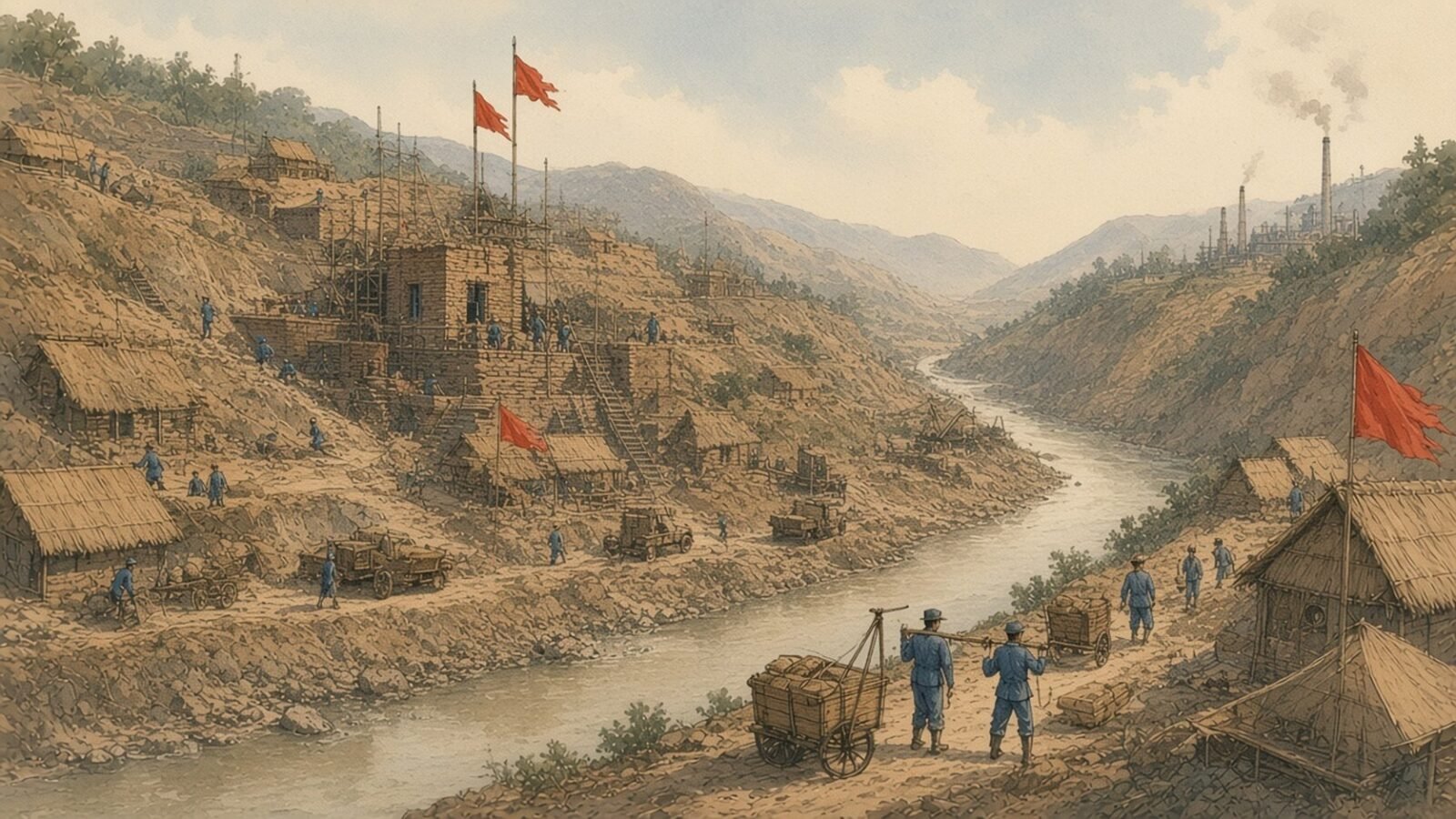
Three cities tell the story better than any statistic. Panzhihua – The City That Should Not Exist. In 1964, Dukou was a village of 12 households on the Jinsha River, so hot and malarial that even the Yi people avoided it. Geologists had found magnetite there, a huge iron ore deposit. Mao reportedly said, ‘If we don’t build Panzhihua, I won’t be able to sleep.’ In early 1965, tens of thousands of workers arrived to find nothing. They lived in tents, then in earth huts. The steel mill was built before the city. Today Panzhihua produces more vanadium and titanium than anywhere in China. Its Museum of the Third Front has that Mao quote carved on a boulder outside, and another slogan inside: ‘Good People and Good Horses Go to the Third Front.’ Shiyan – The Truck City in the Forest. In 1969, the Second Automobile Works (Erqi, 二汽), later Dongfeng Motor, was ordered to be built not in Wuhan where the market was, but in a mountain hollow in northwest Hubei called Shiyan, with one dirt road in. The idea was that trucks could be produced under forest cover. The assembly line was scattered across 20 kilometers of valleys. Parts had to be carried by tractor between plants. One estimate found that moving a crankshaft from forging to machining cost more than the crankshaft itself. And yet, Shiyan grew from a few hundred people to 400,000 in a decade. Today Dongfeng is one of China’s Big Four automakers, still headquartered there. Liupanshui and the Coal Constellation. Guizhou was chosen as the coal base to feed Panzhihua’s steel. A whole coal city was conjured on the slopes of Wumeng Mountain. Shuicheng Steel, Panjiang Coal, mines, railways, everything at once. To make any of it work, China had to build railways through some of the most difficult terrain on earth. The Chengdu-Kunming Railway, finished in 1970, is 1,100 km of bridges and tunnels, 427 tunnels and 653 bridges, built largely by railway corps soldiers and local laborers, with a death toll that remains classified but is estimated in the thousands. Without it, neither Panzhihua nor Liupanshui could come to life. It was the spine of the Third Front. The list goes on, hypnotic in its scale: Mianyang and Deyang (electronics), Guiyang and Zunyi (missiles), Lanzhou and Tianshui (nuclear parts), Jinchang (nickel), Jiuquan (space), Xichang (satellites), Gezhouba Dam, the Xichang Satellite Launch Center. Cities such as Shiyan in Hubei, Mianyang and Panzhihua in Sichuan, were literally created by the Third Front Movement. The map of western China today is still the map of the Third Front.
The human movement was as planned as the factories. A slogan went up in every major Shanghai and Shenyang plant: ‘Choose the best people and best horses for the Third Front’ (好人好马上三线). In this slogan, the best horses refers to the best available equipment and resources. Operating on that principle, many skilled engineers, scientists, and intellectuals were transferred to Third Front facilities. Incomplete statistics show that between 1964 and 1970, 380 large projects, 145 thousand workers and 38 thousand units of equipment were moved from coastal areas to the Third Front region. But that counts only the core workers. With families and construction teams, the total was closer to 4-5 million, plus tens of millions of local peasants mobilized. Who went? Three kinds of people. First, the Shanghai elite – engineers from Jiangnan Shipyard, technicians from No. 1 Machine Tool Plant, sent with their lathes on trains. Second, rural recruits who saw it as a step up from farming to state-owned industrial work. Third, sent-down youth and demobilized soldiers. All had to pass a political review: no landlord, rich peasant, counterrevolutionary, bad element or rightist families. The reactions were mixed. Rural recruits were often excited. Urban Shanghai recruits were apprehensive – they already had housing and schools. Refusing was possible but meant political blacklisting. Many fathers went alone for years before they were allowed to bring wives and children. In some factories, the first two years, men and women lived in separate dorms and needed permission to marry. They were promised hardship. They got it. In oral histories collected by Coventry University and Shanghai Jiao Tong, workers recall arriving to find no road, only mule tracks. One engineer from Shanghai recalled his team being given explosives and told to level a hilltop to build a generator hall. They slept in straw sheds that leaked. In winter, the rammed earth houses froze. And yet, almost all oral histories also contain pride. Participation was a sign of a good family background. It meant you were trusted.
Once built, a Third Front factory was a total world – a danwei (单位). It had its own school, hospital, grain store, cinema, barber. Some had their own armed guard. The factory was known only by a number: 012 Base was aircraft in Hanzhong, 061 Base was missiles in Guizhou, 066 Base was established in 1969 in Hubei, 404 was the nuclear plant in Gansu. Workers knew each other by number. Outsiders didn’t know the numbers existed. Life was isolated and communal. Because the factory was hidden in mountains, in dispersion, in caves (shan, san, dong – 山,散,洞), there was nowhere to go. Children grew up speaking Mandarin in a sea of Sichuan dialect or Miao villages, creating a linguistic island. The factory school taught only children of workers. The factory hospital delivered them. When you needed pork, you bought it at the factory store. When you needed to see a film, you saw it at the factory auditorium. Rural recruits and urban engineers lived side by side but not always easily. Shanghai people kept their habits, pickling vegetables differently. Locals thought they were arrogant. Over time, a hybrid culture formed – spicy Sichuan food eaten with Shanghai sweet soy. Education was the constant anxiety. Due to poor standard of schools in the third front area, the large majority of the offspring of those who moved west in the 1960s and 1970s were unable to receive a good education even though their parents were experts in their fields. That scar still runs deep. Many parents who had given up coastal life for the nation watched their children fail the gaokao because the factory middle school had no English teacher.
By 1971, the logic was collapsing. Nixon visited China in 1972. The Soviet threat was real, but it was a land threat from the north, not an American bombing from the coast. The economic logic of hiding steel mills in gorges was becoming impossible to defend. From 1972 to 1978, China reduced its discrimination against investments in coastal provinces and increased economic interaction with capitalist economies. The national security justification for third-front industries was hence undermined. Postmortem studies concluded that only half of the factories built performed to design specifications and the rest were either only partially completed (30%) or not completed at all (20%). Fully one-third of total investment was wasted. The example of the Second Auto Works was telling – parts and assembly plants scattered over mountainous region, transportation poor, far from suppliers and consumers. When reform started in 1980, the state stopped pouring money in. Since the reform of state-owned enterprises starting in the 1980s, many Third Front plants went bankrupt, though some others reinvented themselves. Between 1980 and 1990, hundreds of factories were closed, merged, or told to ‘switch from military to civilian’ (军转民). They tried to make bicycles, refrigerators, washing machines. Most failed. 100 yuan of fixed asset investment in 1978 yielded 70 yuan of output from third-front enterprises, compared to 141 yuan from coastal enterprises. The profit rate in 1978 was 9% for third-front enterprises, compared to 23% for coastal enterprises. That gap killed them. Some survived spectacularly. Dongfeng moved part of its operation to Wuhan and became a global automaker. Panzhihua Steel became Pangang, a listed giant. Jiuquan became the backbone of China’s space program. But most Small Third Front factories simply rotted, their machines rusting in caves where workers had once made anti-aircraft guns.
If you go to these cities today, you meet the second generation. In Chinese, there are two overlapping terms. Chang’erdai (厂二代) – second-generation factory offspring – originally meant children of factory workers in any city. But in the Third Front, it means something specific: children born in the mountains, raised in a factory compound, whose identity is the factory. One Sixth Tone oral history puts it perfectly: ‘As a child, the sight represented holiday festivities and delicious food, but I can see now that those trash piles also reflected the ambitions of the Third Front workers to make this new land better than where they had left. I am a third-generation of the Third Front Movement.’ These children grew up bilingual in factory Mandarin and local dialect, often more loyal to the factory than to the city. When the factories collapsed, they faced a choice: leave for Shenzhen or Guangzhou, or stay and guard the ruins. Many left. Those who stayed became the curators of memory. In recent years, Chinese social media has seen a wave of Third Front nostalgia. On Douyin and Xiaohongshu, chang’erdai post videos of abandoned workshops, their fathers’ enamel mugs, factory ID cards. They collect the slogans: ‘Prepare for war, prepare for famine, for the people’ (备战备荒,为人民), ‘Dig tunnels deep, store grain everywhere, never seek hegemony.’ They are not nostalgic for Maoism, but for a community that was total, warm, and certain. Some are returning as entrepreneurs. In Hanzhong, a former 012 Base fighter factory has been turned into a coffee roastery by the daughter of an engineer. In Liupanshui, a grandson of a miner runs a guesthouse in a former blast shelter. They call it gongye yichan luyou – industrial heritage tourism.
China is now in an odd relationship with the Third Front. For decades, it was an embarrassment – proof of Maoist paranoia and economic waste. Now, as China emphasizes self-reliance again and talks of ‘dual circulation,’ the Third Front looks prescient. China’s Western Development, initiated in 2001, was shaped by the Third Front. The machinery, metallurgical, chemical and non-ferrous mineral companies based in the Third Front have laid a solid foundation for the economic takeoff of western China. The physical remains are extraordinary. The Panzhihua Third Line Museum, opened in 2016, is built into a former ore processing plant. The 816 Nuclear Military Plant in Chongqing, a massive underground maze built to make plutonium that never produced a single atom, is now open as a tourist cave, complete with 18-meter-high reactor hall. Academics talk of Third Front industrial heritage as China’s Ruhr. The questions are similar: how to preserve without romanticizing waste, how to honor the workers without whitewashing the policy, how to turn a secret city into an open one. The best answer may be in the smallest places. In a village outside Baoji, there is a factory that made optical sights for tanks, Factory 248. It closed in 1988. The workers’ children who stayed have kept the slogan on the cliff intact: ‘Quickly build the Third Front, so that Chairman Mao can sleep well.’ They repaint it every Spring Festival. Not because they agree, but because without it, they would not know where they came from. That is the heart of the Third Front. It was a strategic policy in modern history, a decision to preserve the nation’s strength by moving industry to the southwestern and northwestern hinterland. It was also a human story of millions of ordinary people who were told their country needed them to disappear into a mountain and build a future that might never be used. Some of those mountains are empty again. Some are full of new cities that would not exist otherwise. All of them still echo.