City of Eight Dynasties
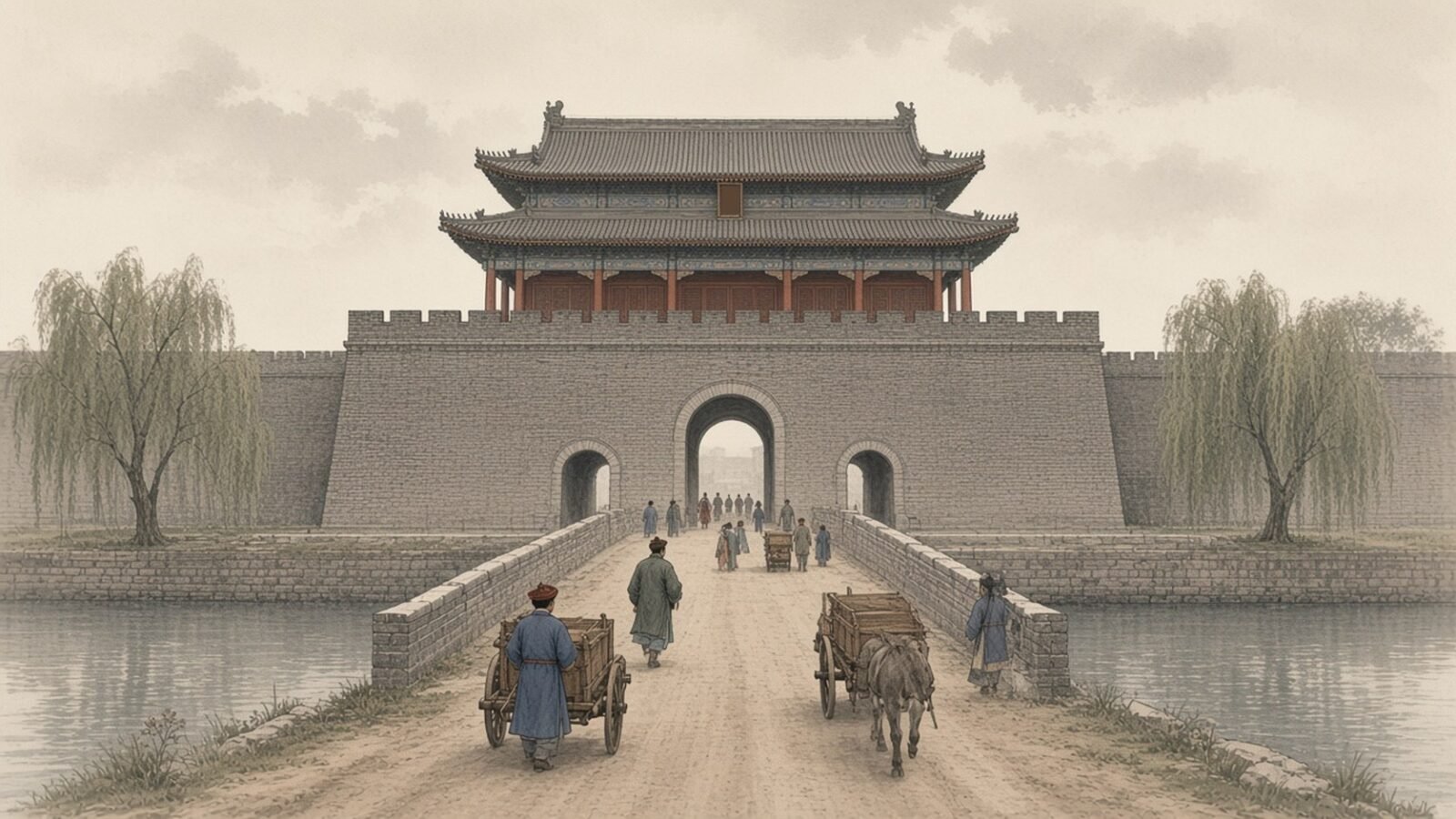
There is no single building you can point to and call “Kaifeng Gate” today and have that name cover the whole story. The phrase is a shorthand, used by travelers and historians, for a system of gates that has been rebuilt, renamed, buried and rebuilt again on the same ground for over two millennia. What you see now as the Kaifeng city wall is 14.4 km long, the second largest ancient city wall building in China after Nanjing, and after war and Yellow River flooding there are five layers of ancient city walls under the present wall. Every gate standing today is a late Qing layer sitting on Ming, Yuan, Jin, Song, Five Dynasties and Tang foundations, and understanding Kaifeng’s gates means reading that vertical stack.
The story begins not with Song but with Wei. The earliest city wall in the history of Kaifeng was built more than 2300 years ago in Daliang City, the capital of Wei in the Warring States period, partly coincident with the present wall but slightly northwest. In 365 BC, in order to control the Central Plains, King Hui of Wei moved the capital from Anyi to this place and built Daliang city. At that time the wall was almost square with only two confirmed gates, Yi in the east and Gao in the west, and the Qushui crossed the northern part. That city flourished for over a century until 225 BC when General Wang Ben of Qin used the water of Honggou River to flood the entire city, submerging relics to a depth of about 12 to 14 meters. The area reverted to a market town called Xunyi under Chenliu for centuries, reviving only under Eastern Wei as Liangzhou and then under Northern Zhou as Bianzhou, a name that would persist through Sui and Tang as a crucial transport node.
The foundation of all later Kaifeng gates was laid in the Tang. In 781 AD, Li Mian, who was the governor of Yongping army and the governor of Bianzhou, rebuilt Bianzhou city in the northern and Southern Dynasties, which is the beginning of the history of Kaifeng city wall. According to Beidao Corrigendum and other documents, after the expansion of Bianzhou City, there are 20 Li 155 steps around, there are seven gates, which enclose the Bianhe River into the city. The rebuilt Bianzhou city actually laid the foundation of Kaifeng city wall. That act of bringing the Bianhe inside the defenses changed Chinese urban history. Kaifeng was no longer just a walled administrative compound but a canal city whose wealth came from water. Water locks were added in 798 under Dong Jin, and the south-facing Gujiao Gate of this Tang city would become the ancestor of the great Xuande Gate. Indeed Xuande gate originated from Gujiao gate of Bianzhou city in Tang Dynasty, and after Five Dynasties until Northern Song there were three or five gateways instead of two, the tall gate tower not only a place to show supremacy of imperial power but also a stage to perform the common happiness of monarch and people. By the time of Later Zhou in 952 to 956, Chai Rong undertook large-scale reconstruction, and after that the perimeter of the outside wall made up 48 Li and 233 bu, about 27 km, forming the base on which Song would build.
When Zhao Kuangyin made Kaifeng Dongjing in 960, the capital of Northern Song for 168 years, that Tang core was transformed into the center of the largest metropolis in the world. In the late Northern Song Dynasty, the outer city of Tokyo had a circumference of 50 Li and 165 steps, a height of 4 Zhang, a width of 5 Zhang and 9 feet, and a resident population of more than 1.5 million. The city was not one enclosure but three, from inside out Gongcheng the palace city, the inner or old city also called Quecheng or Licheng, and Waicheng the outer or new city also called Xincheng, Guocheng, Luocheng. Archaeology confirms this: the outer city is a slightly north-south rectangle, the inner city is a little square whose south wall is 300 meters north of the present Ming-Qing south wall and north wall 500 meters north of Longting, east and west walls overlapped under present walls, total length about 11550 meters basically consistent with Bianzhou records, and imperial city 1050 meters east-west by 1090 meters north-south later expanded to nine li thirteen steps in 1113. This three-part structure explains why gate counts are so confusing: each wall had its own gates, and many had both an official and a colloquial name.
The outer city gate system is described most completely in Meng Yuanlao’s Dongjing Meng Hua Lu, Eastern Capital: A Dream of Splendor, written in 1147 after the fall of Song. Meng says the perimeter of the wall of the Outer City of the Eastern Capital is forty li and more, the city ditch is called Hulonghe, it is ten zhang and more and on both banks planted with poplars and willows. He then lists gates in order. There are three gates in the southern walls of the Outer City: the one strictly facing south is called Nanxunmen, to the east of it is Chenzhoumen and right next to it there is a lock through which Caihe flows, to the west of it is Dailoumen gate and there is a lock right next to it through which Caihe flows. There are four gates in the eastern wall: the gate in the southern part is called Dongshuimen, Eastern lock where Bianhe river flows, the next are called Xinsongmen and Xincaomen, and there is also Dongbeishuimen, the South-Eastern lock through which Wuzhanghe river flows. There are four gates in the western wall: the one in the southern part is called Xinzhengmen, the next one is called Xishuimen, the Western lock though which Bianhe flows, the next one is Wanshengmen, and the following one is Guzimen, and there is also Xibeishuimen, the North-Western Lock where Jinshuihe flows. The northern wall has four gates: the most eastern one is called Chenqiaomen here was the road used by embassies of the Great Liao Dynasty, the next gate is called Fengqumen this is where the august exit to the northern suburb lay, the next one is called Xinsuanzaomen, the next one is called Weizhoumen. All these names for the gates are colloquial, their real names are as follows: for Xishuimen it was Lize men, Xinzhengmen in reality was named Shuntianmen, Guzimen in reality was Jinyaomen. Later compendia simplify this to 14 gates and 7 Watergates in the outer city during Northern Song, most of them are Wengcheng gates with double straight or bent doors, and the city gate consists of double ones, treble barbicans and water gates, so that the outer city make Kaifeng city of Northern Song Dynasty looks like a military castle.
The inner city and imperial city gates were smaller but more ceremonial. The Old Capital City inner wall makes up a little over twenty li. The southern part has three gates: one strictly facing south is called Zhuqiaomen, one to left is Baokangmen and one to right is Xinmen. The eastern part has three gates: on the southern bank of Bianhe which flows from the south there is the corner gate, and the one on its northern bank is called Songmen, the following gate is called Jiucaomen. The western part of the wall has also three gates: one to the south is called Jiuzhengmen, the following one is the corner gate on northern bank of Bianhe, and the following one is Liangmen. The northern part of the wall has three gates as well: one from east is called Jiufengqumen, the following one is called Jinglongmen located opposite to corner part of palace city of Baolugong, and following one is called Jinshuimen. There are thus ten gates and two water gates in the inner city, which matches the record that the inner city was built in the second year of Tang Jianzhong 781 with circumference 20 Li 155 steps, now increased to ten gates and two water gates. The imperial city had six gates, with Xuande Gate as main gate of imperial palace, tall majestic also called Xuande building, whose site at Xinjiekou in Kaifeng was confirmed in 1990s excavations. The axis that tied them together was Imperial Street, which started from Xuande Gate of the Imperial Palace, passing through Zhuque Gate of the inner city, and ending at Nanxun Gate of the outer city, stretching more than ten miles, the main road for emperor to worship ancestors and hold grand ceremonies, also called Imperial Road, Tian Street. According to Meng Yuanlao it was about 200 meters wide, divided into three, middle imperial road exclusive for royal family, ditches with lotus and black lacquered railings beyond, and beyond that imperial corridors for commoners with shops facing street where people traded, creating bustling atmosphere depicted in Along the River During the Qingming Festival.
Architecturally, a Song gate was a fortress in itself. Take Shuntianmen, the main gate on the western wall of the outer city of Dongjing during Northern Song. Local archaeologists discovered the gate site in coring surveys and trial excavation in early 1980s, then from 2012 to 2017 carried out large-scale survey and excavation. The coring survey reveals gate site consists of two major parts: a wengcheng barbican and a moat. The barbican is composed of main city gate, barbican gate, and rectangle of walls with 160 m north to south and 100 m east to west, moat on west side of barbican. Systematic excavation recovered Northern Song remains including main city gate, walls, buildings, ground surfaces, roads, grinding stones, building materials, coins. Five Dynasties remains include walls and roads on west end of Yingqiu Gate. The wengcheng, urn city, forced an attacker through an outer gate into a closed courtyard 160 by 100 meters where defenders on three sides could shoot down, and the bent entrance forced a 90 degree turn. Foundations were 23 meters wide of yellow-brown clay hangtu rammed earth, later faced with brick, with masonry platforms 16.7 meters wide flanking earthen cores, walls between entrance and exit about 4.7 meters wide. This construction echoes records in Yingzao Fashi, Treatise on Architectural Methods, a Northern Song manual, with crossed pillars and beams and earthen foundations.
After the Jurchen conquest in 1127, Kaifeng was severely damaged but remained Jin capital Bianjing. Emperor Xuanzong Wanyanyu expanded Kaifeng to north and south respectively, which made inner city of Northern Song expand 350 meters to south to area of today’s Dananmen and 750 meters to north to northern section of Kaifeng city wall, scale of Kaifeng city wall determined by expansion of Tokyo inner city by Jin people. To resist Mongol invasion north and south city walls were expanded outward respectively, east and west walls slightly higher, there were 13 city gates, which established scale of Kaifeng city wall today. Under Yuan, in order to prevent Han people from resisting, Kaifeng inner and outer cities were completely destroyed, and because Yellow River repeatedly burst flood, sediment deposition gradually submerged underground. By Ming, the city was provincial capital but diminished. In the first year of Hongwu 1368, Emperor Taizu of Ming Dynasty, Kaifeng city wall was rebuilt and earth city was changed into brick city, perimeter 20 Li 190 steps, height 3.5 feet width 2.1 feet. Because Kaifeng was once designated as Beijing, city of Kaifeng in Ming Dynasty was built according to standards of imperial city from inside out, therefore city walls covered with bricks and became solid brick city previously made of earth and in Song. The west gate of Kaifeng ancient city, known as Daliangmen in ancient times, was built in second year of Jianzhong 781 of Tang, also known as Changhemen in Northern Song. After repeated wars, storms and floods, gate tower dilapidated and finally demolished. In early Ming Zhu Yuanzhang was promoted to Kaifeng as Beijing, capital of Nanjing, and changed west gate to Daliangmen, commonly known as west gate.
The Ming city was then destroyed by water used as a weapon. In 1642 Li Zicheng’s peasant army besieged Kaifeng for six months. The dikes were burst in an attempt to flood rebels, but water destroyed Kaifeng. The Ming governor directed his men to break dikes to wash away Li’s army, while Li did same to flood city and destroy it. Li won. On October 8 1642 Li’s men cut dikes and rain-swollen Yellow River burst through with tremendous force, flooding Kaifeng. According to another account both sides tried using Yellow River against each other. The 1642 flood was man-made, caused by attempt of Ming governor to use river to destroy rebels, but destroyed own city instead: flood and ensuing famine and plague estimated to have killed 300,000 of city’s previous population of 378,000. The once-prosperous city was nearly abandoned until rebuilt under Kangxi Emperor in Qing. After this disaster city was abandoned until 1662 when rebuilt under rule of Kangxi Emperor in Qing dynasty, archaeological research providing evidence for 1642 flood and subsequent occupation in 1662. There were seven major flood disasters, two of which in 225 BC and 1642 AD destroyed whole city. In 1841 city was inundated for about eight months, but not until 1843 that walls were reconstructed, and by this time urban form including earth rampart, brick city wall and lake became critically important flood-adaptability landscape.
That 1843 reconstruction is the wall visitors walk today. In 1662 during reign of Kangxi Emperor in Qing dynasty Kaifeng city wall was rebuilt on basis of Kaifeng city wall of Ming Dynasty with five gates built as old, perimeter 20 Li 190 steps, 3 Zhang 5 feet high 2 Zhang 1 feet wide just like Ming. In 1842 Kaifeng city wall was rebuilt, taking one and a half years to complete, compared with Qing ancient city wall built in first year of Kangxi perimeter rebuilt wall increased from 20 Li 190 steps to present situation, height increased to 8 meters width to 5 meters perimeter increased to 14.4 kilometers, blue brick structure similar to inner city of Tokyo, although not as grand as capital of Song but still second largest city wall site in China after Nanjing city wall of Ming Dynasty. Early excavations showed Qing dynasty wall directly overlaid on top of Ming dynasty wall and has been in use to this day, reflecting spatial scale of Kaifeng during Qing remained same as Ming. Walls of Nanjing and Xi’an are Ming originals with extensive Qing and modern restorations, while wall of Kaifeng visible today is largely result of Qing Dynasty restoration. The walls of Kaifeng solid line is Song dynasty wall, dashed line is Ming Qing dynasty wall in geoarchaeological maps.
Modern archaeology has made Kaifeng a textbook case of city-over-city. Except for a few standing pagodas, modern visitors can barely see traces of other Northern Song architecture above ground. Ruins of Northern Song city lie buried 8 to 11 meters beneath current ground level, deposits of Yellow River mud plus remains of Jin, Yuan, Ming and Qing layered on top overlapping almost entirely with urban area today. Archaeologists began search in 1980s and unearthed Shuntian Gate smaller than Jinglong in western section of outer city and found remains of Zhouqiao bridge once downtown artery. The recent landmark is Jinglong Gate. As attested in many historical documents, Jinglong Gate which translates as gate to worship dragon was originally set in Kaifeng’s inner city wall. According to Dongjing Meng Hua Lu, square-shaped inner city had perimeter about 10 kilometers, and Jinglong Gate was middle of three gates set in inner north wall. Beginning last year researchers from Henan Provincial Institute and Kaifeng Institute focused on excavating ruins, unearthing city gate whose front facade spans 60 meters, equal to dimensions of Meridian Gate southern entry to Beijing’s Forbidden City. Jinglong Gate is largest and highest-level city gate from Northern Song period excavated so far. It is about 60 meters wide with gateway extending 19.3 meters, only inner city gate of ancient capital discovered to date. With depth 19.3 meters width 5.6 meters structure consists of crossed pillars and beams with earthen foundations on either side, walls between entrance and exit about 4.7 meters wide made of rammed earth, masonry platforms both sides about 16.7 meters wide, demonstrating exceptional ceremonial significance and filling gaps in study of city gates, echoing Yingzao Fashi. Overall scale larger than Shuntian Gate earlier discovered, and excavation also found overlapping walls built in different periods ranging from Tang to Ming, shedding further light on historical evolution. Using extraordinary finding of Jinglong Gate as coordinates we can explore more areas of Dongjing, ruins of roads, walls of nearby palace, towering terraces and other key structures from Northern Song and Jin began to show up, and discovery that northern walls of inner city during Northern Song and imperial city of Jin did not overlap gives fresh ideas about reconstruction after war of 1127.
Preservation turned that archaeology into public space. On November 20, 1996 State Council announced ancient city wall of Kaifeng as fourth batch of national key cultural relics protection units, also national 4A scenic spot. To maintain overall style of famous historical and cultural city local government began to renovate ancient city wall in 1994, according to planning of cultural relics protection department several gates restored one after another, namely west gate Daliangmen, north gate Anyuan Gate and small South Gate New Gate, and soon will build Cao Gate Renhe Gate, Song Gate Lijing Gate, Da Nan Gate Nanxun Gate. Today’s Daliang Gate was rebuilt in 1998, one of three gates rebuilt in Kaifeng including north gate Anyuan Gate and new gate of Xiaonanmen, and in Song Capital Cultural Industrial Park two East gates Cao Gate and Song Gate will be rebuilt, two largest gates of Tokyo city at that time matched with magnificence of Beijing’s front gate and become important symbols of ancient capital. Construction of Ximen tower started 1997 completed October 28, 1998 opened to tourists, Ximen tower is double eaves Xieshan type two-story pavilion covering area 2207.6 square meters total height 26.3 meters length 50 meters dignified elegant simple beautiful shape harmonious with western city wall. Gate base adopts blue brick structure with three arched openings, tower adopts double eaves Xieshan architectural style with carved beams and colored drawings simple elegant magnificent. In north of city gate multi-storey ancient city horse road has been proved which provides another important evidence for Kaifeng’s unique history of city stacks, now opened as ancient city wall Museum. Now all surrounding areas of Kaifeng city wall are planned to be green park around city. In 2014 Kaifeng city wall included in world heritage application project of city wall of Ming and Qing Dynasties in China, and city wall scenic area opened Yingbin Gate to Xiaoxi Men 1.6 km, south side of Wansui Mountain to Jinyao Men 1.2 km, west city wall Yingbingmen Wansui Mountain section 6 km, with full immersion 3D performances of ancient horse road and Weimeng Daliangmen.